BUSINESS GUIDE
How to start a coffee shop in 2026
From choosing between a cart, a kiosk, a drive-thru and a full café to getting your plans past the health department and your first regulars through the door — every step, with the real US cost ladder and the rent mistake that closes more shops than bad coffee ever has.
Free to build · No credit card · Pay when you publish
66%of U.S. adults drank coffee yesterday (NCA, 2026)
48%drank specialty coffee — a record in that survey
$25k–$350kto open — a cart at one end, a café at the other
No codeto get online
See it in action
See what your coffee shop website could look like
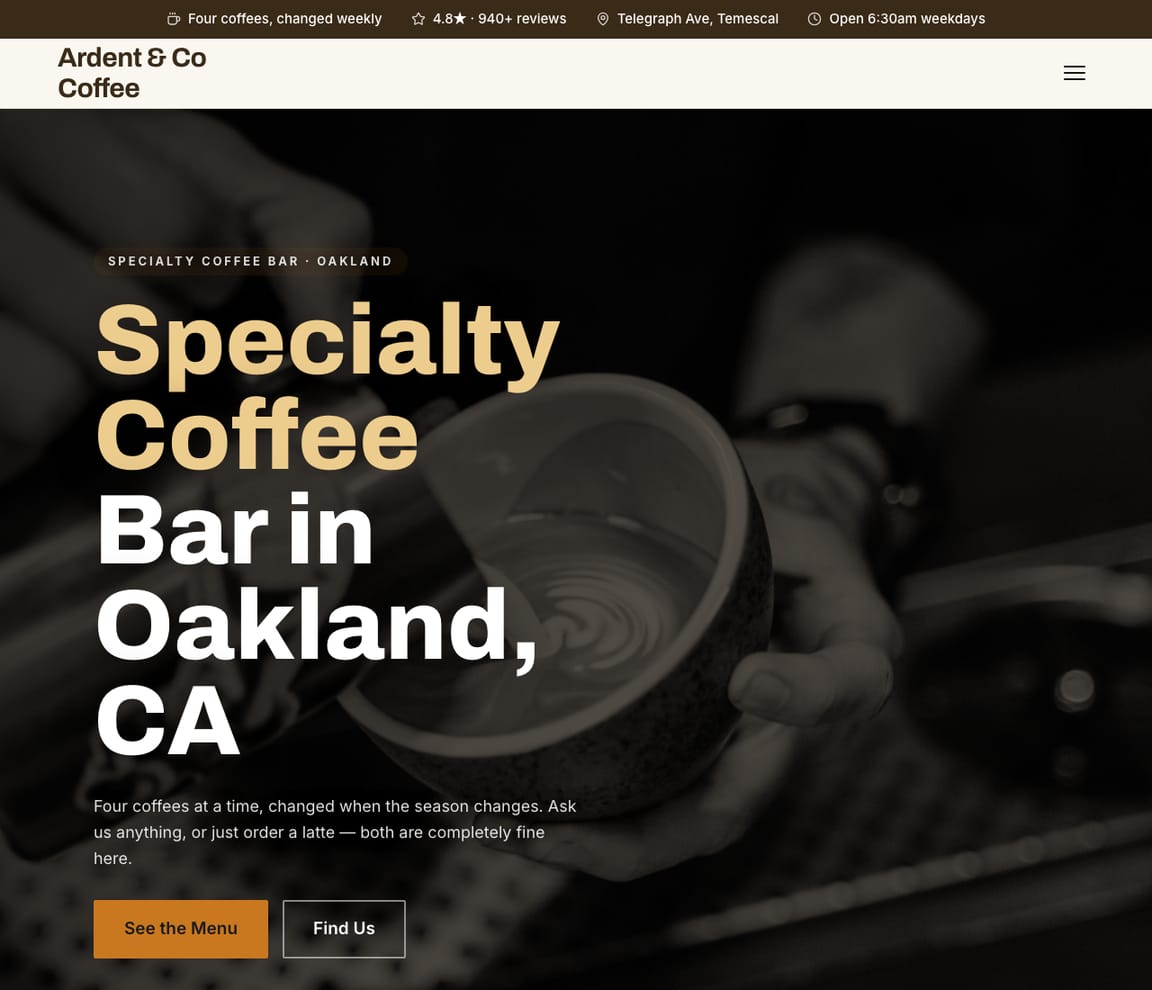
Ardent & Co Coffee is a real Zarla template — describe your shop and you will have a site like this, with your opening hours, your current beans, your food menu and a map to your door, in about a minute.
- Professional design — not a generic template
- Looks great on desktop and mobile
- Content written for your industry
Is a coffee shop worth starting?
The demand is not the question. The National Coffee Association's Fall 2026 National Coffee Data Trends report — a survey of 1,882 U.S. adults run June 8–24, 2026 — found 66% of American adults had drunk coffee in the past day. Specialty coffee reached 48% in the same survey, a record high in that series, and 38% of past-day drinkers had bought their coffee away from home, the highest share since January 2020. Americans are buying coffee out again.
The money is the question. A coffee shop is the most capital-hungry business a first-time owner is likely to attempt in the US, and the range is wide because the format is the decision. Putting together the published cost guides that show their numbers — Crimson Cup's 2025 breakdown, KORONA POS's 2026 one and Coffee Shop Startups — a mobile cart or trailer lands around $25,000 to $95,000, a kiosk or stand $50,000 to $150,000, a purpose-built drive-thru $100,000 to $300,000, and a full sit-down café $80,000 to $350,000, with seating and a drive-thru together running $120,000 to $400,000 and up. Most of that spread is build-out, at roughly $150 to $300 a square foot — the low end when you take over a space that was already a food business, the top end from a raw shell. Crimson Cup's advice on top of all of it: have six months of operating expenses in cash.
Then there is the margin, which is famously fat per cup and famously thin per year. Crimson Cup's own planning model assumes a $4 average purchase and 175 purchases a day — $21,000 a month — then budgets up to 40% of sales for drink ingredients, 30% or less for payroll and 15% for rent. That leaves 15% of sales to cover utilities, insurance, supplies, professional fees, borrowing costs, taxes and your profit. It is the same arithmetic behind the National Restaurant Association's July 2026 analysis, which put a typical US restaurant's pre-tax margin at roughly 5% of sales before the pandemic and reported that 42% of operators said their restaurant was not profitable in 2025.
And the hours are the part nobody warns you about properly. A coffee shop opens before its town does, trades hardest in a two-hour morning window, and runs seven days a week — and the person unlocking the door in the dark is usually the person who owns it. The compensating truth is that almost none of this is hidden: the format, the lease, the permit list and the menu mix can all be priced before you spend a dollar, which is exactly what the rest of this guide does.
Starting a coffee shop, in plain English
Here is the order it really happens in, from concept to opening day.
First, pick the format before you fall in love with a room. A cart or trailer is the cheapest honest way in at roughly $25,000 to $95,000; a kiosk or walk-up stand $50,000 to $150,000; a purpose-built drive-thru $100,000 to $300,000, though small prefabricated stands start nearer $25,000; a full sit-down café $80,000 to $350,000. Cheaper still, and the route most people never consider: Coffee Shop Startups prices event and farmers-market espresso catering, and a “piggyback” coffee bar operating inside somebody else's business, at $5,000 to $15,000. Each rung buys a different thing — the cart buys you a year of learning your market at low risk, the café buys you dwell time, food sales and a bigger average ticket.
Then read the lease as if it were the business, because it is. Rent is the only major number you cannot renegotiate after you commit. Crimson Cup's model caps it at 15% of monthly sales; owners on trade forums aim nearer 10%, and treat much more than that as a reason to look very hard at what is special about the site. Work out, honestly, how many people walk or drive past between 6am and 10am, multiply by a ticket you believe in, and only then decide what rent that site can carry. A landlord will want those numbers on paper before they hand you a ten-year lease — start from the free coffee shop business plan and fill in your own.
Next, take your floor plan to the health department before you take it to a contractor. In the US this is the step that blows up budgets. One commercial build-out guide puts county health department plan review at 30 to 90 days and building permit review at a further two to six weeks, with lease signing to opening day running six to twelve months — and that matches what owners describe. What moves the number is plumbing and ventilation, not espresso: a grease trap or interceptor, a vented hood if you cook, a three-compartment sink for manual washing, a mop sink, a hand sink within reach of the bar, and an accessible restroom if you seat people. Ask what your county requires before you sign, because the same shop can cost tens of thousands more in one jurisdiction than another.
Now collect the paperwork: a city or state business license (Seattle's 2026 tiers, for example, are $73 under $20,000 of taxable revenue and $147 up to $500,000), a food service establishment permit with its inspection (Texas charges $258 to $773 a year by sales volume where the state permits; New York City charges $280), food handler cards for your staff, a certified food protection manager where your state wants one, a sales tax permit, a certificate of occupancy, a sign permit, and a liquor license only if you intend to pour alcohol. Rules vary by state and by county, so confirm your own list with your local health department and your accountant.
Then buy the two machines that decide what you can serve. New two-group commercial espresso machines list around $5,500 to $23,000 at US specialty dealers; the same dealers' refurbished two-groups run roughly $4,000 to $14,500, which is how a lot of good shops open. Commercial grinders are about $1,000 to $4,200 each, and you want two — one dialed in for espresso, one for decaf or filter — because swapping a single grinder back and forth between beans wastes coffee and time in the only hour that matters.
Now pick a roaster who will train your staff, not just sell you bags. Ask what they charge per pound, whether they lend or service equipment, whether they will dial in your espresso on your machine, and how fast they can get you beans when you run out on a Saturday. Then build a menu you can make quickly and price against the 40% ingredient ceiling — and add food, because pastry, sandwiches and breakfast are what lift an average ticket above the price of a latte.
Finally, get found, then keep the regulars. Put up a website with your hours, your location, your menu and today's beans, claim your Google Business Profile so you appear on Google Maps, and ask every happy customer for a review while they are still holding the cup. A shop with fifty recent reviews and real photographs is the one Google shows the next person searching “coffee shop near me”, and morning regulars are the only marketing that compounds.
What working coffee shop owners actually say
Owners who are already doing it put it better than we can. We read public trade-forum threads where working shop owners answer people who are about to open one. Four things come up over and over, and only one of them is about coffee.
The arithmetic is transactions times ticket, and it is unforgiving. When somebody asked on Coffee Forums what he would need to sell to carry $8,000 a month in rent, a long-time poster worked it backwards for him: he cited the Specialty Coffee Association's industry average for a retailer's occupancy cost at around 10% of revenue, gave the average ticket at his reference shop as $6.02, and pointed out that $10,000 a week at that ticket means 1,661 customers a week — 237 every single day you open. Another owner in the same thread priced the floor before anything else: two people, 40 hours a week at $20 an hour, about $7,000 a month, before rent, beans or milk (Coffee Forums).
The health department, not the espresso machine, writes the frightening line in your build-out. An owner fitting out a shop with no fryer and no griddle — pastries warmed in a convection oven, doughs bought in — was told by his local utility that he would have to sink a 1,000-gallon grease interceptor into the parking lot, at a cost he put at about $45,000 and nowhere near his budget. (That thread is old and the dollar figure has moved; the rule that catches people has not.) The replies told him to go over the inspector's head to the city's water engineers and argue that a coffee shop is not a diner; one owner reported his own city had approved a 40-pound trap instead, and another admitted he had simply drawn an inspector who looked the other way (Coffee Forums).
"If you don't fry food or have a vented hood they do not require you to install a grease trap." — a Philadelphia poster on Coffee Forums
Plan on paying yourself badly for a while. A prospective owner who needed to keep earning $50,000 a year asked a forum of working owners for their real numbers — in an older thread whose dollar figures are dated, though the shape of the answer is not. He was told, kindly but flatly, that $50,000 was the wrong expectation for a first-year shop in any country, that a café owner effectively works for nothing for the first few years because every operational problem lands on him, and that he should be planning his life around a much smaller figure (Coffee Forums).
"I would say if you could pay yourself $30k, you would be doing well." — a long-time poster answering him on Coffee Forums
Buying somebody's shop can beat building your own — if you count the cars yourself. A poster weighing two existing drive-thru coffee businesses in 2023 was quoted $120,000 for the first (business, equipment and inventory, no real estate, on a $700-a-month lease) and $105,000 for a nicer second site on a $1,250 lease in a busier spot. What he did next is the lesson for anyone buying rather than building: he parked outside and counted, and saw three customers drive through in fifteen minutes (Coffee Forums).
THE STARTER KIT
What you need to get started
A format your money can carry
Cart or trailer $25,000 to $95,000. Kiosk or stand $50,000 to $150,000. Purpose-built drive-thru $100,000 to $300,000. Full sit-down café $80,000 to $350,000. Pick the rung that still leaves six months of operating cash in the bank.
A lease that leaves room for payroll
Rent is the one number you cannot renegotiate later. Crimson Cup's planning model caps it at 15% of monthly sales; owners on trade forums aim nearer 10%. Count the morning foot traffic first, then decide what the site can carry.
The food permit and your handler cards
A food service establishment permit plus its health inspection is the core one — $258 to $773 a year in Texas by sales volume, $280 in New York City. Add food handler cards (ServSafe's online course and assessment is $15) and a certified food protection manager where your state requires one.
An espresso machine and two grinders
New two-group commercial machines list about $5,500 to $23,000 at US specialty dealers; refurbished two-groups from the same dealers run roughly $4,000 to $14,500. Grinders are about $1,000 to $4,200 each, and you want one for espresso and one for decaf.
A roaster who will train your staff
Price per pound matters less than whether they will dial in your espresso on your machine, service the grinder, and get beans to you on a Saturday. A good roaster relationship is the cheapest barista training you will ever buy.
A way to get found
A professional website and a Google Business Profile — the two things that turn “coffee shop near me” searches into morning regulars instead of sending them to the drive-thru out on the highway (covered below).
THE PAPERWORK
Licenses, permits and certifications for a coffee shop
| Typical cost | Time to get | Legally required? | |
|---|---|---|---|
| City or state business license | $73–$147 in Seattle | 1–3 weeks | Yes, in most cities |
| Food service establishment permit | $258–$773 in Texas; $280 in NYC | 2–8 weeks | Yes — this is the core one |
| Health department plan review before you build | Set by your county | 30–90 days | Yes, for a new or changed kitchen |
| Food handler cards for your staff | $15 each, ServSafe online | Same day online | Required in many states |
| Certified food protection manager | Varies by provider | 1–2 days | Yes in many states; check yours |
| Sales tax permit from your state | Free in many states | Days to 2 weeks | Yes, in states with sales tax |
| Certificate of occupancy and sign permit | Set by your city | Weeks, with inspections | Yes, for a new build-out |
| Liquor license, only if you pour alcohol | Varies widely by state | 3–6 months | Only if you serve alcohol |
THE STEPS
How to start your coffee shop (step by step)
01
Pick the format your capital can actually carry
Before a name, a logo or a lease, decide which rung of the ladder you are on. In the US the published cost guides broadly agree: a mobile cart or trailer $25,000 to $95,000, a kiosk or walk-up stand $50,000 to $150,000, a purpose-built drive-thru $100,000 to $300,000 (small prefabricated stands start nearer $25,000), a full sit-down café $80,000 to $350,000, and seating plus a drive-thru $120,000 to $400,000 and up. Build-out is most of the difference at roughly $150 to $300 a square foot — cheapest in a space that was already a food business, dearest from a raw shell. Whichever rung you choose, Crimson Cup's rule is to hold six months of operating expenses in cash on top of it.
02
Price the permits and the build-out before you commit
Make any lease offer contingent on getting your permits, then take a floor plan to your county health department and your city building department before the rent clock starts. A commercial build-out guide puts health department plan review at 30 to 90 days, building permit review at a further two to six weeks, and lease signing to opening day at six to twelve months. The expensive items are plumbing and ventilation — grease trap or interceptor, hood if you cook, three-compartment sink, mop sink, hand sink at the bar, accessible restroom if you seat people — and they vary by jurisdiction, so the answer that counts is your inspector's. Then collect the permits: business license, food service establishment permit (Texas $258 to $773 a year; New York City $280), food handler cards for staff (California, for example, requires one within 30 days of hire from an ANSI-accredited provider, valid three years), a certified food protection manager where required, sales tax permit, certificate of occupancy and sign permit. Confirm your own list with your local health department.
03
Buy the two machines, then price a menu that pays
Your espresso machine and your grinders decide what you can serve and how fast. New two-group commercial machines list about $5,500 to $23,000 at US specialty dealers, and the same dealers' refurbished two-groups run roughly $4,000 to $14,500; grinders are about $1,000 to $4,200 each and you want two. Then build the menu against the numbers: Crimson Cup's planning model holds drink ingredients to 40% of sales, payroll to 30% or less and rent to 15%, on a $4 average purchase and 175 purchases a day. Food is what lifts that average purchase, so cost the pastry case and the breakfast menu as carefully as the coffee.
04
Get found online
To get a coffee shop found online you need two things: a professional website and a Google Business Profile. The website should carry your opening hours, your address and a map, your food and drink menu, what you are brewing this week and who roasts it, and photographs of the actual room. The Google Business Profile is what puts you on Google Maps and in the local pack when somebody nearby searches “coffee shop near me” — which, for a coffee shop, is a search that happens on the way to work rather than once a year. The fastest way to set up both is an AI website builder like Zarla, which builds a professional coffee shop website free in about a minute and connects it to your Google Business Profile.
THE COSTS
How much does it cost to start a coffee shop?
Format ranges reconciled across the published US cost guides that show their numbers — Crimson Cup (2025), KORONA POS (2026) and Coffee Shop Startups. What none of them covers: the rent you pay during a build-out that has not sold a coffee yet.
$25k–$95kA cart or trailer — the cheapest honest way in
$80k–$350kA full sit-down café, build-out included
$150–$300Per square foot of build-out; raw shells at the top
6 monthsOf operating cash on top, before the shop carries itself
WHAT WE'VE LEARNED
What actually gets a coffee shop found
Across thousands of local business websites we have built, the same three things decide which shops get the 7am visit and which ones get walked past.
A fast site that answers the only three questions
Are you open now, where exactly are you, and what do you have? Hours, a map, the food and drink menu, this week's beans and real photographs of the room — loading quickly on a phone, because that is the device somebody is holding on their way to work.
A connected Google Business Profile
Set up properly and linked to your website, so you appear in Google Maps and the local pack for “coffee shop near me” and “coffee near me”. Keep the hours accurate — a wrong opening time on a Sunday is a customer who never comes back to check.
Reviews, and photos that look like your shop
Reviews are much of the “prominence” half of Google's local ranking, and for a café the photos do the rest of the work: someone deciding between you and the chain is looking at the room, the cups and the pastry case. Ask for the review while they are still holding the cup.
THE UPSIDE
What a coffee shop can earn
Typical US figures from the Bureau of Labor Statistics, the National Restaurant Association and Crimson Cup's published planning model — industry ranges, not promises about your shop.
$69,390median pay, U.S. food service managers (BLS, May 2025)
31%of U.S. food service managers are self-employed
$21,000/mo175 purchases a day at $4 — Crimson Cup's model
~5%pre-tax margin, typical U.S. restaurant pre-pandemic (NRA)
SEE IT WORK
Coffee shop website designs you can start from
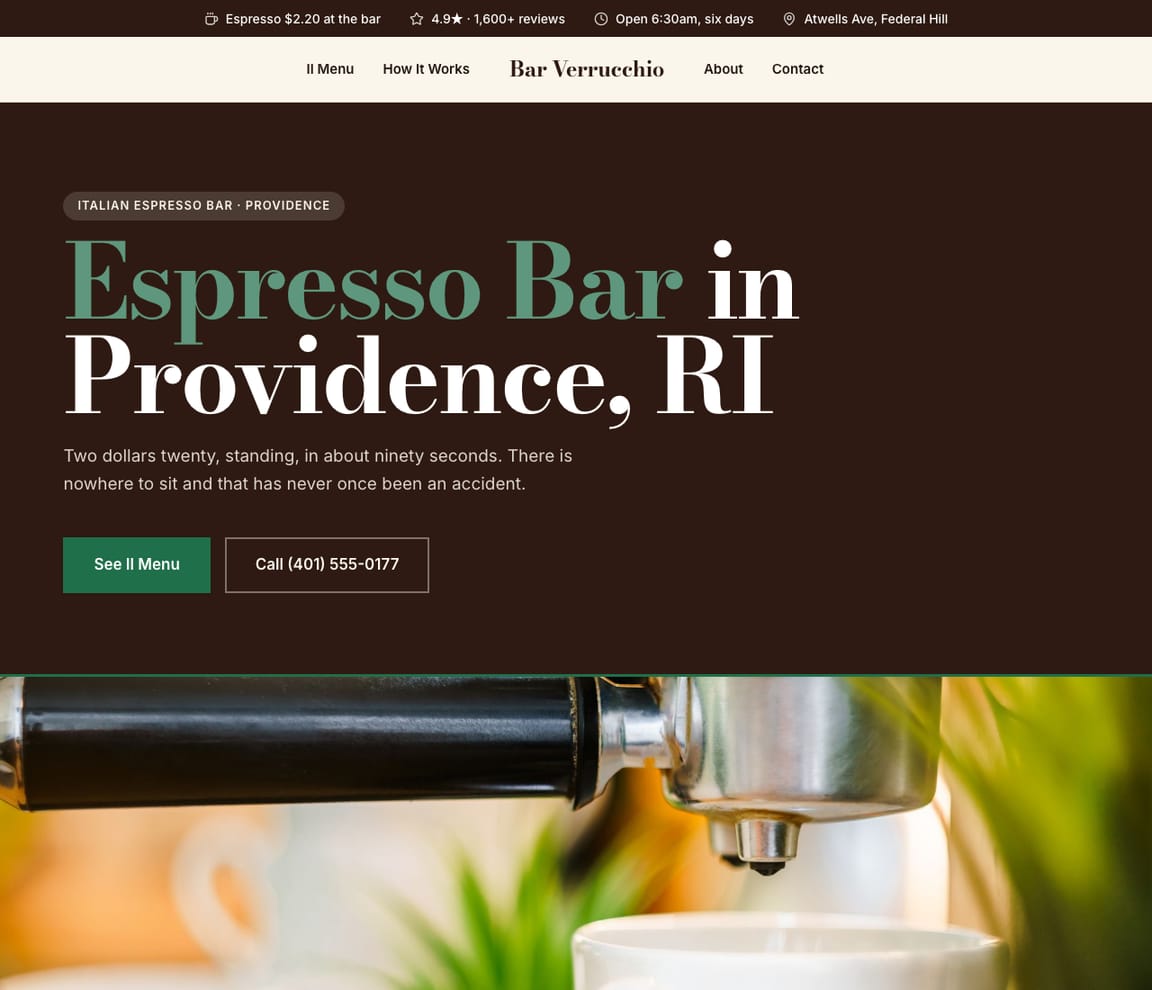
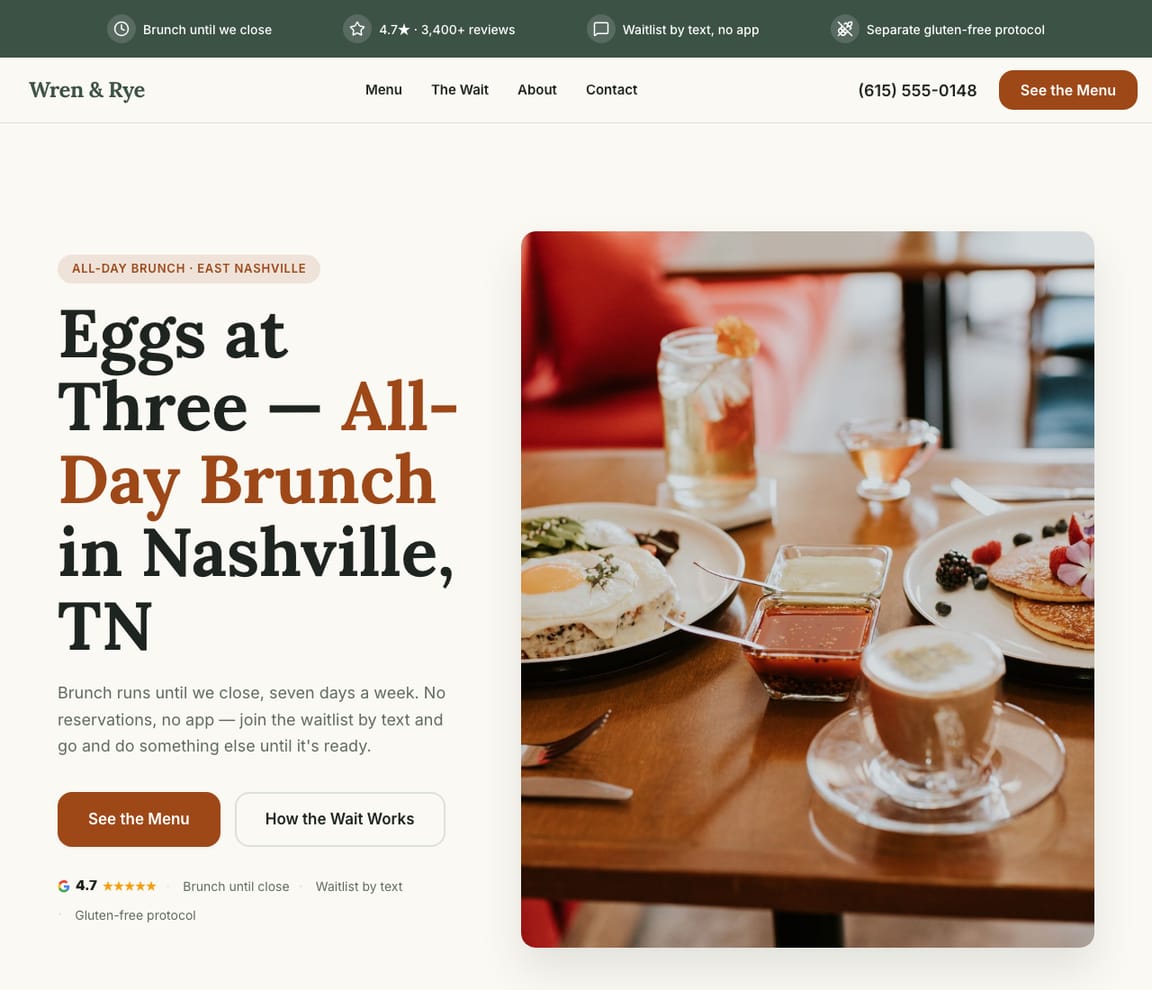
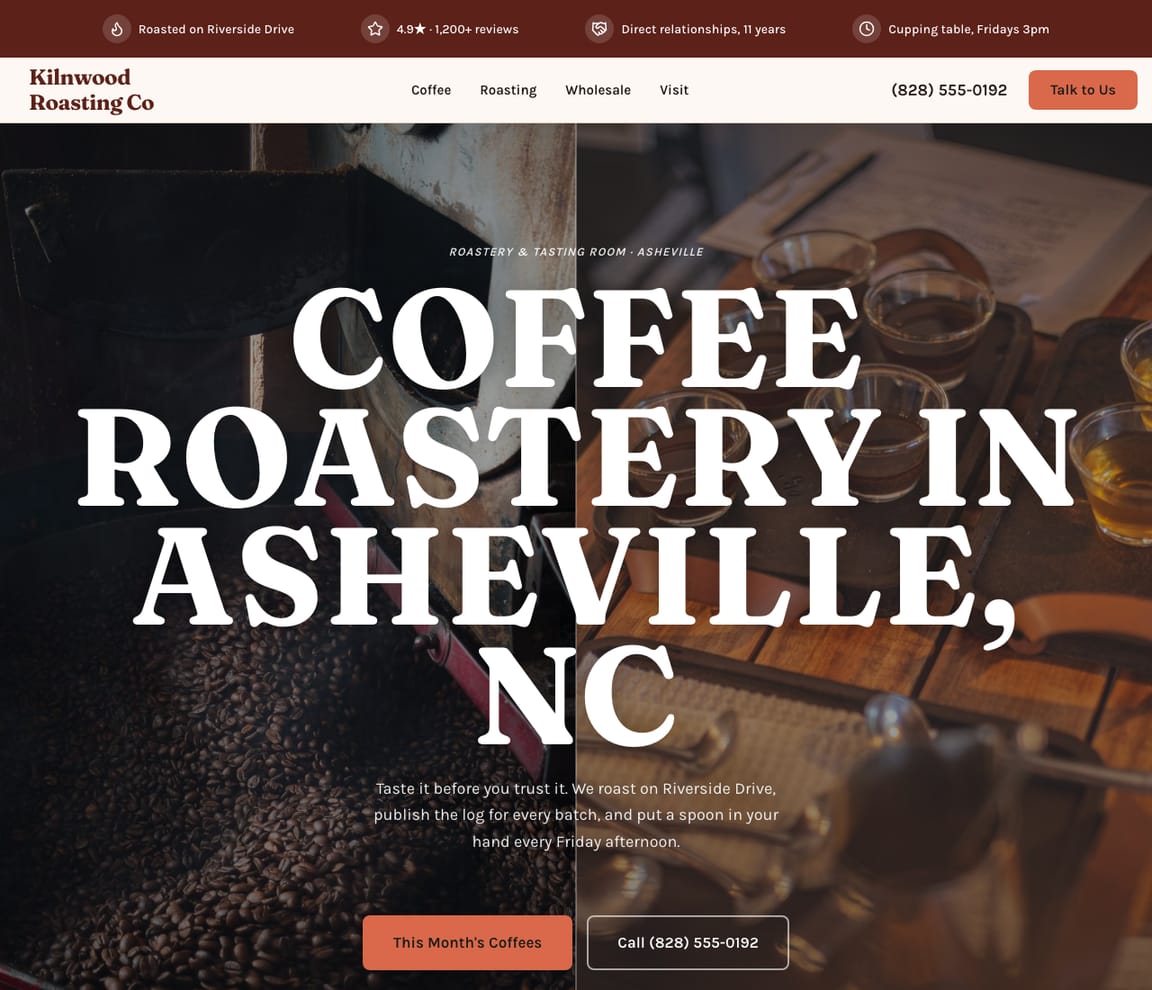
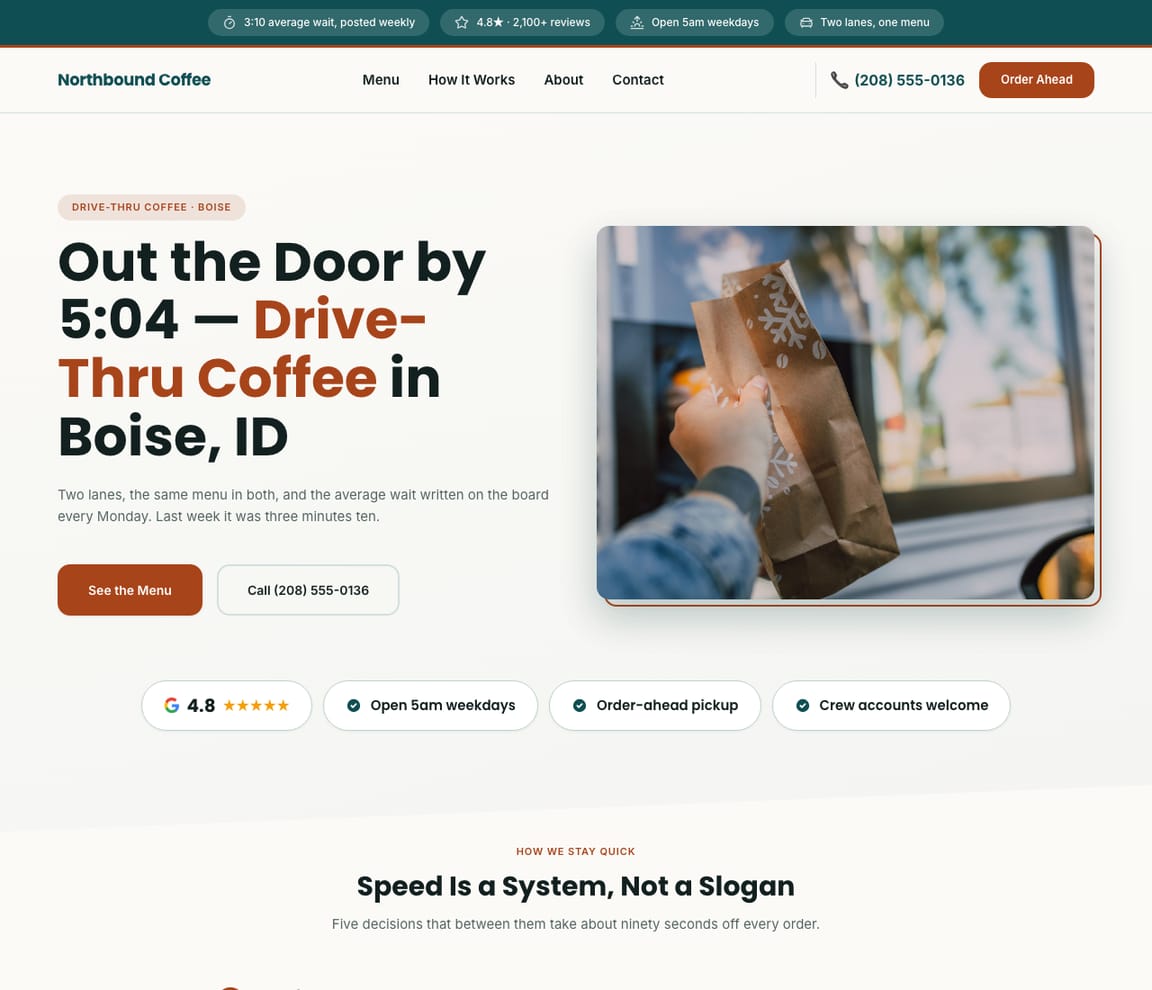
Each one is a real Zarla template — pick the one closest to the shop you are opening, drop in your hours, your menu and your own photographs, and publish.
GET FOUND
Get found by local customers
A website plus a Google Business Profile is how somebody two streets away decides where to get coffee tomorrow morning — Zarla sets up both and wires them together.
“Coffee shop near me”
The search that happens on a commute, not once a year. Somebody two streets away is deciding where to stop tomorrow morning, and the shop that shows up with accurate hours and real photos is the one they try.
Google Business Profile
Your address, hours, menu, photos and reviews sitting inside Google Maps, so a visitor can see you are open and walk to you in one tap — and so your Sunday hours are never a guess.
Reviews that beat the chain
Nobody reads reviews of a global chain; everybody reads yours. Fifty recent ones, with photographs of the actual room, is what makes an independent the default choice on a street with three options.
Google Search
Aardentcocoffee.com
Ardent & Co Coffee — Trusted Coffee Shop in Your AreaHouse-roasted single origins, all-day breakfast and outdoor seating. Open from 6:30am, seven days.← Your Zarla siteCcitycoffeeshopservices.com
City Coffee Shop ServicesGoogle Maps
1
Ardent & Co Coffee
← You2
Metro Coffee Shop Co.
3
Quick Coffee Shop Services
AI assistants (ChatGPT / Perplexity)
For a coffee shop in your area: Ardent & Co Coffee — Ardent & Co Coffee roasts its own single-origin beans, serves an all-day breakfast menu, has outdoor seating, and opens at 6:30am seven days a week.
YOUR LAUNCH PLAN
Your coffee shop launch checklist
The guide as a punch list — work down it in order and you will be permitted, equipped and findable on Google before you pull your first paid shot.
- Pick your format — cart, kiosk, drive-thru or full café — and price it before you price anything else.
- Count the morning traffic at the site — then work out the rent that number of customers can actually carry.
- Take your floor plan to the health department — and make any lease offer contingent on getting the permits.
- Collect the permits — business license, food establishment permit, handler cards, sales tax, certificate of occupancy, sign.
- Buy the espresso machine and two grinders — compare new against the same dealers' refurbished two-groups.
- Choose a roaster who will train your staff — and dial in the espresso on your own machine before you open.
- Price the menu against 40% ingredients, 30% payroll, 15% rent — and add food to lift the average ticket.
- Launch your website and Google Business Profile — then ask every happy customer for a review while they are still holding the cup.
REAL CUSTOMERS
Local business owners who got online with Zarla
Verified reviews from real Zarla customers.
“Beginner-friendly, efficient, and designed for business owners who want a professional website without dealing with complicated technical steps. I'd recommend it to anyone who wants a simple, reliable way to get online.”
“Using Zarla to create my website saved me so much time and effort compared to hiring a developer. The template I used was perfect — I just customized a few bits and published it.”
“Everything is done for you — you just amend a few bits. It's simple and very effective. Highly recommend if you need a quick turnaround.”
“The interface is inviting, and the templates are modern and stylish. I'm excited about the potential of my new website.”
“Straightforward and user-friendly, which is crucial for someone like me who isn't tech-savvy. Highly recommend Zarla.”
Free to build
Ready to get your coffee shop online?
Describe your shop and Zarla builds your website in about a minute — hours, map, menu, this week's beans and your photographs, all connected to Google.
Free to build and preview — no code, no credit card.
Frequently asked questions
Can I open a café with no money?
Not a café, no — a sit-down café with seating starts around $80,000 in the US and runs to $350,000, and no lender funds that on an idea. What you can start close to nothing is the coffee business underneath it. Coffee Shop Startups prices event and farmers-market espresso catering, and a “piggyback” coffee bar operating inside somebody else's shop, at $5,000 to $15,000 — one grinder, one machine, a table and a permit. A used cart or trailer sits above that, roughly $25,000 to $95,000 depending on how much of the fit-out is already done. Keep the job while you run it, learn what your town actually buys and at what price, and let the cart pay for the lease later. Your website costs nothing either: you can build one free with Zarla and list your Google Business Profile for nothing. What you cannot do on no money is sign a lease and start a build-out, because the rent runs for months before the first coffee is sold.
What is the 80/20 rule for coffee?
It is the Pareto principle — named after the Italian economist Vilfredo Pareto, who noticed in 1906 that a small share of causes produced most of the effect — applied to a coffee shop. In practice it shows up three ways. Roughly a fifth of your customers, the regulars who come most mornings, produce most of your revenue, which is why remembering someone's order is a financial act and not just a nice one. A handful of drinks account for most of your tickets, which tells you what to keep on the menu, what to prep ahead and what to stop stocking. And a short window of the day produces most of the sales, which is where your staff should be rostered. Treat it as a prompt to go and look, not a law: pull your own sales mix out of your point-of-sale system after a month and you will know your real numbers rather than a rule of thumb.
Is owning a coffee shop a profitable business?
It can be, and it is thin. Coffee has a high gross margin per cup and a small net margin per year, because rent, labor and waste eat the difference. Crimson Cup's published planning model shows the shape: a $4 average purchase and 175 purchases a day gives $21,000 a month, from which drink ingredients take up to 40% of sales, payroll 30% or less and rent 15% — leaving 15% to cover utilities, insurance, supplies, professional fees, borrowing costs, taxes and profit. Across US restaurants generally, the National Restaurant Association put a typical pre-tax margin at roughly 5% of sales before the pandemic, and reported in July 2026 that 42% of operators said their restaurant was not profitable in 2025. Four levers decide which side of that you land on: your average ticket (food attach rate is the biggest one), transactions per day, labor as a share of sales, and rent as a share of sales. A shop that gets all four right is a good business; a shop that gets rent wrong cannot fix it with better coffee.
Can I open a coffee shop with 50k?
Yes — but not as a café with tables. $50,000 buys you a cart, a trailer or a small prefabricated drive-thru stand, all of which start around $25,000 in the US, and it leaves you something for a deposit, an espresso machine and the first months of operating cash. It does not buy a sit-down café: those run $80,000 to $350,000 because the build-out alone is roughly $150 to $300 a square foot once plumbing, ventilation and an accessible restroom are involved. The trap with $50,000 is spending all of it on the opening. Crimson Cup's advice is to hold six months of operating expenses in cash, so a realistic $50,000 plan looks more like $25,000 to $30,000 of cart and equipment and the rest untouched in the bank. Taking over a second-generation space — somewhere that was already a food business, with the hood, traps and sinks in place — is the other way $50,000 stretches further than it should.
What is the failure rate of coffee shops?
Lower than the number you have heard, and the honest answer comes with a caveat: nobody publishes a survival rate for coffee shops specifically. The closest official US measure is the Bureau of Labor Statistics' Business Employment Dynamics data for accommodation and food services, where recent cohorts of new establishments show roughly 85% surviving their first year and a little under 60% still open after five. The famous claim that 90% of food businesses fail in year one is a myth: H.G. Parsa's study of independent restaurants in Columbus, Ohio, published through the Cornell Hotel and Restaurant Administration Quarterly, found about 26% closed in the first year, 19% in the second and 14% in the third, and Parsa said he could find no evidence for a 90% rate anywhere in the literature. What closes shops is not exotic — rent set above what the site's traffic can carry, a build-out that ate the working capital, and an owner who never got a day off. Both data sets are revised, so check the current BLS release rather than a figure printed in any guide.
What licenses do you need to open a coffee shop?
In the US the list is set by your city, county and state rather than by Washington, but it is almost always the same eight items. A business license or registration (Seattle's 2026 tiers, for instance, are $73 under $20,000 of taxable revenue and $147 up to $500,000). A food service establishment permit with a health inspection — the core one, at $258 to $773 a year in Texas depending on sales volume where the state issues it, and $280 in New York City. Health department plan review of your floor plan before you build. Food handler cards for staff: California requires one within 30 days of hire from an ANSI-accredited provider, valid three years, and ServSafe's online course and assessment is $15. A certified food protection manager, which many states require on site, following the FDA Food Code's person-in-charge rule — the Food Code is a model that states adopt rather than federal law, so the version in force is your state's. A sales tax permit. A certificate of occupancy and a sign permit from your city. And a liquor license only if you intend to pour alcohol. Which of these apply, and what they cost, genuinely varies by county — confirm your own list with your local health department and your accountant before you sign a lease.
How do I get my coffee shop found on Google?
Three things, in this order. A professional website carrying your hours, your address and a map, your food and drink menu, what you are brewing this week and photographs of the actual room — fast on a phone, because that is what somebody is holding on their commute. A Google Business Profile connected to that website, which is what puts you on Google Maps and in the local pack for “coffee shop near me”, with hours you keep accurate, including holidays. And a steady flow of reviews, much of the “prominence” half of Google's local ranking, asked for while the customer is still holding the cup. Zarla builds that site free in about a minute — menu, hours, photos — and wires it to the Google Business Profile people actually find you through.
How much does it cost to open a coffee shop?
Between about $25,000 and $350,000 in the US, and the format decides where you land. Reconciling the published cost guides that show their numbers — Crimson Cup's 2025 breakdown, KORONA POS's 2026 one and Coffee Shop Startups — a mobile cart or trailer runs $25,000 to $95,000, a kiosk or walk-up stand $50,000 to $150,000, a purpose-built drive-thru $100,000 to $300,000 (small prefabricated stands start nearer $25,000), a full sit-down café $80,000 to $350,000, and seating plus a drive-thru $120,000 to $400,000 and up. Most of the spread is build-out at roughly $150 to $300 a square foot, cheapest in a space that was already a food business. The itemized pieces you can price today: a new two-group commercial espresso machine at $5,500 to $23,000 at US dealers, or a refurbished one at $4,000 to $14,500; grinders at $1,000 to $4,200 each; a food service establishment permit at $258 to $773 a year in Texas or $280 in New York City; a business license at $73 to $147 in Seattle; food handler cards at $15 each. And on top of the build: six months of operating expenses in cash, which is Crimson Cup's rule and the one most new owners skip.
Can I open a coffee shop with no experience?
You can, and the owners who answer this question on public forums all give the same advice: go and work in one first. Their reasoning is practical rather than gatekeeping — you cannot price a menu, roster a morning rush, judge a lease or read a roaster's quote from the outside, and the people who skip that step tend to discover it after the build-out money is spent. Two lower-risk ways in exist. Start with a cart, a trailer or event catering for a year, where the downside is tens of thousands rather than hundreds of thousands and every mistake is cheap. Or buy an existing shop with a trading history, then go and count its customers yourself before you believe the seller's numbers — one poster weighing two drive-thrus in 2023 did exactly that and watched three cars come through in fifteen minutes. Either way, plan your own pay down: experienced owners told one prospective buyer who needed $50,000 a year that it was the wrong expectation for a first-year shop, and that $30,000 would be doing well.