
CAREER GUIDE
How to become an electrician in 2026
The apprentice, journeyman and master ladder with the hours, the exams and the fees each big state sets — Texas, California, Florida, New York and Illinois from their own boards, and the states that do it differently — the union and non-union routes in, what a trade school costs and whether you need one, what electricians earn at each rung, and how to go from someone else's van to your own.
Free to build · Pay when you publish · No credit card
8,000 hoursof supervised work before the journeyman exam in Texas and Colorado, and for California's general electrician certification; 4,000 for a Texas residential wireman — from the boards below
$63,190median pay for employed electricians in 2025 (O*NET, from BLS data); 10 percent earn $108,510 or more
$20for the Texas apprentice license you must hold before your first day on a job site — no exam, no experience, renewed yearly
7% or higherprojected growth for 2025–2035, "Much faster than average", with 72,700 openings a year (O*NET)
See it in action
See what your electrician website could look like
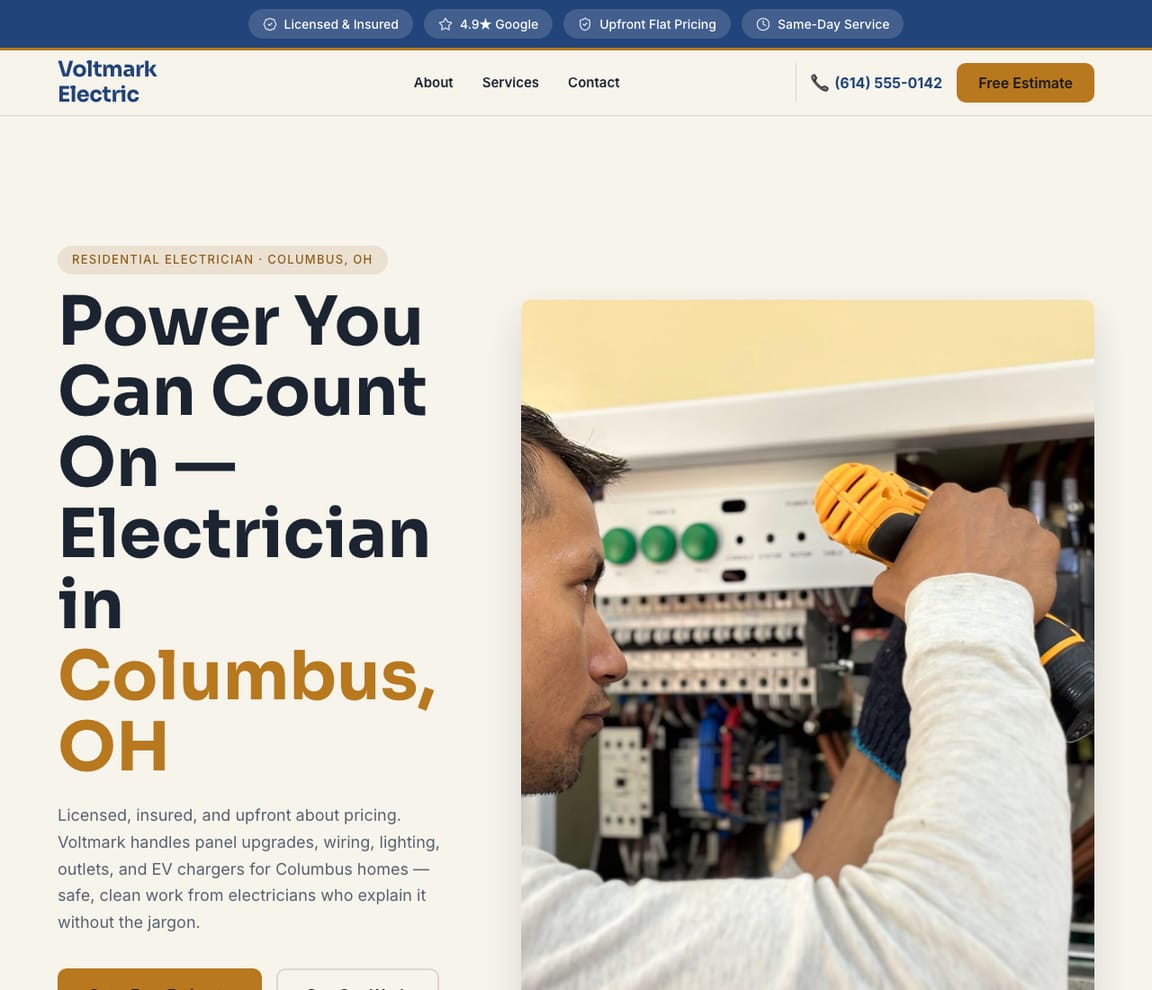
A real Zarla template for a residential electrician — upfront pricing and same-day service in the top strip, the services and the service area underneath, the license number where a homeowner looks for it. Describe yours — the town, the services, the hours — and you'll have a site like this, with a call button and a quote form, in about a minute.
- Professional design — not a generic template
- Looks great on desktop and mobile
- Content written for your industry
Build the website
Start your electrician website now
Add your town and your business name to the sentence, and Zarla builds the site: your services, the area you cover, a call button and a quote form. Add your prices and your license number in chat, then publish.
Already have a website? Bring it across →Zarla keeps your old page addresses where it can and redirects the ones that change, helping you keep the Google standing you've built.
Is becoming an electrician worth it in 2026 — and what does the work pay?
Becoming an electrician is a licensed ladder — in Texas, California, Colorado, Washington and Oregon the worker holds the card; in Florida, North Carolina and Arizona the state tests only the contractor — and at the top of it a local company whose phone rings when the lights go out. Three honest numbers first. Employed electricians had a median of $63,190 a year in 2025, $30.38 an hour: 10 percent earned $42,640 or less, 10 percent $108,510 or more (O*NET, from BLS 2025 wage data). The headcount is large and growing: "Employment (2025) 821,000 employees", "Projected growth (2025-2035) Much faster than average (7% or higher)", "Projected job openings (2025-2035) 72,700" (O*NET, employment and outlook). And the survey behind the wages leaves out the self-employed (Washington ESD) — which is the electrician with their own van, so the median measures the technician in someone else's truck, not the owner.
State by state. The employed median is $58,570 in Texas, $76,160 in California, $57,250 in Florida and $78,750 in New York (O*NET, Texas; California; Florida; New York). The occupation is "Job Zone Three: Medium Preparation Needed" — "an electrician must have completed three or four years of apprenticeship or several years of vocational training, and often must have passed a licensing exam, in order to perform the job" (O*NET, job zone); of the electricians surveyed, "62% responded: Post-secondary certificate required", "31% responded: High school diploma or equivalent required" and "2% responded: Less than high school diploma required" (O*NET, education). One union scale shows what the ladder pays along the way: Portland's inside apprentices start at "40%" of the journeyman rate — $26.20 an hour against a journeyman's "$65.50 per hour eff. 1/1/26" — and reach 85 percent, $55.68, in the last period (NECA-IBEW Local 48 training center, Portland, 2026).
Where the money went. The owners quoted below say the shortage is of licensed people, not of work — "My biggest struggle has been building a team finding well rounded licensed electricians" (Michael DeAses, ESP Electrical Service, Spring, Texas, VoyageHouston, December 22, 2025) — and that the business, not the wage, is where the money is and where the mistakes are: "Estimating projects was another major challenge. I did not fully understand the value of my time when I started, and I made next to nothing on my first project. However, every job has taught me something." (Dmitry Rubinov, Happy Electric, Denver, VoyageDenver, August 26, 2026). Another started with almost nothing: "We started out with a $700 truck and $1,200 in the bank. We worked hard, stayed out of debt, and saved what we could to buy vehicles and tools." (Ted LaBombarbe, Genesis 13 Electric, CanvasRebel, read October 2026). The step after this guide is how to start an electrical business, and the plan page is the electrical business plan.
The catch. The hours come first — four years of them in Texas, California and Colorado before the journeyman exam, more before the master — the work is "Exposed to Hazardous Conditions" every day for 73 percent of those surveyed and "Exposed to Hazardous Equipment" every day for 66 percent (O*NET, work context), and the exams are real: Texas's are "70% Correct to Pass" on two portions at "$78 for both portions" (PSI candidate bulletin, updated September 15, 2026). One Los Angeles owner on the contractor exam: "The electrical portion? Passed it pretty quickly. The business and law section? Let's just say it took me a while and several failed attempts—but persistence, stubbornness, and grit eventually won." (Alberto Rios, RnR Electrician, Los Angeles, VoyageLA, February 3, 2026). That's what the rest of this guide sets up: the ladder in each big state from its board, the union and merit-shop routes in and what each costs, the tools from a distributor's own prices, and how to be the electrician the panel-upgrade search finds first.
How to become an electrician, in plain English: the ladder in your state, from the boards
There is no federal electrician license, and the states do not agree on who gets licensed. Texas, Colorado, Washington and Oregon license the person at every rung; California certifies the worker and licenses the contractor; Florida, North Carolina and Arizona test only the contractor and leave the journeyman to counties or to nobody; New York, Illinois and Pennsylvania have no state electrician license at all — New York City, Chicago and Philadelphia do it instead. Here is each, from its own board or statute:
- Texas: "Anyone who performs, or offers to perform, non-exempt electrical work in the state of Texas must be licensed and perform that work through a licensed electrical contractor" (TDLR, electricians; the statute is Tex. Occ. Code §1305.151). The Department of Licensing and Regulation runs a five-rung ladder. Apprentice — "There are no experience qualifications necessary to apply for this license" and "There are no examination requirements", the fee is $20 (the board's own page words it as the "non-refundable $20 renewal fee"), licenses "are valid for one year from the date of issuance and must be renewed annually", and the card comes before the first day: "Yes, anyone performing electrical work must obtain a license prior to performing the work. There is no grace period that allows you to work while waiting for your license to be issued" (TDLR, apprentice electrician; TDLR FAQ 1.5.1). Residential wireman — "4,000 hours of on-the-job training under the supervision of a Master Electrician or Residential Wireman licensed in Texas", $20 (TDLR, residential wireman). Journeyman — "at least 7,000 hours of on-the-job training under the supervision of a Master Electrician licensed in Texas" to sit the exam "before reaching the full 8,000 hours required for licensure", "documented and signed by each supervisor on an Experience Verification Form", $30 application (TDLR, journeyman electrician). Master — "held Journeyman Electrician license for at least two years" and "12,000 hours of on-the-job training under the supervision of a Master Electrician licensed in Texas", $45 (TDLR, master electrician). Electrical contractor — $110, with liability insurance of "Minimum $300,000 per occurrence (combined for property damage and bodily injury); Minimum $600,000 aggregate … and Minimum $300,000 aggregate for products and completed operation" (TDLR, electrical contractor). The exams are PSI's — "A score of 70% or better is required to pass the exam", on "the current TDLR-adopted bound edition" of the National Electrical Code (TDLR, exam information); "The Journeyman Electrician examination fee is $78 for both portions", the master's the same, the residential wireman's "$64", "EFFECTIVE SEPTEMBER 1, 2026, THE EXAMINATIONS WILL BE REFERENCED TO THE 2026 NEC", and "Candidates are responsible for bringing their own reference - National Electrical Code® (NEC book) to the examination site" (PSI candidate information bulletin, updated September 15, 2026). The homeowner's own house is exempt: "work not specifically regulated by a municipal ordinance that is performed in or on a dwelling by a person who owns and resides in the dwelling" (§1305.003).
- California: the state certifies the worker and licenses the business. Certification is the Division of Labor Standards Enforcement's — "Electricians" are "all persons who engage in the connection of electrical devices for electrical contractors licensed pursuant to Section 7058 of the Business and Profession Code" (DIR, electrician certification) — in five categories: general electrician 8,000 hours, residential electrician 4,800 hours, fire/life safety technician 4,000 hours, voice data video technician 4,000 hours, non-residential lighting technician 2,000 hours (DIR, categories and hours). The fees: "The fee for initially applying for certification is $75.00." "The fee for taking or retaking the examination is $100.00." "The fee for renewal of certification is $100.00." "The fee for registering as an Electrician Trainee Registrant is $25.00." (DIR, fees). Until you have the hours you are a trainee: "you have to register with the division as an electrician trainee. In order for your registration to be complete, you must show proof of enrollment in a state approved school", "You may continue to work only under constant supervision of a certified electrician", and "Trainee cards have to be renewed every year" (DIR, FAQ). The general exam is 100 questions in four and a half hours, the residential 80 in three and a half; "You must have a minimum of 70% in order to pass", and "If you do not pass the exam, you must wait 60 days … You must also send in another exam fee of $100" (DIR, test information). The business is the Contractors State License Board's "C-10 - Electrical Contractor" (CSLB license classifications), a specialty contractor under B&P §7058: "not less than four years experience as a journeyman, foreman, supervising employee or contractor in the particular class" (16 CCR §825), a bond of "twenty-five thousand dollars ($25,000)" (§7071.6), and no license at all for a job where "the aggregate contract price for labor, materials, and all other items is less than one thousand dollars ($1,000)" and no permit is needed (§7048). A homeowner wiring their own residence is outside the contractor law — "A homeowner improving his or her principal place of residence" who "has actually resided in the residence for the 12 months prior to completion of the work" and does the work "prior to sale" (§7044) — though the permit is still the city's. The CSLB's fee pages answered "Page Not Found" the day we read them, so no California contractor fee is printed here.
- Florida: the state licenses the contractor two ways — a "Certified electrical contractor" "possesses a certificate of competency issued by the department", a "Registered electrical contractor" "has registered with the department pursuant to fulfilling the competency requirements in the jurisdiction for which the registration is issued" (Fla. Stat. §489.505). "Any person who is at least 18 years of age may take the certification examination", with routes including "at least 3 years of proven management experience in the trade", "at least 4 years of experience as a supervisor or contractor in the trade", or "at least 6 years of comprehensive training, technical education, or supervisory experience associated with an electrical or alarm system contracting business" (§489.511). There is no state journeyman card; the counties issue those through their construction licensing boards — Pinellas's own notice: "Certified County and Journeyman Licenses Expire September 30, 2026" (PCCLB, 2026); the other big counties' pages refused to open, so ask your county.
- New York (no state license — New York City licenses master and special electricians): the master applicant must "Be at least eighteen (18) years old" and have "at least seven (7) years of experience within ten (10) years prior to application working with their tools on the installation, alteration, and repair of wiring and appliances for light, heat, and power … under the direct and continuing supervision of a licensed master or special electrician in the United States, at least two (2) years must have been obtained in New York City" — or a bachelor's in electrical engineering plus three years, or "an apprenticeship program registered with the New York State Department of Labor" plus five years; "Candidates must first apply for the written exam and submit a payment of $585.00 fee", "Passing score is 70%", then "the $530.00 fee" for the practical (NYC Department of Buildings, obtaining a master or special electrician license); "License Fee $310.00", "Renewal Fee $60.00", "License Term 1 year", and "Special Electricians are licensed to perform electrical work in or on specific buildings, lots or parts thereof in NYC" (DOB, master and special electricians). Buffalo, Nassau and Suffolk run their own; ask the city or county.
- Illinois (no state license): the state's list of licensed professions has no electrician or electrical contractor on it (IDFPR, professions list); Chicago's Department of Buildings "administers trade licenses and registrations for more than 23,000 construction industry professionals, including general contractors, supervising electricians, electrical contractors" (Chicago Department of Buildings) — its hours and fees sit on pages that did not open. Pennsylvania (no state license): Philadelphia's electrical contractor needs "a minimum of four years employment doing electrical work for a company licensed through a local or state jurisdiction" — "Completion of two years of education in the electrical field is equal to one year practical experience" — the International Code Council exam, "at least eight hours of coursework in the current or later edition of NFPA 70", "General Liability: $500,000 per occurrence", "Automobile Liability Insurance: $300,000", workers' compensation, and a "License fee $ 262" with "$202" to renew; from "July 1, 2026" an EV-charger permit needs the installer's "Electric Vehicle Infrastructure Training Program (EVITP) certification" (Philadelphia, electrical contractor license).
- Colorado — the state licenses the worker at three rungs: "Residential Wireman 4,000 hours of residential only experience earned in no less than 2 years"; "Journeyman Electrician Experience Requirements: 8,000 hours of experience earned in no less than 4 years. 2,000 hours of which must be in commercial/industrial work. Education Requirements: 288 hours of classroom education is required for ALL applicants"; "Master Electrician … 10,000 hours of experience earned in no less than 5 years" or "2,000 hours of experience earned in no less than 1 year in addition to the JW requirements" (Colorado DPO, electrical applications); "Law requires that apprentices must register with the State Electrical Board. Once an apprentice begins working for an electrical contractor, the employer must complete an application to register the apprentice with the Board within 30 days" (DPO, apprentices); licenses run three years with "at least 24 hours of Continuing Education" (DPO, electrical). Washington — "No person may engage in the electrical construction trade without having a valid master journey level electrician certificate of competency, journey level electrician certificate of competency, master specialty electrician certificate of competency, or specialty electrician certificate of competency"; learners "shall obtain an electrical training certificate from the department", renewed "biennially" with "forty-eight hours of: Approved classroom training", and a certified electrician "shall be on the same jobsite as the noncertified individual for a minimum of seventy-five percent of each working day" (RCW 19.28.161); the general journey level needs "an 8,000 hour electrical construction trade apprenticeship program … Four thousand of the hours must be new industrial or commercial electrical installations" or the same 8,000 hours of lawful experience, with the residential specialty at 4,000 hours (WAC 296-46B-945). Oregon — a general journeyman has "at least four years of general experience as an apprentice or its equivalent … including not fewer than 1,000 hours in wiring on single or multifamily dwelling units", a general supervising electrician "at least four years of experience as a general journeyman electrician", a limited residential electrician "at least two years of apprenticeship or trainee experience in residential wiring" (ORS 479.630). North Carolina — the state licenses the contractor by project size: "Limited License - $100/year" for "a single electrical contracting project of a value not in excess of sixty thousand dollars ($60,000) and on which the equipment or installation in the contract is rated at not more than 600 volts", "Intermediate License - $150/year" to $150,000, "Unlimited License - $200/year" for "any electrical contracting project regardless of value" (NC Board of Examiners of Electrical Contractors, February 2026), after a "$125.00 examination fee" for "100 multiple-choice questions 6-hours to complete exam" (the board's exam page). Arizona — a Registrar of Contractors license, no journeyman card, and no license at all where "the total value of the sales contract or transaction … does not exceed $1,000, including labor, materials and all other items", unless "a local building permit is required" (A.R.S. §32-1121). Michigan, Massachusetts, Georgia, Ohio and Nebraska license electricians too, on pages that refused to open the day we read them, so none of their hours or fees is printed here.
How you learn it. Two doors, both paid from the first week. The union route is the IBEW-NECA alliance's registered apprenticeship — "Minimum age 18" and "One Year of High School Algebra" at the door (electrical training ALLIANCE); Portland's inside program assigns apprentices "to an electrical contractor for a minimum of 8000 OJT hours" with "a total of 10 terms of school" (NECA-IBEW Local 48, Portland); Chicago's is an "Electrical Construction (5 years) apprenticeship" with "an application fee ($50), processing fee if selected at orientation ($500)" and "You do not get paid for the first 11 weeks of classes" (IBEW Local 134 / ECA, Chicago); New York's is a "Five and One-Half Year Program" with "a minimum of 35 hours per week on-the-job training for four years" and "Three (3) hours per week in college courses leading to an associate degree" — "All applicants must be 18 years of age when applying" (IBEW Local 3, New York); Detroit's graduates "debt-free, with wages, healthcare and retirement benefits" and are "on-the-job 90% of their apprenticeship" (IBEW Local 58, Detroit). The merit-shop route: "An electrical apprenticeship typically takes about four years to complete and includes a minimum of 8,000 hours of on-the-job training (OJT) and 576 hours of classroom instruction", "Starting wages are typically 50% of a journeyman's rate", and "There is no upper age limit for starting an electrical apprenticeship" (Independent Electrical Contractors). The federal description of both: "Most electricians learn through a 4-5 year apprenticeship" with "2,000 hours of paid, on-the-job training as well as some technical instruction" a year (U.S. Department of Energy). School first: Texas State Technical College's electrical construction program is a Tier 3 program at "$232" a credit hour for a Texas resident, "$3,480" for 15 (TSTC tuition table, 2026–27) — and in Texas the school hours still have to be followed by the board's 8,000. The diploma is the program's rule, not the state's: Texas's apprentice card asks for no experience, no exam and no diploma.
You are self-employed from the first invoice. In the US a one-van electrician is a sole proprietor by default: "Use Schedule C (Form 1040) to report income or (loss) from a business you operated or a profession you practiced as a sole proprietor" (IRS, Schedule C instructions); "The self-employment tax rate is 15.3%" once net earnings reach $400 (IRS), and sole proprietors "generally have to make estimated tax payments if they expect to owe tax of $1,000 or more" (IRS). If you want an LLC: Texas $300 (Tex. Bus. Orgs. Code §4.154); Florida $100 plus $25 for the registered agent and $50 a year (Fla. Stat. §605.0213); New York $200 (N.Y. LLC Law §1101) plus a notice "published once in each week for six successive weeks, in two newspapers of the county" (§206) — and in New York City "All firms, corporations, or partnerships must have Electric or Electrical as part of the official name" (DOB); California $70 (Cal. Gov. Code §12190) and "Every LLC that is doing business or organized in California must pay an annual tax of $800" (Franchise Tax Board). Workers' compensation: "In Texas, private employers can choose to carry workers' compensation insurance coverage, but it is not required in most cases" (Texas Department of Insurance), while "All California employers must provide workers' compensation benefits to their employees under California Labor Code Section 3700" (California DIR).
Sales tax on the work — four states' rules. Texas: "Labor to repair, remodel, or restore residential real property is not taxable", while "the total amount charged for remodeling, repairing, or restoring nonresidential real property is taxable" — a rewire at home is untaxed labor, the same job in an office is taxed in full (Texas Comptroller, Publication 94-116). California: "in California many types of labor charges are subject to tax", and "Special rules apply to labor when you perform work on houses, buildings, and other real property" (CDTFA Publication 108). New York draws the line between a capital improvement and a repair — "installing a hot water heater" is a capital improvement, "replacing a thermostat on a hot water heater" is "taxable repair and maintenance work" (New York TB-ST-104) — so, in our words, a new circuit or panel is the first kind and swapping a dead outlet the second. Florida: under lump-sum and time-and-materials real property contracts "the contractor is the final consumer of materials and supplies and: • Must pay sales tax to suppliers on all purchases" (Florida DOR GT-800067). Confirm the details with your accountant.
The money to start. Our arithmetic from the pages that print each price. A lean start for a Texas apprentice — the $20 license (TDLR), a Klein 11-in-1 screwdriver at $16.95 (Zoro, read October 26, 2026), Klein lineman's pliers at $35.98 (Zoro), a Klein wire stripper at $20.99 (Zoro), a Klein NCVT-2P voltage tester at $29.39 (Zoro) and a Klein MM325 multimeter at $34.97 (Zoro) — the hand tools alone are $138.28, and with the license $158.28. The fuller start, a Texas master going out as an electrical contractor — the same hand tools with a Fluke 117 at $270.27 in place of the budget meter (Zoro), a Klein CL220 clamp meter at $74.97 (Zoro), a 25-foot fish tape at $29.99 (Zoro), a half-inch EMT bender at $59.99 (Zoro) and a Tradesman Pro tote at $114.99 (Zoro), the $78 journeyman exam and $30 application, the $78 master exam and $45 application, the $110 contractor application, a year of general liability at Insureon's $732 median and a year of commercial auto at $3,304 — is $5,050.52. A cordless drill kit belongs on the list too; no distributor's page that opened printed its price. Neither total includes the van, wire and device stock, the code book or the website — and the insurance is a median, not your quote: "Electrician businesses and contractors pay an average of $61 per month, or $732 annually, for contractor general liability insurance", "$100 per month for a business owner's policy, or $1,198 annually", "$140 per month for workers' compensation insurance, or $1,679 annually", "$275 per month, or $3,304 annually, for commercial auto insurance" and "$10 per month, or $116 annually, for a surety bond" (Insureon, updated July 28, 2026). The plan page for the business side is the electrical business plan, the step after this guide is how to start an electrical business, the name goes on the van from electrician business names, and the site from the electrician website builder or the electrician website design page.
In the UK: there is no electrician license; the installer self-certifies. "You do not need to get approval yourself if you use someone registered with a competent person scheme" for work such as "replace fuse boxes and connected electrics" or "change electrics near a bath or shower" (GOV.UK, building regulations approval); "You can join a 'competent person scheme' to self-certify certain types of building work if you work in the building trade as an installer", and an electrical scheme puts you on "the electrical competent person register designed to provide a single place for householders to find registered electricians in their area" (GOV.UK, competent person schemes). The government's career profile puts pay at "£26,000 Starter" to "£45,000 Experienced", with "Installation and Maintenance Electrician Level 3 Advanced Apprenticeship" and "Domestic Electrician Level 3 Advanced Apprenticeship" as the routes and "Apprenticeships are open to all ages" (National Careers Service, GOV.UK). In Australia the principle inverts: New South Wales requires a license or certificate before any electrical wiring work, regardless of the cost of the job or whether it is residential, commercial or industrial, with fines of $22,000 for an individual and $110,000 for a company working unlicensed, and the Certificate III in Electrotechnology Electrician as the standard qualification — the regulator's page carries a British spelling in its address that this US page cannot link, so the lines are stated without one; Victoria's and Queensland's regulators refused a scripted reader. Check your own state's electrical board, and your city's, before you take the first job.
What working electricians actually say
None of this is our opinion about the trade. It comes from people who do it — an Atlanta owner who was taken on as an apprentice at 24, a contractor who started with a $700 truck, two Los Angeles owners who came up through trade school and a language barrier, a Houston master electrician in the trade since 2001, two Denver masters, a Los Angeles journeyman who became a refinery's senior electrical inspector, and two journeymen who run a second business beside the trade — talking to CanvasRebel, the Voyage magazines and ShoutoutLA between 2022 and 2026, each described as the page describes them. Read each as theirs at the time. Five things come up again and again.
You get in by being taken on, and the first years are rough. Mike, Yara Electric, Atlanta: “I'm 36 years old I was introduced to the electrical field by a mentor of mine when I was 24 years old. He took me under his wing and hired me as an apprentice and from there I gained knowledge and went on to further my experience and education.” (CanvasRebel, read October 2026). Alberto Rios, RnR Electrician, Los Angeles: “After trade school, the path wasn't exactly smooth. Getting hired as an apprentice felt like a rollercoaster with no seatbelt. I started out working at gas stations, moved into commercial electrical work, and eventually found my way into residential jobs.” And: “There were times when I was sleeping on my brother's couch while attending trade school, just trying to make it work. Money was tight, especially when it came to tools—let's just say Milwaukee was aspirational at the time.” (VoyageLA, February 3, 2026). Dmitry Rubinov, Happy Electric, Denver: “I applied to the International Brotherhood of Electrical Workers and placed number 42 on the waiting list of over 200 applicants. While waiting for my number to be called, I attended the Community College of Aurora, where I earned a certificate in Solar Installation and System Design.” (VoyageDenver, August 26, 2026).
“I started in this trade as a helper, worked my way up to master electrician, and eventually built my own electrical businesses from the ground up. Nothing was handed to me — I learned by showing up every day, working hard, and refusing to quit, even when life threw setbacks my way.” — Michael DeAses, ESP Electrical Service, Spring, Texas, in VoyageHouston, December 22, 2025
The shop you work for decides what you learn. Rubinov: “During my time with Encore Electric, I worked alongside many highly skilled electricians who gave me the opportunity, guidance, and time to learn the trade properly. I often say that if you can wire a hospital, you can probably wire just about anything.” (VoyageDenver, August 26, 2026). Ruben Aragon, Ruben Aragon Electrical Services, Denver: “I became an electrician after doing general construction and realized I enjoyed electrical work the most! I started with a really small company and worked my way up to bigger companies doing mostly apartments and commercial electrical work.” (VoyageDenver, February 25, 2026). Ted LaBombarbe, Genesis 13 Electric: “I have been in the electrical industry since 1996. When I got out of high school, I decided to become an electrician. I started out doing material handling and deliveries, then worked my way into electrical installations on job sites.” (CanvasRebel, read October 2026). Yaro Bezgubenko, Sky Power Co., Los Angeles: “I knew I had to build something better, something stable, something with my own hands. I always wanted to work in a trade, to create real results you can see and touch. That's when I decided to start my career as an electrician.” (VoyageLA, October 5, 2026).
The license is the step that changes everything, and the business exam is the hard half. Rios: “After a few years in the field, I decided to go for my C-10 electrical contractor license. The electrical portion? Passed it pretty quickly. The business and law section? Let's just say it took me a while and several failed attempts—but persistence, stubbornness, and grit eventually won.” (VoyageLA, February 3, 2026). LaBombarbe: “I decided to take my Electrical Contractor's exam and see if I could pass it. After getting approved and spending a week studying, I took the test and, against all odds, passed on my first try.” (CanvasRebel, read October 2026). Rubinov: “On January 23, 2017, I founded Happy Electric LLC in Colorado. I went on to earn my master electrician's license and electrical contractor's license.” (VoyageDenver, August 26, 2026). Aragon: “I started doing service electrical work about 8 years ago with a very small business and loved the customer interactions and being able to help people directly with their electrical needs! I started my own company in February of 2025, after getting my Master Electrician License!” (VoyageDenver, February 25, 2026).
Owning the van is a different trade from working out of it. LaBombarbe: “We started out with a $700 truck and $1,200 in the bank. We worked hard, stayed out of debt, and saved what we could to buy vehicles and tools. This required discipline and careful planning.” And: “It wasn't easy because, while I was a great electrician, I had no business experience and didn't know how to price jobs correctly.” (CanvasRebel, read October 2026). Rios: “Now the struggle looks different. Instead of just focusing on the work, I'm learning how to wear all the hats that come with owning a business—finding leads, doing estimates, completing jobs, sending invoices, and handling everything in between.” (VoyageLA, February 3, 2026). Rubinov: “Estimating projects was another major challenge. I did not fully understand the value of my time when I started, and I made next to nothing on my first project. However, every job has taught me something.” And on the work itself: “One of the challenges of being an electrical contractor is that much of our most important work is hidden behind walls. Customers may never see the careful planning, code knowledge, and craftsmanship that go into an installation, but that is where the real magic happens.” (VoyageDenver, August 26, 2026). DeAses: “It has not been a smooth road. I don't think it will ever be a smooth road. There's lots of up & downs in business some things happen that you would never think of happen. My biggest struggle has been building a team finding well rounded licensed electricians.” (VoyageHouston, December 22, 2025).
The trade is a skill nobody can take from you. Mike: “I will say learning a trade is a great decision. As you will obtain knowledge that no one can take from you and a skill that is in high demand. Which that itself will give you purpose and make you feel empowered.” (CanvasRebel, read October 2026). Dana Andrews, Teller Electric, Los Angeles, a journeyman who became a refinery's senior electrical inspector: “I started the business with a work history of 23 years in the electrical trade. Working up from an helper to journeymen. Working in commerical, residential and industrial industries. I become the Senior Electrical Inspector of the BP Refinery in 2012 and since moved on to other endeavors.” And: “It was not easy and worker protections were not what they are today. I learned how to navigate and raise through ranks not letting anyone else determine my outcome. Within all that there is care for people. Electricity must be installed correctly.” (ShoutoutLA, September 6, 2022). Kevin McGuire, a journeyman who runs a second business: “I'm a journeyman electrician, so I already had a skilled trade and a dependable way to make a living. Magic was completely different. There was no guaranteed paycheck, no promise that someone would book me, and no certainty that all the time and money I put into it would ever come back.” (CanvasRebel, read October 2026). Nick Santos, electrician and artist: “I left school and started doing odd jobs and picking up work from temp agencies. Eventually I became an electrician which taught me a trade that gave me the freedom to still pursue my art and survive.” (CanvasRebel, read October 2026).
The through-line: the electricians who lasted were taken on as helpers, learned at a shop that taught, sat the exams — and failed the business half until they passed — and then learned a second trade, pricing and estimating, the day they bought the van.
THE STARTER KIT
What you need to become an electrician
A registration or apprenticeship on day one
In Texas an apprentice license, in California a trainee card or a registered apprenticeship, in Florida and New York a program or a licensed employer — the hours count only once you are on the books. Named below from the boards.
A licensed electrician to work under
A union local's training center, a merit-shop association's program, or a contractor who sponsors you — the hours only count under a license, and the shop decides what you learn in year one.
The hours, documented
Thousands of supervised hours before the journeyman exam, more before the master — each state's count is below, and the board wants them on paper, signed by the license holder.
The exams, and the code book
A journeyman exam and later a master exam, written on the National Electrical Code — the fee, the pass mark and the retake rules from the boards below.
The tools, from real prices
A meter, a tester, a drill, strippers and linesman's pliers, a fish tape, a bender when the job pays for it — priced from the makers' and distributors' own lists, not a roundup.
A way to be found when you go out on your own
A website with your services, your license number and a call button, and a Google Business Profile with your photos — how the panel-upgrade search reaches your van, not a lead-selling app.
THE PAPERWORK
Licenses, hours, exams and insurance on the way to your own electrical business
| Typical cost | Time to get | Legally required? | |
|---|---|---|---|
| Apprentice license, trainee card or registration | $20 (TX); $25 trainee registration (CA, school enrollment required); employer registers you within 30 days (CO); training certificate (WA) | Days — before the first day on site in Texas | TX, CA, CO, WA, OR; not at state level in FL, NC, AZ, NY, IL or PA |
| Journeyman license or certification | $78 exam + $30 application (TX); $75 + $100 exam (CA); $125 exam (NC contractor); fees not printed for CO, WA, OR | 8,000 hours in TX, CA (general), CO and WA; 4,800 for CA residential; 4,000 for a TX residential wireman; four years in OR | In the states that license the worker; FL, NC and AZ have no state journeyman card |
| Master license | $78 exam + $45 application (TX); $585 + $530 exams and $310 license (NYC); fees not printed for CO | 2 years as a journeyman and 12,000 hours (TX); 1 year beyond journeyman (CO); 4 years as a journeyman (OR); 7 years in 10 (NYC) | To supervise and to qualify a contractor license in TX, CO, OR, NYC; CA has no master — the C-10 is the step up |
| Contractor license (the business) | $110 + $300,000 / $600,000 / $300,000 insurance (TX); $25,000 bond (CA); $100–$200 a year by project size (NC); $262 (Philadelphia); fees not printed for CA, FL, AZ | After the master license, or the four years of journey-level work in CA | Everywhere a business pulls permits; FL, NC and AZ license only this rung |
| The exam | $78 for both portions (TX journeyman and master); $64 (TX residential wireman); $100 (CA, 60-day wait to retest) | A sitting — open-book on the 2026 NEC in Texas | 70 percent to pass in TX, CA, NYC and NC |
| Sole proprietorship (Schedule C) | $0 | None | The default once net earnings pass $400 (self-employment tax 15.3%) |
| LLC (optional) | $300 (TX); $125 (FL); $200 + newspaper notices (NY); $70 + $800/yr (CA) | Days to weeks | No — though NYC firms must carry Electric or Electrical in the name |
| Sales-tax account | Free to register | Before the first commercial job | TX taxes nonresidential repair labor, not residential; NY taxes repairs but not capital improvements; check your state |
| General liability insurance | $61/mo median (Insureon) | Days | A license condition in TX ($300,000 per occurrence), NYC and Philadelphia ($500,000); a contract condition everywhere |
| Commercial auto on the van | $275/mo median (Insureon) | Days | For a work vehicle, yes; Philadelphia sets $300,000 |
| Workers' compensation | $140/mo median (Insureon) | Days | Required from the first employee in CA and for every NYC electrician business; optional for private employers in TX |
| The code book | Sold by NFPA — no price printed on a page that opened | — | You bring your own NEC to the Texas exam; the 2026 edition from September 1, 2026 |
THE STEPS
How to become an electrician (step by step)
Eight steps from the first supervised hour to a master license, a contractor license and a van with your own name on it.
01
Read your state's ladder
Apprentice, journeyman, master, contractor — each with its own hours, exam and fee, set by a state board in Texas, California and Florida and by the city in New York and Illinois. The big states are below, from the boards.
Named by state below02
Get on the books before the first hour
An apprentice license in Texas, a trainee card or a registered apprenticeship in California, a program or a licensed employer elsewhere — the hours count only once you are registered. The age and the fee are below.
03
Get in under a license
A union local's apprenticeship, a merit-shop program, or a contractor who sponsors you — the routes compared below, with what a trade school costs and whether the hours count toward the license.
The long part04
Put in the hours and keep the proof
Thousands of supervised hours over four or five years, plus classroom hours, documented and signed by the licensed electrician you worked under — the board asks for the paperwork, not your word.
05
Pass the journeyman exam
Written on the National Electrical Code; the fee, the pass mark and the retake rule are from the boards below. A journeyman works without supervision but still under a master's or contractor's license.
06
Put in the journeyman years and pass the master exam
More hours at the journeyman rung, then the master exam — the rung that lets you supervise apprentices and qualify a contractor license.
07
Take the contractor license, bonded and insured
An entity, the electrical contractor license your state issues beside the master license, a bond where it is required, general liability and commercial auto, and workers' comp from the first hire.
08
Be the electrician the search finds first
A website with your services, your license number, your service-call fee and a call button, and a Google Business Profile with your photos — so the panel-upgrade search reaches your van.
THE COSTS
How much does it cost to become an electrician?
Itemized from the pages that print a price: the state fees from the boards and PSI, the tools from one distributor's product pages, the insurance from Insureon's electrician medians. The van, wire and device stock, the code book and the website come on top, and so do your own living costs through the apprentice years.
$158.28a lean start for a Texas apprentice — the $20 license, a screwdriver, lineman's pliers, a stripper, a voltage tester and a multimeter (our arithmetic)
$5,050.52the fuller start as a Texas electrical contractor — the Fluke, a clamp meter, fish tape, a bender and a tote, both exams and applications, the $110 contractor application, a year of liability and commercial auto
$78the Texas journeyman or master exam, both portions; $64 for a residential wireman; California's exam is $100 on a $75 application, with a $25 trainee card first
$3,480a 15-credit semester of Texas State Technical College's electrical construction program for a Texas resident, at $232 a credit hour
WHAT WE'VE LEARNED
What actually makes a homeowner call an electrician
Thousands of local business websites in, the pattern for a trade that can burn the house down if done wrong is clear: the homeowner wants to know you are licensed, what the first hour costs, and how soon you can come. For an electrician, three things on a page decide who gets the call.
Licensed, with the number
Your license number and the board that issued it on the page, so the check a homeowner runs on the state's site takes thirty seconds — and so the permit office knows whose name goes on the job.
The price before the visit
A service-call fee and a 'from' price on the common jobs — a panel upgrade, an EV charger, a ceiling fan, a dead circuit. The first thing a caller asks, and the thing the lead-selling apps never show.
A way to reach you now
A call button that works on a phone at the top of every page, your hours, and a quote form for the rewire and the EV charger that can wait until Tuesday.
THE UPSIDE
What an electrician can earn
Pay for employed electricians from O*NET's 2025 figures — the self-employed are not in the survey — and one union local's posted apprentice scale. Medians, not a promise: your state, your rung on the ladder and whether the van is yours decide it.
$63,190a year: the 2025 median for employed electricians — $30.38 an hour; 10 percent under $42,640, 10 percent over $108,510 (O*NET)
$78,750the New York median; California $76,160, Texas $58,570, Florida $57,250
$26.20an hour for a first-period inside apprentice in Portland — 40 percent of the $65.50 journeyman rate from January 1, 2026; $55.68 at 85 percent in the last period
821,000employed electricians in 2025, with 72,700 openings a year projected to 2035 — owner-operators are not counted
SEE IT WORK
Electrician website designs you can start from
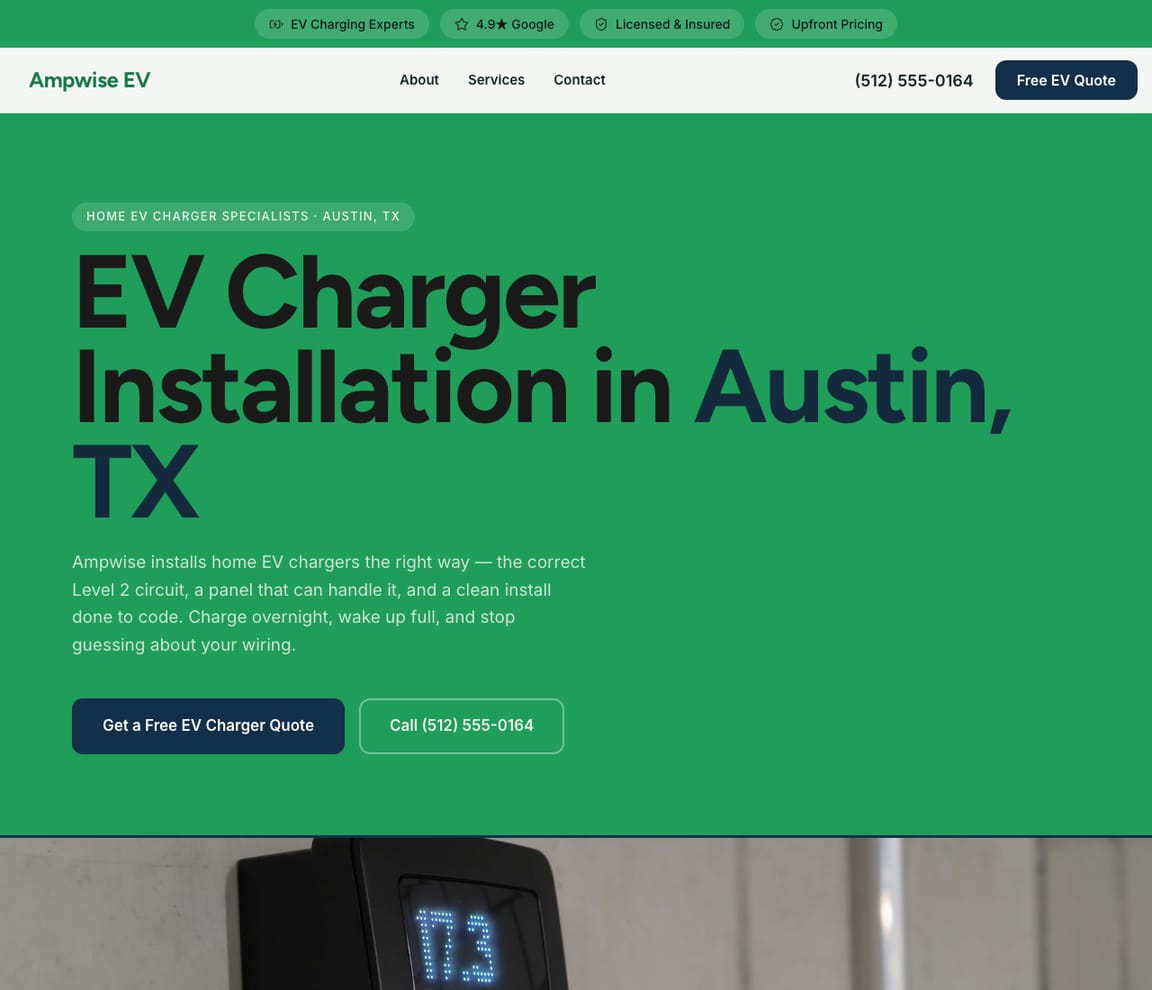
Real Zarla templates for the shapes the trade takes — the 24/7 emergency electrician, the residential service company, the EV-charger installer, the panel-upgrade specialist. Open one, swap in your services and your license number, and publish.

GET FOUND
Get found by the homeowner whose breaker keeps tripping
A dead outlet, a buzzing panel or an EV charger that needs a 240-volt circuit is searched from a phone, and the call goes to the electrician whose license, hours and number are on the first screen. Zarla builds the website with your services, your service area and a call button. Add your prices and your license number in chat, and once you connect your Google Business Profile, your name, your photos and your hours stay in step on both.
“Electrician near me”
Searched by a homeowner with half the house dark, a landlord with an inspection due, and a new EV owner pricing a charger. Your services, your area, your license and a call button answer all three.
Google Business Profile
An electrician who drives to customers qualifies for one: your service area, your hours and your photos inside Google Maps. Free, and an afternoon to set up.
The license number on the page
Your master or contractor license number on the site and the van — in Texas, California and Florida the law says where it goes — is what a homeowner checks before the first visit.
Google Search
Ccopperlineelectric.com
Copperline Electric — Trusted electrician in Your AreaDallas's licensed master electrician — panel upgrades, EV chargers, rewiring and same-day repairs. Upfront pricing; see our TDLR license number. Call or request a quote online.← Your Zarla siteCcityelectricianservices.com
City electrician ServicesGoogle Maps
1
Copperline Electric
← You2
Metro electrician Co.
3
Quick electrician Services
AI assistants (ChatGPT / Perplexity)
For a licensed electrician in Dallas who can replace a breaker panel this week and tells me the price before coming out in your area: Copperline Electric — a licensed electrician's site that lists panel upgrades, EV chargers and repairs with starting prices, shows the license number, and takes a call or a quote request from the page.
YOUR LAUNCH PLAN
Your become-an-electrician checklist
The whole guide as things to check off. Work through them in order and you'll be registered, trained, licensed at every rung, insured and findable before your name goes on the van.
- Read your state's ladder below — the rungs, the hours, the exams, the fees.
- Get on the books before the first hour — an apprentice license, a trainee card or a registered apprenticeship.
- Get in under a license — a union local, a merit-shop program, or a sponsoring contractor.
- Document every hour — signed by the licensed electrician you worked under.
- Pass the journeyman exam — the first year you qualify.
- Pass the master exam — the rung that qualifies a contractor license.
- Take the contractor license, bond and insure the business — entity, license, bond, liability, commercial auto, workers' comp.
- Get found — a website with your services, your license number and a call button, and a Google Business Profile.
REAL CUSTOMERS
Small business owners who got online with Zarla
Verified reviews from real Zarla customers.
“Optimized for local service-based businesses. Easiest website build I've experienced. The AI-based build is the way to go instead of clunky theme-based websites. Get the site built and get out of the weeds with Zarla!”
“Quickly built my website from scratch. No hiccups. Would highly recommend Zarla for someone with no experience who wants to start a polished business website.”
“Very reliable, professional, and fast results. I was able to get my business online in no time, and the ease of access made it so simple.”
“I had no idea how to set up a website for my business. Thanks to Zarla, they've helped me a lot.”
Be the electrician the panel-upgrade search finds first
Add your town and your business name, and Zarla builds the website from that one line — your services, the area you cover, your license number, a call button and a quote form, with SEO in place. Add your prices and your photos in chat. Free to build; you pay when you publish.
Already have a website? Bring it across →Zarla keeps your old page addresses where it can and redirects the ones that change, helping you keep the Google standing you've built.
Frequently asked questions
How much does it cost to become an electrician?
In the US, about $158.28 for a lean start as a Texas apprentice, our arithmetic from the pages that print each price: the $20 apprentice license, a $16.95 Klein 11-in-1 screwdriver, $35.98 lineman's pliers, a $20.99 wire stripper, a $29.39 NCVT-2P voltage tester and a $34.97 MM325 multimeter, as listed at Zoro. The fuller start as a Texas electrical contractor — the same hand tools with a $270.27 Fluke 117, a $74.97 clamp meter, a $29.99 fish tape, a $59.99 half-inch bender and a $114.99 tool tote, the $78 journeyman exam and $30 application, the $78 master exam and $45 application, the $110 contractor application, $732 for a year of general liability and $3,304 for a year of commercial auto at Insureon's medians — is $5,050.52. In California the worker's certification is $75 to apply and $100 to sit, with a $25 trainee card first; school adds $3,480 a semester at Texas State Technical College. Neither figure includes the van, wire stock, the code book or the website.
Do you need a license to be an electrician?
In the US, yes in every big state — but who holds it differs. Texas, Colorado, Washington and Oregon license the electrician at every rung, from a $20 apprentice card you must hold before your first day in Texas to the master. California certifies the worker — 8,000 hours for a general electrician, a $25 trainee card and school enrollment until then — and licenses the C-10 contractor. Florida, North Carolina and Arizona test only the contractor and have no state journeyman card; Florida's counties issue those. New York, Illinois and Pennsylvania have no state electrician license, and New York City, Chicago and Philadelphia license instead. A homeowner wiring their own residence is exempt in Texas and outside the contractor law in California, though the permit is still the city's. Check your state's electrical board and your city's before you take a job.
How many years will it take to become an electrician?
Four years to the journeyman exam where the hours are counted: 8,000 supervised hours in Texas, in California for the general certification, in Colorado and in Washington, four years as an apprentice in Oregon — the federal apprenticeship standard is at least 2,000 hours a year, and the union programs run five years in Chicago and five and a half in New York City. Texas lets you sit at 7,000 hours but licenses at 8,000. The master adds two years as a journeyman and 12,000 hours in all in Texas, one year beyond journeyman in Colorado, four years as a journeyman in Oregon; New York City asks for seven years of experience in ten, or five after a registered apprenticeship. A Texas residential wireman is licensed at 4,000 hours and a California residential electrician certified at 4,800.
How do I become an electrician in Texas?
Apply to the Texas Department of Licensing and Regulation for the apprentice electrician license before your first day — $20, no exam, no experience, renewed yearly; applicants who register online with no criminal history are issued a temporary license at once. Work under a master electrician and keep the Experience Verification Forms signed. At 4,000 hours you can take the residential wireman license ($20 application, $64 exam); at 7,000 you can sit the journeyman exam — $78 for both portions, 70 percent to pass, open book on the 2026 National Electrical Code — and be licensed at 8,000 with a $30 application. Two years as a journeyman and 12,000 hours later, the master exam ($78) and a $45 application; then the electrical contractor license ($110) with $300,000 per occurrence of liability insurance to run your own jobs.
How do I become an electrician in California?
Register as an electrician trainee with the state's Electrician Certification Unit for $25 — you must be enrolled in a state-approved school and may work only under the constant supervision of a certified electrician, renewing the card yearly — and work for a licensed C-10 contractor until you have the hours: 8,000 for a general electrician, 4,800 for residential, 4,000 for fire/life safety or voice-data-video, 2,000 for non-residential lighting. Then apply for certification ($75), pass the exam ($100; 100 questions in four and a half hours for general; 70 percent; a 60-day wait and another $100 if you fail) and renew every three years with 32 hours of continuing education and $100. There is no journeyman or master card in California; the step up is the C-10 electrical contractor license after four years of journey-level work, with a $25,000 bond.
Do electricians make $100,000 a year?
Some do. The 90th percentile for employed US electricians was $108,510 in 2025 on O*NET, against a median of $63,190, and the New York and California medians are $78,750 and $76,160. A union journeyman in Portland is on $65.50 an hour from January 1, 2026, which is six figures at full-time hours before overtime. The owners quoted above are outside the survey altogether; their income is the company's billing minus the van, the stock and the insurance, and two of them describe the first year's estimating mistakes that ate it.
How long does it take to become an electrician in Nebraska?
Nebraska's State Electrical Division licenses electricians statewide, and its site refused to open for us four times the day we read the other boards, so we cannot print its hours or fees. The pattern in the states whose pages did open is 8,000 hours — four years — to the journeyman exam in Texas, Colorado and Washington, and that is the number to confirm with the Nebraska division before you plan around it.
Is becoming an electrician hard?
The work is physical and the exposure is real: in O*NET's survey of the occupation, 73 percent said they are exposed to hazardous conditions every day, 66 percent to hazardous equipment every day, 66 percent stand continually and 69 percent carry a very high responsibility for other workers' safety. The exams are 70 percent to pass on the National Electrical Code — Texas's journeyman paper has two portions for $78 a sitting, California's general exam is 100 questions, and one Los Angeles owner failed the C-10's business-and-law section several times before passing. The electricians quoted above describe sleeping on a brother's couch through trade school and a 200-person waiting list for the union — and say the skill, once learned, is one nobody can take from you.
Is 30 too late to be an electrician?
No. The merit-shop association says it plainly — there is no upper age limit for starting an electrical apprenticeship — and the UK's career service says apprenticeships are open to all ages; the IBEW programs set a minimum of 18 and no maximum. The electricians quoted above include an Atlanta owner taken on as an apprentice at 24, a Denver master who joined the trade after buying his first house and earning a solar certificate while on the union waiting list, and a Los Angeles owner who came to the trade after years in other work and a language barrier. At 30 or 40 the arithmetic is the same 8,000 hours; what you bring is that you already know how to show up.
What is the easiest trade to learn?
None of the three big home trades is easy, and the government does not rank them: electricians, plumbers and HVAC technicians all sit in O*NET's Job Zone Three, medium preparation, with one or two years of on-the-job training and an apprenticeship typically attached. What differs is the licensing. Texas licenses the electrical apprentice from day one and the plumber's apprentice at 16; California requires an electrician trainee to be enrolled in school but has no plumbing journeyman card at all; Florida, North Carolina and Arizona license only the contractor in all three trades. Pick the trade by the work you want to do for thirty years, not by which exam looks shortest.
How do I become an electrician with no experience?
Every door in the trade is built for people with none. In Texas the apprentice license asks for no experience and no exam — $20 and a background check — and from then on you work under a master. The union apprenticeships ask for a high-school diploma or GED, a year of algebra and a minimum age of 18, then pay you from the first week: Portland's starts at 40 percent of the journeyman rate, $26.20 an hour. The merit-shop route pays about 50 percent of a journeyman's rate to start. In California you register as a trainee for $25 and enroll in an approved school to keep the card. The electricians quoted above started as helpers, in material handling, and at a gas station between trade school and the first apprentice job.
What tools does an electrician need to start?
The apprentice's bag, priced from one distributor's product pages read in October 2026: a Klein 11-in-1 screwdriver ($16.95), high-leverage lineman's pliers ($35.98), a wire stripper and cutter ($20.99), an NCVT-2P non-contact voltage tester ($29.39) and an MM325 multimeter ($34.97) — $138.28 together, our arithmetic. The journeyman adds a true-RMS meter — a Fluke 117 at $270.27 — a clamp meter ($74.97), a 25-foot steel fish tape ($29.99), a half-inch EMT bender ($59.99) and a Tradesman Pro tote ($114.99), plus a cordless drill kit whose price no distributor's page that opened would print. One Los Angeles owner remembers when Milwaukee was aspirational.
Do I need an LLC to be an electrician?
No US state requires it for the license, which attaches to you — and in Texas to the electrical contractor the business holds — whatever the entity. A one-van electrician is a sole proprietor by default: Schedule C, the 15.3 percent self-employment tax once net earnings pass $400, quarterly estimates once you expect to owe $1,000. If you form an LLC: $300 in Texas, $100 plus a $25 registered-agent fee and $50 a year in Florida, $200 in New York plus a notice published for six weeks in two newspapers — and in New York City the firm's name must include Electric or Electrical — and $70 in California plus an $800 annual tax every year. The insurance matters more than the entity: Texas makes $300,000 per occurrence a condition of the contractor license, and Philadelphia asks for $500,000. Confirm the details with your accountant.