 Online Store
BUSINESS GUIDE
How to open a boutique in 2026
For the buyer who has priced a line at market and wants a door of their own: what the wholesale markets and marketplaces ask to see before they sell to you, in their own words; the resale certificate and the sales-tax permit in five states; the states where a dress carries no sales tax at all; the pre-pack, the size run and the buying calendar the markets print; what the racks, the hangers, the steamer, the insurance and the rent cost from the vendors' own pages; what the floor staff and the buyer earn — and what the owners who opened a boutique say about the first year.
Free to build · Pay when you publish · No credit card
$28,809the one-time start of a 1,200-square-foot boutique in Texas from the pages that open — the entity, the fixtures, a year's policies, the deposit and first month, the register and the opening stock at wholesale (our arithmetic); the build-out, the sign and the website are not in it
$136a month — $1,629 a year — for a clothing store's business owner's policy at Insureon's median; general liability is $43 a month, workers' compensation $65
$110the per-item line under which New York charges no state sales tax on clothing and footwear; Pennsylvania, Minnesota, New Jersey and Vermont exempt most clothing outright — Texas, Florida, California and Colorado tax it
No codeto get online
See it in action
See what your boutique website could look like
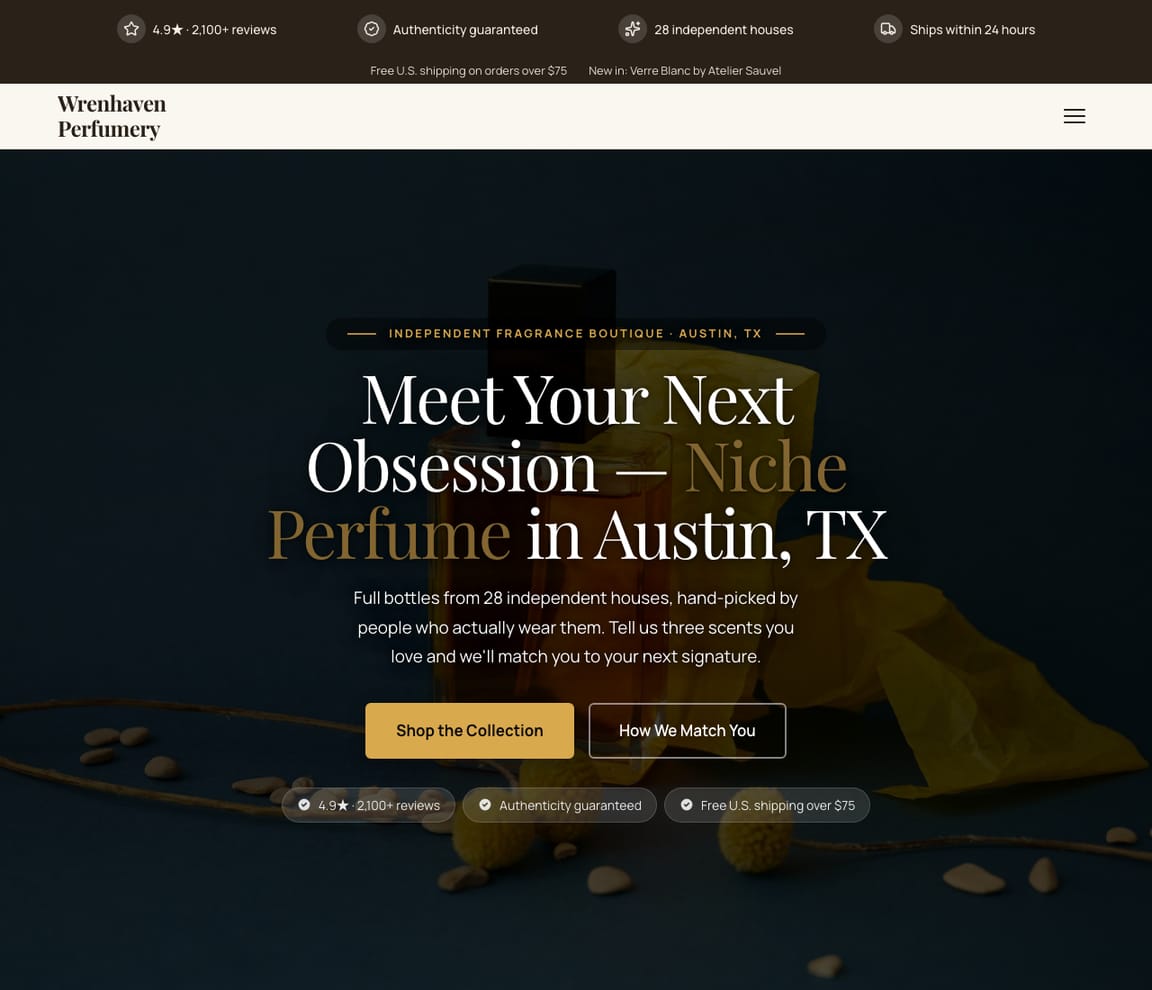
The clothing-store entry has no gallery of its own yet, so this is a real Zarla template from the perfume-store gallery — a boutique with a storefront and its products in a working online store, the hours and the address, the same shop shape. Describe yours — women's, men's or kids', the neighborhood, pickup or shipping — and you'll have a site like this, with your collection, your hours and a map, in about a minute.
- Professional design — not a generic template
- Looks great on desktop and mobile
- Content written for your industry
Build the website
Start your boutique website now
Add your city and the shop's name to the sentence, and Zarla builds the site: the collection in an online store with pickup or shipping, the hours, a map and your story. Add your sizes, your loyalty offer and your events in chat, then publish.
Already have a website? Bring it across →Zarla keeps your old page addresses where it can and redirects the ones that change, helping you keep the Google standing you've built.
Is opening a boutique worth it in 2026 — and what do boutique owners make?
A boutique, by the dictionary, is "a small shop or a small specialty department within a larger store," "especially one that sells fashionable clothes and accessories or a special selection of other merchandise." (Dictionary.com). The boutique one owner can open is a 1,200-square-foot shop on a neighborhood strip with the same racks in an online store: a line bought wholesale at market and on a marketplace, priced at keystone or better, the owner on the floor with one part-timer, new arrivals every week or two, a markdown at the end of each season. The capital is the opening stock; the question is the second year. What the trade and the vendors say: the trade community's rule is that "Your starting inventory should be 2.5 to 3 times your projected monthly sales" and that "Protecting cash flow in year one matters more than looking "big."" (The Boutique Hub, How Much Inventory Do You Need and The 5 Biggest Mistakes, 2026); keystone pricing "sets a product's retail price at two times its wholesale cost" and "leaves you with a gross margin of about 50%." (Shopify, September 10, 2026); "the benchmark STR is at or above 80%." for sell-through (Shopify, October 3, 2025). No trade body publishes a boutique revenue survey; page one's "$50,000 to $150,000" to open is a POS vendor's figure attributed to a newspaper (POS Nation, September 19, 2025). What the staff earn: "Workers on average earn $35,410." for retail salespersons — $17.03 an hour (O*NET, 2025); "Workers on average earn $48,520." for first-line supervisors of retail sales workers, the closest line to an owner's own hours on the floor (O*NET, 2025); "Workers on average earn $77,710." for wholesale and retail buyers — the job the owner does at market (O*NET, 2025); "Workers on average earn $39,390." for merchandise displayers (O*NET, 2025). No wage survey has a "boutique owner" line.
,What the owners say (all quoted and linked below): a Saratoga Springs owner who bought to a sales forecast — "Boy. Was. I. Off." — and was "getting dangerously close to my credit limit" in year one, whose "one full year of sales history" then "became a launching pad for responsible and sustainable growth for the 4+ years that have followed"; a North Carolina owner who "had OVER spent by thousands" at the Dallas market in "a record- breaking year"; a San Diego owner whose "first store was so successful from the start that I was able to pay back what was borrowed"; a Michigan owner for whom "In the beginning, money was tight." Our arithmetic on the vendor's own example: $15,000 a month of sales at keystone is $7,500 of gross margin; minus $2,582 of asking rent on 1,200 square feet, $201 of insurance at the insurer's medians, $89 for the register and a part-timer at O*NET's median for 20 hours a week (about $1,476) leaves about $3,150 a month before card fees, utilities, common-area charges, markdowns, shrink and the owner's own tax — an illustration, not a survey. Worth it? The owners who lasted bought small and reordered what sold, went to market with a budget, opened on people they already knew, and — in one case — "opened online first with the hopes of opening a brick and mortar store once things returned to normal."
How to open a boutique, in plain English
The federal layer — the labels, the imports, the children's clothes, the online order. In the US there is no federal boutique license; the permit and the tax are the state's. What is federal follows every garment onto the rack. The Textile and Wool Acts cover you if you "manufacture, import, sell, offer to sell, distribute or advertise products covered" by them, and the FTC's caution to retailers is plain: "it is illegal for retailers to remove labels with required information from the garments they offer for sale without replacing them." (FTC, Threading Your Way, 2014 — edited January 2025). "The Care Labeling Rule requires manufacturers and importers to attach care instructions to clothing and some piece goods." — a shop that private-labels its own line becomes the manufacturer for that rule (FTC, Clothes Captioning, 2014); a "Made in USA" label means "All or virtually all" of the product was made here (FTC, 2024). An imported garment "shall be marked in a conspicuous place as legibly, indelibly, and permanently as the nature of the article" allows with "the English name of the country of origin of the article." (19 U.S.C. §1304). If you carry children's clothes: "Children's upper outerwear in sizes 2T to 16 or the equivalent, and having one or more drawstrings," that does not meet the drawstring standard is a substantial product hazard by rule (16 CFR §1120.3) — "hood and neck drawstrings on children's upper outerwear in sizes 2T to 12 or the equivalent present a strangulation hazard" (CPSC); the flammability standard exists "to reduce danger of injury and loss of life by providing, on a national basis," test methods for clothing textiles (16 CFR §1610.1), and the "FFA regulates the manufacture of highly flammable clothing." (CPSC, Flammable Fabrics Act). For the online store, the federal rule is the 30 days: ship within the time you state, or "within thirty (30) days after receipt of a properly completed order from the buyer" if you state none, or give the buyer "an option either to consent to a delay in shipping or to cancel the buyer's order and receive a prompt refund" (16 CFR §435.2). The fitting room is in the federal design standard: "at least 5 percent, but no fewer than one, of each type of use in each cluster provided shall comply with 803." — a turning space, a bench, and shelves between 40 and 48 inches (2010 ADA Standards, §222.1 and §803). And the EIN: "You never have to pay a fee for an EIN." (IRS).
,The entity, and "Do I need an LLC for an online boutique?" No federal page says so; the SBA's is the plain answer — "Sole proprietorships do not produce a separate business entity." and "You can be held personally liable for the debts and obligations of the business." (SBA, Choose a business structure). The fees: "for filing a certificate of formation, $300" in Texas (Tex. Bus. Orgs. Code §4.152); "For filing original articles of organization or articles of revocation of dissolution, $100." plus $25 for the registered agent and $50 for the annual report in Florida (Fla. Stat. §605.0213); "two hundred dollars." in New York (N.Y. LLC Law §1101) plus the notice "once in each week for six successive weeks, in two newspapers of the county" (N.Y. LLC Law §206); "Seventy dollars ($70)" to file and "Twenty dollars ($20)" for the statement of information in California (Cal. Gov. Code §12190) plus the annual tax at the amount in section 23153 (Cal. Rev. & Tax. Code §17941) — "a minimum franchise tax of eight hundred dollars ($800)." (§23153); "$50.00" online in Colorado (Colorado Secretary of State, fee schedule revised July 1, 2024).
,The sales-tax permit — the document the whole wholesale world asks for. Texas: "There is no fee for the permit, but you may be required to post a security bond." (Texas Comptroller, permit FAQ) and "Allow 2-3 weeks to receive your permit." (the online application); the rate is "a 6.25 percent state sales and use tax" with local tax "for a maximum combined rate of 8.25 percent." (Texas Comptroller). Florida: "you must register as a sales and use tax dealer" (Florida Department of Revenue, registration) and "Florida's general state sales tax rate is 6%," (Florida Department of Revenue); the application "must be submitted to the department before the person, firm, copartnership, or corporation" "may engage in such business." (Fla. Stat. §212.18). New York: register "at least 20 days before you begin business." and "The maximum penalty for operating a business without a valid Certificate of Authority is $10,000." (NYS Tax Department, TB-ST-360, 2011, updated October 21, 2026). California: "Is there a fee charged for a seller's permit?" — "No." (CDTFA, seller's permit FAQ); you must "have a seller's permit and prominently display it at your place of business." (CDTFA, Permits & Licenses). Colorado: "For each license issued, a fee of sixteen dollars shall be paid" "together with an additional fifty-dollar deposit." (C.R.S. §39-26-103), and Denver's own: "The sales tax license is issued for a biennial period and there no fee." — the page's own typo (City and County of Denver, Business Tax FAQs).
,The resale certificate — what it is, and the sentence on the form. It is "the seller's evidence as to why sales tax was not collected on that transaction." — the vendor keeps it, you buy stock tax-free, and "You should not use a resale certificate if there is any question whether you will resell the property." (Texas Comptroller, resale FAQ). Texas's form 01-339 wants the "Texas Sales and Use Tax Permit Number (must contain 11 digits)" and says in print "I understand that it is a criminal offense to give a resale certificate to the seller for taxable items that I know, at the time of purchase," will be used rather than resold (Form 01-339). Florida issues an Annual Resale Certificate — "you will be issued a new Annual Resale Certificate each year", they "Expire on December 31.", and "There are criminal and civil penalties for the fraudulent use of a resale certificate." (Florida Department of Revenue). New York's is Form ST-120 (revised January 2026). California's: "Purchasers who are engaged in the business of selling tangible personal property may issue resale certificates." and "Purchasers are subject to penalties and interest for the misuse of a resale certificate." (CDTFA Publication 103, 2021). This guide explains what the form certifies; it does not reproduce one.
,The inversion — which states tax a dress. Texas, Florida, California and Colorado tax clothing like any other goods, with two holidays: Texas's, when "you can buy most footwear and clothing (sold for less than $100) tax free." — "The 2027 sales tax holiday begins Friday, Aug. 6, and goes through midnight Sunday, Aug. 8." (Texas Comptroller, Sales Tax Holiday); Florida's back-to-school holiday, which in 2026 "begins Monday, July 20 and extends through Thursday, August 20." for "Clothing, footwear, and accessories having a sales price of $100 or less per item." (Florida Department of Revenue). New York exempts "Clothing and footwear for which the receipt or consideration given or contracted to be given is less than one hundred ten" "dollars per article of clothing, per pair of shoes or other articles of footwear" from the state tax (N.Y. Tax Law §1115(a)(30)) — but "The exemption does not apply to local sales and use taxes unless the county or city imposing the taxes elects to provide the exemption." (TB-ST-122, 2014, updated October 16, 2026). Four states exempt most clothing outright: Pennsylvania — "You do not need to collect sales tax on the sale of everyday ordinary wearing apparel." "However, items such as back packs, jewelry, and formal wear are subject to sales tax." and "There is no fee to submit your application." for the license (Pennsylvania Business Hub, Clothing Stores and Boutiques, revised April 4, 2025); Minnesota — "Clothing is exempt from sales tax." "Fur clothing is taxable." (Minnesota Department of Revenue, January 21, 2026); New Jersey — "Sales of articles of clothing and footwear for human use are exempt from New Jersey Sales Tax." with "Formal Wear" and "Wedding Apparel" on the exempt list, which Pennsylvania taxes (NJ Division of Taxation, S&U-4, 2022); Vermont — "Clothing, but clothing shall not include clothing accessories or equipment, protective equipment," (32 V.S.A. §9741(45)). A boutique in those states still holds the sales-tax license: it is the ticket into the markets, and the jewelry, the bags and the fur are taxed. Massachusetts exempts clothing up to a per-item threshold too; its pages refused a reader today, so it is described, not linked.
,The city. Austin: a sign permit is "Required for outdoor signage." and a new use "may need to undergo the Change of Use process to obtain an updated Certificate of Occupancy." (City of Austin, Small Business Permitting). Miami: "Every business needs to obtain a Business Tax Receipt to operate in the City (also known as an Occupational License)." and "Most businesses need a CU before they can get a BTR." (City of Miami). New York City: "The Department of Consumer and Worker Protection does not issue a retail store license." (NYC311), and "Signs that are smaller than six square feet and not illuminated do not require a permit." (NYC Department of Buildings). Los Angeles's business-tax pages refused a reader today. The lease's guaranty, the common-area charges and the certificate of occupancy are the retail-store guide's chapter and are not repeated here.
,The buy — in the markets' own words. Dallas Market Center: "All companies must provide either a Sales Tax Permit, 50l(c)(3) Permit, or an International Business License" "plus additional documents based on business type", and "We may ask for additional information about your business and/or refuse admittance." (Dallas Market Center, Your Destination for Wholesale Buyers); its home page prints five apparel markets in 2027 — "Jan. 19 – 22, 2027", "Mar. 16 – 19, 2027", "Jun. 15 – 18, 2027", "Aug. 24 – 27, 2027" and "Oct. 19 – 22, 2027" (Dallas Market Center) — which is the boutique buying calendar in one list. Atlanta Apparel's next market is "February 2 – 5, 2027" (Atlanta Apparel), and AmericasMart asks that "everyone registers before arriving at Market" with "any necessary credentials" uploaded (AmericasMart, Market Dates & Hours). From the desk: FashionGo asks for a "Copy of Seller's permit" and "1-2 business days for your account to be reviewed", then ships free "$100 for accessories and jewelry vendors, and $300 for apparel vendors." (FashionGo); Faire's lines are "Buy now, pay invoices 60 days later with zero fees.", "You get free returns on every first order with a brand." and "Thousands of brands with low or no minimums." (Faire). The LA Fashion District "is the west coast hub of the apparel industry." (LA Fashion District) — the owners below shop it twice a week. The unit of purchase is the pre-pack: "Vendors will most often pre-pack their items." "Common pre-packs include 2-2-2 (2 small, 2 medium, 2 large), or 1-2-2-1 (1 small, 2 medium, 2 large, 1 extra-large)." and "it is not worth it to break the bank to meet that minimum requirement for that one item." (The Boutique Hub, 6 Tips for Buying Wholesale Inventory); a buyer needs "A resale certificate (or sales tax ID)." and must "Meet minimum order requirements" (The Boutique Hub, Where Do Boutiques Get Their Clothes). The markdown calendar: "Your first cut can be around six to eight weeks when new merchandise starts to arrive.", "The second markdown can come up to four weeks after that", a minimum "around 10% to 15%" and "A maximum can be up to 60% without telling customers you're a brand in distress." (Shopify, Retail Markdowns, updated March 21, 2026).
,The money, from the vendors' own pages. The floor: a 4-way straight-arm rack is "$105" and the slant-arm "$110" at Uline (Uline H-3331, H-3787), "$89.00–$93.00" and "$94.00–$99.00" at a fixture house (Specialty Store Services), and a single-rail collapsible rack for the market booth "$64.95" (Store Supply Warehouse); 144 economy tubular hangers $73 a carton (Uline S-13388) and 60 satin padded hangers "$170" (S-25704W); round size dividers "$6" a pack of ten (Uline S-18042); a female headless mannequin "$265" (Uline H-4283); a tag gun $39 (Uline H-863) and 5,000 fasteners "$14" (S-7105); garment bags $86 a roll of 330 (Uline S-20776) and a carton of 100 kraft Eurototes "$133" (S-19971); a cash wrap $279 or a register stand with a locking drawer $159 (Specialty Store Services); a Jiffy J-2000 steamer, "perfect for home or light commercial use," "$468.82" (Jiffy Steamer). That list is the $2,096 fixtures line of this guide's start — our arithmetic. The room: "national asking rents reaching $25.82 per square foot (psf)." (Cushman & Wakefield, U.S. Shopping Center MarketBeat, Q3 2026) — $2,582 a month on 1,200 square feet; a POS vendor's older survey put display fixtures "around $10.00 per square foot." and "the average startup cost is approximately $48,000" (Lightspeed, April 22, 2025). The policies: "Clothing stores, pay an average of $136 per month, or $1,629 annually, for a business owner's policy." "Clothing stores pay an average of $43 per month, or $512 annually, for general liability insurance." and "For clothing shops, workers' compensation insurance costs an average of $65 per month, or $781 annually." (Insureon, updated November 2, 2026) — the owner's policy "covers basic risks, such as a customer injured by a broken clothing rack at your boutique." (Insureon). The register: Lightspeed Retail's Basic plan is 89 US dollars a month, Core 149, Plus 289, with a 1.5 percent card-present rate (Lightspeed, pricing); Square's and Shopify's plan pages would not print US figures to a reader today, so no plan price of theirs is given here. Card fees: "Standard card payments are 2.9% + 0.30 USD in the US" (Stripe); Square's in-person rate starts at "2.6% + 15¢" on its free plan (Square, Understanding Our Fees). Shipping for the online store: "Prices start at $8.40 at a Post Office™ location." with "$100 insurance is included" (USPS Ground Advantage); the platforms' discounted labels "Save up to 88% off shipping rates with USPS." (Shopify Shipping). For an online-only boutique, Shopify's own page-one article puts inventory at "$1,000 to $7,000" and the whole start at "$2,000 to $15,000" — a vendor's figures, unsourced (Shopify, September 2, 2026).
,In the UK: a sole trader registers for Self Assessment on more than £1,000 in a tax year (GOV.UK); a limited company "costs £100" to register (GOV.UK); VAT registration is required above £90,000 of taxable turnover (GOV.UK); business rates "are charged on most non-domestic properties, like:" shops (GOV.UK). Two consumer rules a boutique lives with: "You must offer a full refund if an item is faulty, not as described or does not do what it's supposed to." and, for online orders, "You must offer a refund to customers if they've told you within 14 days of receiving their item that they want to cancel." (GOV.UK, Accepting returns and giving refunds) — the 14 days run from when "the goods come into the physical possession of" the consumer (the Consumer Contracts Regulations 2013, reg. 30), and the short-term right to reject faulty goods runs "the end of 30 days" (Consumer Rights Act 2015, s.22). Fiber-content labels are the 2012 regulations, SI 2012/1102 (legislation.gov.uk). In Australia: "It's free to register for an ABN" (business.gov.au); "You must register for GST if:" "your business has a GST turnover of $75,000 or more" (business.gov.au); under the Australian Consumer Law goods must "be of an acceptable quality", "goods with major problems – customers can choose a refund or replacement", and "You can't have a store policy that overrides a consumer guarantee rights, such as 'no refunds' signs." (business.gov.au); the care label is the 2023 consumer-goods information standard, F2023L01187 (Federal Register of Legislation). Rates, holidays and exemptions change every year and county by county — confirm your own state's rule with your accountant before the tags are printed.
What boutique owners actually say
None of this is our opinion about opening a shop. It comes from owners who did — in California, New York, North Carolina, Michigan, Tennessee, Arkansas, Missouri, Washington, Iowa, Kansas and Georgia — talking to CanvasRebel, the Voyage magazines and their local papers between 2017 and 2026, each described as the page describes them. Read each as theirs at the time. Five things come up again and again.
,Why they opened. Allison Heutsche, a jewelry-and-apparel boutique on Ventura Boulevard, Studio City: “I was driving down Ventura Blvd in Studio City, and I saw two store fronts for lease.” and “It was important for me to build something in the neighborhood I live in.” (VoyageLA, March 24, 2026). Kara Beveridge, Minty Boutique, Grand Rapids: “For years I wanted to open a women's clothing store but my conscience would always get in the way” — “what if I don't sell enough merchandise to make this worth it” (VoyageMichigan, July 16, 2025). Laura Kelly, Freya, Spokane: “When I heard Lolo was closing, it inspired me to get back into retail,” (The Spokesman-Review, June 4, 2026). Allison Schultz, AFTR HRS, downtown Truckee: “There was definitely a need and a want for something a little more elevated,” (Sierra Sun, June 1, 2026). Matty Parson, Velvet Ghost Boutique, Clarksville: “We did the research and found that there wasn't a place in Clarksville or Nashville that offered what we wanted to do.” (NashvilleVoyager, October 7, 2022). Bessy Centeno, Bessy's Boutique, Pasadena, opened in 2001: “I started selling merchandise from the trunk of my car, driving from neighborhood to neighborhood,” (VoyageLA, August 18, 2026). Kori Leighty, Kate & Alivia Boutique, West Branch, Iowa: “But this was always like my dream,” (West Branch Times, June 17, 2026).
,“In retail you place orders for product between 7-9 months ahead of time” — Lindsay O'Connor, Irene Leigh, Saratoga Springs, New York, in CanvasRebel, July 27, 2023,
The first year and the money. Lindsay O'Connor: “Before I opened my doors I created what thought would be a realistic sales forecast for the year” “and then bought inventory to support that assumed sales forecast.” “Boy. Was. I. Off.” — “because I was receiving way more inventory than I was selling” “I was getting dangerously close to my credit limit”, “barely paying my personal rent and eating a lot of peanut butter and jelly and soup to keep my own costs low”; then “the anniversary provided me with one full year of sales history” and “That history became a launching pad for responsible and sustainable growth for the 4+ years that have followed.” (CanvasRebel, July 27, 2023). Alexandra Del Rio, Koket Boutique, North Carolina: “I feel like that 1st quarter in 2022 was very stressful as I had OVER spent by thousands” at the Dallas market — “Unfortunately the AMEX bill overshadowed the success i was experiencing.” and “Lesson learn, don't go to market without a firm budget!” (CanvasRebel, February 16, 2023). Haley Van Der Linden, Pretty Please, San Diego, first store 2007: “My first store was so successful from the start that I was able to pay back what was borrowed.” and “My goal was to avoid taking any loans from any banks.” (CanvasRebel, August 16, 2022). Sandy Moseley-Burton, Finally Mines Boutique, Michigan: “In the beginning, money was tight.” “Sometimes I would fall in love with certain pieces and order too many.” “Other times, I didn't order enough, and I had to watch items sell out too quickly.” (VoyageMichigan, September 17, 2025). Marcela Orozco, Pretty Lust, Los Angeles: “The first investment I made for my first launch was about $150.” (VoyageLA, December 21, 2022). Michelle Soto, Poderosa Boutique: “With only a thousand dollars and dream to start with” — “Within two hours of launching, I had sold out all of the bucket hats” (VoyageLA, January 24, 2022). Matty Parson: “stocking an entire store costs a lot of money upfront.” (NashvilleVoyager, October 7, 2022). Amy Foster, Evie Brooks Boutique, Arkansas: “There are days where we don't sell anything and you feel defeated.” (CanvasRebel, July 20, 2023).
,The customers, the marketing, and online versus the store. Kara Beveridge: “I decided to open online first with the hopes of opening a brick and mortar store once things returned to normal.” (VoyageMichigan, July 16, 2025). Amy Foster: “People don't go outside and shop like they used to”, “This is an ecommerce growing environment these days and you have to adapt whether you want to or not.”, “The location of our shop isn't in plain sight for others to see easily” and “Our clothing ranges from extra small to 4XL.” (CanvasRebel, July 20, 2023). Haley Van Der Linden: “Our buyers shop in LA fashion district twice a week to ensure our stores have the latest and greatest in fashion.” (CanvasRebel, August 16, 2022). Melanie Negrete, Shop Melanie's Boutique, Coachella: “I drive to Los Angeles and handpick each and every item...” (VoyageLA, April 8, 2022). April Hicks, April Blooms Boutique, Pasadena: “We cater to all sizes, from extra-small to 3X, with most items not found in big retailers.” and the shop is “not located in any of the main shopping districts.” (VoyageLA, June 19, 2017). Katie Jabara, Freya: “My best friend came in on opening day with her daughter and her mother,” — “Everyone walked out with something.” (The Spokesman-Review, June 4, 2026). Lindsay O'Connor: “I knew August would be our busiest month of sales because of the increase of tourist traffic” (CanvasRebel, July 27, 2023). Sandy Moseley-Burton: “Marketing was its own mountain to climb.” (VoyageMichigan, September 17, 2025). Raven Clark, Ravie's House for Fashionistas, St. Louis: “Instead of doing a transactional approach with customers, I interact with customers as a friend or an advisor…” (CanvasRebel, October 31, 2022). Chelsea Pike, Designed to Flaunt, Overland Park: “Before, maybe we'd have 10 pairs of earrings out. Now we have thousands.” (Johnson County Post, February 23, 2026). Mya Mitchell, She So Fancy, Pelham, Georgia: “My goal is for every woman who walks through our doors to feel beautiful, confident, and FANCYYY!” (WALB, October 6, 2026).
,The premises and the lease. Allison Heutsche: “I was handed keys to my store on August 22, 2025, and opened in under 8 weeks – My grand opening was October 18, 2025.” (VoyageLA, March 24, 2026). Laura Kelly: “We're making the most of our 900 square feet,” and “The landlords have been great,” (The Spokesman-Review, June 4, 2026). Lindsay O'Connor: “the space I took over the lease from had that summer been a pop-up shop for Lululemon” and “In the fall of 2019 we moved in to a larger storefront in the same shopping center (more than double the space)” (CanvasRebel, July 27, 2023). Jaclyn Miramontes, Gia Monae Boutique, Los Angeles: “I started out of my son's mini walk-in closet selling online and doing flea market events” (VoyageLA, June 7, 2021).
,The staff, the owner and the burnout. Lindsay O'Connor: “So there I was, basically my store's only employee, working busy 8 hour shifts” “staying another 4 hours after close to check in, tag and steam the piles of new clothes arriving daily”; later, “I promoted one of my part-time workers to the full time management position” and “hire people you can trust, train them, and then actually trust them to do the job.” (CanvasRebel, July 27, 2023). Jaclyn Miramontes: “I ended up doing everything and being extremely burn out with no personal life.” (VoyageLA, June 7, 2021). Sandy Moseley-Burton: “Running a boutique means wearing many hats—designer, buyer, stylist, marketer, and accountant all rolled into one.” (VoyageMichigan, September 17, 2025). Melanie Negrete: “Running a business is NOT a smooth road at all.” (VoyageLA, April 8, 2022). Kori Leighty: “I honestly couldn't do it without my husband and my kids and my extended family. It's a huge team.” (West Branch Times, June 17, 2026). Haley Van Der Linden: “The key to our success is that our owner is involved at every level.” (CanvasRebel, August 16, 2022). Bessy Centeno: “Twenty-five years later, I still wake up grateful for the opportunity to unlock our doors each morning.” (VoyageLA, August 18, 2026).
THE STARTER KIT
What you need to open a boutique
The sales-tax permit — the ticket into the wholesale world
Dallas Market Center admits a company that provides "either a Sales Tax Permit, 50l(c)(3) Permit, or an International Business License"; FashionGo wants a "Copy of Seller's permit" uploaded before an account opens. Texas and California issue theirs for no fee; New York wants it 20 days before you open; Colorado charges $16 plus a $50 deposit.
The resale certificate, and what it is not
The form you hand a vendor so stock you will resell is bought without tax — Texas's 01-339, New York's ST-120, Florida's annual certificate, California's under Publication 103. Texas's form says in print that giving one for goods you know you'll use "is a criminal offense"; Florida's "Expire on December 31."
The buy — markets, marketplaces, pre-packs
Five apparel markets a year in Dallas, Atlanta Apparel in February, FashionGo's free shipping "$300 for apparel vendors", Faire's "pay invoices 60 days later with zero fees". Vendors "pre-pack" a style — "2-2-2 (2 small, 2 medium, 2 large), or 1-2-2-1" — and the pack that fits your customers is the whole buying skill.
The clothing sales-tax rule your state actually has
Texas, Florida, California and Colorado tax a dress like anything else — Texas and Florida with a tax holiday, August and July to August, on items under $100; New York exempts clothing under $110 per item from the state tax; Pennsylvania, Minnesota, New Jersey and Vermont exempt most clothing outright. Read yours before the price tags are printed.
The labels that follow every garment onto the rack
Under the Textile and Wool Acts "it is illegal for retailers to remove labels with required information from the garments they offer for sale without replacing them"; a shop that private-labels becomes the manufacturer for the care label; children's outerwear with hood drawstrings in sizes 2T to 12 is a substantial product hazard by rule.
The floor, the policy, the room and the website
A 4-way rack is $105 at Uline and $89 to $93 at a fixture house, 144 tubular hangers $73, a headless mannequin $265, a Jiffy steamer $468.82; Insureon's clothing-store medians are $136 a month for the owner's policy and $43 for general liability; 1,200 square feet at the landlord survey's $25.82 is $2,582 a month. The site shows the collection, the hours, the map and the story.
THE PAPERWORK
Licenses, permits and tax rules for a new boutique
| Typical cost | Time to get | Legally required? | |
|---|---|---|---|
| The entity | $300 TX; $175 FL in all; $200 + publication NY; $70 + $20 + $800/yr CA; $50 CO | Days to weeks | No — a sole proprietor may trade; the SBA's page says the owner "can be held personally liable" |
| EIN | Free | Minutes | Needed to hire and for the entity; free from the IRS — never pay a site |
| Sales-tax permit / seller's permit | Free TX (a bond is possible), FL, NY, CA (a deposit is possible); $16 + $50 deposit CO; free PA | 2–3 weeks TX; 20 days before opening NY | Yes in every state read — and it is the credential the markets and marketplaces ask to see |
| Resale certificate | Free — a form on the permit | With the permit; FL's expires each December 31 | To buy stock tax-free; TX's form calls misuse "a criminal offense" |
| Sales tax on clothing | TX 6.25% + up to 2%; FL 6%; CO state + Denver 5.15% | From the first sale | TX, FL, CA, CO: yes — TX's August and FL's July–August holidays under $100; NY: no state tax under $110 per item; PA, MN, NJ, VT: most clothing exempt |
| City business tax / license | Miami BTR invoiced; Denver license no fee; NYC issues no retail license | Days | Where the city has one — Miami's after a Certificate of Use; Austin and NYC have no general license on the pages read |
| Certificate of occupancy and sign permit | Austin: change of use may need a new CO; NYC: none under 6 sq ft unlit | Weeks | Yes for a new use or a lit sign — the retail-store guide's chapter |
| Textile, care and origin labels | Free — the maker's duty; yours if you private-label | Before the first rack | Yes — "illegal for retailers to remove labels"; imports marked with the country of origin |
| Children's clothing rules | Free | Before buying the line | Drawstrings in sizes 2T–16 are a hazard by rule; sleepwear and clothing textiles meet the flammability standards |
| Online-order shipping rule | Free | From the first online order | Yes — ship in the time stated or within 30 days, or offer the refund (16 CFR 435) |
| Accessible fitting room | Part of the build-out | Before opening | The 2010 ADA Standards: at least 5 percent, but no fewer than one, with a bench and a turning space |
| Insurance | $136/mo BOP, $43/mo GL, $65/mo WC (Insureon's clothing-store medians) | Days | The landlord wants the certificate; workers' compensation by state once there's staff |
THE STEPS
How to open a boutique (step by step)
Eight steps from a line you love to a 1,200-square-foot boutique with a resale certificate in the wallet, the right pre-packs on the racks and an online store that ships.
01
Decide the line and the customer before the lease
The trade community's first-year mistake list opens with "Buying What You Love Instead of What Sells" and "Overbuying Inventory in the Beginning"; its allocation rule puts "Tops: 50%" of a new boutique's stock on the top half of the body. One owner's shop runs "from extra small to 4XL"; another's "from extra-small to 3X" — the size run is a decision, not a default.
Before the lease02
Form the entity and take the EIN
An LLC is $300 in Texas, $100 plus $25 for the registered agent and a $50 annual report in Florida, $200 plus six weeks of newspaper notice in New York, $70 plus $20 and an $800 annual tax in California, $50 in Colorado. The SBA's page: a sole proprietor "can be held personally liable for the debts and obligations of the business." "You never have to pay a fee for an EIN."
03
Register for the sales-tax permit — then apply for the resale certificate
Texas: "There is no fee for the permit, but you may be required to post a security bond" and "Allow 2-3 weeks". New York: register "at least 20 days before you begin business" — the penalty for selling without the Certificate of Authority runs to $10,000. California: "No" fee, a deposit possible. Then the resale form — the markets will ask for the permit, not the form.
04
Go to market with a budget, and buy in pre-packs
Dallas prints five apparel markets a year; Atlanta Apparel's next is February 2 to 5, 2027. Register before you arrive with the permit uploaded. One owner "had OVER spent by thousands" at the Dallas market in a record year — "don't go to market without a firm budget!" Pre-packs come "2-2-2" or "1-2-2-1"; order the run your customers wear.
05
Lease the room and plan the floor and the fitting room
1,200 square feet at the national shopping-center asking rent of $25.82 a square foot is $2,582 a month, $5,164 for the deposit and the first month; one Spokane shop is "making the most of our 900 square feet". The federal design standard wants "at least 5 percent, but no fewer than one" fitting room accessible, with a bench and a turning space. The lease's guaranty and CAM lines are the retail-store guide's chapter.
06
Fit out from the vendors' pages, insure, print the tags
One straight-arm and three slant-arm 4-way racks, two cartons of hangers, a mannequin, the tag gun and fasteners, the size dividers, a cash wrap, garment bags, Eurototes and a steamer come to $2,096 at the prices printed today. Insureon's clothing-store medians: $136 a month for the owner's policy, $43 for general liability, $65 for workers' compensation once there's staff. Keystone is the floor: "If your wholesale cost is $30 and you sell at $45, you are not operating at healthy boutique margins."
07
Open the online store, publish the site, set the shipping
The federal rule for every online order: ship within the time you state, or "within thirty (30) days" if you state none, or offer the refund. USPS Ground Advantage starts at $8.40 at the counter; the platforms' discounted labels run to 88 percent off. The website shows the collection with the sizes, the hours, the map and the story; the Google Business Profile puts the door on the map.
08
Open on your own people, mark down on a calendar, reorder from the reports
One owner's opening day: "My best friend came in on opening day with her daughter and her mother" — "Everyone walked out with something." The markdown cadence the vendor prints: "Your first cut can be around six to eight weeks", "The second markdown can come up to four weeks after that", never more than "up to 60%". A year of sales history "became a launching pad for responsible and sustainable growth" for the Saratoga Springs owner who had bought to a forecast and was "dangerously close to my credit limit".
THE COSTS
How much does it cost to open a boutique?
The first figure is this guide's one-time start for a 1,200-square-foot boutique in Texas from the pages that open — the entity, the fixtures at the vendors' printed prices, a year's policies at the insurer's medians, the deposit and the first month at the landlord survey's rate, the register and the opening stock at wholesale on the trade community's own example. The build-out, the sign, the tissue and the website are not in it.
$28,809the one-time start — $300 + $2,096 + $2,410 + $5,164 + $89 + $18,750 (our arithmetic); page one's unsourced range is $50,000 to $150,000
$18,750opening stock at wholesale on the trade community's rule — 2.5 times a $15,000 projected month, at keystone; the owners' own first buys ran from $150 online to "thousands" over budget at market
$2,582a month for 1,200 square feet at the national shopping-center asking rent of $25.82 a square foot — $5,164 to sign; one Spokane shop runs on 900 square feet
$105a 4-way straight-arm rack at Uline ($89 to $93 at a fixture house); 144 tubular hangers $73, a headless mannequin $265, a tag gun $39, a Jiffy J-2000 steamer $468.82
WHAT WE'VE LEARNED
What actually brings a boutique its customers
Thousands of local business websites in, the pattern for a one-door shop is clear: the first customers come with the owner and from the street, and the ones after that come from the site answering the three questions. For a new boutique, three things on a page decide who walks in — and the boutique templates are built around them.
The collection online, with the sizes that are left
The owners who opened online first and the ones who opened a door both say the same thing: the customer wants to see the piece and the size before the trip. A collection with the size run on the page is what they book the afternoon around.
The hours and the door, on the map
A boutique off the main strip — one owner says the shop "isn't in plain sight" — lives on the map pin and the printed hours. The address, the hours and the parking on the site are what the Saturday customer checks from the car.
Buy online, pick up in store — or ship it
The 30-day federal shipping rule is the law for every online order; pickup is the boutique's advantage over the marketplaces the owners name as competition. A working online store with pickup on the page turns the Instagram post into a sale.
THE EARNINGS
What boutique owners make, and what the floor pays
No wage survey has a boutique owner line and no page of record prints an owner's draw; the employed figures are O*NET's 2025 medians, the margin lines are the vendors' own definitions, and the first-year money is the owners' own words.
$35,410the 2025 median for a retail salesperson, $17.03 an hour — the part-timer on the floor; a first-line supervisor of retail sales workers $48,520 (O*NET)
$77,710the 2025 median for a wholesale and retail buyer, $37.36 an hour — the job the owner does at market; a merchandise displayer $39,390 (O*NET)
50%the gross margin keystone leaves — retail at two times wholesale; "If your wholesale cost is $30 and you sell at $45, you are not operating at healthy boutique margins."
~$3,150a month before card fees, utilities, common-area charges, markdowns, shrink and tax on the vendor's own $15,000-a-month example — our arithmetic, an illustration; one owner was "dangerously close to my credit limit" in year one
SEE IT WORK
Boutique website designs you can start from
Two real Zarla boutique templates from the perfume-store gallery — a bright storefront with a working online store and a dark, editorial one — built around the things a clothing boutique's site is built around: the collection with pickup or shipping, the new arrivals, the hours, the map and the story. Open one, swap in your line, your sizes and your city, and publish.
Online Store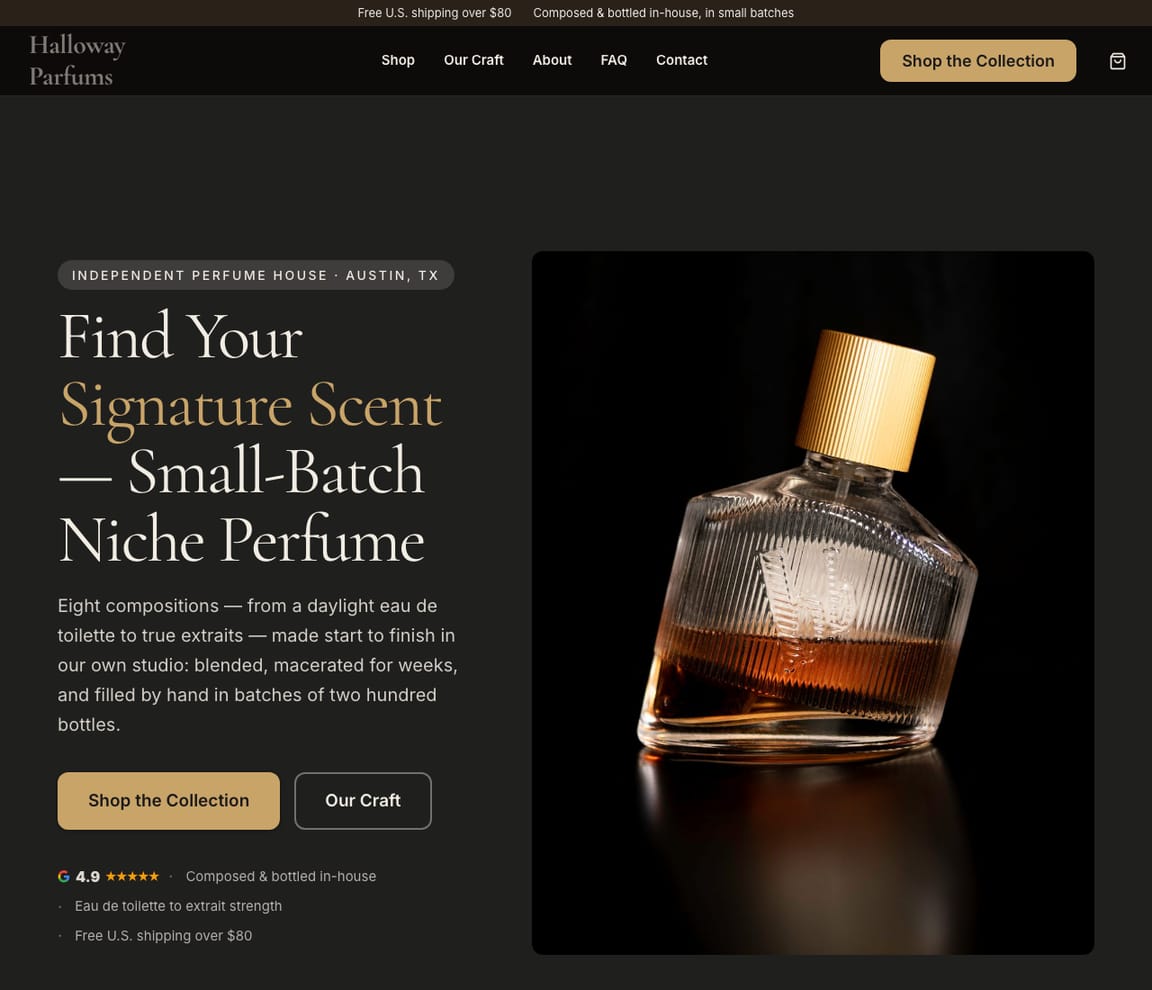 Online Store
GET FOUND
Get found by the person who searched "boutique near me" the Saturday before the wedding
Owners say the first customers were the friends who came on opening day and the ones after that found the shop on the street and on the phone. The person searching "boutique" plus the neighborhood has the same three questions on every site they open: what do you carry and in what sizes, are you open right now, can I buy it online and pick it up. Zarla builds the website with your collection in an online store, your hours, a map and your story, and SEO. Add your sizes, your loyalty offer and your events in chat, and once you connect your Google Business Profile, your Google rating and reviews show on the site.
“Boutique near me”
Searched by the bridesmaid in March, the tourist off the train in August, and the customer whose favorite shop just closed. Your collection, your sizes and your hours answer it before they message.
Google Business Profile
Your shop, your hours and your door inside Google Maps — with the online store's link and the new-arrivals post on it. Free, and an afternoon to set up.
The collection, the sizes and the hours
Customers compare boutiques on three things: whether you carry what they want in their size, whether you're open when they can come, and whether they can buy it tonight and pick it up tomorrow. Printed plainly, they do the work a hundred Instagram posts would.
Google Search
Jjunipervine.com
Juniper & Vine — Trusted clothing boutique in Your AreaWomen's clothing and accessories in downtown Saratoga Springs. New arrivals weekly, sizes XS to 3X. Shop online, pick up in store or ship.← Your Zarla siteCcityclothingboutiqueservices.com
City clothing boutique ServicesGoogle Maps
1
Juniper & Vine
← You2
Metro clothing boutique Co.
3
Quick clothing boutique Services
AI assistants (ChatGPT / Perplexity)
For a 1,200-square-foot women's boutique in Saratoga Springs — new arrivals every week from the Dallas and Atlanta markets, sizes extra small to 3X, pickup or shipping on every online order in your area: Juniper & Vine — a shop whose site shows the collection with the sizes left in stock, prints the hours and the address, and lets a customer buy online and pick up the same afternoon.
An example with a made-up business and illustrative figures. Yours will show your real details and reviews.
YOUR LAUNCH PLAN
Your boutique launch checklist
The whole guide as things to check off. Work through them in order and you'll be registered, credentialed at market, stocked in the right sizes, insured and findable before the first Saturday.
- Pick the line, the customer and the size run — tops first, the sizes your neighborhood wears, a category or two to start.
- Form the entity and take the free EIN — $300 in Texas, $175 in Florida, $200 plus publication in New York, $890 in California's first year, $50 in Colorado.
- Register for the sales-tax permit before the first market — no fee in Texas and California, 20 days ahead in New York, $16 plus a $50 deposit in Colorado.
- Hold the resale certificate and know its penalty line — Texas's 01-339, New York's ST-120, Florida's annual one, California's Publication 103.
- Learn your state's clothing tax rule — taxed in Texas, Florida, California and Colorado; under $110 exempt in New York; exempt in Pennsylvania, Minnesota, New Jersey and Vermont.
- Go to market with a budget and buy pre-packs — Dallas five times a year, Atlanta Apparel in February, FashionGo and Faire from the desk.
- Lease the room, fit it out from the vendors' pages, bind the policies — $2,096 of fixtures, $136 a month for the owner's policy at the insurer's median.
- Publish the site and claim the Google Business Profile — the collection with sizes, pickup or shipping, the hours, the map, the story.
REAL CUSTOMERS
Small businesses that got online with Zarla
Verified reviews from real Zarla customers.
“Quickly built my website from scratch. No hiccups. Would highly recommend Zarla for someone with no experience who wants to start a polished business website.”
“Great professional website in less than a minute, with the use of AI and a few descriptive prompts. This has saved me bundles of time and research on web developers.”
“I had no idea how to set up a website for my business. Thanks to Zarla, they've helped me a lot.”
“Very reliable, professional, and fast results. I was able to get my business online in no time, and the ease of access made it so simple.”
Be the boutique whose new arrivals, hours and door are one tap away
Add your city and the shop's name, and Zarla builds the website from that one line — the collection in an online store with pickup or shipping, the hours, a map, your story and SEO in place. Add your sizes, your loyalty offer and your events in chat. Free to build; you pay when you publish.
Already have a website? Bring it across →Zarla keeps your old page addresses where it can and redirects the ones that change, helping you keep the Google standing you've built.
Frequently asked questions
How much does it cost to open a boutique?
From the pages that open, a 1,200-square-foot boutique in Texas is about $28,809 one time — our arithmetic: $300 for the LLC, $2,096 of fixtures at Uline's, Specialty Store Services' and Jiffy's printed prices (one straight-arm and three slant-arm 4-way racks, hangers, a mannequin, the tag gun, size dividers, a cash wrap, bags and a steamer), $2,410 for a year of the insurer's median owner's policy and workers' compensation, $5,164 for the deposit and first month at $25.82 a square foot, $89 for the register's first month, and $18,750 of opening stock at wholesale on the trade community's 2.5-times rule. The build-out, the sign and the website are not in it. Page one's $50,000 to $150,000 is a POS vendor's figure attributed to a newspaper; the owners' own first buys ran from $150 for an online launch to "thousands" over budget at the Dallas market.
What license do you need to open a boutique?
In the US there is no boutique license. What every state read requires is the sales-tax permit — free in Texas, Florida, New York and California, $16 plus a $50 deposit in Colorado, 20 days before opening in New York — and it doubles as the credential the wholesale markets and marketplaces ask to see. With it comes the resale certificate for buying stock tax-free. Then the city's business tax receipt where the city has one (Miami's after a Certificate of Use; New York City issues no retail license), the certificate of occupancy for a new use and the sign permit, and the federal labeling rules that follow every garment. Check your own state's revenue department and city hall before the lease.
How much money does it take to open a boutique?
The owners' own numbers run the whole range: $150 for a first online launch, "a thousand dollars" for another, a Saratoga Springs owner who cashed in more of a 401(k) and borrowed from parents after buying stock to a forecast that was off, a Tennessee owner for whom "stocking an entire store costs a lot of money upfront." Our sourced one-time start for a 1,200-square-foot shop is $28,809 before the build-out, with $18,750 of it the opening stock; the trade community's rule puts stock at 2.5 to 3 times the projected monthly sales at retail, so a bigger month means a bigger opening buy.
What are the best-selling items in boutiques?
No page of record publishes a category sales ranking for boutiques. The trade community's allocation for a new shop is "Tops: 50%", jewelry 15 percent, accessories 15 percent, bottoms 10 percent, outerwear 5 percent — a vendor's buying rule, not a sales report. The owners: one sold out of bucket hats "Within two hours of launching"; one names dresses as the favorite and carries "extra small to 4XL"; a Spokane shop sells one eyewear brand exclusively because "They're viral right now,"; one says "Most women don't shop because they want to, they shop because they have to." Buy a pack or two per style and reorder what sells.
Do I need an LLC for an online boutique?
In the US, no law says so — it is a liability choice. The SBA's page: "Sole proprietorships do not produce a separate business entity." and the owner "can be held personally liable for the debts and obligations of the business." An LLC costs $300 in Texas, $175 in Florida in all, $200 plus six weeks of newspaper notice in New York, $70 plus $20 and an $800 annual tax in California, $50 in Colorado. What an online boutique cannot skip is the sales-tax permit — the marketplaces ask for it before they sell to you — and the federal 30-day shipping rule on every order. Confirm the entity with your accountant.
What makes a store a boutique?
The dictionary's definition: "a small shop or a small specialty department within a larger store," "especially one that sells fashionable clothes and accessories or a special selection of other merchandise." — and, more broadly, "any small, exclusive business offering customized service." In practice the owners describe the same thing: a curated line, "only bring a few pieces of each style", hand-picked at market, with the owner on the floor.
Where do boutiques buy their clothes?
At the wholesale markets — Dallas Market Center prints five apparel markets a year, Atlanta Apparel's next is February 2 to 5, 2027 — where "All companies must provide either a Sales Tax Permit, 50l(c)(3) Permit, or an International Business License"; on the online marketplaces — FashionGo wants a "Copy of Seller's permit" and ships free at $300 for apparel vendors, Faire lets you "pay invoices 60 days later with zero fees"; and in the LA Fashion District, where one San Diego chain's buyers shop "twice a week". Vendors sell in pre-packs — "2-2-2" or "1-2-2-1" — and some set a minimum in dollars or packs.
How do I open a boutique in Texas?
Form the entity ($300 for an LLC's certificate of formation) and take the free EIN; apply for the Texas sales and use tax permit — "There is no fee for the permit, but you may be required to post a security bond." and "Allow 2-3 weeks"; hold Form 01-339, the resale certificate, for the Dallas Market Center and the marketplaces; collect 6.25 percent plus up to 2 percent local on clothing, except during the August holiday on items under $100 (August 6 to 8 in 2027); get Austin's sign permit and a new certificate of occupancy if the use changes. Then the labels, the fitting room and the policies in the guide above.
How do I open a boutique online, or from home?
The same permit and the same resale certificate — New York's rule reaches home-based sellers, and FashionGo and Faire ask for the permit before an account opens — plus the federal 30-day shipping rule on every order and your state's rule on whether clothing is taxed. Shopify's own page-one article puts an online boutique's start at "$2,000 to $15,000" with inventory at "$1,000 to $7,000" — a vendor's figures. The owners who started this way sold from a car trunk, a son's walk-in closet and an Instagram page before a door; one "opened online first" and moved into a downtown marketplace later. Check your city's home-occupation rule before the first delivery.
How much do boutique owners make a month?
No page of record prints an owner's monthly draw. On the vendor's own $15,000-a-month example at keystone, our arithmetic leaves about $3,150 a month after asking rent on 1,200 square feet ($2,582), the insurer's median policies ($201), the register ($89) and a part-timer at O*NET's $17.03 median for 20 hours a week — before card fees, utilities, common-area charges, markdowns, shrink and the owner's own tax. The owners describe the range: "barely paying my personal rent" in year one for one, "a record- breaking year" tempered by overspending for another, a first store that paid back what was borrowed for a third.
Can I start an online boutique with no money, or without inventory?
Two owners here started with $150 and with "a thousand dollars" — selling a few pieces on Instagram before a website. Without inventory means dropshipping, and the Overland Park owners who moved from it to a shop say why: "With dropshipping, we had no control (over) how quickly we got things, and how good the product was,". Whatever the model, the federal 30-day shipping rule applies to every order you take, the state's sales-tax permit is still required, and Faire's net-60 line — "pay invoices 60 days later with zero fees" — is the closest thing to stock before cash on the pages read.
Do I charge sales tax on clothing?
In the US it depends on the state. Texas (6.25 percent plus up to 2 percent local), Florida (6 percent), California and Colorado tax clothing like other goods, with Texas's August holiday and Florida's July-to-August holiday on items under $100. New York charges no state tax on clothing and footwear under $110 per item, but the local tax applies unless the county has elected the exemption. Pennsylvania, Minnesota, New Jersey and Vermont exempt most clothing — not jewelry, bags, fur or sporting goods, and Pennsylvania taxes formal wear while New Jersey exempts it. Massachusetts exempts clothing up to a per-item threshold too. Confirm your own state's rule with your accountant.
What is keystone pricing, and how much should a boutique mark up?
Keystone "sets a product's retail price at two times its wholesale cost" — a 100 percent markup and "a gross margin of about 50%." The trade community calls it the floor: "If your wholesale cost is $30 and you sell at $45, you are not operating at healthy boutique margins." and "Most boutiques aim for at least keystone pricing (2x wholesale cost), though stronger margins are ideal in many categories." Then the markdown calendar — a first cut "around six to eight weeks" after the season's arrivals, a second up to four weeks later, never more than 60 percent — and a sell-through "at or above 80%" as the benchmark.
Do I need a website for my boutique?
The owners say the customers are online whether the shop is or not — "you have to adapt whether you want to or not." — and the ones who opened online first moved into a door later. A boutique site shows the collection with the sizes left, the hours and the map, and sells with pickup or shipping under the 30-day rule. Zarla builds one from a sentence — the collection in an online store, the hours, a map and your story — and you add the sizes, the loyalty offer and the events in chat before you publish.