BUSINESS GUIDE
How to open a tattoo shop in 2026
Which license your state actually issues — the studio's in Texas, the artist's and the establishment's in Florida, the county's permit in California, the city's license in New York, both from a licensing board in Virginia — in the agencies' own words with the fees; the minors rule by state; what OSHA and the FDA require; the kit priced from the supply houses' own pages; the split and the booth rent as the trade's guides print them; what tattooing pays; and what the artists who opened their own shop actually say.
Free to build · Pay when you publish · No credit card
$2,671.98the one-time kit for one station from the supply houses' own pages — about $2,672 before the license (our arithmetic)
$900Texas's two-year studio license — the state licenses the shop, not the artist; Florida licenses both
32%of US adults have a tattoo, and 41 percent of those under 30 (Pew Research Center, 2023)
No codeto get online
See it in action
See what your tattoo shop website could look like
This is a real Zarla template for a booth-rent shop — the chairs on offer, the artists, the gallery of work, the booking request. Describe yours — fine line, blackwork, the city — and you'll have a site like this, with your portfolio gallery and a booking request form, in about a minute.
- Professional design — not a generic template
- Looks great on desktop and mobile
- Content written for your industry
Build the website
Start your tattoo shop website now
Add your city and the shop's name to the sentence, and Zarla builds the site: your portfolio gallery, a booking request form and a map. Add your deposit policy and your aftercare page in chat, then publish.
Already have a website? Bring it across →Zarla keeps your old page addresses where it can and redirects the ones that change, helping you keep the Google standing you've built.
Is opening a tattoo shop worth it in 2026 — and what do tattoo artists make?
The tattoo shop one artist can open is a two-station, by-appointment studio: the owner tattooing with a deposit on every booking, flash days for the walk-in crowd, and the second chair rented to a guest or a resident artist once the shop is licensed. The capital is the kit, the build-out and the lease; the question is the hourly rate and the hours in the chair. What the work sells for, as the trade's own supply house prints it: "Apprentice and junior artists with one to three years of experience typically charge between $80 and $130 per hour.", "Mid-level professional artists with three to seven years of experience and established portfolios typically charge between $130 and $250 per hour.", "Experienced senior artists with strong reputations and wait lists typically charge between $250 and $400 per hour.", "Shop minimums in 2026 typically range from $80 to $200 across most US markets, with minimums in major metro markets running toward the higher end." and "Artists in major metro markets including New York, Los Angeles, San Francisco, Miami, and Chicago typically charge twenty to forty percent more than the national baseline for equivalent experience levels." (Tommy's Supplies, May 4, 2026; the page refuses a scripted reader and opens in a browser). What the artist keeps. "Tattoo artists get paid four ways — a percentage split with the shop, booth rent, an hourly shop rate, or a flat per-piece fee — and the arrangement matters less than what it touches.", "A percentage split is the most common arrangement, and the one where the fine print does the most damage.", "On a 60/40 split, a $600 tattoo pays you $480, assuming a 20% tip the shop does not split. On 50/50 it is $420." and "Booth rent beats a split above one number: monthly rent divided by the shop's percentage. At $1,200 rent and a 40% cut, that crossover is $3,000 a month in tattoo revenue." (StyleSeat, September 1, 2026); "Your first studio job after an apprenticeship will almost certainly be a commission split arrangement where the studio keeps 30 to 50 percent of your session revenue in exchange for the workspace, professional environment, and shared overhead." (Tommy's Supplies, September 7, 2026).
What nobody counts. No federal wage survey has a tattoo-artist line: O*NET's search for the title returns fine artists and "Personal Care and Service Workers, All Other" (O*NET) — "Median wages (2025) $26.68 hourly, $55,490 annual" for fine artists and "$20.00 hourly, $41,600 annual" for the all-other line — in a survey that leaves out "the self-employed, owner/partners in unincorporated firms" (Washington ESD), which is what a shop owner is; no publisher of record prints a shop owner's median. The market: "And 32% of adults have a tattoo themselves, including 22% who have more than one." and "Some 41% of those under 30 have at least one, as do 46% of those ages 30 to 49." from a survey of 8,480 adults (Pew Research Center, August 15, 2023).
What the plan runs. Our free tattoo shop business plan is a Richmond, Virginia studio in a street-front unit: forty appointments a month at an average of $250 is about $10,000 a month, against the rent, the consumables, the three policies, the card fees and the license, with the second station's rent on top and the owner's own pay the remainder. The owners who did it describe the two halves: "I started tattooing October 2012 and as of June 11, 2025 I will officially open my tattoo shop in Carson City Nevada. It is my goal to make my tattoo shop the destination tattoo shop around my area." (Trevor Jarland — CanvasRebel, July 28, 2025); "This is my only real income, and it's been pretty bad," … "I have two artists that work with me and are not able to work." (Cole Beck, Goldleaf Tattoo Studio, Nederland, Texas, under the 2020 closures — The Port Arthur News, May 12, 2020).
The catch. The book is the artist — an injured hand is zero revenue and nobody else can do the appointments; one infection complaint, even unfounded, is a health-department visit; the license, the sink and the build-out are tied to the address; a resident artist who leaves takes their book with them; and the feed that fills the chair can lose its reach overnight. That's what the rest of this guide sets up.
How to open a tattoo shop, in plain English
Which license — the studio's, the artist's or both — is the state's call. The page-one article's claim that the artist holds an individual license in all but a few states (Juan's Tattoos) is wrong for the first state we read. Texas licenses the shop: "A tattoo or body piercing studio must have a current license issued by the Texas Department of State Health Services (DSHS) to operate the studio. Licenses must be displayed in a prominent place in the studio and are site-specific." (Texas DSHS); "We require any business in the practice of producing an indelible mark or figure on the human body by scarring or inserting pigments under the skin using needles, scalpels or other related equipment to license with the Department of State Health Services." (DSHS, licensing requirements) — no individual artist license — at "(4) $900 for a tattoo only studio for a two-year license;" (DSHS's rules, 25 TAC §229.403; the Cornell mirror). Florida licenses both: "A person may not operate a tattoo establishment or temporary establishment in this state unless the establishment is licensed under this section." (Fla. Stat. §381.00777) and "a person may not tattoo the body of any human being in this state unless the person is licensed as a tattoo artist or registered as a guest tattoo artist under this section." (§381.00775), with the fees capped by statute — "a fee not to exceed $250 per year" for the establishment, "not to exceed $150 per year" for the artist, "not to exceed $45" for a guest (§381.00781); the Department's 2025 application prints "Initial Licensure of a Tattoo Establishment or Temporary Tattoo Establishment: $250.00" (Florida Department of Health, Osceola County) and says "Submit all forms/fees to the county health department where your business is located." (Florida Department of Health); no statewide page that opens prints the dollar amount the artist pays — ask your county. New York has no statewide license yet: "Statewide health regulations for tattooing and body piercing are currently being developed by the New York State Department of Health under the statutory authority of Public Health Law Article 4A." and "Until the new regulations are in place, local regulations, if any, apply." (New York State Department of Health); in New York City the artist holds the license — "Tattoo License Fee: $100.00 for two years." after "a three-hour Infection Control Course" at "$26.00" — $26 (NYC Business). California registers the practitioner and permits the facility through the county: "A person shall not perform body art if he or she is not registered with the local enforcement agency." and the fee is the county's — "The local enforcement agency shall set the fee at an amount not to exceed the amount necessary but that is sufficient to cover the actual costs of administering the program." (Cal. Health & Safety Code §119306); Sacramento County's 2026–27 schedule prints "BODY ART FACILITY PERMIT $400.00" and "PRACTITIONER REGISTRATION (OWNER/MGR) $101.00" (Sacramento County); the facility keeps "a written Infection Prevention and Control Plan" (§119313). Virginia licenses both through a licensing board, not a health department: "Individuals: Application $120 … Parlors or salons: Application $220" (18VAC41-50-130); "Any firm wishing to operate a tattoo parlor, event tattoo parlor, or permanent cosmetic tattoo salon , including any mobile parlor or salon, must obtain a tattoo parlor license" (18VAC41-50-80). Check your own state's rules before you look at a unit.
The training, the sink and the federal layer. The AI answer's "Bloodborne Pathogens (BBP), First Aid, and CPR" is three rules from three places: the bloodborne-pathogens course is the rule in Florida — "Submits proof of successful completion of an education course approved by the department on blood-borne pathogens and communicable diseases." (§381.00775, above) — in California — "Prior to registering with the local enforcement agency, a practitioner shall complete a Bloodborne Pathogens Exposure Control Training program that is specific to his or her practice." of "not less than two hours" (§119307) — and in Virginia, which adds first aid: "board-approved health education to include (a) bloodborne pathogens, sterilization, and aseptic techniques related to tattooing and (b) first aid." (18VAC41-50-20) after "the 1,500-hour tattooing apprenticeship program" in a licensed parlor or a licensed school (18VAC41-50-70) and an exam whose fee "will not exceed $225 per candidate" (18VAC41-50-40); CPR appears in no rule we read. The course: "Bloodborne Pathogens Training for Tattoo Artists Online Course" at "$35.00" — $35 (American Red Cross). Texas's inspectors look at the sink first: "We consider "unobstructed access" to be a situation where the artist can wash his/her hands and return to the tattoo or body piercing area without having to handle an item, such as a door knob." (DSHS, above), and the studio's records: "A tattooist shall maintain a permanent record of each person tattooed by the tattooist for a period established by department rule." (Tex. Health & Safety Code §146.013) — two years in the rules. The day you have an employee, OSHA binds the shop: "Each employer having an employee(s) with occupational exposure as defined by paragraph (b) of this section shall establish a written Exposure Control Plan designed to eliminate or minimize employee exposure.", "Hepatitis B vaccination shall be made available after the employee has received the training required in paragraph (g)(2)(vii)(I) and within 10 working days of initial assignment", "Contaminated sharps shall be discarded immediately or as soon as feasible in containers that are: … Puncture resistant;" and a "Sharps injury log" (29 CFR 1910.1030). A spore test is a rule only where there is an autoclave to test — the single-use shop has none; a six-test mail-in kit lists at $86.99 (Ultimate Tattoo Supply). The ink: "FDA considers the inks used in intradermal tattoos, including permanent makeup, to be cosmetics." and "The actual practice of tattooing is regulated by local jurisdictions." (FDA); the 2022 law puts the duties on the maker — "Facility Registration: Manufacturers and processors must register their facilities with FDA and renew their registration every two years." (FDA, MoCRA) — and on "October 24, 2024" the FDA "issued guidance to help tattoo ink manufacturers and distributors recognize situations in which a tattoo ink may become contaminated with microorganisms." (FDA), after a study CNN reported: "Researchers found 26 samples from 10 manufacturers, or 35% of the sample set, had some degree of bacterial contamination." (CNN, on KVIA, July 18, 2024; no FDA page that opens prints the count). Buy from makers who register, and log the brand and lot on every client's form.
Minors, by state — one rule per state, no exceptions you didn't read. Texas: no one under 18 "except as provided by Subsection (a-1)" — a cover-up of an existing tattoo with the parent "executing an affidavit stating that the person is the parent or guardian" — and a minor who lies about age "commits an offense … a Class B misdemeanor" (Tex. Health & Safety Code §146.012). Florida: "A person may not tattoo the body of a minor child younger than 16 years of age unless the tattooing is performed for medical or dental purposes", and 16- and 17-year-olds under the section's consent rules (Fla. Stat. §381.00787). New York: a class B misdemeanor to mark "the body of a child less than eighteen years old with indelible ink or pigments by means of tattooing" (N.Y. Penal Law §260.21) — "regardless of parental consent", the state health department says (above). California: "Every person who tattoos or offers to tattoo a person under the age of 18 years is guilty of a misdemeanor." (Cal. Penal Code §653). Virginia: under 18 only "in the presence of the person's parent or guardian" or under medical supervision, and every client gets a written disclosure (Va. Code §18.2-371.3). Check a government photo ID and keep a copy with the consent form.
The business layer: the entity, the sales-tax answer, the second chair. A sole proprietorship under your own name costs nothing to form in the five states read. The LLC where you want it: "for filing a certificate of formation, $300;" in Texas (Tex. Bus. Orgs. Code §4.152); "For filing original articles of organization or articles of revocation of dissolution, $100." plus "$25" for the registered agent in Florida (Fla. Stat. §605.0213); "two hundred dollars" in New York (N.Y. LLC Law §1101) — $200 — plus the notice "published once in each week for six successive weeks, in two newspapers of the county" (§206); "Seventy dollars ($70)" in California (Cal. Gov. Code §12190) plus "a minimum franchise tax of eight hundred dollars ($800)" a year (Rev. & Tax. Code §23153); "$100" in Virginia (Va. Code §13.1-1005); "$40.00" in Kentucky — $40 (Kentucky Secretary of State). The EIN: "Use this tool to get an EIN directly from the IRS in minutes for free." (IRS). A tattoo is not a taxed service in the five states read: Texas's "16 broad categories of services" do not include it (Texas Comptroller); Florida's 6 percent is "of the sales price of each item or article of tangible personal property when sold at retail" (Fla. Stat. §212.05); New York's enumerated services omit it (N.Y. Tax Law §1105); in California "Persons engaged in the business of rendering service are consumers, not retailers, of the tangible personal property which they use incidentally in rendering the service." (Cal. Reg. 1501); Virginia exempts "personal service transactions which involve sales as inconsequential elements for which no separate charges are made" (Va. Code §58.1-609.5) — and the inversion is the states that tax services as such: South Dakota's tax "applies to the gross receipts of all retail sales, including the sale, lease, or rental of tangible personal property or any product transferred electronically, and the sale of services." (South Dakota Department of Revenue), New Mexico's gross receipts include "Performing services in New Mexico" (New Mexico Taxation and Revenue), and Hawaii's general excise tax "is assessed on all business activities" (Hawaii Department of Taxation); the aftercare you sell at the counter is taxed retail wherever there is a sales tax. The second chair's artist is a contractor only if the facts say so: "Behavioral: Does the company control or have the right to control what the worker does and how the worker does his or her job?", "Financial: Are the business aspects of the worker's job controlled by the payer?" and "Type of relationship: Are there written contracts or employee type benefits" (IRS), under the Labor Department's rule "effective on March 11, 2024" (Federal Register). Then workers' compensation: "an employer may elect to obtain workers' compensation insurance coverage" in Texas (Tex. Labor Code §406.002); "four or more employees" in Florida (Fla. Stat. §440.02); "Virtually all employers in New York State must provide workers' compensation coverage" (New York Workers' Compensation Board); "Every employer except the state" in California (Cal. Labor Code §3700); "a business with more than two employees regularly employed in Virginia is required to carry workers' compensation coverage" (Virginia Workers' Compensation Commission). Confirm the tax with your accountant and the policy with your broker.
The money to start — and the "$15,000 to $60,000" nobody prints. From the pages that open on October 26, 2026 — the supply houses refuse a scripted reader and open in a browser — the one-station kit: "Cheyenne Sol Nova Unlimited Wireless Tattoo Machine" at "Regular price $580.00" — $580 (Ultimate Tattoo Supply); the "TATSoul 370-S Tattoo Chair" at "$1,499.99" (TATSoul; "Pro Price $1,699.99" at Painful Pleasures); "Cheyenne Craft Cartridge 20 Pack" at "Regular price $16.00" — $16 a box, twenty boxes $320 (Ultimate Tattoo Supply); "Sample Color Set of 12 - 1oz Bottles - Eternal Tattoo Ink" at "Pro Price $170.99" (Painful Pleasures); a 1-gallon "Sharps Mailback Kit" at "$66" (Uline; Stericycle's own system is "$65.35" on its store page as archived December 7, 2025 — the live store refuses readers); and the $35 course: $2,671.98, our arithmetic — about $2,672, one-time, before the license; $3,571.98 with Texas's $900. The backup machine the plan adds: "Spektra Xion Ruby" at "Regular price $624.99 USD" (FK Irons). The AI answer's "$100–$500 each" for machines is not what the trade's suppliers list for a professional wireless rotary. The recurring layer is separate: "Tattoo studios pay an average of $54 per month, or $650 per year, for general liability insurance.", "Tattoo artists pay an average of $67 per month, or $805 per year, for a business owner's policy." and "Tattooists, piercers, and other personal care professionals pay an average of $50 per month, or $596 annually, for professional liability insurance" (Insureon, tattoo shop insurance, April 23, 2025) — none mandated by the five states read; booking at "$0/mo. per location" on the free plan (Square Appointments) with cards at "2.6% + 15¢" tapped and "3.5% + 15¢" keyed (Square's fees) — $266 a month on the plan's $10,000 across forty payments, our arithmetic. The plan page's wider $14,117–$38,418 adds the second machine, the build-out, the deposit and the first month, the furniture, the signage and two months of working capital. The AI answer's "$15,000 – $25,000" solo tier and "$30,000 – $60,000" studio tier appear on no page that opens; the page-one article prints "between $50,000 to $150,000" with no source (Juan's Tattoos, above).
In the UK: in England and Wales a tattooist registers both the person and the premises with the local council — "unless he is registered by the local authority for the area under this section." and the council "shall register the applicant and the premises where he desires to carry on his business and shall issue to the applicant a certificate of registration." (Local Government (Miscellaneous Provisions) Act 1982, s.15); in Greater London the borough licenses "special treatment premises" (London Local Authorities Act 1991); the fee is the council's — Wakefield prints "The cost of a Premises Application and 1 Personal Application is a total of £204" (Wakefield Council); the Tattooing of Minors Act 1969 bars tattooing anyone under eighteen except for medical reasons by a doctor (the 1969 Act); VAT "if your total taxable turnover for the last 12 months goes over £90,000" (GOV.UK); the Health and Safety Executive is assessing a restriction on substances in tattoo inks under UK REACH (HSE consultation) — not yet a rule. The inversion: the UK registers the hygiene of the person and the premises, not training hours or an exam. In Australia: GST registration when "your business has a GST turnover of $75,000 or more" (business.gov.au) — A$75,000; New South Wales licenses the operator and the tattooist through the police under the Tattoo Industry Act 2012 — a probity license, not a health registration, and the inversion of the US model (its sites refuse a scripted reader, so apply through the Security Licensing and Enforcement Directorate; no fee is quotable here); Victoria registers the premises with the local council (ABLIS, Victoria); Queensland licenses the operator and the tattooist under its Tattoo Industry Act 2013 — its regulation prints 988.90 fee units for a one-year operator license and 240.70 for a tattooist license (Queensland Tattoo Industry Regulation 2013) at "$1.096" a unit for 2025–26 (Queensland fee unit) — about A$1,084 and A$264, our arithmetic. Check your own regulator's rules.
What tattoo shop owners actually say
None of this is our opinion about opening a tattoo shop. It comes from artists who own one — in Texas, Arizona, Nevada, Florida, Maryland, New Jersey and Colorado — talking to CanvasRebel, VoyageLA, Community Impact, local papers and television between 2014 and 2026, each described as the page describes them. Read each as theirs at the time. Five things come up again and again.
The city, the lease and the license come first — and slowly. Christopher Reyes, owner of Bloodline Tattoo: “Definitely not a smooth road lol. The challenges came immediately. It took me 6 months and several meetings at city hall in order to get my first shop open. At that time in 2001 tattooing had such a bad stigma that none of the city's wanted a shop in town.” (VoyageLA, September 2, 2025). Mark Walters, 32 years a studio owner in Tempe, Arizona: “When I tried to open my studio in the city of Tempe az I was told no so many times for so many reason . The city had no tattoo shops and didn't want any .” (CanvasRebel, May 6, 2024). Nathan Alderete, owner of Comal River Tattoo, New Braunfels, Texas: “We've been trying to get out here for some years into an actual downtown area—which took a little finessing—but it happened, thankfully,” (Community Impact, December 29, 2022). Benny Binnu, who opened a tattoo and piercing shop in Somerset, New Jersey: “Opening my own shop has been a dream, and I am excited to see this dream become a reality,” … “Our shop is modern, clean and comfortable. A tattoo is forever — selecting the best tattoo artist gives someone the best experience and optimal results.” (Real Estate NJ, November 3, 2022). Shawn LaFramboise, owner and sole artist of Midnight Hour Tattoo, Thurmont, Maryland: “I opened my shop in Thurmont because it reminds me of the small towns of Maine,” … “I love the small downtown feel and the strong sense of community here.” (The Catoctin Banner, February 26, 2026).
“Since she had extra space in her salon and I was fully licensed, she asked if I'd like to move in and build out a space for myself. It was such an incredible act of kindness and trust, and I can never thank Gayle enough for giving me my start.” — Syd Nielsen, owner of a private studio in the back of a salon, in CanvasRebel, May 13, 2026
The jump. Sebastian Garcia, owner and artist of a Miami tattoo shop: “I always had a dream with my brother to open a studio. One day we had the opportunity to Open one and I jumped into the void. I left my job at the hotel 3 months after opening the studio not knowing what was coming but I just had faith.” (CanvasRebel, March 14, 2022). Jared Shoup, owner of Unity Tattoo, Arizona: “Being in the industry for as long as I have, I've seen things I didn't agree with.” … “After years of feeling this way, I knew it was time to make the jump and open my own shop.” (CanvasRebel, July 15, 2024). Trevor Jarland, opening in Carson City, Nevada: “Striving for great customer service to create relationships and loyalty from my clients.” and “Tattooing is a service industry and it is our job and duty to give the clients what they're asking for to unapologetically express themselves personally, and emotionally.” (CanvasRebel, July 28, 2025).
Pricing, the consultation and the client. Alena Wedderburn, owner of Chroma Tattoo and Art Studio, Jersey City: “One of my greatest achievements is that my prices have been the same for the past four years,” … “I know how difficult it is to afford tattoos, for everyone around the world, so my main concern is supporting the customers.” (Hudpost, March 13, 2026). Syd Nielsen: “My design process is another area where I do things differently. I handle consultations through text or messenger rather than only in person. This allows me to carefully review every detail, reference image, and idea my clients share so nothing gets overlooked during the design process.” and “Because I work privately, I'm able to offer a more personal and accommodating experience than many traditional street shops. I understand life is busy, and sometimes clients need flexibility.” (CanvasRebel, May 13, 2026). Hannah Batres, owner and lead artist of Rooted Ink: “Many tattoo shops can feel intimidating or unwelcoming, particularly for women or people getting their first tattoo. I wanted to create a space that felt different, somewhere people could walk in and immediately feel comfortable, respected, and safe expressing their ideas.” and “As a tattoo artist, I realized that the experience matters just as much as the artwork itself. People are trusting you with something permanent and often deeply meaningful.” (CanvasRebel, March 24, 2026). Michael Borkoski, owner of Atlantis Tattoo, Salisbury, Maryland: “We're a family business, so we're really family oriented here,” … “We just want to provide good services to Salisbury, and bring good customer service to the area.” (WMDT, December 31, 2023).
Hygiene, the inspection and the risk. Cole Beck, owner of Goldleaf Tattoo Studio, Nederland, Texas: “Everything is wiped down with medical grade sterilizer, we use medical soap to wash the tattoo, we wear masks, we wear gloves and everything is cleaned down,” … “If anything, I feel safer in a tattoo shop than anywhere else.” (The Port Arthur News, May 12, 2020). Mark Walters: “I think the way I learned and from who I learned molded me into the artist and studio owner I have been for 32 years and it set a standard for how to run a great tattoo shop.” (CanvasRebel, May 6, 2024). Sandi Calistro, co-owner of Kaze Gallery and then Ritual Tattoo & Gallery, Denver: “When you're doing your own canvas piece of artwork, you're generating your original idea from your own head, but when you're doing it on a person you're collaborating with them almost.” (Westword, January 23, 2014). Sebastian Garcia on wearing every hat: “My responsibilities at the studio where to take care of the administrative tasks, socialmedia, acocunting, customer service but the tattoo life dragged me down with it and I ended up being a tattoo artist and I wouldn't change it for the world” (CanvasRebel, March 14, 2022).
The through-line: the owners who lasted spent months at city hall before they spent a dollar on a chair, started in a borrowed room or a salon's back space before the street-front unit, moved the consultation off the chair, kept the shop clean enough to say so out loud, and treated the first-timer's comfort as the product — because the healed piece, and the question it gets asked, is the whole marketing plan.
THE STARTER KIT
What you need to open a tattoo shop
The license your state issues — studio, artist or both
Texas licenses the studio only, $900 for two years, and no artist. Florida licenses the establishment ($250 on the 2025 form) and the artist (capped at $150 a year). Virginia licenses the parlor ($220) and the tattooer ($120). California registers both through the county (Sacramento: $400 and $101). New York City licenses the artist ($100) while the state writes its rules.
The bloodborne-pathogens course, and the plan on the wall
Florida, California and Virginia require the training before the license; Virginia adds first aid; CPR is in no rule read. The Red Cross course for tattoo artists is $35. A shop with an employee writes OSHA's exposure control plan and offers the hepatitis B vaccine within ten working days.
A sink the inspector can reach without a doorknob
Texas's inspectors want "unobstructed access" — the artist washes and returns to the chair without touching a handle. The build-out, the floors and the license are tied to the address, so the plan review comes before the lease.
The kit at list price — about $2,670 before the license
A Cheyenne Sol Nova Unlimited at $580, the TATSoul 370-S chair at $1,499.99, twenty boxes of Craft cartridges at $16, Eternal's twelve-color set at $170.99, a $66 Uline sharps mail-back and the $35 course — from the supply houses' own pages, one-time, in our arithmetic.
The second chair's deal, written as the IRS reads it
A percentage split is the most common arrangement; on 60/40 a $600 tattoo pays the artist $480, on 50/50 $420. Booth rent beats a split above one number. Whether the resident artist is a contractor is the IRS's three-factor test and the Labor Department's 2024 rule, not the label.
Insurance at $54 a month, and a free booking plan
No state read mandates liability cover for a tattoo studio; Insureon's customers pay $54 a month for general liability, $50 for professional, $67 for a business owner's policy. Square's appointments plan is $0 a month per location, with cards at 2.6 percent plus 15 cents tapped.
THE PAPERWORK
Licenses, rules and taxes for a new tattoo shop
| Typical cost | Time to get | Legally required? | |
|---|---|---|---|
| The studio or establishment license | $900 / 2 yrs (TX); $250 / yr (FL); $220 (VA parlor); county permit (CA — Sacramento $400); none statewide (NY) | Weeks — after the plan review and the inspection | Yes in TX, FL, CA and VA; NY's statewide rules are still being written |
| The artist's license or registration | None (TX); capped at $150 / yr (FL); $120 (VA); county registration (CA — Sacramento $101); $100 / 2 yrs (NYC) | Days to weeks, after the course | Yes in FL, CA, VA and NYC; Texas licenses the studio only |
| Bloodborne-pathogens training | $35 (the Red Cross course) | Hours, online | Yes before the license in FL, CA and VA (VA adds first aid; NYC a 3-hour infection-control course); CPR is in no rule read |
| OSHA's exposure control plan | Free (a template) | Before the first employee | Yes the day you have an employee — the plan, the hepatitis B offer, the sharps log (29 CFR 1910.1030) |
| The minors rule | — | — | Under 18 banned in CA and NY; TX allows a cover-up with the parent's affidavit; FL 16–17 with consent; VA with the parent present |
| Business registration (LLC) | $300 (TX); $100 + $25 (FL); $200 + publication (NY); $70 + $800/yr (CA); $100 (VA); $40 (KY) | Days to weeks | No — your own name costs nothing; the LLC is a choice |
| EIN | Free | Minutes | Needed for the entity or a hire; free from the IRS — never pay a site |
| Sales tax on a tattoo | None in TX, FL, NY, CA or VA | — | Not a taxed service in the five states read; SD, NM and HI tax services; aftercare sold at the counter is taxed retail |
| Liability insurance | $54 + $50 + $67/mo (Insureon's tattoo averages) | Days | No state read mandates it; the landlord and the clients expect it |
| Workers' compensation | $66/mo (Insureon) | On the first hire | CA from 1; VA from 3; FL from 4; NY nearly all; TX elective |
| The second chair's contract | — | Before the first guest | The IRS's three-factor test and the 2024 Labor Department rule decide contractor or employee — not the label |
| Client records | Inside the booking software | Every client | Yes — Texas keeps a permanent record for the period its rules set (two years at the studio); check your own state |
THE STEPS
How to open a tattoo shop (step by step)
Eight steps from the rented station to a licensed two-chair studio with a deposit on every booking and a guest in the second chair.
01
Learn which license your state issues, and who inspects
The studio in Texas ($900 for two years, no artist license); the establishment and the artist in Florida; the parlor and the tattooer in Virginia; the county's facility permit and practitioner registration in California; the city's artist license in New York. Call the agency before you look at a unit.
Before the lease02
Take the course, and write the plan
The state-approved bloodborne-pathogens course where the state requires it (Florida, California, Virginia; New York City's three-hour infection-control course) — the Red Cross's is $35 — and, the day you have an employee, OSHA's written exposure control plan, the hepatitis B offer and the sharps log.
03
Find the unit, and get the sink and the zoning checked first
The inspector checks the hand-washing sink first — Texas wants it reachable without touching a door knob — then the floors and the lighting. The build-out is a planning $1,500 to $8,000 and it stays with the address, so the plan review comes before the signature.
04
Register the business, or don't — and take the free EIN
A sole proprietorship under your own name costs nothing in the five states read. An LLC is $300 in Texas, $100 plus $25 in Florida, $200 plus publication in New York, $70 plus $800 a year in California, $100 in Virginia, $40 in Kentucky. The EIN is free from the IRS in minutes.
05
Buy the kit from the supply houses' own pages
A wireless rotary at $580, the chair at $1,499.99, twenty boxes of cartridges at $16, the twelve-color set at $170.99, the $66 mail-back — about $2,670 one-time before the license, our arithmetic; the plan's fuller two-station start adds the backup machine, the furniture, the build-out and the deposit.
06
Bind the policies and set up the free booking plan
General liability at $54 a month, professional liability at $50, a business owner's policy at $67 in Insureon's tattoo data — none mandated, all expected. Square's appointments plan is $0 a month per location; the deposit on a six-week-out booking is the cash flow.
07
Write the second chair's deal as the law reads it
A split — 60/40 pays the artist $480 on a $600 tattoo, 50/50 $420 — or booth rent, which beats a split above rent divided by the shop's percentage. Then the IRS's behavioral, financial and relationship test decides whether that artist is a contractor, whatever the paper says.
08
Put the site live, then book the first flash day
The healed work, the minimum, the deposit policy, the aftercare page, the license number and a booking request with a reference image; claim the Google Business Profile. The owners here opened with a flash weekend posted a month ahead.
THE COSTS
How much does it cost to open a tattoo shop?
The first figure is this guide's one-time kit for one station from the supply houses' own pages — the machine, the chair, twenty boxes of cartridges, the twelve-color set, the sharps mail-back, the course. The second adds Texas's two-year studio license. The range is the tattoo shop business plan's fuller two-station start, with the backup machine, the build-out, the deposit and the first month, the furniture, the signage, the three policies and two months of working capital.
$2,671.98the one-station kit, one-time — about $2,672 (our arithmetic)
$3,571.98with Texas's $900 two-year studio license — about $3,572, still before the lease and the build-out
$1,160two Sol Nova machines, the plan's low; the plan page's whole range, $14,117–$38,418, runs from a lean unit to a full build-out
$650a year of general liability at Insureon's tattoo average — the recurring layer, kept apart from the kit
WHAT WE'VE LEARNED
What actually brings a tattoo shop its next client
Thousands of local business websites in, the pattern for a one-artist studio is clear: the client picks the artist on their feed, then checks the shop on the page before booking. For a new studio, three things on a page decide who sends the booking request — and the barber templates that host the tattoo designs are built around them.
Healed work, in a gallery of its own
Not the fresh photo under the shop lights — the piece at four weeks, posted with permission. Every owner here describes the feed as the pipeline; the gallery on your own domain is the one the search result lands on.
The minimum, the deposit and the aftercare, printed
The trade's own guide puts shop minimums at $80 to $200 in 2026 and a mid-career hourly rate at $130 to $250. A page that prints the minimum, says the deposit books the date, and posts the aftercare instructions answers the three questions the booking request would otherwise ask.
A booking request with a reference image
The owners here moved the consultation off the chair — by text, by message, with the reference and the placement before anyone sits down. A request form that collects the idea, the size and the placement is the consultation already started.
THE EARNINGS
What tattoo artists make, and what a tattoo sells for
The rates from a supply house's 2026 pricing guide and the split from a booking platform's guide; no federal wage survey counts tattoo artists as their own trade, and the surveys that exist leave out the self-employed owner.
$130–$250an hour for a mid-level artist with three to seven years and a portfolio; apprentices $80 to $130, senior artists $250 to $400 (Tommy's Supplies, May 2026)
$80–$200the shop minimum in 2026 — the price of the smallest piece, higher in the big cities (the same guide)
$480what a $600 tattoo pays the artist on a 60/40 split, and $420 on 50/50 (StyleSeat, September 2026); a first studio job is a split where the shop keeps 30 to 50 percent
$55,490the 2025 median for employed fine artists, O*NET's nearest line — no tattoo-artist line exists, and the survey excludes the self-employed
SEE IT WORK
Shop website designs a tattoo artist can start from
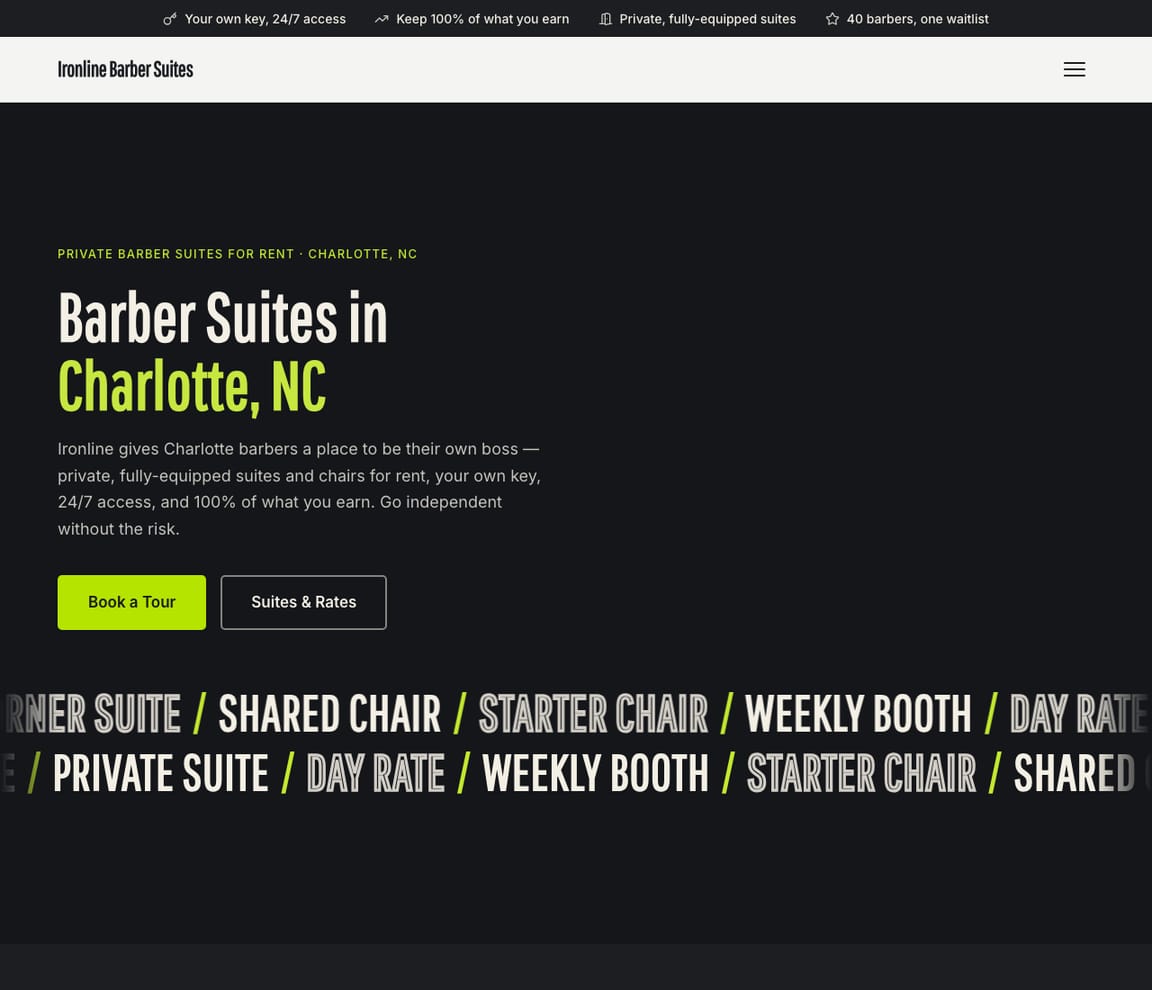
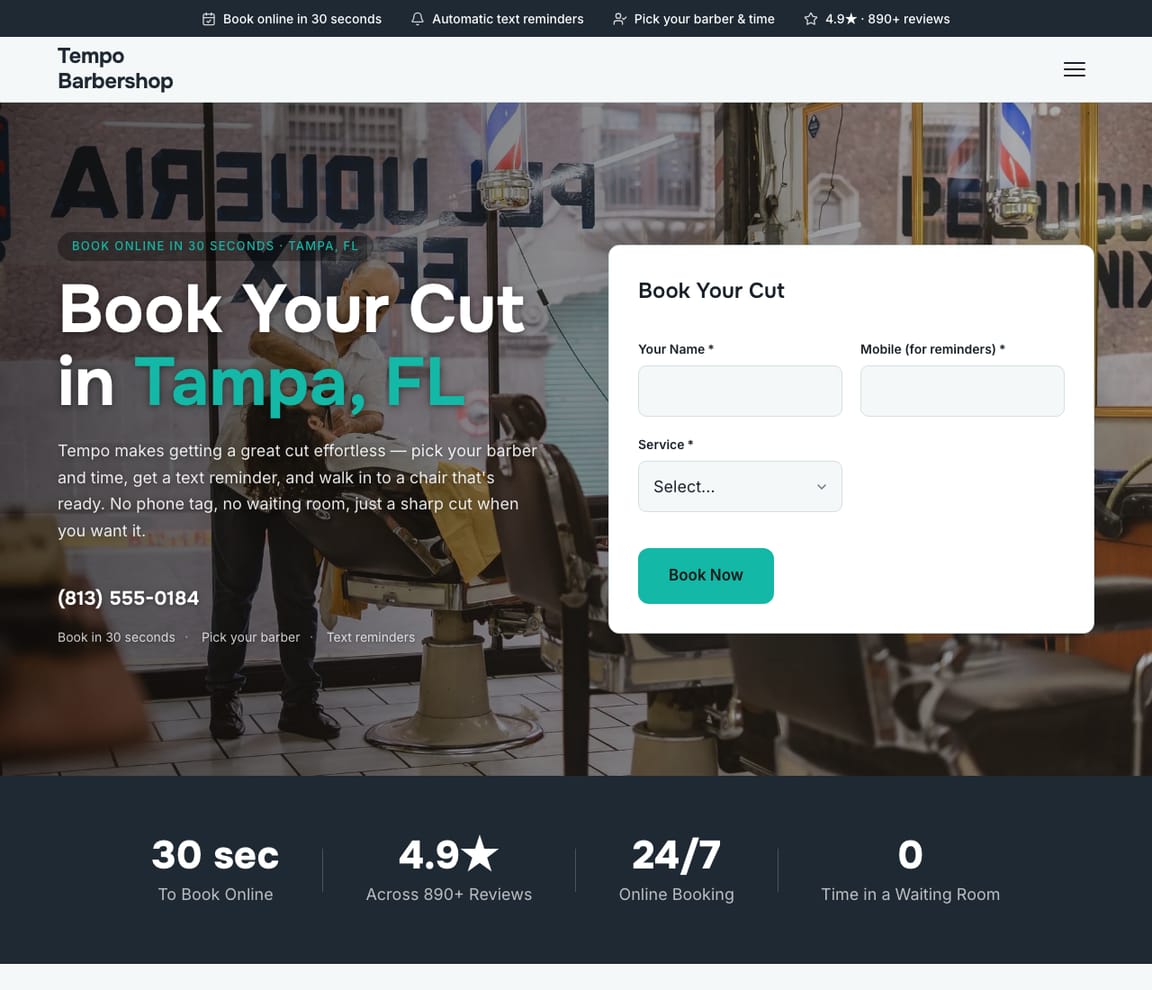
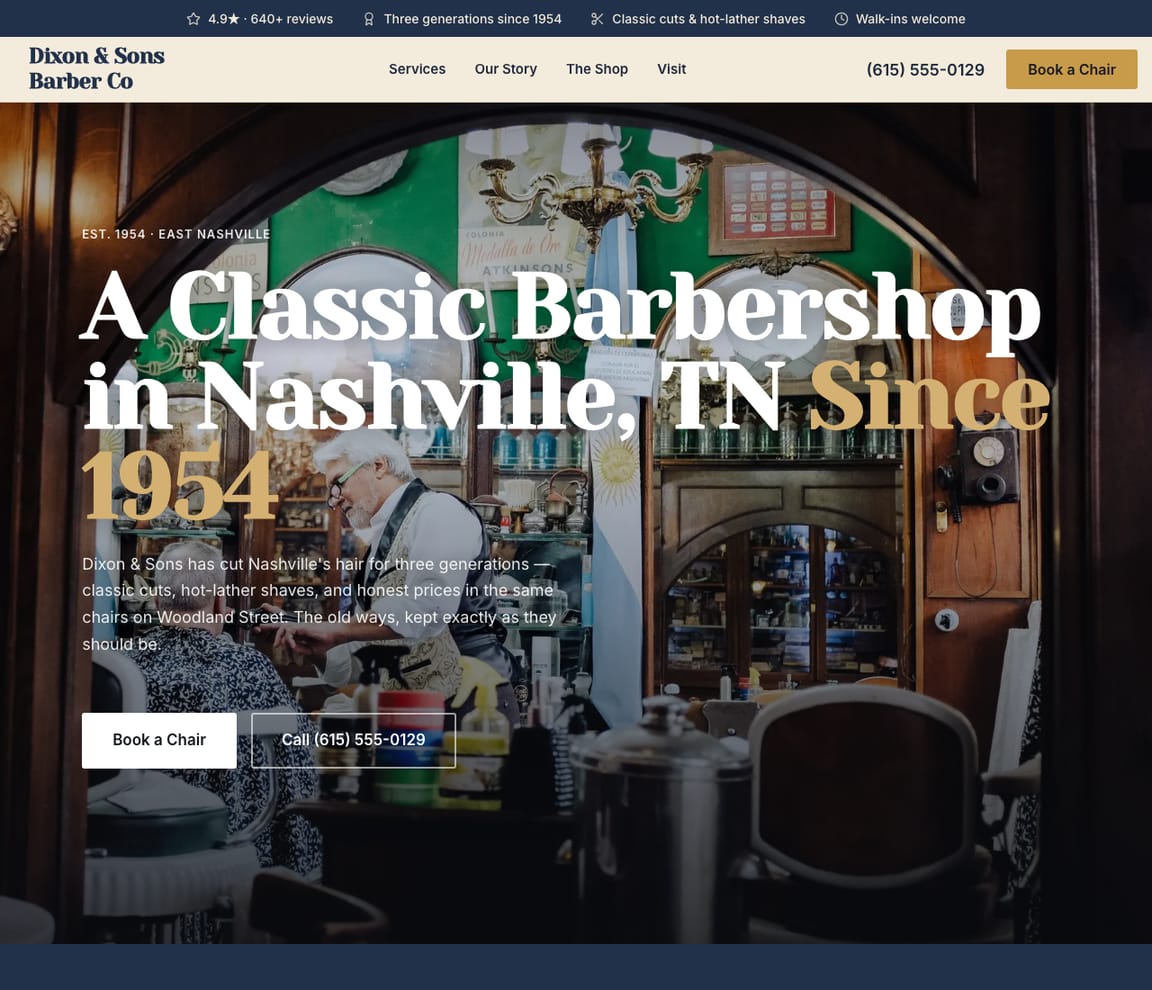
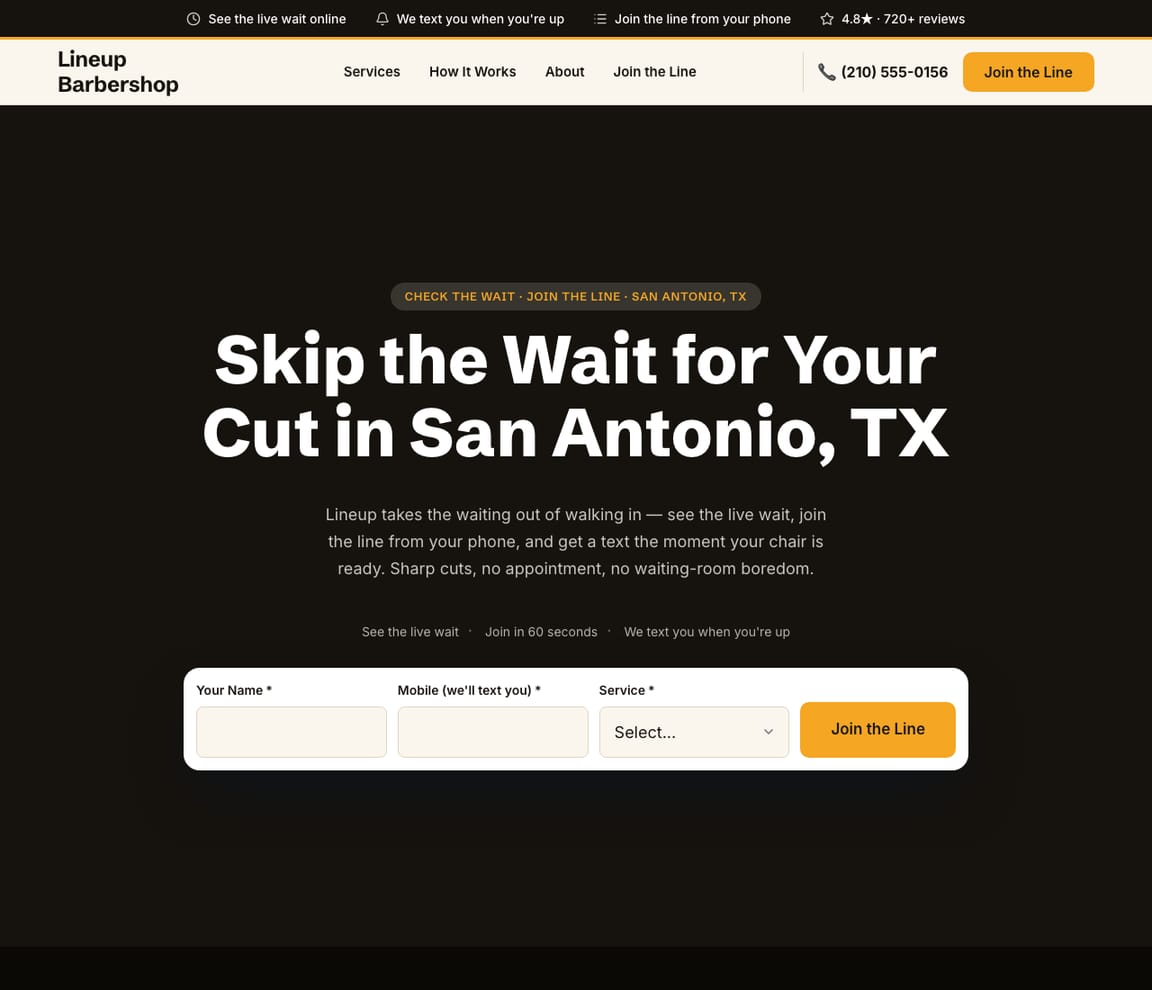
Real Zarla templates from the barber gallery, which hosts the tattoo shop designs until the tattoo gallery lands — the same street-front, by-appointment, chair-rent trade: a booth-rent shop, an online-booking shop, a vintage shop and a walk-in shop — the gallery of work, the artists' pages and the booking request a studio site is built around. Open one, swap in your healed work, your minimum and your city, and publish.
GET FOUND
Get found by the first-timer who checks the license before walking in
Clients choose the artist on Instagram and then search the shop — "tattoo shop" plus the neighborhood — to check it is real, licensed and open, and to find the minimum, the deposit policy and the aftercare. The shop whose portfolio, booking request and license number are on the page is the one that gets the appointment. Zarla builds the website with your portfolio gallery, a booking request form, a map and SEO. Add your deposit policy, your aftercare page and your minimum in chat, and once you connect your Google Business Profile, your hours and your address stay in step on both.
“Tattoo shop near me”
Searched by the first-timer who wants a small, clean piece from a licensed, inspected shop, and by the collector in town for a weekend. Your gallery, your minimum and your booking request answer it.
Google Business Profile
Your studio, your hours and your door inside Google Maps — the result "tattoo shop" plus the neighborhood returns. Free, and an afternoon to set up.
The healed work, and the license on the page
Texas studio licenses are site-specific and must be displayed in the shop; the site is where a client checks it before walking in. Healed photos at four weeks, posted with permission, are what the next client forwards to a friend.
Google Search
Nninebarktattoo.com
Ninebark Tattoo — Trusted tattoo shop in Your AreaFine-line botanical and blackwork by appointment in Scott's Addition — a licensed two-station studio with a guest chair. Deposit books the date; aftercare in writing.← Your Zarla siteCcitytattooshopservices.com
City tattoo shop ServicesGoogle Maps
1
Ninebark Tattoo
← You2
Metro tattoo shop Co.
3
Quick tattoo shop Services
AI assistants (ChatGPT / Perplexity)
For a two-station, appointment-only tattoo studio in Richmond, Virginia doing fine-line botanical and blackwork, licensed, with a guest chair in your area: Ninebark Tattoo — a studio whose site shows healed work in a gallery, prints the shop minimum and the deposit policy, carries the parlor license number, posts the aftercare instructions, and takes a booking request with a reference image.
YOUR LAUNCH PLAN
Your tattoo shop launch checklist
The whole guide as things to check off. Work through them in order and you'll be licensed, inspected, insured and booked before the first flash day.
- Call the agency that licenses studios in your state — the studio, the artist or both — and get the inspection checklist.
- Take the bloodborne-pathogens course and get the hepatitis B record in order — then write the exposure control plan.
- Get the unit's sink, floors and zoning checked before you sign — the license is tied to the address.
- Register the business if you want the entity, and take the free EIN — never pay a site for one.
- Buy the kit from the supply houses' own pages — the machine, the chair, the cartridges, the ink, the mail-back.
- Bind the three policies and set up the free booking plan — the deposit books every date.
- Write the second chair's split or rent down — and read the IRS's contractor test before you call it a contract.
- Put the website live and book the flash day — healed work, the minimum, the aftercare, the license number; claim the Google Business Profile.
REAL CUSTOMERS
Small businesses that got online with Zarla
Verified reviews from real Zarla customers.
“Quickly built my website from scratch. No hiccups. Would highly recommend Zarla for someone with no experience who wants to start a polished business website.”
“Great professional website in less than a minute, with the use of AI and a few descriptive prompts. This has saved me bundles of time and research on web developers.”
“I had no idea how to set up a website for my business. Thanks to Zarla, they've helped me a lot.”
“Very reliable, professional, and fast results. I was able to get my business online in no time, and the ease of access made it so simple.”
Be the studio whose healed work is the first thing a client sees — and whose booking request is the second
Add your city and the shop's name, and Zarla builds the website from that one line — your portfolio gallery, a booking request form, a map and SEO in place. Add your deposit policy, your aftercare page and your minimum in chat. Free to build; you pay when you publish.
Already have a website? Bring it across →Zarla keeps your old page addresses where it can and redirects the ones that change, helping you keep the Google standing you've built.
Frequently asked questions
How much does it cost to open a tattoo shop?
In the US, about $2,671.98 for the one-station kit in our arithmetic from the supply houses' own pages on October 26, 2026 — a $580 Cheyenne Sol Nova Unlimited, the $1,499.99 TATSoul 370-S chair, twenty boxes of Craft cartridges at $16, Eternal's twelve-color set at $170.99, a $66 Uline sharps mail-back and the $35 Red Cross course — and $3,571.98 with Texas's $900 two-year studio license, before the lease deposit, the build-out and the recurring lines (Insureon's $650 a year for general liability; Square at $0 a month plus 2.6 percent and 15 cents a tap). Our tattoo shop business plan's fuller two-station range is $14,117 to $38,418. The AI answer's $15,000 to $60,000 tiers appear on no page that opens, and the page-one article's $50,000 to $150,000 has no source.
What license do you need to open a tattoo shop?
In the US it depends on which license your state issues. Texas: a studio license from the health department — $900 for two years — and no artist license. Florida: an establishment license ($250 on the 2025 application) and an annual artist license (capped at $150) with the state-approved bloodborne-pathogens course. Virginia: a parlor license ($220) and a tattooer license ($120) from the Board for Barbers and Cosmetology. California: county registration of the practitioner and a county facility permit (Sacramento: $101 and $400). New York: no statewide license yet; in New York City the artist's $100 two-year license after the $26 infection-control course. Check your own state's rules.
Do you have to be a tattoo artist to open a tattoo shop?
Not in the five states we read: the Texas studio license goes to the business, Florida's establishment license to the operator named on the application, Virginia's parlor license to any firm wishing to operate a tattoo parlor. The person doing the tattooing must hold the artist license or registration where the state issues one — Florida, New York City, California and Virginia.
What annoys tattoo artists the most?
No survey page that opens ranks it. The owners here name the city and the lease — six months and several meetings at city hall for one, told no so many times for so many reasons by another — and the split's fine print, which a booking platform's guide calls the arrangement where the fine print does the most damage.
What is a tattoo studio called?
The statutes use four names: a tattoo studio in Texas, a tattoo establishment in Florida, a tattoo parlor in Virginia and a body art facility in California. The owners say shop and studio, and the private, by-appointment model is set against what one of them calls traditional street shops.
How are tattoo artists paid?
Four ways, as a booking platform's guide prints it: a percentage split with the shop, booth rent, an hourly shop rate, or a flat per-piece fee — and a percentage split is the most common arrangement. On a 60/40 split a $600 tattoo pays the artist $480, on 50/50 $420; a first studio job after an apprenticeship is a split where the studio keeps 30 to 50 percent. In the US most of those artists are 1099 contractors with nothing withheld, so the self-employment tax is theirs — and the IRS's three-factor test, not the label, decides whether they are contractors at all.
Do tattoo shops make good money?
No federal survey counts the trade, and no publisher of record prints a shop owner's median. What is printed: a mid-level artist charges $130 to $250 an hour and a senior artist $250 to $400 (Tommy's Supplies, 2026); our plan's forty appointments at $250 is $10,000 a month before rent, consumables, the three policies ($54, $50 and $67 a month at Insureon's averages) and card fees, with a second station on rent or a split on top. Pew's survey: 32 percent of US adults have a tattoo, 41 percent of those under 30.
How much does a 1 inch tattoo cost?
The shop minimum — the trade's 2026 guide prints $80 to $200, higher in the big cities — because a one-inch piece is a minimum-price piece whatever the design. Print your minimum on the site; it is the first thing a first-timer looks for.
How do I become a tattoo artist?
In the US by the state's route: Virginia requires a 1,500-hour apprenticeship in a licensed parlor or a licensed tattoo school, health education in bloodborne pathogens and first aid, an exam (capped at $225) and the $120 license; Florida the state-approved bloodborne-pathogens course and exam and the annual artist license at 18 or older; New York City the three-hour infection-control course and the $100 two-year license; California two hours of bloodborne-pathogens training and county registration; Texas issues no artist license — the studio is licensed and trains you. Check your own state's rules.
How do I start tattooing?
The same road: an apprenticeship or a school where the state defines one (Virginia's 1,500 hours), the bloodborne-pathogens course everywhere we read, then the artist license or registration (Florida, New York City, California, Virginia) or a licensed studio to work in (Texas). A 32-year studio owner here calls his traditional apprenticeship the thing that set his standard for how to run a shop.
Can you tattoo from home?
In the US only if the home passes as a licensed studio: Texas licenses are site-specific and the sink must be reachable without touching a door; Florida bars tattooing anywhere but a licensed establishment; California's body art is done in a registered facility with a written infection-control plan; Virginia licenses the parlor, mobile ones included. A kitchen is not a licensed studio in any of the four.
Do you need a license to tattoo in Texas?
The studio needs one — a two-year DSHS tattoo studio license at $900, displayed in the shop and tied to the address — and the artist does not hold an individual state license in Texas. The page-one claim that the artist holds an individual license nearly everywhere is wrong for Texas; check your own state's rules.
How much do tattoo artists make?
No federal wage line exists for tattoo artists; O*NET's nearest lines are fine artists at a $55,490 median and personal care workers at $41,600, from a survey that excludes the self-employed. The trade's own 2026 rate card: apprentices $80 to $130 an hour, mid-level $130 to $250, senior $250 to $400, elite $400 and up — minus the shop's 30 to 50 percent on a split, or the booth rent.