BUSINESS GUIDE
How to open an ice cream shop in 2026
For the home churner whose pints disappear at every party: what the counter and the freezers cost from the vendors' own pages (a twelve-tub dipping cabinet is about half of what the dealer blogs say), what five states charge to permit a scoop shop and which permits are for wholesalers only, how each state taxes a cone against a pint, what a scoop costs in ice cream against what it sells for, what the trade's own numbers and a franchise's disclosure say — and what the owners who did it say about the winter.
Free to build · Pay when you publish · No credit card
$6,469a cart start — the cart, six tubs, the paper, the scoops, the policy and Florida's permit and LLC, from the pages that open (our arithmetic)
$2,119a twelve-tub dipping cabinet at WebstaurantStore's member price on November 3, 2026 ($2,299 regular) — the equipment dealer's blog says "$4K–$10K"
$0.67of ice cream in a scoop from a $63.99 three-gallon tub of Tillamook at a small-batch maker's "approximately 96 scoops" a tub — against a $4.99 single at a university creamery (our arithmetic)
No codeto get online
See it in action
See what your ice cream shop website could look like
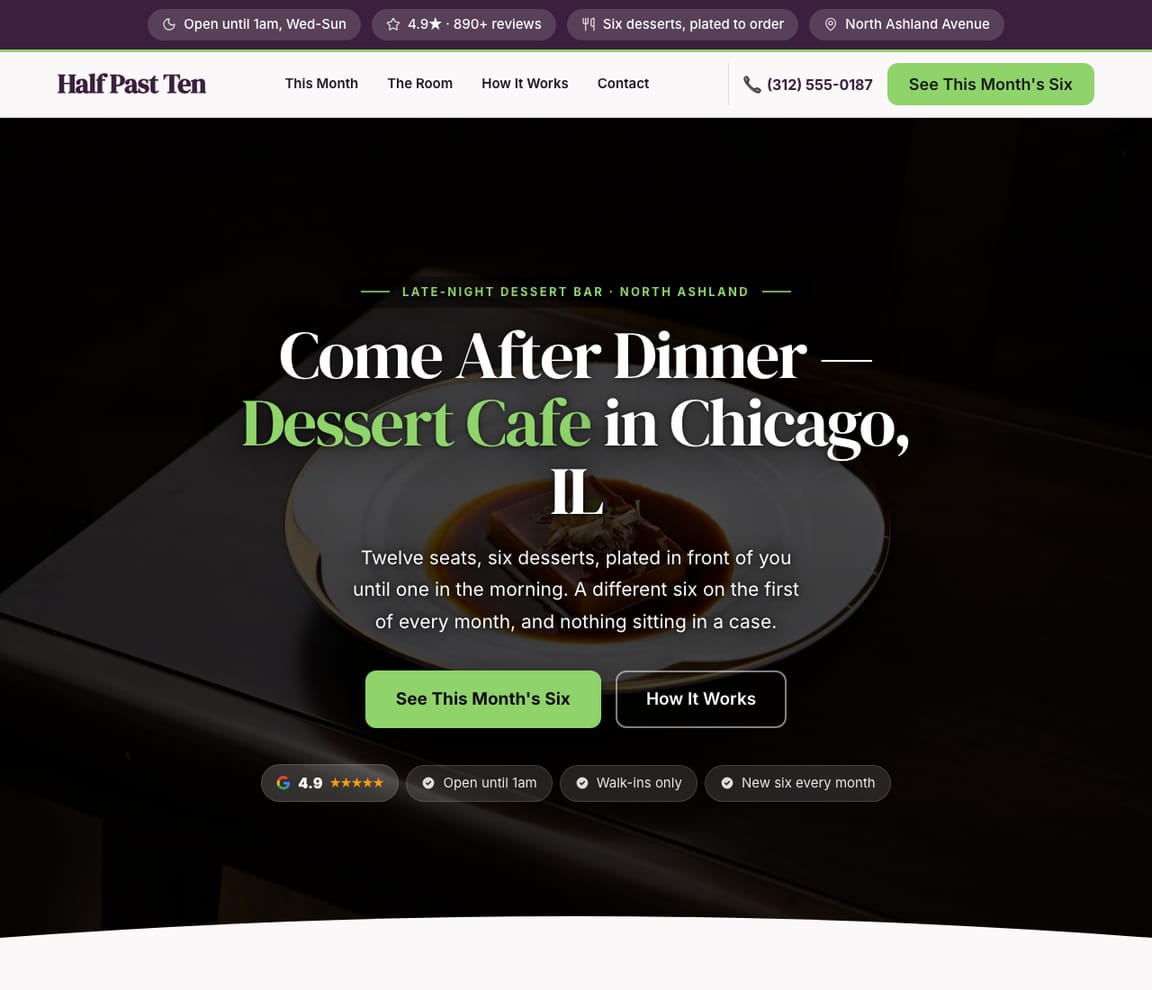
This is a real Zarla design for a late-night dessert cafe — it lives in the cafe gallery, because the ice cream shop entry has no gallery of its own yet. A dessert menu that changes monthly, the hours, the room, the walk-in rules. Describe yours — small-batch or soft serve, the neighborhood, pints and cakes to go — and you'll have a site like this, with your flavors, your hours and a map, in about a minute.
- Professional design — not a generic template
- Looks great on desktop and mobile
- Content written for your industry
Build the website
Start your ice cream shop website now
Add your town and the shop's name to the sentence, and Zarla builds the site: today's flavors, the hours, a map and a cake-and-catering order form. Add your prices, your seasonal hours and your online ordering in chat, then publish.
Already have a website? Bring it across →Zarla keeps your old page addresses where it can and redirects the ones that change, helping you keep the Google standing you've built.
Is opening an ice cream shop worth it in 2026 — and what do ice cream shop owners make?
The ice cream shop one owner can open is a scoop shop: 1,200 square feet on a neighborhood strip, a twelve-tub dipping cabinet, finished tubs from a dairy or a countertop batch freezer in back, pints and cakes to go, a cart for the summer festivals. The capital is the counter and the lease; the question is the winter. What the trade sells: "In 2025, ice cream makers in the U.S. churned out 1.23 billion gallons of ice cream." and "The average American eats roughly 18 pounds of ice cream each year, or about 4 gallons." — with "Chocolate" at the top of the favorite-flavor list (International Dairy Foods Association, 2026). What a scoop costs and sells for — our arithmetic. A three-gallon tub of Tillamook vanilla bean is "$63.99" and Turkey Hill vanilla "$40.49" at a restaurant supplier (WebstaurantStore); a small-batch maker's tub is "$127.50 WSP" and "Each tub holds approximately 96 scoops of ice cream (not counting sampling)." (Tipsy Scoop, wholesale tubs) — so a scoop carries $0.42 to $1.33 of ice cream, $0.67 for the Tillamook. A university creamery sells a "Single" for "$4.99" and a "1 Pint Cup" for "$4.99" (Utah State University Aggie Ice Cream menu); another a "Single Scoop" for $4.00 and a "Hand Packed Pint" for $7.64 (University of Nebraska–Lincoln Dairy Store, 2026). A $4.99 scoop with $0.67 of ice cream, an $0.11 cone and a taster spoon is about $0.79 of product, and a $7.64 hand-packed pint from the same tub — twenty-four to three gallons — about $2.67 of ice cream and a $0.23 cup and lid, $2.90; the rest is the counter, the rent, the scoopers and the four months nobody wants ice cream.
What employed managers and scoopers earn. "Workers on average earn $69,390." for food service managers, $33.36 an hour (O*NET, 2025) — the salary the shop must afford before there is a profit; "Workers on average earn $31,200." for fast food and counter workers, $15.00 an hour (O*NET, 2025) — the scooper. What owners report. No page of record prints a scoop-shop owner's draw. A franchise's 2026 disclosure, as a franchise site reproduces it, puts "Total Estimated Baskin-Robbins Franchise Costs: $307,400 to $626,700" and an "average unit volume" that "edged down 1.1% in 2025 to $526,669" (Franchise Chatter on the 2026 disclosure, August 9, 2026); a scheduling vendor's model says "Running a typical ice cream shop business can bring in $200,000 to $500,000 annually, depending on your size and location." and "An ice cream shop that makes $40,000 in July might only make $12,000 in January." with "a 20% net profit margin" — no source on the page (7shifts, May 26, 2025). The owners say the winter: "I mean, sales drop around 85% from the busy season to the rainy season." and "We actually lose money in the winter." — "And all that overhead continues, regardless of how much ice cream we sell." (Chad Draizin, Fifty Licks, Portland — OPB, May 27, 2025); "It's about chasing volume and margins." (Danielle Jowdy, Zsa's Ice Cream, Philadelphia, closing her shop — The Philadelphia Inquirer, January 21, 2025).
The catch. The rent runs twelve months and the line runs four; the dealer blogs price the counter at two to four times what the supplier's page prints, and the consultant's model at $404,500; the frozen-dessert licenses on every state's books are mostly for wholesalers, and the one the shop needs is the health department's; the sales tax on a cone, a pint and a cake is a different answer in every state read; and a first shop can close after four years before the second one works. That's what the rest of this guide sets up.
How to open an ice cream shop, in plain English
The federal layer — what ice cream is, and what a shop is. In the US, "Ice cream is a food produced by freezing, while stirring, a pasteurized mix" and "Ice cream contains not less than 10 percent milkfat, nor less than 10 percent nonfat milk solids", "not less than 1.6 pounds of total solids to the gallon" and "weighs not less than 4.5 pounds to the gallon." (21 CFR 135.110) — under that, it is "frozen dessert" on the label. The Food Code is "a model for safeguarding public health" "offered for adoption by local, state, and federal governmental jurisdictions" (FDA Food Code 2022) — your inspector enforces the state or county code that adopted it. A scoop shop does not register with the FDA: the registration rule does not apply to "(c) Retail food establishments;" or "(d) Restaurants;" (21 CFR 1.226). A packaged pint declares its allergens: "The major food allergens are milk, eggs, fish, Crustacean shellfish, tree nuts, peanuts, wheat, soybeans, and sesame." — sesame since "The change was effective on January 1, 2023." — because "FALCPA requires that foods or ingredients that contain a 'major food allergen' be specifically labeled" (FDA, March 11, 2026); a small shop's pint is exempt from the nutrition panel under the low-volume rule for a business with "fewer than an average of 100 full-time equivalent employees and fewer than 100,000 units", with a notice to the FDA where the rule asks for one (21 CFR 101.9). The EIN: "You never have to pay a fee for an EIN." (IRS).
The permit — five states in the agencies' own words, and the licenses you can skip. Texas: the state's retail food permit — where no city or county health department permits you — has "Fees for initial applications, renewals, and change of ownership are based on gross annual volume of food sales.": "$258" under $50,000 of food sales, "$515" to $149,999.99, "$773" above, and "Single event permits are $52, and the fee for a multiple event permit is $200." (Texas DSHS); every employee completes "an accredited food handler training course, within 30 days of employment." (Texas DSHS, food handler FAQ) and a shop "may be required to employ a certified food manager." (Texas DSHS, food manager FAQ). The frozen-dessert manufacturer license is not the shop's: the chapter's definition says "The term does not include a frozen desserts retail establishment." (Tex. Health & Safety Code §440.003), "This chapter does not apply to:" "a person operating a frozen desserts retail establishment; or" a retail store that is not also a manufacturer (§440.004); the license it requires for "the manufacture of a frozen dessert" (§440.011) is "$800 for a two-year license;" in the rule (25 Tex. Admin. Code §217.91) — for the shop that wholesales pints. Florida: a shop with seats is the hotel-and-restaurant division's — "a fee of $50 in addition to any other fees required by law or rule." to apply, and $262 for one to forty-nine seats on the rule's table — a mobile food dispensing vehicle is $347 in all on the same table — $185, $135, $17 and $10, our arithmetic (Fla. Admin. Code R. 61C-1.008), under the statute's cap, "The aggregate fee per establishment charged any public food service establishment may not exceed $400;" (Fla. Stat. §509.251); "All managers employed by a food service establishment must have passed an approved test" with "a period of 30 days after employment to pass the required test." (§509.039), and "Food service employees must receive certification within 60 days after employment." (§509.049), the certificate "valid for a period of five years from the date of issuance." (R. 61C-4.023). A to-go-only shop is the agriculture department's food permit instead — "To open a food establishment in Florida, you must obtain a food establishment permit from FDACS." (FDACS) — at "Minor Food Outlet 300" on its schedule, "Mobile Vendor 300" for a cart and "Frozen Dessert Manufacturer 200" (Fla. Admin. Code R. 5K-4.020); the frozen desserts plant permit — "The initial application for a frozen dessert plant permit must be accompanied by a permit fee of $200." and "The annual permit renewal fee is $100." — is for a place that pasteurizes or takes raw milk, with "Grocery stores, restaurants, soda fountains, and similar establishments" exempt (§502.053). New York: in the city, "The permit fee for most food service establishments in New York City is $280.00," "plus $25.00 if you will make frozen desserts." and "A supervising manager must pass a Food Protection Course and be on-site at all times." (NYC Business, food service establishment permit) — the course is "Free course, $24 for the final exam." online or "The course and final exam cost $114." in person, and "Your Food Protection Certificate does not expire." (NYC Business, food protection certificate). Outside the city the county health department permits the shop: the state's own jurisdiction table puts "ice cream and frozen" "dessert stands" and "dairy bars" under local health departments, the frozen desserts license under "frozen desserts" "(wholesale only)" (New York State Agriculture and Markets, jurisdiction table, revised March 2025) — "If you have a food service operation (such as a restaurant, café, pizza shop), contact your local health department." (New York State Agriculture and Markets). The licenses to skip unless you wholesale: the Article 20-C processing license "upon payment of the license fee of four hundred dollars" for "two years" (N.Y. Agric. & Mkts. Law §251-z-3), and the frozen desserts license for "Every wholesale manufacturer of frozen desserts produced for sale" (§71-b) at "Not to exceed 200,000 gallons $ 50.00" for two years (§71-c). California: every scoop shop is a "Food facility" — an operation that "stores, prepares, packages, serves, vends, or otherwise provides food" at retail (Cal. Health & Safety Code §113789) — permitted by the county: Los Angeles County's 2026–27 schedule prints "RESTAURANT (0-30) SEATS LOW RISK $319.00", "RESTAURANT (0-30) SEATS MODERATE RISK $719.00" and, for a new build, "PC - RESTAURANT (501-1,999 SF) $1,530.00" (Los Angeles County Public Health, fee schedule, August 18, 2026) — the risk line is the county's call at plan check; every food handler gets the card "within 30 days after the date of hire." (§113948). The dairy license is the plant's: "A frozen milk products plant license is required for the manufacture of hard frozen ice cream." — the first-year fee "$112.00" in 2026 and "$115.00" in 2027, "An additional inspection fee due quarterly also applies." (CDFA, milk product plant licenses), on a statutory "one hundred dollars ($100)" (Cal. Food & Agric. Code §35221) — ask the county whether a counter freezing bought-in pasteurized mix is a plant, because the page does not draw that line. The seller's permit: is there a fee — "No." (CDTFA). Pennsylvania: the agriculture department's retail food facility license, a new shop at $241, a new owner-operated shop with under 50 seats at $103, the annual renewal at $82 (Pennsylvania Department of Agriculture); the state's separate frozen dessert license was repealed in 2023 — the department's letter and the senator's release sit on pages that did not open today, so treat it as reported until one does. Check your own state's agency and your county before you sign the lease — in a city with its own health department, the permit and the fee are the city's.
The entity. Texas: "for filing a certificate of formation, $300;" (Tex. Bus. Orgs. Code §4.152, applied to an LLC by §4.154). Florida: "For filing original articles of organization or articles of revocation of dissolution, $100." plus "For filing a certificate designating a registered agent or changing a registered agent, $25." — $125 (Fla. Stat. §605.0213). New York: "two hundred dollars." for the articles (N.Y. LLC Law §1101) and the notice published "once in each week for six successive weeks" (§206). California: "Filing articles of organization of a limited liability company: Seventy dollars ($70)." and "Twenty dollars ($20)." for the statement of information (Cal. Gov. Code §12190), plus the annual tax "specified in subdivision (d) of Section 23153" (Rev. & Tax. Code §17941) — "a minimum franchise tax of eight hundred dollars ($800)." (§23153). Pennsylvania: the state's certificate of organization — its fee page did not open today, so no figure is printed here. The summer scoopers and workers' compensation: "an employer may elect to obtain workers' compensation insurance coverage" in Texas (Tex. Labor Code §406.002); "All private employments in which four or more employees are employed by the same employer" in Florida (Fla. Stat. §440.02); "Workers' compensation coverage is required for sole proprietors with employees, including part-time employees" in New York (New York Workers' Compensation Board); "Every employer except the state shall secure the payment of compensation" in California (Cal. Labor Code §3700).
The sales tax — a cone, a pint and a cake, five different answers. Texas: on the Comptroller's grocery list "Ice cream, sherbet and frozen yogurt." are taxable snack items when individual-sized, and "Any food sold with eating utensils." is taxable — "Eating utensils include trays, plates, knives, forks, spoons, glasses, cups, straws or chopsticks." (Texas Comptroller, publication 96-280, March 2024), so the scoop in a cup with a spoon is taxed and the multi-serving pint carried out is the question to put to the Comptroller. Florida taxes the pint by name: the food exemption leaves out "Ice cream, frozen yogurt, and similar frozen dairy or nondairy products in cones, small cups, or pints" and "Food that is prepared, whether on or off the premises, and sold for immediate consumption." (Fla. Stat. §212.08). New York's bulletin gives the example straight: "ice cream served on a cone or in a sundae" is taxable, ice cream "sold in a container by weight (including hand-packed pints, quarts, etc.)" is exempt, a "made-to-order cone or sundae." is taxable (New York Tax Department, TB-ST-283, April 8, 2019). California's rule is the room: "The “80-80 rule” applies when more than 80 percent of your gross receipts are from sales of food products" and "more than 80 percent of the food products you sell are taxable." — "Cold food products include cold sandwiches, milkshakes, smoothies, ice cream, and cold salads." — and to keep the cold to-go sales exempt, "Sales of those products must be separately accounted for and supported by documents" (CDTFA, tax guide for restaurant owners). Pennsylvania draws the sharpest line: "The sale of hand-dipped ice cream in any quantity is taxable", the grocery items a food retailer sells untaxed include "prepackaged ice cream products such as ice cream by the pint, quart, 1/2 gallon or gallon quantities.", and "The sale of ice cream cakes, pies and prepackaged ice cream sundaes by 'I' would not be subject to tax." (61 Pa. Code §60.7). Confirm the details with your accountant before the register is programmed.
The money to start — three starts, our arithmetic, and the "$50,000" and "$404,500" page one prints. From the pages that open on November 3, 2026. A cart: "A brand new high quality pushcart without any refrigeration or cold-plates generally starts around $2900," and with cold plates "will start at around $4,500 for the smallest models." (Freezer Planet, November 18, 2021); six tubs of Tillamook at "$63.99" ($383.94); a case each of "JOY #10 Flat Bottom Jacketed Cake Cone - 720/Case" at "$82.49/Case" and "JOY #310 Sugar Cone - 400/Case" at "$43.99/Case" (WebstaurantStore), 4-ounce cups at "$72.49/Case" (WebstaurantStore) and spoons at "$28.49/Case" (WebstaurantStore) — $227.46; two "Vollrath 47274 #10 Aluminum Brown Ice Cream Scoop / Dipper - 4 oz." at "$19.80/Each" (WebstaurantStore); the policy — "Ice cream parlors pay an average of $74 per month, or $893 annually, for general liability insurance." (Insureon, September 28, 2026); Florida's LLC at $125 and its "Mobile Vendor 300" permit — $6,469. A used truck instead: a 2023 Ford E-450 soft-serve truck at "$31,360" on a used-vending listings page (UsedVending, a listing). A lean storefront buying tubs, 1,200 square feet, Pennsylvania's fees: the counter — "Avantco CPW-68-HC 67 3/4" 12 Tub White Deluxe Ice Cream Dipping Cabinet" at "$2,119.00/Each" and the sixteen-tub at "$2,789.00/Each", the supplier's member prices, $2,299 and $3,039 regular (WebstaurantStore), "Avantco A-23F-HC 29" Solid Door Reach-In Freezer" at "$1,299.00/Each", $1,419 regular (WebstaurantStore), "Excellence FT-4 25" Four Tub Ice Cream Storage Freezer" at "$1,049.00/Each" (WebstaurantStore), a "Regency 11" Ice Cream Dipper Well and Faucet Set" at "$99.99/Each" (WebstaurantStore), a "San Jamar IC2200SM Wall-Mount Plastic Ice Cream Cone Dispenser" at "$122.49/Each" (WebstaurantStore) and six scoops — $4,808.28; sixteen tubs and a case each of three cones, three cups and two spoons — $1,472.26; the policy — "Ice cream shops pay an average of about $178 per month, or $2,140 annually, for a business owner's policy." and "The average cost for workers' compensation insurance for ice cream stores is $77 per month, or $929 annually." (Insureon) — $3,069; the room at the landlord survey's "national asking rents reaching $25.82 per square foot (psf)" (Cushman & Wakefield, Q3 2026 US shopping center MarketBeat, October 14, 2026) — $2,582 a month, three months' deposit and the first month $10,328; Pennsylvania's $103 license as a sole proprietor (its LLC fee page did not open today) — $19,781, before the build-out. A shop making its own, 1,400 square feet, Los Angeles County's fees: a "Carpigiani LB100 B 4 Qt. Air Cooled Countertop Ice Cream / Gelato Batch Freezer - 208-230V" at "$13,932.35/Each", with a "Cattabriga Cubo 2i 2.75 Qt. Air Cooled Countertop Batch Freezer - 220V, 1 Phase" at "$5,499.00/Each" the cheapest on the page and a "Coldelite Compacta 4 6 Quart Countertop Horizontal Batch Freezer with Pasteurizer - 208-230V, 1 Phase" at "$32,591.00/Each" (WebstaurantStore) — the American scoop-shop standard, the Emery Thompson, prints no price on any maker's or dealer's page, only a used one at "$12,995.00" beside "New MSRP: $20,000.00" (Slices Concession, a used listing); a "Master-Bilt IHC-27 60 Gallon Stainless Steel Ice Cream Hardening Cabinet - 115V" at "$10,700.80/Each" (WebstaurantStore); the sixteen-tub cabinet, the reach-in, the small iron and a case of three-gallon tubs — $29,199.42; ten cases of "Turkey Hill Frozen 10% Premium Vanilla Soft Serve Ice Cream Mix 1 Gallon - 4/Case" at "$84.99" and the paper (WebstaurantStore) — $1,298.32; the two policies, $3,069; the room, $3,012 a month and $12,049 to sign; the county and the state — $70 and $20 for the LLC, $800 of annual tax, the $1,530 plan check, the $319 permit, the $112 plant license — $2,851: $48,467, before the build-out. Soft serve instead of hard-pack: a "SaniServ DF200 DuraFreeze 7 Qt. Countertop Soft Serve Ice Cream Machine with 1 Hopper - 115V" at $4,929.00 to a twin-twist "Spaceman 6250-C" at $16,709.00 (WebstaurantStore). The build-out is the one line no page prices from a contractor — the dealer blog's "B. Build-Out & Renovations: $20,000 – $100,000+", with "Dipping cabinets: $4K–$10K" and "Most new ice cream shops will cost between $75,000 and $250,000 to open." (Sentry Equipment, June 23, 2025) — so the lean storefront is about $39,781 at its low end, our arithmetic on their figure. The cards: "2.6% + 15¢" in person through Square (Square), "Standard card payments are 2.9% + 0.30 USD in the US" through Stripe (Stripe support). What page one prints: "Typically, opening an ice cream shop will cost you anywhere between $20,000 to $50,000." (WebstaurantStore, September 1, 2026); "Most ice cream parlor businesses can expect to spend, on average, $50,000," (eHopper, January 26, 2019 — the figure Google's AI Overview repeats); a consultant's "$404,500" for "roughly 1,100 square feet in a second-generation space in a mid-size US market", with $231,000 of it the build-out (Wilson K Lee, August 2026). The winter is not in any of those sums: at $2,582 to $3,012 a month, four months of rent is $10,328 to $12,048 to bank before the first summer.
In the UK: "Registration of your food business is free and can't be refused." and "You should do this at least 28 days before you start trading." (GOV.UK, starting a food business, updated August 19, 2026) — "You are required to register at least 28 days before trading." (GOV.UK, food business registration); you "will need to demonstrate that you have been adequately trained in food hygiene." (GOV.UK). The inversion on tax: ice cream is standard-rated whether eaten in or taken away — "You must standard rate your supplies of any product designed to be eaten while frozen." (HMRC, VAT Notice 701/14, updated June 8, 2026) — so the cold-takeaway relief that helps a sandwich shop does not help a scoop shop; VAT registers once turnover "is more than £90,000." (GOV.UK). In Australia: "You need to notify your local council if your business sells or serves food directly to consumers." (Service NSW, February 27, 2024) — "You will need to notify either your council or the NSW Food Authority if you intend to operate a food business." (ABLIS, 2026–27); a shop that pasteurizes its own mix is the Food Authority's dairy license, whose pages timed out today and whose application page carries a British spelling in its address, so it is described, not linked; "It's free to register for an ABN through the Australian Government's Australian Business Register (ABR)." (business.gov.au) and GST once "your business has a GST turnover of $75,000 or more" (business.gov.au) — the Tax Office's page listing ice cream among taxable foods refused a reader today. Check your own state's rules and your council.
What ice cream shop owners actually say
None of this is our opinion about opening a scoop shop. It comes from owners who did — in Oregon, New York, Virginia, Pennsylvania, Texas, Georgia, Colorado, California, Alabama, Utah, Florida, Wisconsin and Tennessee — talking to CanvasRebel, the Voyage and Shoutout magazines, a public radio station and the local papers between 2019 and 2026, each described as the page describes them. Read each as theirs at the time. Five things come up again and again.
Why they opened. Jeni Britton, Jeni's Splendid Ice Creams: “I started making ice cream in 1996 when I was 22 years old.”, “I quit art school to open my first ice cream shop, Scream.” and “Despite all my hard work and passion, I had to close the shop four years after its opening.” (NashvilleVoyager, August 22, 2022). Ryan O'Hara, Big Spoon Creamery, Birmingham: “Throughout our careers working as chefs in high end restaurants, we knew we wanted to start our own venture one day.” (ShoutoutAtlanta, December 21, 2022). Lolita Yagnik, Lolita's Parlour: “During 2007 I was going through grad school and I was assisting my cousin at her ice cream shop.” (ShoutoutAtlanta, September 4, 2025). Jeff, Hidden Oak Gourmet Creamery, Utah: “In 2013, I began making ice cream as a hobby, sharing it with family and friends.” (VoyageUtah, October 30, 2024). Sam Howland, a scoop-shop owner in Los Angeles: “We started out 5 years ago with a home ice cream maker and a freezer.” (ShoutoutLA, November 17, 2020). Alyssa and Ray Wyatt, Churned Ice Cream, St. Petersburg: “Now that we own our own business, we have found ourselves again.” (CanvasRebel, June 26, 2023).
“I mean, sales drop around 85% from the busy season to the rainy season.” — Chad Draizin, Fifty Licks, Portland, in OPB, May 27, 2025
The first year and the money. Chad Draizin again: “We actually lose money in the winter.” and “And all that overhead continues, regardless of how much ice cream we sell.” (OPB, May 27, 2025). Petrushka Bazin Larsen, Sugar Hill Creamery, Harlem: “When we closed, we didn't have any ice cream left, which was exciting and terrifying” and “Looking back, we probably should have gotten more consulting from experienced business owners before opening.” (CanvasRebel, January 9, 2025). Erin Bottcher, Bev's Homemade Ice Cream and Cafe, Richmond: “I purchased my business at 22 years old, 9 months after graduating college in 2021.” and “Every year Richmond grows, and so does my business!” (CanvasRebel, August 13, 2024). Jeff of Hidden Oak: “When the money isn't coming in, I have to trust in the product!” (VoyageUtah, October 30, 2024). Danielle Jowdy, Zsa's Ice Cream, Philadelphia, on wholesale against the counter: “In two weeks selling at Whole Foods, we sold less than we did in two days here.” and “It's about chasing volume and margins.” (The Philadelphia Inquirer, January 21, 2025). Peter Penizotto, Big Dip, North Syracuse, closing for the season: “That's all you need. A few good days to make up for five or six bad days.” (NCC News, November 28, 2023).
The customers and the marketing. Sharyn Lindblad, Cocktail Creamery, McKinney, Texas: “We started out slowly with just 9 flavors and listened to what flavors our customers were interested in” (VoyageDallas, February 24, 2022). Alyssa and Ray Wyatt on Instagram: “It is the #1 way for our customers to find us, follow us and book us for events/order ice cream/etc” (CanvasRebel, June 26, 2023). PJ Smith, nineteen, Mr. Ice Cream, Springfield, Oregon: “In the beginning, we wanted to keep it just as simple as possible,” and “Five straight hours. Just a line out the door down the block. Everyone was getting ice cream.” (The Chronicle, December 21, 2023). Patty Jackson, Cobachi C.R.E.A.M., Suwanee, Georgia: “Cobachi CREAM began in 2021 as a pop-up festival business in the Suwanee area of Gwinnett.” and “In 2022, we expanded into catering services, further broadening our reach.” (ShoutoutAtlanta, September 4, 2024). Brittney and Ryan Stirpe, The Conroe Ice Cream Boat, Texas: “There was a lot of behind-the-scenes work getting the boat initially set up and approved to get out on the water.” (VoyageHouston, January 27, 2026). Lolita Yagnik: “We originally started off as an ice cream store only but a few months in we realized we had to add more stuff.” (ShoutoutAtlanta, September 4, 2025).
The premises and the lease. Petrushka Bazin Larsen: “We found a space close to our house that was affordable but only 500 square feet.” (CanvasRebel, January 9, 2025). Sharyn Lindblad: “Fortunately, we were offered an opportunity to open our shop inside the Pantry Restaurant at 214 E Louisiana St.” and “However, when we started out, we shared a small space within 2 other locations of which both of them closed” (VoyageDallas, February 24, 2022). Emily Hester, JoJo's Creamery, Encinitas: “My Mom and I opened JoJo's Creamery in March 2017 in Encinitas.” and “We are grateful we get to make ice cream a few blocks from the beach in a town we love.” (SDVoyager, July 18, 2019). Christine Cruz, selling Babe's Ice Cream in Milwaukee as its winter break began: “This was not an easy choice, but I am at peace knowing [Babe's] will continue to grow,” (Urban Milwaukee, November 24, 2025).
The staff, the owner and the burnout. Troy Knuckle, Howdy Homemade Ice Cream, Aurora, Colorado: “It's a very seasonal business,” and “When it gets slow, we sometimes have to cut back on shifts, which goes against our mission of keeping these heroes employed.” (CBS News Colorado, January 2, 2025). Sam Howland: “There were so many times when we questioned what we were doing and if we were making the right decisions (we still do).” and “The late nights and long days require you to give absolutely every bit of yourself to the business.” (ShoutoutLA, November 17, 2020). Ryan O'Hara: “Adversity and problems happen everyday when you own a business, so it's crucial to be an elite problem solver.” (ShoutoutAtlanta, December 21, 2022). Taylor and Dylan Ruby, an ice cream truck franchise in Peachtree City: “We have had truck electrical issues, ice cream deliveries showing up all hours of the day and many humorous fumbles.” (VoyageATL, October 9, 2025). Francene White, Perfect Blend Urban Creamery, Atlanta: “Honestly, the biggest obstacle has been myself.” (VoyageATL, June 17, 2026). Lauren Koritko, Sunset On Main, Newnan, Georgia, who began with a mobile Italian ice cart: “Just because it gets difficult doesn't mean it's not worth doing.” (ShoutoutAtlanta, April 17, 2024). Alyssa and Ray Wyatt on running it as a couple: “It is imperative you both have the same drive and passion for the business or you/and or the business will fail.” (CanvasRebel, June 26, 2023). Erin Bottcher: “…it truly takes a village to maintain a business.” (CanvasRebel, August 13, 2024).
The through-line: the owners who lasted started small — a cart, a pop-up, nine flavors, 500 square feet, or a shop bought with its regulars — added the cakes and the catering that carry a winter, kept the counter rather than chasing wholesale volume, grew on the block party and the festival line, and treated the rainy season as the calendar rather than a surprise.
THE STARTER KIT
What you need to open an ice cream shop
The food permit — $103 to $319 in the five states, and the ones you can skip
Texas $258 by food sales where the state permits; Florida $262 plus $50 for a seated shop, $300 to go only; New York City $280 plus $25 for making frozen desserts; Los Angeles County $319 plus a $1,530 plan check; Pennsylvania $103 for an owner-run shop under 50 seats. The frozen-dessert manufacturer licenses are for wholesalers and plants, not a counter.
The counter — a third of what the dealer blog says
A twelve-tub dipping cabinet is $2,119 and a sixteen-tub $2,789 at WebstaurantStore's member prices ($2,299 and $3,039 regular) against the dealer blog's "$4K–$10K"; a reach-in freezer $1,299 ($1,419 regular), a four-tub storage freezer $1,049, a dipper well $99.99, a cone dispenser $122.49, a #10 scoop $19.80. The whole counter at the member prices, our arithmetic, $4,808.28.
The ice cream — a dairy's tub, or your own batch freezer
A three-gallon tub of Tillamook is $63.99, Turkey Hill $40.49, a small-batch maker's $127.50 wholesale — about 96 scoops a tub, so $0.42 to $1.33 of ice cream in a scoop. Making your own: a 4-quart Carpigiani batch freezer $13,932.35, a hardening cabinet $10,700.80, mix at $84.99 a case.
The sales tax on a cone against a pint
Florida taxes ice cream in cones, small cups or pints by name; New York exempts the hand-packed pint and taxes the cone; Pennsylvania taxes anything hand-dipped in any quantity and exempts the sealed pint and the cake; California's 80/80 rule taxes everything unless the cold to-go sales are tracked apart; Texas taxes a scoop sold with a spoon.
Insurance at the insurer's medians
Insureon's September 2026 page: a business owner's policy at $178 a month, $2,140 a year; general liability alone at $74 a month, $893 a year; workers' compensation at $77 a month, $929 a year, once the summer scoopers are on payroll.
The cart, the cards and the website
A push cart with cold plates starts around $4,500 at a cart dealer, $2,900 without; cards are 2.6% plus 15 cents in person through Square or 2.9% plus 30 cents online through Stripe. The site shows today's flavors, the hours, the map and the cake-and-catering form.
THE PAPERWORK
Licenses, permits and taxes for a new ice cream shop
| Typical cost | Time to get | Legally required? | |
|---|---|---|---|
| Health department food permit | $258 TX (by sales); $262 + $50 FL seated, $300 to go; $280 + $25 NYC; $319 + $1,530 plan check LA County; $103 PA owner-run | Weeks; the plan check first on a new build | Yes — the scoop shop's permit in every state read; a city with its own health department issues it instead |
| Frozen-dessert manufacturer / plant license | $800/2 yrs TX; $200 + $100/yr FL; $50/2 yrs NY; $112/yr CA; repealed PA | Weeks | Only to wholesale or pasteurize — Texas and New York say the retail counter is outside it by name |
| Food handler cards and the certified manager | Course-priced; NYC's exam $24 online, $114 in person | 30 days after hire (TX, CA); 60 days FL, 30 for the manager | Yes — every employee's card in TX, FL and CA; a certified manager in FL, NYC and usually TX |
| FDA food facility registration | Free — and not required | — | No — a retail food establishment is exempt by rule; a shop that wholesales pints is the case to check |
| Allergen label on a packaged pint | Free | Before the first pint sells | Yes — milk, and any nut, egg, wheat or sesame in the ribbon; the nutrition panel is exempt for a small shop |
| Sales tax registration | Free (CA: "No.") | Days | Yes — the cone is taxed in every state read; the pint and the cake differ by state |
| The entity | $300 TX; $125 FL; $200 + publication NY; $70 + $20 + $800/yr CA; PA's fee page did not open | Days to weeks | No — a sole proprietorship is lawful; the LLC is the common choice |
| EIN | Free | Minutes | Needed to hire the summer scoopers; free from the IRS — never pay a site |
| Mobile vendor / cart permit | $300 FL (FDACS); $347 in all for a mobile food dispensing vehicle on the DBPR rule's table (our arithmetic); by city in TX | Weeks | Yes for a cart or a truck — and a commissary in many cities; ask the health department |
| Zoning, occupancy, the plan check | A planning $0–$500; LA County's plan check $1,044–$1,865 for a shop under 4,000 square feet | Weeks to months | Yes — the certificate of occupancy after the build-out passes; the health department's plan check before it starts |
| Insurance | $2,140 BOP; $893 GL; $929 WC (Insureon's medians) | Days | The landlord wants the certificate; workers' compensation from the first part-timer in CA and NY, from four employees in FL, elective in TX |
| Music licensing | By quote | Before the first playlist | Yes — recorded music in the shop is a public performance |
THE STEPS
How to open an ice cream shop (step by step)
Eight steps from a home churn and a chest freezer to a scoop shop with twelve tubs in the cabinet, pints and cakes to go and a cart for the festivals.
01
Sell from a cart first, and learn the nine flavors
A cart with cold plates at $4,500, six tubs, a case each of cones, cups and spoons, two scoops, the policy and Florida's mobile-vendor permit is about $6,469 in our arithmetic. One Texas owner started with nine flavors and listened; a Georgia shop started as a pop-up at festivals and added catering the next year. The cart tells you the flavors and the block before the lease does.
Before the lease02
Form the entity and take the EIN
Texas $300, Florida $125, New York $200 plus six weeks of newspaper notice, California $70 plus $20 and the $800 minimum tax, Pennsylvania $125. "You never have to pay a fee for an EIN." The IRS form takes minutes, and the health department's application asks for it.
03
Learn which permit is the shop's — and which are for wholesalers
A scoop shop is a food establishment of the state or county health department: Texas $258 by sales, Florida $262 plus $50 seated or $300 to go, New York City $280 plus $25 for making frozen desserts, LA County $319 plus the plan check, Pennsylvania $103. Texas's $800 frozen-dessert manufacturer license, Florida's $200 plant permit, New York's $50 frozen-desserts license and California's $112 plant license are for wholesalers and pasteurizers — not a counter freezing bought-in mix.
04
Decide: a dairy's tubs, or your own batch freezer
Buying finished tubs — $40.49 to $63.99 for three gallons at the supplier, $127.50 from a small-batch maker — skips the batch freezer, the hardening cabinet and in three of the five states the plant license. Making your own adds a $5,499 to $13,932.35 countertop batch freezer, a $10,700.80 hardening cabinet and mix at $84.99 a case — and the flavors nobody else has.
05
Sign the lease with the winter in the bank
At the landlord survey's $25.82 a square foot, 1,200 square feet is $2,582 a month and the deposit and first month $10,328. One owner's sales drop 85 percent from the busy season to the rainy one and the shop loses money in winter; another's first shop closed after four years. Bank four months of rent before the first summer, and ask the city about a cart for the off-season.
06
Buy the counter from the pages that print prices, bind the policy
The twelve-tub cabinet at $2,119, the reach-in at $1,299 — the supplier's member prices — the storage freezer at $1,049, the dipper well, the cone dispenser, six scoops — $4,808.28 for the counter. Sixteen tubs and a case each of cones, cups and spoons, $1,472.26. Insureon's business owner's policy at $2,140 and workers' compensation at $929 before the first scooper clocks in.
07
Price the scoop, set the tax, publish the site
A university creamery sells a single for $4.99 and a pint cup for $4.99; another $4.00 a scoop and $7.64 a hand-packed pint. At $4.99, Tillamook's $0.67 of ice cream plus a cone and a taster spoon is about $0.79 of product. Learn your state's cone-versus-pint tax line before the register is programmed. The website shows today's flavors, the hours, the map and the cake form; the Google Business Profile puts the door on the map.
08
Open on the block party, then plan for January
The owners who lasted sold at the festival that drew the line down the block, added the cakes and the catering for the winter, kept the shifts honest when it got slow, and treated the 85 percent drop as the calendar rather than a surprise. Those still open bought a shop with its regulars, or sold theirs to someone who would keep it.
THE COSTS
How much does it cost to open an ice cream shop?
Three starts from the pages that open, our arithmetic: a cart buying finished tubs with Florida's fees, a lean storefront buying tubs with Pennsylvania's, a shop making its own with Los Angeles County's — every addend named in the plain-English section. The build-out is the one line no page prices from a contractor, so it is the dealer blog's range, labeled.
$6,469a cart — $4,500 + $383.94 + $227.46 + $39.60 + $893 + $125 + $300 (our arithmetic)
$19,781a lean storefront buying tubs, before the build-out — the counter $4,808.28 at the supplier's member prices, product $1,472.26, insurance $3,069, rent to sign $10,328, Pennsylvania's $103 license; about $39,781 with the dealer blog's lowest build-out
$48,467a shop making its own, before the build-out — the freezer side $29,199.42, mix and paper $1,298.32, insurance $3,069, rent to sign $12,049, Los Angeles County and the state $2,851
$2,582a month for 1,200 square feet at the national shopping-center asking rent of $25.82 a square foot — the winter's four months is $10,328 to bank
WHAT WE'VE LEARNED
What actually brings a scoop shop its regulars
Thousands of local business websites in, the pattern for a scoop shop is clear: the first customers come from the opening weekend and the block, and the ones after that come from the site answering the three questions. For a new shop, three things on a page decide who walks in — and the cafe templates that host the scoop shop's design are built around them.
Today's flavors, with what's new this week
A scoop shop sells what is in the cabinet now. One owner's whole marketing was nine flavors and listening to what customers asked for next; the flavor board on the site is the Instagram post that never goes stale.
The hours, by season, printed
Owners say sales drop by most of the summer's take in the rainy months, and some close for the winter. The site that says what the hours are this week is the one the family drives to; the one that doesn't sends them to the chain.
A cake-and-catering form that takes one minute
A name, a date, a flavor and a headcount — nothing more. The deposit and the design come by reply; the form on the page is the door, not the paperwork. Owners say the cake and the party booking are the winter's income.
THE EARNINGS
What ice cream shop owners make, and what a scoop is worth
No page of record prints a scoop-shop owner's draw; the nearest employed figures are O*NET's 2025 medians for the manager and the counter, the scoop figures are two creameries' own menus, and the franchise figure is a franchise site's reproduction of a 2026 disclosure.
$69,390the 2025 median for food service managers, $33.36 an hour — the salary the shop pays before profit; fast food and counter workers $31,200, $15.00 an hour (O*NET)
$4.99a single scoop and a pint cup at Utah State's creamery; $4.00 a scoop and $7.64 a hand-packed pint at Nebraska's — two real menus, no survey
$0.79of product in a $4.99 scoop — $0.67 of Tillamook from a $63.99 tub, an $0.11 cone, a taster spoon — before the counter, the rent, the scoopers and the winter (our arithmetic)
$526,669a franchise's 2025 average unit volume as a franchise site reproduces the 2026 disclosure, which prices the build at $307,400 to $626,700
SEE IT WORK
Cafe website designs a scoop shop can start from
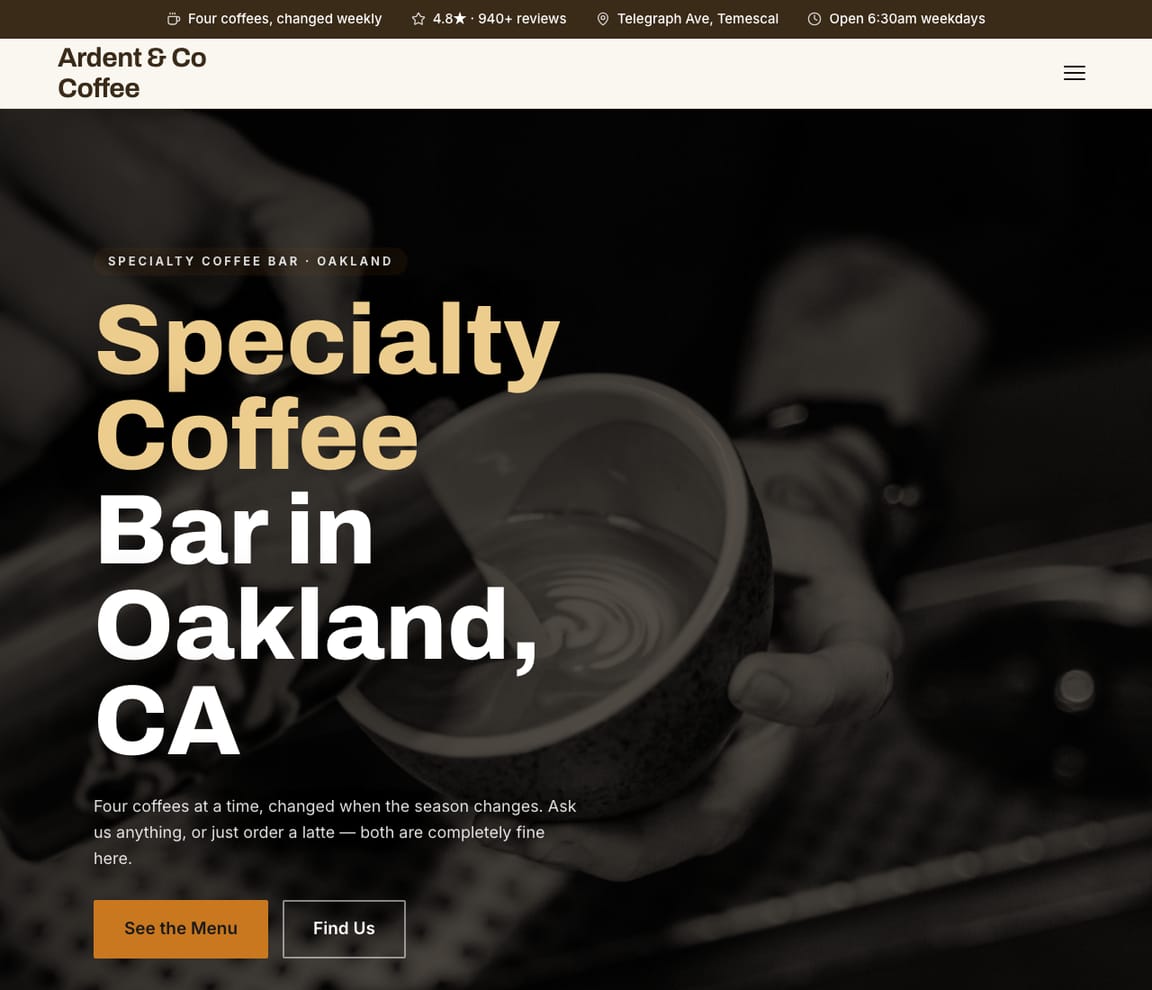
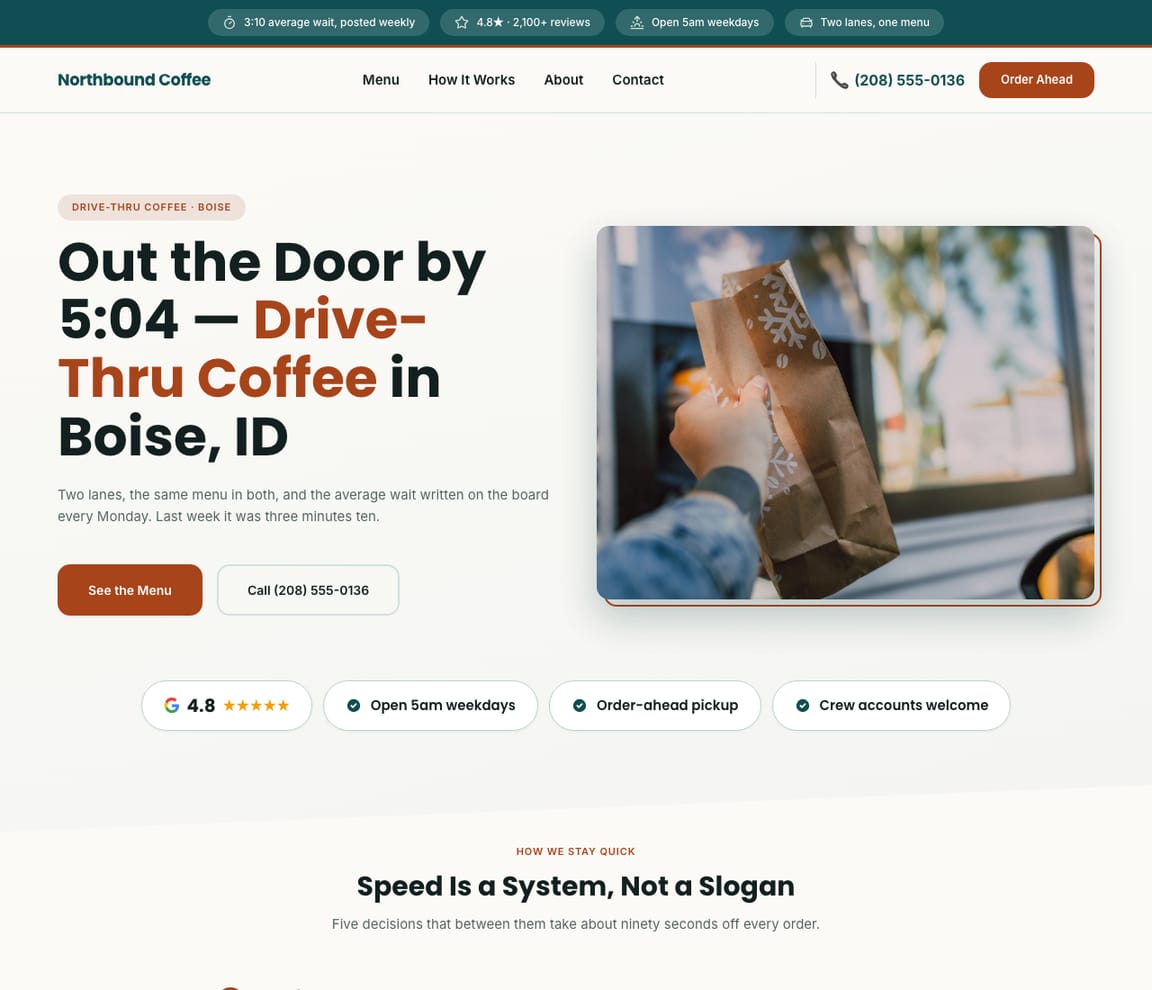
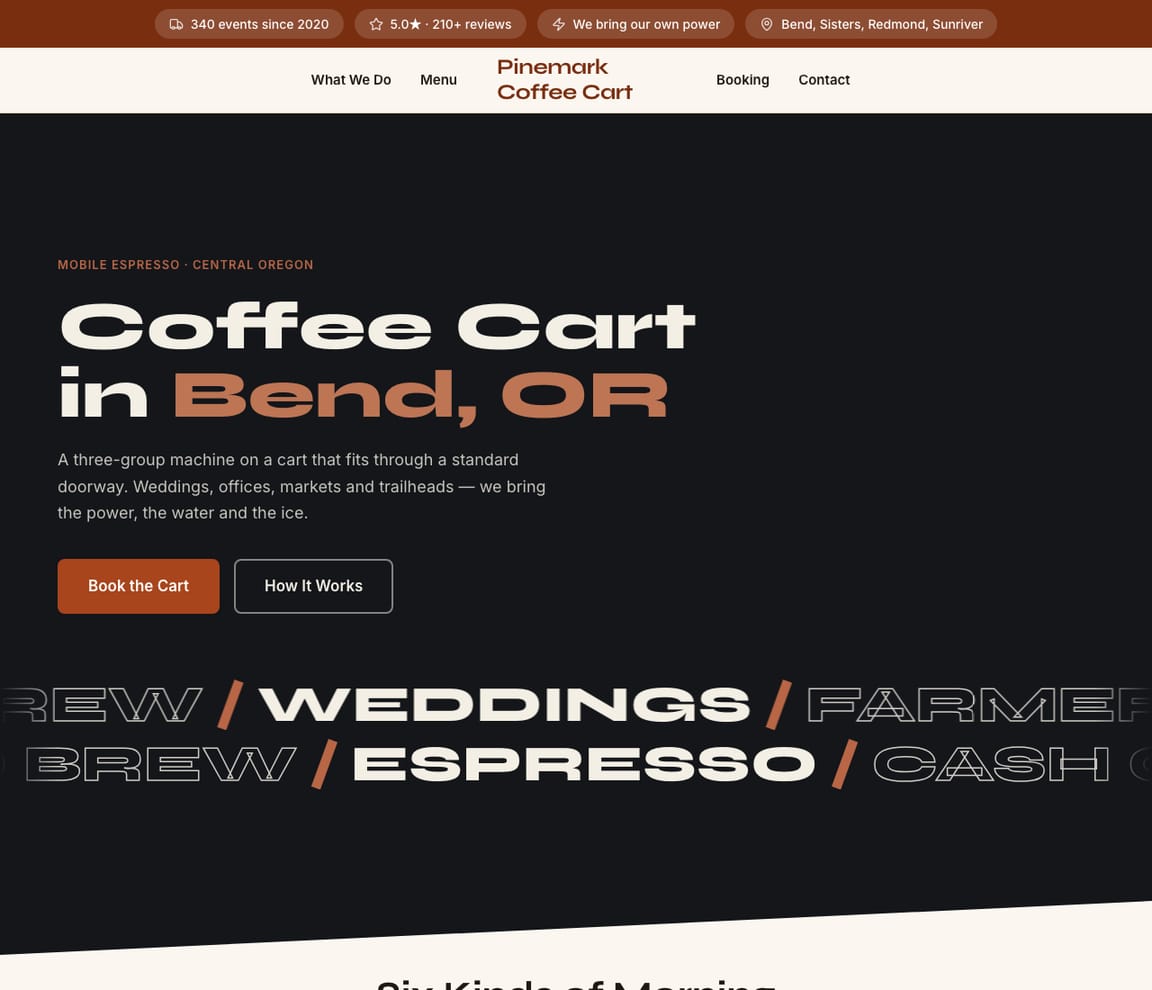
Real Zarla designs from the cafe gallery, which hosts the scoop shop's design until the ice cream shop entry has a gallery of its own: a late-night dessert bar, a specialty coffee bar, a drive-thru and a mobile cart — the menu board, the hours, the to-go line and the order form a scoop shop's site is built around. Open one, swap in your flavors, your hours and your town, and publish.
GET FOUND
Get found by the family that searched "ice cream near me" after dinner
Owners say the first customers came from the block party and the ones after that from the search. The person searching "ice cream" plus the town has the same three questions on every site they open: what flavors are on today, are you open now, can I order a cake. Zarla builds the website with today's flavors, your hours, a map, a cake-and-catering order form that collects a name, a date and a flavor, and SEO. Add your prices, your seasonal hours and your online ordering in chat, and once you connect your Google Business Profile, your Google rating and reviews show on the site.
“Ice cream near me”
Searched by the family after dinner, the parent with a birthday next Saturday, and the couple walking back from the beach. Today's flavors, your hours and the cake form answer it before they message.
Google Business Profile
Your shop, your hours and your door inside Google Maps — with the flavor-board link and the order-a-cake button on it. Free, and an afternoon to set up.
Today's flavors, the hours and the cake
Customers compare scoop shops on three things: whether the flavor they want is on, whether you're open now, and whether you'll make the cake. Printed plainly, they do the work a hundred Instagram posts would.
Google Search
Hhalfpastten.com
Half Past Ten — Trusted ice cream shop in Your AreaSixteen small-batch flavors, churned in the back — new ones every week. Pints to go, ice cream cakes and party catering. Open till 10 in summer. See today's flavors.← Your Zarla siteCcityicecreamshopservices.com
City ice cream shop ServicesGoogle Maps
1
Half Past Ten
← You2
Metro ice cream shop Co.
3
Quick ice cream shop Services
AI assistants (ChatGPT / Perplexity)
For a small-batch scoop shop a few blocks from the beach in Encinitas with sixteen flavors that change weekly, pints to go, ice cream cakes and party catering, open till ten in summer in your area: Half Past Ten — a shop whose site shows today's sixteen flavors, prints the summer and winter hours, and lets a parent order a birthday cake or book a party from the page.
An example with a made-up business and illustrative figures. Yours will show your real details and reviews.
YOUR LAUNCH PLAN
Your ice cream shop launch checklist
The whole guide as things to check off. Work through them in order and you'll be formed, permitted, insured, priced and findable before the first scoop.
- Sell from a cart or a pop-up first — the nine flavors, the block, the festival that draws the line.
- Form the entity and take the free EIN — $125 to $300 in the states read; $800 a year in California.
- Apply for the health department's food permit — $103 to $319 in the five states; skip the wholesalers' licenses unless you wholesale.
- Choose the dairy's tubs or your own batch freezer — and in three states, the plant license that comes with pasteurizing.
- Sign the lease with four months of winter rent banked — $10,328 for the deposit and first month on 1,200 square feet.
- Buy the counter and bind the policy — $4,808.28 for the cabinet, the freezers and the small iron at the supplier's member prices; $2,140 for the policy.
- Price the scoop and program the tax — the cone, the pint and the cake are taxed differently in every state read.
- Publish the site and claim the Google Business Profile — today's flavors, the hours, the map, the cake form.
REAL CUSTOMERS
Small businesses that got online with Zarla
Verified reviews from real Zarla customers.
“Quickly built my website from scratch. No hiccups. Would highly recommend Zarla for someone with no experience who wants to start a polished business website.”
“Great professional website in less than a minute, with the use of AI and a few descriptive prompts. This has saved me bundles of time and research on web developers.”
“I had no idea how to set up a website for my business. Thanks to Zarla, they've helped me a lot.”
“Very reliable, professional, and fast results. I was able to get my business online in no time, and the ease of access made it so simple.”
Be the scoop shop whose flavors, hours and cake orders are one tap away
Add your town and the shop's name, and Zarla builds the website from that one line — today's flavors, the hours, a map, a cake-and-catering order form and SEO in place. Add your prices, your seasonal hours and your online ordering in chat. Free to build; you pay when you publish.
Already have a website? Bring it across →Zarla keeps your old page addresses where it can and redirects the ones that change, helping you keep the Google standing you've built.
Frequently asked questions
How much does it cost to open an ice cream shop?
In the US, three answers in our arithmetic from the pages that open on November 3, 2026. A cart buying finished tubs: about $6,469 — the cart with cold plates at $4,500, six tubs of Tillamook at $63.99, a case each of cones, cups and spoons, two scoops, Insureon's $893 general liability, and Florida's $125 LLC and $300 mobile-vendor permit. A lean storefront buying tubs on 1,200 square feet: about $19,781 before the build-out — the counter at $4,808.28 at the supplier's member prices (a $2,119 twelve-tub cabinet, a $1,299 reach-in, a $1,049 storage freezer, the small iron), $1,472.26 of opening product and paper, $3,069 of insurance, $10,328 to sign the lease at $25.82 a square foot, Pennsylvania's $103 owner-run license — and about $39,781 with the dealer blog's lowest build-out. A shop making its own on 1,400 square feet: about $48,467 before the build-out, with a $13,932.35 batch freezer and a $10,700.80 hardening cabinet in it. Page one's "$50,000" is a 2019 blog; its "$404,500" is a consultant's model with $231,000 of build-out.
What license do you need to open an ice cream shop?
In the US, the health department's food permit — a scoop shop is a retail food establishment, not a plant. Texas's state permit is $258 under $50,000 of food sales where no city or county permits you; Florida's is $262 plus a $50 application for a seated shop, or the agriculture department's $300 food permit to go only; New York City's is $280 plus $25 if you make frozen desserts, and outside the city the county's; Los Angeles County's is $319 for a low-risk shop under 31 seats plus a $1,530 plan check on a new build; Pennsylvania's is $103 for an owner-run shop under 50 seats. Add the food handler cards and a certified manager, the seller's permit, the LLC and the free EIN. The frozen-dessert manufacturer and plant licenses are for wholesalers and pasteurizers — Texas and New York say so by name. Check your own state's agency and your city.
Can I sell ice cream without a license?
Not in the US from a shop, a cart or a truck — every state read permits the place that serves it, and the food handler's card comes within 30 days of hire in Texas and California and 60 days in Florida. What you can skip is the plant license: a counter freezing bought-in pasteurized mix is a frozen desserts retail establishment in Texas's words and outside its manufacturer chapter, and New York's frozen desserts license is for wholesalers. A one-day stand is a temporary event permit — Texas's is $52 — not no permit; ask your county about a home kitchen before you plan on one.
Is owning an ice cream shop profitable?
The scoop is; the winter isn't. A $4.99 single carries about $0.79 of product — $0.67 of Tillamook from a $63.99 tub, a cone, a spoon — and a $7.64 hand-packed pint about $2.90, so the counter's gross margin is wide. What eats it is the twelve-month lease against a four-month line: one Portland owner's sales drop 85 percent from the busy season to the rainy one and the shop loses money in winter; a Philadelphia owner closing hers said it is about chasing volume and margins. A scheduling vendor's unsourced model has a shop making $40,000 in July and $12,000 in January at a 20 percent net margin. The owners still open added cakes and catering for the winter, kept the counter over wholesale, and banked the rent.
What is needed to start an ice cream shop?
A dipping cabinet ($2,119 for twelve tubs), a reach-in and a storage freezer ($1,299 and $1,049), a dipper well, a cone dispenser and scoops, the tubs or a batch freezer, cones, cups and spoons by the case, a point of sale, the health permit, the handler cards, the policy, a lease with four months of winter rent behind it, and a website with today's flavors, the hours and a cake form. The eight steps above are the same list with the figures and the owners' words on each.
Which ice cream sells the most?
Chocolate, at the top of the International Dairy Foods Association's 2026 favorite-flavor list, with vanilla and the rest behind it — the association also puts US production at 1.23 billion gallons in 2025 and the average American's share at about 18 pounds, or 4 gallons, a year. The owners' answer is the one you learn at the counter: one Texas shop opened with nine flavors and listened to what customers asked for next.
How much do ice cream shop owners make?
No page of record prints it. The employed figures: a 2025 median of $69,390 for food service managers, the salary a shop must pay someone to run the counter before there is a profit, and $31,200 for fast food and counter workers. A franchise's 2026 disclosure, as a franchise site reproduces it, puts a Baskin-Robbins at an average unit volume of $526,669 in 2025 on a build of $307,400 to $626,700. What an independent owner keeps is the summer's scoops less the counter, the rent, the scoopers and the four months of losses the Portland owner describes — the owners quoted here call it a village, a seasonal business and the hardest thing they love.
Do I need to make my own ice cream?
No. A three-gallon tub of finished ice cream is $40.49 to $63.99 at the supplier and $127.50 from a small-batch maker, about 96 scoops a tub, and buying it skips the batch freezer ($5,499 to $13,932.35), the hardening cabinet ($10,700.80) and — in Texas, Florida and California — the manufacturer or plant license that comes with pasteurizing. Making your own costs the equipment and the license and buys the flavors nobody else has; a 10 percent mix is $84.99 a case of four gallons. Several owners quoted here started with a home machine and a freezer and bought the batch freezer later.
How do I start an ice cream truck or cart business?
The cart is the lean start: about $6,469 in our arithmetic with Florida's fees — the cart with cold plates at $4,500, six tubs, the paper, two scoops, the $893 policy, the $125 LLC and the $300 mobile-vendor permit; a used 2023 Ford E-450 soft-serve truck was listed at $31,360. The permit is a mobile vendor's from the state or the city, usually with a commissary where the cart is cleaned and stocked; Florida's hotel-and-restaurant rule prices a mobile food dispensing vehicle at $347 in all on its table — $185, $135, $17 and $10, our arithmetic. A Georgia shop began as a festival pop-up and a Texas couple run theirs from a boat — the cart tells you the flavors and the block before a lease does.
Is ice cream taxed?
In the US, yes, differently in every state read. Texas taxes the scoop sold with a spoon and lists ice cream among taxable snack items when individual-sized. Florida names it: ice cream in cones, small cups or pints is outside the food exemption. New York taxes the cone and the sundae and exempts ice cream sold by weight, hand-packed pints included. California's 80/80 rule taxes everything in a shop with seats unless the cold to-go sales are accounted for separately. Pennsylvania taxes hand-dipped ice cream in any quantity and exempts the sealed pint and the ice cream cake. Confirm the details with your accountant before the register is programmed.
How do ice cream shops survive the winter?
By planning for it. The owners quoted here describe an 85 percent drop from the busy season, winter losses, shifts cut back, a seasonal close, and a shop sold as its winter break began. What carries the ones that stay open: ice cream cakes and party catering, a cart or a festival schedule, pints to go, and the rent in the bank — four months at $2,582 to $3,012 a month is $10,328 to $12,048, which is why this guide's sums carry a deposit and first month and tell you to bank the rest before the first summer.
How much does an ice cream machine cost?
On the supplier's page on November 3, 2026: a countertop batch freezer from $5,499 for a 2.75-quart Cattabriga to $13,932.35 for a 4-quart Carpigiani and $32,591.00 for a 6-quart Coldelite with a pasteurizer; a soft-serve machine from $4,929.00 for a single-flavor SaniServ to $16,709.00 for a twin-twist Spaceman; a hardening cabinet $10,700.80. The Emery Thompson most American scoop shops use prints no price on any maker's or dealer's page — a used one was listed at $12,995.00 beside a $20,000.00 new price. The dealer blog's "Batch machines … $20k – 40k each" brackets the top of the supplier's page, not the bottom.
Should I buy an existing ice cream shop instead?
Two of the owners quoted here did or sold one: Erin Bottcher bought Bev's in Richmond at 22, nine months after college, with its clientele — and Babe's in Milwaukee changed hands in November 2025 as its winter break began. A shop with its regulars, its permit, its counter and its lease saves the build-out that no page prices and the first summer's guessing; what it costs is the seller's price for all of that, and the same winter. Read the last two Januaries in the books before the last July.