BUSINESS GUIDE
How to start a Christmas light installation business in 2026
The real version, for an owner with a ladder and a truck: what to charge per foot, the insurance and ladder rules that matter on a roof, what it costs to start, when the season is actually sold — and how this year's houses become next year's bookings and permanent-lighting jobs.
Free to build · Pay when you publish · No credit card
$2.50–$7a foot: what US homeowners pay pro installers, lights included (HomeAdvisor, 2026)
$18–$35a foot installed for permanent lighting, the year-round upsell (Trimlight, 2026)
10%–20%net margin at a national installer doing 2,000+ jobs a season (Freakonomics, 2025)
No codeto get online
See it in action
See what your Christmas lighting website could look like
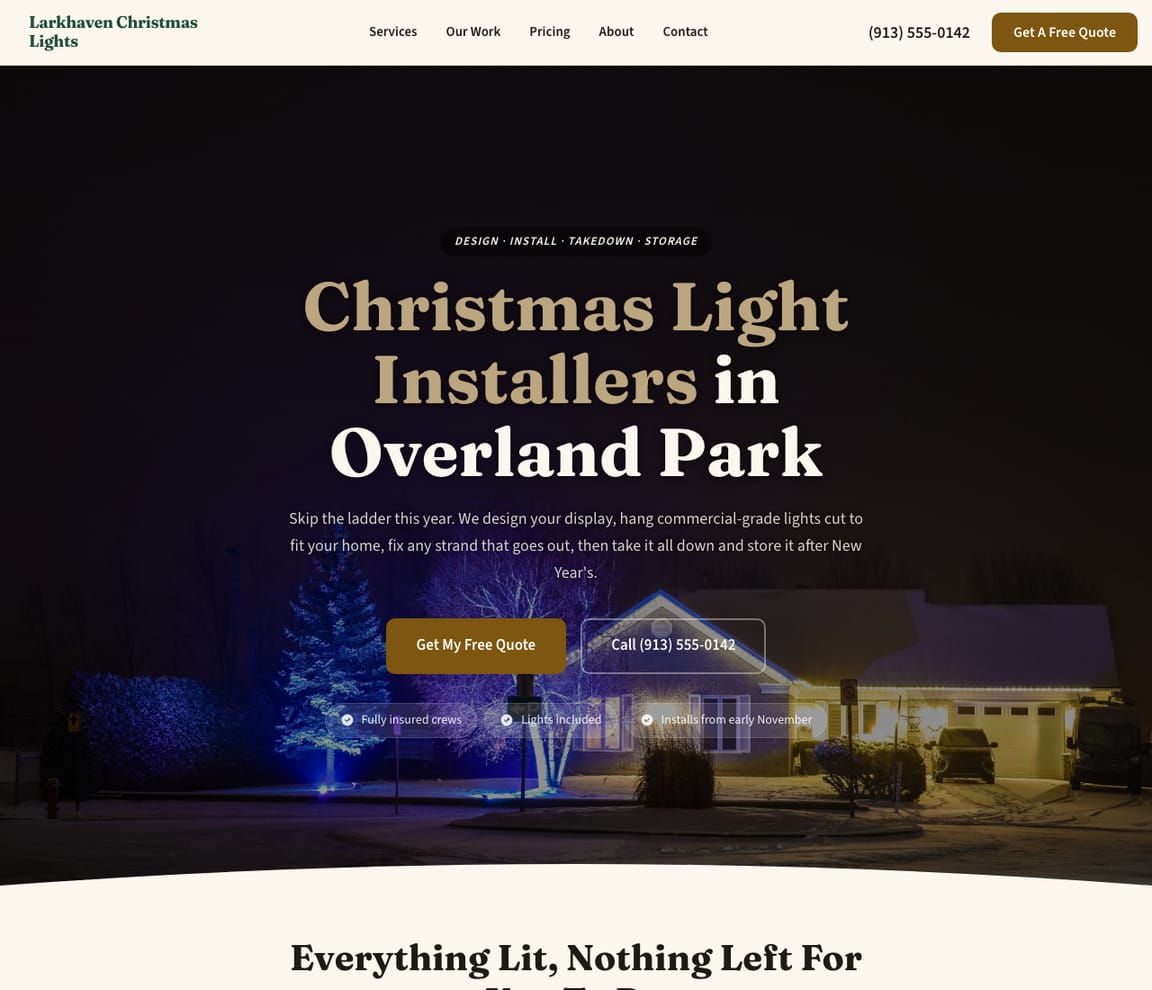
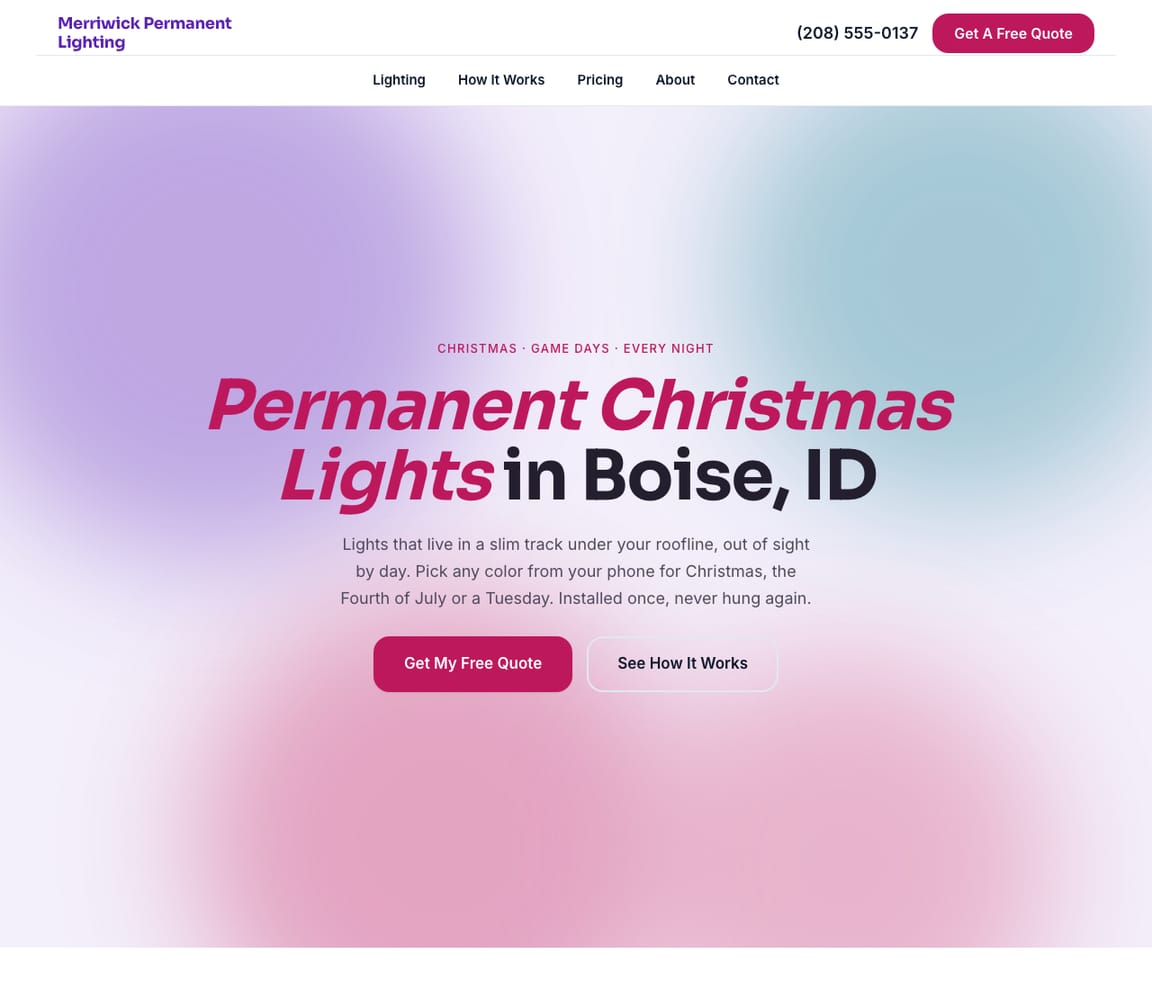
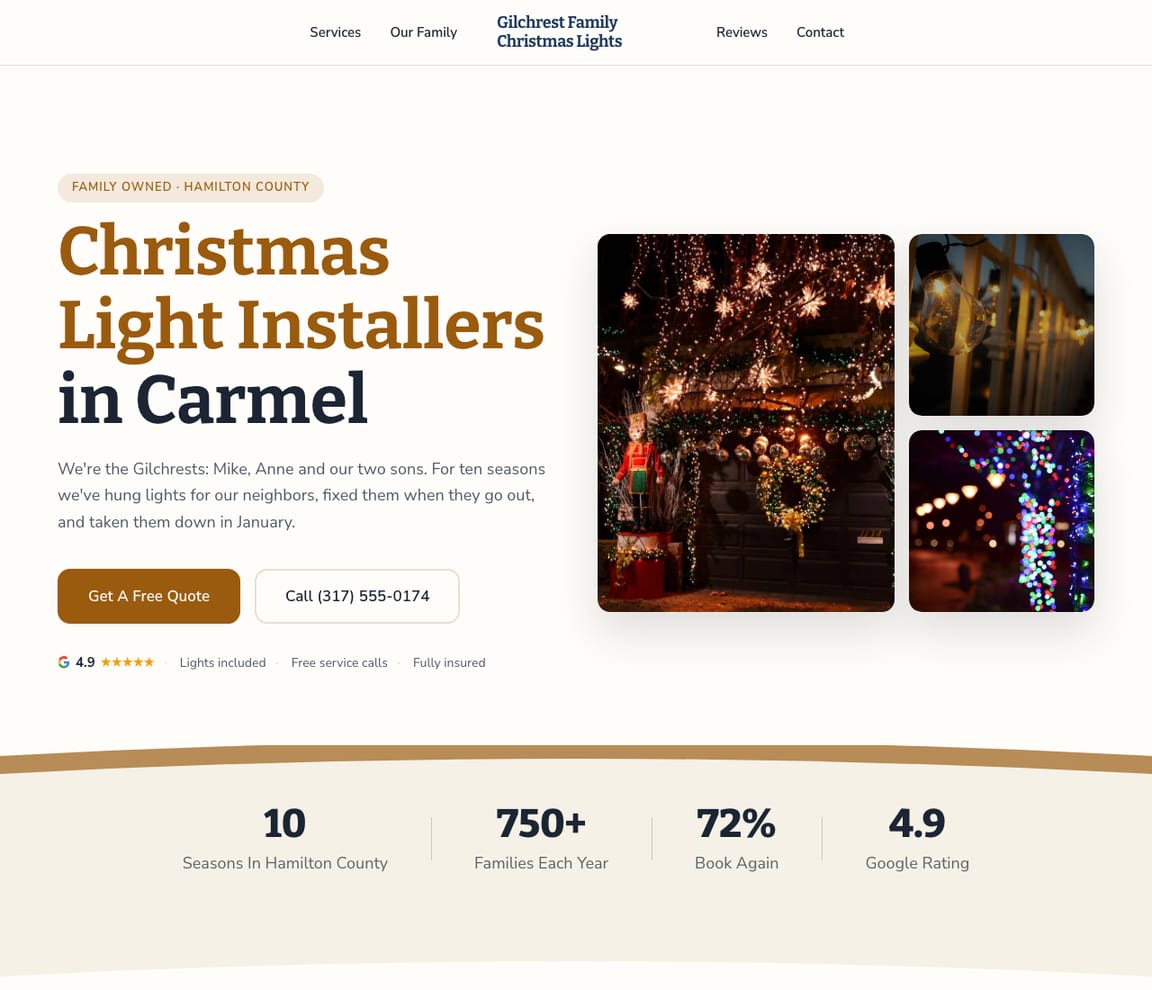
This is a real Zarla template for a Christmas light installer. Describe yours — rooflines, trees, permanent lights, the neighborhoods you cover — and you'll have a site like this, with a quote form up front and room for photos of your installs, in about a minute.
- Professional design — not a generic template
- Looks great on desktop and mobile
- Content written for your industry
Build the website
Start your Christmas lighting website now
Add your town and your company's name to the sentence, and Zarla builds the site: a call button at the top, a service-area map and a quote request form. Add photos of your installs and your prices in chat, and publish by early September.
Already have a website? Bring it across →Zarla keeps your old page addresses where it can and redirects the ones that change, helping you keep the Google standing you've built.
Is a Christmas light installation business worth starting — and what should you charge?
The demand is real and it comes back every year. Professional Christmas light installation costs US homeowners $220 to $684 for a typical job, $444 on average for setup and take-down, and pros charge $2.50 to $7 a foot of roofline with the lights included (HomeAdvisor, June 2026). Another guide puts the average at $450, with removal $0.50 to $0.65 a foot when it isn't in the package (Fixr, January 2025).
How much to charge depends on whose lights go up. Labor-only work on lights the customer owns typically runs $2 to $5 a foot; installs that include the lights or rent them to the customer run $5 to $10 a foot, and commercial and HOA jobs $2,000 to $10,000 or more (ThePricer, November 2025). Installers' own posted prices sit in that band: one window-cleaning owner charged $4 to $5 a foot with the lights rented in 2020 (WindowCleaner.com forum), and a pressure-washing owner posted a $7-a-foot minimum for C9 rooflines and an $850 job minimum in 2021 (PressureWashingResource forum). A design-software company for installers advises a $500 to $800 residential minimum, and while its budget tier ($5 to $10 a foot) matches the lease band, its mid-range and premium tiers ($10 to $20 and $20 to $35) sit well above everyone else (Strandr, 2026) — read those as a vendor's advice, not a survey. So price by the foot of roofline, add trees, bushes and wreaths per item, set a minimum, and say what the price includes: the lights, the install, service calls, take-down and storage.
The lease model is where the money is. Brite Nites, a national installer, prices a basic residential package at around $2,500 — the lights, the set-up, the take-down and off-site storage — does more than 2,000 jobs a season, and nets a 10% to 20% margin after all expenses; a two-person crew does a $2,500 job in about two hours, at about 100 feet of roofline an hour (Freakonomics Radio Network, December 2025). Year one is the expensive year, because you buy every customer's lights; year two, the same lights go back up on the same house for the same fee.
The upsell is permanent lighting — LED track fixed under the roofline once and controlled from a phone — at $18 to $35 a foot installed (Trimlight, August 2026), and about $4,600 on average for the street-facing sides of a home (JellyFish, May 2025). HomeAdvisor puts a permanent install at about $3,500 on average (HomeAdvisor). Manufacturers sell through dealers — Trimlight's entry is a one-time $5,000 or $10,000 in product credit, with a $499 demo kit counted inside it in its FAQ and listed on top in its package table, with two days of required training in Salt Lake City (Trimlight). The hard parts are a season of about ten weeks, work at the roof edge in the cold, and the lights you buy before they earn — which is what the rest of this guide sets up.
How to start a Christmas light installation business, in plain English
Licensing depends on your state and on the lights you use. There's no single US rule, so check your state's electrical and contractor boards. Three examples:
- Washington: firms that design and install custom, cut-to-fit seasonal lighting must be licensed electrical contractors with certified electricians, and the work needs permits and inspections; installing unaltered, off-the-shelf lights listed to UL 588 needs no electrical license — and where fasteners attach lights to a structure, contractor registration rules may apply (Washington L&I, December 2025). UL 588 is the standard for seasonal decorative lighting (UL).
- Texas requires a license for electrical work, and its exemption for holiday lighting is written for landscapers, “excluding any required power source” (Texas Occupations Code §1305).
- California has a general minor-work rule that may apply: an unlicensed person can take jobs under $1,000 only if the job needs no permit and they employ no one, and must say in their advertising that they are not licensed (CSLB, on AB 2622). The board's bulletin doesn't mention seasonal lighting, so ask CSLB about your work.
Adding an outlet or hardwiring permanent lighting is electrical work in many states. Cities set their own rules for lights on public trees and poles: Bellevue, Washington requires a licensed lighting contractor with an electrician on staff and allows its decorations only from November 1 to January 31 (City of Bellevue).
Insurance, ladders and lifts. General liability is the cover homeowners and commercial clients ask about; one insurer advertises it from $375 a year as part of a lawn-care policy, for homes and structures up to two stories (Insurance Canopy), and the median for installation businesses is $85 a month for general liability, $165 for workers' comp and $299 for commercial auto (Insureon, August 2026). Once you have an employee, OSHA's rules apply: a ladder used to reach a roof must extend at least 3 feet above the edge (OSHA 1926.1053), and fall protection is required from 6 feet in construction work (OSHA 1926.501) and 4 feet in general industry (OSHA 1910.28) — OSHA hasn't said which one covers seasonal decorating, so plan to the stricter. A Werner 28-foot Type IA fiberglass extension ladder lists at $469 (Zoro) and a roofer's fall-protection kit at $106.99 to $129.99 (Zoro). For trees and rooflines out of ladder reach, rent a lift by the day: a towable boom averages $300 a day nationally, $532 for the 50-foot class (DOZR).
What it costs to start. Most of the money is the lights. A 1,000-foot C9 spool with 12-inch socket spacing runs $391.13 to $424.76 (1000Bulbs), and LED C9 bulbs $21.29 for 25 (1000Bulbs) to $32.99 for 25 for Wintergreen's (Christmas Lights Etc) — about $1.24 to $1.74 a foot of lit roofline at one bulb a foot. Wintergreen's all-in-one clips are $13.99 for 100 (Christmas Lights Etc). For a lease-model installer lighting 40 to 80 homes in the first season, our free Christmas light business plan adds that up to $16,255–$52,800 with cords, timers, ladders, insurance, registration and the first month's helper pay and fuel — and you buy the lights after the jobs are booked, with the deposits. A smaller first season costs less in proportion: the lights scale with the homes you book. The government publishes no pay figure for Christmas light installers; a helper costs about what landscaping workers earn, a 2025 US median of $18.82 an hour (O*NET). Training is optional — Action Lighting's hands-on course is $200 a person, credited toward your first order (Action Lighting). Form the business — state filing fees vary — for example $40 for an LLC in Kentucky (Kentucky SOS) and $300 in Texas (Texas SOS) — and get the free EIN (IRS).
The season is sold before it's installed. Renew last year's customers as early as late August or early September and collect their deposits, market to new customers in October and early November, install from November 1, expect the busiest stretch in the two weeks either side of Thanksgiving, and start take-down as early as January 2 (Jobber). Many owners run it as the winter line of a pressure washing business, window cleaning or landscaping company. The Christmas lighting website templates show what a good installer site looks like, and Zarla's Christmas lighting website builder is how homeowners find your lit houses in September.
What Christmas light installers actually say
None of this is our opinion about the trade. It comes from installers talking and writing about how they started — most of the forum posts are from 2020 to 2024, so read the prices as theirs at the time. Four things come up again and again.
You start with a ladder and a flyer. Dean Lyons, who founded the national installer Brite Nites, on his first season: “Went to the ace hardware, bought the ladders, and just grabbed lights off the shelf. I found a guy who made me this cheesy little flyer. And then I walked around the neighborhood of some of the bigger houses in town. The phone just went off the hook.” His first year: “Within the first year of doing it, we did seventeen thousand dollars in revenue. And that was in two months.” (Freakonomics Radio Network, December 2025). Many start it beside another trade — Kyle O'Hearn of Powergreen Pressure Washing in Strongsville, Ohio: “We began looking for an off-season service to keep us busy during the winter.” (Cleaner Times, October 2022).
“Yea we’re $7/ft minimum for c9 and $850 job minimum. I get sticker shocked at some of our jobs too that job I posted came to $2800. After doing it a couple years now I’ve realized we have to charge properly or no profits lol” — Jared Ross, PressureWashingResource forum, November 2021
Year one buys the lights. Austin Dooley, a window-cleaning owner, in 2020: “We charge between $4 and $5 per foot depending on how hard the job is, which includes renting the lights from us. At this price we don’t expect to make much in year in year one when we have to buy the lights (30-50/hr), but should make decent money in subsequent years (70-100/hr).” (WindowCleaner.com forum). Anne McGinty, who ran a Bay Area installer with her husband for 13 years, on why they stopped selling lights: “it's more profitable to lease the lights” (How I Built My Small Business, September 2025).
The season is short and it doesn't wait. JC Chanowsky, founder of Patriot Illumination in Wilmington, North Carolina: “We have roughly less than 90 days. … You have to know your pricing or else you're gonna just completely run yourself into the ground and not be profitable. You'll be broke your first year.” (The Huge Insider podcast, August 2025). Lyons: “It really goes crazy after Halloween. As soon as Halloween’s over, it’s full throttle.” (Freakonomics Radio Network).
The roof is the risk, and permanent lighting is the next business. Jason Atkinson, who runs a pressure-washing and lighting company, on roof anchors: “I mean, we can be safe on your roof and repair the holes, or we can risk falling and our insurance not covering it because we were negligent…then they probably come after you Mr. Homeowner.” (PressureWashingResource forum, September 2022). And two years later: “We had tons of people asking about permanent holiday lighting, so a couple years ago we got into that as well, which is a year-round thing.” (PressureWashingResource forum, December 2024) — and on the lights themselves: “Christmas lights… easier sales, more profitable, and a massive repeat rate.” (June 2024).
The through-line: the installers who last price by the foot without apologizing, sell the season before it starts, work safely at the roof edge, and keep every house they light.
THE STARTER KIT
What you need to start a Christmas light installation business
A head for heights and a season to give
Comfort on a ladder and a roof edge, a helper you trust, and November and December mostly free — the installs all land in the same ten weeks.
Commercial-grade lights
C9 LED bulbs on wire you cut to fit each roofline, clips for gutters and shingles, mini lights for trees and bushes, cords and timers.
Ladders, standoffs and a harness
Fiberglass extension ladders, a stepladder, standoffs that keep the ladder off the gutter, a roof harness — and a lift rented by the day for tall trees.
The right license for your state
Whatever registration your state and city require, and in some states an electrical license for cut-to-fit lighting or permanent installs. Check before you quote.
Insurance and somewhere to store it all
General liability before the first ladder goes up, workers' comp once you hire, and a storage unit for every house's lights from January to November.
A way to be found in September
Photos of lit houses, a price per foot, a quote form, and a website and Google profile live before homeowners start searching in the fall.
THE PAPERWORK
Licenses, insurance and safety rules for a Christmas light installation business
| Typical cost | Time to get | Legally required? | |
|---|---|---|---|
| Business registration (LLC) and local business license | e.g. $40 (Kentucky), $300 (Texas) | Days | Depends on your structure and city |
| EIN from the IRS | Free | Minutes online | If you hire or have partners; optional when solo |
| Electrical license for cut-to-fit lighting (Washington) | A licensed electrical contractor | Months | In Washington; off-the-shelf UL 588 lights exempt |
| Electrical license for hardwiring or a new outlet | Set by your state | Months, or hire an electrician | In many states |
| California's minor-work rule | Set by CSLB | Ask CSLB | License needed from $1,000, with a helper or a permit |
| General liability insurance | From $375/year (2 stories); $85/mo median | Same day | Homeowners, HOAs and stores ask for it |
| Workers' compensation | $165/month median | Days | In most states, once you hire |
| Ladder and fall-protection rules (OSHA) | Standoffs and a harness | Before the first climb | Yes, for employers in the US |
| City permit for lights on public property | Set by your city | Weeks | Often — ask before you quote |
THE STEPS
How to start a Christmas light installation business (step by step)
Eight steps from “I could do that for the neighbors” to your first paid install.
01
Hang a few houses first
Light your own house and a friend's: measure the roofline, cut the wire to fit, clip it on and time yourself — then you know how many feet an hour you can do safely.
02
Choose how you'll sell the lights
Lease your own lights to the customer — installed, serviced, taken down and stored — or hang lights the customer owns. Leasing costs more to start and earns more every year after.
03
Check your state's licensing rules
Look up your state's electrical and contractor boards: whether cut-to-fit lighting or a new outlet needs a license, and what permanent lighting needs.
Before your first quote04
Register and insure the business
Form the business, get a free EIN from the IRS, open a business bank account, and buy general liability cover — workers' comp once you hire a helper.
05
Set up the safety gear and the lights
Buy the ladders, standoffs and a roof harness for everyone who climbs, find a rental yard for lift days, and line up a light supplier you can order from fast.
06
Write your prices and your deposit rule
A price per foot of roofline, per item for trees, bushes and wreaths, a job minimum, what's included — install, service calls, take-down, storage — and a deposit at booking.
07
Get found before the searching starts
Put your website and Google Business Profile live by early September with photos of lit houses, your prices, the neighborhoods you cover and a quote form.
08
Sell the season, then the next one
Book through October and November, install from early November, take down in January — and rebook every customer, and offer permanent lighting, before the crew leaves.
THE COSTS
How much does it cost to start a Christmas light installation business?
The total is our free Christmas light business plan's itemized US ranges for a two-person installer leasing the lights to 40 to 80 homes in the first season: C9 spools and bulbs, clips, cords and timers, ladders and fall protection, a year of liability cover, registration, yard signs and the first month's helper pay and fuel. A lift, training and a permanent-lighting dealer account are extras. Light prices from 1000Bulbs and Christmas Lights Etc, ladders from Zoro, insurance from Insureon and Insurance Canopy, checked October 2026.
$16,255–$52,800to start on the lease model — most of it lights you buy after the jobs are booked
$1.24–$1.74a foot of lit roofline in C9 wire and LED bulbs, before clips
$85/monthmedian general liability for installation businesses (Insureon)
$300/dayfor a towable boom lift, rented only for tall trees and high rooflines
WHAT WE'VE LEARNED
What actually makes a homeowner book your crew
Thousands of local business websites in, the pattern for seasonal home services is clear: the homeowner is choosing fast, a few weeks before they want the lights up, and choosing someone to put a ladder against their house. Three things on a page decide who gets the call.
Photos of houses at night
Rooflines, trees and wreaths you actually lit — taken after dark, with the town under each one — so a homeowner can picture their own house.
A price they can understand
Your price per foot or your packages, what they include — the lights, the install, take-down in January, storage — and your minimum.
An easy way to get a quote
A call button at the top, the neighborhoods you cover, proof of insurance, and a short quote request form that can take a photo of the house.
THE UPSIDE
What a Christmas light installation business can earn
Homeowner prices from HomeAdvisor's June 2026 guide and ThePricer's November 2025 guide; package price and margin from the December 2025 Freakonomics Radio Network episode on Brite Nites (spelled “Bright Nites” there); permanent-lighting prices from Trimlight. Averages, not a promise — your feet an hour, your prices and how many customers rebook decide it.
$5–$10 a foottypical price for installs that include the lights or rent them to the customer
$2,500a basic residential package at a national installer — lights, install, take-down and storage
10%–20%the net margin that installer reports after all expenses
$18.82 an hourthe 2025 US median for landscaping workers — about what a helper costs you (O*NET)
SEE IT WORK
Christmas light installation website designs you can start from
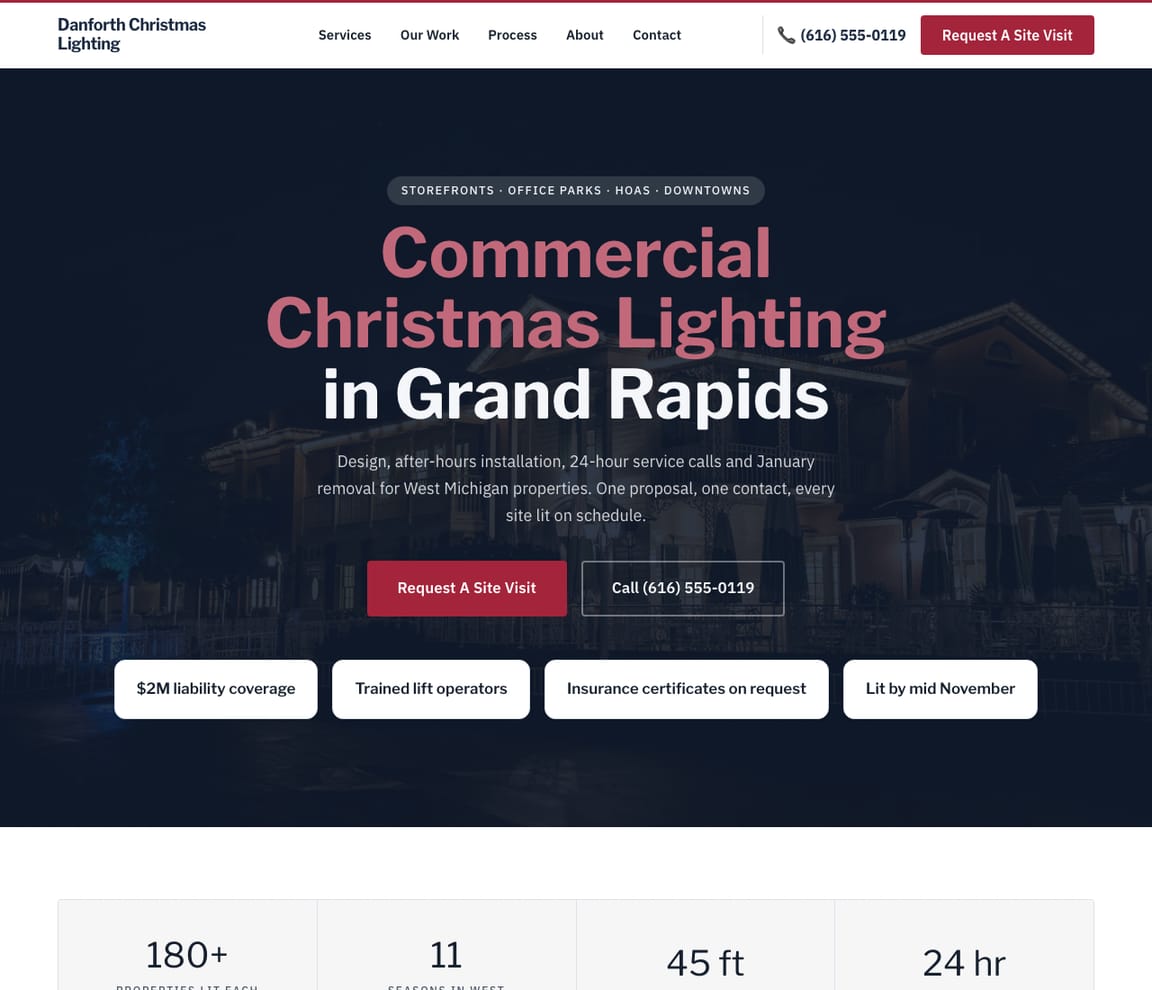
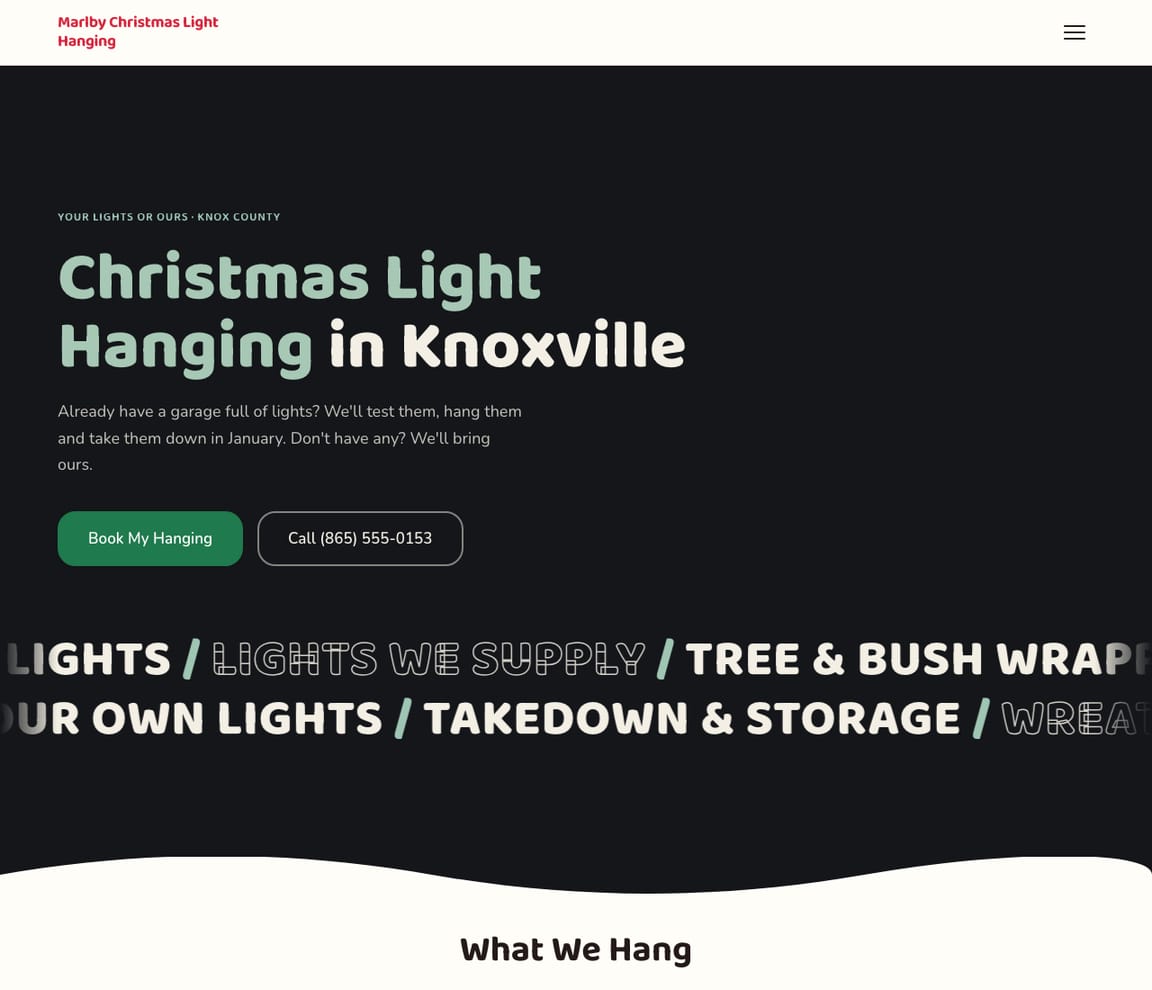
All four are real Zarla templates. Open the one closest to how you'll sell — permanent lights, commercial displays, a light-hanging service or a family-run installer — swap in your number, your neighborhoods and photos of real installs, and publish.
GET FOUND
Get found when the first house on the street lights up
A homeowner who wants their lights up this year compares a few installers in September and October: photos of real houses, a price they can understand, and whether you still have dates. Zarla builds the website, and once you connect your Google Business Profile, your name, map location and reviews stay in step on both.
“Christmas light installation near me”
Searched by a homeowner who has just watched the neighbor's roofline light up. Photos of houses you've lit, the neighborhoods you cover and a quick way to ask for a quote answer it before they call the next name.
Google Business Profile
Your service area, your hours, photos of real installs at night and your reviews inside Google Maps. Free, and an afternoon to set up — do it in August, before the searches start.
Reviews from lit houses
Ask the evening the lights first go on, when the customer is standing in the driveway taking photos. A lit house is seen by the whole street, and the review tells that street who did it.
Google Search
Llarkhavenchristmaslights.com
Larkhaven Christmas Lights — Trusted Christmas light installation in Your AreaRoofline, tree and wreath installs with our commercial-grade lights. Take-down and storage included. Free quotes from a photo of your house.← Your Zarla siteCcitychristmaslightinstallationservices.com
City Christmas light installation ServicesGoogle Maps
1
Larkhaven Christmas Lights
← You2
Metro Christmas light installation Co.
3
Quick Christmas light installation Services
AI assistants (ChatGPT / Perplexity)
For a local Christmas light installer in your area: Larkhaven Christmas Lights — a local Christmas light installer with photos of lit homes, prices by the foot, take-down and storage included, and reviews from homeowners nearby.
YOUR LAUNCH PLAN
Your Christmas light installation business launch checklist
The whole guide as things to check off. Work through them in order and you'll be licensed where you need to be, insured, equipped and priced before the first homeowner calls.
- Hang a few houses first — and time how many feet an hour you can do safely.
- Check your state's electrical and contractor rules — for cut-to-fit lights and permanent installs.
- Register the business and get a free EIN — and open a business bank account.
- Buy general liability cover — and workers' comp before a helper climbs a ladder.
- Buy ladders, standoffs and a roof harness — and find a rental yard for lift days.
- Write your price sheet — per foot, per item, a job minimum and a deposit at booking.
- Get found by early September — website and Google Business Profile live with photos of lit houses.
- Rebook every customer at take-down — and offer permanent lighting in the spring.
REAL CUSTOMERS
Small business owners who got online with Zarla
Verified reviews from real Zarla customers.
“Quickly built my website from scratch. No hiccups. Would highly recommend Zarla for someone with no experience who wants to start a polished business website.”
“Great professional website in less than a minute, with the use of AI and a few descriptive prompts. This has saved me bundles of time and research on web developers.”
“I had no idea how to set up a website for my business. Thanks to Zarla, they've helped me a lot.”
“Very reliable, professional, and fast results. I was able to get my business online in no time, and the ease of access made it so simple.”
Be the name they find when the lights go on next door
Add your town and your company's name, and Zarla builds the website from that one line — a call button at the top, the neighborhoods you cover on a service-area map and a quote request form. Free to build; you pay when you publish.
Already have a website? Bring it across →Zarla keeps your old page addresses where it can and redirects the ones that change, helping you keep the Google standing you've built.
Frequently asked questions
How much to charge for Christmas light installation?
Price by the foot of roofline. In the US, labor-only work on lights the customer owns typically runs $2 to $5 a foot, and installs that include the lights or rent them to the customer $5 to $10 a foot; HomeAdvisor puts what homeowners pay at $2.50 to $7 a foot with the lights included. Add trees, bushes and wreaths per item, charge more for steep or two-story rooflines, set a job minimum — one installer posted $850 in 2021 — and say what's included: the install, service calls, take-down in January and storage. Take a deposit when the customer books.
How much to install 200 ft of Christmas lights?
At HomeAdvisor's $2.50 to $7 a foot, 200 feet of roofline comes to $500 to $1,400 with the lights included; at the $7-a-foot minimum one installer posted for C9 rooflines in 2021, at least $1,400. Your own cost is roughly $250 to $350 in C9 wire and LED bulbs at $1.24 to $1.74 a foot, plus clips, a cord, a timer and about two crew-hours at the 100 feet an hour a national installer's crews work to.
Do Christmas light installers make good money?
The good ones do, from the second season on. The lease model costs the most in year one, when you buy every customer's lights — one installer charging $4 to $5 a foot in 2020 expected $30 to $50 an hour that first season and $70 to $100 an hour after. Brite Nites, a national installer, prices a basic package around $2,500 and does more than 2,000 jobs a season.
Is a Christmas light business profitable?
It can be. Brite Nites reports a 10% to 20% net margin after all expenses, and installers describe the repeat rate as the reason: the same lights go back up on the same house each year. What erodes it is the first-year light purchase, a helper's pay through a ten-week rush, workers' comp, storage all year, and customers who don't rebook.
What do you need to start a Christmas lights business?
A business registration and EIN, general liability insurance, the license your state requires for the work you'll do, commercial-grade C9 lights and clips, cords and timers, fiberglass extension ladders with standoffs, a roof harness for everyone who climbs, a truck you already drive, a storage unit, and a price sheet. On the lease model that comes to about $16,255 to $52,800 for 40 to 80 homes, most of it lights bought after the jobs are booked.
How much does it cost to start a Christmas light installation business?
In the US, about $16,255 to $52,800 for a two-person installer leasing the lights to 40 to 80 homes in the first season, in our Christmas light business plan's itemized ranges — the C9 spools and bulbs are most of it, bought with the deposits after the jobs are booked. A smaller first season costs less in proportion, because the lights scale with the homes you book. A lift rental, training and a permanent-lighting dealer account are extras.
Do you have to be licensed to install Christmas lights?
It depends on your state and on the lights. In Washington, custom cut-to-fit lighting needs a licensed electrical contractor and permits, while unaltered off-the-shelf lights listed to UL 588 need no electrical license. Texas requires a license for electrical work, and its holiday-lighting exemption is written for landscapers, excluding the power source. California's general minor-work rule allows unlicensed jobs under $1,000 only with no permit, no employees and an ad that says you're unlicensed — ask CSLB about your work. In Washington, clipping lights to a house may also bring contractor registration rules into play. Adding an outlet or hardwiring permanent lighting is electrical work in many states — check your state's electrical and contractor boards before you quote.
Do I need insurance to install Christmas lights?
In practice, yes. General liability pays for a cracked gutter or a broken window on a customer's house, homeowners ask for proof before you put a ladder on their roof, and HOAs and storefronts ask to be named on your certificate. One insurer advertises cover from $375 a year on a lawn-care policy, for homes up to two stories; the median for installation businesses is $85 a month. Once you hire, most states require workers' comp, and OSHA's ladder and fall-protection rules apply.
Can you pay someone to put Christmas lights up?
Yes — that's the whole business. US homeowners typically pay $220 to $684 for professional installation and take-down, $444 on average, and many installers sell a package that includes the lights, service calls through December, take-down in January and storage until next year.
When should I start selling Christmas light installation?
In late summer. Renew last year's customers in late August or early September and take their deposits, market to new customers through October and early November, and expect the rush after Halloween. Installs run from early November, the busiest weeks are either side of Thanksgiving, and take-down starts in the first days of January.
Should I offer permanent Christmas lights?
If customers ask, yes — many installers add it once seasonal installs are running. Permanent lighting is installed once under the roofline and controlled from a phone, at $18 to $35 a foot installed, about $4,600 on average for the street-facing sides of a home. Manufacturers sell through dealers: Trimlight's entry is a one-time $5,000 or $10,000 in product credit, with a $499 demo kit counted inside it in its FAQ and listed on top in its package table, and two days of training in Salt Lake City. Hardwiring the power is electrical work in many states.
How do I get customers for a Christmas light installation business?
Start with the people who already trust you — your neighbors and the customers of any trade you run — then put a yard sign on every lit house, ask for a review the night the lights go on, and have your Google Business Profile and website live by early September with photos of lit houses, your prices and the neighborhoods you cover. Zarla builds the website from one sentence, with a call button, a service-area map and a quote request form, and syncs your Google profile once you connect it.