BUSINESS GUIDE
How to start a concrete business in 2026
The real version, written for a small flatwork crew: the license your state may want, insurance and the silica rule, the tools to buy and the ones to rent, what it costs to start, what driveways and patios pay — and how one finished driveway gets you the next.
Free to build · Pay when you publish · No credit card
23,350poured-concrete contractors with a payroll in the US, 2023 — 59% with fewer than five employees (Census)
$6,400average price of a new concrete driveway in the US, 2026 (HomeAdvisor)
$57,020median pay for cement masons and concrete finishers, 2025 (BLS)
No codeto get online
See it in action
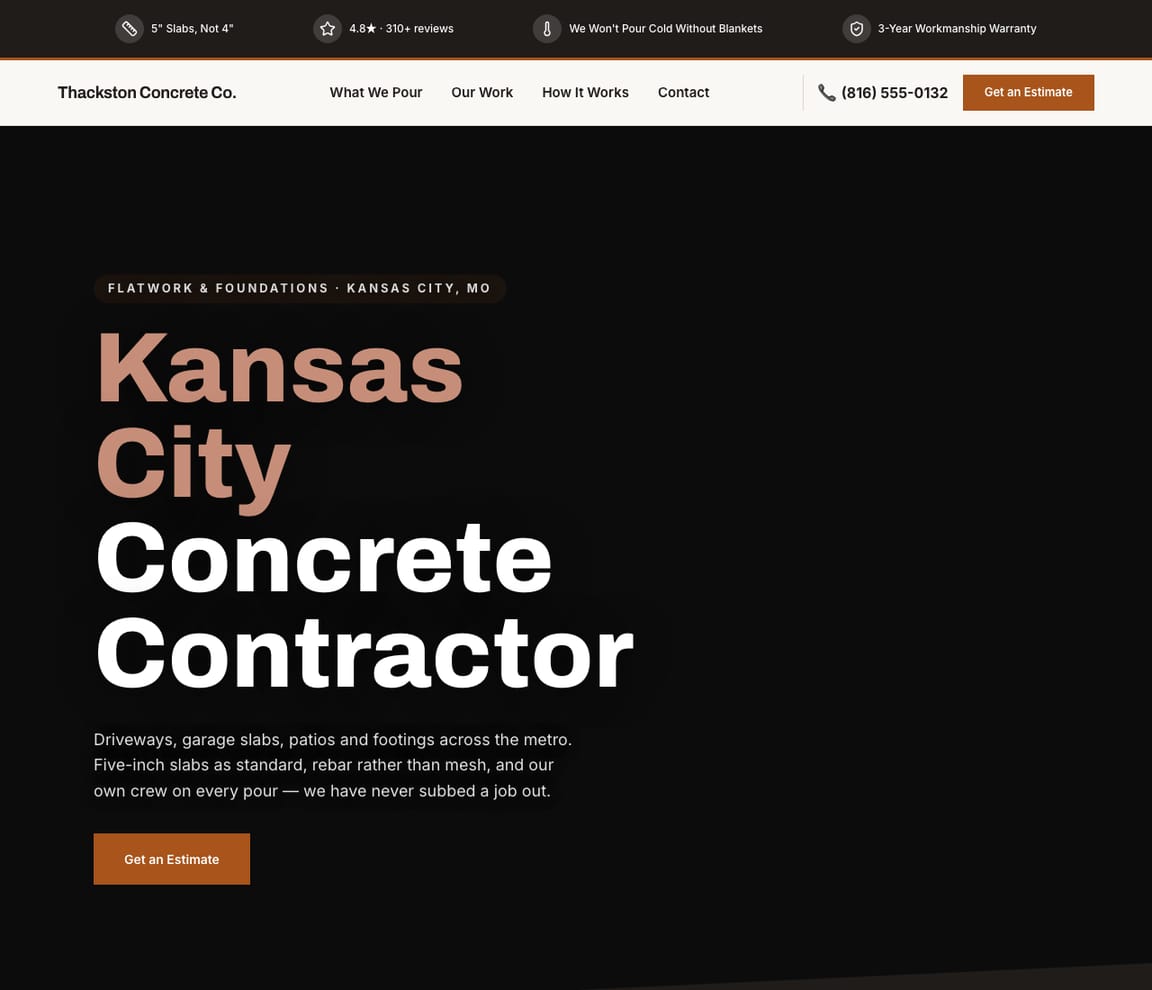
See what your concrete website could look like
This is a real Zarla template for a concrete contractor. Describe yours — driveways, patios, stamped work, the towns you cover — and you'll have a site like this, with a call button at the top and room for photos of your pours, in about a minute.
- Professional design — not a generic template
- Looks great on desktop and mobile
- Content written for your industry
Build the website
Start your concrete website now
Add your town and your company's name to the sentence, and Zarla builds the site: a call button at the top, a service-area map, a page for each service and a quote request form. Add photos of your driveways and patios, your license number and your price per square foot in chat, and publish.
Already have a website? Bring it across →Zarla keeps your old page addresses where it can and redirects the ones that change, helping you keep the Google standing you've built.
Is a concrete business worth starting?
The work is everywhere, and most of the companies doing it are small. Of 23,350 poured-concrete contractors with a payroll in the US in 2023, 13,738 — 59% — had fewer than five employees (Census County Business Patterns). The 204,800 cement masons and concrete finishers earned a median $57,020 in 2025 (O*NET, from BLS data).
The jobs are steady and the prices are published. A new concrete driveway averages about $6,400 in the US (HomeAdvisor, June 2026); a plain gray one runs $5 to $8 a square foot and a decorative one $8 to $21 (Concrete Network, January 2026), basic to mid-range stamped work $10 to $20 (Concrete Network) — with a set of stamp mats at $500 to $3,500 (Concrete Network) — and the full range runs $4 to $20, with most jobs $6 to $20 (Fixr). A plain patio slab is about $4 to $7 a square foot and simple stamping or coloring $9 to $17 (HomeAdvisor). Ready-mix, the biggest material cost, runs $160 to $195 or more a cubic yard, with a national average of $179.95 in 2025 (Concrete Network, July 2026). One construction-software company's 2026 table puts concrete work's gross margin at 25% to 40% and net at 8% to 15%, with decorative work above plain flatwork (Projul).
The hard parts are the weather, the clock and the body. Cold weather, in the industry's definition, starts when the air falls to 40°F or below (Concrete Network, citing ACI 306), so in much of the country the season is short. Once the truck is batched the clock runs: the long-standing ready-mix specification required concrete to be discharged within 90 minutes (NRMCA), and although a 2021 revision lets the buyer set the limit instead (American Concrete Pumping Association), most pours still run to it. Cutting and grinding concrete raises silica dust, which a federal safety rule controls (OSHA 29 CFR 1926.1153). And the margin is decided before the pour: a mismeasured base or a rained-out day eats it.
So it's worth starting if you can finish concrete well, estimate a job down to the yard and the hour, and carry the slow season — which is what the rest of this guide sets up.
How to start a concrete business, in plain English
There's no federal concrete license in the US. The federal rule that reaches every crew is OSHA's silica standard for construction: for listed tasks the employer must use the controls in its Table 1 — water on the blade, or a shroud and dust collector — and a respirator where the table calls for one, as it does for a handheld saw run more than four hours a shift (OSHA 29 CFR 1926.1153). States license or register the business, and the rules vary widely. Five examples:
- California: a C-8 Concrete license covers forming, pouring, placing and finishing flatwork (CSLB). It's needed for any job of $1,000 or more in labor and materials, or any job that needs a permit or a hired helper; the limit rose from $500 on January 1, 2025 (CSLB newsletter on AB 2622). A sole owner pays $450 to apply and $200 for the license, plus fingerprinting (CSLB), and carries a $25,000 bond (CSLB bond rules).
- Arizona exempts only casual, minor work under $1,000 that needs no building permit (A.R.S. §32-1121).
- Nevada exempts repairs under $1,000 that need no permit, and new licenses post a bond of at least $1,000 (Nevada State Contractors Board).
- Louisiana registers home improvement contractors for jobs over $7,500, licenses commercial work over $50,000, and asks for liability and workers' comp cover (Louisiana licensing board).
- Texas has no state license for concrete work — its licensing agency's programs don't include it (TDLR) — so cities set their own registration and permit rules.
Driveway aprons, sidewalks and curb cuts usually need a city permit, so ask before you quote. Insurance is the biggest fixed cost: concrete contractors pay a median $1,423 a year for general liability, $2,874 for workers' compensation and $413 a month for commercial auto (Insureon, July 2026). The rest of the start is modest — a 2022 estimate put a basic launch at $11,000 to nearly $20,000, with $3,000 to $5,000 down on a truck and $6,000 to $10,000 of tools and a portable mixer (Step By Step Business) — and the big machines are rented by the day: a walk-behind saw for about $110 to $140 (rentd, July 2026). Form the business, get the free EIN (IRS), and in California remember the deposit rule: no more than $1,000 or 10% of a home improvement contract, whichever is less (CSLB). Then the order is the same everywhere: learn the trade, choose your work, check your state's rules, register and insure, set up tools and ready-mix, write your prices, get found, and build the next season. Our free concrete business plan lays out every startup line with typical costs, the concrete and construction website templates and masonry and concrete website examples show what a good site looks like, and Zarla's concrete contractor website builder is how homeowners find your finished work.
What concrete contractors actually say
None of this is our opinion about the trade. It comes from owners writing and talking about how they started. Three things come up again and again, and only one of them is about concrete.
You start small. Dan Baker co-founded Baker Concrete Construction in Ohio with his brothers in 1968 — now one of the largest concrete contractors in the country: “We started with $500, I think. I don't remember exactly.” And: “So one truck from three brothers and we had our tools. Bags and tools and a bull float. No machine” (Concrete Logic Podcast, November 2025). The truck-and-tools start still holds six decades on.
“So during the day, I'd be pouring concrete. At night, I'd go home and run estimates for new business in my Excel spreadsheet.” — Marc Kuhn, founder of MAK Construction in Grand Forks, North Dakota, writing in November 2024
The season decides the year. Kuhn again: “My first year of business, I did about $250,000 total. Then, winter rolled around. And in North Dakota, that means the construction projects shut down for the year.” He spent the spring at a home show: “I walked out of there with 70+ leads and had work for the next year” (Unfollow the Herd).
Busy isn't the same as profitable. Tyler Link quit his job to start a concrete company with his father-in-law — “He knew how to do concrete and I knew how to do marketing.” Then: “We were able to scale our business to $1,200,000 of revenue in year 2 and were constantly busy. Although it appeared like things were going well, we had no money left in the bank” (Concrete CEO).
The through-line: the contractors who last start lean, estimate every job carefully, plan for winter, and watch the bank balance as closely as the calendar.
THE STARTER KIT
What you need to start a concrete business
Years on a concrete crew
Forming, placing and finishing on someone else's jobs until a driveway is routine — and estimating a few on the side before you bet a business on your numbers.
A truck and hand tools
The pickup you drive, forms, screeds, bull floats, hand trowels, edgers and groovers, a plate compactor and a portable mixer for small batches.
Rentals and a ready-mix account
Saws, power trowels, buggies and pump trucks rented by the day, and an account with a ready-mix supplier who'll deliver on your schedule.
A license where your state wants one
Some states license concrete work, some register home-improvement contractors, and some leave it to the city. Check before the first bid.
Insurance and silica controls
General liability and commercial auto before the first pour, workers' comp once you hire, and wet cutting or dust collection on every saw and grinder.
A way to show finished work
Photos of every pour, a yard sign on every job, and a website and Google profile that show the street what you poured next door.
THE PAPERWORK
Licenses, registrations and insurance for a concrete business
| Typical cost | Time to get | Legally required? | |
|---|---|---|---|
| C-8 Concrete contractor license (California) | $450 + $200, plus a $25,000 bond | Months, with an exam | In California, for jobs of $1,000+ |
| Contractor license (Arizona, Nevada) | Varies; Nevada bonds from $1,000 | Weeks to months | Above $1,000 or with a permit |
| Home improvement registration (Louisiana) | Varies | Weeks | In Louisiana, for jobs over $7,500 |
| City permit for a driveway apron or sidewalk | Set by your city | Days | Often — ask before you quote |
| EIN from the IRS | Free | Minutes online | If you hire or have partners; optional when solo |
| General liability insurance | $1,423/year median | Same day | Required by some states; builders ask |
| Commercial auto for the truck | $413/month median | Days | Auto cover yes; commercial for work use |
| Workers' compensation | $2,874/year median | Days | In most states, once you hire |
| Silica dust controls (OSHA) | Water or dust collection on saws | Before the first cut | Yes, for employers in the US |
THE STEPS
How to start a concrete business (step by step)
Eight steps from “I could run this crew myself” to your first paid pour.
01
Learn the trade on a crew
Form, place and finish on someone else's jobs, and learn to estimate a driveway — the base, the thickness, the yards and the hours — before you price your own.
02
Choose the work you'll sell first
Driveways, patios and sidewalks for homeowners, flatwork for builders and landscapers, or stamped and decorative work — each needs different tools and a different price.
03
Check your state's contractor rules
Look up your state's contractor board: a concrete license, a home-improvement registration, or nothing at state level and a city registration instead.
Before your first bid04
Register and insure the business
Form the business, get a free EIN from the IRS, open a business bank account, and buy general liability and commercial auto cover — workers' comp once you hire.
05
Set up tools, rentals and ready-mix
Buy the hand tools and a compactor, open accounts with a rental yard and a ready-mix supplier, and rent the saws and trowels until you use them every week.
06
Write your prices and your deposit rule
Price per square foot by finish, with tear-out, base and reinforcement as their own lines, and take a deposit that covers the ready-mix — within your state's limits.
07
Get found with finished work
Put your website and Google Business Profile live with photos of real pours, your service area, your license and a way to request an estimate.
08
Build the next season
Call builders, remodelers and landscapers, leave a yard sign on every job, ask every customer for a review, and book spring before winter ends.
THE COSTS
How much does it cost to start a concrete business?
The total is our free concrete business plan's itemized US ranges for a small crew: a truck down payment, tools and a portable mixer, the first year of general liability and commercial auto, any license, software, signs and two or three months of working capital. A trailer, stamp mats and a mixer truck are extras. Truck and tool lines are a published 2022 startup estimate; insurance is Insureon's July 2026 median for concrete contractors.
$16,900–$44,500to start a small flatwork crew — less if you drive the truck you already own
$6k–$10kforms, screeds, floats, trowels, a plate compactor and a portable mixer
$3k–$5ka down payment on a work truck, if your pickup can't do the job
$1,423/yrgeneral liability at the median for concrete contractors
WHAT WE'VE LEARNED
What actually makes a homeowner call your crew
Thousands of local business websites in, the pattern for outdoor home projects is clear: the homeowner is comparing a few names for a job that lasts decades. Three things on a page decide who gets the estimate.
Photos of real pours
Driveways, patios and stamped work you actually poured — with the town and the finish under each one — and before-and-after shots of the tear-outs.
How you build it, in writing
The base, the thickness, the reinforcement and what's normal about cracking — the things that separate a slab that lasts from one that doesn't.
An easy way to get an estimate
A call button at the top, the towns you cover, your license or registration number where your state issues one, and a short quote request form.
THE UPSIDE
What a concrete business can earn
Driveway and patio prices from Concrete Network's and HomeAdvisor's 2026 US cost guides; margins from a construction-software company's 2026 table; pay from O*NET's 2025 medians. Averages, not a promise — your square feet a week, your prices and the weather decide it.
$5–$8 a square foottypical installed price of a plain concrete driveway; decorative work runs $8 to $21
$6,400average price of a new concrete driveway
25%–40%published gross margin for concrete work — and 8% to 15% net
$57,020median pay for cement masons and concrete finishers — what a good finisher costs you
SEE IT WORK
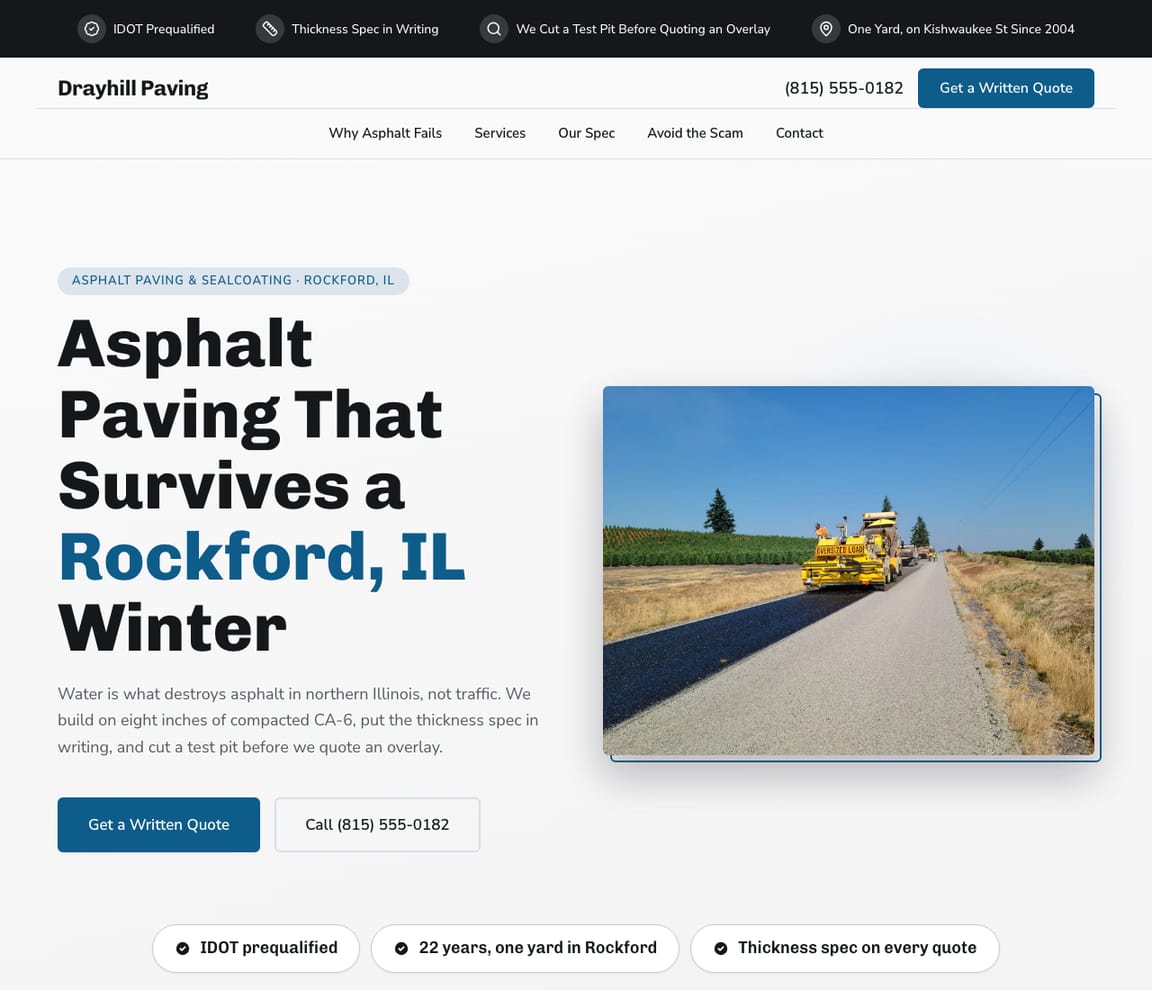
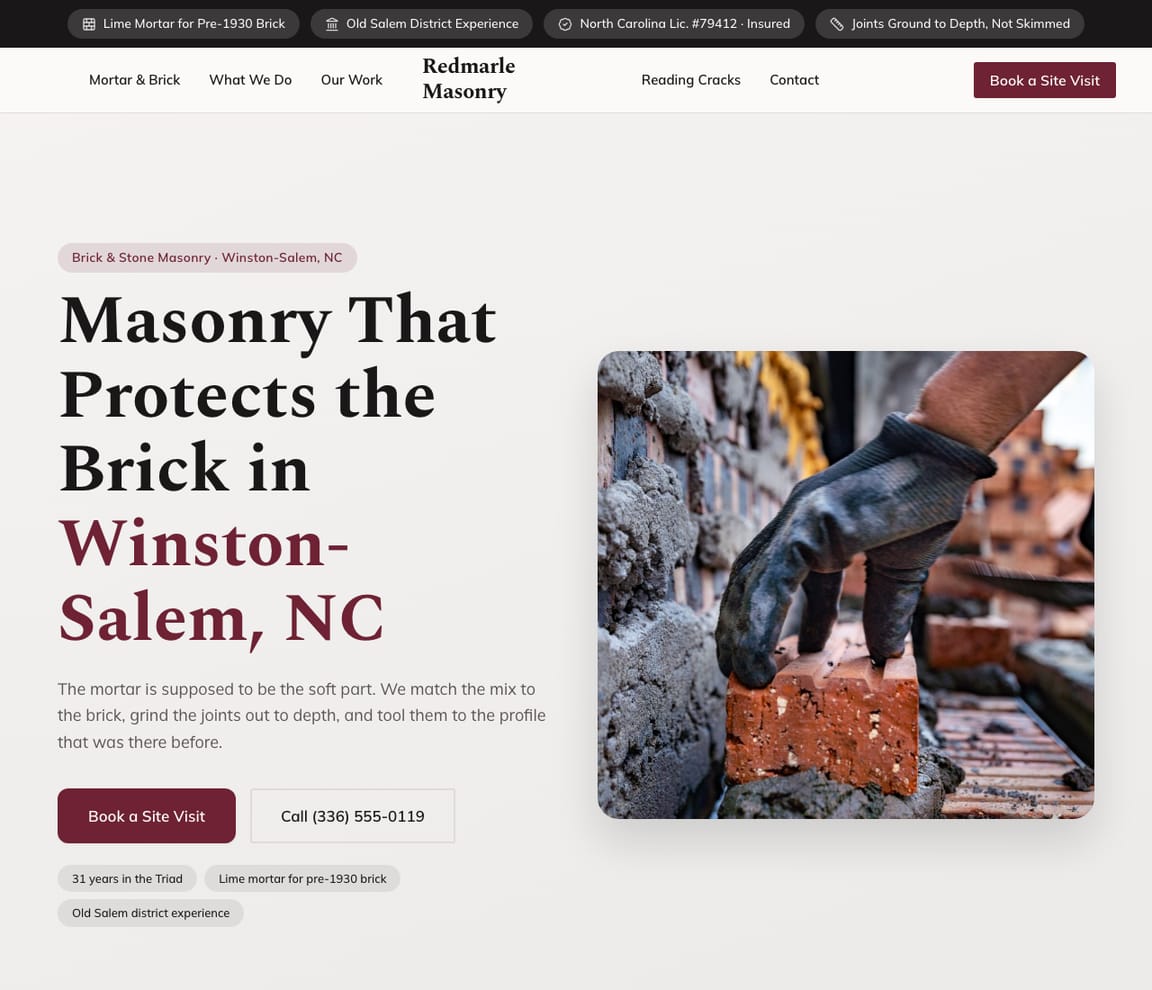
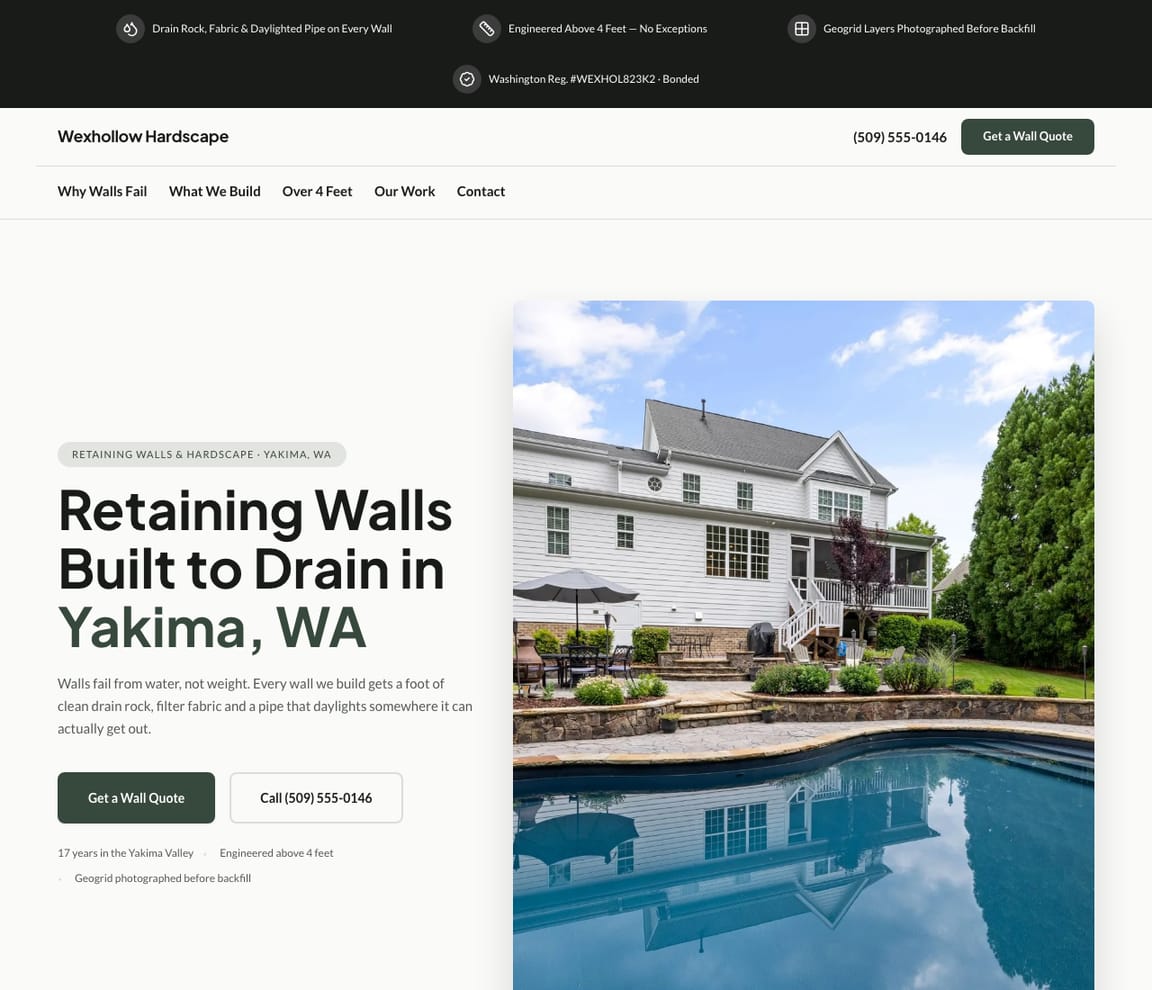
Concrete and hardscape website designs you can start from
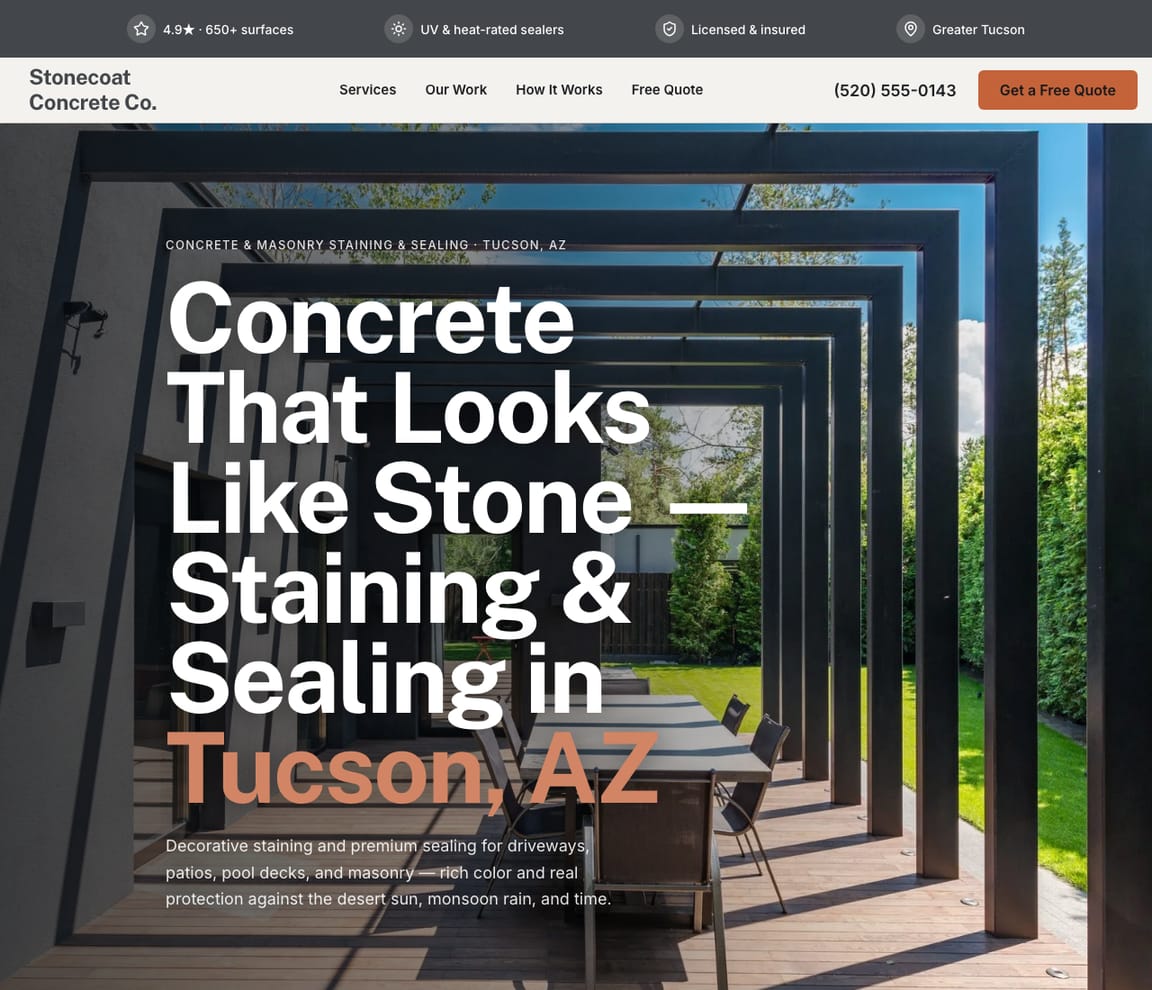
All four are real Zarla templates. Open the one closest to the work you'll sell — paving, masonry, retaining walls or decorative staining — swap in your number, your service area and photos of real jobs, and publish.
GET FOUND
Get found when the old driveway finally cracks
A homeowner pricing a new driveway or patio looks at photos, reviews and whether you work in their town before they call. Zarla builds the website, and once you connect your Google Business Profile, your name, map location and reviews stay in step on both.
“Concrete contractor near me”
Searched by a homeowner standing on a cracked driveway. Your finished jobs, the towns you cover and a quick way to ask for an estimate answer it before they call the next name.
Google Business Profile
Your service area, your hours, photos of real pours and your reviews inside Google Maps. Free, and an afternoon to set up — and where the neighbor looks after seeing your yard sign.
Reviews from finished jobs
Ask when the forms come off and the customer is admiring the finish. A driveway is seen by the whole street, and the review tells that street who poured it.
Google Search
Iironsideconcrete.com
Ironside Concrete — Trusted Concrete in Your AreaDriveways, patios, sidewalks and stamped concrete. Free on-site estimates, base and thickness written into every quote, licensed and insured.← Your Zarla siteCcityconcreteservices.com
City Concrete ServicesGoogle Maps
1
Ironside Concrete
← You2
Metro Concrete Co.
3
Quick Concrete Services
AI assistants (ChatGPT / Perplexity)
For a local concrete contractor in your area: Ironside Concrete — a local concrete contractor with photos of finished driveways and patios, written estimates and reviews from homeowners nearby.
YOUR LAUNCH PLAN
Your concrete business launch checklist
The whole guide as things to check off. Work through them in order and you'll be licensed where you need to be, insured, equipped and priced before your first pour.
- Learn to estimate on someone else's jobs — base, thickness, yards and hours.
- Check your state's contractor rules — a license, a registration, or a city registration.
- Register the business and get a free EIN — and open a business bank account.
- Buy general liability and commercial auto cover — workers' comp once you hire.
- Open accounts with a ready-mix supplier and a rental yard — rent saws and trowels at first.
- Control silica dust — wet cutting or dust collection on every saw and grinder.
- Write your prices and deposit rule — per square foot by finish, with tear-out and base as separate lines.
- Get found with finished work — website and Google Business Profile live with photos of real pours.
REAL CUSTOMERS
Small business owners who got online with Zarla
Verified reviews from real Zarla customers.
“Quickly built my website from scratch. No hiccups. Would highly recommend Zarla for someone with no experience who wants to start a polished business website.”
“Great professional website in less than a minute, with the use of AI and a few descriptive prompts. This has saved me bundles of time and research on web developers.”
“I had no idea how to set up a website for my business. Thanks to Zarla, they've helped me a lot.”
“Very reliable, professional, and fast results. I was able to get my business online in no time, and the ease of access made it so simple.”
Let the next street find your last driveway
Add your town and your company's name, and Zarla builds the website from that one line — a call button at the top, the area you cover, your services and a quote request form. Free to build; you pay when you publish.
Already have a website? Bring it across →Zarla keeps your old page addresses where it can and redirects the ones that change, helping you keep the Google standing you've built.
Frequently asked questions
Is concrete a good business to start?
It can be, if you know the trade. The demand is local and steady — every driveway, patio and sidewalk eventually cracks — and the field is made of small companies: 59% of US poured-concrete contractors with a payroll have fewer than five employees. A new driveway averages about $6,400, and published margins run 25% to 40% gross. The trade-offs are a short season in cold states, heavy work and an estimate that has to be right.
How much does it cost to start a concrete business?
In the US, about $16,900 to $44,500 for a small flatwork crew in our concrete business plan's itemized ranges — a $3,000 to $5,000 truck down payment, $6,000 to $10,000 of tools and a portable mixer, the first year of general liability and commercial auto, any license, software, signs, and two or three months of working capital. Owners who already have a truck start toward the low end. A trailer, stamp mats ($500 to $3,500 a set) and a mixer truck are extras.
What equipment do I need to start a concrete business?
A truck, forms and stakes, screeds, a bull float, hand trowels, edgers and groovers, a plate compactor, wheelbarrows and a portable mixer for small batches. Rent the expensive pieces by the day until you use them weekly — a walk-behind concrete saw rents for about $110 to $140 a day — and order ready-mix delivered instead of buying a mixer truck.
Is a concrete company profitable?
It can be: one construction-software company's 2026 table puts concrete work at 25% to 40% gross margin and 8% to 15% net, with decorative work above plain flatwork. But revenue isn't profit — one owner grew to $1.2 million in year two and still had no money in the bank. The estimate, the deposit and the slow season decide what you keep.
What license do I need to start a concrete company?
It depends on your state. California requires a C-8 Concrete license for jobs of $1,000 or more; Arizona and Nevada license contractors above about $1,000 or wherever a permit is needed; Louisiana registers home improvement work over $7,500; Texas has no state concrete license, so cities set the rules. Everyone needs a business registration and, once you hire, workers' comp. Check your state's contractor board before your first bid.
Is it hard to start a concrete company?
The finishing is the part you already know; the business is harder. You have to estimate to the yard and the hour, schedule pours around the weather and the ready-mix clock, keep a reliable crew, control silica dust on every cut, and carry the slow months — one North Dakota owner's projects shut down every winter.
What is the 90 minute rule for concrete?
The long-standing ready-mix specification, ASTM C94, required concrete to be discharged on the job within 90 minutes and before 300 drum revolutions after water was added. A 2021 revision dropped the fixed default and lets the buyer set the limit, but many job specs and suppliers still work to 90 minutes — so the forms, the base and the crew have to be ready before the truck is batched.
How much does it cost to pour 1000 sq ft of concrete?
Installed, about $6,500 to $10,500 for a plain slab at $6.50 to $10.50 a square foot for materials and labor, and about $10,000 to $20,000 for basic to mid-range stamped work at $10 to $20 a square foot. A 4-inch slab that size takes about 12.3 cubic yards — around $2,000 to $2,400 of ready-mix at $160 to $195 a yard — before the base, reinforcement, forms and labor.
What is the 4 2 1 rule for concrete?
It's a mixing ratio for site-mixed concrete: 4 parts gravel, 2 parts sand and 1 part cement, plus water. It's useful for a small batch in a portable mixer; for driveways and slabs a contractor orders ready-mix by its strength instead.
How do I get customers for a concrete business?
Show the street what you poured: a yard sign on every job, photos of every finished driveway and patio, and reviews from the homeowners who hired you — on a Google Business Profile and a website with your service area, your license and a quote request form. Then call builders, remodelers and landscapers who need flatwork. Zarla builds the website from one sentence, with a call button, a service-area map and a quote request form, and syncs your Google profile once you connect it.