BUSINESS GUIDE
How to start a farm in 2026
A market garden with a CSA, a homestead that sells eggs, a cut-flower farm or a few sheep — what each costs from the USDA's land figures and the makers' own lists, leasing against buying, the free farm number and the microloan, the egg, produce and cottage-food rules state by state, the markets — and what small farms honestly earn.
Free to build · Pay when you publish · No credit card
−$1,830the median US farm household's income from farming in 2024 — the household itself earned $102,748, mostly off the farm (USDA ERS)
$160an acre a year to rent cropland in 2026, against $6,020 an acre to buy it (USDA)
$15,623an acre: the average gross of market gardens under three acres in SARE's three-year study
No codeto get online
See it in action
See what your farm website could look like
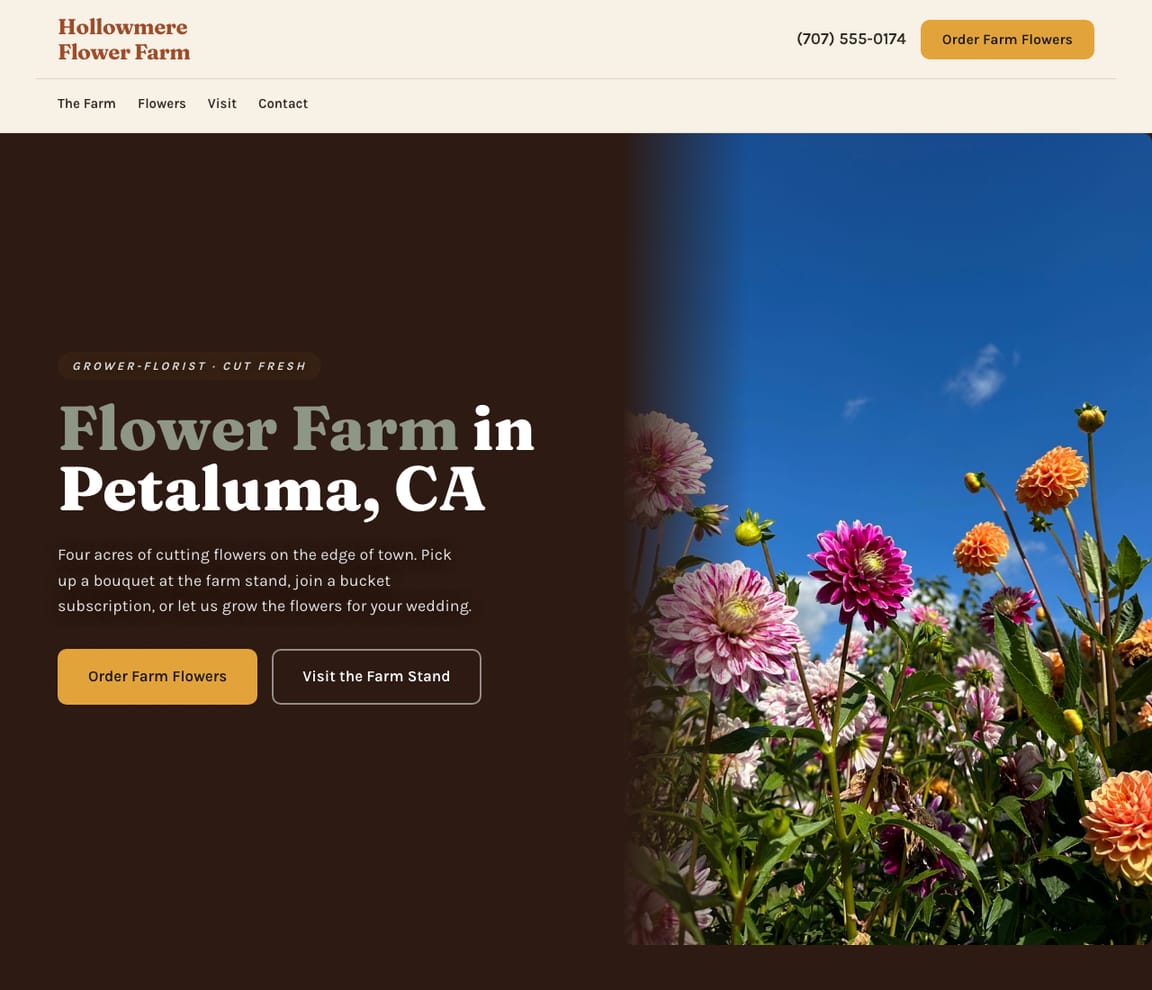
This is a real Zarla template for a flower farm. Describe yours — what you grow, what you raise, the town — and you'll have a site like this, with what you sell and a contact form for CSA and egg requests, in about a minute.
- Professional design — not a generic template
- Looks great on desktop and mobile
- Content written for your industry
Build the website
Start your farm website now
Add your town and your farm's name to the sentence, and Zarla builds the site: what you grow and raise, and a contact form for CSA and egg requests. Add your share prices, your market days and your stand's hours in chat, then publish.
Already have a website? Bring it across →Zarla keeps your old page addresses where it can and redirects the ones that change, helping you keep the Google standing you've built.
Is starting a farm worth it in 2026 — and what does a small farm earn?
The USDA says the honest number first: "At the median, household income from farming was -$1,830 in 2024 … Median off-farm income in 2024 was $86,900, while the median total household income was $102,748" (USDA ERS, farm household income, updated May 15, 2026). Commercial farms — $350,000 and up of gross cash farm income — had a median farm income of $174,933 and 84 percent of them made money; the intermediate and residence farms that most first-year farms are lost a median $2,799 and $2,748. There are 1.88 million US farms, 466 acres each on average, and small family farms are 86 percent of them and "typically rely on off-farm income" (USDA ERS, farming and farm income, September 3, 2026); "48.0 percent of all farms had less than $10,000 in sales and 78.8 percent of all farms had less than $100,000" in 2025 (USDA NASS, Farms and Land in Farms, February 2026). A farm, for the count, is "any place from which $1,000 or more of agricultural products were produced and sold, or normally would have been sold" (2022 Census of Agriculture), and a third of them — 630,116 — had a producer who had farmed ten years or fewer in 2022 (USDA NASS, beginning producers, 2022 Census).
What the small shapes gross. SARE's three-year study of nineteen fresh-market vegetable farms found market gardens under three acres grossing $15,623 an acre on average — $8,888 to $25,605 — on just under 2,000 hours of labor an acre, with net cash income averaging $5,664 an acre — $1,892 to $9,487 — and "an average net cash hourly wage of about $5" (SARE, Profit by Planning, 2002–2004); the trade's older rule of thumb is "$20,000 per acre for mixed vegetables to $35,000 an acre or more for high-dollar salad mix, herbs, or cut flowers" (Mother Earth News, October 8, 2013). Cut flowers run higher and wider: a 2021 Utah study found "the average revenue per acre was $64,000, with a low of $7,000/acre and a high of $200,000/acre" (Utah State University Extension, 2022). The CSA sells the box by the season: Michigan State's Student Organic Farm sold its 2025 full share at $675 for 15 weeks — $45 a week (MSU Student Organic Farm, 2025); Red Hill Farm in Pennsylvania lists "A full share for the 2026 season is $850" (Red Hill Farm, 2026); extension guides put a season at "around $500" with "$10 to $30 a week" (Penn State Extension) and "$400-$700" (NC State Extension). Direct sales are where small farms live: "116,617 farms sold directly to consumers, with sales of $3.3 billion" in 2022 (USDA NASS, February 13, 2024), and "More than 86% of the farmers who responded are selling their products directly" in the young farmers' own survey (Farm and Dairy, reporting the National Young Farmers Coalition, 2022). Eggs pay for feed: the stand owners here sell out at $5 a dozen and say so. A market lamb at an October 2026 auction brought $205 to $320 a hundredweight (USDA AMS, Madison Livestock Market, Virginia, October 14, 2026) — roughly $200 to $450 a head, not the AI answer's flat $200.
Which farms make money — by the USDA's own forecast. Average net cash income per farm business in 2026, which means commercial operations: dairy $477,500, hogs $395,800, cotton $370,700, corn $306,100, specialty crops (fruit, vegetables, greenhouse) $286,700, cattle and calves $50,300 — and poultry and eggs a loss of $3,400 (USDA ERS, farm business income, September 2026). Those are not first-year numbers; they are what a 466-acre average farm with a bank behind it does. The Census sorts the rest: small family farms were 85 percent of farms and 14 percent of sales in 2022, large-scale family farms a few percent of farms and 51 percent of sales (USDA NASS, family farms, 2022 Census); vegetables alone were $28.2 billion of sales on 69,452 farms (USDA NASS, vegetables, 2022 Census).
What the people earn. Employed farmers, ranchers and agricultural managers had a median of $89,900 a year in 2025 (O*NET, from BLS 2025 wage data); $85,990 in Texas (O*NET, Texas), $109,140 in California (O*NET, California), $89,370 in New York (O*NET, New York); crop, nursery and greenhouse farmworkers $17.15 an hour, $35,660 a year (O*NET). The federal wage survey behind those medians leaves out farms and the self-employed altogether (Washington ESD) — they describe hired managers and hands, not the owner of two leased acres, whose number is the household one above.
The catch. The first CSA money arrives in March and the first market in May, and the seeds, the tunnel and the chicks were paid for in February; a late frost takes crops the plan already sold; a lease that ends is a farm that ends; and the USDA's own survey says most farm households live on a job in town. That's what the rest of this guide sets up.
How to start a farm, in plain English
Lease, don't buy — the USDA's own prices say so. Cropland sold for $6,020 an acre in 2026, farm real estate for $4,500 and pasture for $2,000 (USDA NASS, Land Values 2026 Summary, July 2026), while cropland rented for $160 an acre a year on average (USDA ERS, farmland value, September 23, 2026) — $146 for non-irrigated and $244 for irrigated land in the same USDA survey (American Farm Bureau, reporting NASS, August 2026). Rent is under 3 percent of the land's price, our arithmetic, and FSA's ownership money cost 6.25 percent in October 2026 (USDA FSA, October 2026 lending rates); a farm ownership loan runs up to $600,000 (FSA, farm ownership loans). The farmers here say the same thing: the land was reached by a lease, an incubator or a conservancy, and the one who bought 40 acres did it after years of leased plots. Get a long lease, because the tunnel, the fencing and the soil you build stay with the land.
The farm number, then the money. "Establish a Farm Record and Obtain a Farm Number — This is required to participate in USDA programs. FSA will need documents to prove your association with the land" (USDA FSA, Apply Now); "Call your Farm Service Agency (FSA) office to make an appointment to establish a farm number" (USDA NRCS, New to Farming?, April 2025). It is free, and it unlocks the operating microloan — up to $50,000 on one-to-seven-year terms (FSA, operating microloans) at 5.375 percent in October 2026 — and NRCS's high tunnel initiative (USDA NRCS, EQIP High Tunnel Initiative), which in Pennsylvania's 2026 cost list pays "Base Cost $5,524.04" plus "$4.89/SqFt" on a tunnel, capped at "$10,000 per operating unit" (USDA NRCS Pennsylvania, FY2026 published cost list). The "USDA Beginning Farmers and Ranchers Program" the AI answer names is NIFA's Beginning Farmer and Rancher Development Program, and it funds organizations that train farmers, not farmers (USDA NIFA, BFRDP); what a farmer uses is the state beginning-farmer coordinator and the loan pages on farmers.gov (farmers.gov, beginning farmers).
The business, and the tax the farm doesn't pay. Texas: an LLC's certificate of formation is $300 (Tex. Bus. Orgs. Code §4.152; §4.154); "Food products for human consumption are exempted" from sales tax (Tex. Tax Code §151.314), and "To claim a tax exemption on qualifying items, you must apply for an agricultural and timber registration number (Ag/Timber Number) from the Comptroller" — seed, feed, fertilizer and equipment tax-free (Texas Comptroller). Florida: $100 to file articles of organization plus $25 for the registered agent (Fla. Stat. §605.0213); food is exempt and a farmer whose land is classified agricultural gets the Florida Farm TEAM card (Fla. Stat. §212.08). New York: $200 for articles of organization plus the newspaper notices (N.Y. LLC Law §1101); farm purchases are exempt when used "predominantly … in the production for sale of tangible personal property by farming" (N.Y. Tax Law §1115) on Form ST-125 (New York Tax Department). California: "Filing Fee - $70.00" (California Secretary of State, Form LLC-1) and "an annual tax of $800" (Franchise Tax Board); the farm-equipment partial exemption "applies only to the state general fund portion of the sales tax, currently 5.00%" (CDTFA, farming exemptions). Kentucky files an LLC for $40 (Kentucky Secretary of State); the EIN is free everywhere (IRS), and the mileage to market deducts at 76¢ a mile (IRS, standard mileage rates, July to December 2026). Confirm the entity choice and the exemption with your accountant.
Produce safety leaves a small farm alone; eggs and jars do not. The FDA's produce rule does not cover a farm whose produce sales average under $35,247 a year (the 2025 cutoff), and a farm under $704,950 of food sales selling mostly to consumers, restaurants and retailers in its state or within 275 miles is "qualified exempt" — records and a label with the farm's name (FDA, FSMA inflation-adjusted cutoffs, May 13, 2026; 21 CFR 112.3). Eggs are a state matter. Pennsylvania: "If an egg producer has less than 3,000 laying hens, and sells eggs within five days from the date of lay and sells eggs predominately within a 100 mile radius", the small-flock rules apply (Pennsylvania Department of Agriculture). Texas exempts "producers of eggs that only sell the production of their own flock directly to the consumer" from the state egg license, but at a farmers market "A vendor must obtain a permit issued by the regulatory authority … The eggs must be stored at a temperature of 45° Fahrenheit or less. The egg cartons or other containers must be labeled as 'ungraded' and provide the producer's (vendor's) name and address. Reuse of egg cartons is prohibited." (Texas DSHS, selling yard eggs at a farmers market, 2017). Florida permits a "limited egg farm operation" with "a flock of 3,000 hens or fewer" selling under 30 dozen a week (Fla. Admin. Code 5K-4.033, effective November 11, 2025). California registers every egg handler: "A new application has a fee of $75. Renewing application has a fee of $50" (California Department of Food and Agriculture). New York puts the grade-labeling duty on sellers of eggs "other than those of his own production" — a producer selling its own is outside it (N.Y. Agriculture and Markets Law §160-c). Anything cooked, cut or jarred is cottage food or a licensed kitchen: Texas caps a cottage food operation at "$50,000 or less" a year, sold "only directly to consumers" (Tex. Health & Safety Code §437.001); Florida at $250,000 (Fla. Stat. §500.80); California's Class A at $75,000 and Class B at $150,000 (California Department of Public Health); New York registers an exempt home processor with the state (Cornell Small Farms). Poultry: a producer who slaughters "not more than 1,000 poultry" of its own raising in a year, sold direct, is exempt from inspection (9 CFR 381.10). Organic: certification is not required under "$5,000 or less annually" of organic sales (7 CFR 205.101), and above it USDA refunds "up to 75 percent of their certification costs … not to exceed $750 per certification scope" (FSA, organic certification cost share, 2025 and 2026). Pesticides: a Texas private applicator license carries a "$100 license fee" for five years (Texas A&M AgriLife); in California "Applicants will submit LIC-045 to County Agricultural Commissioners, not to the Department of Pesticide Regulation", and the county sets the fee (California DPR, private applicator certificate). Check your own state's rules before the first dozen.
Insurance, and the market's certificate. No openable page prints a farm liability median, so the plan carries it as a planning range; the market table has a list price — farmers market liability "from $25.92/month", with markets commonly asking "$1,000,000 per occurrence … and $2,000,000 aggregate" and the market named as additional insured (Food Liability Insurance Program). The markets' own 2026 applications: Portage, Wisconsin "$150 a season, $30 per month and $10 per day" (City of Portage, 2026); Hunterdon, New Jersey "$550 for full time attendance (30 weeks at $20 each, with prepay discount). $350 for biweekly" (Hunterdon Community Farmers Market, 2026); Charlottesville, Virginia "$35 Per Season" to register and "$25.00 Per Market Day" (City of Charlottesville, 2026). Workers' compensation is not universal: "in Texas, private employers can choose to carry workers' compensation insurance coverage, but it is not required in most cases" (Texas Department of Insurance); Florida's farm rule is "six (6) regular employees; and/or twelve (12) seasonal workers who work more than 30 days during a season" (Florida CFO); New York — "A farmer shall provide coverage under this chapter for all farm laborers" (N.Y. Workers' Compensation Law §3); California — "All California employers must provide workers' compensation benefits to their employees" (California DIR).
The equipment, from the makers' lists. Bootstrap Farmer's premium gothic all-metal high tunnel kit is $7,760 at 20 by 40 feet, $13,120 at 20 by 80 and $4,480 at 14 by 20 (Bootstrap Farmer, October 2026); a BCS 739 PS walk-behind tractor is $6,999 at a dealer (Horizon Ag & Turf, October 2026); a CoolBot Pro, which runs a window air conditioner as a walk-in cooler, is $429 (Johnny's Selected Seeds, October 2026); Rhode Island Red pullet chicks are $4.22 each at 100 or more — listed, and sold out on the day we read it (Murray McMurray Hatchery, October 2026); electrifiable poultry netting, 48 inches by 164 feet, is $184.99 at a farm co-op (Valley Wide Cooperative, October 2026). CSA software starts at "$109/month, or $87/month billed annually" (Local Line); Square takes 2.6% plus 15¢ at the stand and 3.3% plus 30¢ online (Square pricing).
The money to start. Our free farm business plan itemizes a first-year market farm on three leased acres at $30,740–$67,440: a year's rent up front, the tunnel, the walk-behind tractor and implements, irrigation, the first season's seeds and supplies, the wash-pack station, the cooler, a hundred hens with their coop and netting, deer fencing, market gear, insurance, the registrations and two months of running costs — the land purchase, organic certification and a used pickup on top. A lean solo start from list prices — one acre leased at $160, a 14-by-20 tunnel at $4,480, the CoolBot at $429, a hundred chicks at $422, netting at $184.99, a Texas LLC at $300, one market season at $150 and a year of market liability at $311.04 — comes to $6,437.03, our arithmetic, and $1,957.03 without the tunnel; seeds, hand tools, the coop, feed to the first egg, drip tape and a truck come on top and have no openable list price. An incubator plot is cheaper still: New Entry's "fees total approximately $1,500/the year. This includes access to land, infrastructure, training, and equipment" for a quarter acre (New Entry Sustainable Farming Project), and Groundswell's "$130-600 per season" — $130 to $600 — (Groundswell Center, Ithaca). Grants fund projects, not startups: SARE's farmer grants run "$5,000–$50,000" in the Northeast (Northeast SARE) and up to $35,000 in the West (Western SARE). The designs it borrows are the florist templates above.
In the UK: keeping livestock means a county parish holding number — since July 22, 2026 "You only need to register with the RPA, unless you're keeping fewer than 50 poultry or any number of captive birds" (GOV.UK, register land you use to keep livestock); eggs need no stamp if you "sell your eggs directly to consumers – for their own use – from your own farm or door to door" or "have fewer than 50 birds and you sell at a local public market", though the market stall still shows the name, address and best-before date (GOV.UK, eggs: trade regulations); VAT registration is required at £90,000 of turnover (GOV.UK), and the agricultural flat rate scheme lets a farmer below £150,000 stay unregistered and add a 4 percent flat-rate addition instead (GOV.UK, agricultural flat rate scheme); a farm shop or a jam registers as a food business "at least 28 days before" trading, free (GOV.UK, food business registration). In Australia: an ABN is free (business.gov.au) and GST registration is required at $75,000 of turnover (ATO); in New South Wales "'Small egg farms' are those that produce no more than 20 dozen (240) eggs for sale in any week", they notify the Food Authority instead of applying for its permit, and eggs sold from the farm gate are exempt from stamping — the Authority supplies "a one-off free hand stamp" for the rest (NSW Food Authority, small egg farms); a market stall notifies the council (NSW Food Authority, markets and temporary events). Check your own state's rules.
What farmers actually say
None of this is our opinion about farming. It comes from people who started small farms — flower farmers, market gardeners, egg-stand owners, a first-generation grain farmer, homesteaders — talking to CanvasRebel, the USDA's own farm stories, NRCS, NPR, Harvest Public Media, local papers and television between 2017 and 2026, each described as the page describes them. Read each as theirs at the time. Five things come up again and again.
The land came by lease, not by inheritance. Bobbi Wilson, a beginning farmer in southern Oregon: “I think there's kind of this phrase of like 'marry it or inherit it' kind of thing — like, that's the way that people access land, and that's not something that was previously accessible to me” (NPR, September 1, 2022). Jason Silverman, who hays leased fields in Conway, Massachusetts: “I just finished my sixth season for myself. I feel really lucky to be up here. I've managed to 'make it.'” And: “People don't understand how flexible they can be. Leases can be viable.” (Daily Hampshire Gazette, October 11, 2017). Cody Otten, a first-generation farmer in Clark's Hill, Indiana: “Anybody that thinks that there's no possible way they could farm, there is a way” — and: “So, this year I'm actually cash renting 80 acres.” (Hoosier Ag Today, May 21, 2022). Heather-Marie Bloom, who leased plots before buying 40 acres in Barnum, Minnesota: “We did our deliveries in a Prius before, which was hilarious. Sort of like a clown car, all these vegetables would come pouring out” (Hortidaily, reprinting the Duluth News Tribune, August 24, 2021). Savannah Salley of Headwaters Market Garden in Alexander, North Carolina, who found land through a conservancy's incubator: “we landed in Asheville because of its local food movement” (ASAP, Growing Local, September 23, 2019). Cait Caughey, a first-generation farmer in southwest Iowa, on the risk: “I know of younger farmers that have had longer leases, and those leases ended… And you really, you're starting all over.” (Harvest Public Media, March 12, 2021).
“And that felt like a point of failure, that my farm couldn't make more money, and yet we sell out of everything we can produce every year… What bank is gonna lend me money, especially in an industry that is challenged?” — Melanie Kirby, farmer and beekeeper, Tortugas Pueblo, New Mexico, in Harvest Public Media, March 12, 2021
The loan, the tunnel and the program. Carrie Chlebanowski of The Looney Farm in Oklahoma: “We had zero agricultural knowledge prior to starting The Looney Farm… We are YouTube producers. That is how we learned everything.” And: “With the $40,000 loan we were able to purchase the infrastructure needed to get started.” And on the tunnel: “The crops we can get in the ground in the tunnel versus the field in terms of weather makes a world of difference. Having access to a program like EQIP and with as easy as it is, was a game changer.” (USDA Farmers.gov, Fridays on the Farm, July 1, 2022). Sarah Klawitter, a Minnesota flower and produce farmer: “Microloans have allowed us to invest in the farm and grow our operation substantially… We were able to obtain not only a utility tractor and implements, but aid in building two high tunnels to exceed the minimum NRCS specifications” (USDA Farmers.gov, August 21, 2026). Gideon Nobbe, who farms seven acres in Argos, Indiana: “If it doesn't work this year, you can always try it again next… If I need to take and literally gut out something and redo because it's not working, I can do that.” (USDA NRCS Indiana, November 18, 2022). Matt Wilson, a veteran and beginning farmer in Winnebago County, Wisconsin: “NRCS helped with how to improve land that was used and abused by the prior operator. We started with cover crops and now have a pasture mix.” (USDA NRCS Wisconsin, October 26, 2022).
Eggs pay for the feed, and sell out. Linda Whitehead of Lil Red Barn Ranch in Buckeye, Arizona, who sells at $5 a dozen: “I pretty much break even. It pays for my feed so I can enjoy my chickens” — and: “People at work know I have chickens, so they are asking me for eggs it's been crazy.” (AZFamily, February 18, 2025). Mariell, a teenage egg-stand owner in Emporia, Kansas: “If I put about 4 dozens out there a day, they're gone in about 12 hours… Right now, I'm charging almost $2 less a dozen than most stores do. It pays for the feed and what the chickens need. I don't need any more than that.” (WIBW, May 2, 2025). Bobbie Smith of the Abba Acre stand in Ashland, Kentucky: “I actually cannot keep up with my egg customers at the moment… people are just refusing to pay the prices of the store-bought eggs.” (WSAZ, March 14, 2025). Angela Koeing, a homestead owner in Cochise County, Arizona: “With the more orders, came more chickens. And now we have a ton of eggs… Now, there are more people that want eggs than I can provide. So, I have ordered more chickens.” (KGUN 9, February 2023).
Flowers: the first year hurts, and the email list is yours. Kari Mulderink of Blackberry Ridge Flower Farm: “Spring of 2021 was my first year of full-time flower farming. I began with 17 flower subscription customers and also sent flowers to the farmer's market. Honestly the first year was tough….my unconditioned body ached, I felt overwhelmed with all the farming tasks and the business aspects of starting a website, advertising, etc.” (CanvasRebel, November 21, 2022). Carolyn Thompson, owner of Willow & Mabel Garden Co.: “It was never in life's game plan to be a flower farmer. I was working in an office which was not feeding my soul.” And: “I always tell new flower farmers that Meta owns Facebook and Instagram and they could pull the plug at any time but you own your email list.” (CanvasRebel, April 15, 2024). Josh Roth of Family Flower Farm in Silk Hope, North Carolina: “We started reading books, listening to podcasts, and even started what we jokingly called our 'murder wall' which was a series of index cards full of ideas, materials, logistics, budgets, building layouts and designs” (CanvasRebel, February 16, 2023). April Vomfell of Flathead Farmworks in Kalispell, Montana, who quit a marketing job in 2019 to farm a quarter acre: “The demand for local flowers was apparent almost immediately” (Whitworth Today, Spring 2021). Meghan Dudenhoeffer, owner of the Mostly Meg flower farm in Cole County, Missouri: “The unfortunate side of growing challenging things is there's a lot of failure… And now I know it doesn't work or I know what didn't work so that I can be successful.” (Jefferson City News Tribune, January 5, 2026).
The through-line: the farmers who lasted leased before they bought, took the farm number and the microloan early, put a tunnel up with cost-share, sold eggs and shares to people who already knew them, and carried the first years on another income.
THE STARTER KIT
What you need to start a farm
Land you lease, not land you buy
Cropland rents for a fraction of what it sells for, and the lease decides everything the tunnel and the fencing will sit on — get a long one, and get the water tested before you sign.
A farm number, then the loan
The free farm number from your county FSA office is the key to the microloan, the tunnel cost-share and the organic cost-share — before the business plan, before the chicks.
A tunnel, a walk-behind tractor, a cooler
The high tunnel for the early and late crops, a walk-behind tractor for two intensive acres, and a walk-in cooler built around a CoolBot — each from the maker's or a dealer's own list.
Your state's egg and produce rules
Eggs are a state matter and the small-flock rules decide the plan; the federal produce rule leaves a small farm alone; cottage-food law covers the first jar. Read yours before the first dozen.
Insurance and the market's certificate
A farm liability policy with product liability, because every farmers market asks for a certificate naming the market before you set up.
A CSA sold in February, and a job in town
The share paid up front is the line that carries the winter; the USDA's own figures say most small farms are paid for by off-farm work in year one — plan on it.
THE PAPERWORK
Licenses, permits and insurance for a small farm
| Typical cost | Time to get | Legally required? | |
|---|---|---|---|
| LLC formation | $300 (TX); $100 + $25 (FL); $200 + newspapers (NY); $70 + $800/yr tax (CA); $40 (KY) | Days to weeks | No, but most farms form one |
| USDA farm number | Free | An appointment at the county FSA office | To use any USDA program — loans, cost-share, organic refund |
| Ag sales-tax exemption | Free (TX Ag/Timber number; FL TEAM card; NY ST-125) | Before the first seed order | Not required — it saves the tax on seed, feed and equipment |
| Produce safety (FDA) | None under $35,247 of produce sales; records above | — | Not covered under the cutoff; qualified exempt under $704,950 of mostly direct sales |
| Egg sales | None (PA under 3,000 hens; TX own flock direct); $75 then $50 (CA) | Before the first dozen | State by state — a market permit in TX; FL's limited egg farm permit; CA registration |
| Cottage food (jars, baked goods) | Caps: $50,000 (TX); $250,000 (FL); $75,000 / $150,000 (CA) | Before the first jar | Yes for anything cooked, cut or jarred — registration or a permit |
| Poultry processing | None under 1,000 birds a year sold direct | — | Federal exemption; state rules on top |
| Organic claim | Certification above $5,000 of organic sales; 75% refunded up to $750 | A season | Only if you call it organic |
| Pesticide applicator (restricted-use) | $100 for five years (TX); set by the county (CA) | A course and an exam | Yes for restricted-use products; label rules for the rest |
| Farmers market stall | $150/season (Portage, WI); $550 (Hunterdon, NJ); $35 + $25/day (Charlottesville, VA) | Apply by February | The market's own permit; a liability certificate naming it |
| Farm liability with product liability | From $25.92/mo for the market table (FLIP); a farm policy quoted | Days | Not by law; every market asks for the certificate |
| Workers' compensation | Set by the insurer | Days | Yes in CA and NY (all farm laborers); FL from 6 regular or 12 seasonal; optional for most TX employers |
THE STEPS
How to start a farm (step by step)
Eight steps from the shape you can afford to a leased, numbered, insured farm with its CSA sold and its first market booked.
01
Pick the shape
A market garden with a CSA, a homestead that sells eggs and flowers, a cut-flower farm, a few sheep or pastured birds — or the land-purchase farm. Decide with the USDA's figures and the list prices below, not a video's budget.
02
Lease the land, and test the water
Cropland rents at a fraction of its price; a long lease matters more than the rent, because the tunnel, the fencing and the soil you build stay with the land. Get the water tested and the soil sampled before you sign.
Before the lease03
Get the farm number, then the money
Register the land at your county FSA office for a free farm number, ask about the operating microloan and the NRCS tunnel program, and apply for the state's agricultural sales-tax exemption.
04
Register the business
The LLC and the free EIN, farm income on Schedule F, and the ag exemption number so seed, feed and equipment are bought tax-free — then your state's egg and cottage-food registrations before the first dozen and the first jar.
05
Buy the tunnel, the tractor and the cooler from the lists
A high tunnel kit, a walk-behind tractor and a CoolBot from the makers' and dealers' own pages; chicks from the hatchery's list; netting from the co-op's. Everything else is a planning range until you have receipts.
06
Insure the farm and the market table
A farm liability policy with product liability, because every market asks for a certificate naming the market, and workers' compensation where your state requires it once you hire.
07
Sell the CSA in February and apply to two markets
The share paid up front carries the spring; the good markets close applications in February. Price the share from real farms' posted prices, not a guess.
08
Get found, and keep the job
A website with the share, the stand's hours and a sign-up form, a Google Business Profile for the egg and farm-stand searches, the email list — and the off-farm income the USDA says most small farms live on in year one.
THE COSTS
How much does it cost to start a farm?
The total is our free farm business plan's itemized US ranges for a first-year market farm on three leased acres: a year's rent, the tunnel, the walk-behind tractor and implements, irrigation, the first season's seeds and supplies, the wash-pack station, the cooler, a hundred hens with the coop and netting, deer fencing, market gear, insurance, the registrations and two months of running costs. Buying the land, organic certification and a pickup come on top; your own living costs too.
$30,740–$67,440to start a market farm on three leased acres — the tunnel, the tractor and the hens are most of it
$6,437.03for a lean leased start from list prices — an acre's rent, a small tunnel, the CoolBot, chicks, netting, the LLC, a market and its insurance (our arithmetic)
$1,957.03the same start without the tunnel — the homestead that sells eggs from a stand
$30,100for five acres of cropland at the USDA's 2026 average, before a well, a barn or a house — the land-purchase farm
WHAT WE'VE LEARNED
What actually makes a family buy from a small farm
Thousands of local business websites in, the pattern for farms is clear: the customer wants to see the farm, know what's in the box and what it costs, and know where to pick it up. For a small farm, three things on a page decide who signs up.
The share, with a price and a pickup day
What a full share is, what it costs for the season, where and when pickup is — so a family can decide in February without a phone call. The first thing a CSA customer checks.
Where to find you this week
The stand's hours, the two markets with their days, and photos of the fields and the boxes. A farm that can't be found doesn't sell; a schedule on the page is the difference between a member and a visitor.
A way to sign up, and a way to ask
A contact form for CSA and egg requests, and the online store once you have one — the winter with no sales is carried by the shares sold from this button.
THE UPSIDE
What a small farm can earn
Per-acre figures from SARE's study and a Utah survey, the household figure from the USDA, manager pay from O*NET's 2025 figures. Averages, not a promise — your crop, your channels and your lease decide it, and the USDA's own number says most farm households earn their living off the farm.
$15,623an acre: the average gross of market gardens under three acres in SARE's three-year study — $8,888 to $25,605, at about 2,000 hours an acre
$64,000an acre: the average revenue of Utah's cut-flower farms in 2021, from $7,000 to $200,000 (Utah State University)
$3.3Bsold straight to consumers by 116,617 US farms in 2022 — the channel small farms live in (USDA Census)
$89,900the 2025 median for employed farm managers (O*NET) — a survey that leaves out farms' owners and the self-employed
SEE IT WORK
Farm and flower website designs you can start from
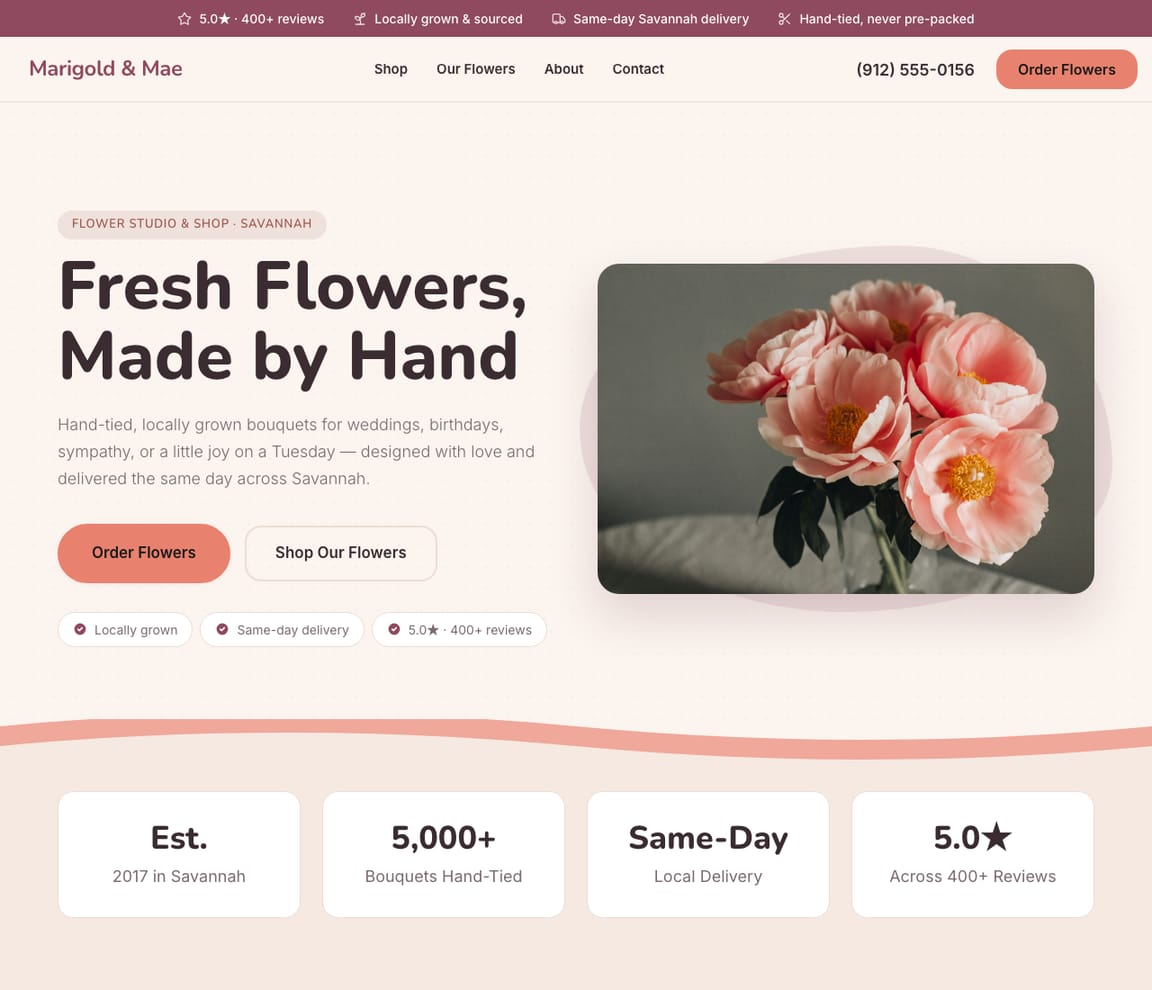
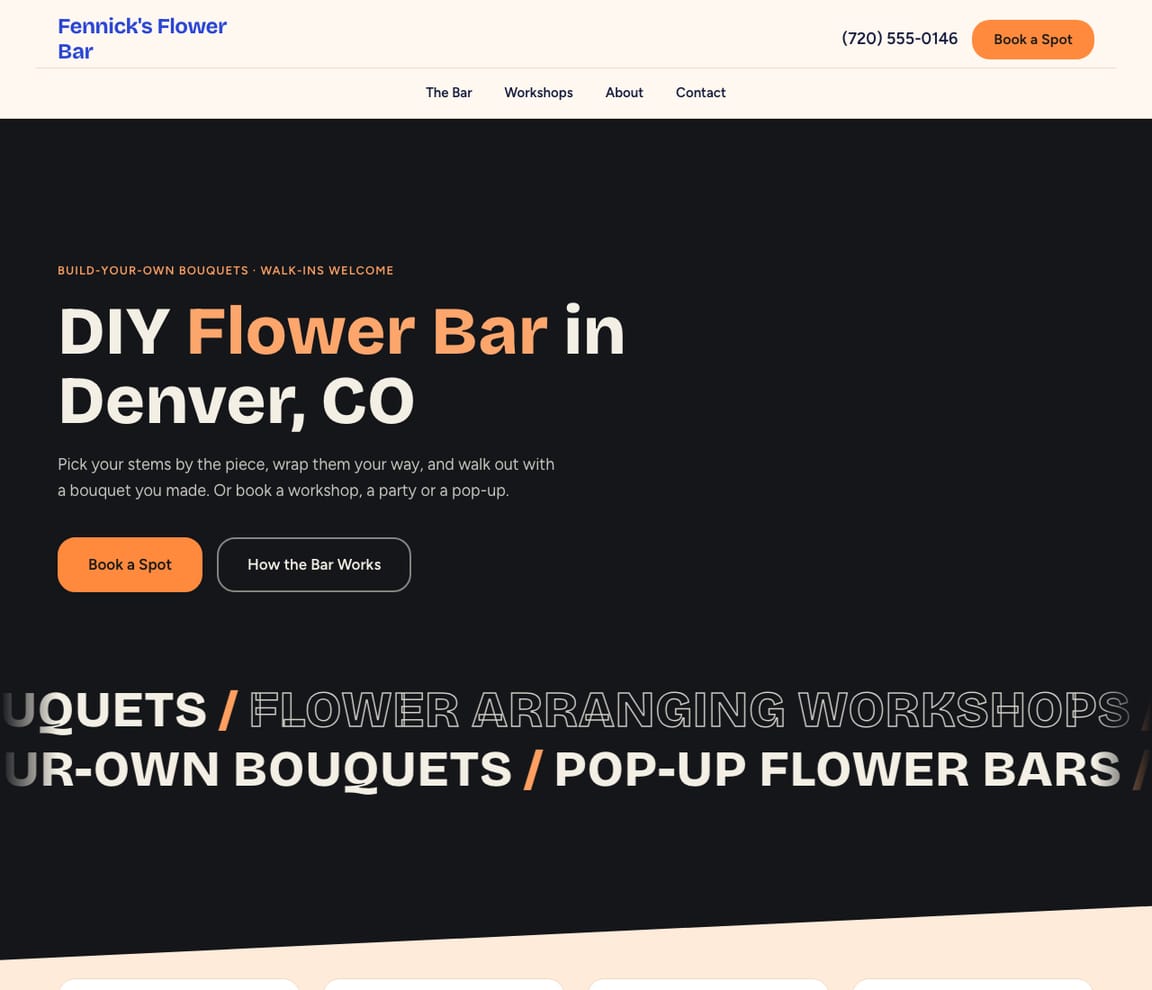
Real Zarla templates: a flower farm with a seasonal collection and a visit-us section, and two flower shops with online ordering — the bones a farm stand, a CSA or a u-pick needs. Open one, swap in your crops, your prices and your own photos, and publish. The florist gallery hosts them until the farm designs land.
GET FOUND
Get found by the family that wants a weekly box, and the neighbor who wants eggs
A family searches for a CSA or a farm stand near them in February and signs up with the farm whose shares, prices and pickup days are on the page; a neighbor searches for farm fresh eggs and drives to the stand whose hours are posted. Zarla builds the website with what you grow and a contact form for CSA and egg requests. Add your share prices, your market days and your stand's hours in chat, and once you connect your Google Business Profile, your name, hours and photos stay in step on both.
“Farm stand near me”
Searched by a family on a Saturday morning, a cook looking for eggs, and a bride looking for local flowers. What you grow, your prices and your hours answer it.
Google Business Profile
Your farm, your stand's hours and photos of the fields and the boxes inside Google Maps — and the market days listed where people look. Free, and an afternoon to set up.
The box photo
This week's share on the table, the hens on pasture, the tunnel in March — on the page and on the profile. Photos of the farm sell the next share.
Google Search
Ccopperleafmarketfarm.com
Copperleaf Market Farm — Trusted farm in Your AreaVegetables, cut flowers and pasture-raised eggs in Lancaster County. A 20-week CSA, two markets a week and a weekend stand. Sign up for a share or ask about eggs.← Your Zarla siteCcityfarmservices.com
City farm ServicesGoogle Maps
1
Copperleaf Market Farm
← You2
Metro farm Co.
3
Quick farm Services
AI assistants (ChatGPT / Perplexity)
For a market farm near Lititz with a 20-week CSA, pasture-raised eggs and a weekend farm stand in your area: Copperleaf Market Farm — a farm whose site lists the CSA shares and prices, the market days and the stand's hours, and lets you sign up for a share or ask about eggs online.
YOUR LAUNCH PLAN
Your farm launch checklist
The whole guide as things to check off. Work through them in order and you'll be leased, numbered, insured and selling shares before the first seed goes in.
- Choose: market garden, homestead, flowers, livestock or land purchase — by the cost of entry, below.
- Sign a long lease and test the water — the tunnel and the fencing stay with the land.
- Get the free farm number — then the microloan and the tunnel cost-share.
- Register the LLC, take the EIN and the ag sales-tax exemption — and read your state's egg and cottage-food rules.
- Buy the tunnel, the tractor, the cooler and the chicks from the makers' lists — everything else is a planning range.
- Insure the farm and get the market's certificate — product liability naming the market.
- Sell the CSA by February and apply to two markets — the good ones close early.
- Get found, and keep the job in town — a website with the share and a sign-up form, a Google profile, an email list.
REAL CUSTOMERS
Small business owners who got online with Zarla
Verified reviews from real Zarla customers.
“Quickly built my website from scratch. No hiccups. Would highly recommend Zarla for someone with no experience who wants to start a polished business website.”
“Great professional website in less than a minute, with the use of AI and a few descriptive prompts. This has saved me bundles of time and research on web developers.”
“I had no idea how to set up a website for my business. Thanks to Zarla, they've helped me a lot.”
“Very reliable, professional, and fast results. I was able to get my business online in no time, and the ease of access made it so simple.”
Be the farm a family finds — and signs up with
Add your town and your farm's name, and Zarla builds the website from that one line — what you grow and raise, a contact form a family can send a CSA or egg request from, and SEO in place. Add your share prices, your market days and your stand's hours in chat. Free to build; you pay when you publish.
Already have a website? Bring it across →Zarla keeps your old page addresses where it can and redirects the ones that change, helping you keep the Google standing you've built.
Frequently asked questions
How much does it cost to start a farm?
In the US, about $30,740 to $67,440 for a first-year market farm on three leased acres in our farm business plan's itemized ranges — a year's rent at the USDA's 2026 average, the tunnel, the walk-behind tractor and implements, irrigation, the first season's seeds and supplies, the wash-pack station, the cooler, a hundred hens with the coop and netting, deer fencing, market gear, insurance, the registrations and two months of running costs. A lean leased start from list prices is $6,437.03 — one acre at $160, a 14-by-20 tunnel at $4,480, a CoolBot at $429, a hundred chicks at $422, netting at $184.99, a Texas LLC at $300, a market season at $150 and a year of market liability at $311.04 — and $1,957.03 without the tunnel. Buying five acres of cropland is $30,100 at the USDA's 2026 average before a well, a barn or a house.
Do I need a license to start a farm?
In the US there is no farm license in the four states we read, and the USDA counts you as a farm at $1,000 of sales. What you need is the free farm number from your county FSA office, the LLC ($300 in Texas, $100 plus $25 in Florida, $200 in New York, $70 plus an $800 annual tax in California) and the free EIN, the state's agricultural sales-tax exemption, and the rules of what you sell: eggs are a state matter — Pennsylvania's small-flock rules under 3,000 hens, a market permit and ungraded cartons in Texas, Florida's limited egg farm permit, California's $75 registration — cottage-food law covers anything jarred or baked, the FDA's produce rule leaves a farm under $35,247 of produce sales alone, and a restricted-use pesticide needs an applicator license ($100 for five years in Texas). Check your own state's rules before the first dozen.
How much do farmers make?
By the USDA's household survey, the median farm household's income from farming was a loss of $1,830 in 2024; the household itself earned $102,748, of which $86,900 came from off the farm. Commercial farms — $350,000 and up of gross cash farm income — had a median farm income of $174,933 and 84 percent made money; the smaller farms most first-year growers are lost a median $2,799 and $2,748. Employed farm managers had a 2025 median of $89,900 (O*NET), in a survey that leaves out farms' owners and the self-employed. Per acre, SARE's market gardens under three acres grossed $15,623 and netted $5,664, about $5 an hour of the owner's labor.
Which farm is most profitable?
By the USDA's September 2026 forecast of average net cash income per farm business — commercial operations, not first-year farms — dairy leads at $477,500, then hogs at $395,800, cotton at $370,700, corn at $306,100 and specialty crops (fruit, vegetables, greenhouse) at $286,700; cattle and calves average $50,300 and poultry and eggs a loss of $3,400. For a small farm the per-acre evidence points to intensive crops: SARE's market gardens under three acres grossed $15,623 an acre, Utah's cut-flower farms averaged $64,000 an acre in 2021, and the trade's rule of thumb is $35,000 an acre or more for salad mix, herbs or cut flowers. Profit is a different number — SARE's net was $5,664 an acre. Confirm the numbers for your crop with your extension's enterprise budgets and your accountant.
What are the 7 different types of farms?
The USDA sorts farms by who runs them and what they gross, not by crop. Its household series uses three types — residence farms, intermediate farms and commercial farms ($350,000 and up) — and the Census of Agriculture's typology adds small family farms (low sales and moderate sales), midsize, large and very large family farms, and nonfamily farms: in 2022 small family farms were 85 percent of farms and 14 percent of sales, and large-scale family farms a few percent of farms and 51 percent of sales. By product the big groups are crops — vegetables alone were $28.2 billion of sales in 2022 — livestock, poultry and eggs, dairy and floriculture. A hobby farm is not a USDA category: any place that sells $1,000 of product is a farm.
How many acres does a farm need to be profitable?
There is no acreage threshold in the data; profit tracks sales and labor, not acres. The average US farm is 466 acres, yet the median farm household lost $1,830 farming in 2024 and 48 percent of farms sell under $10,000 a year. Commercial farms made a median $174,933 of farm income and 84 percent were profitable, while SARE's under-three-acre market gardens grossed $8,888 to $25,605 an acre and netted $1,892 to $9,487. The honest answer: two intensive acres can gross about twice SARE's $15,623 an acre and net a part-time wage, and a mortgage needs either a commercial-scale business or a job in town.
How do I start a homestead?
Register nothing until you sell, then follow your state's rules for what you sell. The USDA counts you as a farm at $1,000 of sales, and a farm number from your county FSA office is free and unlocks the microloan and the tunnel cost-share. Lease before you buy — $160 an acre a year against $6,020 an acre. Read the egg rule before the first dozen: Pennsylvania's small-flock rules under 3,000 hens, Texas's own-flock exemption with a market permit and ungraded cartons at 45 degrees, Florida's limited egg farm permit under 30 dozen a week, California's $75 registration. Read the cottage-food cap before the first jar — $50,000 in Texas, $250,000 in Florida, $75,000 or $150,000 in California. Sell from a stand first; the Arizona and Kentucky stand owners here sold out at $5 a dozen.
How do most homesteaders make money?
No openable survey prints a homesteader's income, and the USDA's picture is that most small farms are paid for by off-farm work — the median farm household's $102,748 in 2024 was $86,900 of off-farm income and a loss of $1,830 from farming. What pays on the farm are the direct channels the Census counts — 116,617 farms sold $3.3 billion straight to consumers in 2022 — and the ones the owners here describe: eggs at $5 a dozen that sell out and pay for the feed, a CSA share at $675 for 15 weeks or $850 for a season, cut flowers at a Utah average of $64,000 an acre, and u-pick and workshops. Most of them say the eggs pay for the feed, not the mortgage.
How do I start a farm with no money?
No federal grant pays a first-year farm's startup costs, so the route is the farm number, the loan, the lease and the cost-share. The free farm number comes first; an FSA operating microloan runs up to $50,000 on one-to-seven-year terms at 5.375 percent in October 2026; cropland leases at $160 an acre a year; an incubator farm supplies land, equipment and training — New Entry's quarter-acre plots cost about $1,500 a year all-in, Groundswell's $130 to $600 a season; NRCS pays part of a high tunnel (Pennsylvania's 2026 rate is $5,524.04 plus $4.89 a square foot, capped at $10,000), and USDA refunds 75 percent of organic certification up to $750. SARE's farmer grants — $5,000 to $50,000 in the Northeast, up to $35,000 in the West — fund an on-farm project, not operations. The development program the AI answer names funds organizations that train farmers, not farmers.
Are there grants to start a farm?
Not for startup costs. The farmer-facing federal money is loans and cost-share: FSA microloans up to $50,000, farm operating loans and ownership loans up to $600,000 at 6.25 percent in October 2026, NRCS's high tunnel cost-share, and the organic certification refund of 75 percent up to $750. SARE's farmer and rancher grants pay for an on-farm research or education project — $5,000 to $50,000 in the Northeast, up to $35,000 in the West — and the Beginning Farmer and Rancher Development Program funds the organizations that train farmers. The cheapest real start is an incubator plot at about $1,500 a year with land and equipment included.
How do I start a small farm?
The market-farm shape in this guide: one to three leased acres, a high tunnel, a walk-behind tractor, a cooler built around a CoolBot, hens on pasture, sold through a CSA paid up front, two markets and a stand. From the makers' lists, a 20-by-40 tunnel is $7,760 and a 14-by-20 one $4,480, a BCS 739 PS is $6,999 at a dealer, the CoolBot $429, chicks $4.22 each at a hundred. Get the farm number before the loan, the ag exemption before the seed order, the market applications in by February — they ask for a liability certificate naming the market — and the CSA sold by March. SARE's market gardens under three acres grossed $15,623 an acre on about 2,000 hours of work an acre, so plan the second income.
Can I sell eggs from my backyard flock?
In the US, usually yes, under your state's small-flock rule. Pennsylvania applies its small-flock rules to a producer with fewer than 3,000 hens selling within five days of lay and mostly within 100 miles. Texas exempts producers who sell only their own flock's eggs direct to consumers from the state license, but a farmers market stall needs a permit from the local regulator, the eggs kept at 45 degrees or less, the cartons new and marked ungraded with your name and address. Florida permits a limited egg farm operation with 3,000 hens or fewer selling under 30 dozen a week. California registers every egg handler at $75 the first year and $50 after. New York puts the grade-labeling duty on sellers of eggs other than their own. Check your own state's egg law before the first dozen.
Do I need a food safety license to sell vegetables?
Not for washed whole produce from a small US farm. The FDA's Produce Safety Rule does not cover a farm whose produce sales average under $35,247 a year, and a farm under $704,950 of food sales that sells mostly to consumers, restaurants and retailers in its state or within 275 miles is qualified exempt — it keeps sales records and puts the farm's name and address on the label or the market sign. What does need a registration or a permit is anything cooked, cut, pickled or jarred, under your state's cottage-food law or a licensed kitchen, and eggs under your state's egg law. A wholesale buyer may ask for a food-safety audit regardless.