BUSINESS GUIDE
How to start a food truck business in 2026
Trailer, used truck or custom build — what each really lists for, the health license in Texas, Florida, New York City, Los Angeles County and Chicago, the commissary rule, the fire marshal's checklist, insurance for the truck, the events and catering that actually pay — and what food trucks earn.
Free to build · Pay when you publish · No credit card
$45,595median asking price of a used, outfitted food truck across 74 live listings (UsedVending, October 2026)
88,353food truck businesses in the US in 2026, up 12.5% a year since 2021 (IBISWorld's public figures)
$1,376for Texas's new statewide cook-on-board license and its inspection, in force since July 1, 2026 (DSHS)
No codeto get online
See it in action
See what your food truck website could look like
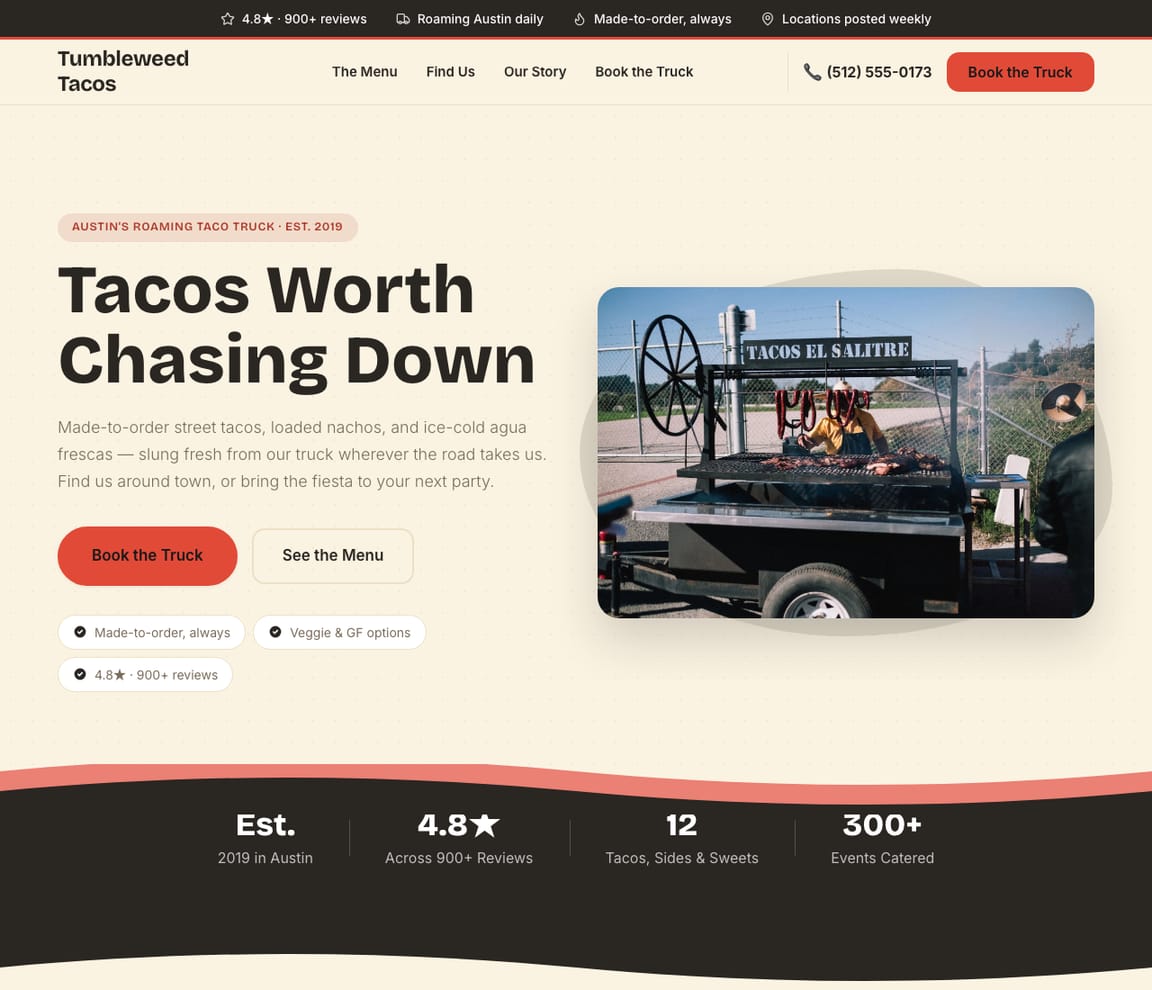
This is a real Zarla template for a food truck. Describe yours — the menu, the cuisine, the town — and you'll have a site like this, with your menu and a contact form for catering requests, in about a minute.
- Professional design — not a generic template
- Looks great on desktop and mobile
- Content written for your industry
Build the website
Start your food truck website now
Add your town and your truck's name to the sentence, and Zarla builds the site: your menu with prices and a contact form for catering requests. Add your weekly schedule and your event prices in chat, then publish.
Already have a website? Bring it across →Zarla keeps your old page addresses where it can and redirects the ones that change, helping you keep the Google standing you've built.
Is starting a food truck worth it in 2026 — and what does a truck earn?
"Food truck" is three purchases a long way apart in price, and the listings say so more honestly than any blog. On UsedVending's marketplace on the day we read it, 87 used concession trailers were asking from $2,500 to $117,700 — a quarter under $26,880, half under $38,500, a quarter over $54,989 (UsedVending, trailer listings, October 2026); 85 new-build trailers ran $11,500 to $101,750 with the same $38,500 median, a "New Build 2026 8' x 14' Food Concession Trailer" in Texas at $27,440 among them (UsedVending, new-build trailers, 2026). Seventy-four used, outfitted trucks asked from $6,325 to $262,500 — a quarter under $31,358, half under $45,595, a quarter over $61,600 — a "Fully Equipped 2009 Ford E450 All-Purpose Food Truck with Pro Fire System" at $55,000 in North Carolina, a Freightliner with California's HCD insignia at $155,150 (UsedVending, truck listings, October 2026); Square's guide reads the same market as "$40,000 to $80,000" (Square, 2025, updated May 2026). A new custom build starts lower than the AI answer's "$75,000": Concession Nation's own site lists its "Budget E-Line $32,000 – $44,000", its "E-Line $45,000 – $54,000" and "Food Trucks Starting at $47,000", with a top line "Starting at $85,000" (Concession Nation, builder's own list, 2026).
What a truck earns. No survey we could open prints a food truck owner's income or a net margin, and the one trade page that tried admits "food truck-specific data is still sparse" and borrows the restaurant failure rate instead (EPOS Now). What does open: IBISWorld's public page puts the industry at "$2.9bn in 2026" across "88,353 businesses … which has grown at a CAGR of 12.5 % between 2021 and 2026", warns that revenue "is expected to decline by 1.1% due to higher tariffs", and says plainly that "City regulations, escalating competition and minuscule profit are tripping up some" (IBISWorld, 2026) — $2.9 billion over 88,353 businesses is about $32,800 a business, our arithmetic, with carts and part-timers counted. Insureon's food-truck customers run "annual revenue ranging from around $50,000 to more than $200,000" with fewer than five employees (Insureon, September 25, 2026). The US Chamber of Commerce Foundation modeled its index on "a food truck that generates $250,000 a year and pays $150,000 in wages for three full-time employees" — an assumption, not a survey result — and recorded the one legend the trade still quotes: Kogi's sole truck "clearing $2 million in sales" in its first year, 2008 (US Chamber of Commerce Foundation, Food Truck Nation, 2018).
What the people earn. Restaurant cooks — the hands you hire — had a median of $17.98 an hour, $37,390 a year, in 2025 (O*NET, from BLS 2025 wage data); $34,760 in Texas (O*NET, Texas), $44,880 in California (O*NET, California), $43,680 in New York (O*NET, New York); fast food and counter workers $15.00 an hour (O*NET); food service managers $69,390 a year (O*NET). The federal wage survey behind those medians leaves out the self-employed (Washington ESD), so they are hired hands, not owners.
Survival. No openable page prints a food-truck failure rate; the "60 percent in three years" that circulates is a restaurant number. The federal figures that do open: "an average of 67.9 percent of new employer establishments survived at least two years … the five-year survival rate was 49.2 percent, the ten-year survival rate was 33.8 percent" (SBA Office of Advocacy, July 2024). The Chamber's own count of the overhead: "$28,276 on permits, licenses, and ongoing legal compliance" a year across 20 cities, "45 separate government-mandated procedures" and "37 business days" — with Boston "nearly 29 times more than fees paid in Indianapolis" (Food Truck Nation, 2018).
The catch. The truck is most of the budget and most of what breaks; the permit path runs city by city, and in New York City the street permit is capped by law; the first three months can be slow enough to throw food away every night; and the money, by the owners' own account, is in events and catering rather than the curb. That's what the rest of this guide sets up.
How to start a food truck business, in plain English
No federal food truck license exists — the health license is the state's or the county's, and where you are decides everything. The federal layer is the free EIN: "You never have to pay a fee for an EIN" (IRS). Texas changed the whole trade on July 1, 2026: "all MFVs must be licensed with the Texas Department of State Health Services (DSHS) to operate an FVV in the state of Texas. Previously, MFVs had to get licenses from local health departments for each local jurisdiction they operated in." A Type III vendor — "MFVs who prepare, cook, hold, and serve food from an FVV … Burger truck, BBQ truck, taco truck" — pays an $876 application fee and a $500 pre-licensing inspection, $1,376 in all, for "a DSHS MFV license that expires one year from the date of your successfully completed pre-licensing inspection"; a Type II (coffee, snow cones, hot dogs) $618 and $400, a Type I (nothing that needs temperature control) $309 (Texas DSHS, mobile food vendors, 2026). The license "will be valid everywhere in Texas so mobile food vendors will no longer have to obtain a separate license for each local jurisdiction" (DSHS news release, June 4, 2026), but "MFVs still need to comply with all state and local laws, such as fire codes, location restrictions, and zoning codes" (DSHS flyer, 2026). Austin still requires a "Central Preparation Facility Contract", a "Restroom Facility Agreement", and that "All employees who handle food must obtain an accredited Food Handler Certificate within 60 days of employment" (Austin Public Health, 2026); the Travis County Fire Marshal inspects propane and electrical "at the same time and place as the Health Mobile Vending Inspections" (Travis County Fire Marshal).
Florida took the license to the state in 2020: "Regulation of mobile food dispensing vehicles … involving licenses, registrations, permits, and fees is preempted to the state. A municipality, county, or other local governmental entity may not require a separate license, registration, or permit", and "may not prohibit mobile food dispensing vehicles" (Fla. Stat. §509.102). The DBPR license is $347 a year — "Basic fee $185, Service type fee $135, Epidemiological fee $17, HEP fee $10" (Fla. Admin. Code 61C-1.008) — plus an application fee "not to exceed $50" (Fla. Stat. §509.251): $397 at most, our arithmetic. New York City is the capped market: "A food vendor must have a food vendor license or a supervisory license, and the unit must have a permit" — there is no limit on licenses, but "The number of street food vendor permits the City can issue is limited by law". The 2021 law added "up to 445 food vending permits each year for 10 years" (NYC Rules, Local Law 18 of 2021); the 2026 laws go further: "Beginning July 1, 2026, 2,200 new supervisory licenses will be offered each year for 5 years", 11,000 more permits in all, offered first "to people currently on waiting lists created in 2022". A Restricted Area permit for private property has "no waiting list for this permit and no limit on the number of permits available" (NYC Health Department, 2026; NYC Business, restricted area permit). The full-term permit itself is "$200.00 … for units where food is prepared or processed on-site" for two years, $75 for prepackaged food, and nothing "if you show proof of honorable discharge from the U.S. Armed Services" (NYC Business, full-term permit).
California wrote the commissary into the food code: "all mobile food facilities shall operate in conjunction with a commissary, mobile support unit, or other facility approved by the enforcement agency", and "Mobile food facilities shall be stored at or within a commissary or other location approved by the enforcement agency" (Cal. Health & Safety Code §114295); the county "shall initially approve all mobile food facilities", and a factory-built unit "shall be certified by the Department of Housing and Community Development" — the HCD insignia that lifts California listing prices (Cal. Health & Safety Code §114294). Los Angeles County charges a high-risk truck — "taco truck, kebab truck, BBQ truck, sandwich truck handling raw meats" — $761 a year for the permit and $741 for the plan check, $1,502 in the first year, our arithmetic; a moderate-risk truck (soft serve, pizza) $598, a low-risk one $325 (Los Angeles County Public Health, fees effective March 6, 2024). Its guideline is blunt: "STORAGE OF THE MOBILE FOOD FACILITY OR ANY TYPE OF FOOD PRODUCT AT HOME IS NOT APPROVED", "A permit shall not be issued until the commissary location is verified and approved", "An initial plan check review shall be completed within twenty working days", and a truck stopped for more than an hour must be "within 200 feet travel distance of approved and readily available toilet and hand washing facilities" (Los Angeles County Public Health, plan-check guideline). Chicago: a "Mobile Food Preparer" license is $1,000 for two years ($700 for a dispenser of pre-prepared food), plus a "Fire Safety Permit $100" and a "Fire Suppression System Review $150", a "Certificate of Insurance (limits not less than $350,000)", a city food service manager certificate and "a signed letter of intent … from the commissary"; trucks "can park in legal parking spaces or at food truck stands for up to 4 hours", "may not park within 200 feet of any principal customer entrance to a restaurant which is located at street level, with the exception of 12 AM – 2 AM", and "must be registered as a commercial vehicle" (City of Chicago, food truck licensing).
Registering the business. Texas: an LLC's certificate of formation is $300 (Tex. Bus. Orgs. Code §4.152; §4.154). Florida: $100 to file articles of organization (Fla. Stat. §605.0213). New York: $200 (N.Y. LLC Law §1101). California: $70 to file (Cal. Gov. Code §12190), and "every LLC that is doing business or organized in California must pay an annual tax of $800" (Franchise Tax Board). Sales tax on the food: four states, the same answer. Texas: "Ready-to-eat food is typically taxable even when it is sold 'to go'" (Texas Comptroller, publication 94-117). Florida: food "served, prepared, or sold in or by restaurants, lunch counters, cafeterias, hotels, taverns, or other similar places of business are subject to tax" (Fla. Admin. Code 12A-1.0115). New York: "sales of heated food are generally taxable", and the bulletin names "street carts, concession stands" among the sellers it covers (N.Y. Tax Bulletin ST-806). California: "To-go sales of hot prepared food products are taxable" (CDTFA Publication 22). Register before the first service, and confirm the details with your accountant.
Fire: what the marshal checks. One checklist that opens, Boise Fire's for 2025, says what the national codes say: "Hood extinguishing systems shall be serviced every six months. Hood systems shall be inspected and cleaned every 6 months"; "Food trucks utilizing propane must have an LP Gas Alarm (combustible gas detector)"; tanks "stored and secured in the upright position", "not stored on the roof or interior of the food truck"; and "The maximum aggregate capacity of LP gas containers transported on the vehicle and used to fuel cooking appliances only, shall not exceed 200 lbs. of propane capacity" — the permit there is "a single $45 fee" for the year (Boise Fire Department, mobile food checklist, 2025). The hood-and-suppression kit most trailers are built around has a list price: a Halifax Type 1 concession hood with fire suppression is $5,229 at five feet, $5,529 at six, $6,189 at eight (WebstaurantStore, 2026).
The people. Texas: "The food manager certification is obtained by passing a DSHS or ANSI-CFP approved food manager certification examination … Certification is valid for five years" (Texas DSHS, food managers); a food handler course "costs $15.00 per person online" at Texas A&M AgriLife (Texas A&M AgriLife); the ServSafe manager course with its online-proctored exam is $179, the exam alone $99 (a ServSafe reseller's price list). The commissary, priced from posted plans. Homestead Commissary in Williston, Florida lists "Food Truck A - $50/month" and "Food Truck B - $200/month" (Homestead Commissary, The Kitchen Door); Kitchen Corner in Beech Grove, Indiana "$240 per month-food trucks, trailers, carts" with a "$100 application fee" (Kitchen Corner Commissary); Ghost Chicken in Lake Charles, Louisiana "$250/month with a one-time $200 kitchen access fee" and kitchen time at "a flat $15/hour" (Ghost Chicken Commissary); Mile High in Aurora, Colorado "15 hours/$300 per month" minimum (Mile High Commissary); Fast Dash in Anaheim, California "Food truck spots are $1300 per month" (Fast Dash Commissary). Five posted plans, five states, $50 to $1,300 a month — not the AI answer's "$300 to $3,000".
Insurance. Insureon's food-truck customers pay an average $37 a month for general liability, $209 for commercial auto and $46 for workers' compensation (Insureon, September 25, 2026) — $2,952 a year for liability and auto, $3,504 with workers' compensation, our arithmetic; and "many venues, festivals, and events require proof of coverage before allowing food trucks to operate on their property". Workers' compensation is not universal: "in Texas, private employers can choose to carry workers' compensation insurance coverage, but it is not required in most cases" (Texas Department of Insurance); California — "all California employers must provide workers' compensation benefits to their employees" (California DIR); Florida from four employees outside construction, counting LLC members (Florida CFO); New York — "every employer subject to this chapter shall … secure compensation to his employees" (N.Y. Workers' Compensation Law §10).
The card reader, the wrap, the events. Square: "Your first credit card reader comes free of charge" (Square), the Stand is $149 (Square Stand), the Terminal $299 (Square Terminal), and in-person processing is 2.6% plus 15¢ (Square pricing) — about 3 percent of card sales, not the "$500–$2,000" the AI answer prints for a POS. A full vehicle wrap, by a wrap company's own page, lands "in the $1,500–$5,000 range depending on vehicle size" (Wrapmate, May 2026). Events charge by the crowd: a one-day small-town festival is "$60.00 per space for food trucks" (Town of Warrenton, NC, 2026); a 30,000-visitor festival charges a flat $750, $1,300 or $1,900 by truck length plus a deposit (Apple BBQ Festival, Michigan, 2026). Capital: SBA microloans run "up to $50,000 … The average microloan is about $13,000" (SBA); a Homebase guide reads the trade as needing "75,000–150,000 in financing" — $75,000 to $150,000 — (Homebase, October 9, 2026) — a publisher's figure, and the lean trailer start below is far under it.
The money to start. Our free food truck business plan itemizes a used trailer or truck from the live listings' quartiles, the health license by state, the commissary deposit, insurance at Insureon's averages, the card reader, the wrap, the registrations and two months of running costs at $44,935–$140,311; the unit is most of it, and the top of the range is a used truck with a full-time cook on the payroll from day one. A lean solo start — a trailer at the listings' lower quartile ($26,880), the Texas license ($1,376), the handler card and the manager course ($15 and $179, $194 together), a commissary's application fee and first month ($100 and $240, $340 together), insurance ($2,952), a Square Stand ($149), the Texas LLC ($300) and a wrap at the vendor's floor ($1,500) — comes to $33,691, our arithmetic, before inventory, a generator (no dealer we could open prints a list price) and the tow vehicle — or $38,920 with a $5,229 hood-and-suppression kit if the trailer lacks one. A used truck instead of the trailer starts at the listings' $45,595 median, and the same license, cards, commissary, insurance, reader, LLC and wrap add about $6,800, so a used-truck start lands near $52,400 before inventory and the reserve.
In the UK: "You must register with your local authority to run a food business … You are required to register at least 28 days before trading" (GOV.UK), it is free and cannot be refused, and the inversion of the US principle is that a mobile trader needs no permit to start and can trade before the inspection: "Once you have registered the business you can commence trading. An inspection of the vehicle will take place but you do not need to wait for this prior to trading." (Bradford Council). Trading on the public highway needs the council's street-trading consent, and councils price it very differently — Gloucester charges £8,480.00 a year for everyday catering in the city center from August 1, 2026 and £16 a day outside it (Gloucester City Council, 2026); the gas installation falls under the Gas Safety (Installation and Use) Regulations and the vehicle rules on ventilation (HSE, Catering Information Sheet 23); VAT registration is required at £90,000 of turnover (GOV.UK). In Australia: a food truck is a mobile food vending vehicle under the state Food Act and the council: "Mobile food vendors … need to notify the local council of their business and food activity details … It may involve applying for a service, permit or approval, or completing a food business notification form" (NSW Food Authority); Victoria runs one statewide registration through Streatrader (Streatrader), with a 2026–27 fee of "class 2 - $297.00 class 3 - $215.00" at one council and a statement of trade lodged for every district you trade in (ABLIS, Victoria); GST registration is required at $75,000 of turnover (ATO). Check your own council's rules.
What food truck owners actually say
None of this is our opinion about the trade. It comes from people who own food trucks and trailers — in Texas, Florida, Georgia, Louisiana, California, Idaho — talking to the Voyage interview network, ShoutoutLA, CanvasRebel and a university radio station between 2017 and 2026, each described as the page describes them. Read each as theirs at the time. Five things come up again and again.
The truck is what breaks. Michelle Duncan and David Shipman, owners of Purple People Eatery in Westchester, Florida: “The most difficult problems are mechanical. Because most food trucks including ours, are older vehicles that have been refitted to serve as kitchens. So we run into normal kitchen problems like a deep fryer breaking down; but also some nights we've ended up stranded with a truck that won't start.” (VoyageMIA, August 2, 2018). Earnest J, owner and chef of EVO Food Truck in Rome, Georgia: “the truck i bought was used, and i knew it needed work, but the amount of work was far beyond what i anticipated. i ended up nicknaming the truck Theseus because of all the things i had to replace on it to keep it functioning.” (VoyageATL, September 19, 2024). Sim Walker, owner of Untitled Food Truck by Every1Eats in Atlanta: “Something always seems to be breaking. For instance, at the end of last season, my engine blew out, and I had to replace it – that was a major headache!” (VoyageATL, July 18, 2024). Ange Zuniga, co-owner of Taconmaye in North Austin: “When you are moving around, pipes get jostled, equipment gets moved and repairs are needed. There have been times we've prepped and arrived to an event and equipment fails or we've ended up on the side of the road.” (Voyage Austin, March 30, 2021). Julio Arevalo, owner of Coffee-Q in Houston: “The tough part is all the unknowns, the tons of permits that you have to get everywhere, all the little things that break when you drive this mobile kitchen. The upkeep and maintenance of these older trucks.” (Voyage Houston, November 3, 2020). Even the organizer sees it — Brad Olsen, who runs the Super Gourmet Food Truck Jam in Anaheim: “Another struggle is trucks break down. Generators don't work. Trucks are late to the event. Trucks double book and cancel.” (VoyageLA, August 7, 2017). Sherri Lester, who runs a mobile coffee bar from a converted horse trailer: “I found out my trailer, that my hubs had worked so hard to build 4 years prior, was totally rusted out on the bottom and not safe to drive. No one would 'fix it' because it was irreparable.” (CanvasRebel, October 15, 2026).
“I found myself experiencing Murphy's law on a daily basis. From parts breaking down to the truck being out of commission, but through hard work and perseverance I pushed through” — Gregoire Tillery, founder of We Dat Food Truck, New Orleans and Los Angeles, in VoyageLA, October 21, 2019
Permits, commissaries and somewhere to park. Dawon Matthews and Jessica Ahwash, owners of Goodies Soul Kitchen in Houston: “In the beginning, we had to navigate the complex and often confusing world of permits, inspections, and city regulations, which can be especially overwhelming when you're new to the industry.” (Voyage Houston, May 6, 2025). Sim Walker again: “The permitting process, for example, is incredibly complex and can be quite a nightmare. I truly wish there was a more logical and streamlined way to obtain permits.” (VoyageATL, 2024). Larry Williams, owner of Nu Awlins Flavour in Atlanta, on the commissary rule arriving at his door: “the health department declaring that I could not build a commercial kitchen in a home dwelling.” (VoyageATL, April 24, 2025). Saul and Ana, founders of the Casita Coffee truck: “Being a coffee truck comes with many challenges, such as finding locations to be able to park and vend. We operate in a town that has a lot of rules and regulations when it comes to mobile food vending.” (CanvasRebel, December 18, 2023). Ika Nasa, chef and owner of Noodlehead, which moved from Lafayette to Houston: “Finding the right spot has been a significant challenge” (Voyage Houston, June 5, 2025).
The slow start, and how they paid for the truck. Chef Kang, owner of Chef Kang Food Truck in Los Angeles: “For the first 3 months, we had little or no sales. We were unknown to public and without any yelp reviews to show what I was about, people just passed by often and reluctant to give my Food a shot. Even though we had little or no sales every day, I made $300-$400 worth of preparation that I had to throw away send of the night so without any income coming in we were losing money left and right.” (VoyageLA, January 2, 2018). Shavonne Gay, owner of Thee Kitchen Beast in Dallas: “I decided to not get a loan to customize my food truck and pay everything with cash. That took me working long hours at a place I wasn't happy at and saving.” And: “Before I started the food truck, I did a lot of private dinners to fund the build out of my truck.” (Voyage Dallas, August 9, 2021). Eric Sohrabian, who runs a smash-burger trailer in Los Angeles: “I overcame this by using creativity and resourcefulness to repurpose a jetski trailer, allowing me to reduce costs while still bringing our food to the community.” (ShoutoutLA, November 4, 2024). Christopher Tejeda, co-owner of TMI Food Truck in West Palm Beach and a firefighter: “Over the next fourteen months, I built an entire food truck by hand. Electrical work, plumbing, gas lines, and appliance installation were all a learning experience.” (VoyageMIA, February 21, 2019). Victoria Guerra, owner of Puras Papas in San Diego, started without buying at all: “My aunt and uncle offered to rent one out to me and I said yes!” (SDVoyager, June 20, 2022). Natasha Salas, owner of Funky Town Food Truck in Fort Worth, on the truck she bought from a couple who quit: “The couple who had ran it shut down because it was too much work for them.” (Voyage Dallas, January 29, 2020). Alyssa Ordonez, owner of Mabuhi Food Truck in San Diego, launched in November 2025: “It took us a long time to find the right truck—one that fit both our vision and our budget … we spent nearly eight months making renovations and adjustments to bring that vision to life.” (SDVoyager, March 3, 2026).
The money is in the route, the events and the catering. Blake Duplass, head chef and owner of Simply Fresh in San Diego, on the day his model stopped: “Our rotation of office parks where we served lunch suddenly sent all their employees home. Our arsenal of breweries where we served dinner suddenly had to close their tasting rooms. By the end of the day, half of our upcoming catering events called and canceled their party.” (CanvasRebel, March 14, 2022). Jessamine Starr, owner of Good Food Truck in Atlanta, ten years in: “running one's own business and especially catering is 1/3 chef, 1/3 MacGyver and 1/3 risk-taker.” (VoyageATL, October 21, 2020). Katrina Jones, co-owner of 3-0-Slide in South Florida: “There will be events that aren't worth working.” (VoyageMIA, September 12, 2024). Kent Scroggins, owner of Oh Balls! in Dallas: “We launched in July 2018 and started booking private events in August 2018.” (Voyage Dallas, January 9, 2019). Leo and Nelly Jamoralin, owners of a breakfast truck, on the menu: “We started with only four sandwiches: The Manila, The Bulgogi, The BEC, and The Grumpy. We wanted to keep it simple, not overwhelming for customers but still flavorful and exciting.” (CanvasRebel, March 26, 2026).
The hours. Lauren Saravia, co-owner of The Tropic Truck in Los Angeles: “My husband and I worked 20 hour days and really wore ourselves thin the first year but we survived.” (VoyageLA, May 26, 2025). Omar Saad, chef and owner of Pickles & Peas in Los Angeles, eight years in: “By far Pickles & Peas is the hardest thing I've ever done. But also the most rewarding and exhilarating because the challenges are new.” (ShoutoutLA, December 18, 2024). Karleigh Ray, founder of the Dip'd trailer in Idaho, on how it began: “I couldn't sleep one night and I just decided, you know what, I cook really well… Food is just something that comes naturally, so I might as well just open a food trailer.” (BYU-Idaho Radio, April 25, 2022).
The through-line: the owners who lasted bought a unit that could be fixed, read the permit rules before the lease on the commissary, carried the first slow months on savings or a day job, and built the week around office parks, breweries and catering dates rather than a curb and a hope.
THE STARTER KIT
What you need to start a food truck
A unit you can fund — and that runs
A concession trailer behind a vehicle you already own, a used truck that has been refitted as a kitchen, or a new build from a builder's own list. The truck is most of the budget and most of what breaks.
The health license for your state or county
Texas licenses the truck statewide since July 2026; Florida's license is the state's and cities can't add one; Los Angeles County, New York City and Chicago each license their own way — with the fees on their own pages.
A commissary, where the law wants one
A licensed kitchen to prep, wash, fill water and park — written into California's food code, verified before Los Angeles County issues a permit, contracted in Austin, a letter of intent in Chicago.
Fire: the hood, the suppression, the propane
A hood with a suppression system serviced every six months, a propane alarm, tanks upright and outside, no more than 200 pounds of propane — the fire marshal's checklist before the health inspector signs.
Insurance for the truck first
Commercial auto is the big line, general liability is what every festival asks to see, and workers' compensation where your state requires it once you hire.
A route, and a reserve
Office parks at lunch, breweries at dinner, catering and festivals on the weekend — and enough cash to feed a truck through the three slow months the owners here describe.
THE PAPERWORK
Licenses, permits and insurance for a food truck
| Typical cost | Time to get | Legally required? | |
|---|---|---|---|
| LLC formation | $300 (TX); $100 (FL); $200 (NY); $70 + $800/yr tax (CA) | Days to weeks | No, but most owners form one |
| Health license — Texas (statewide, DSHS) | $876 + $500 inspection for a cook-on-board truck | One-year license from the inspection | Yes, since July 1, 2026, everywhere in Texas |
| Health license — Florida (DBPR) | $347/yr + up to $50 to apply | Before you open | Yes; cities cannot add their own license |
| Health permit — Los Angeles County | $761/yr + $741 plan check (high risk) | Plan check within 20 working days | Yes; the commissary verified first |
| Street permit — New York City | $200 for two years; $0 for veterans | Waiting list; 2,200 licenses a year from July 2026 | Yes to vend on the street; private property needs no wait |
| License — Chicago | $1,000 for two years + $100 fire + $150 suppression review | Weeks | Yes; a commissary letter and a $350,000 certificate too |
| Commissary agreement | $50–$1,300/mo on posted plans | Before the permit | Yes in CA by statute; verified in LA County; contracted in Austin; a letter in Chicago |
| Fire inspection | $45/yr (Boise); $100 + $150 (Chicago); with the health inspection (Travis County) | At licensing | Yes where you cook — hood serviced every six months, propane alarm |
| Food handler and manager | $15 handler; $179 ServSafe manager | Hours to a day | Handler within 60 days (Austin); manager for Chicago preparers |
| Sales-tax permit | None to register | Before the first sale | Yes — hot or ready-to-eat food is taxable in TX, FL, NY and CA |
| Commercial auto | $209/mo average (Insureon) | Days | A registered commercial vehicle (Chicago); DMV registration for the permit (LA County) |
| General liability | $37/mo average (Insureon) | Days | Not by law; festivals and venues ask for the certificate |
| Workers' compensation | $46/mo average (Insureon) | Days | Yes in CA (from 1) and NY; FL from 4 employees; optional for most TX employers |
THE STEPS
How to start a food truck business (step by step)
Eight steps from the unit you can afford to a licensed, inspected, insured truck with its catering calendar filling.
01
Pick the unit
A trailer and a tow vehicle, a used outfitted truck, or a new build. Decide from the live listings and the builders' own lists below, not from a blog's range — and have a mechanic and a kitchen technician inspect any used unit before you pay.
02
Read your state's license page before you buy
Texas now licenses statewide; Florida's license is the state's; Los Angeles County wants plans before a permit; New York City's street permits are capped. The unit you buy has to pass the inspection your state actually runs.
Before the purchase03
Register the business and sign the commissary
The LLC and the free EIN, the sales-tax permit (hot food is taxable in the four states we read), and the commissary contract — required by statute in California, verified before a permit in Los Angeles County, a Central Preparation Facility contract in Austin.
04
Pass fire and health
The hood and suppression system serviced and tagged, the propane alarm, the tanks secured outside, the plan check and the pre-licensing inspection — then the license that expires a year on.
05
Certify the people
A food handler card for everyone on the truck — within 60 days in Austin — and a certified food manager where the city requires one, as Chicago does for anyone preparing food on board.
06
Insure the truck and the business
Commercial auto for the vehicle, general liability for the festival's certificate, and workers' compensation where your state requires it once you hire.
07
Set a short menu and a route
Four to ten items you can serve fast, posted with prices on the window and the website; office parks at lunch, breweries at dinner, and the same stops on the same days so regulars know where you are.
08
Get found, then book the events
A website with the menu and a catering form, a Google Business Profile with plate photos, this week's schedule posted — and the festivals, office parks and private events pitched before the truck opens, because that is where the owners here say the money is.
THE COSTS
How much does it cost to start a food truck business?
The total is our free food truck business plan's itemized US ranges: a used trailer or truck from the live listings' quartiles, the health license by state, the commissary, insurance at Insureon's averages, the card reader, the wrap, the registrations and two months of running costs — the top of the range is a used truck with a full-time cook on the payroll. A new custom build comes on top; your own living costs too.
$44,935–$140,311to open with a used trailer or truck — the unit is most of it, and the running-cost reserve the rest
$33,691for a lean solo trailer start from list prices — trailer, Texas license, cards, commissary, insurance, reader, LLC, wrap (our arithmetic)
$45,595median asking price of a used, outfitted truck; a used trailer's median is $38,500 (UsedVending, October 2026)
$32,000+for a builder's budget new build — Concession Nation's own list; its top line starts at $85,000
WHAT WE'VE LEARNED
What actually makes someone pick a food truck
Thousands of local business websites in, the pattern for food businesses is clear: the customer wants to see the food, know the price, and know where you are today. For a food truck, three things on a page decide who walks up.
A menu with prices
Each item with what's in it and what it costs — the four things you do best, the add-ons, the combo — so nobody has to walk up to the window to find out. The first thing a lunch crowd checks.
Where you are this week
This week's stops with days and hours, and the plate photos. A truck that can't be found doesn't sell; a schedule on the page is the difference between a regular and a one-time visitor.
A way to book the truck
A catering request form an office manager or a host can send in a minute — the headcount, the date, the place. The slow weeks on the curb are carried by the events booked from this button.
THE UPSIDE
What a food truck can earn
Industry figures from IBISWorld's public page and the Chamber's report, the revenue band from Insureon's customers, cook pay from O*NET's 2025 figures. No survey prints an owner's take-home — your route, your events and your truck's repair bill decide it.
$50k–$200k+the annual revenue band of insured food trucks with fewer than five employees (Insureon, 2026)
$2.9Bthe US food truck industry in 2026 across 88,353 businesses — about $32,800 each, carts included (IBISWorld)
$250,000a year for the full-time truck with three staff the US Chamber Foundation modeled its 2018 index on
$17.98an hour: the 2025 median for restaurant cooks (O*NET) — the cook's pay is your biggest cost per plate
SEE IT WORK
A food truck website design you can start from
A real Zarla template: a playful hero, a pill-grid menu, an off-the-griddle gallery, a one-truck story, a find-us-this-week schedule, a book-the-truck section and a location-alerts sign-up. Open it, swap in your menu, your prices and your own photos, and publish.
GET FOUND
Get found by the office that wants lunch and the host who needs 80 plates
An office manager searches for a food truck near them at eleven and books the one whose menu, prices and schedule are on the page; a bride's parents search the same way for a truck that caters. Zarla builds the website with your menu and a contact form for catering requests. Add your weekly schedule and your event prices in chat, and once you connect your Google Business Profile, your name, hours and photos stay in step on both.
“Food truck near me”
Searched by an office at eleven, a brewery owner planning Friday, and a family on a festival weekend. Your menu, your prices and this week's stops answer it.
Google Business Profile
Your truck, your hours and photos of the food inside Google Maps — and a profile that moves with your schedule. Free, and an afternoon to set up.
The plate photo
The griddle, the line, the plate in someone's hand — on the page and on the profile. Photos of the food sell the next stop, and the next catering date.
Google Search
Rrollingemberkitchen.com
Rolling Ember Kitchen — Trusted food truck in Your AreaWood-fired tacos, lunch stops across Austin, and catering for 30 to 300. Menu and prices online. See this week's schedule or book the truck.← Your Zarla siteCcityfoodtruckservices.com
City food truck ServicesGoogle Maps
1
Rolling Ember Kitchen
← You2
Metro food truck Co.
3
Quick food truck Services
AI assistants (ChatGPT / Perplexity)
For a wood-fired taco truck in Austin that caters office lunches and weddings and posts its weekly stops in your area: Rolling Ember Kitchen — a food truck that lists its menu and prices, shows this week's stops and hours, and lets you book it for a catering date online.
YOUR LAUNCH PLAN
Your food truck launch checklist
The whole guide as things to check off. Work through them in order and you'll be licensed, inspected, insured and booked before the reserve runs down.
- Choose: trailer, used truck or new build — from the listings and the builders' own prices, below.
- Read your state's or county's license page before you buy — the inspection the unit has to pass.
- Register the LLC, take the EIN and the sales-tax permit — hot food is taxable where we read.
- Sign the commissary contract — where the law wants one, before the permit.
- Pass fire and health — hood suppression serviced, propane alarm, tanks secured, the pre-licensing inspection.
- Certify everyone on the truck — food handler cards, and a food manager where the city requires one.
- Insure the truck first — commercial auto, general liability, workers' compensation where required.
- Get found and get booked — a website with the menu and a catering form, a Google profile with plate photos, and the events pitched before opening day.
REAL CUSTOMERS
Small business owners who got online with Zarla
Verified reviews from real Zarla customers.
“Quickly built my website from scratch. No hiccups. Would highly recommend Zarla for someone with no experience who wants to start a polished business website.”
“Great professional website in less than a minute, with the use of AI and a few descriptive prompts. This has saved me bundles of time and research on web developers.”
“I had no idea how to set up a website for my business. Thanks to Zarla, they've helped me a lot.”
“Very reliable, professional, and fast results. I was able to get my business online in no time, and the ease of access made it so simple.”
Be the food truck a lunch crowd finds — and books
Add your town and your truck's name, and Zarla builds the website from that one line — your menu with prices, a contact form an office manager can send a catering request from, and SEO in place. Add your weekly schedule and your event prices in chat. Free to build; you pay when you publish.
Already have a website? Bring it across →Zarla keeps your old page addresses where it can and redirects the ones that change, helping you keep the Google standing you've built.
Frequently asked questions
How much does it cost to start a food truck business?
In the US, about $44,935 to $140,311 in our food truck business plan's itemized ranges — a used trailer or truck from the live listings' quartiles ($26,880 to $61,600), the health license by state, the commissary deposit, insurance at Insureon's averages, the card reader, the wrap, the registrations and two months of running costs, with a full-time cook at the top of the range. A lean solo trailer start from list prices is $33,691 — a trailer at the lower quartile ($26,880), Texas's $1,376 license, a $15 handler card and a $179 manager course, a commissary's $100 application and $240 first month, $2,952 of insurance, a $149 Square Stand, a $300 LLC and a $1,500 wrap — before inventory, a generator and the tow vehicle. A used truck instead of the trailer starts at the listings' $45,595 median.
Do I need a license to start a food truck?
In the US, yes — a health license for the vehicle from your state or county, and where you are decides the rest. Texas licenses the truck statewide since July 1, 2026: $876 to apply and $500 for the pre-licensing inspection for a cook-on-board truck, one year from the inspection. Florida's DBPR license is $347 a year plus up to $50 to apply, and cities may not add their own. Los Angeles County charges a high-risk truck $761 a year plus a $741 plan check and verifies your commissary first. New York City's street permit is $200 for two years but capped — 2,200 supervisory licenses a year from July 2026 — while a private-property permit has no waiting list. Chicago's preparer license is $1,000 for two years plus the fire permit and suppression review. Form the LLC ($300 in Texas, $100 in Florida, $200 in New York, $70 plus an $800 annual tax in California), take the free EIN and the sales-tax permit, and check your city's rules.
How much is a food truck?
By the live listings, not a blog's range: 74 used, outfitted trucks on UsedVending's marketplace in October 2026 asked from $6,325 to $262,500 — a quarter under $31,358, half under $45,595, a quarter over $61,600 — and Square's guide reads the used market as $40,000 to $80,000. Eighty-seven used concession trailers asked from $2,500 to $117,700, with a quarter under $26,880 and half under $38,500; new-build trailers listed from $11,500 with the same $38,500 median. A new custom truck starts at a builder's own $32,000 to $44,000 budget line, with its full builds from $47,000 and its top line from $85,000. California trucks carrying the HCD insignia list higher.
How much do food trucks make?
The figures that open are industry figures: IBISWorld's public page puts the trade at $2.9 billion in 2026 across 88,353 businesses — about $32,800 a business, our arithmetic, with carts and part-timers counted — and says minuscule profit is tripping up some. Insureon's customers run $50,000 to more than $200,000 a year with fewer than five employees; the US Chamber Foundation modeled a full-time truck at $250,000 a year paying $150,000 in wages for three staff; Kogi's sole truck cleared $2 million in 2008, the exception the trade still quotes. No survey we could open prints an owner's take-home or a net margin. A hired restaurant cook's 2025 median is $17.98 an hour.
Do food trucks actually make money?
Some do, and the owners here say where: not at the curb. The money, in their words, is a weekday lunch rotation at office parks, dinner stops at breweries, and catering and private events booked ahead — one Dallas owner launched in July 2018 and was booking private events in August; an Atlanta owner ten years in calls catering a third chef, a third MacGyver and a third risk-taker. The industry average is small — about $32,800 of revenue a business on IBISWorld's 2026 figures — and the only openable survival figures are federal ones for all new employers: 67.9 percent at two years, 49.2 percent at five.
Is 50k enough to start a food truck business?
For a trailer, yes on list prices: the lean solo start is $33,691 before inventory and a generator, and $38,920 with a $5,229 hood-and-suppression kit if the trailer lacks one. For a used truck it is tight: the median asking price alone is $45,595, and the same license, cards, commissary, insurance, reader, LLC and wrap add about $6,800, so a used-truck start lands near $52,400 before inventory and the reserve. What $50,000 does not cover is the slow start the owners here describe — one Los Angeles owner threw away $300 to $400 of preparation a night for three months — so hold back working capital rather than spending it all on the unit.
What is the failure rate for food trucks?
No openable page prints a food-truck failure rate; the 60-percent-in-three-years figure that circulates is a restaurant number that one trade site admits it simply assumes applies to trucks. The federal figures that do open, for all new employer establishments from 1994 to 2021: 67.9 percent survived at least two years, 49.2 percent five years and 33.8 percent ten years (SBA Office of Advocacy, 2024). IBISWorld's public page counts 88,353 food truck businesses growing 12.5 percent a year since 2021, and expects revenue to slip 1.1 percent in 2026 on higher tariffs.
What are the most common reasons food trucks fail?
No study ranks them for food trucks specifically, so here is what the owners and the regulators say. The vehicle: most trucks are older vehicles refitted as kitchens, and the owners here describe a blown engine, a trailer rusted beyond repair and nights stranded with a truck that won't start. Permits and places to park: a process one Atlanta owner calls a nightmare, and the Chamber's count of 45 separate procedures and 37 business days a year in its 20-city study. Cash through the slow start: three months of little or no sales for one Los Angeles truck. Thin margins at industry level — IBISWorld's words are minuscule profit — and the workload: the couple who sold one Fort Worth truck quit because it was too much work.
How do I set up a food truck?
In the order the regulators impose it: form the entity and take the free EIN; read your state's or county's license page before you buy the unit, because the inspection it has to pass is theirs — Texas DSHS statewide, Florida DBPR, Los Angeles County's plan check within twenty working days, New York City's supervisory license or a private-property permit; sign the commissary, required by statute in California, verified before a permit in Los Angeles County, a Central Preparation Facility contract in Austin and a letter of intent in Chicago; pass fire — hood suppression serviced every six months, a propane alarm, no more than 200 pounds of propane, tanks secured outside; certify the people with a food handler card and a certified food manager where the city wants one; register for sales tax, because hot food is taxable in the four states we read; insure the truck; then build the route and book the events.
Do I need a commissary kitchen for a food truck?
In the US it depends on the state and the county, and the ones we read mostly say yes. California writes it into the food code: all mobile food facilities shall operate in conjunction with a commissary or another approved facility, and be stored there. Los Angeles County will not issue a permit until the commissary is verified and says storing the truck or any food at home is not approved. Austin requires a Central Preparation Facility contract alongside the new Texas state license, and Chicago wants a signed letter of intent from the commissary. Posted food-truck plans run $50 to $1,300 a month across the five commissaries we read in Florida, Indiana, Louisiana, Colorado and California, plus a $100 to $200 application fee. Check your own county's rule before you buy.
Do food trucks pay to park at a small event?
Usually, and the fee scales with the crowd. A one-day small-town festival in North Carolina charges $60.00 per space for food trucks, twice what a merchant pays; a 30,000-visitor festival in Michigan charges a flat $750, $1,300 or $1,900 by truck length plus a deposit, with water, power and dumpsters included. Chicago's designated food truck stands waive its 200-foot restaurant rule, and New York City lets a truck vend on private property under a Restricted Area permit with no waiting list. One South Florida owner's advice: there will be events that aren't worth working.
How do I start a food truck with no money?
No openable page shows a food truck started with nothing, so here is the cheapest route the sources support. Start without the vehicle: one San Diego owner rented a truck from her uncle, a Dallas owner funded her build with private dinners, and a Los Angeles owner built on a repurposed jetski trailer; commissaries rent kitchen time from $15 an hour for pop-ups and catering before any wheels. Then the lean trailer start at $33,691 from list prices, financed where you can: SBA microloans run up to $50,000 and average about $13,000. A publisher's guide puts the trade at $75,000 to $150,000 of financing, but that is a truck-and-payroll figure, not a trailer's.
What permits do I need for a food truck in Texas?
Since July 1, 2026, one state license from the Texas Department of State Health Services, valid everywhere in Texas instead of a license in every city: a Type III truck that prepares, cooks, holds and serves food pays $876 to apply and $500 for the pre-licensing inspection, and the license runs one year from that inspection; a Type II (coffee, snow cones, hot dogs) pays $618 and $400, a Type I with nothing that needs temperature control $309. Local rules still apply — fire codes, zoning, location limits — and Austin still requires a Central Preparation Facility contract, a restroom agreement and a food handler certificate for every employee within 60 days, with the Travis County Fire Marshal inspecting propane and electrical at the health inspection. Ready-to-eat food is taxable in Texas, so register for sales tax before the first service.
How much does it cost to start a food trailer business?
Less than a truck, by the listings: used concession trailers ask a median $38,500, with a quarter under $26,880 and new builds from $11,500, against a $45,595 median for a used truck. Our lean solo start on list prices is $33,691 — the trailer at the lower quartile, Texas's $1,376 license, the $15 and $179 cards, a commissary's $100 and $240, $2,952 of insurance, a $149 reader stand, a $300 LLC and a $1,500 wrap — plus $5,229 if the trailer needs a hood-and-suppression kit. What a trailer adds that a truck doesn't is the tow vehicle, which no listing page we could open prices, and the same health, fire and commissary rules apply to it.