 Online Store
BUSINESS GUIDE
How to start a perfume business in 2026
For the person who blends at the kitchen table and wants to sell the third bottle, not give it away: what the FDA does and doesn't require of a home perfumer, the free alcohol permit nobody mentions, why the parcel has to go by ground, the one state that licenses cosmetic makers, what the alcohol, the materials, the balance and the vials cost at the suppliers' own printed prices, what indie houses charge for a bottle and a sample — and what the perfumers who started a line say about the first year.
Free to build · Pay when you publish · No credit card
$1,889the lean start in Texas from the suppliers' own pages, our arithmetic
$0for the TTB alcohol permit, the EIN and FDA registration
$80–$200an indie full bottle by fragplace's July 2026 list of indie brands; sample sets $25–$45
No codeto get online
See it in action
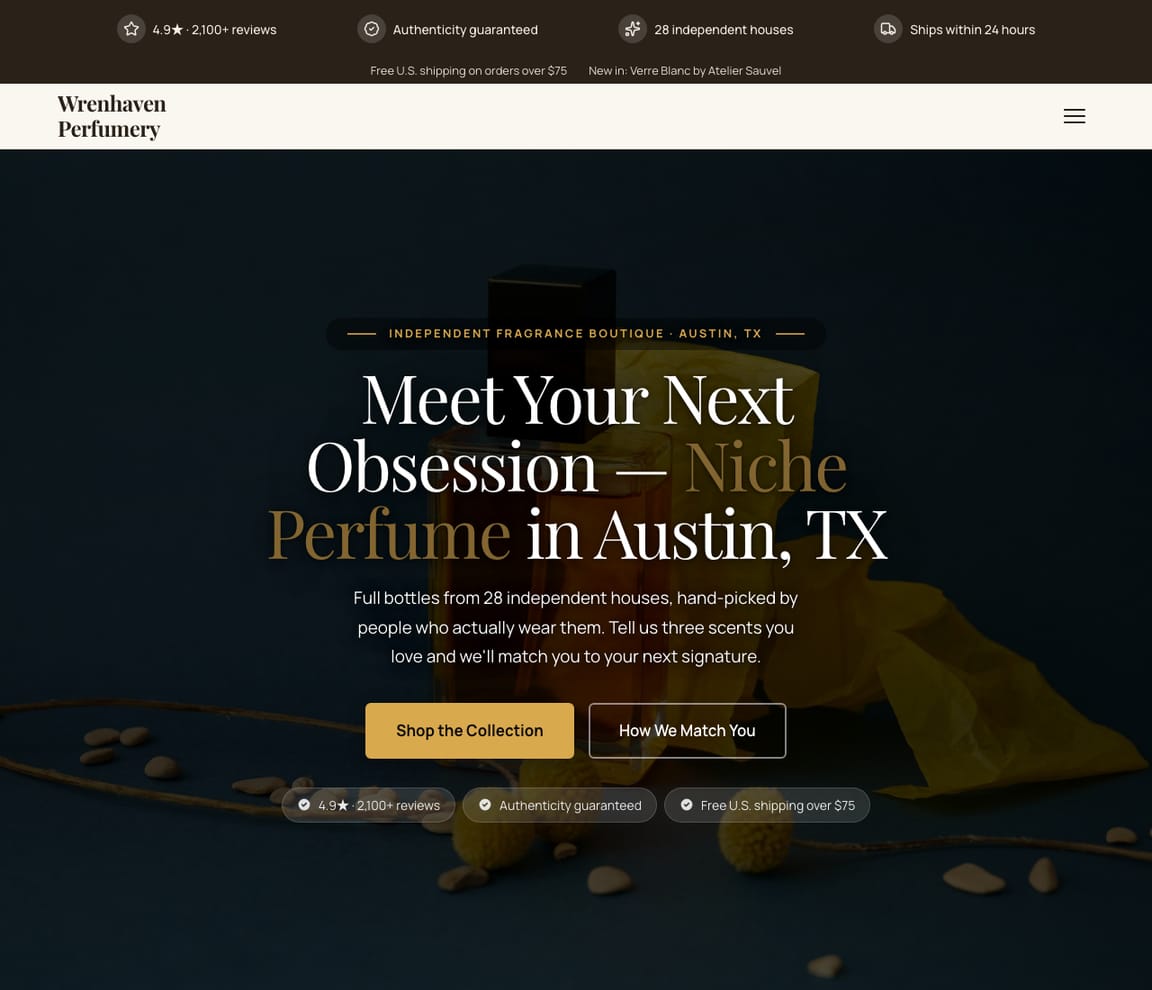
See what your perfume business website could look like
A real Zarla template from the perfume gallery — the scents with their notes up front, the sample set, the story behind the line and a way to buy. Describe yours — the line, the city, the markets you do — and you'll have a site like this, with your scents and your sample set, in about a minute.
- Professional design — not a generic template
- Looks great on desktop and mobile
- Content written for your industry
Build the website
Start your perfume business website now
Add your city and your brand's name to the sentence, and Zarla builds the site: the scents with their notes, the sample set, online ordering and your story. Add your prices, your market dates and your stockists in chat, then publish.
Already have a website? Bring it across →Zarla keeps your old page addresses where it can and redirects the ones that change, helping you keep the Google standing you've built.
Is starting a perfume business worth it in 2026 — and what do perfumers make?
The perfume business one maker can start is an own-label line blended by weight at home — perfumer's alcohol, a handful of materials, a 0.01-gram balance, sample vials and bottles — sold by the sample at markets and online, then to boutiques. The capital is small; the work is the formula, the file the law asks you to keep, and getting a stranger to buy a scent they can't smell. What the market says: "U.S. consumers spend more than $80 billion a year on fragrance-dependent products" — the trade body's figure for everything scented, not perfume alone (Fragrance Creators Association, June 5, 2026); in prestige beauty's first half of 2026, "fragrance dollar sales grew 6%" "with average prices rising 5% while unit sales remained flat" and "eau de parfum (EDP) and perfume posting double-digit growth" — growth from higher prices, not more bottles (Cosmetics Business on Circana, August 12, 2026). What indie houses charge: "Indie fragrances usually land between $80 and $200 for a full bottle" and "Most indie brands sell discovery sets or sample packs for $25–$45." — Imaginary Authors "$95–$115 for 50ml", D.S. & Durga "$110–$200 for 50ml" (fragplace's July 2026 list of indie brands). What a chemist and a counter earn: there is no O*NET line for a perfumer; "Workers on average earn $91,240." for chemists (O*NET, 2025), "Workers on average earn $60,390." for chemical technicians (O*NET, 2025) and "Workers on average earn $35,410." for retail salespeople — the market-stall hire (O*NET, 2025).
,What the perfumers say (all quoted and linked below): a founder who "began with a very small budget, basically just my savings" and whose "first customer came from the very first pop-up event at the farmers market"; a Brooklyn pair who "started this from basically nothing — just on our own, with no investment, years ago."; a founder who "had spent thousands of dollars on marketing, branding, and content creation" before a near-identical name was filed "two weeks before us."; a Denver store owner for whom it's "been profitable almost from the beginning." No owner page read today prints a revenue figure. Our arithmetic on the pages that open: about 40 mL of alcohol in a 50 mL bottle is 69 cents at $64.90 a gallon; the concentrate depends on the materials, whose pages print one price range across their sizes; the bottle is the dollars; a full bottle sells for $80 to $200. The margin is real — the hours are the cost. Worth it? The perfumers who lasted kept a job or savings through year one, reinvested "almost all of the profits back into the business", sold the sample before the bottle, and — in one Los Angeles perfumer's words — learned to "outsource manufacturing, shipping and bookkeeping so I can spend more time being in creative flow." The full budget for a year — working capital, markets, packaging — is on the perfume business plan.
How to start a perfume business, in plain English
The FDA — what it does and doesn't ask of a home perfumer. In the US perfume is a cosmetic: cosmetics are "articles intended to be rubbed, poured, sprinkled, or sprayed on" the body "for cleansing, beautifying, promoting attractiveness, or altering the appearance" — "a fragrance marketed for promoting attractiveness is a cosmetic." — but a fragrance sold with certain "aromatherapy" claims "meets the definition of a drug because of its intended use." (FDA, Is It a Cosmetic, a Drug, or Both?); the FDA's examples of drug claims include that a product will "help you sleep" or "relax muscles", and "The fact that a fragrance material or other ingredient comes from a plant doesn't keep it from being regulated as a drug." (FDA, Aromatherapy). This guide makes no such claim and suggests none. Home manufacture: "It's not against the law to manufacture cosmetics in your home."; "The law does not require cosmetic products and ingredients, except for color additives, to be approved by FDA"; and for the label address, "A post office box or website address is not adequate for this labeling requirement." (FDA, Small Businesses & Homemade Cosmetics, November 2025). MoCRA's small business is one "whose average gross annual sales in the United States of cosmetic products" "for the previous 3-year period is less than $1,000,000, adjusted for inflation" (21 U.S.C. §364h); "MoCRA exempts certain small businesses from GMP, registration, and product listing requirements." (FDA, MoCRA, October 2026) — above the line, registration is renewed "biennially (i.e., every two years)" (FDA, Registration and Listing). What nobody is exempt from: a serious adverse event goes to the FDA "no later than 15 business days after the report is received by the responsible person." and a small business "shall maintain such records for a period of 3 years" (21 U.S.C. §364a); and the responsible person "shall ensure, and maintain records supporting," "that there is adequate substantiation of safety of such cosmetic product." (21 U.S.C. §364d). No FDA page read today names a fee.
,The label. The ingredients "in descending order of predominance" "except that fragrance or flavor may be listed as fragrance or flavor." "in letters not less than 1/16 of an inch in height." (21 CFR §701.3); "fragrance and flavor ingredients can be listed simply as 'Fragrance' or 'Flavor.'" (FDA, Fragrances in Cosmetics); the net contents: "The declaration shall be located on the principal display panel of the label." "within the bottom 30 percent of the area of the label panel," (21 CFR §701.13); the front panel carries the name, the identity and the net quantity, the back "Directions for safe use," "Warnings," "Name and place of business," and the "Ingredient declaration," (FDA, Cosmetics Labeling Guide). A "flammable" line is good practice and what carriers expect, but it is not an FDA cosmetic requirement — the federal hazardous-substances law does not reach "foods, drugs and cosmetics subject to the Federal Food, Drug, and Cosmetic Act" (15 U.S.C. §1261).
,Perfumer's alcohol — the free permit page one never mentions. "A person who desires to withdraw and use or recover specially denatured spirits shall" "before commencing business, file an application on Form 5150.22 for, and obtain a permit, Form 5150.9." (27 CFR §20.41); "There is no fee to apply." (TTB, Permits Online, updated March 17, 2025); "Samples not larger than five gallons per calendar year may be obtained without a permit." but "Samples of specially denatured spirits shall not be used to manufacture articles for commercial sale." (27 CFR §20.251); "Perfumes and perfume tinctures" are use code "121", with formulas including "40-B" (27 CFR §21.141). The supplier: SDA 40-B "$64.90" a gallon, "$220.66" for a case of four — $55.17 a gallon, our arithmetic — and its page asks for the permit on larger orders, at five gallons in one sentence and six in another; the regulation is the rule to follow (Lab Alley).
,Shipping a flammable liquid. "Flammable liquids with a flashpoint at or below 20° F (-7° C) are prohibited."; "Other flammable liquids may be mailed if they qualify as a Limited Quantity surface material"; "International Mail: Flammable liquids are prohibited." (USPS Publication 52, §343); a nonmetal bottle up to "1 pint", "Enough cushioning material must surround the primary receptacles to prevent breakage and absorb any potential leakage.", "The outer packaging must bear an approved DOT Limited Quantity surface mark designating surface transportation." and "Domestic Mail: Permitted only via surface transportation." (USPS Packaging Instruction 3A); vials of "30 ml (1 ounce) or less for liquids" have a separate small-quantity route — read it before mailing sample sets (USPS Publication 52, §338); the federal rule behind it caps each inner packaging at "1.0 L (0.3 gallons)" and the box at "30 kg (66 pounds)" (49 CFR §173.150). The cost of getting it wrong: "The $50 noncompliance fee applies to any competitive commercial package where USPS detects hazardous materials" and "Perfume and cologne — alcohol-based and flammable." (Ship.com, July 6, 2026); "The result can be a $50 non-compliance charge per shipment" (Pitney Bowes) — both carriers' advisers, not the Postal Service's own notice. Ground Advantage: "Prices start at $8.40 at a Post Office™ location." and it is the "Primary option for sending hazardous materials (HAZMAT) that can’t go by air." (USPS). Online orders ship in the time you state or within 30 days — the rule says sellers must "have a reasonable basis to expect that the sellers can ship within the advertised time frame," (FTC, Mail Order Rule).
,The brand name, and the decant question. "Base application, per class" "$350.00" since January 2025 (USPTO fee schedule, revised November 1, 2026). Decanting other houses' fragrances is a different business: a court of appeals put the general rule that trademark rights "are exhausted after the trademark owner’s first authorized sale of that product." and its limit — it "does not hold true, however, when an alleged infringer sells trademarked goods that are materially different" (Davidoff v. PLD International, 11th Cir., 2001); a brand-side law firm: "Decanting involves repackaging genuine designer fragrances, typically into smaller containers for resale." and "The first sale doctrine does not shield resellers if the quality of the resold product is compromised." (Loeb & Loeb, November 18, 2025). This guide explains the question; talk to a trademark lawyer before you decant.
,The entity and the sales-tax permit, five states. Texas: "for filing a certificate of formation, $300;" (Tex. Bus. Orgs. Code §4.152); the application is for anyone who sells "tangible personal property in Texas" (Texas Comptroller); "There is no fee for the permit, but you may be required to post a security bond." (Texas Comptroller, permit FAQ); "6.25 percent" state, "a maximum combined rate of 8.25 percent." (Texas Comptroller); the resale certificate covers what you "intend to resell as an integral part of other merchandise." — the bottle, the sprayer, the box (Texas Comptroller, resale FAQ). Florida: "$100." for the articles and "$25." for the registered agent — $125 to file — then "$50." for each annual report (Fla. Stat. §605.0213); "Florida’s general state sales tax rate of 6% applies to most taxable transactions." and market sellers "must have their certificate in their possession at the temporary location." (Florida DOR, GT-300015); the Annual Resale Certificate lets a dealer "buy or rent property or services tax free" (Florida DOR). And Florida's own permit — the one state cosmetic-maker license among the five: "A cosmetic manufacturer permit is required for any person that manufactures or repackages cosmetics in this state."; the statute exempts a maker with annual gross sales of $25,000 or less, but "An exempt cosmetic manufacturer may only:" sell prepackaged cosmetics carrying the FDA's label information and "Manufacture and sell cosmetics that are soaps, not otherwise exempt from the definition of cosmetics, lotions, moisturizers, and creams." — each unit labeled "Made by a manufacturer exempt from Florida’s cosmetic manufacturing permit requirements." (Fla. Stat. §499.01(2)(p)). Perfume is not on that list, so a perfume maker in Florida needs the permit from the start: the fee "shall be sufficient to cover the costs" (§499.041) — "Cosmetic Manufacturer" "$800.00" every two years (Fla. Admin. Code R. 61N-1.018) on "form number DBPR-DDC-206" (R. 61N-2.002); a decanter who opens sealed bottles "repackages" from day one too. Miami: "Every business needs to obtain a Business Tax Receipt to operate in the City (also known as an Occupational License)." (City of Miami). New York: "two hundred dollars" (N.Y. LLC Law §1101) and the notice "published once in each week for six successive weeks, in two newspapers of the county." (§206); register "at least 20 days before you begin business." and a market seller "must apply for a regular Certificate of Authority" (NYS Tax Department, TB-ST-360, updated October 21, 2026); Form ST-120 covers goods "for resale as a physical component part of tangible personal property;" (Form ST-120, revised January 2026). California: "Seventy dollars ($70)" and "Twenty dollars ($20)," (Cal. Gov. Code §12190), "a minimum franchise tax of eight hundred dollars ($800)." (Cal. Rev. & Tax. Code §23153); "Is there a fee charged for a seller's permit?" — "No." (CDTFA); the Safe Cosmetics Act's reporting "shall not apply to any manufacturer of cosmetic products with annual aggregate sales of cosmetic products," "of less than one million dollars ($1,000,000)," (Cal. Health & Safety Code §111792); the fragrance right-to-know law requires a manufacturer to disclose "A list of each fragrance ingredient or flavor ingredient that is included on a designated list" (§111792.6); Proposition 65 excludes "any person employing fewer than 10 employees in his or her business." (§25249.11). New Jersey — the fragrance industry's home state, where the beauty industry supports "~215,000" jobs by its trade body's count (Personal Care Products Council): the LLC "Certificate of formation" is "$100.00" (NJ Treasury, fees, updated July 1, 2026) — not the $125 many guides still print; "You must complete the NJ-REG at least 15 business days before doing business" (NJ Division of Revenue); "New Jersey assesses a 6.625% Sales Tax on sales of most tangible personal property" (NJ Division of Taxation). The home studio: "The City of Austin cannot prohibit or require permits for home-based businesses that do not exceed occupancy limits," (City of Austin) — storing gallons of a flammable liquid at home is your fire marshal's question. "You never have to pay a fee for an EIN." (IRS).
,The making, at the suppliers' own printed prices. Materials by the gram: Iso E Super "Price range: $3.00 through $18.00" (Perfumer Supply House); ambroxan "Price range: $11.50 through $190.00" (Perfumer Supply House); bergaptene-free bergamot "$10.00 – $121.50" (Perfumer Supply House) — each page prints one range across its sizes, from 5 grams to 200 grams, not a price for each size. Each ships with its "IFRA 51" document: "The IFRA Standards is a globally recognized risk management system for the safe use of fragrance ingredients." (IFRA); the 51st Amendment's restrictions applied to existing creations from "Oct. 30, 2025." (UL, July 10, 2023), and the 52nd "is expected to be published by late 2026" (IFRA). The balance: "220 g x 0.01 g" at "$240" (Uline). Sample vials: "Your VIP Price: $ 0.55" for a 2 mL mister with a "Natural fine mist sprayer cap & overcap included." (Berlin Packaging). Bottles: no US supplier's 50 mL spray-bottle page printed a price to a reader today; the plan page's makesy line, read 21 October 2026, was $48.95 a case of twelve, which the plan prints as $4.07 a bottle, and $3.26 a bottle at forty cases. The private-label door: "Priced as low as $6.62 per bottle (50ml) with a suggested retail of $44.95" and "$22.83" for a single bottle (Bulk Apothecary) — its blends are modeled on known designer scents, so the trademark caution above applies. Markets: "a nonrefundable $35 application fee per event", and "Booth fees are invoiced separately for each Fair." — a shared booth "$375" in New York and "$500" in Seattle (Renegade Craft, 2026). Etsy: "$0.20 per listing.", "6.5% of the total order amount" (Etsy Help Center) and "3% + 0.25 USD." to process (Etsy Help Center) — $9.32 of an $85 bottle with $8.40 shipping, our arithmetic. Cards: "2.6% + 15¢" in person at Square (Square); "Standard card payments are 2.9% + 0.30 USD in the US" (Stripe).
,The policy, the room and what a bottle sells for. "Beauty product insurance starts at $89.10 per month" "(after initial payment of $279)" — $1,259.10 for the first year, our arithmetic (Insurance Canopy); "From about $26/mo" (Assureful, reviewed July 1, 2026); ACT's "ACT Pro for Handmade Beauty Businesses" at "$515 per year" lists "Products containing alcohol (except compliant hand sanitizer)" among its exclusions — ask any insurer whether alcohol-based products are covered (ACT Insurance, soap makers' page); "Small businesses pay an average of $45 per month" for general liability, which usually carries product liability (Insureon, April 24, 2026). A shop that sells other houses' bottles pays rent: "national asking rents reaching $25.82 per square foot (psf)" (Cushman & Wakefield, Q3 2026) — $1,039 a month for a 483-square-foot shop, our arithmetic. What houses charge on their own sites: an eau de parfum at "$100.00", a perfume oil at "$65.00" (Maison Louis Marie); a "Mini Duo Set: $35" (Commodity); decants of designer and niche fragrances at "$7.79" to "$17.79" (DecantX). At the far end: "Clive Christian No1" at "205,000 US dollar(s)" — $205,000 — for a 500 ml limited edition in 2005 (Guinness World Records). The full first-year budget, with working capital and the first markets, is $6,557–$19,611 on the perfume business plan.
,In the UK: a sole trader registers for Self Assessment "if you earn more than £1,000 in a tax year" (GOV.UK); "Businesses have to register for VAT if their VAT taxable turnover is more than £90,000." (GOV.UK); "A Responsible Person must have a UK established address to make cosmetic products available in GB." and "Before making a cosmetic product available to consumers, its safety must be checked by a qualified safety assessor." (GOV.UK, OPSS); products are notified "before they can be placed on the GB market." (GOV.UK); Royal Mail treats perfume as a restricted item — its page refused a reader, so it is described, not linked. In Australia: "It’s free to register for an ABN" (business.gov.au); register for GST at "a GST turnover of $75,000 or more" (business.gov.au); a business that makes or imports the chemicals in a fragrance registers with the industrial-chemicals scheme, whose pages timed out — described, not linked. Fees, thresholds and the list of what is taxed change every year — confirm your own state's rule with your accountant before the first sale, and check your local fire marshal's limit before the first case of alcohol.
What perfumers and fragrance founders actually say
None of this is our opinion about making perfume for a living. It comes from perfumers, fragrance founders, a perfume-oil maker and perfume-store owners in Arizona, New York, New Hampshire, California, Georgia, Texas, Colorado and Florida, talking to CanvasRebel, ShoutoutLA, Shoutout Atlanta, Glossy, regional magazines and local papers between 2021 and 2026, each described as the page describes them. Read each as theirs at the time. Five things come up again and again.
,Why they started. Gatsby Yeh, Nose of Gatsby: “By 2015, I had grown bored of the commercial market and began dreaming of building my own brand.” (CanvasRebel, July 21, 2025). Odette Fontaine, Odette Parfum Co.: “Odette Parfum Co. was born from that sense—that there was space in the world for handmade, story-driven perfume.” (CanvasRebel, June 12, 2025). Miriam Shechet, LabHouse, Dover, New Hampshire: “I didn't know this was a career, and people could make a living with their nose—sniffing things and creating formulas,” (Business NH Magazine, April 13, 2023). Danielle Bryant, Lucky Cloud, Hampton, New Hampshire: “I got a couple of oils and made a really rudimentary thing that I liked for a bit, and that's where it started,” (New Hampshire Magazine, August 18, 2025). Octavia Morgan, Los Angeles: “The idea for my brand emerged when I developed sensitivities to certain ingredients commonly found in fragrances” (ShoutoutLA, March 19, 2025). Aiesha McKenzie, a custom perfume studio, Atlanta: “I never thought I could make perfume because you had to be handpicked and go to Paris to learn how to do it.” (Shoutout Atlanta, January 4, 2024). YOSH Han, eaudeYOSH, Los Angeles: “Early in my career, there were not as many artisan or indie perfumers from USA” (ShoutoutLA, August 30, 2021). Bharvi Soni, Expressive Aromas, McKinney, Texas: “I don't want 20 ingredients added to my perfume, and I want to know exactly what's being added to my fragrance.” (Community Impact, February 23, 2024).
,“I ended up living very frugally during the first year and reinvested almost all of the profits back into the business.” — Gatsby Yeh, Nose of Gatsby, in CanvasRebel, July 21, 2025,
The first batch, the first year and the money. Gatsby Yeh: “I began with a very small budget, basically just my savings.” and “If you're thinking of starting a business, I suggest beginning it as a side project.” (CanvasRebel, July 21, 2025). Odette Fontaine: “I worked by intuition and instinct, teaching myself through trial and error.” (CanvasRebel, June 12, 2025). Ilsa Manning, Ilsa Fragrances, Phoenix: “When we first launched Ilsa Fragrances in 2016, we decided we wanted to be direct to consumer with our own website.” (CanvasRebel, March 14, 2022). Danielle Bryant: “It took a few years of building my skills, solidifying my vision, stashing my cash, but here we are.” (New Hampshire Magazine, August 18, 2025). Brianna Arps, MOODEAUX: “I started MOODEAUX and the initial stages with my savings account, I didn't have a job anymore” and “We had spent thousands of dollars on marketing, branding, and content creation” (xoNecole, 2023, updated 2025). Kavi Moltz, D.S. & Durga, Brooklyn: “David and I started this from basically nothing — just on our own, with no investment, years ago.” (Glossy, August 11, 2022). Rachel Greiman, Ode to Perfume, a Denver store: “We've been really lucky that it's been profitable almost from the beginning.” (Glossy, September 24, 2025).
,The rules, the supplies and the surprises. Ilsa Manning: “fine fragrances are not allowed to be overnight shipped by air to due the fact they are a hazardous good.” [sic] (CanvasRebel, March 14, 2022). Brianna Arps, on the brand's first name: “someone has filed for a very similar name, two weeks before us.” and “I was devastated.” (xoNecole, 2023, updated 2025). Ridhima Agarwal, Mitti Parfum: “We've navigated failed bottle iterations, supplier issues, inventory shortages, and forecasting mistakes” (Shoutout Atlanta, March 26, 2026). Bria Joyner, January Rose Atelier: “Each fragrance is carefully crafted in small batches, allowing me to ensure the highest quality and safety standards.” (CanvasRebel, November 7, 2024). Magda Khalifa, Triangle Fragrance: “there can be a steep learning curve which consumes resources” (CanvasRebel, September 8, 2022).
,The customers, the samples and the markets. Gatsby Yeh: “My first customer came from the very first pop-up event at the farmers market.” and “To my surprise, they ended up purchasing a full-size bottle.” (CanvasRebel, July 21, 2025). Magda Khalifa: “The most effective way I have been able to increase customer base for my company has been through live events” and “People value a person to person connection, and the ability to ask questions from a credible source.” (CanvasRebel, September 8, 2022). Bria Joyner: “Pop-up shops allow me to transform the shopping experience into something memorable.” and “In the luxury fragrance industry, trust is paramount.” (CanvasRebel, November 7, 2024). Aiesha McKenzie: “I focused on offering my clients private sessions and parties with their friends.” and “The aspect of creating the perfume when you have your own brand is fun; the retail/distribution aspect, not so much.” (Shoutout Atlanta, January 4, 2024). David Seth Moltz, D.S. & Durga: “You have to know people who know how to sell well in wholesale and how that whole system works.” (Glossy, August 11, 2022). Octavia Morgan: “From perfecting each scent to launching in ULTA Beauty, every step has been a testament to believing in my vision” (ShoutoutLA, March 19, 2025). Carrie Hadley, Indiehouse, Atlanta: “We kind of have to curate our selection to have enough interesting things for people.” (Glossy, September 24, 2025). Merryck Walker's St. Petersburg shop, Super Memory, is “just 483-square feet” in the paper's words (Creative Loafing Tampa Bay, November 20, 2025).
,The owner and the burnout. YOSH Han: “I was successful but burnt out.” and “outsource manufacturing, shipping and bookkeeping so I can spend more time being in creative flow.” (ShoutoutLA, August 30, 2021). Ridhima Agarwal: “Balancing a corporate career while nurturing a growing brand hasn't always been easy” (Shoutout Atlanta, March 26, 2026). Ilsa Manning: “Someone always needs to be there to answer queries and get orders out.” (CanvasRebel, March 14, 2022). Odette Fontaine: “Unlearning that what you create must please everyone has been a formidable challenge.” (CanvasRebel, June 12, 2025). Kavi Moltz: “Every facet of the beauty industry is more crowded today than it was 14 years ago.” (Glossy, August 11, 2022). Carrie Hadley: “The brick-and-mortar game is definitely harder.” (Glossy, September 24, 2025).
THE STARTER KIT
What you need to start a perfume business
The free TTB permit for perfumer's alcohol
Perfumer's alcohol is specially denatured spirits. "Samples not larger than five gallons per calendar year may be obtained without a permit." — but "Samples of specially denatured spirits shall not be used to manufacture articles for commercial sale." The user permit is Form 5150.22, and "There is no fee to apply."
The FDA's rules — and the small-business line
"It's not against the law to manufacture cosmetics in your home." Under $1,000,000 of average annual US cosmetic sales, adjusted for inflation, MoCRA exempts you from registration, listing and the manufacturing rules — not from the 15-business-day adverse-event report or the safety records.
The label
The ingredients "in descending order of predominance" — "except that fragrance or flavor may be listed as fragrance or flavor." — in letters at least 1/16 inch, the net contents on the front panel, your name and a real address: "A post office box or website address is not adequate".
Shipping a flammable liquid
Alcohol-based perfume goes by ground only, as a limited quantity: a nonmetal bottle up to one pint, the DOT limited-quantity mark on the box, cushioning that absorbs a leak, and never international mail. A carrier's guide puts the undeclared-hazmat fee at $50.
The alcohol, the materials, the balance, the vials
SDA 40-B at $64.90 a gallon or $220.66 a case of four; Iso E Super printed at $3.00 through $18.00, ambroxan $11.50 through $190.00 and a bergamot $10.00 to $121.50, each a range across sizes from 5 to 200 grams; a 0.01-gram balance $240; a 2 mL mister vial $0.55. Every material arrives with a safety data sheet and an IFRA certificate.
The policy, the permit in Florida, the brand name
Product liability from about $26 a month, or $279 down and $89.10 a month — and check it covers alcohol-based products; one $515-a-year handmade-beauty policy excludes them. In Florida a perfume maker needs the cosmetic manufacturer permit, $800 every two years, from the start — the $25,000 exemption covers only soaps, lotions, moisturizers and creams. A trademark is $350 a class.
THE PAPERWORK
Permits, rules and registrations for a new perfume business
| Typical cost | Time to get | Legally required? | |
|---|---|---|---|
| FDA approval before sale | — | — | No — the FDA approves no cosmetic but color additives before sale |
| TTB user permit for perfumer's alcohol | Free (Form 5150.22) | Before the first commercial batch | Yes to make products for sale with SDA; five gallons of samples a year are for experiments only |
| MoCRA registration and listing | Free | — | Not below $1,000,000 of average annual US cosmetic sales, adjusted for inflation; the adverse-event and safety records apply to everyone |
| The label | Your printing | Before the first bottle | Yes — ingredients by predominance ("fragrance" allowed), net contents, name and a real address |
| Shipping by ground as a limited quantity | The DOT mark and cushioning; a $50 fee if undeclared | Before the first parcel | Yes — no air, no international mail for alcohol-based perfume |
| The entity | $300 TX; $125 FL + $50/yr report; $200 + publication NY; $70 + $20 + $800/yr CA; $100 NJ | Days to weeks | No — a sole proprietor may trade; the LLC is a liability choice |
| Sales-tax permit / seller's permit | Free TX, NY, CA (a deposit is possible in CA); no fee printed FL, NJ | 20 days before NY; 15 business days before NJ | Yes in every state read — perfume is tangible goods |
| Florida cosmetic manufacturer permit | $800 every two years | Before the first bottle | In Florida, from the start — the $25,000 exemption covers only soaps, lotions, moisturizers and creams, not perfume |
| California's cosmetics reporting | Free | With the first California sale | Safe Cosmetics reporting from $1,000,000 of sales; the fragrance right-to-know disclosure; Prop 65 at 10+ employees |
| Federal trademark | $350 a class | Months | No — but a name filed first by someone else can end yours |
| EIN | Free | Minutes | Needed to hire and for the entity; free from the IRS — never pay a site |
| Product liability insurance | From about $26/mo, or $279 + $89.10/mo | Days | Not by law; markets and boutiques ask — check it covers alcohol-based products |
THE STEPS
How to start a perfume business (step by step)
Eight steps from a few blends you love to a perfume line with the alcohol permit on file, the labels to the rule, the parcels going by ground and a sample set a stranger can order.
01
Pick the line — own-label, private label, or a store
The perfumers here began with "a very small budget, basically just my savings", "a couple of oils", or a hobby that became an Etsy shop. The private-label door is a ready blend under your label — one supplier prints $6.62 a 50 mL bottle by the hundred. A shop selling other houses' bottles is a retailer.
Before the first batch02
Form the entity and take the EIN
An LLC is $300 in Texas, $125 to file in Florida ($100 + $25 for the registered agent), then a $50 annual report, $200 plus six weeks of newspaper notice in New York, $70 plus $20 and an $800 annual tax in California, $100 in New Jersey on the Treasury's fee page, updated July 1, 2026. "You never have to pay a fee for an EIN."
03
Take the TTB permit before the first bottle is sold
"A person who desires to withdraw and use or recover specially denatured spirits shall" "before commencing business, file an application on Form 5150.22". Five gallons of samples a year need no permit — but never for anything you sell. Perfume is use code 121, and SDA 40-B is on its list.
04
Register for sales tax and the resale certificate
Texas: "There is no fee for the permit"; Florida, 6% state rate — and the cosmetic manufacturer permit, $800 every two years, before the first bottle; New York, at least 20 days before you begin; California, "No." fee; New Jersey, the NJ-REG "at least 15 business days before doing business". The resale certificate buys the bottles and boxes that leave with the perfume tax-free.
05
Formulate by weight, keep the file, label to the rule
A 0.01-gram balance, a batch log, a safety data sheet and an IFRA certificate for every material — the 51st Amendment is in force, the 52nd expected late 2026. MoCRA's records: six years, or three for a small business. The label lists ingredients by predominance, with the blend as "fragrance".
06
Set up ground-only shipping
"Flammable liquids with a flashpoint at or below 20° F (-7° C) are prohibited."; the rest may go "if they qualify as a Limited Quantity surface material" — "Domestic Mail: Permitted only via surface transportation." Ground Advantage starts at $8.40. Sample vials of 30 mL or less have their own small-quantity rule — check it.
07
Insure, then sell the sample before the bottle
Insurance Canopy: "$89.10 per month" "(after initial payment of $279)"; Assureful "From about $26/mo". A big craft fair charges a $35 application, then invoices a shared booth at $375 to $500. Indie sample sets run "$25–$45"; a full bottle "between $80 and $200".
08
Publish the site, then the boutiques
The site shows each scent with its notes, the sample set and your story; the Google Business Profile puts the studio on the map. Wholesale comes from the markets — one founder: "You have to know people who know how to sell well in wholesale and how that whole system works."
THE COSTS
How much does it cost to start a perfume business?
The first figure is the plan page's startup budget — the full list, with working capital and the first markets. The second is this guide's lean start in Texas from the pages that open, our arithmetic. Not in the lean start: labels, boxes, glassware, photography and the website, which no page priced to a reader today.
$6,557–$19,611the startup budget on the perfume business plan — alcohol, materials, 300 bottles and 1,000 samples, packaging, equipment, insurance, registration, shipping setup, photography, the website, the first markets and two months of working capital
$1,889the lean start — $220.66 of alcohol + $329.50 of materials + a $240 balance + $110 of vials + $279 of insurance + the $300 LLC + a $35 application + a $375 booth = $1,889.16; sixty bottles at the plan page's October makesy price add $244.75, for $2,133.91
$0.69of perfumer's alcohol in a 50 mL eau de parfum at $64.90 a gallon (about 40 mL, our arithmetic)
$1,259.10the first year of Insurance Canopy's beauty-products policy — $279 down and eleven payments of $89.10; Assureful starts from about $26 a month
WHAT WE'VE LEARNED
What actually brings a perfume line its customers
Thousands of local business websites in, the pattern for a one-maker brand is clear: the first bottle is sold face to face, and the second comes from a page that lets a stranger choose a scent they can't smell. Three things on that page decide it — and the perfume templates are built around them.
Each scent, in words a nose can read
The top, heart and base notes, what it reminds people of, the concentration and the size. One perfumer's first customer bought a full bottle at a farmers market pop-up; online, the notes are the only tester a buyer has.
The sample set, before the bottle
Indie houses sell discovery sets because a buyer who tries five scents and keeps one is the whole model. A sample set at the top of the page, with a note that it's credited against a bottle if you do that, is the door.
The story, the markets and the stockists
Who blends it and where, the markets this month, the boutiques that carry it. Perfumers say person-to-person trust sells the bottle — the page carries that trust to the people who weren't at the stall.
THE EARNINGS
What perfumers make, and what the bottle sells for
No wage survey has a perfumer's line and no owner page read today prints a revenue figure; the employed figures are O*NET's 2025 medians, the prices are the indie houses' own and fragplace's July 2026 list of indie brands.
$80–$200an indie full bottle by fragplace's July 2026 list of indie brands; Imaginary Authors $95–$115 for 50 mL, D.S. & Durga $110–$200; discovery sets $25–$45
$91,240the 2025 median for chemists — the perfumer's employed equivalent; chemical technicians $60,390 (O*NET)
$35,410the 2025 median for retail salespeople, $17.03 an hour — the market-stall or counter hire (O*NET)
6%fragrance's dollar growth in US prestige beauty in the first half of 2026, with average prices up 5% and units flat (Cosmetics Business on Circana)
SEE IT WORK
Perfume website designs you can start from
Two real Zarla perfume templates — a light boutique and a dark perfume house — built around what a fragrance site needs: each scent with its notes, the sample set, the story and the buy button. Open one, swap in your scents, your bottles and your city, and publish.
Online Store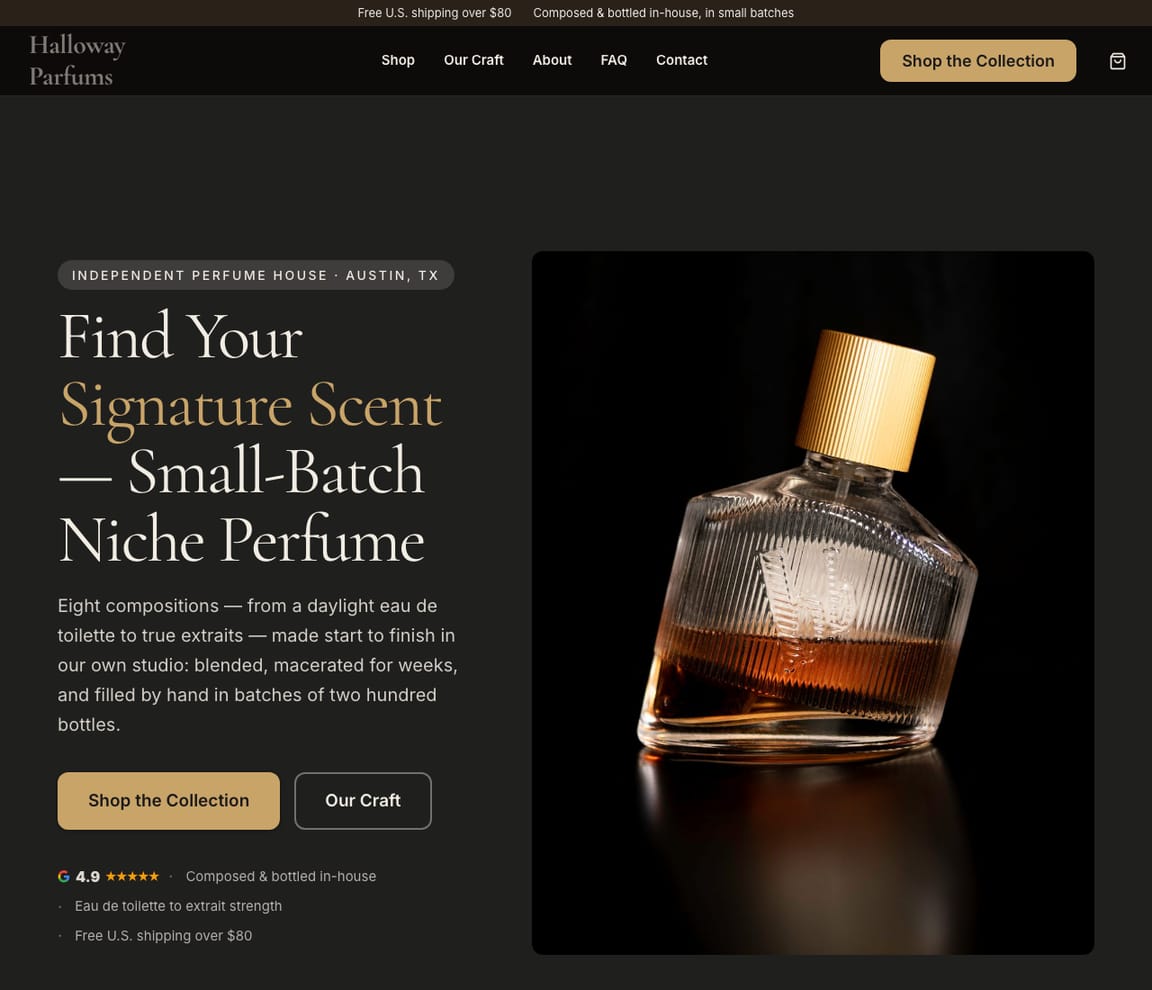 Online Store
GET FOUND
Get found by the person who searched "handmade perfume near me" after smelling yours at the market
The perfumers say their first customers came from a farmers market, a pop-up or a live event, and the ones after that went home and looked them up. That second look asks the same questions every time: what does each scent smell like, is there a sample set, where can I buy it. Zarla builds the website with each scent and its notes, the sample set, online ordering and your story, and SEO. Add your prices, your market dates and your stockists in chat, and once you connect your Google Business Profile, your Google rating shows on the site.
“Handmade perfume near me”
Searched by the person who smelled your tester at a market, the gift buyer who wants something local, and the enthusiast who samples every indie house. Your scents, your sample set and your market dates answer it.
Google Business Profile
Your studio or your stall, your hours and your market days inside Google Maps — with the shop link on it. Free, and an afternoon to set up.
The notes, the sample set, the story
Nobody buys a scent unsmelled online. The notes for each scent, a sample set that lets them try the line, and the story of who blends it are what turn a visit into an order.
Google Search
Llanternvetiverperfumes.com
Lantern & Vetiver Perfumes — Trusted perfume business in Your AreaSmall-batch eau de parfum blended in Savannah. Six scents, a sample set of the whole line, and the markets we're at this month. Order online.← Your Zarla siteCcityperfumebusinessservices.com
City perfume business ServicesGoogle Maps
1
Lantern & Vetiver Perfumes
← You2
Metro perfume business Co.
3
Quick perfume business Services
AI assistants (ChatGPT / Perplexity)
For a Savannah perfumer who blends six eau de parfums in small batches, sells a sample set of the whole line, and is at two markets a month in your area: Lantern & Vetiver Perfumes — a small-batch perfume house whose site lists each scent with its notes, sells a five-vial sample set so you can try before you buy, and posts its market dates.
An example with a made-up business and illustrative figures. Yours will show your real details and reviews.
YOUR LAUNCH PLAN
Your perfume business launch checklist
The whole guide as things to check off. Work through them in order and you'll be permitted, labeled, insured, shipping legally and findable before the first market.
- Pick the line — your own blends, a private-label line, or a store that sells other houses' bottles.
- Form the entity and take the free EIN — $300 in Texas, $125 to file in Florida ($100 + $25 for the registered agent) then a $50 annual report, $200 plus publication in New York, $890 in California's first year, $100 in New Jersey.
- File for the free TTB permit — before the first bottle you sell; five gallons of samples are for experiments only.
- Register for sales tax — and use the resale certificate for the bottles and boxes that leave with the perfume.
- Keep the safety file and label to the rule — the SDS and IFRA certificate for every material, the batch log, ingredients by predominance.
- Ship by ground as a limited quantity — the DOT mark, the cushioning, no air, no international mail.
- Insure for alcohol-based products — and in Florida, take the cosmetic manufacturer permit before the first bottle; its $25,000 exemption doesn't cover perfume.
- Publish the site and claim the Google Business Profile — each scent with its notes, the sample set, your story, the shop.
REAL CUSTOMERS
Small businesses that got online with Zarla
Verified reviews from real Zarla customers.
“Quickly built my website from scratch. No hiccups. Would highly recommend Zarla for someone with no experience who wants to start a polished business website.”
“Great professional website in less than a minute, with the use of AI and a few descriptive prompts. This has saved me bundles of time and research on web developers.”
“I had no idea how to set up a website for my business. Thanks to Zarla, they've helped me a lot.”
“Very reliable, professional, and fast results. I was able to get my business online in no time, and the ease of access made it so simple.”
Be the perfumer whose scents, sample set and story are one tap away
Add your city and your brand's name, and Zarla builds the website from that one line — the scents with their notes, the sample set, online ordering, your story and SEO in place. Add your prices, your market dates and your stockists in chat. Free to build; you pay when you publish.
Already have a website? Bring it across →Zarla keeps your old page addresses where it can and redirects the ones that change, helping you keep the Google standing you've built.
Frequently asked questions
How much does it cost to start a perfume business?
Two answers from the pages that open. The full budget on the perfume business plan runs $6,557 to $19,611 — alcohol, materials, 300 bottles and 1,000 samples, packaging, equipment, insurance, registration, shipping setup, photography, the website, the first markets and two months of working capital. The lean start in Texas is about $1,889 — our arithmetic: a case of perfumer's alcohol at $220.66, three materials at $329.50, a 0.01-gram balance at $240, two hundred sample vials at $110, Insurance Canopy's $279 first payment, the $300 LLC, a craft fair's $35 application and its $375 booth; the EIN and the TTB permit are free. Sixty bottles at the plan page's October price add $244.75, for $2,133.91.
What license do you need to start a perfume business?
In the US there is no perfumer's license, and the FDA approves no cosmetic before sale. What you need: the free TTB permit to use perfumer's alcohol for products you sell; your state's sales-tax permit — free in Texas, New York and California; and, in Florida, the cosmetic manufacturer permit from the start ($800 every two years) — the state's $25,000 exemption covers only soaps, lotions, moisturizers and creams, not perfume. Then the FDA's label rule, the safety records and the 15-business-day adverse-event report, which apply even below MoCRA's $1,000,000 line. Check your own state's revenue department before the first sale.
Do you need a license to sell homemade perfume?
In the US, no license from the FDA: "It's not against the law to manufacture cosmetics in your home." But homemade perfume made with perfumer's alcohol needs the free TTB user permit before you sell it, the sales-tax permit in your state, a label with the ingredients and a real street address, and ground-only shipping. Florida licenses cosmetic manufacturers, and a perfume maker there needs the permit from the first bottle — the $25,000 exemption covers only soaps, lotions, moisturizers and creams. Cottage-food laws are written for food, not perfume — check your state's rule.
How much does it take to start a perfume business?
As little as about $1,889 for the lean start the pages price — alcohol, three materials, a balance, sample vials, the first insurance payment, the LLC and one fair's application and booth — or $6,557 to $19,611 for the plan page's full first budget with working capital. The perfumers here started with savings: one "began with a very small budget, basically just my savings", another "from basically nothing", a third spent "thousands of dollars on marketing, branding, and content creation".
How to create your own fragrance?
The perfumers here describe it the same way: buy a few materials with their safety data sheets and IFRA certificates, weigh every drop on a 0.01-gram balance, log every trial, and let each blend rest before judging it — one "worked by intuition and instinct, teaching myself through trial and error.", another "got a couple of oils and made a really rudimentary thing". One supplier prints Iso E Super at $3.00 through $18.00 across its sizes. To sell it, the rules above begin with the first bottle.
How are perfumes made?
A concentrate of aroma materials and naturals is weighed out, blended into perfumer's alcohol — SDA 40-B is one of the federal formulas listed for "Perfumes and perfume tinctures" — left to rest, filtered and bottled. An eau de parfum is roughly a fifth concentrate; a 50 mL bottle holds about 69 cents of alcohol at $64.90 a gallon. A perfume oil skips the alcohol, which also takes it outside the flammable-liquid shipping rule for alcohol-based perfume.
How can I become a perfumer?
Two roads. The employed one runs through chemistry — O*NET has no perfumer line; its 2025 median for chemists is $91,240 and for chemical technicians $60,390. The independent one is the line in this guide: the perfumers quoted here taught themselves — Aiesha McKenzie, an Atlanta perfume-studio owner: "It took some work, but I figured out how I could blend perfume without having to go to school for it." Either way the materials come with IFRA's limits.
How much does a perfumer make?
No wage survey has a perfumer's line and no owner page read today prints a revenue figure. The nearest employed medians are chemists at $91,240 and chemical technicians at $60,390. An indie full bottle sells for $80 to $200 against about 69 cents of alcohol, the concentrate and the glass; what the owner keeps depends on how many sell, which is why the perfumers here reinvested "almost all of the profits" in year one.
What cologne costs $5000?
No page read today prints a cologne at that price. The record on file is far above it: Guinness lists Clive Christian No1's limited "Imperial Majesty" edition at $205,000 for 500 ml, in 2005. Indie full bottles land between $80 and $200 by fragplace's July 2026 list of indie brands.
How to start a perfume business from home?
The lean start above is a home start: about $1,889 for alcohol, materials, a balance, vials, insurance, the LLC and a fair's application and booth. In the US the FDA says making cosmetics at home is legal; you still need the free TTB permit before selling, the label rule, the safety file, the sales-tax permit and ground-only shipping. Check your city's home-business rule and your fire marshal's limit on stored alcohol; Austin cannot require permits for home-based businesses within occupancy limits.
How to start a perfume business in Florida?
In Florida: register with the Department of Revenue (the state rate is 6%) and carry the certificate to markets; an LLC is $125 to file ($100 + $25 for the registered agent), then a $50 annual report. Then the state's own rule: "A cosmetic manufacturer permit is required for any person that manufactures or repackages cosmetics in this state." A perfume maker needs it from the start — $800 every two years — because the $25,000 exemption covers only what the statute lists: "Manufacture and sell cosmetics that are soaps, not otherwise exempt from the definition of cosmetics, lotions, moisturizers, and creams." Decanting other houses' bottles counts as repackaging. Confirm the details with your accountant.
How to start a perfume line in California?
In California: a free seller's permit, an LLC at $70 plus $20 and the $800 minimum franchise tax each year. Then the state's own cosmetics laws: the Safe Cosmetics Act's reporting from $1,000,000 of annual cosmetic sales, the fragrance right-to-know law's disclosure of listed fragrance ingredients, and Proposition 65 once you employ 10 or more. The federal rules — the TTB permit, the label, the safety file, ground shipping — apply as everywhere. Confirm the details with your accountant.
Can I sell decants of designer perfume?
In the US decanting is repackaging another house's trademarked product, and the law is unsettled at the edges: an appeals court held trademark rights are exhausted after the first authorized sale but not when the goods are "materially different", and a brand-side firm warns the doctrine "does not shield resellers if the quality of the resold product is compromised." In Florida repackaging also needs the cosmetic manufacturer permit from the start. Talk to a trademark lawyer before you decant; this guide gives no advice.
Can I ship perfume through the mail?
In the US alcohol-based perfume goes by ground only, as a limited quantity: a nonmetal bottle up to a pint, cushioning that absorbs a leak, the DOT limited-quantity mark on the box, no air and no international mail. Ground Advantage starts at $8.40. Two carriers' advisers put the fee for an undeclared hazmat parcel at $50. Sample vials of 30 mL or less have a separate small-quantity rule.
Do I need a website for my perfume business?
One founder went direct to consumer "with our own website" from launch, and the market customers go home and look the brand up before buying a second scent. A perfume site shows each scent with its notes, the sample set, the story and a way to buy. Zarla builds one from a sentence — the scents, the sample set, online ordering and your story — and you add the prices, the market dates and the stockists in chat before you publish.