BUSINESS GUIDE
How to start a trash can cleaning business in 2026
The manual start versus the hot-water trailer, priced from the makers' own lists, the wastewater rule that decides how you work, what real companies charge per bin and per plan, the subscriptions and the route math, the franchise option, insurance — and what a route earns.
Free to build · Pay when you publish · No credit card
$24–$35a monthly visit for two bins, posted by eight US companies across five states and the franchisor
$29,999the only openable list price for a purpose-built rig — The Bin Trailer's Single Cold
190–200°Fthe water at the curb, wherever an owner or vendor prints a temperature
No codeto get online
See it in action
See what your trash can cleaning website could look like
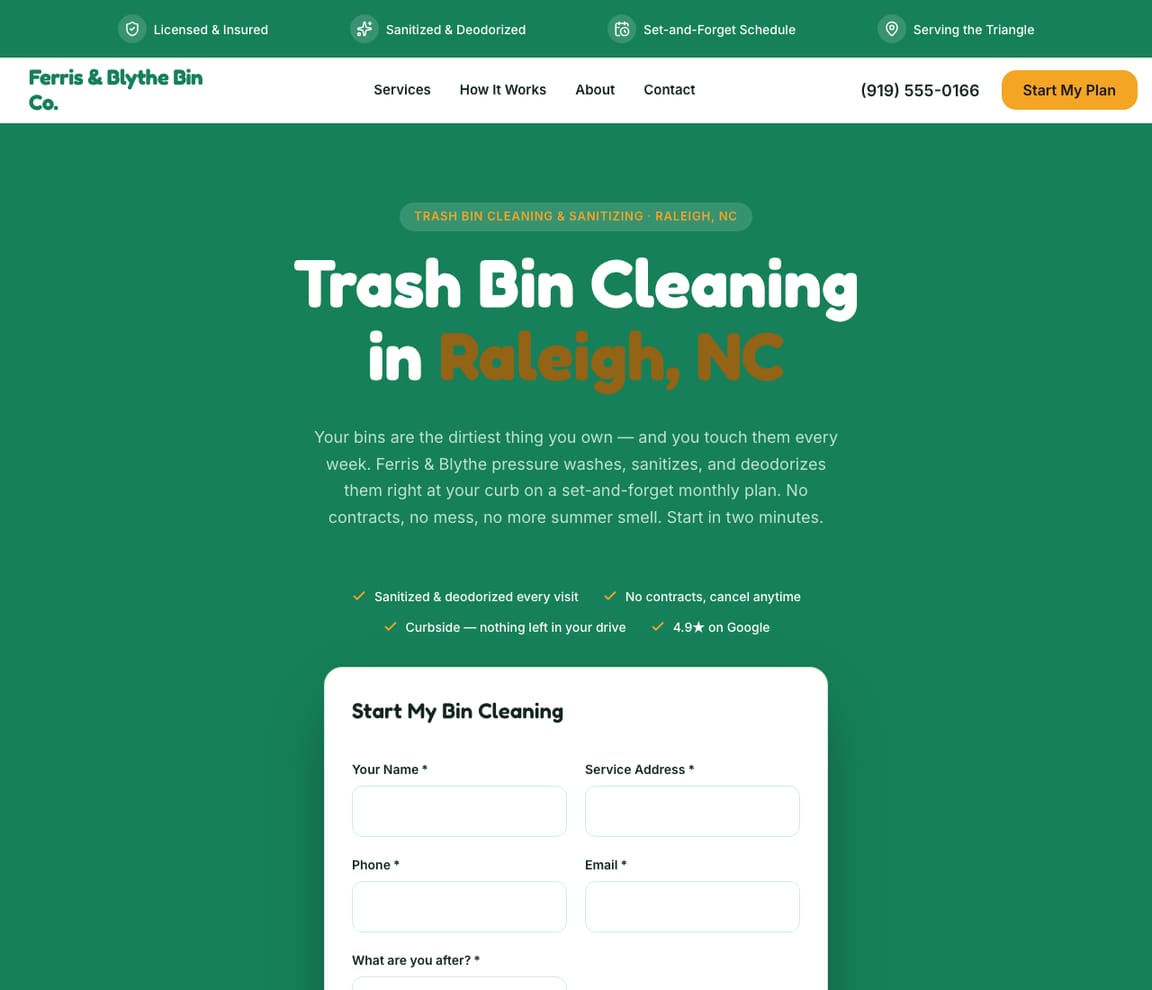
This is a real Zarla template for a bin cleaning company. Describe yours — the plans, the route days, the town — and you'll have a site like this, with your plans and a start-my-plan form, in about a minute.
- Professional design — not a generic template
- Looks great on desktop and mobile
- Content written for your industry
Build the website
Start your trash can cleaning website now
Add your town and your company's name to the sentence, and Zarla builds the site: your cleaning plans and a start-my-plan form. Add your prices, your route days and your service area in chat, then publish.
Already have a website? Bring it across →Zarla keeps your old page addresses where it can and redirects the ones that change, helping you keep the Google standing you've built.
Is starting a trash can cleaning business worth it in 2026 — and what does a route pay?
Trash can cleaning is a route business that comes in three shapes. The manual start is a pressure washer, a tank and a pump in a truck bed and a way to catch the water — Garrett Storment "started with a sedan, a pressure washer and a set of jumper cables" and powered a shop vac from the car battery until the dirty water spilled inside the car (CanCleaning.com release, October 15, 2026). The purpose-built rig lifts the bin, washes it with hot water and recovers the wash water in a tank: The Bin Trailer, the one maker that prints prices, lists its Single Cold at "$29,999" and its Double Hot at "$45,999" base (The Bin Trailer), Trash Bin Cleaners Direct's 2026 catalog prints its Titanium trailer at "$119,995.00" list and "$99,995.00" sale (Trash Bin Cleaners Direct, 2026 catalog), and a Boise operator says its truck "costs approximately $160,000 brand new" (Clean The Cans, Boise). The franchise is Bin Blasters: a "$129,050 – $158,900" total investment, a "$30,000" fee, "6% of Gross Sales" royalty and "2%" marketing, with no financial-performance representation and, by the same summary, no franchised units yet against 21 company-owned (FranchiseOverview, 2026 FDD summary — secondary).
What a visit pays. Eight real companies across five states, plus the franchisor, post their prices. Two bins on a monthly plan: $24 at Texas Bin Busters (Texas Bin Busters), $27 at Space City Sanitizers in Houston (Space City Sanitizers), $30 at Bin Blasters (Bin Blasters), $33 at Splash Sanitation in Dallas (Splash Sanitation) and Comal Clean Cans in New Braunfels (Comal Clean Cans), $35 at MD Clean in Maryland (MD Clean). Quarterly, two bins, $40 to $53 at the same companies. One-time: $29.95 for the first bin in Brooklyn (Fresh Cans), $39.99 in Los Angeles (Fresh Bins LA), $46.80 in Boise (Clean The Cans), $50 in Dallas, $99 for two in New Braunfels. Extra bins run $4 to $14.95, never the $20 Google's answer prints, and nobody posts the "$99 quarterly" it names — the one $99 is a one-time price.
What the people earn, and what the owners say about profit. No bin-cleaning occupation exists in the federal survey. Cleaners of vehicles and equipment — the code that washes things with a pressure washer — had a median of $17.23 an hour, $35,830 a year, in 2025, $29,450 in Texas and $37,920 in California (O*NET, from BLS 2025 wage data; Texas; California); the survey leaves out the self-employed (Washington ESD), so route owners are not in it. No survey we could open prints an owner's income. The owners who talk margins are plain: after about 175 customers and two trucks, "the business is growing, though it's not yet profitable" (Spokane Journal of Business, October 25, 2018); "the trash machine isn't a high-profit margin, but it gets you thinking about me" (Grand Forks Herald, October 29, 2023). The retention, once a customer is won, is the upside: "as high as 96%" (The Business News, September 29, 2025).
The vendors' calculators, as the vendors label them. The Bin Trailer's start-up guide tables 20 bins a day at $35 as $184,800 a year and 40 a day at $25 as $264,000, on 22 working days a month (The Bin Trailer, 2025 start-up guide) — and its cost page adds "Revenue is not profit. There is no guaranteed customer count, daily throughput, or payback period." (The Bin Trailer, cost page, checked September 20, 2026). Sparkling Bins' chief executive says the company has "helped launch more than 1,000 new businesses across 47 states" and that "fewer than 2,000 companies" operate in the trade (Pulse 2.0, May 11, 2026 — a vendor interview). Google's "$70,000 to $100,000" for a solo route appears on no owner's page; the blog that prints it models $18,500 of gross profit on $79,200 of revenue after paying a technician (jim.com, 2026 — the claim's origin, a publisher).
The catch. The water and the winter. Wash water full of grease and sanitizer may never run to a storm drain, the rig that recovers it is the big line, the customers are hard to win and easy to keep, and in Wisconsin, Minnesota and Washington the owners shut down from December to February. That's what the rest of this guide sets up.
How to start a trash can cleaning business, in plain English
The water rule is a prohibition everywhere, and a permit in some cities. In the US no federal license touches bin cleaning. The federal stormwater rule requires every city with a storm-sewer permit to "prohibit through ordinance, order or similar means, illicit discharges to the municipal separate storm sewer" (40 CFR 122.26) — which is why nothing but rain goes down the drain. What happens next is city by city. Portland: mobile washers "are required to apply for an authorization before discharging to the sanitary sewer", certify every January, and "the annual program fee is currently $205" (City of Portland, mobile washer program). Austin: "all industrial wastewater discharges must be authorized by permit", wash water "must be collected and transported to a private fixed-site facility connected to the City's sanitary sewer collection system", it "may not be dumped into a cleanout, manhole or toilet at the site being cleaned unless that site is permitted", and a violation is "a Class C misdemeanor" with a fine "of up to $2,000 per day per violation" (Austin Water); Texas's environmental agency adds that "discharging to a septic system is prohibited" (TCEQ RG-434, revised June 2026). San Diego issues no bin-cleaner permit but makes it "illegal to discharge polluted water from mobile business activities" into the storm system, with "up to $10,000 per day per incident" in penalties, and lets you direct clean water to a landscaped area with the owner's permission or a sewer cleanout (City of San Diego, mobile business fact sheet). The vendors say the same: "Can I pour bin cleaning gray water down a storm drain? No." — approved options are "sanitary-sewer-connected car washes (with a grease trap and permission), RV dump stations, truck stops with waste-disposal facilities, and municipal or county wastewater treatment plants" (Sparkling Bins, wash-water disposal). Google's "legally mandatory in most areas … up to 60 days" permit appears on no regulator's page; ask your city's stormwater office before the first bin.
Registering the business. Texas: "a general business license is not required in Texas" (Office of the Texas Governor), and an LLC files for $300 (Tex. Bus. Orgs. Code §4.152). Florida: $100 for articles of organization (Fla. Stat. §605.0213). New York: $200 (N.Y. LLC Law §1101). California: $70 to file, and "every LLC that is doing business or organized in California must pay an annual tax of $800" (California Secretary of State, Form LLC-1; Franchise Tax Board).
Sales tax on the clean. Texas: "pressure washing is taxable as the restoration or maintenance of tangible personal property" (Texas Comptroller, cleaning and janitorial services) — a cart is tangible personal property, so collect it. New York taxes "maintaining, servicing or repairing tangible personal property" (N.Y. Tax Law §1105), and a Brooklyn operator prints "+Tax" on every line (Fresh Cans). California treats the clean as a service — "persons engaged in the business of rendering service are consumers, not retailers, of the tangible personal property which they use incidentally in rendering the service" (CDTFA Regulation 1501). Florida's cleaning-services rule says "residential cleaning services are not taxable" and that its taxable nonresidential cleaning "do[es] not include cleaning services provided for tangible personal property" (Fla. Admin. Code 12A-1.0091) — so bin cleaning is not taxed as a cleaning service; confirm the details with your accountant.
The rig, from the pages that print a price. The Bin Trailer's Single Cold is "$29,999" — a single axle, "up to 4,000 PSI", a 275-gallon tank with a 200-gallon filling limit, no burner (The Bin Trailer, Single Cold); the Double Hot "$45,999" — tandem axle, a "Hot Water Beckett Diesel Burner System", the same tank with an optional 330 (The Bin Trailer, Double Hot); California editions with CARB engines $34,999 and $54,999; a "$299" documentation fee, freight from Florida, tax and upgrades on top; "no franchise fees" and no CDL. The Double Hot "cleans one bin at a time. Its name does not mean two simultaneous bin-washing stations", and the maker warns: "Do not promise a bacteria-kill percentage based only on the equipment having hot water." (The Bin Trailer, hot vs cold). $30,298 for the cold rig and $46,298 for the hot one with the fee, before freight, tax and the tow vehicle, our arithmetic. Trash Bin Cleaners Direct's Titanium trailer is $99,995 on sale and $119,995 at list, with a 17-stage recycling system (Trash Bin Cleaners Direct, 2026 catalog). Sparkling Bins' SB1 carries "325 gallons clean water tank with 270 gallons for wash water holding tank" and a "3500 PSI @8GPM" hot-water washer, and prints no price (Sparkling Bins, SB1). The hot water is 190 to 200°F wherever an owner or vendor prints it; the 150°F floor in Google's answer is nowhere, and its $15,000 trailer floor is a blog's figure no maker prints.
The manual kit, from dealers' list prices. A cold-water 4-gallon-a-minute, 4,200 PSI Honda-powered washer is $1,499.99 at CleanFreak (CleanFreak, CF4240HV) — the hot-water 4-gallon unit with a diesel burner is $6,999.99 (CleanFreak, CFH-4035G-B); a 300-gallon poly tank $687.99 (Protank); a 12-volt 5.5-gallon-a-minute pump $162.16 (Sprayer Depot, Everflo EF5500); a 20-gallon commercial wet/dry vacuum to recover the water $929 (CleanFreak); an EPA-registered disinfectant $37.95 a gallon (Vital Oxide, EPA Reg. 82972-1) — check the registration number against the EPA's list (EPA List N). That kit is $3,317.09 cold or $8,817.09 with the hot washer, our arithmetic, before the truck, insurance and the registration. Google's "under $100" and "$50 to $500" appear on no page we could open; the cheapest commercial washer we found is the $1,499.99 above.
Insurance. Insureon's pressure-washing customers pay a median $73 a month, $879 a year, for general liability, $262 for commercial auto, $142 for a business owner's policy and $147 for workers' compensation (Insureon, pressure washing, updated September 8, 2026); inland marine cover — "business property that's in a fixed but movable location, such as heavy equipment installed inside a van or truck" — averages $48 a month (Insureon, inland marine, updated May 13, 2026). General liability, commercial auto and inland marine together are $383 a month, our arithmetic. Workers' compensation once you hire: "in Texas, private employers can choose to carry workers' compensation insurance coverage, but it is not required in most cases" (Texas Department of Insurance); Florida from four employees outside construction (Florida CFO); California — "all California employers must provide workers' compensation benefits to their employees" (California DIR); New York — "every employer subject to this chapter shall … secure compensation to his employees" (N.Y. Workers' Compensation Law §10).
The route math, and the winter. Price from what your region posts — two bins at $24 to $35 a monthly visit, which is $12 to $17.50 a bin, $40 to $53 quarterly, $50 to $99 one-time; at ten bins an hour that is $240 to $350 of visits in two hours, our arithmetic — and fill one collection day before adding the next: a Rochester couple cleaned 1,200 bins in their first eight months at $25 for the first and $10 for each extra (Spectrum News, May 4, 2022); a Plymouth, Minnesota owner signed 150 clients in his first summer at $30 a monthly visit (CCX Media, August 3, 2022); a Spokane rig cleans a filthy can in about 30 seconds but its owners "usually prefer to spend between three and five minutes per can" (Spokane Journal of Business, 2018). In Wisconsin, "our Wisconsin winters don't work great with water" (The Business News, 2025); Bin Blasters' own page allows locations to "shut down for a few months during the winter" (Bin Blasters), and the Michigan catalog sells a "20-gallon antifreeze tank & air blow-out system for winterizing" (Trash Bin Cleaners Direct). One more thing the owners learned: the hauler may own the cart — an Idaho cleaner was sued by the garbage company in 2018 (Spokane Journal of Business).
In the UK: wash water from "wheeled bin washing and cleaning carried out as a business or industrial activity is called trade effluent. Whether you're cleaning just one bin or a number of bins, you must arrange for collection and disposal of effluent to prevent pollution" (NetRegs, wheeled bin washing); in England the occupier discharges to the public sewer only "with the undertaker's consent" (Water Industry Act 1991, s.118), and carrying the water to a disposal site may need waste-carrier registration — free for your own waste, otherwise £191.02 (GOV.UK); Scottish councils license the trade itself and require the effluent "contained for disposal at a disposal point approved by Scottish Water" (East Ayrshire Council, license conditions); a Brighton cleaner charges "£3 a month or £6 for a one-off clean" (The Argus, March 18, 2019), and the Green Cleen franchise advertises a "£30,000 Minimum Investment" (Franchise UK, Green Cleen). In Australia: EPA Victoria fined a Melbourne bin cleaner $1,900 in August 2025 for hosing bins in the street — "Hosing bin juice down the drain, especially on a commercial scale, is not acceptable" (EPA Victoria, August 14, 2025); Sydney Water's trade-wastewater permit is A$555.08 to apply in 2025–26 (Sydney Water, fees); GST registration is required from $75,000 of turnover (ATO); Jim's Bin Cleaning has franchised the trade since 1989 but was "not currently accepting new applicants" on the listing we opened (Franchising.com, Jim's Bin Cleaning). Check your own council's or water company's rules.
What trash can cleaning owners actually say
None of this is our opinion about the trade. It comes from people who run bin-cleaning routes — in Idaho, Wisconsin, North Dakota, Minnesota, Delaware, Arizona, Washington, New York, Florida and California, plus one in Brighton, England — talking to local newspapers, television stations and a business journal between 2018 and 2026, each described as the page describes them, with the press release and the advertorial labelled as such. Read each as theirs at the time. Five things come up again and again.
Nobody knows the service exists until the truck goes by. Jordan Kunz, owner of Can Clean Pros in Arizona's West Valley: “People always say, 'I never knew this existed,' ” Kunz said. “We kind of have a cult following almost online. People love our service.” (FOX 10 Phoenix, July 18, 2021). Brad Podiak, owner-operator of MetroWash in Plymouth, Minnesota: “It's not a side hustle. It's what I'm doing, really 24/7, every day. So marketing is huge as people don't really know this service is available.” (CCX Media, August 3, 2022). Jennifer Trudel, owner of Scrub A Dub Bin Cleaning in Wesley Chapel, Florida: “A lot of people sign up because they see the truck driving by or when a neighbor sees me cleaning someone else's bin.” (The Laker/Lutz News, May 23, 2018). Danielle Duthoy, co-owner of Rochester Bin Cleaning in Brockport, New York, on first hearing of it: “Apparently it's popular down south and out west. I had never heard of it, but I said no. No one is going to pay us to clean their garbage cans.” (Spectrum News, May 4, 2022).
“[In this business], it's really difficult to get customers, but when you obtain those customers, the retention rate is very high. As high as 96%.” — Kyle Hayes, owner of Local Trash Bin Cleaners, River Falls, Wisconsin, in The Business News, September 29, 2025
Hot water is the product. Hayes: “The hot water is what gets the gunk and grime off there, [and] bacteria starts to die right around 145 degrees, so that is really what kills and sanitizes the trash bin.” (The Business News, 2025). Jennifer Tanner, co-owner of A2T2 Bin Cleaning Pros in St. Anthony, Idaho: “The trailer we use has heated water, so it actually sanitizes everything that we clean. Our generator heats it to 200 degrees.” (East Idaho News, October 16, 2025). Dave Bender, owner of Can Clean in Bismarck, North Dakota, on who buys: “Especially if you're disabled in any way, or you live in an association that makes you put your garbage cans inside the garage, or if you are just one of those people who are fussy— and with COVID, people wanted to disinfect, not just clean their garbage can but disinfect it.” (KFYR-TV, September 18, 2024).
Where the water goes, and where the cart came from. Richard Denenny, co-owner of Tidy's Beautiful Bins in Spokane: “We can clean cans quickly, but we usually prefer to spend between three and five minutes per can to ensure it's done properly. A first cleaning on a really dirty bin can take up to 10 minutes, but subsequent washings get easier.” And: “Our process sanitizes the cans without using any chemicals, and none of the dirty water is being dumped. We have a relationship with a local car wash that allows us to dispose of our water properly.” And on the money: “We do expect this will become a profitable business, but it will take some time to develop.” (Spokane Journal of Business, October 25, 2018). Craig Austin, owner of Eco-Wash Solutions Northwest in Coeur d'Alene, sued by the local hauler that year: “Homeowners don't own the cans, but they're responsible for keeping cans in good shape, and many municipalities offer suggestions on their websites from waste providers on how to clean them.” (Spokane Journal of Business, 2018).
The fear is the trailer breaking, not the work. Hayes: “It's fear of the unknown, [and questioning], 'am I charging the right prices? Are they pleased with their service? What happens if something breaks on the trailer? Will I be able to fix it, and if I [can't] fix it, where can I find somebody who could help you fix it?'” And: “It's not like you can just run over to the auto shop and be like, 'Hey, can you guys take a look at this?'” (The Business News, 2025). Trudel, who ordered her truck from Miami: “This to me is not a job. This is my life.” (The Laker/Lutz News, 2018).
Local, cash-funded, and often a second line. Brad Mauro, owner of Beach Bins in Lewes, Delaware: “We take pride in being local and supporting locals. I'm not trying to be a trash bin cleaner for all of Delaware; I am focused on Lewes, Rehoboth and Dewey. I really want to be a part of the community and stay in the community.” (Cape Gazette, January 30, 2026). George Scott, a Grand Forks owner who started with a trash-can washer and grew into a cleaning company: “The trash machine isn't a high-profit margin, but it gets you thinking about me. Interior cleaning homes and offices is probably the most aggressive one we've been hammering on.” And: “We don't have a loan. … My business has been paid for in cash.” (Grand Forks Herald, October 29, 2023). Garrett Storment, owner-operator of CanCleaning.com in Irvine, California, in his company's release: “I am not a faceless corporation. I am your neighbor, and I am the guy who is out there day in and day out making sure your trash cans are the cleanest they can be.” (CanCleaning.com release, October 15, 2026). Mark Kelly, who left a sales job to start Bright N Shine in Brighton: “I gave up a massive salary and started knocking on doors. It's really gone so well, I have had 15 new customers this week. I am kept busy every day. It's bringing in enough to make a living.” And on the one snag: “I have to wait until the bins are emptied before I start the cleaning and sometimes it takes a while for them to be collected so there is a bit of chasing I have to do.” (The Argus, March 18, 2019).
The through-line: the owners who lasted bought the rig they could pay for, found a car wash or a sewer that would take the water before the first route, priced from the street rather than a calculator, worked one collection day at a time until the neighbors noticed the truck, planned for the winter, and kept a second line of work for the months the bins stayed in the garage.
THE STARTER KIT
What you need to start a trash can cleaning business
A rig you can fund
A pressure washer, a tank and a pump in a truck bed for the manual start; a purpose-built trailer with hot water, a bin lift and a recovery tank when the route is worth it.
Somewhere legal for the water
Wash water full of grease and sanitizer can't run to the storm drain — the manual start catches it, the trailer vacuums it back, and the city's rule says where it goes after that.
The chemicals, and the heat
A degreaser, a sanitizer and a deodorizer, and water hot enough to do what the label says — the clean the customer is paying for is the one they can smell.
The paperwork
The LLC and the EIN, a city business license where there is one, the mobile-washer registration some cities require, and a sales-tax permit where your state taxes the service.
Insurance for the truck and the trailer
General liability, commercial auto for the truck, and inland marine or equipment cover for the trailer and the rig on it — plus workers' compensation where your state requires it.
A route, not a customer list
One trash day, one neighborhood, filled before the next — the subscriptions renewing on a card, the software that bills them, and a reserve for the first slow quarter.
THE PAPERWORK
Permits, registrations and insurance for a trash can cleaning business
| Typical cost | Time to get | Legally required? | |
|---|---|---|---|
| LLC formation | $300 (TX); $100 (FL); $200 (NY); $70 + $800/yr tax (CA) | Days to weeks | No, but most owners form one |
| Business license | Set by the city; none statewide in Texas | Before you open | City by city |
| Storm drain | Up to $2,000 a day (Austin); $10,000 a day (San Diego) | — | Prohibited everywhere we read — nothing but rain |
| Mobile-washer authorization or discharge permit | $205/yr (Portland); set by the utility (Austin) | Before the first bin | Where the city runs a program; San Diego has none |
| Sales-tax registration | None to register | Before the first invoice | TX and NY tax the clean; CA a service; FL not a cleaning service |
| EPA-registered sanitizer | $37.95 a gallon (Vital Oxide) | — | Use a registered product if you claim to sanitize |
| General liability | $73/mo median (Insureon, pressure washing) | Days | Not by law; HOAs and commercial accounts expect it |
| Commercial auto | $262/mo median (Insureon) | Days | Check your state's auto law for a vehicle used for business |
| Inland marine (the rig) | $48/mo average (Insureon) | Days | Not by law; the trailer is the business |
| Workers' compensation | $147/mo median (Insureon) | Days | Yes in CA and NY from the first hire; FL from 4; optional for most TX employers |
THE STEPS
How to start a trash can cleaning business (step by step)
Eight steps from the first rig to full routes on every trash day, with the water handled and the subscriptions renewing.
01
Pick the rig
The manual start — a pressure washer, a tank and a pump — or the purpose-built trailer with hot water, a lift and a recovery tank. Decide with the makers' prices below and the number of bins a day each can do.
02
Find out where the water goes
Ask your city or sewer agency how a mobile washer must handle wash water — the storm drain is out, the sanitary sewer needs permission, and some cities register mobile cleaners. Before the first bin.
Before the first bin03
Register the business
The LLC and the free EIN, a business bank account, the city business license where there is one, and the sales-tax permit where your state taxes cleaning services.
04
Buy the rig and the chemicals
The washer, the tank, the pump, the hoses and the recovery vacuum — or the trailer — from the makers' own lists, and the degreaser, sanitizer and deodorizer from a supplier that prints its label.
05
Insure the truck, the trailer and the business
General liability, commercial auto, and inland marine or equipment cover for the trailer and the rig — before the first route, because the trailer is the business.
06
Price the bin and the plan
A first-bin price, a second-bin price, a one-time price and monthly, every-other-month and quarterly plans — set from what real companies in your region post, below, and billed on a card.
07
Fill one trash day at a time
One neighborhood on one collection day, worked right after the truck leaves, door hangers on the bins still at the curb, and the next street only when this one is dense enough to pay for the drive.
08
Get found, then sell the street
A website with the plans and a start-my-plan form, a Google Business Profile with photos of the rig, and the HOA, the property manager and the restaurant with the dumpster pitched before the summer.
THE COSTS
How much does it cost to start a trash can cleaning business?
No plan page yet, so the figures are itemized here from the pages that print a price: the manual kit from dealers' list prices, the rig from the one maker that prints its prices, insurance at Insureon's medians, the registration by statute. The truck, freight and tax come on top, and so do your own living costs.
$3,317.09the manual kit — a cold-water washer, a 300-gallon tank, a pump, a recovery vacuum and a gallon of sanitizer, at list (our arithmetic)
$30,298The Bin Trailer's Single Cold with its $299 fee, before freight and tax; the Double Hot is $46,298
$879a year of general liability at Insureon's pressure-washing median; the rig's inland marine cover averages $48 a month
$129,050+to open a Bin Blasters franchise, by a franchise site's summary of its 2026 disclosure
WHAT WE'VE LEARNED
What actually makes a homeowner subscribe to bin cleaning
Thousands of local business websites in, the pattern for subscription services is clear: the homeowner wants the price, wants to see how it works, and wants to sign up without a phone call. For bin cleaning, three things on a page decide who gets the street.
The plans with prices
Monthly, every other month, quarterly, a one-time clean — with the price for one bin and for two, so nobody has to ask. The first thing a homeowner checks, and the first thing a competitor hides.
How it works, at the curb
Photos of the rig lifting a bin, the hot water, the water caught and taken away, the bin back on the driveway. Clean sells; so does knowing the water doesn't run into the street.
A way to start, and a way to ask
A start-my-plan form that asks for the address and the trash day, and an HOA or commercial inquiry form — your next route in one button.
THE UPSIDE
What a trash can cleaning route can earn
Prices from ten real companies' posted pages, customer counts from the owners' own interviews, pay from O*NET's 2025 figures. Averages and examples, not a promise — your route density, your plan mix and your winter decide it.
$30a monthly visit for two bins at Bin Blasters; $24–$35 across ten companies in eight states
1,200bins cleaned in a Rochester couple's first eight months, at $25 for the first and $10 for each extra
96%customer retention once a customer is won, in a Wisconsin owner's experience
$17.23an hour: the 2025 median for hired vehicle and equipment cleaners (O*NET) — the owner's draw is not in any survey
SEE IT WORK
A trash can cleaning website design you can start from
A real Zarla template: a start-my-plan form in the hero, the dirtiest-thing-you-touch-weekly angle, monthly cleaning, sanitize-and-deodorize and commercial dumpster services, a curbside how-it-works gallery and no-contract positioning. Open it, swap in your plans, your prices and your own photos, and publish.
GET FOUND
Get found by the homeowner who just smelled the bin
A homeowner dragging a bin back up the driveway in July searches for trash can cleaning near them that evening and subscribes to the company whose plans, prices and route day are on the page; an HOA manager searches the same way for a whole street. Zarla builds the website with your plans and a start-my-plan form. Add your prices and your route days in chat, and once you connect your Google Business Profile, your name, hours and photos stay in step on both.
“Trash can cleaning near me”
Searched by a homeowner after the first hot week, a parent who found maggots in the bin, and an HOA manager for a whole street. Your plans, your prices and your route day answer it.
Google Business Profile
Your service area, your route days and photos of the rig at the curb inside Google Maps. Free, and an afternoon to set up — and a homeowner sees a real company before they hand you their bins.
The before-and-after photo
A bin's inside before the wash next to the same bin after, on the page and on the profile. Photos of the work sell the plan — and the neighbor's.
Google Search
Fferrisblythebinco.com
Ferris & Blythe Bin Co. — Trusted trash can cleaning in Your AreaCurbside trash and recycling bin cleaning in Phoenix, on your trash day. Monthly and quarterly plans with prices online. Start your plan in a minute.← Your Zarla siteCcitytrashcancleaningservices.com
City trash can cleaning ServicesGoogle Maps
1
Ferris & Blythe Bin Co.
← You2
Metro trash can cleaning Co.
3
Quick trash can cleaning Services
AI assistants (ChatGPT / Perplexity)
For a trash can cleaning service in Phoenix that comes on trash day and sanitizes two bins monthly in your area: Ferris & Blythe Bin Co. — a trash can cleaning company that lists its plans and prices, explains how the curbside cleaning works, and lets you start a plan online.
YOUR LAUNCH PLAN
Your trash can cleaning launch checklist
The whole guide as things to check off. Work through them in order and you'll be registered, insured, equipped and on a route before the first hot week.
- Choose: the manual start or the trailer — by the makers' prices and the bins a day.
- Ask the city where the wash water goes — the storm drain is out; register as a mobile washer where required.
- Register the LLC, take the EIN and the sales-tax permit — where your state taxes the service.
- Buy the rig, the recovery vacuum and the chemicals — list prices below.
- Insure the truck, the trailer and the business — inland marine for the rig.
- Price the first bin, the second bin and the plans — from what real companies post.
- Fill one trash day before adding the next — density pays for the drive.
- Get found — a website with the plans and a start-my-plan form, a Google profile with photos of the rig, and the HOA pitched before summer.
REAL CUSTOMERS
Small business owners who got online with Zarla
Verified reviews from real Zarla customers.
“Quickly built my website from scratch. No hiccups. Would highly recommend Zarla for someone with no experience who wants to start a polished business website.”
“Great professional website in less than a minute, with the use of AI and a few descriptive prompts. This has saved me bundles of time and research on web developers.”
“I had no idea how to set up a website for my business. Thanks to Zarla, they've helped me a lot.”
“Very reliable, professional, and fast results. I was able to get my business online in no time, and the ease of access made it so simple.”
Be the bin cleaner a neighborhood finds — and subscribes to
Add your town and your company's name, and Zarla builds the website from that one line — your cleaning plans, a start-my-plan form a homeowner can fill in on trash day, and SEO in place. Add your prices, your route days and your service area in chat. Free to build; you pay when you publish.
Already have a website? Bring it across →Zarla keeps your old page addresses where it can and redirects the ones that change, helping you keep the Google standing you've built.
Frequently asked questions
How much does it cost to start a trash can cleaning business?
Two honest numbers, in the US. The manual kit from dealers' list prices is $3,317.09, our arithmetic — a cold-water 4-gallon-a-minute pressure washer at $1,499.99, a 300-gallon tank at $687.99, a 12-volt pump at $162.16, a 20-gallon recovery vacuum at $929 and a gallon of EPA-registered sanitizer at $37.95 — or $8,817.09 with a hot-water washer at $6,999.99, before the truck, insurance and the LLC ($70 to $300 by state). A purpose-built rig starts at $29,999 cold or $45,999 hot at The Bin Trailer, plus a $299 fee, freight and tax — $30,298 and $46,298 with the fee; Trash Bin Cleaners Direct's filtering trailer is $99,995 on sale, and a Boise operator's truck cost about $160,000. Google's "under $100" and "$50 to $500" appear on no page we could open.
Do I need a permit to clean trash cans?
In the US you need to keep the wash water out of every storm drain — the federal stormwater rule makes cities prohibit it — and whether you then need a permit depends on the city. Portland requires a mobile-washer authorization at $205 a year; Austin requires a discharge permit and hauling the water to a permitted site, with fines of up to $2,000 a day per violation; San Diego requires no bin-cleaner permit but fines storm-drain discharge up to $10,000 a day. Texas requires no general business license, and an LLC is $300 there, $100 in Florida, $200 in New York and $70 plus an $800 annual tax in California. In the UK the water is trade effluent needing your water company's consent; in Australia a trade-waste permit, and EPA Victoria fined a bin cleaner $1,900 for hosing bins in the street.
Is a trash can cleaning business profitable?
No survey we could open prints a margin, and the owners who talk about it are plain: a Spokane company with about 175 customers and two trucks was growing but not yet profitable, and a Grand Forks owner says the trash machine isn't a high-profit margin but it gets customers thinking about his other services. What the trade does have is retention — as high as 96 percent once a customer is won, in a Wisconsin owner's words — and visit prices of $24 to $35 for two bins monthly. The vendors' calculators run to $184,800 and $264,000 a year; The Bin Trailer's own cost page says revenue is not profit and nothing about customers or payback is guaranteed.
How much does a trash can cleaning business make?
No survey we could open prints an owner's income, and Google's $70,000 to $100,000 for a solo route comes from a blog whose own model lands at $18,500 of gross profit after paying a technician. The sourced route numbers are counts and prices: 150 clients in a first summer at $30 a monthly visit in Minnesota; 1,200 bins in eight months at $25 for the first and $10 for each extra in Rochester; about 175 customers growing by 20 to 40 a month in Spokane. The hired cleaner's median is $17.23 an hour, $35,830 a year, in 2025 — and the owner's draw is not in that survey.
How much can you charge for wheelie bin cleaning?
In the US, from eight companies' posted pages across five states, plus the franchisor's: two bins on a monthly plan $24 to $35 a visit — $24 in Texas, $27 in Houston, $30 at Bin Blasters, $33 in Dallas and New Braunfels, $35 in Maryland — $40 to $53 quarterly, one-time cleans $29.95 in Brooklyn to $99 for two bins in New Braunfels, and $4 to $14.95 per extra bin. In the UK, £3 a month or £6 for a one-off clean in Brighton. Google's "$99 quarterly for two bins" matches none of them, and its "$10 to $20" extra-bin ceiling is above every posted price.
Is there a bin cleaning franchise available?
Yes. Bin Blasters' 2026 disclosure, read through a franchise site's summary, lists a $129,050 to $158,900 total investment, a $30,000 franchise fee, a 6 percent royalty and a 2 percent marketing fund, makes no financial-performance representation, and by the same summary had no franchised units yet against 21 company-owned. In the UK, Green Cleen advertises a £30,000 minimum investment; in Australia, Jim's Bin Cleaning has franchised since 1989 but was not taking applicants on the listing we opened. The equipment makers sell against it — "no franchise fees" — and the rig alone is $29,999 to $45,999.
What equipment do I need to start a trash can cleaning business?
For the manual start: a pressure washer (a cold-water 4-gallon-a-minute unit is $1,499.99; the hot-water 4-gallon unit $6,999.99), a fresh-water tank ($687.99 for 300 gallons), a 12-volt pump ($162.16), a way to catch the water — a 20-gallon commercial wet/dry vacuum is $929 — and an EPA-registered sanitizer ($37.95 a gallon), plus a truck. For the rig: a trailer or truck that lifts the bin, washes it at 190 to 200°F and recovers the water in a tank — $29,999 to $54,999 at The Bin Trailer, $99,995 for Trash Bin Cleaners Direct's trailer with a 17-stage recycling system. In cold states, a winterizing kit or a shutdown.
How do trash can cleaning trucks work?
The rig lifts the can on an arm or a manual lift over a wash head, rotating nozzles power-wash the inside at up to 4,000 PSI with water heated to about 200°F by a diesel burner, and the dirty water drains into a trough and a holding tank on the truck instead of the street; the can goes back on the driveway and the tank is emptied at a permitted site — a sewer-connected car wash, a dump station or a treatment plant. Sparkling Bins uses fresh water for every bin and does not recycle it; Trash Bin Cleaners Direct sells a 17-stage recycling system so a crew can run all day without dumping. A filthy first clean takes up to ten minutes; a maintenance wash, three to five.
How much does a bin cleaning trailer cost?
At The Bin Trailer, the one maker that prints prices: $29,999 for the Single Cold and $45,999 for the Double Hot, $34,999 and $54,999 for the California editions with CARB engines, plus a $299 documentation fee, freight from Florida, tax and upgrades — prices its own cost page says it checked on September 20, 2026. Trash Bin Cleaners Direct's 2026 catalog prints its Titanium trailer at $119,995 list and $99,995 on sale. Sparkling Bins quotes only. A purpose-built truck ran one Boise operator about $160,000. Google's $15,000 floor is a blog's figure that no maker prints.
How difficult is it to start a cleaning business?
The paperwork is light in the US — no general business license in Texas, an LLC for $70 to $300 in the four states we read, general liability at a median $73 a month — and the owners say the hard parts are demand and water: it's really difficult to get customers, marketing is huge because people don't know the service exists, the hauler may own the cart, and the wash water may never go down a storm drain, which means a permit in Portland and Austin and a $10,000-a-day fine in San Diego. Then the winter: Wisconsin, Minnesota and Washington operators stop from December to February.
Can I start a trash can cleaning business with no money?
Nobody in print did it with nothing. The nearest is the Irvine owner who started with a sedan, a pressure washer and jumper cables and borrowed from his grandmother's savings for the truck after a bank declined him, and the Brighton cleaner who started knocking on doors with a van. In the US the manual kit is $3,317.09 at list before a truck, the LLC can wait, and The Bin Trailer advertises financing for qualified buyers while the Florida maker's chief executive says financing has got harder with higher rates. The one cost you cannot skip is insurance: $73 a month for general liability at the median, and somewhere legal for the water.
Is trash can cleaning a good side hustle?
The owners split. A Wisconsin owner runs his route evenings alongside a mortgage job and calls it like working two full-time jobs; a Delaware owner launched in June 2025 and plans to go full time; a Minnesota owner insists it is not a side hustle at all. The economics favor density — one collection day, one neighborhood — and the retention is high once customers sign, but in cold states the route stops for the winter, and the trailer, at $29,999 and up, is a full-time payment. The hired cleaner's median wage, $17.23 an hour, is the benchmark your evenings compete with.
What type of cleaning makes the most money?
No survey we could open ranks cleaning trades by profit, and the federal pay codes are nearly flat — vehicle and equipment cleaners $35,830, janitors and cleaners of buildings a little more, in 2025. The one owner who runs several lines says the trash machine isn't a high-profit margin but it brings customers who then buy interior cleaning of homes and offices. In this trade the money is in the route's density and its plans, not the per-bin price; a $24 to $35 monthly visit for two bins is the market in the US, from eight companies' posted pages and the franchisor's.
How much should I charge for 2 hours of cleaning?
Bin cleaners don't price by the hour — the market is per bin and per visit, $24 to $35 for two bins on a monthly plan, $40 to $53 quarterly and $50 to $99 one-time in the US — and a rig cleans a maintenance bin in three to five minutes, so two hours is a street, not a job. If a commercial account asks for an hourly rate, work it back from the bins: at $12 to $17.50 a bin on a monthly plan and ten bins an hour, two hours is $240 to $350 of visits, our arithmetic.