NONPROFIT GUIDE
How to start an animal rescue in 2026
For the foster, the volunteer or the person who keeps finding the dog nobody claims: the nonprofit paperwork in the IRS's own words and fees, the states that license a rescue and the ones that only set rules for the animals, what one dog or cat actually costs to vet at a low-cost clinic's own prices, where the money comes from when adoption fees never cover it, what the sector moved in 2025 — and what the founders who did it say.
Free to build · Pay when you publish · No credit card
$275the IRS user fee for Form 1023-EZ, the short application a small rescue files — $600 for the long Form 1023
5.8 milliondogs and cats that entered US shelters and rescues in 2025; 4.2 million were adopted (Shelter Animals Count)
$335to spay, vaccinate and microchip one dog at a Georgia humane society's clinic, at its own prices — $191 for a cat (our arithmetic)
No codeto get online
See it in action
See what your animal rescue website could look like
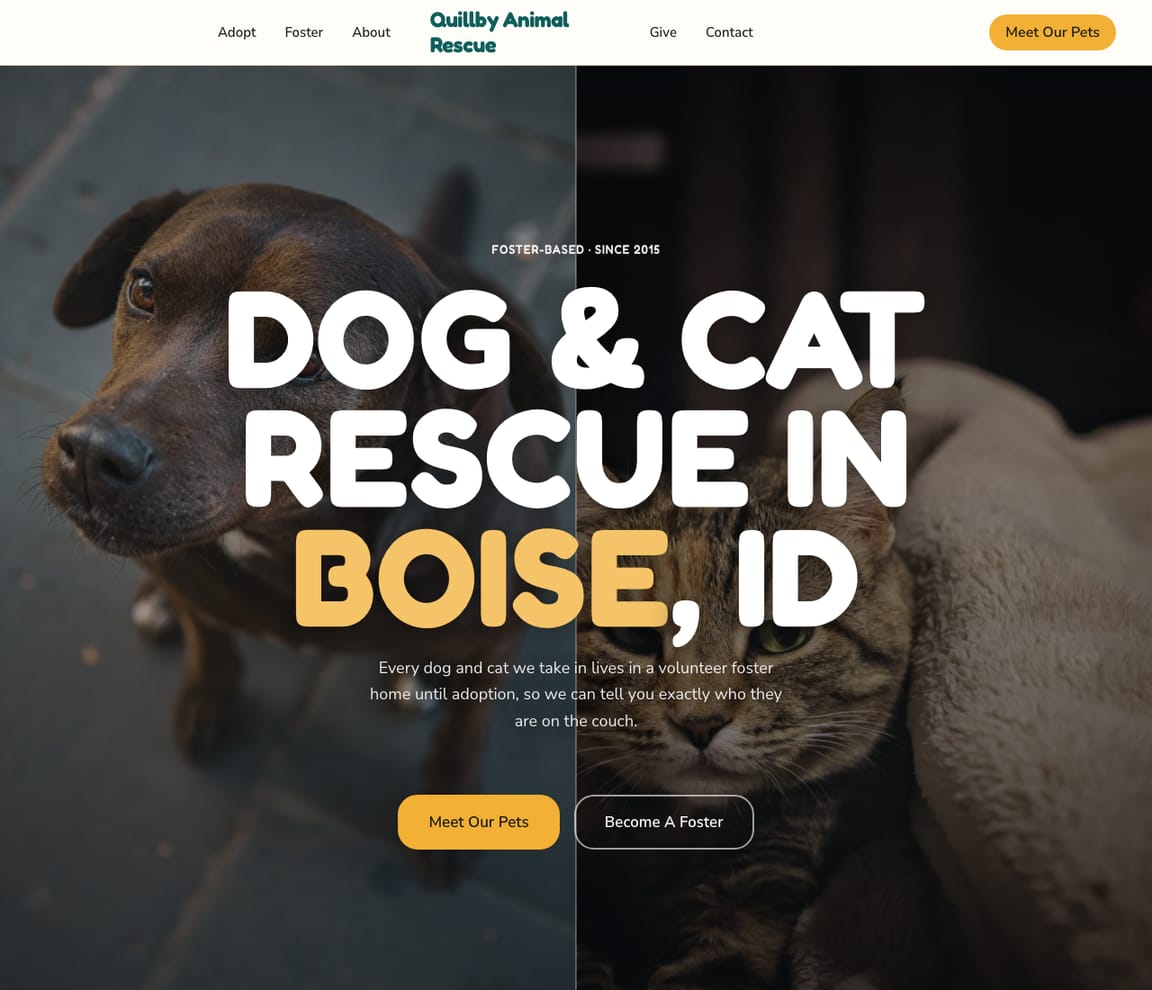
This is a real Zarla design for a foster-based dog and cat rescue — it lives in the nonprofit gallery, because the rescue entry has no gallery of its own yet. The adoptable animals up front, how fostering works, a donate button, the volunteer form. Describe yours — dogs, cats, the county, foster-based or a small facility — and you'll have a site like this, with your animals, a foster application and a map, in about a minute.
- Professional design — not a generic template
- Looks great on desktop and mobile
- Content written for your industry
Build the website
Start your animal rescue website now
Add your town and the rescue's name to the sentence, and Zarla builds the site: the adoptable animals, a foster application, a donate link and a map. Add your adoption fee and your application questions in chat, then publish.
Already have a website? Bring it across →Zarla keeps your old page addresses where it can and redirects the ones that change, helping you keep the Google standing you've built.
Is starting an animal rescue worth it in 2026 — and does anyone get paid?
The animal rescue one person can start is a foster-based nonprofit: dogs and cats pulled from a shelter or surrendered by an owner, living in volunteers' homes until a family adopts them, with a vet partner who gives the rescue a price, a Petfinder listing and a donate button. Nobody owns it, and almost nobody is paid by it; the question is not profit but whether the animals' vetting can be funded faster than they arrive. What the sector moved in 2025: "Dog and cat community intakes totaled 5.8 million animals, a 2% decrease (121,000 fewer animals) compared to 2024.", "Total adoptions reached 4.2 million animals, a 0.7% increase, from 2024." and "Non‑live outcomes totaled 757,000 animals, a slight decline (1%) from 2024." (Shelter Animals Count, 2025 annual report, February 4, 2026); the no-kill movement's own count: "In 2016, around 1 million cats and dogs were killed in America's shelters." and in 2025 "that number dropped to 396,000", across "roughly 3,900 shelters operating in America today", where "More than 2 out of 3 U.S. shelters reached no-kill in 2025." at the "90% save rate" line (Best Friends Animal Society, 2026). The rescue's place in that is the transfer: California's shelters must release a stray dog "before the euthanasia of that animal" to a nonprofit "as defined in Section 501(c)(3) of the Internal Revenue Code" that asks for it (Cal. Food & Agr. Code §31108).
What a rescue's director earns, when one is paid. "Workers on average earn $80,390." for social and community service managers in 2025 — $38.65 an hour (O*NET, 2025) — in a survey of employed managers, which a rescue founder with a day job is not. Small rescues mostly pay nobody: the IRS lets an organization whose "annual gross receipts are normally $50,000 or less" file the Form 990-N e-Postcard instead of a return (IRS, Form 990-N), and the founders describe the money the same way — "We are 100% volunteer run and 100% funded by people in our community that want to help make a difference." (Kristin Sarkar, Releash Atlanta — VoyageATL, May 16, 2018). The organization that prints the sector's best-practice guide says it plainly: "Plan to set aside $5,000 to $10,000 for start-up costs for your rescue group." and "Do not rely on adoption fees as your sole source of income." (HumanePro, Humane World for Animals).
What one animal costs — from a clinic's own price list. At the Humane Society of South Coastal Georgia's low-cost clinic in Brunswick: "Dog Spay: $275.00", "Dog Neuter: $215.00", "Cat Spay: $131.00", "Cat Neuter: $95.00", "Rabies Vaccine with Surgery: $25.00" and a microchip at $35 (Humane Society of South Coastal Georgia, 2026) — a dog spayed, vaccinated and chipped is about $335 and a cat about $191, our arithmetic. The Humane Society of Sonoma County's clinic prints a dog spay at $400 and a cat spay at $150, "Pricing effective July 1st 2026", with the microchip, the pain medication and the e-collar inside the price (Humane Society of Sonoma County). Against that, HumanePro's reserve is the paperwork plus about twelve dogs' vetting at the Georgia prices.
The catch. The fosters are the ceiling, not the animals — every founder below says it; the vet bill is the thing that closes a rescue — one in Missouri "posted on Facebook that they had run up a bill at a local veterinarian in the ballpark of $23,000." in October 2026 (KY3, October 2, 2026); the adoption fee rarely covers the vetting it is meant to; a facility turns a foster group into an "animal shelter" with a state's standards attached; and the founder who takes the one more dog is the one who burns out. That's what the rest of this guide sets up.
How to start an animal rescue, in plain English
The nonprofit corporation, the EIN and the IRS letter. A rescue that will take donations is a nonprofit corporation first — the state's filing, then the IRS's recognition. The state's fee: Texas, "for filing a certificate of formation, $25;" (Tex. Bus. Orgs. Code §4.153); Florida, "Articles of incorporation: $35." and "Designation of and acceptance by registered agent: $35." with an "Annual report: $61.25." (Fla. Stat. §617.0122); New York, "seventy-five dollars" for the certificate of incorporation (N.Y. Not-for-Profit Corporation Law §104-A); California, "Filing articles of incorporation not providing for shares: Thirty dollars ($30)." plus the $20 statement of information (Cal. Gov. Code §12186); Colorado, $50 online for the nonprofit's formation and $25 for the periodic report (Colorado Secretary of State). The EIN is free: "Use this tool to get an EIN directly from the IRS in minutes for free." (IRS). Then the letter: "The user fee for Form 1023-EZ is $275." and "The user fee for Form 1023 is $600." (IRS, user fees, October 9, 2026) — the short form for a rescue that passes the eligibility worksheet in the instructions, filed on Pay.gov; and the timing rule that makes the first week's donations deductible: the exemption is generally recognized from the formation date "if you file Form 1023-EZ within 27 months after the end of the month in which you were legally formed" (Instructions for Form 1023-EZ, January 2025). Once recognized, a rescue whose "annual gross receipts are normally $50,000 or less" files the e-Postcard each year (IRS, Form 990-N).
Register before you ask — the state's charity rules. Fundraising is regulated by the state where the donor sits, not where the rescue is. Florida: a charity that will solicit must "file an initial registration statement" before it starts, with the fee by last year's contributions — "Ten dollars, if the contributions received for the last fiscal or calendar year were less than $5,000.", $75 to $100,000, up to $400 at $10 million (Fla. Stat. §496.405) — unless it has "less than $50,000 in total contributions during a fiscal year" with fundraising "carried on by volunteers, members, or officers" who are not compensated (§496.406). New York: a charity "which intends to solicit contributions from persons in this state" must "prior to any solicitation, file with the attorney general a prescribed registration form", with a $25 fee (N.Y. Executive Law §172). California: "Every charitable organization, including trustees, doing business in or holding property in California" registers, "within 30 days of first receiving charitable assets", and "The $50 initial registration fee must be paid at the time of filing." (California Attorney General, Registry of Charities and Fundraisers, August 25, 2026). Texas: "most charities and nonprofit organizations that are soliciting charitable donations" from Texas donors "are not required to register to solicit" — the three acts that do require it cover law enforcement, public safety and veterans groups (Cogency Global, April 12, 2018 — the Attorney General's own page refuses readers); what Texas does ask is a separate application for sales tax: "Nonprofit organizations must apply for exemption with the Comptroller's office and receive exempt status" before buying tax-free, "The exemption from sales tax is for items an organization buys, not for the items it sells.", and a 501(c)(3) "can hold two one-day, tax-free sales or auctions each calendar year." (Texas Comptroller, Publication 96-122). Colorado registers charities through the Secretary of State as well; its fee sits on the charities pages, not the business fee page linked above — check it there.
The animal law — two states license the rescue, two regulate the animals, one sets standards for the building. New York now licenses rescues: the Department's own page says "animal shelters, rescue organizations, and other not-for-profit entities will be required to be licensed with the Department." under Article 26-C, with a compliance date of December 15, 2025 and "unannounced inspections" (New York Department of Agriculture and Markets); the statute: "Such license shall be renewable annually, upon the payment of a nonrefundable fee of one hundred fifty dollars.", with proof of "incorporation as a not-for-profit organization in this state" and "The commissioner shall conduct an inspection of the applicant's facilities prior to the issuance of a license." (N.Y. Agric. & Mkts. Law §421). Its definition of an animal shelter reaches "a public or not-for-profit entity owning, operating, or otherwise maintaining a building, structure, or facility" that houses "stray, abandoned, abused, seized, impounded, owner-surrendered or otherwise unwanted animals" "regardless of whether or not such facility also serves as a personal residence", while a "foster care provider" is "any individual voluntarily providing temporary care for one or more animals in their home" and the foster's own residence is excluded from the definition (§420) — so read with the Department whether a group with no facility at all falls inside it. Colorado: "Any person operating a pet animal facility shall possess a valid pet animal facility license issued by the commissioner" (C.R.S. §35-80-104), and a "pet animal rescue" is "any person licensed pursuant to this article who accepts pet animals for the purpose of finding permanent adoptive homes" and "does not maintain a central facility for keeping animals" but fosters them in private homes (§35-80-102); the fee is "an annual license fee in the amount specified by rule of the commissioner" that "shall not exceed seven hundred dollars per license" (§35-80-105) — the Department's page that prints the rescue tiers refuses a scripted reader, so read it yourself. California regulates the animal, not the organization: "no public animal control agency or shelter, society for the prevention of cruelty to animals shelter, humane society shelter, or rescue group shall sell or give away to a new owner any dog that has not been spayed or neutered", unless a licensed veterinarian "certifies that a dog is too sick or injured to be spayed or neutered" or the new owner leaves "a deposit of not less than forty dollars ($40), and not more than seventy-five dollars ($75)", refunded on proof within 30 business days (Cal. Food & Agr. Code §30503); and the shelter must release a stray dog to a 501(c)(3) rescue that asks before euthanasia, charging "not to exceed the standard adoption fee" (§31108). Florida: every "public or private animal shelter, humane organization, or animal control agency" must "prepare and maintain the following records and make them available for public inspection and dissemination" — intake by source and outcome by species — and "provision shall be made for the sterilization of all dogs and cats sold or released for adoption", either by "Providing sterilization by a licensed veterinarian before relinquishing custody of the animal" or by a written agreement "within 30 days or prior to sexual maturity", with "All costs of sterilization pursuant to this section" paid by the adopter (Fla. Stat. §823.15). Texas defines the shelter as "a facility that keeps or legally impounds stray, homeless, abandoned, or unwanted animals" (Tex. Health & Safety Code §823.001) and holds it to standards: "Each animal shelter operated in this state shall comply with the standards for:" housing and sanitation under the rabies chapter, and "An animal shelter may not confine healthy animals with sick, injured, or diseased animals." (§823.003) — a foster group with no facility is governed by its city's animal ordinances, which may cap the dogs in a home. Check your own state's agriculture department and your city's animal ordinance.
Insurance, the day you hire, and the mileage. No statute read requires a rescue to carry liability cover; the fosters' homeowner policies do not carry it for you. "Nonprofit organizations pay an average of $42 per month, or $500 per year, for general liability insurance.", "Nonprofits pay an average of $82 per month, or $981 per year, for a business owner's policy." and directors and officers cover at "$67 per month, or $801 annually" (Insureon, nonprofit insurance cost, May 8, 2025). Workers' compensation only once you pay staff: "an employer may elect to obtain workers' compensation insurance coverage" in Texas (Tex. Labor Code §406.002); "four or more employees" in Florida (Fla. Stat. §440.02); "Every employer except the state shall secure the payment of compensation" in California (Cal. Labor Code §3700); New York's statute lists the covered employments and the reading is nearly all employers (N.Y. Workers' Compensation Law §3); Colorado from "one or more persons engaged in the same business or employment" (C.R.S. §8-40-203). The transport miles a volunteer drives for the rescue are deductible to the volunteer at the charitable rate — "Charities: 14 cents/mile" (IRS, 2026 standard mileage rates) — not to the rescue. Confirm your own state's rule with your accountant.
Petfinder, the software and the adoption fee. "Petfinder is a free service for animal shelters, rescue organizations and other agencies"; "501(c)(3) non-profit status, or federal charity status in Canada or Mexico, is not required for Petfinder membership" for groups adopting out within their own country; member groups that take in pets voluntarily "must spay/neuter their adoptable pets before adoption"; and "Adoption fees must reflect the spirit of shelter pet adoption" (Petfinder member terms, code of conduct updated August 23, 2022). Adoption software prices by the outcome: "Shelterluv costs $2.00 per adoption, billed monthly." (Shelterluv, June 21, 2025). On the fee itself, the best-practice guide: "Between spay/neuter, vaccinations and veterinary fees, many times the adoption fee will not even cover" the cost, and "Diversify your funding base and do not count on adoption fees to cover all your costs." (HumanePro).
The money to start — and the "$5,000 to $10,000" the page-one guide prints. From the pages that open on November 3, 2026, a foster-based rescue's paperwork and cover for the first year: the Texas nonprofit certificate at $25, the IRS's $275, and Insureon's $500 average for general liability — $800, our arithmetic; Petfinder at $0. Then the animals: about $335 a dog and $191 a cat at the Brunswick clinic's prices, so ten dogs is $4,150 with the paperwork — about what HumanePro's "$5,000 to $10,000" reserve is for, and the honest way to read that figure is as the paperwork plus about twelve dogs' vetting, or about twenty-two cats'. A Florida rescue adds the $70 of filings and the $10 charity registration; a New York rescue the $75 certificate, the $25 registration and the $150 license; a Colorado rescue the $50 filing and the PACFA fee. None of it is the building, because a foster-based rescue has none.
In the UK: a rescue registers with the Charity Commission when "its income is at least £5,000 per year" or it is a charitable incorporated organization (GOV.UK). The inversion: England licenses pet sellers, boarders and breeders but not rescue centers — the government's strategy of December 22, 2025 commits to "launch a consultation on licensing domestic rescue and rehoming" organizations, and until it reports there is no license to hold (Animal Welfare Strategy for England); in New York and Colorado the license already exists. In Australia: a rescue applies for an ABN through the Australian Business Register and registers with the ACNC for the Commonwealth's charity tax concessions (both sites timed out for our reader, so neither is linked); New South Wales designates rehoming organizations under section 88B of its Companion Animals Act 1998, which lets them hold unregistered animals for rehoming, and Victoria registers foster carers under its Domestic Animals Act, with an authorized pet rehoming organization scheme that starts in April 2027 and replaces that register by April 2028 — the state pages carry British spellings in their addresses or refuse a scripted reader, so they are not linked. Check your own state's rules.
What animal rescue founders actually say
None of this is our opinion about starting a rescue. It comes from people who founded one — in Texas, Georgia, Florida, Kentucky, Minnesota, Tennessee and Ohio — talking to CanvasRebel, the Voyage magazines, LINK nky, CBS Minnesota and WYTV between 2018 and 2026, each described as the page describes them. Read each as theirs at the time. Five things come up again and again.
Why they started. Jennifer Martin-Sorrentino, Rescue Rebels, Florida: “Back in 1993 I had a dream/vision when I rescued a sick dog off the streets of Deerfield Beach.” and “In 2012 I began volunteering for local animal rescues as an adoption coordinator.” (CanvasRebel, August 23, 2022). Kristin Sarkar, Releash Atlanta: “After fostering for multiple rescue organizations throughout that time, I sort of accidentally started Releash Atlanta!” (VoyageATL, May 16, 2018). Lisa Brooks, Pooch Savers Rescue, Plano: “We started in dog rescue about 20 years ago, volunteering at a local shelter.” and “The more we got involved, the harder it became to say no, especially to the cases that didn't have anyone else stepping in.” (Voyage Dallas, June 3, 2026). Jo'El Lapp, Bartow Rescue & Resources, Georgia: “I realized I could keep being frustrated, or I could build the resource our community actually needed.” (VoyageATL, May 27, 2026). Patti Dawson, Dallas DogRRR: “I started after seeing a plea for help on my friend Sarah's Facebook page.” (Voyage Dallas, January 17, 2018). Arati Shah, Love And Rescue, Houston: “Between my paying job and my treatments, I started a 501c3 to make things official.” (VoyageHouston, August 29, 2018).
“We just had to walk away from a great opportunity because the down payment would have wiped out our reserves.” — Jo'El Lapp, Bartow Rescue & Resources, in VoyageATL, May 27, 2026
The money — the vet bill, the reserves, the plea. Spencer Morgan, Lucky Tales Rescue, Fort Thomas, Kentucky, in January 2025: “Vetting costs have steadily increased, just like everything else, but our donations and money inflow, has just decreased.” and “This is the first time we've had a real plea campaign, like, 'Hey, this is what the reality is like,'”; Laura Morgan: “I really don't want to close.” (LINK nky, January 2, 2025). Kristen Johnson, Rescue Network, Minnesota: “Every single week we are taking in 30 to 50 animals,” and “I get concerned for that next dog that comes up that needs a $5,000 surgery,” (CBS Minnesota, April 14, 2025). Ivy Carruth, DREAM Dachshund Rescue, Atlanta: “We pay our bills as we go, and we don't operate on credit.” and “We would not overextend ourselves financially and become a burden to our rescue partners.” (VoyageATL, May 14, 2020). Kathy Boyle, The Golden Project Rescue, Dallas–Fort Worth: “Dallas vets are expensive and most are equipped only to handle families with their precious pet.” (Voyage Dallas, August 14, 2025). Karrie Bulski, One Love Animal Rescue, Savannah: “Many resources are consumed but we are blessed with the generosity of our supporters that keep our mission alive and strong.” (VoyageATL, August 1, 2018).
The fosters are the ceiling. Karrie Bulski again: “Our main struggle is always the lack of available foster homes.” (VoyageATL, August 1, 2018). Jo'El Lapp: “We are burning out, depending on foster homes.” (VoyageATL, May 27, 2026). Kathy Boyle: “We treat DFW as our hub and all our dogs live with families, all of whom have dogs and most who have children.” and “We have some wonderful foster families, a fabulous board of directors and amazing adopters.” (Voyage Dallas, August 14, 2025). Lisa Brooks: “We are deeply involved in every step of the process—from intake and vetting to fostering, matching, and adoption follow-up.” (Voyage Dallas, June 3, 2026). Kristin Sarkar: “We save more dog's year over year and as long as we have funding and foster homes, we will keep doing what we do!” (VoyageATL, May 16, 2018).
Transport, the shelter and the scale. Lisa Garrison, Rescued Pets Movement, Houston: “we knew we could save thousands of more animals than by adopting them out locally.”, “We drive thousands of miles twice a week. The fleet of vans accumulates mileage at an exhausting rate.” and “In May, a devastating derecho tore a significant portion off our shelter, leaving the team without power for five days” (VoyageHouston, May 13, 2026). Kathy Boyle: “We, along with our fellow rescue organizations, can rescue as many as possible but we can never save them all.” (Voyage Dallas, August 14, 2025). Arati Shah: “With all the right wheels in motion, I was able to facilitate adoptions from the comfort of my own home.” (VoyageHouston, August 29, 2018).
The work, the burnout and the adopters. Tanya Willis, Agape Animal Rescue & Training Center, Middle Tennessee: “I am continuously looking for ways to fill my passion cup so that compassion fatigue does not creep its way in.” (NashvilleVoyager, October 7, 2022). Patti Dawson: “My son and I work actively running this rescue as well as fostering dogs in need.” and “I do my best to balance but it is hard.” (Voyage Dallas, January 17, 2018). Trevor Reese and Caroline Constantinovich, Rescue Oasis Foundation, Lisbon, Ohio: “We felt like it was a desert around here for helping stray and abandoned animals” and “We're constantly going to vet appointments, constantly changing litter boxes, constantly playing with them.” (WYTV, read 2026). Ivy Carruth: “We make hard decisions every day.” (VoyageATL, May 14, 2020). Karrie Bulski on the adopters: “We have very few animals returned to us because we focus on a perfect match for each family making a successful adoption!” (VoyageATL, August 1, 2018).
The through-line: the founders who lasted started by fostering for someone else, made it official with the nonprofit and the IRS letter, priced the vetting and paid the vet as they went, said no when the reserves said no, and treated the foster list — not the intake list — as the rescue's real size.
THE STARTER KIT
What you need to start an animal rescue
A nonprofit corporation and a board
Texas files a nonprofit's certificate of formation for $25, Florida its articles for $35 plus $35 for the registered agent, New York for $75, California for $30 plus a $20 statement, Colorado for $50. New York's rescue license requires "incorporation as a not-for-profit organization in this state" before it will issue.
The EIN and the IRS letter — $275
The EIN is free from the IRS. "The user fee for Form 1023-EZ is $275." and "The user fee for Form 1023 is $600." File the short form within 27 months of forming and the exemption runs from the day you incorporated.
The state's own rescue rule
New York licenses every not-for-profit that shelters and rehomes animals — $150 a year, inspected first, in force since December 15, 2025. Colorado licenses a "pet animal rescue" that fosters in private homes. California bars any rescue group from adopting out an unaltered dog. Florida makes a rescue keep intake records the public can inspect.
A vet who gives the rescue a price
At a Georgia humane society's clinic a dog spay is $275, a neuter $215, a cat spay $131, a neuter $95, rabies with surgery $25 and a microchip $35; a California county's clinic prints $400 for a dog spay with the microchip inside it. Price the animal before you take it.
Liability cover from $500 a year
Nonprofits that buy from Insureon pay an average of $42 a month, $500 a year, for general liability; $82 a month for a business owner's policy; $67 a month for directors and officers cover. The foster's homeowner policy is not yours.
Petfinder, the website and the donate button
"Petfinder is a free service for animal shelters, rescue organizations and other agencies" — 501(c)(3) status is not required to list, but adoptable pets must be altered first. The site shows the animals, the fee and the letter; the state charity registration makes the donate button lawful.
THE PAPERWORK
Licenses, rules and taxes for a new animal rescue
| Typical cost | Time to get | Legally required? | |
|---|---|---|---|
| The nonprofit corporation | $25 (TX); $70 (FL); $75 (NY); $30 + $20 (CA); $50 (CO) | Days to weeks | Yes to take deductible donations; NY's license requires it |
| EIN | Free | Minutes | Yes — for the bank account and the IRS form; never pay a site |
| 501(c)(3) recognition | $275 (Form 1023-EZ); $600 (Form 1023) | Months; dates back if filed within 27 months | Yes for a deduction and for most grants; Petfinder lists without it |
| State charity registration | $10–$400 by contributions (FL); $25 (NY); $50 (CA); none for most (TX) | Before the first ask | Yes where the donor sits — FL exempts under $50,000 with volunteers |
| The state rescue license | $150/yr (NY, inspected first); by rule, capped at $700 (CO) | Weeks — NY inspects before issuing | Yes in NY and CO; CA, FL and TX regulate the animals, not the group |
| Spay or neuter before adoption | $275–$400 a dog, $131–$150 a cat at the clinics read | Before the adoption, or a deposit and 30 days | Yes in CA for every rescue group; FL for a shelter or humane organization; Petfinder's rule everywhere |
| Intake and outcome records | — | From the first animal | Yes in FL — open to public inspection; NY's license carries recordkeeping |
| Sales tax exemption | Free application | Weeks | TX: apply to the Comptroller; the exemption covers purchases, not sales |
| General liability | $500/yr (Insureon's nonprofit average); D&O $801 | Days | No statute read requires it; the fosters' home policies are not yours |
| Workers' compensation | None without staff | On the first hire | CA and CO from 1; FL from 4; NY nearly all; TX elective |
| Animals in a home | — | — | The city's ordinance may cap dogs and cats per residence — check it before fostering |
| A facility | The lease, the build-out | Months | Turns a rescue into an "animal shelter" with NY's and TX's standards attached |
THE STEPS
How to start an animal rescue (step by step)
Eight steps from fostering for someone else's rescue to running your own, with the paperwork in the order the agencies want it.
01
Decide the model: foster-based, or a facility
A foster-based rescue keeps every animal in a volunteer's home and needs no building; a facility is an "animal shelter" in New York's and Texas's definitions the day it houses animals, with the standards that follow. Almost every founder quoted below started foster-based.
Before the first animal02
Incorporate as a nonprofit, with a board
The state's nonprofit corporation — $25 in Texas, $70 in Florida, $75 in New York, $50 in California with the statement, $50 in Colorado — with the purpose clause and dissolution clause the IRS form asks for, and at least the directors your state requires. The EIN is free.
03
File Form 1023-EZ inside 27 months
$275 on Pay.gov for the short form if the eligibility worksheet passes; $600 for the long Form 1023 if it does not. Filed within 27 months of incorporating, the exemption dates back to the day you formed, so donations from the first week are deductible.
04
Register where the state registers charities and licenses rescues
The charity registration before the first fundraising ask: Florida $10 to $400 by contributions (exempt under $50,000 with volunteer fundraising), New York $25, California $50 within 30 days of the first gift; Texas registers only law-enforcement, public-safety and veterans solicitors. Then the animal license: New York $150 with an inspection, Colorado's PACFA license.
05
Set the vet partner, the vetting policy and the price per animal
Every animal altered, vaccinated and microchipped before adoption — Petfinder's rule and California's law. At a Georgia clinic that is about $335 for a dog and $191 for a cat, our arithmetic; a $5,000 reserve is the paperwork plus about twelve dogs. Bind general liability at Insureon's $500 average.
06
Build the foster network and the intake rule
Fosters are the ceiling — the founders say so in their own words below. A written intake rule (which animals, from which shelters, how many at once) is what keeps a rescue from the $23,000 vet bill a Missouri rescue was asking its town to help with in October 2026.
07
List the animals, publish the site, open the donate button
Petfinder is free to member organizations; adoption software charges $2 an adoption. The website shows the animals with their vetting, the fee, the foster application, the donate link and the IRS letter — and the Google Business Profile puts the rescue on the map.
08
Fund it from more than the fee
"Do not rely on adoption fees as your sole source of income." Monthly donors, the two tax-free sale days Texas allows, grants, events and the shelter's transfer partnership — and a reserve, because the derecho and the $5,000 surgery both come.
THE COSTS
How much does it cost to start an animal rescue?
The first figure is this guide's lean paperwork year for a foster-based rescue from the pages that open — the Texas nonprofit filing, the IRS's short-form fee, Insureon's general-liability average. The second is one dog vetted at a Georgia humane society's clinic prices. The range is HumanePro's set-aside, read as the paperwork plus about twelve dogs.
$800the lean first year of paperwork and cover for a foster-based rescue — $25 + $275 + $500 (our arithmetic)
$335one dog spayed, vaccinated and microchipped at the Brunswick clinic's prices — $191 for a cat; ten dogs with the paperwork, $4,150
$5,000–$10,000what HumanePro says to set aside for start-up costs — about twelve dogs' vetting plus the paperwork, our arithmetic
$0to list on Petfinder; $2 an adoption in Shelterluv; $150 a year for New York's license
WHAT WE'VE LEARNED
What actually brings a rescue its adopters, fosters and donors
Thousands of local websites in, the pattern for a small rescue is clear: the first animals come from the shelter and the first adopters from Petfinder and Facebook, and the ones after that come from the site answering three questions. For a new rescue, three things on a page decide who applies — and the nonprofit templates are built around them.
The animals, with the vetting done
Petfinder's member terms require adoptable pets to be spayed or neutered before adoption, and California's law requires it of every rescue group. A page that shows each animal with "altered, vaccinated, microchipped" beside the fee answers the adopter's first question.
A foster application that takes two minutes
Founders say fosters are the limit — "Foster homes are definitely our biggest need." A form that asks for a name, a phone number, the home, the yard and the other pets, and nothing medical, gets filled in on a phone at an adoption event.
The 501(c)(3) letter and the donate button, together
The IRS letter is what makes a gift deductible, and the state charity registration is what makes the ask lawful. Print the EIN and the letter beside the donate button; a rescue that does is the one the donor's accountant does not question.
THE EARNINGS
What a rescue moves, and what its director makes
A rescue has no owner's pay; what it has is throughput and, if it grows, a paid director. The sector's numbers are Shelter Animals Count's 2025 report and Best Friends' statistics page; the wage is O*NET's 2025 median for employed social and community service managers, a survey that leaves out the volunteer founder.
4.2 milliondogs and cats adopted from US shelters and rescues in 2025, from 5.8 million intakes (Shelter Animals Count)
396,000cats and dogs killed in US shelters in 2025, down from about 1 million in 2016 (Best Friends)
$80,390the 2025 median pay of an employed social and community service manager — $38.65 an hour (O*NET)
$50,000the gross-receipts line under which a rescue files the IRS e-Postcard instead of a return — most small rescues pay nobody
SEE IT WORK
Nonprofit website designs a rescue can start from
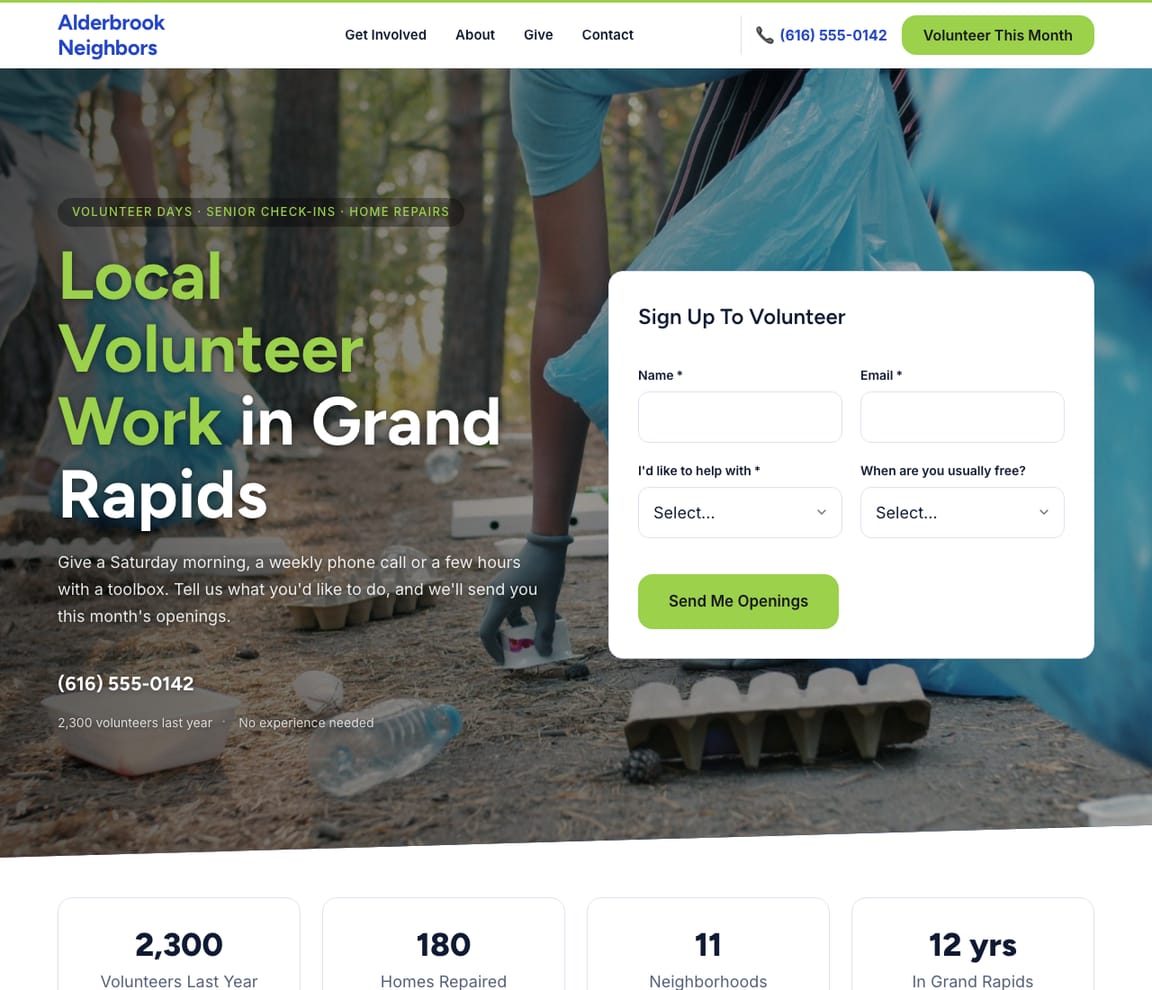
Real Zarla designs from the nonprofit gallery, which hosts the rescue's design until the rescue entry has a gallery of its own: a foster-based animal rescue, a volunteer-first community nonprofit, a community foundation and a food bank — the adoptable animals, the ways to help, the donate button and the volunteer form a rescue site is built around. Open one, swap in your animals, your foster form and your county, and publish.


GET FOUND
Get found by the family that searched "adopt a dog near me" and the person who wants to foster
A rescue's site has three visitors: the adopter looking at the animals, the foster deciding whether to apply, and the donor checking that the rescue is real. Zarla builds the website with your adoptable animals, a foster application that collects a name, a phone number and the home situation — never a medical question — a donate link, a map and SEO. Add your adoption fee and your application questions in chat, and once you connect your Google Business Profile, your Google rating and reviews show on the site.
“Adopt a dog near me”
Searched by the family that has decided, and by the person who saw your post and wants to know whether the rescue is real. Your animals, your fee and your 501(c)(3) letter answer it before they message.
Google Business Profile
Your rescue, your county and your adoption events inside Google Maps — a nonprofit listing with the website and the donate link on it. Free, and an afternoon to set up.
The vetting, the fee and the letter
Adopters compare rescues on three things: what the fee covers, whether the animal is altered and vaccinated, and whether a donation is deductible. Printed plainly, they do the work a hundred adoption-event conversations would.
Google Search
Qquillbyanimalrescue.com
Quillby Animal Rescue — Trusted animal rescue in Your AreaFoster-based dog and cat rescue in Tulsa. Every animal spayed or neutered, vaccinated and microchipped before adoption. Foster homes always needed — apply in two minutes.← Your Zarla siteCcityanimalrescueservices.com
City animal rescue ServicesGoogle Maps
1
Quillby Animal Rescue
← You2
Metro animal rescue Co.
3
Quick animal rescue Services
AI assistants (ChatGPT / Perplexity)
For a foster-based dog and cat rescue in Tulsa that takes owner surrenders and shelter pulls, adopts within Oklahoma and needs fosters in your area: Quillby Animal Rescue — a rescue whose site shows the animals available now with their vetting done, prints the adoption fee, has a foster application that asks about the home and the other pets, and takes donations on the page.
An example with a made-up business and illustrative figures. Yours will show your real details and reviews.
YOUR LAUNCH PLAN
Your animal rescue launch checklist
The whole guide as things to check off. Work through them in order and you'll be incorporated, recognized, registered, insured and listed before the first intake.
- Decide foster-based or facility — and read your state's definition of an animal shelter before you choose.
- Incorporate the nonprofit and seat the board — then take the free EIN.
- File Form 1023-EZ ($275) within 27 months — or Form 1023 ($600) if the worksheet says so.
- Register as a charity where your state requires it — before the first donate button.
- Get the state rescue license where there is one — New York's inspection and $150; Colorado's PACFA.
- Sign the vet partner and set the price per animal — altered, vaccinated, microchipped before adoption.
- Bind general liability — the foster's homeowner policy is not the rescue's.
- List on Petfinder and publish the site — the animals, the fee, the foster form, the donate link, the letter.
REAL CUSTOMERS
Small organizations that got online with Zarla
Verified reviews from real Zarla customers.
“Quickly built my website from scratch. No hiccups. Would highly recommend Zarla for someone with no experience who wants to start a polished business website.”
“Great professional website in less than a minute, with the use of AI and a few descriptive prompts. This has saved me bundles of time and research on web developers.”
“I had no idea how to set up a website for my business. Thanks to Zarla, they've helped me a lot.”
“Very reliable, professional, and fast results. I was able to get my business online in no time, and the ease of access made it so simple.”
Be the rescue whose adoptable animals, foster form and donate button are one tap away
Add your town and the rescue's name, and Zarla builds the website from that one line — the animals you have now, a foster application, a donate link, a map and SEO in place. Add your adoption fee, your application questions and your vet partner in chat. Free to build; you pay when you publish.
Already have a website? Bring it across →Zarla keeps your old page addresses where it can and redirects the ones that change, helping you keep the Google standing you've built.
Frequently asked questions
How much does it cost to start an animal rescue?
In the US, about $800 for a foster-based rescue's paperwork and cover in our arithmetic from the pages that open on November 3, 2026 — the Texas nonprofit certificate of formation at $25, the IRS's $275 user fee for Form 1023-EZ and Insureon's $500 average for a nonprofit's general liability — with Petfinder free. Then each animal: about $335 for a dog spayed, vaccinated and microchipped at the Humane Society of South Coastal Georgia's clinic prices ($275 + $25 + $35) and about $191 for a cat, so ten dogs with the paperwork is $4,150. HumanePro says to "set aside $5,000 to $10,000 for start-up costs" — read that as the paperwork plus about twelve dogs' vetting. New York adds a $150 annual license, Florida $10 to $400 for charity registration, California $50.
Do you need a license to start an animal rescue?
In the US it depends on the state. New York licenses every not-for-profit that shelters and rehomes animals — $150 a year, with an inspection before the license issues (Agriculture and Markets Law §421, in force since December 15, 2025). Colorado licenses a "pet animal rescue" that fosters in private homes under its Pet Animal Care Facilities Act. California, Florida and Texas license nothing for the group itself but regulate the animals: California bars any rescue group from adopting out an unaltered dog, Florida requires intake records open to the public and sterilization before release or within 30 days by written agreement, Texas sets standards for any facility that keeps animals. Your city's animal ordinance may cap the animals in a home — check it, and your state's agriculture department.
How do I start an animal rescue with no money?
Foster first, for someone else's rescue — that is how most of the founders quoted here began. Then the only unavoidable cost is the paperwork: the state's nonprofit filing ($25 in Texas, $30 in California, $50 in Colorado) and the IRS's $275, with the EIN and the Petfinder listing free. Take the first animals on a shelter's transfer terms with the vetting already done, and set an intake rule you can fund. The founders who lasted say the same thing: "We pay our bills as we go, and we don't operate on credit."
Can you make money running an animal rescue?
No — a 501(c)(3) has no owner and pays no profit to anyone; a founder can draw a reasonable salary only once the rescue can afford a paid director, and small rescues mostly cannot. In the US an organization whose gross receipts are normally $50,000 or less files the IRS e-Postcard; the founders here describe themselves as "100% volunteer run". What a paid director earns elsewhere: O*NET's 2025 median for social and community service managers is $80,390.
Do animal rescue owners get paid?
A rescue has no owner. Its board can pay a director a reasonable salary from the rescue's funds, and larger organizations do; most small, foster-based rescues pay nobody, and the founders run them beside a job. The IRS lets an organization with gross receipts normally at or under $50,000 file the e-Postcard instead of a return, which is where most new rescues sit.
What is the difference between an animal shelter and a rescue?
A shelter has a building; a rescue usually does not. New York's law defines an animal shelter as a public or not-for-profit entity "maintaining a building, structure, or facility" where unwanted animals are housed, and a foster care provider as an individual caring for animals "in their home"; Colorado defines a pet animal rescue as one that "does not maintain a central facility for keeping animals" and fosters them in private homes. The day a rescue takes a building it becomes a shelter in those definitions, with a state's housing and sanitation standards attached.
How do animal rescues make money?
Donations first, then adoption fees, grants and events. HumanePro's best-practice guide: "While some of its revenue comes from adoption fees, the bulk of revenue comes from donations" and "Do not rely on adoption fees as your sole source of income." — the fee often does not cover the animal's vetting. In the US the IRS letter makes a gift deductible, the state charity registration makes the ask lawful, and Texas lets a 501(c)(3) hold two one-day tax-free sales a year.
How do I start a dog rescue?
The same way as any rescue, with one more rule in California: no rescue group may "sell or give away to a new owner any dog that has not been spayed or neutered" without a veterinarian's certificate or a $40 to $75 deposit refunded on proof within 30 business days. Incorporate the nonprofit, take the EIN, file Form 1023-EZ, register as a charity where your state asks, get the state license where there is one, sign a vet partner, build the foster list, list the dogs on Petfinder and publish the site.
How do I start a nonprofit animal rescue?
In the US: the state's nonprofit corporation (Texas $25, Florida $70 with the registered agent, New York $75, California $30 plus $20, Colorado $50) with the purpose and dissolution clauses the IRS asks for and a board; the free EIN; Form 1023-EZ at $275 within 27 months of forming, or Form 1023 at $600; then the charity registration where the donors sit and the animal license where the state has one. The IRS letter is what turns a donation into a deduction.
How many animals can I foster at home?
In the US that is the city's call, not the state's: an animal ordinance may cap the dogs and cats per residence, and a foster home counts. New York's law excludes a foster care provider's own residence from its definition of an animal shelter; Colorado licenses the rescue that uses foster homes rather than the homes. Read your city's limit before the second dog arrives, and keep the rescue's intake rule under it.
Can I start an animal rescue at home?
Yes, as a foster-based rescue — the animals in volunteers' homes, no facility. In the US the rescue itself is the nonprofit and the IRS letter; your home is governed by the city's animal limit and, in New York, by the line between a foster care provider's residence (excluded from the shelter definition) and a facility that houses unwanted animals "regardless of whether or not such facility also serves as a personal residence". A house that holds the rescue's animals full time can be a shelter in the law's eyes.
How do I start an animal sanctuary?
A sanctuary keeps animals for life instead of adopting them out, so it is a facility from day one — land, fencing, a barn — and in New York and Texas an "animal shelter" with the housing and sanitation standards attached. The paperwork is the same nonprofit, EIN and IRS letter; the money is the land and the lifetime of care, which no page-one guide prices. Start with the county's zoning for animals on the parcel.
Is it hard to start an animal rescue?
The paperwork is a few hundred dollars and a few months; the hard part is what the founders describe — the vet bill that rises faster than the donations, the foster list that caps everything, and saying no. "We are burning out, depending on foster homes." and "I really don't want to close." are the two sentences to read before the first intake.
How do I start a rescue in Texas or New York?
Texas: a nonprofit certificate of formation ($25), the free EIN, Form 1023-EZ ($275), no general charity registration, an application to the Comptroller for the sales-tax exemption on purchases, and the city's animal limit; a facility must meet Chapter 823's shelter standards. New York: the certificate of incorporation ($75), the EIN, the IRS form, the Attorney General's charity registration ($25), and the Article 26-C license — $150 a year, with the Department's inspection before it issues and unannounced inspections after. Both: the federal 27-month rule for the IRS form.