ORIGINAL RESEARCH · AUGUST 2026
Do AI assistants recommend small businesses? We checked 1,851 of them.
We asked ChatGPT and Google's AI the question customers actually type — "best plumber in Houston, TX" — for 10 trades across 10 US cities, then matched every answer against 1,851 real Google-listed businesses using the same engine our product runs. Fewer than half were confirmably named. Here's the full picture, with the methodology attached.
Free · No sign-up to check · Under two minutes
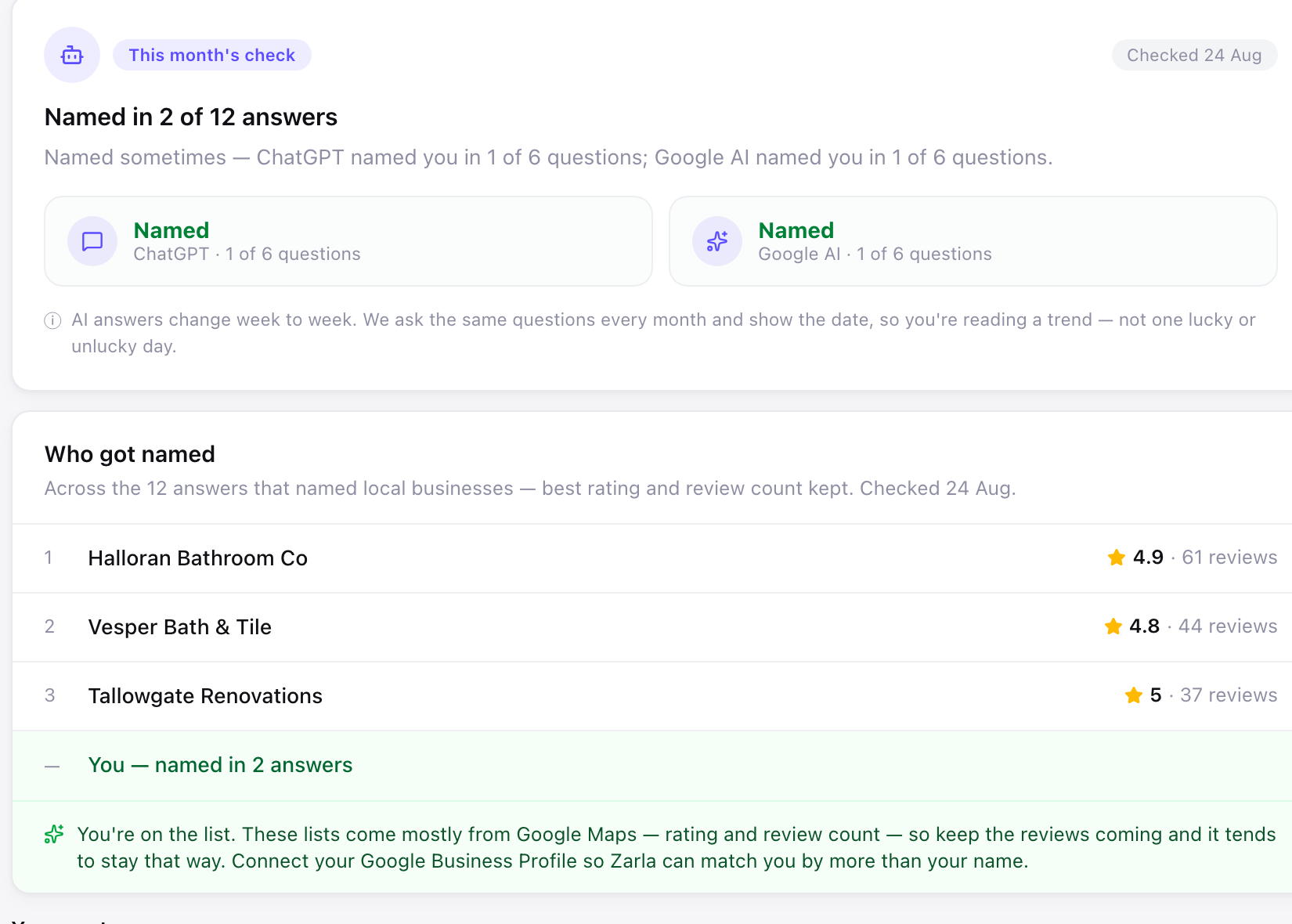
The August 2026 numbers
What we did
On 24 August 2026 we asked ChatGPT and Google's AI Mode one deterministic question per trade and city — "best {trade} in {City, ST}" — for ten local trades (plumber, electrician, locksmith, roofer, HVAC contractor, house cleaning service, landscaper, pest control company, carpet cleaning service, auto repair shop) across ten US cities (Houston, Phoenix, Philadelphia, Charlotte, Denver, Portland, Nashville, Columbus, Tucson, Boise). That's 100 questions per platform: the same wording a customer types, asked the same way every time.
We then sampled the top 20 Google Places results for each trade-and-city — 1,851 business listings with public ratings and review counts — and matched every one against every answer using the same matching engine our product uses, which resolves a business by its Google listing identity, not just its name. A name-alike mention that couldn't be confirmed was never counted as named: 28.31% of listings fell into that ambiguous bucket, 43.65% were confirmably named, and 28.04% were clearly never named.
What we found
Four findings stand out — all from the same run, all traceable to the published aggregates.
- Even Google's winners mostly don't exist in AI answers. Our sample wasn't a random slice of small businesses — it was the top 20 Google results per trade and city, the businesses already winning local search. Fewer than half (43.65%) were confirmably named by either assistant. For the average small business, the real share is lower still.
- Review volume separates the named from the unnamed; rating barely does. The named cohort's median rating was 4.9★ against 4.8★ for the not-named — everyone at the top has a good rating. The medians that split them: 444 reviews vs 192. A strong rating is table stakes; a deep, steady review stream is the visible difference.
- The two assistants disagree far more than they agree. ChatGPT confirmably named 659 businesses; Google's AI Mode named 330; only 181 were named by both. 478 businesses were ChatGPT-only and 149 were AI-Mode-only. Checking one assistant tells you little about the other — which is why our checks always ask both.
- The answers do name businesses — the question is whose. Of 197 platform answers, only 11 named nobody. Across all answers, the assistants named specific businesses 3,122 times, and where the answer showed a rating and review count, the medians were 4.9★ and 100 reviews — right in the answer text. This channel is already routing customers; it's just concentrated on a minority of businesses.
The spread by trade ran from house cleaning at 53.1% named down to auto repair at 31.5% — every trade had a majority-or-near-majority of its top-20 businesses missing from at least one assistant's answers.
Why review depth shows up in the answers
This result matches what we see in our week-to-week checks for customers: the businesses AI assistants name arrive with their Google ratings and review counts attached — the lists are grounded in Google's business data. An assistant assembling a short list from a directory of near-identical 4.8–4.9★ businesses has one strong public differentiator left: how many people said so, and how recently.
That makes the playbook unglamorous and clear: a complete Google Business Profile, a steady review stream, and a website that states what you do in plain text. We've written it up step by step in how to get your business recommended by ChatGPT — and the mechanism behind it in does ChatGPT recommend local businesses?
Methodology
Collected: 24 August 2026 (UTC). Platforms: ChatGPT (search-enabled) and Google AI Mode, asked with US targeting in English. Questions: exactly one per trade-and-city cell — "best {trade} in {City, ST}" — 100 cells, the identical deterministic template our product uses, asked once per platform. Sample: the top 20 Google Places results for "{trade} in {City, ST}" per cell — up to 20 per cell, and some cells returned fewer — giving 1,851 business listings (1,815 unique businesses; 31 appear in more than one trade sample, e.g. a firm listed under both plumbing and HVAC). This sample deliberately skews toward the most visible businesses — it measures AI visibility among local search's current winners, and overall small-business rates will be lower. Matching: the production matching engine, which resolves businesses by Google listing identity (name plus phone, website, or address); ambiguous name-alike mentions were never counted as named. Counting: a business counts as named on a platform only when at least one of that platform's answers confirmably named it; per-platform denominators exclude businesses in cells where that platform declined to answer (3 of 200 answers). What we publish: aggregates only — no individual business is named. AI answers change week to week; these numbers are a dated snapshot, not a permanent ranking, and we plan to re-run the index.
Which side of the 43.65% is your business on?
The same check this study ran, on your business: the question your customers ask, on ChatGPT and Google's AI, answers word for word with the date. Free, about two minutes.
Free to build and preview · No credit card · Pay only to go live
Questions about the AI Visibility Index
It deliberately isn't — and that makes the headline stronger, not weaker. We sampled the top 20 Google results per trade and city, the businesses already winning local search, and even among them fewer than half were confirmably named. A random sample of all businesses would show a lower named rate; we chose the harder test on purpose and state the skew in the methodology.
Because a name-alike is not a match. Local trades are full of similar names — multiple branches of the same national franchise, several near-identical business names in one metro — so our matcher requires the answer to line up with the business's Google listing identity (name plus phone, website, or address) before counting it. 28.31% of listings got a name-alike mention we couldn't confirm; counting those as named would have inflated the results, so we didn't.
The lists are more stable than the prose. In our recurring checks, asking the same city-level question again returns substantially the same businesses with the wording changed — consistent with answers grounded in Google's business data rather than invented per run. That said, AI answers do change week to week, which is why the index is dated and why any single check of any single business should be read as a snapshot.
In our data ChatGPT's answers simply carried more named businesses per answer — 659 businesses confirmably named against AI Mode's 330 — while AI Mode's local answers tend to be a tighter set of cards. We report the difference without over-explaining it: both platforms ground local answers in Google-style business data, and both concentrated their naming on businesses with deep review streams.
We publish aggregates only — no individual business's result appears in the index, named or not. The sample was mechanical: the top 20 Google Places results for each of the 100 trade-and-city combinations on the collection date. If you want an individual result, run it on your own business — that's exactly what our free checker does, and it's the same engine this study used.
Zarla's free AI Visibility Checker asks ChatGPT and Google's AI the question your customers ask, matches the answers against your Google Maps listing so a same-name business is never mistaken for you, and shows you the result word for word with the date — named or not, and who was named instead. It takes about two minutes with no sign-up, and the step-by-step improvement playbook is in our getting-recommended guide.
The index is the average. Your answer is specific.
Two minutes, free: exactly what ChatGPT and Google's AI say when your customers ask — counted, dated, word for word.
Free to build and preview · No credit card · Pay only to go live