AI VISIBILITY GUIDE
Does ChatGPT recommend local businesses? Yes — here's how it picks them.
Ask ChatGPT for "the best electrician in Portland" and it doesn't shrug — it names real businesses, with their Google ratings and review counts right in the answer. We run these checks for Zarla customers. Here's what the answers actually look like, where the lists come from, and what that means for yours.
Free · No sign-up to check · Under two minutes
The short answer: yes — with names, ratings, and review counts
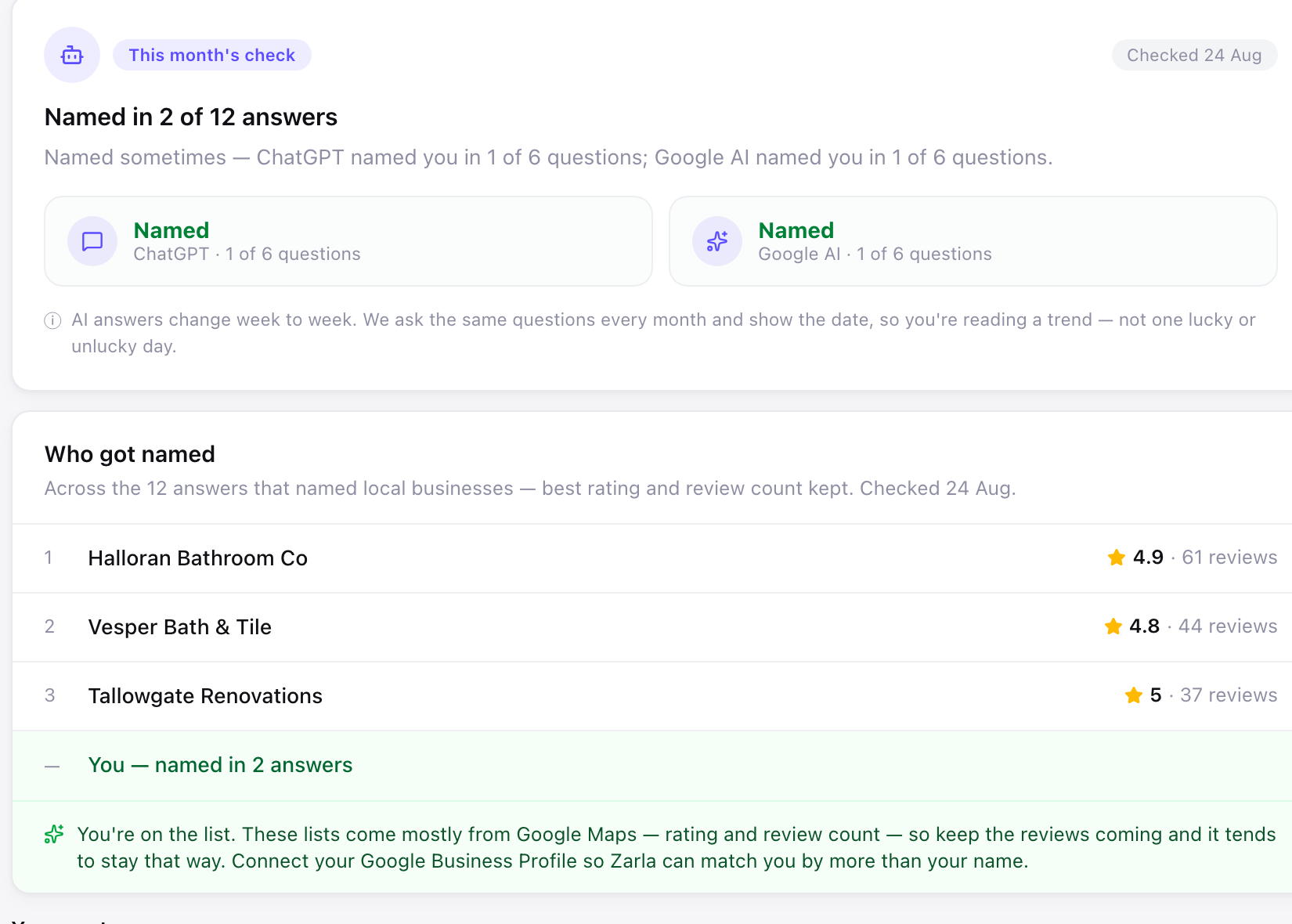
When someone asks ChatGPT a local-service question — "best plumber in Concord," "who should I call for a blocked drain" — it returns a short list of specific businesses. Not categories, not advice to "check review sites": named businesses, usually with their star rating and review count attached, often with a line about why each one made the list.
That makes it a real referral channel. There's no page two of an AI answer and no ad slot beside it — a handful of businesses get named, and everyone else doesn't exist for that customer in that moment. Which raises the question that actually matters: where does the list come from?
WHAT OUR CHECKS SHOW
Where ChatGPT's list comes from: Google's business data
We ask these questions on ChatGPT and Google's AI for Zarla customers, and read the answers word for word. Three observations hold up run after run:
1. The names arrive wearing Google's data. The businesses ChatGPT recommends come with star ratings and review counts that match their Google Business Profiles — the same numbers you'd see on Google Maps. Whatever happens inside the model, the output is grounded in Google's business directory.
2. The lists are stable; the prose isn't. Ask the same city-level question twice and you get substantially the same businesses, wrapped in different sentences. That's the signature of answers built from a data source rather than invented per run — and it means getting named isn't a lottery.
3. Coverage thins below city level. Suburb-level questions often name nobody at all, while the city question reliably produces a list. If ChatGPT goes quiet on your specific suburb, that's its coverage today — not a verdict on you.
And one thing our checks have never found: a way to pay. There's no ad product, no paid placement, and no business directory you can join at ChatGPT. The list is earned through public signals — which is the good news, because every one of them is yours to improve. For the measured wide-angle view, see the AI Visibility Index — 1,851 businesses checked with this same engine.
- Named businesses carry Google ratings and review counts in the answer itself
- Same city-level question, substantially the same list — stability that points at a data source
- Suburb-level questions often return nobody; city-level questions return lists
- No paid placement, no ads, no directory to join — the list is earned
What this means for your business
If ChatGPT's local lists are grounded in Google's business data, then the strategy writes itself: the work that wins Google is the work that wins ChatGPT. There's no separate "AI channel" to buy into — there's your Google Business Profile, your reviews, and your website, now being read by one more very influential reader.
In practice, three moves cover most of it:
- Complete your Google Business Profile. Categories, services, areas served, hours, photos. This is the directory the lists are grounded in — a half-empty profile is a half-entered race.
- Keep reviews coming. The rating and count travel with your name into the answer. Recent and steady beats big and stale.
- Give the assistants a website worth citing. Your services and suburbs in plain text on real pages — the evidence layer that confirms you are what your profile says.
The full six-lever version, with steps, lives in our guide to getting your business recommended by ChatGPT. And Google's own AI works the same way — its documentation says AI Overviews and AI Mode ride the normal search rankings, which we unpack in the AI Overviews guide.
Find out if your business is on the list.
We ask ChatGPT and Google's AI the question your customers ask, match the answer against your Google Maps listing so a same-name business is never mistaken for you, and show you the result — word for word, dated.
Free to build and preview · No credit card · Pay only to go live
Common questions about ChatGPT and local businesses
Work the signals it reads: claim and complete your Google Business Profile, build a steady stream of recent Google reviews, and publish a website that states your services and service area in plain text. In our checks, the businesses ChatGPT names carry strong Google ratings and review counts into the answer — there's no shortcut around that, and no paid one either. Start by checking what it says about you today, then close the biggest gap first; the step-by-step version is in our full playbook guide.
Everything we can observe says its local lists are grounded in Google's business data. The businesses it names arrive with star ratings and review counts that match their Google Business Profiles, and repeat asks return stable lists — the behavior of answers built on a directory, not improvised. OpenAI doesn't publish its local-data pipeline, so we'll only claim what we can see: the numbers in the answers are Google's numbers, which makes your Google presence the input that matters.
Two things, and they're different. As a tool, it can draft quotes, emails, job descriptions, and website copy — real time savings. As a channel, it can send you customers: people ask it who to hire, and it names specific businesses in the answer. The tool side works the day you try it; the channel side is earned through your Google presence, reviews, and website. This guide is about the channel — because that's the side your competitors can take from you by being named while you're not.
As a work tool, try both and keep the one that fits your tasks — they're close, and the differences shift with every release. For being found, the practical answer today is that ChatGPT has the largest consumer audience asking who-should-I-hire questions, and Google's AI reaches everyone who searches — so those two are where we point our checks. The good news: the same public signals feed all of the assistants, so you don't have to optimize per-platform.
No. There's no ad product in ChatGPT's local recommendations, no paid placement, and no listing you can buy — and in every check we've run, we've seen no trace of one. That cuts both ways: you can't buy your way on, and your better-funded competitor can't either. The list is earned through public signals — Google Business Profile, reviews, and a readable website — which makes this one of the few channels where the playing field is genuinely level.
Ask it the question your customers ask — "best [your trade] in [your city]" — from a logged-out browser, and read who comes back. Do the same in Google's AI Mode, and note the date, because AI answers change week to week. Or let Zarla's free AI Visibility Checker do it properly in about two minutes: both assistants, answers shown word for word, matched against your Google Maps listing, dated. Either way, check before you change anything — you can't improve a number you haven't seen.
The question is already being asked. See today's answer.
Free check: the question your customers ask, on ChatGPT and Google's AI, answers word for word with the date on them. Then you'll know exactly where you stand.
Free to build and preview · No credit card · Pay only to go live