CAREER GUIDE
How to become a carpenter in 2026
The apprenticeship and its hours from the programs' own pages, the routes in without one, which states license the work and at what dollar line — California's C-5 and C-6 above $1,000, Virginia's Class C, Oregon's and Washington's registration, Pennsylvania's registration above $5,000 a year of work, North Carolina's $40,000 — what carpenters earn at each rung from BLS data, the kit priced from real listings, and how to go from someone else's crew to your own business.
Free to build · Pay when you publish · No credit card
No US statelicenses the carpenter as a person — the contractor line is what licenses the work: $1,000 in California and Virginia, the first dollar in Oregon and Washington, $40,000 in North Carolina, from the boards below
$60,580median pay for employed carpenters in 2025 (O*NET, from BLS data); 10 percent earn $99,910 or more
2,000 hoursa year of on-the-job learning — the federal floor for a registered apprenticeship, with 144 classroom hours a year recommended
$692.19a first day's kit from one distributor's listings: a tape, a square, a belt, glasses, earmuffs, a circular saw, a drill kit and a clamp (our arithmetic)
See it in action
See what your carpentry website could look like
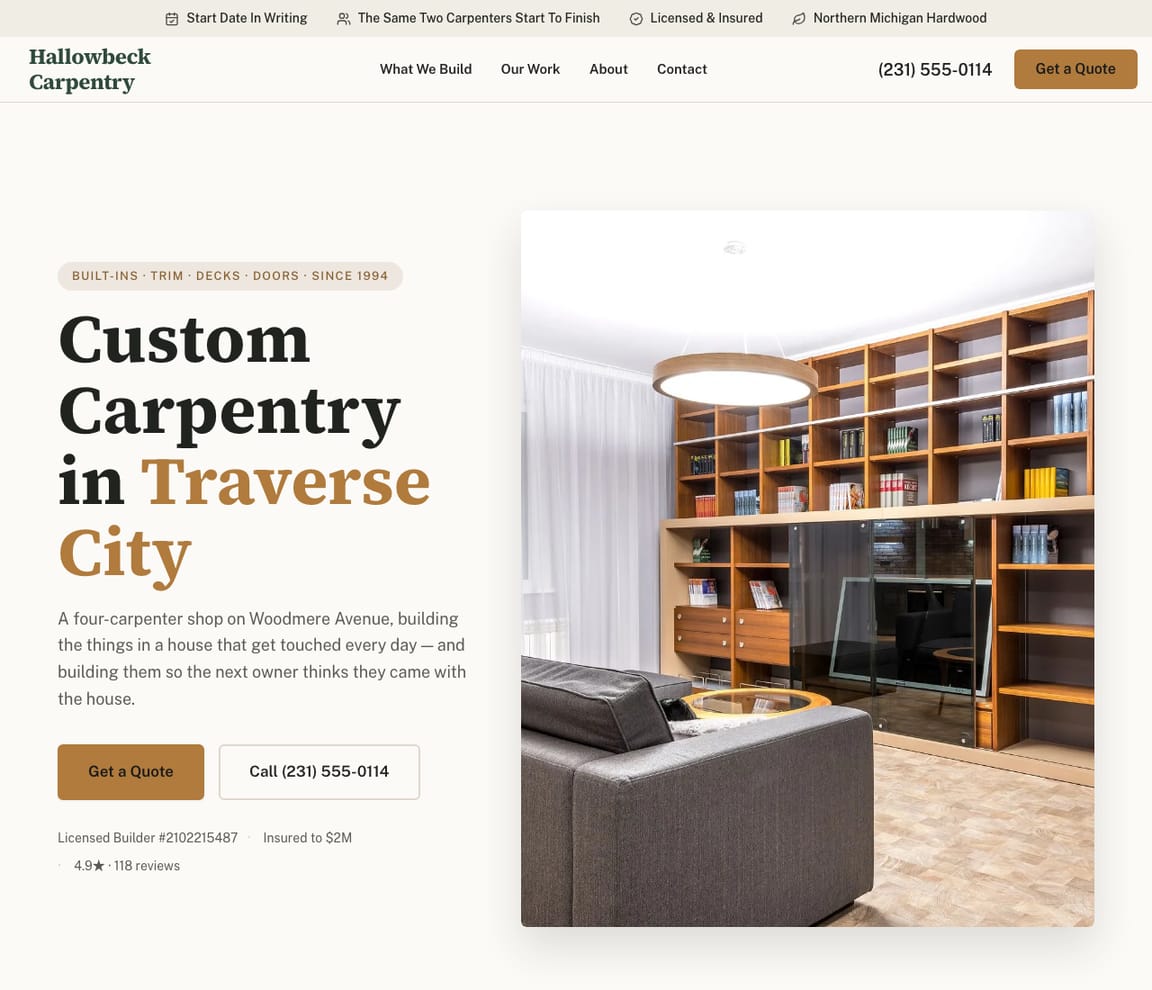
A real Zarla template for a carpenter — a finished built-in in the first screen, framing and finish work underneath, the license number where a homeowner looks for it. Describe yours — the town, the services, the hours — and you'll have a site like this, with a call button and a quote form, in about a minute.
- Professional design — not a generic template
- Looks great on desktop and mobile
- Content written for your industry
Build the website
Start your carpentry website now
Add your town and your business name to the sentence, and Zarla builds the site: your services, the area you cover, a project gallery, a call button and a quote form. Add your prices and your license number in chat, then publish.
Already have a website? Bring it across →Zarla keeps your old page addresses where it can and redirects the ones that change, helping you keep the Google standing you've built.
Is becoming a carpenter worth it in 2026 — and what does the work pay?
Becoming a carpenter is a trade with no license on the person and an apprenticeship that is the real credential, and at the top of it a business whose quotes a homeowner trusts from a photo of the joints. Three honest numbers first. Employed carpenters had a median of $60,580 a year in 2025, $29.12 an hour: 10 percent earned $40,410 or less — $19.43 an hour or under — and 10 percent $99,910 or more, $48.03 an hour and up (O*NET, from BLS 2025 wage data). The headcount is the biggest in this batch: "Employment (2025) 889,700 employees", "Projected growth (2025-2035) Average (3% to 4%)", "Projected job openings (2025-2035) 62,800" (O*NET, employment and outlook). And the survey behind the wages leaves out the self-employed (Washington ESD) — which the builders' association says is a third of the trade: "approximately one out of three carpenters were self-employed", and the same page puts the BLS mean, not the median, at "$66,470, or about $31.96 hourly" (NAHB, careers in carpentry).
State by state. The employed median is $48,900 in Texas, $75,920 in California — where the top 10 percent clear $119,950 — $49,870 in Florida and $72,330 in New York, where they clear $122,400 (O*NET, Texas; California; Florida; New York). The occupation sits in "Job Zone 1-2: Very Little to Some Preparation Needed" with training that "Ranges from a few days to one year of on-the-job training"; of the carpenters surveyed, "52% responded: High school diploma or equivalent required", "21% responded: Post-secondary certificate required" and "18% responded: Less than high school diploma required" (O*NET, education).
Where the money went. The owners quoted below are blunt that the wage is not the point — "The business of carpentry has been found not to be lucrative. However, the purpose, products and dealings with the clients make for a soul fulfilling endeavor" (Daniel Whitton, DFW Carpentry, Justin, Texas, VoyageDallas, June 14, 2017) — and that the first years' income goes into the truck and the tools: "I started out working out of my car, moving jobsite boxes in and out every day. As the business grew and I started making a little more money, I bought a truck and then a trailer. Not long after, both were stolen, leaving me completely wiped out" (Jarell Rebar, Innovations Carpentry, Dallas, VoyageDallas, November 13, 2025). The insurance is the surprise: "We learned the struggle of running a legit business that is fully insured and how expensive insurance for our industry is" (Michael Plancon, Good Wood Flooring & Carpentry, Chicago, VoyageChicago, June 27, 2017). The business side is its own guide — how to start a carpentry business — and the plan page below prices the shop.
The catch. The body pays — "Spend Time Standing … 70% responded: Continually or almost continually", "Wear Common Protective or Safety Equipment … 95% responded: Every day" (O*NET, work context) — the first years are the lean ones, and the license that lets you own the business in the states that have one takes four years of documented hours. That's what the rest of this guide sets up: the contractor line in each big state from its board, the apprenticeship's federal floor, the routes in and what each costs, the kit from a distributor's own prices, and how to be the carpenter the built-ins search finds first.
How to become a carpenter, in plain English: the license question, state by state, from the boards
There is no carpenter's license in the US — not federal, not in any state. What the law licenses is the contractor: in the states that license construction work above a dollar line, a carpentry business past that line needs the state's contractor license or registration, and a few states name carpentry as its own classification. In Texas, Florida, New York and Illinois there is nothing at state level. Framing that touches structural members is building or residential contractor work where those licenses exist; cabinets and trim are home improvement where that is registered; and a carpenter who replaces windows or demolishes painted walls in a home built before 1978 meets the EPA's lead-paint rule. On top sits the ordinary business license your city issues to any trade. Here is each big state, from its own board or statute:
- California: two classifications — "C-5 - Framing and Rough Carpentry Contractor" and "C-6 - Cabinet, Millwork and Finish Carpentry Contractor" (CSLB license classifications). The C-5 "performs any form work, framing or rough carpentry necessary to construct framed structures; installs or repairs individual components of framing systems and performs any rough carpentry or associated work, including but not limited to the construction or installation of: sub-flooring, siding, exterior staircases and railings, overhead doors, roof decking, truss members, and sheathing" (16 CCR §832.05); the C-6 "makes cabinets, cases, sashes, doors, trims, nonbearing partitions and other items of "finish carpentry" by cutting, surfacing, joining, gluing and fabricating wood or other products" and "places, erects, and finishes such cabinets and millwork in structures" (§832.06). The line: no license where "the aggregate contract price for labor, materials, and all other items is less than one thousand dollars ($1,000), that work or operation being considered of casual, minor, or inconsequential nature, and the work or operation does not require a building permit" — and the exemption is lost by anyone who "Advertises or puts out a sign or card or other device that might indicate to the public that the person is a contractor" or "Employs another person to perform, or assist in performing, the work" (Cal. Bus. & Prof. Code §7048); an unlicensed ad is lawful only under $1,000 and if "the person states in the advertisement that the person is not licensed under this chapter" (§7027.2). To get either license: "not less than four years experience as a journeyman, foreman, supervising employee or contractor in the particular class", and an apprenticeship cannot "count for more than 3 years of the experience" (16 CCR §825); the bond is "twenty-five thousand dollars ($25,000)" (§7071.6). The CSLB's fee pages refused our reader, so no California dollar fee is printed here.
- Florida: carpentry is not one of the contractor types the statute lists — the word carpentry appears nowhere on the page. What covers the work is the "Building contractor", "whose services are limited to construction of commercial buildings and single-dwelling or multiple-dwelling residential buildings, which do not exceed three stories in height … or a contractor whose services are limited to remodeling, repair, or improvement of any size building if the services do not affect the structural members of the building", and the "Residential contractor", limited to "construction, remodeling, repair, or improvement of one-family, two-family, or three-family residences not exceeding two habitable stories" (Fla. Stat. §489.105) — so framing that touches structure is their work, and a carpenter does it as their employee or sub. The casual-work line is "$2,500": exempt is "Any work or operation of a casual, minor, or inconsequential nature in which the aggregate contract price for labor, materials, and all other items is less than $2,500", unless it "is a part of a larger or major operation" (§489.103). The county cards are over: "any such local government licensing of occupations expires on July 1, 2025" (§163.211).
- Texas: no state license — the Department of Licensing and Regulation's program list has no carpentry entry (TDLR); the cities register contractors on pages that refused our reader, so ask your city's permit office. Illinois: the state's profession list licenses roofing contractors and no carpenters (IDFPR, licensed professions). New York: no state license; New York City licenses the business — "A person or business must have a Home Improvement Contractor license to do construction, repair, remodeling, or other home improvement work to any residential land or building in New York City", with "Home Improvement Business Trust Fund Enrollment OR Copy of $20,000 Surety Bond", "The fee for joining the Trust Fund is $200", an exam of "30 questions. You must answer a minimum of 21 questions correctly to pass", copies of the "EPA Renovation, Repair, and Painting (RRP) certification", and "Pay $200 for a license expiring February 28 of the next odd year. (Valid for at most 24 months.)" (NYC Department of Consumer and Worker Protection).
- Virginia: the state licenses the business by contract size — "Class C contractors" work "when (i) the total value referred to in a single contract or project is over $1,000 but less than $30,000" (Va. Code §54.1-1100); every applicant "must complete eight hours of pre-license education" (Virginia DPOR, contractors). Washington: from the first dollar — "Washington State requires all construction contractors to register with L&I", with "63 specialties that each require contractor registration", an application fee of "$150.20" and a bond of "$30,000 for general contractors. $15,000 for specialty contractors" (Washington L&I, register as a contractor); the page's examples do not name carpentry, so ask the department which specialty yours is. Oregon: "Oregon law requires anyone who works for compensation in any construction activity involving improvements to real property to be licensed", and the board's own list of work that requires a license reads "Roofing Siding Painting Carpentry Floor covering Concrete"; the route is "the 16-hour training" and an exam (Oregon CCB) — the board's fee and bond pages did not open, so neither is printed.
- Nevada: the board's "42 distinct subcontracting fields within Classification C" include "plumbing, electrical, carpentry, painting, concrete contracting" (Nevada State Contractors Board, classifications), and the handyman exemption covers "Work to repair or maintain property valued at less than $1,000, including labor and materials, unless certain conditions apply (e.g., building permit required, type of work, contractor's license)" (NSCB, handyman exemptions). Arizona: the same $1,000 line — exempt is work "for which the aggregate contract price, including labor, materials and all other items … is less than $1,000", "of a casual or minor nature", unless "the performance of the work requires a local building permit" (A.R.S. §32-1121). Utah: exempt is "a person engaged in the alteration, repair, remodeling, or addition to or improvement of a building with a contracted or agreed value of less than $7,000, including both labor and materials" — but "if the total value of the project is greater than $3,000, the person shall file with the division a one-time affirmation" of liability insurance (Utah Code §58-55-305). Minnesota: "Carpentry" is one special skill — "rough framing", "finish carpentry", "doors, windows, and skylights", "porches and decks, excluding footings", "wood foundations" and "drywall installation" — while "cabinet and counter top installation" sits inside a second skill, "Interior finishing" (Minn. Stat. §326B.802); "specialty contractors who provide only one special skill" are exempt from the residential building contractor license (§326B.805), so a framing-and-trim carpenter needs none and a carpenter who also hangs cabinets provides two skills and does.
- Louisiana: "For commercial projects, if the total project amount exceeds $50,000, a contractor's license is required. For home improvement projects, if the total project amount exceeds $7,500 but not exceeding $50,000, a home improvement registration is required", and "There are no licensing requirements for labor only subcontractors performing work on new residential construction projects" (Louisiana State Licensing Board for Contractors). Pennsylvania: a registration, not a license, and the work carpenters do is listed — "porches, garages, roofs, siding, insulation, solar energy systems, security systems, flooring, patios, fences, gazebos, sheds, cabanas … doors and windows" on any job "for which the total cash price of all work agreed upon between the contractor and owner is more than $500"; excluded is "A person for whom the total cash value of all of that person's home improvements is less than $5,000 during the previous taxable year", and the application "shall be accompanied by a fee of $50" (Pennsylvania Act 132 of 2008). Maryland: a Home Improvement Commission license with a Guaranty Fund assessment of "$100.00 for an original MHIC contractor" and, since June 1, 2024, general liability insurance "in the amount of at least $500,000"; "Home improvement subcontractors may work without a license when performing home improvements for an MHIC licensed contractor" (Maryland Home Improvement Commission). New Jersey: "No person shall engage in the business of making or selling home improvements in this State unless registered with the Division" (N.J.A.C. 13:45A-17.3). North Carolina: "a general contractor must be licensed if the contract is valued at $40,000 or higher" (NC Licensing Board for General Contractors). Massachusetts, Connecticut, Michigan, Georgia and Tennessee regulate home-improvement work too, on pages that refused to open or that we did not reach, so none of their lines is printed here.
The federal rule a carpenter meets in an old house. "EPA's RRP Rule requires that anyone paid to perform work that disturbs painted surfaces in homes, childcare facilities and preschools built before 1978 be certified and their employees be trained" (EPA, the RRP program); "This includes all firms, even sole proprietorships", and the small-job exemption — "six square feet or less of paint per room inside, or 20 square feet or less on the exterior" — does not cover a carpenter's bread and butter: "Window replacement and demolition of painted surfaces are always covered regardless of square footage" (EPA, RRP for contractors). The person: "The renovator course must last a minimum of 8 training hours, with a minimum of 2 hours devoted to hands-on training activities" (40 CFR §745.225). The firm: "Renovation Firm | Certification | Re-certification (every 5 years …) | Firm | $300 | $300" (§745.92).
The safety rules a superintendent will ask about. Saws: "All portable, power-driven circular saws shall be equipped with guards above and below the base plate or shoe … When the tool is withdrawn from the work, the lower guard shall automatically and instantly return to the covering position", and "All fixed power driven woodworking tools shall be provided with a disconnect switch that can either be locked or tagged in the off position" (29 CFR §1926.304). Falls: "Each employee on a walking/working surface (horizontal and vertical surface) with an unprotected side or edge which is 6 feet (1.8 m) or more above a lower level shall be protected from falling" (§1926.501). Eyes, ears and lungs: protective equipment "shall be provided, used, and maintained in a sanitary and reliable condition wherever it is necessary by reason of hazards of processes or environment" (§1926.95).
How you learn it. In a registered apprenticeship or on a crew. The federal standard behind every registered apprenticeship: a term "measured either through the completion of the industry standard for on-the-job learning (at least 2,000 hours) (time-based approach), the attainment of competency (competency-based approach), or a blend", with "A minimum of 144 hours for each year of apprenticeship is recommended" and "A progressively increasing schedule of wages" (29 CFR §29.5). The union door is the carpenters' training centers: in New York, "Before you can complete the online application, you must attend an in-person Info Session" (NYC District Council of Carpenters Training Center); in Northern California the pre-apprenticeship is a "Six-week intensive training course" where "PAT is free and you receive a stipend for participating!", "Successful completion of PAT guarantees your acceptance into Apprenticeship" and "Graduates receive their own set of carpenter's tools" (Carpenters Training Committee for Northern California) — the national union's own site answered an error to every reader we sent, so its term and hours are not printed; the owners below put their apprenticeships at two to four years. The builders' door: "Technical training for construction industry jobs such as carpentry does not require a four-year degree. In addition, aspiring carpenters can start earning income in the construction industry before they can complete technical training. Apprenticeships provide technical training and allow carpentry students to earn while they learn", and the association points to HBI, which "provides pre-apprenticeship, certification programs, and job placement services" (NAHB, careers in carpentry); HBI's academies "offer tuition-free trades training for future builders" (HBI programs). The college door: Texas State Technical College's building construction technology program is a Tier 2 program, so a Texas resident's 12-credit semester is "$3,240" and a 15-credit one "$4,050" before fees (TSTC tuition table, fall 2026). And in California the apprenticeship pays twice: it counts for up to three of the four years the contractor license asks for (16 CCR §825).
You are self-employed from the first invoice. In the US a one-truck carpenter is a sole proprietor by default: "Use Schedule C (Form 1040) to report income or (loss) from a business you operated or a profession you practiced as a sole proprietor" (IRS, Schedule C instructions); "The self-employment tax rate is 15.3%" once net earnings reach $400 (IRS), and sole proprietors "generally have to make estimated tax payments if they expect to owe tax of $1,000 or more" (IRS). If you want an LLC: Texas $300 (Tex. Bus. Orgs. Code §4.154); Florida $100 plus $25 for the registered agent and $50 a year (Fla. Stat. §605.0213); New York $200 (N.Y. LLC Law §1101) plus a notice "published once in each week for six successive weeks, in two newspapers of the county" (§206); California $70 (Cal. Gov. Code §12190) and "Every LLC that is doing business or organized in California must pay an annual tax of $800" (Franchise Tax Board). Workers' compensation: "In Texas, private employers can choose to carry workers' compensation insurance coverage, but it is not required in most cases" (Texas Department of Insurance), while "All California employers must provide workers' compensation benefits to their employees under California Labor Code Section 3700" (California DIR).
Sales tax on the work — two states' rules. Texas: "Labor to repair, remodel, or restore residential real property is not taxable", while "the total amount charged for remodeling, repairing, or restoring nonresidential real property is taxable" (Texas Comptroller, Publication 94-116) — the same trim job untaxed in a home, taxed in an office. New York draws the line a carpenter lives on: "building a deck, installing a hot water heater, or installing kitchen cabinets are all capital improvement projects", while "Repairing a broken step" is "taxable repair and maintenance work" (New York TB-ST-104). Confirm the details with your accountant.
The money to start. Our arithmetic from the pages that print each price. A lean start for the first day on a crew — a Stanley FatMax 25-foot tape at $24.79 (Zoro, read October 27, 2026), a Swanson speed square at $12.55 (Zoro), a 12-pocket leather tool bag and belt at $22.99 (Zoro), 3M safety glasses at $15.39 (Zoro) and Peltor earmuffs at $49.99 (Zoro), a DeWalt 7-1/4-inch circular saw at $179.00 (Zoro), a DeWalt 20-volt hammer drill and impact driver kit at $362.99 (Zoro) and an Irwin 12-inch bar clamp at $24.49 (Zoro) — is $692.19. The fuller start as a carpentry business — the same kit, a DeWalt 12-inch sliding compound miter saw at $649.00 (Zoro), a Metabo HPT framing nailer at $361.99 (Zoro) and a DeWalt 18-gauge brad nailer at $129.00 (Zoro), a Craftsman 6-gallon pancake compressor at $152.99 (Zoro), a Stabila 16-and-48-inch level set at $183.99 (Zoro), a DeWalt 10-inch table saw with stand at $792.99 (Zoro), the $300 EPA firm certification, Washington's $150.20 registration fee as one state's example, and a year of general liability at Insureon's $1,124 carpenter median, $500 of inland marine cover on the tools and $2,865 of commercial auto — is $7,901.35. A dust extractor belongs in both kits; its product page refused our reader, so it is unpriced. Neither total includes the truck, the lumber or the website — and the insurance is a median, not your quote: "Carpenters pay an average of $94 per month , or $1,124 annually, for contractor general liability insurance", "$130 per month for a business owner's policy , or $1,559 annually", "$201 per month , or $2,411 annually, for workers' compensation insurance", "$42 per month , or $500 annually, for inland marine insurance , which covers saws, hammers, wrenches, and other tools brought to jobsites", and "$239 per month for commercial auto insurance , or $2,865 annually" (Insureon, updated July 23, 2026). The plan page for the business side is the carpentry business plan, the step after this guide is how to start a carpentry business, the name goes on the truck from carpentry business names, and the site from the carpentry website builder.
In the UK: there is no license to work as a carpenter; the government's career profile puts pay at "£24,000 Starter" to "£40,000 Experienced", with routes through a college course — "bench joinery", "site carpentry" or a "T Level in On Site Construction" — or an apprenticeship such as the "Carpentry and Joinery Level 2 Intermediate Apprenticeship" and the "Craft Carpentry and Joinery Level 3 Advanced Apprenticeship", and "You can apply for a foundation apprenticeship if you're aged 16 to 21" (National Careers Service, GOV.UK); on most sites the card to carry is a CSCS card, with its skilled card "For those who have achieved an NVQ or SVQ level 2, an apprenticeship or other approved qualifications" (CSCS). In Australia the principle inverts: New South Wales lists carpentry as a licensed category of home-building work, so a carpenter contracting with a homeowner there needs the state building regulator's contractor license above its dollar line — the regulator's pages carry a British spelling in their addresses that this US page cannot link, and none that opened printed the line itself, so no figure is printed here. Check your own state's contractor board, and your city's building department, before you quote the first job.
What working carpenters actually say
None of this is our opinion about the trade. It comes from people who do it — a Georgia carpenter whose two grandfathers were carpenters, an Austin trim carpenter who framed houses at 18, a Chicago-area husband-and-wife company with ten staff, a flooring-and-carpentry owner who started in a slow year, an Itasca owner who apprenticed in 2000 and started in a recession, a Texas sole proprietor since 1988, a Dallas owner whose truck and trailer were stolen, a Houston woodworker laid off from oil and gas, a Spring furniture maker who left a desk job, a Houston cabinetmaker twenty-four years in, a Phoenix finish carpenter three years in, and a Washington remodeler running three businesses — talking to the Voyage magazines between 2017 and 2026, each described as the page describes them. Read each as theirs at the time. Five things come up again and again.
You get in young, through family or a crew, and the apprenticeship is the credential. Jaan Watson, True Carpentry, Sugar Hill, Georgia: “Both of my grandfathers were carpenters, and after I broke 2 small hammers at maybe 12 years old helping build a deck for with them for my father, I knew it was something I was passionate about.” (VoyageATL, May 22, 2017). Ben Worley, True Custom Carpentry, Austin: “This was also the time that I was becoming a carpenter. I started framing houses and going to college at 18 years old. After eight years of going to Texas State on and off, I decided that building was the direction I was going to take.” (VoyageAustin, October 4, 2022). Todd Chionis, Top Drawer Carpentry, Itasca, Illinois: “Professionally, I began an apprenticeship with a North Shore custom construction company in 2000. I worked my way up from apprentice to carpenter, lead carpenter, and finally project manager. This gave me the opportunity to hone my hands on skills while in the field as well as learn the business side of the industry.” (VoyageChicago, July 11, 2017). Enrique Laurent, Laurent Carpentry, Houston: “Our journey started 24 years ago in 1999, when I began my career as an apprentice to a master carpenter. I began by learning the art of trim work from this expert and honed my skills over the next two years. It wasn't long before I felt confident enough to venture out on my own as a trim carpenter.” (VoyageHouston, May 31, 2023). Dallas Bobryk-Miller, DBM Custom Carpentry, Phoenix: “So my grandfather who had been a finish carpenter for 30+ years suggested I try and give it a shot. So I was able to get into a crew pretty quickly only due to the fact that there weren't many in the field. I learned a lot pretty quickly and I enjoy it very much!” (VoyagePhoenix, September 18, 2019).
“In 1984, after postponing university studies, the opportunity came to study the trades in carpentry from specialists originating in Excelsior Springs MO. The application of mathematics to physical geometry filled a desire in my creativity and my urge to be self-employed. After four years of apprenticeship, DFW Carpentry was formed 8-8-1988 as a sole proprietorship and continues to this day in 2017.” — Daniel Whitton, DFW Carpentry, Justin, Texas, in VoyageDallas, June 14, 2017
Most owners went out on their own after years on someone else's crew — or after a layoff. Worley: “I started True Custom Carpentry about a year ago after working for 18 years for different custom builders, cabinet makers, and trim carpentry companies. We now specialize in high-end trim and Finnish work, with a focus on delivering a high-end product and building lasting relationships with our clients.” (VoyageAustin, October 4, 2022). Brandon Wilson, Wilson Custom Carpentry, Humble, Texas: “The birth of Wilson Custom Carpentry came around 2016 after I returned to the US from an expatriate assignment in West Africa. I was laid-off from my then employer due to the decline in the oil & gas industry and began to do woodworking full-time.” (VoyageHouston, August 18, 2020). Jarell Rebar, Innovations Carpentry, Dallas: “I was working as a commercial project manager and had just accepted a new position at a larger company. The day before my orientation, the offer was rescinded due to COVID. I had just purchased my first home and didn't know what to do.” (VoyageDallas, November 13, 2025). Doug Farmer, Sovereign Carpentry, Spring, Texas: “At the time, I was working 50+ hours a week at my regular job and getting up early every day to work on furniture, usually putting in another 20+ hours a week on that. In 2018 I left my job to make furniture full time and I haven't looked back.” (VoyageHouston, January 7, 2020).
The first years are lean, and the tools are bought the hard way. Michael Plancon, Good Wood Flooring & Carpentry, Chicago: “The first year was really tough, we really didn't have that many jobs in the beginning, and we were still learning all the ins and outs of running a business. We learned the struggle of running a legit business that is fully insured and how expensive insurance for our industry is, after making a few adjustments we have really gotten in a good grove.” (VoyageChicago, June 27, 2017). Farmer: “For one, all my tools were made for the hobbyist and I had just stepped into the professional world of woodworking. Some of my tools couldn't handle the stress of what I was asking them to do so I've spent a lot of time and money investing in more powerful tools.” (VoyageHouston, January 7, 2020). Wilson: “When I started I didn't have the best tools to do jobs, which increased lead times and the amount of work I had to put into each project. It was frustrating at times but I feel as if I had to go through that process to learn more and deepen my appreciation for the craft.” (VoyageHouston, August 18, 2020). Rebar: “I started out working out of my car, moving jobsite boxes in and out every day. As the business grew and I started making a little more money, I bought a truck and then a trailer. Not long after, both were stolen, leaving me completely wiped out.” (VoyageDallas, November 13, 2025). Chionis: “We started out during the recession so work was not exactly abundant. We were happy just to get small handyman projects to create a customer base at first. In addition to a project shortage there was the lowball contractor that you had to compete with, gaining the trust of clients, and trusting subcontractors and the clients themselves.” (VoyageChicago, July 11, 2017).
The craft takes longer than the license. Laurent: “As time passed, I expanded my knowledge and expertise, learning how to create stairs and cabinets. It took me 16 years to master the craft of cabinet making, and it was then that I knew I had found my calling.” (VoyageHouston, May 31, 2023). Bobryk-Miller: “I'm only three years into my journey but, that being said I've been blessed with a fairly smooth road and progression from newb to the competent carpenter. But that is in big part to there just not being a whole lot of finish carpenters and an abundance of work.” And: “Part of being a good finish carpenter is to be a good problem solver so you can see ahead and avoid problems before they happen.” (VoyagePhoenix, September 18, 2019). Watson: “The biggest struggles we've faced so far is finding likeminded contractors and craftsmen that share the same attention to detail, and pride in their work as we do. Everyone on our jobs reflect on us, and we have a reputation to uphold, and will not allow any lazy, or sloppy work.” (VoyageATL, May 22, 2017).
Owning the business is a different trade from working in it. Margaret Stoch, Quality Carpentry & Roofing, Romeoville, Illinois: “Our business had been thriving and growing over the years mainly on satisfied customers' word-to-mouth referrals. We moved from a home office to an industrial office space with a warehouse and showroom (which my husband designed and built). We employ 10 full-time staff and we have an additional 20-30 of trusted and trained workers that we hire as needed in busy seasons.” (VoyageChicago, May 31, 2017). Rebar: “Over time, we grew from relying on subs to building a solid team of full-time employees. Every challenge pushed me to get stronger and more intentional about the kind of company I wanted to be.” (VoyageDallas, November 13, 2025). Justin La Gra, The Carpenter's House, Olympia, Washington: “On top of that, I'm still running Steadfast Remodeling and La Gra Specialty Woodworking, which are the businesses that pay the bills. Splitting time between those and The Carpenter's House can make it difficult to give each the attention it deserves, and there's a constant balancing act there.” (VoyageHouston, May 5, 2026). Whitton, on the money: “The business of carpentry has been found not to be lucrative. However, the purpose, products and dealings with the clients make for a soul fulfilling endeavor.” (VoyageDallas, June 14, 2017).
The through-line: the carpenters who lasted got on a crew young, served the apprenticeship years, bought the professional tools after the hobby ones broke, took the small jobs in the lean years, and learned a second trade — insurance, hiring, answering the phone — the day they bought the truck.
THE STARTER KIT
What you need to become a carpenter
An apprenticeship, or a crew
The union carpenters' apprenticeship — the hours and the classroom from the programs' own pages — a builder who takes on a helper, or a technical college first and a crew after. Each route and what it costs is below.
The hours, documented
The federal apprenticeship standard is at least 2,000 hours a year and 144 hours of classroom; the programs run about four years. Where a state licenses the contractor, those years are what the license asks for.
Your state's contractor line
No US state licenses the carpenter; the ones that license the work draw a dollar line — from the first dollar to $40,000 — and a few register home-improvement contractors by the year. Each big state is below, from its own board or statute.
The saw rules you will be asked about
Guards above and below the blade on every portable circular saw, six feet as the fall-protection line, dust and hearing protection — from OSHA's own regulation below, and an OSHA 10 card for the site.
The kit, from real prices
A miter saw and a circular saw, a drill and impact kit, a nailer and compressor, a tape, a square, a level and a belt — priced from a distributor's own listings below; the track saw and the shop come when the business does.
A way to be found when you go out on your own
A website with your project gallery, your price range, your license number and a quote form, and a Google Business Profile with your photos — how the built-ins search reaches your truck, not a lead-selling app.
THE PAPERWORK
Apprenticeship, licenses, registrations and insurance on the way to your own carpentry business
| Typical cost | Time to get | Legally required? | |
|---|---|---|---|
| A carpenter's license (the person) | None exists | — | No US state licenses the carpenter; the contractor line below licenses the work |
| Registered apprenticeship | Paid work; a free six-week pre-apprenticeship with a stipend and tools in Northern California | At least 2,000 hours a year of on-the-job learning; the owners above put it at two to four years | No — but it counts for up to three of California's four years of experience |
| EPA renovator course and firm certification | The trainer's fee; $300 for the firm, five years | 8 hours, 2 hands-on; weeks for the firm | Federal: before window replacement, demolition or any paint-disturbing work in a home built before 1978 |
| State contractor license | $25,000 bond (CA); fee not printed for CA or OR; 8-hour course (VA); 16-hour course + exam (OR) | Four years of journey-level experience (CA); weeks to months elsewhere | CA above $1,000 (C-5 or C-6); VA above $1,000; OR from the first dollar; NV and AZ above $1,000; NC at $40,000; LA above $50,000 commercial |
| State contractor registration | $150.20 + $15,000 bond (WA); $50 (PA); fund $100 (MD); $200 fund or $20,000 bond + $200 (NYC) | Days to weeks | WA from the first dollar; PA once home-improvement work passes $5,000 a year, on jobs over $500; LA $7,500–$50,000 home improvement; MD, NJ, NYC for home-improvement work |
| Nothing at state level | $0 | — | TX, FL (under $2,500 casual work; otherwise the building or residential contractor's license), NY State, IL; MN for a one-skill carpenter; UT under $7,000 |
| Sole proprietorship (Schedule C) | $0 | None | The default once net earnings pass $400 (self-employment tax 15.3%) |
| LLC (optional) | $300 (TX); $125 (FL); $200 + newspaper notices (NY); $70 + $800/yr (CA) | Days to weeks | No |
| Sales-tax account | Free to register | Before the first commercial job | TX taxes nonresidential remodeling labor, not residential; NY taxes repairs but not capital improvements like decks and cabinets; check your state |
| General liability insurance | $94/mo median (Insureon) | Days | A registration condition in WA, MD ($500,000) and PA; a contract condition everywhere |
| Commercial auto on the truck | $239/mo median (Insureon) | Days | For a work vehicle, yes |
| Workers' compensation | $201/mo median (Insureon) | Days | Required from the first employee in CA; optional for private employers in TX |
| Inland marine (tools on the truck) | $42/mo median (Insureon) | Days | No — but the saws and nailers live in the truck, and one Dallas owner lost truck and trailer together |
THE STEPS
How to become a carpenter (step by step)
Eight steps from the first day as a helper to a journeyman carpenter with a licensed business and your own name on the truck.
01
Pick the route in
A registered apprenticeship through the union or a builders' association, a crew that hires helpers, or a technical college's certificate and a crew after — each below with its hours and its cost.
Named below02
Put in the hours and keep the proof
Four years at the federal floor of 2,000 hours a year under a journeyman, with the classroom alongside. The hours are what a union card, and later a contractor license, ask you to show.
The long part03
Take the OSHA 10 and learn the saw rules
Guards on every blade, six feet as the fall line, dust and hearing protection — from the regulation below. It is what a superintendent asks before you cut on a site.
04
Choose your carpentry
Rough — framing, decks, formwork — or finish — trim, cabinets, built-ins, stairs. California licenses them as two classifications; the pay and the tools differ, and the plan page below prices both.
05
Read your state's contractor line
California's C-5 or C-6 after four years and the $1,000 line, Virginia's Class C above $1,000, Oregon's sixteen hours and exam, Washington's registration and bond, Pennsylvania's registration above $5,000 a year of home-improvement work, North Carolina's $40,000 — each from the board below. Texas, Florida, New York and Illinois have nothing at state level.
06
License or register the business, bonded and insured
An entity, the license or registration at your state's line, the bond where one is required, general liability and commercial auto, tools cover, workers' comp from the first hire — the medians a small carpentry business actually pays are below.
07
Price from the lumber up
Materials, hours, the saw blades and the drive time — a 'from' price for the common jobs and a lead time. The plan page below carries the costs.
08
Be the carpenter the search finds first
A website with your project gallery, your price range, your license number and a quote form, and a Google Business Profile with your photos — so the built-ins search reaches your truck.
THE COSTS
How much does it cost to become a carpenter?
Itemized from the pages that print a price: the kit from one distributor's listings, the federal card from the regulation's fee table, one state's registration fee from its board, one college's tuition from its table, the insurance from Insureon's carpenter medians. The truck, the lumber and the website come on top, and so do your own living costs while you learn on someone else's crew.
$692.19a lean start for the first day on a crew — a tape, a square, a belt, glasses, earmuffs, a circular saw, a drill and impact kit and a clamp (our arithmetic)
$7,901.35the fuller start as a carpentry business — the kit, a miter saw, two nailers and a compressor, a level set, a table saw, the $300 EPA firm certification, Washington's $150.20 registration, a year of liability, tools cover and commercial auto
$3,240a 12-credit semester of Texas State Technical College's building construction program for a Texas resident; $4,050 for 15 credits
$0for the apprenticeship — paid work at a federal floor of 2,000 hours a year; the Northern California pre-apprenticeship is free, with a stipend and a set of tools
WHAT WE'VE LEARNED
What actually makes a homeowner hire a carpenter
Thousands of local business websites in, the pattern for a trade hired on a photo and judged on the joints is clear: the homeowner wants to see finished work like theirs, know roughly what it costs, and believe the job will be done when you said. For a carpenter, three things on a page decide who gets the quote.
A project gallery, sorted by job
Built-ins, trim, decks, framing, cabinets — a homeowner looks for the job they want and the joints up close. The gallery is the quote before the quote.
A price range and a lead time
A 'from' price for the common jobs and how many weeks out you are. The first things a caller asks, and the things the plan page below is built from.
Proof you're legal and insured
Your contractor license or registration number where your state has one, and the insurance certificate a general contractor or property manager asks for — on the page, not in a text later.
THE UPSIDE
What a carpenter can earn
Pay for employed carpenters from O*NET's 2025 figures — the self-employed, a third of the trade by the builders' association's count, are not in the survey. Medians, not a promise: your state, your specialty and whether the truck is yours decide it.
$60,580a year: the 2025 median for employed carpenters — $29.12 an hour; 10 percent under $40,410, 10 percent over $99,910 (O*NET)
$75,920the California median; New York $72,330, Florida $49,870, Texas $48,900 — and the top 10 percent clear $119,950 in California and $122,400 in New York
3% to 4%the projected growth for 2025–2035 — "Average" — with 62,800 openings a year projected (O*NET)
889,700employed carpenters in 2025 — the self-employed third is not counted
SEE IT WORK
Carpentry website designs you can start from
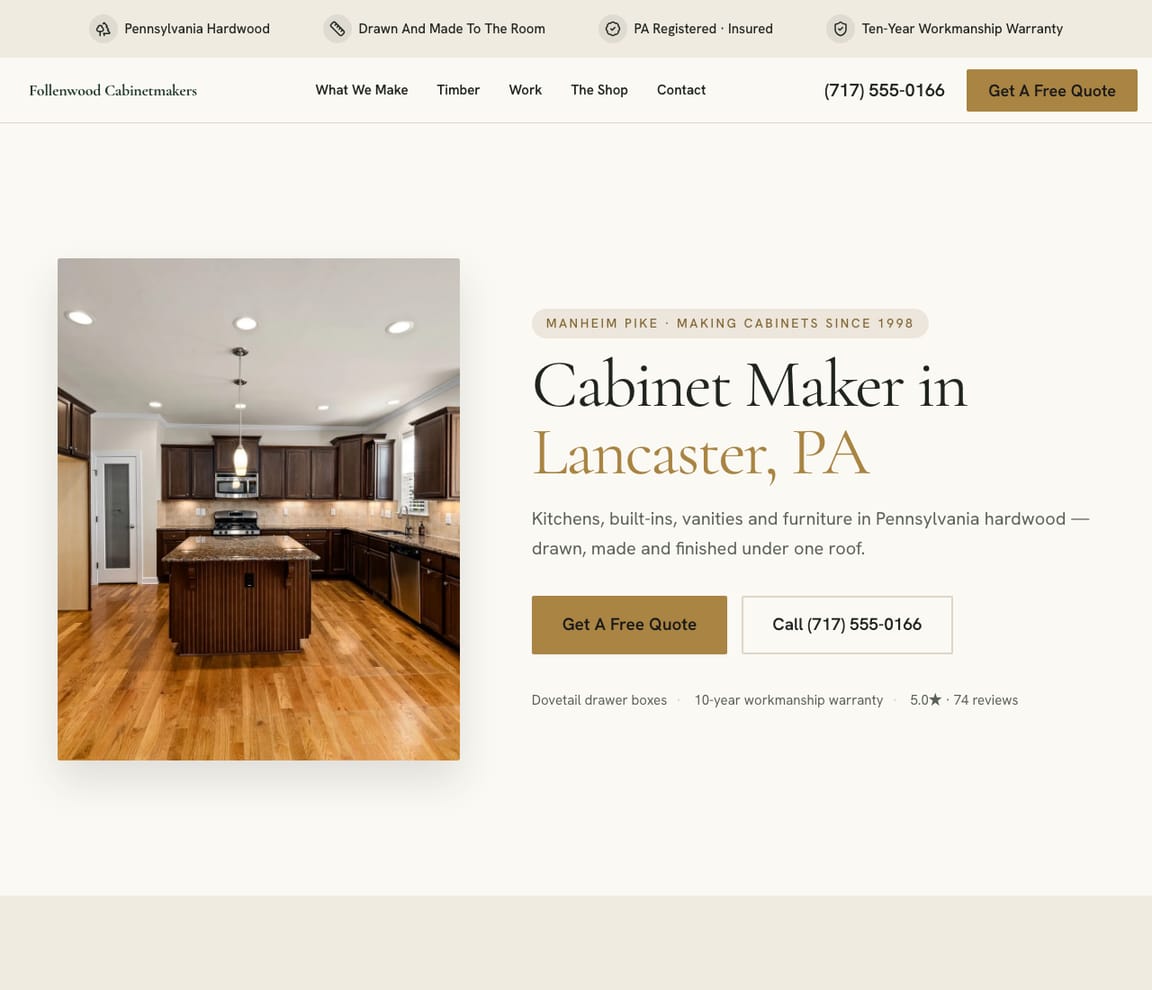
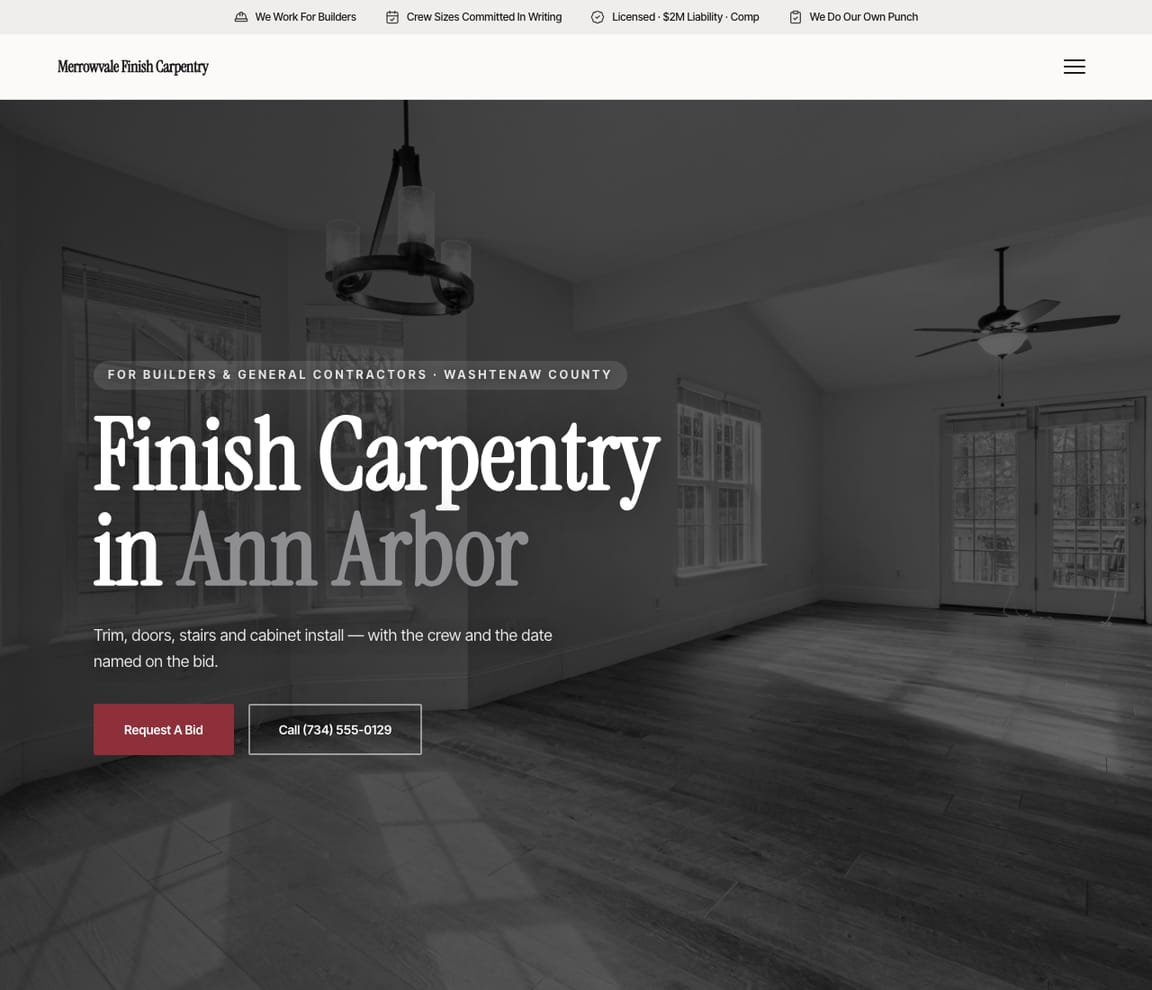
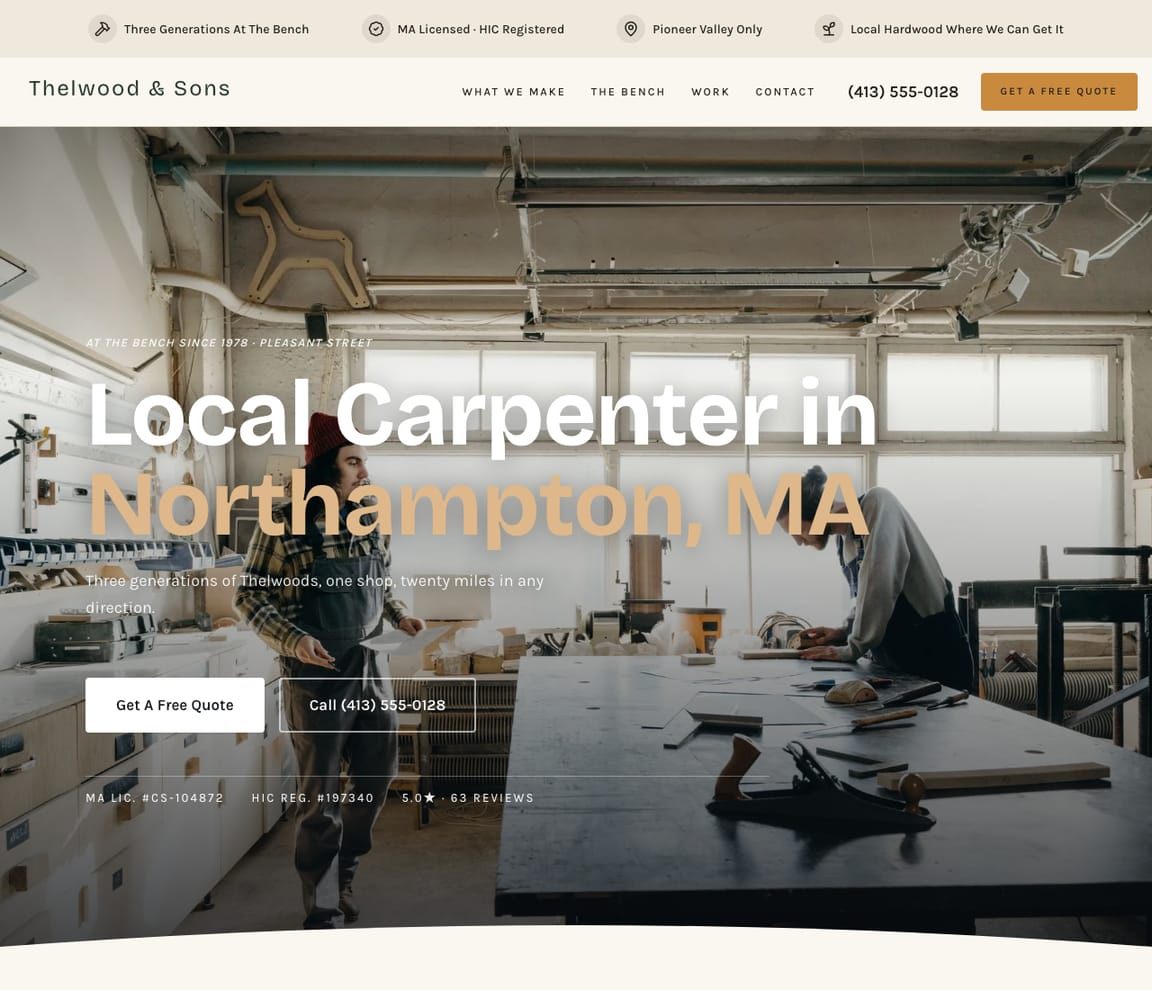
Real Zarla templates for the shapes the trade takes — the custom cabinetmaker, the finish carpenter, the craft shop, the restoration specialist. Open one, swap in your services and your project photos, and publish.

GET FOUND
Get found by the homeowner who has already saved the photo
Carpentry is searched with a picture in hand — the built-in, the deck, the trim — and the quote goes to the carpenter whose own photos, service area and license number are on the first screen. Zarla builds the website with your services, your service area and a quote form. Add your prices and your photos in chat, and once you connect your Google Business Profile, your name, your photos and your hours stay in step on both.
“Carpenter near me”
Searched by a homeowner with a saved photo, a realtor with a punch list and a contractor short a framer. Your services, your area, your photos and a quote form answer all three.
Google Business Profile
A carpenter who drives to customers qualifies for one: your service area, your hours and your project photos inside Google Maps. Free, and an afternoon to set up.
The license number on the page
Your contractor license or registration number on the site and the quote — in California and Oregon the law says where it goes — is what a homeowner checks before the deposit, and what a permit office asks for on a structural job.
Google Search
Hharborlanecarpentry.com
Harbor Lane Carpentry — Trusted carpenter in Your AreaDenver's licensed finish carpenter — built-ins, trim, decks, framing. Send a photo for a quote this week; see our project gallery and our license number. Call or request a quote online.← Your Zarla siteCcitycarpenterservices.com
City carpenter ServicesGoogle Maps
1
Harbor Lane Carpentry
← You2
Metro carpenter Co.
3
Quick carpenter Services
AI assistants (ChatGPT / Perplexity)
For a licensed finish carpenter in Denver who builds custom built-ins and can quote from a photo this week in your area: Harbor Lane Carpentry — a carpenter's site that lists built-ins, trim, decks and framing with a price range, shows the contractor license or registration number, has a project gallery, and takes a quote request with a photo upload from the page.
YOUR LAUNCH PLAN
Your become-a-carpenter checklist
The whole guide as things to check off. Work through them in order and you'll be trained, carded, licensed or registered where your state asks, insured and findable before your name goes on the truck.
- Pick the route in — a registered apprenticeship, a crew, or a technical college and a crew after.
- Document every hour — four years at 2,000 a year, signed off by the journeyman you worked under.
- Take the OSHA 10 — and learn the saw and fall rules below.
- Choose rough or finish — and buy the kit for it, from real prices.
- Read your state's contractor line — the dollar amount, the exam, the bond.
- License or register, bond and insure the business — entity, license, bond, liability, commercial auto, tools cover, workers' comp.
- Price from the lumber up — a 'from' price and a lead time.
- Get found — a website with your project gallery, your license number and a quote form, and a Google Business Profile.
REAL CUSTOMERS
Small business owners who got online with Zarla
Verified reviews from real Zarla customers.
“Optimized for local service-based businesses. Easiest website build I've experienced. The AI-based build is the way to go instead of clunky theme-based websites. Get the site built and get out of the weeds with Zarla!”
“Quickly built my website from scratch. No hiccups. Would highly recommend Zarla for someone with no experience who wants to start a polished business website.”
“Very reliable, professional, and fast results. I was able to get my business online in no time, and the ease of access made it so simple.”
“I had no idea how to set up a website for my business. Thanks to Zarla, they've helped me a lot.”
Be the carpenter the built-ins search finds first
Add your town and your business name, and Zarla builds the website from that one line — your services, the area you cover, your project photos, a call button and a quote form, with SEO in place. Add your prices and your license or registration number in chat. Free to build; you pay when you publish.
Already have a website? Bring it across →Zarla keeps your old page addresses where it can and redirects the ones that change, helping you keep the Google standing you've built.
Frequently asked questions
How much does it cost to become a carpenter?
In the US, about $692.19 for a lean start on a crew, our arithmetic from the pages that print each price: a $24.79 Stanley FatMax tape, a $12.55 speed square, a $22.99 leather tool bag and belt, $15.39 safety glasses, $49.99 Peltor earmuffs, a $179.00 DeWalt circular saw, a $362.99 DeWalt hammer drill and impact driver kit and a $24.49 bar clamp, as listed at Zoro. The fuller start as a carpentry business — the same kit, a $649.00 12-inch sliding miter saw, a $361.99 framing nailer and a $129.00 brad nailer, a $152.99 pancake compressor, a $183.99 level set, a $792.99 table saw with stand, the $300 EPA firm certification, Washington's $150.20 registration fee as one state's example, $1,124 for a year of general liability, $500 of tools cover and $2,865 of commercial auto at Insureon's medians — is $7,901.35. The apprenticeship itself is paid work; school first is $3,240 a semester at Texas State Technical College; California's contractor license adds a $25,000 bond. Neither figure includes the truck, the lumber or the website.
Do you need a license to be a carpenter?
In the US, there is no carpenter's license on the person in any state. What the states license is the contractor — the business — above a dollar line: California's C-5 framing or C-6 finish carpentry license for jobs of $1,000 or more, Virginia's Class C above $1,000, Nevada and Arizona above $1,000, Oregon and Washington from the first dollar, Florida's building or residential contractor for anything beyond $2,500 of casual work, Louisiana above $50,000 for commercial work with a registration from $7,500 for home improvements, North Carolina at $40,000. Pennsylvania, Maryland, New Jersey and New York City register or license home-improvement contractors. Texas, New York State and Illinois have nothing at state level, and a one-skill carpenter is exempt in Minnesota. Separately, federal law requires the EPA's lead-safe certification before window replacement or demolition in a home built before 1978. Check your state's contractor board and your city's before you take a job.
How long does it take to become a carpenter?
The federal apprenticeship standard is at least 2,000 hours of on-the-job learning a year with 144 classroom hours recommended, and the owners quoted above put their apprenticeships at two to four years — one studied four years before opening his sole proprietorship in 1988, one learned trim for two years before going out alone, and one says it took sixteen years to master cabinetmaking. O*NET puts the on-the-job training at a few days to a year to be useful on a crew. In California the contractor license asks for four years of journey-level experience, of which an apprenticeship can count for three.
What is a carpenter apprenticeship?
A registered program that pays you to learn: at least 2,000 hours a year on the job under a journeyman, 144 classroom hours a year recommended, and a progressively increasing schedule of wages, in the federal standard's words. The union route runs through the carpenters' training centers — in New York you attend an information session before you can apply; in Northern California a free six-week pre-apprenticeship with a stipend guarantees acceptance and hands graduates their own set of tools. The builders' route runs through the NAHB and HBI, whose academies offer tuition-free trades training. No US state requires an apprenticeship to work as a carpenter; what it buys is the hours a contractor license later asks for.
Is 40 too late to start an apprenticeship?
No source prints an age limit, so we will not invent one: the federal standard measures an apprenticeship in hours, not years of age, and no state board page we read sets a ceiling — the one age line we found is the UK's foundation apprenticeship for 16-to-21-year-olds, an entry route, not a cap. The carpenters quoted above include a Dallas project manager who went back to the tools in his thirties after a job offer was rescinded, a Spring furniture maker who left a desk job in 2018, and a Texas carpenter who started his training in 1984 after postponing university. At 40 the hours are the same hours.
How to become a carpenter with no experience?
Get on a crew. Every carpenter quoted above started as a helper — on a grandfather's deck, on a framing crew at 18, as an apprentice to a master carpenter, in a restaurant job swapped for a finish crew that was short of hands. The union training centers and the builders' pre-apprenticeships take people with no experience by design: Northern California's six-week course is free, pays a stipend and ends with your own tools. In the US nothing is required of the person before the first day except glasses, earmuffs and a willingness to carry lumber; the licenses arrive years later, when the business is yours.
Is it hard being a carpenter?
Physically, yes, and the first years of a business are the hard ones. Of the carpenters O*NET surveyed, 70 percent spend time standing continually or almost continually, 95 percent wear protective equipment every day and 67 percent say being exact or accurate is extremely important. The owners quoted above describe a first year with few jobs, lowball competitors, hobbyist tools that broke under professional work, and a truck and trailer stolen together. One Phoenix finish carpenter three years in calls it a fairly smooth road — because there were not many finish carpenters and an abundance of work.
How much do carpenters make?
Employed carpenters had a median of $60,580 in 2025 — $29.12 an hour — with 10 percent earning $40,410 or less and 10 percent $99,910 or more, from BLS data on O*NET. By state the median is $48,900 in Texas, $75,920 in California, $49,870 in Florida and $72,330 in New York. The builders' association quotes the BLS mean at $66,470 and says about one carpenter in three is self-employed — and the self-employed are not in the wage survey, so an owner's income is the billing minus the truck, the lumber, the tools and the insurance.
Is a carpenter well paid?
Against the other trades in this series, in the middle: a 2025 median of $60,580 for employed carpenters, above painters and welders and below plumbers and electricians, with the top 10 percent at $99,910 or more and the bottom 10 percent at $40,410 or less. The state matters more than the title: California's median is $75,920 and New York's $72,330, Texas's $48,900 and Florida's $49,870. The owner's income is a different number, and one Texas sole proprietor says plainly that the business has not been lucrative — the purpose and the clients are what kept him in it.
What is the highest paid type of carpenter?
The wage survey does not rank framers against finish carpenters or cabinetmakers, so no honest page can. What it does print is the top of the distribution: the 10 percent of employed carpenters earning $99,910 or more nationally, $119,950 or more in California and $122,400 or more in New York. The owners quoted above suggest where that sits — high-end trim and cabinet work for custom builders, and ownership — but that is their experience, not a statistic.
Can a carpenter make $100,000 a year?
The top 10 percent of employed US carpenters earned $99,910 or more in 2025, and in California the 90th percentile is $119,950 and in New York $122,400 — so for roughly one in ten employees, yes, and in the high-wage states more than that. The wage survey excludes the self-employed, which the builders' association puts at one carpenter in three; an owner's six figures is billing, not a paycheck, and the plan page linked above works that arithmetic.
Why does carpentry pay so little?
The figures first: a median of $60,580 and $29.12 an hour, a 10th percentile of $40,410 or $19.43 an hour, and medians under $50,000 in Texas and Florida. No source prints a cause, so we will not editorialize beyond them; what the owners quoted above describe is a trade where the first years' income goes into tools and a truck, where the lowball contractor sets the price in a recession, and where one sole proprietor since 1988 calls the business not lucrative and the work soul-fulfilling. The upside is in the states with high medians and in owning the shop.
Do I need an LLC to be a carpenter?
No US state requires it for the work, which attaches to you — or, where your state licenses the contractor, to that license, whatever the entity. A one-truck carpenter is a sole proprietor by default: Schedule C, the 15.3 percent self-employment tax once net earnings pass $400, quarterly estimates once you expect to owe $1,000. If you form an LLC: $300 in Texas, $100 plus a $25 registered-agent fee and $50 a year in Florida, $200 in New York plus a notice published for six weeks in two newspapers, and $70 in California plus an $800 annual tax every year. The insurance matters more than the entity — and the owners above learned how expensive it is the first year. Confirm the details with your accountant.