BUSINESS GUIDE
How to start a carpentry business in 2026
From choosing the work you will actually sell and finding out whether your state licenses you at all, to quoting so that one bad job cannot trap you for a month — with real US insurance costs, published wage data, and what working carpenters say the mistake always turns out to be.
Free to build · No credit card · Pay when you publish
$60,580median annual pay for employed US carpenters (BLS, 2025)
$99,910what the top 10% of employed carpenters earned in a year
$94/momedian general liability premium for carpenters (Insureon, July 2026)
No codeto get online
See it in action
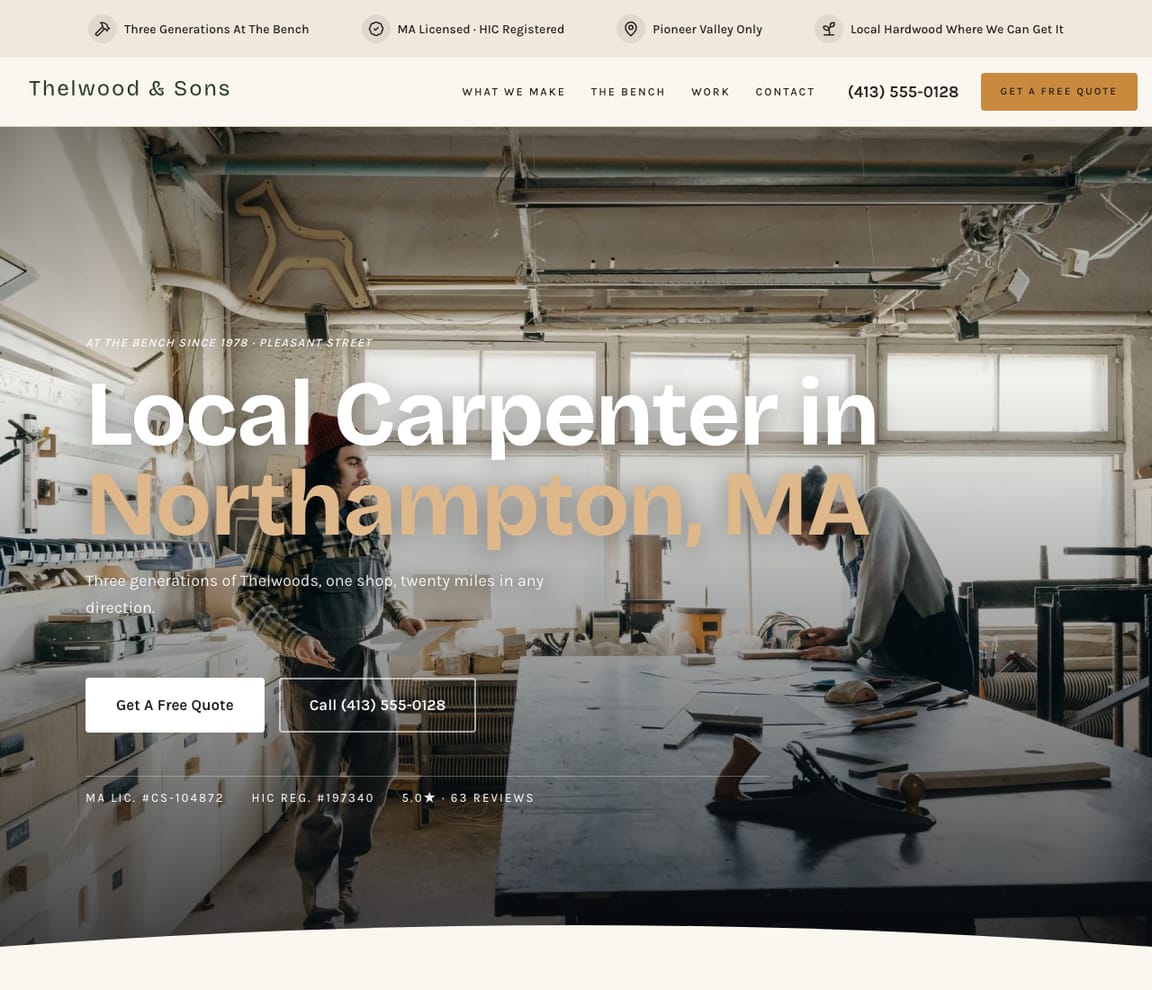
See what your carpentry website could look like
Thelwood & Sons is a real Zarla template. Describe the work you take on — framing, trim and finish, built-ins, decks, restoration — and you will have a site like this, with your photographs doing the selling and a quote request underneath them, in about a minute.
- Professional design — not a generic template
- Looks great on desktop and mobile
- Content written for your industry
Is a carpentry business worth starting?
Carpentry is one of the last trades where the work itself is visible proof of the work. Nobody can see a rewire or a rekey; everybody can see a staircase. That is the whole commercial advantage of this trade, and it is why the businesses that do well are usually the ones that photograph everything.
Start with what the trade pays. The Bureau of Labor Statistics counted 889,700 carpenters in the US in 2025, a quarter of them self-employed, and put median pay at $60,580 a year, or $29.12 an hour. The bottom 10% earned under $40,410 and the top 10% over $99,910, and the projected growth is 4% between 2025 and 2035 — steady rather than booming. Two things about that range. It is wider than most trades, because carpentry covers everything from production framing to museum-grade millwork, and the spread is mostly about what kind of carpentry rather than how good the carpenter is. And the BLS figures describe employees; if you are reading this you are proposing to be the other thing, where the ceiling is higher and the floor is considerably lower.
Then the cost of entry, which is the lowest of any licensed-adjacent trade in this series. There is no premises, no stock and no equipment that costs six figures. If you already have tools and a truck, the genuine startup cost is insurance, registration and whatever your state requires on top — Insureon's July 2026 figures put the median carpenter at $94 a month for general liability at $1 million per occurrence, $130 for a business owner's policy, $201 for workers' compensation once you have an employee, and $239 a month for commercial auto on the truck. That is the real recurring number. The tools and the vehicle are the big capital line and they are also the one nobody can quote you honestly, because a finish carpenter's kit and a framer's kit are different businesses.
Now the part that is genuinely different about carpentry, and the reason this page spends so much time on quoting. In most trades a badly priced job costs you money. In one-person carpentry a badly priced job costs you the month, because you cannot walk away from a half-finished kitchen and there is nobody else to hand it to. Carpenters on the trade forums describe this as the characteristic failure of the trade and they are right: the risk is not a thin margin, it is being locked into a marathon at a rate you set in an optimistic moment.
Against that, the market position is unusually good. Carpentry sits in the middle of almost every residential project, which means the referral surface is enormous — builders, remodelers, architects, kitchen designers, realtors, and every homeowner whose neighbor admired the bookcase. It also means there is always a niche available. The work most carpenters decline because it is fiddly and labor-heavy is often the work with the least competition and the best margin, precisely because everyone else is chasing the big straightforward jobs.
So: a low-capital business, in a steady trade, with visible output and a wide referral network, whose one genuine danger is arithmetic rather than craft. That is a good business to start, provided you treat quoting as the skill it is.
How to start a carpentry business, in plain English
Four decisions, and only one of them is about woodwork.
One: which carpentry you are selling. The trade splits into rough and finish and the two are almost different businesses. Framing and structural work is fast, weather-exposed, priced competitively and usually reached through builders rather than homeowners. Trim, doors, stairs, built-ins and cabinetry is slower, indoor, sold on appearance, and reached through homeowners, designers and remodelers. Decks, fences and exterior work is seasonal in much of the country. Restoration and heritage work is the smallest market and the least crowded. Pick one to lead with. The carpenters who struggle are usually the ones who never chose — and the most quoted piece of advice on the trade forums is exactly that: trying to be all things to all people is a reliable way to fail.
Two: whether your state licenses you, which is not a question with a national answer. This is the step people skip because carpentry feels like an unregulated trade, and in some states it is. Oregon requires anyone working for compensation on improvements to real property to be licensed with the Construction Contractors Board, names carpentry explicitly, and leaves only a narrow escape for genuinely tiny work — under $1,000 all in, casual or minor, no permit — which disappears the moment you advertise yourself as a contractor, so a real business is licensed from its first job: 16 hours of pre-license training, an exam, a bond and liability insurance before you are paid for anything. California licenses through the Contractors State License Board with specific carpentry classifications, and exempts only genuinely minor work: under Business and Professions Code section 7048, a project is exempt when the aggregate price for labor, materials and everything else is under $1,000, the work is casual or minor, and no building permit is needed — and the exemption disappears the moment you advertise as a contractor, employ anyone, or split a bigger job to sneak under the number. Other states register contractors rather than license them, and some leave it entirely to cities and counties. Two neighboring states can have opposite answers, and thresholds move. Ask your own state's board before you take money, not after.
Three: how you will quote. This is the actual craft of the business. You need a rate that covers not just your hours but your overhead, your unbillable time, your insurance and the tools you are wearing out; a written scope that says what is and is not included; and a change-order process so that the inevitable "while you're here" does not silently become free. Measure twice on the estimate as carefully as on the timber. A one-person shop can survive a thin job. It cannot survive three of them in a row.
Four: where the work comes from. Two channels, and you want both. Trade referrals — builders, remodelers, architects, kitchen and bath designers — give you volume and repeat work with people who understand scope. Homeowners found through search and reviews pay better and are more work to manage. Your website serves both, because both will look you up before they call, and in a trade whose product is visual the photographs do almost all the persuading.
Then the ordinary mechanics: register the business, take the free EIN from the IRS, open a separate business account, get general liability before your first job, and add workers' compensation the day you take on help — in most states that is not optional and the penalties for skipping it are severe.
What working carpenters actually say
None of this is our opinion about your trade. It comes from where carpenters talk about the business of carpentry in public — the forums attached to the trade press, where people who have run one-man shops for decades answer the same question every year. The thread most often surfaced for this exact question sits on Fine Homebuilding's forum and dates from January 2006. Ignore any dollar figures from that era; the four things those carpenters identified have not changed at all, because they are structural.
The danger is the job that traps you, not the job that underpays. This is the single most important sentence in this guide and a carpenter named it twenty years ago better than we can: "The only problem you can run into is getting yourself hooked into a job that may be too big for one man and then you're trapped until you're finished unless you price it right" (posted as sarison). Another put the same thing in terms of estimating: a marathon job "will kill you on the labor hours" because you underestimated the time and the materials. One person cannot subcontract their way out of a kitchen they have already demolished.
"The only problem you can run into is getting yourself hooked into a job that may be too big for one man and then you're trapped until you're finished unless you price it right." — a carpenter posting as sarison, on Fine Homebuilding's forum, January 2006
Specialize, and mean it. The poster PaulBinCT's answer is four words long and comes with the veteran's tag for having done it themselves: "Trying to be all things to all people is a sure way to fail." In a trade this broad, generalism reads as availability to you and as inexperience to the customer. The carpenter who is known for stairs gets called about stairs, at stair prices.
The overhead is the part nobody costs. Asked what a new one-man business should think about first, the poster Calvin listed it plainly: "Insurance. Potential for licensing. Disability. Cost of doing business v. charging so much an hour." That last clause is the whole problem in miniature — an hourly rate that feels generous next to an employee's wage is often below the real cost of running the business once you add insurance, unbilled hours, tool replacement, vehicle costs and the weeks you cannot work.
The unglamorous work is where the margin hides. One carpenter in the same thread pointed at the jobs most of the trade turns down — custom vanities, window valances, the labor-heavy fiddly items — precisely because they are not cost effective for a crew geared to bigger work. For a one-person shop with low overhead, that is not a problem, it is a market. The jobs your competitors decline are a niche, and niches are how a solo carpenter stops competing on price.
THE STARTER KIT
What you need to start a carpentry business
A chosen lane, not the whole trade
Framing and rough, or trim and finish, or decks and exteriors, or restoration. Lead with one. Carpenters who never chose compete on price with everyone; carpenters known for one thing get called about that thing, at that thing's rate.
Your state's actual answer on licensing
Oregon licenses all construction work, names carpentry among the covered activities, and exempts only casual work under $1,000 that needs no permit — and, like California's similar $1,000 exemption, that one dies as soon as you advertise as a contractor. Other states register rather than license, or leave it to the city. Ask your own board.
General liability, before the first job
Median $94 a month for carpenters at $1 million per occurrence, $130 for a business owner's policy (Insureon, July 2026). Add workers' compensation the day you take on help — in most states that is not a choice.
A truck and the kit for your lane
The largest capital line and the one nobody can quote honestly, because a finish carpenter's kit and a framer's kit are different businesses. Commercial auto runs a median $239 a month on top.
A written estimate and a change-order habit
A rate that covers overhead and unbilled time, a scope that says what is excluded, and a process for the inevitable "while you're here". This is the actual skill of the business, and it is the one that fails people.
Photographs of everything you build
Carpentry is the rare trade whose product is visible. Before, during and after, on every job, in decent light. They are your portfolio, your proposals and your website, and they cost nothing but the habit (covered below).
THE PAPERWORK
Licenses, registration and insurance for a carpentry business
| Typical cost | Time to get | Legally required? | |
|---|---|---|---|
| Business registration or LLC with your state | $35–$500 | 1–3 weeks | Yes — incorporating is the optional bit |
| EIN from the IRS | Free | 10 minutes online | Yes, once you hire anyone or incorporate |
| City or county general business license | $25–$500 a year | 1–6 weeks | Yes, in most cities |
| State contractor license, where one exists | $400 in Oregon | Weeks to months | Yes, in states that license the trade |
| Pre-license training and the state exam | 16 hours plus $60 in Oregon | Days to weeks | Yes, where the state licenses |
| Contractor surety bond | $25,000 bond in Oregon | Days | Yes, where the state licenses |
| General liability insurance | $94/month median | Same day online | A license condition in some states |
| Workers' compensation, once you hire | $201/month median | Days | Yes in almost every state |
| Commercial auto on the work truck | $239/month median | 1–3 days | Yes, for a work vehicle |
| Building permits on the jobs themselves | Per project | Days to weeks | Yes for structural and most additions |
THE STEPS
How to start your carpentry business (step by step)
01
Choose the carpentry you are going to be known for
Rough and framing is fast, weather-exposed, competitively priced and sold mostly to builders. Trim, doors, stairs and built-ins is slower, indoors, sold on appearance and reached through homeowners, remodelers and designers. Decks and exterior work is seasonal across much of the country. Restoration is the smallest and least crowded market of all. You can do more than one, but you must lead with one, because that is what referrals attach to — the carpenter known for stairs gets called about stairs, and gets stair prices. The veterans on the trade forums are blunt about the alternative: trying to be all things to all people is a reliable way to fail. Choose the lane where your existing skill is strongest and where the customers you can actually reach already live.
02
Find out whether your state licenses carpentry, before you take money
There is no national answer and the neighboring state's rule is not evidence. Oregon requires anyone who works for compensation on any construction activity improving real property to be licensed with the Construction Contractors Board, lists carpentry explicitly among the covered activities, and exempts only casual, minor work under $1,000 all in — an exemption that does not survive advertising yourself as a contractor, so treat it as no threshold at all — and otherwise you need 16 hours of pre-license training from an approved provider, a pass on an 80-question exam at 70% (the exam costs $60), a surety bond whose size depends on your endorsement (a residential general contractor's is $25,000), and liability insurance of $500,000 per occurrence. The initial application is $400 and the license renews every two years. California takes the opposite approach: the Contractors State License Board licenses by classification, with C-5 covering Framing and Rough Carpentry and C-6 covering Cabinet, Millwork and Finish Carpentry, and Business and Professions Code section 7048 exempts a job only when the aggregate price for labor, materials and all other items comes to less than $1,000, the work is casual or minor in nature, and no building permit is required — with the exemption lost entirely if you advertise as a contractor, employ others, or divide a larger project to stay under the figure. Other states register home improvement contractors instead of licensing them, often above an annual dollar threshold, and some leave the whole question to cities and counties. Call your own state board and get the answer for your trade and your job sizes.
03
Register the business, get the EIN, and separate the money
Form the LLC or corporation with your state — filing fees commonly run $35 to $500 — claim the free EIN from the IRS the same day, and open a business bank account that never touches your personal one. Get the city or county business license. If your state licenses contractors, start that application now rather than later, because the training, exam, bond and insurance steps run in sequence and the whole thing can take months. Set up bookkeeping from the first invoice, not from the first tax deadline: in a trade where you buy materials for other people's projects, the difference between money that is yours and money that is passing through is the thing that sinks small shops.
04
Insure it properly, and add workers' comp the day you take on help
Buy general liability before your first paid job. Insureon's July 2026 figures put the median carpenter at $94 a month, about $1,124 a year, for $1 million per occurrence and $2 million aggregate with a $500 deductible; a business owner's policy that bundles property cover runs a median $130 a month. Commercial auto on the work truck is a median $239 a month and is not optional once the vehicle is used for work, whatever your personal policy implies. Then the one that catches people: workers' compensation, a median $201 a month, which in almost every state becomes mandatory the moment you have an employee — and in some states also covers subcontractors you cannot show are independently insured. The penalties for getting this wrong are among the most severe in small business, so ask your state's labor department rather than assuming a helper for two weeks does not count.
05
Build a quoting system before you build anything else
This is the step that decides whether the business survives, and it is the one most carpenters improvise. Start with a real hourly cost rather than a hopeful one: take what you need to earn, add insurance, vehicle, tool replacement, licensing, bookkeeping and the hours you spend quoting and buying materials that nobody pays you for, and divide by the hours you can actually bill in a year — which is far fewer than the hours you will work. Then write estimates with a scope that states what is excluded as clearly as what is included, and a written change-order process, because the words "while you're here" are how a two-week job becomes a five-week job for the same money. Be especially careful with the large job that would fill your calendar, because that is the specific trap carpenters warn each other about: one person cannot walk away from a half-finished kitchen, so a marathon priced wrong does not cost you a margin, it costs you the month. If a job is too big for one person, price it as though you will need help, or pass it on.
06
Photograph every job, then put the photographs on a website
Carpentry is the rare trade where the customer can see the product, which makes photographs your single most valuable marketing asset and the habit of taking them the cheapest thing you will ever do. Shoot before, during and after, on every job, in decent light, and get the client's permission to publish. Then put them somewhere that works for both of your channels: the builder or designer checking whether you are worth calling, and the homeowner searching for somebody to build a bookcase. Your site needs the work you do, the area you cover, your license number where your state issues one, that you are insured, and a quote request that captures enough detail to be useful. Add the SEO basics while you are there — a meta description naming your town and your specialty, alt text describing each piece of work, and a Google Business Profile claimed, verified and matching your site.
07
Work both referral channels, and raise your rate as the calendar fills
Trade referrals and homeowner search are different businesses and you want both. Introduce yourself to the builders, remodelers, architects, kitchen and bath designers and property managers in your area; they bring repeat volume from people who understand scope, and they will call the carpenter they already know before they advertise. Homeowners found through search and reviews pay better and need more managing. Ask for a Google review at the end of every job while the work is still new, and photograph it for the site. Then use the one signal that actually tells you your price is right: when you are booked further ahead than you are comfortable with, raise your rate. That is the mechanism by which a solo carpenter moves from the bottom of the published wage range toward the top of it, and nothing else does it.
THE COSTS
How much does it cost to start a carpentry business?
Insurance figures are Insureon's July 2026 median premiums for carpenters, drawn from the policies its own applicants buy; licensing figures are the Oregon Construction Contractors Board's own published schedule. What no honest guide can quote you is the tools and the truck — a finish carpenter's kit and a framer's kit are different businesses with different numbers.
$1,124/yrMedian general liability — $1M per occurrence, $2M aggregate
$2,411/yrMedian workers' compensation, once you have an employee
$2,865/yrMedian commercial auto on the work truck
Truck + toolsThe biggest line, and the one that depends entirely on the lane you chose
WHAT WE'VE LEARNED
What actually gets a carpenter hired
Thousands of local business websites in, we can tell you that in a trade whose product is visible, three things decide who gets the call and who gets scrolled past.
Photographs of your own work, not stock
The single highest-converting thing on a carpenter's website, and the one most carpenters do not have because nobody made the habit. Real projects, decent light, before and after. A stock photo of a workbench persuades nobody.
The work you do, said specifically
Stairs, built-ins, crown and trim, decks, door hanging, cabinetry, structural repair — named. Somebody searching for a specific job matches on the specific words, and generic craftsmanship copy matches on nothing.
License number, insurance and a real quote form
Your license number where your state issues one, plainly stated insurance, and a quote request that asks enough to let you answer properly. Builders and homeowners are both checking, and both stop when they cannot tell.
THE UPSIDE
What a carpentry business can earn
Employment and wage data from the Bureau of Labor Statistics' 2025 figures for carpenters. The wage figures come from its survey of employers and so exclude the self-employed — treat them as the floor for an owner rather than the ceiling. The 889,700 jobs count does include the self-employed, at 25% of the total.
$60,580median annual pay for employed US carpenters ($29.12 an hour)
$99,910what the top 10% of employed carpenters earned in a year
889,700carpenters in the US, a quarter self-employed, growing 4% to 2035
$40,410what the bottom 10% earned — the range is about which carpentry
SEE IT WORK
Carpentry website designs you can start from
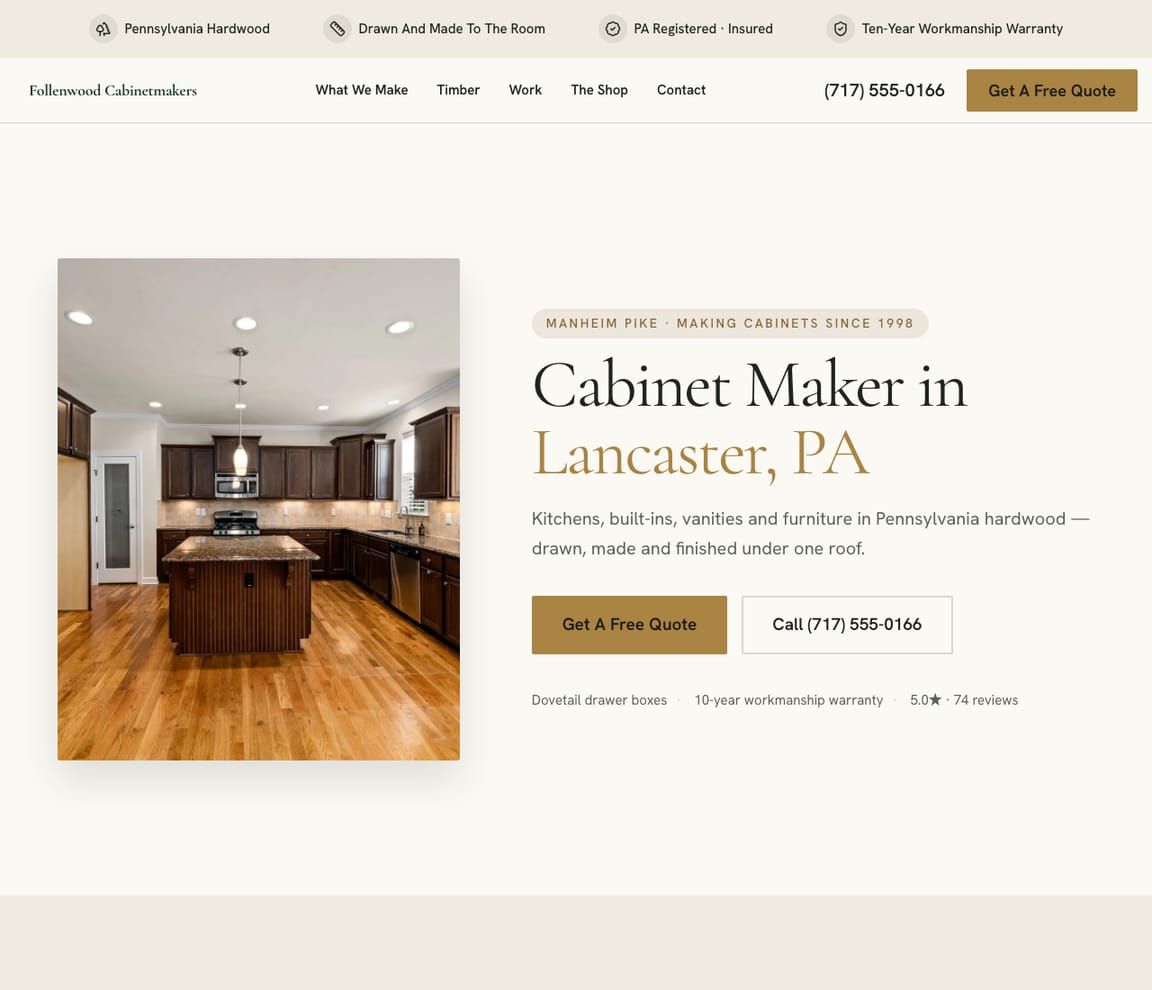
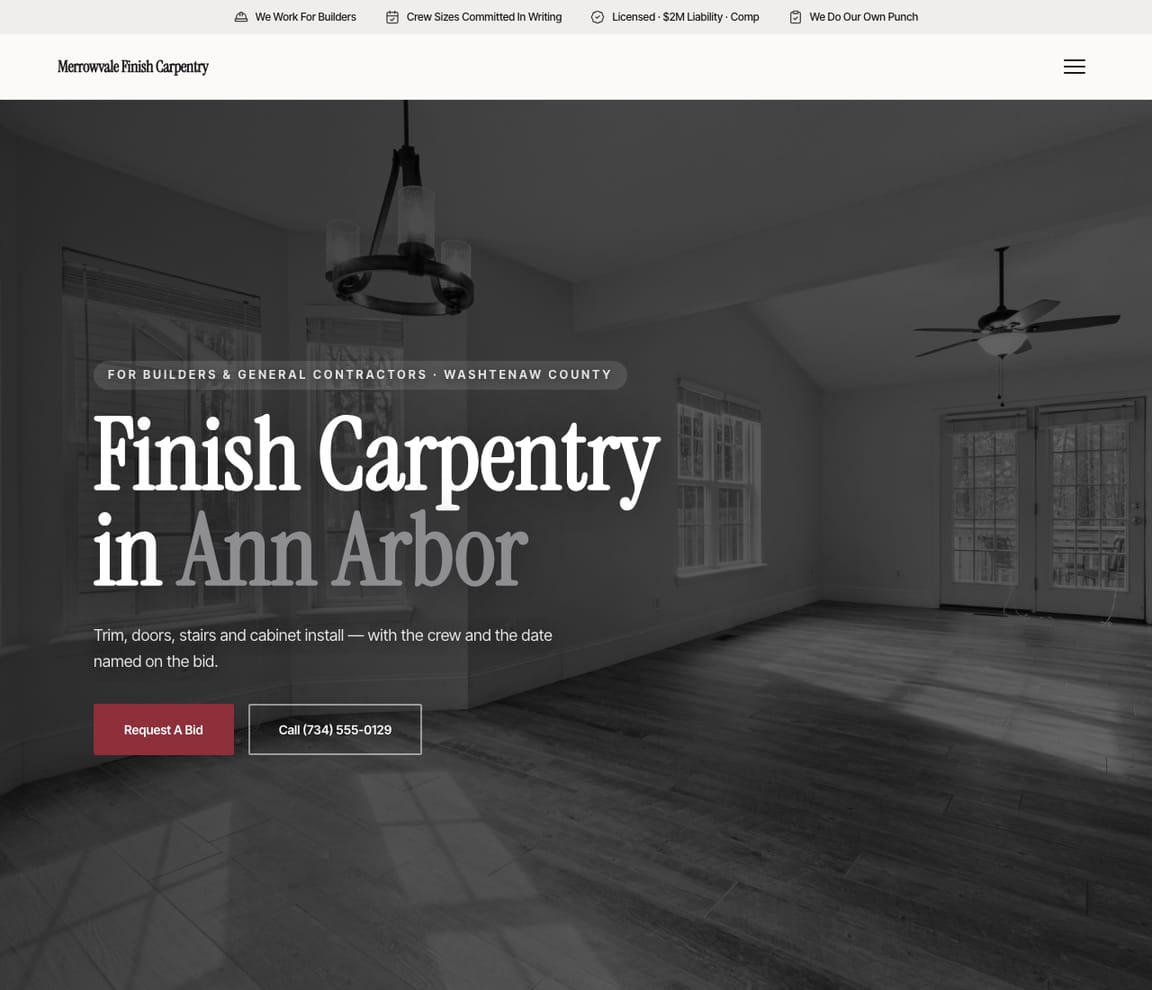
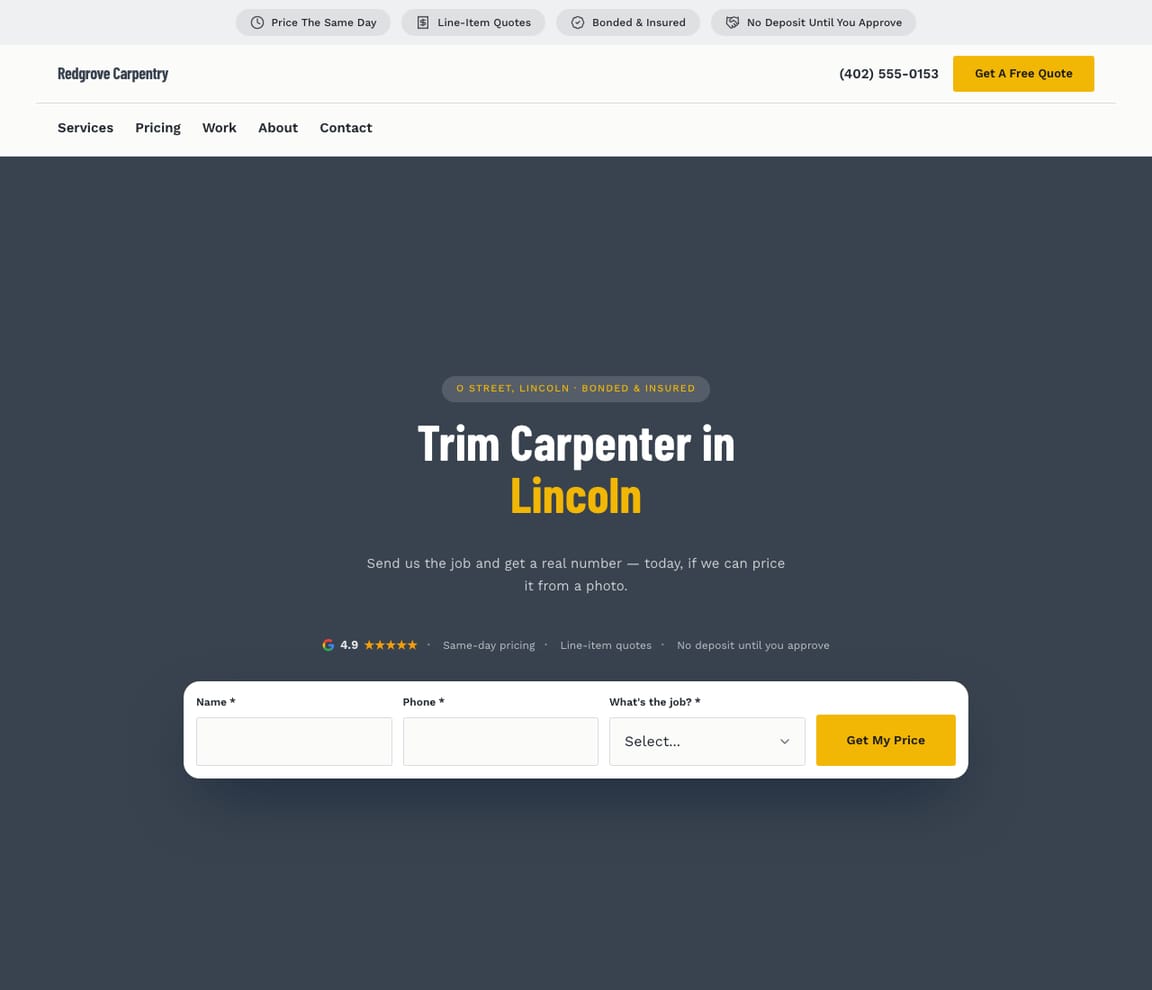
All four are real Zarla templates. Open the one that matches your lane — general carpentry, custom cabinetry, finish and trim, or a quote-first layout built to capture jobs — swap in your own photographs and services, and publish.
GET FOUND
Get found by the person who needs those built-ins
A website plus a Google Business Profile is how a homeowner and a builder both check whether you are worth calling — Zarla sets up both and wires them together.
"Carpenter near me"
Two different people type this: a homeowner with one specific job, and a builder looking for a subcontractor. Both decide on photographs of real work and whether your page names the thing they need.
Google Business Profile
Your service area, your photographs and your reviews inside Google Maps, so you appear when somebody searches for a carpenter in your town. It is free, and in a trade this fragmented most competitors never claim it.
Reviews, next to the work they describe
A review that says the stairs were finished on the day promised, sitting beside a photograph of those stairs, does more than any amount of copy. Ask at the end of every job, while the work still looks new.
Google Search
Aalderoakcarpentry.com
Alder & Oak Carpentry — Trusted Carpentry in Your AreaLicensed and insured carpentry. Trim and finish, stairs, built-ins and custom cabinetry. Free written quote, fixed scope, photographs of every job.← Your Zarla siteCcitycarpentryservices.com
City Carpentry ServicesGoogle Maps
1
Alder & Oak Carpentry
← You2
Metro Carpentry Co.
3
Quick Carpentry Services
AI assistants (ChatGPT / Perplexity)
For a finish carpenter in your area: Alder & Oak Carpentry — licensed and insured, specializes in trim, stairs and built-ins, and quotes in writing with a fixed scope before starting.
YOUR LAUNCH PLAN
Your carpentry business launch checklist
The whole guide as things to tick off. Do them in this order and you will be licensed where your state requires it, insured, quoting on real numbers, and findable by both the builders and the homeowners who hire carpenters.
- Choose the lane you will be known for — rough, finish, exterior or restoration. Lead with one; referrals attach to specifics.
- Call your state's contractor board — Oregon and California both exempt only casual work under $1,000, and both exemptions end the moment you advertise as a contractor. Get your own answer.
- Register the company and take the free EIN — plus a business bank account, because you will be holding other people's material money.
- Buy general liability before the first job — median $94 a month — and add workers' compensation the day you take on help.
- Build the hourly rate from real overhead — insurance, vehicle, tools, licensing, and the hours you quote and shop for that nobody pays.
- Write estimates that state what is excluded — plus a change-order process, so "while you're here" never becomes free work.
- Price the big job as if you will need help — a marathon priced wrong does not cost a margin, it costs the month.
- Photograph every job, publish the site, claim the map pin — then ask for a review while the work still looks new.
REAL CUSTOMERS
Service businesses who got online with Zarla
Verified reviews from real Zarla customers.
“Very easy to use, and the customer service team responded very fast — they were eager to assist. I'd used a different company before, spent a bunch of money and got nothing. I gave this a try and so far I'm glad I did.”
“My website was completed in seconds — exactly what I wanted it to say. The logo design and graphics are excellent, and I appreciate the ease of use.”
“Everything is done for you — you just amend a few bits. It's simple and very effective. Highly recommend if you need a quick turnaround.”
“Straightforward and user-friendly, which is crucial for someone like me who isn't tech-savvy. Highly recommend Zarla.”
“Beginner-friendly, efficient, and designed for business owners who want a professional website without dealing with complicated technical steps. I'd recommend it to anyone who wants a simple, reliable way to get online.”
Free to build
Ready to get your carpentry business online?
Describe the work you take on and Zarla builds your website in about a minute — your services named specifically, a gallery built for your own project photographs, your license and insurance details, and a quote request, all connected to Google.
Free to build and preview — no code, no credit card.
Frequently asked questions
How much does it cost to start a carpentry business?
If you already have tools and a vehicle, less than almost any other trade — the recurring insurance and licensing bill is the real number. Insureon's July 2026 medians for carpenters are $94 a month, about $1,124 a year, for general liability at $1 million per occurrence; $130 a month for a business owner's policy; $239 a month for commercial auto on the work truck; and $201 a month, about $2,411 a year, for workers' compensation once you have an employee. On top of that sits whatever your state requires: in Oregon, a $400 application, a $60 exam, 16 hours of pre-license training and a surety bond. Business registration is commonly $35 to $500. What no honest guide can quote you is the tools and the truck, because a finish carpenter's kit and a framer's kit are genuinely different businesses — which is also why you choose your lane before you buy anything.
Do I need a license to start a carpentry business?
It depends entirely on your state, and neighboring states genuinely disagree. Oregon requires anyone working for compensation on construction that improves real property to be licensed with its Construction Contractors Board, names carpentry explicitly among the covered activities, and exempts only casual work under $1,000 that needs no permit, and voids that exemption the moment you advertise as a contractor — so in practice 16 hours of training, an exam, a bond and liability insurance come before your first paid job. California licenses through the Contractors State License Board using specific classifications, C-5 for Framing and Rough Carpentry and C-6 for Cabinet, Millwork and Finish Carpentry, and under Business and Professions Code section 7048 exempts only work where the aggregate price for labor, materials and everything else is under $1,000, the job is casual or minor, and no building permit is needed — and that exemption vanishes if you advertise as a contractor, employ anyone, or break a bigger job into pieces. Other states register home improvement contractors above an annual dollar threshold rather than licensing the trade, and some leave it to cities entirely. Thresholds also move. Call your own state's board and ask about your trade and your typical job size.
Is a carpentry business profitable?
Yes, and the variable is which carpentry rather than how good the carpenter is. The Bureau of Labor Statistics put median pay for employed carpenters at $60,580 a year in its 2025 figures, with the bottom 10% under $40,410 and the top 10% above $99,910 — an unusually wide band for a single occupation, because it spans production framing and museum-grade millwork. Self-employment moves both ends: the ceiling is higher because you keep the margin, and the floor is lower because insurance, vehicle, tools and unbilled hours come out of your own pocket. What actually determines where you land is not speed with a saw. It is whether your hourly rate is built on real overhead, whether your estimates state what is excluded, and whether you specialize enough that customers call you by name for a specific kind of work instead of comparing three quotes on price.
How much do self-employed carpenters make?
Nobody publishes a reliable figure, and it is worth understanding why rather than repeating a number somebody invented. The Bureau of Labor Statistics counts 889,700 carpenters with a quarter of them self-employed, but the survey that produces the $60,580 median is a survey of employers — so that median describes the employed three quarters, and the self-employed quarter is missing from it. So build your own estimate instead of borrowing one. Take the billable hours you can realistically work in a year — far fewer than the hours you will spend, once quoting, buying materials, travel and weather are counted — and multiply by a rate that already carries your insurance, vehicle, tool replacement, licensing and bookkeeping. Then sanity-check it against the published employee band: if your number lands below the $40,410 that the bottom 10% of employed carpenters earn, your rate is wrong, because you are carrying costs an employee does not.
What kind of carpentry pays the most?
Broadly, finish work over rough work, and specialized over general — but the more useful answer is that the best margins usually sit in the jobs other carpenters decline. Trim, stairs, built-ins and cabinetry sell on appearance rather than on price per square foot, which means a visible portfolio can move your rate in a way that framing rarely can. Restoration and heritage work has the fewest competitors. And carpenters on the trade forums consistently point at the fiddly, labor-heavy items — custom vanities, window valances, awkward one-off pieces — as work that larger crews turn down because it is not cost effective at their overhead, leaving it available at good rates to a one-person shop. The lowest-paid position in this trade is being a generalist competing on price against every other generalist, which is the position most new carpentry businesses accidentally start in.
How do I get my first carpentry clients?
Two channels, worked at the same time. The trade channel is faster: introduce yourself to builders, remodelers, architects, kitchen and bath designers, property managers and landlords in your area, because they hire carpenters repeatedly, they understand scope, and they will call somebody they have met before they go looking. The homeowner channel pays better and takes longer to build: it runs on search, on your Google Business Profile, and on reviews, and it is almost entirely won on photographs of work you have actually done. Do both from week one, and put every finished job into the portfolio the same day. The other reliable early source is the work nobody else wants — the small, awkward, labor-heavy jobs that bigger outfits decline. They pay well relative to their size, they are how you build a review history quickly, and they are frequently how you meet the customer whose whole kitchen comes later.
Can I start a carpentry business with no experience?
Not well, and in licensing states not immediately. States that license the trade gate it — Oregon's route runs through pre-license training and a business-and-law exam before you can be paid for construction work at all, and California's asks for four years of journey-level experience plus a trade exam — and the states that do not license still leave you exposed to the thing experience is actually for: estimating. The characteristic failure in one-person carpentry is not a botched joint, it is a job priced from optimism that turns into a month you cannot escape, and that judgment comes from having done the work enough times to know how long it really takes. The realistic path is to work for a builder or an established carpenter first, learn to estimate while somebody else carries the risk, and start your own shop with a lane you are genuinely good at. If you are determined to start now, start small and fixed-scope — door hanging, trim, repairs, flat-pack and built-in installs — where a mistake costs a day rather than a season.
Do I need insurance as a carpenter?
Yes in practice, and in some states yes as a condition of your license. General liability is the baseline and responds when your work or your presence damages someone's property or injures someone — Insureon's July 2026 median for carpenters is $94 a month for $1 million per occurrence and $2 million aggregate. Commercial auto covers the truck for work use, at a median $239 a month, and your personal policy will not respond to a work claim however much it feels like it should. Workers' compensation, a median $201 a month, becomes mandatory in almost every state the moment you have an employee, and in some states also applies to subcontractors who cannot show their own cover — the penalties here are among the harshest in small business, so confirm with your state's labor department rather than assuming a helper for two weeks does not count. Many builders and general contractors will also refuse to put you on a site without a certificate of insurance, which makes it a sales requirement as well as a legal one.
How do I get my carpentry business found on Google?
Three things, and in this trade the first one is unusually powerful. First, photographs of your own finished work, on your own website, with the specific jobs named — stairs, built-ins, crown and trim, decks, cabinetry, structural repair. Carpentry is one of the few trades whose product is visible, and a page of real projects outperforms any amount of craftsmanship copy, both for the homeowner deciding and for Google, which has something concrete to index. Second, claim and verify your Google Business Profile, set your service area, load it with those same photographs, and keep the details identical to your site — that is what surfaces you for a search for a carpenter in your town. Third, ask for a review at the end of every job while the work still looks new, and describe the job in your reply so the specific words appear. Zarla builds the site with the meta description, alt text and structured data already in place, and walks you through claiming the profile. For the deeper version, see our SEO tools.