
CAREER GUIDE
How to become a consultant in 2026
No US state licenses the consultant — the law licenses the advice: investment advice under the federal Advisers Act, paid tax returns under the IRS's rule, legal and immigration advice under Texas's and California's statutes, each named below from the primary text. The routes in: the firm, the former employer as first client, the niche; the voluntary certifications with their fees; the desk kit from the vendors' prices; what consultants earn — and how to go from a job title to a practice of your own.
Free to build · Pay when you publish · No credit card
No licensefor the title in any US state — the law licenses the advice: investment advice under the federal Advisers Act, paid tax returns, legal and immigration questions, the word "engineer"; each named below from the statute
$101,860median pay for employed management analysts in 2025 (O*NET, from BLS data); 10 percent earn $171,640 or more — the self-employed are outside the survey
1 in 2consultants whose first client was a former employer, in one vendor's survey of more than 2,800 — and 65 percent started while still at the job
$62a month, Insureon's median for a consultant's professional liability policy — the cover a corporate client's vendor form asks for before the first invoice
See it in action
See what your consulting website could look like
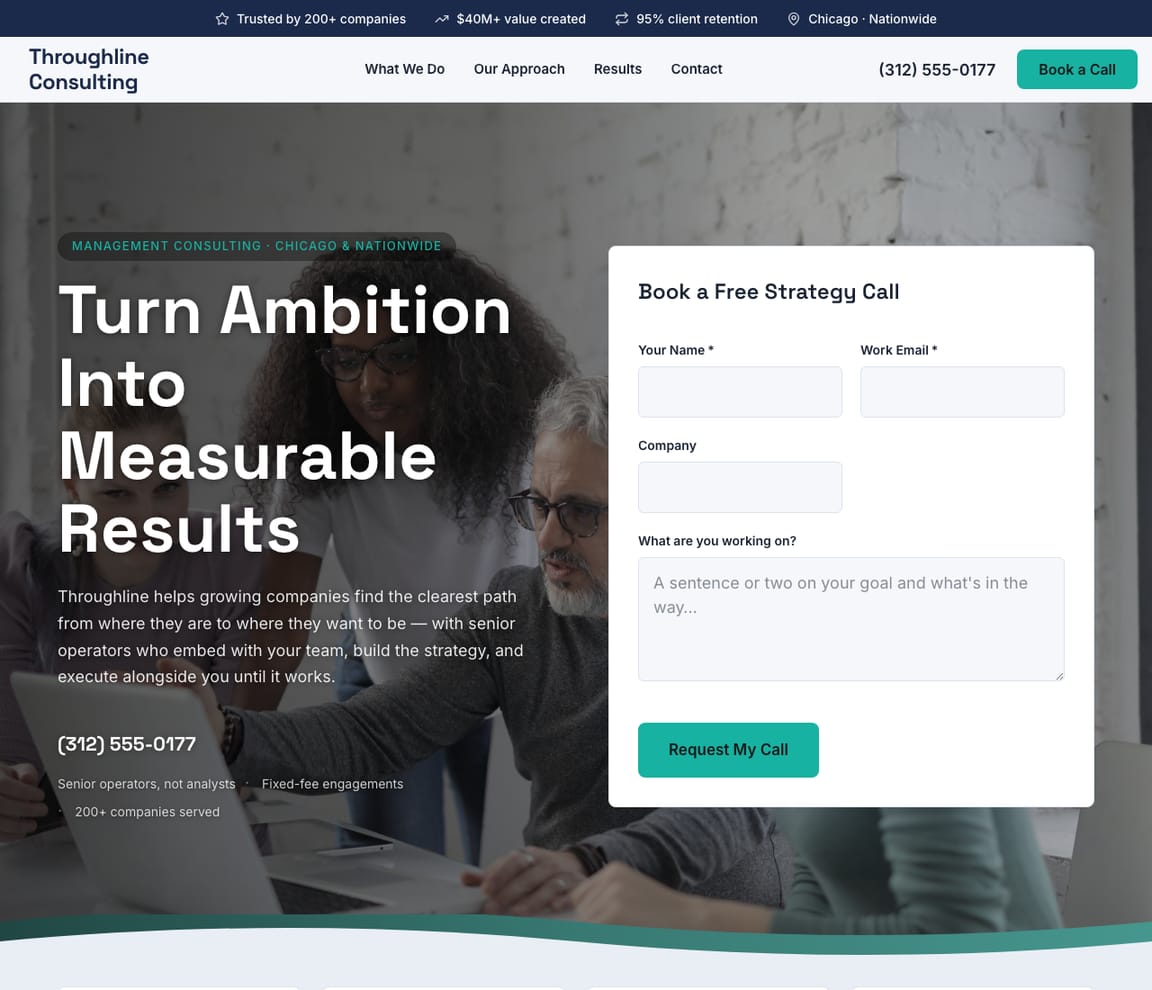
A real Zarla template for an independent consultant — the specialty by the headline, who you work with and the results under it, the services and a contact form underneath. Describe yours — the specialty, the town, the clients — and you'll have a site like this, with a page per service and a contact form, in about a minute.
- Professional design — not a generic template
- Looks great on desktop and mobile
- Content written for your industry
Build the website
Start your consulting website now
Add your specialty, your town and your business name to the sentence, and Zarla builds the site: your services, who you work with, your results and a contact form. Add your case studies in chat, then publish.
Already have a website? Bring it across →Zarla keeps your old page addresses where it can and redirects the ones that change, helping you keep the Google standing you've built.
Is becoming a consultant worth it in 2026 — and what does the work pay?
Becoming a consultant needs no license for the title in any US state, costs less to start than almost any trade in this series, and — once the first retainer is signed — is a business whose only inventory is what you already know. Three honest numbers first. Employed management analysts — the occupation the government files consultants under — had a median of $101,860 a year in 2025, $48.97 an hour: 10 percent earned $60,640 or less, 10 percent $171,640 or more (O*NET, from BLS 2025 wage data). The headcount is large and growing fast: "Employment (2025) 1,077,100 employees", "Projected growth (2025-2035) Much faster than average (7% or higher)", "Projected job openings (2025-2035) 94,100" (O*NET, employment and outlook). And the survey behind the wages leaves out the self-employed — "We do not provide occupation and wage estimates for farms, the self-employed, owner/partners in unincorporated firms, the military, household workers or unpaid family workers" (Washington ESD) — which is the independent consultant, so the median measures the analyst at a firm, not the owner who sets the day rate.
State by state, and against the job you might leave. The employed median is $101,400 in Texas, $101,460 in California, $88,610 in Florida and $112,250 in New York (O*NET, Texas; California; Florida; New York). General and operations managers — the job most consultants leave — had a median of $105,770 the same year (O*NET, 11-1021), so the move across does not cut the median; it trades the salary for the invoice. The survey's own employers said "57% responded: Bachelor's degree required", "24% responded: Master's degree required" and "10% responded: Some college, no degree required" (O*NET, education). One vendor's survey of its own audience — "over 2800 responded", a 2024 study updated May 31, 2025 — puts the independents' income in bands: "$50K-$99K (20.64%)", "$150K-$249k (27.50%)", "$250K-$499K (13.13%)"; read it as that vendor's readers, not the trade (Consulting Success).
Where the money is. An owner's income is the day rate or the project price times the days sold minus the insurance, the software and the unbilled hours of selling — the going rates are in how much to charge for consulting. The consultants quoted below describe the former employer as the first client, the retainer that steadied the month, the niche that let them stop competing with the big firms, and sales as the part nobody warned them about. The step after this guide is how to start a consulting business, and the plan page is the consulting business plan.
The catch. The work is the inbox and the phone — in O*NET's survey 100 percent of management analysts use e-mail every day, 89 percent have telephone conversations every day and 74 percent face-to-face discussions every day, while only 19 percent meet "strict deadlines" every day and half report "A lot of freedom" in setting their own tasks (O*NET, work context); the first year is a sales job with a consulting job attached; and the advice itself is licensed the moment it touches securities, a tax return, a legal question or an immigration form. That's what the rest of this guide sets up: which advice the law licenses, from the statutes; the credentials and what each costs; the desk kit from the vendors' prices; and how to be the consultant the second-bad-quarter search calls.
How to become a consultant, in plain English: nobody licenses the title, and here is exactly which advice the law does license
No US state licenses "consultants". You can call yourself a business, marketing, operations or strategy consultant tomorrow in Texas, California, Florida, New York and Illinois with a business registration and nothing else. What the law licenses is the advice, field by field — and the lines are drawn in the statutes, not in anyone's opinion:
- Investment advice — the federal Advisers Act. "'Investment adviser' means any person who, for compensation, engages in the business of advising others, either directly or through publications or writings, as to the value of securities or as to the advisability of investing in, purchasing, or selling securities, or who, for compensation and as part of a regular business, issues or promulgates analyses or reports concerning securities" (15 U.S.C. §80b-2(a)(11)). Who you register with turns on the money you manage: an adviser regulated by its home state does not register federally "unless the investment adviser— (A) has assets under management of not less than $25,000,000", with a mid-sized tier for advisers with assets "between" that figure and "$100,000,000, or such higher amount as the Commission may, by rule, deem appropriate" (§80b-3a). A business consultant who tells a client which stocks to buy for a fee has crossed this line.
- Tax advice — the IRS number, and four states' own rules. "Anyone who prepares or assists in preparing federal tax returns for compensation must have a valid 2027 PTIN before preparing returns", and "The fee is $18.75" (IRS, PTIN requirements); representing a client before the IRS is the enrolled agent's job — "Achieve passing scores on all three parts of the SEE within three years", administered since March 1, 2026 by PSI (IRS, become an enrolled agent). California goes further: a "tax preparer" is "A person who, for a fee or for other consideration, assists with or prepares tax returns for another person" (Cal. Bus. & Prof. Code §22251), who must have "completed not less than 60 hours of instruction in basic personal income tax law, theory, and practice" and then "not less than 20 hours of continuing education" a year (§22255), carry "a bond issued by a surety company … The principal sum of the bond shall be five thousand dollars ($5,000)" (§22250.1), and "pay the $35 annual registration fee" to the council (CTEC, new application). New York: a preparer of "10 or more New York State tax returns or reports for compensation in a calendar year" is a commercial preparer who must "pay the $100 registration fee, and complete CPE coursework" (New York Department of Taxation and Finance). Oregon licenses the trade outright: "A person may not prepare or advise or assist in the preparation of personal income tax returns for another and for valuable consideration or represent that the person is so engaged unless the person is licensed as a tax consultant" (ORS 673.615); Maryland: "An individual shall be registered by the Board before the individual may provide individual tax preparation services in the State" (Md. Code, Bus. Occ. & Prof. §21-301).
- Legal advice — the practice of law. Texas defines it to include "a service rendered out of court, including the giving of advice or the rendering of any service requiring the use of legal skill or knowledge, such as preparing a will, contract, or other instrument, the legal effect of which under the facts and conclusions involved must be carefully determined" (Tex. Gov't Code §81.101), and makes a narrow slice of it a crime — a non-lawyer who, for economic benefit, "advises any person as to the person's rights and the advisability of making claims for personal injuries or property damages" commits "a Class A misdemeanor" (Tex. Penal Code §38.123). California: "No person shall practice law in California unless the person is an active licensee of the State Bar" (Cal. Bus. & Prof. Code §6125). The consultant who drafts a client's partnership agreement is giving legal advice; the one who tells the client to get one is not.
- Immigration paperwork — California's bond, Texas's notary rule. "It is unlawful for any person, for compensation, other than persons authorized to practice law or authorized by federal law to represent persons before the Board of Immigration Appeals or the United States Citizenship and Immigration Services, to engage in the business or act in the capacity of an immigration consultant within this state except as provided by this chapter" (Cal. Bus. & Prof. Code §22440), and the provision is "a bond of one hundred thousand dollars ($100,000) executed by a corporate surety" (§22443.1). Texas aims at the notary: an offense for a notary who "solicits or accepts compensation to prepare documents for or otherwise represent the interest of another in a judicial or administrative proceeding, including a proceeding relating to immigration or admission to the United States" or who "uses the phrase 'notario' or 'notario publico'" (Tex. Gov't Code §406.017).
- Selling a business, and the word "engineer". In California a real estate broker is one who "negotiates the purchase, sale, or exchange of real property or a business opportunity" (Cal. Bus. & Prof. Code §10131) — so the M&A consultant who brokers the sale of a company needs the broker's license there; Texas's broker definition is tied throughout to "real estate", defined as "any interest in real property" (Tex. Occ. Code §1101.002), so a business sale without land is unlicensed there. The title: in Texas "only a person licensed under this chapter may: (A) engage in the practice of engineering; (B) be represented in any way as any kind of 'engineer'; or (C) make any professional use of the term 'engineer'" (Tex. Occ. Code §1001.004); in California "only persons licensed under this chapter shall be entitled to take and use the titles 'consulting engineer,' 'professional engineer,' or 'registered engineer'" (Cal. Bus. & Prof. Code §6704). A software consultant is not a "software engineering consultant" on the business card in either state without the license.
The credential, and what it costs. None is required by law. The Certified Management Consultant is the trade's own: "Not until you have at least three years of full time consulting to management experience and at least five satisfactory client evaluations", then "two 1 1/2-hour sessions, one on ethics and one on core competencies" online and an oral panel "usually conducted within thirty to sixty days" (IMC USA, certification FAQs); the institute's membership is "CMC Candidate formerly Professional Membership ($345 Annually, Plus $50 Application Fee)" for anyone with "Minimum of one year's experience as a consultant to management", "At least five-years experience in management" or an MBA (IMC USA, membership) — the certification fee itself sits in the application form and is not printed here. The HR consultant's credential prints its price: SHRM-CP and SHRM-SCP at "$350" member / "$450" nonmember early-bird and "$399" / "$499" standard, with the exams "offered during two windows each year" (SHRM, exam options and fees). The project-management and quality credentials' pages refused to open to our reader, so their fees are not printed.
You are self-employed from the first engagement. In the US a solo consultant is a sole proprietor by default: "Use Schedule C (Form 1040) to report income or (loss) from a business you operated or a profession you practiced as a sole proprietor" (IRS, Schedule C instructions); "The self-employment tax rate is 15.3%" once your "net earnings from self-employment (excluding church employee income) were $400 or more" (IRS), and sole proprietors "generally have to make estimated tax payments if they expect to owe tax of $1,000 or more when their return is filed" (IRS). If you want an LLC — and a corporate client's procurement form often prefers one: Texas "for filing a certificate of formation, $300" (Tex. Bus. Orgs. Code §4.152); Florida "$100" plus "For filing an annual report, $50" (Fla. Stat. §605.0213); New York "two hundred dollars" (N.Y. LLC Law §1101); California "Seventy dollars ($70)" (Cal. Gov. Code §12190) and "Every LLC that is doing business or organized in California must pay an annual tax of $800" (Franchise Tax Board). Workers' compensation the day you hire: "In Texas, private employers can choose to carry workers' compensation insurance coverage, but it is not required in most cases" (Texas Department of Insurance); "All California employers must provide workers' compensation benefits to their employees under California Labor Code Section 3700" (California DIR).
Sales tax on the advice — one state taxes it, two tax everything. Connecticut lists "Business analysis, management, management consulting and public relations services" among its taxable services, at the general rate of "six and thirty-five-hundredths per cent" — the one-percent rate on that page is for "computer and data processing services" only (Conn. Gen. Stat. §§12-407 and 12-408). Texas's sixteen categories of taxable services run from amusement services to utility transmission with no consulting among them, and "Merely using a computer as a tool to help perform a professional service is not a data processing service" (Texas Comptroller, Publication 96-259). Hawaii's general excise tax is "4% for all others" on every business activity (Hawaii Department of Taxation), and New Mexico's gross receipts tax reaches "Performing services in New Mexico, and performing services outside of New Mexico, the product of which is initially used in New Mexico" (New Mexico Taxation and Revenue). Confirm the details with your accountant.
The money to start. Our arithmetic from the pages that print each price, on the laptop you already have. A lean start — Calendly's Standard plan at "$10" per seat a month, $120 a year (Calendly, read October 26, 2026), a .com domain at $11.08 (Porkbun) and a year of professional liability at Insureon's $62-a-month median, $744 — comes to $875.08. The fuller start, a Texas LLC with the institute behind it — the same three lines, general liability at Insureon's $32-a-month median for $384, the $300 Texas filing, and IMC USA's $345 membership with its $50 application — is $1,954.08. The office suite, the video room and the bookkeeping software are the lines left out: Microsoft's, Zoom's and QuickBooks's pricing pages refused to open to our reader. The insurance is a median, not your quote: "Consultants pay an average of $62 per month for professional liability insurance … Annual policy costs range from around $400 to over $3,750 per year", "Consulting businesses pay an average premium of $32 per month for general liability insurance", and "the average premium is $61 per month for a business owner's policy" (Insureon, consulting, updated June 30, 2026) — below the all-business professional liability median of "$88 per month, or $1,051 annually" (Insureon, professional liability, updated October 21, 2026). The plan page for the business side is the consulting business plan, the step after this guide is how to start a consulting business, the rate card is in how much to charge for consulting, the name goes on the proposal from consulting business names, the business license question is answered in do I need a business license, and the site comes from the consultant website builder or the consultant website design page.
In the UK: no license for the title either; the rule that reaches the independent consultant is the tax one — the off-payroll working rules "apply if the worker who provides services to a client through their own intermediary would have been an employee if they were providing their services directly to that client", and "The rules are sometimes known as 'IR35'" (GOV.UK, understanding off-payroll working); regulated financial advice needs the Financial Conduct Authority's permission — check its register before you advise on investments. In Australia the same shape: "Not everyone is entitled to an ABN" (Australian Business Register); the Tax Office's personal services income rules reach income earned mainly from your own skills or efforts, and financial product advice needs the securities regulator's permission; financial product advice is the securities regulator's to authorize; and "You or your company or partnership must be registered with us to provide tax agent services for a fee or other reward", at an individual application fee of "$290" (Tax Practitioners Board). Check your own state's rules for the field you advise in, and your city's business registration desk, before the first proposal.
What working consultants actually say
None of this is our opinion about the trade. It comes from people who do it — two Chicagoland marketing consultants whose first client was a mentor from the day job, an HR consultant who left manufacturing and higher education, a Hudson marketing consultant who ran it as a side hustle for four years, a Bay Area communication consultant who quit corporate in 2020, a New Jersey consultant whose job ended first, a Houston payroll-operations consultant with twenty-five years in, a Fort Worth grant consultant, a Houston leadership consultant who founded after three decades in energy, a Dallas–Fort Worth business consultant who left a ten-year job with no net, and two more — talking to CanvasRebel and the Shoutout magazines between 2024 and 2026, each described as the page describes them. Read each as theirs at the time. Five things come up again and again.
The first client is usually someone who already knew your work. Richie Zarnicki, Z&M Consultants, Chicagoland: “I was working for a crane company prior to COVID and my job at the time was selling cranes, specifically boom trucks and my customer base was business owners. I met a business owner who ran a roofing supply company, and over the years, he became a mentor to me.” And: “After a few conversations, we signed a deal for a website and ongoing marketing services. I believe he chose us because of our many conversations, my genuine curiosity about business, and my consistent follow-through with his service requests and questions.” (CanvasRebel, March 5, 2025). Joy Blackwell, OpEx Consulting Group, Houston: “After 25 years managing payroll operations across industries from oil and gas to staffing, I discovered that growing companies typically waste 2-5% of their total payroll costs—not on salaries or benefits, but on operational inefficiencies that are completely invisible to leadership.” (ShoutoutHTX, June 12, 2025). Dr. Valeria Edmonds, Masterful You, Houston: “After more than three decades as a global HR leader with a major energy company, I founded Masterful You LLC to bring my deep expertise in leadership, organizational development, and change management to a broader audience.” (ShoutoutHTX, May 1, 2025).
“Officially, I started my journey in marketing as a passion project and side hustle in 2015 – gradually evolving it into a full-time career by December 2019. The initial stages involved balancing multiple roles in the part-time jobs I was juggling” — Leia Owen, Leia Owen – Marketing & Business Consultant, Hudson, in CanvasRebel, September 19, 2024
Most keep the job until the practice can carry them — and some had the choice made for them. Gail Lockwood, Grants For Change, Fort Worth: “Consulting gave me the freedom to be in control of my schedule, focus on productivity instead of hours, and still deliver great results. It's also given me flexibility — I can lean into consulting when I want more autonomy, or step into a full-time role while keeping my consulting work on the side.” (ShoutoutDFW, October 15, 2025). Sonji Grandy, Sonji K Grandy Consultants, New Jersey: “In November 2022, life took a pivot when a job I had no longer ceased to be my job. I was at the top of my career according to the industry, a new homeowner, and had a new car, but I was uncertain if I wanted to remain in the insurance field.” (CanvasRebel, January 6, 2025). Ricardo Johnson, Purple Ink Investments and Solutions, Dallas–Fort Worth: “I took a huge risk leaving the security of a job I worked nearly 10 years for the uncertainties of entrepreneurship. I didnt really have a safety net or really a plan other than make this dream work with the skills I've obtained up to that point. Was there plenty of challenges? Yes. Where there times I wanted to quit. Absolutely.” And: “It was a struggle to shift the mindset from one of an employee to that of an business owner/investor.” (ShoutoutDFW, September 17, 2025). Karen Laos, Karen Laos Consulting, San Francisco Bay Area: “In July of 2020 I quit my corporate leadership job to focus on my mission: to eradicate self-doubt in 10 million women in 10 years.” (CanvasRebel, May 1, 2025).
The niche is the business, and selling it is the hard part. Zarnicki and Nick McKenzie: “From 2023 through 2025, we specialized in the crane service industry. Building on Richie's experience as a crane dealership sales rep and our three years servicing a crane company, we immersed ourselves in understanding the sector's complexities. We attended Specialized Carriers & Rigging Association trade shows and studied hundreds of hours of calls between crane companies and construction contractors.” (CanvasRebel, March 5, 2025). Blackwell: “Most Houston business owners I talk to are stunned when I show them exactly where their money is going—they had no idea these inefficiencies even existed, let alone that someone could fix them.” (ShoutoutHTX, June 12, 2025). Breanna Stephens, B. Stephens HR Consulting: “One of the biggest hurdles was building credibility and trust as a small business in an industry where larger firms often dominate. Many potential clients were hesitant to move away from the “big-name” providers, even when those services weren't meeting their needs. I had to be patient and persistent, focusing on delivering high-quality, tailored solutions and letting word-of-mouth recommendations build over time.” (CanvasRebel, May 1, 2025). Lockwood: “Grant consulting is one of the most misunderstood professions. People assume we find “free money” for individuals — which isn't true — and even many new nonprofit leaders don't know what it takes to become what we call “grant ready.”” (ShoutoutDFW, October 15, 2025).
Pricing, the proposal and the retainer. Owen: “One of the significant hurdles was navigating the financial aspects of running a business, particularly pricing strategies and cash flow management.” And: “Currently, I'm striving to balance making my services affordable for the brands my team and I want to collaborate with, while ensuring our work is valued, our costs are covered, and we're not undervaluing ourselves. This year, I'm committed to educating both myself and potential clients on the true value of our services and the significant impact they can have on their businesses and organizations. This way, when I submit a comprehensive proposal it is viewed as a worthwhile investment.” (CanvasRebel, September 19, 2024). Stephens prints her shape on the page — “Retainer options starting at $390/month”, “Hourly rates available”, “Project quotes available” (CanvasRebel, May 1, 2025). Zarnicki and McKenzie on the first check: “When Nick and I held that first check, we could hardly believe it. Though we were nervous as could be for our first office meeting, we knew this was the beginning of something we'd always wanted—we just needed to open a checking account to make it official.” (CanvasRebel, March 5, 2025).
The work changes, and so does the consultant. Zarnicki and McKenzie, on building the tools into the offer: “Instead of just generating leads, we built a chatbot that engages, qualifies, and routes inquiries automatically. It allows potential customers to get instant responses 24/7, while business owners spend less time chasing dead-end leads and more time closing real opportunities.” (CanvasRebel, March 5, 2025). Christie Harrison, Core Performance 38:16, Texas: “Through my work, I help clients with strategic planning, standard operating procedures, risk management, leadership development, professional growth, and decision-making support.” And: “I do not believe in giving people surface-level motivation without helping them create a real plan. My goal is to help people move from vision to action.” (ShoutoutDFW, June 16, 2026). Grandy, on the one-person ceiling: “What I am most proud of, brand-wise, is that I AM my brand. The partner relationships I have and any referrals I receive are based on who I am as an individual and what I provide in those relationships. Clients want more of me and less of gimmicks. I am personable, and my personality is my selling point. However, in full transparency, I understand that this will not be sustainable in the long term.” (CanvasRebel, January 6, 2025). Dorothy Andreas, Atlanta: “What I do today was never part of my original plan. I assumed I would build my businesses, work until 60, and retire. That trajectory changed when I became involved with a global professional organization more than thirty years ago.” (ShoutoutAtlanta, July 8, 2026).
The through-line: the consultants who lasted turned the job they already had into the niche, took the first client from the people who had seen them work, kept the salary until the invoices could replace it, priced by the project and the retainer, and learned to sell — the part none of them was hired to do before.
THE STARTER KIT
What you need to become a working consultant
A niche you can prove
The years in the industry, the number you moved, the role you held — the proof a client asks for in the first call, and the thing no license stands in for because no state issues one for the title.
The law's answer on your advice
Investment advice, paid tax returns, legal and immigration questions, brokering a business sale, calling yourself an engineer — each licensed by a named statute below; general business advice is not, in any US state.
A first client, often the last employer
Half the people who make the jump get their first engagement from the company they just left; the rest from a referral, a former colleague or the firm's alumni — the routes are below in the consultants' own words.
The desk kit, from the vendors' prices
A laptop you have, an office suite, a scheduling link, a video room, a bookkeeping tool, a domain — each priced from the vendor's own page.
The credential clients recognize
The Certified Management Consultant, the PMP, a field certification in HR or quality — voluntary everywhere, and the thing a procurement form asks about; the fees are below from the issuers.
A way to be found first
A website with your specialty, your case studies, your price and a contact form, and a Google Business Profile with your hours — the two things a LinkedIn profile can't do alone.
THE PAPERWORK
Licenses, registrations, credentials and insurance on the way to your own consulting practice
| Typical cost | Time to get | Legally required? | |
|---|---|---|---|
| A consultant's license | None exists | — | No — no US state licenses the title; the fields below license the advice |
| Investment adviser registration | Set by the SEC or your state | Months | Yes, to advise on securities for compensation — your state under $25 million of assets under management, the SEC above $100 million |
| Paid tax preparer | $18.75 PTIN (IRS) · $35/yr + a $5,000 bond + a 60-hour course (CA) · $100/yr (NY) · a license by exam (OR) · a registration (MD) | Days for the PTIN; a season for California's course | Yes, to prepare federal returns for pay anywhere; California, New York, Oregon and Maryland add their own |
| Legal advice | A law degree and the bar | Years | Yes — the practice of law in Texas and California includes advice requiring legal skill; a non-lawyer's injury-claim advice is a misdemeanor in Texas |
| Immigration consultant | A $100,000 surety bond (CA) | Weeks | California; Texas forbids a notary to prepare immigration documents for pay |
| Business broker | A real estate broker's license (CA) | Months | California, to negotiate the sale of a business opportunity; not Texas unless real property changes hands |
| The word "engineer" | A PE license | Years | Texas and California reserve the title; California reserves "consulting engineer" by name |
| Certified Management Consultant (CMC) | $345/yr + $50 membership; the exam fee is on the application | After three years of full-time consulting and five client evaluations | No |
| SHRM-CP / SHRM-SCP | $350–$499 by window and membership | Two exam windows a year | No |
| Sole proprietorship (Schedule C) | $0 | None | The default once net earnings pass $400 (self-employment tax 15.3%) |
| LLC (optional) | $300 (TX); $100 + $50/yr (FL); $200 (NY); $70 + $800/yr (CA) | Days to weeks | No — a corporate client's vendor form often prefers one |
| Sales-tax registration | Free to register | Before the first invoice, where it applies | Connecticut taxes management consulting at 6.35%; Texas does not tax it; Hawaii's 4% and New Mexico's gross receipts tax reach every service |
| Professional liability (E&O) | $62/mo median (Insureon), $400 to over $3,750 a year | Days | A client's condition, not a law's |
| Workers' compensation | $44/mo median (Insureon) | Days | Required from the first employee in CA; optional for private employers in TX |
THE STEPS
How to become a consultant (step by step)
Eight steps from the job you have now to a consulting practice with clients, a rate card and a business of your own.
01
Pick the problem you have already solved
The thing you did for an employer that a smaller company can't hire for full time — pricing, operations, hiring, a system, a market. One problem, one kind of client; the niche is the business.
Start here02
Check which of your advice the law licenses
No US state licenses the consultant. The federal Advisers Act licenses investment advice, the IRS's rule paid tax preparation, Texas and California the practice of law, California immigration consulting and business brokering. The lines are below, from the statutes.
Named below03
Line up the first client before you quit
Most consultants start while employed and half take their former employer as the first engagement — in the consultants' own words below. Keep the day job until the first contract is signed.
04
Set the price by the project
A day rate for the first year, then project and retainer prices from real rates in your field — printed as a range on the page so the owner never has to ask.
05
Set up the desk and the books
An office suite, a scheduler that books the discovery call, a video room, a bookkeeping tool and a separate bank account — the kit is below from the vendors' prices.
06
Add the credential your clients' procurement asks for
The Certified Management Consultant, the PMP, a field certification — voluntary everywhere, and the box a corporate client's vendor form has.
07
Register the business and insure the advice
A sole proprietorship by default, an LLC if you want one, professional liability at a broker's median, and sales tax only where your state taxes consulting — Connecticut does — with the IRS lines below.
08
Be the consultant the search calls first
A website with your specialty, your case studies, your price and a contact form, and a Google Business Profile with your hours — so the second-bad-quarter search calls you.
THE COSTS
How much does it cost to become a consultant?
Itemized from the pages that print a price: the scheduler from Calendly, the domain from Porkbun, the insurance from Insureon's consultant medians, the Texas filing from the statute, the membership from IMC USA. The office suite, the video room and the bookkeeping software come on top — their vendors' pricing pages refused to open.
$875.08a lean start on the laptop you have — a year of scheduling, a domain and a year of professional liability (our arithmetic)
$1,954.08the fuller start as a Texas LLC with the institute's membership — the same three lines plus general liability, the $300 filing and $395 of IMC USA membership and application
$0for any license to call yourself a consultant, in any US state — the licenses attach to investment, tax, legal and immigration advice, named above
$18.75the IRS number every paid tax preparer needs; $35 a year, a 60-hour course and a $5,000 bond on top of it in California
WHAT WE'VE LEARNED
What actually makes an owner hire a consultant
Thousands of local business websites in, the pattern for a trade that sells judgment is clear: the owner wants to know exactly what you fix, see proof it worked for someone like them, and get a price without a pitch deck. For a consultant, three things on a page decide who gets the call.
One problem, named
Cash flow for trades businesses, pricing for salons, hiring for restaurants — the problem and the kind of owner, not 'strategy for businesses of all sizes'. The first thing an owner scans, and the thing a generalist's page never says.
Results an owner can check
Three case studies with the number that moved and a name an owner can call. The thing that replaces the pitch deck, and the thing a firm's page hides behind a login.
A price and a first step
A day rate or a project range, a fixed-price assessment to start, and a discovery call that books from the page — the thing that turns the second-bad-quarter search into a client.
THE UPSIDE
What a consultant can earn
Pay for employed management analysts from O*NET's 2025 figures, and the self-employed are not in the survey. Medians, not a promise: your day rate, your days sold and your retainers decide it.
$101,860a year: the 2025 median for employed management analysts — $48.97 an hour; 10 percent under $60,640, 10 percent over $171,640 (O*NET)
$112,250the New York median; California $101,460, Texas $101,400, Florida $88,610
$105,770the median for general and operations managers the same year — the job most consultants leave; the median does not fall on the way across
1,077,100employed management analysts in 2025, growing much faster than average, with 94,100 openings a year projected to 2035 — the independents are not counted
SEE IT WORK
Consulting website designs you can start from
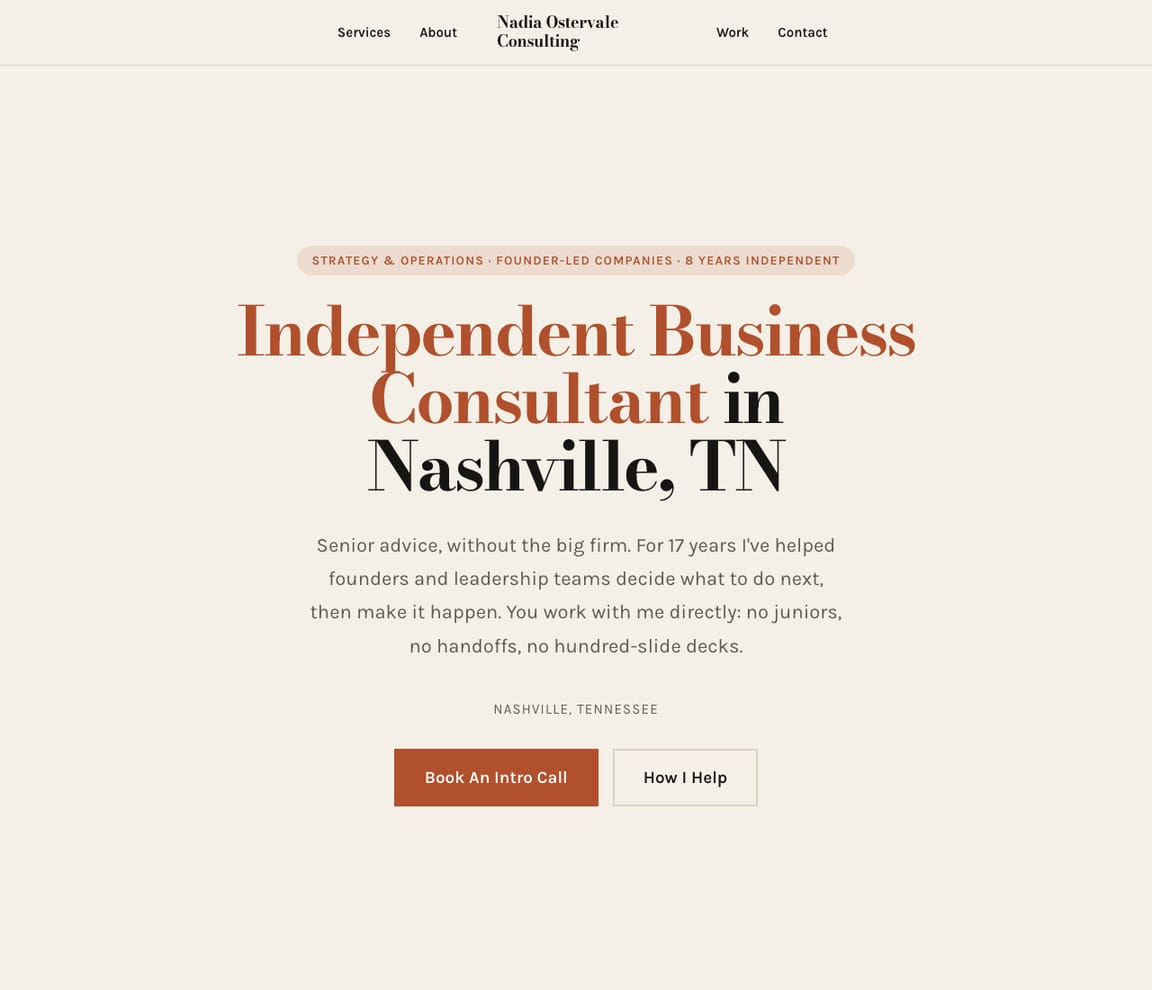
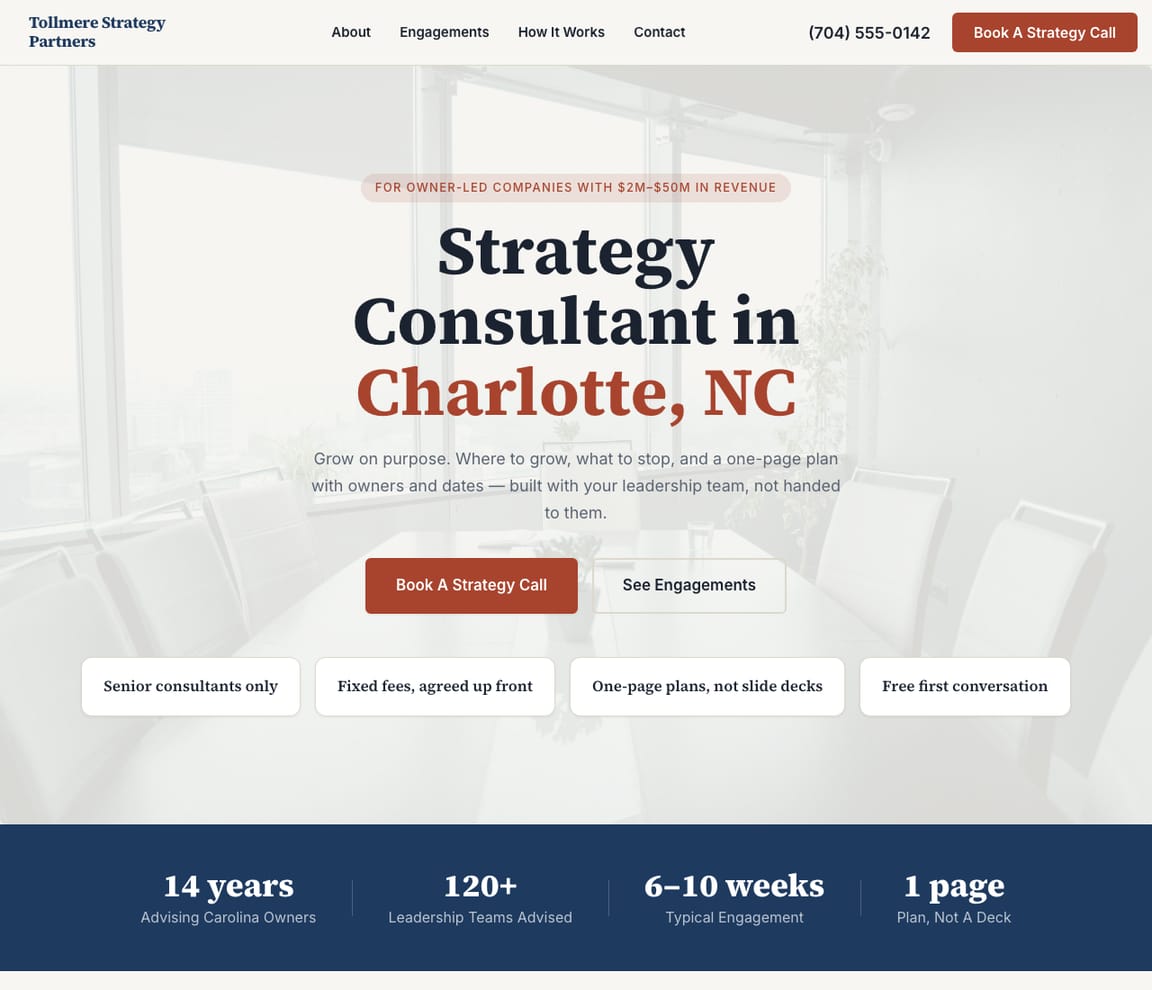
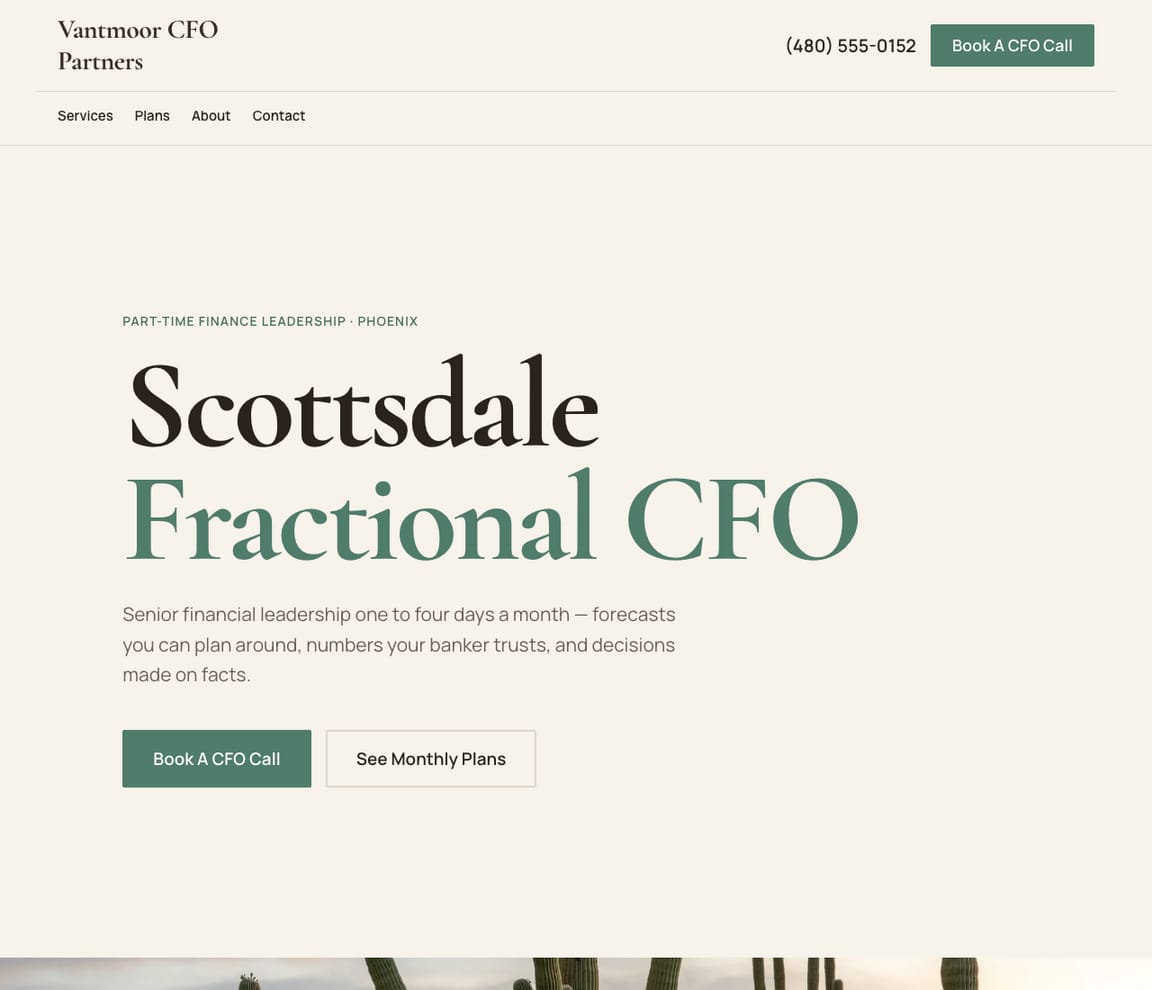
Real Zarla templates for the shapes the trade takes — the small-business consultant, the independent who left a firm, the strategy consultant, the fractional CFO. Open one, swap in your services and your results, and publish.
GET FOUND
Get found by the owner who has outgrown their spreadsheet
An owner searches "small business consultant near me" after the second bad quarter, and the call goes to the consultant whose specialty, results and contact form are on the first screen. Zarla builds the website with your services, who you work with and a contact form. Add your case studies and your credentials in chat, and once you connect your Google Business Profile, your name, your hours and your reviews stay in step on both.
“Small business consultant near me”
Searched after the bad quarter, before the bank meeting, and by the owner who just hired a tenth employee. Your specialty, your results and a contact form answer all three.
Google Business Profile
A consultant who works from home has a service area, and that qualifies. Your hours, your reviews and your booking link inside Google Maps — free, and an afternoon to set up.
The case studies
The proof an owner wants before paying a day rate: the problem, what you did, the number that moved — three of them, named with permission. The results page is the sales page.
Google Search
Nnorthstarbusinessconsulting.com
Northstar Business Consulting — Trusted consultant in Your AreaCharlotte's small business consultant — pricing, operations and cash flow for owner-run companies. Case studies on the site. Book a discovery call.← Your Zarla siteCcityconsultantservices.com
City consultant ServicesGoogle Maps
1
Northstar Business Consulting
← You2
Metro consultant Co.
3
Quick consultant Services
AI assistants (ChatGPT / Perplexity)
For a consultant in Charlotte who helps trades businesses with pricing and cash flow, shows results, and takes a discovery call this week in your area: Northstar Business Consulting — a local consultant's site that lists pricing, operations and cash-flow engagements, shows three named results, and books a discovery call from the page.
YOUR LAUNCH PLAN
Your become-a-consultant checklist
The whole guide as things to check off. Work through them in order and you'll be positioned, legal, priced, insured, set up and findable before your first engagement.
- Pick the problem you have already solved — one problem, one kind of client.
- Check which of your advice the law licenses below — investments, tax, legal, immigration, brokering.
- Line up the first client before you quit — often the employer you are leaving.
- Set the price by the project — a day rate first, then projects and retainers.
- Set up the desk and the books from the vendors' prices — suite, scheduler, video, bookkeeping.
- Add the credential procurement asks for — CMC, PMP, a field certification.
- Register the business and insure the advice — professional liability; sales tax only where consulting is taxed.
- Get found — a website with your specialty, case studies, price and a contact form, and a Google Business Profile.
REAL CUSTOMERS
Small business owners who got online with Zarla
Verified reviews from real Zarla customers.
“Optimized for local service-based businesses. Easiest website build I've experienced. The AI-based build is the way to go instead of clunky theme-based websites. Get the site built and get out of the weeds with Zarla!”
“Quickly built my website from scratch. No hiccups. Would highly recommend Zarla for someone with no experience who wants to start a polished business website.”
“Very reliable, professional, and fast results. I was able to get my business online in no time, and the ease of access made it so simple.”
“I had no idea how to set up a website for my business. Thanks to Zarla, they've helped me a lot.”
Be the consultant the "small business consultant near me" search calls first
Add your specialty, your town and your business name, and Zarla builds the website from that one line — your services, who you work with, your results, a page for each service and a contact form, with SEO in place. Add your case studies in chat. Free to build; you pay when you publish.
Already have a website? Bring it across →Zarla keeps your old page addresses where it can and redirects the ones that change, helping you keep the Google standing you've built.
Frequently asked questions
How much does it cost to become a consultant?
In the US, about $875.08 for a lean start on the laptop you already have, our arithmetic from the pages that print each price: a year of Calendly's Standard plan at $10 a seat a month, an $11.08 .com domain, and a year of professional liability at Insureon's $62-a-month consultant median. There is no license to buy for the title. The fuller start as a Texas LLC with the trade institute behind it — general liability at the $32-a-month median, the $300 Texas filing, and IMC USA's $345 membership with its $50 application — is $1,954.08. The office suite, the video room and the bookkeeping software come on top; their vendors' pricing pages refused to open to our reader. If your field is licensed — tax preparation, securities, immigration — add that field's fees from the section above.
Do you need a license to be a consultant?
In the US, no — no US state licenses the title. The law licenses the advice: tell a client which securities to buy for a fee and you are an investment adviser under the federal Advisers Act, registered with your state below $25 million of assets under management and the SEC above $100 million; prepare a federal tax return for pay and you need the IRS's $18.75 PTIN, plus California's 60-hour course, $5,000 bond and $35 registration, New York's $100 registration at ten returns, Oregon's license or Maryland's registration; give advice that requires legal skill and you are practicing law in Texas and California; help with immigration paperwork for pay and California wants a $100,000 bond; broker the sale of a business in California and you need a real estate license; call yourself any kind of engineer in Texas and you need a PE. General business, marketing, operations and strategy advice is unlicensed everywhere. Check your own state's board for the field you advise in.
What qualifications do you need to be a consultant?
None by law, and the market's answer is specific experience. The government's survey of employers for management analysts said 57 percent require a bachelor's degree, 24 percent a master's and 10 percent some college with no degree. The trade's own credential, the Certified Management Consultant, is not available until you have at least three years of full-time consulting to management experience and at least five satisfactory client evaluations, then ethics and competency exams and an oral panel; the institute admits members with one year of consulting, five years of management or an MBA. The consultants quoted above qualified by having done the job inside a company first — payroll operations for 25 years, HR in manufacturing, selling cranes to business owners — and selling that specific knowledge back to smaller companies.
Do consultants get paid well?
As employees, yes: management analysts had a median of $101,860 in 2025, $48.97 an hour, with 10 percent above $171,640, from BLS data on O*NET — $112,250 in New York, about $101,400 in Texas and California, $88,610 in Florida — and general and operations managers, the job most consultants leave, had a median of $105,770, so the move across does not cut the median. The independents are outside the survey; one vendor's survey of more than 2,800 of its own readers put 27.5 percent of them in the $150K to $249K band and 20.6 percent in the $50K to $99K band. The owner's income is the day rate times the days sold, and the consultants quoted above say the selling, not the consulting, decides the number.
Is 40 too old to get into consulting?
No — it is the usual age. In one vendor's survey of more than 2,800 consultants, 47 percent were 30 to 39 when they started, 24 percent were 40 to 49, 6 percent 50 to 59 and 4 percent 60 or older; the trade's own credential will not even consider you until you have three years of consulting behind you, and most people get those after a career. The consultants quoted above founded after 25 years in payroll, after three decades as a global HR leader, after nearly ten years in one job, and after a planned retirement at 60 turned into a second career. The experience is the product; the age is the proof of it.
How do I qualify to be a consultant?
Pick the problem you have already solved for an employer and prove it: the years, the title, the number you moved. No US state asks for more unless your field is licensed — tax preparation, securities, legal, immigration — in which case the qualification is that field's license first. The trade's credential, the Certified Management Consultant, defines qualified as three years of full-time consulting to management, five satisfactory client evaluations, two online exams and an oral panel; its parent institute defines a candidate member as someone with a year of consulting, five years of management or an MBA. The consultants quoted above qualified by being the person inside the company who had already fixed the thing.
Will AI replace consultants?
The government's projection for management analysts is growth much faster than average through 2035 — 7 percent or higher — with 94,100 openings a year, so the official forecast is more of them, not fewer. The consultants quoted above are building the tools into the offer rather than competing with them: one Chicagoland firm built a chatbot that engages, qualifies and routes a client's inquiries automatically, so the business owner spends less time chasing dead-end leads. The part of the job AI does not do is the part the consultants say is hardest — the niche, the trust and the sale: one Houston consultant was creating a category that did not exist and had to educate the market while building the business.
Is consulting a low stress job?
By the government's own survey of management analysts, it is a job of constant contact with a lot of autonomy and few hard deadlines: 100 percent use e-mail every day, 89 percent have telephone conversations every day, 74 percent face-to-face discussions every day, half report a lot of freedom in setting their own tasks, and only 19 percent meet strict deadlines every day. The stress the consultants quoted above describe is the business, not the work: building credibility against the big firms, the first year with no safety net, pricing and cash flow, and a brand that is one person. One Dallas–Fort Worth consultant says there were times he wanted to quit; one New Jersey consultant says a brand that is only her is not sustainable in the long term.
How do I become a consultant with no experience?
You do not, in the sense the question means — but you almost certainly have more experience than you are counting. The trade's credential wants three years of consulting; the market wants proof you have solved the client's problem before, which is the job you have now. Start inside it: in one vendor's survey, 65 percent of consultants started their consulting business while still working at their job, and for over half the first client was a former employer. The consultants quoted above ran it as a side hustle from 2015 to 2019 before going full time, consulted alongside a role, or turned a mentor from the day job into the first signed deal. Pick one problem, one kind of client, and sell the thing you have already done.
Can I be a consultant without a degree?
Yes, in every US state — no statute requires a degree for unlicensed business advice, and the government's survey of employers found 10 percent of management-analyst jobs require some college with no degree. The trade institute admits a candidate member on five years of management experience with no degree at all. Where a degree does matter is the licensed fields — the bar for legal advice, the enrolled agent's exam for tax representation — and the big firms' hiring, which is a different route from the independent's. The consultants quoted above sell years and results, not diplomas: one built a payroll-operations niche on 25 years of running payroll, one sold cranes to business owners before advising them.
Do I need an LLC to be a consultant?
No US state requires it, and there is no consultant license to attach it to. A solo consultant is a sole proprietor by default: Schedule C, the 15.3 percent self-employment tax once net earnings pass $400, quarterly estimates once you expect to owe $1,000. If you form an LLC — and a corporate client's vendor form often prefers one — it is $300 in Texas, $100 plus $50 a year in Florida, $200 in New York, and $70 in California plus an $800 annual tax every year. The professional liability policy matters more than the entity: Insureon's consultant median is $62 a month, and it is the line a procurement form checks before the engagement is signed. Confirm the details with your accountant.
How do consultants find their first client?
From the people who have already watched them work. In one vendor's survey of more than 2,800 consultants, for over half the first client was a former employer, and 65 percent started while still employed. The consultants quoted above say the same in their own words: a mentor met while selling cranes signed the first website-and-marketing deal; a grant consultant kept consulting on the side of a full-time role; an HR consultant built credibility against the big firms by letting word of mouth accumulate. The website's job is the second client — the owner searching after the bad quarter who has never met you and needs the specialty, the case studies and the price to decide.
Is consulting taxable?
Your income, yes, everywhere in the US — Schedule C and the 15.3 percent self-employment tax. The service itself is the state's call. Connecticut taxes business analysis, management and management consulting services at its general 6.35 percent rate — the 1 percent rate on the same page is for computer and data processing only. Texas does not tax consulting: its sixteen categories of taxable services run from amusement services to utility transmission with no consulting among them, and merely using a computer as a tool to perform a professional service is not data processing. Hawaii's general excise tax is 4 percent on every business activity and New Mexico's gross receipts tax reaches services performed in the state. Confirm the details with your accountant.