BUSINESS GUIDE
How to start a consulting business in 2026
The real version, written for one person leaving a job to consult: picking a niche, the LLC question, insurance and taxes, what consultants actually charge, how much cash to have before you jump — and how your first clients find and check you.
Free to build · Pay when you publish · No credit card
1.08Mconsulting businesses with no employees in the US, 2023 (Census Nonemployer Statistics)
$101,860median pay for management analysts, May 2025 (BLS) — the salary benchmark you're replacing
10%projected growth in management analyst jobs, 2025–35, much faster than average (BLS)
No codeto get online
See it in action
See what your consulting website could look like
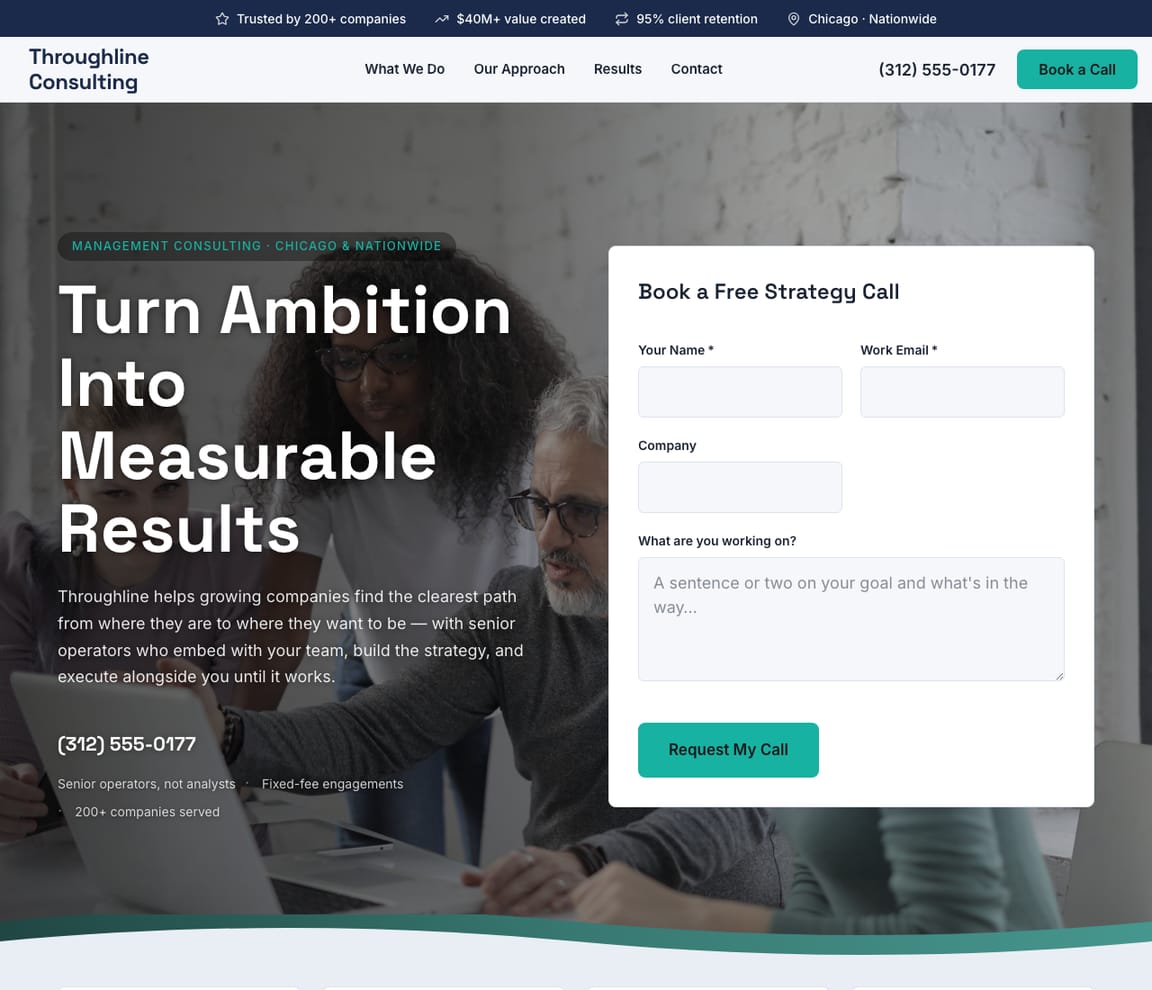
This is a real Zarla template for a management consultant. Describe your practice — your specialty, who you help, how you work — and you'll have a site like this, with your services as engagements, room for case studies and a way to start a conversation, in about a minute.
- Professional design — not a generic template
- Looks great on desktop and mobile
- Content written for your industry
Build the website
Start your consulting website now
Add your specialty and your firm's name to the sentence, and Zarla builds the site: a clear line on who you help, your services as engagements, your background and a contact form. Add case studies in chat and publish before you tell your network.
Already have a website? Bring it across →Zarla keeps your old page addresses where it can and redirects the ones that change, helping you keep the Google standing you've built.
Is a consulting business worth starting?
The demand is real and it's growing. The Bureau of Labor Statistics projects management analyst jobs — the occupation most consultants come from — to grow 10% from 2025 to 2035, much faster than average, with about 94,100 openings a year (BLS Occupational Outlook Handbook). The median management analyst earned $101,860 in May 2025, and the top tenth $171,640 or more (BLS, May 2025). And independence is common: the Census Bureau counted 1,081,961 consulting businesses with no employees in 2023, against 225,945 with a payroll (Nonemployer Statistics 2023, County Business Patterns 2023, industry 5416). MBO Partners counts a record 74.9 million Americans earning income independently, almost 6 million of them more than $100,000 a year (MBO Partners, State of Independence 2026).
The hard part is that most of those businesses are small, and some never replace a salary. Those 1,081,961 no-employee consulting businesses took in about $59,800 each on average in 2023, and 59% of them took in under $25,000 — many are side businesses run alongside a job (Census, 2023). The constraint isn't startup money: professional liability cover averages about $62 a month for consultants, general liability about $32 and a business owner's policy about $61 (Insureon, June 2026), and the EIN is free (IRS). It's the months before the first invoices are paid, and the selling — 70% of consultants say their website brings them no leads at all in a month, and for 60% the first client is a referral from their own network (Consulting Success).
On the other side, the rates are good once the work is sold. Most consultants charge between $100 and $250 an hour — 39% bill in that band, 19% charge $250 to $500, and a quarter don't bill by the hour at all; specialists charge more, with 28% of them at $250 an hour or more against 7% of generalists (Consulting Success, September 2026). The most common average project values are $5,000 to $15,000 and $15,000 to $50,000 (Consulting Success), and in a study of nearly 1,000 consultants, 30% price by the project, 29% by the hour, 16% on a monthly retainer, 15% on value and 10% by the day (Consulting Success fee study), and over half of consultants reach their old salary within two years of starting (the same study). Engineering and technical consultants report similar ground: roughly one in five charge $300 or more an hour (IEEE-USA 2025 fee survey).
So it's worth starting if you have expertise someone already pays for, people who know your work and will say so, and enough runway to sell your first engagements without panicking — which is what the rest of this guide sets up.
How to start a consulting business, in plain English
In the US, nobody licenses “consulting.” What you need depends on three things: how you set up the business, what kind of advice you give, and where you and your clients are.
- The business itself: if you work for clients who control only the result of your work — not how you do it — you're an independent contractor, which the IRS treats as self-employed (IRS). A sole proprietorship is the default and needs no filing; an LLC is optional, filed with your state — $35 in Montana (Montana Secretary of State), $300 in Texas (Texas Form 205), or $70 in California (California LLC-1) plus an $800 annual LLC tax every year after (California Franchise Tax Board). The EIN is free, online, in minutes (IRS).
- The advice: some consulting crosses into a licensed profession. Investment advisers generally register with the SEC or their state securities regulator (investor.gov); Texas requires any entity offering engineering services to the public — even a one-person sole proprietorship — to register with its engineering board, $25 for a sole proprietor (Texas Board of Professional Engineers and Land Surveyors); and a benefits consultant who sells insurance needs a producer license in each state they sell in (NIPR). Check your field before your first client.
- Taxes: self-employment tax is 15.3% — 12.4% Social Security and 2.9% Medicare — on net earnings of $400 or more, and half of it is deductible (IRS). The Social Security part stops at $184,500 of earnings for 2026; Medicare has no cap (IRS Topic 751). If you expect to owe $1,000 or more, you pay estimated tax quarterly (IRS).
States and cities add a few rules of their own. Four examples:
- Connecticut charges sales tax on “business analysis, management, management consulting and public relations services” (Conn. Gen. Stat. §12-407), at the general 6.35% rate (Connecticut DRS). Most states don't tax consulting at all.
- Hawaii has no sales tax, but its 4% general excise tax reaches services, plus a county surcharge (Hawaii Department of Taxation); New Mexico's gross receipts tax applies to performing services in the state (New Mexico Taxation and Revenue).
- Philadelphia requires a Commercial Activity License, and it's free (City of Philadelphia).
- Washington State requires a business license once your gross income reaches $12,000 a year, among other triggers (Washington Department of Revenue).
Two more things to read before you resign. The FTC's nationwide ban on non-competes never took effect: a federal court stopped it in August 2024, and the FTC moved to dismiss its own appeal in September 2025 (FTC). So whether your old employer's non-compete or non-solicit binds you depends on your contract and your state — California, for example, voids most non-competes under its Business and Professions Code §16600; ask a lawyer if yours is unclear. And if you want government work, registering on SAM.gov for federal contracts is free (Social Security Administration notice) and gets you the Unique Entity ID that federal work requires (SBA).
From there the order is the same everywhere: pick the problem you solve, check what your field requires, set up the business, set your prices and terms, line up your first client, and get found. Our free consulting business plan lays out every startup line with typical costs, the consultant website templates and consultant website examples show what a good site looks like, and Zarla's consultant website builder is how a referred client checks you out.
What independent consultants actually say
None of this is our opinion about consulting. It comes from consultants talking about their own start, on podcasts, in interviews and in their own words. Three things come up again and again, and none of them is about qualifications.
Your first client already knows your work. Summer Craig left a corporate job to start the Craig Group, a growth-advisory firm that grew to 23 people. When she told her employer she was leaving, “they said, ‘Okay. Well, great. Well, we'll hire you.’ So they hired my firm.” Within two weeks, she said, “I was no longer an employee. I was a consultant. And I had my first client” (Consulting Success podcast, January 2025). Scott Curran, founder of Beyond Advisers, had the same start one step removed: “The first client we ever got was from one of my then existing clients who said, ‘Hey, if you're going to do this, I know somebody who needs your help’” (Consulting Success podcast, May 2025).
“I handed in my three weeks' notice with my employer. Can you guess what happened next? That's right. My potential client ghosted me! There was no signed paperwork. No deposit was paid. I made an amateurish decision that left me with nothing. The lesson is simple: You don't have a client until they've paid you.” — Vuk Stajic, founder of the Salesforce consultancy MVRK, writing in Entrepreneur in July 2026
Write the scope down. Curran also bought consulting before he sold it, and remembers which engagements worked: the ones that “had exquisite statements of work or project scopes where we knew exactly what to expect along what timeline, with what deliverables.” A generic one, he said, “was a red flag for us” (Consulting Success, May 2025). Cash Sutton III, an electrical engineering consultant in California, put the other half plainly: “If you solve the problem, you should get paid. Unfortunately, when solving the problem becomes too much fun, you may have trouble making ends meet financially” (IEEE-USA InSight, August 2025).
Plan for the gap, and be visible. Paul Millerd, a freelance strategy consultant, on how much runway to have: “In my experience three months is too short, six months is the bare minimum and at least 12 months is about right” (StrategyU, November 2023). Devon O'Rourke left Amazon to start Fluvio and remembers the grind before the first big client: “I was cold emailing 200 people a week and finally had one big retainer-like client come through” (Consulting Success podcast, May 2023). And Cynthia Mills of The Leaders' Haven: “Do not hide. It is important for people to begin to see you as a thought leader” (Consulting Success podcast, July 2022).
The through-line: the consultants who make it start with people who already trust their work, put every engagement in writing and get paid before they relax, carry enough runway to sell without panic, and make themselves easy to find and check.
THE STARTER KIT
What you need to start a consulting business
A specialty people can repeat
One sentence a former colleague could pass on: who you help and the problem you solve. The narrower it is, the easier you are to refer — and to pay well.
Months of runway
Savings or a first signed client to live on while the pipeline fills. Experienced independents call three months too short and six the bare minimum.
A standard agreement
A contract or statement of work you reuse: the deliverables, the timeline, the price, what's out of scope, and the deposit due before work starts.
Insurance and a business account
Professional liability (errors and omissions) cover, which many corporate clients ask for, and a separate bank account so the business money stays out of yours.
A short list of people to tell
Former managers, colleagues and clients who already trust your work. For most consultants the first client comes from this list, not from a stranger.
A way to be checked
A website with your specialty, case studies and a way to get in touch, a Google Business Profile and an updated LinkedIn — what a referred client looks at before they reply.
THE PAPERWORK
Licenses, registrations and insurance for a consulting business
| Typical cost | Time to get | Legally required? | |
|---|---|---|---|
| EIN from the IRS | Free | Minutes online | If you hire or have partners; optional when solo |
| LLC filing with your state | $35 (MT) to $300 (TX); CA $70 + $800/yr | Days to weeks | No — a sole proprietorship is the default |
| City or state business license | Free in Philadelphia; varies | Days | In some cities and states |
| Professional liability (E&O) insurance | About $62/month average | Same day | No — but many client contracts ask for it |
| General liability or a business owner's policy | About $32–$61/month average | Same day | No — landlords and some clients ask |
| Quarterly estimated tax (Form 1040-ES) | No fee | Four deadlines a year | Yes, once you'll owe $1,000 or more |
| Sales tax registration | Free to register | Days | In a few states — Connecticut, for example |
| Professional license for regulated advice | Set by the regulator | Months | For regulated advice: investment, legal, engineering, CPA, insurance |
| SAM.gov registration for federal contracts | Free | Days to weeks | Only to bid on federal work |
THE STEPS
How to start a consulting business (step by step)
Seven steps from “I could do this on my own” to your first paid engagement.
01
Pick the problem you solve
Choose one client and one problem you've solved before — usually the work you were best known for in your last job. Write it as the sentence someone would use to refer you.
02
Check what your field requires
Consulting itself needs no license, but some advice does — investment advice, engineering, accounting under the CPA title, insurance. Read your old employment agreement for a non-compete or non-solicit too.
Before you resign03
Set up the business
Start as a sole proprietor or form an LLC, get a free EIN from the IRS, open a business bank account and buy professional liability cover.
04
Set your prices and your terms
Decide how you'll price — by the project, the hour, the day or a monthly retainer — and write the standard agreement and statement of work you'll reuse.
05
Line up your first client
Tell former managers, colleagues and clients what you now do, one by one. Many consultants' first client is someone who already knows their work — sometimes the employer they just left.
Before you jump, if you can06
Get found and get checked
Put your website and Google Business Profile live with your specialty, a case study and a way to get in touch, and update LinkedIn — a referred client looks before they reply.
07
Deliver, then write it up
Take a deposit, deliver what the statement of work says, then turn each finished engagement into a short case study and ask for a review and an introduction.
THE COSTS
How much does it cost to start a consulting business?
The total is our free consulting business plan's itemized US ranges for one consultant: registration, the first year of professional liability cover, a laptop, software, branding, memberships and three to six months of living costs while the first engagements are sold and paid. Insurance is Insureon's June 2026 consulting figure; filing fees are the states' own schedules.
$6.2k–$42kto start, all in — most of it the living costs before the first invoices are paid
~$1,000the paperwork-and-insurance floor, with a laptop you already own
~$62/moaverage professional liability (E&O) premium for consultants
$35–$300to file an LLC in Montana and Texas; California is $70 plus an $800 annual tax
WHAT WE'VE LEARNED
What actually makes a client book the first call
Thousands of small business websites in, the pattern for advisers is clear: the buyer usually arrives with your name already, and the site's job is to confirm the referral. Three things on a page decide it.
One line on who you help
Not “strategy and growth for businesses of all sizes” — the specific client and the specific problem. A buyer should know in five seconds whether you've solved theirs before.
Proof of the result
Two or three short case studies — the situation, what you did, what changed — and your background. Clients buy a consultant's judgment, and proof is the only way to show it before the work starts.
One easy next step
A clear way to start a conversation — a short form or a call request — and an honest line on how you work: projects, retainers or a paid diagnostic. Nobody books a consultant through a maze.
THE UPSIDE
What a consulting business can earn
Rates and project values from the 2026 Consulting Success studies of independent consultants; pay from the Bureau of Labor Statistics' May 2025 figures for management analysts; the time-to-salary figure from the same consultant survey. Industry figures, not a promise — your specialty, your clients and how much of your week you can sell decide it.
$100–$250/hrthe hourly band more consultants bill in than any other — 39% of them
$5K–$50Kthe two most common average project-value bands: $5K–$15K and $15K–$50K
$101,860median pay for management analysts in May 2025 — the salary you're replacing
2 yearsthe time it takes over half of consultants to match their old salary
SEE IT WORK
Consulting website designs you can start from
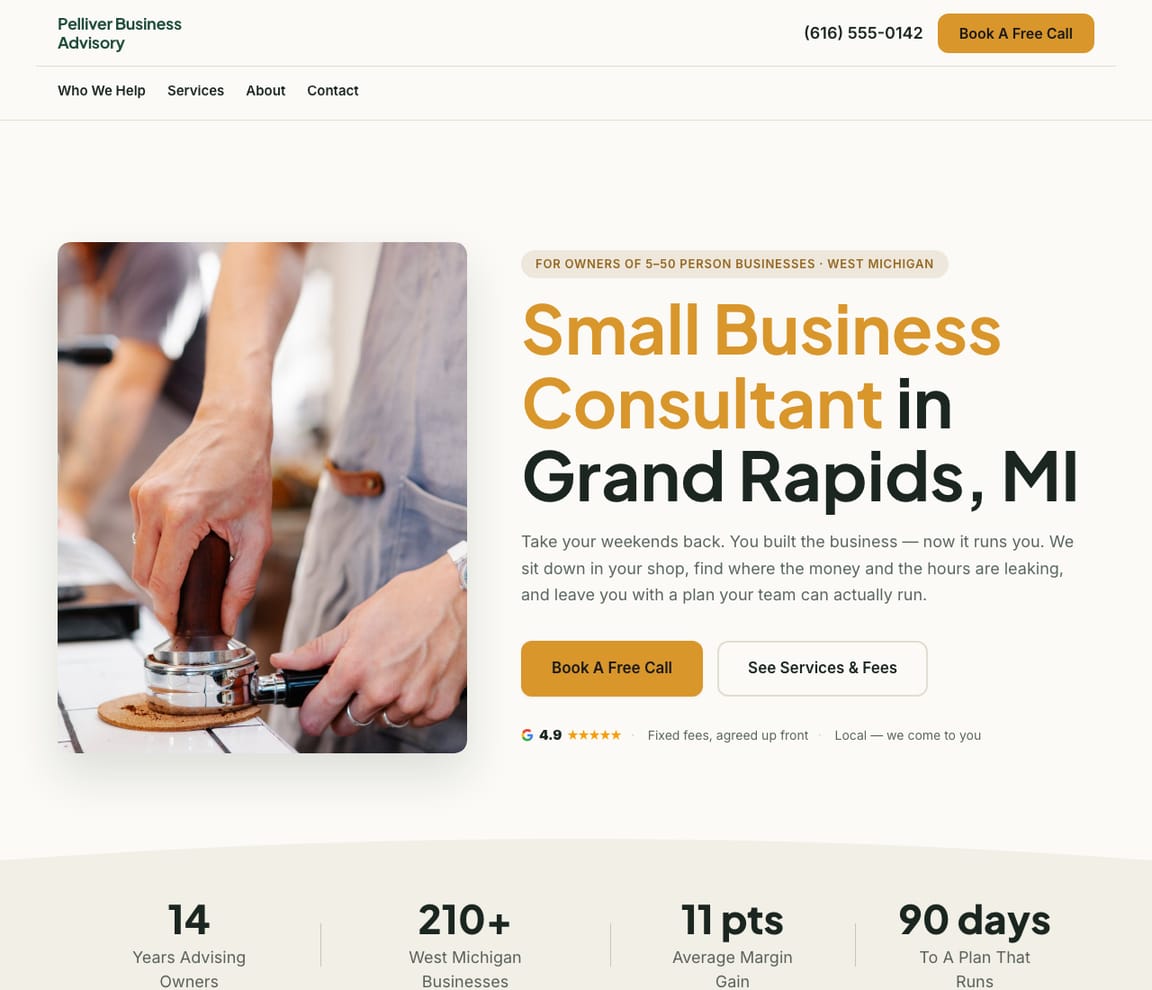
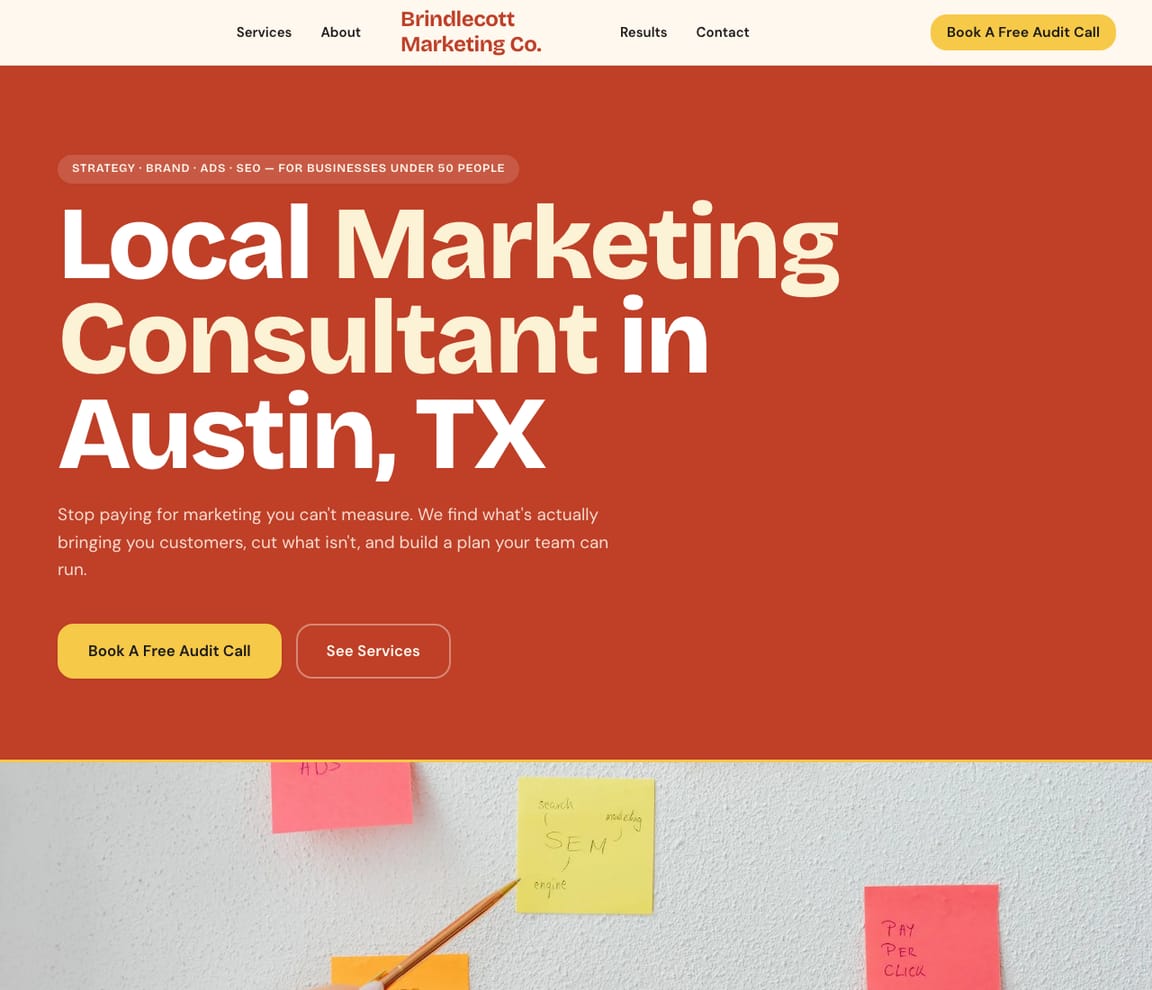
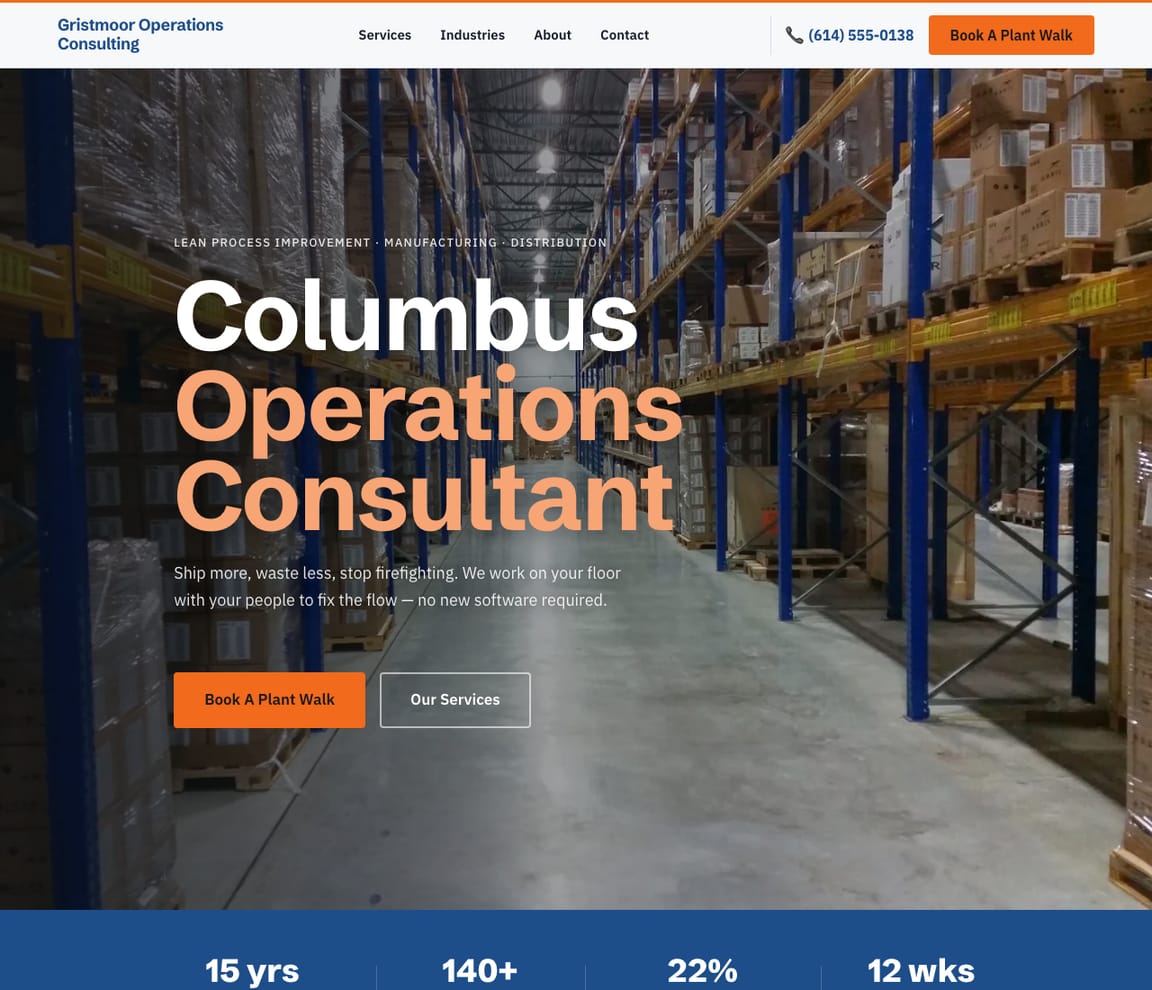
All four are real Zarla templates. Open the one closest to your practice — management, small-business, marketing or operations consulting — swap in your specialty, your case studies and your background, and publish.
GET FOUND
Get found by the client who was just given your name
Most first clients come by referral — and the first thing a referred client does is search your name. A website plus a Google Business Profile is what they find: Zarla builds the website, and once you connect your profile, your name, location and reviews stay in step on both.
Your name, searched
A colleague passes your name on and the buyer looks you up before they reply. A site that says who you help, shows the work and gives one way to start a conversation turns that referral into a first call.
Google Business Profile
Your specialty, your city and your reviews inside Google Search and Maps — for the owner searching “business consultant near me”, and for the referred client checking you're real. Free, and an afternoon to set up.
Reviews and case studies
A buyer hires judgment they can't test in advance, so they look for proof: a short case study per engagement, written with the client's permission, and a review from every client who'd happily give one.
Google Search
Tthroughlineconsulting.com
Throughline Consulting — Trusted Consulting in Your AreaOperations and process consulting for owner-led service businesses. Fixed-scope projects, monthly advisory and team workshops. Book a free first call.← Your Zarla siteCcityconsultingservices.com
City Consulting ServicesGoogle Maps
1
Throughline Consulting
← You2
Metro Consulting Co.
3
Quick Consulting Services
AI assistants (ChatGPT / Perplexity)
For an operations consultant for small businesses in your area: Throughline Consulting — an independent operations consultant who works with owner-led service businesses on fixed-scope projects, with case studies and a free first call.
YOUR LAUNCH PLAN
Your consulting business launch checklist
The whole guide as things to check off. Work through them in order and you'll be set up, insured, priced and easy to check before your first engagement.
- Write your one-sentence specialty — the client you help and the problem you solve.
- Check your field and your old contract — any professional license your advice needs, and any non-compete or non-solicit you signed.
- Save your runway — or sign a first client before you resign.
- Set up the business — sole proprietorship or LLC, a free EIN and a business bank account.
- Buy professional liability cover — and general liability if a landlord or client asks for it.
- Write your standard agreement — deliverables, timeline, price, what's out of scope and the deposit.
- Set aside money for taxes — and pay quarterly estimated tax once you'll owe $1,000 or more.
- Get found — website and Google Business Profile live, LinkedIn updated, and a personal note to everyone who might refer you.
REAL CUSTOMERS
Small business owners who got online with Zarla
Verified reviews from real Zarla customers.
“Great professional website in less than a minute, with the use of AI and a few descriptive prompts. This has saved me bundles of time and research on web developers.”
“Quickly built my website from scratch. No hiccups. Would highly recommend Zarla for someone with no experience who wants to start a polished business website.”
“Very reliable, professional, and fast results. I was able to get my business online in no time, and the ease of access made it so simple.”
“I had no idea how to set up a website for my business. Thanks to Zarla, they've helped me a lot.”
Be the consultant a referral can check in one search
Add your specialty, your city and your firm's name, and Zarla builds the website from that one line — who you help, the problems you solve, how you work and a contact form for first conversations. Free to build; you pay when you publish.
Already have a website? Bring it across →Zarla keeps your old page addresses where it can and redirects the ones that change, helping you keep the Google standing you've built.
Frequently asked questions
How much money do I need to start a consulting business?
In the US, about $6,235 to $42,100 in our consulting business plan's itemized ranges for one consultant — and most of that is living costs while your first engagements are sold and paid, not equipment. The paperwork is cheap: the EIN is free, an LLC costs $35 to file in Montana and $300 in Texas, and professional liability cover averages about $62 a month. Experienced independents call three months of runway too short and six the bare minimum, so either save it or sign a first client before you resign.
Do I need an LLC to be a consultant?
No. In the US, an independent contractor is self-employed by default and can work as a sole proprietor with no state filing. An LLC is optional: it separates the business from you, some corporate clients prefer contracting with one, and it costs $35 to file in Montana and $300 in Texas — California charges $70 plus an $800 annual LLC tax. Ask an accountant which suits your income and your state.
How much tax will I pay as a consultant?
In the US, self-employment tax of 15.3% on your net earnings — 12.4% for Social Security up to $184,500 of earnings in 2026, and 2.9% for Medicare with no cap — plus federal and state income tax. Half of the self-employment tax is deductible, and once you expect to owe $1,000 or more you pay estimated tax quarterly. A few states also tax the service itself: Connecticut charges 6.35% sales tax on management consulting. Confirm the details with your accountant.
What type of consultants are most in demand?
Consultants with a clear specialty. The Bureau of Labor Statistics projects management analyst jobs — the occupation most business consultants fall under — to grow 10% from 2025 to 2035, much faster than average. Specialists also charge more: in one 2026 rate study, 28% of specialist consultants charged $250 an hour or more, against 7% of generalists. Pick the problem you've already solved for an employer, and the clients who have it.
Can I start my own consulting firm?
Yes. In the US there's no license to consult — more than a million consulting businesses had no employees in 2023, by the Census Bureau's count. You need a professional license only if your advice crosses into a regulated field, such as investment advice, engineering, accounting under the CPA title or selling insurance. Most firms start as one consultant and add people when the work outgrows them.
How do independent consultants get paid?
By the project, the hour, the day, a monthly retainer or on value. In a study of nearly 1,000 consultants, 30% price by the project, 29% by the hour, 16% on a monthly retainer, 15% on value and 10% by the day. Most take a deposit before project work starts and invoice as an independent contractor — clients don't withhold tax, so you set money aside for it yourself.
What is the difference between a freelance consultant and an independent consultant?
In the US there's no legal difference — both are self-employed independent contractors under the IRS test. In practice, “freelance” usually means hourly or task work, often through a platform, and “independent consultant” usually means scoped engagements or retainers sold directly to the client. The paperwork, insurance and taxes are the same.
What are the 7 C's of consulting?
They're the seven stages of Mick Cope's consulting model, from his book The Seven Cs of Consulting: Client, Clarify, Create, Change, Confirm, Continue and Close. Read in order, they run from the first meeting with a client to the end of the engagement — a useful checklist when you write your first statements of work.
Is AI replacing consultants?
Not on the official numbers: the Bureau of Labor Statistics still projects management analyst jobs to grow 10% from 2025 to 2035, much faster than average. What AI changes is how long some work takes, which is one reason consultants' own trade press now argues for pricing by the project or the result rather than the hour. Clients still pay for judgment, and for someone accountable for the outcome.
How do I get my first consulting clients?
Through people who already know your work. For 60% of consultants the first client is a referral from their own network, and many start with a former employer. Tell former managers, colleagues and clients what you now do, one by one, and make yourself easy to check when they pass your name on: a website with your specialty, a case study and a way to get in touch, a Google Business Profile and an updated LinkedIn. Zarla builds the website from one sentence, with your services, your background and a contact form, and syncs your Google profile once you connect it.