CAREER GUIDE
How to become a daycare provider in 2026
How many children you can watch before your state licenses you, what a licensed home may hold, the background checks for everyone in the house, the training hours and the CPR card — each big state's answer from its own regulation — plus the home-or-center fork, the first families, and what providers actually earn.
Free to build · Pay when you publish · No credit card
5 checksin the federal background-check floor — FBI fingerprints, the national sex-offender registry, and your state's criminal, sex-offender and child-abuse registries — for every adult who lives in the home
$10,572a year: the 2025 average price of a four-year-old's spot in a US family child care home (Child Care Aware of America) — six of them is $63,432
$16.82an hour: the 2025 median for employed childcare workers (O*NET, from BLS data) — the provider who owns the home is not in the survey
No degreerequired — a high-school diploma or GED is the floor in Illinois, Oklahoma and Pennsylvania
See it in action
See what your daycare website could look like
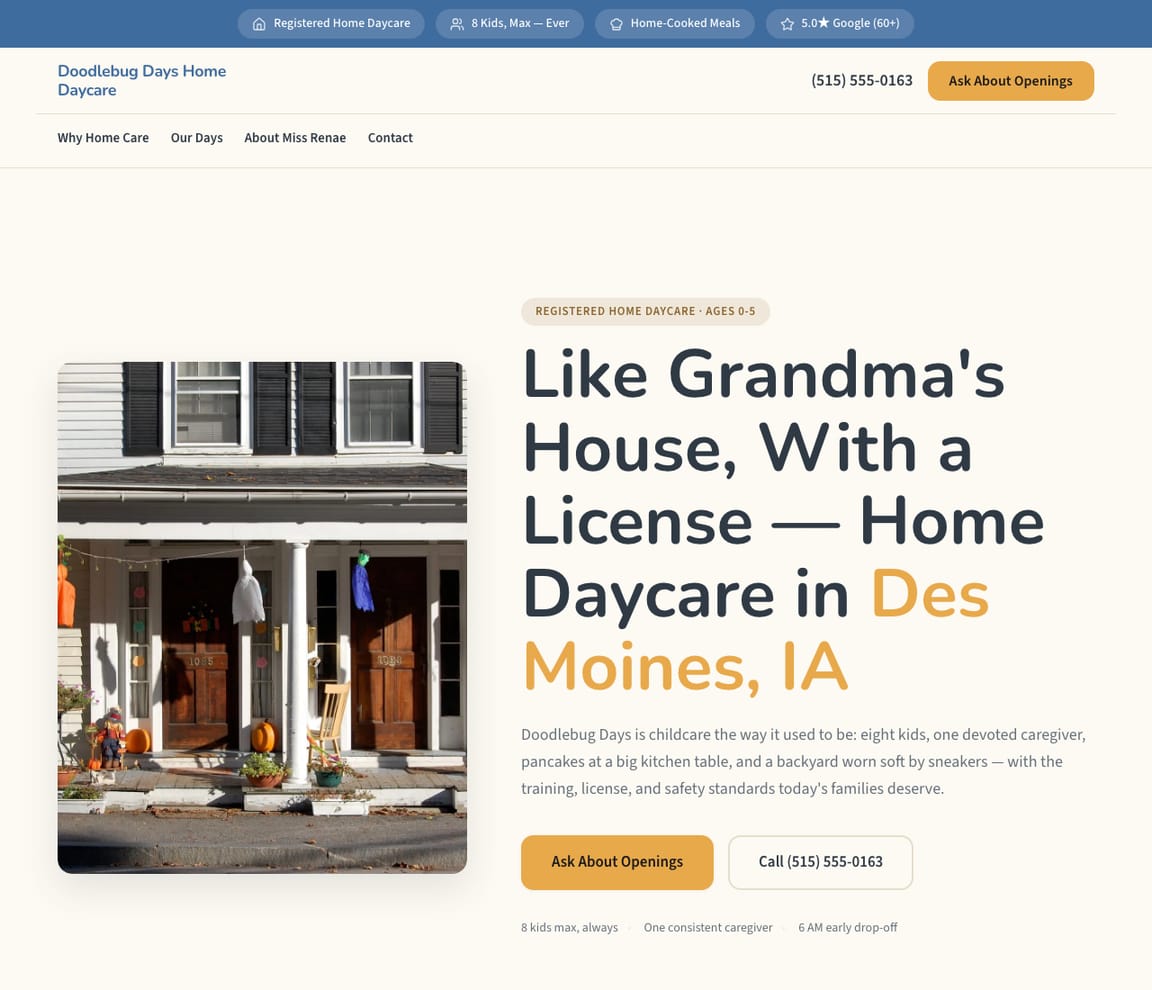
A real Zarla template for an in-home family daycare — the design most new providers start as: a cozy hero, the eight-kids-max promise, the daily rhythm, and a tour request a parent can send from their phone. Describe yours — the town, the ages you take, the hours — and you'll have a site like this in about a minute.
- Professional design — not a generic template
- Looks great on desktop and mobile
- Content written for your industry
Build the website
Start your daycare website now
Add your town and your daycare's name to the sentence, and Zarla builds the site: your program, your hours, your license and a tour request form. Add your rates and your photos in chat, then publish.
Already have a website? Bring it across →Zarla keeps your old page addresses where it can and redirects the ones that change, helping you keep the Google standing you've built.
Is becoming a daycare provider worth it in 2026 — and what does the work pay?
Becoming a daycare provider is a license you earn from your state, a house that passes an inspection, and a business whose income is capped by arithmetic: the children your license allows, times the tuition your town pays. Three honest numbers first. Employed childcare workers had a median of $16.82 an hour in 2025, $34,980 a year — 10 percent under $24,260, 10 percent over $46,010 — with $28,570 the Texas median and $40,020 California's (O*NET, from BLS 2025 wage data; Texas; California); the occupation is "Employment (2025) 1,010,300 employees · Projected growth (2025-2035) Decline (-1% or lower) · Projected job openings (2025-2035) 150,300" (O*NET, childcare workers), while preschool teachers are at "$18.34 hourly, $38,140 annual" with growth "Faster than average (5% to 6%)" (O*NET, preschool teachers). And the survey behind those wages leaves out the self-employed (Washington ESD) — which is the home provider, whose income is the arithmetic below, not the median.
The arithmetic. The 2025 average price of a spot in a US family child care home is $11,673 for an infant and $10,572 for a four-year-old (Child Care Aware of America, 2025 price and supply). Six four-year-olds, the one-adult cap in several states' rows below, gross $63,432 a year; two infants and four preschoolers gross $65,634; Oklahoma's seven with two under two, $76,206 — our arithmetic, before food, insurance, utilities, supplies and the slots your own children take. The federal food program adds a Tier I home's "1 dollar and 74 cents" a breakfast, "3 dollars and 31 cents" a lunch and "98 cents" a snack (Federal Register, July 27, 2026) — about $9,045 a year for six children over 250 days, our arithmetic. Two San Francisco owners put real numbers on it: one "earns $65,000 a year in salary" caring for 12 children with two co-teachers and says "I am making about 52 percent more now as an owner and director compared to when I was a pre-K teacher in a center-based program"; another, at six children, was "taking home about $6,000 a month after paying all of her expenses, except rent" — "she'll earn $70,000 per year" (The Hechinger Report, 2019).
The other end of the spread. Child Care Aware of America's interviews with family providers found that "family child care providers' hourly wages were below the federal minimum wage of $7.25" — $7.02 an hour in four states — that "approximately 75% of family child care providers interviewed reported that there was a time" they could not pay themselves, and that "the median number of hours worked each week was 63 hours" (Child Care Aware of America, March 2025). The spread between $7.02 and $70,000 is tuition and capacity: a full license in a town that pays, or three children in one that doesn't. Cyndi Cunningham, a licensed provider in St. Paul for 27 years: "Personally, I opened my program with 3 children. It was difficult to ensure that I had enough income to justify calling myself a business." (Minnesota House testimony, February 2025).
The catch. The license takes months and reaches everyone in your house; the inspector checks hinges; there is no substitute when you are sick; and the price parents can pay sets your ceiling before you open. That's what the rest of this guide sets up: the federal checks and your state's rules from the regulations, the training and the credential at real prices, the money to start, and how to fill every spot you are licensed for.
How to become a daycare provider, in plain English: the checks, your state's rules, and the home
First decide: a home daycare or a center. A family child care home runs in the home you live in with a small group and one adult, sometimes two; a center is a commercial space with rooms by age, a director and staff at the state's ratio for every room. Most new providers start at home — Pennsylvania's toolkit draws the center line at seven or more unrelated children (Pennsylvania OCDEL toolkit) — and the rules below are the home's; the center's ratios and capital are in how to start a daycare and the daycare business plan.
The federal floor: five checks, for everyone who lives in the house. The child care law's rule covers each "child care staff member", which includes "Any individual residing in a family child care home who is age 18 and older". The check "shall include: (1) A Federal Bureau of Investigation fingerprint check using Next Generation Identification; (2) A search of the National Crime Information Center's National Sex Offender Registry; and (3) A search of the following registries, repositories, or databases in the State where the child care staff member resides and each State where such staff member resided during the preceding five years: (i) State criminal registry or repository … (ii) State sex offender registry or repository; and (iii) State-based child abuse and neglect registry and database." It is run "Prior to the date an individual becomes a child care staff member" and "Not less than once during each 5-year period", the state must answer "not to exceed 45 days after the date on which the provider submitted the request", and the fee "shall not exceed the actual costs for the processing and administration" (45 CFR §98.43, eCFR). childcare.gov adds the training floor — "Ongoing training for child care staff, such as CPR, first aid, and safe sleep for infants" — and the rule of this whole page: "Along with federal requirements, states and territories have additional child care licensing requirements that vary across the U.S." (childcare.gov).
Your state's rule — how many children before a license, what a licensed home holds, and what comes before you open. Each row is read from the state's own regulation, the same rows our daycare start guide prints:
- California: No license while you care only for your own children (or a relative's) plus children from one other family. Licensed, a small family child care home is licensed for up to 8 children and a large one for up to 14, counting your own children under 10. Before you open: a $25 orientation before you apply, a $73 license fee for a small home, and at least 15 hours of health and safety training — pediatric CPR and first aid and preventive health — plus an hour of childhood nutrition for licenses issued since 2016. (CDSS, Do I need a license?, Health & Safety Code §1596.866, Title 22 §102416.5, §101416.5, §101216.3, §101238.2–3, application steps)
- Texas: Up to 3 unrelated children as a listed family home — you list with the state rather than hold a permit. Licensed, a registered child-care home takes up to 6 children 13 or younger plus 6 more school-age children after school, never more than 12 in all including your own; a licensed child-care home takes 7 to 12. Before you open: a pre-application course certificate from the year before you apply, and pediatric first aid and CPR before the home is registered or licensed. (Texas HHS, types of operations, 26 TAC ch. 747 (homes), 26 TAC §746.1601 (centers))
- Florida: A home becomes a regulated family child care home once it regularly cares, for pay, for children from at least two unrelated families. Licensed, a family child care home registers each year (four counties license instead) and may take, for example, 6 children with no more than 3 infants, or 10 children if no more than 5 are preschool age — household children under 13 count; a large family child care home is licensed for up to 12. Before you open: a 30-hour family child care home course with a competency exam before you register. (Fla. Stat. §402.302, §402.305, §402.313, Florida DCF)
- New York: Up to 2 children — a family day care home starts at 3 children for more than three hours a day. Licensed, a family day care home is registered for 3 to 6 children (8 when at least two are school-age); a group family day care home is licensed for 7 to 12; centers in New York City answer to the city's health department instead. Before you open: a pre-application orientation and an approved health and safety course before registration, then 30 hours of training every two years. (Social Services Law §390, 18 NYCRR §417.8, §418-1.8, §417.14)
- Pennsylvania: Up to 3 unrelated children — the rules begin at four, five or six unrelated children, and care for your relatives doesn't count. Licensed, a family child care home holds a certificate of compliance (Pennsylvania's word for the license) for 4 to 6 unrelated children; a group child care home for 7 to 12; a center is 7 or more. Before you open: the state's orientation within the 12 months before you open; the operator must be 18 with a high school diploma or GED, and staff take 12 clock hours of training a year. (55 Pa. Code §3290.3, §3290.4, §3270.51, §3290.31, OCDEL toolkit)
- Illinois: Up to 3 children — a day care home starts at more than 3, and your own children under 12 count toward that number; care for one household's children alone is exempt. Licensed, a day care home run by one caregiver takes up to 8 children under 12 including your own, with limits on how many are under 5 and under 2; a group day care home with an assistant takes 12 — and since 1 July 2026 the Illinois Department of Early Childhood issues the license, not DCFS. Before you open: 15 hours of pre-service training in the year before you apply, then 15 clock hours a year. (89 Ill. Adm. Code 406, Part 407, Part 408, Illinois Department of Early Childhood)
- North Carolina: Up to 2 children — the state regulates care for three or more children under 13 who don't live with you, for more than four hours a day at least once a week. Licensed, a family child care home is licensed for more than two and fewer than eleven children in the operator's own residence (the state's overview page still says fewer than nine — the rule was amended in 2025). Before you open: the state's pre-licensing workshop before the first license is issued. (NC DCDEE, Getting a License, 10A NCAC 09 (Chapter 9 rules), license overview)
- Michigan: No license-free tier for unrelated children in regular care that the rules describe — the statute's exemptions aren't on a page we can link, so check them with the licensing bureau. Licensed, a family child care home is licensed for up to 6 unrelated children and a group child care home for up to 12; related children don't count toward the cap, though related children under 6 count in the home's 1-to-6 ratio. Before you open: 10 clock hours of training a year for the licensee, with CPR, first aid and infectious-disease training on top. (Mich. Admin. Code R 400.1908, R 400.1910, R 400.8222, R 400.1905)
- Nevada: The smallest licensed tier, a family home, begins at five children, so a home with four or fewer sits below the regulated tiers — the statute's exact exemption isn't on a page we can link, so confirm it with the licensing program before you open. Licensed, a family home is licensed for 5 to 6 children (no more than two under 1 or four under 2) and a group home for 7 to 12. Before you open: a written and oral orientation in the first two weeks of work, then set hours of training within 90 days — shaken-baby prevention, medication, building safety, emergencies. (NAC 432A.100, 432A.110, 432A.534, 432A.5205, 432A.320, 432A.323, Nevada Child Care Licensing)
- Virginia: Up to 4 children, not counting your own or any child who lives with you — a family day home serving five through twelve must be licensed, and one caring for more than four children under 2 (your own included) must be licensed or voluntarily registered. Licensed, a family day home is a program in the provider's residence for one through twelve children under 13, exclusive of the provider's own and resident children. (8VAC20-800-10, 8VAC20-780-350)
- Washington: No head count — a license is needed for any ongoing, regularly scheduled care of unrelated children run as a business; caring for a neighbor's or friend's child now and then, paid or not, is exempt, as is care by relatives. Licensed, a family home license covers up to 12 children in the provider's own living quarters, counting children related to the licensee. Before you open: the department's orientation for every applicant, and the Child Care Basics training before a license is granted. (RCW 43.216.010, WAC 110-300-0355, 110-300-0356, 110-300-0105, 110-300-0106, DCYF)
- Arizona: Up to 4 unrelated children — a child care facility is one that regularly cares, for pay, for five or more children not related to the proprietor. Licensed, a child care group home is certified by the Department of Health Services for five to ten children through age 12 in a residence; five or more anywhere else is a licensed child care facility. (A.R.S. §36-881, §36-897, A.A.C. R9-5-404)
- Massachusetts: No head count — regular care of children in your home, paid or not, up to ten, is family child care and needs a license from the Department of Early Education and Care; informal arrangements among neighbors or relatives and occasional care are exempt. Licensed, family child care is 6 or fewer children with one educator (no more than three under 2), or 7 or 8 when the extra children are school-age; large family child care is 7 to 10 children with two educators. (606 CMR 7.02, 606 CMR 7.10)
- New Jersey: Up to 5 children — only a child care center, which is six or more children under 13, must be licensed; a home with three to five children is a family child care home that registers voluntarily through a sponsoring organization. Licensed, a registered family child care home takes three to five children at a time for at least 15 hours a week, or up to eight when the extra children live with the provider and are under six; six or more children, not counting those who live in the home, is a licensed center. Before you open: eight hours of pre-service training from the sponsoring organization before registration. (N.J.A.C. 3A:52-1.2, 3A:54-1.2, 3A:54-6.1, 3A:52-4.3, 3A:54-5.2)
And the provider-side rules those rows don't carry, from the pages that open. Illinois checks "Federal Bureau of Investigation, State and National Sex Offender Registry, Illinois DCFS Child Abuse and Neglect Tracking System, and the child abuse and neglect registry of any other state of residence. There is no cost for this check", and a home applicant also submits "A medical examination, including TB, DPT, and MMR · Proof of high school diploma, GED, or other degree from an accredited university or vocational school · Affidavit that they are current with any child support owed · Proof of at least 15 hours of required pre-service training", and "Licenses are free, however there are expenses associated with medicals and vaccinations, inspections or testing, pet vaccinations, equipment and supplies, training, and other requirements" (Illinois DCFS, become licensed); a Springfield provider's timeline was "about six to nine months" (NewsChannel 20, October 31, 2024). California clears, "In addition to the applicant", "A person, other than a child, residing in the facility" (Cal. Health & Safety Code §1596.871), and protects the home itself: "The use of a home as a small or large family daycare home shall be considered a residential use of property and a use by right for the purposes of all local ordinances, including, but not limited to, zoning ordinances" (§1597.45), because "family daycare homes for children should be situated in normal residential surroundings" (§1597.40). Texas charges, from August 15, 2025, $35 to apply for a registered child-care home and $20 for a listed family home, $35 and $20 a year after, and "$2/background check" (Texas HHS child care regulation handbook, Revision 25-3); the check is "A name-based Texas criminal history check with a Texas sex offender registry check, except the person must have a fingerprint-based criminal history check if … The person has resided outside of Texas any time during the five-year period", plus "A Central Registry check" (26 TAC §745.615). Maryland: "The first step is to complete a FREE required orientation workshop" — "the 3-hour in-person orientation workshop" (Howard County, Maryland). Oklahoma, a question people ask by name: a family child care home "provides care and supervision for seven (7) or fewer children for part of the twenty-four-hour day", and the law exempts only "informal arrangements which parents make independently with neighbors, friends, and others" (10 O.S. §402, as reprinted in SB 1558, 2026); "Primary caregivers are at least 21 years of age" with a high school diploma or GED, one caregiver may have "seven children, with no more than two children younger than 2 years of age", an assistant may be "at least 16 years of age" but "The caregiver is prohibited from leaving children alone in the care of individuals younger than 18 years of age", and "Current CPR and first aid certification is required for … the primary caregiver, prior to permission to operate or initial permit issuance" (Oklahoma DHS, licensing requirements for family child care homes, effective November 1, 2024). Not your state? childcare.gov's state-by-state resources list every licensing agency, and the national yardstick for a small home is one caregiver to six children when none is under two, your own young children counted (Caring for Our Children standard 1.1.1.1, via Minnesota DHS). Google's "at least 18" is Pennsylvania's rule, not Oklahoma's — check your own state's licensing agency before the first family arrives.
How long it takes. Pennsylvania: "complete application to the mailing of the certificate is 100 days" (OCDEL toolkit). Wisconsin: "a license must be issued within 60 working days of receipt and approval of all application materials" (Wisconsin DCF licensing manual). Illinois, lived: six to nine months.
The training and the credential. No degree is required to run a home; the credential the field recognizes is the Child Development Associate: "Possess a minimum of high school diploma/GED", "Complete 120 hours of formal early childhood education", "Complete 480 hours of professional work experience", then "Submit $525 assessment fee and application" (Council for Professional Recognition, February 2026). The CPR card every state's row asks for: an "Adult and Pediatric First Aid/CPR/AED course" with "a certificate … valid for two years. Price $75" at a university-run Red Cross class (UNLV, March 2026). Maryland's post-orientation list is the shape of it everywhere: a six-hour emergency-preparedness workshop, SIDS and breastfeeding training, and "24 hours of professional development in 6 four-hour workshops" (Howard County, Maryland).
You are self-employed from the first tuition check. In the US a home provider is a sole proprietor by default: "Use Schedule C (Form 1040) to report income or (loss) from a business you operated or a profession you practiced as a sole proprietor" (IRS, Schedule C instructions); "The self-employment tax rate is 15.3%" (IRS), and sole proprietors "generally have to make estimated tax payments if they expect to owe tax of $1,000 or more" (IRS). Get the free EIN — "Use this tool to get an EIN directly from the IRS in minutes for free" (IRS) — because parents claiming the child care credit must enter your number: "If the care provider is an individual, enter their SSN or individual taxpayer identification number (ITIN). Otherwise, enter the provider's employer identification number (EIN)" (IRS, Form 2441 instructions). The IRS flips its own home-office rule for you: "You do not have to meet the exclusive use test if … You use the part of your home in question as a daycare facility" — provided "You must have applied for, been granted, or be exempt from having a license, certification, registration, or approval as a daycare center or as a family or group daycare home under state law" — and "If the use of part of your home as a daycare facility is regular, but not exclusive, you must figure the percentage of time that part of your home is used for daycare" (IRS Publication 587). If you want an LLC: Texas $300 (Tex. Bus. Orgs. Code §4.152); Florida $100 plus $25 for the registered agent and $50 a year (Fla. Stat. §605.0213); New York $200 (N.Y. LLC Law §1101) plus a notice "published once in each week for six successive weeks, in two newspapers of the county" (§206); California $70 (Cal. Gov. Code §12190) and "Every LLC that is doing business or organized in California must pay an annual tax of $800" (Franchise Tax Board). Confirm the details with your accountant.
Can you be paid to watch your own children? No — a relative, sometimes. The subsidy route in Texas is for "individuals who provide child care to a related child whose parent receives a child care scholarship from the state", and the relatives it names are the child's "Grandparent · Great-grandparent · Aunt · Uncle · Sibling (over the age of 18 and not living in the child's home)" — a parent is not on the list (Workforce Solutions Capital Area, June 2025); the federal rule's own definition leaves out anyone "related to all children for whom child care services are provided" (45 CFR §98.43). And once you are licensed, your own children live inside the rules: "Caring for our own children presents one of the biggest challenges in-home child care … our children must then follow program standards, even though this is their home" (Cyndi Cunningham, Minnesota Senate testimony, April 15, 2026).
The money to start. Our arithmetic from the pages that print each price, for a California small family home: the $25 orientation and the $73 license fee from the state's row, a $75 pediatric first aid and CPR class, a First Alert ten-year sealed smoke alarm at $29.95 on the maker's own store (First Alert Store) and a year of general liability at Insureon's $91-a-month median — $1,092 — come to $1,294.95. The fuller paperwork start — the same fees and class, a business owner's policy at Insureon's $135 a month instead — $1,620 a year — the CDA's $525 assessment fee and a $300 Texas LLC — is $2,647.95. Neither prices the gates, outlet covers, cribs and toys: every retailer's page refused to open the day we read them, so the honest line is Missouri's — "A Family Child Care Home often starts under about $2,000 for background checks, safety items, and inspections" (Child Care Aware of Missouri, June 2026) — and the daycare business plan lays out every line as a planning range. The insurance: "General liability: $91 per month · Business owner's policy: $135 per month · Professional liability: $99 per month", and "General liability insurance is required in 23 states for childcare centers and in 13 states for home-based care, while others require you to notify parents of your coverage status" (Insureon, daycare insurance). The step after this guide is how to start a daycare; the name comes from daycare business names, and the site from the daycare website builder or the daycare website design page.
In the UK: you register with Ofsted or a childminder agency to be paid to look after children under 8 for more than two hours a day (GOV.UK); the Early Years Register costs £35 a year (Ofsted fees, September 2026); and a childminder may care for at most six children under eight at once, no more than three of them young children and only one under one, own children included (EYFS framework for childminders, effective September 1, 2026). In Australia a new service needs provider approval and then service approval from the state regulator under the National Quality Framework — New South Wales decides a complete service application within 90 days (NSW Department of Planning, 2022) — and a family day care educator works under an approved service, as Western Australia's sector page sets out (WA Department of Communities). Check your own state's licensing agency before the first family arrives.
What daycare providers actually say
None of this is our opinion about child care. It comes from providers speaking in public — to reporters, to a TV station, to CanvasRebel, and to state legislators in Minnesota and Massachusetts — between 2019 and 2026, each described as the page describes them. Read each as theirs at the time. Five things come up again and again.
The license reaches the whole house, and it takes months. Alexia Heaton, who runs a licensed in-home daycare in Springfield, Illinois: “The process was kind of long, it was about six to nine months … But the process went by pretty quickly and it was definitely worth it.” And: “It was physicals for my entire family, the background checks were for my entire family as well … It was inspections on everything you could possibly imagine.” (NewsChannel 20, October 31, 2024). Ellen Dembro, who ran a family child care in West Boylston, Massachusetts for 12 years and was re-licensing in 2020: “I'm a patient person and I know there's so much going on, but I've been very anxious … It's just not knowing what's happening.” (CommonWealth Beacon, August 21, 2020). Amanda Rieder, who ran a home child care in Tyler, Minnesota for eight years: “We had to either buy hinges that made the door self close, or you had to buy one of those attachments to screw onto your door that pulls it shut, and so we had to make those changes” (MPR News, September 24, 2025).
“Personally, I opened my program with 3 children. It was difficult to ensure that I had enough income to justify calling myself a business.” — Cyndi Cunningham, licensed family child care provider in St. Paul for 27 years, in testimony to the Minnesota House, February 2025
The house is the license. Destinee Hodges, a center director in Nevada trying to open a home program: “Things were moving slow, and I wasn't getting anywhere … I couldn't find a house. I was doing everything I could, but it didn't matter. I couldn't be a licensed provider if I didn't have a house.” (EdSurge, July 27, 2023). Rieder on the cover nobody budgets for: “We have a hard time finding homeowner's insurance, vehicle insurance, being able to just have the basic needs of coverage just because we're operating a day care” (NPR, November 18, 2025).
The money is the arithmetic. Rachele Long, who runs a home program in San Francisco with two co-teachers: “I am making about 52 percent more now as an owner and director compared to when I was a pre-K teacher in a center-based program” (The Hechinger Report, 2019). Pat Sullivan, who has run a San Francisco family child care since 1992, on the companies selling help with licensing: “I think it's predatory … Especially when they talk about helping someone get licensed. That's really a much more simple process than people realize.” And: “Most providers in California are low-income. We are the lowest paid part of the teacher workforce” (The Hechinger Report, 2019). Elizabeth Olivo, a family child care provider in the Bronx: “Nearly every major operating expense for my family child care program has increased, making it more challenging to maintain stability while continuing to provide quality care for families” (The Hechinger Report, May 2026). Gertrudis Espinal, also in the Bronx, on a pilot that paid her a monthly stipend: “I have the money, so your mind is focusing on what you need to, [like] training and teaching these kids to develop their skills and the foundation … You're in peace of mind, so you are projecting a more peaceful and a better environment to the kids.” (The Hechinger Report, May 2026).
There is no backup, and you wear every hat. Kelsey Hayley, a family child care provider in Mounds View, Minnesota for three years: “We wear lots of hats. We are the teacher, the janitor, the lunch lady, the secretary, we wear all of these hats,” and “we are getting more correction orders, we are getting more rules.” (MPR News, September 24, 2025). Kelly Dawn Jones, a home-based provider in Indiana, on finding someone to cover her: “I don't want to hire a warm body. I want someone who's going to talk with [the kids], interact with them, joke with them, build relationships with them” (EdSurge, February 3, 2025). Shandreca Gibson, a disabled veteran who owns a licensed home daycare: “In the first few months, I had a week where everything seemed to go wrong. I had enrolled several new children … At the same time, the paperwork and licensing requirements seemed never-ending, and as a single person running this operation, it felt overwhelming.” (CanvasRebel, read October 2026).
Your own children live inside the rules. Cunningham, 27 years in by her 2025 testimony and now a policy chair: “Caring for our own children presents one of the biggest challenges in-home child care. Often, programs are started because parents wish to stay home with their children and see an opportunity to care for others as well. However, our children must then follow program standards, even though this is their home.” (Minnesota Senate testimony, April 15, 2026). Theresa Peplinski, a licensed family child care provider in Rochester, Minnesota for about 17 years, on a training mandate: “The amount of additional training that would be required of child care providers would be a burden and would result in less providers being qualified to provide care for disabled children. The children and the providers need relief from this over-reach.” (Minnesota House testimony, 2024 session, read October 2026). Hayley on why she does it anyway: “I've always loved the family child care business, being able to work with kids, having a small group, being able to apply my education from early childhood and apply it in my home.” (MPR News, September 24, 2025).
The through-line: the providers who last read their state's rule before the first family arrives, get the whole household checked early, price from the real cost of a licensed spot and fill every one, carry the insurance a homeowner's policy won't, and treat the home as the business it legally is.
THE STARTER KIT
What you need to become a licensed daycare provider
Your state's rule, read first
How many children you may watch before a license, what a licensed home may hold, and whether your state says licensed, registered or certified — different in each, named below from the regulations.
Checks for everyone in the house
Fingerprint, criminal-history and child-abuse registry checks for you and every adult who lives with you, and in Illinois a medical exam and a TB test — before the application, not after.
The orientation and the training hours
Your state's pre-application orientation, pediatric CPR and first aid, safe sleep, and the health-and-safety hours each state counts differently — the card and the certificates in a folder for the inspector.
A home that passes inspection
Outlet covers, gates, locked cabinets, a fire extinguisher and smoke alarms, square footage per child, a fenced yard where the rule asks for one — and your landlord's or HOA's permission in writing.
Insurance the inspector asks about
Child care liability cover, because a homeowner's policy may exclude a business in the home; the cost from the insurers that publish one, below.
Policies, prices and a way to be found
A parent handbook, a tuition schedule priced from your real cost per spot, a contract — and a website with your hours, your license and a tour form, plus a Google Business Profile.
THE PAPERWORK
Checks, training, licenses and insurance for a new daycare provider
| Typical cost | Time to get | Legally required? | |
|---|---|---|---|
| The federal background check (five components) | Actual cost — $2 a check in Texas; free in Illinois | Up to 45 days | Yes — every adult living in the home, re-run every five years |
| The state license or registration | $25 orientation + $73 license (CA small home); $35 registered / $20 listed (TX); free (IL) | 100 days (PA); 60 working days after approval (WI); 6–9 months lived (IL) | Yes, above your state's threshold — named above |
| Pre-service orientation and training | Free 3-hour orientation (MD); 15 hours (IL); your state's hours above | Days to weeks | Yes in the states that set hours |
| Pediatric first aid and CPR | $75 at a university-run Red Cross class | A day; valid two years | Yes — before the permit in Oklahoma, before registration in Texas |
| Medical exam and TB test | Your clinic's price | Days | Illinois (TB, DPT, MMR); check your state |
| Minimum age and education | None | — | 18 with a diploma or GED (PA); 21 with a diploma or GED (OK) |
| The CDA credential (optional) | $525 assessment fee + 120 hours of education + 480 hours of experience | Months | No — the credential the field recognizes |
| Sole proprietorship (Schedule C) | $0 | None | The default (self-employment tax 15.3%) |
| LLC (optional) | $300 (TX); $125 (FL); $200 + newspaper notices (NY); $70 + $800/yr (CA) | Days to weeks | No |
| An EIN | Free | Minutes | Not by law — the number parents enter on Form 2441 instead of your SSN |
| General liability insurance | $91/mo median (Insureon) | Days | Required for home-based care in 13 states; Illinois asks group homes for proof |
| Zoning, landlord or HOA permission | None | Before you apply | California makes a family daycare home a use by right; elsewhere ask, in writing |
THE STEPS
How to become a daycare provider (step by step)
Eight steps from the first question — how many children can I watch? — to a licensed home with every spot filled.
01
Decide: a home or a center
A family child care home runs in the home you live in with a small group and one or two adults; a center is a commercial space with rooms by age, a director and staff at the state's ratio for every room. Most new providers start at home; the rules below cover both.
02
Read your state's threshold and capacity
How many children you may care for before a license, how many a licensed home may hold, whether your own children count — each state's answer is below, from its regulation. Read your row before you spend anything.
Named by state below03
Go to the orientation and do the training
Your state's pre-application orientation, pediatric CPR and first aid, safe sleep and the health-and-safety hours — the certificates the application asks for and the inspector checks.
04
Clear the checks for everyone in the household
Fingerprints, criminal history, the child-abuse registry — for you and every adult who lives with you, and in Illinois a medical exam and a TB test.
05
Prepare the home and get permission
Childproof the rooms you will use, meet the space rule, fence the yard where the regulation asks, and get your landlord's or HOA's yes in writing; then book the inspection.
The inspector's visit06
Apply, pass the inspection, get the license
The application, the fee where your state charges one, the inspection, and a provisional or full license — then the number goes on your contract and your website.
07
Price from the real cost of a spot
Your tuition against your ratio, your hours and your fixed costs — the posted averages are below — with a contract, a deposit and a late-pickup fee, and the federal food program if you qualify.
The hard part08
Fill the spots, and be found
A website with your program, your hours, your license and a tour form, and a Google Business Profile with your photos — so the parent searching in January finds you for March.
THE COSTS
How much does it cost to become a daycare provider?
Itemized from the pages that print a price: the fees from the state regulations, the class from a university's listing, the alarm from the maker's store, the insurance from Insureon's daycare medians. The gates, cribs, toys and yard fence come on top — every retailer refused to open the day we read it, so the plan page carries those as planning ranges — and so do your own living costs while the first families arrive.
$1,294.95the paperwork and the first safety item for a California small family home — orientation, license, a CPR class, a smoke alarm and a year of liability cover (our arithmetic)
$2,647.95the fuller paperwork start with a business owner's policy, the CDA credential and a Texas LLC
Under ~$2,000what a Missouri family child care home often starts for — background checks, safety items and inspections (Child Care Aware of Missouri, June 2026)
$525the CDA credential's assessment fee, after 120 hours of education and 480 hours of experience
WHAT WE'VE LEARNED
What actually makes a parent choose a daycare
Thousands of local business websites in, the pattern for a service parents entrust a child to is clear: the parent wants to know you are licensed, who is in the room, and whether there is a spot. For a daycare, three things on a page decide who gets the tour.
Licensed, and easy to check
Your license or registration number, the agency that issued it, your ratio and your training on the page — a parent will look you up on the state's registry, so make the number theirs to find.
The day, as it actually goes
Drop-off to pick-up — meals, naps, outside time, what the two-year-olds do while the baby sleeps. The schedule is the thing a parent pictures their child inside.
Openings and a way to ask
Which ages have a spot and when, the rates or how to get them, and a tour request form that works on a phone at 11pm. The parent who can ask tonight is the parent who tours this week.
THE UPSIDE
What a daycare provider can earn
Pay for employed childcare workers from O*NET's 2025 figures — the home provider is not in the survey — and the home's ceiling from Child Care Aware of America's 2025 prices times a one-adult license. Averages and arithmetic, not a promise: your state's cap, your town's tuition and your filled spots decide it.
$63,432a year gross for six four-year-olds at the 2025 US family-home average of $10,572 — $65,634 with two infants at $11,673 (our arithmetic)
$9,045a year the federal food program adds for six children at Tier I rates over 250 days — $1.74 a breakfast, $3.31 a lunch, 98 cents a snack (our arithmetic)
$16.82an hour: the 2025 median for employed childcare workers — $34,980 a year; $28,570 in Texas, $40,020 in California (O*NET)
$7.02an hour: what interviewed family providers in four states effectively earned on a 63-hour week (Child Care Aware of America, March 2025) — against two San Francisco owners' $65,000 and $70,000
SEE IT WORK
Daycare website designs you can start from
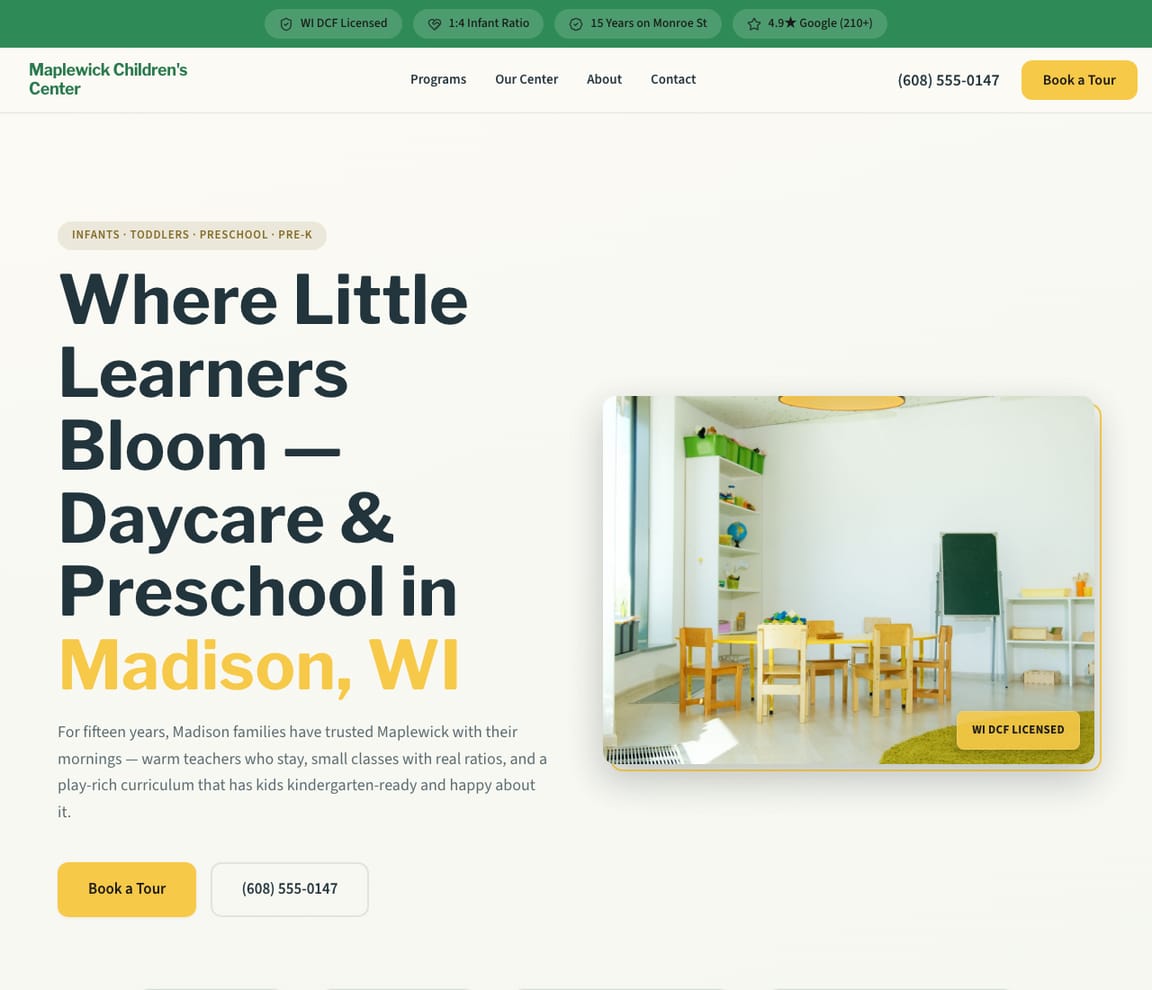
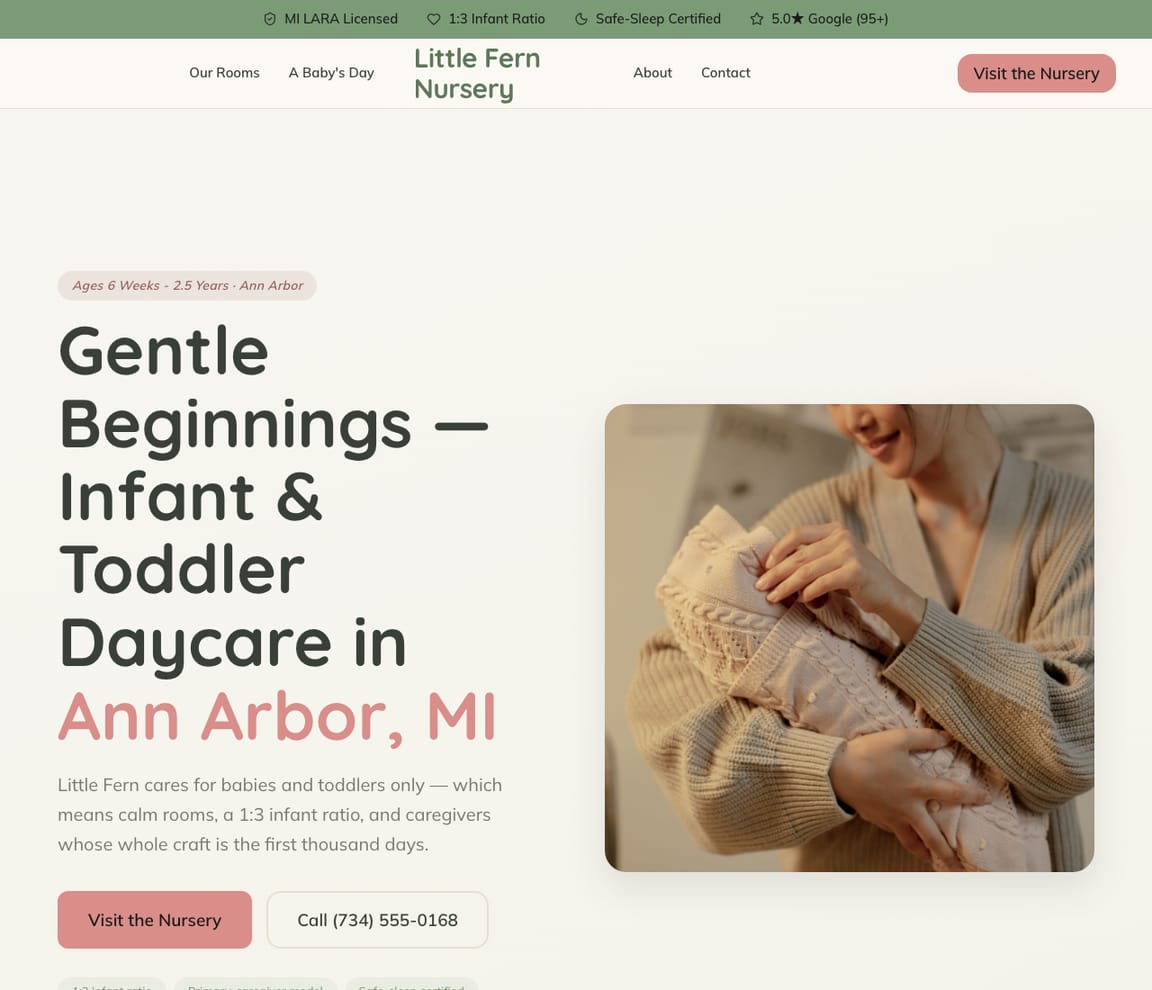
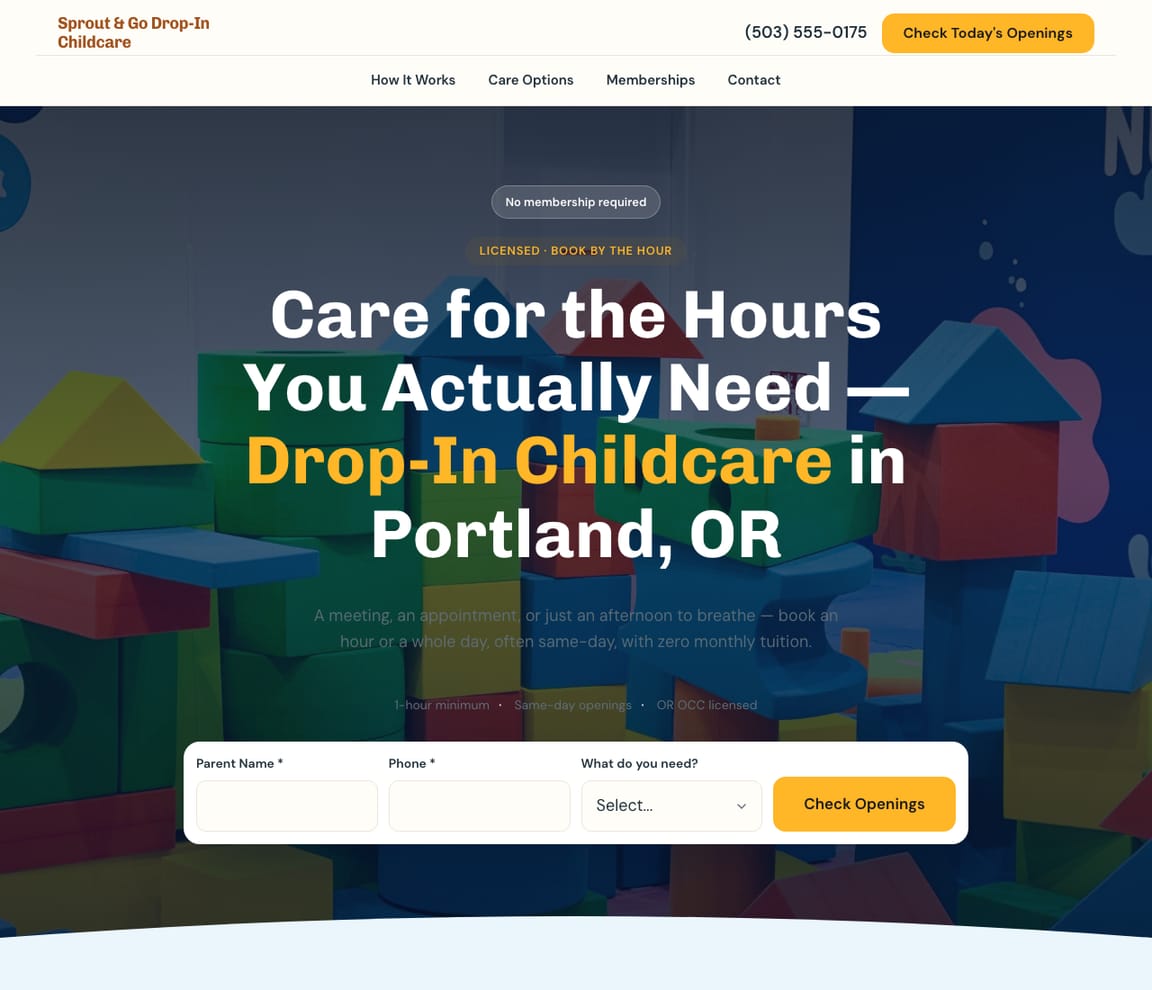
Real Zarla templates for the shapes the work takes — the in-home family daycare, the licensed center, the infant and toddler nursery, the drop-in hourly care. Open one, swap in your program and your hours, and publish.
GET FOUND
Get found by the parent going back to work in March
A parent searches for daycare months before they need it, on a phone, at night, and tours the one whose hours, ages, license and openings are on the page. Zarla builds the website with your program, your hours and a tour request form. Add your rates and your photos in chat, and once you connect your Google Business Profile, your name, your photos and your hours stay in step on both.
“Home daycare near me”
Searched by a parent on maternity leave, a family that just moved, and a grandparent who can't do five days anymore. Your ages, your hours, your license and a tour form answer all three.
Google Business Profile
A licensed daycare qualifies for one: your hours, your photos and your address inside Google Maps, where the parent searching from the office finds you. Free, and an afternoon to set up.
The license, on the page
Your license or registration number, your ratio and your training on the site and on the profile. A parent checks the state's registry; make the number easy to check.
Google Search
Llittleoaksfamilydaycare.com
Little Oaks Family Daycare — Trusted daycare in Your AreaColumbus's licensed home daycare for babies and toddlers — open 6:45am to 5:30pm, six children at most, state-licensed, CPR-certified. One infant spot opening in March. Request a tour.← Your Zarla siteCcitydaycareservices.com
City daycare ServicesGoogle Maps
1
Little Oaks Family Daycare
← You2
Metro daycare Co.
3
Quick daycare Services
AI assistants (ChatGPT / Perplexity)
For a licensed home daycare in Columbus that takes a one-year-old full time, is open by 7am, and has a spot opening in March in your area: Little Oaks Family Daycare — a licensed provider's site that shows the ages and hours, the license and the ratio, the daily rhythm and the openings, and lets you request a tour from the page.
YOUR LAUNCH PLAN
Your become-a-daycare-provider checklist
The whole guide as things to check off. Work through them in order and you'll be trained, checked, inspected, licensed, priced and findable before the first family arrives.
- Decide home or center — and read your state's row below for the threshold and the capacity.
- Go to the orientation — then pediatric CPR and first aid, safe sleep, the health-and-safety hours.
- Clear the checks for everyone in the house — fingerprints, criminal history, the registry.
- Prepare the home — childproof, the space rule, the yard, the landlord's or HOA's yes in writing.
- Apply and pass the inspection — then put the license number on the contract and the site.
- Insure the business — child care liability cover; check what your homeowner's policy excludes.
- Price from the real cost of a spot — a contract, a deposit, a late-pickup fee.
- Get found — a website with your hours, your license and a tour form, and a Google Business Profile.
REAL CUSTOMERS
Small business owners who got online with Zarla
Verified reviews from real Zarla customers.
“Quickly built my website from scratch. No hiccups. Would highly recommend Zarla for someone with no experience who wants to start a polished business website.”
“Great professional website in less than a minute, with the use of AI and a few descriptive prompts. This has saved me bundles of time and research on web developers.”
“I had no idea how to set up a website for my business. Thanks to Zarla, they've helped me a lot.”
“Very reliable, professional, and fast results. I was able to get my business online in no time, and the ease of access made it so simple.”
Be the daycare a parent finds — and trusts
Add your town and your daycare's name, and Zarla builds the website from that one line — your program and your hours, your license and your ratios, a tour request form a parent can fill in on their phone, with SEO in place. Add your rates and your photos in chat. Free to build; you pay when you publish.
Already have a website? Bring it across →Zarla keeps your old page addresses where it can and redirects the ones that change, helping you keep the Google standing you've built.
Frequently asked questions
How much does it cost to become a daycare provider?
In the US, about $1,294.95 for the paperwork and the first safety item in a California small family home, our arithmetic from the pages that print each price: the $25 orientation, the $73 license fee, a $75 pediatric first aid and CPR class, a $29.95 First Alert smoke alarm and $1,092 for a year of general liability at Insureon's $91-a-month daycare median. The fuller paperwork start — a business owner's policy at $135 a month instead, the CDA's $525 assessment fee and a $300 Texas LLC — is $2,647.95. Texas charges $35 to register a home and $20 to list one, plus $2 a background check; Illinois charges nothing for the license or the check. The gates, cribs and toys are on top: Missouri's resource agency says a family home often starts under about $2,000 for background checks, safety items and inspections, and our daycare business plan carries every line as a planning range.
Do you need a license to run a daycare from your home?
In the US, above your state's threshold, yes — and the threshold is the first thing to read, because each state draws it differently: one other family's children in California, up to three unrelated children in Texas, Pennsylvania and Illinois, two in New York and North Carolina, four in Virginia and Arizona, five in New Jersey, and no head count at all in Washington and Massachusetts, which regulate any regular paid care. Oklahoma licenses the family home itself at seven or fewer children and exempts only informal arrangements with neighbors and friends. Below the line you are a babysitter in the law's eyes; above it you are a licensed, registered or certified home with capacity rules, training and the federal background check for every adult in the house. Check your own state's licensing agency.
How many kids can you watch without a license?
It depends on the state, from the regulations: in California, only your own children or a relative's plus children from one other family; in Texas, Pennsylvania and Illinois, up to three unrelated children; in New York and North Carolina, two; in Virginia and Arizona, four; in New Jersey, five; in Washington and Massachusetts, none in regular paid care. Several states count your own young children toward the number, and unrelated usually means not your child, grandchild, sibling, niece or nephew. The rows above carry each state's exact wording and its regulation.
Do daycare owners make a lot of money?
A home provider's ceiling is arithmetic: the children the license allows times the tuition the town pays. At the 2025 US family-home averages — $10,572 a year for a four-year-old, $11,673 for an infant — six children gross $63,432 to $65,634 a year, plus about $9,045 from the federal food program at Tier I rates, before food, insurance, utilities, supplies and your own children's slots. Two San Francisco owners cleared $65,000 and $70,000; providers interviewed by Child Care Aware of America in four states effectively earned $7.02 an hour on a 63-hour week. Employed childcare workers, for comparison, had a median of $34,980 in 2025. The spread is capacity and tuition, which is why filling every licensed spot is the business.
How do I get certified to work in a daycare?
The credential the field recognizes across the US is the Child Development Associate: a high school diploma or GED, 120 hours of formal early childhood education, 480 hours of professional work experience in your setting and age group, and a $525 assessment fee, from the Council for Professional Recognition's own process flyer. Employers and licensing rules add a pediatric first aid and CPR card — about $75 at a university-run Red Cross class, valid two years — and the federal background check. To run your own home, no degree is required: a high school diploma or GED is the floor in Illinois, Oklahoma and Pennsylvania.
Can I get paid to watch my own kids?
Not for your own children, on any page that opened. In the US the subsidy route pays listed relatives — Texas's relative-care program is for someone who provides care to a related child whose parent receives a child care scholarship from the state, and it names the child's grandparent, great-grandparent, aunt, uncle or adult sibling, usually outside the child's home; a parent is not on the list. The federal rule's definition of a paid child care provider leaves out anyone related to all the children in care. Once you are licensed, your own children follow the program's standards in their own home, as a thirty-year Minnesota provider told her state senate.
What are the licensing requirements for child care services in Oklahoma?
In Oklahoma, from the state's own statute and rules, a family child care home provides care for seven or fewer children for part of the day, and the statute exempts only informal arrangements parents make with neighbors and friends. The Department of Human Services' requirements, effective November 1, 2024: the primary caregiver is at least 21 with a high school diploma or GED; one caregiver may have seven children with no more than two under age two, six with no more than three under two, or five of any age; an assistant may be 16 but nobody under 18 may be left alone with the children; and current CPR and first aid certification is required for the primary caregiver before the permit is issued, with health and safety training before caring for children.
How much money do you need to have to open a daycare?
For a home, less than people expect: Missouri's child care resource agency says a family child care home often starts under about $2,000 for background checks, safety items and inspections, and our paperwork arithmetic for a California small home is $1,294.95 to $2,647.95 depending on the insurance, the credential and the entity. The daycare business plan lays out the furniture, toys, yard and childproofing as planning ranges. A center is a different business — a commercial lease, rooms by age, staff at the state's ratio for every room — and the start guide covers it.
What is a normal daycare ratio?
For a home, the national yardstick is one caregiver to six children when none is under two, your own young children counted, with fewer as babies join the group; Oklahoma's table — seven with no more than two under two, six with three under two, or five of any age — is the clearest state version. For centers, each state sets infant and preschool ratios in the same regulation its row above cites, and our guide to starting a daycare prints them state by state — they run from one adult to three or four infants up to one to twenty four-year-olds in the loosest states.
How long does it take to get a daycare license?
By state, from the agencies: Pennsylvania's toolkit puts a complete application to the mailing of the certificate at 100 days; Wisconsin's manual says a license must be issued within 60 working days of receipt and approval of all application materials; a Springfield, Illinois provider's lived timeline was about six to nine months, with physicals and background checks for her whole family. The federal check itself must come back within 45 days. Budget months, not weeks, and start the checks and the orientation before the house is ready.
Do I need a degree to run a home daycare?
No. In the US a high school diploma or GED is the stated floor for a home provider in Illinois, Oklahoma and Pennsylvania, and O*NET's survey of the occupation found 39 percent of employers asking for a high school diploma and 23 percent for an associate's degree. The credential that counts is the CDA, built on 120 hours of coursework and 480 hours of experience, not a degree; centers' directors and preschool teachers are where the degree requirements live.
What insurance does a home daycare need?
General liability first — Insureon's daycare median is $91 a month, and it says general liability insurance is required in 23 states for childcare centers and in 13 states for home-based care, while others require you to notify parents of your coverage status; a business owner's policy is $135 a month and professional liability $99. Illinois asks group homes for proof of liability insurance. The gap providers name is the homeowner's policy: a Minnesota provider said she had a hard time finding homeowner's and vehicle insurance just because she was operating a daycare, so ask your insurer in writing before you apply.
How old do you have to be to run a daycare?
It depends on the state, not on the US as a whole: 18 with a high school diploma or GED in Pennsylvania, 21 with a diploma or GED in Oklahoma, where an assistant may be 16 but nobody under 18 may be left alone with the children. Google's answer of at least 18 is one state's rule. The federal background check applies to every adult of 18 and over who lives in the home, whatever the provider's age.
Do I need an LLC to be a daycare provider?
No. In the US a home provider is a sole proprietor by default — Schedule C, the 15.3 percent self-employment tax, quarterly estimates once you expect to owe $1,000 — and the IRS waives its exclusive-use rule for a daycare that holds or has applied for its state license, so the time-space share of your home is deductible. Get the free EIN whatever you decide, so parents enter it on Form 2441 instead of your Social Security number. If you want an LLC: $300 in Texas, $100 plus a $25 registered-agent fee and $50 a year in Florida, $200 in New York plus a notice published for six weeks in two newspapers, and $70 in California plus an $800 annual tax every year. Confirm the details with your accountant.