

CAREER GUIDE
How to become a general contractor in 2026
Which states license general contractors and which leave it to the city, named from the agencies; the experience years the boards count, the exams, the bonds and the fees for the big states; the routes in without a degree; what contractors earn — and how to go from running someone else's jobs to running your own.
Free to build · Pay when you publish · No credit card
4 yearsof journey-level, foreman, supervising or contracting experience in the last ten, in California, Arizona and Nevada — Florida counts four with a year as a foreman
$79,920median pay in 2025 for first-line supervisors of construction trades (O*NET, from BLS data); construction managers $114,990 — the owner is in neither survey
$40,000the North Carolina job value that needs a general contractor license; $100,000 in Alabama; $50,000 commercial in Louisiana; none at state level in Texas
No degreerequired anywhere — Florida and Georgia count one toward the experience years, California caps the credit at three
See it in action
See what your contractor website could look like
A real Zarla template for a construction company — a full-bleed hero, a project gallery, the license and insurance details where a homeowner looks for them, and an estimate request form. Describe yours — the town, the work you build, your license number — and you'll have a site like this in about a minute.
- Professional design — not a generic template
- Looks great on desktop and mobile
- Content written for your industry
Build the website
Start your contractor website now
Add your town and your company name to the sentence, and Zarla builds the site: your services, a project gallery, your license and insurance details and an estimate request form. Add your projects and your photos in chat, then publish.
Already have a website? Bring it across →Zarla keeps your old page addresses where it can and redirects the ones that change, helping you keep the Google standing you've built.
Is becoming a general contractor worth it in 2026 — and what does the work pay?
Becoming a general contractor is a state license in California, Florida, Arizona, Nevada, Oregon and Georgia, a city registration in Texas and New York, years of someone else's jobs before your own name goes on a permit, and a business whose first killer is cash flow, not bad building. Three honest numbers first. First-line supervisors of construction trades — the foreman the boards count your years as — had a median of $79,920 a year in 2025, $38.42 an hour: 10 percent under $53,280, 10 percent over $128,260 (O*NET, from BLS 2025 wage data), $74,520 in Texas and $97,680 in California (O*NET, Texas; California). Construction managers, the office the owner also runs, had a median of $114,990, 10 percent over $189,440 (O*NET, construction managers). And the survey behind both leaves out the self-employed (Washington ESD) — which is the owner, whose income is the margin on the jobs, not a median. The education survey for supervisors is 27 percent post-secondary certificate, 22 percent less than high school, 21 percent high school diploma (O*NET, supervisors).
What the owners say about the money. Matt Miller, who started a restoration and construction business in Middle Tennessee: "In construction, I feel like it is easy compared to some other businesses to get started. In most cases, you get paid a deposit to start and you can ask for draw payments as you go. The problems come when you make mistakes, dont ask for enough money, don't budget correctly." (CanvasRebel, July 28, 2025). Chris Weaver, whose Colorado general contracting company made the 2026 Inc. 5000: "construction is a difficult industry. You're constantly dealing with cash flow, employees, subcontractors, customers, insurance companies, and circumstances that are completely outside your control." (Voyage Denver, October 20, 2026). Chris Platow, a third-generation tradesman in Houston: "I have dealt with a ton of problems related to not knowing my numbers and undercharging for things" (Voyage Houston, March 17, 2026).
The catch. The license is years away on the day you decide — four of documented experience in the biggest licensing states — the bond and the financial test are real money, the deposit a homeowner may pay is capped by law in California at $1,000 or 10 percent, whichever is less, and the materials and payroll you float before the first draw clear are what close contractors. That's what the rest of this guide sets up: who licenses the work where you work, the years and exams and bonds from the boards, the money to start, and how to be the contractor a homeowner asks for an estimate.
How to get a contractor license, in plain English: which states license general contractors, and what each asks
There is no national contractor license. In the US the question "do I need a contractor license?" has a different answer in each state, and the honest way to answer it is state by state, from the boards. Some license general contractors at state level with experience years, exams, a bond and a financial test; others leave general building to the city or county and license only the trades inside the job — electrical, plumbing, heating and air. Here are the big ones, each from its own agency or statute:
- California — a state license for any job of $1,000 or more. The B General Building license covers "a contractor whose principal contracting business is in connection with any structure built, being built, or to be built, for the support, shelter, and enclosure of persons, animals, chattels, or movable property of any kind" and may not take a prime contract "unless the prime contract requires at least two unrelated building trades or crafts" beyond framing or carpentry (Cal. Bus. & Prof. Code §7057). The qualifier needs "not less than four years experience as a journeyman, foreman, supervising employee or contractor in the particular class", and training or an apprenticeship cannot "count for more than 3 years of the experience" (16 CCR §825); CSLB's own guide puts it as "four years within the last ten years as a journeyperson, foreperson, supervising employee, contractor, or owner-builder", then "a trade exam and/or a business and law exam", fingerprints for everyone on the application, a contractor bond, and "Workers' compensation insurance or exemption" (CSLB, applying for a sole owner license). The bond is "twenty-five thousand dollars ($25,000)" (§7071.6). The fees: "Original Application (exam or waiver for one classification) $450", "Initial License Fee (Sole Owner) $200", "Initial License Fee (Non-Sole Owner) $350", a "Dept. of Justice Processing Fee $32" and an "FBI Processing Fee $17" for the fingerprints, and "Active Timely Renewal (Sole Owner) $450" every two years (CSLB fee list) — the statute lets the Board raise the $450 to $563 and the $200 to $250 (§7137). And the deposit a home-improvement contract may take: "the downpayment shall not exceed one thousand dollars ($1,000) or 10 percent of the contract amount, whichever amount is less" (§7159.5).
- Florida — certified for the whole state, or registered for one county. "A person must be certified or registered in order to engage in the business of contracting in this state" (Fla. Stat. §489.113); a "contractor" is anyone who "for compensation, undertakes to, submits a bid to, or does himself or herself or by others construct, repair, alter, remodel, add to, demolish, subtract from, or improve any building or structure" (§489.105). To be certified: be 18, and have "at least 4 years of active experience as a worker who has learned the trade by serving an apprenticeship as a skilled worker who is able to command the rate of a mechanic in the particular trade or as a foreman … provided, however, that at least 1 year of active experience shall be as a foreman", or a four-year degree in engineering, architecture or building construction "and has 1 year of proven experience" (§489.111); pass the licensing examination; and show financial responsibility through "a credit report from a nationally recognized credit agency", with the board's net worth, cash and bonding minimums capped at "no more than $20,000" for Division I and "no more than $10,000" for Division II (§489.115).
- Arizona — four years, an exam, and a bond sized to your volume. The qualifying party must "Have a minimum of four years' practical or management trade experience, at least two of which must have been within the last ten years", with technical training creditable but "in no case may credited technical training exceed two years", and pass the written exam "taken not more than two years before application" (A.R.S. §32-1122). The license bond for a general residential contractor is "not more than $15,000 and not less than $5,000"; a general commercial contractor under $150,000 of annual volume posts "five thousand dollars", rising by bracket to "not less than $50,000 or more than $100,000" above $10,000,000 (§32-1152).
- Nevada — four years, two exams, a bond and a fee schedule. "The trade qualified individual must have, within the 10 years immediately preceding the filing of this application, at least 4 years of experience as a journeyman, foreman, supervising employee or contractor in the specific classification requested." "A Business and Law (CMS) examination will be required. A trade examination may be required depending on the classification requested." "The fee to apply is $300. If your license is approved the license fee is $600 for a two year license." And "It is your responsibility to file a Contractor's Bond in the amount required by the Board", from $1,000 to $500,000 (Nevada State Contractors Board FAQ).
- Oregon — a 16-hour course, an exam, a bond and insurance, no experience test. "Complete at least 16 hours of pre-license training from an approved pre-license education provider and pass the Oregon exam." "There are 80 multiple choice questions; a passing score is 70 percent (56 correct answers)." "The RMI must be an owner or employee of the business and manage or supervise its construction activities." The bond for a "Residential general contractor: $25,000", liability cover "Residential General Contractor: $500,000 per occurrence", and the application "$400 (beginning 7/1/2025)" (Oregon Construction Contractors Board).
- North Carolina — a license at $40,000. "In the State of North Carolina, a general contractor must be licensed if the contract is valued at $40,000 or higher." (NC Licensing Board for General Contractors FAQ). The board's three limitations and their working-capital tests sit on pages that refused to open the day we read them, so no figure is printed here.
- Georgia — a state license with a net-worth affirmation. The board's licensing rules ask for "at least one year of proven experience working as or in the employment of a general contractor" from an applicant with a construction-related degree, or "four years of proven active experience working in a construction industry related field" without one, an examination approved by the general contractor division, and a net worth affirmation of "$150,000" for the standard tier or "$25,000" for the limited tier, which is capped at contracts of "no more than one million dollars" (Georgia State Licensing Board for Residential and General Contractors, rules chapter 553-4). Georgia's dollar exemption for small repair work lives in a statute whose hosts refused every reader, so it is not printed.
- Alabama — $100,000. A general contractor is "one who undertakes to construct or superintend the construction, alteration, maintenance, repair, rehabilitation, remediation, reclamation, or demolition of any building, highway, sewer, structure, site work, grading, paving or project or any improvement in the State of Alabama where the cost of the undertaking including labor and materials is $100,000 or more" (Alabama Licensing Board for General Contractors, the law).
- Louisiana — $50,000 commercial, $75,000 residential. A commercial license at "$50,000 or more for major and specialty classifications", a residential license for work "In excess of seventy-five thousand dollars for a residential construction project", and the home improvement registration at "$7,500 or more for home improvement projects", with "An exam/administrative fee is required for each classification and for Business and Law" (Louisiana State Licensing Board for Contractors FAQ).
- Texas — no state license for the general contractor, and the trades licensed at any price. The Department of Licensing and Regulation's list of regulated industries has electricians and air-conditioning contractors on it and no general-contractor entry (TDLR); "a person or business may not perform or offer to perform electrical work or residential appliance installation unless the person or business holds an appropriate license" (Tex. Occ. Code §1305.151), "A person may not engage in air conditioning and refrigeration contracting unless the person holds an air conditioning and refrigeration contractor license" (§1302.251), and "A property owner is not required to be licensed under this chapter to perform plumbing in the property owner's homestead" — nobody else is (§1301.051). Your city may register contractors on its own; ask its building department.
- Washington, Virginia, New York City and the registration states. "Washington State requires all construction contractors to register with L&I" — a "$30,000 for general contractors" bond, "$200,000 in public liability and $50,000 property damage, or $250,000 combined single limit", and "The required application fee of $150.20" (Washington L&I). Virginia tiers its license by job value: Class C "over $1,000 but less than $30,000", Class B "$30,000 or more, but less than $150,000", Class A "$150,000 or more" (Va. Code §54.1-1100). New York has no state license; in New York City "A person or business must have a Home Improvement Contractor license to do construction, repair, remodeling, or other home improvement work to any residential land or building", with a 30-question exam, "$200" into the trust fund or "a $20,000 Surety Bond", for two years (NYC Department of Consumer and Worker Protection). Utah licenses from "$7,000, including both labor and materials" (Utah Code §58-55-305); Minnesota licenses the residential building contractor who offers more than one skill above "$15,000" of annual receipts (Minn. Stat. §326B.805); Maryland's Home Improvement Commission "licenses and regulates home improvement contractors" with no floor (Maryland MHIC); New Jersey registers anyone "in the business of making or selling home improvements" (N.J.A.C. 13:45A-17.3); Pennsylvania registers from "$5,000 during the previous taxable year" and caps the deposit on a contract over $5,000 at one-third of the price (Pennsylvania Act 132 of 2008).
One exam for several states. NASCLA's accredited commercial general building exam travels: "NASCLA transcripts are used to waive the trade examination portion for a regulatory agency. Once a transcript is purchased, the receiving regulatory agency will be electronically notified through the National Examination Database (NED)", and "The application fee is $65.00 per application" (NASCLA, accredited examinations FAQ). Oregon's own exam is the NASCLA business, law and project management test. The business-and-law exam is the one every licensing state sets in some form; the trade exam is what NASCLA's transcript can waive.
The one federal rule. "EPA's RRP Rule requires that anyone paid to perform work that disturbs painted surfaces in homes, childcare facilities and preschools built before 1978 be certified and their employees be trained" (EPA, updated June 17, 2026), "This includes all firms, even sole proprietorships", except "Minor repair and maintenance activities that disturb six square feet or less of paint per room inside, or 20 square feet or less on the exterior" (EPA, for contractors). The firm certification is $300 (40 CFR 745.92), good for five years (40 CFR 745.89), with a renovator course that "must last a minimum of 8 training hours" (40 CFR 745.225).
You are self-employed from the first draw. In the US a one-truck contractor is a sole proprietor by default: "Use Schedule C (Form 1040) to report income or (loss) from a business you operated or a profession you practiced as a sole proprietor" (IRS, Schedule C instructions); "The self-employment tax rate is 15.3%" (IRS); sole proprietors "generally have to make estimated tax payments if they expect to owe tax of $1,000 or more" (IRS); and "You never have to pay a fee for an EIN" (IRS). If you want an LLC — and the licensing boards license the entity and its qualifier, so decide before you apply: Texas $300 (Tex. Bus. Orgs. Code §4.154); Florida $100 plus $25 for the registered agent and $50 a year (Fla. Stat. §605.0213); New York $200 (N.Y. LLC Law §1101) plus a notice "published once in each week for six successive weeks, in two newspapers of the county" (§206); California $70 (Cal. Gov. Code §12190) and "Every LLC that is doing business or organized in California must pay an annual tax of $800" (Franchise Tax Board). Workers' compensation: "In Texas, private employers can choose to carry workers' compensation insurance coverage, but it is not required in most cases" (Texas Department of Insurance); "All California employers must provide workers' compensation benefits to their employees" (California DIR). Sales tax on the work: Texas — "Labor to repair, remodel, or restore residential real property is not taxable", while "the total amount charged for remodeling, repairing, or restoring nonresidential real property is taxable" (Texas Comptroller, Publication 94-116); California — "Construction contractors are always the consumers of materials that they furnish and install in the performance of a lump sum contract. Tax applies to the cost of materials to the construction contractor." (CDTFA Publication 9, February 2025); New York — a capital improvement "is not taxable" while "Repairing a broken step, replacing a thermostat on a hot water heater, or painting existing cabinets are all examples of taxable repair and maintenance work" (New York TB-ST-104, updated October 16, 2026); Florida — items "permanently installed into a structure … are classified as real property and are not subject to sales tax" (Florida DOR GT-800067). Confirm the details with your accountant.
The money to start. Our arithmetic from the pages that print each price, for a California sole-owner license: the $450 application, the $200 initial license fee, the $32 and $17 fingerprint fees, and a year of general liability at Insureon's general-contractor median of $1,950 come to $2,649. The fuller paperwork start — commercial auto at $3,444, tools cover at $505, workers' compensation for the first hire at $2,348 and the $300 EPA certification on top — is $9,246. Neither prices the $25,000 bond's premium: every surety company's page refused to open, so ask three. The insurance is a median, not your quote: "General contractors pay an average of $162 per month, or $1,950 annually" for general liability, "$125 per month, or $1,503 annually" for a business owner's policy, "$196 per month, or $2,348 annually" for workers' compensation, "$287 per month, or $3,444 annually" for commercial auto, and "$42 per month for inland marine insurance, or $505 annually" (Insureon, updated July 31, 2026). The truck, the tools and the cash you float are the construction business plan's job — its startup lines run $18,600 to $86,500 as planning ranges before workers' compensation. The step after this guide is how to start a construction business; the name comes from construction company names, and the site from the construction website builder.
In the UK: there is no general-contractor license; the controls are the building regulations — "You might also need building regulations approval for many alteration projects", and "You do not need to get approval yourself if you use someone registered with a competent person scheme" (GOV.UK; the schemes). In Australia the principle inverts: in New South Wales any home building work "above $5,000 (except specialist work)" needs a licensed contractor, and the specialist trades need one at any value (Legal Aid NSW). Check your own state's contractor board, and your city's building department, before you bid the first job.
What general contractors actually say
None of this is our opinion about the trade. It comes from people who run construction companies — a Colorado roofing-and-restoration contractor on the Inc. 5000, a Middle Tennessee builder who sold his car to start, a Houston home builder, a Lexington remodeler, a third-generation Houston tradesman, a Rancho Cucamonga restoration owner, a Baltimore design-build founder, a Sacramento builder, a Denver owner with a civil-engineering degree, a Houston roofer, a 30-year-old Florida state-licensed contractor and a San Diego remodeler — talking to CanvasRebel, Voyage Denver, Voyage Houston and Lake & Sumter Style between 2017 and 2026, each described as the page describes them. Read each as theirs at the time. Five things come up again and again.
The years under someone else's license are the education. Rick Byrd, Byrd Design and Build, Baltimore: “When I attended school for architecture and interior design at MICA in Baltimore, I worked for a general contractor learning the trade. I saw the challenges he faced every day. And even then, I knew what I had to offer the world was different and I would never truly be happy working for anyone but myself.” (CanvasRebel, November 28, 2022). Ari Domingo, Novus Construction, Denver: “I graduated college with a degree in Civil Engineering and immediately went to work for some of the biggest general contractors in the country. I took what I learned from those companies over the years and turned my passion into a successful construction business.” (CanvasRebel, December 4, 2023). Aaron Byrne, AB Bespoke Home, Sacramento: “Eventually, that early curiosity led me back to building. I worked alongside seasoned pros, re learned the ins and outs of residential construction, and slowly began to develop my own approach — one grounded in clear communication, thoughtful design, and attention to the little details that make a house truly feel like home.” (CanvasRebel, March 26, 2026). Robert Wiseman, Wiseman Homes, Houston: “The first projects I did were home renovations. This allowed me to start small and gain some experience. I was on site at every project observing and learning what each trade was doing. I familiarized myself with the different phases of construction and what they required.” (CanvasRebel, July 21, 2022).
“Becoming a licensed state contractor and starting my own company. The relationships I've built with my trades is also one of the best parts of my professional career.” — Chandler Holt, 30, Holt House Construction, on his biggest professional accomplishment, in Lake & Sumter Style, December 30, 2024
The license is one line on a long list. Vanessa Van Holland, co-owner of a restoration company in Rancho Cucamonga, California: “Once we committed, the idea quickly turned into a very long checklist. We researched the franchise, formed our corporation, secured our general contractor's license, completed industry training and certifications, found an office, purchased equipment and vehicles, obtained insurance, and set up our accounting, payroll, estimating, and job management systems.” (CanvasRebel, October 7, 2026). Mark Donaldson, Roof MD and General Contracting, Houston: “From 2004 to 2015, I was in the roofing business running distribution houses for major roofing suppliers. I was literally running my own business with someone else's money, and that's when I knew I needed to bring Roof MD to the masses.” (Voyage Houston, June 28, 2017).
The start is a truck and a deposit. Matt Miller, White Buffalo Restoration, Middle Tennessee: “I sold my car that was worth $5000 and bought a super rusty truck for $2500, and I sold an IRA had that was $6700. This was enough to buy a few tools and an enclosed trailer. After that It was all sweat. I didn't have any backup for a while. I maxed the credit cards, and drank cheap beer, packed lunch, and worked 7 days a week.” (CanvasRebel, July 28, 2025). Robert Sheeley, Double Touch Home Improvements, Lexington, Kentucky: “The initial start up for my company and has been and always will be boot strapping it. I didn't go to no bank. Didn't go to no loan office. I started this company with a handful of tools two bags and an SUV and one humongous dream.” And on the first clients: “Shaking hands with people giving them my business card and just grinding every day to have somebody give me a chance. Then a property owner gave me that chance and I started renovating all of his rental properties.” (CanvasRebel, October 20, 2026).
Cash flow and the numbers are what hurt. Miller: “If I had it to do over again, I would separate the project money from my regular business accounts. Your bank can help you do it. If I am giving advise, I would also say, try hard to turn down some work if you will be really busy, or try to schedule more time for each project.” (CanvasRebel, July 28, 2025). Platow: “I've never had to deal with damaging client conflicts, but I have dealt with a ton of problems related to not knowing my numbers and undercharging for things, employees leaving me suddenly with a workload I can't immediately handle causing me to work 80+ hour weeks.” (Voyage Houston, March 17, 2026). Weaver: “I've had plenty of struggles, both personally and professionally. Building Weaver Construction has been an incredible experience, but construction is a difficult industry. You're constantly dealing with cash flow, employees, subcontractors, customers, insurance companies, and circumstances that are completely outside your control.” (Voyage Denver, October 20, 2026). Dotan Trabulsi, Optimal Home Remodeling & Design, San Diego, on the quote that wins the right job: “A proper quote should not be a single page summary. It should outline exactly what happens at demolition, plumbing, electrical, framing, and finish stages. Transparency on paper equals peace of mind on site.” (CanvasRebel, October 7, 2026).
And the field is crowded with people who think it's easy. Byrd: “But the construction industry is hard. It's saturated. It has a certain stigma. Most contractors are incredibly old school in their ways. I wanted to break free of that. But, in a world where information is at your fingertips, and tv shows show seemingly simple renovation projects, everyone thinks they are the expert.” (CanvasRebel, November 28, 2022). Wiseman, told by a former partner he could never build on his own: “This was tough to hear and at first I started to doubt myself and almost believed what I was told. Maybe I didn't have the amount of experience to be successful. But deep inside of me something told me that I still needed to take the chance.” (CanvasRebel, July 21, 2022). Byrne on where it starts: “In seventh grade I was re-roofing homes with a volunteer organization and during high school I worked summers on a family friend's construction sites learning everything I could.” (CanvasRebel, March 26, 2026).
The through-line: the contractors who lasted put the years in under someone else's license and counted them, treated the license as one line on a long checklist, started with a truck and a deposit instead of a loan, kept the project money apart from the business money, priced from their numbers, and built the finished jobs the next client hires from.
THE STARTER KIT
What you need to become a general contractor
Years the board will count
Documented experience at journeyman, foreman or supervising level — the number of years and who may vouch for them differs by state, and is named below from the boards.
Your state's answer on licensing
A state license with exams in California, Florida, Arizona, Nevada, Oregon and Georgia, a city registration in Texas and New York, a bond or a financial test in the states that license — each named below from the agencies.
The exams, and the study for them
A trade exam and a business-and-law exam where the state tests, or the multi-state NASCLA exam where it is accepted — passed once, carried for years.
A bond and the insurance
The license bond at the amount your state sets, general liability at the minimum the board or the customer asks for, commercial auto, and workers' compensation from the first employee.
A business that can carry the cash flow
An entity, a bank account, a line of credit or a reserve for the materials and payroll you float before the first draw — the thing that closes more contractors than bad building.
A way to be found
A website with your galleries, your license and insurance details and an estimate form, and a Google Business Profile with your photos — how the homeowner collecting three estimates finds you.
THE PAPERWORK
Licenses, exams, bonds and insurance for a new general contractor
| Typical cost | Time to get | Legally required? | |
|---|---|---|---|
| The state general contractor license | $450 + $200 (CA); $300 + $600 (NV); $400 (OR); $150.20 (WA) | Months, after the years | CA, AZ, NV from $1,000; FL from $2,500; OR, GA at any contract; NC at $40,000; AL at $100,000; LA at $50,000 commercial; not at state level in TX or NY |
| The experience the board counts | None | 4 years in 10 (CA, AZ, NV); 4 with a year as foreman (FL); 1 under a GC or 4 in the field (GA) | Yes in the licensing states; Oregon asks for a 16-hour course instead |
| The exams | In the application (CA, NV); $65 to move a NASCLA transcript | A sitting each | Business and law in every licensing state; a trade exam in most of them |
| The license bond | $25,000 (CA, OR residential); $5,000–$15,000 residential (AZ); $1,000–$500,000 (NV); $30,000 (WA) | Days, from a surety | Yes in the states that license |
| The financial test | A credit report and up to $20,000 net worth (FL Division I); a $150,000 net-worth affirmation (GA); working capital (NC) | With the application | FL, GA, NC |
| The trades inside the job | Their own licenses | Years | Electrical, plumbing, HVAC at any price in TX; C-10, C-36, C-20 in CA |
| EPA lead-safe firm certification | $300 per five years + an 8-hour renovator course | Weeks | Yes, for paid work disturbing paint in pre-1978 homes beyond six square feet a room |
| General liability insurance | $162/mo median (Insureon) | Days | $500,000 per occurrence in OR; $250,000 in WA; the customer's condition everywhere |
| Workers' compensation | $196/mo median (Insureon) | Days | Optional for private employers in TX; required of every employer in CA; a license condition in CA |
| Deposit caps | None | — | CA: $1,000 or 10 percent, whichever is less; PA: one-third of a contract over $5,000 |
| Sole proprietorship or LLC | $0; or $300 (TX), $125 (FL), $200 + notices (NY), $70 + $800/yr (CA) | Days to weeks | The boards license the entity and its qualifier — decide before you apply |
| City registration where the state doesn't license | Varies | Weeks | TX, NY outside NYC — ask the building department |
THE STEPS
How to become a general contractor (step by step)
Eight steps from the first year on a crew to a licensed, bonded, insured contractor with your own name on the permit.
01
Find out who licenses the work where you work
There is no national contractor license in the US. California, Florida, Arizona, Nevada, Oregon, Georgia, North Carolina, Alabama and Louisiana license general contractors at state level; Texas and New York leave general building to the city or county; and the trades inside the job — plumbing, electrical, HVAC — are licensed separately in every state named here. The big states are below, from the agencies.
Named by state below02
Put in the years the board will count
Experience at journeyman, foreman, supervising or contracting level, documented and vouched for — the years differ by state, and a construction degree substitutes for some of them in several. Keep the paperwork from day one.
The long part03
Learn to run a job, not just build one
Estimating, scheduling, subcontracts, change orders, lien law and the draw schedule — the business-and-law exam tests it, and the first job you run on your own license tests it harder.
04
Pass the exams your state sets
A trade exam and a business-and-law exam where the state tests, the NASCLA exam where it is accepted, and in a few states a financial statement or a credit report instead of an exam.
05
Form the business and apply
An entity, a free EIN, the application with your experience, references and fees, fingerprints where the state takes them — and the license, usually weeks to a few months later.
06
Post the bond and buy the insurance
The license bond at your state's amount, general liability at the minimum the board sets, commercial auto, and workers' compensation from the first employee — in several states a condition of the license itself.
07
Fund the cash flow before the first contract
A reserve or a line of credit for the materials and payroll you float before the first draw, and a deposit and progress payments in every contract — the states cap the deposit, and the caps are below.
08
Be the contractor the homeowner finds
A website with your galleries, your license number, your bond and insurance and an estimate form, and a Google Business Profile with your photos — so the search for a contractor reaches you first.
THE COSTS
How much does it cost to become a general contractor?
Itemized from the pages that print a price: the fees from the boards, the insurance from Insureon's general-contractor medians, the EPA fee from the regulation. The bond's premium is not printed — every surety company's page refused to open — and the truck, the tools and the cash you float before the first draw are the plan page's planning ranges.
$2,649the paperwork year one for a California sole-owner license — application, license, fingerprints and a year of liability cover (our arithmetic)
$9,246the fuller paperwork start with commercial auto, tools cover, workers' compensation for the first hire and the EPA certification
$18,600–$86,500the construction business plan's startup lines before workers' compensation — the truck, the tools, the bond and the first two months of cash, as planning ranges
$25,000the license bond in California and for an Oregon residential general contractor; $5,000 to $15,000 for an Arizona residential contractor
WHAT WE'VE LEARNED
What actually makes a homeowner hire a general contractor
Thousands of local business websites in, the pattern for the biggest check a homeowner writes is clear: they want proof you have built this before, proof you are licensed and insured, and a way to start the conversation without a phone call. For a contractor, three things on a page decide who gets asked for an estimate.
Finished jobs, in photos
Galleries of additions, remodels and builds you actually completed — before and after, with the town and the year. The first thing a homeowner clicks, and the thing a slogan can't replace.
Licensed, bonded, insured — with the numbers
Your license number, your bond and your insurance carrier on the page, so the check a homeowner runs on the state's site takes thirty seconds and comes back clean.
A way to ask for an estimate
A form that asks for the project, the address and the timing, and lands on your phone — the homeowner comparing three contractors fills in the one that is easy to fill in.
THE UPSIDE
What a general contractor can earn
Pay for employed construction supervisors and construction managers from O*NET's 2025 figures — the owner is in neither survey — and the owners' own words on where the money goes. Medians, not a promise: your margin, your state and your cash flow decide it.
$79,920a year: the 2025 median for first-line supervisors of construction trades — $38.42 an hour; 10 percent under $53,280, 10 percent over $128,260 (O*NET)
$114,990the 2025 median for construction managers — 10 percent over $189,440
$97,680the California median for construction supervisors; $74,520 in Texas
30%the extra revenue one Tennessee owner says he can book for the same profit when he takes on more than he can run — the margin the owner keeps is the number no survey prints
SEE IT WORK
Contractor website designs you can start from
Real Zarla templates for the shapes the trade takes — the custom home builder, the whole-house remodeler, the home-additions specialist, the commercial general contractor. Open one, swap in your projects and your license, and publish.
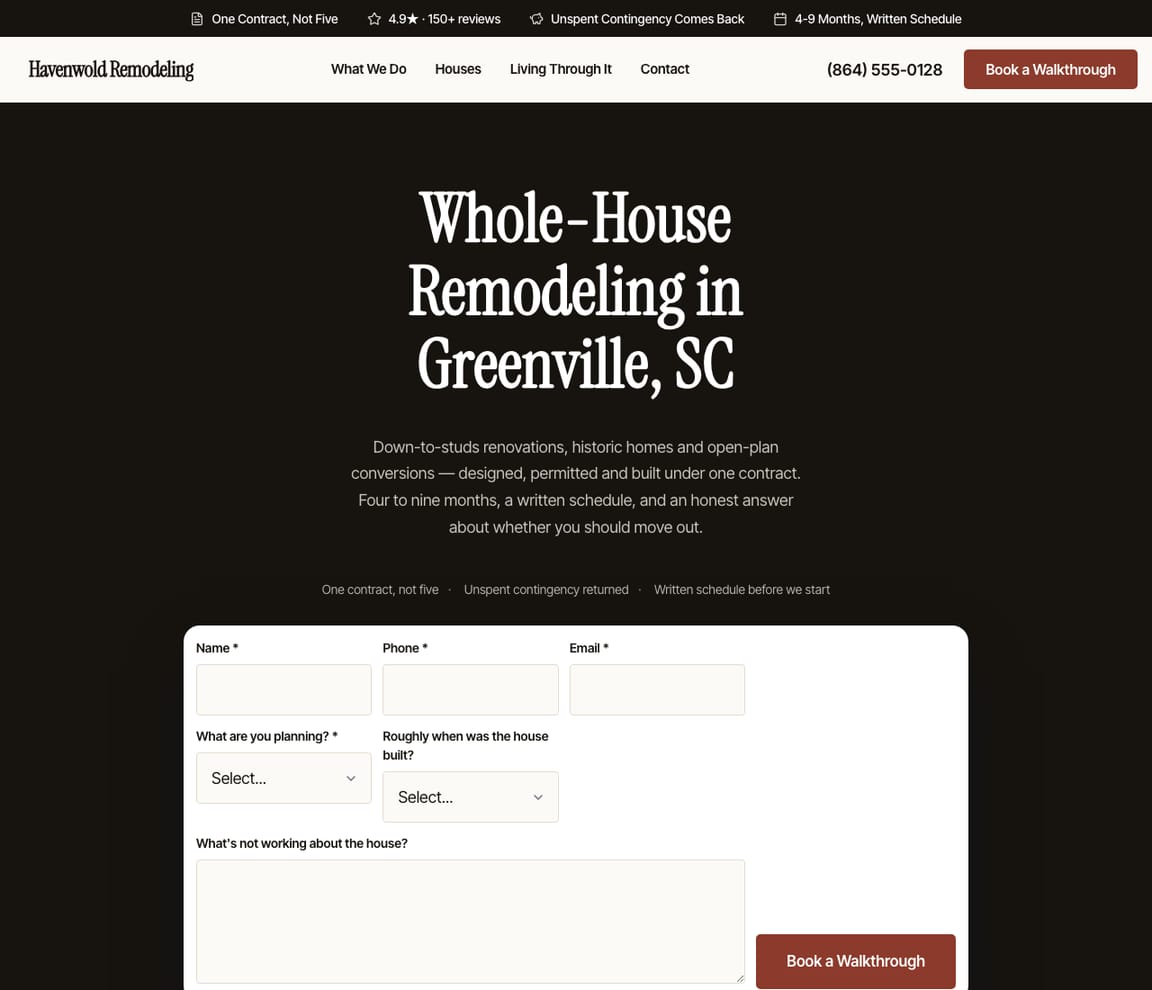

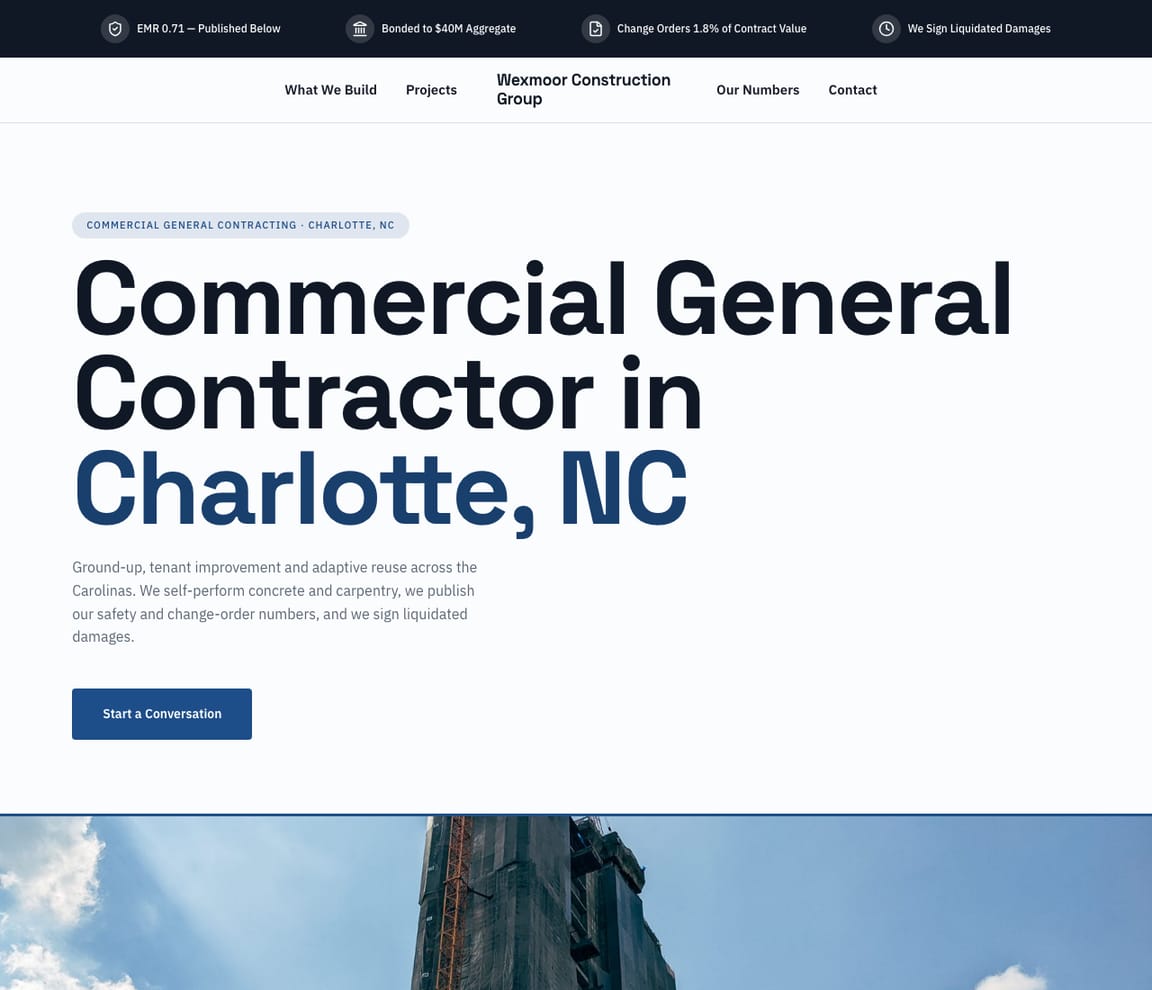
GET FOUND
Get found by the homeowner collecting three estimates
A homeowner planning an addition searches months ahead, reads the galleries, checks the license number on the state's site, and asks three contractors for an estimate — the three whose sites made that easy. Zarla builds the website with your services, a project gallery and an estimate request form. Add your projects and your license details in chat, and once you connect your Google Business Profile, your name, your photos and your hours stay in step on both.
“General contractor near me”
Searched by a homeowner with a plan, a landlord with a vacant unit and a business with a lease to fit out. Your galleries, your license and an estimate form answer all three.
Google Business Profile
A contractor who works at customers' sites qualifies for one: your service area, your photos and your hours inside Google Maps. Free, and an afternoon to set up.
The license number, where the law puts it
In the states that license, the number goes on your ads, your site and your contracts — and the homeowner checks it on the board's site before the first meeting. Make it easy to find.
Google Search
Rridgelinebuilders.com
Ridgeline Builders — Trusted construction in Your AreaSacramento's licensed general contractor — additions, whole-house remodels and ADUs. CSLB-licensed, bonded and insured; see the license number and our finished projects. Request an estimate online.← Your Zarla siteCcityconstructionservices.com
City construction ServicesGoogle Maps
1
Ridgeline Builders
← You2
Metro construction Co.
3
Quick construction Services
AI assistants (ChatGPT / Perplexity)
For a licensed general contractor in Sacramento who builds home additions, is bonded and insured, and can give an estimate this month in your area: Ridgeline Builders — a licensed contractor's site that shows finished additions and remodels with photos, lists the license number, bond and insurance, and takes an estimate request from the page.
YOUR LAUNCH PLAN
Your become-a-general-contractor checklist
The whole guide as things to check off. Work through them in order and you'll be experienced, licensed, bonded, insured, funded and findable before your name goes on a permit.
- Read your state's row below — a state license, a city registration, or both; then ask the building department.
- Put in the years and keep the paperwork — pay stubs, permits, a supervisor who will sign.
- Learn to run a job — estimating, scheduling, change orders, lien law, the draw schedule.
- Pass the exams — trade, business and law, or NASCLA where your state accepts it.
- Form the business and apply — entity, EIN, application, fingerprints, fees.
- Bond and insure — the license bond, general liability, commercial auto, workers' comp from the first hire.
- Fund the cash flow — a reserve or a credit line, a deposit and progress payments in every contract.
- Get found — a website with your galleries, your license details and an estimate form, and a Google Business Profile.
REAL CUSTOMERS
Small business owners who got online with Zarla
Verified reviews from real Zarla customers.
“Optimized for local service-based businesses. Easiest website build I've experienced. The AI-based build is the way to go instead of clunky theme-based websites. Get the site built and get out of the weeds with Zarla!”
“Quickly built my website from scratch. No hiccups. Would highly recommend Zarla for someone with no experience who wants to start a polished business website.”
“Great professional website in less than a minute, with the use of AI and a few descriptive prompts. This has saved me bundles of time and research on web developers.”
“Very reliable, professional, and fast results. I was able to get my business online in no time, and the ease of access made it so simple.”
Be the contractor the homeowner calls for an estimate
Add your town and your company name, and Zarla builds the website from that one line — your services, your project gallery, your license and insurance details, and an estimate request form, with SEO in place. Add your projects and your photos in chat. Free to build; you pay when you publish.
Already have a website? Bring it across →Zarla keeps your old page addresses where it can and redirects the ones that change, helping you keep the Google standing you've built.
Frequently asked questions
How much does it cost to become a general contractor?
In the US, about $2,649 for the paperwork year one of a California sole-owner license, our arithmetic from the pages that print each price: the $450 application, the $200 initial license fee, the $32 and $17 fingerprint processing fees, and $1,950 for a year of general liability at Insureon's general-contractor median. The fuller paperwork start — $3,444 of commercial auto, $505 of tools cover, $2,348 of workers' compensation for the first hire and the $300 EPA lead-safe certification on top — is $9,246. Other states: $300 to apply and $600 for a two-year license in Nevada, $400 in Oregon, $150.20 in Washington. The $25,000 bond's premium is not printed because no surety company's page opened; the truck, the tools and the first two months of cash are the construction business plan's planning ranges, $18,600 to $86,500 before workers' compensation.
Which states do not require general contractors to have a license?
From the pages that open: Texas has no state general contractor license — its Department of Licensing and Regulation lists electricians and air-conditioning contractors and no general-contractor entry — and licenses the trades inside the job at any price; New York licenses general building only through cities, New York City's Home Improvement Contractor license being the big one; Pennsylvania registers rather than licenses, from $5,000 of home improvements a year; Maryland and New Jersey register home improvement contractors from the first dollar. Every other state in this guide licenses general contractors at state level, from $2,500 in Florida, from $1,000 in California, Arizona and Nevada, from the first dollar in Oregon and Georgia, from $7,000 in Utah, $40,000 in North Carolina, $50,000 of commercial work in Louisiana and $100,000 in Alabama. Check your own state's contractor board and your city's building department.
How do I get a contractor license?
In the US the shape is the same in every licensing state and the numbers differ: document the years the board counts — four of journey-level, foreman, supervising or contracting experience in the last ten in California, Arizona and Nevada, four with a year as a foreman in Florida, one year under a general contractor with a related degree, or four in the field, in Georgia; pass the exams — business and law everywhere, a trade exam in California, Nevada and Florida, with a NASCLA transcript waiving the trade exam where it is accepted; post the bond — $25,000 in California and for an Oregon residential general contractor, $5,000 to $15,000 for an Arizona residential contractor; pass the financial test where there is one — a credit report in Florida, a $150,000 net-worth affirmation in Georgia; fingerprint, insure, and pay the fee. Oregon swaps the years for a 16-hour course and an 80-question exam. The section above carries each state's own words.
How much does a contractor license cost?
By state, from the boards: California $450 to apply plus $200 for a sole owner's initial license, with $32 and $17 fingerprint fees and a $25,000 bond; Nevada $300 to apply and $600 for a two-year license; Oregon $400 to apply, a $25,000 bond for a residential general contractor and $500,000 of liability cover; Washington $150.20 to register with a $30,000 bond; New York City $200 into the trust fund or a $20,000 bond; a NASCLA transcript $65. The insurance the license and the customer require costs more than the license: $1,950 a year of general liability at Insureon's median.
How long does it take to become a general contractor?
In the US, the years come first: four of documented journey-level, foreman, supervising or contracting experience in the last ten in California, Arizona and Nevada, four with a year as a foreman in Florida, one year under a general contractor with a related degree, or four in the field, in Georgia — then weeks to months for the exams, the bond, the fingerprints and the application. Oregon is the exception that proves it: a 16-hour course and an 80-question exam, no experience test. Google's answer of two to four years is a rounding of the four years California, Arizona, Nevada and Florida count; a builder's degree shortens it to one year of experience in Florida and up to three years of credit in California.
How much does a general contractor make?
Two surveyed numbers, and neither is the owner. First-line supervisors of construction trades had a median of $79,920 in 2025 — $38.42 an hour, 10 percent under $53,280, 10 percent over $128,260 — with $74,520 the Texas median and $97,680 California's; construction managers had a median of $114,990, 10 percent over $189,440, from BLS data on O*NET. The owner's income is the margin on the jobs after materials, subcontractors, insurance and the bond, and the owners quoted above say the margin is lost to undercharging and to taking more work than they can run — one says he can book 30 percent more revenue for the same profit when he is overloaded.
What skills are needed to be a contractor?
The boards test two sets and the owners name a third. The trade: the years the boards count are journey-level, foreman or supervising experience in the work you will contract for. Business and law: estimating, scheduling, contracts, lien law, the deposit caps and the draw schedule — the exam every licensing state sets. And the one no exam covers: knowing your numbers. A Houston contractor says his problems came from not knowing his numbers and undercharging; a Tennessee builder says to keep the project money apart from the business account and to turn down work when you are already full; a San Diego remodeler says a proper quote outlines exactly what happens at demolition, plumbing, electrical, framing and finish.
How does a GC get paid?
By deposit and draws: a deposit when the contract is signed, progress payments as stages complete, and the balance at the end — a Tennessee builder calls that the reason construction is easier to start than other businesses, and the reason it fails when you do not ask for enough money or budget correctly. The deposit is capped by law in some US states: California limits a home-improvement down payment to $1,000 or 10 percent of the contract, whichever is less; Pennsylvania caps it at one-third of a contract over $5,000. Between draws the contractor floats materials and payroll, which is why the plan page budgets the first two months of cash.
Is a GC the same as a builder?
In the licensing states the general contractor is the licensed party who takes the prime contract and is responsible for the whole job — California's B license covers a structure 'for the support, shelter, and enclosure of persons, animals, chattels, or movable property' and requires at least two unrelated trades on a prime contract; Florida divides its certified contractors into Division I (general, building and residential) and Division II (the trades). A builder is usually a general contractor who builds new homes; a remodeler is one who alters existing ones; both hold the same license class in California and Florida.
What are the four main types of contractors?
The general contractor, who holds the prime contract and runs the job; the specialty or trade contractor — electrical, plumbing, heating and air, roofing — licensed separately in Texas at any price and above the dollar line in California as the C-10, C-36 and C-20; the subcontractor, a trade contractor working under the general's contract; and the handyman, who works under the state's dollar limit without a contractor's license. Florida adds its own split: certified contractors work statewide after the board's exams, registered contractors work in one county.
What is another name for a general contractor?
Prime contractor, in the contract: the party that holds the contract with the owner and hires the subcontractors — California's statute uses 'prime contract' for exactly that. A builder, a home builder or a remodeler in the trade; a GC on the site; a 'B' licensee in California; a Division I contractor in Florida; a responsible managing individual's company in Oregon. Whatever the name, the license attaches to the person who qualified for it and the company it was issued to.
How do I become a general contractor in California?
Document four years within the last ten as a journeyperson, foreperson, supervising employee, contractor or owner-builder — training or an apprenticeship can count for up to three of them — apply to the Contractors State License Board for the B General Building classification with the $450 application fee, pass the trade exam and the law and business exam, fingerprint everyone on the application through Live Scan with the $32 and $17 processing fees, post the $25,000 contractor bond, show workers' compensation or an exemption, and pay the $200 initial license fee as a sole owner; renewal is $450 every two years. Then know the rules you work under: a home-improvement down payment of no more than $1,000 or 10 percent, whichever is less, and the C-10, C-36 and C-20 trades licensed separately.
How do I become a general contractor in Texas?
There is no state general contractor license in Texas: the Department of Licensing and Regulation's list of regulated industries has no general-contractor entry. What Texas licenses is the trades inside the job — electrical work needs a license at any price, air conditioning and refrigeration contracting needs one, and the only unlicensed plumbing is a property owner's own homestead — so a Texas general contractor subcontracts those to licensed trades, registers with the city where the city asks, carries the insurance the customer and the lender require, and decides on workers' compensation, which Texas leaves optional for private employers. Labor to repair or remodel a home is not taxable in Texas; nonresidential work is.
How do I become a general contractor in Georgia?
Georgia licenses general contractors at state level through the State Licensing Board for Residential and General Contractors. Its rules ask for at least one year of proven experience working as or for a general contractor from an applicant with a construction-related degree, or four years of proven active experience in a construction-related field, an examination approved by the general contractor division, and a net-worth affirmation — $150,000 for the standard tier, $25,000 for the limited tier, which is capped at contracts of no more than one million dollars. The statute's small-repair exemption and its dollar figure live on a host that refused every reader, so they are not printed here; read the board's rules and the statute before you take a job without the license.
Do you need a degree to become a general contractor?
No US state requires one; several count one. Florida lets a four-year degree in engineering, architecture or building construction stand in for all but one year of the experience; California credits training or an apprenticeship for up to three of the four years; Arizona credits technical training for up to two. The surveyed supervisors are 27 percent post-secondary certificate, 22 percent less than high school and 21 percent high school diploma. The contractors quoted above came in through an architecture school and a general contractor's crew, a civil-engineering degree and the big firms, a father's commercial crew, a mortgage desk and a renovation, and a DeWalt tool set on Father's Day.
Do I need an LLC to be a general contractor?
No, but decide before you apply, because the boards license the entity and its qualifying person together. In the US a one-truck contractor is a sole proprietor by default — Schedule C, the 15.3 percent self-employment tax, quarterly estimates once you expect to owe $1,000, a free EIN. If you want an LLC: $300 in Texas, $100 plus a $25 registered-agent fee and $50 a year in Florida, $200 in New York plus a notice published for six weeks in two newspapers, and $70 in California plus an $800 annual tax every year. California's initial license fee is $200 for a sole owner and $350 for a company. Confirm the details with your accountant.