BUSINESS GUIDE
How to start a construction business in 2026
From choosing what you build to getting licensed in your state, bidding a job properly and getting the phone to ring — every step, with real US costs and the cash-flow mistake that closes more contractors than bad building ever has.
Free to build · No credit card · Pay when you publish
$2.16TU.S. construction spending, annual rate
4 in 5new U.S. construction businesses survive year one
8.7%net margin, U.S. home builders (NAHB study)
No codeto get online
See it in action
See what your construction website could look like
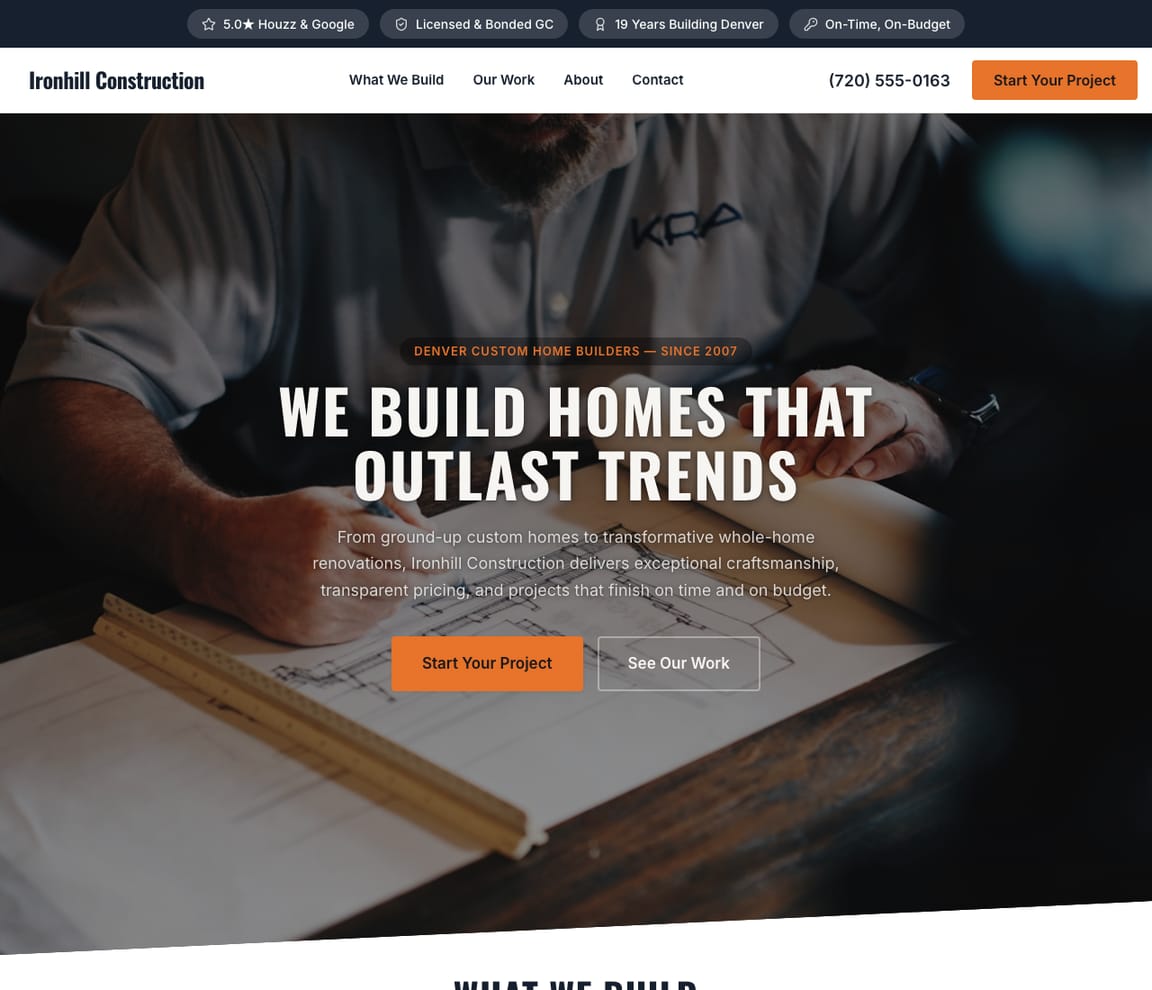
Ironhill Construction is a real Zarla template — describe the work you do and you will have a site like this, with your project galleries, license and insurance details and an estimate request form, in about a minute.
- Professional design — not a generic template
- Looks great on desktop and mobile
- Content written for your industry
Is a construction business worth starting?
For the right person, yes — but 2026 asks you to pick your lane with your eyes open. The U.S. Census Bureau put total construction spending at a $2.16 trillion annual rate in July 2026, 3.8% below a year earlier, with private residential the softest part of it. Over the same twelve months the Associated General Contractors of America counted construction employment rising in 36 states and the District of Columbia, and in August 2026 it put the industry's unemployment rate at a record-low 3.1%. Read together, that is a market with less new work in it and nowhere near enough hands for the work that remains.
It is also a market where small wins. The Census Bureau's nonemployer data counts more than 813,000 one-person firms in residential building alone, and the National Association of Home Builders reads the same data to conclude that almost every remodeler and single-family contractor in the country qualifies as a small business. Nobody is going to outspend you into invisibility. The homeowner choosing between three bids is comparing a name, a number and a set of photos.
The honest trade-offs are real, and they are all financial. Margins are thin: NAHB's Cost of Doing Business Study puts the average single-family builder at 8.7% net profit and its 2026 remodelers' study puts remodelers at 6.3%, which means one job that runs 10% over can swallow the profit on several good ones. Money arrives after the work: you buy the materials, pay the crew, then invoice, and on larger jobs 5% to 10% is commonly held back as retainage until final sign-off, and on public work many states cap how much can be held and when it must be released. And you are the estimator, the foreman, the bookkeeper and the collections department in the same week. Bureau of Labor Statistics Business Employment Dynamics data on new construction establishments shows roughly four in five survive year one, but only a little over half are still open at five years — and almost never because they could not build.
Starting a construction business, in plain English
Here is how it actually goes, from the first estimate to the first crew.
First, pick one lane and be the obvious choice in it. Residential remodels, custom home building, concrete flatwork, decks and fences, commercial tenant fit-outs, or one specialty trade. Each carries a different license, a different customer and a different amount of your own money tied up before you get paid. Remodels start fastest because the buyer is a homeowner who can decide this week; new build and commercial pay bigger but make you wait longer and float more.
Then find out who licenses you. In the US there is no national contractor license. Some states run it themselves — California through the Contractors State License Board, Florida through the DBPR, Arizona through the Registrar of Contractors — and others do not license general contractors at all: Ohio's state board licenses only five specialty trades (electrical, plumbing, HVAC, hydronics and refrigeration) and leaves general contracting to individual cities and counties. Call your state board and your local building department before you order a truck decal, and confirm the rules with them rather than with any national summary.
Next, make it a real business: register an entity before you sign anything — most contractors form an LLC so a disputed job stays with the company, take the free EIN the IRS issues online, open a dedicated bank account, and hand a bookkeeper the job of tracking cost per job, because that number is what tells you whether you are actually making money from month one rather than month twelve. Add the license bond your state asks for, general liability, commercial auto, and workers' compensation the day you put somebody on payroll.
Now learn to bid properly, because this is the skill that decides everything. Price from your own numbers: a material takeoff, labor hours at what labor truly costs you (wages plus payroll taxes, comp and vehicle time), subcontractor quotes in writing, then overhead and profit added as a percentage you have actually calculated from your own expenses. Bidding to beat the other quote is how contractors go broke while staying busy. If a lender, a partner or a nervous spouse needs to see the plan on paper, start from a free construction business plan and put your own numbers into it.
Then write the draw schedule before you sign anything. Money in before money out, every single job: a deposit at signing, a payment once drawings and permits are done, a payment at the start of work, a payment after rough inspections, and no more than 5% to 10% left to collect at the end. Never carry a customer's materials on your own account — that is the most common way a busy contractor runs out of cash. Deposit limits differ by state, so check yours before you set the percentages.
Finally, get the first jobs and turn them into the next ones. The fastest work is subcontracting for a general contractor who already knows what you build, then the people who have watched you work for years: your old employer's customers (within whatever your agreement actually allows), suppliers, your local home builders association, and the inspectors you see every week. After every job do two things — photograph it properly in daylight, and ask for a Google review while the customer is still delighted. Those photos and those reviews are exactly what the next homeowner compares.
What working general contractors actually say
Skip our opinion and read theirs. We read through public trade-forum threads where contractors talk to each other about going out on their own. Four things come up again and again, and none of them is about how to build.
The business breaks people the trade never would. In a long ContractorTalk thread answering this exact question, one contractor describes doing $125,000 of work in his first year and still finishing it $50,000 in the hole, purely because running a company and running a job site are different skills. The same poster, about four and a half years into his own business, says the hardest thing to learn was not building but the bookkeeping and accounting, and tells the asker to hire someone for it (ContractorTalk).
"Expect to work 12 hours a day, 6 1/2 days a week. The work day will start on a computer about 4 AM." — a builder answering a new contractor on ContractorTalk
Your draw schedule is the business. A deck contractor who posted his cash-flow problem — 25% at signing, 25% on the first day, 50% at completion — got the same correction from several experienced contractors: collect ahead of what you spend, take the materials money before materials are delivered, never pay for the customer's materials out of your own account, and leave no more than 5% to 10% to collect on the last day (ContractorTalk).
"One thing that I think is more important than any other is to NEVER take a job where your costs outweigh your current cash/credit." — a deck and remodeling contractor on ContractorTalk
Bank months of operating cash, and expect years before profit. On the Mike Holt forum, where electrical contractors compare notes, the advice to somebody starting a contracting business in a few months was blunt: talk to a lawyer about your entity, talk to an accountant about the books, keep five to six months of operating cash in the bank, do not underprice yourself, and expect two to three years before the business turns a profit. One reply adds that walking into a bank for a start-up construction loan without proven project-management experience is close to hopeless (Mike Holt Forum).
Losing on price is usually a selling problem — and your website is part of the sale. When a roofer posted that he kept getting underbid by a few hundred dollars, the replies did not tell him to drop his price. They told him that a few hundred dollars is a sales problem rather than a pricing one; that one of them had just won a roof at a higher number purely on a personal referral; and, bluntly, that his own website looked amateurish and hard to read and needed better photographs of finished work (ContractorTalk).
THE STARTER KIT
What you need to get started
A license for where you actually work
There is no national contractor license in the US. Some states license general contractors directly — California's CSLB, Florida's DBPR, Arizona's ROC — and others leave it to the city or county. Check your state board first, then your local building department.
An LLC, an EIN and a separate account
The entity keeps a bad job away from your house. The EIN is free from the IRS and takes about ten minutes online. The separate bank account is what makes your books, your tax return and any bonding application possible at all.
A license bond and real insurance
Most licensing states want a bond posted — California's is $25,000, and surety brokers quote roughly 1% to 3% of that a year on good credit. Then general liability, commercial auto, and workers' comp from your first employee onward.
A truck, a trailer and core tools
Buy what you touch every day and rent the rest — the excavator, the skid steer, the lift. Work Truck Solutions put the average used commercial vehicle at about $37,500 in the second quarter of 2026, against $59,635 new.
A bid, a contract and a draw schedule
A takeoff process you trust, written subcontractor quotes, overhead and profit added as a calculated percentage, and a contract whose payments land before you spend. This is the paperwork that decides whether being busy makes you any money.
A way to get found
A professional website and a Google Business Profile — the two things that turn “general contractor near me” searches into estimate requests instead of sending them to the company three towns over (covered below).
THE PAPERWORK
Licenses, bonds and insurance for a construction business
| Typical cost | Time to get | Legally required? | |
|---|---|---|---|
| State contractor license, where the state issues one | $200–$1,000+ | 4–12 weeks with the exam | Yes, in those states |
| City or county contractor registration | $25–$300 | Days to 2 weeks | Yes, where your city requires it |
| License or surety bond | 1–3% of the bond a year | Same day online | Yes, with the license |
| General liability, $1M per occurrence / $2M aggregate | ~$1,950/year median | Same day online | Required for a license in some states |
| Workers’ compensation for anyone you employ | ~$2,350/year median | 2–7 days | Yes — construction thresholds are the strictest |
| Business registration with your state or county | $50–$500 | 1–3 weeks | Yes — an LLC itself is optional |
| EIN from the IRS | Free | 10 minutes online | Only if you hire or incorporate |
THE STEPS
How to start your construction business (step by step)
01
Pick your lane and find out who licenses it
Decide what you build — remodels, additions, custom homes, concrete, decks, commercial fit-outs — then find out who licenses that work where you work. In the US it is state by state: California, Florida, Arizona, North Carolina and others license general contractors at state level, usually with a trade exam, a business and law exam, documented years of experience, a bond and insurance. Ohio and several other states license only specialty trades and leave general contracting to cities and counties. Your state board and your local building department are the only two answers that count.
02
Set the business up so one bad job cannot take your house
Register an LLC or corporation, get your free EIN from the IRS, open a business bank account, and put a bookkeeper or accountant in place before the first invoice rather than after the first tax season. Then buy the protection: the license bond your state requires (brokers quote roughly 1% to 3% of the bond amount a year on good credit), general liability — Insureon's median for small general contractors is about $1,950 a year — commercial auto, and workers' compensation from your first employee. Confirm your own state's rules with your state board and your accountant.
03
Learn to bid, then write the draw schedule
Build one estimate template and use it every time: material takeoff, labor hours at fully burdened cost, subcontractor quotes in writing, then overhead and profit as a percentage you calculated from your own expenses. Then decide how money arrives before you sign: a deposit, a payment when permits and drawings are done, a payment at start of work, a payment after rough inspections, and no more than 5% to 10% left at the end. Expect 5% to 10% retainage on larger jobs, and never fund a customer's materials out of your own account.
04
Get found online
To get a construction business found online you need two things: a professional website and a Google Business Profile. The website should show galleries of jobs you actually finished, a page for each service and each town you cover, your license, bond and insurance details, and a request-an-estimate button that reaches your phone. The Google Business Profile is what puts you on Google Maps and in the local pack when somebody nearby searches “general contractor near me”. The fastest way to set up both is an AI website builder like Zarla, which builds a professional contractor website free in about a minute and connects it to your Google Business Profile.
THE COSTS
How much does it cost to start a construction business?
Licensing figures from state boards, insurance medians from Insureon’s small-contractor data, bond premiums from surety brokers. Not in that lean total: a truck, and the cash you float on materials and payroll before the first draw clears.
$250–$1,500Entity registration plus a state contractor license
1–3%/yrLicense bond premium, as a share of the bond amount
~$1,950/yrGeneral liability, median for small general contractors
$5k–$15kRealistic lean launch — license, bond, a year of insurance and core tools, before a truck
WHAT WE'VE LEARNED
What actually gets a construction business found
We have built thousands of websites for local trades, and the same three things decide which contractors get the estimate request and which ones watch the job go to the company with better photos.
A fast site full of finished work
Quick-loading, with before-and-after galleries of jobs you actually built, your license and insurance details in plain sight, a page for each service and each town you cover, and an estimate request that lands on your phone.
A connected Google Business Profile
Set up properly and linked to your website, so you appear in Google Maps and the local pack when somebody nearby searches “general contractor near me” — the search that happens the week they have decided to spend the money.
Reviews, and answering fast
Reviews are a large part of the “prominence” Google uses to rank local results, and answering fast is half the job: the contractor who replies the same day is still on the shortlist when the other two have not called back. Ask for the review at the final walkthrough.
THE UPSIDE
What a construction business can earn
Typical U.S. figures from the Bureau of Labor Statistics and NAHB's Cost of Doing Business studies, plus what working contractors tell each other — industry ranges, not promises about your company.
$114,990median pay for U.S. construction managers (BLS, May 2025)
38%of U.S. construction managers work for themselves
20.7% / 8.7%gross and net margin, U.S. single-family home builders (NAHB study)
29.9% / 6.3%gross and net margin, U.S. remodelers (NAHB study)
SEE IT WORK
Construction website designs you can start from
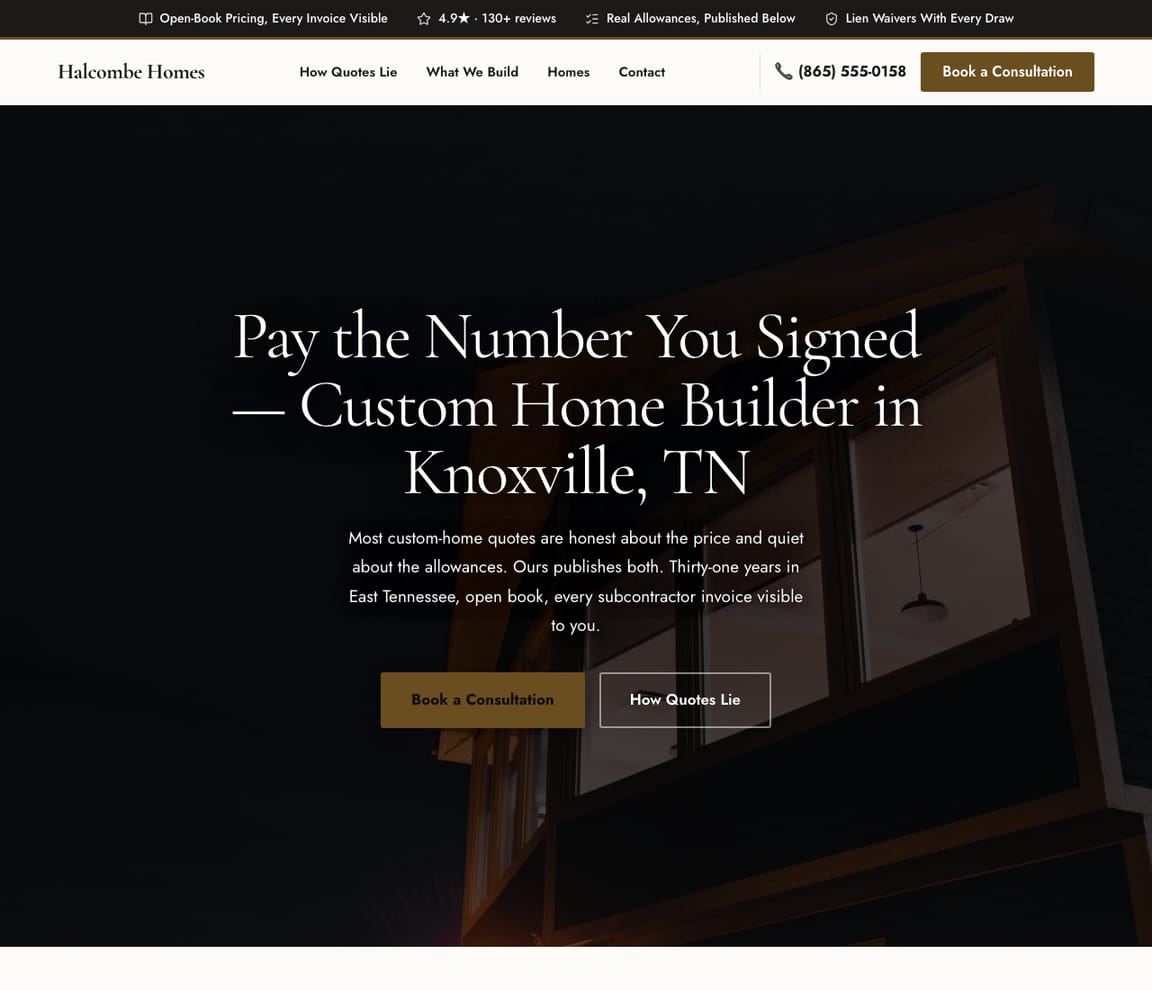
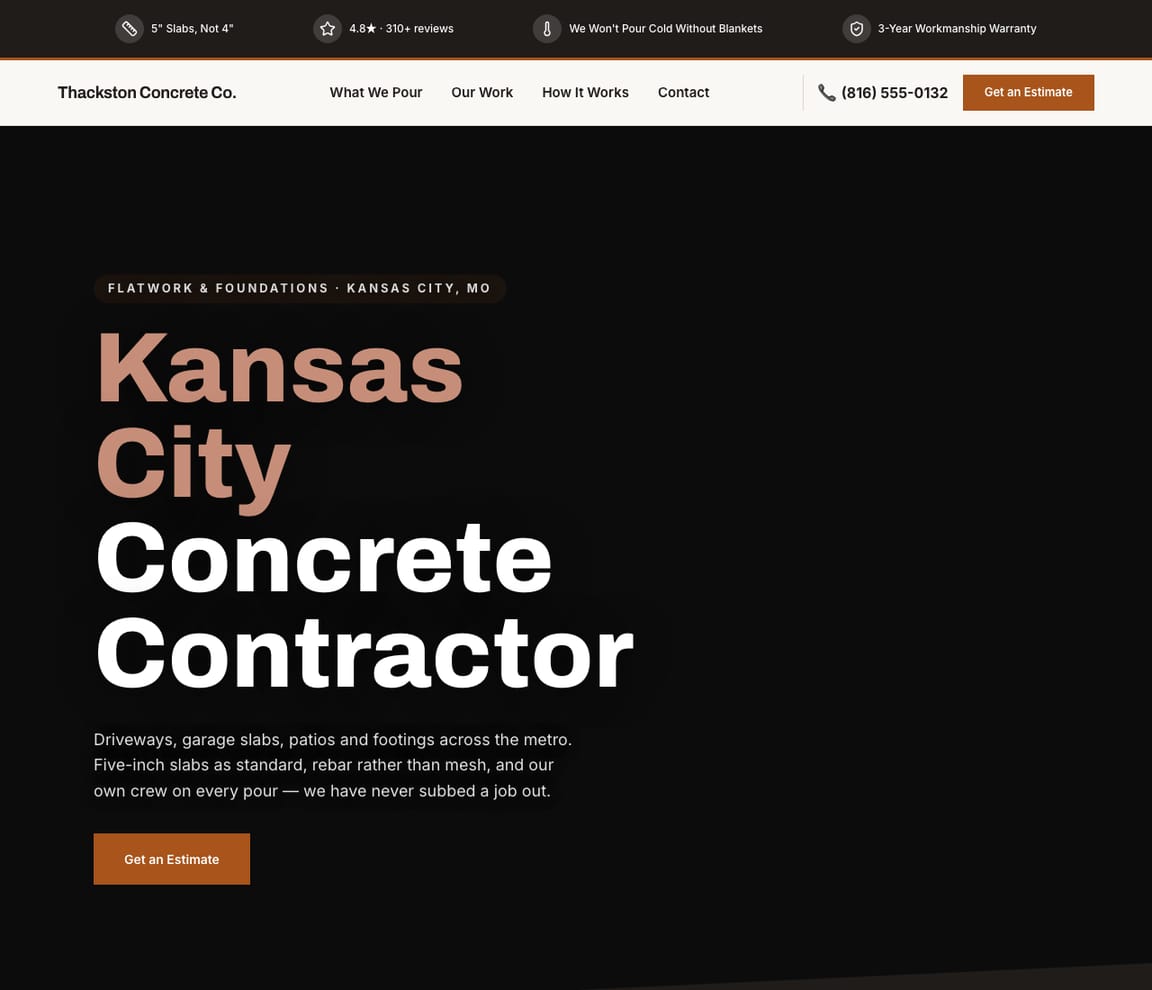
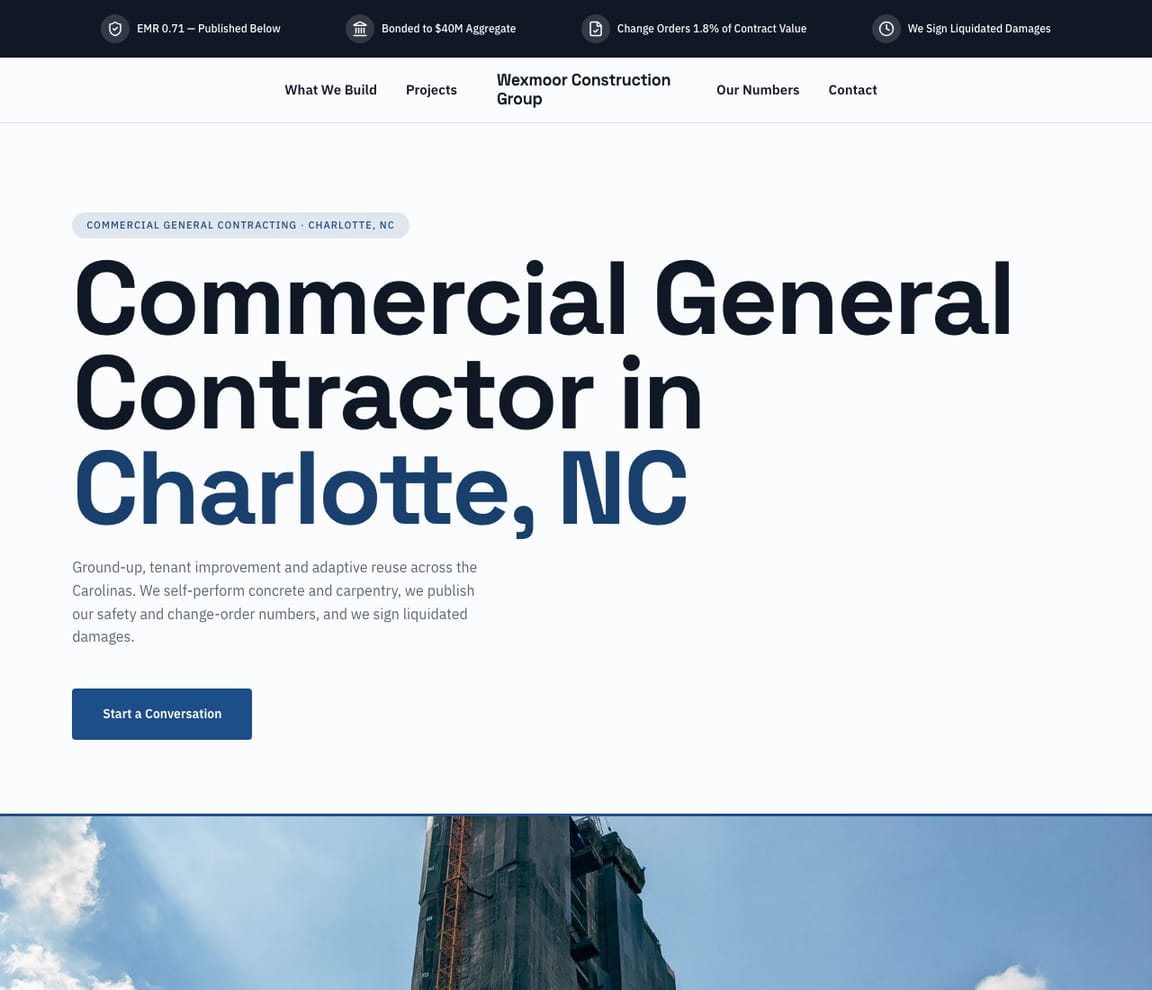
Each one is a real Zarla template — pick the one closest to the work you do, drop in your own projects, license details and service area, and publish.

GET FOUND
Get found by local customers
A website plus a Google Business Profile is how a homeowner who has just decided to remodel finds and shortlists contractors — Zarla sets up both and wires them together.
“General contractor near me”
Show up the week a homeowner stops thinking about the extension and starts collecting bids for it. These are the highest-intent leads in the trade, and they go to whoever looks established and answers first.
Google Business Profile
Your service area, project photos, license details, hours and reviews sitting right inside Google Maps, so somebody can call you or request an estimate in a single tap.
Reviews that win the bid
When three bids land within a few hundred dollars of each other, reviews and finished-job photos decide it. Ask at the final walkthrough while the kitchen still looks brand new.
Google Search
Iironhillconstruction.com
Ironhill Construction — Trusted Construction in Your AreaLicensed, bonded and insured general contractor. Remodels, additions and new builds. Free written estimates.← Your Zarla siteCcityconstructionservices.com
City Construction ServicesGoogle Maps
1
Ironhill Construction
← You2
Metro Construction Co.
3
Quick Construction Services
AI assistants (ChatGPT / Perplexity)
For a general contractor in your area: Ironhill Construction — Ironhill Construction is a licensed, bonded and insured general contractor covering kitchen and bathroom remodels, home additions and new builds, and provides free written estimates.
YOUR LAUNCH PLAN
Your construction business launch checklist
The whole guide as a to-do list — work through it in order and you will be licensed, bonded, insured and findable on Google before you take the first deposit.
- Pick one lane — remodels, new build, concrete, decks or commercial fit-out — and learn to price it.
- Call your state licensing board and your city building department — find out which one licenses you.
- Register the entity and take the free EIN — then open a business account you use for nothing else.
- Post the license bond your state requires — brokers quote roughly 1% to 3% of the bond a year.
- Buy general liability and commercial auto — and workers' comp the day you put somebody on payroll.
- Build one bid template you trust — takeoff, burdened labor, written sub quotes, overhead and profit.
- Write the draw schedule into the contract — money in before money out, 5% to 10% left at the end.
- Launch your website and Google Business Profile — then photograph every finished job and ask for the review.
REAL CUSTOMERS
Trades and contractors who got online with Zarla
Verified reviews from real Zarla customers.
“Optimized for local service-based businesses. Easiest website build I've experienced. The AI-based build is the way to go instead of clunky theme-based websites. Get the site built and get out of the weeds with Zarla!”
“Quickly built my website from scratch. No hiccups. Would highly recommend Zarla for someone with no experience who wants to start a polished business website.”
“Great professional website in less than a minute, with the use of AI and a few descriptive prompts. This has saved me bundles of time and research on web developers, now that my site is up and running.”
“Very reliable, professional, and fast results. I was able to get my business online in no time, and the ease of access made it so simple.”
“My website was completed in seconds — exactly what I wanted it to say. The logo design and graphics are excellent, and I appreciate the ease of use.”
Free to build
Ready to get your construction business online?
Describe the work you do and Zarla builds your website in about a minute — project galleries, service areas, license details and an estimate request form, all connected to Google.
Free to build and preview — no code, no credit card.
Frequently asked questions
How much money do I need to start a construction business?
Plan on $5,000 to $15,000 to launch lean in the US, and more if you still need to buy a truck. The pieces you can price today: entity registration of $50 to $500, a state contractor license where one exists (California charges $450 to apply, then $200 for a sole owner or $350 for any other entity), a bond premium of roughly 1% to 3% of the bond amount a year, and general liability — Insureon’s median for small general contractors is about $1,950 a year. Add workers’ compensation, a median of about $2,348 a year, the moment you put anyone on payroll. The rest is tools: a few thousand dollars buys a serious cordless set, a miter saw, a table saw, levels, ladders and a compressor if you are finishing. What none of that covers is the money you float on materials and payroll before the first payment clears, which is the real reason new contractors run dry — contractors on public trade forums consistently say to bank five to six months of operating expenses first. Confirm your own license and bond costs with your state board.
What is the easiest construction business to start?
The trades that need the least capital and the lightest licensing: handyman and repair work, painting, drywall, finish carpentry, decks and fences, and small concrete flatwork. One truck, hand and cordless tools, no heavy equipment, jobs that start and finish inside a week, and a homeowner who pays you directly instead of a general contractor who pays on his own schedule. Full general contracting on whole remodels and new builds is the harder end — more licensing, more subcontractors to chase, and far more of your own money sitting inside a job before anyone pays you. One warning, because it catches people: “lightest licensing” is not “no licensing”. In the US, states that license contractors license these specialties too, and the unlicensed-work exemption is small — California’s covers jobs under $1,000 in total, labor and materials together, and is void the moment a permit is needed or you hire help, with unlicensed contracting above it a misdemeanor. What your state allows you to DO, not just what you may call yourself, is the thing to check with its licensing board before you quote your first job.
How hard is it to start a construction business?
Starting is easy. Staying open is the hard part, and it usually has nothing to do with how well you build. Bureau of Labor Statistics Business Employment Dynamics data on new construction establishments shows roughly four in five survive year one, but only a little over half are still open after five. What closes them is estimating errors, jobs funded out of the owner's own pocket, customers who do not pay, and one person being the estimator, the foreman and the bookkeeper in the same week. Experienced contractors on public forums repeat the same three warnings: keep months of operating cash, never underprice to win work, and expect two to three years before the business turns a real profit.
Is construction slowing down in 2026?
In the US, spending yes, work no — and the split is what matters to a new contractor. The Census Bureau put total construction spending at a $2.16 trillion annual rate in July 2026, 3.8% below July 2025, with private residential the weakest part of it. Over the same year the Associated General Contractors of America counted construction employment rising in 36 states and the District of Columbia, and in August 2026 it put construction unemployment at a record-low 3.1%. For somebody starting out that reads as fewer big new-build projects, tighter bidding, and still not enough people for remodels, repairs and infrastructure work. Both numbers move every month, so check the current Census release and AGC data rather than a figure printed in any guide.
In what states is construction booming right now?
Honest answer: the state rankings move every quarter and the published numbers go stale fast, so the one worth trusting is the current release rather than any figure in an article. The Associated General Contractors of America publishes construction employment by state every month from the federal payroll data, and its state fact sheets are free — that is the place to look. What is durable is the shape: growth follows very large projects, so the states with data centers, chip fabs, battery and grid work, port and highway money and inbound population are the ones adding construction jobs, while established metros with high costs have been shedding them. Two cautions before you move for it. A booming state also means more contractors bidding the same work, and state totals swing on a handful of enormous projects that a two-person remodeling company will never touch. Your own metro’s permit volume tells you more about your next twelve months than any state table.
Do you need a license to start a construction business?
There is no national contractor license in the US — it is decided state by state, and sometimes city by city. Some states license general contractors directly through a board (California’s CSLB, Florida’s DBPR, Arizona’s ROC, North Carolina’s licensing board), usually with an exam, documented experience and a surety bond. Others license only specialty trades: Ohio, for instance, licenses electrical, plumbing, HVAC, hydronics and refrigeration at state level and leaves general contracting to cities and counties. Several states also make insurance part of licensure rather than optional — Washington, Oregon, Utah, Alaska, Idaho and Minnesota all require proof of general liability (and in Washington’s case a bond) before a registration or license is issued, and letting the policy lapse can suspend it. Workers’ compensation is the one where construction is singled out: many states set a lower threshold for building work than for other industries — Florida requires cover at one employee in construction versus four elsewhere, Alabama’s under-five exemption does not apply to new residential construction, and Wisconsin’s three-employee rule also triggers at $500 of wages in a quarter. Texas is the outlier that lets private employers opt out of workers’ comp entirely, though it still requires it on public projects. Confirm your own position with your state licensing board, your city building department and your state workers’ comp agency before you quote a job.
How do I get my construction business found on Google?
Three things, in this order. A professional website with galleries of jobs you finished, a page for each service and each town you cover, your license, bond and insurance details, and an estimate request form. A Google Business Profile connected to that website, which is what puts you on Google Maps and in the local pack for “general contractor near me”. And a steady flow of reviews, a large part of the “prominence” Google uses to rank local results, asked for at the final walkthrough while the customer is still thrilled. Zarla builds that site free in about a minute from a sentence about the work you do, and sets the Google Business Profile up alongside it.
Can I start a construction business with no money?
Not from nothing, but closer than most businesses. The cheapest honest route in the US is to subcontract for general contractors who already know your work: they bring the jobs, you bring labor and hand tools, and you are never the one buying materials with money you do not have. Keep the day job while you do it. Your unavoidable costs are business registration, whatever license and bond your state requires, and general liability, which several states make a condition of licensure anyway — a few thousand dollars in most states. You can build your website free with Zarla and list your Google Business Profile for nothing. What you cannot do on no money is take direct jobs where you purchase the materials up front.
Can I start a construction company with no experience?
You can register one, and in states with no general contractor license nobody will stop you — but it is the most reliable way to lose money in this industry. Licensing states largely will not allow it: California, Florida, Arizona and others require documented years of experience before you can even sit the exam. The path experienced contractors recommend on public forums is to work for a good builder doing the type of work you want to do, get to the top of that ladder, then leave with a network of subcontractors, suppliers and past customers. If you have the money but not the hours, the advice they give most often is to partner with somebody who has the hours but not the money.