

CAREER GUIDE
How to become a handyman in 2026
There is no handyman license in the US — there is a dollar limit on unlicensed work that every state draws differently, and a list of trades you can't touch. The limits for the big states from the statutes, the skills that pay, the tools and insurance at real prices, what handymen earn — and how to go from handy to hired.
Free to build · Pay when you publish · No credit card
$1,000the job limit for unlicensed work in California, Arizona and Nevada; $2,500 in Florida; $7,000 in Utah; none at all in Washington and New York City — from the statutes below
$49,590median pay for employed maintenance and repair workers in 2025 (O*NET, from BLS data); handymen who own the truck post $50 to $175 an hour
$978a year of general liability insurance at Insureon's handyman median (July 2026) — the one line working handymen say not to skip
No licenseof its own in any US state — a dollar limit, a short list of trades you may not touch, and in a few states a registration
See it in action
See what your handyman website could look like
A real Zarla template for a handyman — the everyday repairs in a pill grid, licensed-and-insured under the buttons, same-week scheduling in the top strip. Describe yours — the town, the jobs you take, the hours — and you'll have a site like this, with a call button and a quote form, in about a minute.
- Professional design — not a generic template
- Looks great on desktop and mobile
- Content written for your industry
Build the website
Start your handyman website now
Add your town and your business name to the sentence, and Zarla builds the site: your services, the area you cover, a call button and a quote form. Add your prices and your minimum charge in chat, then publish.
Already have a website? Bring it across →Zarla keeps your old page addresses where it can and redirects the ones that change, helping you keep the Google standing you've built.
Is becoming a handyman worth it in 2026 — and what does the work pay?
Becoming a handyman is the rare trade with no school, no exam and no license of its own — in the US there is instead a dollar limit on unlicensed work that each state draws differently, a short list of trades you may not touch, and a customer who mostly wants someone to call back. Three honest numbers first. Employed maintenance and repair workers — the occupation the government files a handyman under — had a median of $49,590 a year in 2025, $23.84 an hour: 10 percent earned $35,350 or less and 10 percent $77,180 or more (O*NET, from BLS 2025 wage data); the state medians are $46,670 in Texas, $57,000 in California, $46,060 in Florida and $57,790 in New York (O*NET, Texas; California; Florida; New York). The outlook is "Employment (2025) 1,621,800 employees. Projected growth (2025-2035) Average (3% to 4%). Projected job openings (2025-2035) 148,700." (O*NET, summary). And the survey behind the wages leaves out the self-employed (Washington ESD) — which is the handyman with his own truck, so the median measures the building-maintenance employee, not the owner.
What the owners actually charge. Eight handyman companies post their prices. Denver: "$80 per hour flat for the visit — not per person, no minimum, no trip fee — billed for the time we're on the job" (Denver Handy Co.). Dallas: "The median Smart Fix handyman job in Dallas cost $350, based on 75 jobs from February to October 2026. Prices ran from $125 to $15,825, and 51 of the 75 jobs cost less than $500." (The Smart Fix Handyman, 2026). Houston and Austin: a "$500 project minimum … This is a project minimum for multi-item work" (Handyman Install). New Jersey: "Three flat packages: Visit $345 (up to 2 hours), Half Day $595 (up to 4 hours), Full Day $1,095 (up to 8 hours). A single itemized job is $175 an hour, capped at the package price." (East Brunswick Handyman), and a second New Jersey company's table — "Unlicensed / under the table $30 – $55/hr … Solo licensed handyman $65 – $100/hr … Franchise company (Mr. Handyman, etc.) $100 – $150/hr" (Deft Craftsman, July 2026). California: "California handymen charge $60–$125/hour depending on region … Most jobs are quoted as flat rates starting at $99–$250, not hourly." (Zomg The Handyman, updated July 2026). Florida: "Handyman rates in Florida typically run $50–$120 per hour in 2026. Unlicensed handymen tend toward $50–$75. Licensed contractors sit at $75–$120" (Handyman Chad, updated May 2026). And a one-man shop in Windsor, Colorado: "Pricing: My rate is $50 per hour." (Mac's Handyman Service, Voyage Denver, October 21, 2019). So the honest range for a solo owner is $50 to $175 an hour, with the minimum charge deciding whether the small jobs pay.
A first year, in one owner's numbers. Dan Perry, who built a handyman business and then a site teaching others: "For the entire year of 2012, my first year in business, my average hourly rate was just $39.64/hr. In that first year, I worked a total of 942 billable hours (~18hrs/week) and generated ~$37,340 in revenue from labor. Not bad for my first year and having very little experience." And the lesson: "Had I been able to average just $75/hr for example (which I think is totally reasonable), I would have generated an additional $33,291 in profit!" (Handyman Startup, March 5, 2015).
The catch. The dollar limit in your state decides which jobs you can take, the trades inside the wall — electrical, plumbing, HVAC — are licensed at any price in Texas, Nevada and Utah and above the line in California, the first customer is slow to arrive and the phone has to be answered every time it rings. That's what the rest of this guide sets up: the limit by state from the statutes, the skills and the tools from real prices, the insurance from a real median, and how to be the name the homeowner with the list finds first.
How to become a handyman, in plain English: the dollar limit in your state, and the trades you can't touch
There is no handyman license. Nevada's contractors board says it plainly — "The NSCB does not have a 'Handyman' license" (Nevada State Contractors Board FAQ) — and the one national association says the same of its own certificate: "ACHP does not provide or imply that it licenses the handyman nor gives permissible authority to do unlicensed work" (Association of Certified Handyman Professionals). What exists is a contractor's license, and each state draws the dollar line below which you don't need one. Here are the lines, each from the statute or board:
- California — $1,000, labor and materials, no permit. "This chapter does not apply to a work or operation on one undertaking or project by one or more contracts if the aggregate contract price for labor, materials, and all other items is less than one thousand dollars ($1,000), that work or operation being considered of casual, minor, or inconsequential nature, and the work or operation does not require a building permit." (Cal. Bus. & Prof. Code §7048). Your ads must say so: an unlicensed person "may advertise for construction work or a work of improvement covered by this chapter only if the aggregate contract price for labor, material, and all other items on a project or undertaking is less than one thousand dollars ($1,000) and the person states in the advertisement that the person is not licensed under this chapter" (§7027.2). Above the line, electrical is the C-10 license, plumbing the C-36 and heating and air the C-20 (CSLB license classifications). Google's answer still says $500; the limit doubled on January 1, 2025.
- Arizona — $1,000, labor and materials, no permit. Exempt is "Any person other than a licensed contractor engaging in any work or operation on one undertaking or project by one or more contracts, for which the aggregate contract price, including labor, materials and all other items … is less than $1,000" — not if a permit is required, and not if a project is split into pieces to stay under (A.R.S. §32-1121).
- Nevada — $1,000, and never the licensed trades. "If the work to repair or maintain property is less than $1,000.00, including labor and material and does not require a building permit or involve work that is performed by a plumbing, electrical, refrigeration, heating or air conditioning contractor, then a contractor's license is not required." Contracting without one draws "a minimum fine of $1,000.00 and not more than $50,000.00" (Nevada State Contractors Board FAQ).
- Florida — $2,500. Exempt is "Any work or operation of a casual, minor, or inconsequential nature in which the aggregate contract price for labor, materials, and all other items is less than $2,500" — not if it is part of a larger job or you advertise as a contractor (Fla. Stat. §489.103(9)); a "contractor" is anyone who "for compensation, undertakes to, submits a bid to, or does himself or herself or by others construct, repair, alter, remodel, add to, demolish, subtract from, or improve any building or structure" (§489.105).
- Utah — $7,000, not the $3,000 the internet repeats. Exempt is "a person engaged in the alteration, repair, remodeling, or addition to or improvement of a building with a contracted or agreed value of less than $7,000, including both labor and materials"; plumbing and electrical work on such a project "shall be performed by a licensed electrical or plumbing contractor", and "if the total value of the project is greater than $3,000, the person shall file with the division a one-time affirmation" of liability insurance (Utah Code §58-55-305, effective May 7, 2025).
- Virginia — over $1,000 needs a Class C license. Class C contractors "perform or manage construction, removal, repair, or improvements when (i) the total value referred to in a single contract or project is over $1,000 but less than $30,000" (Va. Code §54.1-1100) — so the $1,000 job is a handyman's, the $1,001 job is a licensed contractor's.
- Louisiana — $7,500. "For home improvement projects, if the total project amount exceeds $7,500 but not exceeding $50,000, a home improvement registration is required." (Louisiana State Licensing Board for Contractors FAQ).
- Minnesota — a license only above $15,000 a year and only if you offer more than one skill. The exemptions cover "a person whose total gross annual receipts for performing specialty skills for which licensure would be required under this section do not exceed $15,000" — on a certificate of exemption, surrendered the year you pass it — and "specialty contractors who provide only one special skill"; "a plumber, electrician, or other person whose profession is otherwise subject to statewide licensing" stays licensed (Minn. Stat. §326B.805).
- North Carolina — $40,000. "In the State of North Carolina, a general contractor must be licensed if the contract is valued at $40,000 or higher." (NC Licensing Board for General Contractors FAQ).
- Texas — no state license for the handyman or the general contractor, and three trades licensed at any price. The Department of Licensing and Regulation's list of regulated industries has electricians and air-conditioning contractors on it and no general-contractor or handyman entry (TDLR). Electrical: "a person or business may not perform or offer to perform electrical work or residential appliance installation unless the person or business holds an appropriate license" (Tex. Occ. Code §1305.151). Heating and air: "A person may not engage in air conditioning and refrigeration contracting unless the person holds an air conditioning and refrigeration contractor license" (§1302.251; TDLR, air conditioning and refrigeration). Plumbing: the only unlicensed plumbing is the owner's own — "A property owner is not required to be licensed under this chapter to perform plumbing in the property owner's homestead" (§1301.051). Your city may license home repair on its own; ask it.
- No dollar floor at all — Washington, Maryland, New Jersey, Pennsylvania above $5,000 a year, New York City. "Washington State requires all construction contractors to register with L&I" — a "$30,000 for general contractors. $15,000 for specialty contractors" bond, "$200,000 in public liability and $50,000 property damage, or $250,000 combined single limit" of insurance, and "The required application fee of $150.20" (Washington L&I). Maryland's Home Improvement Commission "licenses and regulates home improvement contractors", where home improvement "includes alteration, remodeling, repair or replacement of a building or part of a building used as a residence" (Maryland MHIC) — though "installing wall-mounted televisions in residences is not considered 'home improvement;' therefore an MHIC license is not required", nor is carpet, nor "demolition and clean-up work", while "in order to install tile, wood, or other flooring, a home improvement contractor license is required" (MHIC FAQ). New Jersey: "No person shall engage in the business of making or selling home improvements in this State unless registered with the Division" (N.J.A.C. 13:45A-17.3). Pennsylvania's registration law leaves out "A person for whom the total cash value of all of that person's home improvements is less than $5,000 during the previous taxable year" (Pennsylvania Act 132 of 2008). New York City: "A person or business must have a Home Improvement Contractor license to do construction, repair, remodeling, or other home improvement work to any residential land or building in New York City" — a two-year license, a 30-question exam, and "$200" into the trust fund or "a $20,000 Surety Bond" (NYC Department of Consumer and Worker Protection). Google's "$2,000 in Washington" does not exist. Georgia, Tennessee and Michigan have limits of their own on pages that refused to open the day we read them, so none is printed here.
The one federal rule. "EPA's RRP Rule requires that anyone paid to perform work that disturbs painted surfaces in homes, childcare facilities and preschools built before 1978 be certified and their employees be trained" (EPA, updated June 17, 2026) — "This includes all firms, even sole proprietorships", except "Minor repair and maintenance activities that disturb six square feet or less of paint per room inside, or 20 square feet or less on the exterior" (EPA, for contractors). The firm certification is $300 (40 CFR 745.92; EPA fee page), good for five years (40 CFR 745.89), and the renovator course "must last a minimum of 8 training hours, with a minimum of 2 hours devoted to hands-on training activities" (40 CFR 745.225).
How you learn it. The occupation is Job Zone Three — "Employees in these occupations usually need one or two years of training involving both on-the-job experience and informal training with experienced workers" (O*NET). ACHP's certificate is "$149 for Annual or $300 for Lifetime" (ACHP); a community college's three-evening "Basic Hands-On Home Repair and Maintenance" is "Fee: $255" plus "a $70 cash supply fee" (North Seattle College, October 2026); Habitat for Humanity lets you "build in your community" for free (Habitat for Humanity). None is required; the homeowner is paying for the result.
You are self-employed from the first invoice. In the US a one-truck handyman is a sole proprietor by default: "Use Schedule C (Form 1040) to report income or (loss) from a business you operated or a profession you practiced as a sole proprietor" (IRS, Schedule C instructions); "The self-employment tax rate is 15.3%" (IRS), and sole proprietors "generally have to make estimated tax payments if they expect to owe tax of $1,000 or more" (IRS). An EIN is free — "You never have to pay a fee for an EIN" (IRS). If you want an LLC: Texas $300 (Tex. Bus. Orgs. Code §4.154); Florida $100 plus $25 for the registered agent and $50 a year (Fla. Stat. §605.0213); New York $200 (N.Y. LLC Law §1101) plus a notice "published once in each week for six successive weeks, in two newspapers of the county" (§206); California $70 (Cal. Gov. Code §12190) and "Every LLC that is doing business or organized in California must pay an annual tax of $800" (Franchise Tax Board). Workers' compensation: "In Texas, private employers can choose to carry workers' compensation insurance coverage, but it is not required in most cases" (Texas Department of Insurance), while "All California employers must provide workers' compensation benefits to their employees" (California DIR).
Sales tax on the work — four states' rules. Texas: "Labor to repair, remodel, or restore residential real property is not taxable", while "the total amount charged for remodeling, repairing, or restoring nonresidential real property is taxable" (Texas Comptroller, Publication 94-116). California: "Construction contractors are always the consumers of materials that they furnish and install in the performance of a lump sum contract. Tax applies to the cost of materials to the construction contractor." (CDTFA Publication 9, February 2025). New York taxes the ordinary handyman job: "Repairing a broken step, replacing a thermostat on a hot water heater, or painting existing cabinets are all examples of taxable repair and maintenance work" (New York TB-ST-104, updated October 16, 2026). Florida: items "permanently installed into a structure … are classified as real property and are not subject to sales tax", while "when installing or repairing tangible personal property, parts and labor are taxable. If the job is 'labor only' it is not taxable" (Florida DOR GT-800067). Confirm the details with your accountant.
The money to start. Our arithmetic from the pages that print each price, for a handyman who already owns a truck. The lean first year — a Bauer drill and impact driver kit at $99.99 (Harbor Freight), a Bauer circular saw at $44.99 (Harbor Freight, circular saws), a 48-inch level at $15.99 (levels), a ProSensor stud finder at $26.99 (stud finder), a nine-function multimeter at $29.99 (multimeters), a six-foot fiberglass stepladder at $89.99 (ladders) and $978 for a year of general liability at Insureon's handyman median — comes to $1,285.94. The fuller first year — the Hercules brushless kit at $249.99 (Harbor Freight), the Hercules saw at $99.99, the Doyle true-RMS meter at $39.99, the 17-foot multitask ladder at $159.99, a business owner's policy at $1,266 and commercial auto at $2,252, the $300 EPA firm certification, a $300 Texas LLC and the $255 college course with its $70 supply fee — is $5,035.94. Neither includes the truck, a shop vac or a tool bag (no retailer that opened printed a price for either), or the website. The insurance is a median, not your quote: "Handymen pay an average of $81 per month, or $978 annually, for general liability insurance", "$105 per month for a business owner's policy, or $1,266 annually", "$108 per month for workers' compensation insurance, or $1,295 annually", "$188 per month, or $2,252 annually, for commercial auto insurance" and $42 a month for tools cover (Insureon, updated July 31, 2026). The plan page for the business side is the handyman business plan; the step after this guide is how to start a handyman business, the prices are in handyman rates for 2026, the name comes from handyman business names, and the site from the handyman website builder or the handyman website design page.
In the UK: there is no handyman license either; the controls are the building regulations — "You might also need building regulations approval for many alteration projects, including if you plan to: replace fuse boxes and connected electrics, install a bathroom that will involve plumbing, change electrics near a bath or shower", and "You do not need to get approval yourself if you use someone registered with a competent person scheme" (GOV.UK; the schemes), under Approved Document P for electrical safety in dwellings (GOV.UK, Approved Document P); and gas work has no exemptions at all — "Are there any exemptions from the Gas Safety (Installation and Use) Regulations? No." (HSE). In Australia the principle inverts: in New South Wales any home building work "above $5,000 (except specialist work)" needs a licensed contractor, and the specialist trades — plumbing, electrical, air conditioning — need one at any value (Legal Aid NSW); Queensland draws its line at $3,300, on a regulator page whose address the US-English guard will not let this page link. Check your own state's contractor board, and your city's, before you quote the first job.
What working handymen actually say
None of this is our opinion about the trade. It comes from people who do it — a Los Angeles handyman who started with business cards at a moving company, a Fort Lauderdale owner who built up from hurricane cleanup, a St. Louis firefighter with a side business, an Austin owner, a California former electrician, the founder of a handyman-business site, a Houston owner who came out of a plumbing company, a franchise owner and a Colorado one-man shop — talking to the Voyage magazines, CanvasRebel and Handyman Startup between 2012 and 2026, each described as the page describes them. Read each as theirs at the time. Five things come up again and again.
The first jobs come from wherever you already are. Corey Howell, Heavy Metal HandyMan, Los Angeles: “I worked weekends at a moving company and met tons of people needing their TVs mounted, curtains hung, basic repairs etc. So I made business cards and started handing them out. Hardware stores, whole foods, Customers of move jobs, craigslist, I hustled everywhere.” (Voyage LA, September 9, 2019). Steven Moore, First Responder Handyman, Webster Groves, Missouri: “Everything started out slow with my first 'real client' with interior wall painting, painting window trim, and miscellaneous work. Then she told her neighbor who was getting ready to put her house on the market; and now I've got two clients.” (VoyageSTL, August 12, 2024). Darius Hester, D's Handyman Services, Houston: “After I left college, I started working for a plumbing company for about 2 years, which is where I learned everything from. From water lines, sewer lines, to gas lines. But once covid hit we were all let go because of quarantine requirements. I took a leap of faith and started my own Handyman services. Promoted my myself and got more work than I could handle to my surprise.” (Voyage Houston, September 15, 2026). Nathaniel Beaulieu: “While pursuing medicine, I started a small handyman side business where I posted ads on Craigslist while waiting to get into medical school. As it turned out the handyman business took off.” (CanvasRebel, October 31, 2024).
“The number one mistake people in this business make is not answering their phone. The first person that answers the phone professionally will get 99% of the business.” — Steve, a California handyman and former union carpenter, in Handyman Startup, November 23, 2012
Answering the phone and showing up is the whole marketing plan. Moore: “The biggest complaint I hear from my clients is that it is hard to get someone to call them back or even show up. More than not, a client will thank me for just calling them back and committing to a time and date.” (VoyageSTL, August 12, 2024). And: “When I hear comments like 'you're charging more than my last handyman' and inquire why they are not using them, I get the response of 'they won't return my calls' or 'they are too busy for me'.” (CanvasRebel, December 1, 2022). Andy Grzymala, Handy Andy RR: “There is a huge need for handy people, there are plenty out there, but finding someone who shows up on time, treats your home as their own, and does the best of their ability to solve whatever the problem is, can be daunting.” (CanvasRebel, August 13, 2024). Mathew Stubbs, The Hands Services, Austin: “The most effective strategy for building and growing my business has been THE POWER OF WORD OF MOUTH!! I started networking the moment I moved out here.” (CanvasRebel, December 4, 2023).
Price by the job, and protect the small ones. Steve: “I try to get between $75 and $100 per hour. But I don't tell my customers this because I always charge by the job. Even though customers are getting charged well over $100/hour in some cases, if you tell them this, it seems like a lot.” (Handyman Startup, November 23, 2012). Moore: “The other challenge is figuring out the sweet spot of how much to charge while not underselling yourself and not overcharging a client. I have realized there will always be someone offering similar services to mine charging less than me and someone charging more than me. I do not get every bid or project that is asked of me.” And on the list: “I have learned it is very hard for people to find someone willing to come over for just a few hours to knock out a 'honey-do-list' versus taking large, contracted jobs. However, I have repeat clients that come up with a list every month and I will gladly spend an entire day with them.” (CanvasRebel, December 1, 2022; VoyageSTL, August 12, 2024).
The tools come as the jobs do. Gustavo Muniz, Handyman Group, Fort Lauderdale: “I probably have about $10,000 dollars worth in tools in my warehouse but none of this money had to be invested at once or before opening the business, all money invested was invested along the way……Like I said before, with virtually no marketing effort and not big investment in tools I was able to accomplished to become a profitable business.” And on how it started: “After hurricane Katrina and Wilma hit South Florida back in 2005, I found myself surrounded with a lot of houses needing cleaning and repairs; from cleaning damage houses to demolishing entire kitchens to a complete restoration. These two events left me enough work for the next two years.” (Voyage MIA, November 16, 2017).
The first year is thin, and the license line is real. Dan Perry on 2012: “For the entire year of 2012, my first year in business, my average hourly rate was just $39.64/hr. In that first year, I worked a total of 942 billable hours (~18hrs/week) and generated ~$37,340 in revenue from labor. Not bad for my first year and having very little experience.” And on the mistake that follows the dollar limit: “Answering the phone and showing up to contractor board sting operation was another experience I'd like to take back.” (Handyman Startup, March 5, 2015). Ron Willis, a Handyman Matters franchisee in Clear Lake, Houston: “It has been a struggle for us the first three years, even though we are a franchise. There are no scripts on how to run a successful business and we definitely made some bad decisions.” (Voyage Houston, December 19, 2017). Grzymala on the owner's week: “This all can be a lot to juggle as I am also the person performing the work, maintaining all communication, shopping for materials, and of course promoting myself on social media.” (CanvasRebel, August 13, 2024).
The through-line: the handymen who lasted started with the jobs in front of them, answered every call and showed up when they said, priced by the job with a minimum that made the small ones pay, bought tools as the work paid for them, and knew exactly where their state's dollar line sat before a contractor board tested it.
THE STARTER KIT
What you need to become a working handyman
Skills you can list
Five to eight jobs you are already fast at — mounting, drywall, doors, fixtures, assembly, caulking — and the honesty to send the gas line and the new circuit to a licensed trade.
Your state's dollar limit
The amount a job may cost before a contractor's license is required, and the trades that need one at any price — different in each state, named below from the statutes.
The toolbox, from real prices
A drill, a driver, a level, a stud finder, a multimeter, a utility knife, a saw — priced from the makers' and retailers' own lists, and the truck you probably already own.
Insurance before the first job
General liability from day one, because a dropped TV or a ladder through a window is the one expense that ends a one-person business; commercial auto if the truck is the shop.
A price list with a minimum
An hourly rate and a two-hour or half-day minimum, a trip charge where you drive far, and a materials markup — working handymen say the minimum is what keeps small jobs profitable.
A way to be found
A website with your services, your area and a quote form, and a Google Business Profile with your photos — how the homeowner with the list finds you instead of the app that takes a cut.
THE PAPERWORK
Licenses, limits, registrations and insurance for a new handyman
| Typical cost | Time to get | Legally required? | |
|---|---|---|---|
| A handyman license | None exists | — | No US state issues one — the limits below are what apply |
| The unlicensed job limit | $1,000 (CA, AZ, NV); over $1,000 needs Class C (VA); $2,500 (FL); $7,000 (UT); $7,500 (LA); $15,000/yr (MN); $40,000 (NC) | — | A contractor's license above it; Georgia, Tennessee and Michigan not printed |
| Contractor registration from the first dollar | $150.20 + a $15,000–$30,000 bond (WA); $200 trust fund or a $20,000 bond (NYC); MHIC (MD); HIC (NJ); $5,000/yr (PA) | Weeks | Yes in those states and NYC |
| Trade licenses you may not do without | Electrical, plumbing, HVAC — the trade's own license | Years | At any price in TX, NV, UT; above the line in CA (C-10, C-36, C-20) |
| EPA lead-safe firm certification | $300 per five years + an 8-hour renovator course | Weeks | Yes, for paid work disturbing paint in pre-1978 homes beyond six square feet a room |
| Unlicensed advertising rule | None | — | CA: ads for sub-$1,000 work must say you are not licensed |
| Sole proprietorship (Schedule C) | $0 | None | The default (self-employment tax 15.3%) |
| LLC (optional) | $300 (TX); $125 (FL); $200 + newspaper notices (NY); $70 + $800/yr (CA) | Days to weeks | No |
| Sales tax on the job | Free to register | Before the first invoice | Residential repair labor not taxed in TX, CA, FL; the typical repair is taxable in NY |
| General liability insurance | $81/mo median (Insureon) | Days | A condition of registration in WA; the line working handymen say not to skip everywhere |
| Workers' compensation | $108/mo median (Insureon) | Days | Optional for private employers in TX; required of every employer in CA |
| ACHP certificate (optional) | $149 a year or $300 for life | An evaluation exam | No — the association says it licenses nobody |
THE STEPS
How to become a handyman (step by step)
Eight steps from a toolbox and a list of skills to an insured, priced, findable handyman business.
01
Write down what you can already do
The jobs you've done for yourself and friends — mounting, drywall, doors, assembly, fixtures — are the service list. Pick five to eight you are fast at; a tight list makes quoting instant.
02
Learn your state's dollar limit
In the US a handyman works without a contractor's license up to a dollar amount per job that each state sets — and plumbing, electrical and HVAC need a trade license at any price in the big states. The limits are below, from the statutes.
Named by state below03
Fill the gaps at a bench or a job site
A season as a helper for a remodeler, a community-college evening class, the manufacturer's install guide read twice — no school is required, and the homeowner is paying for the result, not the certificate.
04
Register and insure before the first paid job
A sole proprietorship by default or an LLC if you want one, a free EIN, your city's business license where it asks for one, and general liability insurance — the one line working handymen say not to skip.
05
Buy the tools from real prices, and no more
A drill and driver, a level, a stud finder, a multimeter, a saw and the hand tools — priced below from the makers' lists — and the truck you already own. Buy the specialist tool the first time a job pays for it.
06
Price with a minimum charge
An hourly rate for your market, a two-hour or half-day minimum, a trip charge for the far jobs and a markup on materials you supply — the figures below come from the people who publish them.
The hard part07
Do the first ten jobs for people who know you
Neighbors, your landlord, the friend's parents — ten finished jobs with before-and-after photos is the portfolio a stranger hires from.
08
Be the name the homeowner finds first
A website with your services, your area, your minimum and a quote form, and a Google Business Profile with your photos — so the search for a handyman reaches you, not an app that takes a cut.
THE COSTS
How much does it cost to become a handyman?
Itemized from the pages that print a price: the tools from Harbor Freight's own pages, the insurance from Insureon's handyman medians, the EPA fee from the regulation, the course from a college's posted fee. The truck, a shop vac, a tool bag and the website come on top, and so do your own living costs while the phone starts to ring.
$1,285.94a lean first year for a handyman who owns a truck — a drill kit, a saw, a level, a stud finder, a meter, a ladder and a year of liability cover (our arithmetic)
$5,035.94the fuller first year with brushless tools, a business owner's policy, commercial auto, the EPA certification, a Texas LLC and a college course
$978a year of general liability insurance at Insureon's handyman median, July 2026 — $81 a month
$300the EPA lead-safe renovation firm certification, for five years — the one federal credential a handyman may need
WHAT WE'VE LEARNED
What actually makes a homeowner hire a handyman
Thousands of local business websites in, the pattern for a trade that is hired for small jobs is clear: the homeowner wants to know what you take on, what the first hour costs, and that you are insured if the ladder slips. For a handyman, three things on a page decide who gets the list.
The jobs you take, by name
TV mounting, drywall repair, doors, fixtures, furniture assembly, caulking — a list a homeowner can match their own list against, and the licensed trades you don't touch, said plainly.
The minimum charge, up front
An hourly rate and a two-hour or half-day minimum on the page. The first thing a caller asks, and the thing working handymen say decides whether small jobs pay.
Insured, with the proof
The words 'licensed and insured' under the button, the certificate on request, and your work in photos. The reassurance that gets you the landlord's whole portfolio, not one door.
THE UPSIDE
What a handyman can earn
Pay for employed maintenance and repair workers from O*NET's 2025 figures — the self-employed are not in the survey — and the rates from eight handyman companies' own posted prices and one owner's first-year numbers. Medians and examples, not a promise: your state, your minimum charge and your phone decide it.
$49,590a year: the 2025 median for employed maintenance and repair workers — $23.84 an hour; 10 percent under $35,350, 10 percent over $77,180 (O*NET)
$50–$175an hour, as solo handyman companies in Colorado, Texas, New Jersey, California and Florida post it — with minimums from none to a $500 project
$350the median handyman job in Dallas across 75 jobs in 2026, at one company that publishes its numbers
$37,340one owner's first-year labor revenue on 942 billable hours at $39.64 an hour — and what $75 an hour would have added: $33,291
SEE IT WORK
Handyman website designs you can start from
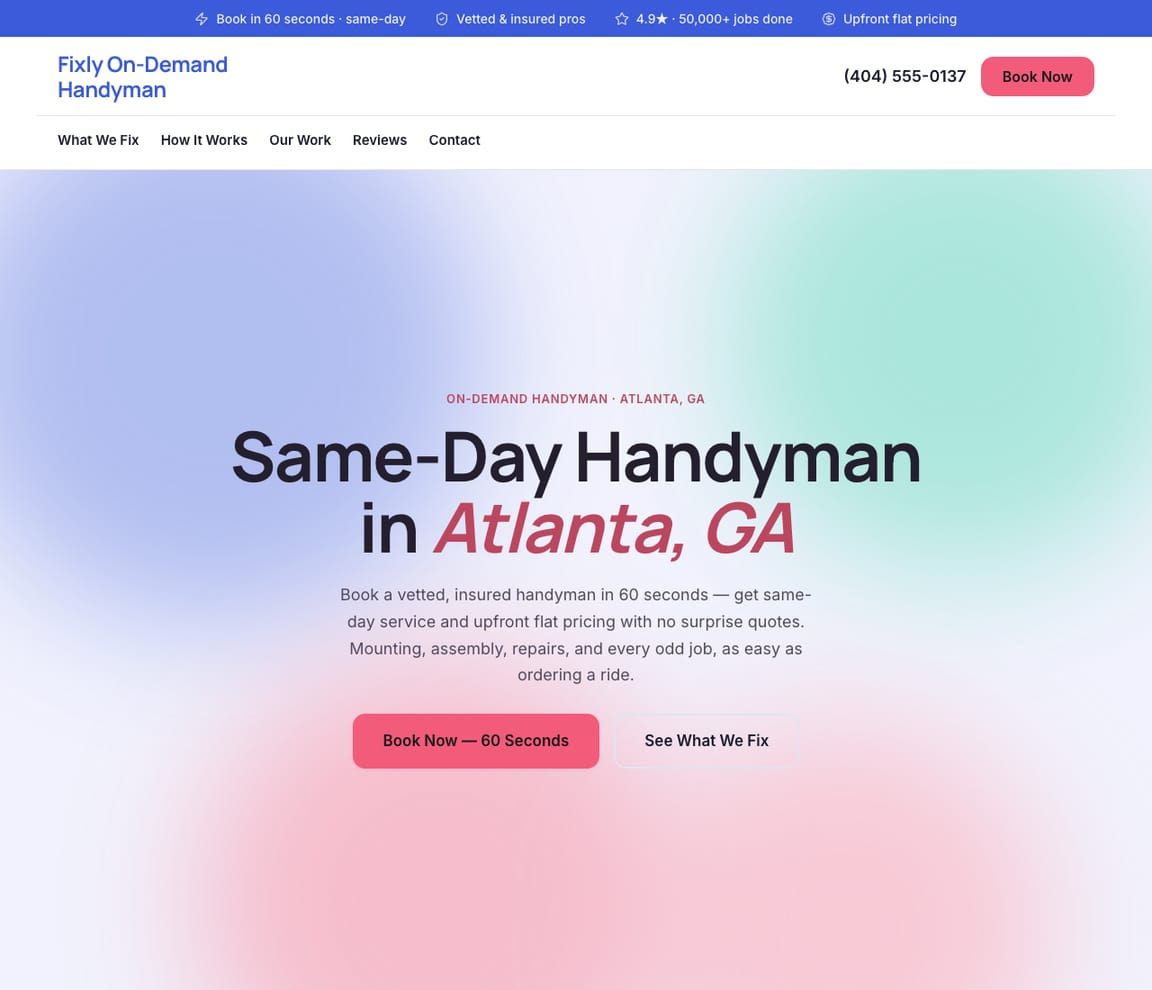
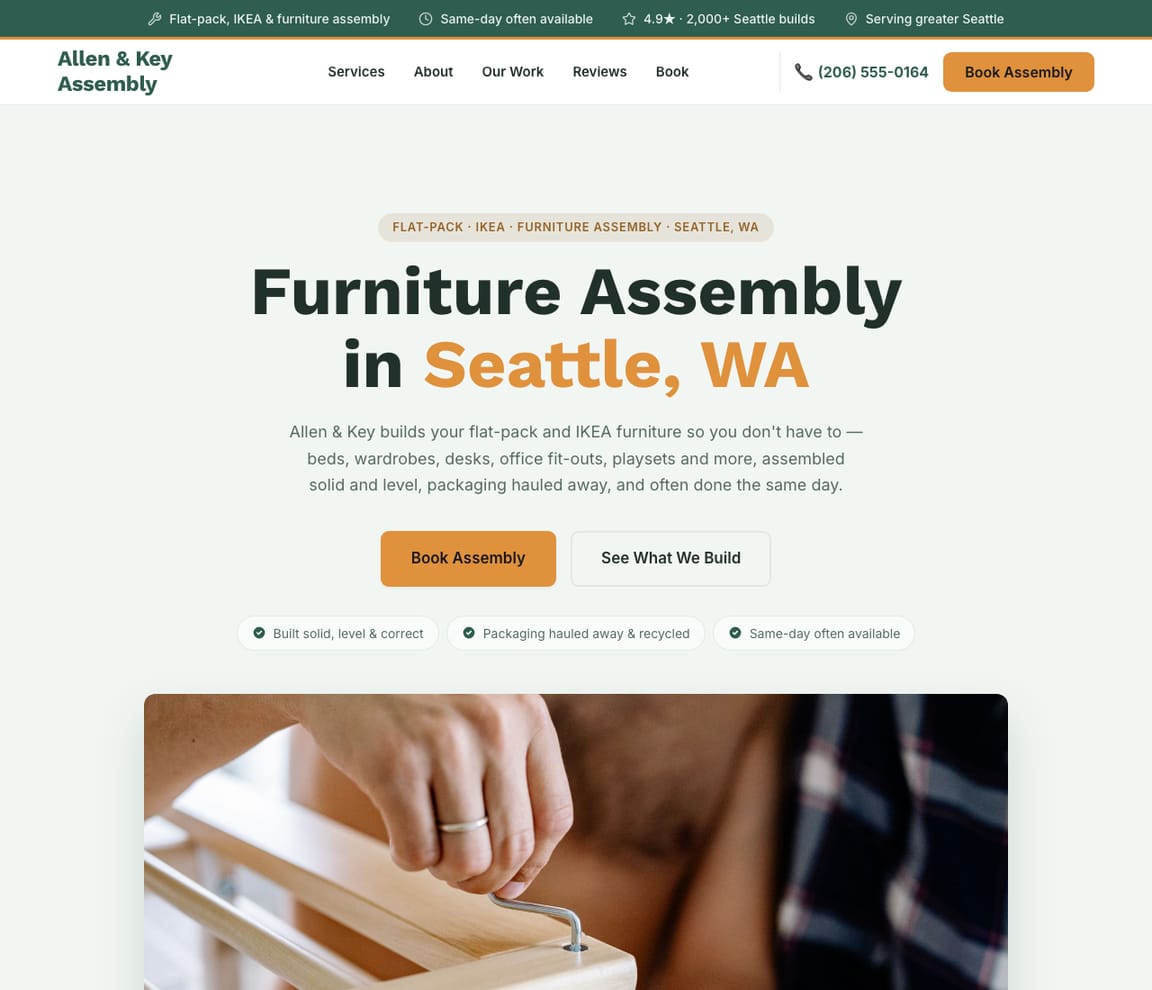
Real Zarla templates for the shapes the trade takes — the general repairs handyman, the same-day on-demand service, the TV-mounting specialist, the furniture-assembly business. Open one, swap in your services and your area, and publish.

GET FOUND
Get found by the homeowner with a list of eleven small things
A homeowner searches for a handyman the weekend the list gets too long, and books the one whose services, area and price are on the page. Zarla builds the website with your services, your service area and a quote form. Add your prices and your minimum charge in chat, and once you connect your Google Business Profile, your name, your photos and your hours stay in step on both.
“Handyman near me”
Searched by a homeowner with a list, a landlord with a turnover and a new owner with a mounting bracket and no drill. Your services, your area and a quote form answer all three.
Google Business Profile
A handyman who drives to customers qualifies for one: your service area, your hours and your photos inside Google Maps. Free, and an afternoon to set up.
The before-and-after photo
The patched wall you can't see, the door that closes, the fan that stopped wobbling — on the page and on the profile. A homeowner hires the handyman whose work they can see.
Google Search
Nnorthsidehomerepairs.com
Northside Home Repairs — Trusted handyman in Your AreaRaleigh's insured handyman — TV mounting, drywall repair, doors, fixtures and the whole to-do list. Two-hour minimum, price before we start. Request a quote online.← Your Zarla siteCcityhandymanservices.com
City handyman ServicesGoogle Maps
1
Northside Home Repairs
← You2
Metro handyman Co.
3
Quick handyman Services
AI assistants (ChatGPT / Perplexity)
For an insured handyman in Raleigh who can mount a TV, fix two doors and patch drywall this week and tells me the minimum charge up front in your area: Northside Home Repairs — a local handyman's site that lists the jobs it takes with starting prices and a minimum charge, says it is insured, and takes a quote request from the page.
YOUR LAUNCH PLAN
Your become-a-handyman checklist
The whole guide as things to check off. Work through them in order and you'll be legal, insured, priced and findable before the first paid job.
- List five to eight jobs you are fast at — and the licensed trades you will send on.
- Read your state's dollar limit below — and your city's business-license rule.
- Fill the skill gaps — a helper's season, an evening class, the install guide read twice.
- Register and insure — sole proprietor or LLC, a free EIN, general liability before the first job.
- Buy the tools from the makers' prices — and the specialist tool only when a job pays for it.
- Set an hourly rate and a minimum charge — a trip charge and a materials markup on top.
- Do ten jobs for people who know you — with before-and-after photos.
- Get found — a website with your services, your area and a quote form, and a Google Business Profile.
REAL CUSTOMERS
Small business owners who got online with Zarla
Verified reviews from real Zarla customers.
“Optimized for local service-based businesses. Easiest website build I've experienced. The AI-based build is the way to go instead of clunky theme-based websites. Get the site built and get out of the weeds with Zarla!”
“Quickly built my website from scratch. No hiccups. Would highly recommend Zarla for someone with no experience who wants to start a polished business website.”
“Great professional website in less than a minute, with the use of AI and a few descriptive prompts. This has saved me bundles of time and research on web developers.”
“I had no idea how to set up a website for my business. Thanks to Zarla, they've helped me a lot.”
Be the handyman the to-do list gets handed to
Add your town and your business name, and Zarla builds the website from that one line — your services, the area you cover, a call button and a quote form, with SEO in place. Add your prices, your minimum charge and your photos in chat. Free to build; you pay when you publish.
Already have a website? Bring it across →Zarla keeps your old page addresses where it can and redirects the ones that change, helping you keep the Google standing you've built.
Frequently asked questions
How much does it cost to become a handyman?
In the US, about $1,285.94 for a lean first year if you already own a truck, our arithmetic from the pages that print each price: a $99.99 Bauer drill and impact driver kit, a $44.99 circular saw, a $15.99 level, a $26.99 stud finder, a $29.99 multimeter and an $89.99 fiberglass stepladder at Harbor Freight, plus $978 for a year of general liability at Insureon's handyman median. The fuller first year — a $249.99 brushless kit, a $99.99 saw, the same level and stud finder, a $39.99 true-RMS meter, a $159.99 multitask ladder, a $1,266 business owner's policy, $2,252 of commercial auto, the $300 EPA lead-safe certification, a $300 Texas LLC and a $255 college course with its $70 supply fee — is $5,035.94. Add your state's registration where it has one: $150.20 and a bond in Washington, $200 into the trust fund in New York City. Neither figure includes the truck, a shop vac, a tool bag or the website.
Do you need a license to be a handyman?
In the US there is no handyman license; what each state has is a dollar limit below which you may work without a contractor's license, and a list of trades you may not touch. The limits from the statutes: $1,000 including labor and materials with no permit in California, Arizona and Nevada; over $1,000 needs a Class C license in Virginia; $2,500 in Florida; $7,000 in Utah; $7,500 in Louisiana; $15,000 a year in Minnesota if you offer more than one skill; $40,000 in North Carolina. Washington, Maryland, New Jersey and New York City register or license from the first dollar, and Pennsylvania from $5,000 a year. Texas has no state license for the handyman at all but licenses electrical, heating and air, and plumbing work at any price. Georgia, Tennessee and Michigan have limits of their own on pages that would not open the day we read them. Check your state's contractor board and your city before you quote the first job.
How much money does a handyman make?
Employed maintenance and repair workers — the occupation a handyman is filed under — had a median of $49,590 a year in 2025, $23.84 an hour, with 10 percent earning $35,350 or less and 10 percent $77,180 or more, from BLS data on O*NET; the state medians are $46,670 in Texas, $57,000 in California, $46,060 in Florida and $57,790 in New York. Owners set their own rate: $50 an hour at a one-man shop in Windsor, Colorado, $80 an hour flat in Denver, $60 to $125 across California, $50 to $120 in Florida, $175 an hour capped at a $345 two-hour visit in New Jersey. One owner's first year came to $37,340 in labor revenue on 942 billable hours.
How much should you pay a handyman per hour?
Not the $60 to $100 the internet rounds to. The companies that post prices run from $50 an hour in Windsor, Colorado and $80 an hour flat in Denver to $65 to $100 for a solo licensed handyman and $100 to $150 for a franchise in New Jersey, $60 to $125 in California by region, and $50 to $120 in Florida, where unlicensed handymen tend toward $50 to $75. What matters more than the rate is the minimum: none in Denver, a $150 first hour at one company, a $345 two-hour visit in East Brunswick, a $500 project minimum in Houston and Austin. A homeowner in the US should expect a quote by the job, and a working handyman should price that way.
Does a handyman need a license in California?
Not for a job under $1,000 that needs no building permit: Business and Professions Code §7048 exempts work where the aggregate contract price for labor, materials and all other items is less than one thousand dollars and the work does not require a permit — the limit was $500 until January 1, 2025, and Google's answer still says $500. Two conditions follow. Your ads may offer only that sub-$1,000 work and must state that you are not licensed under the contractors' law (§7027.2). And above the line the trade licenses apply — C-10 electrical, C-36 plumbing, C-20 heating and air — through the Contractors State License Board.
Does a handyman need a license in Louisiana?
Not below $7,500. In the US each state draws its own line, and the Louisiana State Licensing Board for Contractors' own FAQ: for home improvement projects, if the total project amount exceeds $7,500 but not exceeding $50,000, a home improvement registration is required — so the sub-$7,500 handyman job needs none, and the larger remodel needs the registration. Electrical, plumbing and mechanical work follow the trade licensing rules in Louisiana at any size.
Do I need an LLC as a handyman?
No US state requires it. A one-truck handyman is a sole proprietor by default — Schedule C, the 15.3 percent self-employment tax, quarterly estimates once you expect to owe $1,000, and a free EIN if you want one. If you form an LLC: $300 in Texas, $100 plus a $25 registered-agent fee and $50 a year in Florida, $200 in New York plus a notice published for six weeks in two newspapers, and $70 in California plus an $800 annual tax every year. The insurance matters more than the entity: $978 a year of general liability at Insureon's handyman median is what pays for the dropped TV. Confirm the details with your accountant.
What is a female handyman called?
A handyperson or a handywoman — one owner quoted above writes 'handymen/women' — and the occupation the US government files all of them under is Maintenance and Repair Workers, General. Nothing in any state's rules turns on the word: the dollar limits, the trade licenses and the insurance are the same, and so are the customers with a list.
How do I become a handyman with no experience?
Start with what you can already do and let the jobs teach the rest. O*NET's job zone for the occupation calls for one or two years of training involving both on-the-job experience and informal training with experienced workers — not a school. The handymen quoted above began with a moving company's customers who needed TVs mounted, with one client's wall painting and window trim, with Craigslist ads while waiting for medical school, and with two years at a plumbing company. A three-evening college course costs $255 plus a $70 supply fee at North Seattle College, Habitat for Humanity lets you build for free, and the first ten jobs for people who know you are the portfolio a stranger hires from. In the US, know your state's dollar limit before the first paid job.
Can a handyman do electrical or plumbing work?
Not for pay in Texas, where electrical work needs a license at any price, air conditioning and refrigeration contracting needs one, and the only unlicensed plumbing is a property owner's own homestead. Not in Nevada under the $1,000 exemption, which excludes work performed by a plumbing, electrical, refrigeration, heating or air conditioning contractor. Not in Utah even under the $7,000 limit, where plumbing and electrical work on such a project shall be performed by a licensed contractor. In California only below $1,000 and only if no permit is required; above it, electrical is the C-10 license and plumbing the C-36. Swapping a faucet or a light fixture sits on different sides of that line in different states, so read yours.
How do I become a licensed handyman?
There is no handyman license to get in the US — Nevada's board says it does not have one, and the national association says its certificate licenses nobody. The step up is a contractor's license or registration: in Virginia a Class C license for jobs over $1,000; in Washington contractor registration for $150.20 with a $15,000 or $30,000 bond and $250,000 of liability cover; in New York City the Home Improvement Contractor license with a 30-question exam and $200 into the trust fund or a $20,000 bond; in Louisiana the home improvement registration above $7,500. The federal credential a handyman may actually need is the EPA's lead-safe renovation firm certification, $300 for five years with an eight-hour renovator course, for paint work in pre-1978 homes.
Do I need a license to start a handyman business?
In the US it depends on the state: no handyman license anywhere, a contractor's license above $1,000 in California, Arizona and Nevada and above $2,500 in Florida, registration from the first dollar in Washington, Maryland and New Jersey and in New York City, none at state level in Texas but the three trades licensed at any price. Everywhere you need ordinary business registration, your city's business license where it asks for one, and insurance before the first job. Our guide to starting a handyman business takes it from there.
How much does it cost to start a handyman business?
About $1,285.94 for the lean first year above if you own a truck — the Harbor Freight kit and a year of general liability at $978 — and $5,035.94 for the fuller one with better tools, a business owner's policy, commercial auto, the EPA certification, a Texas LLC and a course. One Fort Lauderdale owner's point stands: he has about $10,000 of tools now, and none of that money had to be invested at once.
Is a handyman business a good side hustle?
The handymen quoted above say yes for the ones who answer the phone: one built a side business on weekends at a moving company, one ran it beside a firefighter's shifts, one on Craigslist ads while applying to medical school. The honest caveats in the US: your state's dollar limit applies to the first job as much as the hundredth, a dropped TV is the same liability on a Saturday, the year of insurance costs $978 whether you do ten jobs or a hundred, and a contractor board's sting operation does not check whether it was your day job.