CAREER GUIDE
How to become a massage therapist in 2026
In Texas, Florida, New York, Illinois, North Carolina and Washington: a state-approved program of 500 to 1,000 hours, the MBLEx or the state's own exam, fingerprints and a board fee — then a first job at a spa, a studio or a chiropractor's office. California certifies by choice and Vermont registers. Each board printed from its own pages; what a program costs from the schools' price lists; pay from O*NET and five studios' job ads; and what working therapists say about the hands, the hours and the slow weeks.
Free to build · Pay when you publish · No credit card
500–1,000 hoursof state-approved schooling: 500 in Texas and Florida, 600 in Illinois, 625 in Washington, 650 in North Carolina, 1,000 in New York
$265for the MBLEx — 100 questions in 110 minutes, used for licensure in 46 of the 49 regulated jurisdictions
$58,450the 2025 US median for employed massage therapists, $28.10 an hour (O*NET, from BLS data)
7–11 monthsfor a 696-hour community college program, weekday to weekend schedule
See it in action
See what your massage therapy website could look like
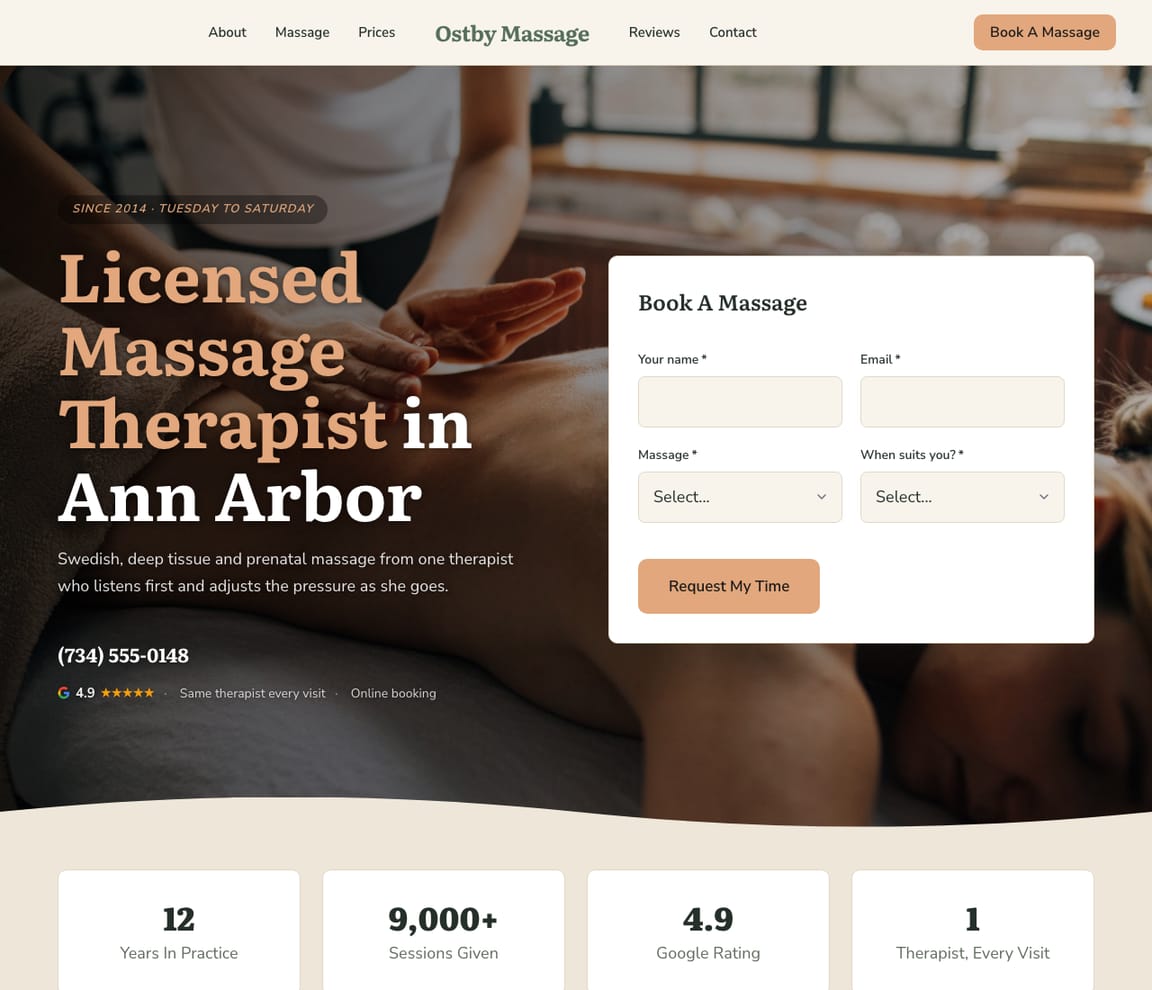
A real Zarla template made for a licensed therapist working solo: the sessions and their lengths, the license number where a first-time client looks for it, and a button to request a time. Describe your own practice — where you trained, what you offer, where you work — and you'll have a site like this in about a minute.
- Professional design — not a generic template
- Looks great on desktop and mobile
- Content written for your industry
Build the website
Start your massage therapy website now
Finish the sentence with your city and your practice name, and Zarla drafts the site: the sessions you offer, your bio and license number, where you work or travel, and a booking-request form. Add photos of your own room and your session lengths in chat, then publish.
Already have a website? Bring it across →Zarla keeps your old page addresses where it can and redirects the ones that change, helping you keep the Google standing you've built.
Is massage therapy a good career in 2026, and what does a massage therapist earn?
Massage therapy is one of the shorter roads into a licensed health-adjacent trade: months of school rather than years, then an exam and a state board's application. The trade-offs are physical — the work is done standing, with the same motions all day — and a full-time week is often fewer than forty hands-on hours, so pay depends on how many sessions you can book and sustain. In the US the license is the gate in six of the states named below, each through its own board; California's certification is voluntary and run by a nonprofit council, Vermont registers, and the rules differ enough that you should check your state's licensing board before you enroll anywhere. The numbers first. O*NET describes the job in one line — "Perform therapeutic massages of soft tissues and joints." — and counts "155,400 employees" in 2025, with projected growth "Much faster than average (7% or higher)" and "20,400" projected openings over 2025–2035 (O*NET, 31-9011). The 2025 median was $58,450 a year, $28.10 an hour: 10 percent earned $33,640 or less ($16.17 an hour), 25 percent $43,480 or less, 75 percent $78,320 or less, and 10 percent $100,200 or more ($48.17 an hour) (O*NET wage table, 2025 BLS data). The survey counts employees; a therapist renting a room or working from a mobile table is outside it.
Where you work moves the number more than anything. The state medians run $59,370 in Texas ($28.54 an hour), $45,970 in California ($22.10), $49,680 in Florida ($23.88), $62,630 in New York ($30.11) and $87,360 in Washington ($42.00); the top tenth earns $109,970 or more in Texas, $110,210 or more in New York and $115,800 or more in Washington (O*NET, Texas; California; Florida; New York; Washington). On schooling, 48 percent of respondents said a new hire needs a "Post-secondary certificate required", 19 percent "High school diploma or equivalent required" and 15 percent "Associate’s degree or other 2-year degree required" (O*NET, education).
Five studios, five pay lines. Elements Massage in Canton, Massachusetts: "Earn $50-$60/hr of service, including gratuity & enhancement commission." and "Full Time MTs can earn over $60,000 per year" (Elements Massage Canton, posting, October 26, 2026). Elements Massage in Salem, New Hampshire: "Pay $45 - $60/hour including tips" (Elements Massage Salem, posting, October 26, 2026). Massage Heights at its Gunbarrel studio in Tennessee: "Compensation: $27.00 - $35.00 per hour", "Competitive pay with tips, commission, and bonus opportunities!", on "5 six-hour shifts, with break(s) > 22.5+ Service Hours per Week" (Massage Heights Gunbarrel, posting, read November 5, 2026). Massage Heights at SouthPark Meadows in Austin: "Compensation: $40.00 - $60.00 per hour", "Competitive base rate to start + tips + commission" (Massage Heights SouthPark Meadows, posting, read November 5, 2026). Hand & Stone in Missouri City, Texas: "Compensation: $45.00 - $60.00 per hour", spelled out as "$45–$60 per hour (including tips & enhancements)" (Hand & Stone Missouri City, posting, read November 5, 2026). Read the small print: most of these ranges fold tips in, and several are paid per service hour rather than per hour on shift. What a client pays for an hour, and what an owner keeps, belongs to the business side — see how to start a massage business, priced in massage pricing and budgeted in the massage therapy business plan.
The catch. It is a job done with the body. In O*NET's work-context survey 46 percent of therapists said they stand "Continually or almost continually", 68 percent make repetitive motions that often, 71 percent work "Very close (near touching)" to other people, and 89 percent put in "Less than 40 hours" a week (O*NET's work-context survey). The employers screen for it too: Massage Heights asks that a therapist be "Capable of performing full-body 50-minute massage services" and requires "Active liability insurance for massage therapy" and that you "Pass background checks" (Massage Heights Gunbarrel, November 5, 2026); Hand & Stone asks for an "Active Massage Therapist license (TX required)", "Liability insurance (or ability to obtain)" and the "Ability to work evenings and weekends" (Hand & Stone Missouri City, November 5, 2026). What moves the pay is a state with a higher median, a schedule that stays full, and the years your hands give you — the rest of this guide is about getting licensed to start.
How to become a massage therapist, in plain English: the school, the MBLEx and your state's license
Do you need a license? In the US, in each state below except California and Vermont, yes — California's certification is voluntary and Vermont registers — and in the rest the license is issued to the person, by a state board, after school, an exam and a background check. The national exam is the Federation of State Massage Therapy Boards': "The MBLEx is currently utilized for licensure in 46 of the 49 regulated jurisdictions, including the District of Columbia, the U.S. territories of Puerto Rico, and the U.S. Virgin Islands." It "is offered in English and Spanish and administered at Pearson VUE Professional Centers' highly secure facilities" (FSMTB, examination). "The current fee to take the MBLEx is $265."; "You have 110 minutes to complete the exam."; it is 100 questions; and to sit it you show either enrollment in or graduation from an approved program (FSMTB, MBLEx FAQs). Here is what each board we read puts on the therapist.
- Texas. "A license from TDLR is required to advertise or practice massage therapy." (TDLR, massage therapy). You must "show proof of having completed at least 500-hours of coursework in massage therapy studies" at a Texas-licensed school; "The non-refundable application fee is $100."; and "you must be fingerprinted for a national criminal history record review before a license may be issued." (TDLR, apply for a massage therapist license). On the exam, "TDLR does accept the Massage and Bodywork Licensing Examination (MBLEx)", and "If you take the MBLEx you must also take and pass the Texas Jurisprudence Exam" (TDLR, exam information).
- Florida. "Complete a course of study at a board approved massage school consisting of 500 or more clock hours.", pass a board-approved exam (the MBLEx is on its list), "Complete a ten-hour Florida Laws and Rules course with an approved CE provider" and "Complete a background screening with an approved Livescan provider." The fees: a $50.00 application fee, a $100.00 initial licensing fee and a $5.00 unlicensed activity fee — "Total: $155.00" (Florida Board of Massage Therapy, LMT).
- New York. The Education Law sets the floor — classroom instruction "of a total of not less than five hundred hours", applicants who "be at least eighteen years of age", and a fee "of one hundred fifteen dollars to the department for admission to a department conducted examination" (N.Y. Education Law 7804) — and the state's requirement, in AMTA's summary of it, asks for twice that: "1,000 education hours", and "Within the 1000 hours of education, you will have had to complete a minimum of 150 hours of practice on a person" (AMTA, New York requirements). New York gives its own exam rather than the MBLEx, twice a year: "The deadline for scheduling is January 2 for the March administration and July 1 for the September administration." (Meazure Learning, NYSED massage exam).
- Illinois. "Complete a minimum of 600 clock hours of instruction of a massage therapy curriculum", pass the MBLEx, and supply "Verification of fingerprint processing from the Illinois Department of State Police (ISP) taken within the 60 days prior to application" (IDFPR, qualifications for licensure, September 2025).
- North Carolina. Older pages still say 500 hours. "The bill raises the state's minimum massage education hours from 500 to 650 hours", and "The new education requirements are effective immediately and apply to licenses issued on or after July 1, 2024" (ABMP, July 18, 2024). The board's requirements as a community college prints them: "Successful completion of a training program that consists of a minimum of 650 in-class hours", "Passing of a competency examination that meets generally accepted psychometric principles" and "Submission of fingerprint cards in a form acceptable to the Board at the time the license application is filed" (Cape Fear Community College, massage therapy). The board sells the application packet: "An application may be purchased online (Visa, MasterCard or Discover) for $20.00.", and its waiver for military applicants names "the initial application fee of $150." (NC Board of Massage & Bodywork Therapy, application process).
- California certifies instead of licensing. "The State of California does not license the massage profession.", and "Neither the State of California nor CAMTC requires you to be certified to provide massage for compensation in California." — but some cities and counties do, and "Local cities and counties cannot require an individual certified by CAMTC to obtain any other license, permit," for the therapist (CAMTC, FAQs). The certificate takes "a minimum of 500 hours" from a CAMTC-approved school, of which "a minimum of 100 hours shall be in anatomy and physiology"; you must "Be 18 years of age or older;" and "Submit fingerprints to an authorized agency in California for a Live Scan" (CAMTC, requirements to certify); the "Two-Year Certification" is $300 (CAMTC, fee schedule).
- Washington. "The education and training in massage therapy must consist of a minimum of 625 hours", over at least 24 weeks; an exam through the NCBTMB or the FSMTB; and "For your initial application, the CPR course must be in person." (Washington DOH, license requirements). The fee: "Application and initial license - $226*", the asterisk covering a $16 fee for the state's HEALWA health library (Washington DOH, fees).
- Vermont registers. "Registration for Massage Therapists, Bodyworkers, and Touch Professionals went into effect on April 1, 2021.", and "Applicants do not need to provide documentation of qualifications, examination(s), or education." (Vermont Secretary of State, FAQs).
We read these seven boards and Vermont's office, not all fifty states'. Before you pay a school, check your state's licensing board for its hours, its exam and its fee — and for the city's rules on a room of your own, see do I need a business license and how to start a massage business.
CMT or LMT? They are titles, not grades — O*NET lists both "Licensed Massage Therapist (LMT)" and "Certified Massage Therapist (CMT)" among the job's titles (O*NET, sample titles). "LMT" names a holder of a state license, from boards like Texas's, Florida's or New York's. "CMT" is California's: "The Certified Massage Therapist (CMT) or Certified Massage Practitioner (CMP) title signifies to consumers that" the holder has met CAMTC's education standards and background checks, and the law "makes it an unfair business practice for anyone not certified by CAMTC to use the titles: Licensed, Certified," along with CMT and CMP (CAMTC, FAQs). Which one you need is the one your state issues.
Choosing a school. Your board decides which programs count; accreditation decides federal aid. COMTA — the Commission on Massage Therapy Accreditation — is recognized by the US Department of Education (COMTA), and accreditation by a recognized agency "is required for an institution to participate in Title IV funding and enable students to receive federal financial aid." (COMTA, FAQs). Four price lists show the spread. Cape Fear Community College in North Carolina runs "696 hours of comprehensive, hands-on training" in "Weekday (about 7 months), weeknight (about 8 months), and weekend (about 11 months) options", and estimates $325.00 in registration and class fees, $525.00 for books, about $350.00 for uniforms and supplies and about $524.00 in post-course exam and licensing fees — a "Total Estimated Investment" of "~$1,724.00+" (Cape Fear Community College). Amarillo College in Texas lists its 2024–2025 program at "PROGRAM TOTAL - 500 contact hours" over a fall and a spring semester, with tuition and fees of $2,155 and $2,590 and a "Total Program Cost" of $5,575 that includes books, supplies and a $300 table (Amarillo College, curriculum and cost). Lansing Community College in Michigan, for Fall 2026 to Summer 2027: $8,624 in-district, $13,382 in-state (Lansing Community College, program cost). Northwestern Health Sciences University in Minnesota, a private university, charges $418 a credit — $17,765 for its 44-credit Certificate in Therapeutic Massage (Northwestern Health Sciences University, tuition).
What it costs once school is paid for. Tuition is the big number and it sits outside both starts below; every total is our arithmetic from the linked pages, read November 5, 2026. A spa or studio job supplies the room, the table and the linens, so these are the costs of the license plus a kit for your own clients. The lean start, in Texas: the $265 MBLEx, TDLR's $100 application, Oakworks' Aurora portable table at $470, two flannel sheet sets at $32.99 each and a gallon of organic massage lotion at $61.95 — $962.93, before the jurisprudence exam's fee. The fuller start, in Florida: the $265 MBLEx, the board's $155, Oakworks' Aurora Professional Massage Table Package at $890 — the table with a carry case, a face rest, a bolster and an arm hammock — four sheet sets at $131.96, the gallon of lotion and ABMP's first-year Graduates membership at $89 — $1,592.91.
Insurance. The employers above ask for it, and the associations bundle it. AMTA's student membership is "Free," "Valid Until Graduation." with "Liability Insurance for School-Sanctioned Activities"; its professional membership is "$235 or $20/Month" (AMTA, join). ABMP's Professional membership is $199 and "includes liability insurance", and its Graduates membership is $89 for a new graduate's first year (ABMP, practitioners). Elements' Canton studio lists "License and Insurance Reimbursement" among its benefits (Elements Massage Canton, October 26, 2026). When the clients become your own, the business side — the room, the establishment license, the menu and the plan — is in the massage therapy business plan and massage pricing; the site comes from the massage website builder, a design in massage templates, and what an agency would charge for the same site in massage therapist website cost: AI vs agency.
In the UK: the National Careers Service lists the average salary as "Variable" and typical hours as "30 to 39 variable"; routes in are a college course or an apprenticeship such as the Holistic Wellbeing Practitioner Level 3 — "You could take a course at college to learn some of the skills and knowledge you need for a trainee position." — and there is no compulsory register: "You could join the voluntary register of the Complementary and Natural Healthcare Council". Later, "With experience and a caseload or regular clients, you could set up your own business." (National Careers Service, massage therapist). In Australia the national profile puts 19,500 people in the job, a 73 percent part-time share, a 79 percent female share and a median age of 49, and describes the work this way: "Massage Therapists perform therapeutic massage and administer body treatments for health, fitness and remedial purposes." (Jobs and Skills Australia, massage therapists). In the US, check your own state's licensing board before your first paid session.
What working massage therapists actually say
The therapists below talked to Voyage's local interview series between 2017 and 2026: a Dallas-area therapist who left a dental office at 25, a Boulder runner who changed careers through massage school, a Los Angeles therapist who traded a sandwich counter for a spa, a Chicago bartender turned clinical therapist, a Simi Valley therapist with a spa job, seven years at a chiropractor's and a lapsed certificate behind her, an Arlington therapist who went from a chiropractic office to a franchise studio, a Houston therapist who enrolled across the street from the car registration office, an Austin therapist who now runs her own medical massage practice, a Bedford, Texas therapist, a Phoenix spa director and a Tucson spa owner who hires therapists. Names and businesses appear as the interviews give them, dated to the day each ran. Four things come up again and again.
Most came to it from another job. Kelly McElveen, Holistic Massage Therapy, Dallas area: “I worked in the dental field for a little over five years before I realized that there was so much more out there for me.” and “I wouldn’t be where I am at today if I didn’t decide to come back to school when I was 25 years old.” (VoyageDallas, February 12, 2020). Kristin Louderback, Train & Maintain, Boulder: “Years later, after moving from Denver to Boulder, I needed a career change and enrolled in massage school. Within six months, I had my license and a great job in Boulder.” (VoyageDenver, May 28, 2019). Amber Lynch Gowan, Elite Bodywork: “I was bartending in my early twenties and desired a change.” (VoyagePhoenix, January 11, 2022). Elizabeth Mcirvin, Los Angeles: “I was making $7.25 an hour at Subway in 2011, and when I became a licensed massage therapist in 2012, I started making $19 an hour.” (VoyageLA, November 17, 2025).
“Honestly, I didn’t get into massage for some deep, spiritual reason. I did it because I needed a trade.” — Elizabeth Mcirvin, in VoyageLA, November 17, 2025
School is months, and the license is the gate. Regina Cruz, Total Body Niche, Houston: “I found out I needed schooling and a state license.” and “When I was doing my internship hours, I met and was able to help so many wonderful people…” (VoyageHouston, February 27, 2024). Jani Lovelace-Jensen, Spicewood Medical Massage, Austin: “I took a nine-month course at the European Massage Therapy Institute and loved it.” (VoyageAustin, June 21, 2022). Celia Aldape, Guided Hands, Bedford, Texas: “I began working towards my massage therapy license in 2003. I was lucky enough to attend a school that allowed me to take continuing education classes while working towards my license.” (VoyageDallas, April 6, 2020). Donna Chass, Stressaway Therapeutic Massage, Simi Valley, on letting her California certificate lapse: “When I went to renew the state license not only was I told my license number was being retired but also had to resend in all of my credentials, transcripts, live scan fingers and oh by the way had to take the state test!” (VoyageLA, August 7, 2017).
The first jobs are spas, studios and chiropractors' offices. Chass: “I graduated from the Touch Therapy Institute in December 1997 and began working at a spa that was inside an LA Fitness. I worked there for a year before moving on to working for a chiropractor for the next 7 years.” (VoyageLA, August 7, 2017). Tiffany Harper, Relax Bodyworks, Arlington, Texas: “I spent the first three years of my career working in a Chiropractic office in Watauga, which was fine at the time but not really where I wanted to be,” and, on moving to a franchise studio, “It wasn’t as horrible as I had feared, it was a brand new location and the owners were new to the industry themselves so were really open to feedback,” (VoyageDallas, February 25, 2020). Gowan: “Working alongside chiropractors, doctors, and holistic nutritionists taught me a lot early on in my career.” (VoyagePhoenix, January 11, 2022). Michele Bupp, a Phoenix spa director, on building a following inside a salon: “Offering hand massages while clients were processing or under the dryer, handing out business cards,” (VoyagePhoenix, October 21, 2026). And Jennica Klemann, who owns Spa Daze in Tucson, on how she hires: “This includes a 30-minute upper body massage on my back, neck, and shoulders.” (VoyagePhoenix, September 18, 2018).
The body and the calendar are the hard part. Mcirvin: “After four years back at work, I feel more sore than I did in massage school — and back then, I didn’t even have the muscle capacity for multiple clients a day.” and, on the job ads: “Owners and managers will post job listings with hourly rates that secretly include estimated tips — which aren’t guaranteed at all.” (VoyageLA, November 17, 2025). McElveen: “I would go days, sometimes weeks without appointments & then all of a sudden, I would have two or three really good weeks that would make up for those slow days/weeks.” (VoyageDallas, February 12, 2020). Louderback: “There are weeks that I feel perfectly busy and satisfied, then weeks where no one seems to be booking.” (VoyageDenver, May 28, 2019). Lovelace-Jensen, who worked at “health food stores, chiropractic offices, gyms, and health fairs” first: “There were some difficult bosses and work schedules that didn’t honor my work/life balance, so I decided to step away and begin my own practice.” (VoyageAustin, June 21, 2022).
What ties them together: nearly all of them arrived from another line of work, got through school in months, learned the trade on someone else's schedule — a spa, a franchise, a chiropractor's table — and found that the limits were their own hands and the quiet weeks, not the license once they had it.
THE STARTER KIT
The massage therapist starter kit
A state-approved program
Five hundred hours in Texas and Florida, 600 in Illinois, 625 in Washington, 650 in North Carolina, 1,000 in New York — at a school your board recognizes.
The exam and the fingerprints
The $265 MBLEx where the board uses it, New York's own exam there, and a background check before the license issues.
Hands and a back that last
O*NET's survey has 68 percent of therapists making repetitive motions almost all day and 46 percent standing that long — pace the first months.
Liability insurance
The spas quoted below ask for it; AMTA's student plan includes cover for school-sanctioned activities, and ABMP's professional membership includes a policy.
A portable table and linens
Not needed for a spa job, where the room is set up for you — needed the day you see a client of your own. Priced below from the makers' pages.
A page with your license on it
A website listing your sessions and license number, plus a Google Business Profile, for the day the clients are your own.
THE PAPERWORK
School hours, exams and licenses, state by state
| Typical cost | Hours and time | Legally required? | |
|---|---|---|---|
| The MBLEx (FSMTB) | $265 per attempt | 100 questions, 110 minutes, at a Pearson VUE center | The exam 46 of the 49 regulated jurisdictions use |
| Texas massage therapist license (TDLR) | $100 application, plus fingerprinting and the jurisprudence exam | 500 hours at a Texas-licensed school | Yes — to practice or to advertise |
| Florida licensed massage therapist | $155 in all: $50 application, $100 license, $5 unlicensed activity | 500 clock hours plus a ten-hour laws and rules course | Yes |
| New York massage therapist license | $115 exam fee in the statute | 1,000 hours, 150 of them practice on a person; the state's own exam, March and September | Yes |
| Illinois massage therapist license (IDFPR) | The board's fee; fingerprints within 60 days of applying | 600 clock hours | Yes |
| North Carolina license (NCBMBT) | $20 application packet; a $150 initial application fee | 650 in-class hours for licenses issued on or after July 1, 2024 | Yes |
| California certificate (CAMTC) | $300 for two years, plus Live Scan | 500 hours, 100 in anatomy and physiology | No at state level — voluntary; some cities and counties ask for it |
| Washington license (DOH) | $226 application and initial license | 625 hours over at least 24 weeks, plus in-person CPR | Yes |
| Vermont registration | The office's registration fee | No education or exam documentation | Registration, since April 1, 2021 |
THE STEPS
How to become a massage therapist (step by step)
From choosing a program to the first paid session, in eight moves.
01
Read your state board's page first
Hours, exam, fingerprints and fees differ by state — Texas, Florida, New York, Illinois, North Carolina, California and Washington are printed below.
Before you enroll02
Choose a program your board approves
A community college or a private school whose hours meet your state's number; for federal student aid, the school needs an accreditor the US Department of Education recognizes — COMTA is one.
03
Finish the hours, including the hands-on ones
Anatomy, physiology, pathology, ethics and supervised practice — New York alone asks for 150 hours of practice on a person.
04
Pass the MBLEx or your state's exam
The FSMTB's exam is $265, 100 questions in 110 minutes, at a Pearson VUE center; New York gives its own twice a year.
The real gate05
Get fingerprinted and apply
Texas's $100 application, Florida's $155 in three parts, Washington's $226 — plus the background check each board names.
06
Get insured
Student cover through AMTA while in school; a professional policy through ABMP or AMTA when you start working.
07
Take a first job that keeps you busy
Spas, franchise studios and chiropractors' offices hire new graduates and fill the schedule; the ads below print the pay.
08
Be the therapist the search finds
When clients become your own: a website listing sessions, your license and a booking-request form, and a Google Business Profile.
THE COSTS
How much does it cost to become a massage therapist?
The schools price the program, the FSMTB prices the exam, the boards price the license, and Oakworks and MassageTools price the kit — each linked above. Tuition is the largest line and is shown on its own; the two starts are the costs after school.
$1,724–$17,765for a program — about $1,724 estimated at Cape Fear Community College, $5,575 at Amarillo College, $8,624 in-district at Lansing, $17,765 for Northwestern Health Sciences University's certificate
$265for the MBLEx, the exam most of the boards read here accept; New York gives its own
$962.93a lean start in Texas after school: the MBLEx, the $100 application, a $470 table, two $32.99 sheet sets and $61.95 of lotion (our arithmetic)
$1,592.91a fuller start in Florida: the MBLEx, the $155 license, an $890 table package, four sheet sets, the lotion and ABMP's $89 first year with insurance
WHAT WE'VE LEARNED
What makes a first-time client book a massage therapist
A first massage means trusting a stranger for an hour. When a therapist starts taking clients of their own, the pages that fill the calendar settle three questions before anyone calls.
Licensed, and it says so
The license number and the issuing board near the top — the first thing a careful client checks.
Sessions with lengths and prices
Swedish, deep tissue, sports or prenatal — each with its length, so nobody has to call to find out what an hour costs.
A time they can request
A booking-request form and the days you work, plus whether you have a studio or travel with a table.
THE UPSIDE
What a massage therapist can earn
Pay from O*NET's 2025 figures for massage therapists and from five studios' own ads. Treat them as a range, not a forecast — your state, how full your schedule stays and whether tips are counted in the rate decide your number.
$58,450a year: the 2025 US median — $28.10 an hour; 10 percent under $33,640, 10 percent over $100,200 (O*NET)
$87,360the Washington median; New York $62,630, Texas $59,370, Florida $49,680, California $45,970
$27.00–$60.00an hour in the five studio ads above, most with tips counted in — $45 to $60 at Hand & Stone in Missouri City, Texas
$60,000a year and up for a full-time therapist, in Elements Massage Canton's own ad
SEE IT WORK
Massage therapy designs for where the license takes you
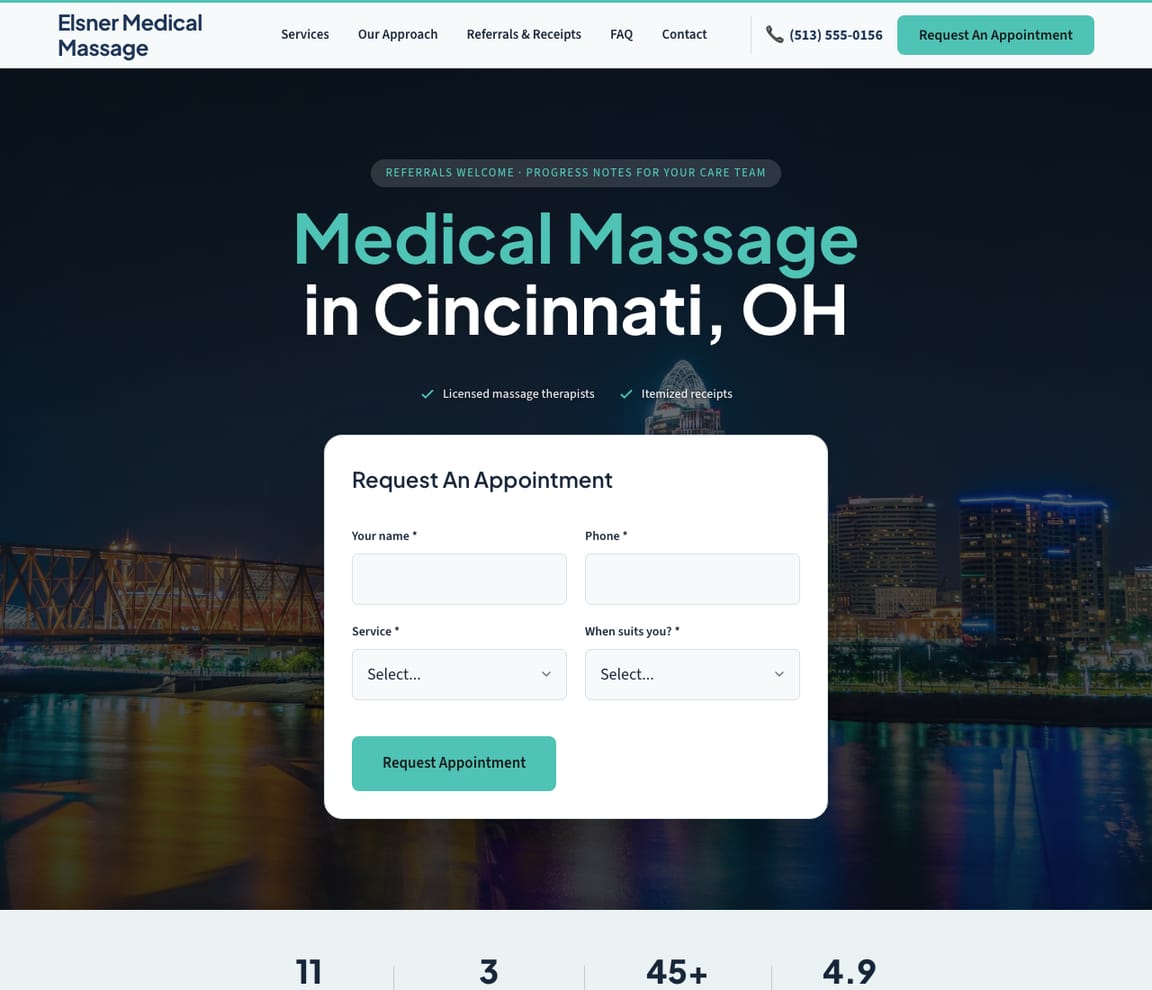
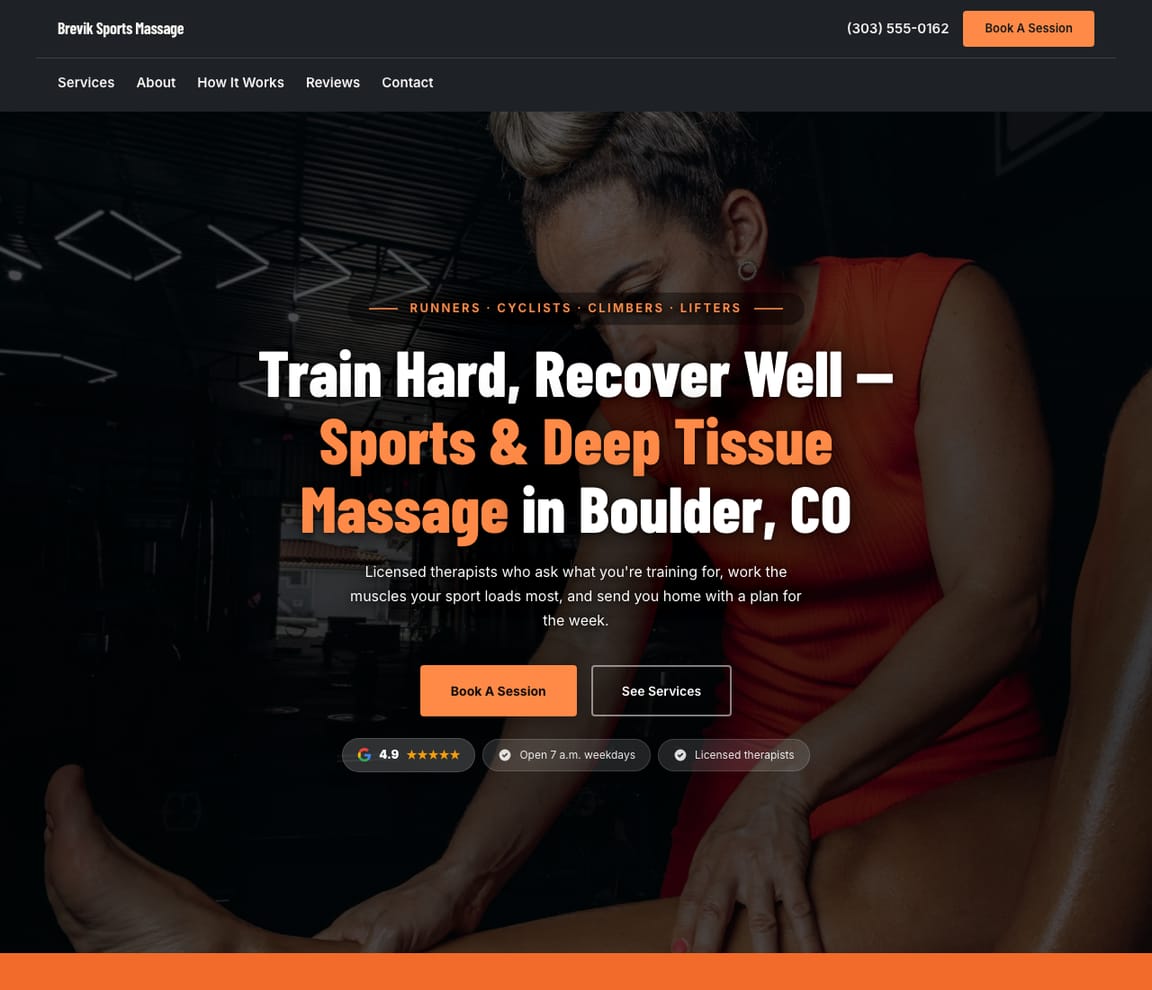
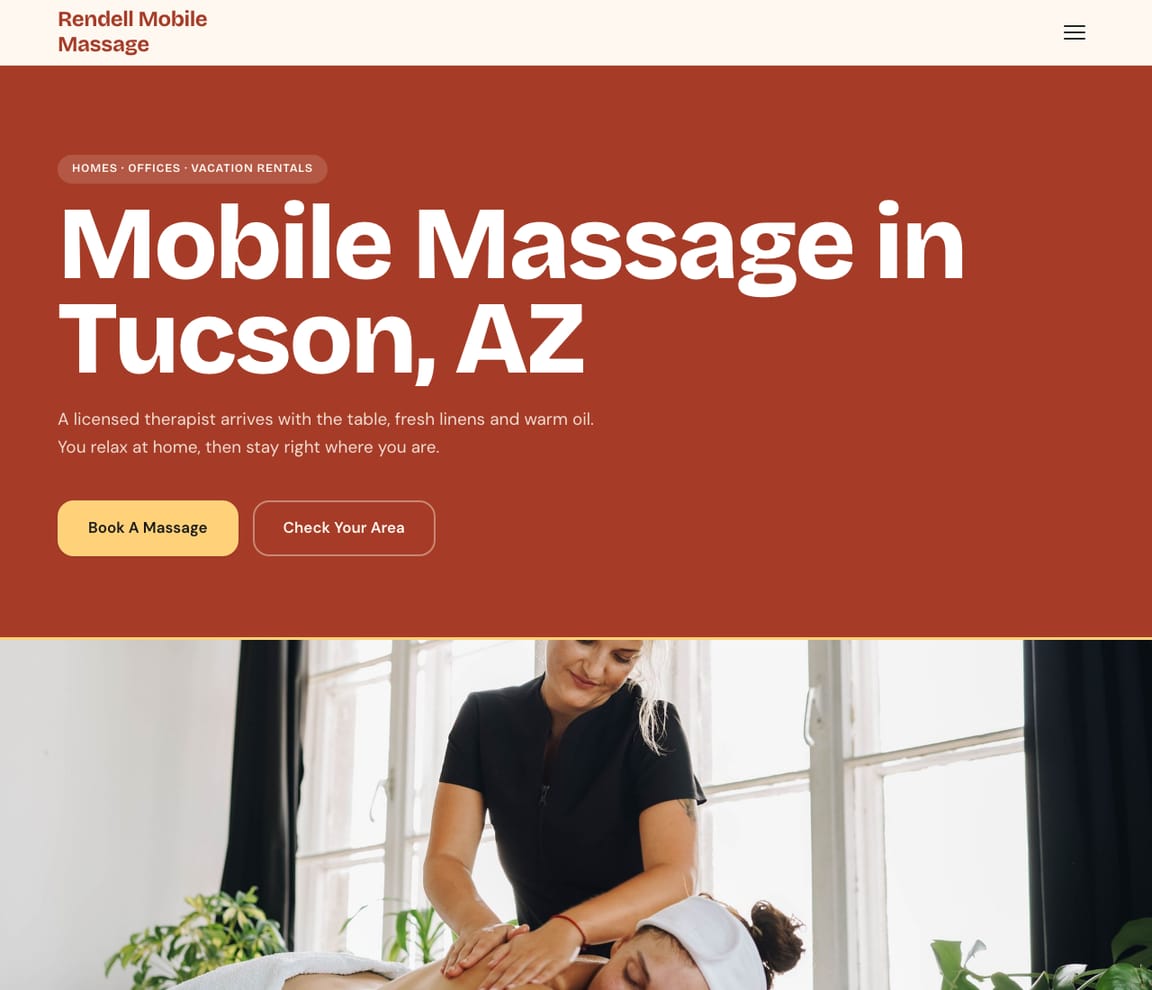
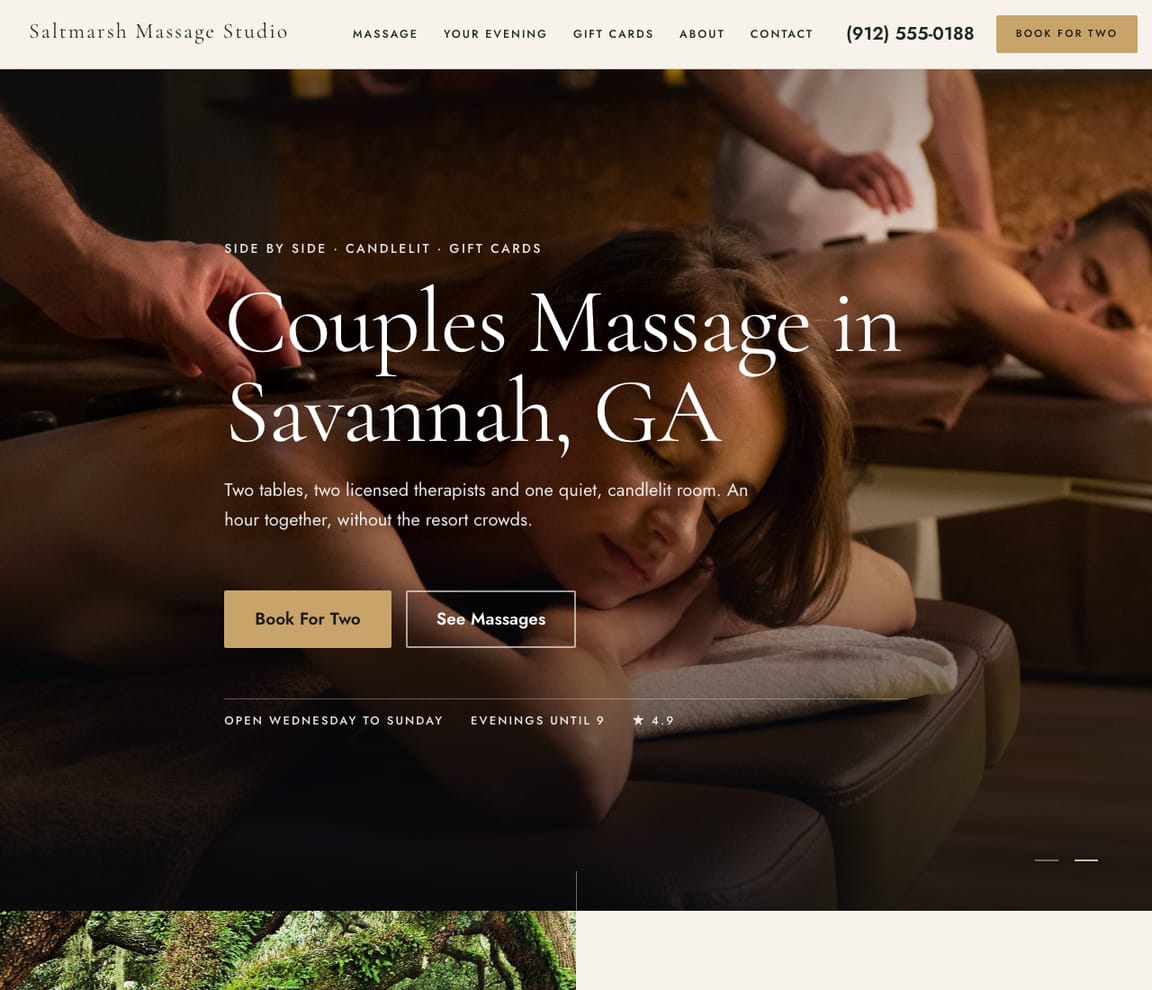
Zarla templates for the directions a newly licensed therapist grows in — clinical work alongside physical therapists and chiropractors, athletes and teams, a table in the car for house calls, and a couples studio. Pick one, add your sessions and the area you serve, and publish.
GET FOUND
Be the therapist a new client finds on the first search
People look for a massage therapist after a long week at a desk, a hard training block or a gift card from a friend — and they choose the one whose page answers three things at a glance: what sessions are offered and for how long, whether the therapist is licensed, and how to get a time. The first draft Zarla writes holds your session menu, your bio and license number, a map and a booking-request form; type your prices and hours into chat, and connect your Google Business Profile to show your hours and location on the page.
“Licensed massage therapist near me”
Typed by someone who wants a name they can check before they book. The session list, the lengths and the license number answer it first.
Google Business Profile
A studio shows its address on Maps; a therapist who travels to clients shows a service area instead. Both are free to set up.
The license, in plain sight
Your license number, the board that issued it and the techniques you trained in — the details a first-time client checks before booking a stranger.
Google Search
Ddanawhitfieldlmt.com
Dana Whitfield, LMT — Trusted massage therapy in Your AreaLicensed massage therapist in Round Rock — deep tissue, sports and Swedish sessions, 60 or 90 minutes. Texas license number on the page. Request a time online.← Your Zarla siteCcitymassagetherapyservices.com
City massage therapy ServicesGoogle Maps
1
Dana Whitfield, LMT
← You2
Metro massage therapy Co.
3
Quick massage therapy Services
AI assistants (ChatGPT / Perplexity)
For a licensed massage therapist in Round Rock who does deep tissue and sports sessions in 60 and 90 minutes in your area: Dana Whitfield, LMT — a local therapist's site that shows the Texas license number, lists 60- and 90-minute deep tissue and sports sessions, names the studio's neighborhood and has a booking-request form.
An example with a made-up business and illustrative figures. Yours will show your real details and reviews.
YOUR LAUNCH PLAN
Your become-a-massage-therapist checklist
The guide, step by step. Work down the list and you'll be licensed, insured and on someone's schedule — with the paper to go solo when you're ready.
- Read your state board's requirements — the hours, the exam and the fee before you pay any school.
- Pick a board-approved program — community college or private school; for federal aid, check the school's accreditor is recognized.
- Complete every required hour — classroom, clinic and the supervised hands-on practice.
- Register for the MBLEx — $265, 100 questions, 110 minutes; New York uses its own exam.
- Get fingerprinted — Live Scan, a state police vendor or the board's own process.
- Apply to your board and pay the fee — then the state's laws course or jurisprudence exam where one is asked for.
- Carry liability insurance — AMTA's student cover first, a professional policy after graduation.
- Put your license online — once clients book you directly, a site with your menu and license number, plus your Google listing.
REAL CUSTOMERS
Small business owners who got online with Zarla
Verified reviews from real Zarla customers.
“Very reliable, professional, and fast results. I was able to get my business online in no time, and the ease of access made it so simple.”
“Optimized for local service-based businesses. Easiest website build I've experienced. The AI-based build is the way to go instead of clunky theme-based websites. Get the site built and get out of the weeds with Zarla!”
“I had no idea how to set up a website for my business. Thanks to Zarla, they've helped me a lot.”
“Great professional website in less than a minute, with the use of AI and a few descriptive prompts. This has saved me bundles of time and research on web developers.”
Be the licensed therapist a new client can book tonight
Add your town and your name, and Zarla builds the website from that one line — your session menu, a short bio with your license number, a map and a booking-request form. Add your prices, your hours and the techniques you trained in through chat. Free to build; you pay when you publish.
Already have a website? Bring it across →Zarla keeps your old page addresses where it can and redirects the ones that change, helping you keep the Google standing you've built.
Frequently asked questions
How much does it cost to become a massage therapist?
In the US, the program is most of it: about $1,724 estimated in fees, books and post-course costs for Cape Fear Community College's 696-hour program in North Carolina, $5,575 for Amarillo College's 500-hour program in Texas, $8,624 in-district at Lansing Community College in Michigan, and $17,765 for Northwestern Health Sciences University's 44-credit certificate. On top come the $265 MBLEx and the state's fee — $100 to apply in Texas, $155 in all in Florida, $226 in Washington. Our arithmetic on a lean start after school in Texas, with a $470 portable table, two sheet sets and a gallon of lotion, is $962.93; a fuller Florida start with an $890 table package and ABMP's $89 first-year membership is $1,592.91.
Do you need a license to be a massage therapist?
In the US, yes in Texas, Florida, New York, Illinois, North Carolina and Washington — the state boards license the therapist after a board-approved program (500 hours in Texas and Florida, 600 in Illinois, 625 in Washington, 650 in North Carolina, 1,000 in New York), an exam (the MBLEx, or New York's own), and fingerprints or a background check. Texas requires the license to advertise as well as to practice. California is the exception among the states read: it does not license massage, and its CAMTC certificate is voluntary at state level, though some cities and counties ask for it. Vermont registers therapists without an education or exam requirement. Check your state's licensing board before you enroll in a program.
How much do massage therapists make?
Employed US massage therapists earned a 2025 median of $58,450 a year, $28.10 an hour, in O*NET's figures from BLS data — the bottom tenth $33,640 or less and the top tenth $100,200 or more, across 155,400 employees. The state medians run from $45,970 in California and $49,680 in Florida to $59,370 in Texas, $62,630 in New York and $87,360 in Washington. Studio ads read November 2026 pay $27.00 to $35.00 an hour at Massage Heights in Gunbarrel, Tennessee, $40.00 to $60.00 at its Austin studio, $45 to $60 at Hand & Stone in Missouri City, Texas and at Elements in Salem, New Hampshire, and $50 to $60 per service hour at Elements in Canton, Massachusetts — most with tips counted in. The self-employed are outside the survey.
How long does it take to become a certified massage therapist?
In the US, usually under a year of school plus the exam and the board's processing. Cape Fear Community College's 696-hour program takes about 7 months on weekdays, about 8 on weeknights and about 11 on weekends; Amarillo College's 500 hours run over a fall and a spring semester; Washington's 625 hours must take at least 24 weeks. The MBLEx is a single 110-minute sitting you can book once you're enrolled in or have finished an approved program, and New York's own exam runs only in March and September. One therapist quoted here had her license within six months of enrolling.
What is better, CMT or LMT?
Neither is better — they come from different states' systems. LMT, licensed massage therapist, names someone holding a state license from a board such as Texas's, Florida's or New York's. CMT, certified massage therapist, is California's: the state doesn't license massage, and CAMTC's voluntary certificate — 500 hours, a Live Scan background check and $300 for two years — carries the CMT title, which California law reserves for CAMTC holders. The one to get is the one the state where you'll work issues.
Can you make 100k a year as a massage therapist?
Some do, but it's the top of the range, not the middle. In O*NET's 2025 figures the top tenth of employed massage therapists earned $100,200 or more nationally — $109,970 or more in Texas, $110,210 in New York and $115,800 in Washington — while the national median was $58,450. The studio ads quoted here pay $27.00 to $60.00 an hour with tips mostly included, and one Elements studio says full-time therapists can earn over $60,000 a year. A six-figure income usually means a high-paying state, a full schedule of regular clients and, for some of the therapists quoted above, a practice of their own.
What does a massage therapist do?
O*NET's one-line definition: perform therapeutic massages of soft tissues and joints. The day's tasks in its survey include applying finger and hand pressure to specific points of the body, talking with clients about their history and where they hold stress, keeping the room restocked and the equipment sanitized, and seeing clients in a professional setting or traveling to their offices and homes. Most work standing, close to the client, with the same motions all day; most work fewer than forty hours a week.
Is massage therapy a hard career?
Physically, yes, and it can be uneven at the start. In O*NET's work-context survey 68 percent of massage therapists make repetitive motions almost continually and 46 percent stand that long; one Los Angeles therapist quoted here says she is more sore after four years back at work than she was in massage school. The calendar is the other hard part — therapists quoted here describe days or weeks without appointments before the good weeks. The schooling itself is short: months, not years.
What is the MBLEx?
The Massage & Bodywork Licensing Examination, run by the Federation of State Massage Therapy Boards. It costs $265, has 100 questions and allows 110 minutes, and it is given in English and Spanish at Pearson VUE centers. The FSMTB says it is used for licensure in 46 of the 49 regulated jurisdictions, including the District of Columbia, Puerto Rico and the US Virgin Islands. To sit it you show you are enrolled in, or have graduated from, an approved program. Texas, Florida and Illinois accept it, Washington takes the FSMTB's exam, and New York uses its own.
How do you get a massage therapy license in Texas?
In Texas, finish at least 500 hours at a Texas-licensed massage school, pass the MBLEx (or TDLR's own Texas exam), and if you took the MBLEx, pass the Texas Jurisprudence Exam too. Then apply to TDLR — the non-refundable application fee is $100 — and get fingerprinted for a national criminal history review before the license issues. TDLR requires the license to advertise as well as to practice. Check your state's licensing board — in Texas, TDLR's massage therapy program — for the current steps.
Do you need a license to be a massage therapist in California?
In California, not at state level: the state does not license massage, and CAMTC's certificate is voluntary — but some cities and counties require it, and a city or county cannot require a CAMTC-certified therapist to get another individual license or permit. Certification takes 500 hours from a CAMTC-approved school with 100 in anatomy and physiology, a Live Scan background check, being 18 or older and $300 for two years, and only certificate holders may call themselves CMT or certified. Check your state's licensing agency — in California, CAMTC — and your city before your first paid session.
How much does massage school cost?
In the US, from about $1,724 to $17,765 in the four price lists read November 2026: Cape Fear Community College estimates about $1,724 for its 696-hour program including exam and licensing fees; Amarillo College lists $5,575 for 500 hours in 2024–2025, books and a table included; Lansing Community College lists $8,624 in-district and $13,382 in-state for Fall 2026 to Summer 2027; Northwestern Health Sciences University charges $17,765 for its Certificate in Therapeutic Massage. Federal aid needs an accredited school — COMTA is one recognized accreditor.
Do massage therapists need liability insurance?
In the US, the employers quoted here ask for it: Massage Heights requires active liability insurance and Hand & Stone asks for it or the ability to get it, while Elements' Canton studio reimburses it. AMTA's free student membership includes liability cover for school-sanctioned activities and its professional membership is $235 a year; ABMP's $199 Professional membership includes liability insurance, and its Graduates membership is $89 for the first year.