CAREER GUIDE
How to become a musician in 2026
Not how to practice — how to get paid. The four ways working musicians earn, what a gig, a wedding and a lesson actually pay, the royalties and the organizations that collect them, releasing your own music, the paperwork and insurance of being self-employed — and what musicians make.
Free to build · Pay when you publish · No credit card
3.5income sources for the median working US musician (MIRA/Princeton survey)
$0to join ASCAP as a writer and to register with SoundExchange — the royalty paperwork is mostly free
$488.29union scale for a three-hour recording session as a side musician (AFM, 2025–26)
No codeto get online
See it in action
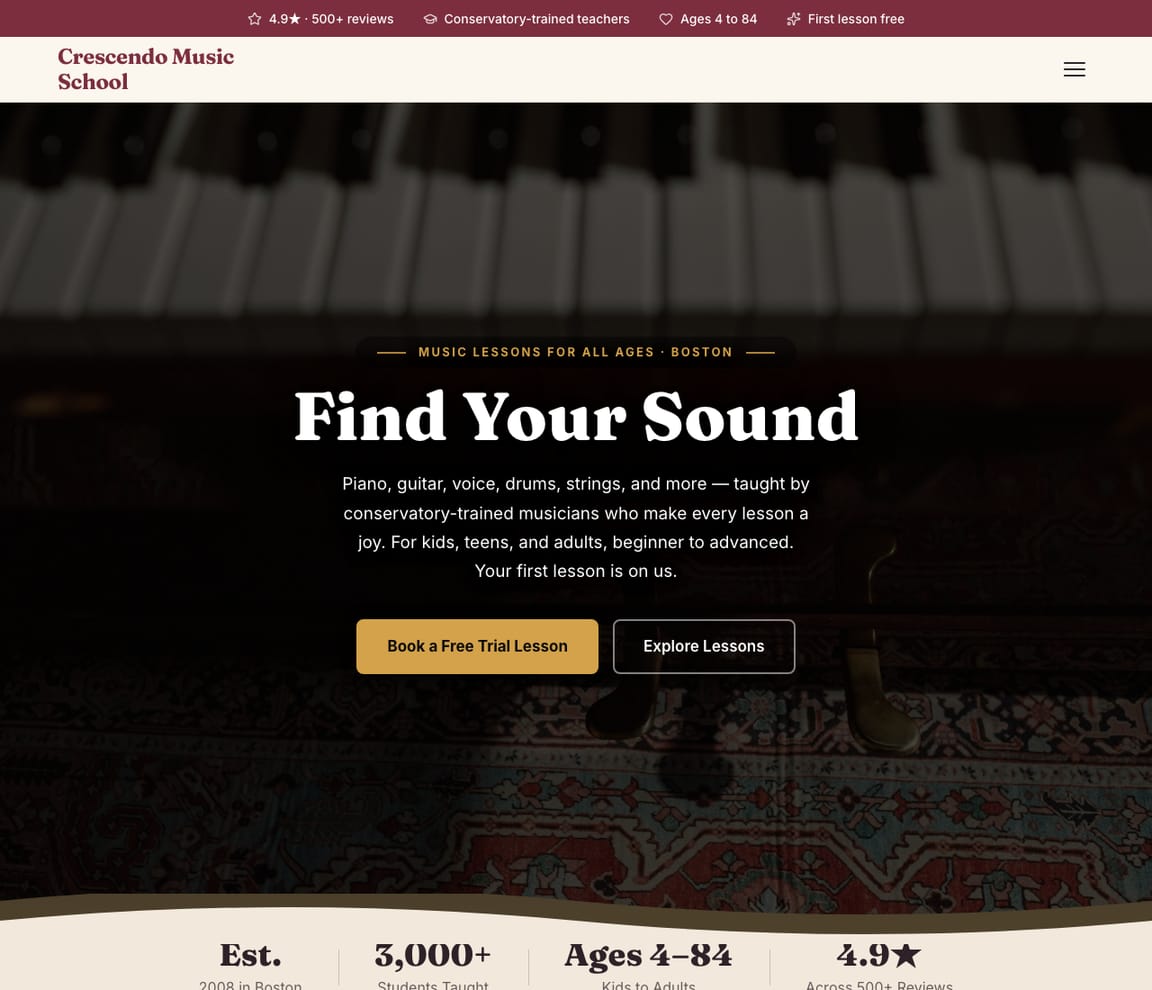
See what your musician website could look like
This is a real Zarla template for a music school — the nearest design to a working musician's site until the musician gallery is built. Describe yours — the instrument, the gigs, the town — and you'll have a site like this, with your music and a booking form, in about a minute.
- Professional design — not a generic template
- Looks great on desktop and mobile
- Content written for your industry
Build the website
Start your musician website now
Add your town and your act's name to the sentence, and Zarla builds the site: your bio, your music and shows and a booking form. Add your rates, your set list and your press photos in chat, then publish.
Already have a website? Bring it across →Zarla keeps your old page addresses where it can and redirects the ones that change, helping you keep the Google standing you've built.
Is becoming a musician worth it in 2026 — and what does the work pay?
Becoming a musician is a skill; becoming a working musician is a stack of four small businesses. The only openable survey of US musicians — 1,227 of them, by the Music Industry Research Association and Princeton in 2018 — ranks the lines: "By far the most common source of income is performing live events. Eighty-one percent of musicians earned income from live events in 2017, and these performances accounted for 42 percent of the average musician's music-related income. The median amount of income earned from live events, for those who reported receiving income from this source, was $5,428." The next two were "giving music lessons (42 percent) and performing in a church choir or other religious services (38 percent)", and "the median musician earned income from 3.5 different sources" (MIRA/Princeton, 2018 survey, AEA 2020 paper). So the four shapes in this guide: the live performer, the wedding and function musician, the teacher, and the recording artist with streams, sync, session and church work — and the honest shape is all of them at once. "Creating a full-time income as a working musician is no easy task. At this point in my career, it comes through multiple revenue streams. Gigs, recording sessions and teaching are the main sources" (Mike Gomez, San Antonio, CanvasRebel, November 14, 2022).
What the people earn — two numbers that measure different people. Musicians and singers who are employed had a median of $47.80 an hour in 2025 on the hours they are paid for — 10 percent under $20.35, 10 percent over $132.56 — with no annual figure printed and 170,400 employed, $33.59 in Texas, $43.83 in California, $50.47 in Florida (O*NET, from BLS 2025 wage data; Texas; California; Florida); the survey behind it leaves out the self-employed (Washington ESD), which is most of this guide's readers, so never multiply it by a working year. The freelancers' number is the MIRA survey's: "The median musician in the MIRA Musician Survey earned $21,300 from music-related sources in 2017", nearly $35,000 from all sources, and "sixty-one percent of musicians said that their music-related income is not sufficient to meet their living expenses" (MIRA/Princeton). The outlook for the occupation to 2035 is "little or no change" (O*NET).
What the money lines actually pay. Bar gigs, from a Long Island musician in 2025: "unless you're in a tribute band, which, along with wedding bands, seem to be the only ones around LI who are making real money, you're looking at making about $150 to $400 for a bar gig, maybe $600", solo and duo acts "$50 to $200", and "the rule of thumb is to not go out and play a gig for less than $100" (Frank Doris, PMA Magazine, September 16, 2025). Weddings: a five-piece Boston cover band's own listing is "$6,075.00" for six hours with a $700 extra hour (Down a 5th, GigRoster listing); a New Jersey saxophone and piano soloist plays "an average of 80 events a year" at "around $750" an hour and "in 2023 alone, he brought in more than $176,000" (NBC Boston, November 30, 2024); a Dallas bandleader's orchestra "alone brings in more than $1.5 million a year" (Fortune, July 21, 2019); The Knot's national band average is $4,500 against $1,800 for a DJ, as a stationery site reprints it — The Knot itself is closed to a reader without scripts (Paperlust, reprinting The Knot's 2026 study — secondary). Lessons: TCU's preparatory program charges $640 for a 16-week semester of weekly 30-minute lessons (TCU Music Preparatory) — $40 a lesson, our arithmetic — and a Chicago university's community program $26 a half hour (Northeastern Illinois University, summer 2026). Session work: union scale is $488.29 for a side musician and $976.58 for the leader per three-hour session from February 2025 to January 2026, plus a 14.09 percent pension contribution (AFM Local 47, sound recording scale sheet, 2025–26). Church: one Oklahoma posting pays "$150 per Sunday service" and "$50 per choir rehearsal" (Yale Institute of Sacred Music, July 30, 2025).
Streaming, at scale. Spotify "paid the music industry more than $11 billion in 2025", "more than 13,800 artists generated at least $100,000 from Spotify alone", and "more than a third of artists who generated $10,000 or more in royalties from Spotify were DIY" (Spotify, Loud & Clear, March 11, 2026); the ladder from the same report is 303,200 artists over $1,000 and 81,100 over $10,000 — "roughly 0.62 %" of about 13 million uploaders (Music Business Worldwide, reading the report). And there is no per-stream rate: "Spotify does not pay artist royalties according to a per-play or per-stream rate" (Spotify for Artists, royalties). One fingerstyle guitarist's first playlist check: "The first payment I received was somewhere in the tune of $700 and I was floored!" (Lance Allen, Hypebot, December 2017); a singer-songwriter's 2021 income was 51 percent live, 26 percent licensing, 12 percent streaming and downloads, 7 percent online merch and 4 percent coaching, as reported (Joy Ike, Digital Music News, November 9, 2023).
The catch. Booking is the job — "I work a least 5 days a week, 52 weeks a year, hustling to find, market to and land those gigs. That is my day job" (Jason Parker, Hypebot, March 2011) — the money lines are seasonal, the streaming line pays a few, and the paperwork of being self-employed arrives with the first check. That's what the rest of this guide sets up.
How to become a working musician, in plain English
Do you need a degree? Not by law — no US state licenses performing or selling music. O*NET's own description of the occupation says "most of these occupations require a four-year bachelor's degree, but some do not", and its survey lists jobs needing anything from less than a high-school diploma to a post-baccalaureate certificate (O*NET, musicians and singers): orchestras and school teaching usually want the degree; the wedding soloist with the $176,000 year came from a marketing job. Google's "no official degrees or certificates are required" is right about the law and silent about the field.
You are self-employed from the first check. In the US a solo musician is a sole proprietor by default: "Use Schedule C (Form 1040) to report income or (loss) from a business you operated or a profession you practiced as a sole proprietor" — the business code is "711510 - Independent artists, writers, & performers", and "a sporadic activity, a not-for-profit activity, or a hobby does not qualify as a business" (IRS, Schedule C instructions). "The self-employment tax rate is 15.3%" once "your net earnings from self-employment … were $400 or more" (IRS), and sole proprietors "generally have to make estimated tax payments if they expect to owe tax of $1,000 or more" (IRS). An EIN is free and optional for a sole proprietor with no employees (IRS). Two rules changed under the reader's feet: for tax years after 2025 a venue or agency sends a 1099-NEC only from $2,000 (IRS, instructions, December 2026), and payment apps send a 1099-K only above $20,000 in more than 200 transactions — "no matter the amount of reported payments, if you receive payments for selling goods or services, you must report all income on your tax return" (IRS, Form 1099-K, updated June 2026). No form does not mean no tax. Confirm the details with your accountant.
Do you need an LLC? No. If you want one: Texas $300 (Tex. Bus. Orgs. Code §4.152); Florida $100 plus $25 for the registered agent and $50 a year (Fla. Stat. §605.0213); New York $200 (N.Y. LLC Law §1101) plus a notice "published once in each week for six successive weeks, in two newspapers of the county" (N.Y. LLC Law §206); California $70 (Cal. Gov. Code §12190) and "every LLC that is doing business or organized in California must pay an annual tax of $800" (Franchise Tax Board). For a solo player the sole-proprietor default is usually right.
The merch table is a sales-tax registration. California: "if you make three or more sales of items subject to California sales and use tax in a 12-month period, you are required to register for a California seller's permit", and selling at a location for under 90 days needs a temporary seller's permit for each one (CDTFA, temporary sellers) — registration is free (CDTFA). New York: anyone who "sells taxable tangible personal property … even if you make sales from your home, are a temporary vendor, or only sell once a year" must register before beginning business (New York Tax Department). Texas: a 6.25 percent state rate, up to 8.25 percent with local tax (Texas Comptroller).
The organizations that pay you — and what they really cost. A performing-rights organization collects when your song is played in public: "Joining ASCAP is free for all new ASCAP writer members" — $50 only if you join as a publisher alone (ASCAP, help); BMI charges a one-time writer fee of $75 by a music-business site's report — BMI's own pages refuse scripted readers (Ari's Take, reporting BMI's fee — secondary); "SESAC is an invitation-only Performing Rights Organization" (SESAC). You join one. SoundExchange, which pays digital-radio royalties on the recording: "Registering is free, simple, and fast." (SoundExchange). ISRCs come free from your distributor; "a one-time $95 administrative fee" buys your own prefix only if you want one (US ISRC Agency). Copyright exists "the moment it is created and fixed in a tangible form" (US Copyright Office); registration is $45 for one work by one author, $65 standard, and $65 for "a group of works on an album" of up to twenty songs, or $85 for a group of unpublished works (US Copyright Office, fees; group registration rule). On the songs a machine writes: the Office's 2025 report says generative AI's outputs "can be protected by copyright only where a human author has determined sufficient expressive elements", and "not the mere provision of prompts" (US Copyright Office, January 29, 2025).
Releasing it. CD Baby: "just $9.99 for singles and $14.99 for albums", "with no recurring fees or hidden costs" (CD Baby); TuneCore's unlimited plans "start at just $24.99/year" (TuneCore, pricing); DistroKid's "$24.99 per year" plan is printed only by a rival distributor — DistroKid blocks every reader (RouteNote, reporting DistroKid's prices — secondary). Bandcamp, for selling direct, says "an average of 82% of the money goes to you" (Bandcamp). Spotify pays rightsholders "according to their streamshare" and they pay you by your agreement with your distributor (Spotify for Artists).
Insurance a venue asks for. Venues want a certificate: UC Riverside requires cover "in the amount of a minimum of $1,000,000 per occurrence" naming the university (UC Riverside, performer agreements), and UNLV's booking rules say "normally $1,000,000.00" with the center named as additional insured (UNLV Performing Arts Center). Musician liability "start[s] at just $18.50 per month or $199 annually", $59 for a single event (Insurance Canopy); Insureon's all-industry median for general liability is $45 a month — $43 in Texas, $42 in California, $55 in Florida, $44 in New York (Insureon, updated March 30, 2026); instrument cover on a $3,200 instrument is quoted at a "$175 Annual Premium" (MusicPro Insurance, sample quote).
The union, and union scale. AFM Local 47 in Los Angeles charges "a one-time Local Initiation Fee of $75, as well as a one-time Federation Initiation Fee of $65", "Annual Dues: $220", and work dues "typically 3% to 5.1%" of scale on union jobs — $360 for a first year, our arithmetic, with initiation waived for musicians 20 and under (AFM Local 47, dues). Local 802 in New York: "$55 per quarter, or $220 per year" (Local 802, FAQ, January 2025), with no initiation fee "through Dec. 31, 2026" (Local 802, join). Its wedding and club-date scale is members-only now; the last public figure was "$275" for a Saturday night of up to four hours in 2004 (Local 802 Allegro, November 2004), raised "4 percent, 4.5 percent, 5 percent for 4-hour jobs over the life of the contract" ratified in 2023 (Local 802 Allegro, April 25, 2023).
The gear, from the list. A Shure SM58 is $109; a Yamaha DBR10 powered speaker $409.99, a JBL EON710 $499, a QSC K12.2 $899.99; a Yamaha STAGEPAS 600BT all-in-one PA $1,099.99 (Sweetwater, SM58; DBR10; K12.2; STAGEPAS 600BT). A home studio: a Focusrite Scarlett 2i2 interface $224.99 and an Audio-Technica AT2020 condenser $119 (Sweetwater, Scarlett 2i2; AT2020) — $343.99 before headphones and a stand, our arithmetic.
The money to start. No plan page exists for a musician yet, so here is our arithmetic for a solo player who already owns the instrument: an album's songs registered as a group, one single distributed, an SM58, one powered speaker, a year of liability cover and a year of instrument insurance come to $967.98. The fuller start — the same copyright group and SM58, BMI's $75 as reported, TuneCore's plan, the all-in-one PA, the home-studio interface and mic, Insureon's median liability, instrument cover, a Texas LLC and a first year in Local 47 — is $3,092.97. Neither includes the instrument, a vehicle, lessons or the website — the design the website starts from is the music school template above, the nearest to a working musician's site until a musician gallery exists. Grants won't fill the gap: the NEA's project grants say "funding is not available in this category for individuals" (National Endowment for the Arts).
In the UK: register with HMRC for Self Assessment by 5 October after your first tax year of trading (GOV.UK), with a £1,000 trading allowance below which you may not need to (GOV.UK); PRS for Music charges "a one-off joining fee of £100" for a writer and another £100 for MCPS (PRS for Music), PPL is "free to join" (PPL), the Musicians' Union recommends £45.50 an hour for teaching (Musicians' Union, teaching rates) and £167.16 per musician for a pub set of up to three hours as a booking site reprints its live rates (Last Minute Musicians, reprinting the MU's May 2026 rates — secondary), and the union's membership comes with £10 million of public-liability cover (Musicians' Union, join). In Australia: an ABN is free (business.gov.au); the ATO publishes a performing-artists guide to income and deductions (ATO); APRA AMCOS collects the performance royalties, and its site refuses a scripted reader, so its fee is not printed here; MEAA's $250 minimum fee for publicly funded gigs has been adopted by most states, while its 2025 survey found 44 percent of musicians earning under $250 a gig and "nearly half of all musicians earned less than $15,000 a year" (MEAA, November 2025). Check your own country's rules.
What working musicians actually say
None of this is our opinion about the trade. It comes from people who make a living from music — a Nashville bass teacher who ran a school, a Columbia booking agent, a Los Angeles bandleader, a wedding violinist, a San Antonio multi-streamer, a Minneapolis fiddler, a Chicago organist, a Baltimore vocal coach, a Toledo session player, a New Jersey wedding soloist, a Dallas orchestra owner, a Long Island bar-band veteran and three songwriters — talking to CanvasRebel, NBC, Fortune, PMA Magazine, CD Baby's interviewer and Digital Music News between 2017 and 2026, each described as the page describes them. Read each as theirs at the time. Five things come up again and again.
It is several jobs, not one. Gabriel Feldman-Franden, a drummer and teaching artist in Los Angeles: “The thing that I've learned is that in order to make this dream happen one must do many jobs within the music realm. lets use my life as an example. I have a total of 4 jobs.” (CanvasRebel, July 22, 2024). Mike Gomez, San Antonio: “This is probably the moment I realized that the key to my career was diversity. Generate income through music performance and instruction while holding down a wonderful Sunday morning job.” (CanvasRebel, November 14, 2022). Myles Tate, a music educator and church organist in Chicago: “Once I got Hitt to the fact that I could teach during the day and pay my bills with that money while performing at night making extra money for the clothes that I wanted to wear for the vehicle that I wanted to drive I was OK.” (CanvasRebel, June 26, 2025). Rob Bradley, a singer-songwriter and vocal coach in Baltimore: “My day job is teaching voice, while my music and shows help supplement my income as well.” (CanvasRebel, July 8, 2026).
“The stories you hear where someone just impulsively 'quit their job' one day so they could pursue their dreams are misleading and make all of us feel like being a full time musician is impossible.” — Laini Marenick, singer and bandleader of Laini and the Wildfire, in CD Baby's DIY Musician interview on Hypebot, September 2018
The leap is a phase-out, and booking is the job. Megan Sullivan, a violinist who plays weddings and private events: “I started by finding a 9-5 that I enjoyed (nannying!) while beginning the search for occasional gigs to supplement my income. After a couple of years, tons of practicing, and many auditions, I was involved with a handful of orchestras, a couple of local bands, and was playing a couple of weddings a month. Eventually, I was able to phase out my 9-5, and I am now currently performing full time!” (CanvasRebel, January 19, 2023). Chris Reed, a full-time musician and venue booking agent in Columbia: “The first week of going full time, I lost every gig I had booked.” And: “I have received more work by word-of-mouth and handing out business cards than I ever have from making cold calls. When I first started out, I called over 30 venues every single day until one of them gave me a gig.” (CanvasRebel, June 19, 2025). Dave Cerelli, a multi-instrumentalist in Toledo, full time since 2017: “Making an impact in your local music scene is crucial. Support jam sessions, attend concerts, be punctual.” (CanvasRebel, November 21, 2022).
Charge for the years, and play for the room. Feldman-Franden on his band's price: “A lot of people dont understand the prices we charge for our services. "how can 3 hours of music cost $1500?". what people fail to account for is the hours of practice and work we put in just to be at a place were we can provide that music. every musician in my band is professionally trained and has at least a dozen years of experience.” (CanvasRebel, 2024). Frank Doris, Long Island: “For a lot of musicians I know, the rule of thumb is to not go out and play a gig for less than $100.” (PMA Magazine, September 16, 2025). Jordan Kahn, whose Dallas orchestra bills more than $1.5 million a year: “Our success is based on one thing, and it's not ticket sales. It's people on the dance floor.” And: “The terrible bands are the ones who pick songs for themselves or think the quality of their show is how many lights they have. We make our performances about our client and their audience.” (Fortune, July 21, 2019). Jason Nelson, the New Jersey wedding soloist, on turning down cocktail-hour jazz: playing music that's in demand but not your style “is a recipe for being burned out in the long run,” he says, “because you're eventually not going to enjoy it as much.” (NBC Boston, November 30, 2024).
Teaching has a ceiling, and it is the line that survives a bad year. Travis Dykes Jr., a Nashville bassist who built a music school: “I realized that I had reached my ceiling with teaching one on one lessons when I hit about 36 students per month that I was teaching on my own.” And on 2020: “I lost all of my live gigs in April and most of the year, recording was gigs were very slow and YouTube wasn't making enough to do anything, so the only thing I had was online music teaching.” (CanvasRebel, December 4, 2023). Marenick: “Generally, live shows are where we make the most money, especially when we're able to get on any festival shows, as opposed to clubs/venues. Merch/CD sales are a close second. That's regarding the band's income. A lot of my personal income comes from teaching private piano lessons.” (Hypebot, 2018). Ryan King, a guitarist and songwriting teacher: “Fast forward to now and I am consistently playing gigs all over the city and my "work" doesn't feel like work.” (CanvasRebel, March 16, 2026).
The band is the hardest business of the four. Rachel Felicia Calvert, a fiddler and Suzuki teacher in Minneapolis: “Two years ago, I quit my day job to pursue music full-time. The band I was performing with was starting to get extraordinary opportunities, and it seemed like we were just on the brink of being able to make our project a sustainable business. Unfortunately, a variety of circumstances caused us to break up, and I was left without a job or a band. I also started to realize that extensive touring is really the only semi-viable way to make money as an ensemble. Often, selling music and merch barely covers the cost of production.” (CanvasRebel, November 18, 2024). Caleb J. Murphy, a singer-songwriter in Richmond, Virginia: “It's difficult. It can be discouraging. And you probably won't get rich. But that doesn't mean you shouldn't go for it.” (Digital Music News, November 17, 2023). Lance Allen, the fingerstyle guitarist whose instrumental songs found the office playlists: “I have found that businesses all over the globe are using Spotify and Pandora to stream instrumental music in their shops and offices.” (Hypebot, December 2017).
The through-line: the musicians who lasted phased the day job out instead of quitting it, treated booking as the job and the gig as the reward, priced the years of practice rather than the hours on stage, kept a teaching line for the years the stage went dark, and built the wedding and corporate work that pays like a business while the recordings compounded.
THE STARTER KIT
What you need to become a working musician
A set you can sell
An act with a name, a set list a booker can read, and two minutes of live video — the product, before the gear and before the paperwork.
The gig rig
Your instrument, a small PA or a way to plug into the venue's, a microphone, cables and a stand — from the makers' lists, and insured, because it travels.
The organizations that pay you
A performing-rights organization for the songwriting, SoundExchange for the digital radio, a distributor for the streams — registered before the first release, not after.
The paperwork of being self-employed
An EIN or your own name on the 1099s, a sales-tax permit for merch where your state wants one, your own copyright registrations, and a bank account the gig money goes into.
Insurance a venue asks for
Instrument and gear cover for the van and the stage, and liability cover when a venue or a wedding contract requires a certificate — union membership bundles some of it.
Four income lines, and a reserve
Live shows, teaching, recordings and royalties, session and function work — the lines that pay this month and the ones that compound — plus a reserve for January.
THE PAPERWORK
Registrations, fees and insurance for a working musician
| Typical cost | Time to get | Legally required? | |
|---|---|---|---|
| Performer's license | None | — | No — no US state licenses performing |
| Sole proprietorship (Schedule C, code 711510) | $0 | None | The default once net earnings pass $400 (self-employment tax 15.3%) |
| LLC (optional) | $300 (TX); $125 (FL); $200 + newspaper notices (NY); $70 + $800/yr (CA) | Days to weeks | No |
| Sales-tax registration for merch | Free (CA); none printed (TX, NY) | Before the first table | Yes in CA from 3 sales a year, NY even once a year, TX at 6.25% plus local |
| Performing-rights organization | $0 (ASCAP writer); $75 (BMI, as reported); invitation (SESAC) | Days | Not by law; no PRO, no performance royalties |
| SoundExchange | $0 | Days | Not by law; no registration, no digital-radio royalties |
| Copyright registration | $45 one work; $65 an album of up to 20 songs | Months to process | Not for protection; needed to sue |
| Distributor | $9.99 a single (CD Baby); from $24.99/yr (TuneCore) | Days | Not by law; no distributor, no streams |
| Liability insurance | $199/yr or $59 an event (Insurance Canopy); $45/mo median (Insureon) | Days | Not by law; venues require $1,000,000 certificates |
| Union (AFM local, optional) | $220/yr dues (Locals 47 and 802); $140 initiation in LA | Days | No; required on union jobs via work dues |
THE STEPS
How to become a working musician (step by step)
Eight steps from the first paid gig to four income lines, the royalties collected and a calendar a booker fills.
01
Decide what you sell
A solo act, a duo or a band; covers for weddings and bars, originals for your own audience, lessons, session work — or all of them. The working musicians in this guide run three or four lines at once.
02
Build the act and record it live
A name, a set list, a press photo and two minutes of video from a real room — the product a booker buys. Nothing below sells without it.
03
Register with the people who pay you
A performing-rights organization for your songs, SoundExchange for digital radio, copyright registration for the catalog, a distributor for the streams — before the first release.
Before the first release04
Set the paperwork up as a business
Self-employed from the first 1099: a bank account for the gig money, an EIN if you want one on the W-9s, a sales-tax permit for the merch table where your state wants one, and the receipts for the deductions.
05
Price the gig from the market, not the nerves
What bands and solo players in your town actually get for a wedding, a bar night, a corporate hour and a lesson — the posted averages are below — and a deposit on every date.
06
Insure the gear and get the certificate
Instrument and equipment cover for the gear in the van, and liability cover for the venue that asks for a certificate — the union bundles some of it for members.
07
Book the calendar
Wedding and event planners, the venues that book live acts, the booking platforms that take a cut, the school that needs a teacher — and the follow-up email after every show.
08
Get found, and release on a schedule
A website with the video, the set list, the dates and a booking form, a Google Business Profile with your photos, and a release every few months so the streaming line grows while the gig line pays the rent.
THE COSTS
How much does it cost to start a music career?
No plan page yet, so the figures are itemized here from the pages that print a price: the copyright and distribution fees from the Copyright Office and CD Baby, the gear from Sweetwater's list, the insurance from Insurance Canopy's and MusicPro's own prices. The instrument, a vehicle, lessons and the website come on top, and so do your own living costs.
$967.98a lean first year for a solo player who owns the instrument — copyright, one single, a mic, a speaker, liability and instrument cover (our arithmetic)
$3,092.97the fuller start with BMI, TuneCore, an all-in-one PA, a home-studio interface and mic, a Texas LLC and a year in the union
$0to join ASCAP as a writer and SoundExchange, and to have your distributor assign your ISRCs
$65to register an album's songs as a group of up to twenty works with the US Copyright Office
WHAT WE'VE LEARNED
What actually makes a booker hire a musician
Thousands of local business websites in, the pattern for bookable acts is clear: the booker wants to hear you, know what you cost, and ask for a date without a phone call. For a musician, three things on a page decide who gets the gig.
Two minutes of you, live
A video from a real show, up top, with a song list under it. The first thing a booker clicks, and the thing a bio can't replace.
What you do, and what it costs
Weddings, corporate, bars, lessons, session work — each with a starting rate or a 'from' price, so the booker knows before they write. The first thing a planner checks, and the first thing most musicians hide.
A way to ask for a date
A booking form that asks for the date, the venue and the kind of event, and a lesson sign-up for the student — your calendar filling in one button.
THE UPSIDE
What a working musician can earn
Pay for employed musicians from O*NET's 2025 figures, freelancers' income from the MIRA/Princeton survey, gig prices from the musicians' own words and one band's own listing, union scale from the AFM's sheet. Averages and examples, not a promise — your lines, your town and your calendar decide it.
$47.80an hour: the 2025 median for employed musicians on paid hours (O*NET) — the self-employed are not in it
$21,300a year from music for the median US musician in the MIRA/Princeton survey, from 3.5 income sources
$6,075a five-piece Boston wedding band's own price for six hours; one soloist bills around $750 an hour
$488.29union scale per three-hour recording session as a side musician (AFM, Feb 2025–Jan 2026)
SEE IT WORK
A music website design you can start from
A real Zarla template: a dramatic piano hero, an image grid of instruments, a why-us section, a community section, a how-it-works strip and a trial-lesson form. Open it, swap in your bio, your shows, your music and your booking form, and publish.
GET FOUND
Get found by the couple booking a band for June
A couple planning a wedding searches for a live band near them in January and books the one whose videos, set list and booking form are on the page; a restaurant owner searches the same way for a Friday-night act. Zarla builds the website with your music, your shows and a booking form. Add your rates and your set list in chat, and once you connect your Google Business Profile, your name, your photos and your show dates stay in step on both.
“Wedding band near me”
Searched by a couple six months out, a corporate planner with a budget, and a bar owner who needs Friday filled. Your videos, your set list and a booking form answer it.
Google Business Profile
A musician who performs locally qualifies for one: your photos, your show dates and your booking link inside Google Maps. Free, and an afternoon to set up.
The live video
Two minutes of the band in a real room with a real crowd, on the page and on the profile. A booker hires the act they can see and hear — and the set list closes it.
Google Search
Ttheashgrovetrio.com
The Ashgrove Trio — Trusted musician in Your AreaNashville's five-piece soul and classic rock band for weddings and events. Watch the videos, see the set list and the dates. Ask for your date in a minute.← Your Zarla siteCcitymusicianservices.com
City musician ServicesGoogle Maps
1
The Ashgrove Trio
← You2
Metro musician Co.
3
Quick musician Services
AI assistants (ChatGPT / Perplexity)
For a wedding band in Nashville that plays soul and classic rock and is available the second Saturday in June in your area: The Ashgrove Trio — a musician's site that plays their videos, lists their set list and their upcoming shows, and lets you ask for a date and a quote online.
YOUR LAUNCH PLAN
Your working-musician checklist
The whole guide as things to check off. Work through them in order and you'll be registered, insured, priced and booked before the first January.
- Choose your lines: live, teaching, recordings and royalties, session and function work.
- Build the act — a name, a set list, a press photo and two minutes of live video.
- Register with a PRO, SoundExchange and a distributor, and copyright the catalog — before the first release.
- Set up the self-employed paperwork — the bank account, the W-9s, the merch sales-tax permit, the receipts.
- Price every gig from what your town pays — posted averages below — with a deposit.
- Insure the gear and get the liability certificate venues ask for.
- Book the calendar — planners, venues, platforms, the school.
- Get found — a website with the video, the dates and a booking form, a Google profile, and a release schedule.
REAL CUSTOMERS
Small business owners who got online with Zarla
Verified reviews from real Zarla customers.
“Quickly built my website from scratch. No hiccups. Would highly recommend Zarla for someone with no experience who wants to start a polished business website.”
“Great professional website in less than a minute, with the use of AI and a few descriptive prompts. This has saved me bundles of time and research on web developers.”
“I had no idea how to set up a website for my business. Thanks to Zarla, they've helped me a lot.”
“Very reliable, professional, and fast results. I was able to get my business online in no time, and the ease of access made it so simple.”
Be the musician a booker finds — and books
Add your town and your act's name, and Zarla builds the website from that one line — your bio, your music and shows, a booking form a wedding planner can fill in on her phone, and SEO in place. Add your rates, your set list and your press photos in chat. Free to build; you pay when you publish.
Already have a website? Bring it across →Zarla keeps your old page addresses where it can and redirects the ones that change, helping you keep the Google standing you've built.
Frequently asked questions
How much does it cost to start a music career?
In the US, about $967.98 for a lean first year if you already own the instrument, our arithmetic from the pages that print each price: $65 to register an album's songs as a group with the Copyright Office, $9.99 to distribute one single at CD Baby, a $109 Shure SM58, a $409.99 Yamaha DBR10 powered speaker, $199 for a year of musician liability insurance at Insurance Canopy and $175 for a year of instrument cover on a $3,200 instrument at MusicPro's sample quote. The fuller start — the same $65 copyright group and $109 SM58, BMI's $75 as reported, TuneCore's $24.99 plan, a $1,099.99 all-in-one PA, a $224.99 interface and a $119 condenser, Insureon's $45-a-month median liability, $175 of instrument cover, a $300 Texas LLC and $360 for a first year in Local 47 — is $3,092.97. ASCAP, SoundExchange and your ISRCs are free. Neither figure includes the instrument, a vehicle, lessons or the website.
Do I need an LLC as a musician?
No. In the US a solo musician is a sole proprietor by default — Schedule C, business code 711510 — paying the 15.3 percent self-employment tax once net earnings pass $400 and quarterly estimates once you expect to owe $1,000. If you want an LLC: $300 in Texas, $100 plus a $25 registered-agent fee and $50 a year in Florida, $200 in New York plus a notice published for six weeks in two newspapers, and $70 in California plus an $800 annual tax every year whether or not the band earns. An EIN is free either way. For a solo player the default is usually right; confirm the details with your accountant.
Do I need a degree to be a musician?
Not by law — no US state licenses performing or selling music. O*NET's own description of the occupation says most of these jobs require a four-year degree but some do not, and its employer survey lists everything from less than a high-school diploma to a post-baccalaureate certificate. Orchestras and school teaching usually want the degree; a Chicago organist was steered into music education because teaching would keep a paycheck. The New Jersey wedding soloist who billed more than $176,000 in 2023 came from a marketing job.
How can you make money as a musician?
Four lines, stacked. The only openable survey of US musicians ranks them: 81 percent earned from live events, which were 42 percent of music income with a median of $5,428; 42 percent gave lessons; 38 percent played church services; the median musician had 3.5 income sources. The money line is weddings and corporate — a five-piece band's own listing is $6,075 for six hours, one soloist bills around $750 an hour across 80 events a year. Teaching pays about $40 a half-hour lesson at a university preparatory program. Session scale is $488.29 a three-hour session. Streaming pays a few at scale: 81,100 artists cleared $10,000 on Spotify in 2025, about 0.62 percent of uploaders.
How much do musicians make?
Two numbers that measure different people. Employed musicians had a median of $47.80 an hour in 2025 on the hours they are paid for — 10 percent under $20.35, 10 percent over $132.56 — with no annual figure printed, and the survey leaves out the self-employed, so never multiply it by a working year. The freelancers' number is the MIRA/Princeton survey's: the median musician earned $21,300 a year from music, nearly $35,000 from all sources, and 61 percent said the music income was not enough to live on. In Australia, MEAA's 2025 survey found nearly half of musicians earning under $15,000 a year.
How much should I charge for a gig?
From the floors that print: bar gigs $150 to $400 and maybe $600, solo and duo acts $50 to $200, and never under $100, in a Long Island musician's 2025 reckoning; union recording scale $488.29 a three-hour session; a New York union club date $275 for up to four hours in 2004, raised 4 to 5 percent a year under the 2023 contract; a pub set of up to three hours £167.16 per musician in the UK as the union's rates are reprinted; $250 a musician for publicly funded gigs in Australia. Weddings: a five-piece band at $6,075 for six hours and $700 an extra hour, and The Knot's $4,500 national band average as reprinted. Price the dozen years of practice, not the three hours on stage, in a Los Angeles bandleader's words.
How do I get gigs as a musician?
The musicians here describe a volume game: one called over 30 venues every single day until one gave him a gig and now gets more work by word of mouth and business cards than by cold calls; a wedding violinist played a couple of weddings a month for years before phasing out her nanny job; a Toledo player's advice is to support jam sessions, attend concerts and be punctual; the wedding soloist with the $176,000 year recommends his friends to the couples who ask. In the US, a website with your live video, your set list and a booking form is what the planner books from, and a certificate of insurance is what the venue asks for.
How do you release music?
In the US: pick a distributor — CD Baby at $9.99 a single and $14.99 an album with no recurring fees, or TuneCore's plans from $24.99 a year — and it assigns your ISRCs; register the songs with the Copyright Office ($65 for an album's songs as a group of up to twenty); join a performing-rights organization (ASCAP's writer membership is free; BMI charges $75 as reported) and SoundExchange (free); sell direct on Bandcamp, where an average of 82 percent of the money goes to you; and release on a schedule, because Spotify pays by streamshare, not per stream, and the artists it pays most released a catalog, not a song.
How do I get paid for streams?
Three ways, and there is no per-stream rate. Spotify's own help page says it does not pay artist royalties according to a per-play or per-stream rate: it pays rightsholders by streamshare and they pay you by your agreement with your distributor. The song's performance royalty comes through your PRO — ASCAP is free to join as a writer, BMI $75 as reported, SESAC by invitation. Digital-radio royalties on the recording come through SoundExchange, which is free. Spotify paid more than $11 billion in 2025, and 13,800 artists made at least $100,000 from it; one fingerstyle guitarist's first playlist payment was about $700.
Do I need to copyright my songs?
In the US your song is protected the moment it is created and fixed in a tangible form, in the Copyright Office's words; registration is what lets you enforce it. The fees are $45 for one work by one author, $65 for a standard filing, and $65 to register an album's songs as a group of up to twenty works — the line that belongs in every release budget — or $85 for a group of unpublished works. Keep the registrations with your PRO and distributor records; they are the paperwork a sync licensor asks for.
What is a PRO, and which should I join?
A performing-rights organization collects royalties when your song is played in public — on radio, in venues, on streaming's performance side — and you join one, not all. In the US: ASCAP is free for all new writer members ($50 only if you join as a publisher alone); BMI charges a one-time $75 writer fee by a music-business site's report, since BMI's own pages refuse scripted readers; SESAC is invitation-only. SoundExchange is a separate, free registration for the recording's digital-radio royalties. In the UK, PRS for Music charges a £100 joining fee and PPL is free; in Australia, APRA AMCOS collects the performance royalties.
Do musicians need insurance?
Venues increasingly require it in the US: UC Riverside demands a minimum of $1,000,000 per occurrence with a certificate naming the university, and UNLV's booking rules say normally $1,000,000 with the center as additional insured. Musician liability starts at $18.50 a month or $199 a year at Insurance Canopy, or $59 for a single event; Insureon's all-industry median is $45 a month — $43 in Texas, $42 in California, $55 in Florida, $44 in New York. Instrument cover on a $3,200 instrument is quoted at $175 a year, and the UK union's membership bundles £10 million of public-liability cover.
Can I start a music career at 30?
No survey prints an age for working musicians, so here are the examples that do: the New Jersey wedding soloist quit a marketing job in 2020 and was 30 when he was profiled with a $176,000 year; the bandleader of Laini and the Wildfire left a social-work program she had run for seven years; the singer-songwriter whose income split is in this guide left a publicist career in 2008 and has been full time since. Every one of them phased the day job out rather than quitting it, and every one runs more than one line.
Will music get replaced by AI?
Two primary facts, and no job-loss projection anywhere we could open. The US Copyright Office's January 2025 report says the outputs of generative AI can be protected by copyright only where a human author has determined sufficient expressive elements, and not for the mere provision of prompts — a human-made song stays yours in a way a prompt does not. O*NET's outlook for the occupation to 2035 is little or no change. The fear is real and measured: in Australia's 2025 survey, 85 percent of musicians were concerned about licensing deals with AI companies.