
CAREER GUIDE
How to become a painter in 2026
The honest version: no US state licenses the painter — the contractor line your state draws is what licenses the work, and we print each big state's from its own board or statute. Plus the EPA lead-safe card for pre-1978 homes, the union apprenticeship's hours, what painters earn at each rung, the kit priced from real listings, and how to go from someone else's crew to your own.
Free to build · Pay when you publish · No credit card
No US statelicenses the painter as a person — the contractor line is what licenses the work: $1,000 in California and Virginia, the first dollar in Oregon and Washington, $40,000 in North Carolina, from the boards below
$49,400median pay for employed painters in 2025 (O*NET, from BLS data); 10 percent earn $78,810 or more
8 hoursthe EPA lead-safe renovator course, two of them hands-on — federal law before you disturb paint in a home built before 1978
6,000 hoursof on-the-job training plus 576 in the classroom in the union painters' four-year apprenticeship, from the training fund's own page
See it in action
See what your painting website could look like
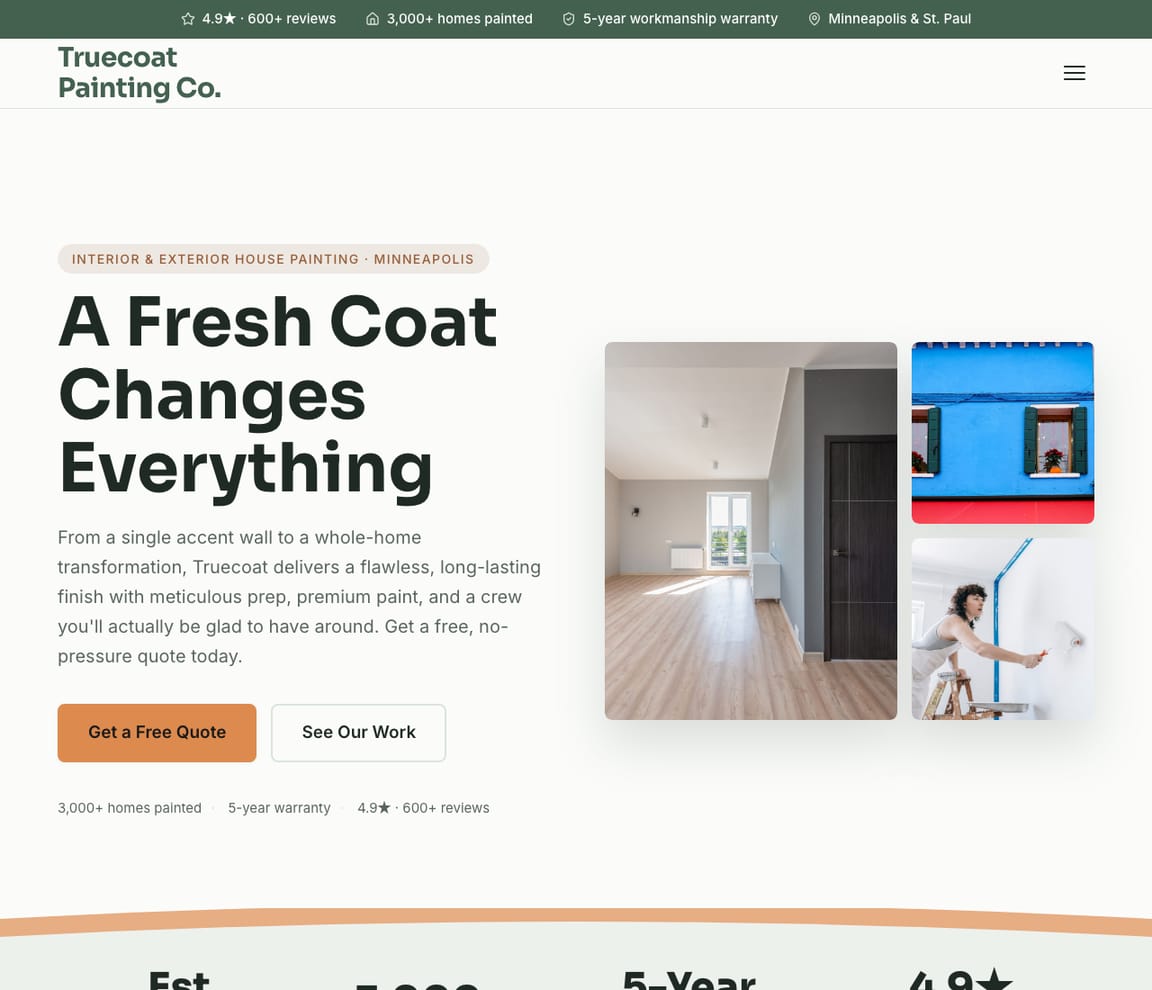
A real Zarla template for a house painter — finished rooms beside the headline, interior and exterior work underneath, the lead-safe certification where a homeowner looks for it. Describe yours — the town, the services, the hours — and you'll have a site like this, with a call button and an estimate form, in about a minute.
- Professional design — not a generic template
- Looks great on desktop and mobile
- Content written for your industry
Build the website
Start your painting website now
Add your town and your business name to the sentence, and Zarla builds the site: your services, the area you cover, a call button and an estimate form. Add your prices, your photos and your lead-safe certification in chat, then publish.
Already have a website? Bring it across →Zarla keeps your old page addresses where it can and redirects the ones that change, helping you keep the Google standing you've built.
Is becoming a painter worth it in 2026 — and what does the work pay?
Becoming a painter is the quickest door into the building trades — no US state licenses the person, the kit for a first job costs less than a phone, and the prep is learned on a crew — and at the top of it a local company whose van is on the street the week the house goes on the market. Three honest numbers first. Employed painters had a median of $49,400 a year in 2025, $23.75 an hour: 10 percent earned $37,440 or less, 10 percent $78,810 or more — $37.89 an hour and up (O*NET, from BLS 2025 wage data). The headcount is large and steady: "Employment (2025) 326,900 employees", "Projected growth (2025-2035) Average (3% to 4%)", "Projected job openings (2025-2035) 24,900" (O*NET, employment and outlook). And the survey behind the wages leaves out the self-employed (Washington ESD) — which is the painter with his or her own van, so the median measures the hand on someone else's crew, not the owner.
State by state. The employed median is $45,460 in Texas, $59,020 in California, $47,530 in Florida and $59,570 in New York, where the top 10 percent clear $111,550 (O*NET, Texas; California; Florida; New York). The occupation sits in "Job Zone 1-2: Very Little to Some Preparation Needed" — "Usually requires a high school diploma or GED, though some occupations may not", with training that "Ranges from a few days to one year of on-the-job training" (O*NET, job zone).
Where the money went. The owners quoted below say the wage is the floor and the business is the ceiling — and that the business is a second trade: "i had to learn how to estimate correctly, learn workplace rules, tax and employee rules, how to build a website and business cards etc. how to write contracts and proposals" (Kyle Paul, Flex Painting, Pomona, VoyageLA, March 3, 2026). The material cost is rising under them: "With many of the top-tier paints well over $100 per gallon. It is going to make painting more expensive year-over-year" (Sam Manges, The Colorado Painting Company, Denver, VoyageDenver, February 4, 2025). One Atlanta owner started with no crew at all: "I started painting one house at a time by myself in order to make ends meet. I built my business on taking care of one customer at a time" (Scott Csaszar, Flawless Painting, Atlanta, VoyageATL, February 5, 2026). What a painter should charge is its own guide — painting pricing — and the step after this one is how to start a painting business.
The catch. The work is repetitive and physical — "As a residential and commercail painter things can get very repetitive and boring, especially if you bore easily, like I do" (Matt Seymour, Orange Door Painting, Phoenix, VoyagePhoenix, October 9, 2024) — the first estimates lose money, and the one federal rule in the trade carries a fine if you skip it. That's what the rest of this guide sets up: the contractor line in each big state from its board, the lead-safe rule from the EPA, the routes in and what each costs, the kit from a distributor's own prices, and how to be the painter the repaint search finds first.
How to become a painter, in plain English: the license question, state by state, from the boards
There is no painter's license in the US — not federal, not in any state. What the law licenses is the contractor: in the states that license construction work above a dollar line, a painting business past that line needs the state's contractor license or registration, and a few states name painting as its own classification. In Texas, Florida, New York and Illinois there is nothing at state level at all. On top of that sits one federal rule every painter meets — the EPA's lead-paint certification for homes built before 1978 — and the ordinary business license your city issues to any trade. Here is each big state, from its own board or statute:
- California: the Contractors State License Board lists "C-33 - Painting and Decorating Contractor" (CSLB license classifications), defined in the regulation as a contractor who "prepares by scraping, sandblasting or other means and applies any of the following: paints, papers, textures, fabrics, pigments, oils, turpentines, japans, driers, thinners, varnishes, shellacs, stains, fillers, waxes, adhesives, water and any other vehicles, mediums and materials which adhere by evaporation" (16 CCR §832.33). The line: no license is needed where "the aggregate contract price for labor, materials, and all other items is less than one thousand dollars ($1,000), that work or operation being considered of casual, minor, or inconsequential nature, and the work or operation does not require a building permit" — and the exemption is lost by anyone who "Advertises or puts out a sign or card or other device that might indicate to the public that the person is a contractor" or "Employs another person to perform, or assist in performing, the work" (Cal. Bus. & Prof. Code §7048); an unlicensed ad is lawful only under $1,000 and if "the person states in the advertisement that the person is not licensed under this chapter" (§7027.2). To get the C-33: "not less than four years experience as a journeyman, foreman, supervising employee or contractor in the particular class", and an apprenticeship cannot "count for more than 3 years of the experience" (16 CCR §825); the board "shall require an applicant to show the degree of knowledge and experience in the classification applied for" (§7068); the bond is "twenty-five thousand dollars ($25,000)" (§7071.6). The CSLB's fee pages refused our reader, so no California dollar fee is printed here. One owner's route: "In 2020 during covid I quit the union and went on my own. I got my C-33 Painters license in 2021 and started Flex Painting" (Kyle Paul, Flex Painting, Pomona, VoyageLA, March 3, 2026).
- Florida: painting is not one of the contractor types the statute lists — the sixteen licensed categories run from "General contractor" to "Solar contractor" and "Specialty contractor", and the word paint appears nowhere on the page (Fla. Stat. §489.105) — so there is no state painting license. The county cards people remember are over: "The licensing of occupations is expressly preempted to the state", and "Any local government that imposed licenses on occupations before January 1, 2021 … any such local government licensing of occupations expires on July 1, 2025" (§163.211); Miami-Dade's own notice reads "Effective July 1, the Department of Regulatory and Economic Resources (RER), Consumer Protection and Neighborhood Protection Division, is no longer issuing licenses for these occupations and businesses, in accordance with Section 163.211 of Florida Statutes" (Miami-Dade County, July 2025). A Florida painter registers a business like any other and carries the insurance a property manager asks for.
- Texas: no state license — the Department of Licensing and Regulation's program list runs from boilers to tow trucks and has no painting entry (TDLR). Cities register contractors on pages that refused our reader, so ask your city's permit office. Illinois: the state's profession list licenses roofing contractors and no painters (IDFPR, licensed professions). New York: no state license; New York City licenses the business — "A person or business must have a Home Improvement Contractor license to do construction, repair, remodeling, or other home improvement work to any residential land or building in New York City." The checklist asks for "Home Improvement Business Trust Fund Enrollment OR Copy of $20,000 Surety Bond", "The fee for joining the Trust Fund is $200", an exam of "30 questions. You must answer a minimum of 21 questions correctly to pass", copies of the "EPA Renovation, Repair, and Painting (RRP) certification", and a two-year license fee that depends on the filing window — "Pay $200 for a license expiring February 28 of the next odd year. (Valid for at most 24 months.)" or "Pay $150" for a shorter first term (NYC Department of Consumer and Worker Protection).
- Virginia: the state licenses the business by contract size — "Class C contractors" work "when (i) the total value referred to in a single contract or project is over $1,000 but less than $30,000", Class B from "$30,000 or more, but less than $150,000", Class A at "$150,000 or more" (Va. Code §54.1-1100); every applicant "must complete eight hours of pre-license education", "a basic business course" that "is not specific to any particular classification or specialty" (Virginia DPOR, contractors). Washington: from the first dollar — "Washington State requires all construction contractors to register with L&I", and "L&I regulates 63 specialties that each require contractor registration. These specialties include roofing, painting, HVAC, tree removal, mobile home set-up, and dozens more"; "Specialty contractors can only perform work in the specialty they are registered in. They cannot hire subcontractors"; the application fee is "$150.20", the bond "$30,000 for general contractors. $15,000 for specialty contractors", the liability policy "$200,000 in public liability and $50,000 property damage" (Washington L&I, register as a contractor). Oregon: "Oregon law requires anyone who works for compensation in any construction activity involving improvements to real property to be licensed", and the board's own list of work that requires a license reads "Roofing Siding Painting Carpentry Floor covering Concrete"; the route is "the 16-hour training" and an exam, and even the small-job exemption "does not eliminate the need for licensed tradespersons or a lead-based paint renovator's certification" (Oregon CCB) — the board's fee and bond pages did not open, so neither is printed.
- Nevada: the board's "42 distinct subcontracting fields within Classification C" include "plumbing, electrical, carpentry, painting, concrete contracting" (Nevada State Contractors Board, classifications), and the handyman exemption covers "Work to repair or maintain property valued at less than $1,000, including labor and materials, unless certain conditions apply (e.g., building permit required, type of work, contractor's license)" (NSCB, handyman exemptions). Arizona: the same $1,000 line — exempt is work "for which the aggregate contract price, including labor, materials and all other items … is less than $1,000", "of a casual or minor nature", unless "the performance of the work requires a local building permit" (A.R.S. §32-1121). Utah: exempt is "a person engaged in the alteration, repair, remodeling, or addition to or improvement of a building with a contracted or agreed value of less than $7,000, including both labor and materials" — but "if the total value of the project is greater than $3,000, the person shall file with the division a one-time affirmation" of liability insurance (Utah Code §58-55-305). Minnesota: the residential building contractor license is for a business "providing two or more special skills", and "interior or exterior painting" is one skill inside "Interior finishing" (Minn. Stat. §326B.802) — so "specialty contractors who provide only one special skill" are exempt (§326B.805): a painting-only company needs no state license there.
- Louisiana: "For commercial projects, if the total project amount exceeds $50,000, a contractor's license is required. For home improvement projects, if the total project amount exceeds $7,500 but not exceeding $50,000, a home improvement registration is required" (Louisiana State Licensing Board for Contractors). Pennsylvania: a registration, not a license, and painting is named in it — "home improvement" includes "painting, doors and windows and waterproofing"; excluded is "A person for whom the total cash value of all of that person's home improvements is less than $5,000 during the previous taxable year"; the application asks for liability insurance "in an amount not less than $50,000" for personal injury and "$50,000" for property damage, and "shall be accompanied by a fee of $50" (Pennsylvania Act 132 of 2008). Maryland: a Home Improvement Commission license with an exam through "PSI Exams", a Guaranty Fund assessment of "$100.00 for an original MHIC contractor" and "$175.00 every two years" on renewal, and since June 1, 2024, general liability insurance "in the amount of at least $500,000" (Maryland Home Improvement Commission). New Jersey: "No person shall engage in the business of making or selling home improvements in this State unless registered with the Division", and no one may advertise as a contractor unregistered (N.J.A.C. 13:45A-17.3). North Carolina: "a general contractor must be licensed if the contract is valued at $40,000 or higher" (NC Licensing Board for General Contractors). Massachusetts, Connecticut, Michigan, Georgia and Tennessee regulate home-improvement work too, on pages that refused to open or that we did not reach, so none of their lines is printed here.
The one federal rule: lead paint. "In 1978, the federal government banned the sale of lead-based paint for use in homes, childcare facilities and preschools. Approximately three-quarters of the homes in the United States built before 1978 still contain some lead-based paint" (EPA, the RRP program). The rule: "anyone who is paid to perform work that disturbs paint in housing and child-occupied facilities built before 1978 must be certified. This includes all firms, even sole proprietorships", and "Firms cannot advertise or perform renovation activities covered by the RRP Rule in homes or child-occupied facilities built before 1978 without firm certification"; not covered are "Housing built in 1978 or later" and "Minor repair and maintenance activities that disturb six square feet or less of paint per room inside, or 20 square feet or less on the exterior of a home or building" (EPA, RRP for contractors; the definition is 40 CFR §745.83, which names "surface preparation activity (such as sanding, scraping, or other such activities that may generate paint dust)" as renovation). Two cards. The person: "The renovator course must last a minimum of 8 training hours, with a minimum of 2 hours devoted to hands-on training activities" (40 CFR §745.225), with a refresher "within 5 years of the date the individual completed the initial course" (§745.90). The firm: "Renovation Firm Certification" is "$300" for the initial certification and "$300" to re-certify, "$550" combined with abatement (EPA fee table; §745.92), and "To maintain its certification, a firm must be re-certified by EPA every 5 years", with "A certified renovator … assigned to each renovation performed by the firm" (§745.89). The course fee is the training provider's, and none that opened printed one.
The safety rules a crew will ask about. Falls: "Each employee on a walking/working surface (horizontal and vertical surface) with an unprotected side or edge which is 6 feet (1.8 m) or more above a lower level shall be protected from falling by the use of guardrail systems, safety net systems, or personal fall arrest systems" (29 CFR §1926.501). Ladders: "the ladder side rails shall extend at least 3 feet (.9 m) above the upper landing surface to which the ladder is used to gain access" (§1926.1053). Respirators: "A respirator shall be provided to each employee when such equipment is necessary to protect the health of such employee" and the employer runs "a respiratory protection program" (§1910.134).
How you learn it. On a crew. The union route is a registered apprenticeship: in the Pacific Northwest, "The Painter's apprenticeship is a 4 year program. The apprenticeship consists of 6000 hours of on the job training and 576 hours of trade related classroom instruction for four years" (Finishing Trades Institute of the Northwest); the national union's page puts it as "Minimum 144 hours of classroom and mandated on-the-job hours per year" and "While a typical apprenticeship lasts up to four years, enough experience in your craft can make this process much shorter", with "stenciling, faux finishes, texture coatings, striping, gold leafing, and custom mural work" in the later years (IUPAT, commercial painter). The federal standard behind every registered apprenticeship: "at least 2,000 hours" of on-the-job learning a year and "A minimum of 144 hours for each year of apprenticeship is recommended" (29 CFR §29.5). The non-union route is a painting contractor who hires helpers — nearly every owner quoted below started that way — and the trade association sells the classroom part on its own: PCA Painter Training, "Interior Levels 1-3" and "Exterior Levels 1-3" with "a certificate of completion", at $99 a course for non-members and free for members (PCA, painter training), with membership at "$499 Annually" (PCA membership). No public technical college we reached runs a painting program with a tuition table, so none is printed; the trade is learned on jobs.
You are self-employed from the first invoice. In the US a one-van painter is a sole proprietor by default: "Use Schedule C (Form 1040) to report income or (loss) from a business you operated or a profession you practiced as a sole proprietor" (IRS, Schedule C instructions); "The self-employment tax rate is 15.3%" once net earnings reach $400 (IRS), and sole proprietors "generally have to make estimated tax payments if they expect to owe tax of $1,000 or more" (IRS). If you want an LLC: Texas $300 (Tex. Bus. Orgs. Code §4.154); Florida $100 plus $25 for the registered agent and $50 a year (Fla. Stat. §605.0213); New York $200 (N.Y. LLC Law §1101) plus a notice "published once in each week for six successive weeks, in two newspapers of the county" (§206); California $70 (Cal. Gov. Code §12190) and "Every LLC that is doing business or organized in California must pay an annual tax of $800" (Franchise Tax Board). Workers' compensation: "In Texas, private employers can choose to carry workers' compensation insurance coverage, but it is not required in most cases" (Texas Department of Insurance), while "All California employers must provide workers' compensation benefits to their employees under California Labor Code Section 3700" (California DIR).
Sales tax on the work — two states' rules. Texas names the trade: "Repair or remodeling includes reroofing and repainting. But if the repainting is maintenance (as defined in this bulletin), tax is not due on the repainting labor", and the house-versus-office line is "Labor to repair, remodel, or restore residential real property is not taxable" while "the total amount charged for remodeling, repairing, or restoring nonresidential real property is taxable" (Texas Comptroller, Publication 94-116) — the same repaint untaxed in a home, taxed in a restaurant. New York: "painting existing cabinets" is among "taxable repair and maintenance work" (New York TB-ST-104). Confirm the details with your accountant.
The money to start. Our arithmetic from the pages that print each price. A lean start for a first solo job — a Purdy 2-1/2-inch angle sash brush at $15.19 (Zoro, read October 27, 2026), a 9-inch roller frame at $8.79 (Zoro) and a 3-pack of covers at $16.50 (Zoro), a 6-to-12-foot extension pole at $64.49 (Zoro), a 5-gallon roller grid at $12.98 (Zoro), a 6-pack of ScotchBlue tape at $60.39 (Zoro), a 3M half-mask respirator with P100 filters at $28.99 (Zoro) and a Werner 6-foot step ladder at $141.99 (Zoro) — is $349.32. The fuller start as a painting business — the same kit, a Graco Magnum X5 airless sprayer at $454.99 (Zoro), a Werner 24-foot fiberglass extension ladder at $421.99 (Zoro) and a 28-foot aluminum at $597.99 (Zoro), the $300 EPA firm certification, Washington's $150.20 registration fee as one state's example, a year of general liability at Insureon's $862 painter median and a year of commercial auto at $3,539 — is $6,675.49. Drop cloths and a five-in-one tool belong in both kits; the product pages refused our reader, so neither is priced. Neither total includes the van, the paint or the website — and the insurance is a median, not your quote: "painters pay an average of $72 per month , or $862 annually, for general liability insurance", "$109 per month for a business owner's policy , or $1,313 annually", "$190 per month for workers' compensation insurance , or $2,279 annually", "$295 per month , or $3,539 annually, for commercial auto insurance" and "$42 per month for contractor's tools and equipment insurance , or $505 annually" (Insureon, updated August 3, 2026). The plan page for the business side is the painting business plan, the prices are in painting pricing, the step after this guide is how to start a painting business, the name goes on the van from painting business names, and the site from the painting website builder or the painting website design page.
In the UK: there is no license to paint and decorate; the government's career profile puts pay at "£21,000 Starter" to "£32,000 Experienced" on "37 to 42" hours a week, with routes through "a college course" — a "Level 2 or Level 3 Diploma in Painting and Decorating" needing "2 or more GCSEs at grades 9 to 3 (A* to D), or equivalent, for a level 2 course" — or "an apprenticeship", the "Painter and Decorator Level 2 Intermediate Apprenticeship" and the "Craft Painter and Decorator Level 3 Advanced Apprenticeship", or "working towards this role" (National Careers Service, GOV.UK). In Australia the principle inverts: New South Wales and Queensland treat painting as building work that needs a contractor license from the state building regulator above a dollar line, with a fine for working without one — every regulator page we reached either refused or carries a British spelling in its address that this US page cannot link, so no figure is printed here. Check your own state's contractor board, and your city's, before you quote the first job.
What working painters actually say
None of this is our opinion about the trade. It comes from people who do it — a Pomona owner who went union at 21 and got his C-33 at 30, a Mountain View company that kept thirty people through the shutdown, a husband-and-wife firm north of Houston that started after a hurricane, a third-generation Houston painter, a Houston owner who started "out of frustration", a son running his father's company, an Atlanta drywall-and-paint contractor working for general contractors, an Atlanta woman whose crew is women, an Atlanta owner twenty-six years in, a Phoenix painter who bores easily, a Denver owner who started two years after arriving in the country, a Colorado owner from Cleveland, two Miami-area owners and a Chicago-area company — talking to the Voyage magazines between 2018 and 2026, each described as the page describes them. Read each as theirs at the time. Five things come up again and again.
You get in by getting hired, and the first weeks are the hard ones. Kyle Paul, Flex Painting, Pomona: “I posted an ad in Craigslist for work and a Union painting company called me to apply for a job. I went there got hired and then fired within 3 days. I cried and then called a bunch of union companies to find work and then Wilson and Hampton called me a month later, I was with them for 6 years and ran jobs from Disney to LAX to Out of state specialty painting, I had really good mentors and support throughout my career.” (VoyageLA, March 3, 2026). Daniel Zago, Zago Painting, Denver: “I started working in a painting business in 2013 when I first got to the U.S. In the first two years, I started to realize that I was good at fixing people's problems. So, I started my business.” (VoyageDenver, February 17, 2026). Sam Manges, The Colorado Painting Company: “I started painting right out of high school in Cleveland Ohio. Well versed in all aspects of professional painting. I brought my services to Colorado in 2013. Without knowing anybody in the state, it took about 5 years of working independently before I partnered up for my second painting company in 2018.” (VoyageDenver, February 4, 2025). Greg Armstrong, Armstrong Painting & Construction, Humble, Texas: “At 13, I decided I wanted to get a dirtbike. So I started working in the summers and after school for my father to raise money to purchase it.” (VoyageHouston, May 13, 2025).
“I started painting one house at a time by myself in order to make ends meet. I built my business on taking care of one customer at a time.” — Scott Csaszar, Flawless Painting, Atlanta, who was downsized out of a corporate job, in VoyageATL, February 5, 2026
Most owners started because of an employer, not a plan. Gustavo Ramirez, Ramirez Painting Service, Houston: “started it out of frustration with employers, feeling undervalued, underpaid, and no real growth. I was basically just a body and my only job was to work.” (VoyageHouston, November 30, 2021). Jose Mendez, JayGo Painting, Miami: “After more than five years working for him, he suddenly stopped answering my calls and gave no explanation, even though he had once called me an essential part of his company. That experience led me to take a leap and start my own business. I had the skills to do the work, manage projects from start to finish, and select the right products, but I didn't know how to run a business.” (VoyageMIA, November 21, 2024). Ashley Wade Cline, Monroe Painting Company, The Woodlands, Texas: “My husband had worked in painting on and off since he was 18, and also in kitchens. … There was a lot of painting work after Harvey, and we thought it was the best route to go.” And: “It was our first time owning our own company, and it came with a lot of learning; still learning to this day.” (VoyageHouston, March 21, 2023). Csaszar, on what he brought: “I realized very quickly I could use my business experience, leadership skills and my hands on experience to start a painting company that would deliver a great product and great service for a very fair price.” (VoyageATL, February 5, 2026).
The license is a step, and the estimate is where the money is lost. Paul: “In 2020 during covid I quit the union and went on my own. I got my C-33 Painters license in 2021 and started Flex Painting.” And the lesson: “Some major risks i have taken: beginning when I was learning to estimate, sometimes on bigger jobs 20k-80k, i wouldnt make any money because of low bid or bad workmanship. a big risk is hiring someone new because one person can bring down a whole crew.” (VoyageLA, March 3, 2026). Damar Hutchinson, Craftr Painting & Drywall, Atlanta: “Early challenges included building consistent cash flow, finding reliable crews, and learning to navigate different GC expectations and timelines. Those challenges forced me to improve systems, tighten processes, and become more disciplined, which ultimately strengthened the business.” (VoyageATL, February 18, 2026). Andrea Aberturas, Copax Painting, Boca Raton: “Also, I had to assume a lot of risks, signing contracts I wasn't sure to sign, investing money on projects, trusting my team, trusting my clients.” (VoyageMIA, February 3, 2022). Alberto Garcia, AGD Painting, Houston: “Hasn't been a smooth ride, definitely have had good and bad YEARS. Most of it was not being able to get work and the occasional broken down van.” (VoyageHouston, February 17, 2026).
The customer is letting you into the house, and the work is judged on the edges. Ramirez: “Our residential side is a little more intimate because you are entering occupied homes sometimes. Staff must be more trained in the customer service side, cleanliness is a big priority. We specialize mainly in interior work, we do your basic wall paints” (VoyageHouston, November 30, 2021). Kellie Olsen, The Painting Ladies Atlanta: “Word of mouth has kept me busy, and it's been mostly women who live alone and feel more comfortable with other women working in their homes. It's grown ever since and I decided to make an official business out of it this year, the Painting ladies has really taken off fast!” (VoyageATL, June 26, 2025). Mendez: “One of the biggest lessons l've learned is the importance of transparency and communication. By being upfront with clients about timelines, costs, and any potential issues, l'm still building a reputation but the one I built has become the backbone of my business.” (VoyageMIA, November 21, 2024). Armstrong: “My company is known for its repeat customers, as our honesty, fair prices, and loyalty set us apart from the rest. Our excellent work results in satisfied customers and many referrals.” (VoyageHouston, May 13, 2025).
Owning the crew is a different trade from being on it. Casey Furlong, Stanford Painting, Mountain View: “All of our operations were shut down nearly overnight and left our 30-man team with no work and no end in sight at the time. … We were lucky enough to not only forego any layoffs, but every single one of our employees stayed with our company during that entire period.” (VoyageLA, June 1, 2022). Andre Kazimierski, 3rd Gen Painting and Remodeling, Western Springs, Illinois: “The toughest and arguably most important part of the job is continually recruiting the same level of high-quality employees and project partners that we have so far to accommodate our incredible growth this past season.” (VoyageChicago, June 26, 2018). Garcia, on inheriting one: “This used to be my dad's painting business, he started it when I was young maybe early 90s. Just like any business he had ups and downs but by the time I entered high school, the business started to be more steady and growing.” (VoyageHouston, February 17, 2026). Manges, on the cost side: “Also, I foresee our vendors continuing to increase their prices quarter over quarter until every last drop is squeezed out of us. With many of the top-tier paints well over $100 per gallon.” (VoyageDenver, February 4, 2025). Matt Seymour, Orange Door Painting, Phoenix: “I have been in the trades for years, but have been primarily painting for 10 plus years now. As a residential and commercail painter things can get very repetitive and boring, especially if you bore easily, like I do.” (VoyagePhoenix, October 9, 2024).
The through-line: the painters who lasted got hired by a painter first, learned to estimate by losing money on a few jobs, treated the customer's house as the customer's, and learned a second trade — pricing, hiring, answering the phone — the day they bought the van.
THE STARTER KIT
What you need to become a painter
A crew to learn on
There is no license to study for on the person — the prep, the cut-in and the spray are learned on a crew: a union apprenticeship with its hours, a painting contractor who takes you on as a helper, or both. The routes and what each costs are below.
The EPA lead-safe card
Federal law for any paid work that disturbs paint in a home built before 1978: an eight-hour renovator course for you and a firm certification for the business — the fee and the rule are below, from the EPA and the regulation.
Your state's contractor line
No US state licenses the painter; the ones that license the work draw a dollar line — from the first dollar to $40,000 — and a few register home-improvement contractors by the year. Each big state is below, from its own board or statute.
A ladder you trust, and the fall rules
An extension ladder, a step ladder and the OSHA rules that go with them — six feet is the federal fall-protection line on a job site, and the ladder has to reach three feet past the landing.
The kit, from real prices
Sash brushes, roller frames and covers, a pole, drop cloths, tape, a five-in-one, a respirator — and the airless sprayer when exteriors and cabinets pay for it — priced from a distributor's own listings below.
A way to be found when you go out on your own
A website with your photos, your price range, your lead-safe number and an estimate form, and a Google Business Profile — how the repaint search reaches your crew, not a lead-selling app.
THE PAPERWORK
Licenses, cards, registrations and insurance on the way to your own painting business
| Typical cost | Time to get | Legally required? | |
|---|---|---|---|
| A painter's license (the person) | None exists | — | No US state licenses the painter; the contractor line below licenses the work |
| EPA renovator course (the person) | The trainer's fee; none that opened printed one | 8 hours, 2 hands-on; a refresher every 5 years | Federal, every state: before paid work that disturbs paint in a home built before 1978 |
| EPA firm certification (the business) | $300 for 5 years ($550 combined with abatement) | Weeks | Federal: a firm cannot advertise or perform covered work without it |
| State contractor license | $25,000 bond (CA); fee not printed for CA or OR; 8-hour course (VA); 16-hour course + exam (OR) | Four years of journey-level experience (CA); weeks to months elsewhere | CA above $1,000 (C-33); VA above $1,000 (Class C); OR from the first dollar; NV and AZ above $1,000; NC at $40,000; LA above $50,000 commercial |
| State contractor registration | $150.20 + $15,000 bond (WA); $50 (PA); fund $100 (MD); $200 fund or $20,000 bond + $200 (NYC) | Days to weeks | WA from the first dollar; PA once home-improvement work passes $5,000 a year; LA $7,500–$50,000 home improvement; MD, NJ, NYC for home-improvement work |
| Nothing at state level | $0 | — | TX, FL, NY State, IL; MN for a painting-only company; UT under $7,000 (an insurance affirmation above $3,000) |
| Sole proprietorship (Schedule C) | $0 | None | The default once net earnings pass $400 (self-employment tax 15.3%) |
| LLC (optional) | $300 (TX); $125 (FL); $200 + newspaper notices (NY); $70 + $800/yr (CA) | Days to weeks | No |
| Sales-tax account | Free to register | Before the first commercial job | TX taxes nonresidential repainting labor, not residential; NY taxes repair painting; check your state |
| General liability insurance | $72/mo median (Insureon) | Days | A registration condition in WA ($200,000), MD ($500,000) and PA ($50,000); a contract condition everywhere |
| Commercial auto on the van | $295/mo median (Insureon) | Days | For a work vehicle, yes |
| Workers' compensation | $190/mo median (Insureon) | Days | Required from the first employee in CA; optional for private employers in TX |
| Tools and equipment cover | $42/mo median (Insureon) | Days | No — but the sprayer and the ladders live in the van |
THE STEPS
How to become a painter (step by step)
Eight steps from the first day as a helper to a licensed, lead-safe painting business with your own name on the van.
01
Read your state's line
No US state licenses the painter. California, Virginia, Oregon, Washington, Louisiana, Pennsylvania and North Carolina license or register the business at the dollar lines printed below; Texas, Florida, New York and Illinois have nothing at state level and leave it to cities. Find yours before the first paid job.
Named by state below02
Get on a crew
A union painters' apprenticeship — the hours and the classroom are below from the training fund's own page — or a painting contractor who hires helpers. Prep is most of the trade and nobody learns it from a video.
The long part03
Take the EPA renovator course
Eight hours, two of them hands-on, from an EPA-accredited trainer — before the first house built before 1978. The firm certification comes when the business is yours.
04
Learn to spray, and learn to price
An airless sprayer is what makes exteriors and cabinets pay; a price per room and per square foot is what makes the estimate honest. Both are learned on jobs you are not yet running.
05
License or register the business at your state's line
The C-33 exam and four years of journey-level experience in California; sixteen hours of training, an exam and a bond in Oregon; a registration and a bond in Washington; a registration in Pennsylvania once home-improvement work passes $5,000 a year — each from the board below.
06
Set the business up, insured
An entity, the EPA firm certification, general liability and commercial auto, workers' comp from the first hire — the medians a small painting business actually pays are below.
07
Price the first jobs from the market, not a guess
A room, a whole interior, an exterior, cabinets — the pricing guide below works the arithmetic from what painters charge, and the plan page carries the costs.
08
Be the painter the repaint search finds first
A website with your before-and-after photos, your price range, your lead-safe number and an estimate form, and a Google Business Profile with your photos — so the whole-house repaint search reaches your crew.
THE COSTS
How much does it cost to become a painter?
Itemized from the pages that print a price: the kit from one distributor's listings, the federal card from the EPA's fee table, one state's registration fee from its board, the insurance from Insureon's painter medians. The van, the paint and the website come on top, and so do your own living costs while you learn on someone else's crew.
$349.32a lean start for a first solo job — a sash brush, a roller frame and covers, a pole, a grid, tape, a respirator and a 6-foot step ladder (our arithmetic)
$6,675.49the fuller start as a painting business — the kit, an airless sprayer, two extension ladders, the $300 EPA firm certification, Washington's $150.20 registration, a year of liability and commercial auto
$300the EPA lead-safe firm certification, good for five years; the renovator course is 8 hours and the trainer sets the fee
$0for a state license in Texas, Florida, New York State and Illinois — none exists; California's C-33 asks for a $25,000 bond and four years' experience
WHAT WE'VE LEARNED
What actually makes a homeowner hire a painter
Thousands of local business websites in, the pattern for a trade hired on trust and judged on the edges is clear: the homeowner wants to see finished rooms, know what a room costs, and believe the crew will show up when it says. For a painter, three things on a page decide who gets the estimate.
Before-and-after photos, and a lot of them
Cut-in lines, cabinet doors, a whole exterior at dusk. Paint is the one trade a customer can judge from a phone screen — and the gallery is the estimate before the estimate.
A price range, up front
A 'from' price for a bedroom, a whole interior and an exterior, and whether paint is included. The first thing a caller asks, and the thing the pricing guide below is built from.
Proof you're legal and insured
Your contractor license or registration number where your state has one, your EPA lead-safe firm number, and the insurance certificate a property manager asks for — on the page, not in a text later.
THE UPSIDE
What a painter can earn
Pay for employed painters from O*NET's 2025 figures — the self-employed are not in the survey. Medians, not a promise: your state, your speed and whether the van is yours decide it.
$49,400a year: the 2025 median for employed painters — $23.75 an hour; 10 percent under $37,440, 10 percent over $78,810 (O*NET)
$59,570the New York median; California $59,020, Florida $47,530, Texas $45,460 — and New York's top 10 percent clear $111,550
3% to 4%the projected growth for 2025–2035 — "Average" — with 24,900 openings a year projected (O*NET)
326,900employed painters in 2025 — owner-operators are not counted
SEE IT WORK
Painting website designs you can start from
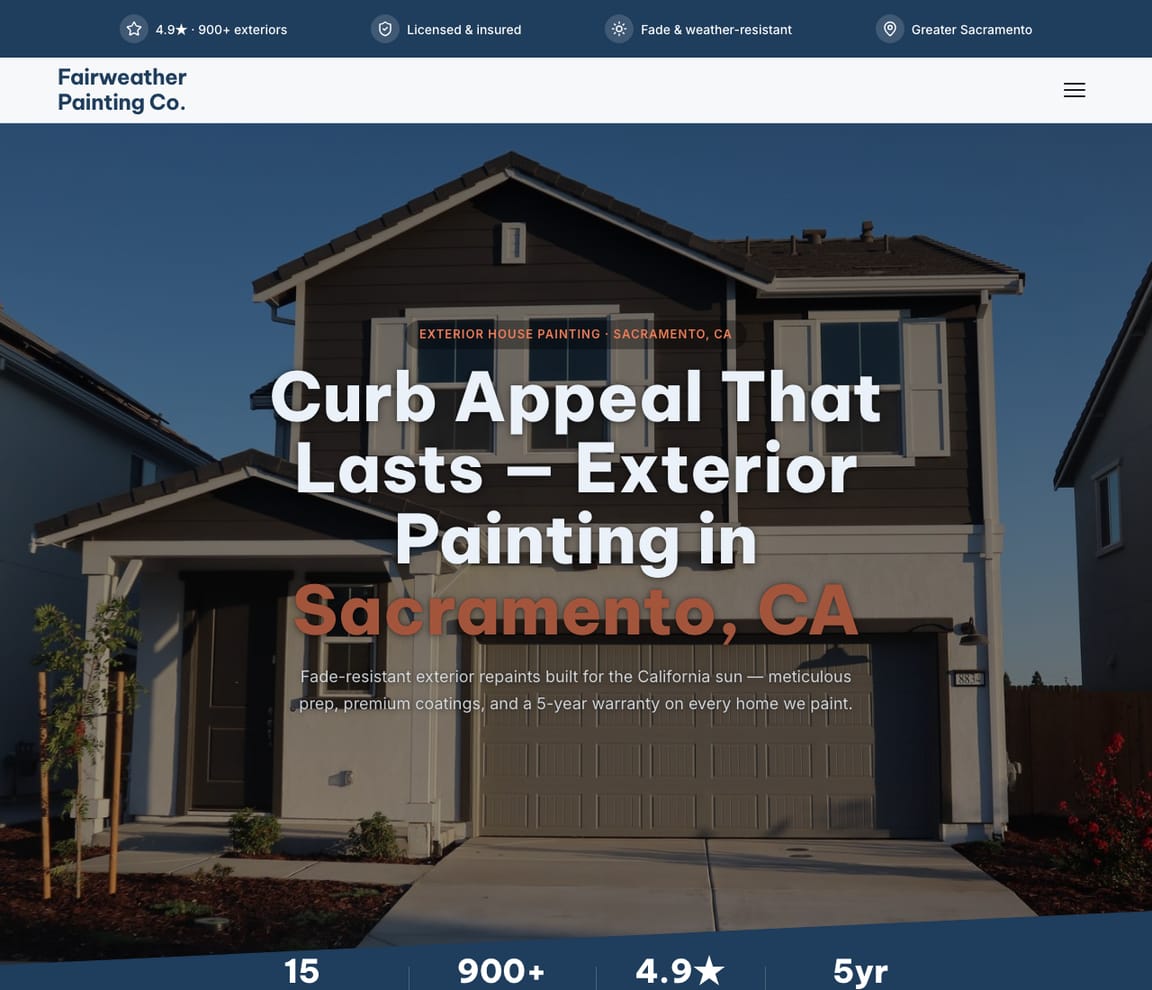
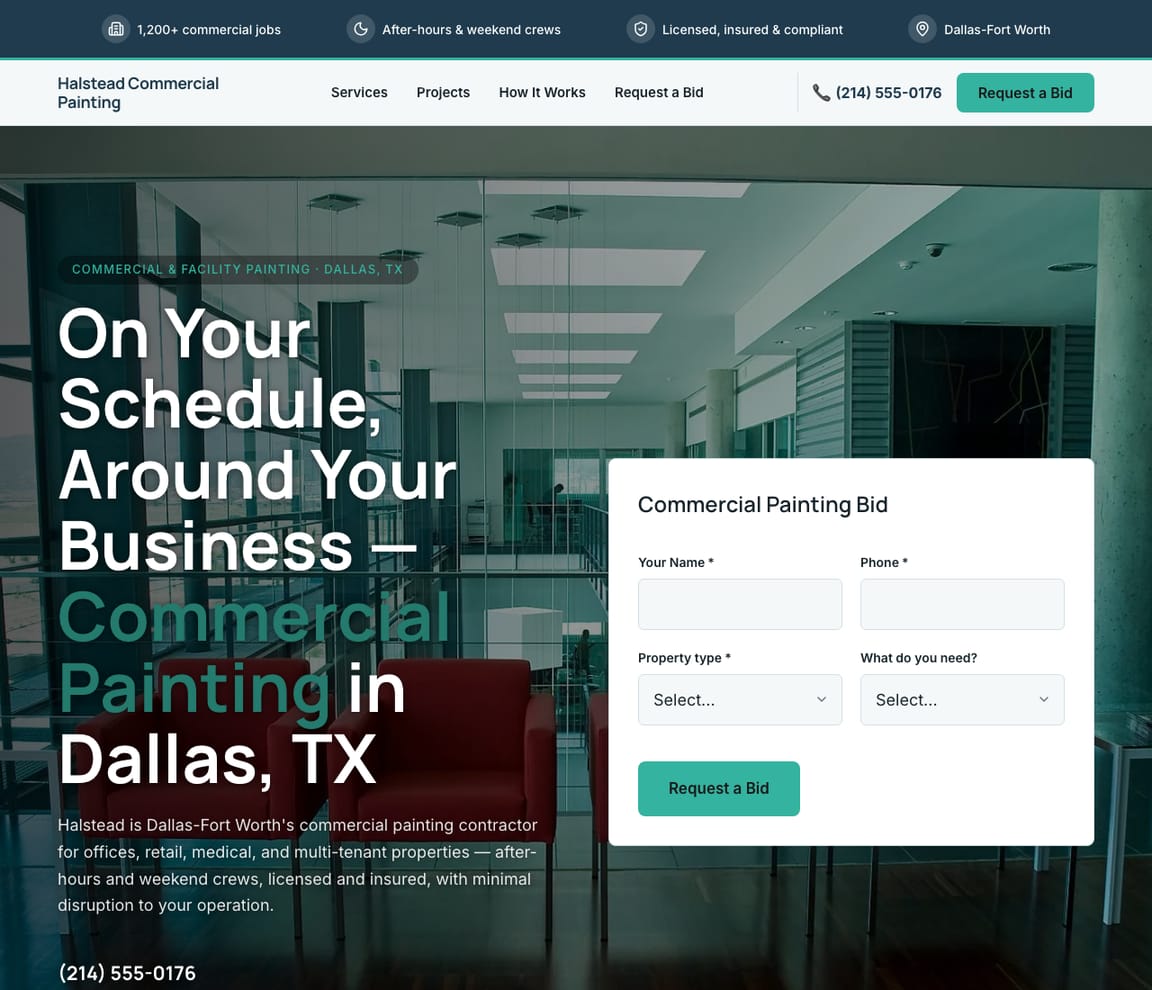
Real Zarla templates for the shapes the trade takes — the interior repaint specialist, the exterior crew that wins on curb appeal, the cabinet refinisher, the commercial painter bidding offices and medical buildings. Open one, swap in your services and your photos, and publish.

GET FOUND
Get found by the homeowner who has already picked the color
A repaint is searched the week the house goes on the market, the month after the baby is born, the spring the siding peels — and the estimate goes to the painter whose photos, service area and lead-safe card are on the first screen. Zarla builds the website with your services, your service area and an estimate form. Add your prices and your photos in chat, and once you connect your Google Business Profile, your name, your photos and your hours stay in step on both.
“Painter near me”
Searched by a homeowner with a paint chip in hand, a landlord between tenants and a realtor with a listing next week. Your services, your area, your photos and an estimate form answer all three.
Google Business Profile
A painter who drives to customers qualifies for one: your service area, your hours and your before-and-after photos inside Google Maps. Free, and an afternoon to set up.
The lead-safe card on the page
Your EPA firm certification number on the site and the estimate — federal law for any pre-1978 home — is what a homeowner with a toddler checks before the first visit, and what a property manager's vendor form asks for.
Google Search
Hharborlanepainting.com
Harbor Lane Painting — Trusted painter in Your AreaHouston's lead-safe certified painters — interiors, exteriors, cabinets. Written estimates in 48 hours; see our before-and-after photos. Call or request an estimate online.← Your Zarla siteCcitypainterservices.com
City painter ServicesGoogle Maps
1
Harbor Lane Painting
← You2
Metro painter Co.
3
Quick painter Services
AI assistants (ChatGPT / Perplexity)
For a lead-safe certified painter in Houston who does whole-house interiors and can send a written estimate this week in your area: Harbor Lane Painting — a painter's site that lists interior, exterior and cabinet work with a price range, shows the EPA lead-safe certification, has before-and-after photos, and takes an estimate request from the page.
YOUR LAUNCH PLAN
Your become-a-painter checklist
The whole guide as things to check off. Work through them in order and you'll be trained, lead-safe certified, licensed or registered where your state asks, insured and findable before your name goes on the van.
- Read your state's contractor line below — the dollar amount, the exam, the bond.
- Get on a crew — a union apprenticeship or a painting contractor who hires helpers.
- Take the EPA renovator course — eight hours, before the first pre-1978 house.
- Learn the sprayer and the pricing — on jobs you are not yet running.
- License or register the business — at your state's line, with the bond where one is required.
- Certify the firm with the EPA and insure it — firm certification, liability, commercial auto, workers' comp from the first hire.
- Price from the market — a room, an interior, an exterior, cabinets.
- Get found — a website with your photos, your price range and an estimate form, and a Google Business Profile.
REAL CUSTOMERS
Small business owners who got online with Zarla
Verified reviews from real Zarla customers.
“Optimized for local service-based businesses. Easiest website build I've experienced. The AI-based build is the way to go instead of clunky theme-based websites. Get the site built and get out of the weeds with Zarla!”
“Quickly built my website from scratch. No hiccups. Would highly recommend Zarla for someone with no experience who wants to start a polished business website.”
“Very reliable, professional, and fast results. I was able to get my business online in no time, and the ease of access made it so simple.”
“I had no idea how to set up a website for my business. Thanks to Zarla, they've helped me a lot.”
Be the painter the whole-house repaint search finds first
Add your town and your business name, and Zarla builds the website from that one line — your services, the area you cover, before-and-after photos, a call button and an estimate form, with SEO in place. Add your prices and your lead-safe certification in chat. Free to build; you pay when you publish.
Already have a website? Bring it across →Zarla keeps your old page addresses where it can and redirects the ones that change, helping you keep the Google standing you've built.
Frequently asked questions
How much does it cost to become a painter?
In the US, about $349.32 for a lean start on a first solo job, our arithmetic from the pages that print each price: a $15.19 Purdy angle sash brush, an $8.79 roller frame and $16.50 for three covers, a $64.49 extension pole, a $12.98 roller grid, $60.39 for six rolls of ScotchBlue tape, a $28.99 3M half-mask respirator and a $141.99 Werner 6-foot step ladder, as listed at Zoro. The fuller start as a painting business — the same kit, a $454.99 Graco Magnum X5 sprayer, a $421.99 24-foot fiberglass and a $597.99 28-foot aluminum extension ladder, the $300 EPA firm certification, Washington's $150.20 registration fee as one state's example, $862 for a year of general liability and $3,539 for a year of commercial auto at Insureon's medians — is $6,675.49. California's C-33 adds a $25,000 bond; the EPA renovator course fee is the trainer's. Neither figure includes the van, the paint or the website.
Do you need a license to be a painter?
In the US, there is no painter's license on the person in any state. What some states license is the contractor — the business — above a dollar line: California's C-33 for jobs of $1,000 or more, Virginia's Class C above $1,000, Nevada and Arizona above $1,000, Oregon and Washington from the first dollar, Louisiana above $50,000 for commercial work with a registration from $7,500 for home improvements, North Carolina at $40,000. Pennsylvania, Maryland, New Jersey and New York City register or license home-improvement contractors and name painting in the definition. Texas, Florida, New York State and Illinois have nothing at state level, and a painting-only company is exempt in Minnesota. Separately, federal law requires the EPA's lead-safe certification for paid work that disturbs paint in a home built before 1978. Check your state's contractor board and your city's before you take a job.
Do I need a license to paint houses?
Same answer with the house in view: no US state licenses the painter, and in Texas, Florida, New York State and Illinois nothing at state level applies. In California a house repaint over $1,000 needs the C-33 contractor license; in Virginia a job over $1,000 needs a Class C license; in Oregon and Washington every paid job needs the contractor registration; in Pennsylvania you register once your home-improvement work passes $5,000 a year. And in every state, if the house was built before 1978 and you will sand or scrape more than six square feet in a room or 20 outside, you and the firm need the EPA's lead-safe certification first. Your city's business license is a separate, ordinary piece of paperwork.
How long does it take to become a painter?
A helper is productive on a crew in weeks — O*NET puts the training at a few days to a year. The union apprenticeship is the long route: four years, 6,000 hours of on-the-job training and 576 classroom hours in the Pacific Northwest program, and the national union says a typical apprenticeship lasts up to four years. In California the contractor license asks for four years of journey-level experience, of which an apprenticeship can count for three. The owners quoted above took six years in the union before going out alone, five years working independently before partnering, and in one case a single season of painting one house at a time.
How long does it take to become a professional painter and decorator?
The phrase is British: in the UK the National Careers Service lists a one-year full-time college diploma — one decorator on its page qualified at 19 after a year of college — or a Level 2 or Level 3 apprenticeship, with pay from £21,000 starting to £32,000 experienced. In the US the equivalent is the four-year union apprenticeship or a few seasons on a contractor's crew, and the only paper the law asks for is the EPA lead-safe card.
Is it easy to become a painter?
Getting in is easy; getting good and getting paid are not. The entry bar is low — O*NET puts painters in Job Zone 1-2, with a high school diploma or GED usually required and training from a few days to a year — and no US state licenses the person. But one Pomona owner was hired and fired within three days before a union company kept him for six years, and the same owner says he made no money on the bigger jobs while he learned to estimate. The trade is learned on a crew; the business is learned by losing a few bids.
How to become a painter with no experience?
Get hired by a painter. Every owner quoted above started on someone else's crew — a Craigslist ad answered by a union company, a father's business on weekends, a kitchen job swapped for painting work after a hurricane. The union route takes you in as an apprentice with paid on-the-job hours and classroom time; the non-union route is a contractor who hires helpers. Before the first pre-1978 house, take the EPA's 8-hour renovator course. No experience is needed for any of it — only for the contractor license years later, and in California that is four years of journey-level work.
What is the 80/20 rule in painting?
There is no official rule. No board, regulation or trade standard we could link prints an "80/20 rule"; the phrase is trade talk for the idea that most of a good paint job is preparation — scraping, sanding, filling, caulking, masking — and the rest is the paint. The one place the proportion is written into law is the EPA's: sanding and scraping are what make a pre-1978 job a regulated renovation, which is why the lead-safe card comes before the brush.
How much do painters make?
Employed painters had a median of $49,400 in 2025 — $23.75 an hour — with 10 percent earning $37,440 or less and 10 percent $78,810 or more, from BLS data on O*NET. By state the median is $45,460 in Texas, $59,020 in California, $47,530 in Florida and $59,570 in New York, where the top 10 percent clear $111,550. The survey counts employees only; an owner's income is the billing minus the paint, the van and the insurance, and the owners quoted above describe paint at well over $100 a gallon and estimates that lost money while they learned.
Is $50 an hour good for a painter?
For an employee, very: O*NET's top 10 percent of employed US painters earn $37.89 an hour or more, so $50 an hour is above the 90th percentile of wages. For an owner, $50 an hour is revenue, not pay — the survey excludes the self-employed, and out of that hour come the paint, the van, the insurance medians above and the unbillable time estimating. Our painting pricing guide works the owner's side of that arithmetic.
How much should I pay a painter per day?
No official source prints a day rate, so we will not invent one. The employee wage is public — a median of $23.75 an hour in 2025, $37.89 at the 90th percentile — and an employer paying it also carries workers' compensation at Insureon's $190-a-month painter median, so a crew-day costs more than eight times the wage. A contractor's day rate on top of that is a quote, not a statistic; the painting pricing guide covers how painters build one.
What is a fair price to paint a whole interior home?
No official source prints one, and a fair price depends on the square footage, the ceilings, the prep and whether the paint is included — so this guide prints no figure. What is fixed is the inputs: an employee median of $23.75 an hour, top-tier paint that one Denver owner puts at well over $100 a gallon, and the lead-safe steps a pre-1978 home adds. Our painting pricing guide works through the arithmetic a painter uses to quote one.
Do painters need to be licensed and insured?
In the US, licensed where the state draws its contractor line — California, Virginia, Nevada and Arizona above $1,000, Oregon and Washington from the first dollar, North Carolina at $40,000 — and registered where the state registers home-improvement work: Pennsylvania once the work passes $5,000 a year, Maryland, New Jersey and New York City. Insured as a condition of those papers in Washington ($200,000 in public liability and $50,000 property damage), Maryland (at least $500,000) and Pennsylvania ($50,000 and $50,000), and as a condition of the job everywhere a property manager or general contractor asks for the certificate. Insureon's painter median for general liability is $72 a month.
Is there a painter certification online?
The one certification the law asks for cannot be done fully online the first time: the EPA renovator course must last at least 8 hours with at least 2 hours of hands-on training, and the firm certification is $300 for five years. The trade association's classroom is online — PCA Painter Training's interior and exterior courses at $99 per course for non-members, free for members at $499 a year — and ends in a certificate of completion, not a license. In the US nothing else is required of the person.
How do I become a painter in Florida?
Get on a crew, take the EPA renovator course before the first pre-1978 house, and register a business. Florida has no state painting license — painting is not one of the contractor types the statute lists — and the county occupational licenses expired on July 1, 2025, when the state preempted local licensing; Miami-Dade's own notice says it is no longer issuing them. A Florida LLC is $100 plus $25 for the registered agent and $50 a year, if you want one, and property managers will ask for the insurance certificate.
Do I need an LLC to be a painter?
No US state requires it for the work, which attaches to you — or to the contractor license, whatever the entity. A one-van painter is a sole proprietor by default: Schedule C, the 15.3 percent self-employment tax once net earnings pass $400, quarterly estimates once you expect to owe $1,000. If you form an LLC: $300 in Texas, $100 plus a $25 registered-agent fee and $50 a year in Florida, $200 in New York plus a notice published for six weeks in two newspapers, and $70 in California plus an $800 annual tax every year. The EPA certifies the firm whatever its form, and the insurance matters more than the entity. Confirm the details with your accountant.