CAREER GUIDE
How to become a plumber in 2026
The apprentice, journeyman and master ladder with the hours, the exams and the fees each big state sets — Texas, California, Florida, New York and Illinois from their own boards — the union and non-union routes in, what a trade school costs and whether you need one, what plumbers earn at each rung, and how to go from someone else's truck to your own.
Free to build · Pay when you publish · No credit card
8,000 hoursof supervised work before the journeyman exam in Texas and Washington; 6,800 in Colorado, three years in Oklahoma, five in New York City — from the boards below
$63,800median pay for employed plumbers, pipefitters and steamfitters in 2025 (O*NET, from BLS data); 10 percent earn $108,420 or more
$15to register as a plumber's apprentice in Texas at 16 — the first rung costs less than a pipe wrench
Age 16to start in Texas and Illinois; 18 for Oklahoma's journeyman exam, New York City's registration and Florida's contractor license
See it in action
See what your plumbing website could look like
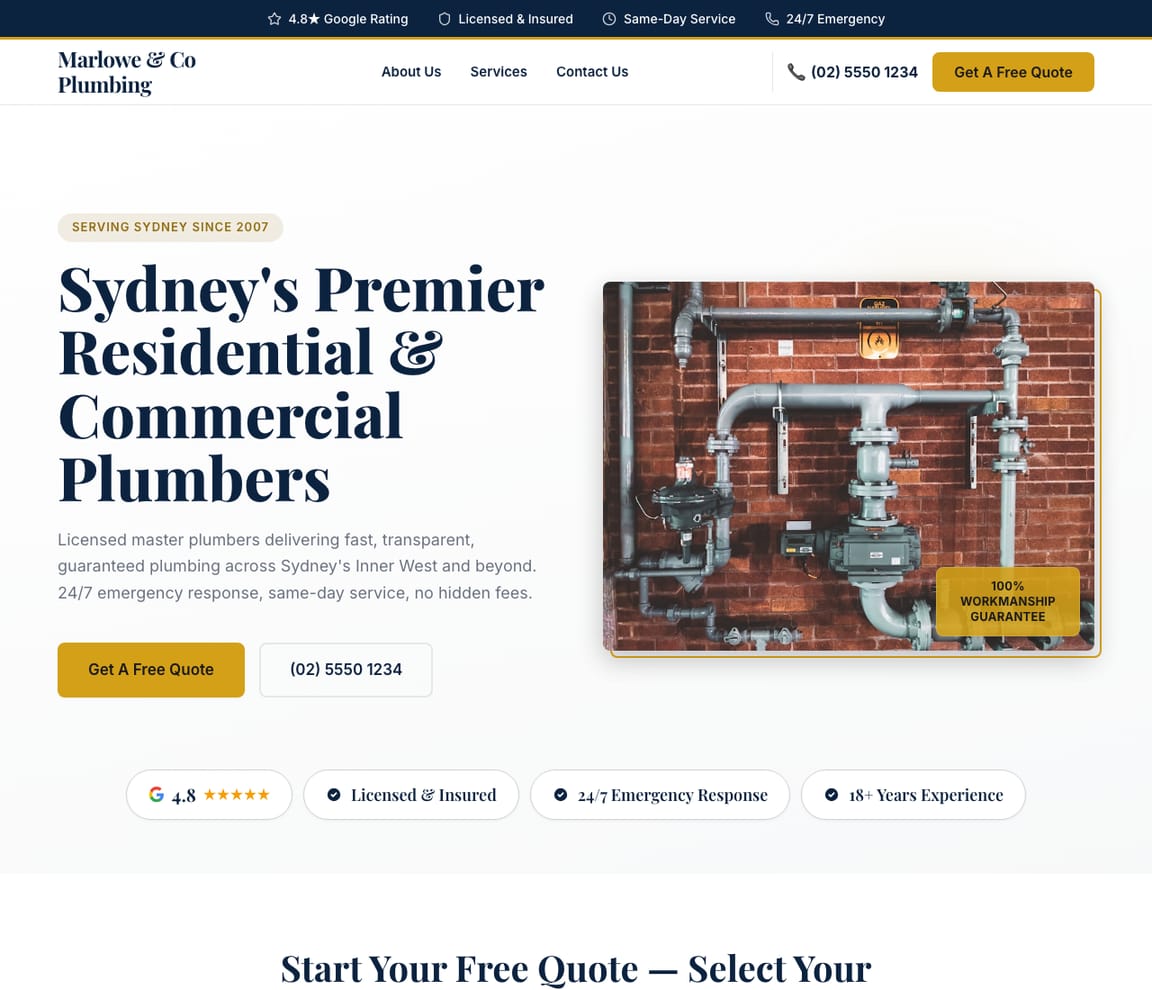
A real Zarla template for a plumber — emergency call-out in the first screen, water heaters and bathroom work underneath, the license number where a customer looks for it. Describe yours — the town, the services, the hours — and you'll have a site like this, with a call button and a quote form, in about a minute.
- Professional design — not a generic template
- Looks great on desktop and mobile
- Content written for your industry
Build the website
Start your plumbing website now
Add your town and your business name to the sentence, and Zarla builds the site: your services, the area you cover, a call button and a quote form. Add your prices and your license number in chat, then publish.
Already have a website? Bring it across →Zarla keeps your old page addresses where it can and redirects the ones that change, helping you keep the Google standing you've built.
Is becoming a plumber worth it in 2026 — and what does the work pay?
Becoming a plumber is a licensed ladder — in most of the big states the worker is licensed, not just the business — and at the top of it a local company whose phone rings when something is leaking. Three honest numbers first. Employed plumbers, pipefitters and steamfitters had a median of $63,800 a year in 2025, $30.67 an hour: 10 percent earned $44,150 or less, 10 percent $108,420 or more (O*NET, from BLS 2025 wage data). The headcount is large and growing: "Employment (2025) 510,600 employees", "Projected growth (2025-2035) Much faster than average (7% or higher)", "Projected job openings (2025-2035) 42,000" (O*NET, employment and outlook). And the survey behind the wages leaves out the self-employed (Washington ESD) — which is the plumber with his or her own truck, so the median measures the technician in someone else's van, not the owner.
State by state. The employed median is $59,840 in Texas, $72,830 in California, $52,910 in Florida and $77,490 in New York (O*NET, Texas; California; Florida; New York). The occupation is "Job Zone Three: Medium Preparation Needed" — "Most occupations in this zone require training in vocational schools, related on-the-job experience, or an associate's degree" (O*NET, job zone); of the plumbers surveyed, "35% responded: High school diploma or equivalent required" and 9 percent said an associate's degree (O*NET, education).
Where the money went. The owners quoted below say the trade is short of people — "There's a real shortage of skilled tradespeople, and I think it's important to show the next generation that this is a solid, rewarding path" (Josh Fisher, Yetty Mountain Plumbing, Denver, VoyageDenver, February 11, 2026) — and that the money is in the business, not the wage: "No one tells you that before you ever turn a wrench, you'll need to invest heavily in equipment, trucks, insurance, licensing, advertising, a professional website, SEO services, and specialized tools—many of which can cost five thousand dollars or more each" (Douglas Parker, Bluepoint Plumbing, Southern California, VoyageLA, September 2, 2025). One Houston company puts the pricing on paper before the first wrench comes out: "We have a price book set up that allows our customers to have options on repairs, and to know what it is going to cost before we even take a tool out of the van" (Gabriel Ginn, Republic Plumbing, Houston, VoyageHouston, February 14, 2023). What a plumber should charge is its own guide — how much should a plumber charge — and the step after this one is how to start a plumbing business.
The catch. The hours come first — four or five years of them before you can sit the journeyman exam in Texas, Illinois, Washington or Philadelphia, more before the master — the hours only count under a license holder, the paperwork has to be signed, and the business is on call: "I am usually in the office before sunrise, and after three decades in this trade I still like the work" (Ron Degner, Zest Plumbing & Drain, Scottsdale, VoyagePhoenix, read October 2026). That's what the rest of this guide sets up: the ladder in each big state from its board, the routes in and what each costs, the tools from a distributor's own prices, and how to be the plumber the burst-pipe search reaches first.
How to become a plumber, in plain English: the ladder in your state, from the boards
There is no federal plumbing license, and the states do not agree on who gets licensed. Texas, Illinois, Washington, Colorado, Oklahoma, New York City and Philadelphia license or register the person from the apprentice rung up. California, Florida and Arizona license the contractor — the business — and leave the journeyman either unlicensed (California, Arizona) or to the counties (Florida). New York and Pennsylvania have no state plumber license at all; their cities do it. Here is each, from its own board or statute:
- Texas: the State Board of Plumbing Examiners runs a five-rung ladder. Apprentice — register at 16 ("you are at least 16 years old; and you are a citizen or national of the United States or an alien or non-immigrant eligible for licensure by the State of Texas"), "Registration Application Fee: $15", "Renewal Fee: $15" (TSBPE, plumber's apprentice). Tradesman plumber-limited — "at least 4,000 hours of experience working in the plumbing trade" and a "24-hour training course approved by the TSBPE", exam $36, license $35 (TSBPE, tradesman). Journeyman — "at least 8,000 hours of experience working in the plumbing trade" and a 48-hour course or enrollment in one, "Exam Fee: $40", "Initial License Fee: $40", renewal $40 (TSBPE, journeyman); the statute's own definition is "has completed at least 8,000 hours working under the supervision of a responsible master plumber" (Tex. Occ. Code §1301.002). Master — a journeyman who has "held your license for at least two years", or one year plus "a training program approved by the United States Department of Labor Office of Apprenticeship"; "Exam Processing Fee (payable to the TSBPE): $25", "Exam Fee (payable to Pearson VUE on the day of the exam): $128.50", "Initial License Fee: $75" (TSBPE, master plumber) — the statute text on the public mirror still reads four years as a journeyman, so the board's current page is the one to follow (§1301.002). Responsible Master Plumber — the designation that lets a master run the business: a master "in good standing" with "a minimum of $300,000 of commercial liability insurance coverage", "Initial Application Fee: $225", "Renewal Fee: $300", and the duty of "ensuring that all service vehicles display the company name and RMP's license number" (TSBPE, responsible master plumber); the insurance is statute — "coverage of not less than $300,000 for all claims arising in a one-year period" (§1301.552; §1301.3576). The 48-hour journeyman course is itemized — "two 6-hour Continuing Professional Education courses (in the classroom) the Occupational Safety and Health Administration 10-Hour Outreach Training 8 hours of training on the International Residential Code and/or Uniform Plumbing Code 18 hours of training on the commercial plumbing codes" — and waived for anyone "enrolled and in good standing with a training program approved by the United States Department of Labor Office of Apprenticeship" (TSBPE, examinations). Pearson VUE's handbook: "You must achieve a score of 70% to pass the exam" (Texas Plumbing Examiners candidate handbook). Two Texas rules nobody else prints: drain cleaning is licensed work — a "Drain cleaner-restricted registrant" is an apprentice who "clears obstructions in sewer and drain lines through any code-approved existing opening under the supervision of a responsible master plumber" (§1301.002), "Registration Application Fee: $18" (TSBPE, registrations), with "at least six hours of approved training" a year to renew (§1301.405); and the only unlicensed plumbing is the owner's own — "A property owner is not required to be licensed under this chapter to perform plumbing in the property owner's homestead" (§1301.051; the maintenance-staff exemption is §1301.053).
- California: no journeyman card. The state licenses the plumbing contractor — the Contractors State License Board's "C-36 - Plumbing Contractor" classification (CSLB license classifications) — and apprentices register with the Department of Industrial Relations' Division of Apprenticeship Standards (DIR, apprenticeship). The experience for the license: "not less than four years experience as a journeyman, foreman, supervising employee or contractor in the particular class within which the applicant intends to engage as a contractor", and schooling or apprenticeship cannot "count for more than 3 years of the experience" (16 CCR §825); the applicant "shall qualify by personal appearance or by the appearance of their responsible managing employee" (Cal. Bus. & Prof. Code §7068); the bond is "twenty-five thousand dollars ($25,000)" (§7071.6). Below the line no license is needed: "if the aggregate contract price for labor, materials, and all other items is less than one thousand dollars ($1,000), that work or operation being considered of casual, minor, or inconsequential nature, and the work or operation does not require a building permit" (§7048). One owner's timeline: "Once I had 4 years of experience, I applied for my C-36 contractor's license and got it in August, 2023" (Josh Lay, Layout Plumbing, Val Verde, VoyageLA, September 2, 2025). The CSLB's fee pages answered "Page Not Found" the day we read them, so no California dollar fee is printed here.
- Florida: the state licenses the contractor two ways — a "Certified contractor" holds "a certificate of competency issued by the department and who shall be allowed to contract in any jurisdiction in the state", a "Registered contractor" "has registered with the department pursuant to fulfilling the competency requirements in the jurisdiction for which the registration is issued" and "may contract only in such jurisdictions" (Fla. Stat. §489.105; §489.113). To sit the exam you must be "18 years of age" and have, among the routes, "a total of at least 4 years of active experience as a worker who has learned the trade by serving an apprenticeship as a skilled worker who is able to command the rate of a mechanic in the particular trade or as a foreman … provided, however, that at least 1 year of active experience shall be as a foreman", or a four-year degree in engineering, architecture or building construction plus "1 year of proven experience" (§489.111). The journeyman card is a county matter — the Pinellas County Construction Licensing Board's own notice: "Certified County and Journeyman Licenses Expire September 30, 2026" (PCCLB, 2026); the other big counties' pages refused to open, so ask your county.
- New York (no state license — New York City licenses the master and registers the journeyman): to register as a journeyman you must "Be at least eighteen (18) years old" and "Have at least Five (5) years of full-time experience performing plumbing or fire suppression piping under the direct and continuing supervision of a licensed Master Plumber … where at least one (1) year of experience was in New York City", with a "Registration fee of $50" (NYC Department of Buildings, journeyman registration). The master license asks for "at least seven (7) years of total experience within the ten (10) years prior to application … with at least two (2) years of such experience as a registered journeyman plumber" and a written and practical exam (DOB, obtaining a master plumber license); "License Fee: $200.00", "Renewal Fee: $150.00", "License Term: 3 years" (DOB, master plumbers); the exams themselves are "$585" written and "$530" practical for every master trade the department licenses (DOB, exam application fees). Buffalo, Nassau and Suffolk run their own; their pages refused a scripted reader, so ask the city or county building department.
- Illinois: the Department of Public Health "licenses approximately 8,900 plumbers and 2,000 apprentice plumbers." To be licensed, "individuals must pass a state licensing exam after working under a licensed plumber as a licensed apprentice for a 48 to 72 month period"; "Applicants must have been employed as a licensed apprentice plumber for a minimum of 4 years, and have successfully completed at least 2 years of high school or equivalent"; apprentices "must be at least 16 years old" with "proof of sponsorship by an Illinois licensed plumber or approved apprenticeship program", and "After a maximum apprenticeship period of 6 years, those individuals who do not apply for the plumbers licensing exam (or fail the exam) will not be eligible for a renewal of the apprentice license" (Illinois Department of Public Health). The apprentice license is "$100" (IDPH apprentice application); the exam application is "$175" for an Illinois apprentice and "$225" for "Plumbers Registered or Licensed in Chicago or Outside the State of Illinois" (IDPH exam application) — Chicago licenses separately, on pages that did not open.
- Washington — the state certifies the plumber and has no master rung: "To become a certified journey level or specialty plumber in Washington, you must typically begin as a plumber trainee." Journey level (PL01) is "Four years or more (at least 8,000 hours) working as a plumber trainee under the supervision of a certified journey level plumber", of which "Two years or more (at least 4,000 hours) must be spent working in commercial or industrial installations"; residential (PL02) is "3 years or more (at least 6,000 hours)"; residential service (PL03) "Two years or more (at least 4,000 hours)" (Washington L&I, plumber certification). Colorado — three state licenses by hours: "Residential Plumber You must verify 2 years (3,400 hours) of practical experience", "Journeyworker Plumber … 4 years (6,800 hours) of practical experience", "Master Plumber … five full-time years (8,500 hours) of practical experience", with "One month of full-time experience is equivalent to 163 hours" and "at least 8 hours of Continuing Education (CE) during EACH YEAR" (Colorado DPO, plumbing; exams through PSI — applications). Oklahoma — "All plumbing helpers performing any plumbing work must be registered and directly supervised by a journeyman or a contractor in ratio of no more than three (3) Apprentices to one Journeyman or Contractor who are licensed"; journeyman applicants "must be eighteen (18) years of age or older and have either: three (3) years of experience in the plumbing trade while employed by a licensed Plumbing contractor" or equivalent military or out-of-state experience, and a plumbing program of "a minimum of 1000 classroom hours … may be substituted for two (2) years of experience"; "Applicants for a contractor license must meet the same requirements as a journeyman" plus bond and insurance (Oklahoma Construction Industries Board). Pennsylvania — no state license; Philadelphia licenses all three rungs: an apprentice license at "$ 25" that "does not allow you to operate a business" (Philadelphia, apprentice); a journeyman who has "been registered as an apprentice plumber in Philadelphia for a minimum of four years" and passed the International Code Council exam, "License fee $ 126" (journeyman); a master "registered as a Philadelphia Journeyman Plumber for a minimum of one year" carrying "General Liability: $500,000 per occurrence Automobile Liability Insurance: $300,000" and workers' compensation (master). Arizona — a Registrar of Contractors license, no journeyman card, and the same $1,000 line as California: exempt is work where "the total value of the sales contract or transaction involving such items and the cost of the installation or attachment of such items to a structure does not exceed $1,000, including labor, materials and all other items", unless "a local building permit is required" (A.R.S. §32-1121). Massachusetts, Michigan, Ohio, Georgia and Maryland license plumbers too, on pages that refused to open the day we read them, so none of their hours or fees is printed here.
How you learn it. The federal standard behind every registered apprenticeship: a term "measured either through the completion of the industry standard for on-the-job learning (at least 2,000 hours) (time-based approach), the attainment of competency (competency-based approach), or a blend", "A minimum of 144 hours for each year of apprenticeship is recommended", and "A progressively increasing schedule of wages to be paid to the apprentice" (29 CFR §29.5) — so 8,000 hours is four years at the federal floor, not the "1,700 to 2,000 hours per year" Google's answer gives. The union route: "UA apprenticeships typically last five years" and "blend paid, on-the-job training with classroom learning" (United Association); one local's door — "$50.00 non-refundable application fee", "Must have a High School Diploma or GED equivalent", "Pass an aptitude test", "Pass a drug screen", "Must be at least 18 years of age" — and no maximum age anywhere on the page (Plumbers Local 130, Chicago, 2026–2027 application). The merit-shop route: PHCC Academy's e-learning apprenticeship runs "Number of Years: Four" with "Classroom Instruction Time: equivalent to 1 year (156 hours)" per course (PHCC Academy). School first: Texas State Technical College's "three-semester certificate program" in plumbing and pipefitting (TSTC, Waco) is a Tier 4 program at "$2,910" for 15 credit hours for a Texas resident, so three full semesters run about $8,730 before books, our arithmetic (TSTC tuition table, 2026–27) — and in Texas the school hours still have to be followed by the board's 8,000. The diploma is the union's rule, not the state's: Texas asks an apprentice for age 16 and lawful status, Illinois for two years of high school at exam time.
What the exam asks. Texas's master exam is "210 written multiple choice questions; including 60 questions based on Plumbing Codes; 25 questions based on the Plumbing Codes, specific to water heater installation; 25 questions on the Occupational Safety and Health Administration (OSHA) Code Federal Regulations; 25 questions on the Texas Accessibility Standards (TAS) … 25 questions on Liquefied Petroleum Gas piping installation; 25 questions on Plumbing Related Mathematics; and 25 questions on the Plumbing License Law and Board Rules" (TSBPE master review course); the journeyman exam is "ninety (90) written multiple choice questions" plus "'hands-on' shop work, including measuring, cutting, assembly and fitting of commonly used plumbing pipe and fittings" and the "design of a two story sanitary drainage and vent system of up to 10 common plumbing fixtures" built "into a scaled down model of a two story building, using miniature pipe and fittings" (TSBPE journeyman review course).
You are self-employed from the first invoice. In the US a one-truck plumber is a sole proprietor by default: "Use Schedule C (Form 1040) to report income or (loss) from a business you operated or a profession you practiced as a sole proprietor" (IRS, Schedule C instructions); "The self-employment tax rate is 15.3%" once net earnings reach $400 (IRS), and sole proprietors "generally have to make estimated tax payments if they expect to owe tax of $1,000 or more" (IRS). If you want an LLC: Texas $300 (Tex. Bus. Orgs. Code §4.154); Florida $100 plus $25 for the registered agent and $50 a year (Fla. Stat. §605.0213); New York $200 (N.Y. LLC Law §1101) plus a notice "published once in each week for six successive weeks, in two newspapers of the county" (§206); California $70 (Cal. Gov. Code §12190) and "Every LLC that is doing business or organized in California must pay an annual tax of $800" (Franchise Tax Board). Workers' compensation: "In Texas, private employers can choose to carry workers' compensation insurance coverage, but it is not required in most cases" (Texas Department of Insurance), while "All California employers must provide workers' compensation benefits to their employees under California Labor Code Section 3700" (California DIR).
Sales tax on the work — four states' rules. Texas: "Labor to repair, remodel, or restore residential real property is not taxable", while "the total amount charged for remodeling, repairing, or restoring nonresidential real property is taxable" — the same leak fixed in a restaurant is taxed (Texas Comptroller, Publication 94-116). California: "Many sellers believe there is a general exemption from sales tax for labor charges. However, in California many types of labor charges are subject to tax", and "Special rules apply to labor when you perform work on houses, buildings, and other real property" (CDTFA Publication 108). New York draws the line between a capital improvement and a repair: "installing a hot water heater" is a capital improvement, while "replacing a thermostat on a hot water heater" is "taxable repair and maintenance work" (New York TB-ST-104). Florida: under lump-sum and time-and-materials real property contracts "the contractor is the final consumer of materials and supplies and: • Must pay sales tax to suppliers on all purchases" (Florida DOR GT-800067). Confirm the details with your accountant.
The money to start. Our arithmetic from the pages that print each price. A lean start for a Texas apprentice — the $15 registration (TSBPE), a RIDGID 14-inch pipe wrench at $45.39 (Zoro, read October 26, 2026) and an 18-inch at $66.39 (Zoro), a basin wrench at $54.29 (Zoro), a 151 tube cutter at $61.99 (Zoro) and a small tubing cutter at $37.89 (Zoro), a Bernzomatic TS8000 torch at $62.19 (Zoro) and a RIDGID micro CA-25 inspection camera at $181.99 (Zoro) — the tools alone are $510.13, and with the registration $525.13. The fuller start, a Texas master going out as a Responsible Master Plumber — the same kit, the $40 journeyman exam and $40 license, the $25 processing, $128.50 exam and $75 license for the master, the $225 RMP application, a RIDGID K-45 drain machine kit at $628.99 (Zoro) and a K-400 at $708.99 (Zoro), a Milwaukee M12 ProPEX expansion kit at $499 (Zoro), a year of general liability at Insureon's $1,768 median and a year of commercial auto at $3,415 — is $8,078.61. Up the ladder: a RIDGID K-60SP sectional machine is $2,315.99 (Zoro) and a SeeSnake CS65XR monitor $6,349.99 (Zoro), and a battery press tool is a four-figure line we could not read from a page that opened. Neither total includes the truck, pipe and fittings stock or the website — and the insurance is a median, not your quote: "Plumbing businesses and contractors pay an average of $147 per month, or $1,768 annually, for general liability insurance", "$213 per month for a business owner's policy, or $2,559 annually", "$179 per month for workers' compensation insurance, or $2,150 annually", "$285 per month, or $3,415 annually, for commercial auto insurance" and "$8 per month, or $100 annually, for a surety bond" (Insureon, updated August 5, 2026). The plan page for the business side is the plumbing business plan, the prices are in how much should a plumber charge, the step after this guide is how to start a plumbing business, the name goes on the truck from plumbing business names, and the site from the plumber website builder or the plumbing website design page.
In the UK: there is no license to call yourself a plumber; the regulated edge is gas, where work on appliances, flues and pipework is reserved to "a Gas Safe registered engineer" under the Gas Safety (Installation and Use) Regulations 1998 (HSE, gas safety). The government's career profile puts pay at "£24,000 Starter" to "£46,000 Experienced", with routes through "a college course", "an apprenticeship" — "You can apply to do a Level 3 Advanced Apprenticeship to learn the skills needed to become a plumber" — or "applying directly" (National Careers Service, GOV.UK); WaterSafe is the voluntary "national accreditation body for competent and qualified plumbers" (WaterSafe). In Australia the principle inverts: New South Wales requires a license or certificate for any plumbing, draining or gasfitting work regardless of the cost of the job or whether it is residential, commercial or industrial, with fines of $22,000 for an individual working unlicensed, and Queensland requires an occupational license for plumbing, drainage and gas fitting at any value — both regulators' pages carry a British spelling in their addresses that this US page cannot link, so the figures are stated here without one; Victoria's Building Authority refused a scripted reader. Check your own state's plumbing board, and your city's, before you take the first job.
What working plumbers actually say
None of this is our opinion about the trade. It comes from people who do it — a Los Angeles owner who failed at other businesses first, a Denver plumber's son, a Georgia master licensed in two states, a Scottsdale owner thirty-two years in, a Dallas career-changer who started over at 26, a Chicago owner thirty years in, a one-man C-36 shop in Val Verde, a union-trained Southern California owner, a Los Angeles plumber who worked for others for fifteen years, an East Tennessee plumber who apprenticed under his father, a Houston husband-and-wife firm, two Austin owners and a Houston owner with a price book — talking to the Voyage magazines and CanvasRebel between 2021 and 2026, each described as the page describes them. Read each as theirs at the time. Five things come up again and again.
You get in by working for a plumber, and the hours are the education. Ron Degner, Zest Plumbing & Drain, Scottsdale: “There was no money for college and no dad around, so I went to work at 18 for a local, small family Plumbing & A/C company.” And: “At 20 I moved to Cincinnati and got into a plumbing trade school, and by 24 I had my Journeyman license. That was 32 years ago, and I have been a plumber ever since.” (VoyagePhoenix, read October 2026). Matthew Chagdes, Full Circle Plumbing & Sewer, Chicago: “I would observe the plumbers and assist them in their work, along the way, little did I realize at the time, but I was learning a skill and one that I actually enjoyed.” (VoyageChicago, March 22, 2021). Taylor Sole, Murphy's Plumbing, Austin: “I got in to plumbing by happenstance. My roommate at the time was in plumbing, and I needed a job. Little did I know it would become what it did. I fell in love with plumbing, and committed myself to the trade.” (VoyageAustin, June 3, 2025). Patrick Williams, OnCall Plumbing, Austin: “I grew up in a construction family and started plumbing in 2008 with the encouragement of another master plumber who saw a talent for the trade.” (VoyageAustin, January 16, 2024).
“I started over as an apprentice plumber, and to a lot of people it probably looked like I was starting from the bottom.” — Eric Juarez, NexDrain Plumbing, Dallas, who changed careers at 26, in VoyageDallas, May 19, 2026
It is not too late, and the master you work under decides what you learn. Juarez again: “I became a sponge, soaking up everything I could from the master plumber I worked under and from anyone willing to teach me.” And: “Plumbing isn't just a job for me, it's something that gave me direction, purpose, and a path to build a legacy for my family.” (VoyageDallas, May 19, 2026). Zach Oliva, Papa Bear Plumbing, Greeneville, Tennessee: “I had the privilege of apprenticing alongside my father, who dedicated more than 45 years to the plumbing trade.” And on the move: “Before we made the move, I studied for the Tennessee plumbing licensing exam and confirmed that I met the qualifications to become licensed.” (CanvasRebel, July 22, 2026). Mark Hernandez, American Made Plumbing, Los Angeles: “I got into the plumbing industry because my father is a plumber. I had started working with him when I was 11 years old.” (CanvasRebel, October 7, 2026).
The license is the step that changes everything. Josh Lay, Layout Plumbing, Val Verde, California: “Once I had 4 years of experience, I applied for my C-36 contractor's license and got it in August, 2023.” And: “During those 4 years, I worked on establishing a complete arsenal of tools and combined two 90s Ford diesel trucks into one reliable service rig.” (VoyageLA, September 2, 2025). Harold Jackson, WeThePlumbers, Gwinnett County, Georgia: “I started as a laborer for the steam fitting trade in NJ. Seeing a bigger picture initiated an apprenticeship program for the city of Newark NJ Public Schools. Attended Plumbers Local 24 apprenticeship. Obtained a NJ Master Plumbers License 11062 in 2000.” (VoyageATL, October 22, 2026). Douglas Parker, Bluepoint Plumbing, Southern California: “That search led me to join a local plumbing union, and it changed everything. Over the next five years, I completed a rigorous apprenticeship program, earned my journeyman status, and honed my skills on some of Southern California's largest and most complex projects, including the Los Angeles Convention Center, the Intuit Dome, and COSM.” (VoyageLA, September 2, 2025). And a California caution from a licensed general contractor who is not a plumber: “In fact, when I was registering my business name, the woman setting up my new B class GC license told me I could not advertise as a plumber.” (Allison Allain, PCI Builders, Los Angeles, VoyageLA, February 8, 2023).
Owning the truck is a different trade from working on it. Josh Fisher, Yetty Mountain Plumbing, Denver: “Being skilled at the trade didn't automatically mean I knew how to run a business, so I had to learn everything on the fly — from pricing and scheduling to marketing and customer communication.” (VoyageDenver, February 11, 2026). Parker: “Plumbing prepared me to work hard with my hands, but owning a company requires mastering an entirely different set of skills: finance, marketing, sales, operations, and leadership.” (VoyageLA, September 2, 2025). Hernandez, fifteen years as an employee first: “As a plumber I spent the past 15 years working as an employee to just 2 companies and I can honestly say it was decisively easier to work as an employee.” And what ownership bought: “I have been able to spend more time with my family, I have been able to employ family and friends as well as educate said individuals on plumbing to help them have personal job security for the rest of their lives by learning this trade.” (CanvasRebel, October 7, 2026). Jaden D'Amico, The Plumber Man, Los Angeles: “When I started The Plumber Man, Inc., it was just me, a truck, and a mission to build a company that actually cared — not the typical transactional kind of service, but something memorable.” (VoyageLA, September 2, 2025).
The customer is standing in water, and the price has to come first. D'Amico: “Plumbing wasn't supposed to be my career, but the first time I solved a major problem for a family and saw the relief on their face, something clicked.” (VoyageLA, September 2, 2025). Gabriel Ginn, Republic Plumbing, Houston: “We have a price book set up that allows our customers to have options on repairs, and to know what it is going to cost before we even take a tool out of the van.” (VoyageHouston, February 14, 2023). Lay, on the one-man shop: “As far as how I'm set apart from other companies, I'd say that as a one man show a lot of my customers like the fact that the person who answers the phone, schedules the call, and shows up to do the work is me.” (VoyageLA, September 2, 2025). Mary and Ted Knight, Knights Plumbing, Houston: “Our story begins over two decades ago when we, Ted and Mary Knight, decided to take a leap of faith and start our own plumbing business. We knew two things for sure when we started, we loved helping people and we knew how to plumb.” (VoyageHouston, March 18, 2025). Oliva: “At the heart of our business is a simple belief: plumbing is ultimately about taking care of people.” (CanvasRebel, July 22, 2026). Fisher, on the next generation: “Looking ahead, I'd like to start offering youth training opportunities and summer programs that introduce young people to the trade, hands-on, and show them what a career in plumbing and skilled trades can look like.” (VoyageDenver, February 11, 2026).
The through-line: the plumbers who lasted got in under a license holder, counted every hour, sat the exam the first year they could, and learned a second trade — pricing, scheduling, answering the phone — the day they bought the truck.
THE STARTER KIT
What you need to become a plumber
An apprentice registration on day one
In the states that register apprentices, the card comes before the first supervised hour counts — the fee and the age are named below from the boards.
A licensed plumber to work under
A union local's program, a non-union shop, or a contractor who sponsors you — the hours only count under a license, and the shop decides what you learn in year one.
The hours, documented
Thousands of supervised hours before the journeyman exam, more before the master — each state's count is below, and the board wants them on paper, signed.
The exams, and the code book
A journeyman exam and later a master exam, written on your state's plumbing code — the fee and the pass-and-wait rules from the boards, below.
The tools, from real prices
A press tool or a torch, a drain machine, a pipe wrench set, an inspection camera when a job pays for it — priced from the makers' and distributors' own lists.
A way to be found when you go out on your own
A website with your services, your license number and a call button, and a Google Business Profile with your photos — how the burst-pipe search reaches your truck, not a lead-selling app.
THE PAPERWORK
Licenses, hours, exams and insurance on the way to your own plumbing business
| Typical cost | Time to get | Legally required? | |
|---|---|---|---|
| Apprentice registration or license | $15 (TX, at 16); $100 (IL, at 16); $25 (Philadelphia); none in CA, AZ or FL at state level | Days — before the first paid hour | TX, IL, OK, WA (trainee), NYC (journeyman at 5 years), Philadelphia; the hours only count once registered |
| Journeyman license | $40 exam + $40 license (TX); $175 exam application (IL); $50 registration (NYC); $126 (Philadelphia) | 8,000 hours in TX and WA; 6,800 in CO; 4 years in IL and Philadelphia; 3 years in OK; 5 years in NYC | In the states that license the person; CA and AZ have no journeyman card |
| Master license | $25 + $128.50 exam, $75 license (TX); $200 for 3 years (NYC); fees not printed for CO | 2 years as a journeyman (TX); 1 year (Philadelphia); 7 in 10 (NYC); 8,500 hours total (CO) | To pull permits and run the shop in TX, NYC, Philadelphia, CO; Washington has no master rung |
| Contractor license (the business) | $225 RMP application + $300,000 insurance (TX); $25,000 bond (CA); fees not printed for CA, FL, AZ | Months — after the master license or the four years of journey-level work | TX (Responsible Master Plumber), CA (C-36 over $1,000), FL (certified or registered), AZ (over $1,000), OK |
| The pre-exam course | 24 hours (TX tradesman); 48 hours (TX journeyman); waived for DOL-registered apprentices | A week | Texas only, by rule; the exam itself is 70 percent to pass |
| Drain-cleaning registration | $18 (TX) + the $15 apprentice registration | Days | Texas: yes, under a Responsible Master Plumber; California and Arizona: no license under $1,000 with no permit |
| Sole proprietorship (Schedule C) | $0 | None | The default once net earnings pass $400 (self-employment tax 15.3%) |
| LLC (optional) | $300 (TX); $125 (FL); $200 + newspaper notices (NY); $70 + $800/yr (CA) | Days to weeks | No |
| Sales-tax account | Free to register | Before the first commercial job | TX taxes nonresidential repair labor, not residential; NY taxes repairs but not capital improvements; check your state |
| General liability insurance | $147/mo median (Insureon) | Days | A license condition in TX ($300,000 for an RMP) and Philadelphia ($500,000); a contract condition everywhere |
| Commercial auto on the truck | $285/mo median (Insureon) | Days | For a work vehicle, yes; Philadelphia sets $300,000 |
| Workers' compensation | $179/mo median (Insureon) | Days | Required from the first employee in CA; optional for private employers in TX; a master license condition in Philadelphia |
| License number on the truck | None | — | TX: every service vehicle shows the company name and the RMP's license number; IL: the license displayed at the place of business |
THE STEPS
How to become a plumber (step by step)
Eight steps from the first supervised hour to a master license and a truck with your own name on it.
01
Read your state's ladder
Apprentice, journeyman, master — and in Texas a tradesman rung between — each with its own hours, exam and fee, set by the state board in most of the country and by the city in a few. The big states are below, from the boards.
Named by state below02
Register as an apprentice before the first hour
In Texas, California's contractor system aside, Florida's counties, New York City and Illinois the hours count only once you are on the books — the card, the age and the fee are below.
03
Get in under a license
A union local's apprenticeship, a non-union shop that sponsors you, or a trade school first and a shop after — the routes compared below, with what the school costs and whether the hours count.
The long part04
Put in the hours and keep the proof
Thousands of supervised hours over four or five years, documented and signed by the licensed plumber you worked under — the board asks for the paperwork, not your word.
05
Pass the journeyman exam
Written on your state's plumbing code; the fee, the pass mark and the retake rule are from the boards below. A journeyman works without supervision but still under a master's license.
06
Put in the journeyman years and pass the master exam
More years at the journeyman rung, then the master exam — the rung that lets you pull permits, supervise apprentices and put your own name on the business.
07
Set the business up, bonded and insured
An entity, a contractor registration or license where your state has one beside the master license, a bond where it is required, general liability and commercial auto, and workers' comp from the first hire.
08
Be the plumber the call reaches first
A website with your services, your license number, your call-out fee and a call button, and a Google Business Profile with your photos — so the burst-pipe search reaches your truck.
THE COSTS
How much does it cost to become a plumber?
Itemized from the pages that print a price: the state fees from the boards, the tools from one distributor's listings, the insurance from Insureon's plumber medians. The truck, the pipe and fittings stock and the website come on top, and so do your own living costs through the apprentice years.
$525.13a lean start for a Texas apprentice — the $15 registration, two pipe wrenches, a basin wrench, two cutters, a torch and an inspection camera (our arithmetic)
$8,078.61the fuller start as a Texas Responsible Master Plumber — the journeyman and master exams and licenses, the $225 RMP application, two drain machines, a PEX expansion kit, a year of liability and commercial auto
$2,910a 15-credit semester of Texas State Technical College's plumbing certificate for a Texas resident — about $8,730 for the three-semester program
$40 + $40Texas's journeyman exam and license; the master is $25 + $128.50 + $75; Illinois's apprentice license is $100 and its exam application $175
WHAT WE'VE LEARNED
What actually makes a homeowner call a plumber
Thousands of local business websites in, the pattern for a trade hired in an emergency and trusted with the walls is clear: the homeowner wants to know you are licensed, what the first hour costs, and how fast you can come. For a plumber, three things on a page decide who gets the call.
Licensed, with the number
Your license number and the board that issued it on the page, so the check a homeowner runs on the state's site takes thirty seconds — and so the permit office knows whose name goes on the job.
The call-out fee, up front
A diagnostic or call-out fee and a 'from' price on the common jobs — a drain, a water heater, a leak. The first thing a caller asks, and the thing the pricing guide below is built from.
A way to reach you now
A call button that works on a phone at the top of every page, your hours, and a quote form for the remodel and the water heater that can wait until Tuesday.
THE UPSIDE
What a plumber can earn
Pay for employed plumbers, pipefitters and steamfitters from O*NET's 2025 figures — the self-employed are not in the survey. Medians, not a promise: your state, your rung on the ladder and whether the truck is yours decide it.
$63,800a year: the 2025 median for employed plumbers, pipefitters and steamfitters — $30.67 an hour; 10 percent under $44,150, 10 percent over $108,420 (O*NET)
$77,490the New York median; California $72,830, Texas $59,840, Florida $52,910
7% or higherthe projected growth for 2025–2035 — "Much faster than average" — with 42,000 openings a year projected (O*NET)
510,600employed plumbers, pipefitters and steamfitters in 2025 — owner-operators are not counted
SEE IT WORK
Plumbing website designs you can start from
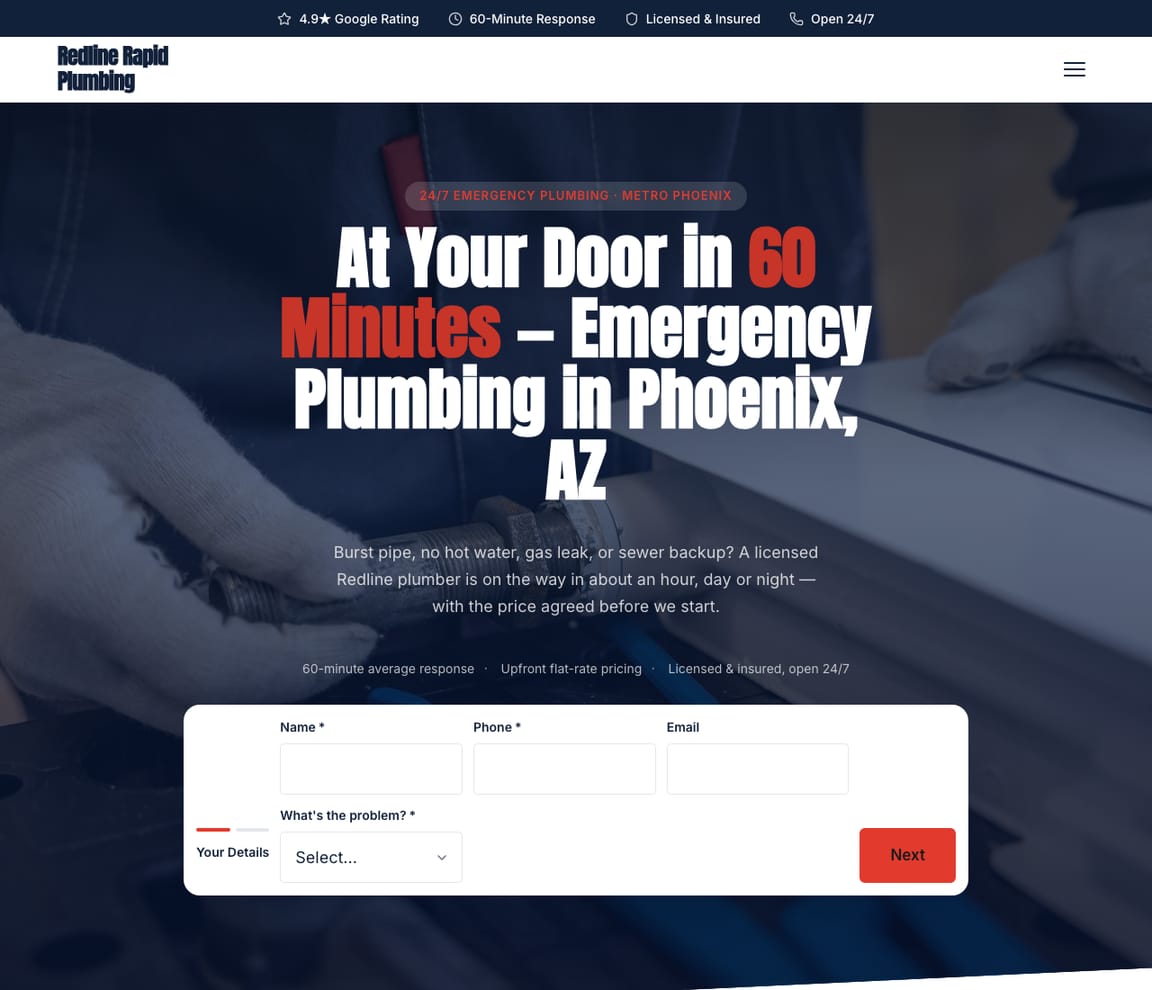
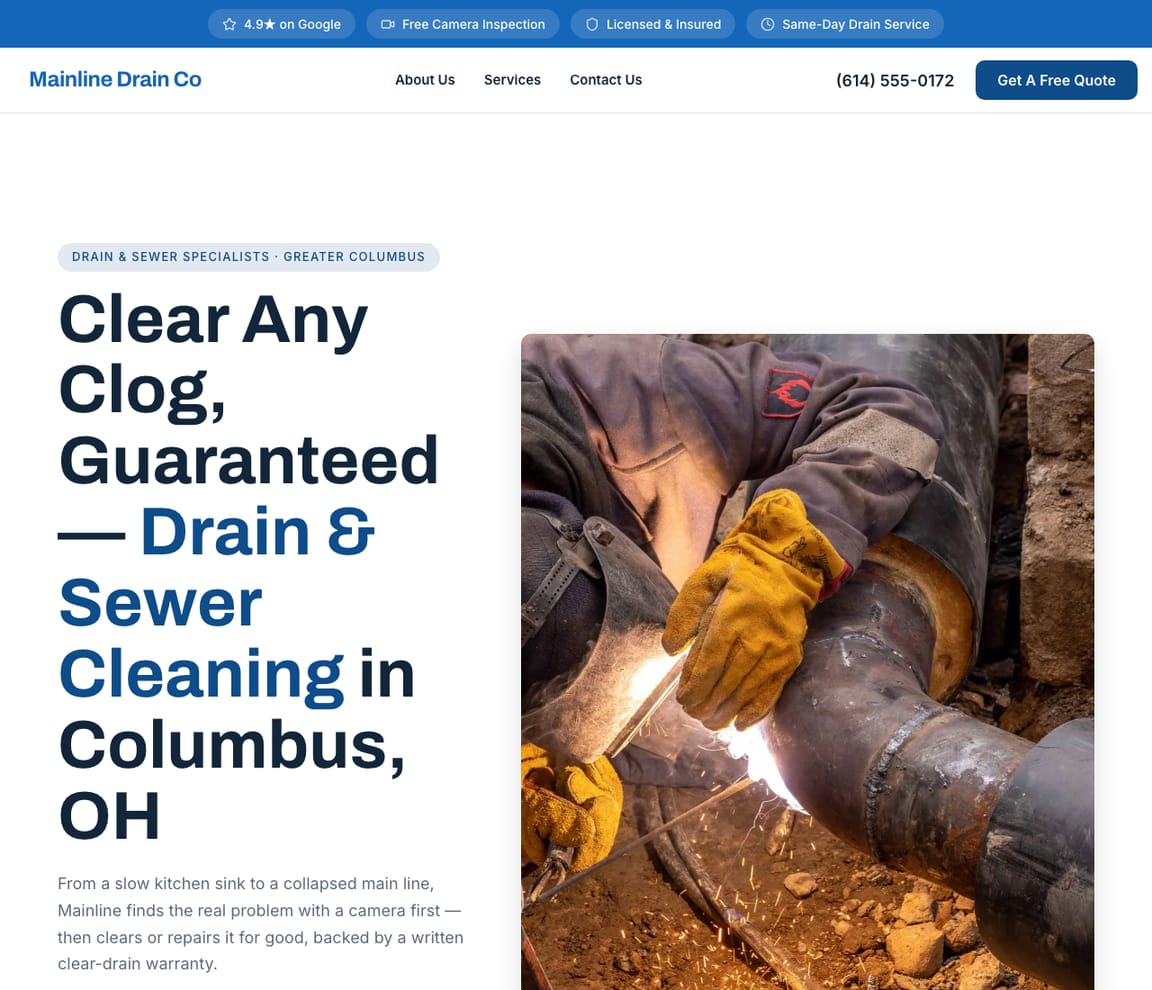
Real Zarla templates for the shapes the trade takes — the 24/7 emergency plumber, the drain and sewer specialist, the water-heater installer, the family-owned neighborhood shop. Open one, swap in your services and your license, and publish.


GET FOUND
Get found by the homeowner with water on the kitchen floor
A burst pipe is searched from a phone with the water still running, and the call goes to the plumber whose number, hours and license are on the first screen. Zarla builds the website with your services, your service area and a call button. Add your prices and your license number in chat, and once you connect your Google Business Profile, your name, your photos and your hours stay in step on both.
“Plumber near me”
Searched from a flooded kitchen at night, by a landlord with a cold tenant, and by a homeowner pricing a water heater. Your services, your area, your license and a call button answer all three.
Google Business Profile
A plumber who drives to customers qualifies for one: your service area, your hours and your photos inside Google Maps. Free, and an afternoon to set up.
The license number on the page
Your master or contractor license number on the site and the truck — in Texas and California the law says where it goes — is what a homeowner checks before the first visit.
Google Search
Hharborlaneplumbing.com
Harbor Lane Plumbing — Trusted plumber in Your AreaHouston's licensed master plumber — burst pipes, drains and water heaters, 24 hours. Call-out fee quoted before we drive; see our license number. Call or request a quote online.← Your Zarla siteCcityplumberservices.com
City plumber ServicesGoogle Maps
1
Harbor Lane Plumbing
← You2
Metro plumber Co.
3
Quick plumber Services
AI assistants (ChatGPT / Perplexity)
For a licensed plumber in Houston who can fix a burst pipe tonight and tells me the call-out fee before coming in your area: Harbor Lane Plumbing — a licensed plumber's site that lists emergency repairs, drains and water heaters with a call-out fee, shows the license number, and takes a call or a quote request from the page.
YOUR LAUNCH PLAN
Your become-a-plumber checklist
The whole guide as things to check off. Work through them in order and you'll be registered, trained, licensed at every rung, insured and findable before your name goes on the truck.
- Read your state's ladder below — the rungs, the hours, the exams, the fees.
- Register as an apprentice before the first hour — where your state registers them.
- Get in under a license — a union local, a sponsoring shop, or school first and a shop after.
- Document every hour — signed by the licensed plumber you worked under.
- Pass the journeyman exam — the first year you qualify.
- Pass the master exam — the rung that puts your name on the permit.
- Set up, bond and insure the business — entity, contractor registration, bond, liability, commercial auto, workers' comp.
- Get found — a website with your services, your license number and a call button, and a Google Business Profile.
REAL CUSTOMERS
Small business owners who got online with Zarla
Verified reviews from real Zarla customers.
“Optimized for local service-based businesses. Easiest website build I've experienced. The AI-based build is the way to go instead of clunky theme-based websites. Get the site built and get out of the weeds with Zarla!”
“Quickly built my website from scratch. No hiccups. Would highly recommend Zarla for someone with no experience who wants to start a polished business website.”
“Very reliable, professional, and fast results. I was able to get my business online in no time, and the ease of access made it so simple.”
“I had no idea how to set up a website for my business. Thanks to Zarla, they've helped me a lot.”
Be the plumber the burst-pipe call reaches first
Add your town and your business name, and Zarla builds the website from that one line — your services, the area you cover, your license number, a call button and a quote form, with SEO in place. Add your prices and your photos in chat. Free to build; you pay when you publish.
Already have a website? Bring it across →Zarla keeps your old page addresses where it can and redirects the ones that change, helping you keep the Google standing you've built.
Frequently asked questions
How much does it cost to become a plumber?
In the US, about $525.13 for a lean start as a Texas apprentice, our arithmetic from the pages that print each price: the $15 apprentice registration, a $45.39 RIDGID 14-inch pipe wrench and a $66.39 18-inch, a $54.29 basin wrench, a $61.99 tube cutter and a $37.89 small tubing cutter, a $62.19 Bernzomatic TS8000 torch and a $181.99 RIDGID micro CA-25 inspection camera, as listed at Zoro. The fuller start as a Texas Responsible Master Plumber — the same kit, the $40 journeyman exam and $40 license, the $25 processing, $128.50 exam and $75 license for the master, the $225 RMP application, a $628.99 RIDGID K-45 and a $708.99 K-400 drain machine, a $499 Milwaukee ProPEX expansion kit, $1,768 for a year of general liability and $3,415 for a year of commercial auto at Insureon's medians — is $8,078.61. School first adds $2,910 a semester at Texas State Technical College; Illinois adds a $100 apprentice license and a $175 exam application. Neither figure includes the truck, pipe stock or the website.
Do you need a license to be a plumber?
In the US, yes in every big state — but who holds it differs. Texas, Illinois, Washington, Colorado, Oklahoma, New York City and Philadelphia license or register the plumber from the apprentice rung: $15 at 16 in Texas, $100 at 16 in Illinois, a $50 journeyman registration after five years in New York City. California, Florida and Arizona license the contractor — the business — and have no state journeyman card; Florida's counties issue those. New York State and Pennsylvania have no state plumber license at all and leave it to their cities. The only unlicensed plumbing in Texas is a property owner's own homestead, and in California and Arizona a job under $1,000 that needs no permit. Check your state's plumbing board and your city's before you take a job.
How long does it take to become a plumber?
Four to five years to the journeyman exam in the states that count hours: 8,000 supervised hours in Texas and Washington, 6,800 in Colorado, four years as a licensed apprentice in Illinois and Philadelphia, five years in New York City, three years in Oklahoma. The federal apprenticeship standard is at least 2,000 hours a year, so 8,000 hours is four years at the floor; the union's programs typically run five. The master license adds two years as a journeyman in Texas, one in Philadelphia, and seven years in ten in New York City. California has no journeyman card at all — four years of journey-level work is what the C-36 contractor license asks for.
How do I get an apprentice plumber license in Texas?
Register with the Texas State Board of Plumbing Examiners: you must be at least 16 and a US citizen or national or an alien eligible for licensure, the registration fee is $15 and the renewal $15 a year, and from then on you work under a Responsible Master Plumber while your hours count — 4,000 toward the tradesman plumber-limited license, 8,000 toward the journeyman. If you will be clearing drains, add the Drain Cleaner-Restricted registration for $18, which lets an apprentice clear obstructions through existing openings under general supervision. Registering online with no criminal history reported is the quickest route; the board runs a criminal history check on every applicant.
Do you need a plumbing license to unclog drains?
In Texas, yes: clearing obstructions in sewer and drain lines is plumbing under the Occupations Code, and the person doing it for pay must hold at least a plumber's apprentice registration ($15) plus a Drain Cleaner-Restricted registration ($18), working under a Responsible Master Plumber, with six hours of approved training a year to renew. In California and Arizona, no license is needed for a job under $1,000 that needs no building permit, which covers an ordinary drain call, and the contractor license applies above that. Illinois's law covers plumbing generally and prints no drain-cleaning exemption. Ask your state's board before you advertise the service.
How much do plumbers make?
Employed plumbers, pipefitters and steamfitters had a median of $63,800 in 2025 — $30.67 an hour — with 10 percent earning $44,150 or less and 10 percent $108,420 or more, from BLS data on O*NET. By state the median is $59,840 in Texas, $72,830 in California, $52,910 in Florida and $77,490 in New York. The survey counts employees only; an owner-operator's income is the billing minus the truck, the stock and the insurance, and the owners quoted above describe five-figure start-up lines before the first wrench turns.
Do plumbers make 300k a year?
Not as employees in the survey: the 90th percentile for employed US plumbers, pipefitters and steamfitters was $108,420 in 2025, and the highest state median in our set was New York's $77,490. The six-figure and up plumbers are owners — a Responsible Master Plumber in Texas or a C-36 contractor in California with a crew, a price book and a full calendar — and $300,000 is a company's billing, not a wage. Our guide to how much a plumber should charge works the owner's side of that arithmetic.
Is 30 too late to become a plumber?
No board or union program prints a maximum age. Texas and Illinois register apprentices from 16, Oklahoma and New York City ask for 18 or older, and Plumbers Local 130 in Chicago lists a minimum of 18 with no ceiling. The plumbers quoted above include a Dallas owner who started over as an apprentice at 26 with a family depending on him, a Scottsdale owner who went to work at 18 and had his journeyman license at 24, and a Los Angeles owner who worked for other companies for fifteen years before buying the truck. At 25 or 30 the arithmetic is the same four or five years of hours; the difference is that you already know how to show up.
Is plumbing physically demanding?
Yes. O*NET's survey of the occupation has plumbers spending time using their hands to handle and control tools every day and standing continually or almost continually, with exposure to contaminants and cramped spaces among the work-context items, and the Texas journeyman exam itself includes hands-on cutting, soldering, brazing and threading of pipe. The owners quoted above describe pre-sunrise starts after three decades in the trade. What changes with the years is the rung: the master plumber supervising a crew and pricing the jobs does less of the lifting than the apprentice did.
What math do you need to know to be a plumber?
Measuring in fractions, pipe sizing from tables, offsets and grades, and the arithmetic of a quote. Texas's master exam is explicit: 210 multiple-choice questions, of which 25 are on plumbing-related mathematics, alongside 60 on the plumbing codes and 25 each on water heaters, OSHA, accessibility standards, LP gas piping and the license law, plus fuel gas, water and vent sizing charts. The journeyman exam is 90 written questions and hands-on work — measuring, cutting, assembling and fitting pipe, and designing a two-story drainage and vent system for up to 10 fixtures in a scaled model. In the UK the entry route asks for GCSEs in English and maths. High-school algebra and the ability to read a chart are what the exams reward.
What is the 135 rule in plumbing?
There isn't one. We could find no "135 rule" in the International Plumbing Code, the Uniform Plumbing Code or any state board's page, and a search for the phrase returns nothing. Our best guess is that it is a muddled memory of the 45-degree fittings drainage codes prefer for changes of direction — two 45s make a 90, and a 45 leaves a 135-degree interior angle — but that is a guess, not a rule. Learn the actual code your state adopts; the Texas journeyman exam is written on it.
What did Albert Einstein say about plumbing?
The remark people search for comes from a letter Einstein wrote to The Reporter magazine in 1954, at the height of the pressure on academics in the McCarthy years, saying that if he were a young man again he would not try to become a scientist or scholar but would rather be a plumber or a peddler, for the modest independence it offered. We could not find the letter on a page we can link, so we have paraphrased it rather than quote it word for word. The plumbers quoted above make the same point in their own words: the trade is theirs, and the truck answers to nobody.
Will AI replace plumbers?
The occupation's own projection points the other way: 510,600 employed plumbers, pipefitters and steamfitters in 2025 and a projected 2025–2035 growth of 7 percent or higher — "Much faster than average" — with 42,000 openings a year, on O*NET. Nobody's software opens a wall, sweats a joint or clears a main. The owners quoted above call it a shortage: one Denver plumber says there is a real shortage of skilled tradespeople and wants summer programs to show teenagers the trade. What AI does change is the office side — the quotes, the scheduling, the website — which is the part the owners say they had to learn on the fly.
What tools do plumbers use?
The starter bag, priced from one distributor's listings read in October 2026: a RIDGID 14-inch pipe wrench ($45.39) and 18-inch ($66.39), a basin wrench ($54.29), a 151 quick-acting tube cutter ($61.99) and a small enclosed-feed cutter ($37.89), a Bernzomatic TS8000 torch ($62.19) and a RIDGID micro CA-25 inspection camera ($181.99) — $510.13 together, our arithmetic. The service truck adds a drain machine — a RIDGID K-45 at $628.99 for sinks and tubs, a K-400 drum machine at $708.99 for main lines, a K-60SP sectional at $2,315.99 — a Milwaukee M12 ProPEX expansion kit at $499 for PEX, and, for a drain-and-sewer business, a SeeSnake camera system whose CS65XR monitor alone is $6,349.99. One Val Verde owner describes the four apprentice years as the time he built a complete arsenal of tools and a reliable service rig.
How do I become a master plumber?
Hold a journeyman license first, then put in the years your state asks: in Texas, two years as a journeyman — or one year plus a Department of Labor-approved apprenticeship — then the master exam ($25 processing plus $128.50 to Pearson VUE) and a $75 license, and the Responsible Master Plumber designation ($225 plus $300,000 of liability insurance) if you want to run the business and put your license number on the trucks. In New York City it is seven years of experience in the last ten, two of them as a registered journeyman, and written and practical exams for a $200 three-year license. In Philadelphia, one year as a registered journeyman and the International Code Council exam. In Colorado, 8,500 hours in all. Washington has no master rung, and California has no master at all — the step up there is the C-36 contractor license after four years of journey-level work.
Do I need an LLC to be a plumber?
No US state requires it for the license, which attaches to you — or in Texas to the Responsible Master Plumber — whatever the entity. A one-truck plumber is a sole proprietor by default: Schedule C, the 15.3 percent self-employment tax once net earnings pass $400, quarterly estimates once you expect to owe $1,000. If you form an LLC: $300 in Texas, $100 plus a $25 registered-agent fee and $50 a year in Florida, $200 in New York plus a notice published for six weeks in two newspapers, and $70 in California plus an $800 annual tax every year. The insurance matters more than the entity — Texas makes $300,000 of liability a condition of the RMP designation, and Philadelphia asks a master for $500,000. Confirm the details with your accountant.