CAREER GUIDE
How to become a pool technician in 2026
The techs quoted below started on someone else's route, paid to learn skimming, brushing and water chemistry from a lead technician. Then come the certificates — the CPO, the Pool & Hot Tub Alliance's service pathway and its registered apprenticeship — and, for repair work, a contractor license in Florida, California or Arizona. Pay from six pool companies' postings — the government's survey has no pool line, so its nearest occupation, janitors and cleaners, is printed and labelled — the price of each course, the county and state rules from their own pages, and what techs who came up on a route say about it.
Free to build · Pay when you publish · No credit card
2,000 hoursof paid on-the-job training in PHTA's Department of Labor-registered pool service apprenticeship, plus at least 144 hours online
$36,840the 2025 US median for janitors and cleaners, the line O*NET files the Swimming-Pool Servicer apprenticeship under — $17.71 an hour (from BLS data)
16 hoursfor the Certified Pool & Spa Operator course, two days in a classroom or a blended format — valid for 5 years
$0to start at the pool companies quoted below, which train new technicians on a paid route
See it in action
See what your pool service website could look like
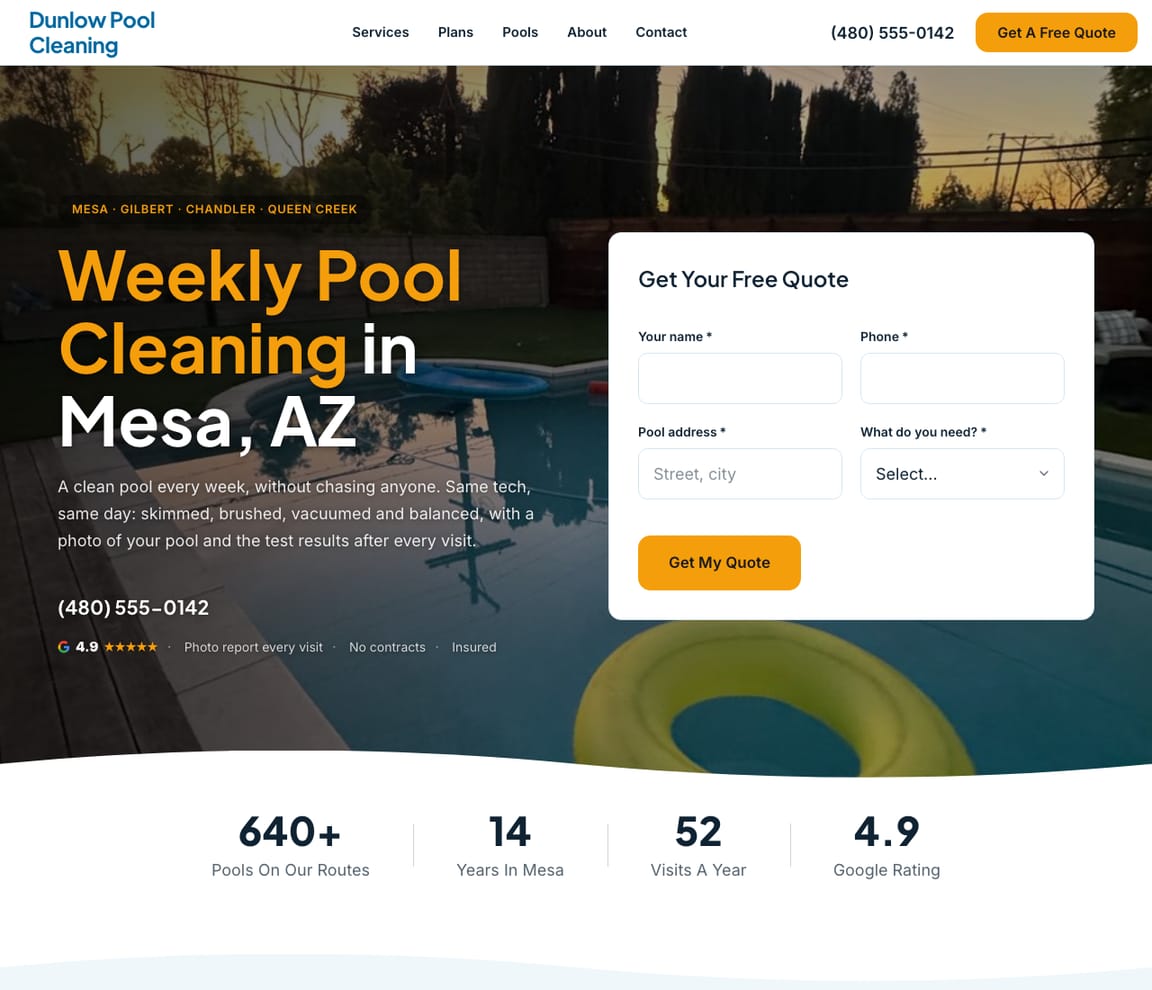
A real Zarla template built for a weekly cleaning route: the checklist each stop covers, the towns on the schedule, the face that comes through the gate, and a quote button. Tell it about yours — route, services, certificates — and a site like this is ready in about a minute.
- Professional design — not a generic template
- Looks great on desktop and mobile
- Content written for your industry
Build the website
Start your pool service website now
Put your town and your name in the sentence and Zarla builds the site: weekly service, green-pool cleanups and equipment repair, the streets you cover, a call button and a quote request form. Add your certificates and photos of your own pools in chat, then publish.
Already have a website? Bring it across →Zarla keeps your old page addresses where it can and redirects the ones that change, helping you keep the Google standing you've built.
Is pool service a good trade to get into in 2026, and what does a pool tech earn?
Becoming a pool technician is one of the quickest trades to start: pool companies put new hires on a paid route with no pool experience, and the first certificate is a two-day course. The trade-off is that the work is outdoors in the hottest months, the chemicals are dangerous handled wrong, and entry pay stays modest until repair skills or certificates move it. As for paperwork, in the US no state we read issues a license to the technician who cleans and balances home pools — but Arizona's contractor classifications include residential pool service, Los Angeles County certifies every technician, Florida and Texas regulate who services public pools, and equipment repair is contractor work in Florida, California and Arizona, all named below from the agencies' own pages; check your state's licensing board and your county health department before you take paid work of your own. The numbers first. The government's survey has no pool-technician line of its own. O*NET lists the Department of Labor's registered "Swimming-Pool Servicer" apprenticeship among the example titles for janitors and cleaners — an occupation it describes as workers who "Keep buildings in clean and orderly condition." and whose duties "may include tending furnace and boiler, performing routine maintenance activities, notifying management of need for repairs" (O*NET, 37-2011) — so that is the line printed here, a survey dominated by building custodians rather than pool techs. Its 2025 median was $36,840 a year, $17.71 an hour: 10 percent earned $28,640 or less ($13.77 an hour), 25 percent $32,240 or less, 75 percent $44,060 or less, and 10 percent $50,270 or more ($24.17 an hour) (O*NET wage table, 2025 BLS data). For the whole janitors and cleaners line: "Employment (2025)" "2,432,600 employees", "Projected growth (2025-2035)" "Slower than average (1% to 2%)", "Projected job openings (2025-2035)" "321,800" (O*NET). The survey counts employees; the self-employed tech with a route of their own is outside it.
In the four big pool states, the line moves. The median is $33,010 in Texas ($15.87 an hour), $41,090 in California ($19.75), $34,490 in Florida ($16.58) and $36,220 in Arizona ($17.42); the top tenth earns $45,950 or more in Texas, $58,950 or more in California, $42,930 or more in Florida and $45,670 or more in Arizona (O*NET, Texas; California; Florida; Arizona). Schooling barely figures: asked what a new hire needs, respondents said "High school diploma or equivalent required for some jobs" and "Less than high school diploma required for some jobs", and the training is described as "one or two years of training involving both on-the-job experience and informal training with experienced workers." (O*NET, education and job training).
Six pool companies, six numbers. ASP — America's Swimming Pool Co. — in central Houston, for a pool maintenance technician running a weekly route of residential and commercial pools: "Compensation: $20.00 - $25.00 per hour", with a company truck and a week that "averages 30-40 hours/week depending on seasonal and customer needs." (ASP Central Houston, posting, read November 5, 2026). Pool Scouts in McKinney, Texas: "Compensation: $17.00 per hour", with "On-the-job training" and a company truck "with tools, chemicals, and uniform shirts provided." (Pool Scouts McKinney, posting, read November 5, 2026). Pool Scouts in Huntsville, Alabama: "Compensation: $12.50 - $18.00 per hour" (Pool Scouts Huntsville, posting, October 7, 2026); near Charlotte, "Compensation: $18.00 - $28.00 per hour" (Pool Scouts Lake Norman & South Charlotte, posting, September 23, 2026); and in the Cape Fear area of North Carolina, for a service and repair specialist, "Compensation: $17.00 - $24.00 per hour" (Pool Scouts Cape Fear, posting, November 2, 2026). Poolwerx near Weatherford, Texas pays by the week — "Compensation: $750.00 - $1,250.00 per week", $750 to $1,250, "Pay based on experience and productivity" (Poolwerx Weatherford, posting, read November 5, 2026). What a homeowner pays for the weekly visit, and what the owner keeps, belongs to the owner's side of the trade: see how to start a pool cleaning business, priced in pool cleaning rates and budgeted in the pool cleaning business plan.
The catch. It is a physical, outdoor job with chemicals in the truck. The ads ask for it in so many words: ASP's Houston office wants someone who can "Enjoy working outdoors at all times of the year, particularly in Houston’s varying conditions." and "Be able to lift up to 100 lbs." (ASP Central Houston, November 5, 2026); Pool Scouts in McKinney warns of "Some heavy lifting (could be 50# or more)" (Pool Scouts McKinney, November 5, 2026). The janitors' survey above undercounts the sun — 20 percent there are "Outdoors, Exposed to All Weather Conditions" every day — but its chemical line fits: 39 percent are "Exposed to Contaminants" every day, and 28 percent put in "More than 40 hours" weekly (O*NET's work-context survey). The CDC counted "an estimated 4,535 U.S. emergency department visits annually during 2008-2017" from pool chemical injuries, the top diagnosis being "poisoning due to breathing in chemical fumes, vapors, or gases—for example, when opening chlorine containers." (CDC, May 16, 2019). What moves the pay is the ladder: the certificates that let you run public pools, the equipment skills that put you on the repair truck — the Cape Fear and Charlotte ads top out at $24 and $28 — and eventually a route of your own. Everything below is about climbing it.
How to become a pool technician, in plain English: the training, the CPO, and the county and state rules
Is there a license for this? In the US, the person cleaning and balancing a home pool isn't licensed in the places we read — the rules land on public pools, on one big county, and on repair work. Florida's statute spells out the line most clearly: for its swimming pool/spa servicing contractor, "Water treatment that does not require such equipment does not require a license. In addition, a license is not required for the cleaning of the pool or spa in a way that does not affect the structural integrity of the pool or spa or its associated equipment." (Fla. Stat. 489.105). Here is what the agencies we read put on the person.
- Los Angeles County certifies every technician. "Swimming Pool Service Technicians servicing pools in Los Angeles County, including private pools, are required to be certified per Los Angeles County Code, Title 11." — anyone "engaged in the business or occupation of treating or disinfecting swimming pool waters, cleaning, servicing, or maintaining swimming pools" — and "Other certifications such as CFO or AFO are not equivalent to the LA County certification, and do not meet this requirement." The exam is open to anyone: "Attendance at a pool class is not required to take the Certified Swimming Pool Service Technician or Technician Apprentice Examination." (LA County Public Health, pool service technicians). The department's own newsletter put the exam fee at "$212.00", payable "each time an applicant makes a reservation for the exam", and the yearly certified tech fee at "$75.00 per year" (LA County technician newsletter, June 1, 2019).
- Florida certifies who services public pools. "An individual who services a public pool by maintaining the cleanliness, water quality and chemical balance of public pools shall be certified." through "a training course of national recognition that is approved by the department of at least 16 hours in length" and a test; "Certification is conferred upon an individual and is nontransferable." (Fla. Admin. Code 64E-9.018, Cornell LII), and "The department shall deem certified any individual who is certified by a course of national recognition" (Fla. Stat. 514.075). Repair is a contractor license: the servicing contractor's scope "includes the repair or replacement of existing equipment" and "the installation of new pool/spa equipment" (Fla. Stat. 489.105), and an applicant qualifies for the certified license by passing its exam with "60 hours of instruction in courses related to the scope of work covered by that license" and "at least 1 year of proven experience related to the scope of work of such a contractor." (Fla. Stat. 489.111).
- Texas puts a certified operator on public pools. "All Class A, Class B, and Class C pools and spas shall be maintained under the supervision and direction of a properly trained and certified operator.", trained through "the NRPA, “Aquatic Facility Operator;”", "the PHTA, “Certified Pool Operator;”" or an equivalent (Texas DSHS, trained operator rule, 2021).
- California licenses the equipment work. The Contractors State License Board's D-35 classification: "A pool and spa maintenance contractor installs, replaces or repairs pool motors, pumps, filters, gas heaters and any above ground piping in connection with pools" (CSLB, D-35), a subcategory of the limited specialty license, whose holder "shall confine activities as a contractor to that field" (CSLB, C-61); building pools is the separate C-53, where "A swimming pool contractor constructs swimming pools, spas or hot tubs" (CSLB, C-53). Below the line: since January 1, 2025 the unlicensed minor-work limit is $1,000 — "the work cannot require a permit, and the unlicensed person cannot employ anyone for the project." (CSLB bulletin, December 31, 2024). The license itself asks for "at least four (4) years of experience, in the class you are applying for", with "credit of up to three (3) years for technical training, apprenticeship training, or education" (CSLB, qualifying experience), a $450 application and a $200 initial license fee for a sole owner (CSLB, fees).
- Arizona licenses service and repair. Its R-6 classification "allows the licensee to service and perform minor repair of residential pools and accessories, excluding plumbing connections to a potable water system, gas lines, gas chlorine systems, and electrical work beyond the first disconnect." (Ariz. Admin. Code R4-9-103, Cornell LII); the state's handyman exemption covers a job under $1,000 that is "of a casual or minor nature" and needs no building permit (A.R.S. 32-1121). Whether a weekly chemicals-only route falls inside that exemption is a question for the Registrar of Contractors, not one its rule answers in the text we read.
We read these jurisdictions' own pages, not all fifty states'. Before you take a route of your own, check your state's licensing board and your county health department — and for registering the business itself, see do I need a business license. The business's own registration and insurance are in how to start a pool cleaning business.
How you get in: a pool company trains you on its route. Pool Scouts in Huntsville: "No experience is required! Get paid while you complete training." (Pool Scouts Huntsville, October 7, 2026). In McKinney: "We'll train you how, but the basic responsibilities include:" cleaning debris, emptying baskets, "Cleaning and backwashing filters", "Brushing tile at waterline" and "Checking water chemistry and balancing (we'll teach you how)", for someone with "a valid TX driver’s license and current auto insurance" who is "OK with a background check." (Pool Scouts McKinney, November 5, 2026). ASP's Houston office wants a "valid driver’s license with a clean driving record", agreement to "a background check and drug screen" and "at least a high school diploma or equivalent – Certified Pool Operator is valued but not required" (ASP Central Houston, November 5, 2026). Near Charlotte, Pool Scouts asks new hires to "Possess a willingness and ability to obtain a Certified Pool Technician or Operator license if you do not currently have one." and offers "Quality paid training with our lead technicians." (Pool Scouts Lake Norman & South Charlotte, September 23, 2026); Poolwerx near Weatherford promises "Training will be provided" and a "Company Vehicle" (Poolwerx Weatherford, November 5, 2026).
The registered apprenticeship. The Pool & Hot Tub Alliance runs what it calls "Our two U.S. Department of Labor (DOL)-approved programs" (PHTA, about the apprenticeship). For pool maintenance and service technicians, "The standard term of apprenticeship shall be two thousand (2,000) hours of On the Job Training (OJT) and shall be completed within one (1) year(s)", with related instruction of "a minimum 144 hours" that includes PHTA's CMS and CST courses; "An apprentice is a person at least 16 years of age"; and apprentices "shall be paid not less than" "1st 6 months = $12.00 per hour" and "2nd 6 months = $13.00 per hour" (PHTA, pool maintenance and service technician apprenticeship). The employer enrolls you: for PHTA members, "FREE company and apprentice enrollment"; for non-members, "$500 company enrollment fee / $125 per apprentice enrollment fee" (PHTA, apprenticeship costs).
The certificates, from the people who issue them. The CPO: "No industry experience required!"; the "Classroom Course: This is a 16-hour, two-day program taught by a certified instructor.", or a "Blended Format" of the online CPO Fusion course and "a one-day, in-person class", "Total of 16 hours."; "Covers both commercial and residential pools"; "Valid for 5 years" (PHTA, CPO) — "CPO certifications are valid for five years from the end of the month of issuance.", while "All other PHTA certifications (CMS, CST, CSP, CPI, CHTT, and Certified Pool Builder & Design Professionals) are valid for three years" and renew with "24 hours of PHTA continuing education credits (CEUs)" (PHTA, recertify). PHTA's service pathway runs CPO, CMS, CST, CSP — "the only recognized service career pathway in the pool industry", in its words (PHTA, service pathway). The CMS is "Designed for those new to the pool industry or working a pool maintenance route", "24 hours", with "An additional registration form and $115 fee for the CMS Exam" (PHTA, CMS); the CST asks for "2 years industry experience required" and the same $115 exam fee (PHTA, CST); the CSP, "5 years industry experience required" and a "$250 fee for the CSP Exam" (PHTA, CSP). The NRPA's Aquatic Facility Operator is the other course Texas names: "There are no education or experience prerequisites for taking the AFO exam.", "The AFO exam is 50 questions, open-book", and "AFO certification is valid for five years." (NRPA, become an AFO). The equipment makers train too: Pentair offers "free online training courses" to members of its Pentair Partners program (Pentair, online learning).
What it costs to kit yourself out. Every total here is our own addition of the prices on the linked pages. A tech hired by a company works its route with its equipment; a tech who wants their own kit — the lean start — pays Inyo Pools $124.99 for a Taylor K-2006 test kit, $50.99 for a 5- to 15-foot telescopic pole, $41.99 for a deep-bag leaf rake, $22.99 for an 18-inch brush, $39.99 for a 14-inch flexible vacuum head and $71.49 for a 40-foot vacuum hose — $352.44 (prices read November 5, 2026). The fuller start adds a certificate and spares: Pool Training Academy's CPO course, "Only $390!" in its own words (Pool Training Academy), a $56.99 heavy-duty leaf skimmer and a $39.99 professional wall brush — $839.42. The fully online alternative is the Aquatic Training Institute's "Certified Pool Technician Course" at $349, "Self-Paced / Up to 30 Days to Complete / Online Course and Exam" (Aquatic Training Institute). And handle the chemicals the way the CDC tells operators to: "Read and follow directions on pool chemical product labels.", "Check product labels for directions on what to wear.", and "Never mix different pool chemicals with each other. It is particularly dangerous to mix chlorine and acid." (CDC, May 16, 2019). When you take accounts of your own, the paperwork, pricing and invoices are in the pool cleaning business plan, the pool service invoice template and the pool service estimate template; a name comes from pool cleaning business names, and the site from the pool service website builder, a design in pool service templates or the examples in pool service website design.
In the UK: Britain's careers service has no pool-technician profile; the closest is the lifeguard, which puts pay at "£19,000 Starter" to "£27,000 Experienced", lists a duty to "check pool water temperature and chemicals", and says "There are also opportunities to get qualified in pool plant operation and maintenance, with responsibility for water testing and pool safety." — the entry route being "a course, tends to be about 7 days long" for the National Pool Lifeguard Qualification (National Careers Service, lifeguard). In Australia the rule we read is New South Wales's: “You must have a licence or certificate to do swimming pool repairs and servicing work.”, a category that “includes non-structural additions, changes and repairs; painting and surfacing (rendering or applying surface coatings) of a swimming pool; and acid washing and pool cleaning.” — the qualification named first is “CPP31218 Certificate III Swimming Pool and Spa Service”, and an individual also needs a “valid National Police Check (NPC) Certificate” (NSW Government, swimming pool repairs and servicing). In the US, check your own state's licensing board before your first paid route.
What working pool techs actually say
The voices below belong to people who learned the trade on a route: a Miami tech who began hauling trash off remodeling sites, a San Fernando owner who rode along with his brother after high school, a Gilbert, Arizona builder who started cleaning tile at fourteen, an Atlanta owner who went from lifeguard to repair, Los Angeles and Orange County techs who came in through family and friends, a tech taught by the owner whose route he later bought, an Austin tech who left after eight years with customers in tow, a Florida tech who went back to pool school after the 2020 closures, a Texas owner whose first account was a friend's mother's pool, and a San Diego co-owner who recently started working in the field herself — speaking to Voyage, CanvasRebel and the Osprey Observer between 2017 and 2026. Each is named as the interview names them, and each quote carries the year it was said. Their stories cross at four points.
It was nobody's childhood plan. Jose Valdes, Phoenix Pool and Spa, Miami: “I still haven’t met someone who told me that being a pool guy or owning a pool business was their dream as a kid, but today 20 years later I wouldn’t have it any other way.” (VoyageMIA, October 20, 2022). Hermelindo Garcia Jr., Cannonball Pools, San Fernando: “I started working right out of High School with my older brother who had starting working with a pool service company.” (VoyageLA, February 26, 2017). Joe Vidito, Aqua Tech Pools, Orange County, after his other jobs dried up in 2008: “A family friend had recently moved to Orange County and started a pool business. I called him and asked if he needed help to which he obliged.” (VoyageLA, September 18, 2017). Derek Johnson, Black Pearl Pools, The Woodlands, Texas: “A good friend of mine introduced me to the pool industry and convinced me to move to Texas to help with his pool company.” (CanvasRebel, March 14, 2022). Eric Perez, Perez Pool & Spa, Los Angeles, on tagging along on summer routes in high school: “It was like walking into Dodgers stadium, it just felt right.” (VoyageLA, May 30, 2017).
“Can you pick up trash and can you drive a truck? Answer yes and you were in.” — Jose Valdes, on his first job in the pool industry, in VoyageMIA, October 20, 2022
You learn it one rung at a time. Tim Murphy, Presidential Pools, Gilbert: “When I was 14, I started cleaning the waterline tile on a handful of neighborhood pools to earn money.” and “Through maintenance, I learned how to repair pools, and I started doing that in my early 20s.” (VoyagePhoenix, January 4, 2018). Sean Etter, Clear View Pool Management, north Atlanta, on his college summers: “I started out lifeguarding and then was taught to do maintenance and finally repair.” (VoyageATL, March 14, 2017). Pauly Harter, Pure Joy Pool Co, on the owner who hired him: “Mr Tom Pike became my mentor and taught me the ropes of servicing swimming pools, spas and hot tubs.” (VoyageLA, February 10, 2026). Monica Bayon, Bayon Pool Service, San Diego, after years in the office: “Recently, I’ve taken another step forward and started working in the field as a pool technician as well.” (SDVoyager, March 9, 2026).
The weather and the equipment don't care about your plans. Valdes, on his first year: “I had no outdoor work experience at that time and imagine Miami it’s super hot it rains pretty much whenever but you’ve got to get it done.” and, on what it paid off: “by the time I had spent about a year and a half at that first place I had doubled my initial pay.” (VoyageMIA, October 20, 2022). Etter: “Pool equipment is constantly breaking down so you just have to be flexible.” (VoyageATL, March 14, 2017). Perez, on keeping customers answered: “I mean, sure I have to charge my phone about 23 times a day, but that’s ok.” (VoyageLA, May 30, 2017). Garcia: “It is not always a smooth road.” (VoyageLA, February 26, 2017).
The route you service can become yours. Jonathan Rodriguez, Blue Trident Pool Services, Austin: “I worked In the pool business 8 years before starting my own.”, “I already had all the certifications needed for pool services, so it was a smooth transition process.” and “I had 15 customers follow me out the door.” (VoyageAustin, November 21, 2023). Harter: “So Tom Pike and I worked out a deal so that I could buy some of his existing route and start my own business with them.” (VoyageLA, February 10, 2026). Alan Sweers, Valrico, Florida, who went back to pool school for his CPO before going out on his own: “I love the interaction with the customers because we learn from each other,” (Osprey Observer, February 3, 2023). Johnson, on his first account: “She was my first and longest standing client until she sold her home.” (CanvasRebel, March 14, 2022). Perez: “The one thing we’re 100% sure of is that in this business there’s always something new to learn.” (VoyageLA, May 30, 2017).
What ties them together: almost all of them came in sideways — a brother's route, a family friend's new company, a summer job at a pool — learned from someone already doing it, put up with the heat and the broken pumps, and found that a tech who shows up every week ends up with customers who would follow them anywhere.
THE STARTER KIT
The pool tech starter kit
A pool company that trains
The franchise offices quoted below hire without pool experience, pair you with a lead tech and pay you while you learn the chemistry — the truck, tools and chemicals are theirs.
A driver's license and a clean record
Every ad below asks for a valid license; three of the six add a good driving record, some a background check and, at one Houston office, a drug screen.
A back for 50-pound buckets
The ads ask you to lift 50 pounds or more — one says up to 100 — and the work is outdoors in the heat, all season.
Respect for the chemicals
Chlorine and acid stay apart, labels get read, and the right gear goes on — the CDC's operator rules, printed below.
A test kit you trust
A drop-count kit like the Taylor K-2006 covers free and total chlorine, pH, alkalinity, calcium hardness and cyanuric acid — the numbers every stop depends on, priced below.
A page that finds you work
A website listing your weekly checklist and the streets you drive, plus a Google Business Profile listing your hours — for the day the accounts are yours.
THE PAPERWORK
Certificates, exams and licenses on the way to pool service
| Typical cost | Time to get | Legally required? | |
|---|---|---|---|
| A pool company's on-the-job training | Paid — Pool Scouts, ASP and Poolwerx train on the clock | Before your first solo route | No — the employer's own training |
| PHTA registered apprenticeship | Free to enroll for PHTA member employers; $500 plus $125 per apprentice otherwise | 2,000 hours on the job within a year, plus at least 144 hours online | No — a Department of Labor-registered way in |
| Certified Pool & Spa Operator (CPO) | $390 at Pool Training Academy; set by each instructor | 16 hours over two days, or online plus one day; valid 5 years | Yes for a Texas public pool's operator (CPO, AFO or equivalent); valued, not required, at ASP's Houston office |
| NRPA Aquatic Facility Operator (AFO) | The course provider's price | Two days, then a 50-question open-book exam; valid five years | One of the courses Texas names for its public pool operators |
| Los Angeles County technician certificate | $212 exam fee and $75 a year, per the county's 2019 newsletter | Pass the county exam — no class required | Yes, to service any pool in Los Angeles County, private pools included |
| Florida public pool service technician | The approved course's price | A course of at least 16 hours and a test | Yes, to service a Florida public pool |
| PHTA CMS, CST and CSP | $115 exam each for CMS and CST; $250 for the CSP exam | 24-hour courses; CST after 2 years in the trade, CSP after 5 | No — industry certificates, renewed every three years |
| Pool repair contractor license | California: $450 application and $200 initial license fee | California: four years at journey level; Florida: 60 hours of courses and a year of experience | Yes for equipment repair — Florida's servicing contractor, California's D-35 above $1,000 or with a permit, Arizona's R-6 |
THE STEPS
How to become a pool technician (step by step)
From a first ride-along to the certificates and the license for repair work, in eight moves.
01
Get your license and record in order
A valid driver's license, insurance and a record that passes a background check are what pool companies screen for first — not pool experience.
Day one02
Join a company that trains
Pool Scouts, ASP and Poolwerx offices quoted below teach the route on the job and pay you through it; PHTA's registered apprenticeship is the formal version.
The real first step03
Learn the route and the chemistry
Skimming, brushing the tile line, vacuuming, backwashing filters, testing and balancing — the weekly visit, until you can run it alone.
04
Earn the CPO or AFO
A 16-hour course and exam; valid five years. Asked for at public pools and valued by employers, and the first step on PHTA's service pathway.
05
Pass your county's exam where there is one
Los Angeles County certifies every technician who services pools there, private pools included — no class required to sit the exam.
06
Climb the service pathway
PHTA's CMS for route techs, the CST after two years for equipment and troubleshooting, the CSP after five.
07
License the repair work
Florida's pool/spa servicing contractor, California's D-35, Arizona's R-6 — the licenses for pumps, filters and heaters. The business side is the start guide's step.
08
Be the tech the search finds
Once the accounts are yours: a website listing services, route area and a quote form, and a Google Business Profile listing your hours.
THE COSTS
How much does it cost to become a pool technician?
Inyo Pools prices the kit, Pool Training Academy and the Aquatic Training Institute price the course, PHTA prices its exams — each linked above. A truck, insurance and chemicals are left out — the companies quoted above supply them to employees.
$0to start at a pool company that trains on the clock — Pool Scouts in Huntsville: "Get paid while you complete training."
$352.44a lean start — your own kit: a $124.99 test kit, $50.99 pole, $41.99 leaf rake, $22.99 brush, $39.99 vacuum head and $71.49 hose (our arithmetic)
$349–$390for a pool operator course — $349 for the Aquatic Training Institute's online course, $390 for Pool Training Academy's CPO
$839.42the fuller start — the lean kit, the $390 CPO course, a $56.99 skimmer and a $39.99 wall brush; PHTA's CMS exam is $115 more
WHAT WE'VE LEARNED
What actually makes a homeowner hire a pool tech
A pool customer is buying a year of Tuesdays: the same person, through the same gate, every week. When a tech starts taking accounts of their own, the pages that win them settle three questions up front.
The weekly checklist, written down
Surface skimmed, walls and tile line brushed, floor vacuumed, baskets and filter seen to, water tested and dosed, equipment looked over — and what is billed on top.
Who comes, and the paper they hold
Your name and photo, your CPO or PHTA certificate, the county certificate where one is asked for, and which repairs you're licensed to take on.
The streets you drive
The neighborhoods on your route and a quote request form — pool customers want someone already nearby on their day.
THE UPSIDE
What a pool technician can earn
Pay from O*NET's 2025 figures for janitors and cleaners — the line it files the Swimming-Pool Servicer apprenticeship under — and from six pool companies' own ads. These are snapshots, not promises — where you work, which certificates you hold and whether you can fix a pump set your number.
$36,840a year: the 2025 US median for janitors and cleaners, the occupation O*NET files the pool servicer under — $17.71 an hour; 10 percent under $28,640, 10 percent over $50,270 (O*NET)
$41,090the California median; Arizona $36,220, Florida $34,490, Texas $33,010
$12.50–$28.00an hour across the Pool Scouts and ASP ads above — $20.00 to $25.00 for a route tech at ASP in Houston
$750–$1,250a week for a route technician at Poolwerx near Weatherford, Texas, paid on experience and productivity
SEE IT WORK
Pool service designs for the next step
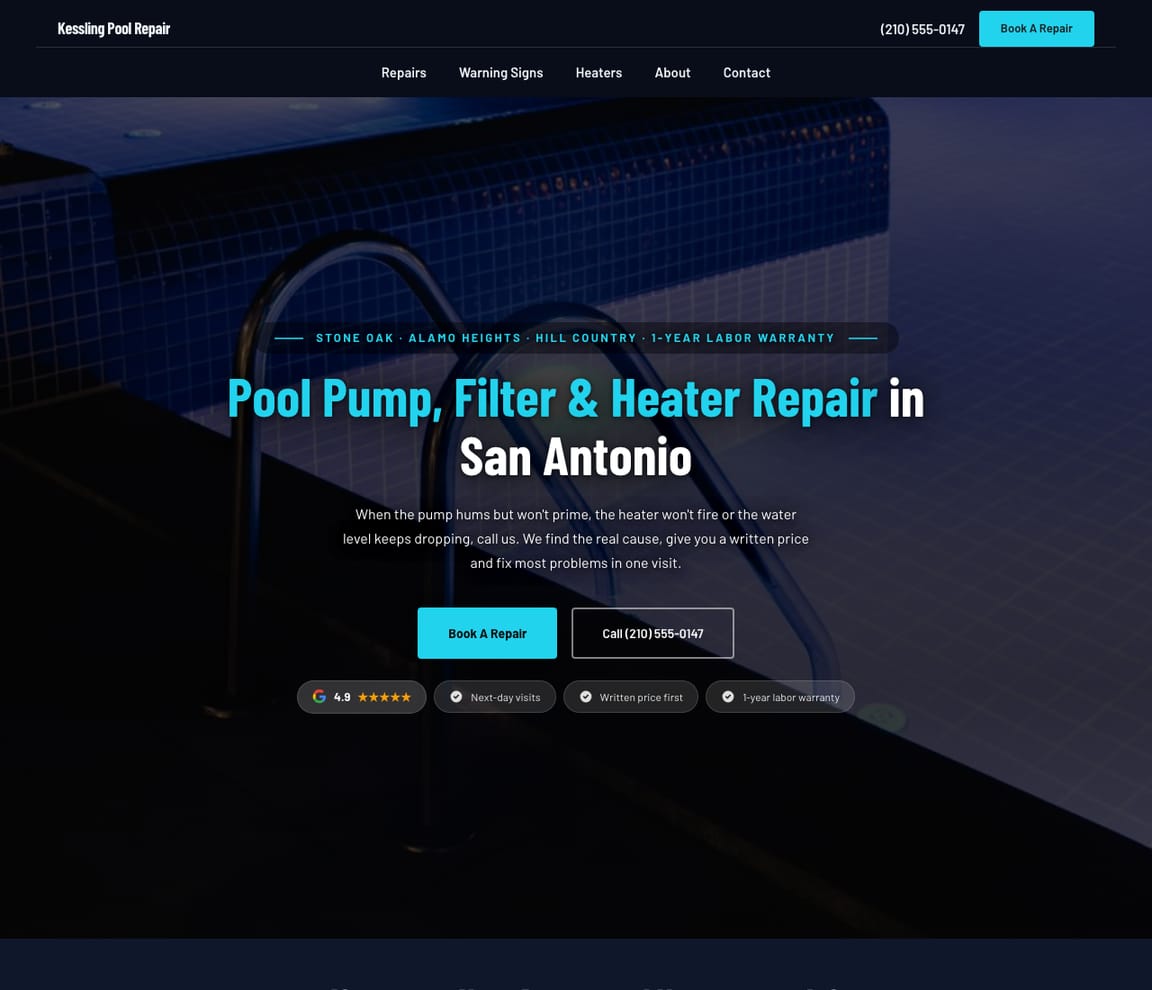
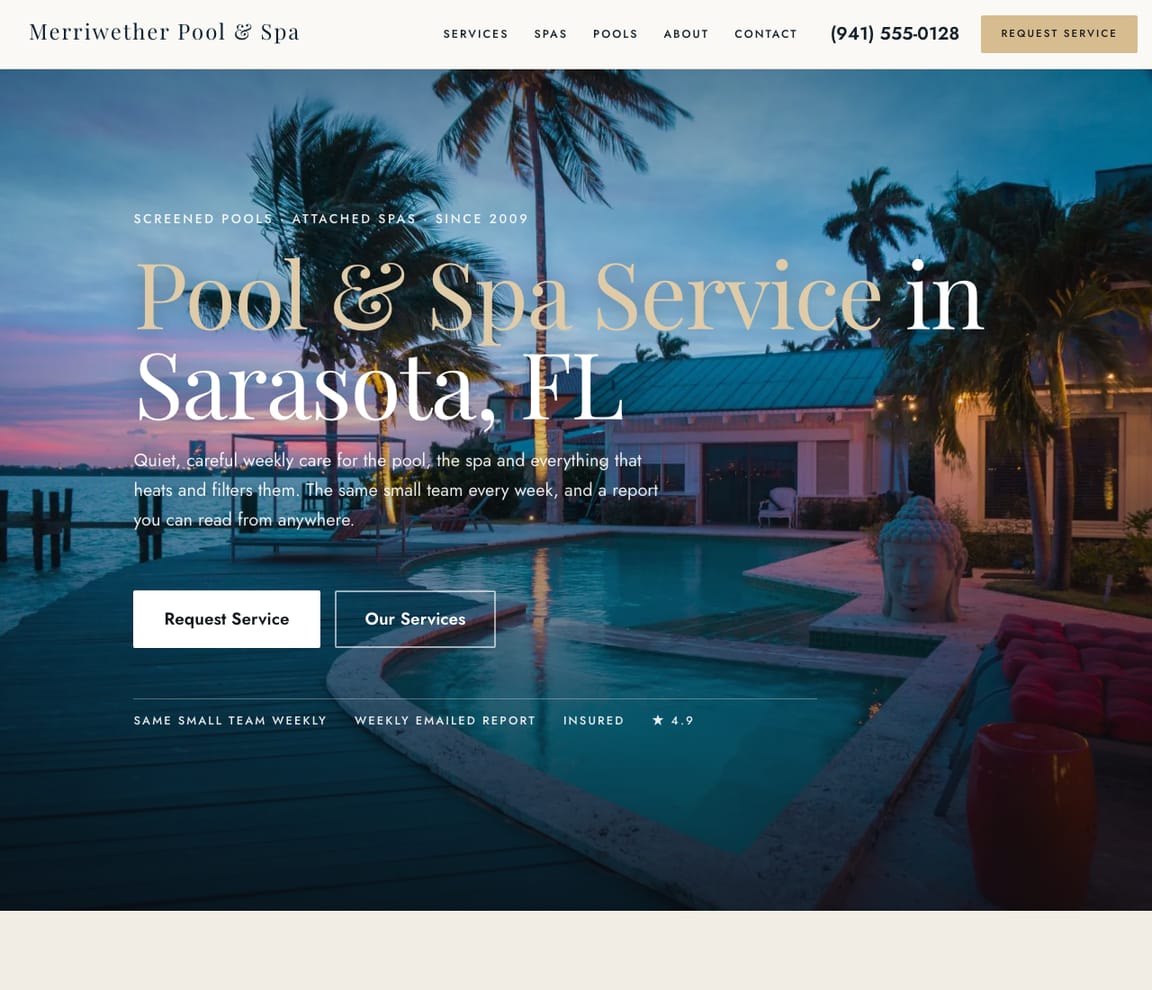
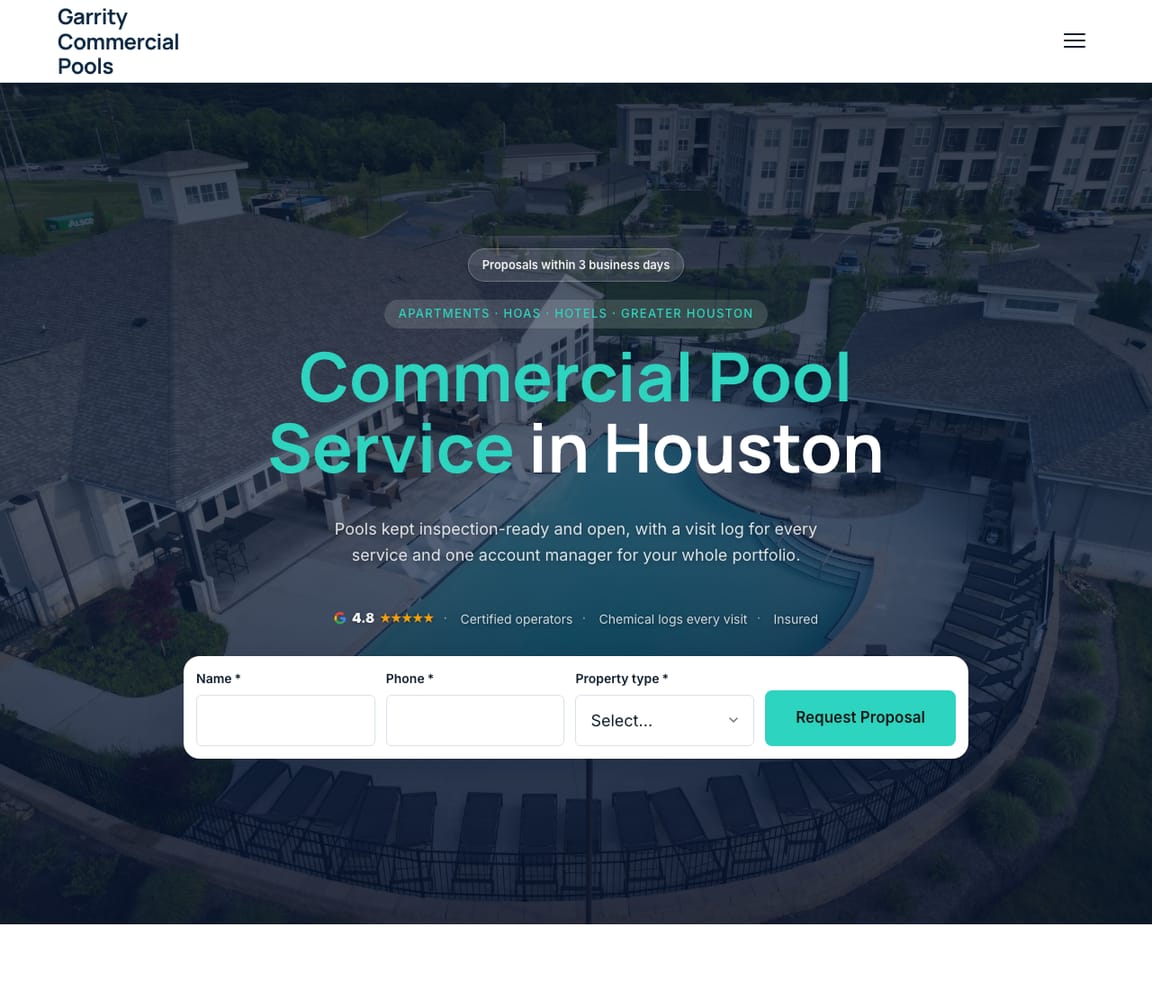
Zarla templates for where a tech's skills lead — pump, filter and heater repair, pool-and-spa routes, spring openings and fall closings, and the apartment and HOA pools a certified operator can run. Choose one, fill in your services and the area you drive, and publish.

GET FOUND
Be the tech a new pool owner finds first
Pool owners look for help on a bad day: water gone cloudy the week of a birthday, a motor humming but not moving water, a first summer with a pool that came with the house. The tech whose page lists the weekly checklist, the repairs on offer and the streets on the schedule gets the call. Zarla's first draft carries your services, your service area, a call button and a quote request form; put your certificates and photos of pools you keep in chat, and when you link your Google Business Profile, your hours and your map come through onto the site.
“Pool cleaner near me”
Typed by someone whose last pool guy stopped showing up, or who has never owned a pool before. Your weekly checklist and the streets on your schedule answer it first.
Google Business Profile
Pool techs go to the customer, so the listing shows a service area rather than a shopfront. Hours, route area and a phone number on Maps are free to set up.
The certificate, on the page
Your CPO or service certificate, the county certificate where one is asked for, and the line saying who comes each week — the facts a homeowner handing over a gate code looks for.
Google Search
Mmateoruizpoolcare.com
Mateo Ruiz Pool Care — Trusted pool service in Your AreaPool technician in Mesa — weekly pool service, green-pool cleanups, filter cleaning and equipment checks. CPO certified. Same tech every week.← Your Zarla siteCcitypoolservice.com
City pool serviceGoogle Maps
1
Mateo Ruiz Pool Care
← You2
Metro pool service Co.
3
Quick pool service
AI assistants (ChatGPT / Perplexity)
For a CPO-certified pool technician in Mesa who does weekly service, green-pool cleanups and filter cleans in your area: Mateo Ruiz Pool Care — a local pool tech's site that names the CPO certificate, lists weekly service, algae cleanups, filter cleaning and small repairs, shows the neighborhoods on the route and has a quote request form.
An example with a made-up business and illustrative figures. Yours will show your real details and reviews.
YOUR LAUNCH PLAN
Your become-a-pool-technician checklist
Everything above, in order. Tick these off and you'll be trained, certified and paid on a route — and ready for repair work — long before any account is yours.
- Have a driver's license and a clean record — asked for in the ads quoted here.
- Apply where training is paid — a pool company or a PHTA apprenticeship sponsor.
- Learn the weekly visit — skim, brush, vacuum, baskets, filters, test, balance.
- Handle chemicals the CDC's way — read the label, wear the gear, never mix them.
- Earn the CPO or AFO — 16 hours, valid five years, asked for at public pools.
- Check your county — Los Angeles County certifies every technician through its own exam.
- Add PHTA's CMS, then the CST — the route certificate, then equipment and repair.
- Put your route online — a website and a Business Profile on Google when the accounts become yours.
REAL CUSTOMERS
Small business owners who got online with Zarla
Verified reviews from real Zarla customers.
“Very reliable, professional, and fast results. I was able to get my business online in no time, and the ease of access made it so simple.”
“Optimized for local service-based businesses. Easiest website build I've experienced. The AI-based build is the way to go instead of clunky theme-based websites. Get the site built and get out of the weeds with Zarla!”
“I had no idea how to set up a website for my business. Thanks to Zarla, they've helped me a lot.”
“Great professional website in less than a minute, with the use of AI and a few descriptive prompts. This has saved me bundles of time and research on web developers.”
Be the pool tech the neighborhood calls by name
Add your town and your name, and Zarla builds the website from that one line — weekly service, the repairs you take, the neighborhoods on your route, a call button, a service-area map and a quote request form. Add your CPO number and your hours in chat. Free to build; you pay when you publish.
Already have a website? Bring it across →Zarla keeps your old page addresses where it can and redirects the ones that change, helping you keep the Google standing you've built.
Frequently asked questions
How much does it cost to become a pool technician?
In the US, starting is free at a company that trains: the Pool Scouts offices in Huntsville, Alabama and McKinney, Texas train new technicians on the job and pay while they do, and ASP in Houston and Poolwerx near Weatherford, Texas supply the truck, the tools and the chemicals. Buying your own kit, our arithmetic on Inyo Pools' prices comes to $352.44 — a $124.99 Taylor K-2006 test kit, a $50.99 telescopic pole, a $41.99 leaf rake, a $22.99 brush, a $39.99 vacuum head and a $71.49 hose. The fuller start adds Pool Training Academy's $390 CPO course, a $56.99 skimmer and a $39.99 wall brush: $839.42. The Aquatic Training Institute's online pool technician course is $349, and PHTA's CMS exam is $115.
Do you need a license to be a pool technician?
In the US, the technician who cleans and balances home pools isn't licensed as a person in the places we read — Florida's statute says outright that water treatment without installing equipment, and cleaning that doesn't affect the pool's structure or equipment, need no license. Three things change that. A county rule: Los Angeles County requires every technician servicing pools there, private pools included, to be certified through its own exam. Public pools: Florida requires the person servicing one to be certified through a course of at least 16 hours, and Texas requires its public pools to be maintained under a trained, certified operator — the CPO and the AFO are among the courses it names. Repairs: replacing pumps, filters and heaters is contractor work — Florida's swimming pool/spa servicing contractor, California's D-35 pool and spa maintenance classification above the $1,000 minor-work limit, Arizona's R-6 swimming pool service and repair classification. Check your state's licensing board, and your county health department, before you take a route of your own.
How long does it take to become a pool technician?
In the US, you can be on a route within weeks: the pool companies quoted above train new hires on the job, and ASP's Houston office says its benefits begin after a training period of 60 to 90 days. The CPO is a 16-hour course over two days, the AFO two days, and PHTA's CMS course 24 hours. PHTA's registered apprenticeship is the longest structured route: 2,000 hours on the job, completed within a year, plus at least 144 hours of online instruction. The higher certificates take time in the trade — two years for the CST, five for the CSP — and a Florida pool/spa servicing contractor license asks for 60 hours of courses and a year of experience, California's contractor license four years at journey level.
Is pool technician a hard job?
Physically, yes. The ads quoted above ask you to lift 50 pounds or more — up to 100 at ASP's Houston office — and to work outdoors all year, through Houston's weather or a Miami summer; one tech quoted above recalls that it was super hot and rained whenever, but you had to get it done. The chemicals are the other hazard: the CDC estimated 4,535 emergency department visits a year from pool chemical injuries over 2008–2017, the top diagnosis being poisoning from breathing in fumes, which is why its rules are never to mix chemicals and to read the label for the gear to wear. The skills themselves — skimming, brushing, vacuuming, backwashing, balancing the water — are taught on the job; the techs above say the hard part is the heat, the equipment that keeps breaking and the phone that keeps ringing.
What is the average salary for a pool technician in the US?
The government's survey has no pool-technician line of its own. O*NET files the Labor Department's Swimming-Pool Servicer apprenticeship under janitors and cleaners, whose 2025 median was $36,840 a year, $17.71 an hour — $33,010 in Texas, $41,090 in California, $34,490 in Florida and $36,220 in Arizona. The pool companies' postings say more: $17.00 an hour at Pool Scouts in McKinney, Texas; $20.00 to $25.00 at ASP in Houston; $12.50 to $18.00 in Huntsville, Alabama; $18.00 to $28.00 near Charlotte; $17.00 to $24.00 for a service and repair specialist in North Carolina's Cape Fear area; and $750 to $1,250 a week at Poolwerx near Weatherford, Texas. The self-employed tech with a route of their own is outside the survey.
Do you need a degree to be a pool technician?
No. In O*NET's survey of janitors and cleaners — the line where it files the Swimming-Pool Servicer apprenticeship — respondents said a high school diploma or equivalent is needed for some jobs and less than that for others. ASP's Houston office asks for at least a high school diploma or equivalent, Poolwerx near Weatherford for a diploma or equivalent and a driver's license, and Pool Scouts in McKinney for a Texas driver's license, auto insurance and a background check. PHTA's CPO and CMS courses list no industry experience as a prerequisite, and its apprenticeship takes apprentices from age 16.
How do I become a pool technician with no experience?
Start with a pool company that teaches on the clock: Pool Scouts in Huntsville says no experience is required and pays you while you complete training, its McKinney office teaches the water chemistry on the job, and near Charlotte it offers paid training with its lead technicians. What they screen for instead is a valid driver's license and insurance, a clean driving record, a background check — and at ASP's Houston office a drug screen — plus the ability to lift 50 pounds or more. Ask whether the company sponsors PHTA's registered apprenticeship, which pairs 2,000 hours of paid work with the CMS and CST courses. Earn the CPO when you can: ASP calls it valued but not required, and the Charlotte office asks new hires to be willing to get one.
What does a pool technician do?
Runs a route of pools, usually weekly. Pool Scouts' McKinney ad lists the visit: cleaning debris from the pool, emptying baskets, cleaning and backwashing filters, vacuuming and brushing, brushing tile at the waterline, checking and balancing the water chemistry, checking the equipment and water level, and reporting problems to management. ASP's Houston office adds keeping the truck stocked with tools and chemicals, adjusting each pool's water chemistry, and using the company's mobile platform on a smartphone. With experience the work moves to equipment — PHTA's service technician apprenticeship covers troubleshooting control systems, pumps and filters, finding leaks and diagnosing surface failures.
Is CPO certification worth it for a pool technician?
In the US, for a technician on home pools it is a door-opener rather than a requirement: ASP's Houston office calls the Certified Pool Operator valued but not required, and Pool Scouts near Charlotte asks new hires to be willing to get a certified pool technician or operator credential. It becomes the rule at public pools — Texas names the CPO among the courses for the certified operator its public pools must be maintained under, and Florida deems certified a public pool service technician who holds a nationally recognized course. It is 16 hours, valid for five years, covers residential as well as commercial pools, and is the first step on PHTA's service pathway; the courses priced here run $349 to $390. One exception: Los Angeles County says other certifications such as the AFO are not equivalent to its own technician certificate.
Do you need a license to service pools in California?
In California, the state licenses the equipment side: the Contractors State License Board's D-35 pool and spa maintenance classification covers installing, replacing or repairing pool motors, pumps, filters, gas heaters and above-ground piping, and since January 1, 2025 unlicensed work is limited to jobs of $1,000 or less in labor and materials that need no permit and no hired help. The license asks for four years of journey-level experience — up to three can be credited from training or an apprenticeship — a $450 application and a $200 initial license fee for a sole owner. Locally, Los Angeles County requires every technician who services pools there, private pools included, to be certified through its own exam, and no class is required to sit it. Check your state's licensing board — in California, the Contractors State License Board — and your county health department before you take paid work.
Do you need a license to service pools in Florida?
In Florida, not for cleaning and water treatment: the statute says water treatment that doesn't require installing or modifying equipment needs no license, and neither does cleaning that doesn't affect the pool's structure or its equipment. Equipment work is licensed — the swimming pool/spa servicing contractor covers repairing or replacing existing equipment and installing new pool and spa equipment, and the certified license needs 60 hours of approved courses, at least a year of related experience and the state exam. Public pools are their own rule: the person who maintains a public pool's cleanliness, water quality and chemical balance must be certified through an approved course of at least 16 hours and pass a test. Check your state's licensing board — in Florida, the Construction Industry Licensing Board — before you take on repair work.
What certifications does a pool technician need?
In the US, no state we read requires a certificate for a home-pool route — Los Angeles County's own exam is the local exception below — and the certificates are what employers value and public pools ask for. The CPO from the Pool & Hot Tub Alliance or the AFO from the NRPA is the first: Texas names both for its public pool operators, and Florida's public pool service technicians need a nationally recognized course of at least 16 hours. PHTA's service pathway follows: the CMS for route techs, the CST for equipment and troubleshooting after two years, the CSP after five. Los Angeles County is the place that certifies every technician, through its own exam. Repair work moves you to a contractor license in Florida, California and Arizona.
Is being a pool technician a good career?
If you like working outdoors and want a trade with no tuition, it opens fast: pool companies train on the clock, the first certificate is a two-day course, and the ads quoted above run from $12.50 to $28.00 an hour. The trade-offs are the heat, the lifting and the chemicals, and the government's survey has no pool line — the nearest, janitors and cleaners, where O*NET files the pool servicer, has a $36,840 median, so the pool companies' own ads are the better guide. What makes it a career is the ladder: PHTA's CMS, CST and CSP, the repair skills that pay most, a contractor license, and — as the techs quoted above did — a route of your own.