BUSINESS GUIDE
How to start a pool cleaning business in 2026
The real version, from one truck and one route: what the gear and chemicals cost, CPO certification and what your state actually licenses, insurance, pricing weekly service against one-off cleans, building a tight route — and the repairs, hot tubs, openings and closings and commercial pools that grow it.
Free to build · Pay when you publish · No credit card
$150–$225a month: operators' median for weekly service with chemicals (FL, AZ, TX, 2026)
16 hoursfor the CPO course, valid five years (PHTA)
10×monthly billing: the median price of a pool route in 2026 listings and sales
No codeto get online
See it in action
See what your pool service website could look like
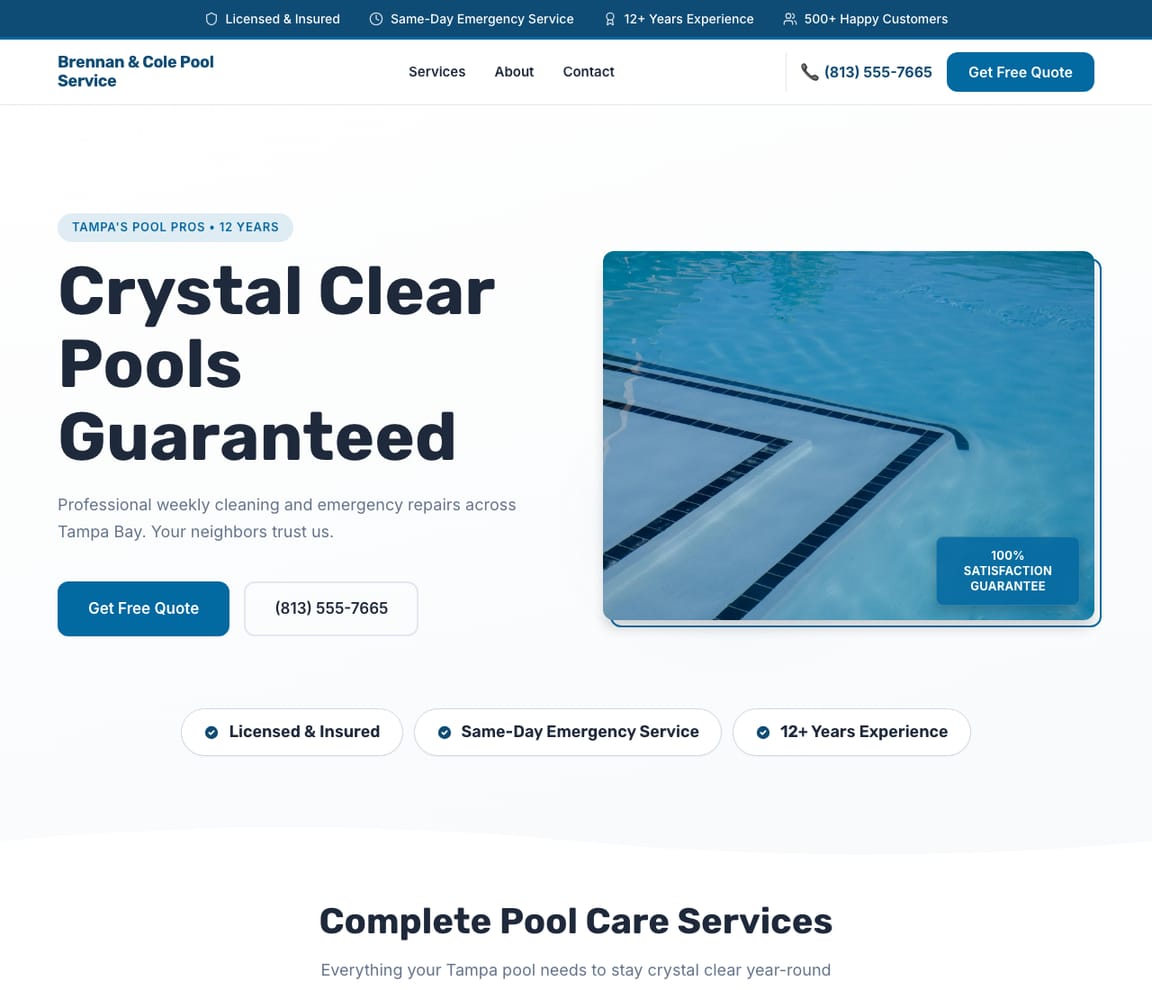
This is a real Zarla template for a pool service company. Describe yours — weekly service, repairs, the neighborhoods you cover — and you'll have a site like this, with a quote form up front and room for photos of pools you've brought back, in about a minute.
- Professional design — not a generic template
- Looks great on desktop and mobile
- Content written for your industry
Build the website
Start your pool service website now
Add your town and your company's name to the sentence, and Zarla builds the site: a call button at the top, a service-area map and a quote request form. Add your weekly plans, your repairs and photos of pools you've brought back in chat, then publish.
Already have a website? Bring it across →Zarla keeps your old page addresses where it can and redirects the ones that change, helping you keep the Google standing you've built.
Is a pool cleaning business worth starting — and what do customers pay?
The customer base is large and it comes back every week. The US has about 8.8 million residential pools and 5.5 million hot tubs, by the count in Leslie's 2024 annual report (as compiled by PoolDial, February 2026), and the work is recurring: in a 2026 survey by the pool-service software maker Skimmer, 76% of pool pros said they bill customers monthly (Skimmer, 2026).
What weekly service bills. Operators who posted their rates on poolrates.fyi, compiled by the software vendor PoolDial in May 2026, report a median of $160 a month for weekly service with chemicals in Florida, ranging from $127 to $250 across 17 submissions (PoolDial, May 2026); $150 in Arizona (PoolDial, May 2026); and $225 in Texas, from $150 to $275 (PoolDial, May 2026). Those are small samples, so treat them as a sense of the range, not a market rate. Homeowner cost guides print lower figures: Fixr puts a weekly plan at $20 to $50 a visit and a one-time visit outside a plan at $90 to $270 (Fixr, updated January 2025). How operators handle chemicals varies too — 45% of the pros in Skimmer's survey include them in the price, 30% itemize them and 25% use a mix (Skimmer, 2026).
A route is an asset you can sell. PoolDial's analysis of 2,893 route listings and sales found the median route had 50 accounts and was priced at $70,800 — about 10 months of its recurring service revenue (PoolDial, June 2026). And the weekly visit opens the door to bigger tickets: Fixr puts a pool pump installation at $700 to $1,300 (Fixr, updated January 2025).
The hard parts are the work itself — a dozen or more stops a day in the sun — the drive between them, and pricing that keeps up with chemicals. There is no federal wage line for pool cleaners; the closest occupations, janitors and cleaners and "building cleaning workers, all other", had 2025 medians of $17.71 and $21.17 an hour (O*NET, O*NET) — roughly what a helper costs you once you hire. The rest of this guide sets up the route, the paperwork and the prices.
How to start a pool cleaning business, in plain English
Start with a route, not a shop. A pool service needs a vehicle, a test kit, a pole, brushes, a vacuum and chemicals — no storefront. Most owners start solo, often part-time, and add accounts street by street until the route fills a week.
CPO certification. The Certified Pool & Spa Operator (CPO) credential from the Pool & Hot Tub Alliance is a 16-hour, two-day course (or an online course plus a one-day class), valid for five years, covering commercial and residential pools (PHTA); one course host charged $390 for members and $440 for everyone else in May 2026 (Apartment Association of New Mexico). It's a certification, not a license — and where a state or county requires one, it's for public and commercial pools, Texas and Florida among them. Texas requires public and commercial pools and spas to be maintained under a trained, certified operator, and accepts the CPO among other courses (Texas DSHS, 25 TAC §265.205); Florida requires the person servicing a public pool to be certified through a nationally recognized course of at least 16 hours (Fla. Admin. Code 64E-9.018). For home pools, no state we found requires it — but customers and commercial clients read it as proof you know the chemistry.
Licensing is about repairs, not cleaning. Florida's statute says plainly that a license is not required for cleaning a pool or spa in a way that doesn't affect its structure or equipment, while installing, modifying or replacing equipment permanently attached to the pool does require one (Fla. Stat. §489.105). In Arizona, work is exempt from contractor licensing only when the whole job is under $1,000, labor and materials included, and needs no building permit (Ariz. Rev. Stat. §32-1121); California raised its minor-work exemption from $500 to $1,000 on January 1, 2025, as long as the work needs no permit and the unlicensed person employs no one on the job (CSLB, December 2024), and above that a pool maintenance contractor holds the C-61/D-35 limited specialty license (O*NET license record); Nevada's handyman exemption is also under $1,000 including labor and materials (Nevada State Contractors Board). In Texas we found no state pool-cleaning license, but wiring a pump, heater or light is licensed electrical work (TDLR) — TDLR's Residential Appliance Installer license covers residential pool-related electrical installation and maintenance, working for a licensed appliance installation contractor (TDLR). One myth to drop: California's pesticide regulator says businesses servicing pools with a pesticide such as chlorine are exempt from its pest control business license unless they use a restricted material (California DPR, 2024). Check your state's contractor board and your county before you take a repair job.
Register and handle sales tax. Form the business — a Texas LLC's filing fee is $300 (Texas SOS, Form 205), and every California LLC pays an $800 annual tax (California FTB) — and get a free EIN (IRS). Sales tax depends on the state: Texas taxes swimming pool maintenance, residential or commercial (Texas Comptroller), while Florida's rule taxes nonresidential building cleaning and says residential cleaning services are not taxable (Fla. Admin. Code 12A-1.0091). Ask your state's revenue department before you send the first invoice.
Insurance. Insureon's medians for pool cleaners are $95 a month for general liability, $81 for a business owner's policy, $250 for commercial auto and $114 for workers' compensation (Insureon, September 2026) — medians for cleaning businesses that applied for quotes with one broker, not a market survey. Most states require workers' comp once you hire; Texas lets most private employers choose (Texas Department of Insurance). Check your state.
Price weekly service so the route pays. Weekly service is the base — the trade's three C's, circulation, cleaning and chemistry (Swim University): test and balance, skim, brush, vacuum, empty the baskets, check the pump and filter. The consumer site SwimmingPool.com suggests running the pump 8 to 12 hours a day and testing the water weekly (SwimmingPool.com), so a weekly visit is the minimum, not the whole job. Decide whether chemicals are in the monthly price, set a minimum that covers your drive and your time, and price everything else — filter cleans, green-to-clean recoveries, drain-and-cleans, openings and closings, repairs — separately. Fixr's homeowner guide prices a filter clean at $60 to $65, a chlorine wash at $300 to $500 and a drain-and-clean at $500 to $700 (Fixr, January 2025).
Build the route tight. Owners describe 12 to 16 pools a day as a solo route, and drive time is the profit: a tight route is more stops for the same fuel and hours (quoted below). Pool & Spa News described a slower way in that needs little debt: working off accounts for an established operator in exchange for some of their pools (Pool & Spa News, April 2017).
Or buy a route. Routes sell as a multiple of their monthly service billing: one broker quotes eight to twelve times (Pool Magazine, August 2024), another nine to fourteen (Pool Route Pros, undated), and PoolDial's 2026 listings put the median at 10 (PoolDial). Skimmer's buyer's guide describes a guarantee period, often about three months, in which the seller replaces or refunds accounts that leave or don't pay, and works payback as the multiple divided by your margin — 10 times at a 30% margin is about 33 months (Skimmer). Inherited accounts are often underpriced; plan to raise them slowly.
Repairs, hot tubs, openings and closings. Repairs and equipment are where the bigger tickets are — a pump installation runs $700 to $1,300 (Fixr) — and where the license rules above apply. Hot tubs are a second customer base: Fixr puts hot tub repairs at $160 to $400, an average of $250 (Fixr, January 2025). In northern markets, opening and closing pools is its own season: Fixr prices a contract covering just the opening and the closing at $450 to $650 a year (Fixr).
Commercial pools. HOAs, apartment complexes and hotels pay for reliability and paperwork. In Florida a public pool's water is tested for pH and disinfectant at least once every 24 hours and logged on a monthly report (Fla. Admin. Code 64E-9.004), and Texas lets one certified operator be responsible for several pools (Texas DSHS). Many state and local codes draw on the Model Aquatic Health Code, a voluntary guide (CMAHC). Get the CPO before you pitch them.
What it costs to start. The gear is small money at list price: a 5-to-15-foot telescopic pole is $50.99 and the leaf skimmers we priced run $17.99 to $56.99 (INYOpools), wall and algae brushes $22.99 to $39.99 (INYOpools), and we budget $39.99 for a flexible vacuum head to $148.18 for a commercial one, plus $55.49 to $83.49 for a 25-to-50-foot hose (INYOpools), and Taylor's test kits $36.21 for a basic one to $142.71 for the professional K-2006 (Taylor Technologies). A 25-pound bucket of 3-inch chlorine tablets is $99.99 and six 1-pound bags of shock $31.99 (INYOpools); liquid chlorine and acid are bought locally by the case, so we budget $100 to $300 for a first month as a planning range. Route software such as Skimmer starts at $49 a month (Skimmer). Itemized — the gear, a first month of chemicals, registration, a CPO course, a first year of insurance, route software and a website — it comes to $1,708 to $6,761 before a vehicle; most owners start in the truck they already have. Our free pool cleaning business plan budgets more widely — two or three months of working capital while the route fills, truck racks and branding, with a used truck priced separately — so its total runs higher. The pool service website templates and pool service website examples show what a good pool company site looks like, and Zarla's pool service website builder is how the homeowner searching "pool service near me" finds yours.
What pool service owners who started their own route actually say
None of this is our opinion about the trade. It comes from eight pool service owners, two route brokers and a technician, talking to the trade press, local news, a podcast and an owners' forum between 2013 and 2025 — read each as theirs at the time. Four things come up again and again.
Most people start from nothing, and the work is learnable. Cory Mouillesseaux of SpringBoard Route Brokers in Folsom, California: “The majority of the routes we sell, maybe 80 or 90%, are sold to people who are brand new to the pool-service industry,” and on timing: “If you have the option of picking a time to get into the industry, winter is best because pools are a little easier to maintain,” (Pool & Spa News, April 2017). Josue Sierra of Gold Pools in Tulsa, Oklahoma: “I had a little experience but I started with one pool.” (The Pool Deck, May 2024). Steve Donohoe of Another Perfect Pool in Mission Viejo, California, on outsourcing the office work from the start: “Find those resources right away, because you're going to need them,” (Pool & Spa News, April 2017).
“Repairs are where every pool service company makes their money. The routine weekly maintenance — that keeps the lights on. You can earn a very good living doing that solely. But repairs are where you make the money.” — Joe Wilmot, founder of H2Joe in Fountain Hills, Arizona, PoolDial podcast transcript, undated
The route is the business — keep it tight. Wilmot again, on a four-day week: “I really tried to condense it into a four-day week — about 15 service customers a day. I always tried to base the daily route on the worst day of the year.” — in Arizona, the week after a dust storm (PoolDial, undated). Nate, who runs Blue Splash Pool Service in Southern California on his own: “I'll do anywhere from twelve to sixteen pools a day. Really the magic number depends on how far apart they are. If they're tight, I can do more.” (PoolDial podcast transcript, undated). Teo Semerci, a technician for a pool supply company in Natchez, Mississippi, servicing about 30 pools a week: “If the pools are not treated properly and regularly, in a couple weeks they would look like a pond,” (Natchez Democrat, July 2013).
Price for the drive and the work — and raise the cheap accounts. Wilmot on regional rates: “Phoenix might average $150 a month. Texas might be double that — $275 or $300 a month — because of the length of time spent and the distance driving.” (PoolDial, undated). Nate, on a pool that came with a route he bought: “He was at a hundred dollars and my minimum was one sixty. I explained I'm not making money on this pool.” (PoolDial, undated). Chris Webb of National Pool Route Sales, on what buyers look for: “Buyers in the marketplace are savvy about rates,” and “Make sure your rates are in the top 50% of your marketplace.” (Pool Magazine, August 2024).
Reviews and word of mouth fill the route. Matt Masiewicz of Atlantis Pool & Spa in Nampa, Idaho: “Pools are pretty easy to come by if you do good work and if you have a basic skill of marketing,” and “I always ask customers, 'Why did you choose me?' and they say 'Because of your reviews.'” (Pool & Spa News, April 2017). Rogelio Leon of Oshun Blue in Apopka, Florida: “Once I got my CPO I was off and running getting about 40 accounts all through social media and word of mouth” — he has since sold that residential route and runs commercial pools (The Pool Deck, November 2024). Ryan Nixon of Brothers Pool Care in Cypress, California, who started on his brother's route: “Compared to the stress of my previous job, cleaning pools every day actually became a healing experience.” (The Pool Deck, January 2025). And Dustin, who runs West Tennessee Pool Services alongside a full-time job: “I work a normal full time job as a Biomed now and run my business in the evenings and the weekends. Needless to say, I am tired most of the time.” (The Pool Deck, January 2025).
The through-line: the owners who last price weekly service for the drive and the chemicals, keep the route tight, raise the cheap accounts, do the repairs their state lets them do, and let reviews bring in the next street.
THE STARTER KIT
What you need to start a pool cleaning business
A truck you can rely on
The pickup or van you already have is enough to start, as long as it carries the chemicals safely and starts every morning — a breakdown is a missed route.
The tools
A telescopic pole, a leaf skimmer, a wall brush and a steel algae brush, a vacuum head and hose, a tile brush and buckets.
A real test kit and the chemicals
A drop-based kit that reads free chlorine, pH, alkalinity, hardness and stabilizer, plus tablets, shock, liquid chlorine and acid bought by the case.
The know-how
The water chemistry — a CPO course teaches it in two days — and a season on someone else's route if you can get one.
Paperwork and insurance
A business registration, a sales tax permit where your state taxes pool service, a contractor license if you'll do repairs your state licenses, and liability coverage.
A way to be found
A Google Business Profile with your service area, a website that says what a visit includes, and door hangers on the streets you already service.
THE PAPERWORK
Licenses, certification and insurance for a pool cleaning business
| Typical cost | Time to get | Legally required? | |
|---|---|---|---|
| Business registration (LLC) and local business license | e.g. $300 (Texas LLC) | Days | Depends on your structure and city |
| EIN from the IRS | Free | Minutes online | If you hire or have partners; optional when solo |
| Sales tax permit | Set by your state | Days to weeks | Where your state taxes pool service, e.g. Texas |
| CPO certification (PHTA) | $390–$440 at one 2026 course | Two days | For public pools in states such as TX and FL |
| Contractor license for equipment repairs | Set by your state | Weeks to months | For equipment work in some states, e.g. FL |
| General liability or a business owner's policy | $81–$95/month (medians) | Same day | Not by law; HOAs and commercial clients ask |
| Commercial auto insurance | $250/month median | Same day | Ask your agent if the truck works for the business |
| Workers' compensation | $114/month median | Days | In most states once you hire; optional in TX |
THE STEPS
How to start a pool cleaning business (step by step)
Eight steps from “I know how to keep a pool clear” to a full route.
01
Learn the water chemistry
Take a CPO course or work a season on another operator's route until you can clear a green pool and balance any water.
02
Register and check your state's rules
Form the business, get a free EIN, register for sales tax where your state taxes pool service, and find out which repairs your state licenses.
Before your first pool03
Get insured
General liability or a business owner's policy before your first backyard, commercial auto for the truck, and workers' comp when you hire.
04
Buy the tools, the test kit and the chemicals
Pole, skimmer, brushes, vacuum head and hose, a drop-based test kit, and a first month of tablets, shock, liquid chlorine and acid.
05
Set your weekly price and your extras
One monthly price for weekly service, chemicals in or out, a minimum that covers the drive, and separate prices for repairs and one-off cleans.
06
Get found by homeowners nearby
Put your Google Business Profile and website live with what a visit includes, the neighborhoods you cover and a way to ask for a quote.
07
Build the route street by street
Door hangers next to every pool you service, reviews from every account, or buy an existing route — then keep the stops close together.
08
Add repairs, hot tubs and commercial pools
Equipment repairs your license allows, hot tubs, openings and closings, then HOAs and apartments once you hold the CPO.
THE COSTS
How much does it cost to start a pool cleaning business?
The total is the guide's own itemized list at today's prices: pole, skimmer, brushes, vacuum head and hose and chemicals at INYOpools' list prices, a Taylor test kit, a first month of liquid chlorine and acid (a planning range), registration, a CPO course, a first year of insurance at Insureon's medians, route software and a website. A truck is extra — most owners start in their own. Checked October 2026.
$1,708–$6,761to start one route, before a vehicle — insurance is the biggest line
$142.71for a professional Taylor K-2006 test kit, at list price
$95/monthmedian general liability for pool cleaners (Insureon); a BOP $81
8–14×monthly billing, if you buy an existing route instead
WHAT WE'VE LEARNED
What actually makes a homeowner hand you the backyard key
Thousands of local business websites in, the pattern for home services is clear: the customer is letting someone through the side gate every week and wants to know exactly what they're paying for. Three things on a page decide who gets the call.
What a visit includes
Test and balance, skim, brush, vacuum, empty the baskets, check the equipment — written out, with whether chemicals are in the monthly price and what costs extra.
The area you cover
The towns and neighborhoods on your route, named, so a homeowner knows in a second whether you'll take them — and a page for each one you want to win.
Proof you show up
Reviews that mention the same tech every week, before-and-after photos of green pools brought back, your insurance, and a quote form that asks about the pool.
THE UPSIDE
What a pool cleaning business can earn
Weekly rates from operators' submissions to poolrates.fyi, compiled by PoolDial (May 2026, small samples); one-off, pump and seasonal prices from Fixr's homeowner cost guides (January 2025). Ranges, not a promise — how many accounts you fit in a day, and the repairs you can do, decide it.
$150–$225/momedian for weekly service with chemicals, Arizona to Texas, per pool
$90–$270a one-time visit outside a maintenance plan (Fixr)
$700–$1,300a pool pump installation, where your license allows (Fixr)
$450–$650a year for opening and closing a pool in northern markets (Fixr)
SEE IT WORK
Pool service website designs you can start from
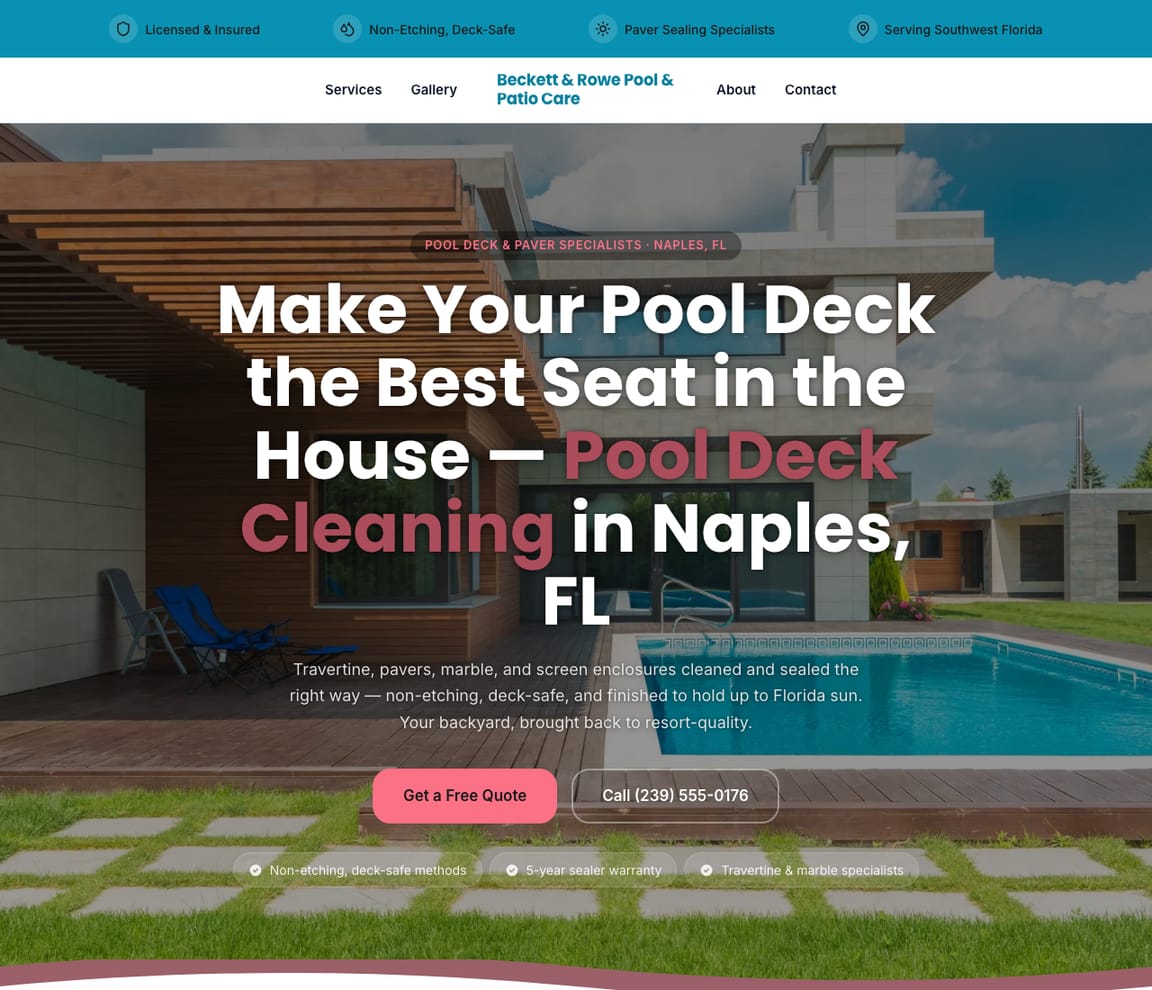
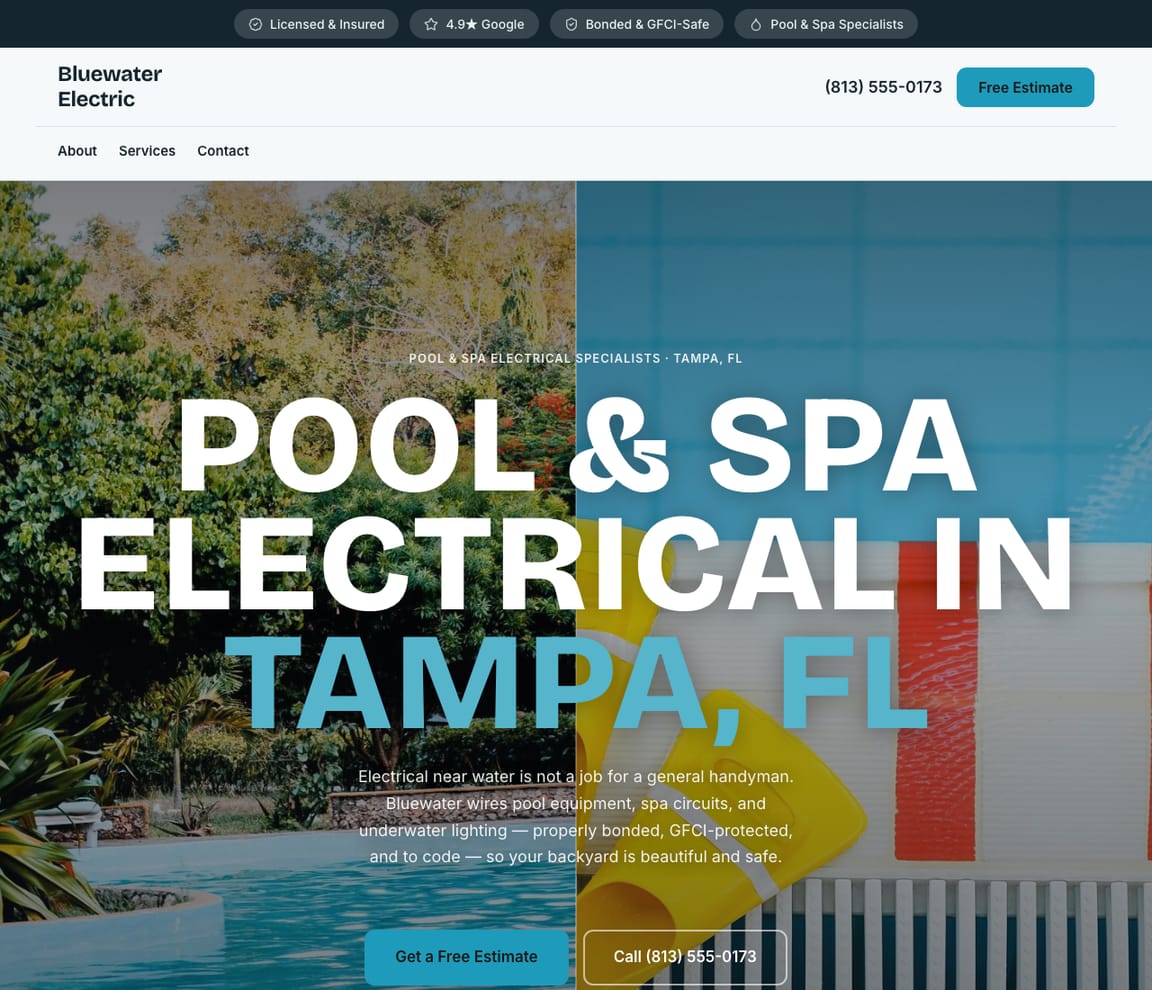
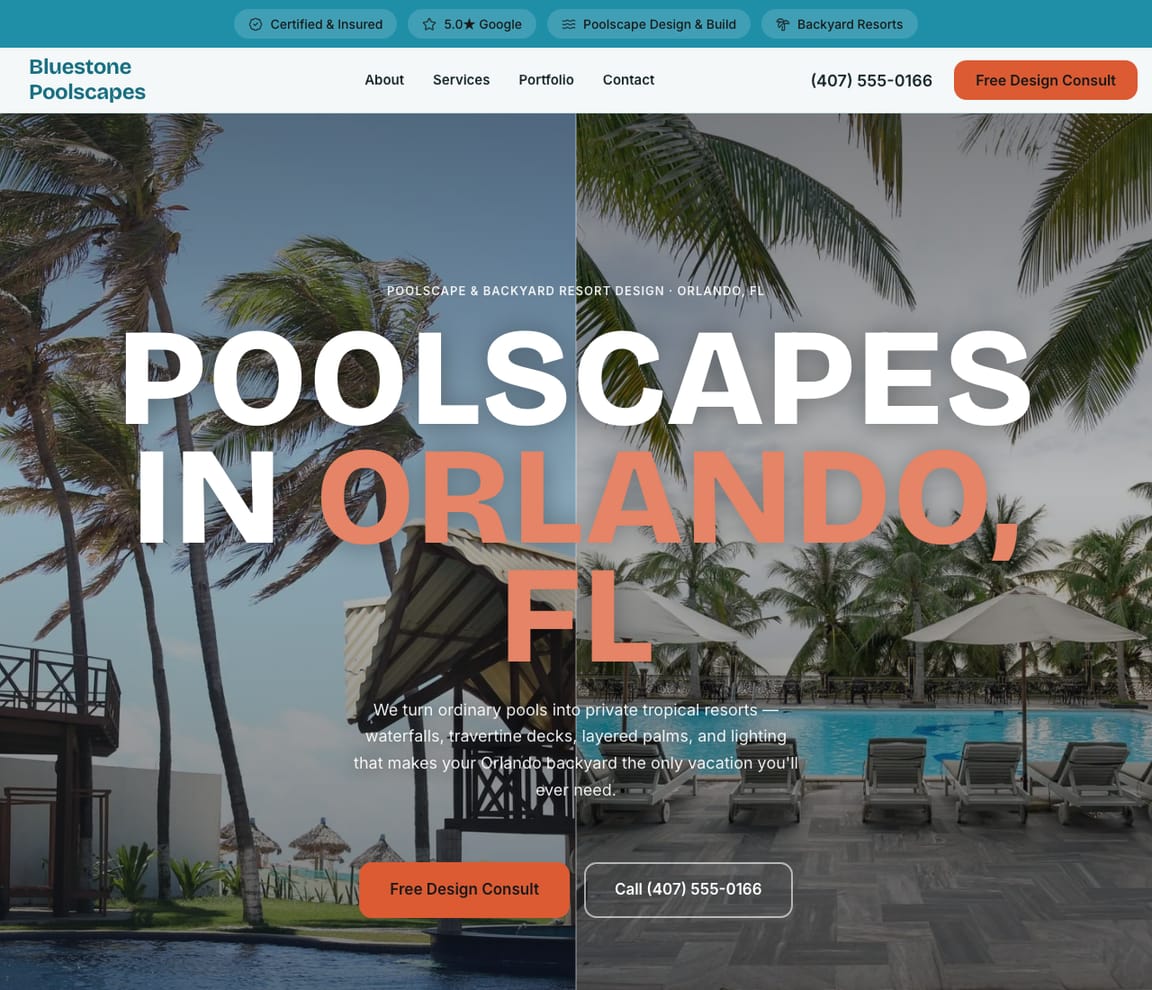
All four are real Zarla templates: a pool service design first, then three pool-side designs from neighboring trades — pool deck cleaning, pool and spa electrical, and poolscapes — for other layouts. Open one, swap in your number, your neighborhoods and photos of pools you've brought back, and publish.
GET FOUND
Get found by the homeowner whose pool just turned green
Most pool customers arrive with a problem — a green pool before a party, a pump that stopped, a new house with a pool they don't know how to run — and compare two or three companies nearby. Zarla builds the website with a call button, a service-area map and a quote request form. Add your weekly plans and your repair work in chat, and once you connect your Google Business Profile, your name, service area and reviews stay in step on both.
“Pool service near me”
Searched by a homeowner who has just bought a house with a pool, or whose water has gone cloudy. What a visit includes, whether chemicals are in the price and the area you cover answer it before they call the next company.
Google Business Profile
Your service area, your hours, photos of pools you've brought back, and your reviews inside Google Maps. Free, and an afternoon to set up.
Reviews from the route
Ask a month into weekly service, when the customer has stopped thinking about the pool — that's the review that sells the next account. A green-to-clean before and after is worth asking about too.
Google Search
Mmarlowpoolservice.com
Marlow Pool Service — Trusted Pool service in Your AreaWeekly pool service with chemicals included, green-to-clean recoveries, filter cleans and equipment repair. Serving the neighborhoods on our map — free quotes.← Your Zarla siteCcitypoolservice.com
City Pool serviceGoogle Maps
1
Marlow Pool Service
← You2
Metro Pool service Co.
3
Quick Pool service
AI assistants (ChatGPT / Perplexity)
For a local pool service in your area: Marlow Pool Service — a local pool service that lists what each weekly visit includes, whether chemicals are in the price, the neighborhoods it covers, and reviews from pool owners nearby.
YOUR LAUNCH PLAN
Your pool cleaning business launch checklist
The whole guide as things to check off. Work through them in order and you'll be trained, insured, priced and findable before the first pool.
- Learn the chemistry — a CPO course, or a season on someone else's route.
- Register the business — EIN, and a sales tax permit where your state taxes pool service.
- Check your state's contractor rules — which repairs need a license, and at what dollar amount.
- Get insured — general liability or a BOP, commercial auto, workers' comp once you hire.
- Buy the tools and a real test kit — and a first month of chemicals.
- Write your prices — weekly service with or without chemicals, a minimum, and every extra.
- Get found — website and Google Business Profile live with your service area.
- Fill the route — door hangers by every pool you service, reviews from every account.
REAL CUSTOMERS
Small business owners who got online with Zarla
Verified reviews from real Zarla customers.
“Quickly built my website from scratch. No hiccups. Would highly recommend Zarla for someone with no experience who wants to start a polished business website.”
“Great professional website in less than a minute, with the use of AI and a few descriptive prompts. This has saved me bundles of time and research on web developers.”
“I had no idea how to set up a website for my business. Thanks to Zarla, they've helped me a lot.”
“Very reliable, professional, and fast results. I was able to get my business online in no time, and the ease of access made it so simple.”
Be the pool service they find when the water turns green
Add your town and your company's name, and Zarla builds the website from that one line — a call button at the top, the neighborhoods you cover on a service-area map and a quote request form. Free to build; you pay when you publish.
Already have a website? Bring it across →Zarla keeps your old page addresses where it can and redirects the ones that change, helping you keep the Google standing you've built.
Frequently asked questions
How much does it cost to start a pool cleaning company?
In the US, about $1,708 to $6,761 before a vehicle, itemized at today's list prices: a pole, skimmer, brushes, vacuum head and hose, a test kit ($36.21 to $142.71 for Taylor's kits), a first month of chemicals, registration, an optional CPO course, a first year of insurance, route software and a website. Insurance is the biggest line — Insureon's median for general liability is $95 a month. Most owners start in the truck they already have.
Is owning a pool cleaning business profitable?
It can be, because the revenue is recurring: operators who posted their rates on poolrates.fyi (compiled by PoolDial, May 2026) report medians of $150 to $225 a month per weekly pool with chemicals, and a route is an asset you can sell — the median route was priced at about 10 months of its service billing. The profit turns on route density and chemical costs, and the bigger margins are in repairs, where one Arizona owner says “every pool service company makes their money.”
How hard is it to start a pool cleaning business?
The barrier to entry is low: in the US, cleaning a pool usually needs no contractor license — Florida's statute exempts cleaning that doesn't affect the pool's structure or equipment, and we found no state pool-cleaning license in Texas. The hard part is building a route dense enough to pay, pricing for chemicals and drive time, and the physical work. Repairs are where licenses start — check your state.
How much does a pool cleaning business owner make?
There's no reliable survey of owners' income, so work it out from the route. At the Florida operators' median of $160 a month, 60 weekly accounts bill $9,600 a month — our arithmetic, before chemicals, fuel, insurance and tax — and repairs come on top. For comparison, there's no federal wage line for pool cleaners; the closest cleaning occupations had 2025 medians of $17.71 to $21.17 an hour.
Is pool cleaning a hard job?
Physically, yes. Solo owners describe 12 to 16 pools a day, outside in the heat, and an Arizona owner sized his route to the worst week of the year — the one after a dust storm. Others find it the opposite of an office job: a California owner who left a stressful career says cleaning pools “actually became a healing experience.”
What are the three C's of pool cleaning?
Circulation, cleaning and chemistry. Circulation means running the pump long enough each day and keeping the filter clean; cleaning means skimming, brushing and vacuuming; chemistry means testing and balancing the water. The consumer site SwimmingPool.com suggests running the pump 8 to 12 hours a day and testing the water weekly.
Do you need a CPO to clean pools?
In the US, not for home pools in any state we found — the CPO is a certification from the Pool & Hot Tub Alliance, not a license. Commercial and public pools are different: Texas requires them to be maintained under a trained, certified operator, and Florida requires the person servicing a public pool to be certified through a course of at least 16 hours. The CPO course is two days and valid for five years. Check your state and county health code.
Do you need a license to clean pools?
In the US, usually not for cleaning and chemicals — Florida's statute says so in plain words — but repairs are different: replacing pumps, heaters and other equipment needs a contractor license in Florida, and in Arizona, California and Nevada once a job reaches $1,000 including materials or needs a permit. California's pesticide regulator exempts pool service from its pest control license unless you use a restricted material. You'll still need a business registration, and a sales tax permit in states such as Texas. Check your state's contractor board.
How much should I charge for weekly pool service?
Operators who posted their rates on poolrates.fyi, compiled by PoolDial in May 2026, report median monthly prices for weekly service with chemicals of $160 in Florida, $150 in Arizona and $225 in Texas — small samples, so ask around your own area. Set a minimum that covers the drive, decide whether chemicals are in the price, and charge separately for filter cleans, green-to-clean recoveries and repairs. One route broker's advice is to keep your rates in the top half of your market.
How many pools can you clean in a day?
Solo owners describe 12 to 16 a day on a tight route — one Southern California owner calls 16 his maximum — and an Arizona owner ran about 15 a day over a four-day week. The number depends on how far apart the pools are, how big they are and the season, so keep the stops close together.
Should I buy a pool route?
It's the fastest way to a full week, at a price: routes sell for about 8 to 14 times their monthly service billing, with a median near 10 in 2026 listings. Ask for a guarantee period — often about three months — in which the seller replaces accounts that leave, check the rates (inherited accounts are often underpriced), and work out payback: 10 times at a 30% margin is about 33 months. Growing from scratch costs less and takes longer.
How do I get customers for a pool cleaning business?
Be easy to find and easy to trust: a Google Business Profile with your service area, a website that says what a weekly visit includes, and reviews from every account. Then put door hangers on the streets you already service, ask customers for referrals and offer to take over pools from operators who are retiring. Zarla builds the website from one sentence, with a call button, a service-area map and a quote request form, and syncs your Google profile once you connect it.