CAREER GUIDE
How to become an HVAC technician in 2026
The one federal certification the law requires — EPA Section 608, with the four types and what the exam costs — then the state ladder, which differs in kind from Texas to California to Florida to New York, named from the boards; the apprenticeship, school and helper routes in; what the tools cost from the distributors' own prices; what technicians earn; and how to go from someone else's truck to your own.
Free to build · Pay when you publish · No credit card
4 typesof EPA Section 608 certification — the one card federal law requires of anyone who opens a refrigerant circuit, in every state, and it never expires
$61,010median pay for employed HVAC mechanics and installers in 2025 (O*NET, from BLS data); 10 percent earn $95,210 or more
$20to register as an air conditioning and refrigeration technician in Texas at 16 — the first rung, before the first paid hour
7% or higherprojected growth for 2025–2035, "Much faster than average", with 40,600 openings a year (O*NET)
See it in action
See what your HVAC website could look like
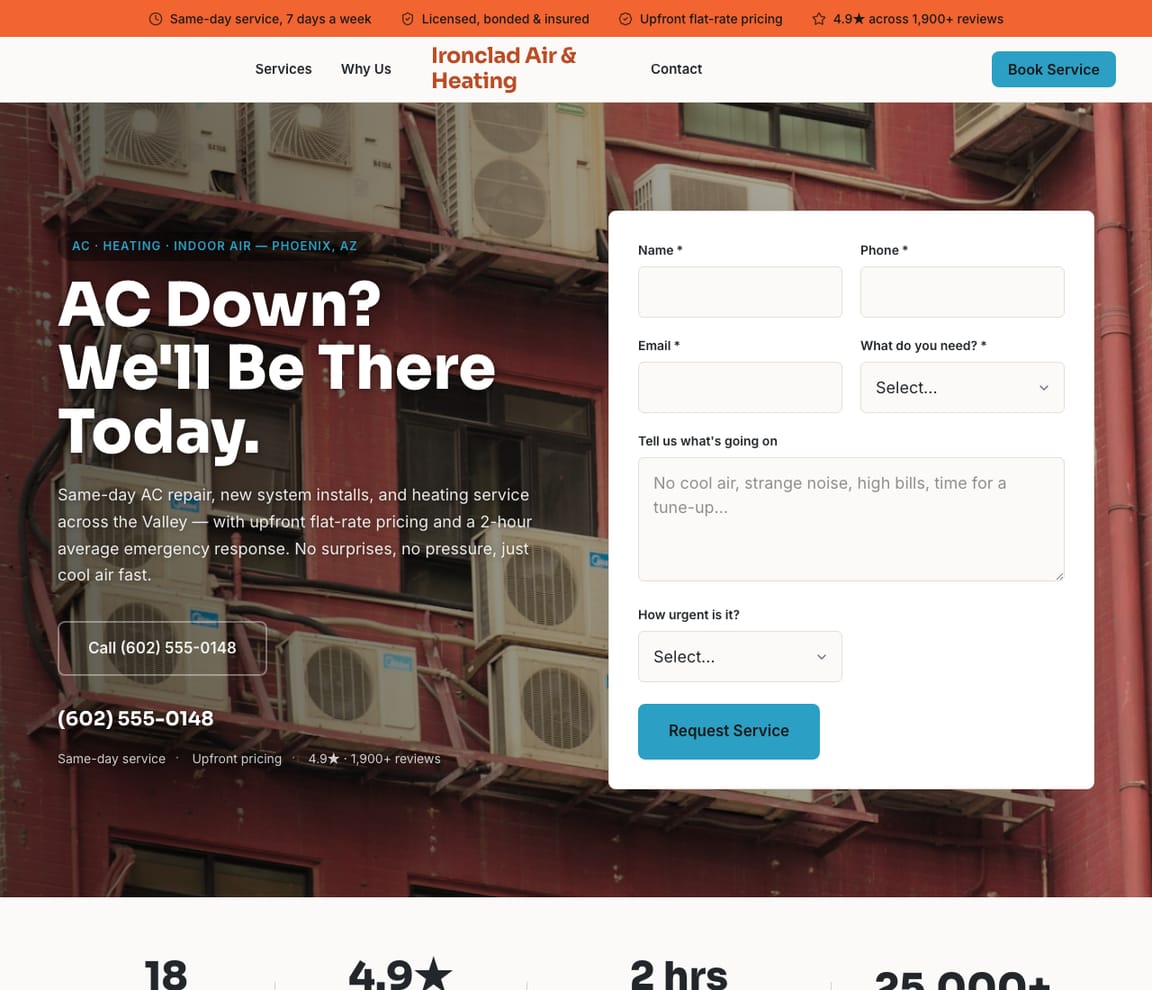
A real Zarla template for a heating and cooling company — "AC down? We'll be there today" beside a service form that asks how urgent it is, the services and the maintenance plan underneath, the license number where a homeowner looks for it. Describe yours — the town, the services, the hours — and you'll have a site like this, with a call button and a service-request form, in about a minute.
- Professional design — not a generic template
- Looks great on desktop and mobile
- Content written for your industry
Build the website
Start your HVAC website now
Add your town and your business name to the sentence, and Zarla builds the site: your services, the area you cover, a call button and a service-request form. Add your prices and your license number in chat, then publish.
Already have a website? Bring it across →Zarla keeps your old page addresses where it can and redirects the ones that change, helping you keep the Google standing you've built.
Is becoming an HVAC technician worth it in 2026 — and what does the work pay?
Becoming an HVAC technician is one federal card and one state ladder — the EPA certification everyone needs, then whatever your state asks, which runs from a technician registration at 16 in Texas to nothing at all for the worker in California — and at the top of it a local company whose phone rings on the hottest day of the year. Three honest numbers first. Employed heating, air conditioning and refrigeration mechanics and installers had a median of $61,010 a year in 2025, $29.33 an hour: 10 percent earned $40,050 or less, 10 percent $95,210 or more (O*NET, from BLS 2025 wage data). The headcount is large and growing: "Employment (2025) 440,900 employees", "Projected growth (2025-2035) Much faster than average (7% or higher)", "Projected job openings (2025-2035) 40,600" (O*NET, employment and outlook). And the survey behind the wages leaves out the self-employed (Washington ESD) — which is the technician with their own trucks, so the median measures the employee, not the owner.
State by state, and against the plumbers. The employed median is $57,760 in Texas, $72,560 in California, $56,670 in Florida and $74,430 in New York (O*NET, Texas; California; Florida; New York). Plumbers, pipefitters and steamfitters had a median of $63,800 the same year, with a 90th percentile of $108,420 against the HVAC trade's $95,210 (O*NET, plumbers) — $2,790 more at the median, with a longer licensing ladder in Texas, Illinois and New York City. And the "$200K in HVAC sales" people search for belongs to a different occupation: technical and scientific product sales representatives had a median of $104,920 and a 90th percentile of $200,440 in 2025 (O*NET, sales representatives). The occupation is "Job Zone Three: Medium Preparation Needed" — "Most occupations in this zone require training in vocational schools, related on-the-job experience, or an associate's degree" (O*NET, job zone); of the technicians surveyed, the two education answers were "High school diploma or equivalent required for some jobs" and "Post-secondary certificate required for some jobs" (O*NET, education).
What changed in 2025. "Beginning January 1, 2025, certain technologies will need to restrict use of higher-GWP HFCs or HFC blends" — the EPA's rule for "installing lower-GWP HFC residential air conditioning and heat pump systems", with the old inventory "manufactured or imported before January 1, 2025, to be installed until January 1, 2026" (EPA, Technology Transitions). A new technician learns the new refrigerants from the first day, and the 608 card is what lets you buy any of them: "Only Section 608 certified technicians can purchase refrigerants intended for use with stationary refrigeration and air-conditioning equipment" (EPA, refrigerant sales restriction).
The catch. The work is hot, high and heavy — in O*NET's survey 45 percent of technicians are "Exposed to Hazardous Equipment" every day, 34 percent work "in very hot (above 90 F degrees) or very cold (below 32 F degrees) temperatures" every day and 31 percent are "Exposed to High Places" every day (O*NET, work context); the hours toward a contractor license run four years in Texas and Florida; and the business is seasonal and on call. That's what the rest of this guide sets up: the federal card and the state ladder from the agencies, the routes in and what each costs, the tools from a distributor's own prices, and how to be the company the no-cool call reaches first.
How to become an HVAC technician, in plain English: the federal card, then your state's ladder
One rule is federal and the same everywhere. "EPA regulations (40 CFR Part 82, Subpart F) under Section 608 of the Clean Air Act require that technicians who maintain, service, repair, or dispose of equipment that could release refrigerants into the atmosphere must be certified" (EPA, Section 608 technician certification). The regulation's own words: "Any person who could be reasonably expected to violate the integrity of the refrigerant circuit during the maintenance, service, repair, or disposal of appliances … must pass a certification exam offered by an approved technician certification program" — Type I for "small appliances", Type II for "medium-, high-, or very high-pressure appliances", Type III for "low-pressure appliances", Universal for all three (40 CFR §82.161). "Tests must be administered by an EPA-approved certifying organization", "Section 608 Technician Certification credentials do not expire", and "The core test must be taken as a proctored exam in order to attain Universal Certification" (EPA, certification requirements); the approved organizations — ESCO Institute, Mainstream Engineering, RETA-RSES among them — set their own exam prices, and none of their price pages opened for a scripted reader, so no exam fee is printed here (EPA, approved certification programs). The card is also the only way to buy the gas: "Only Section 608 certified technicians can purchase refrigerants intended for use with stationary refrigeration and air-conditioning equipment" (EPA, refrigerant sales restriction), and sellers "must keep invoices that indicate the name of the purchaser, the date of sale, and the quantity of refrigerant purchased" for three years (40 CFR §82.154).
Then the state ladder, which differs in kind. Texas, Oklahoma, North Carolina and Washington register or license the worker at some rung; California, Florida, Nevada and Arizona test only the contractor; New York, Illinois and Colorado have no state HVAC license at all. Here is each, from its own board or statute:
- Texas: "A person may not engage in air conditioning and refrigeration contracting unless the person holds an air conditioning and refrigeration contractor license" (Tex. Occ. Code §1302.251), and the Department of Licensing and Regulation runs a three-rung ladder beneath it. Registered technician — "Any person who assists a licensed air conditioning and refrigeration contractor in performing air conditioning and refrigeration maintenance or repair work must register as a technician", "You must be at least 16 years old to apply", "non-refundable application fee of $20", with a criminal history check (TDLR, technician registration). Certified technician — at 18, after "24 months of air conditioning and refrigeration-related work under the supervision of a licensed air conditioning and refrigeration contractor" or "a department-approved certification program consisting of 2,000 hours of combined instruction and practical experience", a $50 application and an exam (TDLR, certified technician). Contractor — at 18, with "at least 48 months of practical experience in air-conditioning and refrigeration-related work under the supervision of a licensed air conditioning and refrigeration contractor in the past 72 months", or "a technician certification for the past 12 months and … at least 36 months of practical experience … in the past 48 months", documented by the supervisors ("Do NOT complete this form yourself"); "The Class A license allows you to work on any size unit. The Class B license allows you to work on cooling systems of 25 tons and under, and heating systems of 1.5 million BTUs/hour and under"; the fee is $115 for a one-year license; "You must maintain commercial general liability insurance at all times while your license is active" — $300,000 per occurrence, $600,000 aggregate and $300,000 for products and completed operations for Class A, $100,000, $200,000 and $100,000 for Class B (TDLR, contractor license). The exam is PSI's: Environmental Air Class A is "120 Items - 230 Minutes - 70%" for "$74", Class B "100 Scored Items - 170 Minutes - 70%" for "$60", "available in English and Spanish for no additional cost" (PSI candidate information bulletin); "If you fail an exam, you may schedule a retake with PSI, within 24-48 hours" (TDLR, exams). The homeowner's own house is exempt — "This chapter does not apply to a person who engages in air conditioning and refrigeration contracting in a building owned solely by the person as the person's home" (§1302.053) — and so is "a portable or self-contained ductless air conditioning product that has a cooling capacity of three tons or less" (§1302.058), though not a mini-split: "A 'Mini-Split' AC unit is not self-contained, it is a split AC system, therefore requiring a Air Conditioning Contractor's License to perform any contracting work for the public" (TDLR FAQ).
- California: no technician card of any kind. The Contractors State License Board licenses the business as a "C-20 - Warm-Air Heating, Ventilating and Air-Conditioning Contractor" and lists no journeyman or technician class (CSLB license classifications): "not less than four years experience as a journeyman, foreman, supervising employee or contractor in the particular class", with schooling or apprenticeship credited for at most three of them (16 CCR §825), a bond of "twenty-five thousand dollars ($25,000)" (B&P §7071.6), and no license at all where "the aggregate contract price for labor, materials, and all other items is less than one thousand dollars ($1,000)" and no permit is needed (§7048). The state's refrigerant program regulates facilities, not people — "facilities with refrigeration systems containing more than 50 pounds of high-GWP refrigerant" register and report leak inspections (CARB, Refrigerant Management Program), and the Air Resources Board says technician certification "is regulated by the U.S. EPA" (CARB). The CSLB's fee pages answered "Page Not Found" the day we read them, so no California fee is printed here.
- Florida: the state licenses the contractor in two classes — a "Class A air-conditioning contractor" is "unlimited", a "Class B air-conditioning contractor" is "limited to 25 tons of cooling and 500,000 Btu of heating in any one system" (Fla. Stat. §489.105) — certified statewide or registered locally. To sit the exam you must be "18 years of age" and have "a total of at least 4 years of active experience as a worker who has learned the trade by serving an apprenticeship as a skilled worker who is able to command the rate of a mechanic in the particular trade or as a foreman … provided, however, that at least 1 year of active experience shall be as a foreman", or a four-year degree in engineering, architecture or building construction plus "1 year of proven experience"; "a minimum of 2,000 person-hours shall be used in determining full-time equivalency" (§489.111). Technician cards are a county matter — the Pinellas County Construction Licensing Board's own notice reads "Certified County and Journeyman Licenses Expire September 30, 2026" (PCCLB, 2026) — and the other big counties' pages refused to open, so ask your county.
- New York (no state HVAC license): the nearest cards are New York City's — the Department of Buildings' oil-burner installer, where "Class A Oil Burning Equipment Installers are licensed to install any type of oil-burning equipment" and "Class B Oil Burning Equipment Installers are licensed to install oil-burning equipment that uses domestic grade fuel oils from one to four", a $100 license for three years after the same $585 written and $530 practical exams the master trades sit (NYC DOB, oil burner equipment installer), and the Fire Department's "Q01 Certificate of Qualification for Refrigerating System Operating Engineer" (FDNY certificates of fitness). A state-registered HVAC apprenticeship exists without a state license — one New York firm was "recently approved with NYS Dept Of Labor to partner on HVAC Apprenticeship" (Sylvia Cothia, Jetway Heating Cooling and Refrigeration, VoyageATL, October 7, 2026). Illinois (no state license): the state's list of licensed professions has no heating, air conditioning or refrigeration entry (IDFPR, professions list), and Chicago's trade-license list runs from general contractors and electricians to plumbers, boiler engineers and crane operators with no HVAC license among them (Chicago Department of Buildings). Colorado (no state license): the state's occupational list carries the electrical and plumbing ladders and nothing for heating or air conditioning (Colorado DPO, occupational professions) — HVAC contractor licensing there is a city matter.
- North Carolina — a heating license from the plumbing board, by group: "To be eligible to take the Plumbing, Heating Group No. 1, Heating Group No. 2 and/or Heating Group No. 3 Contractor examination(s), an applicant must have 2 years (4,000 hours) on-site full-time experience in the installation, maintenance, service, or repair of plumbing or heating systems related to the category for which license is sought, whether or not license was required for the work performed", with a technician license beneath it — "Applicants for Class I licensure must have 18 months (3,000 hours) of the required experience, while an applicant for Class II licensure must have 15 months (2,500 hours)" (NC State Board of Examiners of Plumbing, Heating and Fire Sprinkler Contractors); no dollar fee was on any of the board's pages that opened. Oklahoma — the Construction Industries Board registers the apprentice ("apply for an Apprentice Registration card … so your work hours will count towards experience to becoming a journeyman", at "no more than three Apprentices directly supervised by a Journeyman or Contractor" — Oklahoma CIB, mechanical apprentice), licenses the journeyman — "at least eighteen (18) years of age and have (A) three (3) years of verifiable experience in the mechanical trade", or a 1,000-hour approved program plus one year, or a 500-hour program plus two (CIB, mechanical journeyman) — and the contractor, who "must meet the same requirements as a journeyman with an additional one (1) year of experience in the mechanical trade" (CIB, mechanical contractor); "Bond and Insurance is required to activate your Contractor license" and "six (6) hours of continuing education within the preceding thirty-six (36) months" keep it (CIB, mechanical industry). Washington — no HVAC license, but the electrical side of the work needs a specialty electrician card: "No person may engage in the electrical construction trade without having a valid … specialty electrician certificate of competency" (RCW 19.28.161), and the "HVAC/refrigeration (06A)" specialty "is not limited by voltage, phase, or amperage", may "Install, repair, replace, and maintain line voltage components within HVAC/refrigeration equipment" and may not "Install line voltage controllers or disconnect switches external to HVAC/refrigeration equipment" (WAC 296-46B-920). Nevada — a contractor license only, and no small-job exemption for this trade — the under-$1,000 exemption excludes it by name: "Any work to repair or maintain property the value of which is less than $1,000, including labor and materials, unless: (a) A building permit is required to perform the work; (b) The work is of a type performed by a plumbing, electrical, refrigeration, heating or air-conditioning contractor"; the qualifying individual needs "at least four full years of experience at a journeyman level, or as a foreman, supervisor, or contractor in the classification for which you are applying" (Nevada State Contractors Board FAQ). Arizona — a Registrar of Contractors license, with no license at all where "the total value of the sales contract or transaction … does not exceed $1,000, including labor, materials and all other items", unless "a local building permit is required" (A.R.S. §32-1121). Ohio, Georgia and Michigan license HVAC or mechanical contractors at state level and Massachusetts licenses refrigeration technicians, on pages that refused to open the day we read them, so none of their hours or fees is printed here.
How you learn it. Three doors. A helper's job at a service company — the Texas registration at 16 is built for it, and the technicians quoted below started there. A union apprenticeship: "An apprenticeship with the United Association (UA) is your gateway to a rewarding, high-demand career in the piping, plumbing, HVACR, welding, or fire protection trades" and "UA apprenticeships typically last five years", paid from the first week and registered with the Department of Labor (United Association; its members do "the installation, maintenance, and service of heating, ventilation, air conditioning and refrigeration (HVACR) systems across North America" — UA, HVACR). Or school first: Texas State Technical College's HVAC Technology program — "Choose a certificate or a two-year degree", at six campuses, day or night — prints estimated costs of "$5,568" for the residential service technician certificate, "$8,352" for the HVAC technician certificate, "$11,136" for the second certificate and "$13,920" for the associate degree (TSTC, HVAC Technology), at "$232" a credit hour for a Texas resident, "$3,480" for 15 (TSTC tuition table, 2026–27) — and in Texas a 2,000-hour approved program is itself the route to the certified technician exam. NATE and HVAC Excellence sell voluntary certifications on top; their pages refused a scripted reader, so no fee or exam name is printed. The diploma is the school's rule, not the state's: Texas's technician registration asks for age 16, the fee and a background check.
You are self-employed from the first invoice. In the US a one-truck HVAC company is a sole proprietorship by default: "Use Schedule C (Form 1040) to report income or (loss) from a business you operated or a profession you practiced as a sole proprietor" (IRS, Schedule C instructions); "The self-employment tax rate is 15.3%" once net earnings reach $400 (IRS), and sole proprietors "generally have to make estimated tax payments if they expect to owe tax of $1,000 or more" (IRS). If you want an LLC: Texas $300 (Tex. Bus. Orgs. Code §4.154); Florida $100 plus $25 for the registered agent and $50 a year (Fla. Stat. §605.0213); New York $200 (N.Y. LLC Law §1101) plus a notice "published once in each week for six successive weeks, in two newspapers of the county" (§206); California $70 (Cal. Gov. Code §12190) and "Every LLC that is doing business or organized in California must pay an annual tax of $800" (Franchise Tax Board). Workers' compensation: "In Texas, private employers can choose to carry workers' compensation insurance coverage, but it is not required in most cases" (Texas Department of Insurance), while "All California employers must provide workers' compensation benefits to their employees under California Labor Code Section 3700" (California DIR).
Sales tax on the work — four states' rules. Texas: "Labor to repair, remodel, or restore residential real property is not taxable", while "the total amount charged for remodeling, repairing, or restoring nonresidential real property is taxable" — the capacitor swap at a house is untaxed labor, the same call at a restaurant is taxed in full (Texas Comptroller, Publication 94-116). California: "in California many types of labor charges are subject to tax", and "Special rules apply to labor when you perform work on houses, buildings, and other real property" (CDTFA Publication 108). New York draws the line between a capital improvement and a repair — "installing a hot water heater" is a capital improvement, "replacing a thermostat on a hot water heater" is "taxable repair and maintenance work" (New York TB-ST-104) — so, in our words, a new system is the first kind and a thermostat or capacitor the second. Florida: under lump-sum and time-and-materials real property contracts "the contractor is the final consumer of materials and supplies and: • Must pay sales tax to suppliers on all purchases" (Florida DOR GT-800067). Confirm the details with your accountant.
The money to start. Our arithmetic from the pages that print each price. A lean start for a Texas registered technician who brings their own meters and hand tools to a shop that supplies the pump and recovery machine — the $20 registration (TDLR), a Fieldpiece SC260 clamp meter at $160.99 (Zoro, read October 26, 2026), a Fieldpiece SM382V digital manifold at $698.99 (Zoro), a Fieldpiece DR58 leak detector at $449.99 (Zoro), a Fluke 117 multimeter at $270.27 (Zoro), a RIDGID tubing cutter at $50.79 (Zoro) and an FJC valve-core removal tool at $26.99 (Zoro) — the tools alone are $1,658.02, and with the registration $1,678.02. The fuller start, a Texas Class B contractor's truck — the same kit, the $50 certified technician application, the $60 Class B exam and the $115 contractor license, a Fieldpiece VP67 vacuum pump at $607.99 (Zoro), a Fieldpiece MR45 recovery machine at $1,313.99 (Zoro), an FJC 2850 refrigerant scale at $250.99 (Zoro), a JB DV-22N micron gauge at $241.99 (Zoro), a Vevor flaring kit at $166.99 (Zoro), a year of general liability at Insureon's $1,213 median and a year of commercial auto at $3,438 — is $9,135.97. A four-port Fieldpiece SM482V manifold is $914.99 in place of the three-port (Zoro), and a Klein CL490 clamp meter at $119.99 is the budget alternative to the Fieldpiece (Zoro). Neither total includes the truck, refrigerant and parts stock, the 608 exam (the certifiers set the price and none printed it on a page that opened) or the website — and the insurance is a median, not your quote: "HVAC installation contractors pay an average of $101 per month, or $1,213 annually, for general liability insurance", "$139 per month, or $1,664 annually" for a business owner's policy, "$182 per month or $2,189 annually for workers' compensation insurance", "$286 per month, or $3,438 annually, for commercial auto insurance" and "$9 per month, or $112 annually" for a surety bond (Insureon, updated August 24, 2026). The plan page for the business side is the HVAC business plan, the step after this guide is how to start an HVAC business, the name goes on the truck from HVAC business names, and the site from the HVAC website builder or the HVAC website design page.
In the UK: there is no technician license either — the regulated edges are the refrigerant and the gas. "You must have your own qualifications to work on equipment containing F gas, even if you work for someone else", and "If you're servicing equipment not covered by specific qualifications, you must have appropriate training and qualifications to cover handling F gases" (GOV.UK, qualifications to work with F gas); gas boilers are reserved to "a Gas Safe Registered engineer" under the Gas Safety (Installation and Use) Regulations 1998 (HSE, gas safety). The government's career profiles put pay at "£20,000 Starter" to "£40,000 Experienced" for a heating and ventilation engineer (National Careers Service, GOV.UK) and "£25,000 Starter" to "£45,000 Experienced" for a refrigeration and air conditioning installer (National Careers Service). In Australia the principle inverts: a national government license, not a one-time card — the Australian Refrigeration Council says any person who handles refrigerant or works on refrigeration and air conditioning equipment must hold a refrigerant handling license, with a full license for all stationary equipment, a restricted one for split-system installation and decommissioning, and a trainee license valid for up to a year under a licensed supervisor (Australian Refrigeration Council; the council's deeper pages carry a British spelling in their addresses that this US page cannot link, and its fee page did not open). Check your own state's licensing board, and your city's, before you take the first paid call.
What working HVAC technicians actually say
None of this is our opinion about the trade. It comes from people who do it — a Houston contractor who arrived at 17 and started as an installer's helper, a Houston owner twenty years in, a Houston contractor who teaches the trade, a Dallas owner who was the smallest helper on the crew, a Los Angeles mechanical engineer who runs her own company, an Orange County technician who became a contractor, two Atlanta owners, a Colorado owner who left a general manager's salary, a Kaufman County husband-and-wife firm, a Pico Rivera owner with a classroom in his shop, and a New York founder of a women-owned mechanical firm — talking to the Voyage magazines and ShoutoutLA between 2017 and 2026, each described as the page describes them. Read each as theirs at the time. Five things come up again and again.
You get in as a helper, and the helper gets the attic. Jose Vargas, 5 Star HVAC Contractors, Dallas–Fort Worth: “So I left this place and went to work for a Air Conditioning company as a helper, I was the youngest and smallest so right away I got all the hard work no one wanted. Crawl under houses in the mud to replace ducts, crawl into tight spaces in the hot attic.” And: “I started to bring a notebook with me and ask questions and I would take notes. After about 2 years working together, I knew this is what is wanted to do.” (VoyageDallas, November 18, 2021). Eliezer Gonzalez, The AC Experts, Houston: “At first, I did whatever work I could find—selling flowers on the street, assisting HVAC installers, helping mechanics anything to make ends meet and learn along the way. Eventually, I was offered a position as a Technician Manager at an HVAC company.” (VoyageHouston, June 5, 2025). Roberto Villagomez, PEHVAC, Pico Rivera: “Eventually I was offered an opportunity to go to school to learn the trade. I'm not going to lie; the language barrier made things a little more complicated but a dictionary and a translator device were my best friends.” (VoyageLA, August 15, 2022).
“I began working in the HVAC industry about 20 years ago. I learned the business hands-on—diagnosing equipment, making repairs, installing systems, and working directly with customers.” — Jermaine James, JE Maintenance and Service, Houston, in VoyageHouston, September 22, 2026
The school gives you theory; the truck gives you the trade. Oneil Fuller, Support HVACR Trade, Houston, a contractor who teaches: “As both an HVAC contractor and instructor, I saw students leaving programs with theory but lacking confidence and practical skills, and employers left to bridge that gap on their own. Instead of waiting for the system to change, I built what was missing.” (VoyageHouston, February 4, 2026). Joshua Hong, Coolaris HVAC, Orange County: “I started my career as a technician, working in the field and gaining hands-on experience across a wide range of residential and commercial HVAC systems. Over time, I began to notice a consistent issue in the industry.” And: “In HVAC, what you don't see is often more important than what you do see. Poor design or installation can lead to long-term issues for the customer.” (ShoutoutLA, May 19, 2026). Yesy Hernandez, Climatisation HVAC, Los Angeles: “From him, I learned that success comes from treating everyone with kindness and understanding—and from continuous learning and training, as the trade seems to evolve constantly.” (VoyageLA, July 8, 2024). Westmark HVAC, a family-owned Atlanta firm: “In the beginning, we took on small jobs, using each one as an opportunity to learn, grow, and improve our skills. Through dedication, continued study, and hands-on experience, we built the knowledge and confidence needed to pursue our own business.” (VoyageATL, March 26, 2026).
The trade changed under your feet in 2025, and keeps changing. Chase Thomas, Honor HVAC, north of Atlanta: “Jan 1st this year (2025) We had a huge shift due to refrigerant changes across the whole nation. The industry has shifted dramatically over the last 10 years and over the next 10 years there are a lot of changes to come.” (VoyageATL, October 30, 2025). Hernandez: “Staying on top of frequent regulatory changes in the industry, and integrating them into our mechanical systems, is also a constant challenge. Adapting to new technologies and regulations is demanding, but it really is the key to our success.” (VoyageLA, July 8, 2024). Thaddeus Reay, HVAC Allies, metro Atlanta: “It's been demanding, there's a metal shortage, and parts on backorder, it can be stressful at times. Through all this, you have to remember to give back to yourself, otherwise, you'll be unhappy.” (VoyageATL, June 9, 2022).
Owning the trucks is a different trade from riding in one. James: “One of my biggest challenges was learning that being a good HVAC technician and running a successful HVAC company require two different skill sets. In the field, I could diagnose and repair equipment confidently.” And: “The seasonal nature of HVAC also creates challenges. Houston summers can become extremely demanding, while slower periods require careful planning and financial discipline.” (VoyageHouston, September 22, 2026). Vargas: “I started off with an old Chevy single cab and about $1000 in the bank if that. I started working, really working I was doing everything from Answering the phones to going out to the service call, if I sold something I installed it with a helper.” And now: “We now have 3 Technicians and run 2-3 install crews and we'll end the year at 1.5 Million in total revenue and will be over 2 Million next year.” (VoyageDallas, November 18, 2021). Thomas Schuler, Cheyenne Mountain HVAC, Colorado: “We offer a different approach to HVAC than a lot of our competitors as we don't employ salesmen. So we give you an honest assessment of your equipment and options that you actually get to choose from and not be swayed towards the higher dollar amount because nobody at my company is paid commission.” (VoyageDenver, December 19, 2024). Loren Cowley, L & L HVAC Services, Kaufman County, Texas: “It has been anything but smooth. We work very long hours and like I said earlier we charge a very reasonable price for our work, pay big taxes and we offer our employees and pay 50 % of health insurance. We have the overhead of all the regular business stuff; trucks, office supplies, insurance, workers comp etc.” (VoyageDallas, September 28, 2017).
The customer is hot, scared of the quote, and the honest diagnosis wins. James: “In one case, a customer had been told they needed approximately $34,000 in replacement work. I was able to identify the real problem and repair it for around $1,800.” (VoyageHouston, September 22, 2026). Hong: “Starting my own business also came with risk. I had to give up a certain level of income stability. However, I believed that building long-term trust was more valuable than short-term security.” (ShoutoutLA, May 19, 2026). Two women who own mechanical firms on what the trade still assumes: Lina Parra, Ava's Air Conditioning and Heating, Houston — “Operating as a women-owned business in the HVAC industry brings unique, systemic hurdles, as trade industries remain heavily male-dominated. Customers and suppliers frequently assume a woman is in an administrative role rather than technical leadership.” (VoyageHouston, August 26, 2026) — and Sylvia Cothia, Jetway Heating Cooling and Refrigeration, New York: “It hasn't been smooth, but as an co-women owned in a male dominated construction industry we continue to be trail blazers and pioneer for women owned business owners in the hvac mechanical specialty trade industry.” (VoyageATL, October 7, 2026). Thomas, on who is coming in: “There has been a resurgence in the trades over the last 5 years, and I an encouraged to see so many young people seeing the value in the trades over all.” (VoyageATL, October 30, 2025).
The through-line: the technicians who lasted got the hard jobs first, learned at a shop that taught, took the federal card early and the state's rungs on time, and learned a second trade — pricing, seasons, honesty about the $34,000 quote — the day they bought the truck.
THE STARTER KIT
What you need to become an HVAC technician
The EPA Section 608 card
Federal law: nobody buys, recovers or handles refrigerant without it. Four types, one proctored exam, no expiry — the rule and what the exam costs are below, from the EPA and the test providers.
Your state's answer on registration
A technician registration in Texas and Florida before the first paid hour, nothing of the kind in California, a city card in New York and Chicago — named below, from the boards.
A licensed contractor to work under
A helper's job at a service company, a union apprenticeship, or a trade-school certificate first and a company after — the hours toward a contractor license count only under a license holder.
The hours, documented
Years of supervised experience before the contractor exam — four in Texas and Florida, four in California — each state's count is below, and the board wants them on paper, signed.
The tools, from real prices
A multimeter and a clamp meter, a gauge manifold or a digital probe set, a vacuum pump, a recovery machine, a refrigerant scale, a leak detector — priced from the distributors' own lists.
A way to be found when you go out on your own
A website with your services, your license number and a call button, and a Google Business Profile with your photos — how the no-cool search reaches your truck, not a lead-selling app.
THE PAPERWORK
Certifications, licenses, hours and insurance on the way to your own HVAC business
| Typical cost | Time to get | Legally required? | |
|---|---|---|---|
| EPA Section 608 certification | Set by the certifier — no price on a page that opened; the EPA charges nothing | One proctored sitting; never expires | Federal law, every state, for anyone who opens a refrigerant circuit — and the only way to buy refrigerant |
| Technician registration or apprentice card | $20 at 16 (TX); apprentice registration (OK); none in CA, FL at state level, NY, IL, CO | Days — before the first paid hour in Texas | TX, OK; county cards in parts of Florida |
| Certified technician or journeyman | $50 + exam (TX, after 24 months or a 2,000-hour program); journeyman exam (OK, 3 years); technician license (NC, 15–18 months); fees not printed for OK, NC | Two to three years | TX (to work toward the contractor rung), OK, NC; nowhere in CA, NY, IL, CO |
| Contractor license (the business) | $115 a year + $74 or $60 exam (TX); $25,000 bond (CA); fees not printed for FL, NV, AZ, NC, OK | After 48 months (TX), four years with one as foreman (FL), four journey-level years (CA, NV) | Everywhere a business pulls permits; CA, FL, NV, AZ license only this rung |
| Insurance the license requires | $300,000 / $600,000 / $300,000 (TX Class A); $100,000 / $200,000 / $100,000 (TX Class B); bond and insurance (OK) | Days | A license condition in TX and OK; a contract condition everywhere |
| Sole proprietorship (Schedule C) | $0 | None | The default once net earnings pass $400 (self-employment tax 15.3%) |
| LLC (optional) | $300 (TX); $125 (FL); $200 + newspaper notices (NY); $70 + $800/yr (CA) | Days to weeks | No |
| Sales-tax account | Free to register | Before the first commercial job | TX taxes nonresidential repair labor, not residential; NY taxes repairs but not a new system installed as a capital improvement; check your state |
| General liability insurance | $101/mo median (Insureon) | Days | A license condition in TX; a contract condition everywhere |
| Commercial auto on the truck | $286/mo median (Insureon) | Days | For a work vehicle, yes |
| Workers' compensation | $182/mo median (Insureon) | Days | Required from the first employee in CA; optional for private employers in TX |
| Voluntary certifications (NATE, HVAC Excellence) | Not printed — the certifiers' pages refused to open | A sitting each | No — recognized by employers and commercial accounts |
THE STEPS
How to become an HVAC technician (step by step)
Eight steps from the EPA exam to a contractor license and a truck with your own name on it.
01
Sit the EPA Section 608 exam
The one rule that is the same in every state: a proctored exam, four types, and a card that never expires. Do it in the first month — nobody hands a helper a recovery machine without it. The rule and the exam fees are below.
Federal, everywhere02
Read your state's ladder
Texas and Florida register the technician and license the contractor; California licenses only the contractor; New York and Illinois leave it to cities; Arizona, North Carolina, Ohio and Georgia each do it their own way. The big states are below, from the boards.
Named by state below03
Get on the books where your state keeps them
A technician registration in Texas before the first paid hour, a county or state card in Florida, a city license in New York City — the age, the fee and the form are below.
04
Get in under a license
A helper's job, a union apprenticeship, or a trade school first and a company after — the routes compared below, with what a certificate costs and whether the hours count toward the contractor license.
The long part05
Put in the hours and keep the proof
Years of supervised experience, documented and signed by the licensed contractor you worked under — the board asks for the paperwork, not your word.
06
Earn the credentials customers recognize
NATE and the manufacturers' certifications are voluntary everywhere and the proof a commercial account looks for; the exam fees are below from the certifiers.
07
Pass the contractor exam and insure the business
The contractor license your state issues, a bond where it is required, general liability and commercial auto, and workers' comp from the first hire.
08
Be the company the no-cool call reaches first
A website with your services, your license number, your diagnostic fee and a call button, and a Google Business Profile with your photos — so the July search reaches your truck.
THE COSTS
How much does it cost to become an HVAC technician?
Itemized from the pages that print a price: the state fees from the boards and PSI, the tools from one distributor's product pages, the insurance from Insureon's HVAC medians. The truck, refrigerant and parts stock, the 608 exam and the website come on top, and so do your own living costs through the helper years.
$1,678.02a lean start for a Texas registered technician — the $20 registration, a clamp meter, a digital manifold, a leak detector, a multimeter, a tubing cutter and a core tool (our arithmetic)
$9,135.97the fuller start as a Texas Class B contractor — the certified technician application, the exam and license, a vacuum pump, a recovery machine, a scale, a micron gauge, a flaring kit, a year of liability and commercial auto
$74Texas's Class A contractor exam at PSI; $60 for Class B; 70 percent to pass, in English or Spanish at no extra cost
$5,568Texas State Technical College's estimated cost for its residential service technician certificate; $13,920 for the two-year degree, at $232 a credit hour
WHAT WE'VE LEARNED
What actually makes a homeowner call an HVAC company
Thousands of local business websites in, the pattern for a trade hired in a heat wave and trusted with a five-figure install is clear: the homeowner wants to know you are licensed and certified, what the diagnostic costs, and how soon you can come. For an HVAC company, three things on a page decide who gets the call.
Licensed and certified, with the numbers
Your contractor license number and the board that issued it, and the EPA 608 card behind the refrigerant work — so the check a homeowner runs on the state's site takes thirty seconds.
The diagnostic fee, up front
A diagnostic or service-call fee and a 'from' price on the common jobs — a capacitor, a refrigerant leak, a tune-up, a system replacement. The first thing a caller asks, and the thing the lead-selling apps never show.
A way to reach you now
A call button that works on a phone at the top of every page, your hours, and a service-request form that asks how urgent it is — for the no-cool call today and the replacement quote next week.
THE UPSIDE
What an HVAC technician can earn
Pay for employed heating, air conditioning and refrigeration mechanics and installers from O*NET's 2025 figures — the self-employed are not in the survey. Medians, not a promise: your state, your rung and whether the trucks are yours decide it.
$61,010a year: the 2025 median for employed HVAC mechanics and installers — $29.33 an hour; 10 percent under $40,050, 10 percent over $95,210 (O*NET)
$74,430the New York median; California $72,560, Texas $57,760, Florida $56,670
$63,800the plumbers' median the same year — $2,790 more than HVAC at the median, with a longer licensing ladder in Texas, Illinois and New York City
440,900employed HVAC mechanics and installers in 2025, with 40,600 openings a year projected to 2035 — owner-operators are not counted
SEE IT WORK
HVAC website designs you can start from
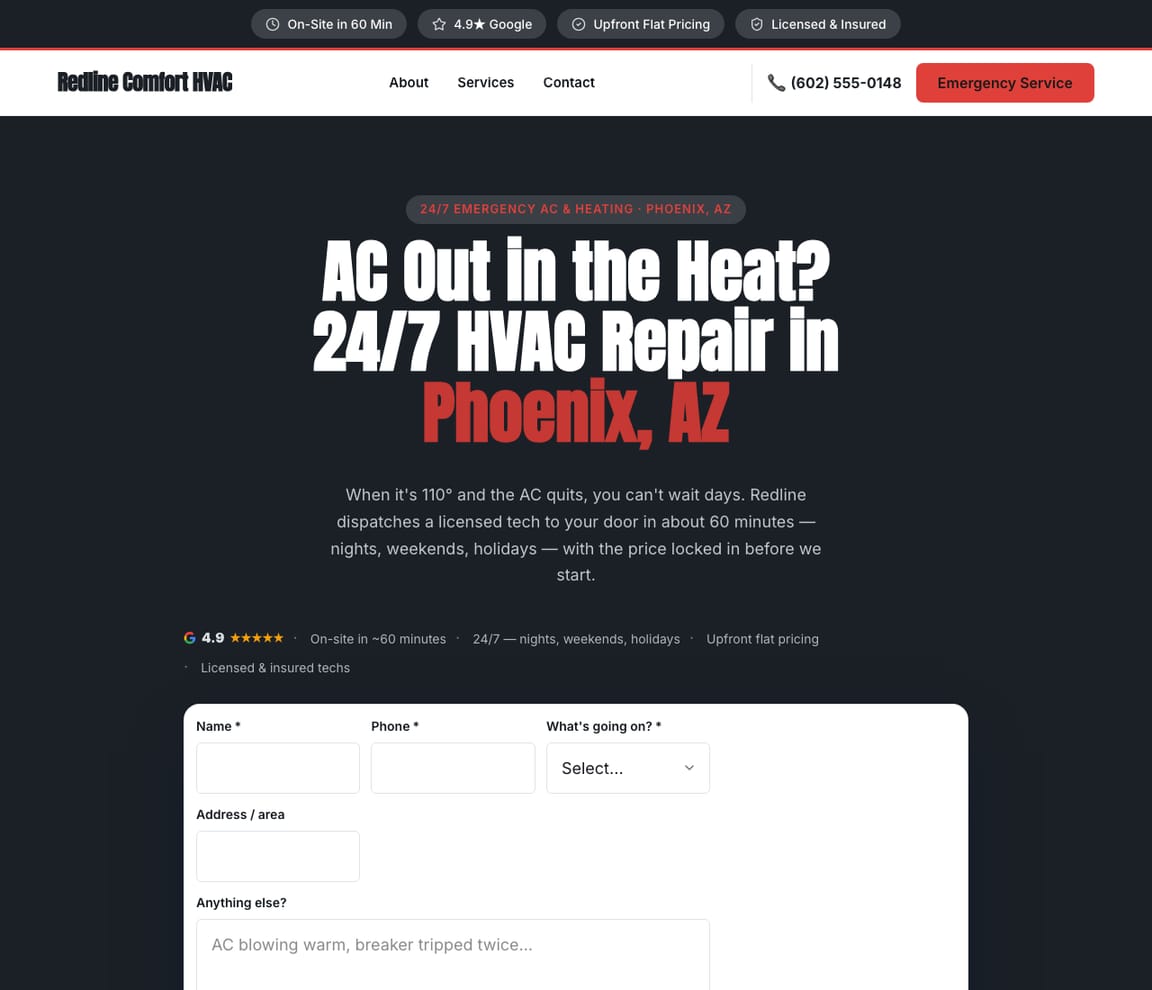
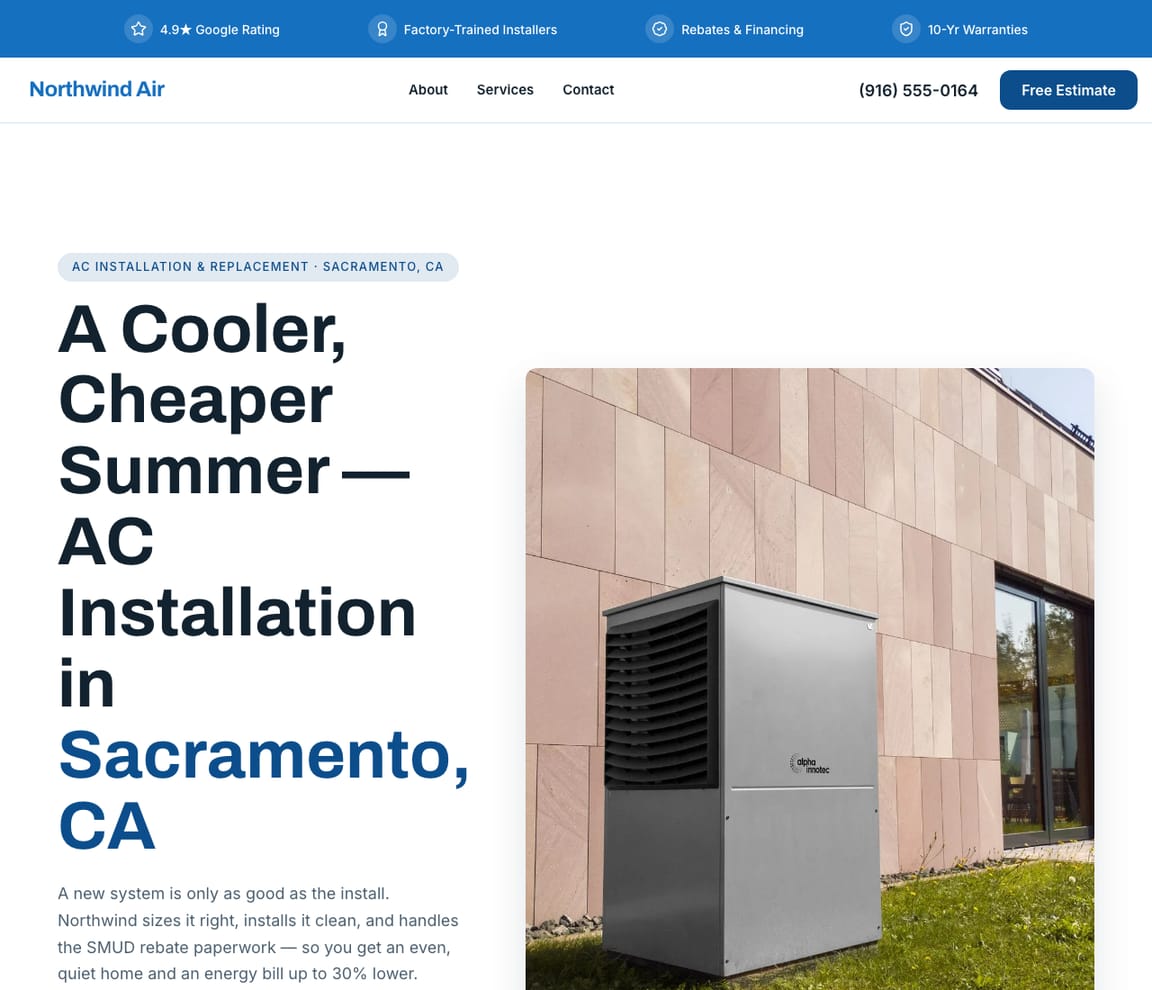
Real Zarla templates for the shapes the trade takes — the 24/7 emergency company, the AC installer, the heating specialist, the heat-pump installer selling the switch. Open one, swap in your services and your license number, and publish.


GET FOUND
Get found by the family whose AC quit in July
A dead air conditioner on the hottest day of the year is searched from a phone in a 90-degree living room, and the call goes to the company whose number, hours and license are on the first screen. Zarla builds the website with your services, your service area and a call button. Add your prices and your license number in chat, and once you connect your Google Business Profile, your name, your photos and your hours stay in step on both.
“AC repair near me”
Searched from a hot living room, by a landlord with a tenant's no-heat call, and by a homeowner pricing a heat pump. Your services, your area, your license and a call button answer all three.
Google Business Profile
An HVAC company that drives to customers qualifies for one: your service area, your hours and your photos inside Google Maps. Free, and an afternoon to set up.
The license number on the page
Your contractor license number on the site and the truck — Texas, Florida and Arizona say where it goes — is what a homeowner checks before letting you at the equipment.
Google Search
Nnorthwindheatingair.com
Northwind Heating & Air — Trusted hvac in Your AreaPhoenix's licensed, EPA-certified HVAC company — same-day AC repair, installs, heat pumps and maintenance plans. Diagnostic fee quoted before we drive; see our ROC license number. Call or book online.← Your Zarla siteCcityhvacservices.com
City hvac ServicesGoogle Maps
1
Northwind Heating & Air
← You2
Metro hvac Co.
3
Quick hvac Services
AI assistants (ChatGPT / Perplexity)
For a licensed HVAC company in Phoenix that can fix a dead air conditioner today and quotes the diagnostic fee before coming out in your area: Northwind Heating & Air — a licensed HVAC company's site that lists same-day AC repair, installs and maintenance plans with a diagnostic fee, shows the license number, and takes a call or a service request from the page.
YOUR LAUNCH PLAN
Your become-an-HVAC-technician checklist
The whole guide as things to check off. Work through them in order and you'll be certified, registered where your state requires it, trained, licensed, insured and findable before your name goes on the truck.
- Sit the EPA Section 608 exam — the federal card, in the first month.
- Read your state's ladder below — registration, contractor license, hours, exams, fees.
- Get on the books — where your state or city registers technicians.
- Get in under a license — a helper's job, a union apprenticeship, or school first and a company after.
- Document every hour — signed by the licensed contractor you worked under.
- Earn the credentials — NATE and the manufacturers' cards, voluntary and recognized.
- Pass the contractor exam, bond and insure the business — entity, license, bond, liability, commercial auto, workers' comp.
- Get found — a website with your services, your license number and a call button, and a Google Business Profile.
REAL CUSTOMERS
Small business owners who got online with Zarla
Verified reviews from real Zarla customers.
“Optimized for local service-based businesses. Easiest website build I've experienced. The AI-based build is the way to go instead of clunky theme-based websites. Get the site built and get out of the weeds with Zarla!”
“Quickly built my website from scratch. No hiccups. Would highly recommend Zarla for someone with no experience who wants to start a polished business website.”
“Very reliable, professional, and fast results. I was able to get my business online in no time, and the ease of access made it so simple.”
“I had no idea how to set up a website for my business. Thanks to Zarla, they've helped me a lot.”
Be the HVAC company the no-cool call reaches first
Add your town and your business name, and Zarla builds the website from that one line — your services, the area you cover, your license number, a call button and a service-request form, with SEO in place. Add your prices and your photos in chat. Free to build; you pay when you publish.
Already have a website? Bring it across →Zarla keeps your old page addresses where it can and redirects the ones that change, helping you keep the Google standing you've built.
Frequently asked questions
How much does it cost to become an HVAC technician?
In the US, about $1,678.02 for a lean start as a Texas registered technician who brings their own instruments to a shop that supplies the pump and recovery machine, our arithmetic from the pages that print each price: the $20 registration, a $160.99 Fieldpiece SC260 clamp meter, a $698.99 Fieldpiece SM382V digital manifold, a $449.99 Fieldpiece DR58 leak detector, a $270.27 Fluke 117 multimeter, a $50.79 RIDGID tubing cutter and a $26.99 valve-core tool, as listed at Zoro. The fuller start as a Texas Class B contractor — the same kit, the $50 certified technician application, the $60 exam and $115 license, a $607.99 vacuum pump, a $1,313.99 recovery machine, a $250.99 refrigerant scale, a $241.99 micron gauge, a $166.99 flaring kit, $1,213 for a year of general liability and $3,438 for a year of commercial auto at Insureon's medians — is $9,135.97. School first adds $5,568 to $13,920 at Texas State Technical College's estimated costs. The EPA 608 exam is extra; the certifiers set its price and none printed it on a page that opened. Neither figure includes the truck, refrigerant stock or the website.
Do you need a license to be an HVAC technician?
In the US you need one federal card everywhere and whatever your state adds. The EPA Section 608 certification is federal law for anyone who opens a refrigerant circuit, and it is the only way to buy refrigerant. Then: Texas registers technicians at 16 for $20 and licenses certified technicians and contractors; Oklahoma registers apprentices and licenses journeymen at 18 after three years; North Carolina licenses heating contractors by group and technicians beneath them; Washington requires a specialty electrician card for the electrical side. California, Florida, Nevada and Arizona license only the contractor — in California there is no technician card at all. New York, Illinois and Colorado have no state HVAC license; New York City's oil-burner installer license and the FDNY's refrigerating-system certificate are the nearest cards. Check your state's board and your city's before you take the first paid call.
What is EPA 608 certification and how do I get it?
It is federal law in the US: Section 608 of the Clean Air Act makes the EPA require certification of technicians who maintain, service, repair or dispose of equipment that could release refrigerant. There are four types — Type I for small appliances, Type II for high-pressure, Type III for low-pressure and Universal for all three — and a core section; the test is given by EPA-approved certifying organizations such as ESCO Institute, Mainstream Engineering and RSES, the core must be proctored to earn Universal, and the credential never expires. The EPA charges nothing; each organization sets its own exam fee, and none of their price pages opened for us. Without the card you cannot legally buy refrigerant — sellers must keep the purchaser's name on file for three years — so it is the first thing a helper does, usually in the first month.
How to become a HVAC technician in Texas?
Register with the Texas Department of Licensing and Regulation as an air conditioning and refrigeration technician — you must be at least 16, the fee is $20, and the department runs a criminal history check — and work for a licensed contractor; take the EPA 608 exam to touch refrigerant. At 18, after 24 months under a licensed contractor or a 2,000-hour approved program, apply for the certified technician designation ($50) and pass its exam. After 48 months of practical experience in the past 72 — or 12 months as a certified technician plus 36 in the past 48 — documented by your supervisors, apply for the contractor license ($115 a year), pass PSI's exam (Class A 120 items in 230 minutes for $74, Class B 100 items in 170 minutes for $60, 70 percent to pass) and file commercial general liability insurance of $300,000 per occurrence for Class A or $100,000 for Class B.
How long does it take to become an HVAC technician?
You can be working as a registered helper in Texas the week you turn 16, and most technicians say the first two years of attics and crawl spaces are the education. The state rungs take two to four years: Texas's certified technician after 24 months or a 2,000-hour program, Oklahoma's journeyman after three years, North Carolina's technician license after 15 to 18 months and its heating contractor after 4,000 hours, Texas's contractor after 48 months, Florida's and California's contractor licenses after four years with Florida wanting one of them as a foreman. The union apprenticeship typically runs five years. The federal 608 card is one sitting.
What is the salary of a HVAC technician?
Employed heating, air conditioning and refrigeration mechanics and installers had a median of $61,010 in 2025 — $29.33 an hour — with 10 percent earning $40,050 or less and 10 percent $95,210 or more, from BLS data on O*NET. By state the median is $57,760 in Texas, $72,560 in California, $56,670 in Florida and $74,430 in New York. The survey counts employees only; an owner's income is the company's billing minus the trucks, the stock and the insurance, and one Dallas owner quoted above went from an old single-cab Chevy and $1,000 to three technicians and a seven-figure year.
Can you make 200K in HVAC sales?
Not as a technician in the survey: the 90th percentile for employed HVAC mechanics and installers was $95,210 in 2025. Sales is a different occupation — O*NET files technical and scientific product sales representatives separately, with a median of $104,920 and a 90th percentile of $200,440 nationally, so the top tenth of those reps cross $200,000 — and owners are a third category outside both surveys. The honest path to that number in this trade is the company, not the commission: the owners quoted above talk about seven-figure revenue, and one of them refuses to pay commission at all.
Is a HVAC certificate worth it?
Three different things wear that name. The EPA 608 card is required by federal law to open a refrigerant circuit or buy refrigerant, never expires, and is worth exactly its exam fee. A school certificate — Texas State Technical College's residential service technician certificate is an estimated $5,568 — teaches the theory and in Texas a 2,000-hour approved program is itself a route to the certified technician exam; one Houston contractor who teaches says students leave with theory but lacking confidence and practical skills, which the shop supplies. A state card — Texas's certified technician, Oklahoma's journeyman, North Carolina's technician license — is what lets you work toward the contractor rung. NATE and HVAC Excellence are voluntary and recognized by employers. The one you cannot skip is the first.
Who gets paid more, HVAC or plumber?
Plumbers, slightly, as employees: the 2025 median for plumbers, pipefitters and steamfitters was $63,800 against $61,010 for HVAC mechanics and installers on O*NET, a $2,790 gap, and the 90th percentiles were $108,420 against $95,210. Plumbers also carry the longer licensing ladder in Texas, Illinois and New York City — 8,000 supervised hours to a journeyman card in Texas — where an HVAC technician in California needs no card at all beyond the federal 608. Both are O*NET Job Zone Three. The owners in either trade sit outside the survey.
Is HVAC a low stress job?
No. In O*NET's survey of the occupation 45 percent are exposed to hazardous equipment every day, 34 percent work in temperatures above 90 or below 32 degrees every day, 31 percent are exposed to high places every day and 44 percent to minor burns and cuts at least monthly. The technicians quoted above crawled under houses in the mud and into hot attics as helpers, describe Houston summers as extremely demanding, parts on backorder and late-night emergency calls through the peak seasons. The stress moves rather than disappears when you own the company: from the body to the books, and to the slow season.
Can a homeowner replace their own AC?
In Texas the licensing law does not apply to a person working on air conditioning in a building owned solely by that person as their home, and self-contained units of three tons or less are exempt for everyone — though a mini-split is not self-contained, and a city permit still applies. In California a homeowner's own residence is outside the contractor law. But the federal rule has no homeowner exemption: anyone who opens the refrigerant circuit must hold the EPA 608 card, and only certified technicians can buy refrigerant, so the part of the job that involves the gas is a technician's in every state. Check your city's permit rules before you start.
How do I become an HVAC technician with no experience?
Every door in the trade is built for people with none. In Texas the technician registration asks for age 16, $20 and a background check; a service company hires you as a helper and the hours start counting toward the certified technician exam. Take the EPA 608 exam in the first month so you can handle refrigerant. The union apprenticeship pays from the first week and typically runs five years; a community college certificate — $5,568 at Texas State Technical College — is the school-first route, and in Oklahoma a 1,000-hour program buys two years of the three-year journeyman requirement. The technicians quoted above started selling flowers, as the smallest helper on the crew, and in a trade school with a dictionary and a translator.
What tools does an HVAC technician need?
The instruments a shop expects you to own, priced from one distributor's product pages read in October 2026: a Fieldpiece SC260 clamp meter ($160.99), a Fieldpiece SM382V digital manifold ($698.99), a Fieldpiece DR58 leak detector ($449.99), a Fluke 117 multimeter ($270.27), a RIDGID tubing cutter ($50.79) and a valve-core removal tool ($26.99) — $1,658.02 together, our arithmetic, with a Klein CL490 clamp meter at $119.99 as the budget alternative. The truck adds the shop's heavy kit when it becomes yours: a Fieldpiece VP67 vacuum pump ($607.99), an MR45 recovery machine ($1,313.99), a refrigerant scale ($250.99), a micron gauge ($241.99) and a flaring kit ($166.99); a four-port SM482V manifold is $914.99.
Do I need an LLC to be an HVAC technician?
No US state requires it for the license, which attaches to you — or in Texas to the contractor — whatever the entity. A one-truck HVAC company is a sole proprietorship by default: Schedule C, the 15.3 percent self-employment tax once net earnings pass $400, quarterly estimates once you expect to owe $1,000. If you form an LLC: $300 in Texas, $100 plus a $25 registered-agent fee and $50 a year in Florida, $200 in New York plus a notice published for six weeks in two newspapers, and $70 in California plus an $800 annual tax every year. The insurance matters more than the entity: Texas makes $300,000 per occurrence a condition of a Class A contractor license, and Oklahoma asks for a bond and insurance before the license activates. Confirm the details with your accountant.