BUSINESS GUIDE
How to start an HVAC business in 2026
The contractor license your state actually requires on top of your EPA 608 card, what a service call and a new system sell for, the van and the tools, the insurance, the sales-tax rule, the maintenance-plan base that carries the slow months — and how to win the first calls. Written for the technician going out on their own, not a designer.
Free to build · Pay when you publish · No credit card
$70–$200an HVAC service-call fee in 2026, with hourly labor at $75–$150 (Housecall Pro, October 2026)
$5,000–$12,500a full residential system replacement (Housecall Pro); Fixr's central AC average is $8,750
$101/monthmedian general liability for HVAC installation businesses, $1,213 a year (Insureon, August 2026)
No codeto get online
See it in action
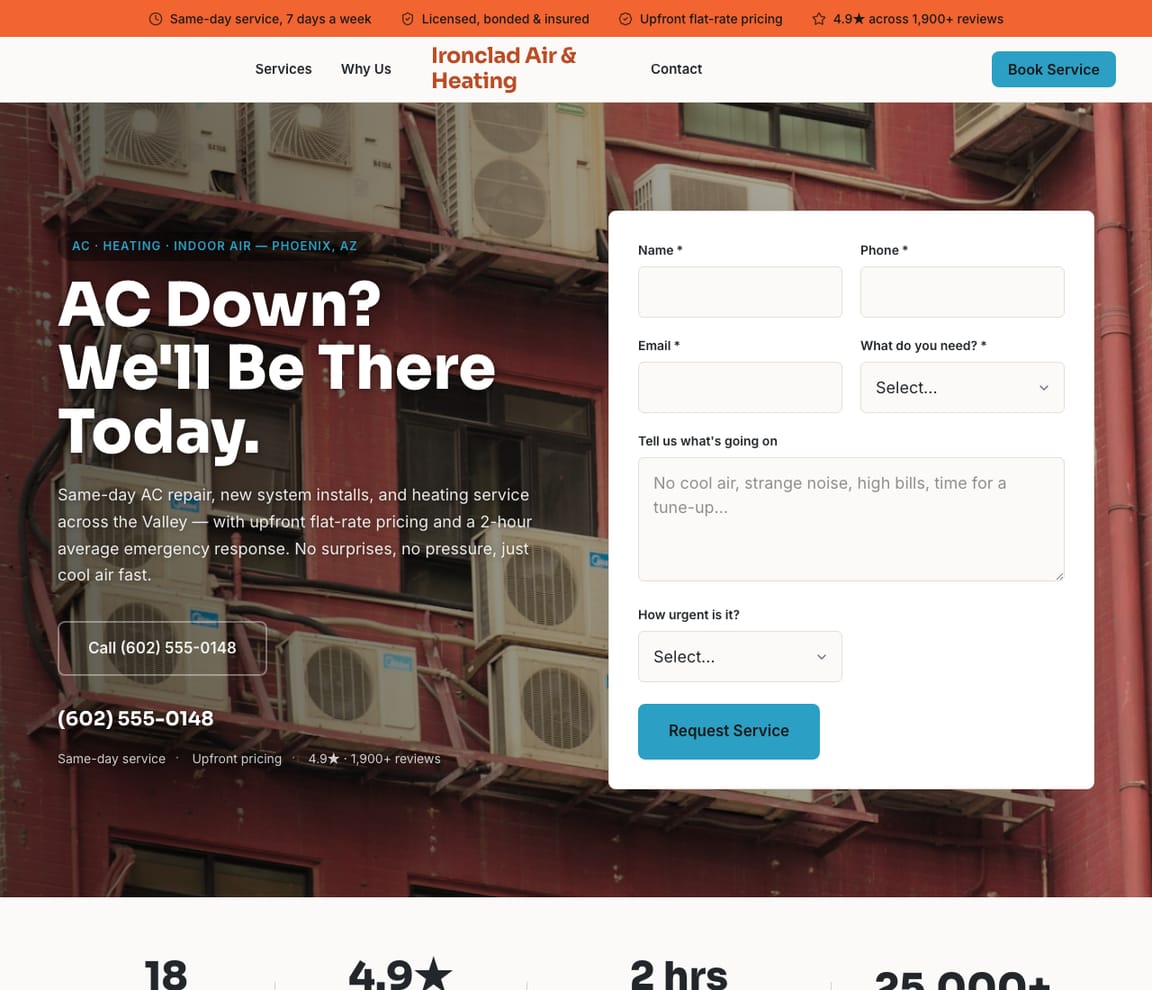
See what your HVAC website could look like
This is a real Zarla template for a residential heating and cooling company. Describe yours — the towns you cover, your services, whether you take same-day calls — and you'll have a site like this, with a call button and a quote request form, in about a minute.
- Professional design — not a generic template
- Looks great on desktop and mobile
- Content written for your industry
Build the website
Start your HVAC website now
Add your town and your company's name to the sentence, and Zarla builds the site: a call button at the top, your services and starting prices, and a quote request form. Add your license number, your diagnostic fee and the towns you cover in chat, then publish.
Already have a website? Bring it across →Zarla keeps your old page addresses where it can and redirects the ones that change, helping you keep the Google standing you've built.
Is an HVAC business worth starting — and what do customers pay?
If you hold the EPA card and the years under a licensed contractor, it's one of the surest trades to own: the air conditioner dies on the first hot weekend, the furnace quits in the first freeze, and the homeowner calls the first company that answers. The work splits into residential service and repair — no-cool calls, capacitors, motors, refrigerant leaks, tune-ups — paid the same day; change-outs, where the equipment is paid to the distributor before the homeowner pays you; and maintenance plans, the only thing that steadies the spring and fall. This guide is about the company; if the card and the hours are the step you're on, how to become an HVAC technician prints the EPA 608 types and the technician rungs state by state. Plumbing is its own trade, with its own guide.
What customers pay. In Housecall Pro's HVAC pricing guide — written by a company that sells field-service software to the trade — "average service call fees range from $70–$200, with higher rates for nights, weekends, emergency response, or long-distance travel," hourly labor runs $75–$150, "Most repairs average $150–$450, though a major repair like a compressor replacement can reach $2,500," and "A full system replacement typically costs $5,000–$12,500" (Housecall Pro, October 2026). Fixr's consumer guides put an air conditioner repair at $250 to $700, averaging $375, with "a minimum of $75 in most cases for a service call fee" (Fixr, 2026); a central air conditioner installed at $5,800 to $14,400, averaging $8,750 (Fixr, 2026); a heat pump at $5,000 to $15,000, averaging $8,350 (Fixr, 2026); and maintenance at $150 to $350 a visit, averaging $275, with a service contract "between $150 and $500 per year" (Fixr, 2026). Our HVAC pricing guide carries the full table — tune-ups, repairs, furnaces, heat pumps, mini-splits, maintenance plans — with a calculator.
The catch. The license comes years after the card, the recovery gear and the van are real money before the first call, installs tie up cash, and the work is seasonal — the searches for this guide run about a third higher in July through September than the rest of the year. As an employee, a heating, air conditioning and refrigeration mechanic or installer earned a 2025 median of $29.33 an hour, $61,010 a year — $57,760 in Texas and $58,590 in San Antonio, the plan's own city (O*NET; O*NET, Texas); a construction trades supervisor $79,920 (O*NET) — and the survey behind those medians counts employees, not "the self-employed, owner/partners in unincorporated firms" (Washington ESD). Insureon's medians for HVAC installation businesses are $101 a month for general liability and $286 for commercial auto (Insureon, August 2026). The owner's income has to beat $61,010 after the van, the insurance, the equipment on the card and the quiet months. That's what the rest of this guide sets up.
How to start an HVAC business, in plain English
Do you need an HVAC contractor license? Usually yes — the company needs one on top of the technician's EPA card. Your EPA Section 608 card lets you handle refrigerant; the company needs the contractor license your state issues on top of it. Of the states we read, two run the other way: New York issues no state HVAC license (its cities and counties do), and Pennsylvania "currently has no licensure or certification requirements for most construction contractors," leaving it to those of its 2,562 municipalities that set their own (Pennsylvania Department of Labor and Industry) — though a Pennsylvania contractor doing home improvement registers with the Attorney General for a $50 fee unless its home improvements totalled under $5,000 in the previous tax year (Pennsylvania Act 132 of 2008). A bond isn't universal either: Texas requires liability cover and no bond, California a $25,000 bond. The states we read:
- Texas. "A person may not engage in air conditioning and refrigeration contracting unless the person holds an air conditioning and refrigeration contractor license," and a license "may assign that license to only one permanent office of one air conditioning and refrigeration contracting company" (Texas Occupations Code §1302.251). Two classes: "The Class A license allows you to work on any size unit. The Class B license allows you to work on cooling systems of 25 tons and under, and heating systems of 1.5 million BTUs/hour and under" — the whole residential market — with one endorsement per license, environmental air conditioning or commercial refrigeration (TDLR; §1302.254). You need "at least 48 months of practical experience in air-conditioning and refrigeration-related work under the supervision of a licensed air conditioning and refrigeration contractor in the past 72 months," or a technician certification for 12 months plus 36 months of experience; the application fee is $115 and "Licenses are valid for a period of 1 year from the date of issue"; the PSI exam is $60 for Class B and $74 for Class A (TDLR; PSI bulletin). "You must maintain commercial general liability insurance at all times while your license is active" — $100,000 per occurrence, $200,000 aggregate and $100,000 products-completed operations for Class B, three times that for Class A — and no bond (TDLR). Since September 1, 2021, no Texas city may charge a TDLR-licensed contractor a registration fee, though cities still collect building permit fees — and a mini-split is a split system that needs the license (TDLR FAQ).
- Florida. "A person must be certified or registered in order to engage in the business of contracting in this state" — certified statewide, registered locally — and any other contractor "shall subcontract all … air-conditioning work" to one (Florida Statutes §489.113). A Class A air-conditioning contractor's services are unlimited; a Class B's "are limited to 25 tons of cooling and 500,000 Btu of heating in any one system" (§489.105). You must be 18 with "at least 4 years of active experience," one of them as a foreman (§489.111); the statute caps the certificate application at $150 ($350 with the exam) and the certification and renewal fees at $250, with $50 to qualify a business organization (§489.109); the license requires $100,000 of public liability and $25,000 of property damage insurance (Rule 61G4-15.003).
- California. The C-20 Warm-Air Heating, Ventilating and Air-Conditioning Contractor license (CSLB) is needed on any job where the price of labor, materials and everything else is $1,000 or more, or that needs a permit (Business and Professions Code §7048); it takes "not less than four years experience as a journeyman, foreman, supervising employee or contractor" (16 CCR §825), a $450 application and a $200 initial license fee for a sole owner or $350 for an LLC or corporation (CSLB fee list; §7137), and a contractor's bond "in the sum of twenty-five thousand dollars ($25,000)" (§7071.6).
- New York. The state issues no HVAC contractor license; the city or county you work in does. In the five boroughs, "A person or business must have a Home Improvement Contractor license to do construction, repair, remodeling, or other home improvement work to any residential land or building in New York City" — $200 for up to two years, plus a $20,000 surety bond or $200 to join the Home Improvement Business Trust Fund (NYC Department of Consumer and Worker Protection, September 2026). The Department of Buildings licenses oil-burner installers separately — a $100 license after a $585 written and $530 practical exam (NYC DOB). Nassau, Suffolk and Westchester license home-improvement contractors at the county level — check the county's consumer-affairs office.
- Pennsylvania. No state HVAC license (Pennsylvania DLI). The state layer is the home improvement contractor registration — the application "shall be accompanied by a fee of $50," and a contractor whose home improvements totalled "less than $5,000 during the previous taxable year" is excluded (Act 132 of 2008) — and the trade license, where there is one, is your municipality's.
Whichever state you're in, check your state board, your county and your city before the first paid call — a city can license on top of the state.
Can someone who isn't licensed own the company? In Texas, the work must be "provided through a Texas licensed Air Conditioning and Refrigeration Contractor who holds the required amount of liability insurance," and that contractor's license lives at one company only (TDLR FAQ; §1302.251). In California the company's license can rest on a responsible managing employee — the statute prices replacing one at $230 (§7137). In Florida "a subcontractor who is not certified or registered may perform construction work under the supervision of a person who is certified or registered," and the board charges $50 to qualify a business organization (§489.113; §489.109). So yes — with the license-holder on the license and the insurance. Read your state's rule before you pick a partner.
The federal layer: the card, the gas and the 2025 refrigerants. "Technicians who maintain, service, repair, or dispose of equipment that could release ozone depleting refrigerants into the atmosphere must be certified" under Section 608 (EPA) — Type I for small appliances, Type II for high-pressure systems, Type III for low-pressure, Universal for all three (40 CFR §82.161). "Only EPA-certified technicians are allowed to purchase ozone-depleting substances (ODS) or non-ozone depleting substitutes used as refrigerants," so the company buys gas through its certified people (EPA); nobody "may knowingly vent or otherwise release into the environment any refrigerant," and the seller's invoices with your name are kept "for three years after each purchase" (40 CFR §82.154). And since January 1, 2025, "Prohibitions apply to the manufacture, distribution, sale, installation, import, and export of products containing restricted HFCs" — new residential systems use lower-global-warming refrigerants, so a company starting now buys recovery and leak-detection gear rated for them and stocks the new gases, not the old (EPA, technology transitions).
The tools, the van and the stock. Dealer list prices the career guide verified this month (Zoro's pages open in a browser): a Fieldpiece MR45 recovery machine $1,313.99 (Zoro), a VP67 vacuum pump $607.99 (Zoro), an SM382V digital manifold $698.99 (Zoro), a DR58 leak detector $449.99 (Zoro), a refrigerant scale $250.99 (Zoro) and a micron gauge $241.99 (Zoro) — with the meters, cutter, core tool and flaring kit, the whole service kit sums to $4,240 (our arithmetic; rounded). A Weather Guard four-shelf van unit is $584 (Elite Truck); a new Mercedes-Benz Sprinter cargo van starts at $48,990 (Mercedes-Benz Vans, 2026); no dealer page prices a used van, so the plan carries it as a planning range. Housecall Pro's start guide puts "Insurance coverage: $2,000–$6,000 annually for liability, workers' comp, and auto policies" (Housecall Pro, March 2026) — a software company's figure. One owner on that page, Danny Reddick of Reddick & Sons: “The essential tools to invest in first are a reliable van, a complete set of hand tools, a good manifold gauge set, a vacuum pump, a leak detector, and a recovery machine. Don't buy the most expensive tools out of the gate unless you're sure you'll use them constantly.” Opening parts and refrigerant stock is a planning range — no distributor prints its terms; open a trade account at a Johnstone, Ferguson, Carrier Enterprise or Lennox branch and ask. Our free HVAC estimate template and invoice template are the paperwork for before and after.
How to price: a diagnostic fee, then a flat price the customer approves. The call-out is $70–$200 and the hourly rate $75–$150 — $140–$250 after hours — in Housecall Pro's figures; the same page reports the Air Conditioning Contractors of America's view that "the average HVAC contractor nets about 6% (5% for residential)" against a 10% target, and that contractors "who use flat-rate pricing on service calls average 7% net, compared with 4% for other pricing methods" (Housecall Pro, October 2026); a Fixr analyst quoted in its start guide says "A healthy HVAC business usually sees a 15%–25% net margin" (Housecall Pro, March 2026). Build a price book for your twenty most common repairs, quote change-outs in writing with financing, sell a two-visit maintenance plan — $150–$300 a year in the pricing guide, $150–$500 in Fixr's — and check each flat price against the hours it really takes. The homeowner will arrive with "the $5,000 rule": "The age of your HVAC system x the estimated repair cost … If the result of that formula is more than $5,000, a replacement is often considered the better long-term option" — a rule of thumb, and CBS adds that it "isn't meant to be the final word" (CBS News, June 2026); show the arithmetic on the quote. Our HVAC pricing guide goes deeper, and HVAC marketing covers the phone ringing.
Permits and sales tax. In the US, change-outs need a mechanical permit almost everywhere — in Texas the cities "may collect building permit fees" even though they can't charge the contractor a registration fee (TDLR FAQ). Sales tax is state law: in Texas, "Labor to repair, remodel, or restore residential real property is not taxable," while "the total amount charged for remodeling, repairing, or restoring nonresidential real property is taxable," and "Charges for maintenance of real property are not taxable" — so a capacitor at a house is untaxed labor, the same call at a restaurant is taxed in full, and you pay tax on the filters you buy for a maintenance plan (Texas Comptroller, publication 94-116); in New York, installing a new system is a capital improvement while "replacing a thermostat on a hot water heater" is a taxable repair (New York Department of Taxation, TB-ST-104); in Florida, a lump-sum contractor "is the final consumer of materials and supplies" and pays tax to the supplier (Florida Department of Revenue, GT-800067); in California, "Special rules apply to labor when you perform work on houses, buildings, and other real property" (CDTFA, publication 108) — its contractors' publication makes you the consumer of the materials you install and the retailer of the fixtures (CDTFA, publication 9, February 2025). Ask an accountant before you print a price book.
How to register the business. In the US it's the same four steps in each state we read, with different fees. Form the business — an LLC is $40 in Kentucky (Kentucky SOS), $300 in Texas (Texas Secretary of State, Form 205), $200 in New York plus six weeks of newspaper publication (N.Y. LLC Law §1101; §206) and $70 in California (Government Code §12190), where every LLC also owes an $800 yearly tax (California FTB) — or file a DBA if you'll trade as a sole proprietor under a business name. Get the free EIN (IRS), open a business bank account, and get the city registration where your city wants one. Our guide to whether you need an LLC walks through the choice.
Insurance and workers' comp. General liability is what the license, the permit office and the property manager ask for. Insureon's medians for HVAC installation businesses are $101 a month ($1,213 a year) for general liability, $286 a month ($3,438 a year) for commercial auto, $182 a month ($2,189 a year) for workers' compensation, $41 a month for tools and equipment, $139 a month for a business owner's policy and $9 a month ($112 a year) for a surety bond; most of its customers have "less than five employees, annual revenue ranging from around $50,000 to more than $200,000, and five years or less in business" (Insureon, August 2026). Workers' comp: in Texas "private employers can choose to carry workers' compensation insurance coverage, but it is not required in most cases" (Texas Department of Insurance); in Florida, construction employers "with one or more employees, including the owner of the business who are corporate officers or Limited Liability Company (LLC) members, must have workers' compensation coverage" — the four-employee rule is for non-construction trades (Florida Division of Workers' Compensation); in New York "Virtually all employers" must, but "coverage is not required for a sole proprietor who does not have employees" (NY Workers' Compensation Board); in California, "If a business employs one or more employees, then it must satisfy the requirement" (California DIR) — and the C-20 HVAC license itself has needed a workers' comp policy since 1 January 2023, "regardless of whether the contractor has employees" (CSLB Industry Bulletin #22-13, November 2022).
Outside the US. In the UK the F-gas qualification is personal — "You must have your own qualifications to work on equipment containing F gas, even if you work for someone else," in four categories from full install-and-maintain down to leak checking (gov.uk) — and the company itself registers with a certification body such as REFCOM (REFCOM); "Anyone employed to work on gas appliances in domestic premises must be a Gas Safe registered engineer" (HSE); a company costs £100 to form (gov.uk) and VAT registration starts at £90,000 of turnover (gov.uk). Australia inverts the US rule on buying gas: the person holds a refrigerant handling license and the business holds its own refrigerant trading authorization — any person or business that acquires, stores or disposes of refrigerant must hold one, whether a sole trader or a company with a hundred technicians (Australian Refrigeration Council); the states license the contractor on top — New South Wales through Fair Trading (NSW Fair Trading), Queensland through the QBCC; an ABN is free (business.gov.au) and GST registration starts at A$75,000 of turnover (the Australian Taxation Office). Wherever you are, confirm the rules with your regulator and an accountant before the first paid call.
Franchise or independent? A franchise directory's reading of two 2026 disclosure documents: One Hour Heating & Air Conditioning — a $43,000 franchise fee, a 6% royalty, an initial investment of $143,273 to $286,702 and average gross revenue of $605,630 per unit (Franzy, 2026); Aire Serv — a $45,000 to $90,000 fee, a 5% to 7% royalty, $113,800 to $271,708 to open and $1,600,000 average gross revenue (Franzy, 2026). Those are sales, not pay, and the directory says it makes "no claims of accuracy" — read the disclosure document before you sign anything. Every owner quoted in the next section built an independent company.
The business, and the calendar. Answer every call, pull every permit, log every pound of refrigerant, and sell the plan at every job. For one certified technician going out alone, our free HVAC business plan puts the start at $10,652–$32,943: the contractor license and exam, the service kit — the recovery machine, vacuum pump, gauges, scale and meters — van shelving, a year of general liability with commercial auto at the high end, registration, a city license where one applies, opening stock as a planning range, the website, software, and two months of running costs. The van itself and your own living costs come on top. The HVAC website templates show what a good contractor's site looks like, Zarla's HVAC website builder is how a homeowner searching for AC repair near them finds yours, and the best website builders for HVAC companies scores the alternatives.
What HVAC business owners actually say
None of this is our opinion about the trade. It comes from people who run heating and cooling companies, talking about the work in a business magazine, two local news features, two interview sites, a company's own release and a software company's guide between 2011 and 2026. Read each as theirs at the time; the dollar figures in older pages are that year's. Five things come up again and again.
The leap, and the first three months. Ben Rogers, who started Rogers HVAC in his hometown in 2020 after 14 years in the trade: “I left a very stable job. We worked great hours, they paid me a very fair wage, I had a company truck to drive home, and my bosses were all top notch. I wanted something more.” And: “3 months into business, with the before mentioned brand new child and I found myself with $86 in my bank account. I was terrified, but I was motivated!” — the company is nine employees strong today (CanvasRebel, January 2024). Jason Fisher, who opened Bluestem Heating & Cooling in Lawrence, Kansas, after 25 years in the trade: “We spent many evenings talking things through as a family, brainstorming names and thinking about what kind of company we wanted to build. We didn't want something flashy. We wanted something local, dependable and built the right way.” (Lawrence Business Magazine, 2026). Stephanie Marquard, who founded Original Kingwood AC & Heating in Texas with one pickup truck: “It was somewhat of a jump. I was teaching at the time, noticed a gap in the market and decided that's where my interest lied” (Community Impact, October 2026).
“Don't try to be everything to everyone at the beginning. Start with a narrow set of services that you can deliver really well. Only expand into extras if you have the staff and systems to support it.” — Sergey Nikolin, Product Air Heating and Cooling, in Housecall Pro's start guide, March 2026
Answer the phone, every time. Nikolin again: “Tell everyone exactly what you offer, answer every call, return every message, and if you can't take the job, give a clear timeline.” And: “If a potential client can't reach you the first time, they will most likely never call you again.” (Housecall Pro, March 2026). Glenn Kipp of Absolute Air Heating & Air Conditioning in Lawrence, whose main advertising is word of mouth and then his website and Google Ads: “When you take good care of people, they will tell their friends and neighbors. As a smaller business, I can have a more personalized approach to my service that many bigger businesses just can't provide. For me, it's all about the customer experience and providing them quality service.” The magazine adds that he has found people will wait a day or two for a heater but want the air conditioner fixed right away (Lawrence Business Magazine, 2026).
Service, not sales. Larry Howald, who launched Broad Ripple Heating & Air Conditioning in Indianapolis after selling the family firm: “I felt the average homeowner would rather deal with local people, a local company, than a big corporation out of state.” And the company “should be service-driven, not sales-driven. Customers should feel comfortable when one of our guys walks into their home that they're not just there to sell something.” (Indianapolis Business Journal, October 2011). Fisher: “Trust matters more than anything. People are inviting you into their home, and that's personal. Being honest, explaining things clearly and standing behind your work goes a long way. If you treat people right, they remember that,” and “We didn't start Bluestem to be the biggest company in the area. We started it to be the one people feel comfortable calling.” (Lawrence Business Magazine, 2026).
The trade's own circles, and the maintenance plan. Marquard, on the Houston and Texas contractor associations her company joined: “We have been very dedicated and loyal to these because they have given us the tools and a lot of direction.” (Community Impact, October 2026). Frankie Hayden, owner of 100% Service in Englewood, Colorado, launching a maintenance program in the company's own release at 30 years: “We are proud to reach 30 years and even prouder to be launching something that gives our customers a real, structured way to protect their systems year-round.” (company release, July 2026). A Contracting Business columnist puts the gap plainly — only one in five homeowners have a maintenance agreement, undated — and describes a credible contractor whose business "didn't succeed after he eliminated the service and maintenance agreement part of the business" (Contracting Business, undated, read 2026).
The work is hard, and the trade is open. Kipp, to anyone considering it: “Be prepared to work hard, but try and enjoy what you're doing. It's a satisfying career, and you will get out of it what you put into it. Be eager to learn and listen to anyone who can help you grow your knowledge. Some technical training would be very helpful, but if a person is willing to work hard and learn on the job, schooling isn't always the only way,” (Lawrence Business Magazine, 2026). Sylvia Cothia, co-owner of Jetway Heating Cooling and Refrigeration in New York City since 2014: “It hasn't been smooth, but as an co-women owned in a male dominated construction industry we continue to be trail blazers and pioneer for women owned business owners in the hvac mechanical specialty trade industry.” (VoyageATL, October 2026). Danny Reddick, on the kit: “Your tools are your livelihood. The essential tools to invest in first are a reliable van, a complete set of hand tools, a good manifold gauge set, a vacuum pump, a leak detector, and a recovery machine.” (Housecall Pro, March 2026). Each of those is one owner's account of one company in one market, not a survey — read them as what the model can do, not what it does on average.
The through-line: the HVAC businesses that last get the contractor license and the insurance before the first ad, start in service work that pays the same day, price the job and not the hour, sell the maintenance plan at every call so the shoulder months are covered, and answer the phone when the house is 90 degrees.
THE STARTER KIT
What you need to start an HVAC business
The EPA 608 card, and the contractor license
Your Section 608 certification lets you buy and handle refrigerant anywhere in the US; the business needs the contractor license your state issues on top of it — with the insurance and, in places, the bond the license requires. The table below has the states we read.
The tools you own, plus the recovery gear
Your hand tools and meters from the trade, a recovery machine and a vacuum pump — the law requires both whenever you open a sealed system — a micron gauge, a refrigerant scale, a leak detector and a brazing kit, bought from dealers whose prices are below.
A van, stocked for the common calls
The vehicle you already drive at first, then a cargo van shelved with capacitors, contactors, motors, thermostats, filters and a jug of each refrigerant you service — so most calls finish in one visit.
Registration and the EIN
An LLC or a DBA with your state, the free EIN from the IRS, a business bank account, and the city business license or contractor registration where your city wants one — before the first paid call.
Liability, auto and comp
General liability — the license, the permit office and the property manager all ask for the certificate — commercial auto for the van, and workers' comp the day you hire the first helper.
A price book, a maintenance plan and a way to be found
A diagnostic fee, flat prices for your common repairs, install packages, a yearly maintenance plan, a Google Business Profile, and a website with your license number, your prices and a quote form, plus lettering on the van.
THE PAPERWORK
Licenses, insurance, permits and tax for an HVAC business
| Typical cost | Time to get | Legally required? | |
|---|---|---|---|
| Business registration (LLC or DBA) and EIN | e.g. $40 (KY), $300 (TX), $200 + publication (NY), $70 + $800/yr tax (CA); EIN free | Days | Depends on your structure |
| EPA Section 608 certification | Set by the certifying body; no fee printed by the EPA | An exam | In the US, for anyone who opens a refrigerant circuit |
| Texas air conditioning and refrigeration contractor | $115/yr + $60 (Class B) or $74 (Class A) exam; liability $100,000 / $200,000 / $100,000 (B) | 48 months' experience | In Texas, for any company offering HVAC work |
| Florida certified air-conditioning contractor | Capped at $150 ($350 with exam) + $250; $100,000 / $25,000 cover | 4 yrs experience, 1 as foreman | In Florida; $50 to qualify a business |
| California C-20 HVAC contractor | $450 application + $200 (sole owner) or $350 (LLC); $25,000 bond | Exam + 4 yrs journey-level | In California, at $1,000 a job or more, or any permit |
| Pennsylvania home improvement contractor registration | $50 | Weeks | In Pennsylvania, from $5,000 of home improvements in the previous tax year; no state HVAC license |
| New York City home improvement contractor | $200 for up to 2 yrs + $20,000 bond or $200 trust fund | Exam (two attempts included) | In NYC, for residential work; no New York state HVAC license |
| Mechanical permit for a change-out | Set by the city or county | Days | Almost everywhere, pulled by the contractor |
| General liability insurance | $101/month median (Insureon) | Same day | To hold the license in TX and FL; expected everywhere |
| Commercial auto insurance | $286/month median (Insureon) | Same day | For a business-owned van (Insureon's median) |
| Workers' compensation | $182/month median (Insureon) | Days | FL from one employee; CA from one employee, and for a C-20 license even with none; NY nearly all employers; optional in Texas |
THE STEPS
How to start an HVAC business (step by step)
Eight steps from a certified technician with a toolbox to a stocked van, a price book, a maintenance-plan base and a property manager who calls you first.
01
Confirm the license you need to run the company
Your EPA 608 card lets you handle refrigerant; the business needs your state's HVAC contractor license — in Texas and Florida from the state, in California from the CSLB, in New York from the city or county — with the insurance it requires filed first. Check your state board and your city before anything else.
Before anything else02
Decide what you'll do first
Residential service and repair — no-cool calls, capacitors, motors, tune-ups — is the fastest way to start earning: small jobs you can run alone, paid the same day, and every fixed system tells three neighbors. Change-outs come as the repair calls turn into replacement quotes; new construction and commercial later, with the cash to carry 30-day invoices.
03
Register and insure the business
Form the LLC or file the DBA, get the free EIN, open the bank account, buy general liability and commercial auto — then apply for the contractor license with the certificates in hand.
04
Write the price book, and the maintenance plan
A diagnostic fee, flat prices for your twenty most common repairs that the customer approves before you start, an after-hours rate, install packages with financing, and a yearly maintenance plan with two visits. Check each flat price against the hours it really takes.
05
Buy the recovery gear and stock the van
A recovery machine, a vacuum pump, gauges, a scale and a leak detector on board every day; shelve the van with the parts for the ten calls you do most; open a distributor account so a part you don't carry arrives the same day.
06
Get found, and tell everyone
Put your Google Business Profile and website live with your license number, your diagnostic fee and a quote form, letter the van, and tell every plumber, electrician, agent and property manager you've worked with that you're taking calls.
07
Answer the phone, pull the permit, log the refrigerant
Pick up every call, pull the mechanical permit on every change-out and book the inspection before you leave, recover and log every pound of refrigerant, and leave the mechanical room cleaner than you found it — the cleanup is what earns the review.
08
Sell the plan on every call, then hire
Offer the maintenance plan at every job so the spring and fall are covered, ask every finished job for the review and the referral, land a property manager or two, and hire the first helper once the calendar is full and the flat prices can carry a second wage.
THE COSTS
How much does it cost to start an HVAC business?
The total is our free HVAC business plan's itemized US ranges for one certified technician going out alone: the contractor license and exam, the service kit at dealers' list prices, van shelving, a year of general liability with commercial auto at the high end, registration, a city license where one applies, opening stock as a planning range, the website, software, and two months of running costs. The van itself and your own living costs come on top. Fees from the boards' own pages, insurance from Insureon, tools from Zoro; checked October 2026.
$10,652–$32,943to start as one certified technician — the low end is Texas's $115 license and $60 exam, a $4,240 service kit, a year of liability cover and a $40 LLC in the van you already drive
$1,314a Fieldpiece MR45 recovery machine at Zoro's list price; the vacuum pump is $608, the digital manifold $699, the leak detector $450 — the whole kit $4,240
$1,213/yrmedian general liability for HVAC installation businesses (Insureon, August 2026) — commercial auto averages $3,438; Texas requires $100,000 of cover for a Class B license
$48,990a new Mercedes-Benz Sprinter cargo van (2026 MSRP) — the number that decides the start if you don't already drive a work vehicle
WHAT WE'VE LEARNED
What actually makes a homeowner call an HVAC company
Thousands of local business websites in, the pattern for heating and cooling is plain: the customer wants to know you're licensed, what showing up costs, and that you can come today. Three things on a page decide who gets the call.
A license number and a phone number
Your state contractor license number where a homeowner can see it, your insurance, and a call button at the top of every page on a phone — the three things checked in the ten seconds before the call.
The diagnostic fee, and flat prices
What it costs for you to come out, whether that's credited to the repair, and a starting price for the common jobs — a capacitor, a tune-up, a mini-split — so the calls you get already expect the number.
Today, and the towns you cover
Same-day or after-hours if you offer it, the towns you drive to, your maintenance plan, photos of real installs and reviews that mention the town — so the homeowner knows you're real, nearby and coming.
THE UPSIDE
What an HVAC business can earn
Prices from Housecall Pro's pricing guide (a field-service software company) and Fixr; revenue from two franchisors' disclosures as read by a directory; pay from O*NET. Ranges and averages, not a promise — your price book, your callbacks and the length of the shoulder months decide it. No public survey reports what one-van HVAC owners take home.
$70–$200the service-call fee in 2026, with hourly labor $75–$150 and $140–$250 after hours (Housecall Pro, October 2026)
$8,750a central air conditioner installed, averaging — most between $5,800 and $14,400 (Fixr); a full replacement $5,000–$12,500 (Housecall Pro)
$605,630average gross revenue per One Hour Heating & Air Conditioning territory, in a directory's reading of the 2026 disclosure — franchisees' sales, not one-van owners' pay
$61,010a year: the 2025 US median for HVAC mechanics and installers (O*NET) — the pay to beat; a construction supervisor's is $79,920
SEE IT WORK
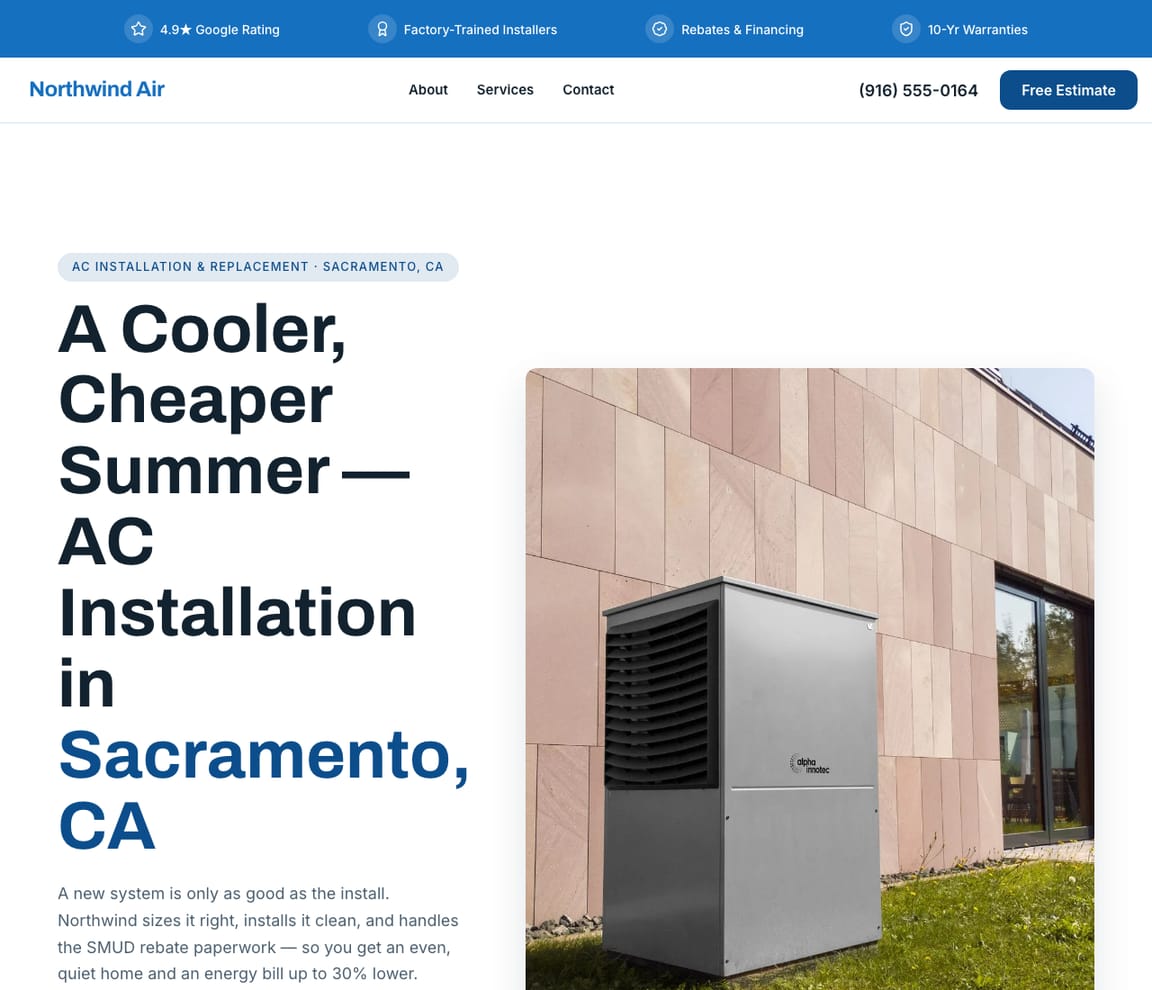
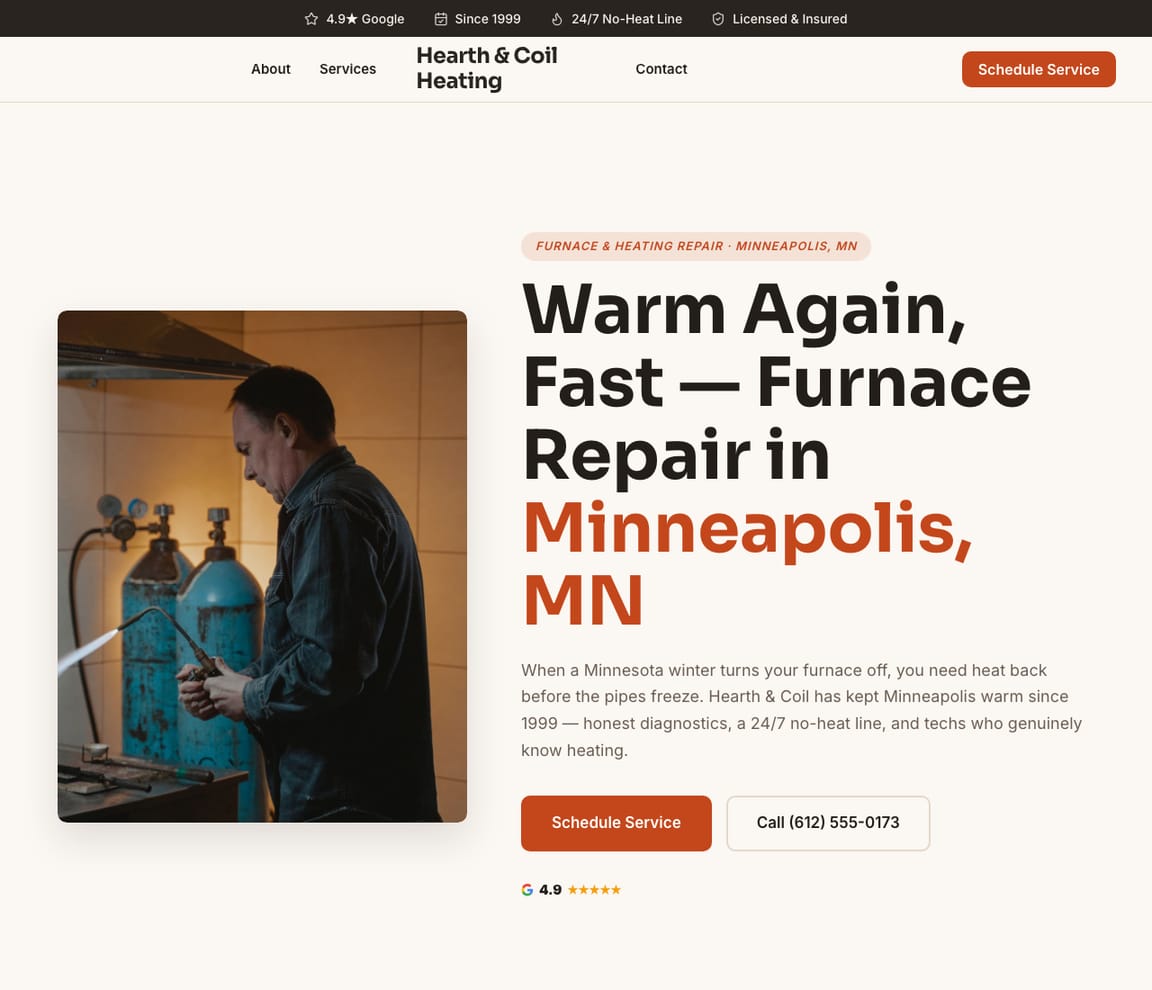
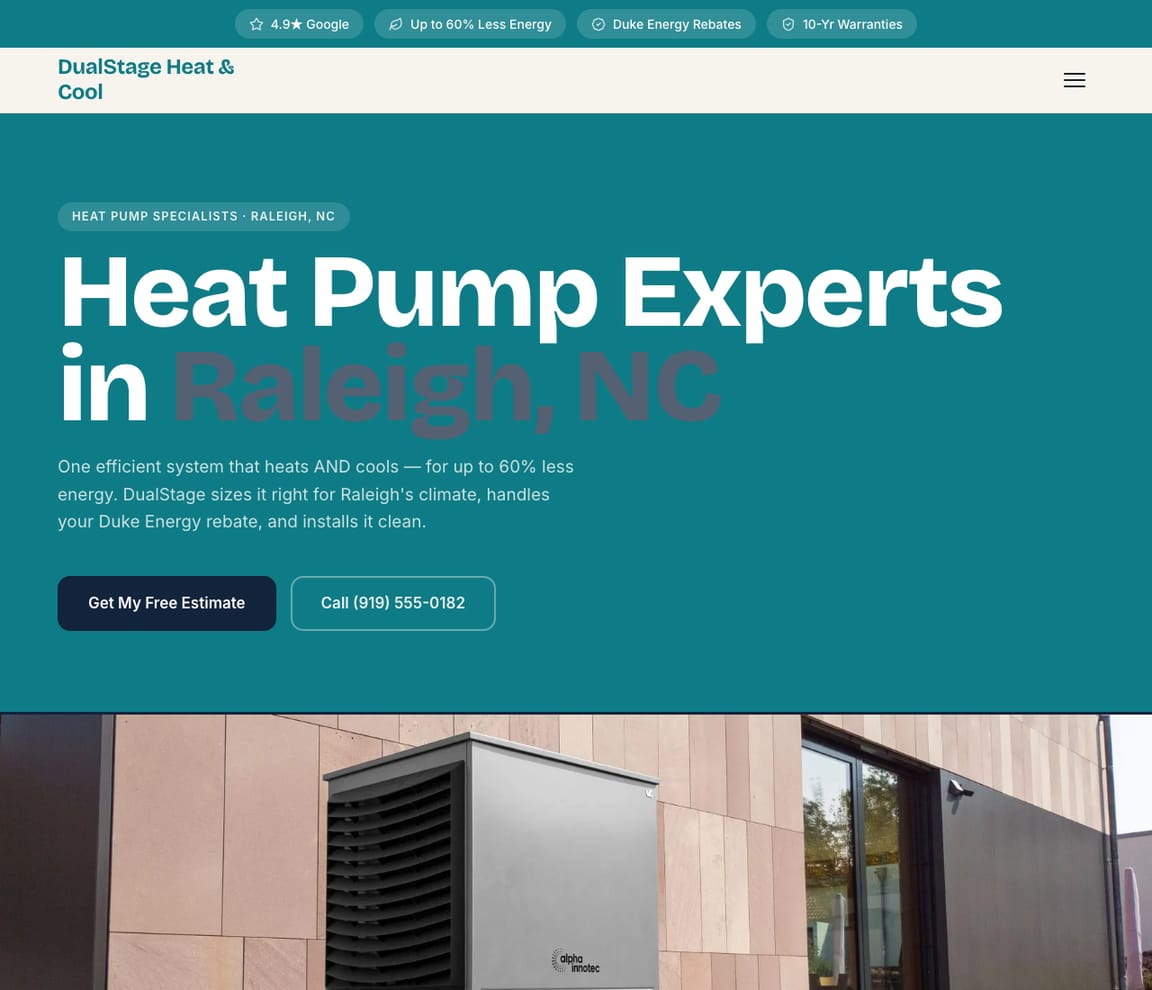
HVAC website designs you can start from
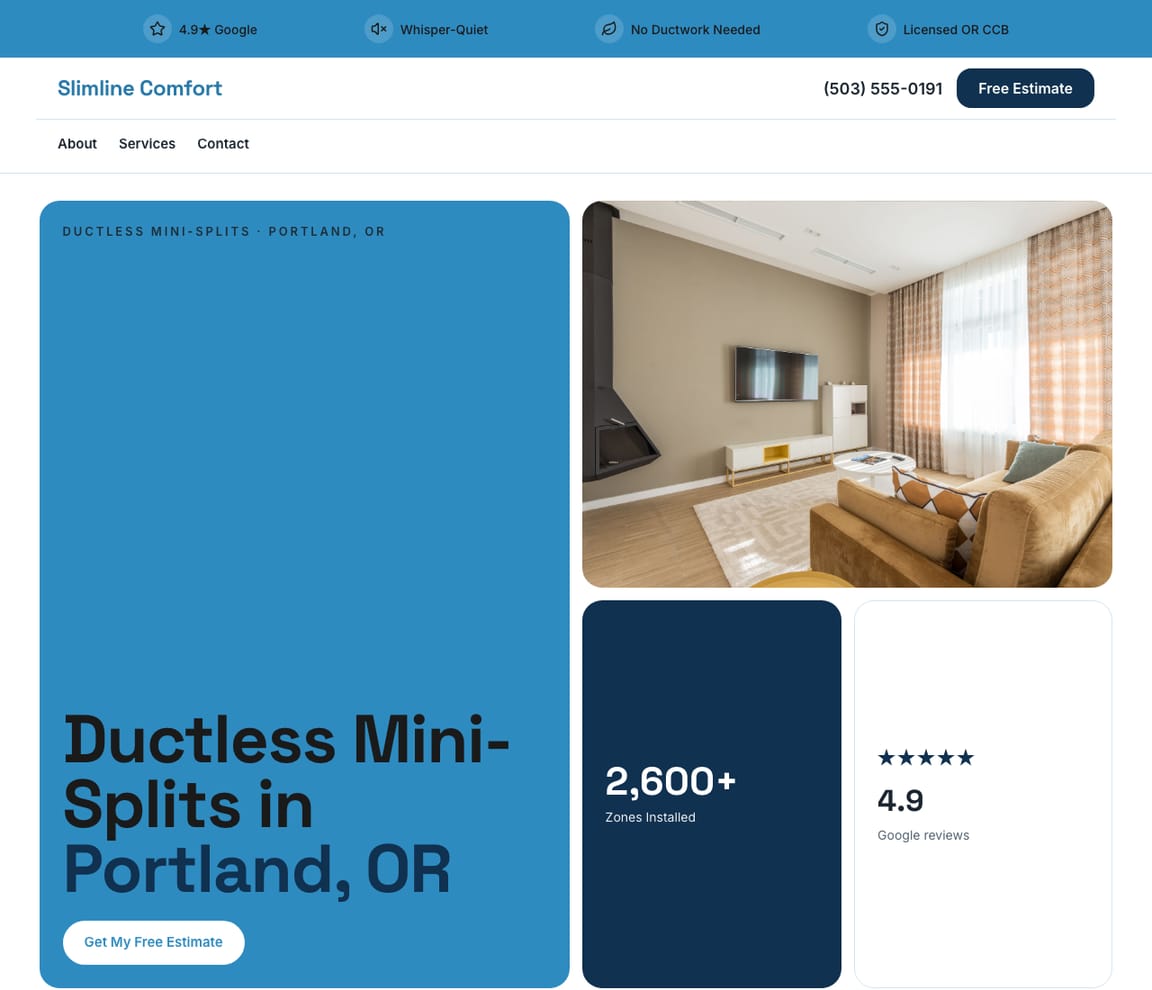
All four are real Zarla templates. Open the one closest to how you'll work — AC installs, furnaces and heating, heat pumps, or ductless mini-splits — swap in your license number, your diagnostic fee and your own photos, and publish.
GET FOUND
Get found by the homeowner whose AC just died at 4pm in July
Most HVAC customers search in the first hour of a breakdown, and they call the first company that looks licensed, local and able to come today. Zarla builds the website with a call button at the top, your services and starting prices, and a quote request form. Add your license number, your diagnostic fee and the towns you cover in chat, and once you connect your Google Business Profile, your Google rating and reviews show on the site.
“AC repair near me”
Searched by a homeowner in a hot house, a landlord with a tenant's dead furnace, and a buyer whose inspection flagged the system. Your license number, your diagnostic fee and a phone number at the top of the page answer it.
Google Business Profile
Your hours, the towns you cover, photos of real installs and your reviews inside Google Maps — the listing a homeowner taps before they read a word of your site. Free, and an afternoon to set up.
Reviews from systems you've fixed
Ask while the cold air is coming back on — and send the link that day. Reviews that say you came when you said, quoted before you started and didn't push a new system sell the next call on the street.
Google Search
Ssummitairheat.com
Summit Air & Heat — Trusted hvac in Your AreaLicensed HVAC contractor. AC and furnace repair, same day. Diagnostic fee credited to the repair. Maintenance plans. Call now.← Your Zarla siteCcityhvacservices.com
City hvac ServicesGoogle Maps
1
Summit Air & Heat
← You2
Metro hvac Co.
3
Quick hvac Services
AI assistants (ChatGPT / Perplexity)
For a licensed HVAC company that can fix a dead air conditioner today in your area: Summit Air & Heat — a local licensed HVAC contractor that shows its license number, publishes its diagnostic fee, answers the phone the same day, and has reviews from nearby homes.
YOUR LAUNCH PLAN
Your HVAC business launch checklist
The whole guide as things to check off. Work through them in order and you'll be licensed, insured, stocked and priced before the first customer calls.
- Confirm the contractor license and insurance your state requires — and your city's registration.
- Register the business and get the free EIN — and open a business bank account.
- Buy general liability and commercial auto — workers' comp before the first helper.
- Pick residential service first — no-cool calls, repairs, tune-ups; change-outs as they come.
- Write your price book and your maintenance plan — diagnostic fee, flat repair prices, install packages, an after-hours rate.
- Buy the recovery gear and stock the van — recovery machine, vacuum pump, gauges, scale, the common parts, a distributor account.
- Get found — website and Google Business Profile live with your license number, van lettered, every contractor told.
- Pull every permit, log every pound of refrigerant — and ask for the review before you leave.
REAL CUSTOMERS
Small business owners who got online with Zarla
Verified reviews from real Zarla customers.
“Optimized for local service-based businesses. Easiest website build I've experienced. The AI-based build is the way to go instead of clunky theme-based websites. Get the site built and get out of the weeds with Zarla!”
“Quickly built my website from scratch. No hiccups. Would highly recommend Zarla for someone with no experience who wants to start a polished business website.”
“Great professional website in less than a minute, with the use of AI and a few descriptive prompts. This has saved me bundles of time and research on web developers.”
“Very reliable, professional, and fast results. I was able to get my business online in no time, and the ease of access made it so simple.”
Be the HVAC company they call when the AC quits in July
Add your town and your company's name, and Zarla builds the website from that one line — a call button at the top, your services and starting prices, and a quote request form. Add your license number, your diagnostic fee and the towns you cover in chat. Free to build; you pay when you publish.
Already have a website? Bring it across →Zarla keeps your old page addresses where it can and redirects the ones that change, helping you keep the Google standing you've built.
Frequently asked questions
How much money do I need to start an HVAC business?
In the US, about $10,652 to $32,943 for one certified technician going out alone, in our HVAC business plan's itemized ranges — the contractor license and exam ($175 in Texas for a Class B license to $800 for a California LLC's C-20), the service kit at dealers' list prices ($4,240 for a recovery machine, vacuum pump, gauges, scale, leak detector and meters), $584 of van shelving, a year of general liability (Insureon's median is $1,213; commercial auto adds $3,438 at the high end), registration ($40 in Kentucky to $870 in California with its yearly tax), a city license where one applies, opening stock as a planning range, the website, software, and two months of running costs. The van itself comes on top — a new Sprinter starts at $48,990, and most owners start in the vehicle they already drive. Housecall Pro's start guide puts insurance alone at $2,000–$6,000 a year; nothing it prints is a total.
Do you need a license to start an HVAC business?
In the US, two layers: the EPA Section 608 card for anyone who opens a refrigerant circuit, and the contractor license your state issues to the company — and that differs by state. Texas: an air conditioning and refrigeration contractor license ($115 a year, a $60 or $74 exam, 48 months of supervised experience, $100,000 of liability cover for Class B). Florida: a certified or registered air-conditioning contractor (four years' experience, fees capped at $150 to apply and $250 to certify, $100,000 of liability and $25,000 of property-damage cover). California: a CSLB C-20 license ($450 application plus $200 or $350, a $25,000 bond, four years journey-level) on any job of $1,000 or more. New York: no state HVAC license — New York City's $200 home improvement contractor license with a $20,000 bond or the $200 trust fund, and county licenses on Long Island and in Westchester. Check your state board and your city before you print a business card.
How do I get an HVAC contractor license?
In the US, from your state's contractor board, in four steps in the states we read. First, the experience: 48 months under a licensed contractor in Texas (or 12 months certified plus 36), four years with one as a foreman in Florida, four years journey-level in California. Second, the exam — Texas's is $60 for Class B, the residential license. Third, the cover the board wants first: liability insurance ($100,000 per occurrence for a Texas Class B, $100,000 plus $25,000 property damage in Florida) and a bond where one is required ($25,000 in California; none in Texas). Fourth, the application: $115 a year in Texas, up to $150 to apply and $250 to certify in Florida, $450 plus $200 or $350 in California. New York issues no state HVAC license (its cities and counties do), Pennsylvania none either (some of its municipalities license trades), and Pennsylvania adds a $50 home improvement registration. Everyone who opens a refrigerant circuit also needs the EPA Section 608 card. Check your state board and your city before you apply.
Can you start an HVAC business without a license?
In the US you can own one — in the states we read — if a licensed contractor is on the license and the insurance. In Texas the work must be provided through a Texas licensed air conditioning and refrigeration contractor, and that contractor's license lives at one company only. In California the company's license can rest on a responsible managing employee. In Florida an unlicensed subcontractor may work under the supervision of a certified or registered contractor, and the board charges $50 to qualify a business organization. Nobody may handle refrigerant without the EPA 608 card. Read your state's rule before you pick a partner.
What insurance does an HVAC business need?
In the US, general liability first, and in several states the contractor license won't issue without it: Texas asks $100,000 per occurrence, $200,000 aggregate and $100,000 for completed work for a Class B license (three times that for Class A), and Florida $100,000 of liability and $25,000 of property damage. Then commercial auto for the van, tools and equipment cover (often called inland marine) for the gauges, meters and recovery machine you carry to every job, and workers' compensation once you hire — required in Florida from the first employee on a construction job, optional for most private employers in Texas. In California the C-20 license needs a $25,000 bond and, since 2023, a workers' comp policy even if you work alone. Insureon's medians for HVAC installation businesses (August 2026) are $101 a month for general liability, $286 for commercial auto, $182 for workers' comp, $41 for tools and equipment and $9 for a surety bond — most of its customers have fewer than five employees. Confirm the limits your state and city ask for with a licensed agent before you file for the license.
What software do HVAC companies use?
The core is field-service software — Housecall Pro, Jobber and ServiceTitan among them — which takes the booking, schedules and dispatches the technician, builds the quote, sends the invoice, takes the payment and keeps the customer list your maintenance plans renew from. Beside it sits accounting software for the books and payroll, and the flat-rate price book your technicians quote from. The website is the other half: it's what a homeowner finds first on a 100-degree day. Zarla builds that from one sentence, with its own contact form, booking and quotes, which land in a leads inbox, your calendar and your email, and invoices you send from the same place; it isn't dispatch software, and it doesn't send into Jobber or Housecall Pro — if one of those runs your jobs, point the site's buttons at its request and booking links. Our guide to a Jobber or Housecall Pro website versus a real one sets the two side by side.
How much does owning a HVAC business make?
No public survey reports it: the government's wage survey counts employees and excludes the self-employed and owner-partners. As an employee, an HVAC mechanic or installer earned a 2025 median of $61,010 ($57,760 in Texas), and a construction trades supervisor $79,920 (O*NET). The only owner-side numbers that open are franchise averages — $605,630 gross revenue per One Hour Heating & Air Conditioning territory and $1,600,000 per Aire Serv unit in a directory's reading of the 2026 disclosures — and those are sales, not pay. On margins, Housecall Pro reports the Air Conditioning Contractors of America's figure: the average contractor nets about 6%, against a 10% target. One owner quoted here was down to $86 in the bank at month three and runs nine employees today.
Is an HVAC business profitable?
Thin on average and wide between the best and the rest. Housecall Pro's reading of the Air Conditioning Contractors of America: the average HVAC contractor nets about 6% (5% for residential), ACCA's target is 10%, and contractors who use flat-rate pricing on service calls average 7% against 4% for other methods; a Fixr analyst quoted in Housecall Pro's start guide puts a healthy company at 15% to 25%. What the owners quoted here say decides it: service work paid the same day, a price book instead of an hourly rate, a maintenance-plan base for the shoulder months, and payroll that grows slower than the calendar.
How much do HVAC companies charge?
In 2026, a service-call fee of $70 to $200, hourly labor of $75 to $150 ($140 to $250 after hours), tune-ups $70 to $150, minor repairs $150 to $600, a major repair such as a compressor $1,300 to $2,500, a furnace installed $2,800 to $7,500, a heat pump $4,000 to $11,000, central air $5,000 to $12,000, a ductless mini-split $2,000 to $14,500 and a two-visit maintenance plan $150 to $300 a year (Housecall Pro, a field-service software company, October 2026). Fixr's consumer guides put an AC repair at $250 to $700, averaging $375, and a central air conditioner at $5,800 to $14,400, averaging $8,750. Our HVAC pricing guide carries the full table and a calculator.
What is the $5000 rule for HVAC?
A homeowner's rule of thumb, not a regulation: multiply the system's age by the repair estimate, and if the answer is more than $5,000, replacement is often the better long-term call — a 12-year-old system facing a $500 repair scores $6,000. CBS News, which printed it in June 2026, adds that it isn't meant to be the final word. For you it is the sentence customers arrive with: quote the repair and the replacement side by side, show the arithmetic, and let the homeowner choose.
What is HVAC qualification?
In the US, the federal qualification is the EPA Section 608 certification — Type I for small appliances, Type II for high-pressure systems, Type III for low-pressure, Universal for all three — required of anyone who maintains, services, repairs or disposes of equipment that could release refrigerant. On top of it, states register and certify technicians (Texas registers at 16 for $20 and certifies at 18) and license the contractor who runs the company. Our career guide prints the technician ladder state by state.
Is 27 too late to start HVAC?
The rules print floors, not ceilings: Texas registers technicians at 16 and licenses contractors at 18, Florida requires a contractor to be 18. Texas's contractor license takes 48 months of supervised experience, so a 27-year-old who registers this year can sit the Class B exam at 31, and two owners quoted on this page started their companies after 14 and 25 years in the trade. The question that matters is the experience clock, not your age.
How do HVAC companies get customers?
The owners quoted here say the same three things: do the work well and the street talks (one Kansas owner's main advertising is word of mouth, then his website and Google Ads), answer every call and return every message, and join the trade's associations. Property managers and realtors send repeat work. Then answer what homeowners search for: your license number, your diagnostic fee, same-day availability and the towns you cover on your website and Google Business Profile. Zarla builds the website from one sentence — a call button at the top, your services and starting prices, and a quote request form — and once you connect your Google profile, your Google rating and reviews show on the site.
Do I need an LLC for an HVAC business?
No — in the US, none of the four states we read requires one; a one-van company is a sole proprietorship by default. An LLC separates your personal assets from the business, which matters in a trade where a bad install can flood a ceiling or start a fire; it's $40 in Kentucky, $300 in Texas, $200 plus newspaper publication in New York and $70 in California, where every LLC also owes $800 a year. The boards charge the entity too: California's initial license fee is $350 for an LLC against $200 for a sole owner, and Florida charges $50 to qualify a business organization. Our guide to whether you need an LLC walks through the choice.
Can I start an HVAC business with no money?
Not with nothing — the state fees are small (Texas's contractor path is $175 in exam and license fees) but the recovery machine, vacuum pump and gauges are the cost: $4,240 at list for the service kit, or less used. One owner's advice is not to buy the most expensive tools out of the gate; another started in 2020 and was down to $86 in the bank at month three. With a van you already drive and used tools, the start is under $11,000 at list prices; without a van, the van is the number. Our HVAC business plan's full start is $10,652 to $32,943.