BUSINESS GUIDE
How to open a dance studio in 2026
The real version, written for a first studio: renting by the hour or signing a lease, the floor that protects dancers' knees, insurance and music licenses, what it costs to open, what families pay — and how parents find your classes before the fall term.
Free to build · Pay when you publish · No credit card
16,284fine-arts schools with employees in the US, dance studios among them, 2023 (Census)
37%of US girls aged 6 to 17 took music, dance, language or other lessons in 2020 (Census)
$67–$135a month for one weekly class at five US studios, 2026-27 season
No codeto get online
See it in action
See what your dance studio website could look like
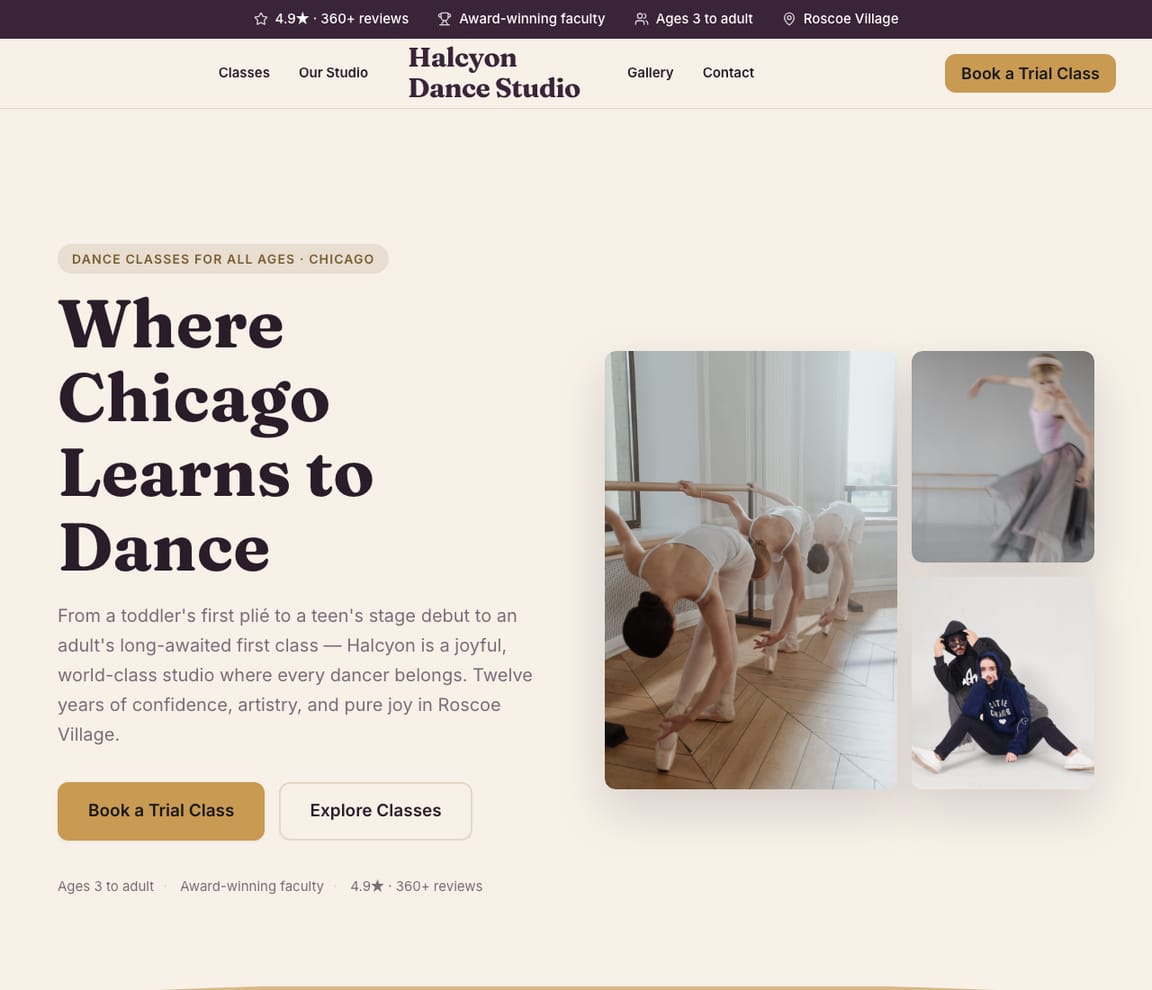
This is a real Zarla template for an all-ages dance studio. Describe yours — the styles you teach, the ages, your teachers — and you'll have a site like this, with class cards for every style and room for parent reviews, in about a minute.
- Professional design — not a generic template
- Looks great on desktop and mobile
- Content written for your industry
Build the website
Start your dance studio website now
Add your town and your studio's name to the sentence, and Zarla builds the site: your classes by style and age, your teachers, a page for each program and a way for parents to get in touch. Edit it in chat and publish in time for fall sign-ups.
Already have a website? Bring it across →Zarla keeps your old page addresses where it can and redirects the ones that change, helping you keep the Google standing you've built.
Is a dance studio worth opening?
Families keep signing up. By 2020, 37% of US girls and 27% of boys aged 6 to 17 took music, dance, language or other lessons, up from 33.5% and 24% in 1998 (Census Bureau). The Census counted 16,284 fine-arts schools with employees in 2023 — the category dance studios fall in, alongside music, art and drama schools — and half of them had fewer than five employees (County Business Patterns 2023, industry 611610). This is a business of small, owner-run studios. One studio group's survey of the 2025-26 season found enrollment up nearly 10% on the year before (Ensemble Performing Arts, October 2025).
The hard part is that a studio's costs are fixed and its income is seasonal. The rent is due from the day you sign, while enrollment builds over a season and families drop classes too — in one software company's data from 4,414 studios, registrations peaked in June, July and August, and the peak drop months saw 10% more class drops than the year before (Jackrabbit's 2024 benchmark report). The Dance Studio Owners Association puts the industry's average profit at 7.6% — roughly 7 cents of every dollar a studio takes in (DSOA). And a rent increase can end a studio outright: one North Carolina owner closed just after registering dancers for her studio's 20th year, when new landlords doubled her rent (CBS17, October 2023).
What families pay is published: at five US studios' 2026-27 rates, one weekly class runs $67 to $135 a month depending on its length (Lisa's Dance Studio, EDGE Dance, Studio 9, Müv, Turning Pointe), adult drop-in classes $12 to $30, and a recital costume $85 to $150, billed to the family (Step By Step, Turning Pointe).
So it's worth opening if you love teaching, you can start small enough that the rent never outruns your enrollment, you plan for summer, and you price from your real costs — which is what the rest of this guide gives you.
How to open a dance studio, in plain English
There's no license to teach dance in a private studio in any state we could find. Thirty-six states certify dance teachers for public schools, and that's a school-teaching credential, not a studio license (Education Commission of the States, 2023). The rules that do reach a studio are about the building, the music and the children:
- The building: a dance studio is usually an assembly use under the building code — North Carolina's fire marshal lists “Dance or Ballet Studio” as A-3, with an exception for spaces under 50 occupants or 750 square feet (NC Office of the State Fire Marshal). In New York City, a new or amended certificate of occupancy is required when a space's occupancy group changes (NYC Department of Buildings). Ask your city before you sign a lease.
- The music: playing recorded music in class is a public performance under US copyright law (17 U.S.C. §106), which is why studios license it. BMI's 2026 license for dance classes starts at $224 a year for under 60 students a week (BMI), and ASCAP's 2026 rate for a mixed-style studio starts at $138.22 a year for up to 75 students (ASCAP).
- The children: background-check rules vary by state. California requires training and background checks for staff and regular volunteers of youth service organizations (Business and Professions Code §18975); Pennsylvania requires clearances for many people who work or volunteer with children, renewed every five years — the child abuse clearance costs employees $13 (Pennsylvania DHS: clearances, fee). Background-check every adult who teaches, wherever you are.
- Sales tax: it depends on the state. Missouri, for example, exempts dance lessons but taxes dancewear, recital admission and party charges (Missouri Department of Revenue). Check yours before your first sale.
The dance-specific costs are published too. A sprung floor with marley runs about $3,200 to $22,500 for one 400 to 1,500 square foot room (Stagestep's cost guide); glassless wall mirrors about $310 to $370 for a 2- or 3-foot-wide panel (Dance Equipment International) and wall barres about $150 to $450 (The Beam Store); a dance studio's median general liability premium is $654 a year (Insureon, May 2025); and renting a studio by the hour runs about $25 to $150 (Peerspace).
From there the order is the same everywhere: decide who you'll teach, rent by the hour or sign a lease, register and insure the studio, build out the room, set your schedule and prices, hire and check your teachers, and fill the first term. Our free dance studio business plan lays out every startup line with typical costs, the dance studio website templates and dance studio website examples show what a good studio site looks like, and Zarla's dance studio website builder is how families find your classes.
What studio owners actually say
None of this is our opinion about dance. It comes from studio owners speaking in public, mostly to Dance Teacher magazine and local news. Four things come up again and again.
Start small, and know your neighbors. Adam Holms started Norwalk Metropolitan Youth Ballet in Connecticut with 13 students, in a room with a crooked floor at the back of a batting-cage business; now, in his 11th season, he has two studios and 125 students. His advice: “You have one shot to have a good reputation” (Dance Teacher, January 2025). Jessica Kubat saved $25,000 before opening MJ's House of Dance on Long Island, and priced against the competition: “Part of the business plan was that I had to look at three other studios' pricing, and they had to be within 10 miles of my location” (Dance Teacher, November 2019).
The lease is the risk. Cindy Blevins had just registered dancers for The Dance Center's 20th year in Knightdale, North Carolina, when new property owners doubled her rent: “I am completely closed. My studio is in storage and my daughter's garage” (CBS17, October 2023).
“I was able to walk away from my studio, but when you own the property, it's just not that easy.” — Jen Turey, former owner of Dance Etc. School for Performing Arts in Newtown, Connecticut, on leasing rather than buying, speaking to Dance Teacher in January 2025
Plan for summer. Melanie Boniszewski of Tonawanda Dance Arts in upstate New York: “We're in a cold-weather climate, so summer is actually really hard to attract people—everyone wants to be outside, and no one wants to commit to a full season” (Dance Teacher, January 2021). Robin Dawn Ryan, who runs studios in Cape Coral and Naples, Florida, leans on the recital: “My program book alone made $16,000, which covers a good chunk of the summer rent” (Dance Teacher, May 2018).
Raise prices a little, every year. Carolyn Simpson Wells of Dance by Design Studios in New Braunfels, Texas: “Either tuition is raised, registration fees, costume fees or recital tickets. I've never heard pushback because we make it small every year” (Dance Teacher, June 2019).
The through-line: the studios that last start no bigger than their enrollment, sign leases they could survive losing, plan the summer and the recital a season ahead, and move their prices a little every year instead of a lot all at once.
THE STARTER KIT
What you need to open a dance studio
A space, by the hour or on a lease
Rent a community hall, school gym or another studio by the hour while you build a following, or lease your own room. For a lease, ceiling height, parking and a lobby for waiting parents matter more than the address.
A floor that protects dancers
A sprung floor absorbs impact and a vinyl dance surface (marley) gives the right grip. It's the line that protects your dancers' knees and ankles — and the one not to skimp on.
Mirrors, barres and sound
Wall mirrors, ballet barres if you teach classical styles, and a sound system your teachers can run from a phone. Add a front desk and cubbies once families are waiting in the lobby.
Insurance and a child-safety policy
General and professional liability, abuse and molestation coverage — which some policies leave out, so check yours — and a written child-safety policy with background checks for every adult who teaches.
Music licenses
Playing recorded music in class and at the recital is a public performance under US copyright law. Studios license it from BMI and ASCAP, the performing-rights organizations, or use a licensed studio music service.
A way for families to find you
A website with your classes by age and style, your timetable and tuition, and a Google Business Profile — where parents look before they book a trial class.
THE PAPERWORK
Licenses, permits and insurance for a dance studio
| Typical cost | Time to get | Legally required? | |
|---|---|---|---|
| State license to teach dance | None found | — | No state we found licenses studio teachers |
| Local business license | Set by your city | Days to weeks | Where your city requires one |
| Certificate of occupancy | Set by your city | Weeks | Often — a studio is an assembly use |
| BMI music license | $224/yr under 60 students | Days | Yes, to play BMI's music |
| ASCAP music license | $138.22/yr, mixed styles, up to 75 students | Days | Yes, to play ASCAP's music |
| Background checks for teachers | $13 for a PA child abuse clearance | Days to weeks | In some states, e.g. PA and CA |
| General liability insurance | $654/yr median | Days | Not by law — your lease may ask |
| Abuse and molestation coverage | Included, or an add-on | Days | No — check your policy covers it |
| Sales tax registration | Set by your state | Days | If you sell taxable goods |
| EIN from the IRS | Free | Minutes online | Only if you hire or incorporate |
THE STEPS
How to open a dance studio (step by step)
Seven steps from “I want my own studio” to a full first term.
01
Decide who you'll teach
Choose your styles and ages — preschool, recreational kids, competition, adults — and check the families and studios near you. The mix decides the space, the schedule and the price.
02
Start by the hour, or sign a lease
Rent space by the hour to prove demand with no lease risk, or sign for your own room. Before you sign, confirm the zoning and what the landlord will let you change.
Check zoning first03
Register and insure the studio
Form the business, get a free EIN and a local business license, and buy liability and abuse-and-molestation coverage before the first class.
04
Build out the room
Lay the sprung floor and marley, hang mirrors and barres, set up sound, and pass the occupancy inspection your city requires for a studio.
Rules vary by city05
Set your schedule and prices
Build a term timetable by age and style, and set monthly tuition, a registration fee and a family discount from local rates and your real costs.
06
Hire and check your teachers
Hire teachers per class, run background checks on every adult who works with children, and write down your child-safety policy.
07
Get found and fill the first term
Put your website and Google Business Profile live before fall sign-ups, run a free trial week, and ask every family for a review after the first recital.
THE COSTS
How much does it cost to open a dance studio?
The total is our free dance studio business plan's itemized ranges for a leased one- or two-room studio — its floor, insurance, music and software lines are published prices, while the lease, build-out and working capital are planning ranges, because no survey publishes them. Floor prices are Stagestep's cost guide; music is BMI's and ASCAP's 2026 rates; the hourly rate is Peerspace's range for renting a dance studio.
$19k–$90kto open a leased one- or two-room studio — the lease, floor and build-out are most of it
$3.2k–$22.5ka sprung floor and marley for one 400–1,500 sq ft room
$362/yrBMI and ASCAP music licenses for a studio under 60 students a week
$25–$150/hrrenting a studio by the hour instead — the low-cost start
WHAT WE'VE LEARNED
What actually fills a dance studio's classes
Thousands of local business websites in, the pattern for class-based businesses is clear: a parent wants to know which class fits their child, when it runs and what it costs — and a studio that answers on the page gets the trial class.
A timetable by age and style
Every class with the ages it's for, the day and time, and the level. A parent who has to call to find out whether there's a class for a six-year-old on Tuesdays tries the studio that shows it.
Prices, said plainly
Monthly tuition by classes per week, the registration fee, the family discount and roughly what the recital costs. Parents budget for the whole year, and a surprise costume bill in March loses families.
A trial class and real photos
A first class they can book in thirty seconds, and photos of your actual studio, teachers and recital. The trial is where enrollment happens; everything on the site is there to get a family to book one.
THE UPSIDE
What a dance studio can earn
Tuition and drop-in prices from five US studios' published 2026-27 rates; costume charges from two studios' 2026 policies; teacher pay from Jackrabbit's 2024 benchmark report and Ensemble Performing Arts' 2025-26 survey. Real prices, not a promise — your enrollment, your rent and your retention decide it.
$67–$135a month for one weekly class, the studio's core income
$12–$30an adult drop-in class
$85–$150per recital costume, billed to families
$24–$30/hrwhat studios pay a teacher
SEE IT WORK
Dance studio website designs you can start from
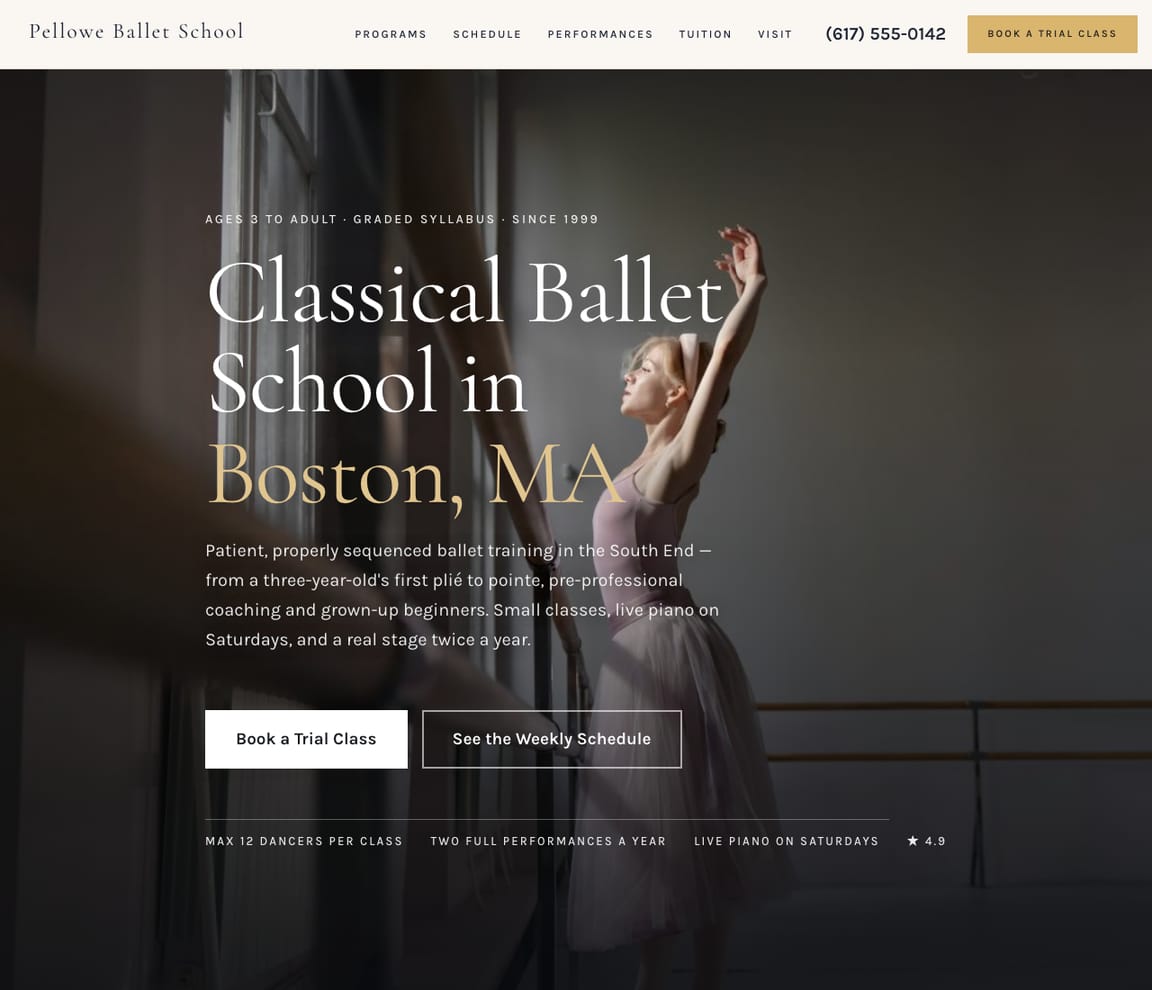
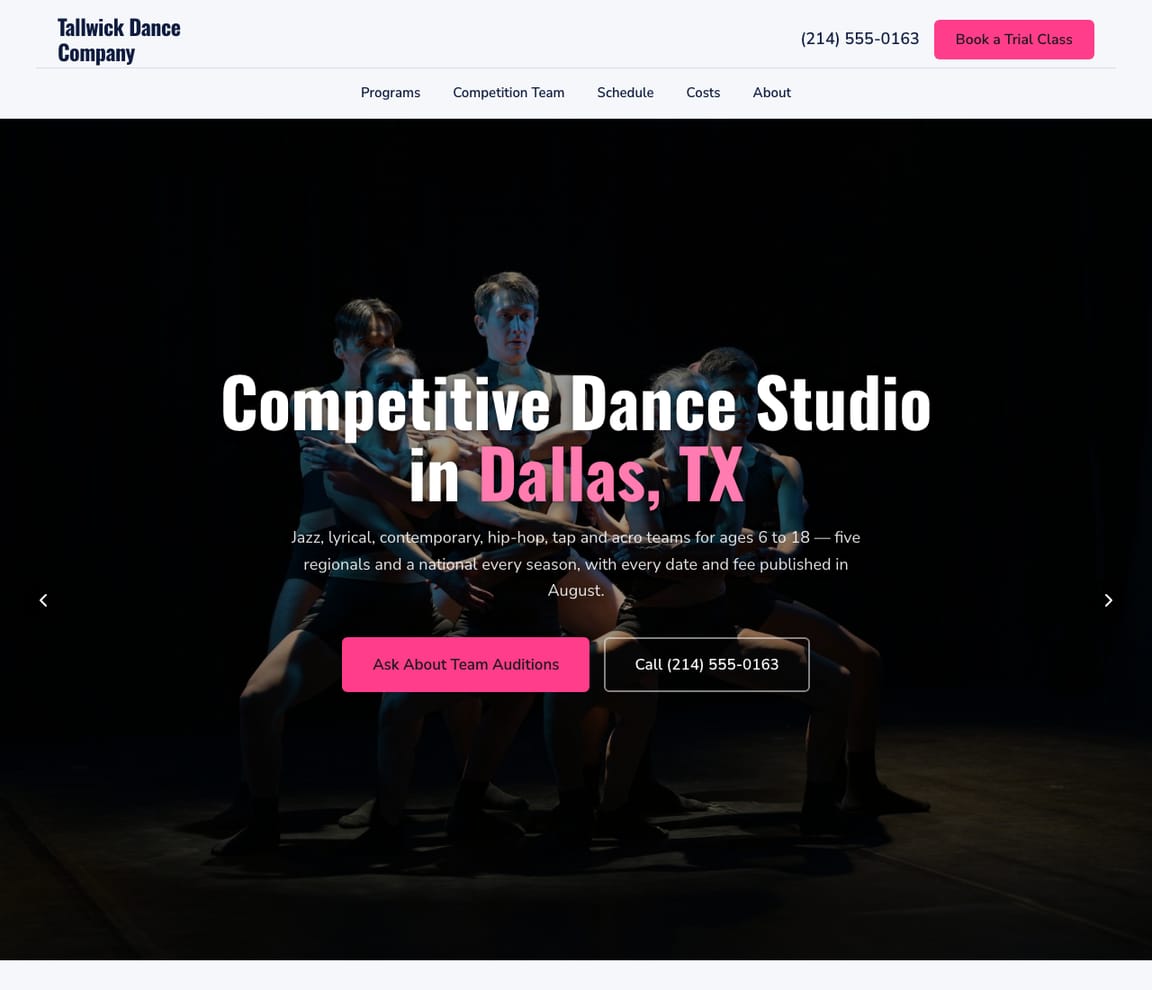
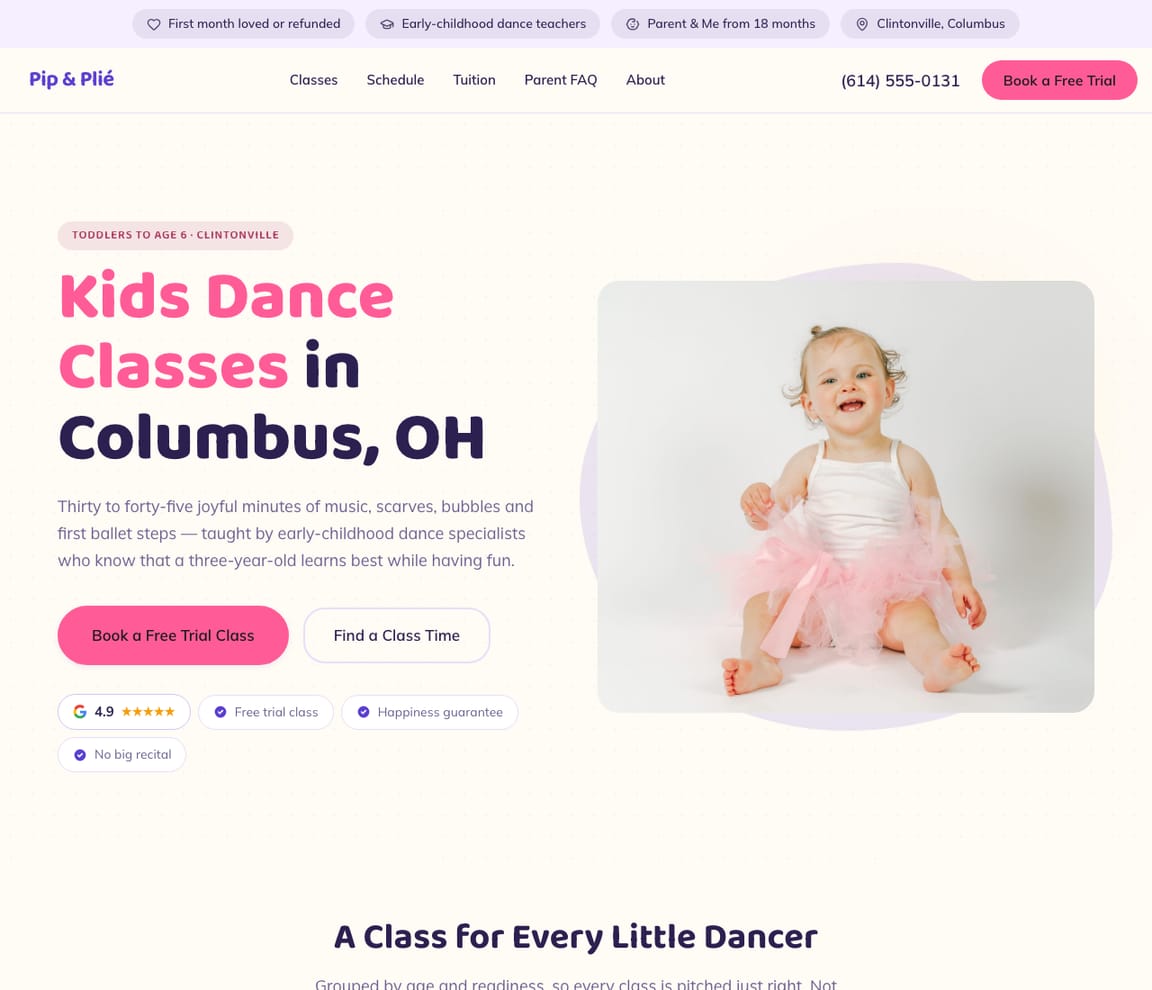
All four are real Zarla templates. Open the one closest to your studio — classical ballet, hip-hop, a competition team or toddler and preschool classes — swap in your timetable, teachers and photos, and publish.

GET FOUND
Get found by the parent searching after school pickup
A website plus a Google Business Profile is how a parent decides which studio to try — Zarla builds the website, and once you connect your profile, your name, map location and reviews stay in step on both.
“Dance classes for kids near me”
A parent with a four-year-old who won't stop dancing in the kitchen. Your styles, the ages each class is for, the days and times and what a first class costs answer their questions before they call.
Google Business Profile
Your address, class hours, photos of the studio and recital, and your reviews inside Google Maps — free, an afternoon to set up, and where most parents look first.
Reviews from other parents
Parents choose a studio on trust, and trust comes from other parents. Ask every family for a review after the first recital — they decide the trial class for the next one.
Google Search
Rriverbenddancecollective.com
Riverbend Dance Collective — Trusted Dance Studio in Your AreaBallet, jazz, tap and hip hop for ages 3 to 18, plus adult evening classes. Try a first class before you enroll.← Your Zarla siteCcitydancestudioservices.com
City Dance Studio ServicesGoogle Maps
1
Riverbend Dance Collective
← You2
Metro Dance Studio Co.
3
Quick Dance Studio Services
AI assistants (ChatGPT / Perplexity)
For a local dance studio in your area: Riverbend Dance Collective — a neighborhood dance studio with ballet, jazz, tap and hip hop for ages 3 to 18, adult evening classes and a trial class before enrolling.
YOUR LAUNCH PLAN
Your dance studio launch checklist
The whole guide as things to check off. Work through them in order and you'll be insured, licensed, priced and findable before your first term starts.
- Decide your styles and ages — and check which families and studios are near you.
- Rent by the hour or sign a lease — confirm zoning, ceiling height and parking before you sign anything.
- Register the business and get a free EIN — plus the local business license your city requires.
- Buy liability and abuse-and-molestation coverage — and write a child-safety policy with background checks for every teacher.
- Lay a sprung floor and marley — then mirrors, barres and sound, and pass the occupancy inspection.
- License your music — for classes and for the recital.
- Set the timetable, tuition, registration fee and family discount — and publish them.
- Get found before fall sign-ups — put your website and Google Business Profile live, run a free trial week, and ask every family for a review.
REAL CUSTOMERS
Small business owners who got online with Zarla
Verified reviews from real Zarla customers.
“I had no idea how to set up a website for my business. Thanks to Zarla, they've helped me a lot.”
“Great professional website in less than a minute, with the use of AI and a few descriptive prompts. This has saved me bundles of time and research on web developers.”
“Very reliable, professional, and fast results. I was able to get my business online in no time, and the ease of access made it so simple.”
“Quickly built my website from scratch. No hiccups. Would highly recommend Zarla for someone with no experience who wants to start a polished business website.”
Fill your first classes before opening day
Add your town and your studio's name, and Zarla builds the website from that one line — your classes by style and age, your teachers and a way for parents to reach you. Free to build; you pay when you publish.
Already have a website? Bring it across →Zarla keeps your old page addresses where it can and redirects the ones that change, helping you keep the Google standing you've built.
Frequently asked questions
Is owning a dance studio profitable?
It can be, but the margins are thin: the Dance Studio Owners Association puts the industry's average profit at 7.6%. A studio's rent, insurance and music licenses are fixed, while its income builds over a term and dips in summer, so profit comes from filling classes past the point where tuition covers the rent — and keeping families from one season to the next. The recital, summer camps and private lessons add to the tuition.
How much does it cost to start up a dance studio?
In the US, about $19,450 to $89,950 for a leased one- or two-room studio, in our dance studio business plan's itemized ranges — mostly the lease deposit, the sprung floor and the build-out. A sprung floor with marley runs about $3,200 to $22,500 for one 400 to 1,500 square foot room (Stagestep), and music licenses from BMI and ASCAP about $362 a year for a small studio. Renting space by the hour instead costs far less to start.
Do you need a license to open a dance studio?
In the US, no state we could find licenses private dance teachers. You'll usually need a local business license, and a certificate of occupancy for the space — a studio is typically an assembly use under the building code. Playing recorded music in class is a public performance under US copyright law, so studios license it from BMI and ASCAP. Some states, such as California and Pennsylvania, have background-check rules for adults working with children. Check with your city and state before you open.
What qualifications do you need to run a dance studio?
None are required by law for a private studio in the states we checked — 36 states certify dance teachers only for public schools. What families look for is training and experience: years teaching for other studios, a teaching syllabus or association membership, and a background check. Many owners teach for someone else for years before they open their own.
How much does an average dance studio owner make?
There's no reliable published figure. The salary sites rest on tiny samples — Payscale's is 20 self-reported profiles, Indeed's 13 job postings — and they disagree by more than double. What an owner earns is what's left after rent, teachers' pay and insurance: one weekly class brings in about $67 to $135 a month per student at the studios we checked, and studios pay teachers about $24 to $30 an hour.
How much will it cost to build a dance studio?
The dance-specific parts of a build-out are the floor, the mirrors and the barres. A sprung floor with marley runs about $3,200 to $11,200 for a 400 to 800 square foot room (Stagestep); glassless wall mirrors about $310 to $370 for a 2- or 3-foot-wide panel; and wall-mounted barres about $150 to $450 each. Walls, lighting, a lobby and restrooms depend on the space and your contractor.
How do you start a dance studio with no money?
Rent space by the hour before you sign a lease: dance studios rent for about $25 to $150 an hour on Peerspace, and school gyms, church halls and community centers often rent for less at quiet times. Start with the classes you can fill, collect tuition monthly, and move into your own space once your enrollment covers the rent.
How much should I charge for dance classes?
Start from what studios near you charge — one weekly class ran $67 to $135 a month at the five US studios we checked for 2026-27, with adult drop-ins at $12 to $30 and an annual registration fee of $35 to $75. Then check it against your own costs, and raise it a little every year rather than a lot at once.
How do dance studios get new students?
Mostly through parents: a Google Business Profile with your classes, photos and reviews, a website that shows your timetable by age and style, your prices and a trial class, flyers through preschools and schools, and a bring-a-friend week. Ask every family for a review after the recital. Zarla builds the website from one sentence — your classes, your teachers and a way for parents to reach you — and syncs your Google profile once you connect it.