BUSINESS GUIDE
How to open a med spa in 2026
For the nurse practitioner, physician assistant, registered nurse or physician done building someone else's practice: who may own a med spa in five states in the boards' and statutes' own words (and who may only own the management company), who must examine the client and sign the order, who may hold the syringe and who may fire the laser, what the licenses, the room, the product, the software and the policy cost from the agencies' and vendors' own pages, what the staff earn — and what the owners who did it say about the first two years.
Free to build · Pay when you publish · No credit card
$19,920the lean floor of a physician-delegated one-room practice in Texas before the device and the build-out — the entity, ten vials, three months of a medical director, the policies, the charting software, the suite's deposit and a course, from the pages that open (our arithmetic)
$208a month — $2,500 a year — for a med spa's professional liability policy at Insureon's median; general liability is $52 a month
$1,398,833the average annual revenue of a US medical spa in 2023, up from $1,307,587, across 10,488 locations (the trade body's 2024 report recap) — a one-provider practice is a fraction of it
No codeto get online
See it in action
See what your med spa website could look like
This is a real Zarla template for a physician-led med spa — the editorial hero, the treatment menu, the clinic gallery, the membership and financing section, the consultation-request form. Describe yours — injectables, laser, the city, who supervises — and you'll have a site like this, with your menu, your providers' credentials and a map, in about a minute.
- Professional design — not a generic template
- Looks great on desktop and mobile
- Content written for your industry
Build the website
Start your med spa website now
Add your city and the practice's name to the sentence, and Zarla builds the site: the treatment menu, the providers' credentials, a map and a consultation-request form. Add your prices, your memberships and your financing in chat, then publish.
Already have a website? Bring it across →Zarla keeps your old page addresses where it can and redirects the ones that change, helping you keep the Google standing you've built.
Is opening a med spa worth it in 2026 — and what do med spa owners make?
The med spa one practitioner can open is a one-or-two-room practice in a professional suite: injectables and one energy device, a nurse injector or the owner injecting, a prescriber's examination before every order, a medical director on a written agreement where the owner is not one, a membership billed monthly. The capital is the device and the build-out; the question is the ownership rule and the second year. What the trade reports: the industry grew "from 8,899 locations in 2022 to 10,488 in 2023", "The average annual medical spa revenue increased from $1,307,587 to $1,398,833", "The average medical spa receives 245 patient visits per month", and "67% of single-owner practices are owned by non-MDs/surgeons" (AmSpa, 2024 State of the Industry recap, November 6, 2024); on ownership, "Physicians can own medical practices throughout the country." and "A Management Services Organization (MSO) offers a legal pathway for non-physicians." (AmSpa, How to Open a Med Spa, April 2026). What the staff earn: "Workers on average earn $132,300." for nurse practitioners — $63.61 an hour (O*NET, 2025); "Workers on average earn $135,880." for physician assistants (O*NET, 2025); "Workers on average earn $97,550." for registered nurses (O*NET, 2025); "Workers on average earn $45,330." for skincare specialists — the esthetician (O*NET, 2025). No wage survey has a "med spa owner" line.
What a unit and a syringe sell for — three menus read today, prices only. "Botox is $12 per unit at all nine InjectCo locations in Texas." — "$7.77 per unit with membership ($24.99/month)." (InjectCo, nine Texas clinics, June 3, 2026); "30 units or less $11/unit. (Normally $14/unit)", "Purchase one (1) Juvedérm Ultra for $610" and a syringe of Voluma at "Normally $800" in Scottsdale (Ultra Smooth Skin, November 2026 specials); "Dysport $6/unit", "Injectables starting at $300" and "Laser Hair Removal starting at $60" on a nurse injector's list in a Dallas magazine (CM Aesthetics in VoyageDallas, August 15, 2024). Against the product: a 100-unit vial is "approximately $656 per 100-unit vial" at the published list price and "commonly $500–$600 per vial through authorized US distributors" — "about $4–$6 per unit at typical wholesale" (Empire Medical Training, updated July 17, 2026); "Clinics typically pay about $400 to $600 for a 100-unit vial of Botox from a supplier, roughly $4 to $6 per unit" (Portrait Care, October 21, 2026). What owners report. No page of record prints a med spa owner's draw. The owners say the shape of the first years: "I took a lot of risks to start my practice." and "I was scary broke for about two years." (Shawnda Dorantes, Beauty Lounge Medical Spa, San Marcos, California — CanvasRebel, November 10, 2022); "I muddled thru and survived, not making much however made enough to pay the bills." (Christina Morado, a nurse injector, CM Aesthetics — VoyageDallas, August 15, 2024); "What if I can't pay myself a living wage?" — the question Eileen Fleer asked herself before opening ALC Medspa in Gurnee, Illinois (Berxi, February 19, 2025).
The catch. In Texas, New York and California the person who may own the practice is the licensed practitioner, and the business partner owns a management company that may not touch the records, the staff or the drugs; the vendors' state lists get this wrong in print; a medical director priced at a name on paper is, in the California Board's words, aiding and abetting; the device is the one line no maker prices on a page; the first two years are the owners' broke ones; and the cash-pay sales side sits badly with a clinician who did not go into medicine to sell. That's what the rest of this guide sets up.
How to open a med spa, in plain English
The federal layer — the drug, the device, the records. In the US there is no federal med spa license; who may own and who may inject is state law. What is federal: the product is a prescription drug by class — a drug "is not safe for use except under the supervision of a practitioner licensed by law to administer such drug" and "shall be dispensed only (i) upon a written prescription of a practitioner licensed by law to administer such drug" (21 U.S.C. §353), its label bearing "The statement “Rx only”" (21 CFR §201.100) — a business fact about who orders it, nothing about what it does. The device: "Medical devices are classified into Class I, II, and III." and "If your device requires the submission of a Premarket Notification 510(k), you cannot commercially distribute the device" "until you receive a letter of substantial equivalence from the FDA authorizing you to do so." (FDA, device regulation overview, January 30, 2026) — the clearance is searchable (FDA 510(k) database), and the guide says nothing about any device beyond that. The records: "HIPAA covered entities include health plans, clearinghouses, and certain health care providers as follows:" — "Providers who submit HIPAA transactions, like claims, electronically are covered." (CMS, covered entities, March 16, 2026) — a cash practice that never files an electronic claim is a question for counsel, and the state's medical-records and privacy law applies either way; written consent for every photo you post is the practice, not the statute. The EIN: "You never have to pay a fee for an EIN." (IRS).
Who may own a med spa — five states in their own words. Texas: "A person may not practice medicine in this state unless the person holds a license issued under this subtitle." (Tex. Occ. Code §155.001); an entity "commits an offense if" it "indicates that the person, partnership, trust, association," "or corporation is entitled to practice medicine if the person, partnership, trust, association," "or corporation is not licensed to do so." (§165.156); and only "Persons licensed as doctors of medicine and persons licensed as doctors of osteopathy by the Texas Medical Board," with podiatrists and chiropractors, "may jointly form and own a professional association" "or a professional limited liability company to perform professional services that fall within the scope" "of practice of those practitioners." (Tex. Bus. Orgs. Code §301.012) — so the physician owns the practice and a non-physician owns the management company; and "There is currently no registration for Med Spa clinics in Texas." — "Nonsurgical medical procedures performed in Texas, such as those offered at a Med Spa, are required to be" "delegated by a licensed physician, however there is no specific registration for this type of clinic at this time." (Texas Medical Board, FAQ). Florida has no such bar but licenses the clinic a non-practitioner owns: ""Clinic" means an entity where health care services are provided to individuals and which tenders charges for reimbursement", with an exemption for "A sole proprietorship, group practice, partnership, or corporation" "that is wholly owned by one or more licensed health care practitioners" (Fla. Stat. §400.9905) — a practitioner-owned practice is exempt; a licensed clinic "shall appoint a medical director or clinic director who shall agree in writing to accept legal responsibility" and shall "Have signs identifying the medical director or clinic director posted in a conspicuous location", "Ensure that all practitioners providing health care services or supplies to patients maintain a current" "active and unencumbered Florida license." and "Conduct systematic reviews of clinic billings to ensure that the billings are not fraudulent or unlawful." (§400.9935); fee-splitting is unlawful — "It is unlawful for any health care provider or any provider of health care services to offer, pay, solicit, or receive" "a kickback, directly or indirectly, overtly or covertly, in cash or in kind, for referring or soliciting patients." (§456.054) and "Paying or receiving any commission, bonus, kickback, or rebate, or engaging in any split-fee arrangement in any form" is grounds for discipline (§458.331). New York: "A professional service corporation may issue shares only to individuals who are authorized by law to practice in this state" (N.Y. Bus. Corp. Law §1507), and in a professional LLC practicing medicine "each member of such limited liability company must be licensed pursuant to article 131 of the education law" (N.Y. LLC Law §1203); "Permitting any person to share in the fees for professional services" outside the firm and "Permitting, aiding or abetting an unlicensed person to perform activities requiring a license;" are professional misconduct (N.Y. Educ. Law §6530). California: "Corporations and other artificial legal entities shall have no professional rights, privileges, or powers." (Cal. Bus. & Prof. Code §2400); a medical corporation's minority shareholders — "Registered nurses." and "Licensed physician assistants." among the listed licensees — may hold shares only "so long as the sum of all shares owned by those licensed persons does not exceed 49 percent of the total number of shares" (Cal. Corp. Code §13401.5); and in the Board's own words, "Laypersons or lay entities may not own" "any part of a medical practice.", "The current practice of lay-owned businesses hiring medical directors is also" "prohibited.", "A physician who acts as medical director of a lay-owned business is aiding and abetting" "the unlicensed practice of medicine.", and a management business that controls "medical records, the hiring and firing of healthcare staff," "decisions over coding and billing, and the approving or selection of medical equipment or drugs," violates the law (Medical Board of California, The Bottom Line: Medical Spas) — the management fee itself may be "based on a percentage" where "the consideration is commensurate" "with the value of the services furnished" (Cal. Bus. & Prof. Code §650). Arizona: a professional corporation "may issue voting shares, fractional voting shares and rights or options to purchase" "voting shares only to:" licensed individuals, and to "Other persons, if after the issuance of voting shares the other persons in the aggregate do not hold more than" "forty-nine per cent of the voting shares" (A.R.S. §10-2220); whether an ordinary Arizona LLC owned by a non-clinician may run the practice is on no state page read today — Arizona is commonly described as not enforcing a corporate-practice bar; confirm it with an Arizona healthcare attorney and print nothing else. Read your own state's statute with a healthcare attorney before the lease.
Who examines, who orders, who injects, who fires the laser. Texas: "A physician may delegate to a qualified and properly trained person acting under the physician's supervision" "any medical act that a reasonable and prudent physician would find within the scope of sound medical judgment" "to delegate", and "The delegating physician remains responsible for the medical acts of the person" "performing the delegated medical acts." (Tex. Occ. Code §157.001); the 2025 rule names "nonsurgical medical cosmetic procedures, including but not limited to the injection of medication" "or substances for cosmetic purposes" as medical acts that "can be properly delegated and supervised" (22 Tex. Admin. Code §169.25); before the act, "a physician, or a physician assistant or advanced practice registered nurse acting under the delegation of a physician, must:" "establish a practitioner-patient relationship;", "disclose the identity and title of the individual who will perform the delegated act; and" "ensure at least one person trained in basic life support is present while the patient is onsite.", and the physician, PA or APRN must "be onsite during the procedure; or" "be immediately available for emergency consultation in the event of an adverse outcome" (§169.26); the physician's written order carries "the identity of the delegating physician responsible for the delegation of the procedure;", "selection criteria for screening patients;" and "procedures for common complications, serious injuries, or emergencies," (§169.27) — the rule names no license for the person who injects, only training and delegation. Lasers outside a physician's practice: "A person may not perform or attempt to perform laser hair removal unless the person holds the" "appropriate certificate under this subchapter." — the subchapter "does not apply to a physician or to a physician's employee or delegate acting under Chapter 157" (Tex. Health & Safety Code §401.504); "A person may not operate a laser hair removal facility unless the person holds a license issued under this subchapter" except "a facility owned or operated by a physician for the practice of medicine;" (§401.510), and the facility "must have a written contract with a consulting physician" (§401.519); the fees: "The two-year initial certification fee for a facility certificate of LHR registration is $900.", "LHR professional--$150;", "senior LHR technician--$100;", "LHR technician--$70; and" "LHR apprentice-in-training--$50." (16 Tex. Admin. Code §118.80) — "with the non-refundable application fee of $900." (TDLR, facility registration), and "A certificate of laser hair removal registration is required for a facility owned or operated by a physician" "that performs only laser hair removal procedures." (TDLR, laser hair removal FAQ). Florida: a physician "who supervises an advanced practice registered nurse or physician assistant at a medical office" is capped by office count — a rule that "excludes practices providing primarily dermatologic and skin care services, which include aesthetic skin care services." — and "The supervising physician must review the medical record of the initial examination or consultation" (Fla. Stat. §458.348); whether an RN may inject rests on the Board of Nursing's fact-specific statements, as the trade body reports them: in 2017 "the Board decided that, no, the RN was not permitted to do this." and on July 7, 2023, "once the physician has examined the patient, ordered the treatment and delegated the task to the RN" — "The board finds that, yes, the RN may perform cosmetic injections in this situation." (AmSpa on the Florida Board of Nursing's declaratory statements, updated February 8, 2024 — the Board's own PDF did not open); a medical assistant works "under the direct supervision and responsibility of a physician" (§458.3485); lasers for hair removal outside a physician's delegation are an electrologist's act, "operating under the direct supervision and responsibility of a physician" who is "on the premises" or on telehealth "located within 150 miles of the electrologist" (Fla. Admin. Code R. 64B8-56.002), with the statute's caps — "License application fee: a fee not to exceed $100.", "Examination fee: a fee not to exceed $300." (Fla. Stat. §478.55). New York: a registered nurse's practice includes "executing medical regimens prescribed by a licensed physician, dentist or other licensed health care provider", and a nurse practitioner practices "in collaboration with a licensed physician qualified to collaborate in the specialty involved" under "a written practice agreement and written practice protocols" — with the experienced NP's exemption running "until July 1, 2030" (N.Y. Educ. Law §6902); no laser-operator license was found on any state page read today. California: "An appropriate prior examination is required where prescriptive drugs and devices will be used, and" "this examination may not be delegated to registered nurses."; "Lasers and other prescriptive devices and prescriptive drugs must only be" "utilized by licensed registered nurses, nurse practitioners, or physician assistants. No unlicensed" "staff, including medical assistants, may use these devices or drugs, regardless of the level of training" "or supervision."; "California law requires advertising to include the physician's name"; and "The use of "for as low as" in advertising procedures, is strictly prohibited." (Medical Board of California) — practicing without the certificate is "a public offense, punishable" "by a fine not exceeding ten thousand dollars ($10,000)" (Cal. Bus. & Prof. Code §2052); medical assistants "are not allowed to perform such invasive procedures as:" "injecting collagen." and using lasers (Medical Board of California, medical assistants); for a cosmetology licensee, "Any licensee who uses a laser in the treatment of any human" "being is guilty of a misdemeanor." (Board of Barbering and Cosmetology, laser bulletin, 2013) and "No. It is against the law for a Board licensee to provide any type of injections unless they also have a medical license." (Board of Barbering and Cosmetology, FAQ). Arizona: a nurse practitioner's practice includes "prescribing, administering and dispensing therapeutic measures," "including legend drugs, medical devices and controlled substances" and "Making independent decisions in solving complex patient care problems." (A.R.S. §32-1601) — no physician agreement in the definition; a medical assistant works under "Direct supervision", meaning a physician, PA or NP "is within the same room or office suite as the medical assistant" (A.R.S. §32-1401); the Board of Nursing's aesthetic-procedures opinion, which governs RN injections, refused a reader today. Lasers: "An aesthetician or a cosmetologist who has been certified as a laser technician by the department" "may use a laser or IPL device." (A.R.S. §32-516), after "completed 10 procedures and 24 hours of hands-on training for hair removal." and a passing score "of at least 80% on an examination", for hair removal "under the indirect supervision of a health professional licensed under A.R.S. Title 32." and for anything else "under the direct supervision of a health professional licensed under A.R.S. Title 32." (Ariz. Admin. Code R9-16-702); "An initial application or renewal application for certification as a laser technician, $30; and" (R9-16-707), the certificate "valid for one year after issuance, unless revoked," (R9-16-703). Check your own state's medical and nursing boards before the first order — and print nothing a board has not.
The entity. Texas: a PLLC pays "for filing a certificate of formation, $300;" (Tex. Bus. Orgs. Code §4.152, applied by §4.154) and a professional association "for filing a certificate of formation" $750 (§4.156) — the entities §301.012 allows a physician. Florida: "For filing original articles of organization or articles of revocation of dissolution, $100." plus "For filing a certificate designating a registered agent or changing a registered agent, $25." and "For filing an annual report, $50." (Fla. Stat. §605.0213). New York: "two hundred dollars." for the articles (N.Y. LLC Law §1101) and the notice "published once in each week for six successive weeks" "in two newspapers of the county in which the office of the limited liability company is located" (§206). California: the professional medical corporation pays "a minimum franchise tax of eight hundred dollars ($800)." (Cal. Rev. & Tax. Code §23153), and the management company's LLC pays the same amount — "an amount equal to the applicable amount specified in subdivision (d) of Section 23153" (§17941). Arizona: "Articles of Organization" at "$50.00" for regular processing and "$85.00" expedited (Arizona Corporation Commission, LLC fee schedule, March 2026). Confirm your own state's rule with your accountant.
The money to start — the floor, our arithmetic, and the "$200,000 to $450,000" the vendors print. From the pages that open on November 3, 2026, a physician-delegated one-room practice in Texas, before the device and the build-out: the entity at $300; ten 100-unit vials at the distributors' "commonly $500–$600 per vial" — $5,000 at the low end, and "Only licensed medical professionals should purchase and administer JUVÉDERM®." "Patients cannot order directly." (Pipeline Medical, January 29, 2025); a medical director at the vendor's single-provider tier, "$1,000 to $1,250 per month" — $3,000 for three months — against its full-time in-house figure of "$120,000 and $250,000 per year" (Consentz, 2026); the policies — "Medispas pay an average of $52 per month, or $624 per year, for general liability insurance.", "Spa owners pay an average of $208 per month, or $2,500 annually, for professional liability insurance" and "For med spa businesses, workers' compensation insurance costs an average of $74 per month, or $883 per year." — $4,007 (Insureon, March 27, 2025), with a business owner's policy at "$102 per month, or $1,219 per year" if you take it instead of the general liability, and per-individual malpractice for the injectors from the nurses' insurer, "Coverage is available to LPN/LVN, RN, NP, and CNS individual practitioners, as well as firms." (NSO, aesthetic procedures); consent and charting with a signed agreement — "Forms Only" at "$29.90 / month" (IntakeQ) — $359 for the year, or a med spa system at "$160/month*" for two users (AestheticsPro) — $1,920; the suite at the landlord survey's "national asking rents reaching $25.82 per square foot (psf)" (Cushman & Wakefield, Q3 2026 US shopping center MarketBeat, October 14, 2026) — $2,152 a month for 1,000 square feet, $4,304 to sign; a course — "One Day Botox® & Juvederm® Hands-On Certification Course: $2950." (The Injectable Academy in VoyageATL, August 28, 2025), or the three-day program at "$3,695" for members and "$5,895" otherwise (IAPAM, Scottsdale): $19,920, our arithmetic, or $21,481 with the charting system. The medical director at the typical tiers the vendors print: "$1,500 to $8,000 or more per month", Arizona and Florida "$2,000–$5,000", Texas "$3,000–$6,000", California "$4,000–$8,000+" and New York "$4,000–$8,000" (MedSpa Standards, updated October 11, 2026); "A medical director retainer typically runs $1,500 to $8,000 a month." and "Renovations and equipment run $50,000 to over $150,000, depending on how much work the space needs." (Pabau, September 22, 2026); and the California Board on the cheap end — a business offering physicians "up to $400 a month" to sign on: "Can physicians simply sign-on, lend their names on paper to a" "salon or spa, collect "up to" $400 a month, and escape any liability or responsibility for the patients" "treated by the business? NO!" (Medical Board of California). The attorney: "Legal and consulting help typically costs $1,500 to $2,000 at launch." (Pabau) and "legal and entity work $7,000–$25,000," for the full practice-and-management-company structure (MedSpa Standards' California guide). The device and the build-out are the lines no maker or contractor prices on a page: "Startup costs average $19,267 before equipment, which can add $80,000 or more, according to IAPAM." (Phorest, October 5, 2026); "A lean single-room opening can be done for around $85,000 if you inherit a compliant space and rent devices;", "Most founders land between roughly $200,000 and $450,000:" and "tenant improvements $150–$350 per square foot." (MedSpa Standards, California guide, updated August 25, 2026). The software for the front desk: "Monthly price is $120 per location and $10 per user." (Mangomint); Essentials at "$143/mo" with forms "Starting $65 per month per location." (Boulevard). The cards: "2.6% + 15¢" in person through Square (Square), "Standard card payments are 2.9% + 0.30 USD in the US" through Stripe (Stripe support). Our free med spa business plan's wider $83,000–$390,500 is the device at the vendors' range, the build-out, the suite, the opening product, three months of the medical director at $1,500 to $5,000, the policies, the supplies, the software, the branding and three months of working capital — with the training as its optional line. What the owners spent: "To get started, we took out a loan for $120,000." — "The franchise was $40,000, and the equipment leases were $80,000." (Eileen Fleer, ALC Medspa — Berxi, February 19, 2025); "I maxed out all my credit cards and cleared out my 401k account, to the tune of about 250k." (Shawnda Dorantes — CanvasRebel, November 10, 2022).
In the UK: no practitioner or premises license is in force as of November 2026; the register is voluntary — "The JCCP has been established as a vehicle to promote patient safety in the world of non-surgical aesthetics" and holds "Professional Standards Authority (PSA) Status." (Joint Council for Cosmetic Practitioners); the Health and Care Act 2022 "gave the Secretary of State for Health and Social Care the power to introduce a licensing regime" "for non-surgical cosmetic procedures in England." under which "practitioners will need to be licensed" "to perform specific non-surgical cosmetic procedures and the premises from which they operate will also need to be licensed." (GOV.UK, licensing consultation, updated August 7, 2025), and the government's October 2026 announcement says the restrictions consultation "is open until 13 January 2027." with the parliamentary process "currently planned for spring 2027." while it "remains committed to implementing a licensing scheme" (GOV.UK, October 21, 2026) — the inversion of the US, where the state's rule is in force today; the Care Quality Commission's registration pages refused a reader, so whether a given practice carries on a regulated activity is described here, not quoted. The business: "you must register for Self Assessment as a sole trader if you earn more than £1,000 in a tax year" (GOV.UK); VAT once "your total taxable turnover for the last 12 months goes over £90,000 (the VAT threshold)." (GOV.UK). In Australia: the prescriber and the nurse are registered health practitioners, and the regulator's hub says "Ahpra is committed to making both surgical and non-surgical cosmetic procedures safer." and "Cosmetic surgery reform is underway, which will establish higher professional standards." (AHPRA, cosmetic hub) — its 2025 guidelines for non-surgical procedures sit on pages that did not open today and are not quoted; the Therapeutic Goods Administration's rule that prescription-only substances may not be advertised to the public sits on a page that did not open, so it is described, not quoted; "It's free to register for an ABN through the Australian Government's Australian Business Register (ABR)." (business.gov.au) and GST once "your business has a GST turnover of $75,000 or more" (business.gov.au). Check your own state's rules — and your boards'.
What med spa owners actually say
None of this is our opinion about opening a practice. It comes from owners who did — in California, Illinois, Maryland, Florida, Texas, Georgia and Tennessee — talking to Berxi, CanvasRebel, the Voyage magazines and ShoutoutAtlanta between 2022 and 2026, each described as the page describes them, and quoted here only on the business: the money, the structure, the clients, the room, the staff. Read each as theirs at the time. Five things come up again and again.
Why they opened. Eileen Fleer, RN, ALC Medspa, Gurnee, Illinois: “Owning my own business was amazing.” and “The money and the flexible schedule were exactly what I wanted.” (Berxi, February 19, 2025). Catherine Ngo, NP, Calista Aesthetics, Orange County: “Starting the business was basically my husband and me pushing a huge boulder up a mountain.” (CanvasRebel, February 5, 2025). Courtney Roberts-Jones, CRNP, Cure Medspa and Wellness, Towson, Maryland: “I knew it was go time; now or never!” (CanvasRebel, November 7, 2022). Polly Dursum, NP, MUDITĀ Skin Health, Santa Barbara: “I was extremely intimidated about starting my own medical aesthetics office.” (CanvasRebel, June 19, 2025). Anna Gryunshpan, FNP, Members Medical Spa: “I'm enjoying the freedom and independence of owning my own med spa without having to meet sales quotas and targets” (VoyageLA, February 12, 2024). Lealanie Bennett, Sculpt Aesthetics Med Spa: “Starting my business in the midst of COVID-19 may not have been the optimal decision.” (VoyageLA, September 29, 2025). Lana Brown, Glow Up Med Spa, Santa Ana: “The last five years I've tried eight different businesses.” (VoyageLA, December 22, 2025). Gabriela Chomiak, FNP, Ageless Elite Aesthetics and Wellness, Naples: “I wanted to build something different from the traditional medspa model.” (CanvasRebel, May 20, 2026).
“I maxed out all my credit cards and cleared out my 401k account, to the tune of about 250k.” — Shawnda Dorantes, FNP, Beauty Lounge Medical Spa, San Marcos, California, in CanvasRebel, November 10, 2022
The first year and the money. Eileen Fleer: “To get started, we took out a loan for $120,000.”, “The franchise was $40,000, and the equipment leases were $80,000.” and “What if I can't pay myself a living wage?” (Berxi, February 19, 2025). Shawnda Dorantes: “I was scary broke for about two years.”, “When I started I had no idea how expensive it would be start my business.” and “really wish I would have kept my overhead low and maximized profits before going into more and more debt.” (CanvasRebel, November 10, 2022). Polly Dursum: “I have no business experience.”, “The start-up of my business was entirely self-funded from my savings.” and “I opened in October 2022 with my schedule almost 3 months booked out.” (CanvasRebel, June 19, 2025). Christina Morado, a nurse injector, CM Aesthetics: “I noticed during my first summer as a business owner, things started to slow down.” and “I muddled thru and survived, not making much however made enough to pay the bills.” (VoyageDallas, August 15, 2024). Kayli Krasnow, NP, Hi, Finch, Nashville: “So my first few months in business I was very uncomfortable.” and “It was difficult for me to discuss budget,…” (CanvasRebel, March 11, 2024). Lori Martin, Longevity Wellness and Med Spa, Woodstock, Georgia: “knowing that I had the income support from my consulting company to keep us going during the start up phase…” (ShoutoutAtlanta, November 26, 2024). Sherrie Esguerra, NP, Skin and Body Rx: “I started Skin and Body Rx in the fall of 2022” and “did not do anything with it for 1 whole year.” (CanvasRebel, April 3, 2023).
The ownership structure and the medical director. Eileen Fleer: “For the first six years I ran the med spa, my then-husband assumed this role.” and “But after the divorce, I had to hire a plastic surgeon, which was costly.” (Berxi, February 19, 2025). Polly Dursum, whose practice is “family-owned and operated by Polly, her wife Nancy Moharram who is a physician associate in dermatology and aesthetics” — “Our sister-in-law, Dr. Matti Jansen (she is married to Nancy's brother) is also our medical director.” (CanvasRebel, June 19, 2025). Beth Littlefield, MD, The Injectable Academy, Atlanta: “I am Medical Director for 11 out of 18.” and “We planned to open in March 2020 but, due to Covid, we delayed until July 2020” (VoyageATL, August 28, 2025). Allison Ortiz and Caitlin Houck, Sorelle Aesthetics: “It is a nurse practitioner owned and operated medical aesthetics clinic.”, “We started by being strictly concierge going to homes to provide service to keep overhead cost down.” and “We opened this business with 2 patients that were family members,” (CanvasRebel, December 9, 2024). Natalia Guzman, FNP, Atelier Aesthetix, Beverly Hills: “My sister, Monse Morales, and I have poured our hearts into this business…” (VoyageLA, December 19, 2024). Kayli Krasnow: “I co-own Hi, Finch, a medspa in Nashville, with my husband, Chad.” (CanvasRebel, March 11, 2024). Lori Martin: “We decided to add a med spa to his chiropractic office to test it out.” (ShoutoutAtlanta, November 26, 2024). Keetha Hanlin, RN: “I have navigated the challenges of changing business partners, staff turnover, rising costs of goods” (VoyageDallas, September 3, 2026).
The clients and the marketing. Verlisha Goins, NP, Sophisticated Skin and Beauty: “Majority of my patients find me by word of mouth or google.” (CanvasRebel, August 14, 2023). Courtney Roberts-Jones: “I believe the most effective strategy in growing my clientele had been word of mouth and referrals.” (CanvasRebel, November 7, 2022). Polly Dursum: “I have never had to run specials, do paid advertising, memberships or referral programs.” (CanvasRebel, June 19, 2025). Gabriela Chomiak: “A large part of my growth has come from word-of-mouth and referrals…” (CanvasRebel, May 20, 2026). Jessica DiMizio, RN, Enhanced Beauty by Jessica Lynn: “The most effective strategy for growing my clientele has been building strong, personal relationships.” (CanvasRebel, April 16, 2026). Elisha Hill, DNP, Better You Meds Spa: “Consistency, integrity, and genuine connection have been far more powerful than any traditional marketing strategy.” (CanvasRebel, February 17, 2026). Anna Gryunshpan: “I've struggled only with the sales-driven industry as it's not in my nature to sell.” (VoyageLA, February 12, 2024). Lana Brown: “Marketing was where we always learned the hard lessons.” (VoyageLA, December 22, 2025).
The room and the lease. Eileen Fleer: “We rented a three-room suite on the second floor of a professional building.” (Berxi, February 19, 2025). Courtney Roberts-Jones: “I signed my lease before I had completed my degree” (CanvasRebel, November 7, 2022). Polly Dursum: “I ended up designing the entire office myself, sourcing every piece of furniture and interior decor.” (CanvasRebel, June 19, 2025). Sorelle Aesthetics: “Within 6 months of starting our business we purchased our Mercedes Sprinter,” “and flash forward another 6 months and we had a brick and mortar office location as well.” (CanvasRebel, December 9, 2024). Dayana Elsaadi, Jeunesse MedSpa: “Opening Jeunesse Med spa was my next big leap, and I was afraid of failure.” (VoyageHouston, June 21, 2022).
The staff, the owner and the burnout. Eileen Fleer: “I did all the procedures at first, but we hired another nurse within the first year,” and “There have been times when I've felt spread so thin that I was having anxiety,” (Berxi, February 19, 2025). Polly Dursum: “After the first year and half we added a clinic manager and another physician associate” and “Right now we are almost 2.5 years in and a busy team of 6.” (CanvasRebel, June 19, 2025). Brook Miller, RN, Vidal Elevated Aesthetics: “When I started Vidal Elevated Aesthetics, I was still working full-time in the Emergency Department” (VoyageDallas, July 13, 2023). Sherrie Esguerra: “It was most definitely rewarding but also mentally and physically draining.” (CanvasRebel, April 3, 2023). Dayana Elsaadi: “But overall, the greatest struggle was self-doubt.” (VoyageHouston, June 21, 2022). Lana Brown: “Some days I didn't want to show up.” (VoyageLA, December 22, 2025). Anna Gryunshpan: “I'm making sure to delegate those day-to-day dealings so I can focus on my craft.” (VoyageLA, February 12, 2024). Catherine Ngo: “Since we've only been in business for less than two years, we're still defining what truly sets us apart from other med spas.” (CanvasRebel, February 5, 2025).
The through-line: the owners who lasted opened on the structure their state allows and a medical director they could name, started on family and concierge clients before a lease, funded the first two broke years from savings, a loan or a day job, grew on word of mouth rather than specials, and learned the sales side without pretending it came naturally.
THE STARTER KIT
What you need to open a med spa
The ownership structure your state allows
Texas, New York and California let only licensed practitioners own the practice that practices medicine — a non-physician owns a separate management company; Florida lets a non-practitioner own, with a state clinic license and a medical director; Arizona's rule for a non-clinician owner is not on any state page read today. Read your state's rule before the lease, with a healthcare attorney.
The prescriber's examination and the written order
Texas's 2025 rule has the physician, PA or APRN "establish a practitioner-patient relationship" before any delegated act; California's Board calls it "An appropriate prior examination" that "may not be delegated to registered nurses"; New York's RN executes a regimen "prescribed by a licensed physician" or other prescriber. The product is "Rx only" under federal law.
The medical director — a written agreement, priced honestly
The vendors' pages put a medical director at $1,500 to $8,000 a month, $2,000 to $5,000 in Arizona and Florida, a single-provider practice at $1,000 to $1,250; California's Board says a physician who lends a name for "up to $400 a month" is "aiding and abetting the unlicensed practice of medicine."
Who injects, who fires the laser — by state
An RN under a prescriber's order in Texas, New York, California and Florida (on the Board of Nursing's fact-specific statements); never an esthetician in California ("against the law"). Lasers: a $30-a-year certified technician under supervision in Arizona, a TDLR certificate and a $900 facility registration outside a physician's practice in Texas, a cosmetology licensee's misdemeanor in California.
The product, the policy and the room
A 100-unit vial of neurotoxin runs "commonly $500–$600" through authorized distributors against a reported $656 list price; Insureon's professional liability for a med spa is $208 a month, $2,500 a year, general liability $52 a month; a 1,000-square-foot two-room suite at the landlord survey's $25.82 a square foot is $2,152 a month.
The device, the software and the website
No maker prints a device price — the vendor guides put equipment at "$80,000 or more" and the lean single-room opening at "$85,000"; charting and consent software is $29.90 a month at the cheapest compliant vendor and $160 for a med spa system; a med spa point of sale $120 a location. The site shows the menu, the providers, the map and the consultation form.
THE PAPERWORK
Ownership rules, licenses and permits for a new med spa
| Typical cost | Time to get | Legally required? | |
|---|---|---|---|
| Who may own the practice | The attorney's fee — $1,500–$2,000 (Pabau) to $7,000–$25,000 for the full PC/MSO structure (MedSpa Standards) | Before the lease | Licensed practitioners only in TX, NY and CA (a lay owner owns the management company); FL licenses the clinic a non-practitioner owns; AZ's lay-LLC rule is not on any state page read |
| The medical director or prescriber | $1,500–$8,000/mo (vendors); $1,000–$1,250 for a single-provider practice | Before the first order | Yes where the owner is not the prescriber — TX by written order, FL's clinic law in writing, CA never for a lay owner |
| The prescriber's examination and the order | Free — the prescriber's time | Before every delegated act | TX: a practitioner-patient relationship by the physician, PA or APRN; CA: an appropriate prior examination not delegable to an RN; NY: an RN executes a prescriber's regimen |
| Who may inject | Their license | — | An RN under a prescriber's order in TX, NY and CA; in FL on the Board of Nursing's fact-specific statements; never a cosmetology licensee in CA |
| Laser operator certificate | $30/yr AZ (24 hands-on hours + 10 procedures); $50–$150/2 yrs TX (TDLR); FL electrologist caps $100 + $300 + $100 | Weeks to months | AZ for an aesthetician; TX outside a physician's delegation; CA: RN, NP, PA or physician only — a cosmetology licensee's misdemeanor |
| Laser facility registration (TX) | $900/2 yrs, $750 to renew, plus a consulting-physician contract | Before opening | Yes for a non-physician facility; a physician's practice is exempt unless it performs only laser hair removal |
| Florida Health Care Clinic license | AHCA's fee — its page refused a reader | Before opening | Yes where a non-practitioner owns and the clinic charges patients; a practitioner-owned practice is exempt |
| The entity | $300 TX for a PLLC, $750 for a professional association; $175 FL; $200 + publication NY; $800/yr CA (the corporation, and the MSO's LLC); $50 AZ | Days to weeks | A professional entity where the state requires one — TX, NY, CA; the management company separately |
| EIN | Free | Minutes | Needed to hire and for the entity; free from the IRS — never pay a site |
| Device clearance | Free to check | Before buying | The device must be FDA-cleared or approved — search the 510(k) database; say nothing about what it does |
| Insurance | $2,500/yr PL; $624 GL or $1,219 BOP; $883 WC (Insureon's medians); per-injector malpractice from the nurses' insurer | Days | FL's medical director is responsible for every practitioner's license being current; the landlord wants the certificate |
| Advertising rules | Free | Before the first ad | CA: the physician's name in every ad, no "for as low as"; NY: nothing "false, fraudulent, deceptive, misleading, sensational, or flamboyant" |
THE STEPS
How to open a med spa (step by step)
Eight steps from someone else's practice to a two-room med spa of your own with a prescriber's order behind every service, a medical director on a written agreement and a consultation form on the site.
01
Read the ownership rule before anything else — with a healthcare attorney
Only licensed practitioners may own the practice in Texas, New York and California; a non-physician there owns the management company and may not control the records, the staff, the billing or the drugs. Florida licenses the clinic a non-practitioner owns. Arizona's non-clinician rule is not on any state page read today. The vendors' blogs get this wrong — one says Texas needs no physician; the statutes say otherwise.
Before the lease02
Form the right entity and take the EIN
A PLLC in Texas ($300; a professional association $750), a PLLC in New York ($200 plus six weeks of notice) and California (the $800 minimum franchise tax), a practitioner-owned entity in Florida ($175 in all), an Arizona LLC at $50. "You never have to pay a fee for an EIN."
03
Sign the medical director — or be the prescriber — on a written agreement
Texas's rule wants the physician's written order with the delegating physician's identity, the screening criteria and the emergency procedures; Florida's clinic law wants a medical director who "shall agree in writing to accept legal responsibility" with a sign on the wall. Price it from the vendors' pages — $1,500 to $8,000 a month, $1,000 to $1,250 for a single-provider practice — never from the name-on-paper offers the California Board calls unlawful.
04
Lease the suite and plan the room
A 1,000-square-foot two-room suite at $25.82 a square foot is $2,152 a month and $4,304 to sign; the vendor guides put tenant improvements at $150 to $350 a square foot and say an inherited compliant space is the cheap start. One owner rented a three-room suite on the second floor of a professional building; another tested the idea in her husband's chiropractic office.
05
Buy the device by quote, the product from an authorized distributor, the software from a pricing page
No maker prints a device price; the vendors say equipment adds "$80,000 or more" and most owners lease it. A 100-unit vial is "commonly $500–$600" from an authorized distributor — "Patients cannot order directly." Consent and charting from $29.90 a month, a med spa system at $160, a point of sale at $120 a location.
06
Bind the policies — one for every provider
Insureon's med spa medians: professional liability $208 a month, general liability $52, a business owner's policy $102, workers' compensation $74 once there are staff. The nurses' insurer writes per-individual policies for LPNs, RNs and NPs that extend to aesthetic procedures — one Florida statute makes the medical director responsible for every practitioner's license being current.
07
Train, certify the laser operator, publish the site
A three-day injectables program is $3,695 for members and $5,895 otherwise; a one-day course $2,950. Arizona's laser technician is $30 a year after 24 hands-on hours and ten procedures for hair removal, and again for any other procedure; Texas's TDLR certificate $50 to $150 for two years. The website shows the menu with the price per unit, the providers' credentials, the map and the consultation form; the Google Business Profile puts the door on the map.
08
Open on the clients you already have, then watch the second year
The owners who lasted opened with family as the first patients, concierge visits before a lease, a schedule booked three months out, or a loan of $120,000 with $80,000 of it equipment leases — and describe two broke years, a slow first summer, and a sales side that sat badly with a clinician. The trade body's average location took 245 visits a month and $1,398,833 a year in 2023; a one-provider practice is a fraction of that.
THE COSTS
How much does it cost to open a med spa?
The first figure is this guide's lean floor for a physician-delegated one-room practice in Texas before the device and the build-out, from the pages that open — the entity, ten vials, three months of a medical director at the vendor's single-provider tier, Insureon's three policies, the forms software, the suite's deposit and a course. The range is the med spa business plan's fuller start, with the device at the vendors' range, the build-out, the medical director at the typical tiers and three months of working capital.
$19,920the lean floor before the device and the build-out — $300 + $5,000 + $3,000 + $4,007 + $359 + $4,304 + $2,950 (our arithmetic); $21,481 with a med spa charting system
$83,000–$390,500the plan page's whole range — the device at the vendors' $25,000 to $150,000, the build-out, the suite, the product, the medical director at $1,500 to $5,000 a month, the policies and three months of working capital
$2,152a month for a 1,000-square-foot two-room suite at the national shopping-center asking rent of $25.82 a square foot — $4,304 to sign; tenant improvements run $150 to $350 a square foot in the vendor's guide
$500–$656a 100-unit vial of neurotoxin — the distributors' common price against the reported list price; about $4 to $6 a unit wholesale against $11 to $14 a unit on the menus read
WHAT WE'VE LEARNED
What actually brings a med spa its clients
Thousands of local business websites in, the pattern for a one-or-two-room practice is clear: the first clients come with the provider and from referrals, and the ones after that come from the site answering the three questions. For a new med spa, three things on a page decide who books — and the med spa templates are built around them.
The menu, with the price per unit and per session
The real menus read today print the price per unit, per syringe and per session on one line, and a membership rate beside it. Owners say word of mouth brings the client; the printed menu is what they book from.
The provider's name and license, on the page
California's advertising rule puts the physician's name in every ad; Florida's clinic law puts the medical director's name on a sign. A provider's credentials on the site are what the state already asks for — and the first thing a careful client looks for.
A consultation-request form that takes one minute
A name, a phone number and the service they're asking about — nothing more. The intake, the prescriber's examination and the consent come in the practice before anything is ordered; the form on the page is the door, not the chart.
THE EARNINGS
What med spa owners make, and what the staff earn
No wage survey has a med spa owner line and no page of record prints an owner's draw; the employed figures are O*NET's 2025 medians, the revenue figure is the trade body's 2024 recap, and the prices are three practices' own menus — prices only.
$132,300the 2025 median for a nurse practitioner, $63.61 an hour; a physician assistant $135,880, a registered nurse $97,550, an esthetician $45,330 (O*NET)
$1,398,833the average US medical spa's annual revenue in 2023, on 245 visits a month, across 10,488 locations — the trade body's recap; 67 percent of single-owner practices are owned by non-physicians
$11–$14a unit of neurotoxin on a Scottsdale practice's menu in November 2026 and $12 at a nine-clinic Texas group; a syringe of filler $610 to $800 — against $4 to $6 a unit wholesale
2 years"scary broke" — how one California owner describes the start; a nurse injector in a Dallas magazine's interview "made enough to pay the bills"; an Illinois owner asked "What if I can't pay myself a living wage?"
SEE IT WORK
Med spa website designs you can start from
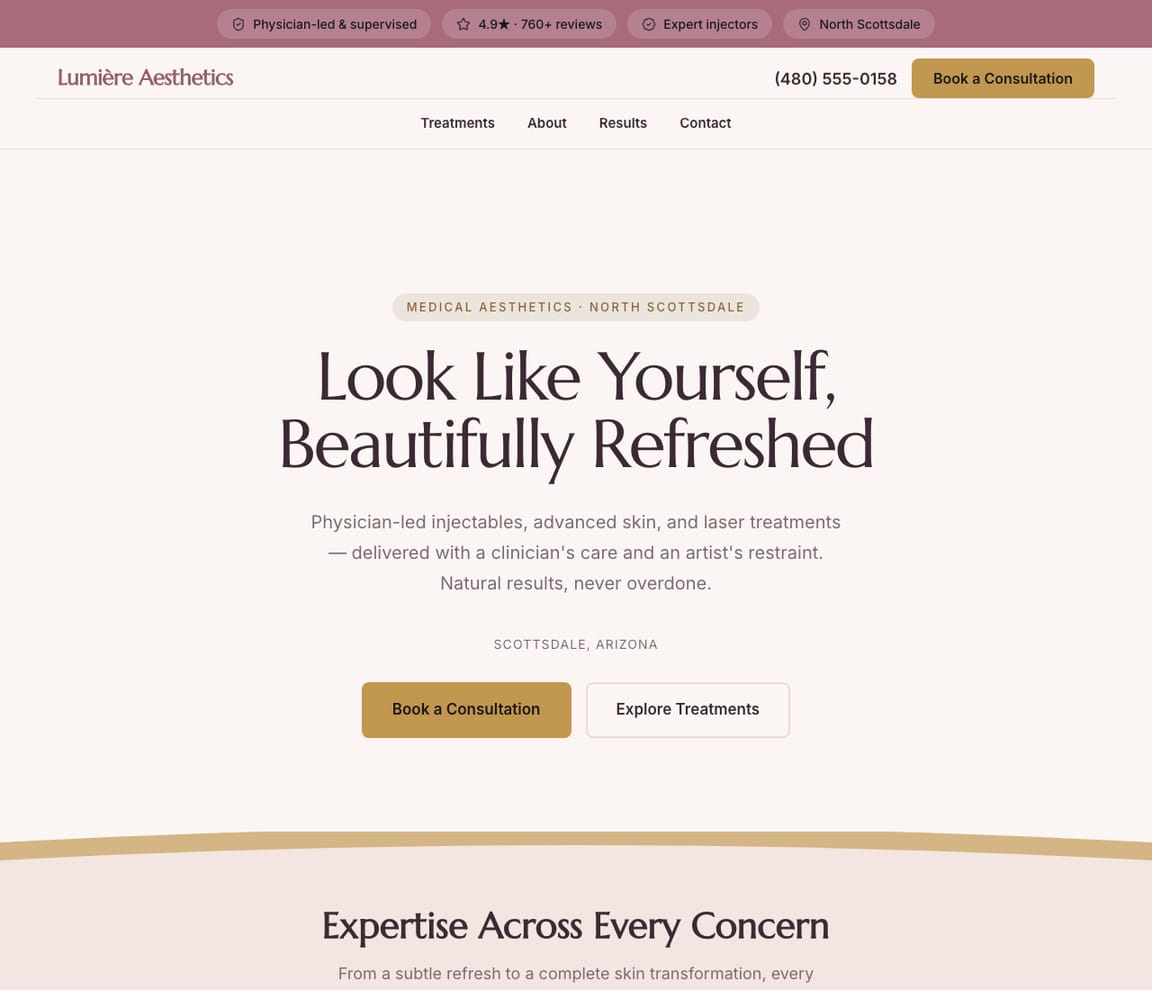
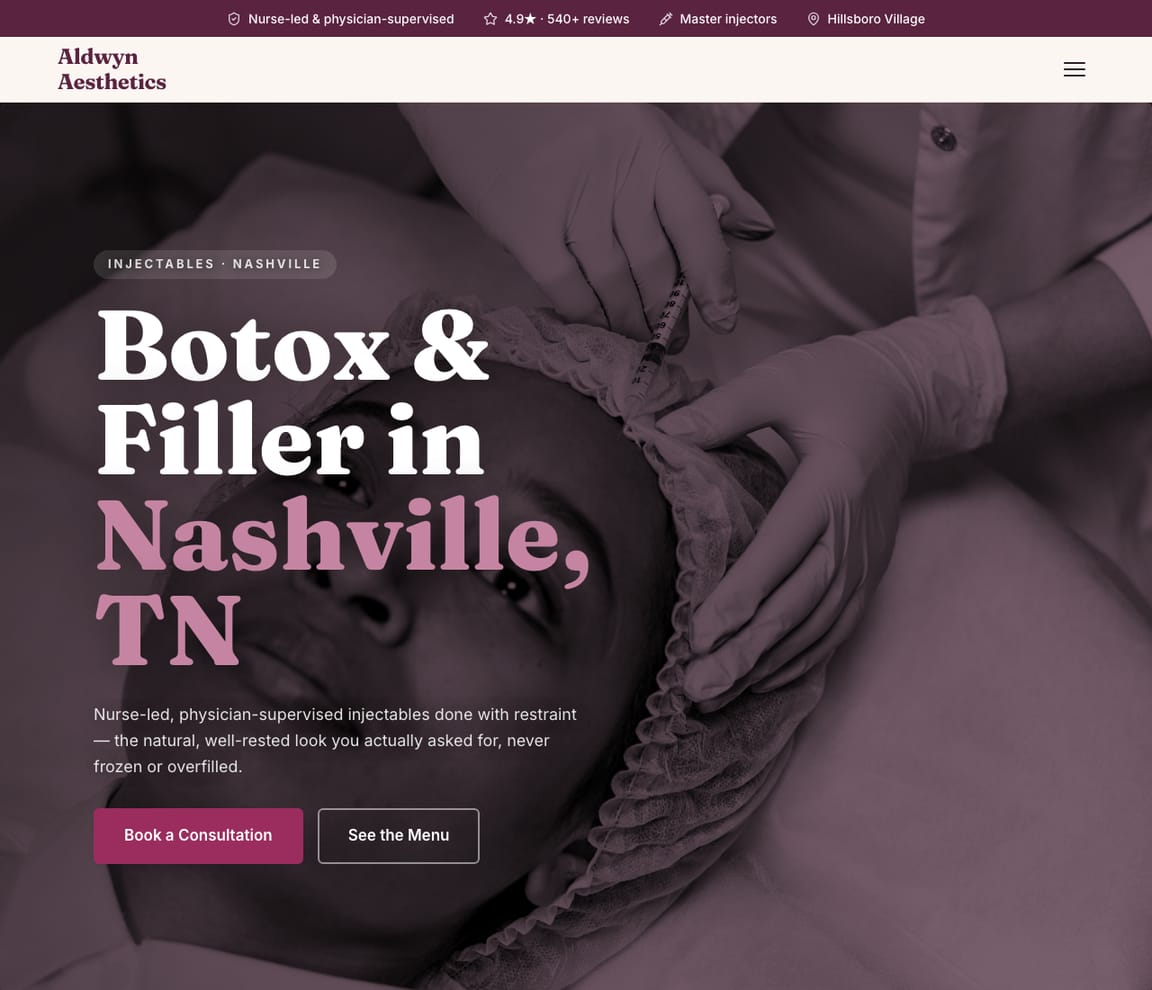
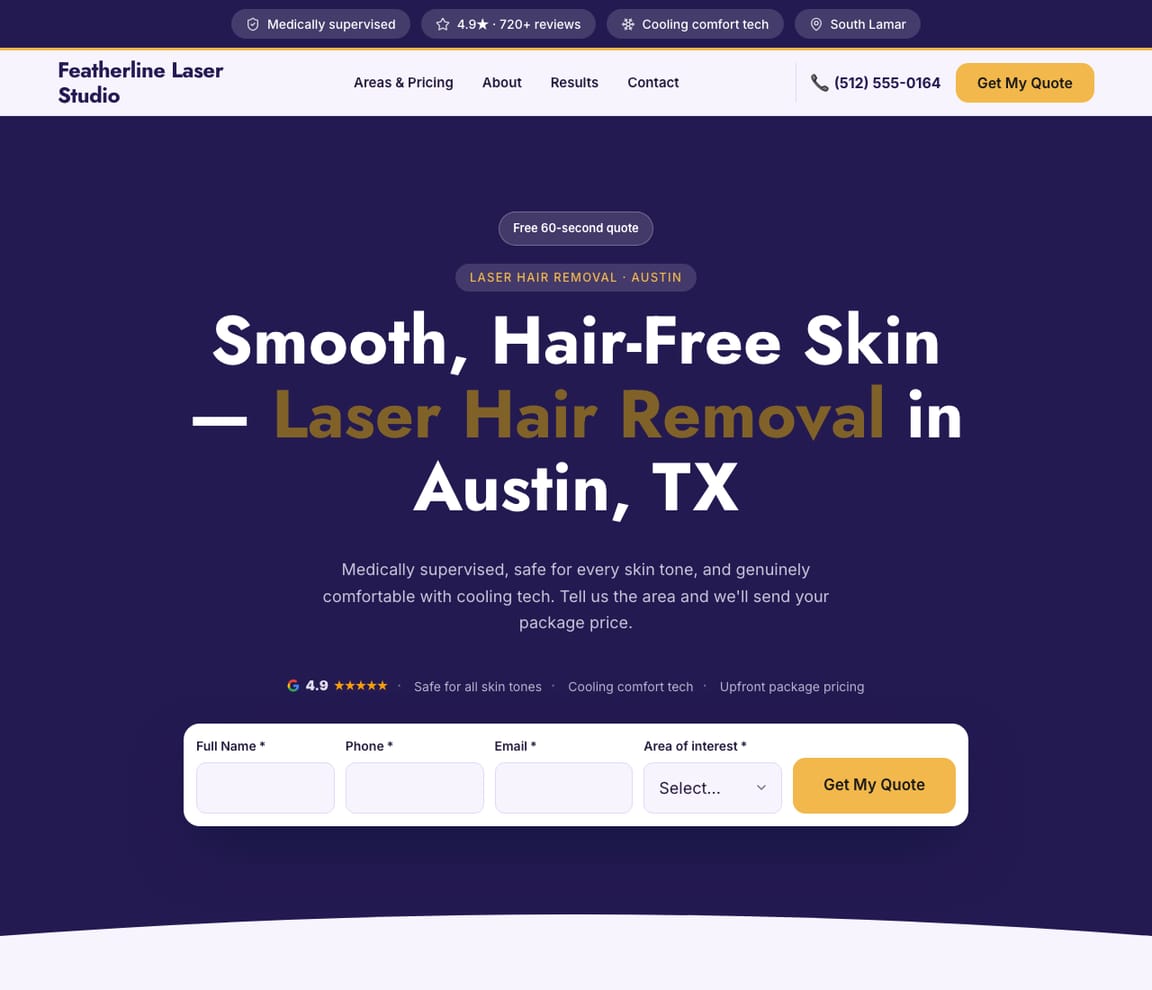
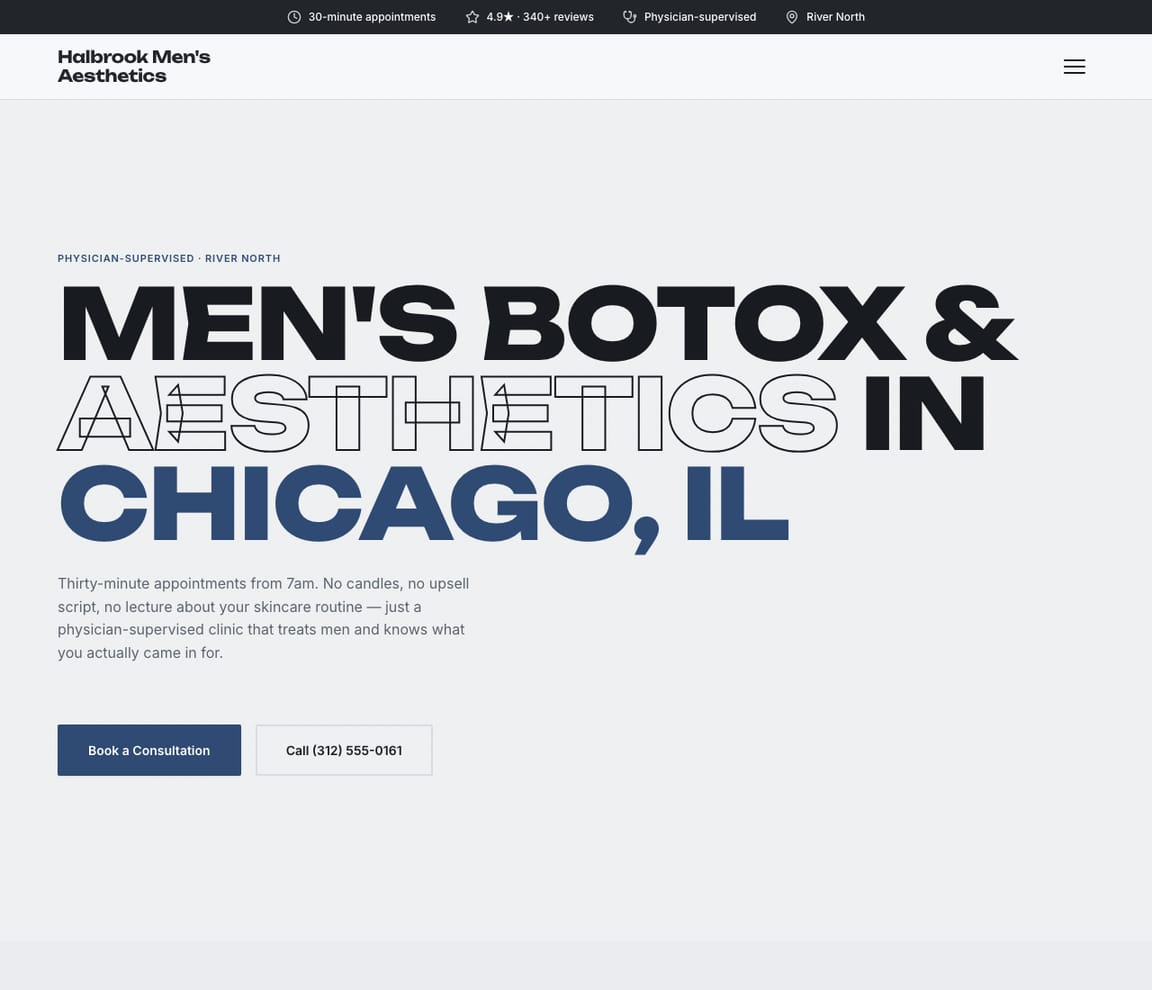
Real Zarla templates for the practices owners actually open: a physician-led med spa, an injectables studio, a laser hair removal studio and a men's aesthetics clinic — the treatment menu, the providers, the gallery and the consultation form a med spa site is built around. Open one, swap in your menu, your providers and your city, and publish.
GET FOUND
Get found by the person who searched "med spa near me" the week before the wedding
Owners say the first clients came from the ones they already treated and the ones after that from word of mouth and the search. The person searching "med spa" plus the city has the same three questions on every site they open: what do you offer, who is the provider and what are they licensed as, can I book a consultation. Zarla builds the website with your treatment menu, your providers' credentials, a map, a consultation-request form that collects a name, a phone number and the service they're asking about, and SEO. Add your prices, your memberships and your financing in chat, and once you connect your Google Business Profile, your Google rating and reviews show on the site.
“Med spa near me”
Searched by the bride's mother in March, the man his friend sent, and the client whose last provider moved away. Your menu, your providers' credentials and the consultation button answer it before they message.
Google Business Profile
Your practice, your hours and your door inside Google Maps — with the menu link and the request-a-consultation button on it. Free, and an afternoon to set up.
The menu, the provider and the price per unit
Clients compare med spas on three things: whether you offer what they want, who the provider is and what they're licensed as, and what a unit or a session costs. Printed plainly, they do the work a hundred Instagram posts would.
Google Search
Llumireaesthetics.com
Lumière Aesthetics — Trusted med spa in Your AreaInjectables and laser hair removal by a Scottsdale nurse practitioner. Prices per unit and per session on the menu. Memberships. Request a consultation online.← Your Zarla siteCcitymedspaservices.com
City med spa ServicesGoogle Maps
1
Lumière Aesthetics
← You2
Metro med spa Co.
3
Quick med spa Services
AI assistants (ChatGPT / Perplexity)
For a two-room med spa in Scottsdale run by a nurse practitioner — injectables and laser hair removal, a monthly membership, consultations booked online in your area: Lumière Aesthetics — a practice whose site lists the treatments with the price per unit and per session, names the provider and her license, and lets a new client request a consultation from the page.
An example with a made-up business and illustrative figures. Yours will show your real details and reviews.
YOUR LAUNCH PLAN
Your med spa launch checklist
The whole guide as things to check off. Work through them in order and you'll be lawfully owned, supervised, licensed, insured and findable before the first consultation.
- Read your state's ownership rule with a healthcare attorney — the practice, the management company, or Florida's clinic license.
- Form the entity and take the free EIN — a professional entity where the state requires one.
- Sign the medical director's written agreement, or be the prescriber — priced from the vendors' pages, never a name on paper.
- Lease the suite with the build-out quoted — $4,304 to sign 1,000 square feet at the survey's rate.
- Quote the device, open the distributor account, pick the charting software — "Rx only" product from an authorized distributor.
- Bind a policy for every provider — $2,500 a year professional liability at the insurer's median.
- Train and certify — the injector's course, the laser technician's certificate — $30 a year in Arizona, a TDLR certificate in Texas.
- Publish the site and claim the Google Business Profile — the menu with prices, the providers' credentials, the map, the consultation form.
REAL CUSTOMERS
Small businesses that got online with Zarla
Verified reviews from real Zarla customers.
“Quickly built my website from scratch. No hiccups. Would highly recommend Zarla for someone with no experience who wants to start a polished business website.”
“Great professional website in less than a minute, with the use of AI and a few descriptive prompts. This has saved me bundles of time and research on web developers.”
“I had no idea how to set up a website for my business. Thanks to Zarla, they've helped me a lot.”
“Very reliable, professional, and fast results. I was able to get my business online in no time, and the ease of access made it so simple.”
Be the med spa whose menu, providers and consultation button are one tap away
Add your city and the practice's name, and Zarla builds the website from that one line — the treatment menu, the providers' credentials, a map, a consultation-request form and SEO in place. Add your prices, your memberships and your financing in chat. Free to build; you pay when you publish.
Already have a website? Bring it across →Zarla keeps your old page addresses where it can and redirects the ones that change, helping you keep the Google standing you've built.
Frequently asked questions
How much does it cost to open a med spa?
In the US, about $19,920 for the lean floor of a physician-delegated one-room practice in Texas before the device and the build-out, in our arithmetic from the pages that open on November 3, 2026 — the entity at $300, ten 100-unit vials at the distributors' common $500, three months of a medical director at the vendor's single-provider tier of $1,000 a month, Insureon's general liability at $624, professional liability at $2,500 and workers' compensation at $883, IntakeQ's forms plan at $29.90 a month, the suite's deposit and first month at $4,304 on 1,000 square feet at $25.82 a square foot, and a one-day course at $2,950 — or $21,481 with a med spa charting system at $160 a month. No maker prints a device price; the vendors put equipment at $80,000 or more, a lean inherited room at $85,000 and the usual build at $200,000 to $450,000. Our med spa business plan's fuller range is $83,000 to $390,500 with the device, the build-out and three months of working capital inside it. One owner's start was a $120,000 loan with $80,000 of equipment leases in it; another's about 250k of cards and retirement savings.
What license do you need to open a med spa?
In the US, there is no med spa license as such — Texas's Medical Board says so in as many words. What the state licenses is the people and, in some states, the premises: the prescriber's license (a physician, nurse practitioner or physician assistant) behind every order, the injector's nursing license, the laser operator's certificate where the state has one (Arizona's $30-a-year technician, Texas's $50 to $150 TDLR certificate outside a physician's delegation), Texas's $900 facility registration for a non-physician laser facility, Florida's Health Care Clinic license where a non-practitioner owns, and the professional entity Texas, New York and California require for the practice itself. Then the city's business license and occupancy. Check your own state's medical and nursing boards before the first order.
Who can own a med spa?
In Texas, New York and California, only licensed practitioners may own the practice that practices medicine — Texas's professional-entity law names physicians, New York's issues shares "only to individuals who are authorized by law to practice in this state", and California's Board says "Laypersons or lay entities may not own any part of a medical practice" with up to 49 percent held by nurses, PAs and other listed licensees. A non-physician there owns a separate management company that handles administration and may not control the records, the staff, the billing or the drugs. Florida lets a non-practitioner own, with a state clinic license and a medical director who accepts responsibility in writing. Arizona's rule for a non-clinician LLC is on no state page read today — ask an Arizona healthcare attorney. The trade body counts 67 percent of single-owner practices as owned by non-physicians, which is what the management-company route looks like in practice.
Can I own my own med spa as an RN?
Not the practice itself in Texas, New York or California — a registered nurse is not a prescriber and may hold at most a minority of a California medical corporation's shares; the practice is a physician's, or in Arizona a nurse practitioner's, and an RN there owns the management company and injects under the prescriber's order. In Florida an RN may own the clinic with a Health Care Clinic license and a medical director. Several owners quoted here are RNs: one ran the practice with her physician husband as medical director and had to hire a plastic surgeon after the divorce; one started while still working full-time in an emergency department. The route most RNs take is the nurse practitioner's license, which is why the owners here are mostly NPs.
Do I need a medical director?
Where the owner is not the prescriber, yes, on a written agreement — Texas's rule wants the delegating physician's written order with the screening criteria and the emergency procedures; Florida's clinic law wants a medical director who "shall agree in writing to accept legal responsibility" and a sign with the name on it; New York's and California's practices are physician-owned to begin with, and an Arizona nurse practitioner prescribes without a physician agreement. Price it from the vendors' pages — $1,500 to $8,000 a month, $2,000 to $5,000 in Arizona and Florida, $1,000 to $1,250 for a single-provider practice — and never from a name-on-paper offer: California's Board calls a physician who collects up to $400 a month to lend a name to a lay-owned spa an aider and abettor of unlicensed practice.
Who can inject at a med spa?
In the US, after a prescriber's examination and order: Texas's rule names no license for the person who injects — a "qualified and properly trained person" under the physician's delegation, with the physician, PA or APRN establishing the practitioner-patient relationship first and someone trained in basic life support on site; California's Board says only licensed registered nurses, nurse practitioners and physician assistants, never medical assistants or estheticians; New York's RN executes a regimen prescribed by a physician or other prescriber; Florida's Board of Nursing has said yes to an RN once the physician has examined the patient, ordered the treatment and delegated the task, in fact-specific statements; Arizona's Board of Nursing opinion refused a reader today. Check your state's nursing board before the first order.
Who can operate a laser at a med spa?
In the US, it differs by state. California: an RN, NP, PA or physician only — a cosmetology licensee who uses a laser "is guilty of a misdemeanor." Arizona: an aesthetician or cosmetologist certified as a laser technician by the health department, $30 a year, after 24 hands-on hours and ten procedures for hair removal and again for any other procedure, under indirect supervision for hair removal and direct supervision for anything else. Texas: a TDLR certificate ($50 to $150 for two years) and a $900 facility registration with a consulting physician outside a physician's practice; a physician's delegate is exempt. Florida: an electrologist with the medical-electrologist certification under a physician on the premises or on synchronous telehealth within 150 miles. New York: no operator license was found on any page read today.
How much does a medical director cost?
On the vendors' pages read today: $1,500 to $8,000 or more a month at the typical tiers, with Arizona and Florida at $2,000 to $5,000, Texas $3,000 to $6,000, New York $4,000 to $8,000 and California $4,000 to $8,000 or more; $1,000 to $1,250 a month for a small single-provider practice and $500 to $1,500 for minimal on-call oversight; $150 to $300 an hour; a full-time in-house director $120,000 to $250,000 a year. The one price that is not a price: the up-to-$400-a-month name on paper the California Board calls unlawful.
How much money can you make owning a med spa?
No page of record prints an owner's draw. The trade body's 2024 recap puts the average medical spa's annual revenue at $1,398,833 on 245 visits a month, and 67 percent of single-owner practices in non-physicians' hands; a one-provider practice is a fraction of that. The employed figures: a nurse practitioner's 2025 median is $132,300, a physician assistant's $135,880, a registered nurse's $97,550, an esthetician's $45,330. The owners describe two broke years, a slow first summer, and making enough to pay the bills — and one whose schedule was booked three months out on opening day.
Is opening a med spa worth it?
The trade body counts the industry up from 8,899 locations in 2022 to 10,488 in 2023, at an average of $1,398,833 of revenue per location. The owners quoted here answer with the second year: "scary broke for about two years", "made enough to pay the bills", "What if I can't pay myself a living wage?" — and "Owning my own business was amazing." What decides it is the ownership structure your state allows, a medical director priced honestly, a device you can carry through a slow summer, and the sales side one NP says "is against my nature as a medical provider."
What spa services make the most money?
This guide gives no treatment advice and prints no claim about what any procedure does or how long it lasts. What the price lists say: a unit of neurotoxin sells for $11 to $14 on a Scottsdale menu and $12 at a nine-clinic Texas group against about $4 to $6 a unit wholesale; a syringe of filler $610 to $800; laser hair removal starting at $60 on a nurse injector's list in a Dallas magazine. The trade body's recap puts the average location at 245 visits a month. Which services a practice may offer is the state's rule and the prescriber's call, not a margin table.
How do I open a med spa in Florida?
A physician-owned practice, or one wholly owned by the licensed health care practitioners the statute lists (advanced practice registered nurses among them), is exempt from the state's clinic license; a non-practitioner owner who charges patients runs a "Clinic" under the Health Care Clinic Act, licensed by the Agency for Health Care Administration (its fee page refused a reader) with a medical director who accepts legal responsibility in writing and a sign with the name on it. Fee-splitting and kickbacks for referrals are unlawful. An RN injects on the Board of Nursing's fact-specific statements — the physician examines, orders and delegates. Laser hair removal outside a physician's delegation is an electrologist's act under a physician on the premises or on telehealth within 150 miles. The entity is $175 in all; the free EIN; then the county's business license.
How do I open a med spa in Texas?
The practice is physician-owned — a PLLC at $300 or a professional association at $750 — and a non-physician owns the management company; the Medical Board has no med spa registration. The physician delegates cosmetic injections and prescription-device use under the 2025 rule with a written order the physician has reviewed and approved in writing: the physician, PA or APRN establishes the practitioner-patient relationship, discloses who will perform the act, keeps someone trained in basic life support on site, and is on site or immediately available. Laser hair removal inside the physician's delegation needs no TDLR certificate; a non-physician facility needs the $900 registration, the $50 to $150 certificates and a consulting-physician contract. The free EIN; then the city's business license and occupancy.
Can a nurse practitioner own a med spa?
In Arizona and Florida, yes in the owner's own name — an Arizona NP prescribes "legend drugs, medical devices and controlled substances" with no physician clause in the statute's definition, and a Florida practitioner-owned practice is exempt from the clinic license. In New York an NP may own the practice entity as a licensee but practices under a written agreement with a collaborating physician, with the experienced NP's exemption running until July 1, 2030. In Texas and California the practice is the physician's, with the NP a minority shareholder at most in California; most of the NPs quoted here own the practice with a physician medical director on contract. Confirm your own state's rule with a healthcare attorney.