BUSINESS GUIDE
How to open a pharmacy in 2026
For the pharmacist who has run someone else's counter long enough: the state license and the inspection in five boards' own words and fees, who may own a pharmacy in each state (none of the five read requires the owner to be a pharmacist; every one requires a licensed pharmacist in charge), the DEA registration from the rule that set its fee, what the build-out, the fixtures and the opening stock cost from the franchise disclosure the page-one guides never cite, what the plans actually pay against what the wholesaler charges, what pharmacists and owners earn — and what the owners who did it say.
Free to build · Pay when you publish · No credit card
$3,627the paperwork and cover before the stock — the Texas license, the DEA, the LLC, the certificates and the policies from the pages that open (our arithmetic)
90 daysthe minimum Texas tells an applicant to allow for a complete pharmacy license application, pre-inspection included — the vendors' guides say one to two years
20.9%the average independent pharmacy's gross margin in 2025, up from 18.2 percent in 2024 (NCPA's 2026 Digest, as the PBM trade group reported it)
No codeto get online
See it in action
See what your pharmacy website could look like
This is a real Zarla design for a neighborhood medical practice — it lives in the doctor gallery, because the pharmacy entry has no gallery of its own yet, and a pharmacy site is built the same way: the services, the hours, a request form, the map. Describe yours — the neighborhood, the delivery area, the vaccines — and you'll have a site like this, with your services, a refill or transfer form and a map, in about a minute.
- Professional design — not a generic template
- Looks great on desktop and mobile
- Content written for your industry
Build the website
Start your pharmacy website now
Add your neighborhood and the pharmacy's name to the sentence, and Zarla builds the site: the services, the hours, a refill or transfer request form and a map. Add your vaccine list and your delivery terms in chat, then publish.
Already have a website? Bring it across →Zarla keeps your old page addresses where it can and redirects the ones that change, helping you keep the Google standing you've built.
Is opening a pharmacy worth it in 2026 — and what do pharmacy owners make?
The pharmacy one pharmacist can open is an independent community pharmacy: about 2,000 square feet on a neighborhood strip, a prescription counter with two technicians and a part-time clerk, a small front end, vaccines and delivery, the stock bought on a wholesaler's agreement and most of the revenue paid by the plans weeks after the claim. The capital is the counter, the fixtures and the opening stock; the question is the margin on each prescription and the cash between the invoice and the payment. What employed pharmacists earn: "Workers on average earn $140,910." in 2025 — $67.75 an hour (O*NET, 2025), and $45,750 for pharmacy technicians — $22.00 an hour (O*NET) — in a survey that leaves out "the self-employed, owner/partners in unincorporated firms" (Washington ESD), which is what an owner is. The industry analyst's read of the same year: "Overall pharmacist salaries averaged $140,920, but varied widely across practice settings." (Drug Channels, June 23, 2026). What owners earn: the only owner figure on a page that opens — "Our analysis of industry survey data indicates that the average pharmacist owning a single pharmacy" "earned about $190,000 in 2023, the most recent year for which data are available." (Drug Channels, June 3, 2025) — an estimate from survey data, not a survey of owners.
What the sector moves. "The estimated number of independent community pharmacies in 2026 is 18,988", "In 2025, the average prescription volume was 65,795 prescriptions per store, compared to 67,601 in 2024.", "Independent pharmacy represented a $103 billion marketplace in 2025.", "Government programs account for nearly half of all prescriptions sold in independent community pharmacies." and "Eighty-one percent of prescriptions at independent pharmacies are filled with a generic drug." (Pharmacy Times on NCPA's 2026 Digest, October 4, 2026); "Prescriptions drive over 96% of total revenue, with stores averaging nearly 66,000 prescriptions annually." and "In 2025, 91% of independent pharmacies provided flu immunizations, 81% offered medication therapy management" (Drug Topics, October 9, 2026); the margin, as the pharmacy benefit managers' trade group quotes the Digest: "gross profit margin rose to 20.9 percent in 2025 from 18.2 percent in 2024" (PCMA, October 7, 2026); the sales: "$5.41M is the average independent pharmacy sales in 2024 per location, up from $4,997,000 in 2023." (RXinsider's Pharmacy500 report, June 2, 2026, citing the 2025 Digest). Four-fifths of every sale leaves for the wholesaler; what is left pays the technicians, the rent and the owner.
What the plan runs. Our free pharmacy business plan is a 2,000-square-foot independent in midtown Tulsa: about 1,400 prescriptions a month at about $75 each plus about $15,000 of front-end sales is about $120,000 a month, against the stock at 78 to 82 percent of sales, two technicians, the rent, the system, the policies and the card fees, with about $500 to $15,100 a month left before the owner's own pay — a year-one pharmacy at about a quarter of the average store's volume is close to break-even until the transfers and the prescribers build it. The owners who did it describe both halves: "The biggest challenge was realizing that about 30% of the prescriptions we fill, we lose money on." (Kristen Moore, A to Z Pharmacy, Cary, North Carolina — Cary Magazine, April 1, 2021); "Last month it was $921 and the insurance company reimbursed me $919." (Tim Lucas, DownHome Pharmacy, Vinton, Virginia — WDBJ7, August 24, 2026).
The catch. The wholesaler's invoice is due before the plans pay, so cash is the first-year problem; a brand prescription can reimburse below its cost and a clawback can arrive months after the claim; the pharmacist-owner is on every shift; one prescriber's retirement takes a hundred patients; and a missed controlled-substance count is an inspection finding, not a warning. That's what the rest of this guide sets up.
How to open a pharmacy, in plain English
The license is the gate — a pharmacy, a pharmacist in charge, an inspection. Texas: the Board's own fee sheet totals the pharmacy application — "Initial or Change of Ownership Application Fee $ 531.00", the Texas Online, prescription-monitoring and patient-protection surcharges, "TOTAL $ 611.00", renewal "$ 608.00", and "Balance/Scale $ 25.00" (Texas State Board of Pharmacy, fee sheet; the rule's base is "$583 for the initial registration period" — 22 Tex. Admin. Code §291.6); "Prior to the issuance of a license for a pharmacy located in Texas, the board shall conduct an on-site inspection" "of the pharmacy in the presence of the pharmacist-in-charge and owner or representative of the owner" (§291.1); the clock: "A pharmacy should allow at minimum 90 days for a COMPLETE pharmacy license application to be reviewed and processed." and "Once application is approved, the license number will be issued. (10 business days)" (the Board's timeline page); and the Board's own answers: "A pharmacy must be licensed before purchasing prescription medications.", "A pharmacy must be fully operational within 6 months of the issuance of a pharmacy license. 291.11(a)(1)" and "The pharmacist to pharmacy technician ratio is 1:6 provided the pharmacist is onsite and a maximum of 3 of the 6 pharmacy technicians are pharmacy technician trainees. 291.33(d)(3)" (Texas State Board of Pharmacy, FAQ for new owners, February 2022). Florida: "No permit shall be issued unless a licensed pharmacist is designated as the prescription department manager." and "Passing an onsite inspection is a prerequisite to the issuance of an initial permit or a permit for a change of location." (Fla. Stat. §465.018); "Initial permit fee not to exceed $250." and "Biennial permit renewal not to exceed $250." (§465.022); the Board's page: "Application and Licensure Fee is $255.00", "Once the application is deemed complete, the board staff authorizes an inspection.", "If the inspection is satisfactory, a permit number is issued within 7 days." and "A community pharmacy provides outpatient pharmacy services, and is open for a minimum of 20 hours per week" (Florida Board of Pharmacy, community pharmacy permit). New York: "The application shall be accompanied by a fee of three hundred forty-five dollars." — $345 — "The triennial registration fee shall be two hundred sixty dollars or a pro rated portion thereof." — $260 — "Every pharmacy shall be under the immediate supervision and management of a licensed pharmacist at all hours when open." and "No pharmacist shall have personal supervision of more than one pharmacy at the same time." (N.Y. Education Law §6808). California: "No person shall conduct a pharmacy in the State of California unless they have obtained a license from the board." (Cal. Bus. & Prof. Code §4110); "The fee for a pharmacy license shall be seven hundred fifty dollars ($750)" and "The fee for a pharmacy license annual renewal shall be one thousand twenty-five dollars ($1,025)" (§4400), with the Board's schedule printing "Pharmacy $570.00 $750.00" for the application and "Pharmacy $1,034.00* $1,040.00*" for the renewal from July 1, 2025, the asterisk a $15 CURES fee (California Board of Pharmacy, fee schedule). Oklahoma: "RETAIL PHARMACY (In-State) $350" with "[Fee includes inspection review]", "Oklahoma pharmacies must have a licensed PIC in place at all times.", "Please allow 2-3 weeks for processing of your license." and the inspection "may require an additional 1-2 weeks" — "Board inspection must occur prior to opening for new in-state applicants." (Oklahoma State Board of Pharmacy, pharmacy license application, October 2026). Confirm the current fee, the pharmacist-in-charge rules and the inspection calendar with your own board before you sign a lease.
Who may own it — the owner and the pharmacist-in-charge are two different questions. Texas: "Anyone who can pass a criminal background check can own a Class A pharmacy in the state of Texas." and "Yes, a non-pharmacist pharmacy owner is allowed to have access to the prescription department, however, they are not allowed" "to perform any duty which requires a pharmacist license or pharmacy technician registration." (Texas State Board of Pharmacy, FAQ). New York's statute contemplates it — "In the event that the owner of a licensed pharmacy is not a licensed pharmacist" the registration names the supervising pharmacist, and "In the case of a corporate applicant, the requirement shall extend to all officers and directors." (§6808). Florida: "A pharmacy permit may be issued only to a natural person who is at least 18 years of age." — or a partnership or registered entity — with "The prescription department manager must ensure the security of the prescription department." (§465.022). California licenses the premises and renews it annually (§4110); Oklahoma's form asks for "up to 2 levels of ownership" and a designated Oklahoma-licensed pharmacist in charge (the application). The entity: Texas "for filing a certificate of formation, $300;" (Tex. Bus. Orgs. Code §4.152, applied to an LLC by §4.154); Florida "For filing original articles of organization or articles of revocation of dissolution, $100." plus $25 for the registered agent — $125 (Fla. Stat. §605.0213); New York "two hundred dollars" (N.Y. LLC Law §1101); California "Filing articles of organization of a limited liability company: Seventy dollars ($70)." plus the $20 statement (Cal. Gov. Code §12190) and "a minimum franchise tax of eight hundred dollars ($800)." a year (Rev. & Tax. Code §23153); Oklahoma "Articles of Organization - Oklahoma LLC" at $100 (Oklahoma Secretary of State). The EIN: "You never have to pay a fee for an EIN." (IRS).
The federal layer — the DEA, the inventories, the NPI, HIPAA and the supply chain. The DEA registration for a pharmacy: "The revised fee for the three-year registration period is $888." and "This final rule is effective October 1, 2020." (DEA fee rule, Federal Register, July 24, 2020 — the DEA's own fee page refuses a reader). The count: "Every person required to keep records shall take an inventory of all stocks of controlled substances on hand" "on the date he/she first engages in the manufacture, distribution, or dispensing of controlled substances," and "After the initial inventory is taken," "the registrant shall take a new inventory of all stocks of controlled substances on hand at least every two years." (21 CFR 1304.11); Texas adds "An annual inventory must be conducted on May 1 of each year or on the pharmacy's general physical inventory date." (the Texas Board's FAQ) and the monitoring report — "Not later than the next business day after the date a controlled substance prescription is dispensed" "electronically submit to the board any data elements indicated as required", with "a zero report indicating that no controlled substances were dispensed every seven days" otherwise (22 Tex. Admin. Code §315.6); California's CURES takes the report "not more than one working day after the date a Schedule II, Schedule III, Schedule IV, or Schedule V controlled substance" is dispensed (California Department of Justice). The NPI: "Just so you know the NPI is free of charge. It only takes approximately twenty (20) minutes to complete" the application (CMS); the NCPDP Provider ID carries a fee the organization prints on no page that opens — ask its provider services; Medicare's enrollment fee if you bill diabetic supplies and equipment: "This notice announces a $750.00 calendar year (CY) 2026" application fee (CMS, Federal Register, December 3, 2025). HIPAA: a covered entity is "(3) A health care provider who transmits any health information in electronic form" "in connection with a transaction covered by this subchapter." (45 CFR 160.103) — which a pharmacy billing a plan is. The supply chain: a small dispenser — one that "has 25 or fewer full-time employees licensed as pharmacists or qualified as pharmacy technicians" — is exempt from the enhanced electronic tracing requirements "until November 27, 2027" and small dispensers "do not need to submit anything to FDA or inform the agency" (FDA, DSCSA exemptions, August 26, 2026).
Sales tax, the first hire, and the insurance. Prescriptions are exempt in every state read and taxed at a reduced rate in one: "The exception is Illinois, where prescription drugs are taxed at the state level, but at a reduced state rate of 1%." (TaxJar, July 1, 2026; "The low rate of tax for qualifying food, drugs, and medical appliances is one-percent (1%)" — Illinois Department of Revenue, PIO-115). Over-the-counter medicines split the states: Texas exempts a drug "labeled with a Drug Facts panel" (Texas Comptroller, publication 94-155); New York's exemption "includes both prescription and nonprescription drugs and medicines" (New York Tax Department, TB-ST-193); California — "Sales of over-the-counter medicines are taxable unless they are prescribed." (CDTFA, publication 27, October 2026); TaxJar's table lists Florida, Pennsylvania and Virginia among the states that exempt them and "Louisiana – Nonprescription medication is taxable." The front end — vitamins, cosmetics, gifts — is taxable retail nearly everywhere; set the point of sale by category and confirm the details with your accountant. The first hire: Florida's minimum wage "reaches $15.00 per hour on September 30th, 2026." (Florida Constitution, Art. X §24); California's "is $16.90 per hour for all employers" from January 1, 2026 (California DIR). Workers' compensation: "an employer may elect to obtain workers' compensation insurance coverage" in Texas (Tex. Labor Code §406.002); "four or more employees" in Florida (Fla. Stat. §440.02); New York's statute reaches employers "in which there are engaged or employed one or more employees regularly" (N.Y. Workers' Compensation Law §3); "Every employer except the state shall secure the payment of compensation" in California (Cal. Labor Code §3700); in Oklahoma "most businessess must cover its employees with workers compensation insurance." — as the state's own page spells it (oklahoma.gov). The policies: "Drugstores pay an average of $56 per month, or $674 per year, for general liability insurance.", "Pharmacies pay an average of $169 per month, or $2,023 per year, for a business owner's policy." and "For pharmacies and drugstores, workers' compensation insurance costs an average of $143 per month, or $1,718 per year." (Insureon, January 22, 2025); the pharmacy's own professional liability: "A standard retail pharmacist can expect to pay $50 to $70 per month for $1 million per claim / $3 million aggregate limits." (Insuranceopedia, July 28, 2026) — "or about $600 to $840 annually" (1800insurance, January 5, 2026). Confirm your own state's rule with your accountant.
The money to start — and the "$400,000 to $600,000" the vendors print. From the pages that open on November 3, 2026, the paperwork and cover before the stock: the Texas license at $611 with the $25 balance fee, the DEA's $888, a Texas LLC at $300, a technician's exam — "The cost to apply for CPhT Certification and take the PTCE is $129." (PTCB) — the immunization certificate at a 2026 host's "$400.00" (APhA program at AUB, July 29, 2026), Insureon's $674 and the $600 professional liability: $3,627, our arithmetic. Then the counter and the stock, from the one itemized source that opens — a wholesaler's franchise disclosure, Item 7, as a franchise site reproduces the 2023 document: "Leasehold Improvements" "$60,000 - $115,000", "Fixtures and Equipment" "$30,000 - $80,000", "Inventory including Merchandise" "$60,000 - $110,000", "Computer Hardware and Software" "$10,000 - $45,000", "Exterior Signage" "$0 - $15,000", "Total" "$250,970 - $674,370" (Health Mart's franchise disclosure, Item 7, as FranchisePayback reproduces it — the franchisor's own pages refuse a reader) — so the paperwork plus the low end of that build is about $254,597. Inside the fixtures, a purpose-built vaccine refrigerator — "Accucold 6 cu ft ADA Height Vaccine Refrigerator w/ Solid Door" at "Now: $1,480.00", "MSRP: $2,235.00" (Medical Device Depot). The room: "National asking rents reached $25.80 per square foot, up 2.2% year over year, although the pace of growth moderated." for shopping centers, with vacancy "holding steady at 5.9%, well below the historical average of 7.4%." (Cushman & Wakefield, Q3 2026 release, October 29, 2026 — its report page of October 14 prints $25.82) — 2,000 square feet at $20 to $35 is $3,333 to $5,833 a month. The plan page's wider $204,150–$452,181 is the same build with the lease, the policies, the training, the opening marketing and three months of working capital, because the invoice lands before the plans pay. What the vendors print: "Opening a pharmacy will cost, on average, between $400,000 and $600,000." and "Expect the entire process – from gathering data to grand opening – to take about 1-2 years." (PioneerRx, a software vendor); "It costs on average between $400,000-$500,000 to open an independent pharmacy." (Datascan, a software vendor); "Typically, an independent pharmacy in the USA can cost anything from $500,000-$800,000 to set up." (RxMile, July 25, 2023); and "Starting a Pharmacy business typically costs $1,000,000 to $2,000,000." (TRUiC, June 10, 2026) — none itemized; the disclosure's $250,970 to $674,370 is the range those sit inside, and the boards' 90 days is the timeline those "1-2 years" stretch. The honest warning is the buying group's: "The reality of opening a new independent pharmacy is that profits aren't guaranteed, and you won't see any right away." (PBA Health, February 3, 2017); on the loan, its step-by-step guide: "Most independent pharmacies are eligible for loans backed by the U.S. Small Business Administration." and "SBA loans do require owners to have equity in their business." (PBA Health, November 19, 2019).
In the UK: a pharmacy's premises are registered with the General Pharmaceutical Council, whose site refuses a scripted reader, so no fee is printed here; an NHS pharmacy enters the market under "the NHS (Pharmaceutical and Local Pharmaceutical Services) Regulations 2013 (the PLPS regulations)" and the local pharmaceutical needs assessment (Community Pharmacy England); the company: "It costs £100 and can be paid by debit or credit card." (GOV.UK), or the sole trader who "must register for Self Assessment as a sole trader if you earn more than £1,000 in a tax year" (GOV.UK); and the inversion on tax: where a registered pharmacist dispenses against a qualifying prescription, "the pharmacists are making a zero-rated supply of goods" (VAT Notice 701/57, August 13, 2026) — the US states exempt the prescription from sales tax and Illinois taxes it at 1 percent. In Australia: the inversion on ownership — "Under NSW law, you must be a registered pharmacist to hold a financial interest in a pharmacy" and "they can't have an interest in more than 5 pharmacies in NSW" (NSW Pharmacy Council), where none of the five US states read requires a pharmacist owner; "Pharmacists must be registered with the Pharmacy Board of Australia" (Pharmacy Board of Australia) at a general registration fee of $504 from October 1, 2026 (its fee schedule); PBS medicines are supplied under an approval under section 90 of the National Health Act 1953, recommended by the Australian Community Pharmacy Authority against the location rules (Department of Health); and "It's free to register for an ABN through the Australian Government's Australian Business Register (ABR)." (business.gov.au) — the tax office's GST page carries a British spelling in its address and refused a reader, so the threshold is not printed here. Check your own regulator's rules.
What independent pharmacy owners actually say
None of this is our opinion about opening a pharmacy. It comes from pharmacists who own one — in Texas, Oklahoma, North Carolina, Virginia, Washington, Delaware, the District of Columbia, Colorado, New Mexico, Pennsylvania, Florida, Ohio, Kentucky, Tennessee and South Carolina — talking to the Voyage magazines, local papers, university magazines, a trade association and the trade press (Pharmacy Times and Drug Topics, marked as such) between 2014 and 2026, each described as the page describes them. Read each as theirs at the time. Five things come up again and again.
Why they opened. Todd Garrett, Franklin Family Pharmacy, Franklin, Tennessee: “The entire reason I went into pharmacy was to own my own pharmacy,” (Lipscomb University, February 4, 2019). Sovit Bista, Robinhood Drugs, Everett, Washington: “I wanted to do something by myself and serve the public,” (The Everett Herald, January 7, 2026). Deepa Pattani, Allen Pharmacy & Wellness, Texas: “That is when in February of 2019, my dream of owning my own independent pharmacy was realized.” (Voyage Dallas, December 28, 2020). Kristen Moore, A to Z Pharmacy, Cary, North Carolina: “I thought it was impossible until I heard it enough times to look into actually doing it.” (Cary Magazine, April 1, 2021). Kathy Campbell, Medicap Owasso, Oklahoma: “Ultimately, my independent practice affords me the clinical autonomy to practice and promote health as I see fit,” (Pharmacy Times, a trade magazine, January 29, 2025). TaQuina Warren, Focus Pharmacy, Smyrna, Delaware: “But I am so proud and so happy to now be the owner of an independent pharmacy,” (Drug Topics, a trade magazine, December 5, 2024). Sahar Kassem, Morgan's Pharmacy, Washington, DC: “It's a dream and a huge responsibility.” and “I want women who are thinking of owning a pharmacy to know that it is doable.” (Howard Magazine, fall 2022).
“The biggest challenge was realizing that about 30% of the prescriptions we fill, we lose money on.” — Kristen Moore, A to Z Pharmacy, Cary, North Carolina, in Cary Magazine, April 1, 2021
The money and the first year. Kristin Holmes, Capitol Heights Pharmacy, Denver: “I advise you to not buy a pharmacy business 3 weeks before you graduate!” and “It has far and away been the most challenging thing I have ever done.” (APhA, a trade association, January 26, 2014). Kristen Moore: “My parents have helped me with some start-up costs, and marketing and business ideas.” (Cary Magazine, April 1, 2021). Ndidiamaka Okpareke, Olive Tree Compounding Pharmacy, Rio Rancho, New Mexico, on the free business-plan help: “I had a vision but didn't have all the tools to bring that vision to reality.” and “Plus, it was all free, which was vital when I was just getting started.” (CNM, December 3, 2024). Kathy Campbell: “My patients were waiting to join me at our new pharmacy, as we opened the store at an incredible 70 prescriptions per day.” (Pharmacy Times, January 29, 2025). Trupti Patel, Safemed Pharmacy, Dallas: “I drove to Dallas to check out the pharmacy and the same day, we made a deal.” and “It was challenging as I solely relied on the existing employees.” (Voyage Dallas, January 24, 2018). Jessica McMakin, The Apothecary Room, Edmond, Oklahoma: “The little details matter, and we spent a lot of time making every decision.” (Pharmacy Times, October 24, 2023).
The payers and the squeeze. De Andrea Moore and Amanda Kennedy, Well Lake Pharmacy, the Houston area: “Our largest obstacle has been the steadily declining reimbursements from insurance companies.” and “As the cost to acquire drugs increases, reimbursements continue to decrease.” (VoyageHouston, July 13, 2021). Sovit Bista: “If you fill a brand-name prescription, you lose money for filling it,” (The Everett Herald, January 7, 2026). Tim Lucas, DownHome Pharmacy, Vinton, Virginia: “Last month it was $921 and the insurance company reimbursed me $919.” and “So for the privilege of filling that one, I get to lose $2,”; Brent Foster, Greever's Drug Store, Chilhowie, Virginia: “And it can't go on this way. Every week that we don't get something done, there's the possibility of more pharmacies closing.” (WDBJ7, August 24, 2026). Parshil Patel, The Medicine Shoppe, Butler, Pennsylvania: “In some cases, we're losing money on certain prescriptions.” (Butler Eagle, May 2, 2026). Shahida Choudhry, Palms Pharmacy, Tampa: “Filling prescriptions and [pharmacy benefit manager] reimbursements were not going to pay the bills.” (Pharmacy Times, November 22, 2018). Jacob Sweet, Elite Pharmacy, Canfield, Ohio: “We can set the price on over-the-counter items, so we're not losing money per se.” (NEOMED, spring 2026). Marie Ekpema, Summerwood Pharmacy and Compounding, Houston: “Independent pharmacy ownership in today's business climate is very challenging.” (VoyageHouston, March 17, 2020).
The staff and the patients. Sherie Loy-Helm, Russell Springs Pharmacy, Kentucky: “You have to have the right people.” and “They have to know how much you trust and appreciate them.” (Pharmacy Times, July 24, 2025). Jacob Sweet: “Leadership at Elite Pharmacy is leading our staff of 30 people now in the common goal of taking care of our patients.” (NEOMED, spring 2026). Jessica McMakin: “We pride ourselves on knowing our patients, so they always feel like they are important, because they are,” (Pharmacy Times, October 24, 2023). Shahida Choudhry: “As soon as they open our front doors, they realize that they are home.” (Pharmacy Times, November 22, 2018). Amina Abubakar, Avant Pharmacy and Wellness Center: “We're in a value-based care system now, and these providers are looking to buy value.” (Drug Topics, October 12, 2025).
What they would tell you. Kristin Holmes: “If you are considering this path, I strongly encourage you to get a mentor or two.” (APhA, January 26, 2014). Jarrod Tippins, The Pharmacy, Florence, South Carolina: “When I opened my pharmacy, there wasn't really a course that provided in-depth information about ownership,” and “The connections I made with successful pharmacy owners, accountants and industry leaders shaped my path.”; Kyle McHugh: “Navigating pharmacy ownership requires that you be an early adopter and stay on top of the constant changes.” (University of South Carolina, January 5, 2026). Amina Abubakar: “Don't forget the knowledge you have as a pharmacist.” and “Definitely join communities that are already doing this.” (Drug Topics, October 12, 2025). Deepa Pattani: “Marketing is still such a challenge and knowing what works and what doesn't seems nothing less than gambling, lol.” (Voyage Dallas, December 28, 2020). Trupti Patel: “Be prepared to work hard.” (Voyage Dallas, January 24, 2018). Shannon Beckman, Beckman's Prescription Shop, Murfreesboro, Tennessee: “I want them to know the great things about owning your business. But also, they must know its challenges.” (UTHSC, December 12, 2024).
The through-line: the owners who lasted opened on the patients they already had, found a mentor and a lender who knew pharmacies, priced every prescription against the plan's payment and the wholesaler's invoice, built the front end and the services the plans don't squeeze, and treated the staff as the pharmacy.
THE STARTER KIT
What you need to open a pharmacy
The state license, the pharmacist-in-charge and the inspection
Texas's Class A license is $611 all in with a $25 balance fee, about 90 days with the pre-inspection; Florida's permit $255 with the inspection once the application is complete; New York's registration $345; California's license $750 and $1,040 a year to renew; Oklahoma's $350 with the inspection in the fee. Every one needs a licensed pharmacist in charge.
The DEA registration — $888 for three years
"The revised fee for the three-year registration period is $888." in the 2020 rule, for any pharmacy that stocks a controlled substance — with the opening-day inventory, the two-year count and the state monitoring program's next-business-day report behind it.
The entity — and whether you must be a pharmacist
An LLC is $300 in Texas, $125 in Florida, $200 in New York, $70 plus $20 and $800 a year in California, $100 in Oklahoma. "Anyone who can pass a criminal background check can own a Class A pharmacy in the state of Texas."; New York and Florida contemplate a non-pharmacist owner too, and no state read requires one. The pharmacist in charge is the license's person, not the owner.
The build-out, the fixtures and the opening stock
The franchise disclosure the vendor guides never cite: leasehold improvements $60,000 to $115,000, fixtures and equipment $30,000 to $80,000, inventory $60,000 to $110,000, the system $10,000 to $45,000 — $250,970 to $674,370 in all. A purpose-built vaccine refrigerator is $1,480.
The identifiers and the plans that pay you
The NPI is free; the NCPDP Provider ID carries a fee the organization does not print; the plan contracts come through a pharmacy services administrative organization. Medicare's enrollment application fee is $750 for 2026 if you bill diabetic supplies. Nothing is paid before the effective date.
Insurance, the technicians and the certificate
Drugstores pay an average of $56 a month, $674 a year, for general liability at Insureon and $169 a month, $2,023, for a business owner's policy; professional liability $600 to $840 a year. A technician's certification exam is $129; the immunization certificate $400 at a 2026 host.
THE PAPERWORK
Licenses, rules and taxes for a new pharmacy
| Typical cost | Time to get | Legally required? | |
|---|---|---|---|
| The state pharmacy license or permit | $611 + $25 a balance, $608 to renew (TX); $255 (FL); $345 (NY); $750 (CA); $350 (OK) | TX ~90 days; FL on completeness, 7 days after the pass; OK 2–3 weeks + inspection | Yes in all five — with an on-site inspection before it issues |
| A pharmacist-in-charge | Their salary — $140,910 the employed median | Before the application | Yes in all five; NY: one pharmacy per supervising pharmacist |
| Pharmacist ownership | — | — | No in the five states read — TX, NY and FL say so in their own words, CA licenses the premises, OK names only the PIC |
| DEA registration | $888 for three years | Weeks — after the state license | Yes to stock any controlled substance; the opening-day inventory and the two-year count follow |
| The entity | $300 TX; $125 FL; $200 NY; $70 + $20 + $800/yr CA; $100 OK | Days to weeks | No — a sole proprietorship is lawful; the LLC or corporation is the common choice |
| EIN and NPI | Free | Minutes; the NPI about twenty | Yes — the NPI on every claim; never pay a site for either |
| The plan contracts and the NCPDP ID | By quote — the services administrative organization and NCPDP price by pharmacy | Weeks to months | Only to bill the plans — nothing is paid before the effective date |
| Medicare supplier enrollment | $750 (2026) | Months, with accreditation | Only if you bill diabetic supplies and equipment |
| HIPAA | Inside the system and the notice | Before the first claim | Yes — a pharmacy billing a plan electronically is a covered entity |
| The monitoring report | Free | Next business day (TX, CA) | Yes for every controlled prescription; zero reports in TX every seven days |
| Sales tax on prescriptions | None (1% in Illinois) | — | Exempt in every state read — Illinois is the exception at 1%; over-the-counter medicines split the states |
| Insurance | $674 GL; $2,023 BOP; $600–$840 professional liability | Days | No statute read requires it; the plans' contracts do |
| Workers' compensation | $1,718/yr (Insureon's average) | On the first hire | CA and NY from 1; FL from 4; OK most employers; TX elective |
THE STEPS
How to open a pharmacy (step by step)
Eight steps from the chain's counter to an independent pharmacy with a license on the wall, the plans contracted and the first seven hundred patients transferred.
01
Walk the neighborhood, then count the prescribers
The prescribers within a mile are the pharmacy: owners say the first patients came from the clinics next door and the transfers. The Digest says government programs pay for nearly half of an independent's prescriptions and 81 percent are generic — read the payer mix before the lease.
Before the lease02
Form the entity, take the EIN, decide who owns it
Texas $300, Florida $125, New York $200, California $70 plus $20 and $800 a year, Oklahoma $100; "You never have to pay a fee for an EIN." No state read requires the owner to be a pharmacist — Texas, New York and Florida say so in their own words, California licenses the premises, and Oklahoma's form names only the pharmacist-in-charge, who must be "in place at all times".
03
File the state application — the 90-day clock starts here
Texas: "A pharmacy should allow at minimum 90 days for a COMPLETE pharmacy license application to be reviewed and processed.", the pre-inspection with the pharmacist-in-charge and the owner present, the license in ten business days after. Florida authorizes the inspection once the application is complete and issues within seven days of a pass. Oklahoma processes in two to three weeks and inspects before opening.
04
Register with the DEA, take the NPI, sign with a services administrative organization
$888 for three years for the DEA registration; the NPI free in about twenty minutes; the NCPDP Provider ID; the organization that holds your plan contracts. "A pharmacy must be licensed before purchasing prescription medications." — so the wholesaler's opening order waits for the license.
05
Sign the lease with a build-out period and the pharmacy use in writing
National shopping-center asking rent is $25.80 a square foot in the landlord survey's third quarter of 2026 — about $3,333 to $5,833 a month for 2,000 square feet at $20 to $35, with the first month and a deposit at signing. Then the counter: $60,000 to $115,000 of leasehold improvements and $30,000 to $80,000 of fixtures in the franchise disclosure.
06
Bind the policies, hire the technicians, take the certificate
General liability at $674 or the business owner's policy at $2,023, professional liability at $600 to $840; technicians at O*NET's $22.00 median, certified for $129, at a 1:6 ratio in Texas; the immunization certificate at $400. Florida's minimum wage is $15 since September 30, 2026 and California's $16.90.
07
Order the stock, take the opening inventory, open the counter
$60,000 to $110,000 of opening inventory on the wholesaler's agreement, with four-fifths of every sale leaving for the wholesaler at the Digest's 20.9 percent gross margin. On opening day, the controlled-substance inventory the federal rule requires — and in Texas an annual count every May 1 on top of it.
08
Publish the site, transfer the patients, watch the cash
The website with the hours, the delivery area, the vaccines and the transfer form; the Google Business Profile on the map; the clinic visits with the transfer mailers. About 1,400 prescriptions a month at about $75 plus $15,000 of front end is about $120,000 a month in our plan — with $500 to $15,100 left before the owner's pay, because the wholesaler's invoice lands before the plans pay.
THE COSTS
How much does it cost to open a pharmacy?
The first figure is this guide's paperwork layer before the stock from the pages that open — the Texas license, the DEA, the LLC, the certificates and the policies. The second is the franchise disclosure's itemized build: the counter, the fixtures, the opening stock and the system. The range is the pharmacy business plan's fuller start, with the lease, the policies, the training, the opening marketing and three months of working capital.
$3,627the paperwork and cover before the stock — $611 + $25 + $888 + $300 + $129 + $400 + $674 + $600 (our arithmetic)
$251k–$674kthe franchise disclosure's Item 7 — $250,970 to $674,370 for the leasehold, the fixtures, the stock, the system and the sign (Health Mart, 2023)
$204k–$452kthe plan page's whole range, $204,150–$452,181 — the same build with the lease, the policies, the training and three months of working capital
$1,480a purpose-built vaccine refrigerator at a medical supplier's listing; $3,333 to $5,833 a month for 2,000 square feet at $20 to $35
WHAT WE'VE LEARNED
What actually brings a pharmacy its patients
Thousands of local business websites in, the pattern for an independent pharmacy is clear: the first patients come from the prescribers and the transfers, and the ones after that come from the site answering the three questions. For a new pharmacy, three things on a page decide who transfers — and the clinic templates are built around them.
The hours and the delivery area, printed
A pharmacy sells convenience. The Digest says 55 percent of independents deliver long-term care services and prescriptions drive over 96 percent of revenue — the site that prints the hours, the delivery area and the same-day promise is the one the clinic's patient chooses.
A transfer form that takes two minutes
A name, a phone number, the date of birth and the pharmacy to move from — nothing clinical. The transfer itself happens pharmacist to pharmacist in the pharmacy system; the form on the page is the door, and the owners quoted here opened at 70 prescriptions a day on transfers.
The vaccines and the services, by name
In 2025, 91 percent of independent pharmacies gave flu immunizations and 48 percent compounded. A page that lists what you give and what you package — flu, shingles, travel, blister packs, medication synchronization — is what the daughter managing a parent's prescriptions is searching for.
THE EARNINGS
What pharmacy owners make, and what a store moves
The wage medians from O*NET's 2025 figures leave out the self-employed; the owner figure is an industry analyst's estimate from survey data; the volume and the margin are NCPA's 2026 Digest as the trade press and the PBM trade group reported it.
$140,910the 2025 median for employed pharmacists — $67.75 an hour; pharmacy technicians $45,750, $22.00 an hour (O*NET)
$190,000what the average pharmacist owning a single pharmacy earned in 2023, an analyst's estimate from industry survey data (Drug Channels, June 2025)
65,795prescriptions the average independent filled in 2025 — nearly half paid by government programs, 81 percent generic (the 2026 Digest)
$5.41Mthe average independent pharmacy's sales per location in 2024, at an 18.2 percent gross margin that rose to 20.9 percent in 2025 (the Digest, as reported)
SEE IT WORK
Clinic website designs a pharmacy can start from
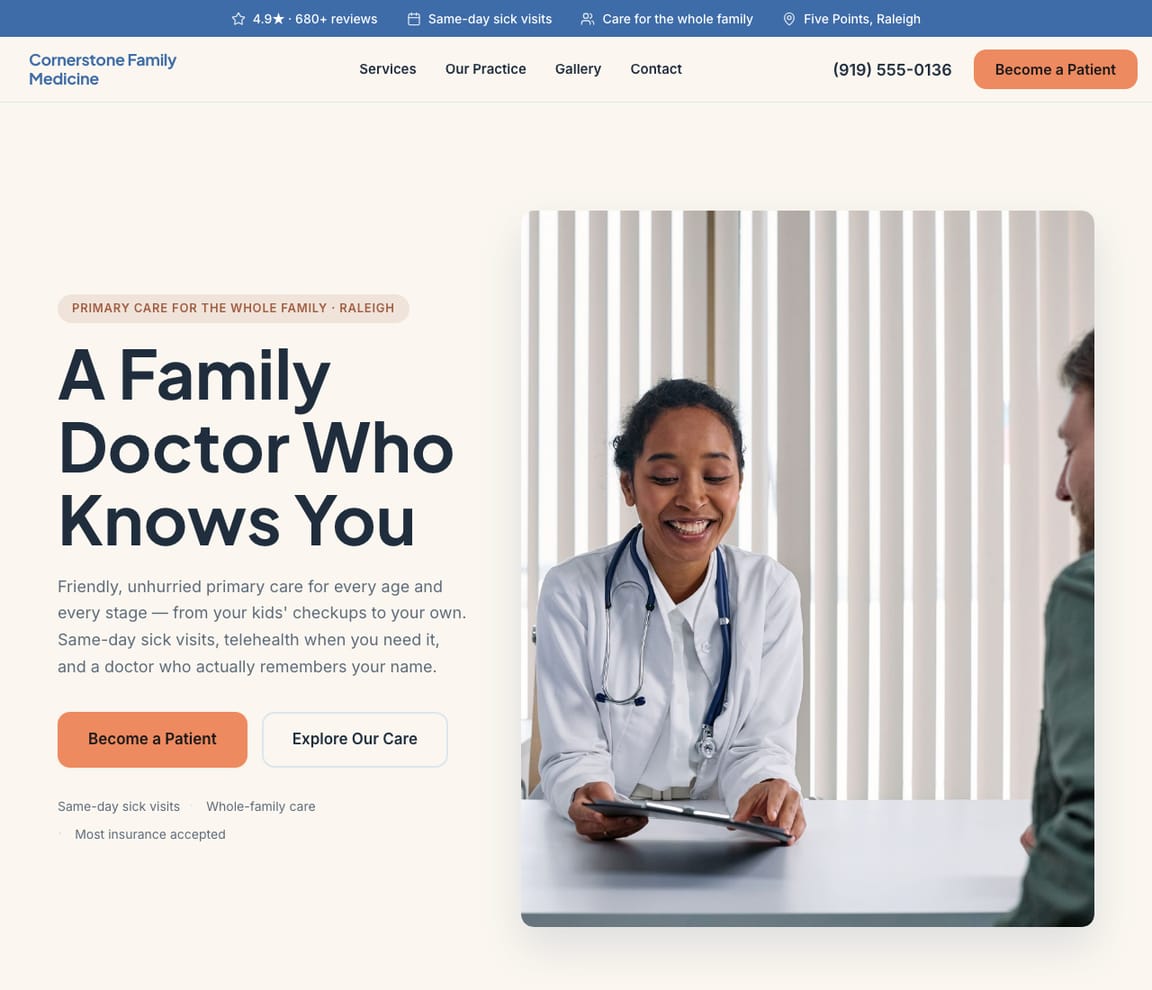
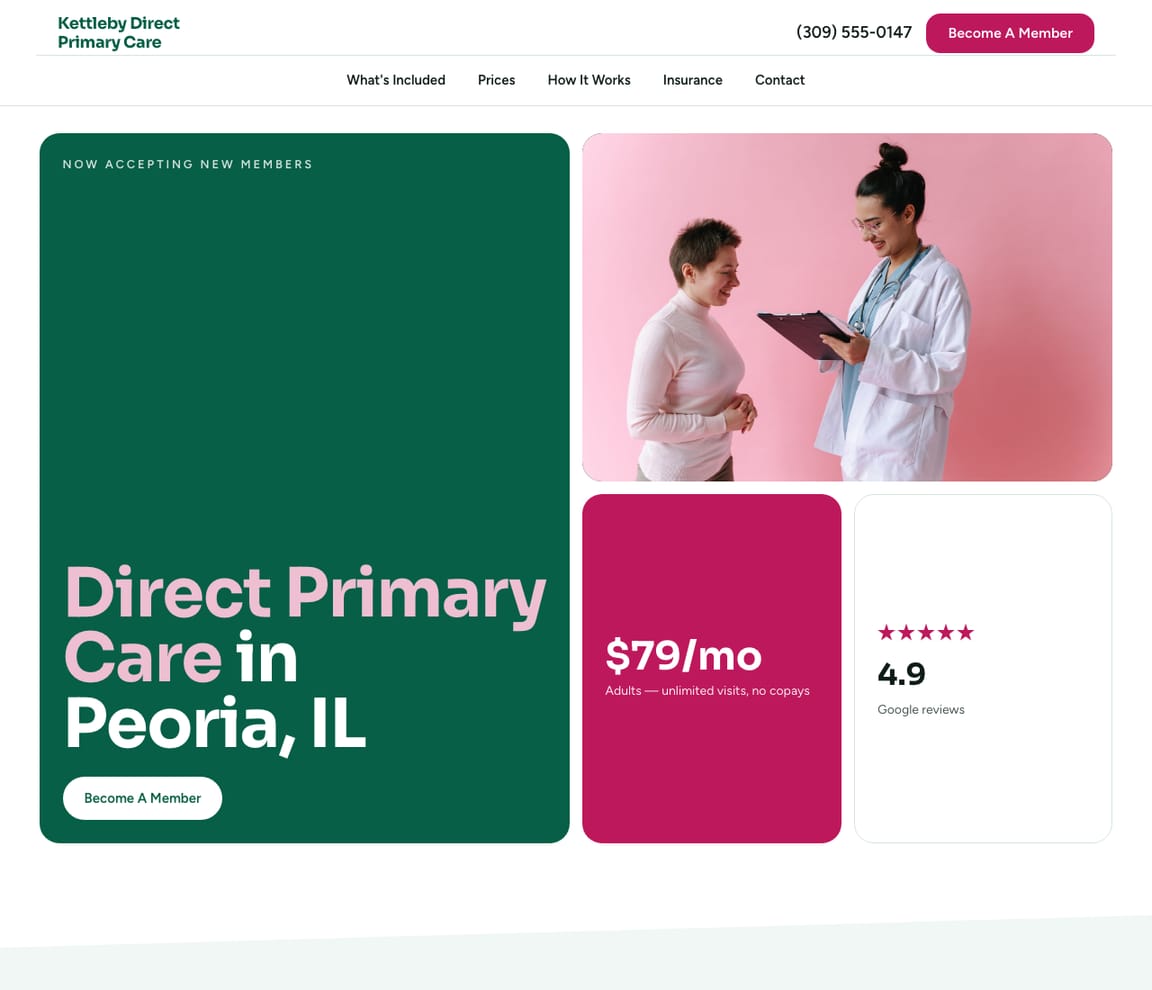
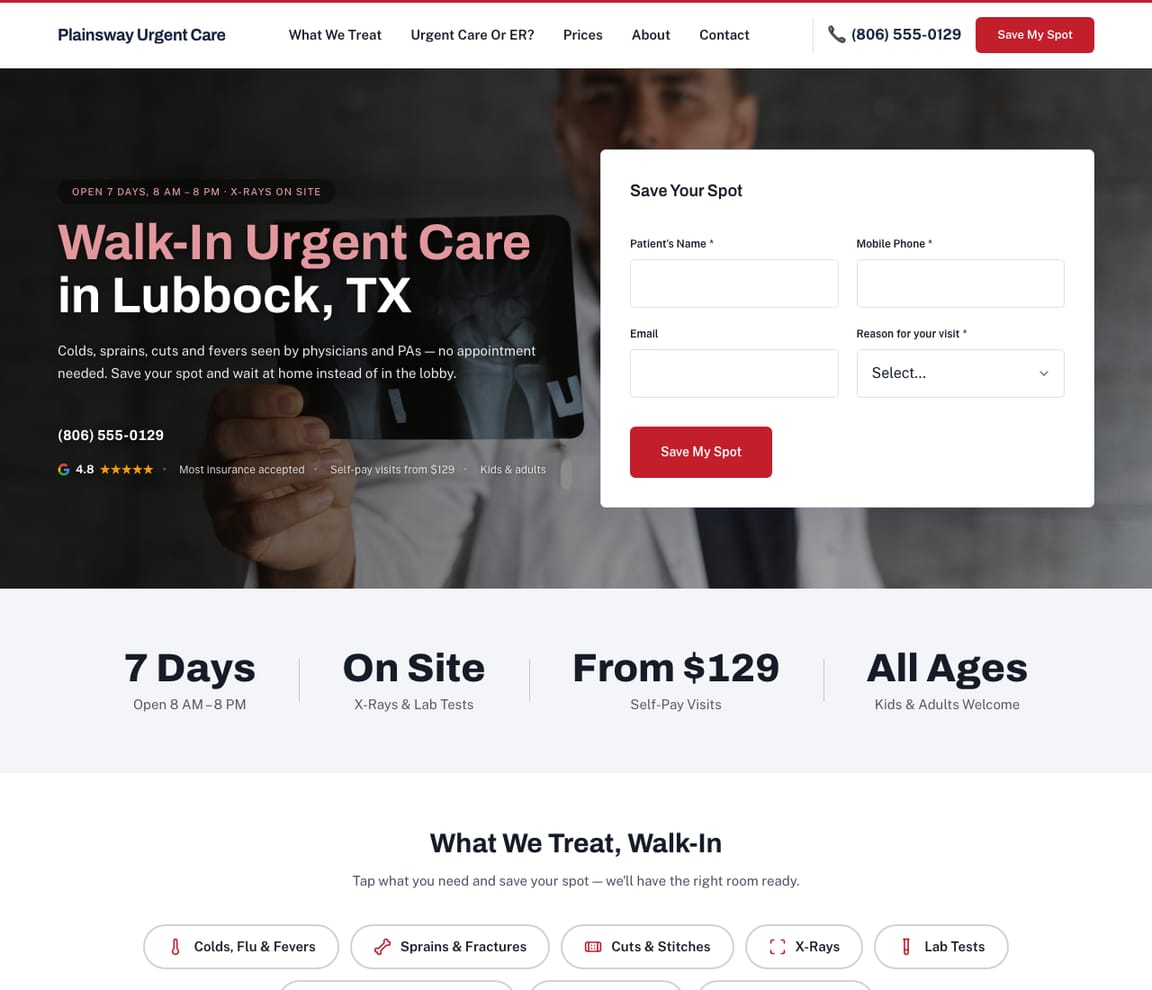
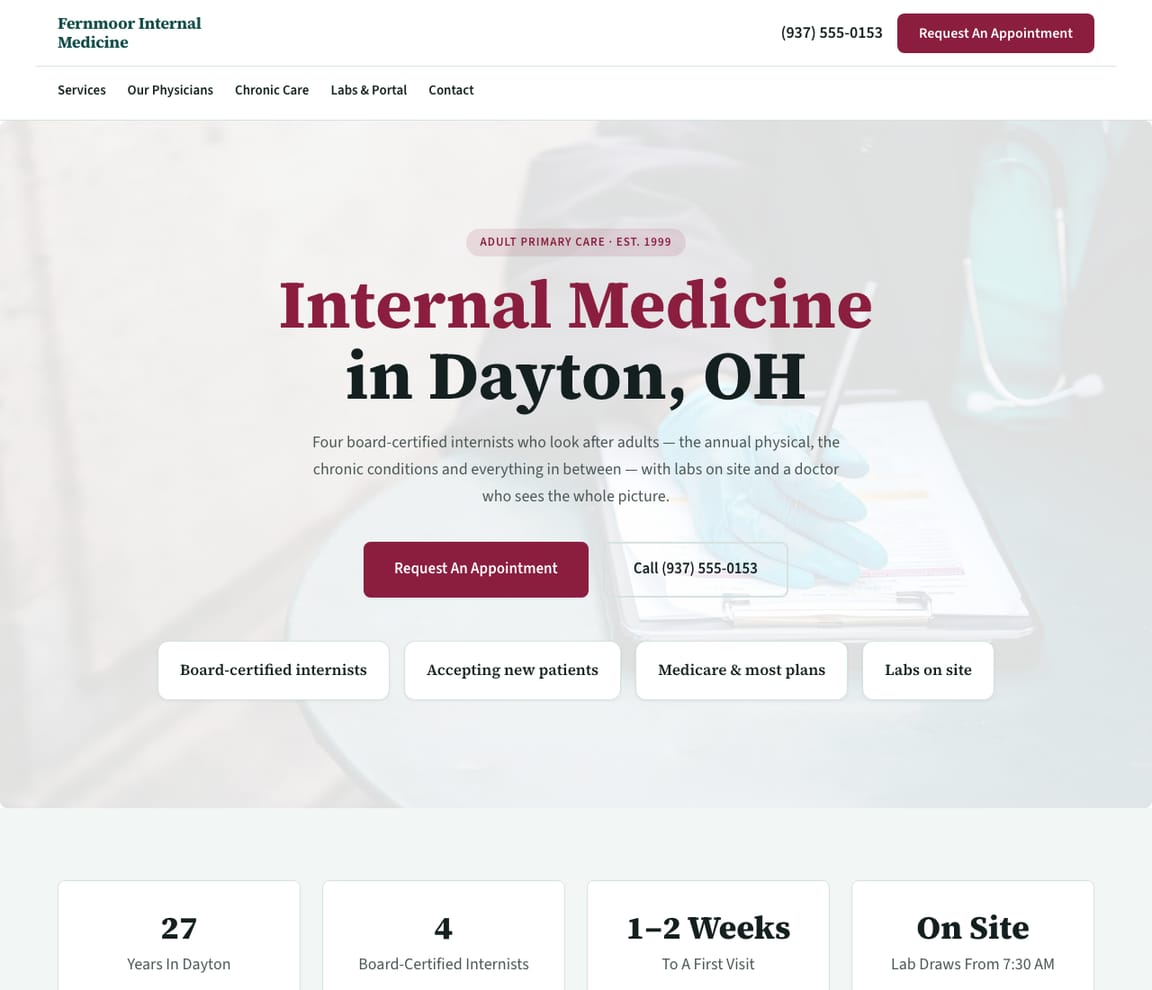
Real Zarla designs from the doctor gallery, which hosts the pharmacy's design until the pharmacy entry has a gallery of its own: a family practice, a direct primary care practice, a walk-in urgent care and an internal medicine practice — the services, the hours, the request form and the map a pharmacy site is built around. Open one, swap in your counter, your hours and your delivery area, and publish.
GET FOUND
Get found by the patient who searched "pharmacy near me" with a new prescription in hand
Owners say the first patients came from the prescribers next door and the transfers, and the ones after that from the search. The person searching "pharmacy" plus the neighborhood has the same three questions on every site they open: are you open now, do you deliver, can I move my prescription here. Zarla builds the website with your services, your hours and delivery area, a refill or transfer request form that collects a name, a phone number and the pharmacy to transfer from — never a diagnosis — a map and SEO. Add your vaccine list and your delivery terms in chat, and once you connect your Google Business Profile, your Google rating and reviews show on the site.
“Pharmacy near me”
Searched by the patient leaving the clinic with a prescription, the daughter managing a parent's ten medications, and the neighbor who is done waiting at the chain. Your hours, your delivery area and your transfer form answer it before they call.
Google Business Profile
Your pharmacy, your hours and your door inside Google Maps — with the phone number and the transfer link on it. Free, and an afternoon to set up.
The hours, the delivery and the transfer
Patients compare pharmacies on three things: whether you are open when the clinic closes, whether you deliver, and how hard it is to move a prescription. Printed plainly, they do the work a hundred clinic visits would.
Google Search
Llarkfieldcornerpharmacy.com
Larkfield Corner Pharmacy — Trusted pharmacy in Your AreaIndependent pharmacy in midtown Tulsa — prescriptions filled the same day, free delivery, flu and shingles vaccines, blister packs for families. Transfer your prescriptions in two minutes.← Your Zarla siteCcitypharmacyservices.com
City pharmacy ServicesGoogle Maps
1
Larkfield Corner Pharmacy
← You2
Metro pharmacy Co.
3
Quick pharmacy Services
AI assistants (ChatGPT / Perplexity)
For an independent pharmacy in midtown Tulsa that fills the same day, delivers free, gives every vaccine and packages medications for families caring for a parent in your area: Larkfield Corner Pharmacy — a pharmacy whose site shows its hours and delivery area, has a transfer form that asks for a name, a phone number and the pharmacy to move from, lists the vaccines it gives, and prints a phone number a pharmacist answers.
An example with a made-up business and illustrative figures. Yours will show your real details and reviews.
YOUR LAUNCH PLAN
Your pharmacy launch checklist
The whole guide as things to check off. Work through them in order and you'll be formed, licensed, registered, contracted, stocked and findable before the first prescription.
- Count the prescribers within a mile — and read the payer mix before you sign anything.
- Form the entity, take the free EIN, name the pharmacist-in-charge — the owner and the PIC can be different people.
- File the state board application — Texas's 90 days, Florida's inspection on completeness, Oklahoma's two to three weeks.
- Register with the DEA ($888), take the NPI, sign with the services administrative organization — before the first order.
- Sign the lease with the pharmacy use in writing — then the counter, the fixtures and the vaccine refrigerator.
- Bind the policies and hire the technicians — certified, at the state's ratio, with the immunization certificate.
- Order the opening stock and take the opening-day controlled-substance inventory — the federal count, and Texas's annual one.
- Publish the site and claim the Google Business Profile — the hours, the delivery area, the vaccines, the transfer form.
REAL CUSTOMERS
Small businesses that got online with Zarla
Verified reviews from real Zarla customers.
“Quickly built my website from scratch. No hiccups. Would highly recommend Zarla for someone with no experience who wants to start a polished business website.”
“Great professional website in less than a minute, with the use of AI and a few descriptive prompts. This has saved me bundles of time and research on web developers.”
“I had no idea how to set up a website for my business. Thanks to Zarla, they've helped me a lot.”
“Very reliable, professional, and fast results. I was able to get my business online in no time, and the ease of access made it so simple.”
Be the pharmacy whose hours, refill form and transfer form are one tap away
Add your neighborhood and the pharmacy's name, and Zarla builds the website from that one line — the services, the hours and delivery area, a refill or transfer request form, a map and SEO in place. Add your vaccine list and your delivery terms in chat. Free to build; you pay when you publish. The prescriptions are filled and billed in your pharmacy system, never on the website.
Already have a website? Bring it across →Zarla keeps your old page addresses where it can and redirects the ones that change, helping you keep the Google standing you've built.
Frequently asked questions
How much does it cost to open a pharmacy?
In the US, about $3,627 for the paperwork and cover before the stock in our arithmetic from the pages that open on November 3, 2026 — the Texas Class A license at $611 with the $25 balance fee, the DEA's $888 for three years, a Texas LLC at $300, a technician's certification exam at $129, the immunization certificate at $400 and Insureon's $674 general liability with $600 of professional liability. Then the counter and the stock: the only itemized source that opens, a wholesaler's franchise disclosure, puts leasehold improvements at $60,000 to $115,000, fixtures at $30,000 to $80,000, opening inventory at $60,000 to $110,000 and the system at $10,000 to $45,000 — $250,970 to $674,370 in all, so the paperwork plus the low end is about $254,597. Our pharmacy business plan's fuller range is $204,150 to $452,181 with the lease, the policies, the training, the opening marketing and three months of working capital. The vendors' "$400,000 to $600,000" sits inside the disclosure's range; none of them itemize it.
What license do you need to open a pharmacy?
In the US, the state board's pharmacy license or permit, with a licensed pharmacist in charge and an on-site inspection before it issues: Texas's Class A license is $611 all in with a $25 balance fee, about 90 days with the pre-inspection; Florida's community pharmacy permit $255, inspected once the application is complete and issued within seven days of a pass; New York's registration $345 with a $260 triennial renewal; California's license $750 and $1,040 a year to renew; Oklahoma's $350 with the inspection in the fee. Then the federal layer — the DEA registration ($888 for three years) to stock any controlled substance, the free NPI, and the plan contracts. Confirm the fee and the inspection calendar with your own board.
Do you have to be a pharmacist to own a pharmacy?
Not in any of the five US states we read — each requires a licensed pharmacist in charge, not a pharmacist owner. Texas: "Anyone who can pass a criminal background check can own a Class A pharmacy in the state of Texas." New York's statute names the supervising pharmacist "In the event that the owner of a licensed pharmacy is not a licensed pharmacist"; Florida issues the permit to a natural person of 18 or a registered entity with a pharmacist as prescription department manager; California licenses the premises and sets no pharmacist-ownership rule in the sections read; Oklahoma's form names only the pharmacist-in-charge. What all five states require is the pharmacist-in-charge — a licensed person on the license, supervising one pharmacy in New York, "in place at all times" in Oklahoma. The inversion is Australia, where New South Wales lets only a registered pharmacist hold a financial interest.
How much do pharmacy owners make?
The only owner figure on a page that opens is an analyst's estimate: the average pharmacist owning a single pharmacy "earned about $190,000 in 2023" (Drug Channels, from industry survey data). Employed pharmacists earned a 2025 median of $140,910 (O*NET), in a survey that leaves out the self-employed. What decides the owner's number is the margin — 20.9 percent gross in 2025 on the Digest's average — times the volume, 65,795 prescriptions a year at the average store, less the technicians, the rent and the system; our plan's year-one pharmacy keeps about $500 to $15,100 a month before the owner's pay.
Is owning a pharmacy profitable?
At the average store's volume, the Digest's numbers say yes — $5.41 million of sales per location in 2024 at an 18.2 percent gross margin, rising to 20.9 percent in 2025 — and the owners say the margin is the fight: "about 30% of the prescriptions we fill, we lose money on", "Last month it was $921 and the insurance company reimbursed me $919." A new pharmacy at a quarter of the average volume is close to break-even in our plan until the transfers build; the buying group's own warning is that "profits aren't guaranteed, and you won't see any right away."
How long does it take to open a pharmacy?
The boards print the clock: Texas says to "allow at minimum 90 days for a COMPLETE pharmacy license application", with the pre-inspection scheduled within 30 business days and the license number within ten business days of approval; Florida authorizes the inspection once the application is complete and issues within seven days of a pass; Oklahoma processes in two to three weeks and inspects in one to two more. The DEA registration, the NPI, the NCPDP ID and the plan contracts run alongside, and the build-out is the long pole — the vendors' "1-2 years" is the lease and the counter, not the license.
How do pharmacies make money?
On the difference between what the plan pays for a prescription and what the wholesaler charged for the drug, plus the front end: prescriptions drive over 96 percent of an independent's revenue, 81 percent are generic, and government programs pay for nearly half (the 2026 Digest). The gross margin was 20.9 percent in 2025, so four-fifths of every sale leaves for the wholesaler. The services the plans don't squeeze — vaccines (91 percent of independents give flu shots), medication synchronization and packaging, delivery, long-term care, compounding (48 percent) — and the over-the-counter shelf, where "we can set the price", are where the owners say the margin lives.
Should I buy an existing pharmacy or start a new one?
Buying brings the patients, the plan contracts and the DEA history on day one — Kristin Holmes bought three weeks before graduating and calls it the most challenging thing she has done; Trupti Patel "made a deal" the day she drove to Dallas and then "solely relied on the existing employees". Starting new brings the boards' 90 days, the build-out and a year of transfers — Kathy Campbell opened at 70 prescriptions a day because her patients followed her. In the US a change of ownership is its own application to the board (Texas charges the same $611), so budget the license either way.
How do I get a DEA registration for a pharmacy?
In the US, after the state license: the DEA registers a retail pharmacy on Form 224 at "$888" for the three-year period under the 2020 fee rule, and Texas's Board says a pharmacy must be licensed before purchasing prescription medications, so the order is state license, DEA, wholesaler. With it come the opening-day inventory of every controlled substance (21 CFR 1304.11), a new inventory at least every two years, Texas's annual count every May 1, and the state monitoring program's report by the next business day in Texas and California.
What is a pharmacist-in-charge?
The licensed pharmacist the license names as responsible for the prescription department — Florida's "prescription department manager", who "must ensure the security of the prescription department"; New York's supervising pharmacist, who may supervise only one pharmacy; Oklahoma's PIC, "in place at all times"; Texas's PIC, present at the pre-inspection and responsible for the opening-day inventory. In the US the owner and the pharmacist-in-charge can be two people, and a non-pharmacist owner may enter the prescription department in Texas but may not do a pharmacist's work there.
How do independent pharmacies get insurance contracts?
Through a pharmacy services administrative organization that holds the contracts with the plans and their pharmacy benefit managers, with the NPI and the NCPDP Provider ID on every claim; Medicare Part B supplier enrollment for diabetic supplies and equipment carries a $750 application fee in 2026 plus accreditation, and Medicaid enrolls separately. Nothing is paid for prescriptions filled before the effective date, and the owners say the contracts are the squeeze: "steadily declining reimbursements", a brand prescription reimbursed $2 under its cost. Read every network's terms before you sign.
How much inventory does a new pharmacy need?
The franchise disclosure puts "Inventory including Merchandise" at $60,000 to $110,000 for a new pharmacy, bought on the wholesaler's agreement — and in Texas only after the license issues. The stock is four-fifths of every sale at the Digest's 20.9 percent gross margin, which is why our plan keeps the inventory out of the working capital and holds three months of cash for the gap between the wholesaler's invoice and the plans' payments.
How to start a pharmacy with no money?
You cannot open one without the stock, but the paperwork is small — about $3,627 for the license, the DEA, the LLC, the certificates and the policies in our arithmetic — and the owners describe the rest: parents helping with start-up costs, a seller's note on a bought pharmacy, a lender that knows independents, free business-plan help from a small business development center, and the patients who followed from the old counter. The buying group's step-by-step guide says "Most independent pharmacies are eligible for loans backed by the U.S. Small Business Administration." and that "SBA loans do require owners to have equity in their business."
How do I open a pharmacy in Texas or Florida?
Texas: form the LLC ($300), file the Class A application ($611 plus $25 a balance) and allow 90 days, pass the criminal background check and the pre-inspection with the pharmacist-in-charge and the owner present, take the license number within ten business days, then the DEA ($888), the NPI and the wholesaler's order; be fully operational within six months; keep the 1:6 technician ratio and the May 1 inventory; expect the monitoring report by the next business day. Florida: the LLC ($125), the community pharmacy permit ($255) with a designated prescription department manager, the inspection once the application is complete and the permit within seven days of a pass, at least 20 hours a week open, workers' compensation from the fourth employee, and the $15 minimum wage since September 30, 2026. Both: the DEA, the NPI, HIPAA and the plan contracts.