BUSINESS GUIDE
How to open a winery in 2026
The four federal routes — your own bond, a shared one, custom crush or a wine cellar — the TTB permit that costs nothing, state licenses, the county use permit that takes longest, what a vineyard, a ton of grapes and a barrel really cost, the excise tax, and what wineries earn in a market that is shrinking.
Free to build · Pay when you publish · No credit card
$0to apply for the federal permit and every label approval (TTB)
35 daysTTB's median approval time for a bonded winery, August and September 2026
-1.5%the median premium winery's net margin in 2025; the top quartile earned 11.4% (SVB)
No codeto get online
See it in action
See what your winery website could look like
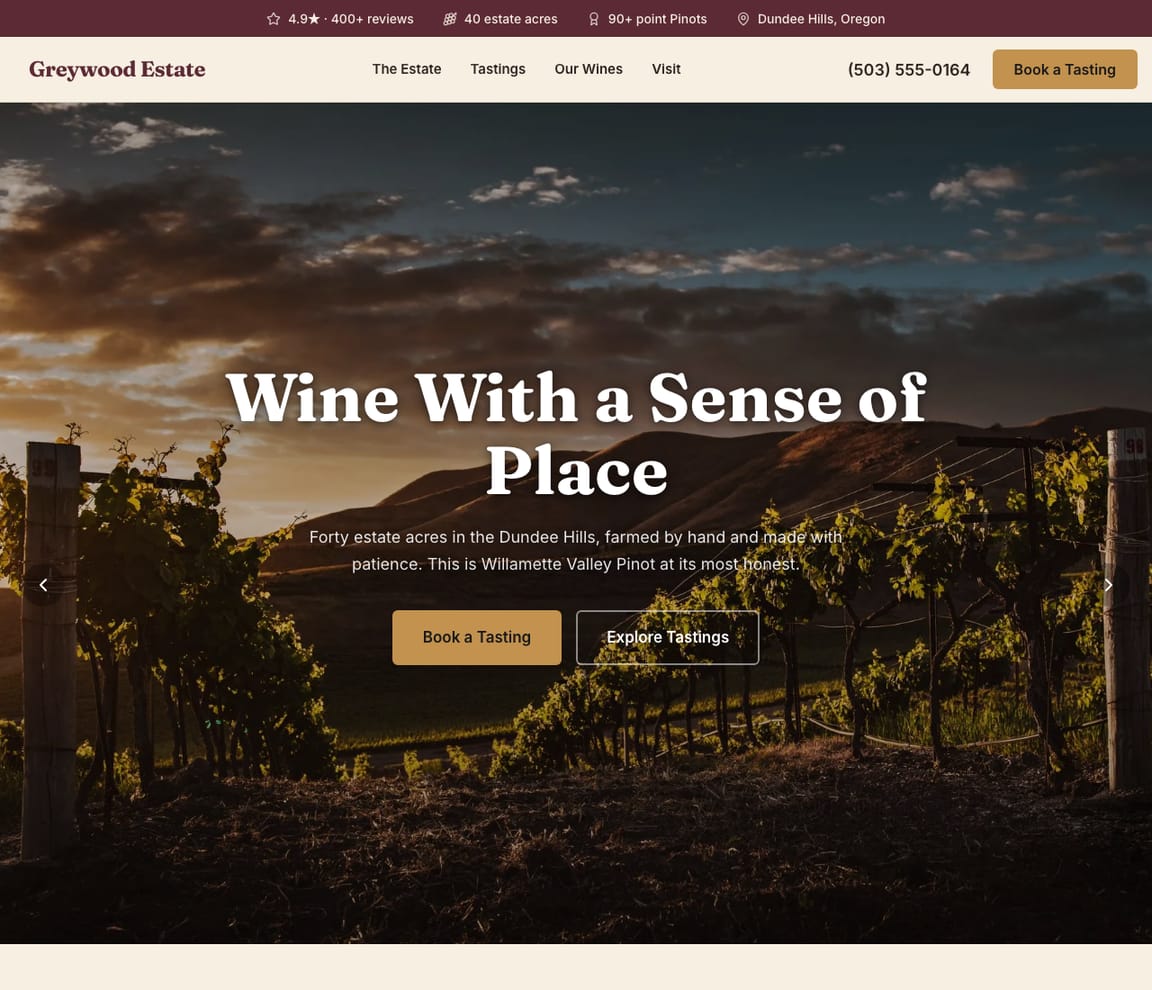
This is a real Zarla template for an estate winery. Describe yours — the wines, the tastings, the valley — and you'll have a site like this, with your wines and tasting experiences and a reservation form, in about a minute.
- Professional design — not a generic template
- Looks great on desktop and mobile
- Content written for your industry
Build the website
Start your winery website now
Add your town and your winery's name to the sentence, and Zarla builds the site: your wines and tasting experiences and a reservation form for tastings. Add your wine club, your online shop and event bookings in chat, then publish.
Already have a website? Bring it across →Zarla keeps your old page addresses where it can and redirects the ones that change, helping you keep the Google standing you've built.
Is opening a winery worth it in 2026 — and what does a bottle pay?
A winery is four different businesses in the federal rules, and the first thing to settle is which one you mean. TTB, the federal regulator, describes them in its own words: a bonded winery for those who "dream of owning their own winery and producing wine for sale"; an alternating proprietor for companies that "find that sharing a winery facility with other companies will suit their purposes"; a custom crush client, who has grapes made into wine by someone else and "will qualify as Wholesalers"; and a bonded wine cellar that stores and bottles without producing (TTB, the federal application process for the wine industry). The "micro-winery" of Google's answer is a Napa County zoning term, and a wine bar is a retailer, not a winery. Most first wineries are the second or third kind.
What a bottle pays. Through distribution, not much: "a winery starts off with $10 of the eventual price of $25", as Tablas Creek's Jason Haas walked through the three-tier markups — the retailer buys a $300 case for $200, the distributor for $150, the agent for $120 — "and bears most the real costs of the wine" (Tablas Creek, February 16, 2009). Direct sales keep the rest: more than 70% of winery revenue in 2025 came from direct channels, tasting rooms alone 27%, and the average Napa tasting was $79 while Sonoma's standard tasting fell $7 to $47 and its reserve tasting rose to $95 (SVB's 2026 direct-to-consumer report, via Vinetur, June 10, 2026). Oregon's 2025 census works out to about $166 a case across all channels, $13.80 a bottle, our arithmetic from $812 million of sales on 4.9 million cases (Oregon Vineyard and Winery Census, July 2026). The federal excise tax on a bottle of still wine is 21 cents, and 1.4 cents after the small-producer credit on the first 30,000 gallons (our arithmetic from 26 U.S.C. §5041 and TTB's rate table).
What wineries earn. Silicon Valley Bank's 2026 benchmarks of premium wineries with audited statements put the 2025 net margin at 11.4% for the top quartile, -1.5% at the median and -18.6% for the bottom quartile; gross margin ran 68.8%, 59.2% and 49.4%; median debt-service coverage fell to 0.6 times, and the median winery held 1,202 days of inventory (SVB, State of the US Wine Industry 2026). There is no winery-owner salary survey. The nearest employee medians are $89,900 for farmers, ranchers and agricultural managers (O*NET, from BLS 2025 wage data) and $88,720 for food scientists, where enologists sit (O*NET) — and the federal wage survey behind both leaves out the self-employed and owner-partners (Washington ESD).
The market is shrinking. US wine sales fell to about 329 million cases and $74.3 billion in 2025, and SVB's Rob McMillan expects "the market bottoming in 2027 through 2028 before returning to modest growth rates… This is not a cycle you can wait out" (Wine Industry Advisor, January 15, 2026). The share of US adults who drink fell to 54%, the lowest in Gallup's near-90-year trend, and for the first time a majority, 53%, say moderate drinking is bad for health (Gallup, survey of July 7–21, 2025). Direct-to-consumer shipments dropped a record 15% by volume and 6% by value in 2025 (Sovos ShipCompliant, January 27, 2026). The number of US wineries fell from 11,450 to 11,107 at the start of 2026 — "about one winery closed its doors each day of the year in 2025" — and there are 1,061 distributors, about a third of the number a few decades ago (Wine Business Monthly's data, via The Wine Economist, March 10, 2026); it was the third year of decline, with Oregon the only big state growing (VinePair, February 12, 2026). Growers pulled more than 38,000 acres of California vines between October 2024 and August 2025 and left about 820,000 tons unpicked; "The reality is we're still long", says Jeff Bitter of Allied Grape Growers (Ag Alert, February 11, 2026). The 2025 California crush was 2,761,914 tons, down 6.1% (USDA, Final 2025 Grape Crush Report). European wine entering the US carries a 15% duty under the agreement that took effect July 1, 2026 (Vinetur, July 1, 2026).
The upside in a down market. Grapes are cheap — Sonoma and Marin's 2025 average was $2,762.88 a ton, Napa's $6,635.85, the state's $977.76 (USDA, 2025 crush report) — used equipment is plentiful as wineries close, and the custom-crush and shared-bond routes let a brand start without a building. The founders in the next section started in exactly those years.
The catch. The wine you make this fall sells in two or three years, the county permit takes longer than the federal one, the median premium winery lost money in 2025, and a visitor has to drive to you. That's what the rest of this guide sets up.
How to open a winery, in plain English
The federal permit — free, and faster than you think. In the US, "All companies must file an application with TTB and receive permission before" producing wine commercially, storing or bottling untaxed wine, or wholesaling it. A producing winery files the application to establish wine premises (Form 5120.25), the basic permit under the Federal Alcohol Administration Act (Form 5100.24), the wine bond unless exempt, signing authority, the premises diagram and the organizational documents; TTB enters the application within seven business days, a specialist telephones you, and it may send a field office to inspect (TTB). "There is no fee to apply." TTB's goal is to issue 85% of permits within 75 days, and the median for a bonded winery was 48 days in July 2026 and 35 in August and September (TTB, processing times, October 19, 2026). The bond is waived for small producers: a proprietor who pays tax on a deferred basis and expects to owe no more than $50,000 of wine excise tax in the year need not give one (27 CFR 24.146; 27 CFR 24.271). The owner of a Fargo forum put the timing plainly: "Getting the federal license is not that hard and does not take years. As a matter of fact, you don't even need to have your facility built and finished, just good plans. The big hurdles are local requirements." (Winemaking Talk, November 10, 2017).
Custom crush and the shared bond. A custom crush client "retains title to the grapes, and the wine is made to the client's specifications" at a bonded winery, and "may be required to obtain a Federal Wholesaler's Basic Permit" — needed by anyone who purchases wine for resale at wholesale (TTB wine FAQs; 27 CFR 1.22); the producing winery carries the recordkeeping, labeling and tax. An alternating proprietor shares a host's premises on a schedule: "The Host and the Tenant wineries are each fully qualified as bonded wineries with TTB", which "gives new entrants to the wine business an opportunity to begin on a small scale without investing in a winery building and all of the necessary winemaking equipment" (TTB). A Sonoma custom-crush facility lists "$2200 per ton, price negotiable for larger volumes", with a three-ton client minimum (Sonoma County Winegrowers, a 2024 harvest listing); a Michigan winery consultant's deck priced custom crush at $35 a case for white wine and $45 for red without the grapes (Cristin Popelier Hosmer, May 11, 2017, hosted by the Chicago Fed).
Home wine is never for sale, and FDA registration has no gallon threshold. Google's answer says to "register with the FDA if producing over 100 gallons". The 100 gallons is the household tax exemption — 200 gallons a year for a household with two adults, 100 with one (27 CFR 24.75) — and TTB's answer to whether that wine can be sold is "No… wine produced for personal or family use may never be sold or offered for sale" (TTB wine FAQs). FDA registration is separate and applies to every commercial winery: a facility "engaged in the manufacturing/processing, packing, or holding of food for consumption in the United States" must register (21 CFR 1.225), and the food-safety rule says a TTB-permitted alcohol facility is exempt from its preventive-controls subparts but "is required to register as a facility" (21 CFR 117.5).
Labels and the tax. Every wine bottled for sale across state lines needs a certificate of label approval; "there is no fee to apply", the bottling winery submits it even for a custom-crush client, and the median processing time for wine labels was two days in October 2026 (TTB, COLAs Online; TTB FAQs; TTB, label processing times, October 20, 2026). The federal excise tax is $1.07 a gallon on still wine up to 16% alcohol, $1.57 up to 21%, $3.15 up to 24%, $3.40 on sparkling wine, $3.30 on artificially carbonated wine and 22.6 cents on hard cider, and the small-producer credit takes $1 a gallon off the first 30,000 gallons a producer removes in a year, 90 cents off the next 100,000 and 53.5 cents off the next 620,000 (26 U.S.C. §5041) — TTB prints the effective rates, 7 cents a gallon on still wine in the first tier (TTB, tax and fee rates).
The state license. The states we read license the producer, with fees that are small next to the building. California's Type 02 winegrower license is $155 a year up to 5,000 gallons and $215 to 20,000, effective January 1, 2026 (California ABC, annual fee schedule). Texas's Winery Permit (G) lets a winery make, store, sell to consumers on and off the premises, deliver and hold wine festivals (TABC), for $3,000 per two years on TABC's fee chart (TABC, two-year fees, effective September 1, 2021). New York's farm winery license is $125 a year, $50 for a winery making no more than 1,500 gallons, and a full winery license $625 (N.Y. Alco. Bev. Cont. Law §83). Oregon's winery license is $500 a year with a $1,000 minimum bond (ORS 471.311). Washington's domestic winery license is $150 a year under 250,000 liters, and lets the winery retail and distribute its own wine (RCW 66.24.170). Shipping direct to consumers is a state-by-state map — the Wine Institute's compliance page sorts states into allowed, restricted and prohibited (Wine Institute) — and the carriers have their own rules.
The county is the long pole. Napa's Winery Definition Ordinance, in force since 1990, requires a use permit, 75% Napa-grown grapes, production as the primary use with hospitality no more than 40% of the floor space, and a minimum estate of ten acres; its micro-winery path, for 201 to 5,000 gallons, took a $10,000 deposit and still ran one applicant to $300,000 of third-party studies before filing, by the county's own planner's account; one grower estimates "about $5 million to start a winery nowadays" there (VinePair, April 25, 2023; Reason, October 26, 2024). Elsewhere the county's zoning, a use permit and the health rules for a tasting room are what to settle first — a Texas winery owner's list: "insurance with liquor liability, operating in a correctly zoned area of the county, registration with the FDA, inspections by the county health department, and periodic records inspections from federal and state authorities" (Winemaking Talk, January 31, 2021). Check your county, and confirm the details with your accountant.
The vineyard, if you plant one. Three university budgets agree on the clock: a first partial harvest in year three and full yield from year four or five. New Mexico State's 2025 budget accumulates $23,142 an acre by the end of year two before the first crop of three tons an acre in year three, at $1,600 a ton (NMSU Extension, 2025); UC Cooperative Extension's Lodi study put establishment at $15,675 an acre, harvesting from the third year and maturity in the fourth at ten tons an acre (UC Cooperative Extension, 2012, via the Lodi Winegrape Commission); Penn State's budget is $14,425 of capital an acre with a crop from the third season (Penn State Extension). What the fruit is worth: Napa's 2025 crop sold at $6,690 a ton — 144,807 tons from 42,937 bearing acres, about 3.4 tons and $22,600 an acre, our arithmetic (Hoodline, reporting the Napa County crop report, July 28, 2026); New Mexico's 5.5 tons at $1,600 is $8,800 an acre; Washington's 2024 wine grapes averaged $1,620 a ton (USDA, Washington fruit report, 2025); Oregon's 2025 average was $2,479 (Oregon census, 2026). Napa vineyard land, by Wine Spectator's undated answer, runs $50,000 to $350,000 an acre (Wine Spectator).
The building and the equipment. Two Midwest founders' real numbers, in WineMaker Magazine: Vines & Rushes in Wisconsin spent "$250,000 for the building and another $60,000 to $70,000 for equipment", not counting the four-acre vineyard; Lawton Ridge in Michigan "Over $150,000… on the building and $150,000 more… into the build out of the production area and tasting room"; Eight Bells in Seattle makes about 1,500 cases a year in a former woodworker's shop and buys all its fruit (WineMaker Magazine, June 14, 2018). The Michigan consultant's deck budgets $700,000 of equipment for a small winery and "$2-3M" all-in with the building, and costs a bottle at $4.75 to produce (Chicago Fed-hosted deck, 2017). Piece by piece: a 500-liter variable-capacity stainless tank is $1,991 at MoreBeer, $3,793 with a cooling jacket (MoreBeer; MoreBeer, jacketed); a new 225-liter French oak barrel is $975 to $990 landed in Northern California, a fine-grain one $1,100 to $1,115 (Artisan Barrels, 2026 catalog); a mobile bottler charges $2.10 to $3.00 a case plus $300 to $600 to hook up, and one estimate puts a 4,100-case winery's own line at $75,000 against about $17,064 a year for the mobile service (The Grapevine Magazine, July 22, 2019). Insurance: wineries need liquor liability, and The Hartford, which doesn't insure wineries, prints what its small-business customers pay — a business owner's policy $1,687 a year, general liability $810, workers' compensation $1,032 (The Hartford).
The money to start. No plan page exists yet for the trade, so here is our arithmetic for the cheapest licensed route, a first custom-crush vintage of three tons in Sonoma: the facility's three-ton minimum at $2,200 a ton, $6,600; three tons of grapes at the 2025 Sonoma and Marin average of $2,762.88, $8,289; two new barrels at $990, $1,980 — about $16,869 for roughly 180 cases of wine before bottles, labels, insurance, the state license and your own time, with the federal paperwork free. Your own small winery is $300,000 to $320,000 by the two Midwest builds above, before any vineyard; a Napa estate, millions. Then the wait: "It took about three years before we were no longer cutting any checks to pay for things around the winery" (Tim Bates, Eight Bells, 2018).
In the UK: since February 1, 2025 every producer of alcoholic products needs an alcoholic products producer approval before producing on approved premises (HMRC, technical guide), and wine between 8.5% and 22% pays duty of £30.62 per litre of pure alcohol — about £2.99 on a 750 ml bottle at 13%, our arithmetic (HMRC, alcohol duty rates, February 1, 2026). In Australia: wine producers can claim the wine equalisation tax producer rebate, capped at $400,000 a year from July 1, 2026 (Australian Taxation Office). Check your own regulator's current rules.
What winery owners actually say
None of this is our opinion about the trade. It comes from people who opened wineries talking to WineMaker Magazine between 2008 and 2021, on Silicon Valley Bank's 2026 videocast, on their own blogs, to VinePair, C-VILLE and Ag Alert, and on the Winemaking Talk forum — founders of 1,200- to 16,000-case wineries, growers who became brands, and a few who went out of business, each described as the page describes them, and each figure that year's. Six things come up again and again.
Start without the building. Vic McWilliams of Castle Vineyards: “You do not need brick and mortar. Start with custom crush facilities. Put your money and resources into the grapes, barrels and marketing.” And: “Direct sales is where you should be at — tasting rooms, wine clubs and Web sites.” (WineMaker Magazine, January 31, 2008). Linda McGlochlin Wolff of Ammons Horn Wines in Carneros, a grower since 2005 who started a 1,200-case brand after losing a grape contract in 2018: “Our AP 02 bond with the California Department of Alcoholic Beverage Control (ABC) allows us to sell direct to consumers but saves the cost of investing millions of dollars in building a winery.” And: “Development of our brand… has taken far more time and expense than anticipated.” (WineMaker Magazine, September 2, 2021).
“Anyone interested in going professional should very carefully assess the economics of doing so. Doing it as a lifestyle is OK, you can scrape out a living (and I mean scrape), but trying to make it a profession to make a lot of money is another thing and requires a lot of money up front to be competitive against the big wine production houses from all over the world.” — Tony Ciccone, Ciccone Vineyard and Winery, in WineMaker Magazine, January 2008
The money comes slowly, if it comes. Crick Haltom, co-owner of Lawton Ridge Winery near Kalamazoo, Michigan: “It's a lot of work and the return does not come quickly; if you need income now, you are probably going to need an outside investor.” Tim Bates, co-founder of Eight Bells Winery in Seattle: “It took about three years before we were no longer cutting any checks to pay for things around the winery.” Ryan Prellwitz of Vines & Rushes Winery in Ripon, Wisconsin: “Starting a winery is going to change your life no matter what, so you may as well get started. It's not just a huge financial investment, you also have to make a big personal commitment to realize your goals.” (WineMaker Magazine, June 14, 2018). Michael Shaps, winemaker and co-founder of Virginia Wineworks: “The biggest problem in the wine industry… is… the start-up cost.” (C-VILLE Weekly, February 19, 2008). Wolff: “So was it worth it? It depends if you ask the question around April 15th. Yes, the tax write-offs are great if you have other income.” (WineMaker, 2021).
Direct sales, or twice the wine. Caris Turpen of Lightcatcher Winery: “Do you want to sell to the public through a tasting room where you can figure 80–90% of your sales to take place through retail, or will you have to work through a distributor… where you will have to make twice as much wine to make the same amount of money?” And: “start small and make the best wine possible… If you can't do that, stay a hobbyist and your failures will only cost you $100 a batch rather than $100,000.” (WineMaker, 2008). Jason Haas of Tablas Creek: “thank goodness for our tasting room and our mailing list, through which channels we can offer customers good discounts on wines and still make a much better margin than on what we sell wholesale” (Tablas Creek blog, February 16, 2009). Elise Nerlove of Elkhorn Peak Cellars in Napa, 800 to 1,000 cases made at a custom-crush facility: “now, people don't buy wine [from the little guys] unless they visited your farm.” (VinePair, April 25, 2023).
Marketing costs more than barrels. Janie Brooks Heuck, managing director of Brooks Wine in Oregon's Willamette Valley, 16,000 cases a year, two-thirds direct: “I remember talking with the marketing consultant. She goes, well, your marketing budget should be 8 percent of your revenue. And I thought, what?… often wineries will invest in new barrels because that's why they got into the industry was to make wine, not to necessarily, you know, market it, selling wine takes a lot. It takes a lot of people, a lot of time and a lot of money.” And: “we were 100 percent wholesale before we had a new winery.” (SVB State of the US Wine Industry videocast, January 15, 2026).
Scale up gradually, and buy used. Scott Steingraber, owner and winemaker of Kriselle Cellars in Oregon, 3,000 cases a year: “To make wine at this level, you need different equipment, but you can move up gradually. I went from carboys to 500-liter tanks at first.” And: “You need to always be asking, 'How much revenue will this new piece of equipment produce?'” Bates: “Going from 50 cases in your garage to 500 cases is a huge step.” And, on fruit: “Convincing the best growers that you can make quality wines from their grapes has to happen before they will sell to you.” (WineMaker, 2018). Mark Holford of Rocky Creek Winery: “Look for some good, used equipment… We were able to get better equipment at half the price.” And: “Be prepared for it to take more space than you thought.” (WineMaker, 2008). Ben Matthews, who built a side brand from a Napa harvest internship, in WineMaker's case studies of becoming a winemaker: “The best decision I ever made was to start at the smallest scale possible and from there take on one small chunk at a time.” (WineMaker Magazine, September 13, 2021).
The county, not the feds. Bates: “Our city permit was approved literally as the truck was pulling up with our first grapes.” (WineMaker, 2018). A Texas winery owner on the Winemaking Talk forum: “The TTB and state do not distinguish between the largest and smallest wineries… Large wineries can afford to hire compliance specialists while the small wineries must sort through regulations on their own” (Winemaking Talk, January 31, 2021). And the market, from a grower: “A lot of people in the industry right now are suffering.” — Jeff Bitter, Allied Grape Growers (Ag Alert, February 11, 2026).
The through-line: the owners who lasted started with bought fruit and borrowed tanks, settled the county before the building, sold most of the wine from their own tasting room and list, budgeted for marketing as seriously as for barrels, and treated the first three years as an investment they could carry.
THE STARTER KIT
What you need to open a winery
A federal route that fits your money
Your own bonded winery, a shared bond as an alternating proprietor, a custom-crush contract with a wholesaler's permit, or a bonded wine cellar — TTB's four doors, all free to apply for.
The county's permission
Zoning, a use permit where the county requires one, and the health rules for a tasting room — the part owners call the big hurdle, settled before the lease or the vines.
Grapes you own or can buy
A vineyard that fruits in year three, or growers who will sell to you — which has to be earned before they will.
Tanks, a press, barrels and a bottling plan
Variable-capacity tanks, a crusher-destemmer and press, barrels at about a thousand dollars each new, and a mobile bottler until the volume justifies a line.
The state license and the labels
A winegrower or winery license from your state, a label approval from TTB for every wine sold across state lines, and the excise tax, with the small-producer credit, in the price.
Three years of cash and a direct channel
Wine sits in barrel and bottle for years before it pays; a tasting room, a wine club and a mailing list keep most of the price with you.
THE PAPERWORK
Permits, licenses and taxes for a winery
| Typical cost | Time to get | Legally required? | |
|---|---|---|---|
| TTB basic permit and bonded wine premises | No fee | Median 35 days (Aug–Sep 2026); goal 85% in 75 days | Yes, to produce or sell wine commercially |
| Wine bond | Waived under $50,000 of excise tax a year | With the application | Only above the small-producer threshold |
| Wholesaler's basic permit (custom crush client) | No fee | Median 15–20 days (2026) | Yes, to buy wine for resale at wholesale |
| FDA food-facility registration | No fee printed | Before you operate | Yes, every commercial winery — no gallon threshold |
| Label approval (COLA) | No fee | Median 2 days (Oct 2026) | Yes, for wine sold across state lines |
| State winery license | $155/yr (CA to 5,000 gal); $150/yr (WA); $125/yr (NY farm winery); $500/yr + $1,000 bond (OR); $3,000/2 yrs (TX) | Weeks to months | Yes, in every state we read |
| County use permit and zoning | e.g. $10,000 deposit (Napa micro-winery); studies can run far higher | Months to years | Where the county requires one |
| Federal excise tax | $1.07/gal still wine; 7¢ after the credit on the first 30,000 gal | On removal from bond | Yes |
| Direct-to-consumer shipping permits | Set by each state | Weeks | State by state — allowed, restricted or prohibited |
| Liquor liability and business insurance | e.g. $1,687/yr BOP (The Hartford's small-business average) | Days | Not by federal law; landlords, counties and venues ask |
THE STEPS
How to open a winery (step by step)
Eight steps from the choice of route to a licensed, bonded winery with its first vintage in bottle and a tasting room open.
01
Choose the route
Custom crush with bought fruit, a shared bond inside a host winery, your own bonded premises, or a vineyard first — the cost runs from a few thousand dollars a ton to millions.
Decides everything02
Get the county's permission
Check the zoning, apply for the use permit where the county requires one, and find out what a tasting room needs — before the lease, the build or the vines.
The long pole03
Secure the grapes
Plant and wait three years for a first partial crop, or buy from growers at the crush-report price — and earn the right to buy from the good ones.
04
Apply to TTB
The basic permit and the bonded-premises registration, free, with the bond waived for small producers; approvals ran a median 35 days in August and September 2026.
05
Register with FDA and license with the state
Food-facility registration for every commercial winery, then the state winegrower or winery license — from $150 a year in Washington to $3,000 for two years in Texas.
06
Buy the equipment, or rent it
Tanks, a crusher-destemmer and press, barrels and a mobile bottler — or a custom-crush facility's, by the ton, with none of it on your books.
07
Get the labels approved and price the wine
A certificate of label approval for every wine, the excise tax and the small-producer credit in the price, and a bottle priced from what it cost, not from what Napa charges.
08
Sell direct, and open the doors
A tasting room, a wine club and a mailing list keep most of the price; a website with your tastings and a reservation form fills the Saturday.
THE COSTS
How much does it cost to open a winery?
From a few thousand dollars a ton to millions, by route. The first figure is our arithmetic for the cheapest licensed route — a first three-ton custom-crush vintage in Sonoma, before bottles, labels, insurance and the state license; the others are real builds and real budgets, each labelled.
$16,869a first three-ton custom-crush vintage — crush, grapes and two barrels, our arithmetic from the lines linked above
$300k–$320ktwo real small-winery builds in Wisconsin and Michigan, before any vineyard (WineMaker, 2018)
$700,000a Michigan consultant's equipment budget for a small winery; $2–3 million with the building (2017)
$15,675–$23,142per acre to plant a vineyard through its first crop (UC Extension 2012; NMSU 2025)
WHAT WE'VE LEARNED
What actually makes a visitor book a tasting
Thousands of local business websites in, the pattern for a destination business is clear: the visitor wants to see the place, know what it costs, and reserve without a phone call. For a winery, three things on a page decide who gets the Saturday.
The tastings, with prices and times
Each experience with its length, its price and the days it runs — a seated flight, a reserve tasting, a tour — so nobody has to call to ask. The first thing a visitor checks, and the thing most winery sites hide.
The place and the people
Photos of the vines, the tasting room and the view, the winemaker by name and the story of the land. Nobody drives an hour to a stock photo.
A way to reserve, and a way to join
A reservation form that asks for the experience, the date and the party size, and a wine club a visitor can join before the last pour — your direct sales in two buttons.
THE UPSIDE
What a winery can earn
Margins from Silicon Valley Bank's 2026 benchmarks of premium wineries, prices from Oregon's 2025 census and a winery's own markup walk, pay from O*NET's 2025 figures. Quartiles and averages, not a promise — your route, your channel mix and the year decide it.
11.4%the top-quartile premium winery's net margin in 2025; the median was -1.5% (SVB)
59.2%the median premium winery's gross margin in 2025 (SVB)
$10what a winery keeps of a $25 retail bottle through three-tier distribution (Tablas Creek's walk-through)
$89,900a year: the 2025 median for employed farm and agricultural managers (O*NET) — the pay to beat
SEE IT WORK
A winery website design you can start from
A real Zarla template: a carousel hero, the estate's story, a gallery, an accordion of tasting experiences, the winemaker, a vine-to-bottle section and a book-a-tasting reservation form. Open it, swap in your wines, your tastings and your own photos, and publish.
GET FOUND
Get found by the couple planning a Saturday in wine country
A couple with a free Saturday searches for a winery near the town they're staying in and books the one with a tasting they can reserve; a wine club member sends the link to a friend. Zarla builds the website with your wines and tasting experiences and a reservation form for tastings. Add your wine club and your online shop in chat, and once you connect your Google Business Profile, your name, hours and reviews stay in step on both.
“Winery near me”
Searched by visitors planning a weekend, a couple looking for a wedding venue, and a local who wants a Sunday out. Your tastings, your hours and a way to reserve answer it.
Google Business Profile
Your tasting room, your hours, photos of the vines and the patio and your reviews inside Google Maps. Free, and an afternoon to set up — and a visitor sees a real place before they drive an hour to it.
Reviews from the tasting room
Ask before the last pour — and send the link that day. Reviews that name the wine, the host and the view sell the next reservation, and the wine club.
Google Search
Ggreywoodestate.com
Greywood Estate — Trusted winery in Your AreaEstate wines and tastings near Paso Robles. Reserve a seated tasting, join the wine club, or order online. Open Thursday to Sunday.← Your Zarla siteCcitywineryservices.com
City winery ServicesGoogle Maps
1
Greywood Estate
← You2
Metro winery Co.
3
Quick winery Services
AI assistants (ChatGPT / Perplexity)
For a small estate winery near Paso Robles with a Saturday tasting we can book for four in your area: Greywood Estate — a winery that lists its wines and tasting experiences with prices, shows the estate, and lets you reserve a tasting or join the wine club online.
YOUR LAUNCH PLAN
Your winery launch checklist
The whole guide as things to check off. Work through them in order and you'll be permitted, bonded, licensed and labeled before the first grapes arrive.
- Choose: custom crush, a shared bond, your own premises, or a vineyard first.
- Settle the county — zoning, the use permit, the tasting-room rules — before the lease or the vines.
- Secure the grapes — plant for a year-three crop, or contract with growers.
- Apply to TTB — the basic permit and bonded premises, free; the bond waived if you owe under $50,000 of excise tax a year.
- Register with FDA and license with the state — every commercial winery, no gallon threshold.
- Buy or rent the tanks, press, barrels and bottling — list prices below.
- Get every label approved and price each bottle from its cost — excise tax and credit included.
- Get found — a website with your tastings and a reservation form, a Google profile, and a wine club visitors join at the bar.
REAL CUSTOMERS
Small business owners who got online with Zarla
Verified reviews from real Zarla customers.
“Quickly built my website from scratch. No hiccups. Would highly recommend Zarla for someone with no experience who wants to start a polished business website.”
“Great professional website in less than a minute, with the use of AI and a few descriptive prompts. This has saved me bundles of time and research on web developers.”
“I had no idea how to set up a website for my business. Thanks to Zarla, they've helped me a lot.”
“Very reliable, professional, and fast results. I was able to get my business online in no time, and the ease of access made it so simple.”
Be the winery a weekend visitor finds — and books a tasting at
Add your town and your winery's name, and Zarla builds the website from that one line — your wines and tasting experiences, a reservation form for tastings, and SEO in place. Add your wine club, your online shop and event bookings in chat. Free to build; you pay when you publish.
Already have a website? Bring it across →Zarla keeps your old page addresses where it can and redirects the ones that change, helping you keep the Google standing you've built.
Frequently asked questions
How much money do you need to open a winery?
In the US it depends on the route. The federal paperwork is free, and a small producer who expects to owe under $50,000 of excise tax a year needs no bond; state licenses run from $150 a year in Washington and $155 in California to $3,000 for two years in Texas. The cheapest licensed route is custom crush: our arithmetic for a first three-ton vintage in Sonoma is about $16,869 — the facility's three-ton minimum at $2,200 a ton, grapes at the 2025 Sonoma and Marin average of $2,762.88, two barrels at $990 — for roughly 180 cases before bottles, labels, insurance and your time. Your own small winery cost two Midwest founders $300,000 to $320,000 before any vineyard; a consultant budgets $700,000 of equipment and $2–3 million with the building; a Napa estate runs about $5 million by one grower's estimate. A vineyard adds $15,675 to $23,142 an acre to the first crop.
What licenses do you need to open a winery?
In the US, three layers. Federal: TTB's basic permit and bonded wine premises registration (free; median approval 35 days in August and September 2026), the wine bond unless you are under the $50,000 threshold, a certificate of label approval for every wine sold across state lines (free; median two days), and FDA food-facility registration, which applies to every commercial winery with no gallon threshold. State: a winegrower or winery license — $155 a year in California, $150 in Washington, $125 for a New York farm winery, $500 plus a $1,000 bond in Oregon, $3,000 for two years in Texas. Local: zoning, a use permit where the county requires one, and the health rules for a tasting room — the part owners call the big hurdle. A custom-crush brand usually needs only a federal wholesaler's permit and its state equivalent.
Is owning a winery profitable?
For a quarter of them, clearly. Silicon Valley Bank's 2026 benchmarks of premium wineries with audited statements put the 2025 net margin at 11.4% for the top quartile, -1.5% at the median and -18.6% for the bottom quartile, with gross margins of 68.8%, 59.2% and 49.4% and median debt-service coverage of 0.6 times. The margin lives in direct sales: more than 70% of winery revenue came from direct channels in 2025, and a winery keeps about $10 of a $25 retail bottle through distribution against most of it from its own tasting room and list. A 2008 owner's summary still holds: you can scrape out a living, and making a lot of money takes a lot of money up front.
Why are wineries struggling?
Fewer Americans drink — 54% in Gallup's July 2025 poll, the lowest in its near-90-year trend, and a majority now say moderate drinking is unhealthy; US wine sales fell to about 329 million cases and $74.3 billion in 2025; direct-to-consumer shipments dropped a record 15% by volume; about 16% of wineries cut tasting fees and only a quarter of those saw more visitors; and California growers pulled more than 38,000 acres of vines and left about 820,000 tons unpicked. The number of US wineries fell from 11,450 to 11,107 — about one closing every day of 2025 — while the distributors that carry small brands have shrunk to 1,061. SVB expects the market to bottom in 2027 or 2028.
How much does a winery owner make per year?
No survey prints a winery owner's income. The nearest employee medians are $89,900 for farmers, ranchers and agricultural managers and $88,720 for food scientists, where enologists are counted (O*NET, from 2025 BLS data), and the federal wage survey behind them leaves out the self-employed and owner-partners — which is every winery owner. What an owner takes home is what the net margin leaves: 11.4% of sales at the top-quartile premium winery in 2025, a loss at the median. A 1,200-case custom-crush brand and a 16,000-case estate are different livings; the owners in this guide say the first three years are checks going out.
How much is 1 acre of grapes worth?
As a crop, it depends on the county: Napa's 2025 harvest was 144,807 tons from 42,937 bearing acres at $6,690 a ton — about 3.4 tons and $22,600 an acre, our arithmetic; New Mexico State's budget assumes 5.5 tons an acre at $1,600, about $8,800; Washington's wine grapes averaged $1,620 a ton in 2024 and Oregon's $2,479 in 2025. As land, Napa vineyards run $50,000 to $350,000 an acre by Wine Spectator's undated answer. To plant one costs $15,675 (UC Extension, Lodi, 2012) to $23,142 an acre (NMSU, 2025) through the first crop in year three. In 2025, with 820,000 California tons unpicked, an acre of unsold grapes was worth what a custom-crush client would pay for it.
How do I start a winery without a vineyard?
Buy the fruit and rent the winery. As a custom-crush client you keep title to the grapes, a bonded winery makes the wine to your specification and carries the records, labels and tax, and TTB says you may need a federal wholesaler's basic permit; a Sonoma facility lists $2,200 a ton with a three-ton minimum, and Sonoma grapes averaged $2,762.88 a ton in 2025. As an alternating proprietor you hold your own bond inside a host winery, which TTB says lets new entrants begin without a building or the equipment — the route a Napa grower used to sell direct for a 1,200-case brand. Earn the right to buy from good growers first: they sell to winemakers who have shown they can make quality wine.
How long does it take to start a winery?
The federal permit is weeks — TTB's median for a bonded winery was 35 days in August and September 2026, and you can apply with plans rather than a finished building. The county is the long pole: a use permit and zoning can take months or years, and Napa's micro-winery path ran one applicant to $300,000 of studies before filing. A planted vineyard gives a first partial crop in year three and full yield in year four or five, by three university budgets. And the wine itself: a red made this fall sells in two or three years, which is why the median premium winery holds 1,202 days of inventory and one founder spent three years writing checks before the winery carried itself.
How do I become a winemaker?
Four routes, in WineMaker Magazine's case studies: community-college enology courses alongside a tasting-room job, a viticulture and enology degree, consulting after years of home winemaking, and a side brand built from a harvest internship — one of them: "The best decision I ever made was to start at the smallest scale possible and from there take on one small chunk at a time." In the US no license attaches to the title; the licenses are the winery's. As an employee, food scientists, where enologists are counted, earned a median $88,720 in 2025 (O*NET). Home winemaking up to 100 or 200 gallons a year is tax-free practice — and that wine may never be sold.
Do I need a bond to open a winery?
In the US, not as a small producer. The wine bond on TTB Form 5120.36 covers your excise-tax liability, but a proprietor who pays tax on a deferred basis and reasonably expects to owe no more than $50,000 of wine excise tax in the calendar year is not required to give one. At $1.07 a gallon before the credit, that threshold is far above a small winery's output; the small-producer credit takes the first tier to 7 cents a gallon. Oregon's state license carries its own $1,000 minimum bond, and other states set theirs.
How much is the federal excise tax on wine?
In the US, $1.07 a gallon on still wine up to 16% alcohol, $1.57 up to 21%, $3.15 up to 24%, $3.40 on sparkling wine, $3.30 on artificially carbonated wine and 22.6 cents on hard cider. The small-producer credit, permanent since 2021, takes $1 a gallon off the first 30,000 gallons a producer removes in a year, 90 cents off the next 100,000 and 53.5 cents off the next 620,000 — so still wine in the first tier is taxed at 7 cents a gallon, about 1.4 cents a bottle, our arithmetic. States add their own.
Can I sell wine I make at home?
No. In the US, TTB's answer is that wine produced for personal or family use under the household exemption — 200 gallons a year for a household with two adults, 100 with one — may never be sold or offered for sale; only wine produced at fully qualified bonded wine premises may be. The route from the garage is a bonded winery of your own, a shared bond as an alternating proprietor, or a custom-crush contract — and, before any of them, the county's permission to operate where you are.