BUSINESS GUIDE
How to open an indoor playground in 2026
For the parent who looked for somewhere to take their own kids and decided to build it: the safety standard a soft-play structure is built to, and the federal handbook that says in its own words it doesn't cover one; five states' ride laws — the bounce house that is a ride in Texas and exempt by name in Florida, California and Colorado; the line where watching children turns a playground into child care; which states tax the ticket at the door; the building code's assembly line; what the toddler climbers, the pretend-play houses and the floor cost at the dealers' printed prices; what real playgrounds charge for open play, memberships and parties — and what the owners who opened one say about the first year.
Free to build · Pay when you publish · No credit card
$25,345a 2,500 sq ft pretend-play cafe in Austin at dealers' printed prices plus a month's rent, our arithmetic — before the build-out
$0for the EIN — and no federal license for the play structure; ask the maker for its ASTM F1918 test report
$1,000,000per occurrence — the liability cover Texas requires for each blower-fed bounce house
No codeto get online
See it in action
See what your indoor playground website could look like
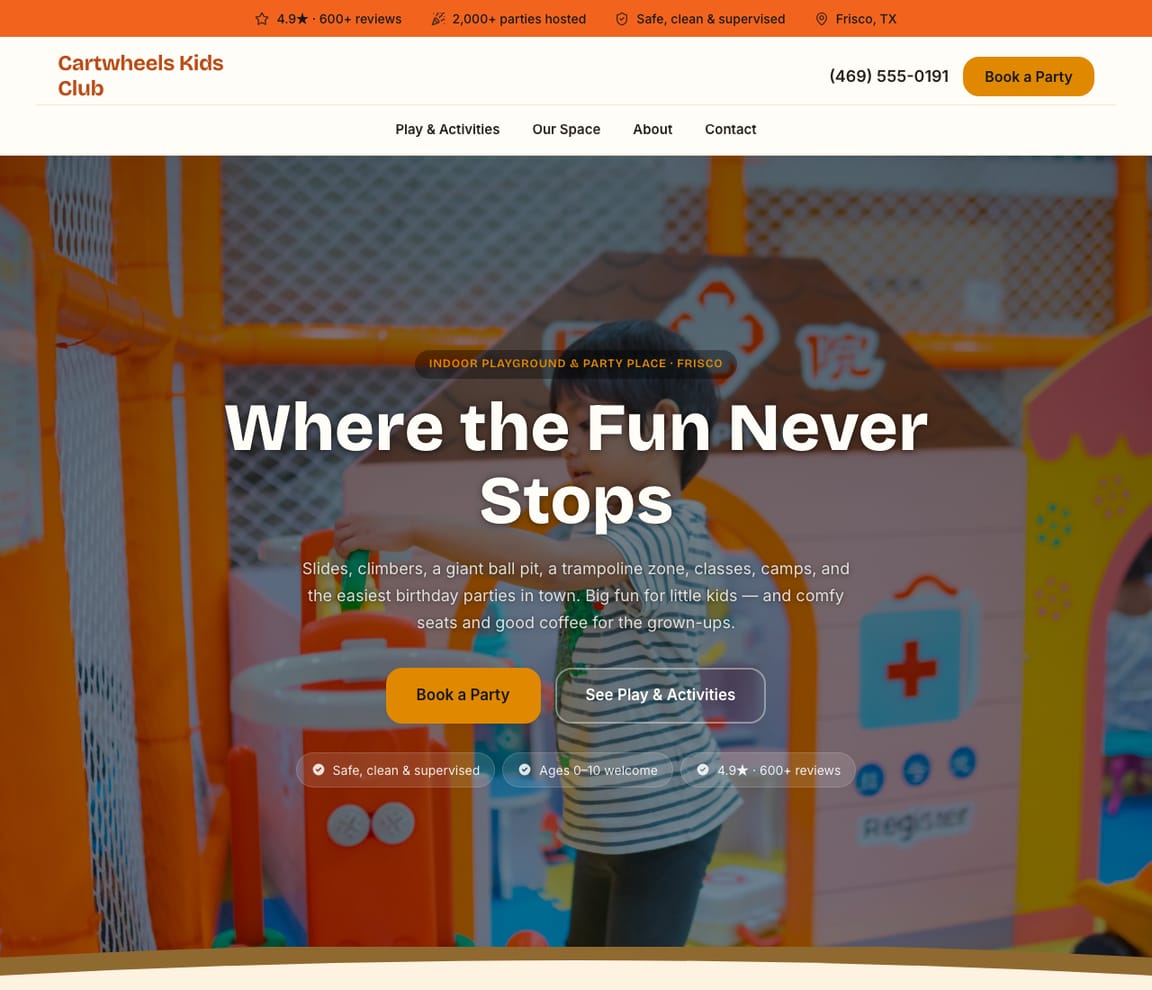
A real Zarla template from the kids activities gallery — a full-bleed playground hero, a birthday-party section up front, a play-space gallery, a why-us section, an easy-parties section and a plan-a-visit form. Describe yours — the play street, the toddler corner, the cafe, the city — and you'll have a site like this, with your prices and your session times, in about a minute.
- Professional design — not a generic template
- Looks great on desktop and mobile
- Content written for your industry
Build the website
Start your indoor playground website now
Add your city and your playground's name to the sentence, and Zarla builds the site: the open-play times and prices, the party packages, a booking form and your story. Add your memberships, the sock rule and the cafe menu in chat, then publish.
Already have a website? Bring it across →Zarla keeps your old page addresses where it can and redirects the ones that change, helping you keep the Google standing you've built.
Is opening an indoor playground worth it in 2026 — and what do indoor playground owners make?
The indoor playground one owner can open is a play cafe for children from crawling to about ten — a pretend-play street of little shops or a soft-play frame, a toddler corner, and a coffee counter where the grown-ups sit within sight of their children — paid for at the door, by monthly members and by birthday parties in a private room. The equipment is the smaller number; the room, the build-out the building code asks for, the rent and the weekday mornings are the big ones. What the employed versions earn: "Workers on average earn $48,560." for first-line supervisors of entertainment and recreation workers — $23.34 an hour, the owner-operator's employed equivalent (O*NET, 2025); "Workers on average earn $32,150." for amusement and recreation attendants — $15.46 an hour, the front desk and the floor (O*NET, 2025); "Workers on average earn $36,560." for recreation workers — $17.58 an hour, the party host (O*NET, 2025); and, only if you run licensed drop-off care, "Workers on average earn $34,980." for childcare workers (O*NET, 2025). What the franchisors print — revenue, not profit: Romp n' Roll, a kids' gym with classes and open play, prints "Avg. unit revenue" "$360,309" — "Based on total gross revenue of Romp n' Roll as per our current FDD. See item 19 of the Romp n' Roll FDD." (Romp n' Roll, the franchisor's page, 2026); Urban Air, an adventure park and a much bigger build, prints "$5.2M Average Park Volume 2.5 Park*" and "$4.6M Average Park Volume 2.0 Park*" — the asterisk's footnote did not show on the page (Urban Air, the franchisor's page, 2026). No page read for this guide prints an independent playground's revenue or profit.
What the owners say (all quoted and linked below): a Flower Mound, Texas owner who now hosts "more than 20 birthday parties a month" and did it "without taking out a bank loan or a personal loan"; a California owner who "used everything we had saved"; a Toledo co-owner for whom "Every dollar matters, especially in the early stages."; a Tifton, Georgia owner who opened in early 2025 and announced her close in May 2026. Our arithmetic on the pages that open: at the national shopping-center asking rent, 2,500 square feet costs $5,379.17 a month — 283.1 visits at $19, so 284 paid visits a month, about 9.5 a day, or 10 parties at $549, before payroll, insurance and the cafe's costs. A party is the better hour: $549 for ten children is $54.90 a child against $20 for a session of open play, about 2.7 times the take. A $78 monthly membership pays for itself at 3.9 visits of $20. An attendant at the $15.46 median costs 0.81 of one $19 admission an hour; a two-hour party with one host at $17.58 is $35.16 of a $549 package. Worth it? Where the weekday mornings, the members and the weekend parties together cover the rent — the owners who lasted watched all three, and the rent most of all.
How to open an indoor playground, in plain English
The structure and its standard — and the handbook that leaves soft play out. In the US no federal law certifies a soft-play frame. The industry standard is ASTM F1918: "This safety performance specification provides safety and performance standards for soft contained play equipment.", for users from "the 5th percentile 2 year old" "to the 95th percentile 12 year old."; "Public playground equipment, home playground equipment, sports equipment, amusement rides," "toys and juvenile products are not included in this specification." The standard costs $104.00 to buy, and you don't need to buy it — ask the maker for its written statement that the structure is built to F1918 and for the test report behind it (ASTM F1918-21, updated September 3, 2021). The toddler corner has its own: "the 5th percentile 6 month old through the 95th percentile 23 month old", and its exclusions name "soft contained play equipment" (ASTM F2373-24, January 16, 2025, $113.00); a conventional post-and-deck climber is F1487, which also says "soft contained play equipment are not included in this specification." (ASTM F1487, the store page, June 2025). The federal handbook page one never quotes says the same about itself: "These guidelines are not intended for amusement park equipment, sports or fitness equipment normally intended for users over the age of 12 years, soft contained play equipment, constant air inflatable play devices for home use," — and "Child care facilities, especially indoor, should refer to ASTM F2373". It does reach a climber, a slide or a toddler piece you set up indoors: "Concrete, asphalt, or other hard surfaces should never be directly under playground equipment." and "Carpeting and mats are also not appropriate unless they are tested to and comply with ASTM F1292." Its standing advice: "Some states and local jurisdictions may require compliance with this handbook and/or ASTM voluntary standards." and "risk managers, insurance companies, or others may require compliance at a particular site;" (CPSC, Public Playground Safety Handbook, December 2015). A maker's list of standards is a claim, not a test: one overseas maker lists "Certificates for USA - ASTM F1487, ASTM F1918, ASTM F2970." among others (Angel Playground, a maker's page, 2026) — ask for the report. This guide explains the standard; it certifies nothing.
The building — the 50-person line, the occupant load, the sprinklers. The model building code's own site refused our reader, so these lines are California's 2025 adoption of it, on a third-party code site: "Assembly Group A occupancy includes, among others, the use of a building or structure, or a portion thereof," "for the gathering of persons for purposes such as civic, social or religious functions;"; "A building or tenant space used for assembly purposes with an occupant load of less than 50 persons" "shall be classified as a Group B occupancy."; and "Group A-3 occupancy includes assembly uses intended for worship, recreation or amusement" — the list names "Amusement arcades" and "Gymnasiums (without spectator seating)", not playgrounds, so the class is the building official's call (2025 California Building Code §303, a code site updated October 24, 2026). The occupant load is floor area divided by a factor: "Unconcentrated (tables and chairs)" "15 net" square feet a person, "Exercise rooms" "50 gross" (2025 California Building Code, Table 1004.5) — 2,500 square feet is about 167 people at the first and 50 at the second, our arithmetic, and the factor the official picks decides the exits and the restrooms. Sprinklers are required where "The fire area exceeds 12,000 square feet (1115 m[2])." or "The fire area has an occupant load of 300 or more." (2025 California Building Code §903.2.1.3) — a ground-floor play cafe usually sits under both; a 10,000-square-foot warehouse build at 15 square feet a person is 667 people, over the line. Accessibility: "Play areas for children ages 2 and over shall comply with 240.", ground-level play components — "at least one of each type shall be on an accessible route." — and elevated ones "at least 50 percent shall be on an accessible route"; but "Amusement attractions shall not be required to comply with 240." — which side a soft-play frame falls on, the page doesn't say, so ask your designer how the layout meets §240 (2010 ADA Standards for Accessible Design). Your own state and city adopt their own code edition — ask the building department before you sign a lease.
The ride law — a bounce house is a ride in Texas and exempt by name in three other states. Texas: an "Amusement ride" is "a mechanical device that carries passengers along, around, or over a fixed or restricted course", and the term excludes "nonmechanized playground equipment, including a swing, seesaw, stationary spring-mounted animal feature," "rider-propelled merry-go-round, climber, playground slide, trampoline, and physical fitness device;" (Tex. Occ. Code §2151.002). The Texas Department of Insurance's list of rides includes "continuous air-flow inflatable rides or devices (bounce houses, inflatable slides), and various simulators." and "rock climbing walls"; "TDI doesn't inspect rides. Amusement rides are inspected by the ride owner's insurance company."; "continuous air flow inflatables (Class B Rides) require limits of liability of $1,000,000 per occurrence."; "Owners and operators must pay a filing fee of $40 per ride." and "An amusement ride compliance sticker is valid for one year from the date of inspection." (TDI, Amusement ride FAQ, March 2025); "you'll need to hire an inspector that your insurance company approves." (TDI, Amusement ride requirements, July 2026). Florida runs the other way: its ride law "does not apply to:" "mechanical bulls; inflatable rides; trampolines; ball crawls; exercise equipment;" — while "Nonmotorized playground equipment that is not required to have a manager." is only half-exempt, "but may be inspected by the department" "upon request following a complaint or pursuant to an accident"; a covered ride needs "at least $1 million per occurrence" of insurance (Fla. Stat. §616.242). New York's article covers "amusement devices, viewing stands and tents at carnivals, fairs and amusement parks" "where an admission or fee is customarily or usually charged" (N.Y. Labor Law §870-b), and an "Amusement device" is "any contrivance that carries and conveys passengers along, around or over a fixed or restricted course" (N.Y. Labor Law §870-c) — no playground or inflatable exclusion is written there, so ask the Department of Labor before you buy an inflatable. Where a device is covered: "$100 application fee, per device paid online through MPWR.", "One Million Dollar minimum occurrence based coverage", filed "annually, at least 10 days before the ride's first use." (NYS DOL, Amusement Device Permitting), with "Proof of Liability, Workers' Compensation and Disability Insurance." (NYS DOL, P217 guide, 2017); in New York City rides "must be inspected by the Department of Buildings (DOB)" and "also need a license from the Department of Consumer and Worker Protection (DCWP)" (NYC Business, Permanent Amusement Ride Installation and Inspections). California's permanent-ride law "does not include slides, playground equipment, coin-operated devices or conveyances" (Cal. Labor Code §7921), and Cal/OSHA's rule "does not apply to" "bowling alleys, miniature golf courses, mechanical bulls, inflatable rides, trampolines, ball crawls, exercise equipment," (Cal. Code Regs. tit. 8, §344.5). Colorado's statute says "'amusement ride' shall not include inflatable amusement rides." (C.R.S. §8-20-1001); its rules don't apply to "Playground equipment that meets the relevant ASTM standards listed in section 1.4.1 of the U.S." "Consumer Product Safety Commission's Public Playground Handbook" (7 CCR 1101-12 §1-4, August 2024) — the handbook's list names F1918, so in Colorado the maker's F1918 statement is the paper that keeps a soft-play frame out of the ride program — and they define a "TRAMPOLINE COURT OR TC" as "A defined area comprising one or more institutional trampolines or a series of institutional trampolines." (7 CCR 1101-12 §1-6, August 2024); the program's own pages refused our reader, so its fee and insurance minimum go unprinted here. A trampoline park is a different and much bigger build with its own rules — Colorado regulates trampoline courts that Texas, Florida and California leave out of their ride laws — and this guide doesn't cover it.
The child-care line — the parent supervises, or you may need a license. Open play where the parent supervises their own child isn't child care on our reading of the five states' rules — New York's definition says so outright, the others by exemption or implication; staff watching children while parents leave can be. Texas exempts a "Program with Parents on the Premises" only where "The program operates in association with a shopping center, business, or other elective activity", "The program does not advertise as a child care operation and informs parents it is not regulated by the state.", "The parent or person responsible for the child attends or engages in the elective activity nearby." and the caregivers can reach the parent "at all times." — capped at "four and one-half hours per day and 12 hours a week." (Texas HHSC, Licensing Policy Handbook §2331, July 2025). Florida goes furthest: ""Drop-in child care" means child care provided occasionally in a child care facility in a shopping mall" "or business establishment where a child is in care for no more than a 4-hour period" "and the parent remains on the premises of the shopping mall or business establishment at all times." — and "Drop-in child care arrangements shall meet all requirements for a child care facility unless specifically exempted." (Fla. Stat. §402.302). New York's line is the definition itself: "Child day care" is care "for less than twenty-four hours per day by someone other than:" "the parent, step-parent, guardian, or relative within the third degree of consanguinity" (N.Y. Soc. Serv. Law §390) — a regular drop-off program is child day care unless an exclusion fits; ask the state's Office of Children and Family Services. California exempts temporary care only where "The services are only provided to parents and guardians who are on the same premises" and "The child daycare program is not operated on the site of a ski facility, shopping mall, department store," (Cal. Health & Safety Code §1596.792) — a play cafe in a mall can't lean on it. Colorado exempts care at a business "during short periods of time while parents" are "shopping, patronizing, or working on the premises", where "'short periods of time' means fewer than three hours in any twenty-four-hour period." (C.R.S. §26.5-5-304). A parents'-night-out or a drop-off class is child care to ask about first — the license itself is its own business, covered in how to start a daycare.
The admission tax — the ticket is taxed in three of the five states. Texas: "Sales tax is due on the sale of an admission to an amusement service" where the service is in Texas, amusement meaning "Entertainment, recreation, sport, pastime, diversion, or enjoyment that is a pleasurable occupation of the senses." — the rule carries its own list of exemptions and of services that aren't amusements, and none of them reads as a for-profit playground's open play (34 Tex. Admin. Code §3.298); the Comptroller's list of amusement services runs to "carnivals, country clubs, amusement parks and other similar events and venues" (Texas Comptroller, Pub. 96-259, January 2026). The rule doesn't name playgrounds or birthday parties, so ask the Comptroller how to split a package that bundles play and food. Florida: admissions include "season pass charges, cover charges, greens fees, participation fees, entrance fees," (Fla. Stat. §212.02), taxed "at the rate of 6 percent of sales price," and "Each ticket must show on its face the actual sales price of the admission," or the price must be posted where it's charged (Fla. Stat. §212.04; Florida DOR, GT-300015) — the open-play fee, the membership and the season pass. New York names the trade: "Examples of taxable admission charges include, but are not limited to, admission charges to:" "museums, zoos, and aquariums;" "play centers for children;" (NYS Tax Department, TB-ST-8). California is the inversion: "separate charges solely for admission or for a ticket to a place furnishing" "entertainment are not subject to tax." (CDTFA, Publication 22, January 2025) — but "Tax applies to sales of food products when sold within, and for consumption within," "a place the entrance to which is subject to an admission charge," (CDTFA, Regulation 1603), so charging at the door can make the cafe's cold drinks and snacks taxable; whether a per-child play fee is an "admission charge" or a charge to use the equipment, ask the CDTFA in writing. Colorado: "Sales of services are generally not subject to Colorado sales tax." (Colorado Department of Revenue, Sales Tax Guide, May 2026), while the cafe's counter is — tax applies "Upon the amount paid for food or drink served or furnished in or by restaurants, cafes, lunch counters," (C.R.S. §39-26-104); home-rule cities set their own tax bases.
The cafe counter — a food permit like any other. Texas: where no city or county permits food, the state does — "$258", "$515" or "$773" by food sales; a business "Inspected and permitted by a City, County or Public Health District;" is exempt from the state's (Texas DSHS, retail food permits). Austin's schedule — "This fee schedule is effective November 1, 2026." — prices "Risk 1C" at "$309", the lowest fee on the schedule, plan review for new construction at "$312" and the "Pre-Opening Inspection" at "$178": $799 in the first year, our arithmetic; a coffee-and-snacks counter's class is the health department's call (Austin Public Health, Permit Fee Schedule, November 2026); "all food employees shall successfully complete an accredited food handler training course, within 30 days of employment." (Texas DSHS, Food Handler FAQ). Florida licenses food service at the state: "$242" for a permanent non-seating counter, "$262" for 1–49 seats (Fla. Admin. Code R. 61C-1.008, 2023); "Managers have a period of 30 days after employment to pass the required test." (Fla. Stat. §509.039) and "Food service employees must receive certification within 60 days after employment." (Fla. Stat. §509.049). New York City: "The permit fee for most food service establishments in New York City is $280.00" (NYC Business, Food Service Establishment Permit); "The online course is free." and "The final exam costs $24 and must be taken in person." (NYC Business, Food Protection Certificate). Los Angeles County: plan check "$1,044.00" for up to 500 square feet, the annual permit "$319.00" at low risk or "$719.00" at moderate — $1,363 to $1,763 in the first year, our arithmetic (LA County Environmental Health, FY 2026-2027 fee schedule); a California food handler "shall obtain a food handler card within 30 days after the date of hire", the course costing "no more than fifteen dollars ($15)" (Cal. Health & Safety Code §113948). Colorado's statute sets "$385" for up to 100 seats, a "$100" plan-review application and a review fee that "shall not exceed five hundred eighty dollars." (C.R.S. §25-4-1607, current through Fall 2025) — the 2026 fees under the state's newer law weren't on a page that opened, so ask your county. The espresso machine and the coffee menu are their own subject — how to start a coffee shop.
The entity, the permit to collect tax, the card fees. Texas: "for filing a certificate of formation, $300;" (Tex. Bus. Orgs. Code §4.152); "There is no fee for the permit, but you may be required to post a security bond." (Texas Comptroller, permit FAQ). Florida: "For filing original articles of organization or articles of revocation of dissolution, $100." plus "$25" for the registered agent and "$50" for each annual report (Fla. Stat. §605.0213). New York: "two hundred dollars" (N.Y. LLC Law §1101) and the notice "published once in each week for six successive weeks, in two newspapers of the county." (N.Y. LLC Law §206); register for sales tax "at least 20 days before you begin business." (NYS Tax Department, TB-ST-360). California: "Seventy dollars ($70)" and "Twenty dollars ($20)," (Cal. Gov. Code §12190), "a minimum franchise tax of eight hundred dollars ($800)." (Cal. Rev. & Tax. Code §23153); "Is there a fee charged for a seller's permit?" — "No." (CDTFA). Colorado: "Articles of Organization" "$50.00" (Colorado Secretary of State, fee schedule revised July 1, 2024); the sales-tax license, "a fee of sixteen dollars" "together with an additional fifty-dollar deposit." (C.R.S. §39-26-103). Our arithmetic for the first year's government fees with the cafe permit: $1,099 in Austin, $387 in Florida with seats, $504 in New York City before the newspaper notice, $2,253 in Los Angeles County at low risk, $66 in Colorado plus the $50 deposit before the food license. "You never have to pay a fee for an EIN." (IRS). Cards: "2.6% + 15¢" in person (Square) — $0.64 on a $19 admission and $14.42 on a $549 party, our arithmetic; "Standard card payments are 2.9% + 0.30 USD in the US" (Stripe) — $16.22 on the same party booked online.
The franchise door — almost nothing is printed on the franchisors' own pages. "The Rule requires franchisors to provide all potential franchisees with a disclosure document containing 23 specific items" (FTC, Franchise Rule), handed over "at least 14 calendar-days before the prospective franchisee signs a binding agreement with, or makes any payment to," the franchisor (16 CFR §436.2) — ask for it; the fee and the costs are in it. Romp n' Roll prints its revenue figure above and no fee (Romp n' Roll, 2026). Urban Air: "$1.5M Net Worth (Assets Minus Liabilities) and $750,000 in Liquid Assets are required minimums." (Urban Air, 2026) — the scale of the bigger build. Hyper Kidz, a large indoor playground, as a third-party index reproduces its 2024 disclosure: "the estimated total initial investment for a single Hyper Kidz franchised business ranges from $751,633 to $1,800,333", an "initial franchise fee of $42,500", "leasehold improvements, which ranges from $250,000 to $900,000" and "furniture, fixtures, and equipment ($250,000 to $400,000)" (fdd.ninja, Hyper Kidz 2024 FDD, a third party's copy) — the only printed equipment figure for a big soft-play build found today. Little Land's franchise page now describes a pediatric-therapy clinic in a play-gym setting — a licensed health business of its own, not a play cafe — and prints no fee (Little Land, the franchisor's page, 2026); We Rock the Spectrum's site calls itself "THE GYM FOR ALL KIDS" and prints no franchise figures (We Rock the Spectrum Kid's Gym, 2026). The aggregators' fee figures for these brands disagree with each other, so they aren't printed here. This guide explains the rule; read the disclosure document with a franchise lawyer before you sign.
The equipment, at the makers' and dealers' own prices — and the one price nobody prints. No US soft-play maker printed a price for a commercial structure on a page that opened today; makers quote per project. What the vendors say instead, as theirs: "Startup costs typically range from $50,000 to $500,000" and "Most indoor playgrounds need at least 5,000–20,000+ square feet" (ROLLER, a booking-software vendor, June 17, 2026); "On average, costs range from $50,000 to $500,000." — the same range, word for word (Dreamland, a maker's blog, updated 2026); "A small playground (1,000 to 3,000 square feet) needs about $100,000 or more.", "$30–$150" a square foot, and to "Can I start with $50k?" — "No—this only works for small pop-ups" (Zhejiang Nannan, an overseas maker, May 5, 2026); a US maker calls its small-footprint structures "a budget-friendly option that doesn't require a lot of space." with no price (softplay.com, August 10, 2022). The pretend-play street: Little People's Cove's "Town Collection - Library, Cafe and Market Playhouse Set" at "$3,564.00" on sale, the "Town Collection Café Playhouse" "$1,336.50", the "Town Collection Library Playhouse" "$1,262.25", and a fire station, a post office and an animal hospital at "$2,489.85" each — our six-front street is $11,033.55 before freight; the listing marks its prices as including sales tax while its page data says without, so ask for a quote (Little People's Cove, playhouses). The toddler corner: a foam climber at "$618.75" on sale (Little People's Cove, Activity Play Zone), a foam ball pit with "130 polyethylene balls" at "$1,311.75" (Little People's Cove, ball pit), a "Children's Factory® Ladybug Climber" at "$999.99" and a folding gym mat at "$476.99" (Discount School Supply) — $2,930.49 for the climber, the pit and the ladybug, our arithmetic. The floor: "Indoor Playground Foam Tiles" "Approximate Cost: $3 per sq. ft." — "rated for a 4-foot fall height" (Greatmats, September 2024); general foam tiles "about $1.75 per square foot" for the cafe and toddler areas (Greatmats, May 2026) — 1,200 square feet of play floor at $3 is $3,600, our arithmetic; ask the seller for the ASTM F1292 report behind a fall-height claim. The fittings (WebstaurantStore, shoe racks; cubbies; changing stations; high chairs; folding tables; table-and-chair sets; sprayers; wipes): a shoe display at "$65.99", a three-shelf cubby unit at "$266.99", a wall-mounted changing station at "$129.99", a high chair at "$46.99", a 30" x 72" folding table at "$48.49" or a table-and-eight-chair set at "$238.49", a handheld sprayer at "$12.99" and a case of disinfecting wipes at "$31.99" — $1,302.88 for the play cafe's set, our arithmetic; no dealer page listed a fogger or a UV wand today. Check-in and booking software: ROLLER prints plans but "Contact sales." and no price (ROLLER, pricing); one waiver-software maker's plans start at "$19/mo" (WaiverForever, pricing). Owners and insurers commonly use a signed waiver; have a lawyer write yours — this guide prints none. The room: "national asking rents reaching $25.82 per square foot (psf)" (Cushman & Wakefield, shopping centers, Q3 2026) — $5,379.17 a month for 2,500 square feet and $21,516.67 for 10,000, our arithmetic; the industrial survey prints "The national industrial vacancy rate fell 20 basis points (bps) from year-end 2025 to 6.8%," but no asking rent (Cushman & Wakefield, industrial, Q3 2026) — a warehouse is cheaper by the foot, and usually a change of use to assembly. The policy: "General liability: $45 per month", "Business owner's policy: $83 per month", "Workers' compensation: $54 per month" — Insureon's averages, method not stated; a policy plus workers' comp is $137 a month, $1,644 a year, our arithmetic (Insureon, Indoor Playground Insurance, 2026). A Texas bounce house adds its own $1,000,000 policy.
The door — what real playgrounds charge. Indigo Play in Austin: "6 - 23 months" $13 and "2 - 17 years" $19 all day, "18 years & Older" $3, a "Monthly Pass" at $70 a child "with 2 free adults" or $60 on auto-pay, and "Socks required" — "Please note we do not allow shoes or bare feet past the gates – for anyone!" (Indigo Play, 2026). My Village Playhouse in Raynham, Massachusetts: "Single Child (crawling and up): $20" and "One adult included with each child admission." (My Village Playhouse, session play); "One Child: $78/month" — "Unlimited play for 1 child. Includes 2 adults." — and "Two Siblings: $148/month" (My Village Playhouse, membership); a party at "$549" — "Set up and admission for 10 children is included." and "2 hrs of Party and shared Play time for up to 10 children" — or "$699" for the "Deluxe Décor Party" (My Village Playhouse, birthday parties). Little Beans Play Café in Lincoln, Nebraska: "We charge $12 plus tax per child, beginning at 6 months to 5 years old.", "One adult is always FREE during open-play hours!", "we have non-slip socks for $3, available in all sizes." and "We have a strict capacity at 25 total people." (Little Beans Play Café, FAQ). Liberty PlayTown in Spring Lake, North Carolina: "$15.75 for ages 0-7.", "$5 for each additional child after one full priced admission." and socks at "$2 a pair." (Liberty PlayTown, open play). Play N' Learn in Chantilly, Virginia: "$10 per child (12 months and up)" and "NO, PARENTS MUST STAY WITH THE KIDS. ADULT SUPERVISION IS REQUIRED." — the parent-on-premises model in one line (Play N' Learn, Chantilly). A Tampa parenting magazine lists "$15.95 weekday drop-ins (all-day)" at one play cafe and "$20-22 for 90-minute sessions" at another (Tampa Bay Parenting, November 2025, updated March 2026). So open play runs $10 to $20 a child on the five playgrounds' own pages, grown-ups go free or pay $3 to $5, and an unlimited month for one child is $60 to $78.
In the UK: "Businesses have to register for VAT if their VAT taxable turnover is more than £90,000." (GOV.UK); admission to soft play is standard-rated at 20% again — a temporary 5% rate for soft-play venues, indoor bounce parks and indoor play facilities ran only "from 25 June 2026 to 1 September 2026 (inclusive)." (HMRC, Revenue and Customs Brief 5 (2026), July 2026), and the cultural exemption covers "Only admission charges to museums, galleries, art exhibitions and zoos" and cultural performances, not play (GOV.UK, VAT Notice 701/47, June 2026); "Health and safety law applies to the supply, hire and use of inflatables for commercial purposes." — with "a numbered PIPA tag or an ADIPs declaration of compliance (DoC)" and "an annual inspection" "by a competent person." (HSE, Inflatables, June 2026); soft-play equipment and the surfacing under it go to the British standards BS EN 1176 and BS EN 1177; and the cafe must "register at least 28 days before trading." (GOV.UK, Register a food business). In Australia: "It's free to register for an ABN" (business.gov.au); register for GST at "a GST turnover of $75,000 or more" (business.gov.au); in New South Wales, devices that don't need registration include "inflatable devices, other than inflatable devices (continuously blown) with a platform height of 3 meters or more" (SafeWork NSW, Amusement devices); the play-equipment standard is AS 4685; and "You need to notify your local council if your business sells or serves food directly to consumers." (Service NSW, 2024). Whether admission is GST-free wasn't on a page that opened — ask the ATO. Fees, thresholds, the ride rules and what is taxed change every year — confirm your own state's rule with your accountant before the first ticket, and check your local building department and health department before you sign a lease.
What indoor playground owners actually say
None of this is our opinion about running an indoor playground. It comes from play-cafe and indoor-playground owners in Texas, California, Florida, Ohio, Indiana, Kansas, Missouri, Arkansas, Georgia and Wisconsin — one owns a franchised store and two rent soft play out for parties, and say so below — talking to the Voyage magazines, CanvasRebel, local papers, TV stations and a city newsletter between 2017 and 2026, each described as the page describes them. Read each as theirs at the time. Five things come up again and again.
Why they opened. Kevin and Kristina Lai, The Busy Bee Play Café, Indianapolis: “As soon as we started having our own kids, we were trying to find things for them to do,” — and Kristina: “It's an indoor playground and coffee shop. So we got something for the kids and something for the adults,” (WRTV, January 31, 2024). Abi Gilman, Little Village Play Cafe, Wauwatosa, Wisconsin: “I just wanted a space where my kid could go and play, and where I could also spend time with a parent or another friend.” (CBS 58, March 13, 2023). Kristi Stanton, The Perfect Playdate, Houston: “I wondered why there wasn't a place that was designed for both.” (VoyageHouston, May 17, 2017). Shavonne Mann, Little Explorers Play Room, Kansas City, Missouri, after her daughter's first birthday: “I thought, 'I want to open a place where I can do this for people. To make it fun and easy.'” (Martin City Telegraph, September 4, 2024). Biliah Muhammad, Fresh Play Cafe, Cabot, Arkansas: “The ideal really came from being a mom with little ones,” (KATV, August 3, 2026). Jennalee Keys, Noah's PlayGrounds Play Cafe, Tifton, Georgia: “I have a large family. I have seven kids, and I just love kids.” (WALB, January 31, 2025). Jonathan and Va'Jeanne Moore, InnerActive Playhouse, Keller, Texas: “While living in Georgia, my husband and I always wanted to open an Indoor Playground.” (VoyageDallas, September 20, 2017). LaChasity Cloud, CJ's Play Corner, Azle, Texas: “CJ's Play Corner started from my personal experience as a mom to an energetic two-year-old.” (VoyageDallas, October 9, 2025). Corey Lockett, Jungle Castle, Flower Mound, Texas: “Jungle Castle was the very first indoor play place we ever visited—and it quickly became a favorite.” (VoyageDallas, January 8, 2026). Maggie Ochoa, Coastal Kids Playspace, Long Beach, California: “Coastal Kids Playspace was created to fill a gap I noticed in our Long Beach community” (VoyageLA, June 17, 2025). Ana Salmanyan, Kids Play Cafe, Fresno: “Sometimes us moms are at home and we get so wrapped up in the routine of our days that we forget, we also need friends,” (ABC30 Fresno, March 2, 2019). Emelin Rodríguez, a mobile soft-play rental owner — PlayroomTX, Dallas–Fort Worth: “PlayroomTX was inspired by my niece's first birthday.” (VoyageDallas, April 29, 2026). Eilis Zheng, a franchise owner — Play Street Museum Katy, Texas: “we saw a need for a place where parents and caregivers could take their kiddos to use their imaginations” (VoyageHouston, September 30, 2025).
“We now host more than 20 birthday parties a month, and overall admissions have increased beyond what they were in 2024.” — Corey Lockett, Jungle Castle, Flower Mound, Texas, in VoyageDallas, January 8, 2026
The first year and the money. Shastina Troup, Haven Play Lounge & Café, who moved to Scotts Valley, California: “We used everything we had saved to fund this venture ourselves.” and “It took a lot of trial and error, many late nights, and constant planning and saving” (CanvasRebel, November 12, 2025). Corey Lockett: “I did it without taking out a bank loan or a personal loan, a decision I'm incredibly proud of.” and “I keep my prices low and affordable for guest when they visit.” [sic] (VoyageDallas, January 8, 2026). Dustin Brooks, co-owner, Kidnetic Play Cafe, Toledo, Ohio: “Kidnetic Play Cafe is our first business, and when we started, there wasn't a roadmap to follow.” and “Every dollar matters, especially in the early stages.” (City of Toledo, August 17, 2026). Jennalee Keys, announcing the close in May 2026 for what the station reports as personal reasons: “You just have to think ahead, know your bills, know your budget, and keep asking what people are going to like.” (WALB, May 13, 2026). Emelin Rodríguez: “One of the main obstacles we faced was the lack of specific knowledge about this type of business.” — the equipment, “we realized it was much larger and more complex than we had anticipated” “which even led us to buy a van to be able to transport it.” (VoyageDallas, April 29, 2026). Uma Modi, Jungle Land, Prosper, Texas, whose interview prints "14.99 for unlimited open play", a "$349 Simple Happy Private Birthday Party" and a "$599 To Be Special All inclusive Private Birthday Party" (VoyageDallas, October 16, 2025); and on her newer Prosper Playhouse: “it's been more of a fast learning curve than a smooth road” (VoyageDallas, May 27, 2026). Ana Salmanyan: “Most of the time it is a struggle.” (ABC30 Fresno, March 2, 2019). The Moores, a year in: “Over the last year we have had a phenomenal ride seeing the smiles on kids' faces.” (VoyageDallas, September 20, 2017).
The lease, the build-out, the equipment and the inspectors. Maggie Ochoa: “I would say the primary challenge was finding, negotiating, and securing the lease for our commercial space.”, “Our construction team themselves were very quick, but the process of plan checks and inspections delayed us significantly.” and “Our space offers children a tiny town of 4 play houses (fire station, market, tool shed, and surf shack)” (VoyageLA, June 17, 2025). Shanel Shotomiwa, Kidz Krazy World, Katy, Texas: “It took us 6 months to find a building, then the play equipment and the contractors were also a struggle.” (VoyageHouston, January 3, 2018). LaChasity Cloud: “Our equipment was imported from overseas” — and a specialist came in “to help ensure everything was properly assembled to standard.” (VoyageDallas, October 9, 2025). Corey Lockett: “Other available spaces required extensive cosmetic renovations that made them financially unrealistic.” (VoyageDallas, January 8, 2026). Dustin Brooks: “Bringing a former community landmark back to life required significant planning, problem-solving and hands-on work.” (City of Toledo, August 17, 2026). Kevin Lai: “The way we've designed the space is to allow for a line of sight pretty much everywhere for the parents” (WRTV, January 31, 2024). The Moores: “It's a 5,000 square foot indoor playground designed specifically to keep your children happy for hours.” (VoyageDallas, September 20, 2017). Shavonne Mann: “We are creating a safe space here.” (Martin City Telegraph, September 4, 2024).
The families, the parties and getting the word out. Kristina Lai: “We had a ton of survey responses early on to help shape this idea.” (WRTV, January 31, 2024). Kristi Stanton: “We do customized birthday parties for kids that go above and beyond the typical one size fits all type birthday.” (VoyageHouston, May 17, 2017). Corey Lockett: “I listened closely to feedback and critiques, especially regarding open play and birthday parties.” (VoyageDallas, January 8, 2026). Maci Lee, a soft-play party-rental owner — Jumping Tots DFW, Dallas: “We've been consistently busy, especially on weekends, often managing multiple events in a single day.” (VoyageDallas, May 6, 2026). The Moores, on the hard part: “making people aware of a new and exciting indoor playground in their area.” (VoyageDallas, September 20, 2017). Eilis Zheng: “Building awareness for a niche concept like a children's museum can be tough, especially when a place is new.” (VoyageHouston, September 30, 2025). Natasha Cook, Fresh Play Cafe: “They can play independently, where you don't have to jump up every five seconds.” (KATV, August 3, 2026). Christina Joiner, Bright Side Play, Southlake, Texas: “We wanted to give moms, dad and caregivers a chance to interact.” (Community Impact, February 20, 2024). Bianca Sisillo-DeFries, Inspired Play Cafe, Overland Park and Merriam, Kansas: “We really make it a point here to have a lot of opportunities, because everyone's schedules are different,” (Johnson County Post, November 22, 2024). Abi Gilman: “You can come and go. You don't need to make any reservations ahead of time.” (CBS 58, March 13, 2023). Connie Valdes, Explorico Indoor Playground, Miami: “we are known for hosting beautiful events and thoughtfully curated birthday parties.” (VoyageMIA, February 12, 2026).
The cleaning, the staff, the owner and the long days. Uma Modi: “We go above and beyond industry standards with regular sanitization and deep cleaning routines.” (VoyageDallas, October 16, 2025); her Prosper Playhouse offers "supervised party hosting, so caregivers can work or relax while kids play" — the kind of offer to check against your state's child-care line above (VoyageDallas, May 27, 2026). LaChasity Cloud's staff “sanitize throughout the day, and conduct deep cleaning every Sunday.”, and: “It definitely hasn't been a smooth road, but the challenges have made the journey even more rewarding.” (VoyageDallas, October 9, 2025). Kristi Stanton: “The biggest stroke of luck I've had in this business is finding our managers Jerrica and Jerry.” and “There are always hurdles that get thrown in front of you that you have to figure out as you go.” (VoyageHouston, May 17, 2017). The Moores: “We owe a lot of our success to our wonderful staff.” (VoyageDallas, September 20, 2017). Shastina Troup: “Starting your life and your business over multiple times is incredibly difficult” (CanvasRebel, November 12, 2025). Shanel Shotomiwa: “You know business is tough and one must be prepared for the highs and lows.” (VoyageHouston, January 3, 2018). Corey Lockett: “I made mistakes and kept learning from them to get better.” (VoyageDallas, January 8, 2026). Connie Valdes: “learning how to best collaborate and communicate has been what we are working on.” (VoyageMIA, February 12, 2026).
THE STARTER KIT
What you need to open an indoor playground
The structure, and its test report
No federal law certifies a soft-play frame; the standard it is built to is ASTM F1918, toddler pieces ASTM F2373. Ask the maker for its written statement and the test report behind it — in Colorado, meeting the ASTM standard is what keeps playground equipment out of the state's ride rules.
The building's occupancy
A room for 50 or more people is an assembly use under the building code family; the official decides the occupant load, the exits and the restrooms, and sprinklers follow above 12,000 square feet or 300 people. The change of use is the line no page prices.
The play street and the toddler corner
Pretend-play houses from $1,262.25 each, a three-front town set at $3,564.00; a toddler climber at $618.75, a foam ball pit at $1,311.75 — dealers' printed prices, before freight. A commercial soft-play frame is quoted per project.
The floor, the cubbies and the socks
Indoor playground foam tiles at about $3 a square foot, a shoe display at $65.99, a cubby unit at $266.99, and grip socks to sell at the desk for $2 or $3 a pair — four of the five playgrounds' own pages read for this guide print a sock rule.
The cafe's food permit
The coffee counter is a food business: $799 in Austin's first year at the lowest-fee class, $280 in New York City, $262 for Florida's state license with seats — plus food handler cards for whoever pours.
The policy, the card fees, the ride rules
Insureon's indoor-playground averages: $83 a month for a business owner's policy, $54 for workers' comp. Square takes 2.6% + 15¢ in person. A blower-fed bounce house in Texas needs its own $1,000,000-per-occurrence policy.
THE PAPERWORK
Permits, standards and registrations for a new indoor playground
| Typical cost | Time to get | Legally required? | |
|---|---|---|---|
| The maker's ASTM F1918 statement and test report (soft play) | Free from the maker — the standard itself is $104.00 | Before the order | No federal law requires it; Colorado exempts playground equipment from its ride rules only if it meets the ASTM standards; insurers ask |
| Toddler pieces to ASTM F2373; a floor tested to ASTM F1292 | Ask the dealer for the reports | Before the order | The CPSC handbook is guidance, not a rule; some states, cities and insurers require it |
| Occupancy approval and change of use (assembly at 50+ people) | Not printed — the building department's fees and the build-out | Before you open | Yes — the building official classes the room and sets the occupant load |
| Sprinklers | Not priced on any page read | With the build-out | Yes in the 2025 California code above 12,000 sq ft or 300 people in an A-3 fire area |
| State ride registration for an inflatable or a powered ride | $40 a ride TX; $100 a device NY | Yearly; NY at least 10 days before first use | Yes for blower-fed inflatables in Texas; no for inflatables in Florida, California and Colorado; ask the NY DOL |
| Ride liability insurance | $1,000,000 per occurrence TX inflatables; $1 million NY and FL rides | With the registration | Yes where the device is a ride; plus an insurer-approved inspection in Texas |
| Child-care license (if staff watch children) | The state's own fees — not needed where each parent supervises their own child, on our reading | Months | Yes for drop-off care unless an exemption fits: Florida licenses drop-in care; Texas caps parents-on-site care at 4½ hours a day; Colorado under 3 hours |
| The cafe's food permit | $799 first year Austin; $280 NYC; $242–$262 Florida; $1,363–$1,763 LA County | After the plan review | Yes |
| Food handler cards and a certified manager | Up to $15 each in California; NYC exam $24 | 30 days TX and CA; 60 days FL | Yes in Texas, Florida and California; a NYC supervisor needs the certificate |
| Sales-tax permit (admission is taxed in TX, FL and NY) | Free TX, CA; $16 + $50 deposit CO | 20 days before opening NY | Yes in all five states read — for the admission where it's taxed and for the cafe |
| The entity (LLC) | $300 TX; $125 FL + $50/yr report; $200 + publication NY; $70 + $20 + $800/yr CA; $50 CO | Days to weeks | No — a sole proprietor may trade; the LLC is a liability choice |
| EIN | Free | Minutes | Needed to hire and for the entity; free from the IRS — never pay a site |
| A franchise's disclosure document | Free from the franchisor | At least 14 calendar days before you sign or pay | Yes under the FTC's rule — the fee and the costs are in it |
| Insurance | About $83/mo BOP; $45/mo liability; $54/mo workers' comp | Days | Not by law outside the ride rules; landlords ask; workers' comp by state once there's staff |
| ADA play-area rules (2010 Standards §240) | Your designer's layout | Before the build-out | Yes for play areas for children 2 and over; amusement attractions are excepted — ask your designer |
THE STEPS
How to open an indoor playground (step by step)
Eight steps from the playground you wished existed to a room with the occupancy signed off, the equipment's test reports on file, the ride and child-care lines checked, the admission tax collected and a page a parent can find.
01
Pick the door — a play cafe, a soft-play build, or a franchise
The play cafe is a pretend-play street and a toddler corner in a 2,000–3,000 sq ft storefront. The soft-play build takes 5,000 square feet and up and a frame quoted per project. A franchise's fee and costs are in its disclosure document.
Before the lease02
Find the space, then ask the building official
At the national shopping-center asking rent of $25.82 a square foot a year, 2,500 square feet is $5,379.17 a month. Ask the building department how it will class the room — assembly at 50 people or more — before you sign.
03
Form the entity and take the EIN
An LLC is $300 in Texas, $100 plus $25 for the registered agent in Florida, $200 plus six weeks of newspaper notice in New York, $70 plus $20 and an $800 annual tax in California, $50 in Colorado. "You never have to pay a fee for an EIN."
04
Order the equipment with its paperwork
Ask which ASTM standard each piece is built to — F1918 for soft contained play, F2373 for the toddler pieces — and for the test report, not the claim. Put a floor tested to ASTM F1292 under any climber or slide.
05
Check the ride law before the bounce house
A blower-fed inflatable is a ride in Texas — a $40 filing, an insurer-approved inspection and $1,000,000 per occurrence of cover. Florida, California and Colorado exempt inflatables by name; in New York, ask the Department of Labor.
06
Keep each parent watching their own child
Open play where each parent supervises their own child isn't child care on our reading of the five states' rules — New York's definition says it outright. Once staff watch children it can be — even with the parent in the building: Florida licenses drop-in care, Colorado's exemption stops under three hours, Texas's at 4½ hours a day.
07
Register for the admission tax and permit the cafe
The ticket at the door is taxable in Texas, Florida and New York; California doesn't tax a separate admission but can tax the cafe's cold food inside; Colorado's state tax skips services. The coffee counter needs its food permit.
08
Publish the site, then open the door
The site carries the ages, the door prices, the session times, the sock rule and the party packages with a booking form; the Google Business Profile puts the playground on the map. Owners say getting the word out was the hard part.
THE COSTS
How much does it cost to open an indoor playground?
The first two figures are this guide's two starts in Austin from the pages that open — our arithmetic, every addend printed, equipment before freight. Not in them: the build-out, sprinklers or fire upgrades, the change-of-use permit, the architect, freight and installation, the espresso machine, the deposit, insurance and software, which no page priced to a reader today — and the soft-play structure itself, which no US maker prices on a page.
$25,345.09a 2,500 sq ft play cafe — $11,033.55 pretend-play street + $2,930.49 toddler climbers and ball pit + $3,600 of foam tiles + $1,302.88 fittings + $1,099 Texas LLC and Austin food permit + $5,379.17 first month's rent
$41,918.55a 10,000 sq ft soft-play build before the structure — $21,516.67 first month's rent + $18,000 of foam tiles for 6,000 sq ft + $1,302.88 fittings + $1,099 fees
$250,000 – $400,000furniture, fixtures and equipment in Hyper Kidz's 2024 disclosure as a third party reproduces it — a franchise's figure, the only printed equipment line for a big build
$54.90a child's share of a $549 ten-child party package, against $20 for a session of open play — the party is the second engine
WHAT WE'VE LEARNED
What actually brings an indoor playground its regulars
Thousands of local business websites in, the pattern for a one-owner playground is clear: the first families come from word of mouth, and the ones who come back every week found the prices, the sessions and the party page online. Three things on that page decide it — the kids activity center template is built around them, and there are more kids activity website examples to start from.
The door prices, by age
Open play per child, what babies and grown-ups pay, and the monthly pass. The playgrounds read for this guide print $10 to $20 a child and memberships from $60 to $78 a month; a page with the prices on it is what a first visit is decided on.
The sessions, the hours and the rules
Whether it's all-day play or timed sessions, whether you book or walk in, the ages the space is for — and the sock rule, printed before the parent arrives in sandals. One owner's page says it plainly: "Socks must be worn by everyone inside the play space."
The party packages, with the dates
What a package includes, how many children, how long, and what each extra child costs. One owner hosts "more than 20 birthday parties a month"; the page that lists the packages and takes the booking fills the weekend.
THE EARNINGS
What indoor playground owners make, and what the door brings in
No wage survey has an owner's line and no page read today prints an independent playground's revenue or profit; the employed figures are O*NET's 2025 medians, the store figure is a franchisor's revenue as its own page prints it, and the door prices are the playgrounds' own.
$48,560the 2025 median for supervisors of entertainment and recreation workers, $23.34 an hour — the owner-operator's employed equivalent (O*NET)
$32,150the 2025 median for amusement and recreation attendants, $15.46 an hour — the front desk and the floor; party hosts $36,560 (O*NET)
$360,309Romp n' Roll's average unit revenue, from Item 19 of its disclosure as the franchisor's page prints it — gross revenue for a kids' gym, not profit
$10–$20open play per child on five playgrounds' own pages; an unlimited month for one child $60 to $78; a ten-child party $549 to $699
SEE IT WORK
An indoor playground website design you can start from
A real Zarla template: the play space up front, the birthday parties highlighted, a gallery of the room, a why-us section and a plan-a-visit form. Open it, swap in your photos, your prices, your party packages and your city, and publish.
GET FOUND
Get found by the parent who searched "indoor playground near me" on a rainy Tuesday
The owners say awareness was the hard part of a new playground — and the parent deciding where to go this morning asks the same questions every time: how old does my child have to be, what does it cost, is there a session now, do I book, can we have the party there. Zarla builds the website with your open-play prices, your session times, the party packages and a booking form, your story and SEO. Add your memberships, your sock rule and the cafe menu in chat, and once you connect your Google Business Profile, your Google rating shows on the site.
“Indoor playground near me”
Searched by the parent with a toddler and a wet afternoon, the grandparent on a visit and the parent planning a fourth birthday. The ages, the prices and the next session answer it before they get in the car.
Google Business Profile
Your playground, your hours and your door inside Google Maps — with the booking link and the party page on it. Free, and an afternoon to set up.
The ages, the prices and the party dates
A playground is chosen on three things: is it right for my child's age, what does a visit cost, and is the Saturday free for a party. Printed plainly, with the sock rule, they answer the phone for you.
Google Search
Ppuddlelaneplaycafe.com
Puddle Lane Play Cafe — Trusted indoor playground in Your AreaIndoor play cafe for kids from crawling to age eight — a pretend-play street, a toddler zone and coffee for grown-ups. Open play, memberships and private birthday parties in Columbus.← Your Zarla siteCcityindoorplaygroundservices.com
City indoor playground ServicesGoogle Maps
1
Puddle Lane Play Cafe
← You2
Metro indoor playground Co.
3
Quick indoor playground Services
AI assistants (ChatGPT / Perplexity)
For a Columbus play cafe with a pretend-play street, a toddler corner, a coffee counter for parents and private birthday parties in your area: Puddle Lane Play Cafe — an indoor playground and play cafe whose site lists open-play prices by age, the session times, the sock rule and its party packages, with an online booking form.
An example with a made-up business and illustrative figures. Yours will show your real details and reviews.
YOUR LAUNCH PLAN
Your indoor playground launch checklist
The whole guide as things to check off. Work through them in order and you'll be permitted, insured, taxed right and findable before the first family takes their shoes off.
- Pick the door — a play cafe in a storefront, a soft-play build in a bigger space, or a franchise.
- Ask the building official before the lease — the occupancy class, the occupant load, the exits, the restrooms and any sprinkler work.
- Form the entity and take the free EIN — $300 in Texas, $125 to file in Florida ($100 + $25 for the registered agent) then a $50 annual report, $200 plus publication in New York, $890 in California's first year, $50 in Colorado.
- Get each maker's ASTM statement and test report — F1918 for the soft-play frame, F2373 for toddler pieces, F1292 for the floor under climbers.
- Check the ride law for anything that inflates or moves — Texas files and inspects bounce houses; New York permits covered devices.
- Decide drop-off care before you advertise it — have each parent supervise their own child, and read your state's child-care rules before staff watch anyone's.
- Register for sales tax and permit the cafe — the admission tax where your state charges it, and the food permit for the counter.
- Publish the site and claim the Google Business Profile — the ages, the prices, the sessions, the sock rule, the party packages.
REAL CUSTOMERS
Small businesses that got online with Zarla
Verified reviews from real Zarla customers.
“Quickly built my website from scratch. No hiccups. Would highly recommend Zarla for someone with no experience who wants to start a polished business website.”
“Great professional website in less than a minute, with the use of AI and a few descriptive prompts. This has saved me bundles of time and research on web developers.”
“I had no idea how to set up a website for my business. Thanks to Zarla, they've helped me a lot.”
“Very reliable, professional, and fast results. I was able to get my business online in no time, and the ease of access made it so simple.”
Be the playground whose session times, door prices and party dates are one tap away
Add your city and your playground's name, and Zarla builds the website from that one line — open-play times and prices, the party packages, a booking form, your story and SEO in place. Add your memberships, your sock rule and the cafe menu in chat. Free to build; you pay when you publish.
Already have a website? Bring it across →Zarla keeps your old page addresses where it can and redirects the ones that change, helping you keep the Google standing you've built.
Frequently asked questions
How much does it cost to open an indoor playground?
No US maker prints a price for a commercial soft-play structure, so there are two answers from the pages that open, both in Austin and both our arithmetic. A 2,500-square-foot pretend-play cafe comes to $25,345.09: $11,033.55 for a six-front play street, $2,930.49 for the toddler climbers and ball pit, $3,600 of foam tiles, $1,302.88 of fittings, $1,099 of Texas and Austin fees and $5,379.17 for a month's rent. A 10,000-square-foot soft-play build is $41,918.55 before the structure. Neither includes the build-out, sprinklers, freight, the espresso machine or insurance. Software and equipment vendors repeat a $50,000 to $500,000 range with no line items; the one printed equipment figure for a big build is Hyper Kidz's $250,000 to $400,000, from its 2024 disclosure as a third party reproduces it.
What license do you need to open an indoor playground?
In the US there is no license for the play structure itself — no federal law certifies soft play; the standard is ASTM F1918, and you ask the maker for its written statement and test report. What you do need: the building department's occupancy approval, the food permit for the cafe counter ($799 in Austin's first year at the lowest-fee class, $280 in New York City, $242 to $262 for Florida's state license), the sales-tax permit, and the LLC and free EIN if you form one. A blower-fed bounce house is an amusement ride in Texas — a $40 filing, an insurer-approved inspection and $1,000,000 per occurrence of cover — and New York permits covered devices at $100 each; Florida, California and Colorado exempt inflatables. Staff watching children while parents leave can need a child-care license. Check your own state's rules before you sign a lease.
What is a play cafe?
A small indoor playground with a coffee counter for the grown-ups — usually a pretend-play street of little shops, a toddler corner and seats where parents sit within sight of their children. One Indianapolis owner put it as "an indoor playground and coffee shop"; a Wisconsin owner's is "a coffee shop first, with a play space attached." Each parent supervises their own child — staff watching children can be child care even with the parent in the building, in Florida outright and in Texas and Colorado past a time cap, so check your own state's rule before you offer drop-off. Open play runs $10 to $20 a child on the playgrounds' own pages read for this guide.
Are indoor playgrounds worth it?
No page read for this guide prints an independent playground's profit, so the honest answer is the arithmetic. At the national shopping-center asking rent, 2,500 square feet is $5,379.17 a month — 284 paid visits at $19, about 9.5 a day, or 10 parties at $549, before payroll, insurance and the cafe's costs. One Texas owner now hosts "more than 20 birthday parties a month"; a Georgia owner opened in early 2025 and announced her close in May 2026. It's worth it where the weekday mornings, the members and the weekend parties together cover the rent.
How much money do you need to open an indoor playground?
For a small pretend-play cafe, the equipment, a month's rent and the Austin fees alone come to $25,345.09 by our arithmetic — the floor, not the total: add the build-out, any sprinkler work, freight, the deposit and the first months of payroll. A big soft-play build is $41,918.55 before the structure, which no US maker prices on a page. The franchise figures run far higher: Hyper Kidz's 2024 disclosure, as a third party reproduces it, estimates $751,633 to $1,800,333 all in, and Urban Air asks for a $1.5M net worth and $750,000 in liquid assets.
Is opening an indoor playground a good business?
It can be a steady one where the parties carry the weekends: a $549 package for ten children is $54.90 a child against $20 for open play, and one Texas owner hosts more than 20 parties a month. The franchisor figure printed today is revenue, not profit — Romp n' Roll's $360,309 average unit revenue for a kids' gym with classes. The employed equivalent of the owner's job paid a $48,560 median in 2025, and the floor staff $15.46 an hour. The owners who lasted describe long days, careful budgets and the cleaning; one announced her close about 16 months after opening.
What permits are needed for an indoor playground?
In the US: the building department's approval for the room — an assembly use once 50 or more people can be inside, with the occupant load, exits, restrooms and, above 12,000 square feet or 300 people in the 2025 California code, sprinklers; the health department's food permit for the cafe counter; the state sales-tax permit; and, in Texas, a $40 TDI filing with an insurer-approved inspection for each blower-fed inflatable. New York permits covered amusement devices through its Department of Labor. A drop-off room can need a child-care license — Florida licenses drop-in care even with the parent in the building. Ask your building department first, and check your own state's rules.
How much does it cost to set up a kids play area?
At dealers' printed prices: a foam toddler climber at $618.75, a foam ball pit with 130 balls at $1,311.75 and a ladybug climber at $999.99 — $2,930.49 together — plus foam playground tiles at about $3 a square foot, $3,600 for 1,200 square feet. A single pretend-play house starts at $1,262.25 and a three-front town set is $3,564.00. Ask which ASTM standard each piece is built to (F2373 for the toddler pieces) and put a floor tested to ASTM F1292 under anything a child can climb.
How much does an indoor playground franchise cost?
Almost no kids' play franchisor prints it on its own page; the fee and the costs are in the disclosure document, which federal law says you get at least 14 days before you sign or pay. Hyper Kidz's 2024 disclosure, as a third party reproduces it: an initial fee of $42,500 and $751,633 to $1,800,333 all in. Urban Air asks for a $1.5M net worth and $750,000 in liquid assets. Romp n' Roll prints $360,309 of average unit revenue but no fee. Read the document with a franchise lawyer.
What is the annual income of an indoor playground?
No page read for this guide prints one for an independent playground. The franchisors print revenue for their own: Romp n' Roll $360,309 in average unit revenue for a kids' gym with classes, and Urban Air a headline $5.2M average park volume for an adventure park — a much bigger build. The rent math gives the scale: 2,500 square feet at the national asking rent is $5,379.17 a month to cover before anything else. The employed equivalent of running one paid a $48,560 median in 2025.
How do you open an indoor playground with no money?
No page read for this guide shows a way to open a fixed playground with nothing; even the small play cafe's equipment, a month's rent and fees come to $25,345.09 by our arithmetic. One overseas maker answers "Can I start with $50k?" with "No—this only works for small pop-ups". The owners started smaller: two Dallas owners rent soft play out for parties, one Texas owner opened "without taking out a bank loan or a personal loan", and a California owner "used everything we had saved".
Is a bounce house an amusement ride?
In Texas, yes: the Texas Department of Insurance lists continuous air-flow inflatables as rides, each needing a $40 filing, an insurer-approved inspection and $1,000,000 per occurrence of liability cover. Florida's ride law exempts "inflatable rides; trampolines; ball crawls", California's rule names inflatable rides among what it doesn't cover, and Colorado's statute excludes inflatable amusement rides. New York's definition has no inflatable exclusion — ask the Department of Labor before you buy one.
Do indoor playgrounds charge sales tax on admission?
In the US it depends on the state. Texas taxes admission as an amusement service; Florida's 6% tax on admissions reaches season passes and entrance fees; New York lists "play centers for children" among taxable admissions by name. California doesn't tax a separate admission charge but can tax the cafe's cold food sold inside a place that charges one; Colorado's state tax doesn't reach services, though home-rule cities set their own. Confirm the details with your accountant.
Can an indoor playground offer drop-off care?
Only inside your state's child-care rules. In Texas a parents-on-the-premises program is exempt only with the parent nearby and for no more than 4½ hours a day and 12 a week; Florida's drop-in child care must meet all requirements for a child care facility; California's exemption needs the parent on the same premises and doesn't apply in a shopping mall; Colorado's stops under three hours; in New York, care by someone other than the parent on a regular basis is child day care. A parents' night out where parents leave is child care to ask about first — New York's definition turns on care "on a regular basis" and Colorado exempts occasional care with no apparent pattern, so check your own state's rule with its child-care agency.
Do I need a website for my indoor playground?
Owners say getting the word out was the hard part of a new playground, and the parent choosing where to go this morning checks the ages, the prices, the session times and the party packages before they get in the car. A playground site shows all four, the sock rule and a booking form. Zarla builds one from a sentence — your prices, sessions, party packages and booking form — and you add your memberships and cafe menu in chat before you publish.