BUSINESS GUIDE
How to start a car dealership in 2026
The dealer license — the fee, the bond, the course and the lot rules in Texas, Florida, New York, California and Oklahoma, in the agencies' own words — how many cars you can sell before you need one, the floor plan that funds the first ten cars, the Buyers Guide, who collects the sales tax, what a used car grosses, and the independent lots the dealers here built.
Free to build · Pay when you publish · No credit card
$600Oklahoma's used motor vehicle dealer license — $700 in Texas, $300 in Florida, $175 in California; the cars are the cost
$1,409the gross profit a franchised dealership made on each used vehicle it retailed in the second quarter of 2026 (Presidio-NCM)
34 daysof supply for used vehicles under $15,000 in September 2026 — the thinnest band in the market (Cox Automotive)
No codeto get online
See it in action
See what your dealership website could look like
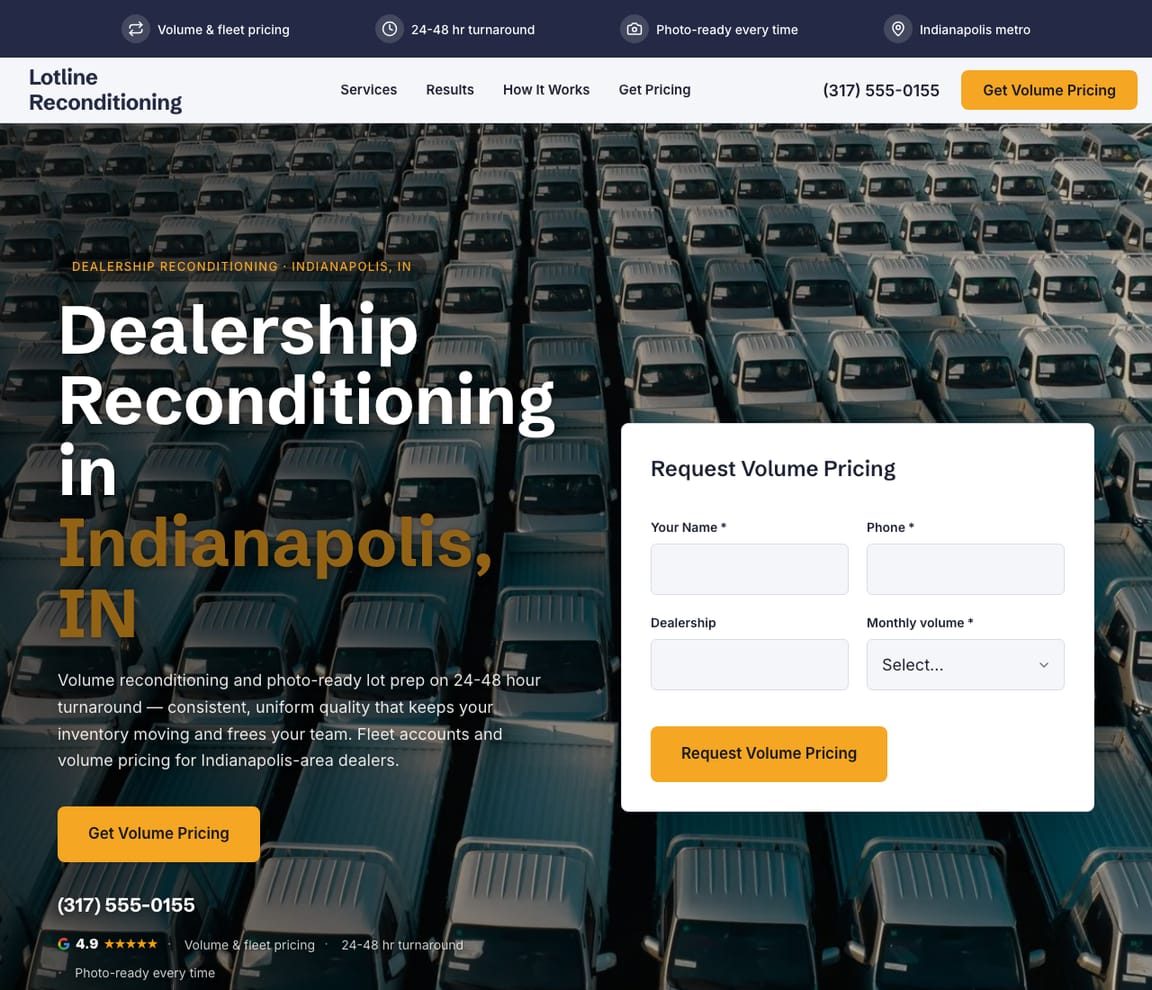
This is a real Zarla template for a dealership reconditioning business — the lead-capture form up top, the lot at dusk, the process laid out, the trust strip. Describe yours — the cars, the town, how you sell — and you'll have a site like this, with a photo gallery, your hours and a contact and inquiry form, in about a minute.
- Professional design — not a generic template
- Looks great on desktop and mobile
- Content written for your industry
Build the website
Start your car dealership website now
Add your town and your dealership's name to the sentence, and Zarla builds the site: what you sell, a photo gallery, a contact and inquiry form, your hours and map. Add your cars and your prices in chat, then publish.
Already have a website? Bring it across →Zarla keeps your old page addresses where it can and redirects the ones that change, helping you keep the Google standing you've built.
Is starting a car dealership worth it in 2026 — and what do car dealers make?
The dealership one owner can open is an independent used-car lot — the phrase searched is the general one, so say it plainly: a franchise is a manufacturer's agreement, and New York's statute wants "the names of each line or make of new motor vehicle which a manufacturer or distributor has authorized the applicant to sell" before it will register one (N.Y. Veh. & Traf. Law §415); a franchise marketplace's blog puts the buy-in at "approximately $130,000 to over $913,500" with a fee that "can range from $30,000 to a whopping $500,000!" and names no source (Franzy, February 12, 2025), and a dealer-CFO consultancy says manufacturers want working capital of "$1,000 to $1,500 per new vehicle projected to be sold annually" (Kruse Control). The independent lot is the other business, and it is growing: "Independent used vehicle dealers sold 9.8 million vehicles in 2025, nearing 2020 total sales", up "more than 200,000 from 2024's 9.7 million", "the third straight year for sales to grow", in a used market of "an estimated 38.6 million" (NIADA, March 4, 2026); the franchised side is "16,990 franchised light-vehicle dealers" selling "16.2 million light-duty vehicles" and "$1.3 trillion" in 2025 (NADA Data).
What a car grosses. The only openable benchmark is the franchised one: "Gross profit per used vehicle retailed declined 10.0% year over year to $1,409 but rose for a second straight quarter to a level in line with the typical average the past few years"; "Gross profit per new vehicle retailed fell 13.5% year over year to $1,840"; "Finance-and-insurance income per vehicle retailed rose 4.8% to $1,769" (Presidio-NCM, second quarter 2026, July 23, 2026), from "more than 4,000 U.S. franchised dealerships of all brands and sizes" (WardsAuto). On a $12,000 car, $1,409 is about 12 percent gross — our arithmetic. A no-haggle independent in Massachusetts reports lower front-end gross and leans on the back end: "We price very competitive to markets … You know, lower front-end gross, and we obviously rely a lot on the back-end. We have a pretty substantial documentation fee as well." (Michael Kelley, general manager of Bourne's Auto Center — Car Dealership Guy, May 23, 2024). Our free car dealership business plan runs a ten-car lot at eight sales a month and about $96,000 of sales, with the cars themselves 75 to 85 percent of it — $1,800 to $3,000 of gross on each, so $14,400 to $24,000 of gross a month before rent, the floor plan, insurance and reconditioning, our arithmetic. At the Massachusetts store "Front-end grosses average around $800", and a salesperson selling "35 to 40 a month" is, by the publication's account of Kelley's figures, "likely making between $100,000 to $150,000 at the store" (Car Dealership Guy, May 23, 2024).
What the market is doing to the buyer. "The average used-vehicle listing price was $27,235 in September, the highest monthly average since December 2022"; "Used vehicles priced below $15,000 had only 34 days' supply, 15 days below the industry average. Supply in that price band fell 16.2% year over year and now accounts for 15.7% of all used-vehicle inventory, down from 19.4% a year ago" (Cox Automotive, October 16, 2026) — the gap the small lot sells into, and the one that makes buying hard: "Today I was at the auction and cars were pretty much going at the retail price according to Kelly Blue Book and so I didn't buy any cars today because cars were so crazy expensive" (Terris Worley, owner of All Cylinder Auto, Tucson — KOLD, April 3, 2025). Wholesale: "The Manheim Used Vehicle Value Index (MUVVI) in September was 205.9 … The index is down 1.1% month over month" (Cox Automotive, October 7, 2026). And the buyer does the work online first: Cox's Car Buyer Journey study found "84% of shoppers who lean into AI-powered online tools report high satisfaction" (Cox Automotive Car Buyer Journey, January 2026), and in a survey of 372 adults "87% of consumers would click on a vehicle with a clear, well-lit, well-framed photo over one with a blurry, poorly lit or poorly framed photo" and "95% of the respondents believe professional-looking photographs of vehicles on a dealership's website significantly increase the perceived value of the vehicles" (Auto Remarketing, May 23, 2024).
What the people earn. Employed retail salespersons had a median of $17.03 an hour, $35,410 a year, in 2025 (O*NET, from BLS 2025 wage data); first-line supervisors of retail sales workers $23.33 an hour, $48,520 a year (O*NET); sales managers $148,270 (O*NET) — and the survey behind all three leaves out "the self-employed, owner/partners in unincorporated firms" (Washington ESD), which is what a lot owner is. No publisher of record prints an independent dealer's income; NADA's workforce study is behind a members' paywall, and the lot owners here talk in units: "I started with about six cars on that lot. It was very slow for the first five years — I never made a lot of money on that lot." (Nathan Buche, owner of Auto Express, Lafayette, Indiana — Auto Dealer Today, July 22, 2014); "I kept about 20 cars on the lot and sold around 15 each month. Now that I have a floor plan, I keep around 150 on the lot and sell 50 vehicles each month." (Bobby VanSickle, owner of AFS Ohio — NextGear Capital, a floor-plan lender's customer story, June 29, 2021).
The catch. Inventory is cash on wheels — a car that sits past the floor plan's 45 days eats its own gross in fees and depreciation; the reconditioning estimate that doubles after the car is yours is where lots lose money; wholesale prices move monthly against a buyer; a title or odometer mistake is a federal matter; and the franchise store down the road has the service bay, the finance office and the ad budget. That's what the rest of this guide sets up.
How to start a car dealership, in plain English
The number that makes you a dealer. Texas: "A person may not engage in business as a dealer … without a dealer general distinguishing number" (Tex. Transp. Code §503.021), and the exclusion is a count — a person who "sells or offers to sell during a calendar year fewer than five vehicles of the same type that are owned and registered in that person's name" is not one (§503.024). Florida: "Any person who buys, sells, or deals in three or more motor vehicles in any 12-month period or who offers or displays for sale three or more motor vehicles in any 12-month period shall be prima facie presumed to be engaged in such business" (Fla. Stat. §320.27). New York: anyone "who sells, or offers for sale more than five motor vehicles, motorcycles or trailers in any calendar year or who displays or permits the display of three or more motor vehicles, motorcycles or trailers for sale at any one time" is a dealer, and unregistered dealing carries "a civil penalty in the sum of one thousand dollars" (N.Y. Veh. & Traf. Law §415). California prints no number: a dealer is anyone who "For commission, money, or other thing of value, sells, exchanges, buys, or offers for sale" vehicles (Cal. Veh. Code §285), excluding "Persons not engaged in the purchase or sale of vehicles as a business, who dispose of any vehicle acquired and used in good faith, for their own personal use" (§286). Oklahoma's statute sits on a site that refuses every connection, so the Commission's office answers the count; federally, the Buyers Guide attaches to "any person or business which sells or offers for sale a used vehicle after selling or offering for sale five (5) or more used vehicles in the previous twelve months" (16 CFR part 455).
The license, by state, in the agency's words. Texas: "The fee for an original general distinguishing number is $500 for the first year and $200 for each subsequent year for which the number is valid. The fee for the renewal of a general distinguishing number is $200 a year" (§503.007) — $700 for the two-year license; "a properly executed surety bond in the amount of $50,000" (§503.033); "The licensing education course must consist of at least 6 hours of online instruction for new applicants and 3 hours of online instruction for renewal applicants" and "must not exceed $150 per person" (TxDMV, dealer education), one-time — a renewing dealer "is not required to complete additional education and training" (§503.0296); the dealer association sells it at "Pre-Licensing Education (English) $149" (TIADA); plates are "a $90 fee for every dealer license plate that you request" (Surety Bonds Direct's Texas guide — TxDMV's plate page refuses readers); and the lot: "A retail dealer's office must be open at least four days per week for at least four consecutive hours per day and may not be open solely by appointment", "a conspicuous, permanent sign with letters at least six inches in height", "a desk; two chairs; internet access; a working telephone number listed in the business name", a locked cabinet, and "The display area must be of sufficient size to display at least five vehicles of the type for which the GDN is issued" (43 Tex. Admin. Code §215.140). Florida: "a fee of $300 in addition to any other fees required by law … $300 for the first year and $75 for the second year", renewal "$75 for a 1-year renewal or $150 for a 2-year renewal"; a bond "in the sum of $25,000"; "a garage liability insurance policy or a general liability insurance policy coupled with a business automobile policy, which shall include, at a minimum, $25,000 combined single-limit liability coverage including bodily injury and property damage protection and $10,000 personal injury protection"; fingerprints; "training conducted by a licensed motor vehicle dealer training school" within six months, "8 hours for required department topics" plus up to 24 more; "8 hours of continuing education … once every 2 years. The continuing education shall include at least 2 hours of legal or legislative issues" (Fla. Stat. §320.27); the association's school: "Course length 16 hours — $199" (FIADA). New York: "Application fee $ 37.50 … Dealer Registration fee $450" (the DMV's VS-1 instructions as a dealer association reproduces them — the DMV's own pages refuse readers), and the bond by volume — "twenty thousand dollars" for a first-time dealer or one who "sold fifty motor vehicles or fewer in the previous calendar year", "one hundred thousand dollars" above fifty, "fifty thousand dollars" for a new-car dealer (§415); no course appears in the statute. California: a "$175 non-refundable application fee", "$92 fee for each dealer plate", "$16 examination fee" with "3 attempts to pass the test", a "$125 renewal application fee" with "Proof of continuing education (required every two years)", and "New and used vehicle dealers must obtain a NMVTIS report for any used vehicle offered or displayed for sale" (California DMV, vehicle dealer license); "A dealer's bond shall be in the amount of fifty thousand dollars ($50,000)" (Cal. Veh. Code §11710); "every applicant shall successfully complete a preliminary educational program of not less than four hours" (§11704.5) — sold at "$79 … Complete in Just 6-Hours" (Dealer Educator) to "$ 295.00" (Dealer Training). Oklahoma, the plan's state, licenses through the Used Motor Vehicle, Dismantler and Manufactured Housing Commission, not the tag office: "Used Motor Vehicle Dealer $600.00", "All licenses expire December 31st of each odd numbered year", a "$25,000 DEALER'S BOND", "$25,000 SINGLE LIMIT GARAGE LIABILITY INSURANCE", a state background report, "a permanent structure separate and apart from any residence or other business and the facility must have an accessible restroom for the public", a sign "at least 32 square feet in size, permanently mounted with permanent lettering at least 6 inches in height", "a letter or permit from the city or county … showing approval of local zoning requirements for used motor vehicle sales", and a class: "One owner … must attend the education program before the license will be issued. ATTENDANCE IS MANDATORY" (Oklahoma Commission, dealer application). The bond premium: "0.5% $125 … 1% $250 … 2% $500 … 3% $750" on $25,000 for a two-year term (Surety Bonds Direct, Oklahoma); "Starting at $375 per year … (0.75% of the $50,000 bond amount for well-qualified applicants)" in Texas (Bryant Surety Bonds, September 23, 2026). Check your own state's checklist before you sign a lease — the lot is inspected.
The business behind the license. No state read requires an entity to hold the license — Oklahoma asks for the LLC papers only "If the business is a Corporation, LLC, LP, or LLP" — but most lots form one: "$300" in Texas (Tex. Bus. Orgs. Code §4.152), "$100" plus "$25" for the registered agent in Florida (Fla. Stat. §605.0213), "two hundred dollars" in New York (N.Y. LLC Law §1101), "Seventy dollars ($70)" in California (Cal. Gov. Code §12190) plus the annual LLC tax (Rev. & Tax. Code §17941), "Articles of Organization - Oklahoma LLC … 100.00" in Oklahoma (Oklahoma Secretary of State fee schedule, as archived October 4, 2026 — the live page answered a server error on October 25), $40 in Kentucky (Kentucky Secretary of State). Who collects the sales tax — four answers. Texas: "Sales: 6.25 percent of sales price, minus any trade-in allowance" and "The dealer will collect motor vehicle sales tax from the purchaser … The dealer will remit the tax to the county tax assessor-collector" with Form 130-U (Texas Comptroller). Florida: sales tax "plus any applicable discretionary sales surtax" on every vehicle, the surtax "to the first $5,000 of the purchase price" (Florida Department of Revenue, GT-800030). New York: "the sales tax is imposed based on the tax rate in effect where the purchaser resides" and the seller collects it (New York Tax Bulletin ST-590). California is the inversion — the dealer pays the tax to the DMV: "Certain used motor vehicle dealers (dealers) are required to pay the applicable sales tax and any applicable use tax (tax) on their retail sales of certain used motor vehicles (vehicles), to the Department of Motor Vehicles (DMV) when the dealer submits a vehicle registration application to DMV" (CDTFA). Oklahoma is the other inversion — the buyer pays at the tag agency: "Oklahoma law prohibits a dealer from procuring or acting as the agent for the registration and licensing of a used motor vehicle. A dealer may include in the purchase price the cost of tag, title and tax." (Oklahoma Commission, dealer FAQ), where "Oklahomans pay an excise tax when a vehicle is purchased, which is at a rate of 3.25%" (Oklahoma State Senate, legislative brief).
The deal jacket, by federal law. The Buyers Guide: a dealer may not "fail to disclose, prior to sale, that a used vehicle is sold without any warranty" nor "represent that a used vehicle is sold with a warranty when the vehicle is sold without any warranty"; the forms are the "'AS IS'—NO DEALER WARRANTY Buyers Guide" and the "IMPLIED WARRANTIES ONLY Buyers Guide", and a state with its own form is exempted under "§ 455.6 State exemptions" (16 CFR part 455); the penalty is "Section 5(m)(1)(A) of the FTC Act, 15 U.S.C. 45(m)(1)(A) —$53,088" a violation (16 CFR §1.98). The odometer: "a person transferring ownership of a motor vehicle shall give the transferee the following written disclosure: (A) Disclosure of the cumulative mileage registered on the odometer. (B) Disclosure that the actual mileage is unknown, if the transferor knows that the odometer reading is different from the number of miles the vehicle has actually traveled" (49 U.S.C. §32705). Cash: "if you're in a trade or business and receive more than $10,000 in cash in a single transaction or in related transactions, you must file Form 8300 … within 15 days" (IRS). Financing: the Safeguards Rule's own example is "An automobile dealership that, as a usual part of its business, leases automobiles on a nonoperating basis for longer than 90 days", which must "Designate a qualified individual responsible for overseeing and implementing your information security program", with lighter duties for "financial institutions that maintain customer information concerning fewer than five thousand consumers" (16 CFR part 314); the Red Flags Rule covers an "automobile loan" account (16 CFR part 681); a buy-here-pay-here lot discloses the "Amount financed", the finance charge and the APR (Regulation Z §1026.18). The FTC's dealer-pricing rule never took effect: "we … VACATE the CARS Rule" (Fifth Circuit, No. 24-60013, January 27, 2025). A commissioned salesperson still earns "$7.25 an hour" (29 U.S.C. §206) and the retail-commission overtime exemption needs "more than half his compensation for a representative period … represents commissions" (§207(i)).
Warranties — the inversions. Texas and Florida print no used-car warranty mandate in the statutes read; Florida makes it a deceptive act to "Sell a vehicle without fully and conspicuously disclosing in writing at or before the consummation of sale any warranty or guarantee terms" (Fla. Stat. §501.976), so the as-is sale rides on the Buyers Guide. New York requires one: "If the used motor vehicle has thirty-six thousand miles or less, the warranty shall be at minimum ninety days or four thousand miles, whichever comes first … more than thirty-six thousand miles, but less than eighty thousand miles … sixty days or three thousand miles … eighty thousand miles or more but no more than one hundred thousand miles … thirty days or one thousand miles" (N.Y. Gen. Bus. Law §198-b). Massachusetts requires one on any car sold for more than $700 with under 125,000 miles: "Less than 40,000 miles: Warranty period is 90 days or 3,750 miles. 40,000 to 79,999 miles: Warranty period is 60 days or 2,500 miles. 80,000 to 124,999 miles: Warranty period is 30 days or 1,250 miles" (City of Boston). California requires one only of a buy-here-pay-here lot: "a written warranty that shall have a minimum duration of at least 30 days from the date of delivery or when the odometer has registered 1,000 miles" (Cal. Civ. Code §1795.51). Oklahoma wants "a Condition of Sale, i.e., a warranty, service contract or warranty disclaimer" in every deal jacket, and says the title is to be delivered with the vehicle (Oklahoma Commission, consumer FAQ); New York's Attorney General tells buyers to walk away from a dealer who will not put the warranty in writing and not to "give in to high-pressure sales tactics" (New York Attorney General, buying a car) — the red flags a buyer is told to watch for are the rules a dealer has to keep. Ask a dealer-law attorney in your state what your contract has to say.
Insurance and the staff. "garage liability (which averages around $1,740/year)" and "Small dealerships typically pay $5,000 to $8,000 annually for a complete insurance package", with workers' compensation "an average of $148 per month" (1-800-Insurance, August 20, 2025); Florida's and Oklahoma's licenses write the garage policy into the conditions; the Texas license does not. Workers' compensation once you hire: "In Texas, private employers can choose to carry workers' compensation insurance coverage, but it is not required in most cases" (Texas Department of Insurance); Florida, "Non-Construction Industry Employers with four (4) or more employees" (Florida CFO); New York, "Virtually all employers in New York State must provide workers' compensation coverage for their employees" (New York Workers' Compensation Board); California, "If a business employs one or more employees, then it must satisfy the requirement of the law" (California DIR); Oklahoma, "Every employer shall secure compensation as provided under this act to its employees", with an exception for "an employer with five or fewer total employees, all of whom are related" (85A O.S. §2 and §35, the Senate's compilation). Pay plans pay on gross, not sticker — "Sell 5 cars and earn 20% of front-end gross. Sell 12 and earn 25% on all deals that month" — and "even commission-paid employees must earn at least the federal minimum wage for every hour worked" (Netchex) — at the franchised $1,840 of new-car gross, 25 percent is about $460 whatever the sticker says, our arithmetic; the no-haggle store here pays "a low base, and then we pay a flat per car. And then we pay spiffs" (Kelley).
The money to start. The paperwork is cheap and the cars are the business. Our free car dealership business plan itemizes the ten-car lot at $95,106–$165,161: the license, the course and the plates, the bond, the lot's deposit and setup, the detailing kit, the first year's insurance, the registration, the website, two months of running costs — and ten auction cars with fees, transport and reconditioning, which are two-thirds to four-fifths of it. Here is the fee-and-floor-plan layer for the Tulsa sample from the pages that open: the Oklahoma license ($600), the $25,000 bond at 1 percent for the two-year term ($250), a year of garage liability at the insurer's average ($1,740) and the LLC ($100) — $2,690, our arithmetic, before the lot, the sign and the cars — then a month of dealer management software at "Dealer Management System DMS $99 / mo." (DealerCenter; Frazer's is $129 desktop — "$ 129 /month" — or $199 hosted — Frazer), ten cars floored for 30 days at "$5,001-$10,000 … $6.00" a day (the line "starts as low as $4 per day" under $5,000 and runs "$10,001-$15,000 … $10.00" — $4, $6 and $10 a day) with "45 days to sell your unit" and "The curtailment fee is 1% of the floored amount" ($1,800 — AFC's Daily Tab, August 19, 2024), and reconditioning at "$600 to $800 per car is common" ($6,000 — Dale Pollak of vAuto, on Cox Automotive's site): $10,589. The cars themselves ride on the line: ten at a planning $7,000 to $9,000 each, bought at auction where "The buyer fee is calculated as a percentage of or a flat rate on the vehicle's sale price" and some events carry "a flat buy fee (such as $100 per vehicle)" (ACV Auctions). The video on page 1 that says a dealership starts for $3,500 to $4,000 is describing this layer in Texas — our arithmetic there is $700 plus $149 plus $180 of plates plus the bond at $375 to $1,500, the $1,740 of garage liability and the $300 LLC: $3,444 to $4,569 — and nothing else. The drive to the auctions is deductible at "76 cents/mile" (IRS, July 1 to December 31, 2026). And the buyer's side of the arithmetic: the "$3,000 rule" a car-shopping site describes is a rule of thumb — have about $3,000 in hand as a down payment or a cushion for the first repairs (SlashGear) — which is who buys under $15,000: a few thousand down and a credit-union pre-approval.
In the UK: there is no dealer license on the pages read; consumer law does the work — goods must be "of satisfactory quality" (Consumer Rights Act 2015, s.9) and "The time limit for exercising the short-term right to reject … is the end of 30 days" (s.22); VAT registration at "£90,000" of taxable turnover (GOV.UK) and, the inversion of the US sales tax, VAT on the margin: "You can use a margin scheme to account for VAT on the difference between the price you pay for a second-hand vehicle and the price you sell it for, instead of the full selling price of each vehicle" (GOV.UK, the VAT margin scheme for second-hand vehicles); arranging a customer's finance is a regulated activity — no person may carry on one in the United Kingdom unless the FCA has approved them or they are exempt, as the statute puts it (Financial Services and Markets Act 2000, s.19), and "All credit brokers need to make clear in their advertising that they are brokers and not lenders" (FCA, credit broking rules). In Australia: a motor dealer license is state-issued and the vehicles may be offered only at the business named on it — New South Wales requires one of any business "buying, selling or exchanging motor vehicles as a: retailer, or wholesaler" (NSW Government, working as a motor dealer); the inversion of the US as-is sale is a statutory warranty on every dealer sale — in Queensland a class A warranty "expires after 3 months or the first 5,000km" on a car under 160,000 km and ten years old, and class B "1 month or 1,000km" above that (Queensland Government); "It's free to register for an ABN" (business.gov.au), GST registration at A$75,000 or more of turnover (the ATO's page; its address carries a British spelling, so it is not linked), and the luxury car tax "at a rate of 33%" above "$91,661" for fuel-efficient cars and "$80,809" for the rest (ATO, 2026–27). Check your own regulator's rules.
What car dealers actually say
None of this is our opinion about starting a car dealership. It comes from independent used-car dealers and the people who run franchised stores — in Ohio, California, Indiana, New Jersey, Washington, Massachusetts, Arizona, Colorado, Alabama, Florida, Missouri, Pennsylvania and North Carolina — talking to a floor-plan lender's customer pages, Car Dealership Guy, Auto Dealer Today, Auto Remarketing, WardsAuto, CNBC and three local TV stations between 2014 and 2026, each described as the page describes them. Read each as theirs at the time — the lender's stories are a vendor's. Five things come up again and again.
They started small, and slow. Bobby VanSickle, owner of AFS Ohio: “I worked for a franchise dealership for 21 years but I wanted more work-life balance. So, about seven years ago, I decided to take everything I had learned and apply it to operating my own dealership and that's how AFS Ohio got its start. I had heard about floor plans when I was on the franchise side but I didn't know how they worked for independent dealers.” (NextGear Capital, June 29, 2021). Tony Harb, owner of Just Better Cars, Rosedale, California: “A few years later, a friend of mine from high school called me up and said he knew about a dealership available for sale which piqued my interest because if I bought it, I would be able to both run and own a dealership. So, in early 2017 I opened Just Better Cars in Rosedale, CA and along with my 15 employees, we've slowly been able to grow the dealership. We currently average about 80 vehicles in our inventory each month.” (NextGear Capital, December 1, 2020). Nathan Buche, owner of Auto Express, Lafayette, Indiana: “I started with about six cars on that lot. It was very slow for the first five years — I never made a lot of money on that lot.” And his partner Rob Jones: “There was a reputation about the used-car business, and when he came to me and said, 'This is what I'm going to do,' I said 'You're crazy.' … But he convinced me, and from Day One, it's been a customer service job, not a sales job.” (Auto Dealer Today, July 22, 2014). RJ McFadden, owner of McFadden Family Motors, Moses Lake, Washington: “I've been 18 years in the car business world, and I've always wanted to own my own dealership. The opportunity for this property came up and I decided to put McFadden Family Motors here and give her a run.” (Columbia Basin Herald, via Yahoo News, February 9, 2026). Yossi Levi, who turned a family lot into a group: “I'm not a car guy by any means. To me, cars are just nuts and bolts—or a line on a balance sheet. But I knew I could connect with people, and little did I know that would serve me well in the car business.” (Dealer Image Pro, a vendor's blog, January 22, 2025).
“People aren't going to remember what you say, but they will remember how you treated them. When I'm selling cars, it's like talking to friends. Talking about cars is the last step.” — Colin Li, owner of Top Shelf Automotive, Newark, New Jersey, in Auto Remarketing, November 13, 2024
Cash or the floor plan, and where the cars come from. Bobby VanSickle: “Before I had a floor plan, I used cash to purchase all of my inventory. I kept about 20 cars on the lot and sold around 15 each month. Now that I have a floor plan, I keep around 150 on the lot and sell 50 vehicles each month.” And: “Finding inventory can be difficult and when I do find it, it's often overpriced. I look for the most competively priced inventory whether I source it from traditonal auctions like Manheim, or from wholesalers.” (as the page spells it — NextGear Capital, June 29, 2021). Tony Harb: “I think buying inventory for dealers is a lot like fishing. When you go to the pond and everyone is standing there with their pole in the water, you have to be flexible and find another pond. We widen our search by looking for inventory at different auctions so we're not in competition with the same dealerships.” (NextGear Capital, December 1, 2020). Michael Kelley, general manager of Bourne's Auto Center, South Easton, Massachusetts: “What we've also done is that we're just trying to pay cash for as many cars as we can…we're owning about probably about half of our inventory right now. So you need to sell it fast, for both reasons. When it's cash, you need to sell it fast. When you're financing it, you need to sell fast.” (Car Dealership Guy, May 23, 2024). Dominic Mannino, owner of Discount Motors, Pueblo, Colorado: “It's amazing how the prices keep going up and up. So that's why I think the market for used cars is going to be better than it was before because a lot of people are going to turn to used vehicles” (KRDO, March 27, 2025). Greg Anthony of North Country Ford, Arab, Alabama: “We ran out and bought all these cars, and not only us, everybody did. We saw at the auctions all these prices were increasing fast because even dealers were in panic mode” (WAFF, December 30, 2025).
Reconditioning, pricing and pay. Yves Belanger, owner of Gibson Truck World, Central Florida: “We spend more than $250,000 per month inspecting and servicing our trucks. Additionally, we spend $15,000 to $20,000 per month for our warranty program, including warranties to our out-of-state customers.” And: “The inventory, that's my blood. I eat with my stock sheet; it's the first thing I look at in the morning, to see what we sold the day before.” (Auto Dealer Today, July 22, 2014). Michael Kelley: “We don't pay off the gross. We pay a low base, and then we pay a flat per car. And then we pay spiffs, you know, if the customer takes the car that day, we'll pay them a spiff. If they finance it, pay them a spiff, if they buy a warranty, cause we want them to kind of set the table for that at the sales desk” (Car Dealership Guy, May 23, 2024). Gus Camacho, president and owner of Camacho Auto Sales, Lancaster and Palmdale, California: “Because we were a large independent dealer, we already had 90% of the lenders. But opening the Mitsubishi franchise, we were able to add on 10% more.” (Auto Dealer Today, July 22, 2014).
The franchise side, and the exit. Eric Gentry, owner of Gentry Chevrolet, Smithville and Camdenton, Missouri: “I spent a lot of money a few weeks ago to go back to working 12 to 14 hours a day … You know, I thought I was kind of done with that, but I'm loving it.” (WardsAuto, July 13, 2026). Derek Sylvester, selling Sylvester Chevrolet, Peckville, Pennsylvania: “As a family, we decided this might be the time … Unless you're a larger store, a much larger store, it's a little bit harder to make money. ... It's just scale.” (CNBC, April 18, 2026). Rob Dell, vice president of Bob Ruth Ford, Dillsburg, Pennsylvania, on why the growth is in used: “Could we go from 50 new to 300 new next year? That would be a difficult test … Could you go from 200 used to 300 used? Yeah, you could do that. There's just a lot more control.” (Car Dealership Guy, December 26, 2025). Mike Mason, partner in Michael Jordan Nissan, Durham, North Carolina: “What we have to do is react as a business to be viable and do what the people are looking for. And what they're looking for is to not pay more money, to pay less money.” (ABC11, April 1, 2025).
The through-line: the dealers who lasted started with six cars and a day job's worth of patience, treated the lot as a customer-service job, bought where the other dealers weren't, paid cash where they could and floored what they couldn't, watched the stock sheet every morning, and turned the cars before the line turned on them.
THE STARTER KIT
What you need to start a car dealership
A lot the inspector will pass
Texas wants room to display five cars, a permanent sign with six-inch letters, an office open four days a week with a desk and two chairs; Oklahoma a 32-square-foot sign, a public restroom and a zoning letter. Find the lot before you pay the fee.
The dealer license and its course
$700 for two years in Texas, $300 in Florida, $175 in California, $600 in Oklahoma, $450 plus $37.50 in New York — with a pre-licensing course where the state requires one, from a free morning class to $295.
The bond and the garage policy
A $50,000 surety bond in Texas and California, $25,000 in Florida and Oklahoma, $20,000 in New York to start — paid at about 1 to 3 percent a year — and garage liability, which averages about $1,740 a year and is a license condition in Florida and Oklahoma.
A floor plan, or the cash for ten cars
A revolving line secured by the cars: $6 a day per $5,001-to-$10,000 unit at one lender, 45 days to sell it, a 1 percent curtailment. Ten cars at $7,000 to $9,000 is the business; the fees are the rounding error.
The deal jacket, by federal law
The FTC's Buyers Guide on every car once you have sold five in a year, the odometer statement at every transfer, Form 8300 for cash over $10,000, the Safeguards Rule if you arrange financing — and your state's sales-tax account.
The auction accounts and the software
Two dealer auctions, a reconditioning budget of $600 to $800 a car, a dealer management system at $99 to $199 a month, the history-report account and the Buyers Guide forms your state association sells.
THE PAPERWORK
Licenses, bonds and rules for a new car dealership
| Typical cost | Time to get | Legally required? | |
|---|---|---|---|
| Dealer license | $700/2 yrs (TX); $300 + $75 (FL); $450 + $37.50 (NY); $175 (CA); $600 (OK) | After the lot inspection | Yes past the state's count — 5 of a type in TX, 3 in FL, more than 5 or 3 displayed in NY, any sale for money in CA |
| Pre-licensing course | $149 (TX, capped at $150); $199 (FL, 16 hrs); $79–$295 (CA); a free morning (OK) | Hours to a day | Yes in TX, FL, CA and OK; none in NY's statute |
| Surety bond | 0.5–3% of $25,000 (FL, OK), $50,000 (TX, CA), $20,000–$100,000 (NY) | Days | Yes — the amount is the state's, not 'around $25,000' |
| Garage liability | ~$1,740/yr average; $5,000–$8,000 the full package | Days | A license condition in FL ($25,000 + $10,000 PIP) and OK ($25,000); practice in TX, NY and CA |
| The lot and the sign | Set by the lease | Before the application | Yes — TX: five cars, six-inch letters, desk and two chairs; OK: 32 sq ft sign, public restroom, zoning letter |
| Dealer plates | $90 each (TX); $92 each (CA) | With the license | To drive inventory on the road |
| Buyers Guide (FTC) | The forms from your state association | Before you offer the car | Yes after 5 or more used vehicles in 12 months; up to $53,088 a violation |
| Odometer statement | Free | At every transfer | Yes — federal law (49 U.S.C. §32705) |
| Form 8300 | Free | Within 15 days | Yes for cash over $10,000 in one or related payments |
| Safeguards and Red Flags Rules | A written program | Before you arrange financing | Yes if you arrange or carry financing — lighter under 5,000 customers |
| Sales-tax account | Free | Before the first sale | Yes — the dealer collects in TX, FL and NY, pays the DMV in CA; the buyer pays the tag agency in OK |
| Workers' compensation | ~$148/mo average | Days | Yes in CA (from 1); FL from 4; NY nearly all; OK unless 5 or fewer related; optional for most TX employers |
THE STEPS
How to start a car dealership (step by step)
Eight steps from the sales count that makes you a dealer to a licensed, bonded, insured lot with ten cars turning inside 45 days.
01
Learn the number that makes you a dealer
Texas: five or more vehicles of the same type in a year in your own name; Florida: three in twelve months is presumed dealing; New York: more than five a year, or three on display; California: any sale for money unless the car was yours to use. Past that number, the license is the law.
Before the first flip02
Find the lot the state will inspect
A commercially zoned lot with an office — five cars' display, a six-inch-letter sign, a desk and two chairs and a listed phone in Texas; a permanent building with a public restroom, a 32-square-foot sign and a zoning letter in Oklahoma. Sign with the inspection in mind, because the lease goes in the application.
03
Form the business and open the accounts
A sole proprietorship or an LLC ($300 in Texas, $125 in Florida, $200 plus notices in New York, $70 plus the yearly tax in California, $100 in Oklahoma), the free EIN, a business bank account and the state sales-tax permit — California's application wants the resale permit attached.
04
Take the course, buy the bond, bind the insurance
Six hours online capped at $150 in Texas; 16 hours at a licensed school in Florida ($199); at least four hours in California ($79 to $295); a mandatory morning at the Commission in Oklahoma. A $25,000 or $50,000 bond at 1 to 3 percent, and garage liability at about $1,740 a year.
05
File the application and pass the inspection
$700 for two years in Texas, $300 in Florida with fingerprints, $450 plus $37.50 in New York, $175 and a $16 exam in California, $600 in Oklahoma with a state background report. The inspector visits the lot; the plates come after.
06
Open the auction accounts and the floor plan
Two dealer auctions and a floor-plan lender — $6 a day per unit floored between $5,001 and $10,000, 45 days to sell, 1 percent curtailment — with a written budget per car and a reconditioning baseline of $600 to $800.
07
Buy, recondition, post the Buyers Guide, list
Ten cars under $15,000, where supply is thinnest; the history report pulled before the bid; inspected and detailed before they are listed; the FTC's Buyers Guide on each; the same price on the windshield and online; the odometer statement and the deal jacket complete before delivery.
08
Get found, and turn the lot
A website with a page per car, real photos, the price and a financing inquiry form; a Google Business Profile with the hours the state makes you post; the free marketplaces the day each car is detailed; two credit unions that refer pre-approved members. Reprice at 45 days — a car that sits eats its gross.
THE COSTS
How much does it cost to start a car dealership?
The range is the car dealership business plan's ten-car independent lot, two-thirds to four-fifths of it the cars. The first total is this guide's own fee-and-floor-plan layer for the Tulsa sample from the pages that open — the license, the bond premium, a year of garage liability, the LLC, a month of software, ten cars floored for a month and their reconditioning; the cars themselves ride on the floor-plan line.
$10,589the fee-and-floor-plan layer for a ten-car lot in Oklahoma — reconditioning is most of it (our arithmetic)
$2,690the license, the bond premium, a year of garage liability and the LLC alone — the paperwork is the rounding error
$95,106–$165,161the plan page's ten-car lot — the license and the lot to ten auction cars with fees, transport and reconditioning
$6a day to floor a $5,001-to-$10,000 car at one lender, with 45 days to sell it and a 1 percent curtailment
WHAT WE'VE LEARNED
What actually brings a buyer to the lot
Thousands of local business websites in, the pattern for used-car lots is clear: the buyer wants to see the car, know the price and check the history — before they drive over. For a new lot, three things on a page decide who comes — and the <a href="/templates/car-detailing">auto templates</a> are built around them.
A page per car, with real photos
Every car with its own photos, the mileage and the price — the same price as the windshield. In one survey 95 percent of shoppers said professional-looking photos raise a car's perceived value, and 87 percent would click the well-lit one.
The history report, and the Buyers Guide
The vehicle history on request and the as-is or warranty terms stated plainly — California makes the history report a license condition, and the Buyers Guide is federal law on every car. Buyers ask for it before they call.
A financing inquiry form
A form that asks what the buyer can put down and lets you answer with a lender before they visit. The independents here work with credit unions and banks; the form is where that starts.
THE EARNINGS
What a car grosses, and what the people earn
The franchised benchmark from the Presidio Group's own page, the market from Cox Automotive and NIADA, the wage medians from O*NET's 2025 figures. No publisher of record prints an independent dealer's income — the lot earns on the gross per car and the days each one sits.
$1,409gross profit per used vehicle retailed at a franchised dealership in the second quarter of 2026, down 10 percent (Presidio-NCM)
$1,769finance-and-insurance income per vehicle retailed in the same quarter, up 4.8 percent — the line an independent that arranges financing reaches for
9.8 millionused vehicles sold by independent dealers in 2025, the third straight year of growth (NIADA)
$48,520the 2025 median for employed first-line retail supervisors (O*NET) — a survey that leaves out owners
SEE IT WORK
Auto website designs a dealership can start from
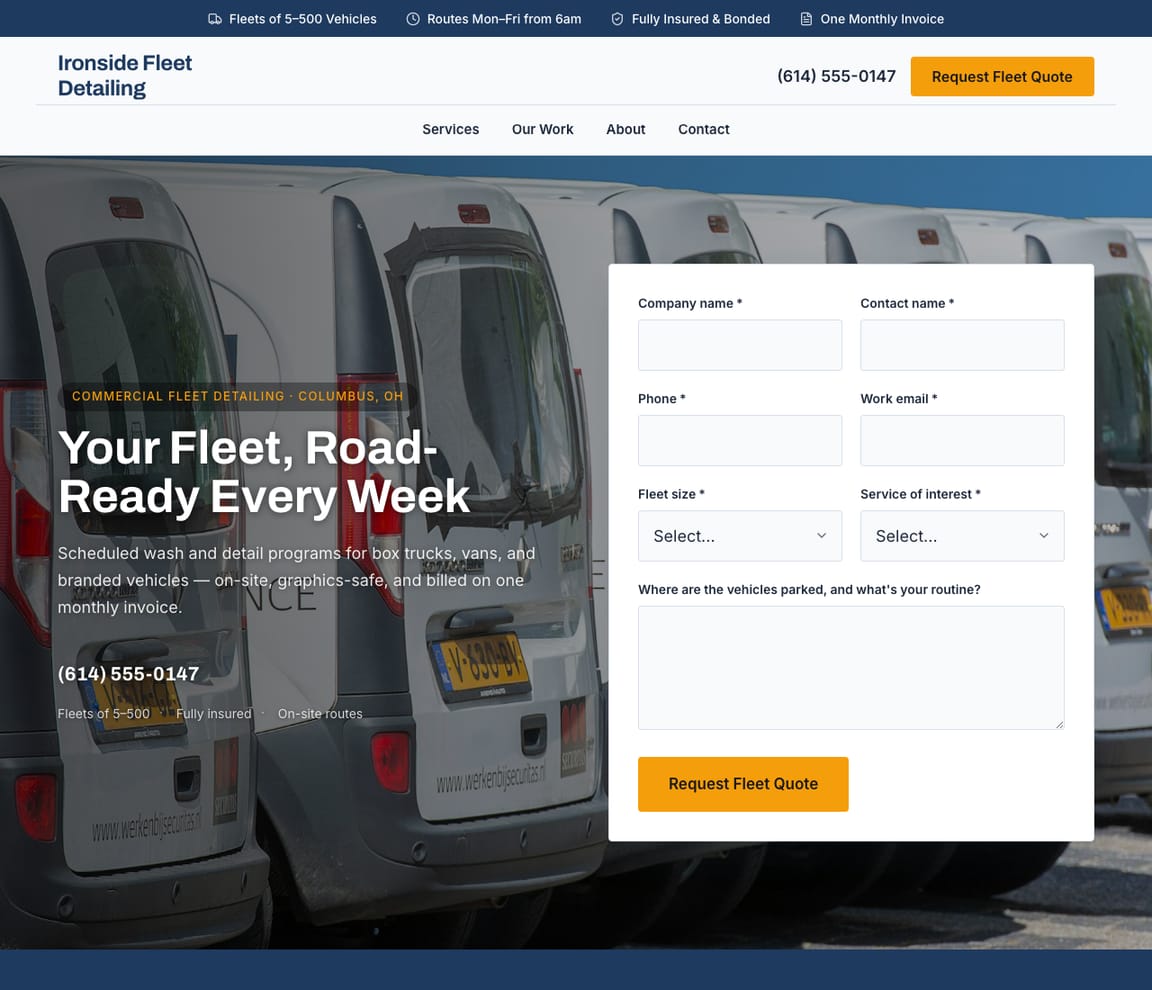
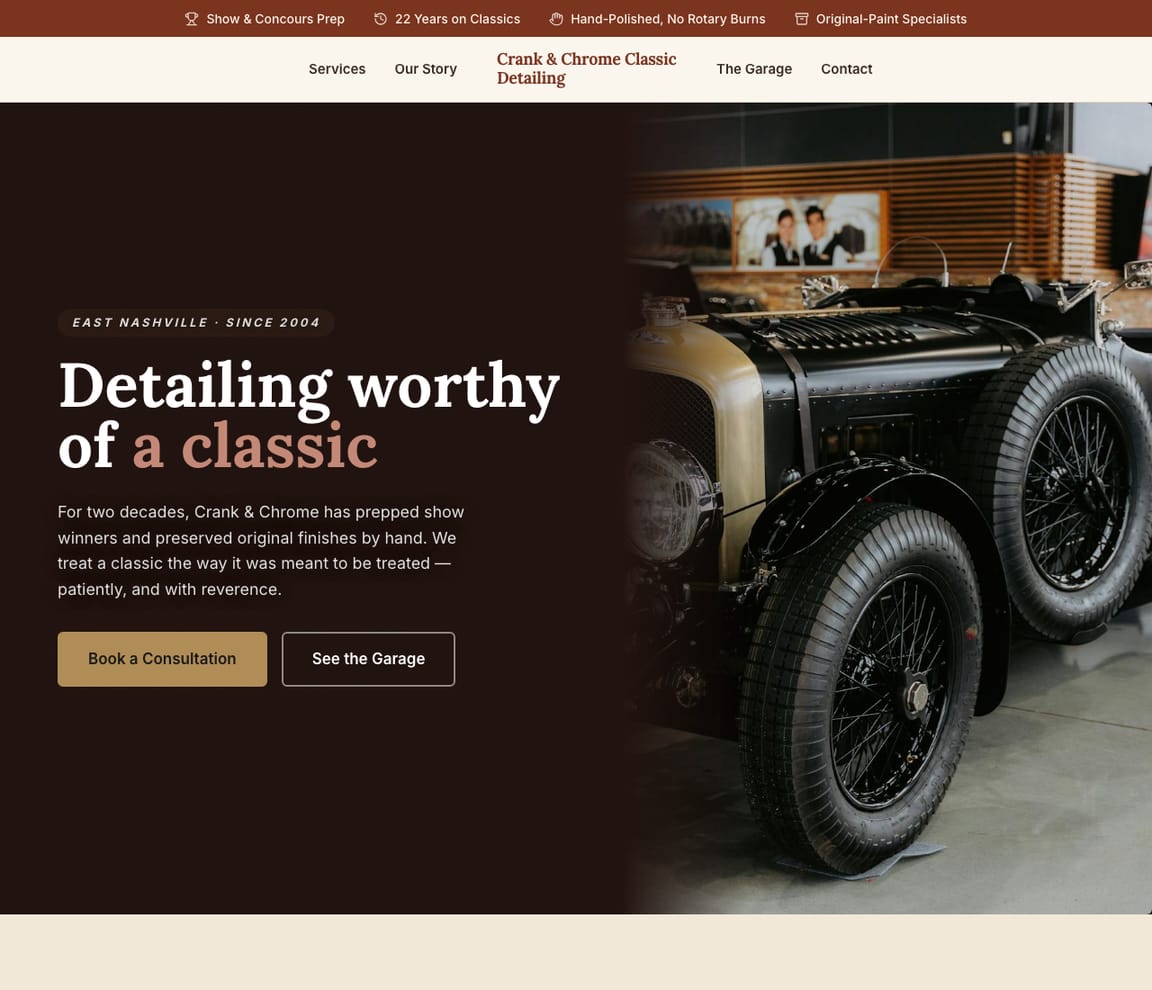
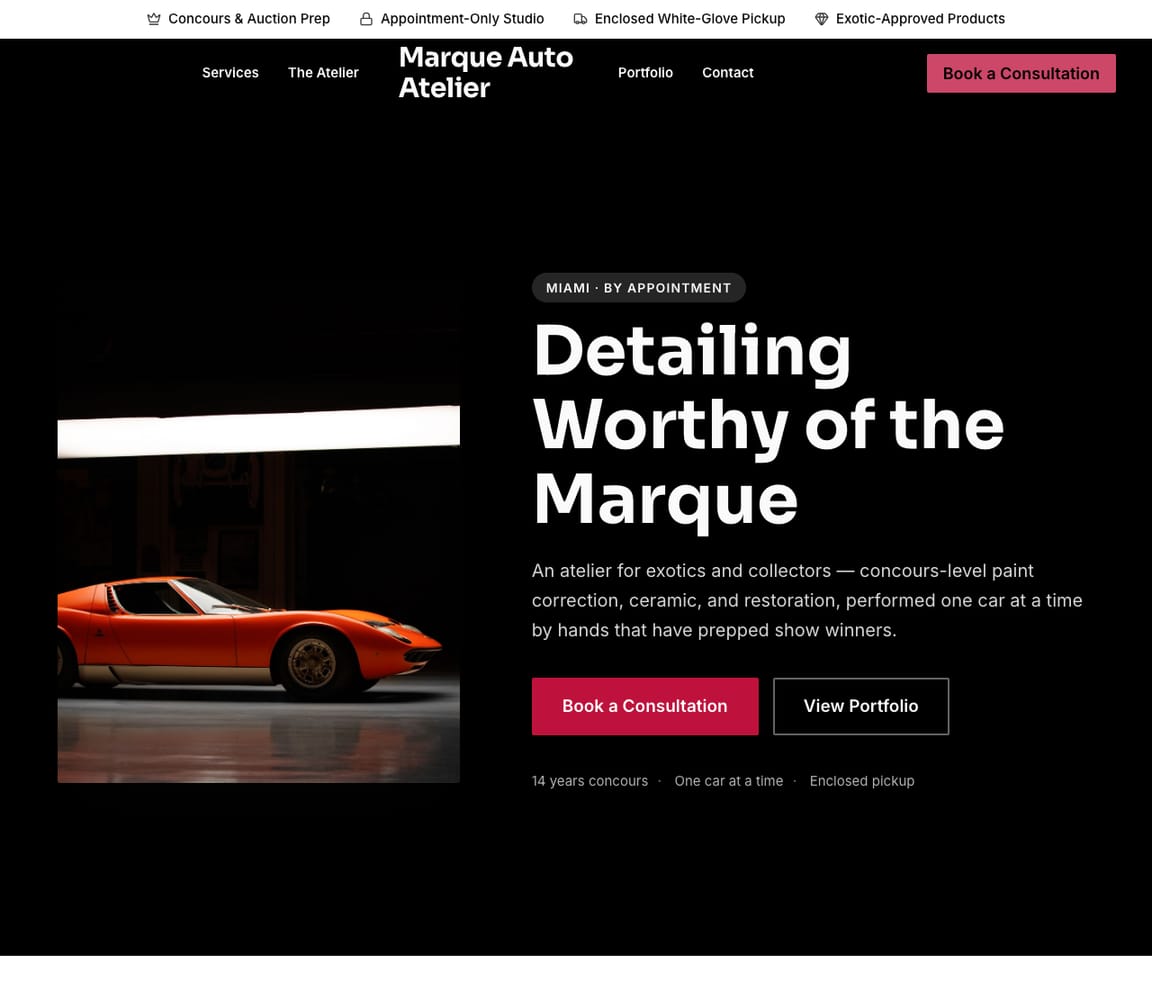
Real Zarla templates from the car-detailing gallery, which hosts the dealership designs until the dealership gallery lands: a dealership reconditioning service, a fleet and commercial detailer, a classic and show-car specialist and an exotic-car studio — the lot photos, the process, the inquiry form and the hours a used-car lot's site is built around. Open one, swap in your cars, your prices and your own photos, and publish.
GET FOUND
Get found by the family that needs a reliable car under $15,000 this week
Used-car buyers research online before they visit a lot, and the under-$15,000 cars they want are the thinnest supply in the market; the lot whose cars, prices, photos and hours are on the page is the one they drive to. Zarla builds the website with what you sell, a photo gallery, a contact and inquiry form, your hours and map. Add your cars, your prices and a financing inquiry form in chat, and once you connect your Google Business Profile, your name, your hours and your photos stay in step on both.
“Used cars near me”
Searched by the family whose car just died, the student with a co-signer and the credit-union member who is already approved. Your cars, your prices and your hours answer it.
Google Business Profile
Your lot, your hours and photos of the row of cars inside Google Maps — and a profile that shows a real, open dealership with a sign and an address. Free, and an afternoon to set up.
The photo of the car
A survey of car shoppers found 87 percent would click on a vehicle with a clear, well-lit photo over a blurry one — on the page and on the profile. A buyer who can see the car comes to see the car.
Google Search
Rredbudmotorco.com
Redbud Motor Co. — Trusted car dealership in Your AreaTen inspected, reconditioned cars under $15,000 on a lot in Tulsa — a history report and a Buyers Guide on every one, financing through local credit unions. Open Monday to Saturday, 9 to 6.← Your Zarla siteCcitycardealershipservices.com
City car dealership ServicesGoogle Maps
1
Redbud Motor Co.
← You2
Metro car dealership Co.
3
Quick car dealership Services
AI assistants (ChatGPT / Perplexity)
For an independent used-car lot in Tulsa with inspected cars under $15,000, a history report on every car and financing through credit unions in your area: Redbud Motor Co. — a lot whose site shows every car with photos and the price, the history report on request, the hours and the address, and a form to ask about financing before you drive over.
YOUR LAUNCH PLAN
Your car dealership launch checklist
The whole guide as things to check off. Work through them in order and you'll be licensed, bonded, insured and inspected before the first car hits the lot.
- Read your state's dealer-license checklist and its sales threshold — the number that makes you a dealer.
- Find a zoned lot the inspector will pass — the display area, the sign, the office; the lease goes in the application.
- Form the LLC, take the free EIN, open the bank account, get the sales-tax permit — before the application.
- Take the course, buy the bond, bind garage liability — the states' amounts, not the AI answer's.
- File the application and pass the inspection — then the plates.
- Open two auction accounts and the floor plan — a written budget per car and a recon baseline.
- Buy ten cars, recondition them, post the Buyers Guide on each — the deal jacket complete before delivery.
- Get found — a page per car with photos and a financing form; a Google profile; the credit unions; reprice at 45 days.
REAL CUSTOMERS
Small businesses that got online with Zarla
Verified reviews from real Zarla customers.
“Quickly built my website from scratch. No hiccups. Would highly recommend Zarla for someone with no experience who wants to start a polished business website.”
“Great professional website in less than a minute, with the use of AI and a few descriptive prompts. This has saved me bundles of time and research on web developers.”
“I had no idea how to set up a website for my business. Thanks to Zarla, they've helped me a lot.”
“Very reliable, professional, and fast results. I was able to get my business online in no time, and the ease of access made it so simple.”
Be the lot the buyer finds before the franchise store — and trusts
Add your town and your dealership's name, and Zarla builds the website from that one line — what you sell and how you sell it, a photo gallery of the lot, a contact and inquiry form a buyer can send from the bus, your hours and map, and SEO in place. Add your cars, your prices and a financing inquiry form in chat. Free to build; you pay when you publish.
Already have a website? Bring it across →Zarla keeps your old page addresses where it can and redirects the ones that change, helping you keep the Google standing you've built.
Frequently asked questions
How much does it cost to start a car dealership?
In the US, about $95,106 to $165,161 for a ten-car independent lot in our car dealership business plan's itemized ranges — the license, the course and the plates, the bond, the lot's deposit and setup, the detailing kit, the first year's insurance, the registration, the website, two months of running costs, and ten auction cars with fees, transport and reconditioning, which are two-thirds to four-fifths of it. The fee-and-floor-plan layer for the Tulsa sample from the pages that open is $10,589 in our arithmetic: the $600 license, the $25,000 bond at 1 percent ($250), a year of garage liability at the $1,740 average, the $100 LLC, a $99 month of software, ten cars floored for 30 days at $6 a day ($1,800) and reconditioning at $600 a car ($6,000) — $2,690 of it the paperwork and the insurance. A franchise is a different business: a marketplace blog puts it at $130,000 to over $913,500 plus a fee of $30,000 to $500,000.
How do I get a dealer license?
In the US, from the state's motor-vehicle agency — in Oklahoma the Used Motor Vehicle, Dismantler and Manufactured Housing Commission — after the lot passes inspection. Texas: $700 for two years, a six-hour online course capped at $150, a $50,000 bond, a lot that displays five cars with a six-inch-letter sign, a desk and two chairs. Florida: $300 for the first year and $75 for the second, a 16-hour school course ($199 at the dealer association), a $25,000 bond, garage liability of $25,000 plus $10,000 of personal injury protection, fingerprints. New York: $450 plus a $37.50 application fee, a $20,000 bond that rises to $100,000 after fifty sales a year. California: $175, a course of at least four hours ($79 to $295), the DMV's $16 exam, a $50,000 bond, $92 plates. Oklahoma: $600, a state background report, a $25,000 bond, $25,000 of garage liability, a 32-square-foot sign, a zoning letter and the Commission's mandatory class. Check your own state's checklist.
How much does a dealer license cost?
The fee itself: $700 for two years in Texas ($200 a year to renew), $300 plus $75 for the second year in Florida, $450 plus $37.50 in New York, $175 in California (plus $92 a plate, a $16 exam and a $125 renewal), $600 in Oklahoma. Add the bond premium — about 0.5 to 3 percent of $25,000 to $50,000 — and the course, $79 to $199 where one is sold. The license is the cheapest part of the lot.
How many cars can I sell without a dealer license?
It depends on the state, and the counts are in the statutes. Texas: a person who sells fewer than five vehicles of the same type in a calendar year, owned and registered in their own name, is not a dealer. Florida: three or more in any twelve months is presumed dealing. New York: more than five in a calendar year, or three on display at one time, makes you a dealer. California prints no number — anyone who sells for money is a dealer unless disposing of a car acquired and used in good faith for their own use. Oklahoma's statute sits on a site that refuses readers; ask the Commission. Federally, the Buyers Guide attaches after five or more used vehicles in the previous twelve months.
What is the average profit margin for used car dealerships?
The only openable benchmark is franchised: gross profit per used vehicle retailed was $1,409 in the second quarter of 2026, down 10 percent on the year, plus $1,769 of finance-and-insurance income per vehicle (Presidio-NCM); on a $12,000 car, $1,409 is about 12 percent gross, our arithmetic. A no-haggle independent reports lower front-end gross and leans on the back end. No association prints an independent dealer's net margin on a page that opens.
What is the $3000 rule for buying cars?
A consumer rule of thumb, not a law: SlashGear describes it as having about $3,000 available before taking on a car — as a down payment or a cushion for the first repairs. For a dealer it is a reminder of who buys under $15,000: buyers who arrive with a few thousand down and a credit-union pre-approval, which is why the independents here work with the lenders.
What is a red flag in a dealership?
The rules a dealer must follow name them: no Buyers Guide on the window, which federal law requires after five used-vehicle sales in a year; a warranty promised but not written, which Florida calls a deceptive act; an odometer statement left blank at transfer; a title not delivered — Oklahoma's Commission says the title is to be delivered with the vehicle; and, in Oklahoma, a dealer who offers to handle the tag, title and tax, which the law there forbids. The New York Attorney General's buying guide tells buyers not to give in to high-pressure sales tactics.
How much commission does a salesman make on a $50,000 car?
Pay plans pay on gross, not on the sticker. A payroll vendor's example: sell five cars and earn 20 percent of front-end gross, sell twelve and earn 25 percent on every deal that month. At the franchised benchmark of $1,840 of gross on a new car, 25 percent is about $460 — our arithmetic — whatever the price on the windshield. The no-haggle store here pays a low base and a flat amount per car plus spiffs for same-day delivery, financing and a warranty.
Do car salesmen get paid if they don't sell?
Yes, by law. A commissioned salesperson must earn at least the federal minimum wage of $7.25 an hour for every hour worked in a week; if a slow week's commissions fall short, the employer makes up the difference. A draw is an advance on future commissions. The retail overtime exemption applies only when more than half of pay in a representative period is commissions and the regular rate exceeds one and a half times the minimum.
Can a car salesman make $500,000 a year?
No openable page prints a $500,000 salesperson. What prints: employed sales managers had a 2025 median of $148,270 and retail salespersons $35,410 (O*NET), and at one Massachusetts independent a salesperson selling 35 to 40 cars a month is, by the publication's account of the general manager's figures, likely making $100,000 to $150,000.
How much do car dealers make?
Per car, the franchised average is $1,409 of gross on a used vehicle and $1,840 on a new one, plus $1,769 of finance-and-insurance income (Presidio-NCM, second quarter 2026), and average dealership profit was down on the year. The plan page's ten-car lot at $1,800 to $3,000 of gross on eight cars a month is $14,400 to $24,000 of gross before rent, the floor plan, insurance and reconditioning. The nearest wage line, first-line retail supervisors at $48,520, leaves out owners, and no publisher of record prints an independent dealer's income — the owners here say the first years were slow.
How do I start a car dealership with no money?
The pages that open say the paperwork is cheap and the cars are financed: the fee layer is $2,690 in Oklahoma and about $3,444 to $4,569 in Texas in our arithmetic, and a floor plan funds the inventory at $6 a day per $5,001-to-$10,000 unit with 45 days to sell it. The dealers here describe the constraint from the inside — one started with six cars and five slow years. No page that opens prints a zero-dollar start.
What is a floor plan for a car dealership?
A revolving line of credit secured by the cars on the lot. At one lender's product the dealer pays only for the days a unit is floored — $4 a day under $5,000, $6 a day from $5,001 to $10,000, $10 a day from $10,001 to $15,000 — with 45 days to sell the unit and a curtailment fee of 1 percent of the floored amount; the lender holds the title until the car is paid off, which one Ohio dealer says is the reason he floors his auction cars. On ten cars at $6 a day, a month is $1,800.
Is a used car dealership profitable?
The trade grew — independents sold 9.8 million vehicles in 2025, the third straight year of growth — and the under-$15,000 cars a small lot sells are the thinnest supply in the market, at 34 days against a 49-day average in September 2026. The margin is per car and small — $1,409 of gross at a franchised store, lower front-end gross at a no-haggle independent — so the turn decides it: a car that sits past the floor plan's 45 days eats its own gross. The owners who lasted say the first years were slow.