ORGANIZATION GUIDE
How to start a church in 2026
What the IRS actually requires of a church (less than the checklists say), incorporating in your state for the fee the statute prints, the free EIN, the rented cafeteria and what it really costs, the land-use law that protects a congregation in a home, insurance, the political line, how congregations are funded — and what pastors earn.
Free to build · Pay when you publish · No credit card
$25to incorporate a church in Texas — the fee the statute prints; the IRS's EIN and exemption cost nothing
$151.58Bgiven to religion in the US in 2025 — 23 percent of all giving (Giving USA 2026)
4,500Protestant churches closed in 2019 against about 3,000 started (Lifeway Research)
No codeto get online
See it in action
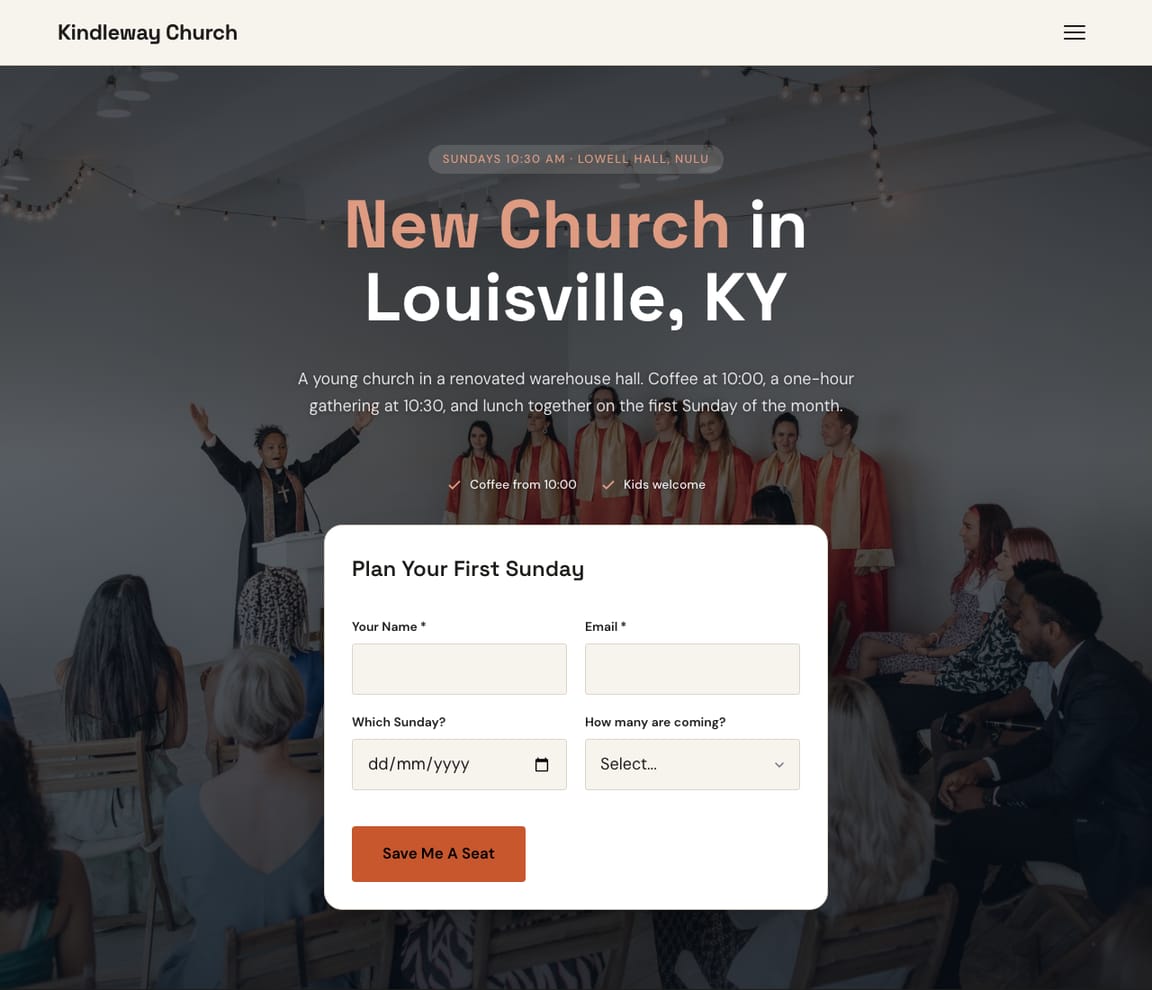
See what your church website could look like
This is a real Zarla template for a church plant. Describe yours — the services, what you believe, the town — and you'll have a site like this, with your service times and a contact form for visitors, in about a minute.
- Professional design — not a generic template
- Looks great on desktop and mobile
- Content written for your industry
Build the website
Start your church website now
Add your town and your church's name to the sentence, and Zarla builds the site: your services and times, what you believe and a contact form for visitors. Add your giving link, your groups and your address in chat, then publish.
Already have a website? Bring it across →Zarla keeps your old page addresses where it can and redirects the ones that change, helping you keep the Google standing you've built.
Is starting a church worth it in 2026 — and how is a congregation funded?
A church is not a business, so "worth it" means three things: is there a congregation to serve, will it still be meeting in a few years, and can it support a pastor. The giving. Religion received "$151.58 billion" in 2025, up 2.4 percent in current dollars and down 0.2 percent after inflation — 23 percent of all US giving (Giving USA 2026). The people. "62% of U.S. adults identify as Christians … a decline of 9 percentage points since 2014 and a 16-point drop since 2007. But for the last five years, between 2019 and 2024, the Christian share of the adult population has been relatively stable, hovering between 60% and 64%" (Pew Research Center, Religious Landscape Study, February 26, 2025); mainline Protestantism "has exhibited the sharpest drop, declining from 18% of U.S. adults in 2007" to 11 percent (Pew Research Center, 2025). The congregations. "From 2000 to 2020, the median average attendance among all faith communities dropped from 137 to 65", and 69 percent of congregations have 100 or fewer in worship (Baptist News Global, reporting the FACT 2020 census, October 15, 2021); the Southern Baptist Convention alone counts "46,876" cooperating churches (Southern Baptist Convention, fast facts). Openings and closings. "In 2019, approximately 3,000 Protestant churches were started in the U.S., but 4,500 Protestant churches closed" (Lifeway Research, May 25, 2021); five years earlier "More than 4,000 new churches opened their doors in 2014, outpacing the 3,700 that closed" (Lifeway Research, 2015).
Do new churches last, and whom do they reach? No openable page prints the "68 percent survive four years" figure that circulates — the study page is gone and the wire services refuse readers — so the guide prints what does open: a Lifeway study of 290 African-American church planters found "Ninety-four percent of the church plants studied are still in existence today. Among the churches that closed, lack of financial support was the most common contributing factor", with "door-to-door evangelism (75 percent) and conducting a new member class (68 percent)" among the churches with more new commitments (Lifeway Research, church plants started before 2012); and its 843-church study found "On average 42 percent of those worshiping at churches launched since 2008 previously never attended church or hadn't attended in many years", and the church "80/20 rule" is Lifeway's rule of thumb — "20% of our church members do 80% of the work. This isn't a hard and fast rule, but it's usually in the ballpark" (Lifeway Research, the 80/20 rule), while a giving platform says "A small number of families likely account for the vast majority of giving" (Pushpay, May 28, 2026); and with "77 percent say word of mouth and personal relationships are the most effective forms of publicity. Only 6 percent say social media is most effective" and "Nearly two-thirds of new churches (63 percent) say Bible study is their primary small group activity" (Lifeway Research, 843 churches from 17 denominations).
What pastors earn. Employed clergy had a median of $29.24 an hour, $60,810 a year, in 2025, with 242,000 employed and growth projected slower than average (O*NET, from BLS 2025 wage data); $59,480 in Texas (O*NET, Texas), $77,710 in California (O*NET, California), $58,580 in New York (O*NET, New York). The federal wage survey behind those medians leaves out the self-employed (Washington ESD) — the bivocational planter with a day job is not in it. The 2026 Southern Baptist compensation study, from "3,888 full-time senior pastors, staff ministers, and office personnel", found full-time senior pastors' pay including housing fell 1.5 percent over two years against a 6.3 percent rise in prices; its dollar medians sit in an interactive tool and are not printed on any page we could open (Lifeway Research, GuideStone and the state conventions, 2026). No survey prints a church founder's income, because a pastor is paid by the congregation or not at all — the planters here say which.
The catch. Half of US congregations have fewer than 65 people in worship, and "lack of financial support" is the first reason a new church closes; the room rent and the insurance ($4,556 of the first year below) come before the first offering; the political line the IRS draws has an excise tax behind it; and the people who start churches, by their own account, keep a day job. That's what the rest of this guide sets up.
How to start a church, in plain English
A church is tax-exempt without applying — the IRS says so in its own words. The notice requirement every other charity faces "shall not apply to— (A) churches, their integrated auxiliaries, and conventions or associations of churches" (26 U.S.C. §508(c)(1)(A)); "Churches that meet the requirements of IRC Section 501(c)(3) are automatically considered tax exempt and are not required to apply for and obtain recognition of tax-exempt status from the IRS" (IRS Publication 1828, Tax Guide for Churches and Religious Organizations). Churches file no annual Form 990 either (26 U.S.C. §6033(a)(3)(A)(i)). What the IRS looks for is a combination of fourteen characteristics — "distinct legal existence; recognized creed and form of worship; definite and distinct ecclesiastical government; formal code of doctrine and discipline; distinct religious history; membership not associated with any other church or denomination; organization of ordained ministers; ordained ministers selected after completing prescribed courses of study; literature of its own; established places of worship; regular congregations; regular religious services; Sunday schools for the religious instruction of the young; and schools for the preparation of its ministers" — and "The IRS generally uses a combination of these characteristics, together with other facts and circumstances, to determine whether an organization is considered a church for federal tax purposes"; "The IRS makes no attempt to evaluate the content of whatever doctrine a particular organization claims is religious, provided the particular beliefs of the organization are truly and sincerely held" (IRS, churches defined, June 2026). Courts "have placed special emphasis on four of the IRS's 14 criteria" — a real congregation served by an organized ministry, meeting regularly (Congressional Research Service, 2025). No church needs all fourteen; a page-1 checklist that calls them "attributes" to tick is wrong about the test. A religious organization that is not a church — an evangelistic association, a Bible study — is different: it "generally must apply to the IRS for tax-exempt status unless their gross receipts do not normally exceed $5,000 annually" (Publication 1828), and the same rules apply to a mosque, a synagogue or a temple.
The letter is optional, and the short form is closed to churches. "Although there is no requirement to do so, many churches seek recognition of tax-exempt status from the IRS because this recognition assures church leaders, members and contributors that the church is recognized as exempt" (Publication 1828). The short form's own instructions: "If you are seeking recognition as a church, school, or hospital, you are not eligible to use Form 1023-EZ and should instead submit Form 1023 if you wish to obtain a determination letter from the IRS. However, churches (including synagogues, temples, and mosques) … may be considered tax exempt under section 501(c)(3) even if they do not file Form 1023" (IRS, Form 1023-EZ instructions). The user fee for Form 1023 is $600; the short form's $275 is not available to a church (Revenue Procedure 2026-5, Appendix A). The EIN is free — "You never have to pay a fee for an EIN" (IRS) — and a church needs one to open a bank account. A paid "start a church" service sells nothing you cannot do for the statute's fee and the IRS's forms.
Incorporating, by state, for the fee the statute prints. Texas: a nonprofit certificate of formation is $25 (Tex. Bus. Orgs. Code §4.153); "Religious groups do not need a federal tax exemption to qualify for Texas state tax exemptions", which require "an organized, established group of people regularly meeting at a designated location to hold religious worship services" — "evangelistic groups, Bible study groups, prayer groups and revivals" do not qualify; the exempt church "must collect tax on most of their sales of taxable items" (Texas Comptroller, religious organizations), on Form AP-209 (Texas Comptroller, Form AP-209); property "used primarily as a place of regular religious worship" is exempt (Tex. Tax Code §11.20); and Texas has no general charity registration. Florida: "Articles of incorporation: $35" and "Designation of and acceptance by registered agent: $35", with a $61.25 annual report (Fla. Stat. §617.0122); sales and leases "directly to religious institutions when used in carrying on their customary nonprofit religious activities" are exempt, where religious institutions "means churches, synagogues, and established physical places for worship at which nonprofit religious services and activities are regularly conducted" (Fla. Stat. §212.08), claimed on Form DR-5 (Florida Department of Revenue, Form DR-5); property is used for a religious purpose once "the institution has taken affirmative steps to prepare the property for use as a house of public worship" (Fla. Stat. §196.196); and the solicitation act does "not apply to bona fide religious institutions" (Fla. Stat. §496.403). New York: a church incorporates under the Religious Corporations Law, filing its certificate "in the office of the clerk of said county" (N.Y. Religious Corporations Law §3) for "seventy-five dollars" (N.Y. Not-for-Profit Corporation Law §104-A); property "organized or conducted exclusively for religious … purposes" and used for them is exempt (N.Y. Real Property Tax Law §420-a); the exempt organization certificate comes on Form ST-119.2 (New York Tax Department, ST-119.2-I); and the charities article does not apply to "corporations organized under the religious corporations law" (N.Y. Executive Law §172-a). California is the inversion: "The fee for filing Articles of Incorporation of a Nonprofit Religious Corporation is $30.00" (California Secretary of State, Form ARTS-RE) plus a $20 statement of information within 90 days (California Secretary of State, forms); the state income-tax exemption is applied for, not automatic — "Your organization must apply to get tax-exempt status from us" (Franchise Tax Board); the church exemption from property tax is claimed on the Board's affidavit, for leased space too (California Board of Equalization, church exemption); and "there is no blanket sales or use tax exemption available for nonprofit religious organizations or churches, even when the organizations are exempt from income tax" (CDTFA Publication 18). None of Texas, Florida, New York or California licenses anyone to preach; the one place a state looks at ordination is the marriage statute — Texas recognizes "a licensed or ordained Christian minister or priest; (2) a Jewish rabbi; (3) a person who is an officer of a religious organization and who is authorized by the organization to conduct a marriage ceremony" (Tex. Fam. Code §2.202), Florida "All regularly ordained ministers of the gospel or elders in communion with some church, or other ordained clergy" (Fla. Stat. §741.07), New York "A clergyman or minister of any religion" (N.Y. Domestic Relations Law §11), California "a priest, minister, rabbi, or authorized person of any religious denomination who is 18 years of age or older" (Cal. Fam. Code §400). Check your own state's rules.
The room, and the law that protects the gathering. A school cafeteria has a posted rate: Richardson ISD rents one to a nonprofit at "$26 per hour with a 2-hour minimum", with maintenance support at $30 an hour where the district requires it (Richardson ISD, facility leasing fee schedule, June 11, 2026); Austin ISD lists a high-school cafeteria at "$225 per hour" with a "50% discount" for a 501(c)(3) (Austin ISD, facility use fees). A converted storefront needs an assembly occupancy — "Local enforcing agencies are classifying most churches and houses of worship as Group A-3" (New Jersey Department of Community Affairs). A home can be a church: "established places of worship" is one characteristic of fourteen, and federal law bars a land-use rule "that imposes a substantial burden on the religious exercise of a person, including a religious assembly or institution, unless the government demonstrates that imposition of the burden … (A) is in furtherance of a compelling governmental interest; and (B) is the least restrictive means" (42 U.S.C. §2000cc; Justice Department, RLUIPA) — "a federal district court on July 11 ruled that RLUIPA required the City of Los Angeles to permit a small Jewish congregation to hold services in a home" (Justice Department, Religious Freedom in Focus, August 2015). Ask the planning department whether religious assembly is permitted or conditional in your zone before you sign.
The political line, money and the pastor's pay — the rules with teeth. "all section 501(c)(3) organizations are absolutely prohibited from directly or indirectly participating in, or intervening in, any political campaign on behalf of (or in opposition to) any candidate for elective public office … Violating this prohibition may result in denial or revocation of tax-exempt status and the imposition of certain excise taxes" (IRS, political campaign intervention, June 2026) — "An initial tax is imposed on an organization at the rate of 10 percent of the political expenditures. Also, a tax at the rate of 2.5 percent of the expenditures is imposed against the organization managers" (Publication 1828). In July 2025 the IRS filed a proposed settlement in a Texas case saying that when a house of worship "in good faith speaks to its congregation, through its customary channels of communication on matters of faith in connection with religious services, concerning electoral politics viewed through the lens of religious faith" it neither participates nor intervenes — "a family discussion" (KPBS, July 8, 2025); the filing covers "communications internal to a house of worship, between the house of worship and its congregation, in connection with religious services", and "only one church ever has lost its tax exemption over politics" (Baptist Standard, July 8, 2025). The statute is unchanged and the IRS's own page still states the absolute prohibition; paid ads, mailers to the public and contributions to campaigns are not a family discussion. Donors need a letter: "A donor can't claim a tax deduction for any single contribution of $250 or more unless the donor obtains a contemporaneous, written acknowledgment of the contribution from the recipient church" (IRS Publication 1771; Publication 1828). A minister's housing allowance "must designate the housing allowance by official action taken in advance of the payment" and is excluded up to the least of what is spent, what is designated and the fair rental value (26 U.S.C. §107; Publication 1828) — upheld as constitutional: "We conclude § 107(2) is constitutional" (Gaylor v. Mnuchin, Seventh Circuit, March 15, 2019). Ministers pay self-employment tax on ministerial earnings — "The combined self-employment tax rate is 15.3%" (IRS Publication 517) — unless they qualify for the religious-objection exemption on Form 4361, for a minister "conscientiously opposed to, or because of my religious principles I am opposed to, the acceptance … of any public insurance" (IRS Form 4361); churches "are not liable for FUTA tax" but withhold for non-minister staff (Publication 1828). Unrelated business income of $1,000 or more goes on Form 990-T.
Insurance, checks and workers' compensation. Insureon's nonprofit customers — "such as churches and charitable organizations" — pay a median $42 a month for general liability, "$500 per year", $82 for a business owner's policy, $62 for workers' compensation and $67 for directors and officers cover (Insureon, nonprofit insurance costs); the school district's facility agreement wants the certificate, and insurers price a church on whether everyone with the children is checked — Checkr's basic report is $29.99 (Checkr, pricing). Workers' compensation is not universal: "in Texas, private employers can choose to carry workers' compensation insurance coverage, but it is not required in most cases" (Texas Department of Insurance); Florida requires it of "All private employments in which four or more employees are employed by the same employer" (Fla. Stat. §440.02); New York's compulsory list excepts "persons engaged in a teaching or nonmanual capacity in or for a religious, charitable or educational institution" — a church that pays only clergy is generally outside it, one that pays a custodian or a musician is not (N.Y. Workers' Compensation Law §3); California — "If a business employs one or more employees, then it must satisfy the requirement of the law" (California DIR).
The money to start. The church business plan page prices a portable church — a sound rig, a screen, a kids' setup, a launch mailing, a school cafeteria with a deposit — at $12,772 to $46,304 before the optional IRS letter and trailer; here is the leaner first year in a rented cafeteria from the posted rates and the vendors' own pages: the Texas filing ($25), a 4,000-lumen projector ($439.99 — ViewSonic), two vinyl banners at $6.99 each ($13.98 — BannerBuzz), five background checks ($149.95), a year of general liability at Insureon's "$500 per year" median ($500) and the cafeteria for three hours on 52 Sundays ($4,056) — $5,184.92, our arithmetic; $7,184.92 with a portable PA at a planning $2,000, because every music retailer refuses a scripted reader and no list price opens; $3,935.60 more for forty church chairs at $98.39 if the room has none (Staples, Flash Furniture church chair); $600 more if you file Form 1023. Giving costs nothing monthly: Tithe.ly's free plan is "2.9% + $0.30 per credit or debit card gift · 1% + $0.30 per ACH/bank transfer" (Tithe.ly, pricing), Subsplash's "2.99% + 30¢ for standard cards, 1% + 0¢ for ACH" (Subsplash, pricing); Planning Center's free tier covers ten check-ins a day (Planning Center, pricing) and Breeze is "$72 per month" flat (Breeze, pricing). A house church starts for the state filing alone. A denomination's network adds assessment and training — the Assemblies of God's network lists "REGISTRATION $599" for its launch training and "$22M+ Matching funds" since 2008 (Church Multiplication Network), ARC says it "has invested $80 million into church planting" (Association of Related Churches), Acts 29 "exists to plant churches worldwide by recruiting, assessing, training, coaching, and supporting church planters" (Acts 29) — no network prints a per-plant figure on a page that opens.
In the UK: a church is a charity in law and registers with the Charity Commission at £5,000 of income (GOV.UK, register your charity) — unless it is an excepted charity: "its income is £100,000 or less and it is in one of the following groups: churches and chapels belonging to some Christian denominations", an exception with an end date of March 31, 2031 (Charity Commission, excepted charities); an independent church outside the listed denominations registers like any charity, and is regulated as one — the inversion of the US rule, which exempts a church from the regulator rather than from registration. Gift Aid returns "25p every time an individual donates £1" (GOV.UK, Gift Aid); VAT registration is required at £90,000 of taxable turnover (GOV.UK); a building is certified as a place of worship under the 1855 Act before it can be registered for marriages (Places of Worship Registration Act 1855). In Australia: a church registers with the ACNC with the subtype of advancing religion (ACNC, start a charity) and, if it meets the criteria — not incorporated under the Corporations Act, not endorsed as a deductible gift recipient, under $100,000 in government grants — is a Basic Religious Charity with lighter reporting (ACNC, Basic Religious Charity); tax concessions follow ATO endorsement of a registered religious institution (ATO, religious institutions); "your religious institution must register for GST if its GST turnover is $150,000 or more" (ATO, August 2026); in New South Wales a religious body that is a recognized denomination needs no fundraising authority, and a new independent church does (NSW Government, authority to fundraise). Check your own regulator's rules.
What church planters actually say
None of this is our opinion about starting a church. It comes from pastors and church planters — in Rhode Island, Florida, Massachusetts, Pennsylvania, Texas, Georgia, Sacramento and Miami — talking to denominational news sites, the Christian Post, an NPR station, Crosswalk and CanvasRebel between 2012 and 2026, each described as the page describes them. Read each as theirs at the time. Five things come up again and again.
Keep the day job. Joe Paravisini, "a software engineer and pastor of The Neighborhood in Providence, R.I.": “Church planting is hard. It's even harder if you're trying to reach those outside of the church.” And: “Planting a church here means understanding that the local giving will always be a struggle, so finding ways to supplement that is important.” And: “I can afford to slow down and walk with people on God's time since there is no ticking clock on a budget running out.” (The Banner, July 24, 2019). Mauricio Chenlo, church-planting director for the Mennonite Mission Network and formerly a bivocational planter: “Bivocational ministry is the present and the future here in America, particularly in terms of church planting.” And: “Most of the church planters I know are not coming out of the seminary; they are carpenters, or people working in corporate business, or nurses.” (Mennonite Mission Network, June 27, 2012). Mark Coppenger, a bivocational church planter on Chicago's north shore and a seminary professor: “God may call you to a big county seat church in Dixie, or He just may call you to be a bivocational church planter. Come on in, the water's fine. It's wonderful, wonderful work.” (The Christian Post — undated, read 2026).
“They let me print color copies of the Prayer Experiment cards my congregation will use during Lent, saving my church plant about $100. Every little bit counts.” — the Rev. Leslie Stewart, church planter in the Episcopal Diocese of Dallas, in the diocese's A Day in the Life of a Church Planter, February 16, 2018
The launch, and the sending church. Jeff Cranford, pastor of Living Truth Church in Cantonment, Florida, which meets in a gym: “Being the pastor of a church plant can cause you to have your hands in various tasks, but our team is great at sharing the load. I try to focus on teaching, praying, meeting with people and shepherding and steering the general direction of the church.” (Florida Baptist Convention, June 27, 2024). Eric Mitchell, planting Cornerstone Baptist Church in Pace, Florida for 2026: “This journey began more than two years ago with seeking clarity and confirmation of the calling.” And Doug Kimsal, executive pastor of the sending church, on why plant at all: “New churches less than three years old tend to create 10 new believers per 100 attenders in a year. Congregations three- to 15-years-old produce five new believers per 100, and those over 15 years old drop to three new believers per 100 attenders each year.” (Florida Baptist Convention, September 8, 2025). Jeremy Westbrook, senior associate pastor of Calvary Baptist Church in Clearwater: “We had a vision birthed in 2016 to plant 100 churches internationally, plant 25 churches nationally, and revitalize 20 churches locally within the next 10 years.” (Florida Baptist Convention, March 24, 2020). Pastor Laboy of Iglesia Comunidad Biblica in Spring Hill, Florida, under a year old: “This church started with a small group. That's how God used this group to start here.” And: “We would like to have three community groups, but we need to prepare the leaders for those groups first.” (Florida Baptist Convention, September 5, 2023).
The first people come by invitation. Jacob Ambrose, who moved from Louisiana to plant Valley Church in Tewksbury, Massachusetts: “I was in a moment of frustration dealing with some of those things when I realized I needed a haircut. I just looked up a barber on Google Maps and went to his shop.” And: “And he's cutting my hair. We had just moved to Tewksbury to start the exact church he wants to go to. I said, 'Bro, you're not going to believe this.'” (Baptist Message, July 24, 2026). McCurdy, campus pastor of FLC Pavilions in Sacramento, launched at Easter 2018 in a school: “The PTA (Parent Teacher Association) [of Sierra Oaks K-8 Elementary School] has asked us, as a church, to form an official partnership with them for volunteer and mentor programs and helping at the school.” And Saunders, pastor of a Wesleyan campus in Lehighton, Pennsylvania: “On the Saturday afternoon prior to launch, one of the launch team felt compelled to stop and invite an elderly couple he observed sitting on the porch of their home as he drove by.” (The Wesleyan Church, May 21, 2018). Ron Sylvia, founding pastor of The Springs in Ocala, Florida: “I heard God whisper, 'I want you to begin a contemporary praise and worship church.'” (Crosswalk, November 5, 2024). Elijah Griggs, pastor of The Hub Southwest in Buena Vista, Georgia: “I told God before I started pastoring The Hub Southwest if your gonna call me to pastor it has to be different you have to give me something creative and he did!” (CanvasRebel, June 20, 2024).
The house church, and the screen. Gary Alloway, pastor of Redemption Church in Bristol, Pennsylvania: “I'm not writing a sermon for 12 people. How about you guys come over to my living room? We'll open a Bible, we'll talk about it, we'll eat together.” And: “I don't know that everyone needs to do house churches, but every church should be doing the things that house churches are doing — that ability for people to come into something right away and be known.” (KUNC, February 22, 2015). Christopher Benek, pastor of First Presbyterian Church of Miami, launching a virtual-reality congregation: “I think that it is important to understand that creation of CHVRCH+ (pronounced 'Church Plus') is not to displace the local congregation.” (The Christian Post, April 2, 2020).
The through-line: the planters who lasted kept a day job, started with a small group that already knew them, invited one household at a time, leaned on a sending church or a network for the training and the first money, and treated the room, the insurance and the paperwork as the scaffolding — not the church.
THE STARTER KIT
What you need to start a church
A gathered congregation and a leader
The IRS's own test is a combination of characteristics — a regular congregation, regular services, an organized ministry — not a building and not a letter. Start with the people, meeting.
The entity, for the fee the statute prints
A nonprofit corporation in your state — $25 in Texas, $35 and $35 in Florida, $75 in New York, $30 and $20 in California — with bylaws and a board, then the free EIN and a bank account in the church's name.
The IRS letter, only if you want it
A church is tax-exempt by statute without applying; Form 1023 is optional, costs $600, and the short form is closed to churches. The letter gives assurance to banks and donors, not the exemption.
A room with a posted rate
A school cafeteria, a community room, a storefront with an assembly occupancy, or a living room — and the federal land-use law that stops a city from burdening the gathering.
Insurance, checks and the certificate
General liability naming the school district, cover for the portable kit, background checks for everyone with the children, and workers' compensation where your state requires it once you pay anyone.
A giving channel, and a day job
A giving platform with no monthly fee and a per-gift charge, the $250 acknowledgment letters the IRS requires, and the bivocational income the planters here say is the present and the future.
THE PAPERWORK
Filings, exemptions and insurance for a new church
| Typical cost | Time to get | Legally required? | |
|---|---|---|---|
| Nonprofit incorporation | $25 (TX); $35 + $35 (FL); $75 (NY); $30 + $20 (CA) | Days to weeks | No — a church is a church unincorporated; nearly all incorporate for the liability shield |
| EIN | Free | Minutes online | Yes to open the bank account and pay anyone |
| Form 1023 (the IRS letter) | $600; the $275 short form is closed to churches | Months | No — a church is exempt by statute; the letter is assurance for banks and donors |
| Form 990 | — | — | No — churches are excepted; Form 990-T at $1,000 of unrelated business income |
| State sales-tax exemption | Free (TX AP-209; FL DR-5; NY ST-119.2) | Weeks | Optional — and California gives none |
| Property-tax exemption | Free to claim | The county's cycle | Only if you own or lease a building — TX §11.20, FL §196.196, NY §420-a, CA's church exemption |
| Charity registration | — | — | Religious institutions exempt in FL and NY; none in TX; ask California's Attorney General about its registry |
| Zoning and occupancy | Set by the city | Before the lease | Yes for a building (assembly, Group A-3); a home is shielded by RLUIPA from a substantial burden |
| General liability | $42/mo median (Insureon, nonprofits) | Days | Not by law; the school district's agreement requires the certificate |
| Background checks | $29.99 a report (Checkr Basic) | Days | Not by federal law; insurers and districts expect them for anyone with the children |
| Workers' compensation | $62/mo median (Insureon, nonprofits) | Days | Yes in CA (from 1); FL from 4; NY unless only clergy and non-manual staff; optional for most TX employers |
| Donor acknowledgment letters | Free | Within the year | Yes for the donor's deduction on any single gift of $250 or more |
THE STEPS
How to start a church (step by step)
Eight steps from a living-room Bible study to an incorporated, insured, meeting congregation with its first Sunday behind it.
01
Gather the core, and decide the shape
A launch team that meets, prays and invites; a decision between a denomination's network (assessment, training, sometimes matching funds), an independent start, a house church or an online one. The IRS test is the same for all of them.
02
Write what you believe and how you govern
A statement of faith, bylaws that say who decides what, and a board — the IRS's 'recognized creed and form of worship' and 'definite and distinct ecclesiastical government' are two of its fourteen characteristics.
Before the filing03
Incorporate in the state, take the EIN, open the account
The nonprofit certificate of formation for the fee the statute prints — Texas $25, Florida $35 plus $35, New York $75 with the county clerk, California $30 plus $20 — then the free EIN, then the bank account in the church's name, never a person's.
04
Claim the state exemptions, and decide on the letter
Texas's sales and franchise exemption needs no federal letter; Florida's certificate keys on an established place of worship; New York issues an exempt organization certificate; California gives no sales-tax exemption at all. Form 1023 is optional, $600, and only on the long form.
05
Find the room and read the zoning
A school cafeteria at the district's posted rate, a community room, a storefront with an assembly occupancy — or a home, where federal law protects the gathering from a land-use burden the city can't justify.
06
Insure, check and train
General liability for the landlord's certificate, cover for the projector and the chairs, background checks for everyone with the children, and workers' compensation where your state requires it once anyone is paid.
07
Set up giving, payroll and the letters
A giving platform with no monthly fee, the written acknowledgment for every gift of $250 or more, the housing allowance designated in advance if you pay a pastor, and the political line the IRS draws — kept.
08
Invite, launch, and get found
Word of mouth and personal relationships are what new churches say works; a website with the service time, the address and what to expect; a Google Business Profile for the Saturday-night search; preview services before the launch Sunday.
THE COSTS
How much does it cost to start a church?
The church business plan page prices a portable launch at $12,772 to $46,304; the total here is this guide's own leaner first year in a rented school cafeteria, from the district's posted rate and vendors' own pages: the Texas filing, a projector, two banners, five background checks, a year of general liability at the median, and the cafeteria for three hours on 52 Sundays. A portable PA, chairs, Form 1023 and district staffing come on top; a pastor's pay too.
$5,184.92for a first year in a rented cafeteria — the room and the insurance are most of it (our arithmetic)
$7,184.92with a portable PA at a planning $2,000 — no music retailer's list price opens
$25–$75to incorporate — Texas $25, Florida $35 plus $35, New York $75, California $30 plus $20 — and the EIN is free
$600the IRS user fee for Form 1023, if you want the letter; the exemption itself costs nothing
WHAT WE'VE LEARNED
What actually makes a visitor come on Sunday
Thousands of local organization websites in, the pattern for congregations is clear: the visitor wants to know when and where, what to expect, and what you believe — before they walk in. For a new church, three things on a page decide who visits.
When and where, in the first screen
The service time and the address — the cafeteria, the room, the parking — in the first screen, with a map. The first thing a visitor checks, and the thing a new church's site most often buries.
What to expect, and what you believe
How long the service is, what happens with the kids, what to wear, and a plain statement of what the church believes. A visitor who can picture the morning, and knows where you stand, comes.
A way to ask, and a way to give
A plan-your-visit form a family can send on Saturday night, and the giving link once you have one — the room rent and the insurance are carried by the people who found you here.
THE FUNDING
How a congregation is funded, and what pastors are paid
Giving from Giving USA, the openings and closings from Lifeway Research, congregation size from the FACT census, clergy pay from O*NET's 2025 figures. A church receives rather than earns — the gifts of the people who found it decide the rest.
$151.58Bgiven to religion in 2025, 23 percent of all US giving — up 2.4 percent in current dollars, down 0.2 after inflation (Giving USA 2026)
65the median congregation's weekly attendance in 2020, down from 137 in 2000 (FACT census)
42%of worshipers at churches launched since 2008 had never attended church or not in many years (Lifeway Research)
$60,810the 2025 median for employed clergy (O*NET) — a survey that leaves out the self-employed and the planter with a day job
SEE IT WORK
Church website designs you can start from
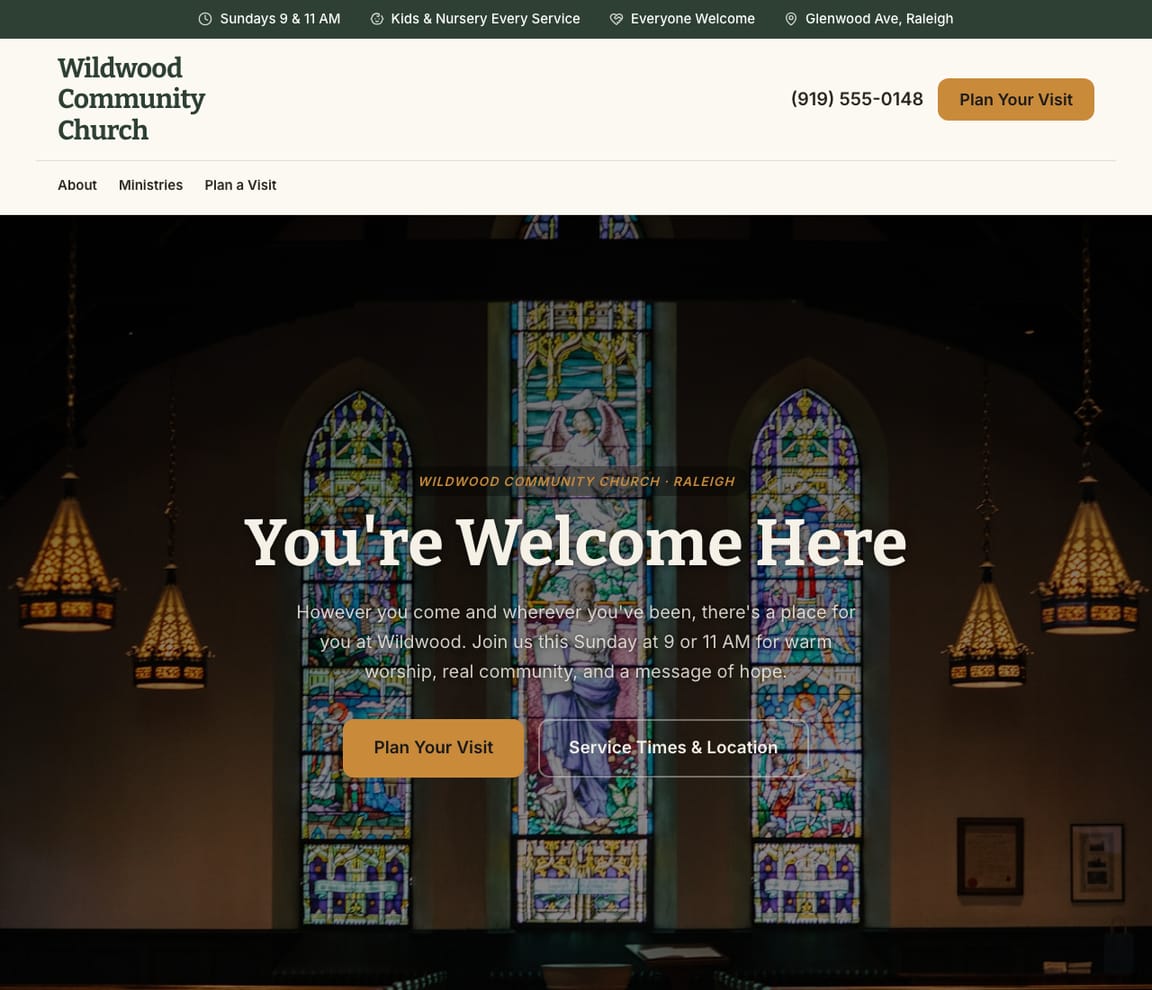
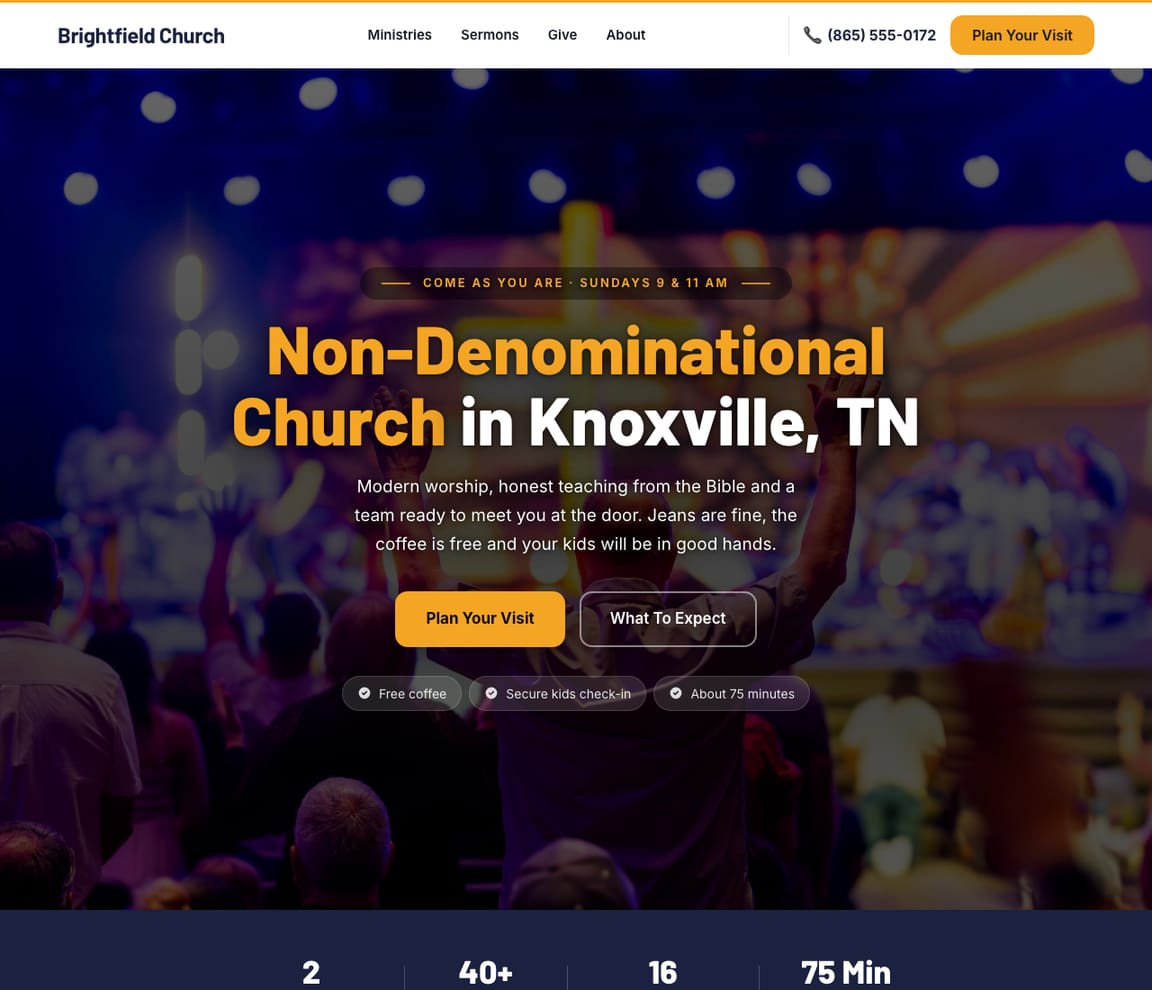
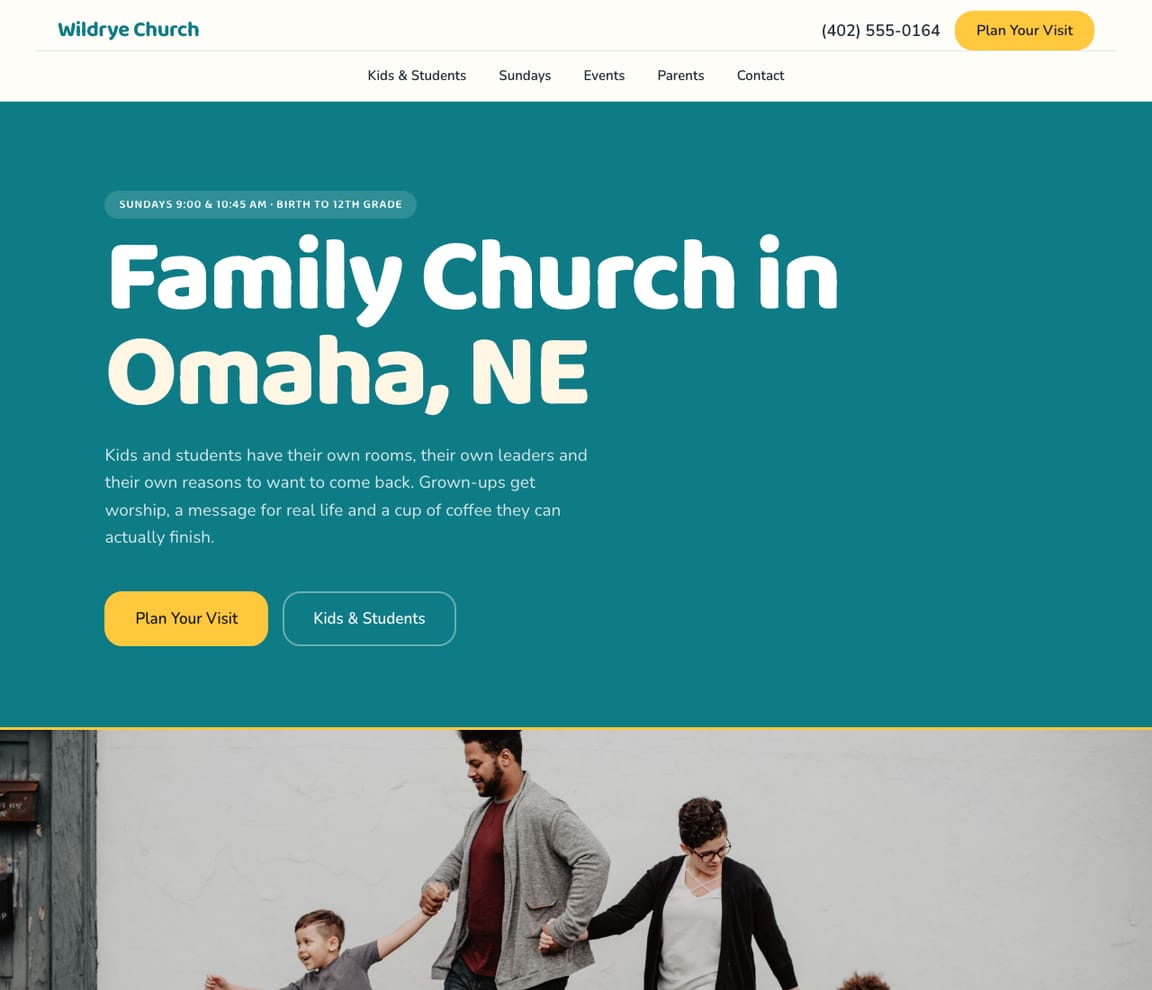
Real Zarla templates for congregations: a church plant, a welcoming community church, a non-denominational church and a family church — service times up top, what you believe, the groups, a plan-your-visit section and a contact form. Open one, swap in your services, your story and your own photos, and publish.
GET FOUND
Get found by the family that moved in last month and is looking for a church
A family new to town searches for a church near them on a Saturday night and visits the one whose service time, address and what-to-expect are on the page; a couple searches for a church that does weddings. Zarla builds the website with your services and a contact form for visitors. Add your giving link, your groups and your address in chat, and once you connect your Google Business Profile, your name, service times and photos stay in step on both.
“Church near me”
Searched by a family that just moved, a student on a new campus, and someone who hasn't been in years. Your service time, your address and what to expect answer it.
Google Business Profile
Your meeting place, your service times and photos of the room inside Google Maps — and a profile that shows a real, meeting congregation. Free, and an afternoon to set up.
The what-to-expect photo
The room on a Sunday, the kids' area, the coffee table — on the page and on the profile. A visitor who can picture the morning comes.
Google Search
Rriverbendcommunitychurch.com
Riverbend Community Church — Trusted church in Your AreaSundays at 10 am in the Lake Highlands cafeteria. A new church for Richardson — kids' program, small groups, and a plan-your-visit form. Everyone welcome.← Your Zarla siteCcitychurchservices.com
City church ServicesGoogle Maps
1
Riverbend Community Church
← You2
Metro church Co.
3
Quick church Services
AI assistants (ChatGPT / Perplexity)
For a new church in Richardson meeting Sundays at 10 in a school cafeteria with a kids' program and small groups in your area: Riverbend Community Church — a church whose site shows the service time and the address, what to expect on a first visit, what the church believes, and a form to ask a question or plan a visit.
YOUR LAUNCH PLAN
Your church launch checklist
The whole guide as things to check off. Work through them in order and you'll be incorporated, insured, exempt and meeting before launch Sunday.
- Gather the launch team and choose the shape — network plant, independent, house or online.
- Write the statement of faith and the bylaws; name the board — before any filing.
- Incorporate for the statute's fee, take the free EIN, open the account — in the church's name.
- Claim the state exemptions; file Form 1023 only if you want the letter — $600, long form only.
- Rent the room at its posted rate and read the zoning — the land-use law is on your side.
- Insure the gathering, check everyone with the children — the district wants the certificate.
- Set up giving, the $250 letters, payroll and the housing allowance — and keep the political line.
- Invite, preview, launch — and get found — a website with the time and the address, a Google profile.
REAL CUSTOMERS
Organizations and small businesses that got online with Zarla
Verified reviews from real Zarla customers.
“Quickly built my website from scratch. No hiccups. Would highly recommend Zarla for someone with no experience who wants to start a polished business website.”
“Great professional website in less than a minute, with the use of AI and a few descriptive prompts. This has saved me bundles of time and research on web developers.”
“I had no idea how to set up a website for my business. Thanks to Zarla, they've helped me a lot.”
“Very reliable, professional, and fast results. I was able to get my business online in no time, and the ease of access made it so simple.”
Be the church a family finds on Saturday night — and visits on Sunday
Add your town and your church's name, and Zarla builds the website from that one line — your services and times, what you believe, a contact form a visitor can send a question from, and SEO in place. Add your giving link, your groups and your address in chat. Free to build; you pay when you publish.
Already have a website? Bring it across →Zarla keeps your old page addresses where it can and redirects the ones that change, helping you keep the Google standing you've built.
Frequently asked questions
How much does it cost to start a church?
In the US, as little as the state filing: $25 in Texas, $35 plus $35 for the registered agent in Florida, $75 in New York, $30 plus a $20 statement in California — and the EIN is free. A first year in a rented school cafeteria, from the district's posted rate and the vendors' own pages, is $5,184.92 in our arithmetic: the $25 filing, a $439.99 projector, two banners at $13.98, five background checks at $149.95, a year of general liability at the $500 median and the cafeteria for three hours on 52 Sundays at $26 an hour ($4,056); $7,184.92 with a portable PA at a planning $2,000; $3,935.60 more for forty chairs if the room has none; $600 more for Form 1023 if you want the IRS letter. A house church starts for the filing alone.
How do I start a church legally?
In the US: gather the congregation and write what you believe and how you govern; incorporate as a nonprofit in your state for the fee the statute prints (Texas $25, Florida $35 plus $35, New York $75 filed with the county clerk under the Religious Corporations Law, California $30 plus $20); take the free EIN and open a bank account in the church's name; claim the state exemptions — Texas's sales and franchise exemption needs no federal letter, Florida's certificate keys on an established place of worship, New York issues an exempt organization certificate, California gives no sales-tax exemption; file Form 1023 only if you want the IRS letter ($600; the short form is closed to churches); check the zoning and occupancy of the room; insure it; keep the political line; send a written acknowledgment for every gift of $250 or more. No license to preach exists in Texas, Florida, New York or California. Check your own state's rules.
Do I need to file Form 1023 to start a church?
No. In the US a church that meets the requirements of section 501(c)(3) is tax-exempt by statute and is not required to apply — the IRS's own guide says so, and the law exempts churches from the notice requirement every other charity faces. Many churches apply anyway, because the letter assures banks, grant-makers and donors; if you do, it is the full Form 1023 at a $600 user fee, because the instructions for the $275 short form say a church is not eligible to use it. Contributions to a church are deductible whether or not it holds a letter; the state property and sales-tax exemptions are state processes, and Texas says outright that a federal exemption is not needed for them.
How do I start a church with no money?
As a house church, for the state filing alone — $25 in Texas — with the free EIN, a giving platform that charges per gift rather than per month, a free church-management tier for check-ins, and the pastor keeping a day job, which the planters here call the present and the future of church planting. Federal law shields a congregation meeting in a home from a land-use burden the city cannot justify. A rented room is where the money goes: $5,184.92 for a first year in a cafeteria in our arithmetic, of which the room and the insurance are $4,556. A denomination's network adds assessment, training and sometimes matching funds — the Assemblies of God's network reports $22 million of matching funds since 2008 — but no network prints a per-plant figure on a page that opens.
Can I start a church in my home?
In the US, yes. To the IRS, an established place of worship is one of fourteen characteristics, not a requirement, and courts have emphasized the gathered congregation and the regular services, not the building. The constraint is local land use, and federal law is on the congregation's side: no government may impose a land-use rule that places a substantial burden on a religious assembly unless it shows a compelling interest pursued by the least restrictive means, and the Justice Department records a federal court ordering Los Angeles in 2015 to permit a small Jewish congregation to hold services in a home. Ask the planning department whether religious assembly is permitted or conditional in your zone, and check your own city's rules.
Can a church endorse a candidate?
In the US the statute says no: every 501(c)(3), churches included, is absolutely prohibited from participating or intervening in any political campaign for or against a candidate, with revocation and an excise tax of 10 percent of the political spending (and 2.5 percent on the managers) behind it. In July 2025 the IRS filed a proposed settlement in a Texas case saying that a house of worship speaking to its own congregation, through its customary channels, in connection with religious services, about electoral politics through the lens of faith is not intervening — it compared it to a family discussion. The law is unchanged and the IRS's own page still states the prohibition; paid ads, mailers to the public and contributions to campaigns are not covered, and only one church has ever lost its exemption over politics. Confirm the details with your accountant or a lawyer.
How much do pastors make?
Employed clergy had a median of $29.24 an hour, $60,810 a year, in 2025 — $59,480 in Texas, $77,710 in California, $58,580 in New York (O*NET, from BLS data), in a survey that leaves out the self-employed and the planter with a day job. The 2026 Southern Baptist compensation study of 3,888 full-time senior pastors, staff and office personnel found senior pastors' pay including housing fell 1.5 percent over two years while prices rose 6.3 percent; its dollar medians are in an interactive tool, not on any page we could open. A minister's housing allowance is excluded from income tax when designated in advance, and ministers pay the 15.3 percent self-employment tax on their ministerial earnings unless they hold the religious-objection exemption.
How does a church make money?
It doesn't make money; it receives gifts. Religion received $151.58 billion of US giving in 2025 — 23 percent of the total, up 2.4 percent in current dollars and down 0.2 percent after inflation. Online giving costs the congregation a fee per gift and nothing monthly on the platforms we read: 2.9 percent plus 30¢ a card gift and 1 percent plus 30¢ by bank transfer at one, 2.99 percent plus 30¢ at another. Rent from church property is generally outside unrelated business income, but income of $1,000 or more from a genuine unrelated business is reported on Form 990-T. Every donor needs a written acknowledgment for a single gift of $250 or more to claim the deduction.
What is the difference between a church and a ministry?
To the IRS, a church is judged on a combination of fourteen characteristics — a regular congregation, regular services, an organized ministry, a creed, a place of worship among them — and is exempt without applying and files no Form 990. A ministry that is not a church — an evangelistic association, a Bible-study group — is a religious organization: it generally must apply to the IRS for exemption unless its gross receipts do not normally exceed $5,000 a year, it may use the $275 short form if it qualifies, and it files the annual return. Texas draws the same line for its state exemptions: groups that simply support or teach religion — evangelistic groups, Bible studies, prayer groups and revivals — do not qualify as religious organizations.
What are the different church denominations?
Pew's Religious Landscape Study groups US Protestants into evangelical, mainline and historically Black traditions, with 62 percent of adults identifying as Christian in 2023 and 2024 — stable for five years after a 16-point fall since 2007 — and mainline Protestants down from 18 percent of adults to 11. The largest Protestant body is the Southern Baptist Convention, with 46,876 cooperating churches. A new church chooses between a denomination, whose network assesses, trains and sometimes funds its planters, and an independent start; the IRS treats both the same, and in the UK only churches of listed denominations are excepted from charity registration.
What are 5 ways to attract people to church?
From Lifeway's study of 843 new churches: personal invitation — 77 percent say word of mouth and personal relationships are the most effective publicity, and only 6 percent say social media; a small-group structure — 63 percent say Bible study is the primary small-group activity; a launch team that invites, as the Pennsylvania planter here did the Saturday before launch; serving the host school or neighborhood, as the Sacramento church whose PTA asked for a partnership did; and door-to-door visiting and a new-member class, which Lifeway's study of 290 African-American church plants linked to more new commitments. Preview services before the launch Sunday are the sixth.
What is the 80/20 rule in churches?
A rule of thumb from the Pareto principle, not a measured figure: Lifeway Research frames it as 20 percent of the members doing 80 percent of the work, adding that it isn't a hard and fast rule but is usually in the ballpark; a giving-platform vendor says a small number of families likely account for the vast majority of giving. No openable page prints a measured split. In a new church the numbers are small either way — half of US congregations have fewer than 65 people in worship, so the 20 percent may be five people.
What are red flags in a church?
The IRS's own list is the honest answer: net earnings that benefit a private individual, intervention in a political campaign, substantial lobbying, and activities that are illegal or violate fundamental public policy — each a ground for revocation, and the political one carries an excise tax. The practical ones a visitor or a donor can check: no written acknowledgment for gifts of $250 or more, no board or bylaws, no insurance certificate for the rented room, and no background checks for the people with the children. Only one church has ever lost its tax exemption over politics, by the Baptist Standard's account.
What is the fastest declining church?
By share of US adults, mainline Protestantism has fallen fastest — from 18 percent of adults in 2007 to 11 percent in Pew's 2023 and 2024 study — while the Christian share overall has held between 60 and 64 percent since 2019. By congregation count, Lifeway estimates 4,500 Protestant churches closed in 2019 against about 3,000 started, and the FACT census found the median congregation's weekly attendance fell from 137 in 2000 to 65 in 2020. No denomination's own ranking of decline was on a page we could open.
How do I start a church for tax purposes?
The IRS's rules and its warnings are the only honest answer. A church must be organized and operated exclusively for religious or charitable purposes, its net earnings may not benefit any private individual, it may not intervene in campaigns or substantially lobby, and the IRS judges whether it is a church on a combination of fourteen characteristics together with other facts — a real congregation, regular services, an organized ministry — while making no attempt to evaluate the content of a doctrine provided the beliefs are truly and sincerely held. The exemption is automatic for a church that meets the test; the consequences for one that does not are revocation, excise taxes and tax on unrelated business income. The housing allowance and the self-employment-tax exemption exist for ministers who meet their stated conditions, the second only for a conscientious religious objection. Confirm the details with your accountant.