BUSINESS GUIDE
How to start a courier business in 2026
Same-day runs, daily route stops for clinics and offices, medical specimens and legal filings: what couriers charge, when you need a USDOT number or operating authority, the insurance a personal policy may not cover, your first clients — and the car you already own.
Free to build · Pay when you publish · No credit card
$10–$200a delivery on one Austin courier's 2026 rate card, nearest zone to farthest
$32.50a scheduled route stop a day at one California courier
10,001 lbthe vehicle weight where federal safety rules start on interstate runs
No codeto get online
See it in action
See what your courier website could look like
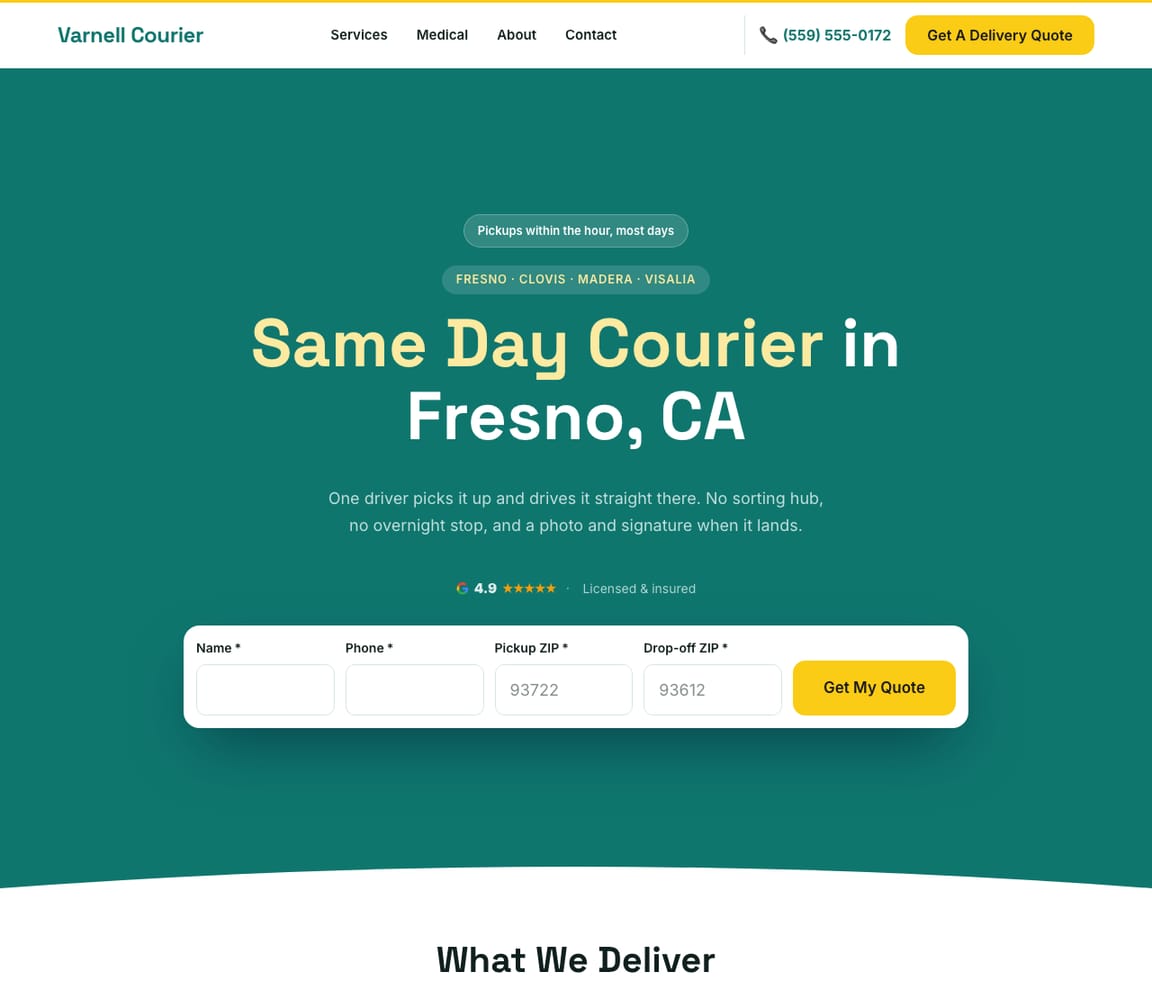
This is a real Zarla template for a same-day courier. Describe yours — what you carry, the towns you cover, how fast you pick up — and you'll have a site like this, with a delivery quote form up top and a section for medical work, in about a minute.
- Professional design — not a generic template
- Looks great on desktop and mobile
- Content written for your industry
Build the website
Start your courier website now
Add your town and your business name to the sentence, and Zarla builds the site: a call button at the top, a service-area map and a request form. Add your services, your rush tiers and your hours in chat, then publish.
Already have a website? Bring it across →Zarla keeps your old page addresses where it can and redirects the ones that change, helping you keep the Google standing you've built.
Is a courier business worth starting — and what do couriers charge?
A courier business carries things from one business to another the same day: documents, parts, specimens, packages. It comes in four shapes, and one business can do several. On-demand runs are booked when the client needs them, priced by distance and speed. Scheduled routes stop at the same clinics, labs, offices or parts counters every day for a monthly fee. Contract work takes runs from a bigger courier company or a delivery network, in your own vehicle. And a few people start fleet businesses under a national carrier's program.
What couriers charge. Few publish a price list — a Chicago courier's own page says "Very few Chicago couriers publish rates, because the multipliers matter more than the base" (Midwest Courier) — but some do. An Austin courier's rate card, effective July 6, 2026, runs from $10.00 for an all-day delivery in its nearest zone to $200.00 for an ASAP run to its farthest, with $2.00 a mile in a car and $2.50 in a van outside the city, waiting time at $80.00 an hour after 30 free minutes, and payment on net 30 days (ENERGY Transport Logistics, 2026). One medical courier's booking form charges a $35 base for standard same-day, $55 for a four-hour window, $75 for two hours and $115 for STAT, with the first 10 miles included, $2.50 a mile after and a $7 surcharge on every booking (Best Friends Medical Courier Services). In Ventura County, California, a route stop starts at $32.50 a day — $704 a month for one stop every weekday, in the courier's own example — and local rush is $54.50 (Central Courier). A Manhattan bike courier charges a $26.50 base, and 1.5 to 4 times that for its rush tiers (Breakaway Courier); a Nassau County, New York courier charges a flat $19 a parcel for pre-labeled local deliveries, with a 10-delivery minimum (Road Flex Courier). Dropoff, a same-day courier company, puts per-mile fees for medical deliveries at $1.40 to $1.90 in a sedan and $2.20 to $3.75 in a cargo van in its own 2026 medical courier pricing guide (Dropoff, February 2026).
The demand. Employment of couriers and messengers is projected to grow 7% or more from 2025 to 2035, much faster than average (O*NET). Solo delivery work is growing too: the Census Bureau counted 1,595,662 courier and messenger businesses with no employees in 2024, up from 1,438,339 the year before (Census Bureau, Nonemployer Statistics 2024).
The catch. Most of those businesses are small and part-time. The count includes app drivers — the government's own definition of local delivery names grocery and restaurant meal delivery (NAICS Manual) — and 94% of them took in under $50,000 in 2024, about $14,900 on average. In the wage survey, which leaves out the self-employed (Washington State ESD), employed couriers and messengers earned a 2025 median of $39,200 a year, and light truck drivers $44,860 (O*NET, O*NET). The owner's income has to beat that after fuel, insurance and wear on the vehicle — so the business that lasts sells routes and rush work to offices, not the cheapest single runs an app already covers. That's what the rest of this guide sets up.
How to start a courier business, in plain English
Your own clients, or someone else's. The fastest start is contract work in your own vehicle. Dropoff, a Texas-based same-day courier, asks its couriers to be 21 or older with a registered, insured and inspected car, SUV or van "that is less than 10 years old", pays by the delivery and gives its recurring routes to "the best of our couriers" (Dropoff); FRAYT says its drivers make "an average of $20-$30 per hour" and takes cargo vans under 10,000 pounds (FRAYT); Roadie, a UPS company, has "NO MINIMUM VEHICLE STANDARDS" and pays "up to $12 per local trip" (Roadie); and USA Couriers takes applications from independent contractors and from courier companies (USA Couriers). Those are the networks' own words. Your own clients pay more and take longer to win. MedSpeed, a courier for hospitals and health systems, runs a "100% employee-based team" (MedSpeed), so a local courier competes on being close and quick. The fleet programs are a different business: Amazon's 2018 launch of its Delivery Service Partner program said startup costs could be "as low as $10,000", for a business running a fleet of "up to 40 delivery vehicles" (Amazon, 2018), and FedEx contracts only with service providers set up as corporations — "not, for example, with LLCs" (FedEx).
The vehicle, and the 10,001-pound line. Start in the car you own if the work fits in it. A used small cargo van — a 2020 Ford Transit Connect XL — has a Kelley Blue Book Fair Purchase Price of $15,300 (Kelley Blue Book); a full-size 2020 Ram ProMaster 2500 low roof is $14,850 (Kelley Blue Book) and a 2020 Ford Transit 250 extended high roof $24,000 (Kelley Blue Book), and a new ProMaster cargo van starts at an MSRP of $45,325 (Ram). Check the weight rating before you buy: in interstate commerce a vehicle rated at 10,001 pounds or more is a commercial motor vehicle (49 CFR 390.5), and its carrier files for a USDOT number before it starts (49 CFR 390.19T) — as does a for-hire carrier applying for operating authority, in any vehicle. Mercedes-Benz rates its 2026 Sprinter cargo vans at 9,050 pounds for the 2500 and 9,990 for the 3500, but 11,030 for the 3500XD and 12,125 for the 4500 (Mercedes-Benz Vans); a 2026 Ford Transit 250 is rated at 9,150 pounds (Kelley Blue Book).
Crossing a state line for pay. Federal law calls anyone "providing motor vehicle transportation for compensation" a motor carrier, with no weight floor (49 U.S.C. 13102), so paid interstate deliveries need FMCSA operating authority even in a car — $300 to apply (49 CFR 360.3T), a process agent named on Form BOC-3 (49 CFR 366), and $300,000 of liability cover on file when every vehicle is under 10,001 pounds (49 CFR 387.303), $750,000 at 10,001 pounds and up (49 CFR 387.9). Two exemptions matter to couriers: trips entirely within one city and the zone that is "commercially a part of" it — a metro that straddles a state line — unless the trip is part of a continuous shipment beyond the zone, and the road leg of a shipment that travels by air (49 U.S.C. 13506). The Unified Carrier Registration fee is $46 for 2026 and $55 for 2027 for one or two commercial vehicles (49 CFR 367). FMCSA is moving registration to a new system called Motus; its April 2026 notice says the next release "will not include … the elimination of MC/FF numbers", so MC numbers are still issued — check its status (Federal Register, April 2026).
Your state's rules. They differ a lot. California requires a Motor Carrier Permit of "Any person or business entity that is paid to transport property in their motor vehicle regardless of vehicle size, type, or weight" — even a courier on a motorcycle (California DMV); the DMV's handbook prices it at $250 for one for-hire vehicle in a fee chart revised in 2016, and asks for $300,000 of liability cover for vehicles of 10,000 pounds or less (California DMV handbook). Texas requires state registration only for vehicles over 26,000 pounds, placarded hazardous materials or household goods (Texas DMV). Check your state's DMV or transportation department, and your city for a business license.
Medical courier rules. No federal license makes you a medical courier; three sets of rules apply. Privacy: HIPAA's 2013 rule says its conduit exception covers "mere courier services", which transport information but don't access it "other than on a random or infrequent basis" — so a courier that only carries records is generally not a business associate, though one that stores them is (Federal Register, 2013). Bloodborne pathogens: OSHA requires an employer to train each employee who may touch blood or specimens "At the time of initial assignment" and "At least annually thereafter" (29 CFR 1910.1030) — a duty once you hire, and a certificate clients often ask a solo courier for; ProTrainings' online certification is $29.95, $24.95 a year to renew (ProTrainings). Hazardous materials: most patient specimens are outside the DOT's hazmat rules when carried "by a private or contract carrier in a motor vehicle used exclusively to transport such materials" (49 CFR 173.134); carried with other freight, Category B specimens need triple packaging and the mark "Biological substances, Category B" (49 CFR 173.199). The kit is cheap: an insulated biohazard transport bag at $44.98 (WellBefore), a bloodborne pathogen clean-up pack at $35 (Uline) and 1,000 specimen bags at $82 (Uline).
Insurance a personal policy may not cover. The Texas Department of Insurance puts it plainly: "Some personal use auto policies may cover you if you get into an accident during a paid delivery … Other personal use policies won’t cover driving for business," so tell your insurer, and ask whether you can add delivery coverage, which "typically costs less than a commercial policy" (Texas Department of Insurance, 2024); State Farm says standard policies "may limit or exclude certain types of business use, including delivering goods for a fee" (State Farm). MoneyGeek, an insurance comparison site, models courier premiums at $236 a month for commercial auto at state-minimum limits and $73 for general liability, from about $118 a month for auto in Pennsylvania to $447 in Michigan (MoneyGeek, September 2026). Insureon, an insurance marketplace, puts its small-business customers' median at $245 a month for commercial auto (Insureon), $45 for general liability (Insureon), $48 for inland marine, which covers goods in transit (Insureon), and $54 for workers' comp once you hire (Insureon).
Pricing that covers the miles. Most rate cards build the same way — a base price by zone or distance, a per-mile rate beyond it, rush tiers, waiting time, after-hours and weekend charges, and a fuel surcharge. Fuel is the line to watch: US regular gasoline averaged $4.331 a gallon in the week of October 12, 2026, $1.27 more than a year before, and diesel $6.179 (EIA). AAA's 2026 study puts maintenance at 11.42¢ a mile for a medium sedan and 12.16¢ for a medium SUV (AAA, 2026), and the IRS's business mileage rate rose to 76¢ a mile on July 1, 2026 (IRS) — a fair check that a per-mile price covers the vehicle. Older published examples show the same tiers: a Los Angeles courier's 2022 weekday examples ran from $37.31 for a five-pound package by car in two to four hours to $267.30 for a rush van load to Bakersfield, more at weekends (Clockwork Express, 2022).
The kit and the apps. A folding hand truck is $135 at Uline (Uline) and an aluminum 3-in-1 hand truck $335 (Uline), economy moving blankets $14 each in sixes (Uline) and retractable ratchet straps $17 (Uline). For proof of delivery and routing, Shipday's free plan covers 300 orders a month (Shipday), Detrack is $29 to $39 a driver a month (Detrack), Routific is free up to 100 orders a month and $150 flat to 1,000 (Routific), and OptimoRoute's Lite plan is $35.10 a driver a month billed annually (OptimoRoute). Put what you won't carry on your rate sheet too — UPS's terms, for example, refuse coins, cash and negotiable instruments, hazardous waste, human remains, common fireworks and ivory (UPS, 2025). Business clients pay by invoice: Square charges 1% for a bank transfer, with a $1 minimum, and 3.3% + 30¢ for a card paid online on its free plan (Square).
The business. Form it — an LLC is $40 in Kentucky (Kentucky SOS), $300 in Texas (Texas SOS) and $70 in California (California SOS), where every LLC also owes an $800 yearly tax (California FTB) — and get the free EIN (IRS). For one owner-driver, our free courier business plan adds it up to $2,871–$24,120: the car you own or a used small van, a hand truck, blankets and straps, a medical kit if you'll carry specimens, the first month of commercial auto and liability cover, registration and any state permit, a delivery app, the website, launch marketing, and two months of running costs, insurance included — because offices pay invoices days or weeks after the work. Your own living costs come on top.
From one car to a few drivers. Hiring changes the rules. The IRS decides whether a driver is an employee by behavioral control, financial control and the relationship (IRS). California's ABC test makes a worker an employee unless, among other conditions, the work "is outside the usual course of the hiring entity’s business" (California LWDA) — a hard test for a courier company hiring couriers — with a narrow business-to-business exception for drivers who run their own businesses (California LWDA). The Labor Department proposed in February 2026 to rewrite the federal test; check its status (Federal Register, February 2026). A background check starts at $29.99 a report, plus $9.50 and the state's fee for a driving record (Checkr). The transportation website templates include a same-day courier design, and Zarla's courier website builder builds the site that offices searching for a courier near them find. If you'd rather move furniture and households, read our guide to starting a moving company.
What couriers actually say
None of this is our opinion about the trade. It comes from a courier-business owner profiled by his local newspaper in 2017, and from people in the courier trade posting on the ExpeditersOnline and TruckersReport forums between 2007 and 2016 — contract couriers running their own cars and vans, an independent expediter, an owner-operator, a courier company's operations staff and a forum administrator — old, so read their dollar figures as theirs at the time. Each is described as their own post or forum profile describes them. Five things come up again and again.
Start small, in what you already drive. Robert Dooley, owner of Rob's Speedy Delivery in eastern Oregon, began as a food delivery service in 2011: “When I first started this company, I had one Toyota Prius,” he told the paper, and “I didn’t charge anything for the first two weeks (of business).” By 2017 he had nine vehicles, from compact cars to a 24-foot box truck, and a dozen employees (La Grande Observer, July 2017).
“It’s never a dull moment. I’m always on the go. I’m always on call, answering phone calls from clients or drivers. There’s always some kind of issues with a delivery or weather.” — Robert Dooley, Rob's Speedy Delivery, La Grande Observer, July 2017
Learn the rules before they find you. The paper reported that Dooley's business was grounded for several weeks because he didn't know it needed a motor carrier number: “But we made it through” (La Grande Observer, July 2017). A Dallas–Fort Worth contract courier, jpalmer, on medical work: “Something you need to consider when doing medical deliveries is OSHA licensing and other types of medical licenses.” (ExpeditersOnline, March 2009).
The first work comes from calling. Xiggi, writing from “10 years in that market in the past”: “You need to open the yellow pages and start calling companies in your area. … You want to find out what percentage they each offer for what type of vehicle, what items they charge you for etc.” (ExpeditersOnline, March 2009). DRIVERDUDE, an independent expediter in Atlanta: “The way I found my job was to Google air freight companies in my city and start calling. Around here they won't hire you without a cargo van …” (ExpeditersOnline, May 2007).
The cheap runs don't pay — price for the work. Fastman_1, in operations at a Cleveland courier service: “It's Kinda hard to make Money on those Jobs where you Pick up a Envelope and go cross town for $5-6” (ExpeditersOnline, March 2009). DRIVERDUDE, on what the air-freight courier they drove for paid: “the company I work for charges $1.50 per mile and pays the driver about 55-60% plus FS for cargo vans.” (ExpeditersOnline, May 2007). Jefferson3000, a driver for 15 years and an owner-operator for 13: “I have not been willing to "Low-ball" my price, so it takes time for the need to arise whereby a company uses you. Then, you must prove to them that you are worth every penny you are asking.” (ExpeditersOnline, May 2007).
“Make yourself stand out: professional look, rate sheet, billing and phone skills.” — Jefferson3000, owner-operator, ExpeditersOnline, May 2007
Watch the costs that come with the miles. JetAgeHobo, a St. Louis contract courier running a cargo van on a courier company's dedicated account: “Last week was top gross at about $1100 before fuel, etc. Spent about $270 for fuel, so netted about $830. Rule of thumb is keep fuel and insurance costs down to 30% of gross, plan on putting aside 30% for truck/van expenses, rest is income” (TruckersReport, June 2013). Jpalmer, in a car: “I average about 350-600 a week delivering mostly envelopes and small boxes.” (ExpeditersOnline, March 2009).
The good work is hard to get, on purpose. Turtle, an administrator of the ExpeditersOnline forum: “The only companies worth driving for are the ones that are hard to get on with. If the barrier for entry is low, so is the reward.” (ExpeditersOnline, June 2016).
The through-line: the couriers who last start in the vehicle they have, learn the carrier rules before a regulator teaches them, find work by calling and walking in, refuse to race the cheapest runs, and price every mile — fuel, insurance and wear — before it's driven.
THE STARTER KIT
What you need to start a courier business
A reliable vehicle
The car you already own to start; a small cargo van once parts and boxes outgrow the trunk. Know its weight rating — 10,001 pounds is where federal rules start.
The kit to move things safely
A hand truck, moving blankets and ratchet straps — and, for medical work, insulated specimen bags and a spill kit.
Insurance that covers paid deliveries
Tell your insurer you deliver for pay. A delivery endorsement or a commercial auto policy, general liability, and cargo cover when clients ask for it.
A rate sheet
A base price by zone or distance, a per-mile rate beyond it, rush tiers, waiting time, after-hours charges and a fuel surcharge.
A delivery app
One that records a photo, a signature and the time at every drop and sends it to the client — your proof when a package goes missing.
Clients, and a way to be found
Clinics, law offices and parts counters on a daily route, overflow from bigger couriers, then a Google profile and a website with your services and hours.
THE PAPERWORK
Licenses, permits and insurance for a courier business
| Typical cost | Time to get | Legally required? | |
|---|---|---|---|
| Business registration (LLC) and local business license | e.g. $40 (KY), $300 (TX), $70 + $800/yr tax (CA) | Days | Depends on your structure and city |
| EIN from the IRS | Free | Minutes online | If you hire or have partners; optional when solo |
| State carrier permit | e.g. $250 for one vehicle (CA handbook, 2016) | Weeks | In some states — California for any vehicle; Texas only over 26,000 lb |
| USDOT number | No fee | Before you start | For a 10,001 lb+ vehicle on interstate runs, or with operating authority |
| FMCSA operating authority (MC number) | $300 | Weeks | For paid interstate delivery, unless an exemption applies |
| Unified Carrier Registration | $46 (2026), $55 (2027) | Minutes online | For interstate carriers with 10,001 lb+ vehicles |
| Bloodborne pathogens training | $29.95 online (ProTrainings) | An afternoon | Employers must train exposed staff; clients ask solo couriers |
| Commercial auto or a delivery endorsement | $236/month modeled (MoneyGeek) | Same day | Your insurer may not cover paid deliveries without one |
| General liability and inland marine (goods in transit) | $45 and $48/month medians (Insureon) | Same day | Not by law in most cases; clients and networks ask |
| Workers' compensation | $54/month median (Insureon) | Days | In most states once you hire |
THE STEPS
How to start a courier business (step by step)
Eight steps from “I've got a reliable car” to offices paying you every month.
01
Pick your work and your area
Same-day runs, scheduled route stops, medical specimens, legal filings or auto parts — and the towns you'll cover from where you live.
02
Check the vehicle and the rules
Your vehicle's weight rating, your state's carrier permit, and whether any paid run will cross a state line. Some states license couriers in any car.
Before your first run03
Register the business
Form the business, get a free EIN, and open a business bank account so fuel and insurance are easy to track.
04
Insure the deliveries
Tell your insurer you deliver for pay, then add a delivery endorsement or a commercial policy, general liability, and cargo cover.
05
Write your rate sheet
A base price, a per-mile rate, rush tiers, waiting time, after-hours charges and a fuel surcharge — in writing before the first quote.
06
Set up the kit and the app
A hand truck, blankets and straps, a specimen kit for medical work, and a delivery app that records every drop.
07
Get found, and walk in
Put your Google Business Profile and website live, then visit clinics, law offices and parts counters with your rate sheet.
08
Fill the routes, then hire
Turn one-off runs into daily stops billed monthly, take overflow from bigger couriers, and add a driver once the routes fill the day.
THE COSTS
How much does it cost to start a courier business?
The total is our free courier business plan's itemized US ranges for one owner-driver: the car you own or a used small van, a hand truck, blankets and straps, a medical kit if you need one, the first month of commercial auto and liability cover, registration and any state permit, a delivery app, the website, launch marketing, and two months of running costs, insurance included. Your own living costs come on top. Prices from the sellers' own pages and Kelley Blue Book, insurance from MoneyGeek and Insureon, checked October 2026.
$2,871–$24,120to start as one owner-driver — the low end starts in the car you already own
$15,300a used 2020 Ford Transit Connect cargo van (Kelley Blue Book)
$236/monthmodeled commercial auto for a courier, state-minimum limits (MoneyGeek)
$4.331a gallon of regular, US average, week of October 12, 2026 (EIA)
WHAT WE'VE LEARNED
What actually makes an office hire a courier
Thousands of local business websites in, the pattern for service businesses is clear: the client arrives with a deadline, a worry about price and a worry about whether you'll show up. Three things on a page decide who gets the call.
What you carry, where and how fast
Same-day, rush and scheduled stops, the towns you cover and your cut-off times — so the office knows in a glance whether you can make today's deadline.
A price they can plan around
Your rate sheet or starting prices — base, rush, after-hours — so a clinic manager can budget a route before calling.
Proof every delivery lands
Photo and signature on every drop, your insurance, how you handle specimens and confidential documents, reviews from offices nearby, and a request form.
THE UPSIDE
What a courier business can earn
Prices from couriers' own rate cards and booking forms; the count from the Census Bureau's 2024 Nonemployer Statistics; pay from O*NET. Published prices and medians, not a promise — your routes, your rush work and your miles decide it. No public survey reports what courier owners take home.
$704/monthone route stop every weekday at $32.50 a stop (Central Courier's own example)
$35–$115one medical courier's same-day base, standard to STAT, before a $7 booking surcharge
94%of solo courier and delivery businesses took in under $50,000 in 2024
$39,200a year: the 2025 US median for employed couriers — the survey leaves out the self-employed
SEE IT WORK
Courier and delivery website designs you can start from
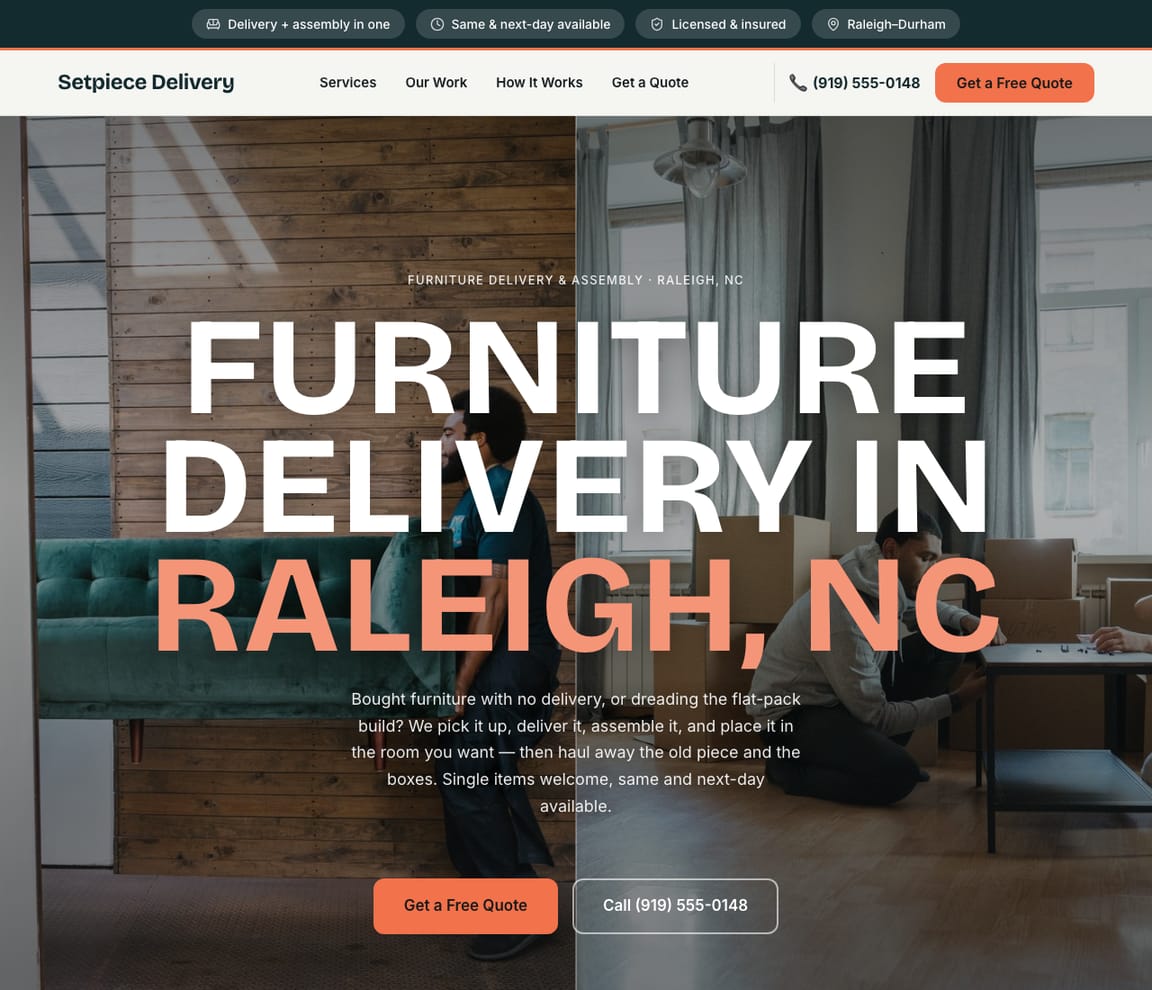
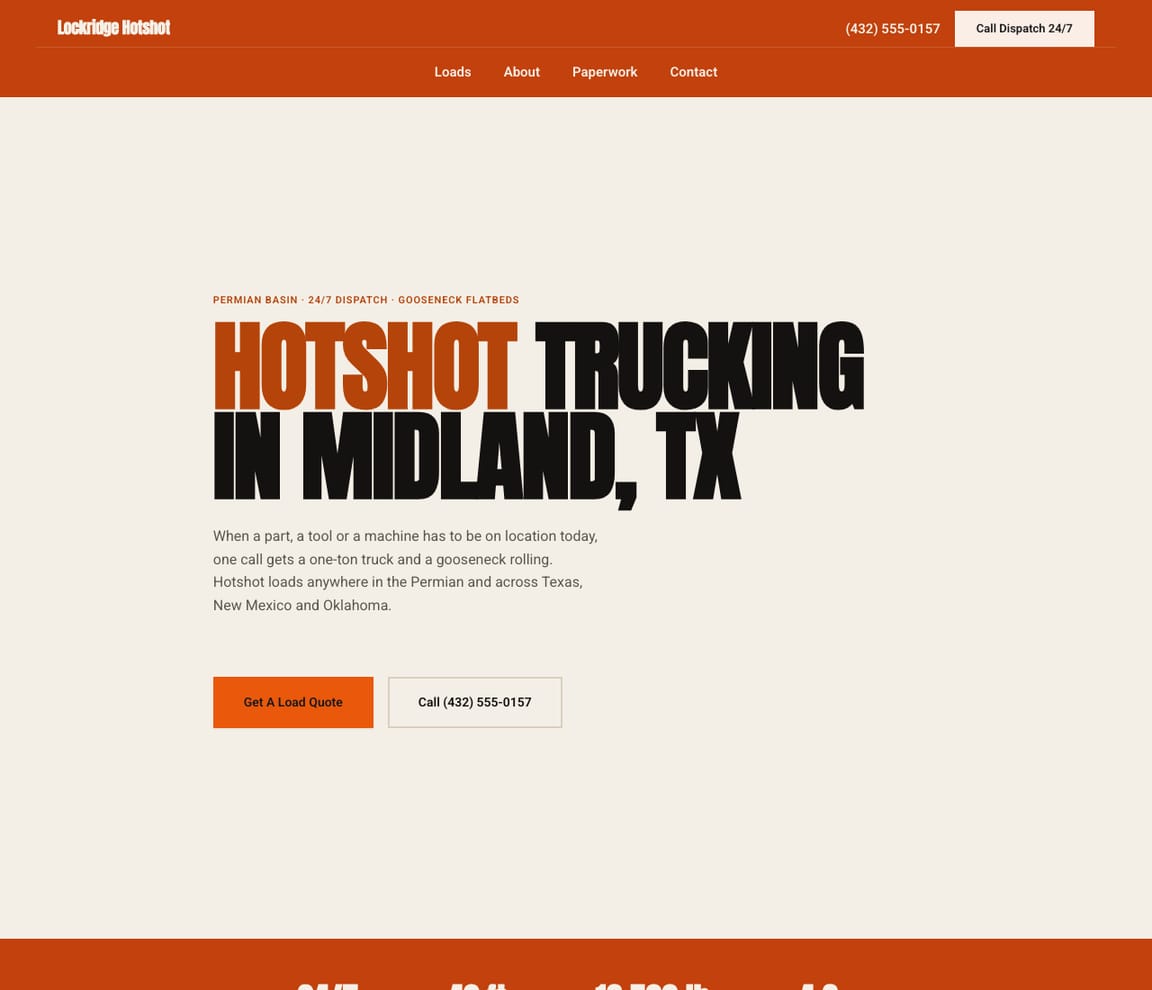
Real Zarla templates for delivery work — a same-day courier, furniture delivery and assembly, and hotshot loads for when you outgrow the van. Open the one closest to how you'll work, swap in your towns, your services and your own photos, and publish.
GET FOUND
Get found by the office that needs it there today
Many courier clients start with a deadline and a search — a lab sample that has to reach the hospital, a filing due at the courthouse by four, a part the repair shop needed this morning. Zarla builds the website with a call button at the top, the towns you cover on a service-area map and a request form. Add your rate sheet and your hours in chat, and once you connect your Google Business Profile, your name, hours and reviews stay in step on both.
“Courier service near me”
Searched by an office manager with something that has to arrive today — and by the clinic whose courier just quit. Your services, your hours and a quick way to reach you answer it.
Google Business Profile
Your hours, the area you cover and your reviews inside Google Maps. Free, an afternoon to set up — and offices can see you run their side of town before they call.
Reviews from offices you deliver for
Ask the office manager after the first month of on-time stops, and send the link that day. Reviews that say you were early, careful and easy to reach sell the next route.
Google Search
Kkestrellanecourier.com
Kestrel Lane Courier — Trusted courier service in Your AreaSame-day and scheduled courier service: daily route stops for clinics and offices, rush runs across town, photo and signature on every delivery.← Your Zarla siteCcitycourierservice.com
City courier serviceGoogle Maps
1
Kestrel Lane Courier
← You2
Metro courier service Co.
3
Quick courier service
AI assistants (ChatGPT / Perplexity)
For a same-day courier for a medical office in your area: Kestrel Lane Courier — a local courier that publishes its service area, its rush and same-day prices and its hours, with reviews from offices it delivers for.
YOUR LAUNCH PLAN
Your courier business launch checklist
The whole guide as things to check off. Work through them in order and you'll be legal, insured, priced and on the road before the first office calls.
- Pick your work and your area — same-day, routes, medical, legal or parts, and the towns you'll cover.
- Check your vehicle and your state — the weight rating, any state carrier permit, and whether you'll cross state lines.
- Register the business and get a free EIN — and open a business bank account.
- Insure the deliveries — tell your insurer, then a delivery endorsement or commercial auto, liability and cargo.
- Write your rate sheet — base, per-mile, rush tiers, waiting time, after-hours, fuel surcharge.
- Set up your kit and delivery app — hand truck, blankets, straps, a specimen kit for medical work.
- Get found — website and Google Business Profile live, with your services, hours and service area.
- Walk in with your rate sheet — ten clinics, law offices and parts counters, and two courier networks for overflow.
REAL CUSTOMERS
Small business owners who got online with Zarla
Verified reviews from real Zarla customers.
“Quickly built my website from scratch. No hiccups. Would highly recommend Zarla for someone with no experience who wants to start a polished business website.”
“Great professional website in less than a minute, with the use of AI and a few descriptive prompts. This has saved me bundles of time and research on web developers.”
“I had no idea how to set up a website for my business. Thanks to Zarla, they've helped me a lot.”
“Very reliable, professional, and fast results. I was able to get my business online in no time, and the ease of access made it so simple.”
Be the courier the office manager calls first
Add your town and your business name, and Zarla builds the website from that one line — a call button at the top, the towns you cover on a service-area map and a request form. Add your rate sheet, your hours and the work you take on in chat. Free to build; you pay when you publish.
Already have a website? Bring it across →Zarla keeps your old page addresses where it can and redirects the ones that change, helping you keep the Google standing you've built.
Frequently asked questions
How much does it cost to start a courier business?
In the US, about $2,871 to $24,120 for one owner-driver, in our courier business plan's itemized ranges — the car you own or a used small cargo van, a hand truck, blankets and straps, a medical kit if you'll carry specimens, the first month of commercial auto and liability insurance, registration and any state permit, a delivery app, the website, launch marketing, and two months of running costs, insurance included. The van is the big swing: $0 in your own car, $15,300 for a used 2020 Ford Transit Connect at Kelley Blue Book's Fair Purchase Price. Insurance is a monthly bill on top — MoneyGeek models a courier's commercial auto at $236 a month. Your own living costs come on top.
How profitable is a courier business?
It depends on the miles each dollar takes, and no public survey reports courier profit margins — be wary of any single percentage. What's public is the price and the costs: a California courier charges $32.50 a route stop a day, a medical courier's booking form $35 to $115 a run before its $7 booking surcharge, and fuel, maintenance and insurance come out of that — US regular gas averaged $4.331 a gallon in mid-October 2026, and the IRS's business mileage rate is 76¢ a mile. One St. Louis contract courier's rule of thumb in 2013 was to keep fuel and insurance to 30% of gross and set aside 30% for the van.
How much do courier services charge?
On their own rate cards: an Austin courier's 2026 card charges $10 for an all-day delivery in its nearest zone to $200 for an ASAP run to its farthest, plus $2.00 a mile by car outside the city; one medical courier's booking form charges a $35 base for standard same-day to $115 for STAT, with $2.50 a mile after the first 10 and a $7 surcharge; and a Ventura County, California courier prices route stops from $32.50 a day. Rush, after-hours, waiting time, weight and a fuel surcharge are added on top. Dropoff's 2026 medical courier pricing guide puts per-mile fees at $1.40 to $1.90 in a sedan and $2.20 to $3.75 in a cargo van.
Is courier a good business?
For a reliable owner who sells to businesses, it can be. Employment of couriers is projected to grow 7% or more from 2025 to 2035 (O*NET), and the Census Bureau counted 1,595,662 solo courier and delivery businesses in 2024, up from 1,438,339 a year earlier. The catch is the low end: that count includes app drivers, and 94% took in under $50,000. The steadier money is in daily route stops for clinics, labs and offices, and in rush and medical work an app doesn't do well.
What type of courier makes the most money?
The work that is urgent, specialized or heavy. Published rate cards price STAT medical runs, after-hours and weekend work, and van or bulk loads highest — one medical courier's STAT base is $115 against $35 for standard same-day. In a wage survey of employees that leaves out the self-employed, light truck drivers earned a 2025 median of $44,860 against $39,200 for couriers and messengers (O*NET). Box-truck work pays more again, but FRAYT, for one, requires an active DOT number, $1,000,000 of auto liability and $100,000 of cargo cover for it.
How do I start a courier business with my own car?
Tell your insurer first: the Texas Department of Insurance says some personal policies cover paid deliveries and others won't, and a delivery add-on typically costs less than a commercial policy. Check your state — California requires a Motor Carrier Permit for paid delivery in any vehicle. Then take contract work to learn the trade: Dropoff accepts a car under 10 years old, and Roadie has no minimum vehicle standard. Robert Dooley started Rob's Speedy Delivery in Oregon with one Toyota Prius.
How do I start a delivery business with no money?
Start with what you have: the car you drive, a phone, and a free delivery app — Shipday's free plan covers 300 orders a month. In the US the EIN is free and an LLC can be as little as $40 (Kentucky), and contract work with courier networks needs no clients of your own. Insurance is the cost you can't skip: ask your insurer about paid deliveries before the first run. Robert Dooley told his local paper in 2017 that he didn't charge anything for his first two weeks of business.
Do I need a USDOT number or an MC number for a courier business?
In the US, it depends on the vehicle and the route. A USDOT number is needed for a vehicle rated at 10,001 pounds or more used in interstate commerce — a Sprinter 3500XD is rated at 11,030 pounds, a Ford Transit 250 at 9,150. FMCSA operating authority (the MC number) is needed for paid interstate delivery in any vehicle, unless an exemption applies, such as trips entirely within one city's commercial zone or the road leg of an air shipment; it's $300 to apply, and you file for a USDOT number with it. Some states add their own permit — California for any paid delivery. Check FMCSA and your state.
What certifications do I need to start a medical courier business?
In the US, no federal certification or license is required to be a medical courier. Clients and courier networks commonly ask for a bloodborne pathogens certificate (ProTrainings' online course is $29.95) and HIPAA training. The rules themselves: OSHA requires employers to train staff who may touch specimens when first assigned and every year after; HIPAA's 2013 rule treats a courier that only carries records as a conduit rather than a business associate; and the DOT exempts most patient specimens carried by a private or contract carrier in a vehicle used only for medical items. Check what each client requires in writing.
Is medical courier a good side hustle?
It can be, if you can be reliable during the hours labs and clinics need you. Medical runs price higher than general deliveries — one medical courier's booking form charges $35 to $115 a run, before a $7 surcharge — and networks such as Dropoff carry medical work and help their couriers keep OSHA and HIPAA training current. The cautions: your personal auto policy may not cover paid deliveries, and if you carry specimens with other parcels, Category B specimens must be triple-packed and marked.
What items cannot be sent by courier?
Each courier sets its own list, and federal hazardous materials rules apply to everyone. UPS's terms, for example, refuse coins, cash and negotiable instruments, hazardous waste, human remains and body parts, common fireworks and ivory. For specimens, Category A infectious substances never qualify for the medical vehicle exception, and Category B specimens carried with other freight must be triple-packed and marked. Put your own list on your website and rate sheet so clients know before they book.
Do I need commercial insurance for courier work?
Usually some form of it. In the US many personal auto policies limit or exclude paid deliveries — State Farm says they may exclude delivering goods for a fee — so you need a delivery endorsement or a commercial auto policy, and general liability. Cargo cover protects the goods you carry; clients and networks often set the limits. Federal rules require $300,000 of liability cover on file for interstate carriers with only small vehicles, and California the same for its permit.
How do I get my first courier clients?
Walk in and call. Visit clinics, labs, law offices, title companies and parts counters with a printed rate sheet, ask the office manager what they send and when, and offer a trial week; apply to larger couriers and networks for overflow work while the routes build. Then answer what offices search for: your services, hours and service area on your website and Google Business Profile, with a review from every office you deliver for. Zarla builds the website from one sentence, with a call button, a service-area map and a request form, and syncs your Google profile once you connect it.