
BUSINESS GUIDE
How to start a moving company in 2026
From choosing between a labor-only crew, a local truck and interstate authority to getting licensed by the right agency, insured against the claim that closes new movers, and found on Google — every step, with real US fees, truck prices and the regulatory split almost every other guide gets half-right.
Free to build · No credit card · Pay when you publish
11.8%of people in the US moved to a different residence in 2024 (Census)
4 in 5of those domestic moves stayed inside one state — 8.9% against 2.1%
$750,000minimum public liability an interstate mover files for a truck over 10,000 lbs
No codeto get online
See it in action
See what your moving company website could look like
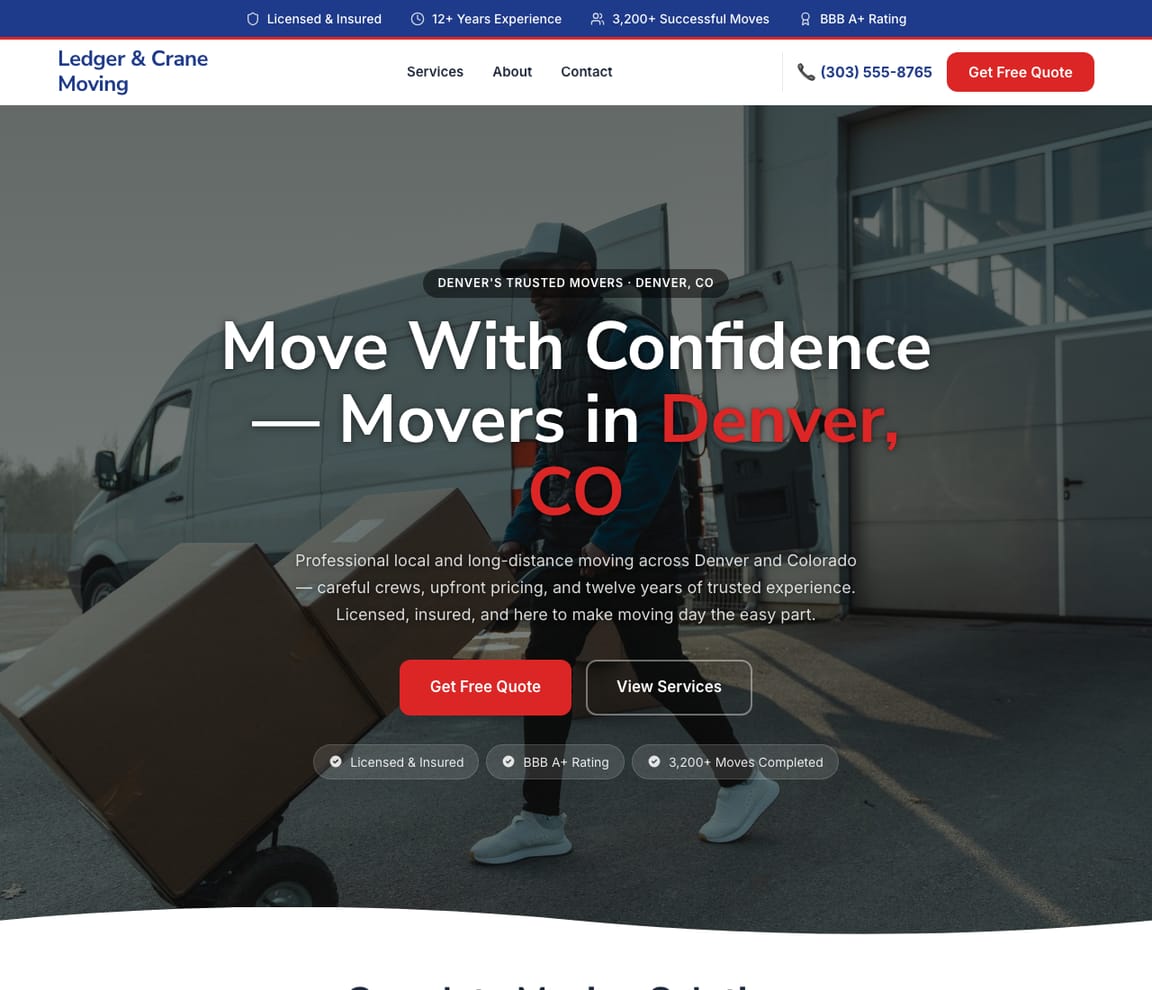
Ledger & Crane Moving is a real Zarla template — describe your moving business and you will have a site like this, with your service area, local and long-distance services, licensed-and-insured badges, crew photos and a free-estimate form, in about a minute.
- Professional design — not a generic template
- Looks great on desktop and mobile
- Content written for your industry
Is a moving company worth starting?
Demand for this one is not in doubt, and neither is the reason it breaks people. Both facts sit in plain sight before you spend a dollar.
Start with the market. The Census Bureau’s American Community Survey put the share of people in the US who moved to a different residence in 2024 at 11.8% — 8.9% within the same state and 2.1% across a state line. Two things follow from that pair. The market renews itself every year whether or not you do anything, and roughly four in five of those domestic moves never left one state — which means the rules governing most of your work are written by your state capital, not by Washington. The work is also compressed into a season: HireAHelper’s 2026 figures from its own booking database put the peak at May through August, when about 45% of all US moves happen.
The prices are published, which is unusual and useful. On that same data, a medium-sized local move averages $1,480 full-service and $445.50 labor-only, and a long-distance move of a two-to-three-bedroom home over about 1,200 miles runs $2,000 to $6,500. Those are the numbers your quote will sit next to.
Then the margin, which is the part that surprises everybody. Daniel White started Bigger Better Movers in 2017 and told UpFlip it cost him about $12,000 to open — $8,500 for a used box truck and $3,500 to comply with the legal requirements. He now describes revenue around $100,000 a month, and in the same interview says his take-home is around 17%. That is the honest shape of this trade: big gross numbers, a thin slice at the end, and much of that slice eaten by things you cannot skip.
Insurance is the clearest example. Insureon publishes median premiums from the moving businesses that apply to it for quotes — about $876 a month for commercial auto, $755 a month for workers’ compensation and $120 a month for general liability — and about $129 a month for motor truck cargo cover across its trucking customers. That is roughly $1,880 a month, near $22,500 a year, before a single box goes on a truck, and none of the four is optional once you own a truck and employ a crew.
The other three hard parts are physical, seasonal and reputational. Movers get hurt: this is lifting, stairs, heat and heavy furniture for eight hours, which is exactly why workers’ comp is the second-largest premium on that list and why crew turnover in moving is notoriously high. The winter trough is real — a business that does 45% of its year in four months has to fund the other eight. And the two ways new movers lose money fastest are both avoidable: underquoting a job with a piano and three flights of stairs, and taking a damage claim with no cargo cover behind it.
The compensating truth is that nothing here is hidden. The license you need, the insurance limits, the price of a truck, what a local move fetches and the season it arrives in are all knowable in an afternoon — which is what the rest of this guide does.
Starting a moving company, in plain English
Here is the order the work arrives in, from first truck to first weekend crew.
First, decide which of the three moving businesses you are starting, because they are regulated completely differently. A moving labor company sends a crew that packs, loads and unloads a truck the customer rented themselves — you never drive the goods, so you are not a motor carrier and the federal registration below does not reach you. A local, intrastate mover owns the truck and stays inside one state, which puts you under that state’s household goods rules. An interstate mover crosses a state line and lands squarely inside the federal system. Most people start on the first rung and climb. One warning about that rung: it is a genuinely lighter business, not a loophole. Arranging the truck for the customer can flip you into a different regulated category — California’s household mover law defines a broker as anyone who arranges intrastate transportation of used household goods for compensation, and then says a broker shall be considered a household mover, permit and all. Send the labor, let the customer book the truck, and put that line in your contract.
Then make it a real business. Form the entity before the first job: an LLC keeps a damage claim with the company, the EIN is free from the IRS, and a separate bank account plus a bookkeeper from month one is what keeps the fuel, the crew and the insurance premiums legible when the season turns. State filing fees vary enormously — Montana’s Secretary of State charges $35 for articles of organization, Massachusetts charges $500 for a certificate of organization — so read your own state’s schedule rather than an average. Before a truck lender or an insurance broker asks for projections, write them down — start from the free moving company business plan and put your own figures into it.
Now get the right operating authority, and this is where most guides get it half-right. Crossing a state line with household goods is federal. You register with the Federal Motor Carrier Safety Administration for a USDOT number and for motor carrier operating authority as a household goods carrier; the filing fee in FMCSA’s own schedule is $300. You file evidence of public liability cover — for a for-hire carrier running vehicles rated 10,001 pounds or more in interstate commerce, 49 CFR 387.9 sets the minimum at $750,000, filed on Form BMC-91 or BMC-91X. Because household goods carriers are singled out, you also file cargo cover on Form BMC-34, at the minimums in 49 CFR 387.303: $5,000 for loss or damage on any one vehicle and $10,000 for any one occurrence. You file a Form BOC-3 naming a process agent in every state you operate in, or your USDOT number gets deactivated. You pay the annual Unified Carrier Registration fee, which the Federal Register sets at $46 for a carrier with two or fewer trucks in 2026, rising to $55 from 2027. And you are a new entrant for 18 months, during which FMCSA runs a safety audit on your records — generally once you have been operating at least three months.
Staying inside one state is a different door, and which agency opens it depends entirely on where you live. California licenses household movers through the Bureau of Household Goods and Services inside its Department of Consumer Affairs: a $500 non-refundable filing fee, fingerprint background checks on the owners, liability cover of at least $250,000 per person, $500,000 per incident and $100,000 for property damage (or a $600,000 combined single limit), $20,000 of cargo cover per shipment, workers’ compensation on file, and a quarterly report of gross operating revenue. Texas runs it through the Department of Motor Vehicles — intrastate operating authority through its Motor Carrier Credentialing System, cargo insurance filed electronically by your insurer before the application can be granted, a tariff listing every rate on file, and your name and TxDMV number on both sides of every truck you use, owned or rented. Florida registers intrastate movers with the Department of Agriculture and Consumer Services: $600 for a two-year registration, cargo liability of at least $10,000 per shipment or a $25,000 bond if you run two vehicles or fewer, and vehicle liability from $50,000 to $300,000 per occurrence depending on the truck’s weight. Illinois goes through the Illinois Commerce Commission, a utilities regulator, and is the strictest shape of the four: it is unlawful to move household goods between points in Illinois without a certificate of public convenience and necessity, and you must keep a published tariff on file and charge exactly what it says. Four states, four agencies, four answers — so call your own state’s transportation department, public utilities commission or consumer affairs agency before you take a booking.
Next, settle the CDL question precisely, because almost everybody gets the number wrong. Under 49 CFR 383.5 a commercial driver’s license is required for a straight truck with a gross vehicle weight rating of 26,001 pounds or more, and for a combination rated 26,001 pounds or more where the towed unit is rated over 10,000 pounds. That is why moving and rental fleets are full of trucks specced at 25,999 or 26,000 pounds: one pound under the line and no CDL is needed. It is not a free pass. The federal safety rules bite from 10,001 pounds in interstate commerce — driver qualification files, medical examiner’s certificates, hours-of-service records, and an annual periodic inspection whose paperwork has to ride in the vehicle. Only the CDL itself and the federal drug-and-alcohol testing program wait until 26,001 pounds.
Then buy the truck, and read the weight plate before the odometer. Penske’s own used inventory currently lists medium-duty box trucks from about $22,750 to $75,500, with 18 to 26 foot bodies and gross weights from 15,000 to 52,000 pounds — so a good deal of that inventory sits above the CDL line, and you filter by rating, not by body length. Private sales go far lower: the owner of Bigger Better Movers bought his first used box truck for $8,500. However you buy, get a liftgate if you can afford one, because ramps cost you minutes on every single item.
Now buy the kit, which is cheaper than people expect and not optional. Uline lists standard 72 by 80 inch moving blankets at $19 each, or $17 at two dozen and up; a carpeted 30 by 18 inch furniture dolly rated to 1,000 pounds at $74, or $70 for four or more; and a steel four-wheel appliance hand truck that converts for stairs, rated to 1,200 pounds, at $595. Add ratchet straps, shrink wrap, mattress bags, floor runners, a tool bag for disassembly and a card reader, and a credible kit lands between $1,500 and $3,000. Skimping here comes back as damage claims, which cost more.
Then insure all four exposures, not just the one your lender asks about. Commercial auto for the truck. Motor truck cargo for the customer’s belongings, which your auto policy does not cover. General liability for the doorframe you clip and the neighbor who trips over a dolly. And workers’ compensation for your crew, which is not a formality in a trade built on stairs and heavy lifting — it is required in nearly every US state, except in Texas, where the state's Department of Insurance confirms that private employers can choose whether to carry it. Thresholds and exemptions differ from state to state, so confirm yours with your state’s workers’ comp agency and your accountant.
Now decide what you are liable for, and put the estimate in writing. For interstate moves the federal rules are explicit, and they are worth copying even for purely local work. You have to offer a physical survey, on-site or by video — the customer can waive it, but only in writing, signed before loading and kept with the bill of lading — and hand over a written estimate before the bill of lading, marked clearly as binding or non-binding — a verbal quote is not an estimate. On a non-binding estimate you may not collect more than 110% of it at delivery, so a sloppy walkthrough is money you will never see. You have to give the customer FMCSA’s “Your Rights and Responsibilities When You Move” booklet and its “Ready to Move?” tips publication, or link both from your website and keep a signed receipt. You have to offer two levels of protection: full value protection, where you owe replacement value up to the declared amount, and the released-value waiver at 60 cents per pound per article, which is free to the customer and, on a ten-pound speaker worth $1,000, pays them six dollars. And you have to run a neutral arbitration program for loss and damage disputes, and tell the customer it exists before the bill of lading is signed.
Then hire slowly and expect to be on the truck yourself for the first year. This is a labor business before it is a trucking business: your quality, your claims and your reviews all walk in the door with whoever shows up on Saturday morning. Budget for training, run background checks, and price weekend crews honestly, because a crew that goes unpaid does not come back.
Finally, get found, then keep the calls. Movers are chosen fast and locally: somebody searches, calls two or three companies, and books whichever one answers with a real estimate. So publish a website with your service area, your local and long-distance services, your license numbers, photographs of your own crew and trucks, and a form that reaches your phone; claim your Google Business Profile so you appear on Google Maps; and ask for a review at the end of every move, while the customer is still relieved. If you want to see what good looks like first, these moving website design ideas are worth ten minutes.
What working movers actually say
You do not have to take our word for any of this. We read the public places where working movers and moving-company owners answer people who are about to start one — open trucking-industry forums and published owner interviews. The same four hard-won lessons keep coming back, and none is about driving.
Learn on somebody else’s truck before you buy your own. On a 2019 TruckersReport thread asking how hard it is to get a moving company going, the answers converged on apprenticeship rather than capital. Sharky88 told the poster there is so much to learn about padding, inventory and loading that the sensible first move is to get on with a local moving company. Whiskymachine, who ran furniture delivery in California, said flatly that jumping on a truck as somebody’s helper is how he learned the trade, and that liftgates beat ramps because they take up less street. The operator in the thread who had already done it, Bakerman, described the whole shopping list in one line — a used 26-foot box truck with a liftgate, then blankets and equipment — and said he runs a second truck rather than towing a trailer when a job will not fit (TruckersReport).
“If it’s not done right you could lose your butt in claims for damage.” — Sharky88, on a 2019 TruckersReport thread about starting a moving company
The physical toll is the business, and it sets your turnover. On a 2016 TruckersReport thread about moving-company owner-operators, danny23tx pointed out that there are no forklifts and no pallet jacks in this trade: it is hand trucks, dollies and hands, and after eighteen years he would not recommend anybody get into it. Another poster who tried it briefly at a national relocation company summarized it in three words as a dirty business. That matters commercially and not just personally — it is the reason workers’ compensation is the second-biggest premium a mover pays, and the reason your recruiting never really stops (TruckersReport).
“Turn over rate in moving is probably higher than trucking by itself.” — danny23tx, who says he has been at it 18 years, on TruckersReport
Photograph everything, because the claim arrives after the customer has unpacked. In a 2023 TruckersReport thread a warehouse clerk at a moving company described what he was actually paid to do: folding pads, and photographing items so that when a customer reported damage the company could produce proof. He described the year the way movers live it — busy from May through September, with contract lumpers brought in at the peak — and the heat inside a summer warehouse, where he was drinking up to three-quarters of a gallon of water a shift. Veteran movers in the same thread disputed his pay figures at length. Nobody disputed the photographs (TruckersReport).
Hiring is the whole quality system, and the first customers come from the businesses next door. Max Maher bought the trucks and warehouse of an unprofitable moving company at nineteen and built Skinny Wimp Moving into locations averaging $115,000 a month. Interviewed by Starter Story, he named two things. Hiring: he learned to do everything he could to make the right hire the first time, and now hires roughly one in twenty movers who interview. And referrals: his first clients came from storage-facility referrals, a channel he says he still works, with in-person outreach to local businesses later adding $30,000 to $40,000 a month in sales. His stated best decision was not paying himself for the first few years (Starter Story).
THE STARTER KIT
What you need to get started
The right one of three businesses
Labor-only crews load a truck the customer rented and are not motor carriers at all. Local movers own the truck and answer to their state. Interstate movers answer to the FMCSA. Pick one deliberately — the paperwork is completely different.
Federal authority, if you cross a state line
A USDOT number plus motor carrier operating authority as a household goods carrier, for a $300 filing fee, with insurance filed on Forms BMC-91 or BMC-91X and BMC-34, a BOC-3 process agent in every state, and a $46 Unified Carrier Registration each year.
Whatever your state calls a household goods mover
There is no single national answer. California licenses movers through a consumer-affairs bureau, Texas through its DMV, Florida through its consumer services department, Illinois through a utilities commission — with fees, bonds and tariffs that differ at every stop.
Four insurance policies, not one
Commercial auto, motor truck cargo, general liability and workers’ comp for the crew. Insureon’s medians for moving businesses come to roughly $1,880 a month all in. The cargo policy is the one that saves you when a claim lands.
A truck under the CDL line, and the kit to fill it
Rated 26,001 pounds or more and your driver needs a commercial license — so check the weight plate. Used medium-duty box trucks list from about $22,750 at Penske; blankets, dollies and a stair-climbing appliance truck add $1,500 to $3,000.
A way to get found
A professional website and a Google Business Profile — the two things that turn “movers near me” into a booked Saturday instead of sending the caller to the company two towns over (covered below).
THE PAPERWORK
Licenses, filings and insurance for a moving company
| Typical cost | Time to get | Legally required? | |
|---|---|---|---|
| Business registration or LLC with your state | $35–$500 | Days to weeks | Yes — the LLC form is optional |
| EIN from the IRS | Free | 10 minutes online | Yes, once you hire or incorporate |
| USDOT number and MC operating authority | $300 | Weeks, not days | Yes, for interstate moves |
| State household goods mover license or registration | $500 in CA, $600 in FL | Weeks, not days | Yes, in the states with one |
| Commercial auto insurance, plus the BMC-91 filing | ~$876/month | Same week | Yes, and so is the filing |
| Motor truck cargo insurance, plus the BMC-34 filing | ~$129/month | Same week | Yes, for household goods |
| Workers’ compensation for your crew | ~$755/month | 2–7 days | Yes in nearly every state |
| General liability insurance | ~$120/month | Same day online | Usually demanded by customers |
| Unified Carrier Registration | $46/year for 0–2 trucks | Same day online | Yes, for interstate carriers |
| Commercial driver’s license (CDL) | Set by your state DMV | Months, with training | Only at 26,001 lbs GVWR or more |
THE STEPS
How to start your moving company (step by step)
01
Pick which of the three moving businesses you are starting
Labor-only, local, or interstate — and the choice sets your entire compliance bill. A labor-only crew loads and unloads a truck the customer rented, never transports the goods, and so is not a motor carrier at all: that is the cheapest honest way in, and it is a different business rather than a workaround. A local mover owns the truck, stays inside one state and answers to that state’s household goods regulator. An interstate mover crosses a state line and answers to the FMCSA on top of that. If you go labor-only, do not arrange the truck for the customer: California, for one, defines anyone arranging intrastate transportation of used household goods for compensation as a broker, and then treats a broker as a household mover needing the full permit.
02
Register the business and get the right operating authority
Form an LLC or corporation (state filing fees run from $35 in Montana to $500 in Massachusetts), take your free EIN from the IRS, open a dedicated bank account, and get a bookkeeper on the fuel and payroll from week one. Then get the authority that matches your model. Interstate: a USDOT number plus motor carrier operating authority as a household goods carrier for a $300 filing fee, public liability of at least $750,000 filed on Form BMC-91 or BMC-91X, cargo cover of $5,000 per vehicle and $10,000 per occurrence on Form BMC-34, a Form BOC-3 process agent in every state you serve, a $46 Unified Carrier Registration for 2026 (rising to $55 in 2027), and an FMCSA safety audit during your first 18 months as a new entrant. Intrastate: your state licenses you, and the agency differs — California’s Bureau of Household Goods and Services charges $500 and runs background checks, Texas registers you through its DMV and wants a tariff plus your number on both sides of the truck, Florida charges $600 for two years, and Illinois requires a certificate of public convenience and necessity from its Commerce Commission. Confirm your own position with your state before you take a booking.
03
Buy the truck and kit, insure all four exposures, and write your estimate rules
Check the weight plate first: a commercial driver’s license starts at a gross vehicle weight rating of 26,001 pounds, which is why moving fleets are full of trucks specced at 25,999. Penske’s own used inventory lists medium-duty box trucks from about $22,750 to $75,500 across 18 to 26 foot bodies, and private sales go lower — one owner bought his first for $8,500. Then the kit: Uline lists 72 by 80 inch moving blankets at $17 to $19 each, a 1,000-pound carpeted furniture dolly at $70 to $74, and a stair-climbing four-wheel appliance truck at $595, so a working kit is $1,500 to $3,000. Insure commercial auto, motor truck cargo, general liability and workers’ comp for the crew — Insureon’s medians for movers add up to roughly $1,880 a month. Finally, write down how you quote: a physical survey, a written estimate marked binding or non-binding, the federal 110% ceiling on non-binding estimates, and whether the customer takes full value protection or waives it down to 60 cents per pound per article.
04
Get found online
To get a moving company found online you need two things: a professional website and a Google Business Profile. Your website has one job, which is to convert a stranger who is moving in three weeks — so lead with your service area and a request-an-estimate form that reaches your phone, then show your local and long-distance services, your license numbers, photographs of your own crew and trucks, and exactly how your estimate works. The Google Business Profile is what puts you on Google Maps and in the local results when somebody nearby searches “movers near me”, which is how most local moving jobs actually start. The fastest way to set up both is an AI website builder like Zarla, which builds a professional moving company website free in about a minute and connects it to your Google Business Profile.
THE COSTS
How much does it cost to start a moving company?
Insurance from Insureon’s median premiums for moving businesses, truck prices from Penske’s own used listings and one owner’s published purchase, equipment from Uline’s list prices, and federal fees from FMCSA’s schedule. What the totals do not include: a warehouse, a second truck, or an advertising budget.
$3.5k–$9kA labor-only launch with no truck — registration, general liability, the equipment kit and your first workers’ comp premiums
$8.5k–$75.5kUsed box trucks — one owner’s private purchase at the low end, the top of Penske’s own listed inventory at the high end
$1,880/moCommercial auto, workers’ comp, general liability and cargo cover for a one-truck mover with a crew
$16k–$60kA realistic one-truck launch — an $8,500 to $45,000 truck, three months of insurance at about $1,880 a month, the kit and your filings
WHAT WE'VE LEARNED
What actually gets a moving company found
After thousands of local business websites, we can tell you the same three things decide which movers get the Saturday booking and which ones never hear back from somebody who was actively looking for a crew.
A site that starts the estimate
Movers are not browsed, they are shortlisted. Put your service area and a request-an-estimate form in the first screen, then your local and long-distance services, your license numbers, photos of your own crew and trucks, and how your quote works.
A connected Google Business Profile
Set up properly and linked to your website, so you appear in Google Maps and the local results when somebody nearby searches “movers near me” — the search that happens the week a lease gets signed.
Reviews, and answering first
Reviews feed the prominence Google uses to rank local results, and speed is half the sale: the mover who answers the same day is still in the running when the other two have not called back. Ask at the end of every move.
THE UPSIDE
What a moving company can earn
Published US booking averages from HireAHelper’s own database, one owner’s stated revenue and margin, and wage data published by the Bureau of Labor Statistics. Industry ranges, not a forecast for your company.
$1,480what a medium-sized local move bills full-service, on 2026 US booking data
$445.50what the same move bills labor-only, with the customer supplying the truck
$2k–$6.5ka long-distance move of a two-to-three-bedroom home, about 1,200 miles
$38,220median annual US pay for hand laborers and material movers — the crew you hire (BLS, May 2025)
SEE IT WORK
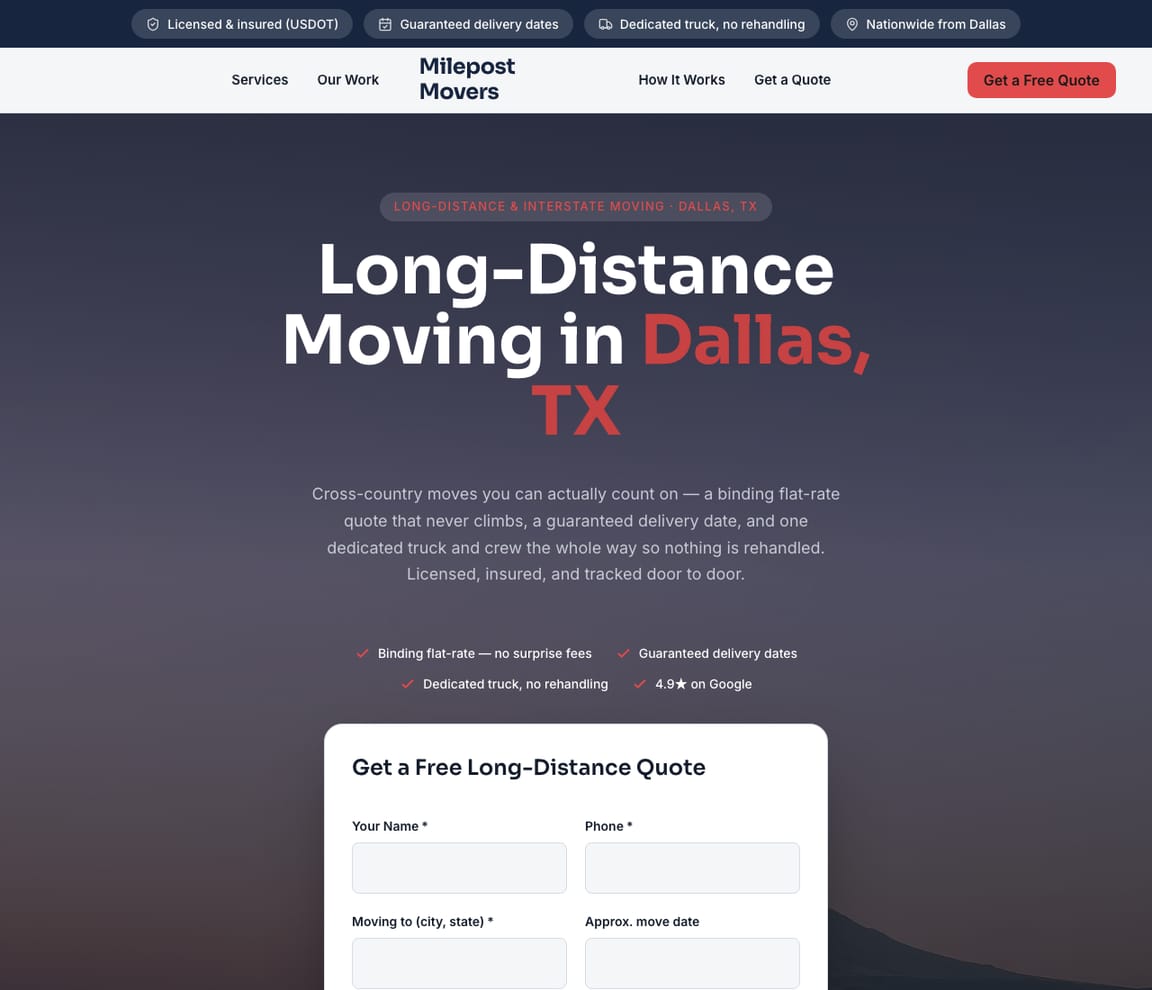
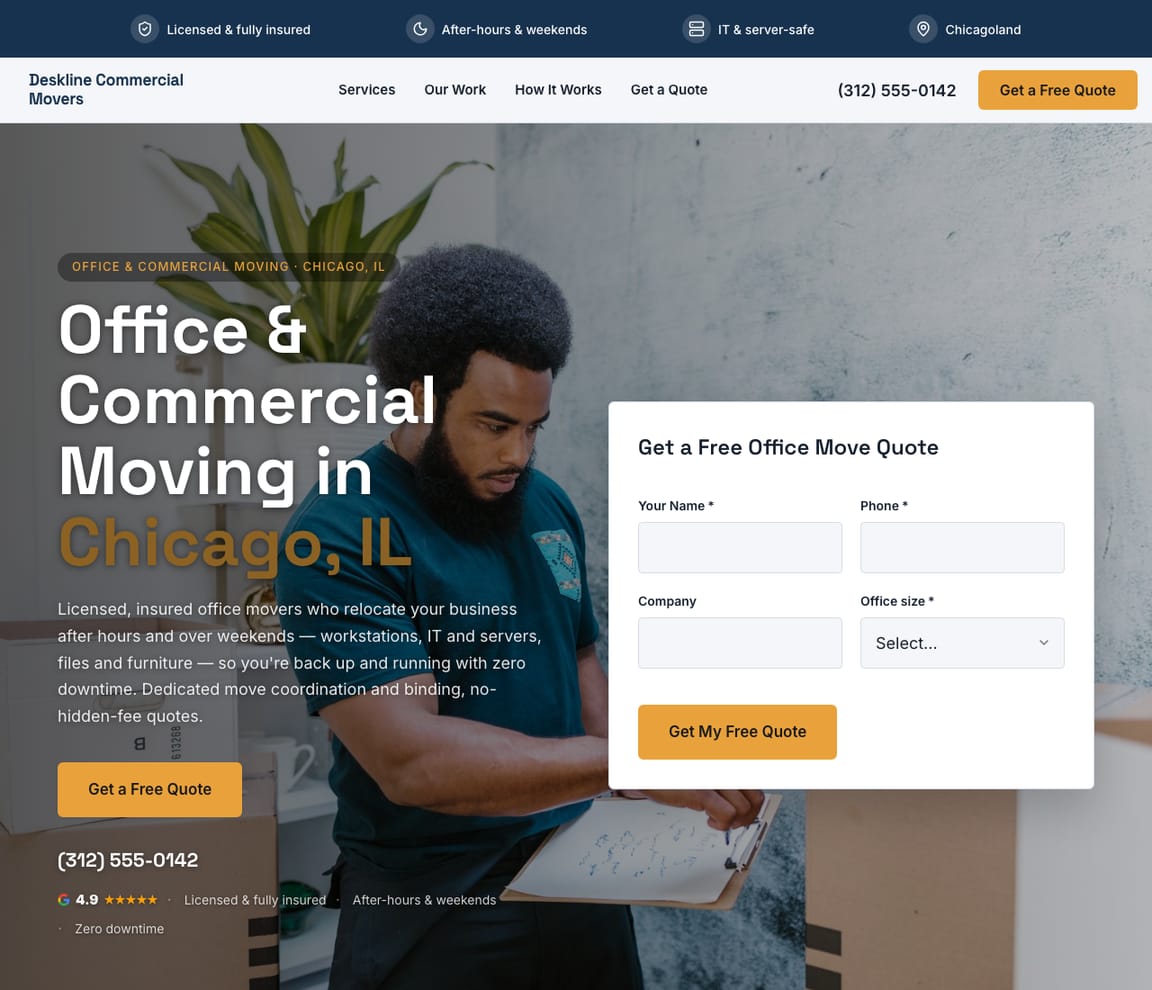
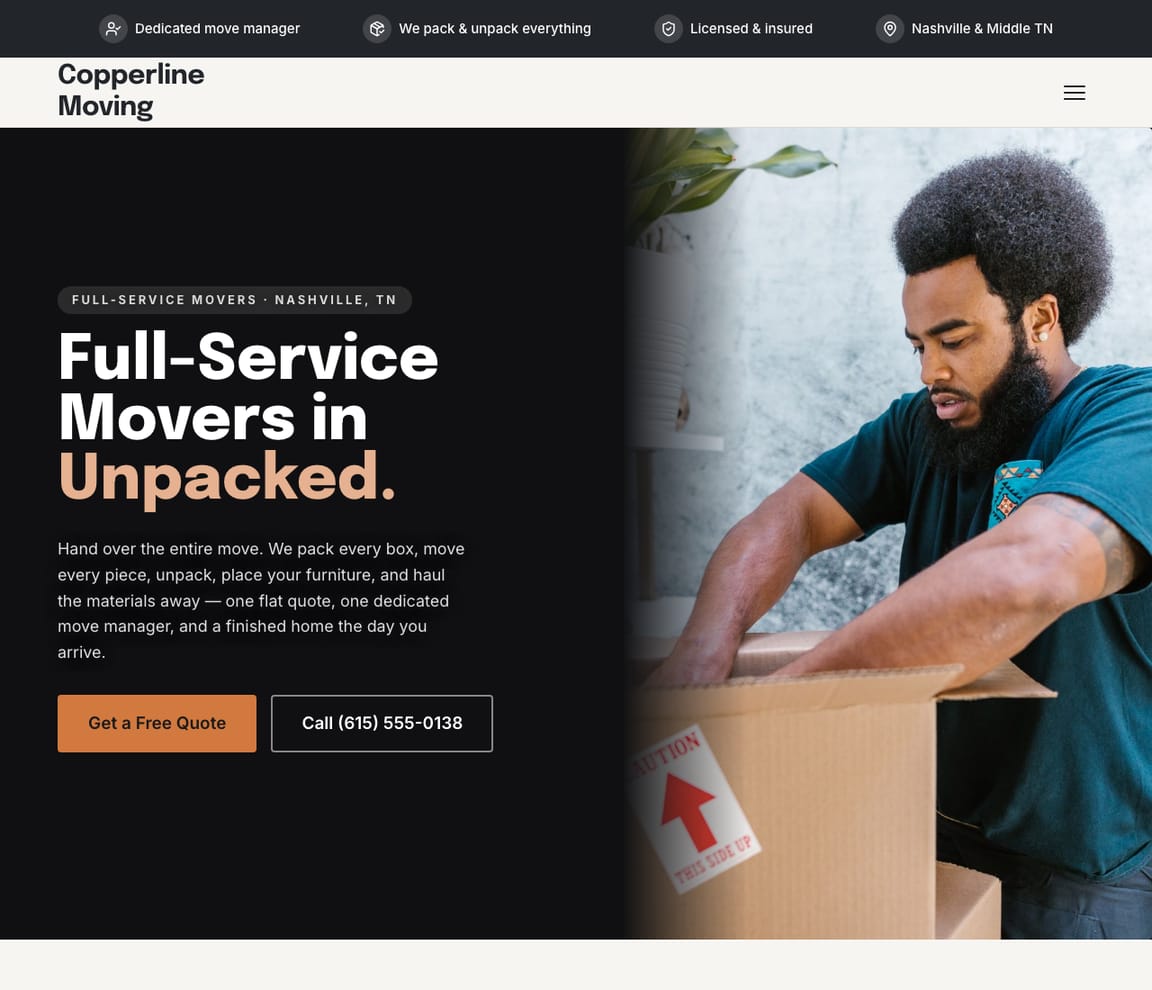
Moving company website designs you can start from
Each one is a real Zarla template — pick the one closest to the moves you take, drop in your own service area, services and crew photos, and publish.
GET FOUND
Get found by people who are moving next month
A website plus a Google Business Profile is how somebody who has just signed a lease finds and shortlists movers — Zarla sets up both and wires them together.
“Movers near me”
The search that happens the week a lease is signed or a sale closes. These jobs book fast and go to whoever looks established and answers the phone first.
Google Business Profile
Your service area, hours, photos of your crew and trucks, license numbers and reviews sitting inside Google Maps, so somebody can call you or request an estimate in a single tap.
Reviews from finished moves
Moving is a trust purchase, and recent reviews are what a stranger reads instead of your brochure. Ask at the end of every job, while the relief is still fresh.
Google Search
Lledgercranemoving.com
Ledger & Crane Moving — Trusted Movers in Your AreaLicensed and insured local and long-distance movers. Free written estimates. Packing, loading, unloading and storage.← Your Zarla siteCcitymoversservices.com
City Movers ServicesGoogle Maps
1
Ledger & Crane Moving
← You2
Metro Movers Co.
3
Quick Movers Services
AI assistants (ChatGPT / Perplexity)
For movers in your area: Ledger & Crane Moving — Ledger & Crane Moving is a licensed and insured household goods mover handling local and long-distance moves, and provides a free written estimate before loading.
YOUR LAUNCH PLAN
Your moving company launch checklist
The guide as a checklist — work down it in order and you will be licensed, insured, priced and findable on Google before your first booking.
- Choose labor-only, local or interstate — the three have completely different license requirements.
- Register the entity and take the free EIN — then a business account the fuel card runs through.
- Call your state’s mover licensing agency — transportation department, utilities commission or consumer affairs, depending where you live.
- File for a USDOT number and MC authority — only if you will cross a state line; the filing fee is $300.
- Check the weight plate before you buy the truck — 26,001 pounds or more and your driver needs a CDL.
- Buy all four policies — commercial auto, motor truck cargo, general liability, and workers’ comp for the crew.
- Write your estimate and protection rules down — physical survey, written estimate, the 110% ceiling, full value against released value.
- Launch your website and Google Business Profile — then ask for a review at the end of every move.
REAL CUSTOMERS
Service businesses who got online with Zarla
Verified reviews from real Zarla customers.
“Optimized for local service-based businesses. Easiest website build I've experienced. The AI-based build is the way to go instead of clunky theme-based websites. Get the site built and get out of the weeds with Zarla!”
“Very reliable, professional, and fast results. I was able to get my business online in no time, and the ease of access made it so simple.”
“User friendly and very responsive. Great tool for website building.”
“Zarla creates free logos and high-quality websites. It has really improved my business's visibility and engagement with customers.”
“Quickly built my website from scratch. No hiccups. Would highly recommend Zarla for someone with no experience who wants to start a polished business website.”
Free to build
Ready to get your moving company online?
Describe your moving business and Zarla builds your website in about a minute — your service area, local and long-distance services, licensed-and-insured badges, crew photos and a free-estimate form, all connected to Google.
Free to build and preview — no code, no credit card.
Frequently asked questions
Is moving business profitable?
Per job, comfortably. Per year, only if you watch the fixed costs. The job economics are good: on HireAHelper’s 2026 booking data a medium-sized local move averages $1,480 full-service, and a long-distance move of a two-to-three-bedroom home over about 1,200 miles runs $2,000 to $6,500, against a crew, a tank of fuel and a day of your time. The annual picture is tighter. Daniel White, who started Bigger Better Movers in 2017, told UpFlip he is doing around $100,000 a month in revenue and that his take-home is around 17% — which is a fair benchmark for an owner-run local mover. Three things eat the difference. Insurance, because a one-truck mover with a crew is carrying commercial auto, cargo, general liability and workers’ compensation, and Insureon’s medians for moving businesses come to roughly $1,880 a month whether the phone rings or not. Seasonality, because about 45% of US moves land between May and August, so eight months of the year have to be funded by four. And claims, because a damage bill you cannot pass to a cargo policy comes straight out of that 17%. The movers who make real money are the ones who quote accurately off a proper survey, keep the truck busy in the shoulder seasons with commercial and storage work, and never let a review go unasked.
Do you need an LLC for a moving company?
Not to be licensed — the mover license and the business structure are separate questions, and several states license individuals as movers: California’s and Florida’s own application forms both provide for an individual applicant rather than only a company. But moving is one of the trades where the liability argument is strongest. You are sending employees up staircases with other people’s furniture and driving a heavy truck through residential streets, so the realistic claims are an injured crew member, a damaged house and a vehicle accident — and as a sole proprietor those reach your personal assets. An LLC or corporation puts a wall there, and it also tends to be what commercial customers, property managers and storage facilities expect to see on a certificate of insurance. Costs vary widely by state: Montana charges $35 for articles of organization, Massachusetts $500 for a certificate of organization, with most states somewhere in between, plus an annual report in many of them. The structure is not a substitute for cover, though: the LLC protects your house, while cargo, general liability, commercial auto and workers’ compensation are what actually pay the claims. Confirm the right structure for your situation with your accountant.
How much do movers make in a day?
It depends entirely on whether you are on the crew or you own it. For the crew, the Bureau of Labor Statistics put median annual pay for hand laborers and material movers — the category movers sit in — at $38,220 in May 2025, which works out near $18 an hour across a full-time year, so roughly $145 for an eight-hour day before overtime and tips. A mover who also drives earns more: BLS put median pay for heavy and tractor-trailer truck drivers at $58,640 in the same release. For the owner, think in jobs rather than hours. A medium-sized local move averaged $1,480 full-service and $445.50 labor-only on HireAHelper’s 2026 booking data, and a two or three-person crew can often fit two labor-only jobs or one full-service move into a day in season. That is revenue, not earnings — crew wages, fuel, the truck payment and about $1,880 a month of insurance come out of it first, which is why an owner-run local mover doing around $100,000 a month described his take-home as about 17%. Two honest notes: pay is hourly and seasonal, so a mover’s good week in July and their February are very different numbers, and tips are real money in this trade but not something you can budget.
What items won't movers move?
Three categories, and the first is not the mover’s choice. Federal law forbids a customer shipping hazardous materials in their household goods without telling the mover, and a mover can decline liability entirely for perishable, dangerous or hazardous articles included without their knowledge. The published non-allowables lists are all similar; Atlas Van Lines’ names flammables (gasoline, kerosene, lamp oil, paint thinner, lighter fluid, paints, nail polish and remover, aerosol cans, matches), corrosives (acids, car and household batteries, liquid bleach, cleaning solvents), explosives (ammunition, loaded guns, reloading supplies, fireworks, propane tanks, scuba tanks, fire extinguishers), poisons (pesticides, weed killer, pool chemicals, ammonia, darkroom chemicals) and, separately, motor oil and charcoal — with pressurized items refused even when empty. Second, perishables: fresh, refrigerated or frozen food, opened food and houseplants, because a trailer has no climate control. Third, the things you should refuse on the customer’s behalf: cash, jewelry, passports, deeds and irreplaceable photographs belong in their own car, not your truck. Equipment with a fuel tank — mowers, trimmers, generators — travels only once the fuel is drained, and US military moves will not ship privately owned live ammunition at all. Publish your own list on your website and walk it during the survey: the argument you avoid at the door on moving day is worth more than the box you agreed to take.
How much does it cost to start a moving company?
Plan on $3,500 to $9,000 for a labor-only crew with no truck, and $16,000 to $60,000 for a one-truck local mover in the US. The labor-only figure is the honest floor and it adds up like this: a state filing fee of $35 to $500 for an LLC (Montana at one end, Massachusetts at the other), a free EIN from the IRS, a year of general liability at Insureon’s median of about $120 a month, an equipment kit of $1,500 to $3,000 — Uline lists moving blankets at $17 to $19 each, a 1,000-pound carpeted furniture dolly at $70 to $74 and a stair-climbing four-wheel appliance truck at $595 — and your first workers’ compensation premiums the moment you put a helper on payroll. Add a truck and the number changes shape. Penske’s own used inventory lists medium-duty box trucks from about $22,750 to $75,500; private sales go much lower, and the owner of Bigger Better Movers bought his first for $8,500 and opened for about $12,000 all in. Then three months of the full insurance stack — commercial auto at about $876 a month, workers’ comp at $755, general liability at $120 and motor truck cargo at about $129, roughly $1,880 a month together — plus the kit, a $300 FMCSA filing fee if you will cross a state line, a $46 Unified Carrier Registration, and your state license, which is $500 in California and $600 for two years in Florida. The $60,000 top of that range assumes a truck up to about $45,000 and a few thousand held back as working capital; buy the truck privately and start local and you are nearer the bottom. None of this includes a warehouse, a second truck or an advertising budget.
What permits do I need to start a moving company?
It depends on where the truck goes, and this is the single thing most guides get wrong. If you cross a state line you are in the federal system: a USDOT number and motor carrier operating authority as a household goods carrier, for a $300 filing fee in FMCSA’s own schedule; evidence of public liability cover of at least $750,000 for a for-hire carrier running vehicles rated 10,001 pounds or more, filed on Form BMC-91 or BMC-91X; cargo cover filed on Form BMC-34 at the household goods minimums of $5,000 per vehicle and $10,000 per occurrence; a Form BOC-3 designating a process agent in every state you operate in, without which your USDOT number is deactivated; a Unified Carrier Registration fee of $46 a year for two or fewer trucks in 2026, rising to $55 from 2027; and an FMCSA safety audit during your first 18 months as a new entrant. If you stay inside one state, your state licenses you, and the agency genuinely differs: California issues a household movers permit through the Bureau of Household Goods and Services for $500 with fingerprint background checks and specified liability and $20,000 cargo minimums; Texas registers intrastate carriers through its Department of Motor Vehicles and requires cargo insurance filed by your insurer, a tariff on file, and your name and TxDMV number on both sides of every truck; Florida registers intrastate movers with its Department of Agriculture and Consumer Services for $600 every two years with at least $10,000 of cargo liability per shipment; and Illinois requires a certificate of public convenience and necessity from the Illinois Commerce Commission plus a published tariff you must charge exactly. On top of any of that sit the ordinary business items — a state or city business license, a sales tax registration where your state taxes moving services, and workers’ compensation for your crew, required in nearly every state with Texas the notable exception where private employers may choose. Rules change and vary, so confirm your own list with your state agency and your accountant before you take a booking.
How do I get my moving company found on Google?
Three things, in this order. A professional website that starts the estimate rather than just describing you — service area and a request-an-estimate form in the first screen, then your local and long-distance services, your license numbers, photographs of your own crew and trucks, and a plain explanation of how you quote, because a stranger who is moving in three weeks is deciding whether you are real. A Google Business Profile connected to that website, which is what puts you on Google Maps and in the local results for “movers near me”, the search that produces most local moving jobs. And a steady flow of recent reviews, which is the prominence half of how Google ranks local results — ask at the end of every move, while the customer is still relieved, and answer the difficult ones in public. Zarla builds a mover's site free in about a minute, with your services, service area and a quote form, and connects it to your Google Business Profile.
Can I start a moving company with no money?
No, and anybody promising otherwise is selling you something. The realistic floor is $3,500 to $9,000 for a labor-only crew, and four of those items are genuinely irreducible: your state registration, general liability cover at around $120 a month, an equipment kit of $1,500 to $3,000, and workers’ compensation from the day somebody helps you for pay. What you can avoid at the start is the truck, which is where the money actually goes — a used box truck is $8,500 at a good private sale and $22,750 upwards at a dealer, and the four-policy insurance stack that comes with owning one runs about $1,880 a month. So the cheap route is the labor-only one: the customer rents the truck, you supply the crew and the equipment. Two ways to get the first jobs while your reserve is thin. Work on somebody else’s truck first, which is what experienced movers on public forums advise anyway, because you will learn padding, inventory and loading on their claims rather than yours. And take bookings from labor marketplaces at the start, accepting that they keep a share, until your own website and Google Business Profile bring the calls in directly. What you should not do is skip cargo cover or workers’ comp to save the premium — one claim on a bare balance sheet ends the business.
How do I start a moving company without a truck?
You start a moving labor company, and it is a genuinely different business rather than a way around the rules. A labor-only crew packs, loads and unloads a truck or container the customer rented themselves, and because you never transport the goods you are not a motor carrier — which means no USDOT number, no MC operating authority and no federal insurance filings. HireAHelper’s 2022 study of its own marketplace made the same point about the economics: no truck to buy, minimal startup costs, and in most states no special mover’s license, with the work concentrated at weekends. On its 2026 booking data a medium-sized labor-only local move bills $445.50, against $1,480 for the same move full-service. Three cautions. You still need general liability, workers’ compensation for your crew and an equipment kit, because customers and marketplaces will ask for the first two and damage claims will punish the third. Your state’s definition decides whether you are exempt, not your website copy — so ask the agency directly. And do not arrange the truck as a favour: California defines anyone who arranges intrastate transportation of used household goods for compensation as a broker and then treats a broker as a household mover, permit and all, while Florida registers moving brokers separately with a $25,000 bond. Send the labor, let the customer book the vehicle, and write that division into your contract.