BUSINESS GUIDE
How to start a driving school in 2026
Every step from earning your instructor license to booking your first students — plus the one thing most new schools skip that decides whether the phone rings. Written for busy owners, not designers.
Free to build · No credit card · Pay when you publish
$1.8BU.S. driving-school market
$50–90/hrtypical lesson rate
~$3kto start lean
No codeto get online
See it in action
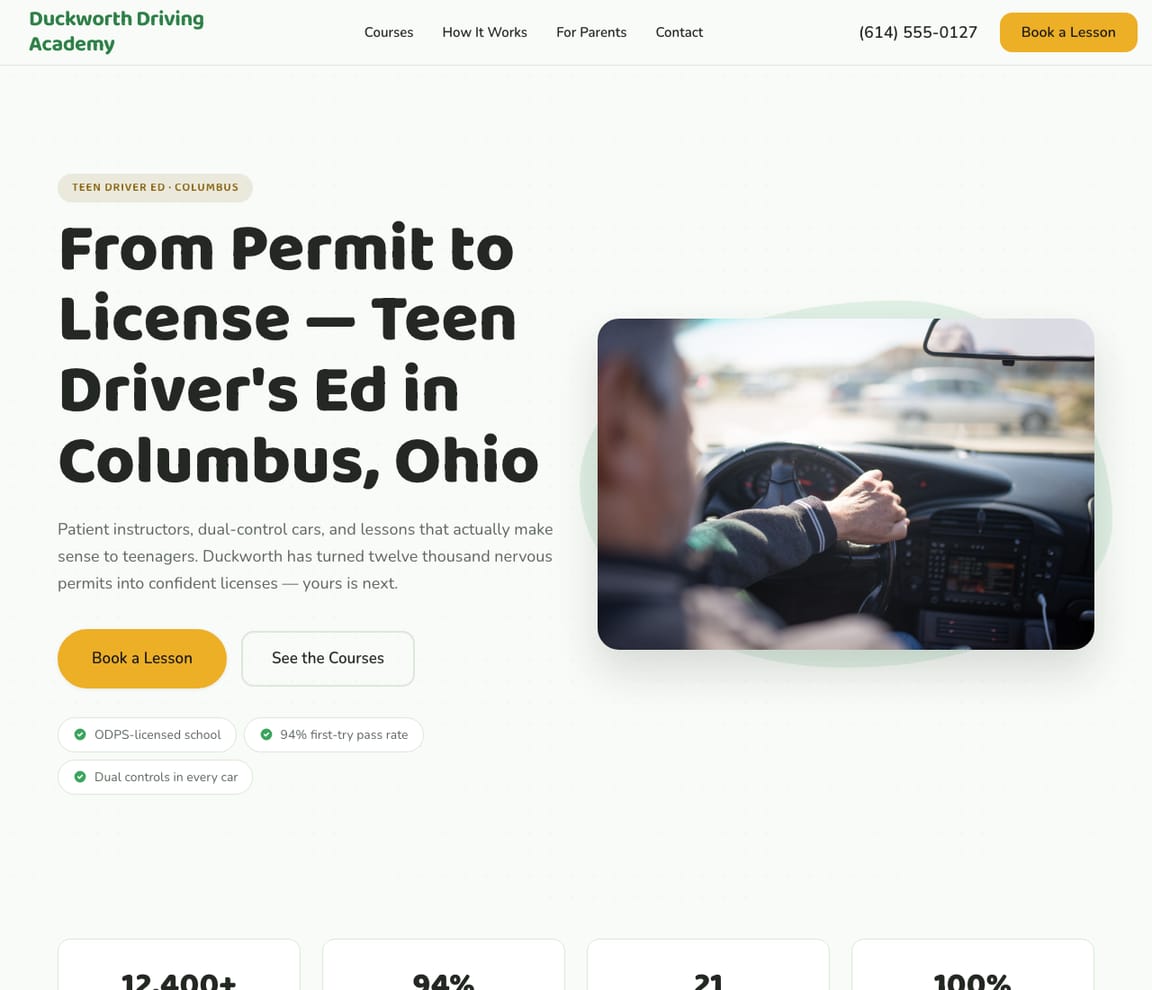
See what your driving school website could look like
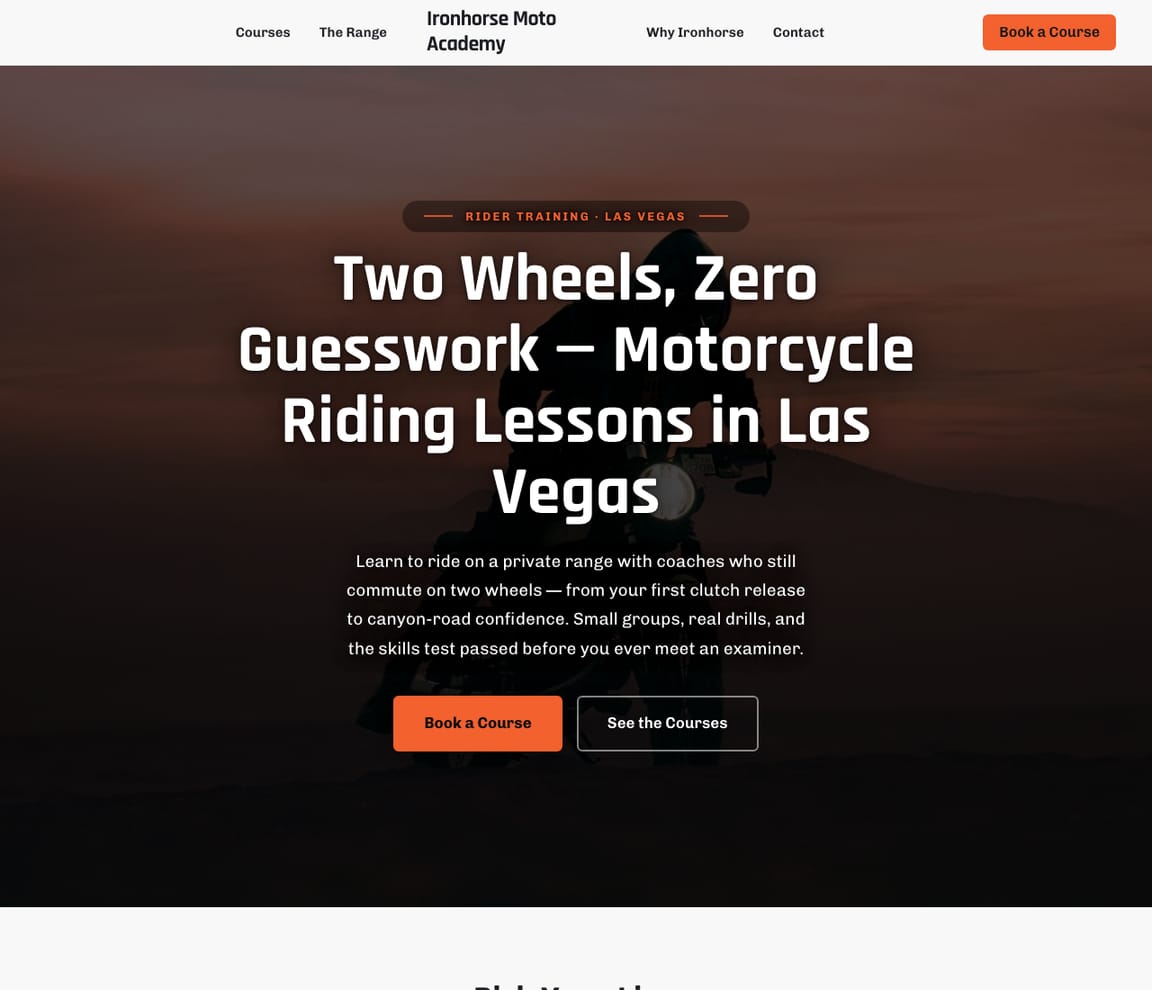
This is a real Zarla driving-school template — describe your school and you get a site like this in about a minute: your lesson packages, a booking form, and room for parent reviews, all mobile-ready and SEO-optimized from the start.
- Professional design — not a generic template
- Looks great on desktop and mobile
- Content written for your industry
Is a driving school worth starting?
For a lot of people, yes. Demand is steady and hard to disrupt: teenagers turn 15 or 16 every year, new arrivals need to pass a road test, and nervous adults finally decide it's time — and none of that can be handed off to an app. Lessons sell in packages, so a full calendar means predictable, repeat income, and you can run lean from a single dual-control car long before you ever rent an office.
The honest trade-offs: this is a regulated business. Nearly every state makes you (and your vehicle) get licensed before you charge for a single lesson, commercial auto insurance is a real ongoing cost, and you're legally responsible for a learner behind the wheel — safety is the entire job. Demand also spikes in summer as teens rush to get licensed, so income can be seasonal.
But the barrier that scares people off is exactly what protects you. Once you're licensed, insured, and trusted by local parents, you're hard to replace. Win on patience, a high first-time pass rate, and reviews, and you'll be turning students away.
Starting a driving school, in plain English
Here's how it actually goes, start to finish.
First, decide who you'll teach: teens, adults, or a specialty like nervous drivers, seniors, defensive-driving referrals, or road-test prep. Teen driver's ed is the biggest and steadiest market; a specialty lets you charge more and compete less. Most instructors start with teens and add a specialty once the calendar fills.
Next, get licensed and equipped — this is the part that's unique to driving schools. Nearly every state requires an instructor license (a background check, a clean driving record, and usually a short certification course), a driving-school or business permit, a car fitted with a passenger-side dual brake, commercial auto insurance, and a “Student Driver” sign. Your own reliable sedan is fine to start.
Then get your first students the fastest way there is: ask. Tell family, friends, and neighbours you're taking bookings — parents talk, and one happy family sends you three more. A message like:
“Hi! I've just launched [School Name], a licensed driving school here in [your town]. If you've got a teen ready to learn — or know someone who does — I'd love to help them pass the first time. I'll take $25 off the first lesson for anyone you send my way.”
Copy that, make it yours, and send it to 20 people — especially parents of high-schoolers.
Now set your pricing. Add up your costs (your time, fuel, insurance, and the car), then price by the lesson-hour ($50–$90 is typical) or as a package — a 6- or 10-lesson teen bundle, or a road-test-prep session with the use of your car for the test. Call a couple of local schools as a “parent” to hear what your area actually pays.
Finally — and this is the part that compounds — when you run that first lesson, be the instructor parents rave about: calm, patient, and safe. Then ask for two things: a review on your Google Business Profile and a referral. A handful of 5-star reviews from local parents is exactly what makes Google show you to the next family searching “driving school near me.” Do that on repeat and your calendar stays full.
THE STARTER KIT
What you'll need to get started
A dual-control car
A reliable sedan with good all-round visibility, fitted with a passenger-side brake pedal. Dual controls are legally required for behind-the-wheel training in most states.
Instructor certification
Most states require an instructor license: a background check, a clean multi-year driving record, and usually a short state-approved course before you can charge for lessons.
Commercial auto insurance
A personal policy won't cover paid instruction. You need commercial cover for a learner at the wheel — your biggest recurring cost, and completely non-negotiable.
A "Student Driver" sign
A rooftop sign or magnetic door decals tell other drivers to give your learner room — a small cost that doubles as free advertising everywhere you park.
A lesson plan
State-approved lesson plans, a road-test skills checklist, and a simple way to log each student's hours and progress for parents and the DMV.
A way to get found
A professional website and a Google Business Profile — the two things that turn "driving school near me" searches into booked lessons (covered below).
THE STEPS
How to start your driving school (step by step)
Four steps from "I want to do this" to your first paying student.
01
Get licensed, insured, and road-ready
This is the regulated part, so do it first. Check your state's DMV or licensing agency for the exact rules, then get your instructor license (background check, clean driving record, and usually a certification course), register the business and any required driving-school permit, fit your car with dual-control brakes, and buy commercial auto insurance. Requirements vary by state — California, Texas, Florida, and New York each run their own process — so your state DMV page is the source of truth.
Rules vary by state02
Set your prices and packages
Know your true costs — your time, fuel, the car, and that insurance premium — then price the lesson-hour ($50–$90 is typical) and bundle it. Teen driver's ed sells best as a package of 6 or 10 lessons; add road-test prep with the use of your car, and premium specialties like nervous-driver or defensive-driving courses. Booked solid on day one? You priced too low.
$50–$90 per lesson-hour03
Book your first students
Driving schools run on word of mouth and local search. Tell every parent you know, post in local Facebook groups and Nextdoor, and ask your high school's front office if you can leave cards. Every happy student and relieved parent is a review and two referrals — the #1 growth engine in this business.
04
Get found online
To get a driving school business found online, you need two things: a professional website and a Google Business Profile. The website should show your lesson packages, service areas, your pass rate and reviews, and a "book a lesson" button; the Google Business Profile puts you on Google Maps for "driving school near me" and "driving lessons [your city]" searches. The fastest way to set up both is an AI website builder like Zarla, which creates a professional driving-school website free in about a minute and connects it to your Google Business Profile.
Set up free belowTHE COSTS
How much does it cost to start a driving school?
Plan on roughly $4,000–$10,000 to launch a one-instructor school — or about $3k if you start with a car you already own. Here's where it goes.
$200–$600Instructor license & course
$400–$1,000Dual-control brake install
$2,500–$5,000Commercial auto insurance (year 1)your biggest recurring cost
$0Website with Zarlavs $2,000+ for a designer
WHAT WE'VE LEARNED
What actually gets a driving school found
We've built websites for thousands of local businesses, and the same three things decide who ranks on Google and Google Maps — and who stays invisible. Do all three and you'll get found; skip one and you won't.
A fast, findable website
Quick-loading, with your lesson packages, real photos of you and the car, parent testimonials, and a dedicated page for every service (teen driver's ed, adult lessons, road-test prep) and every town you serve.
A connected Google Business Profile
Properly set up and linked to your website, so you appear in Google Maps and the local pack for "driving school near me" and "driving lessons [your city]."
A steady stream of reviews
The signal Google trusts most for local businesses — and the one parents read hardest before handing you their teenager. Ask every family for one after the road test.
SEE IT WORK
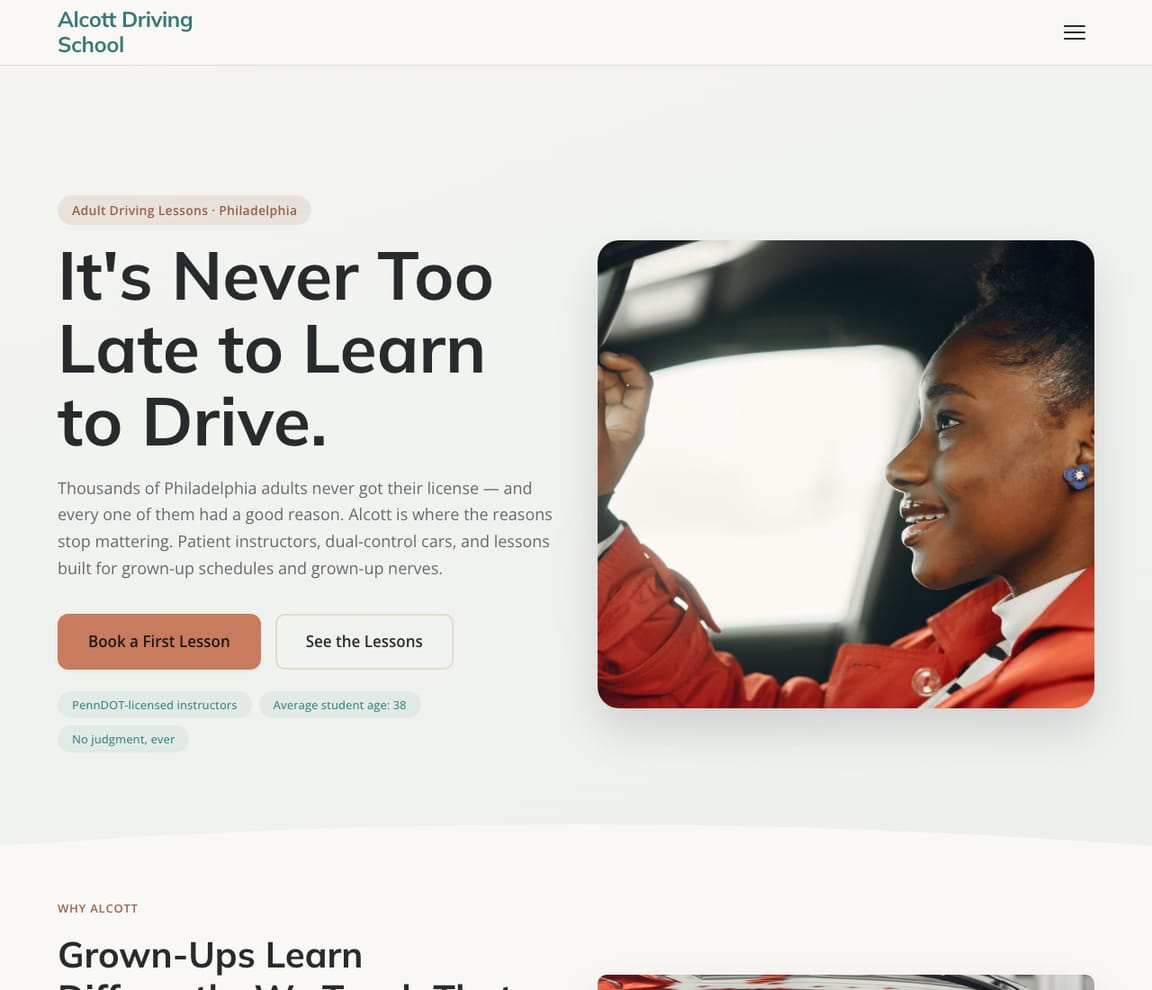
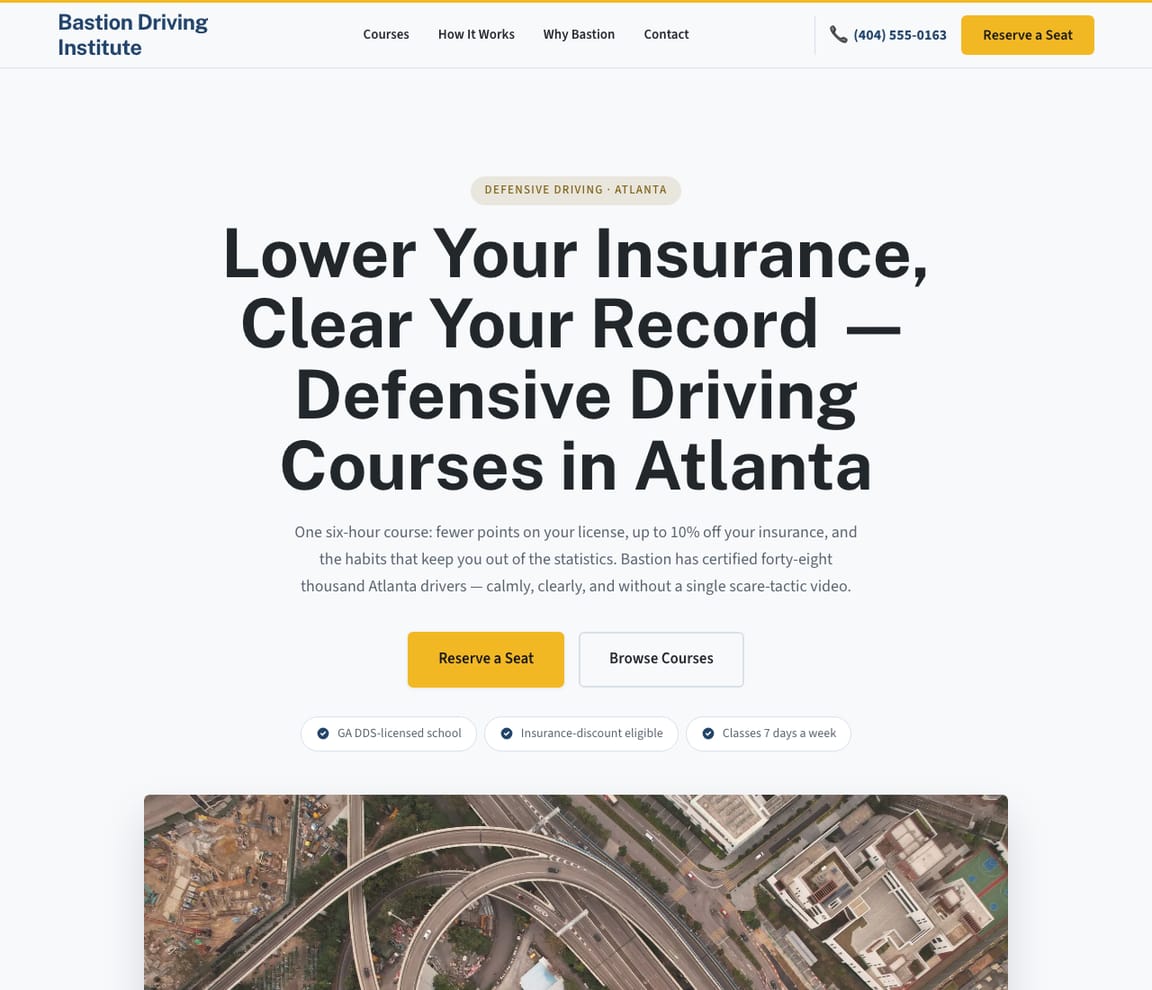
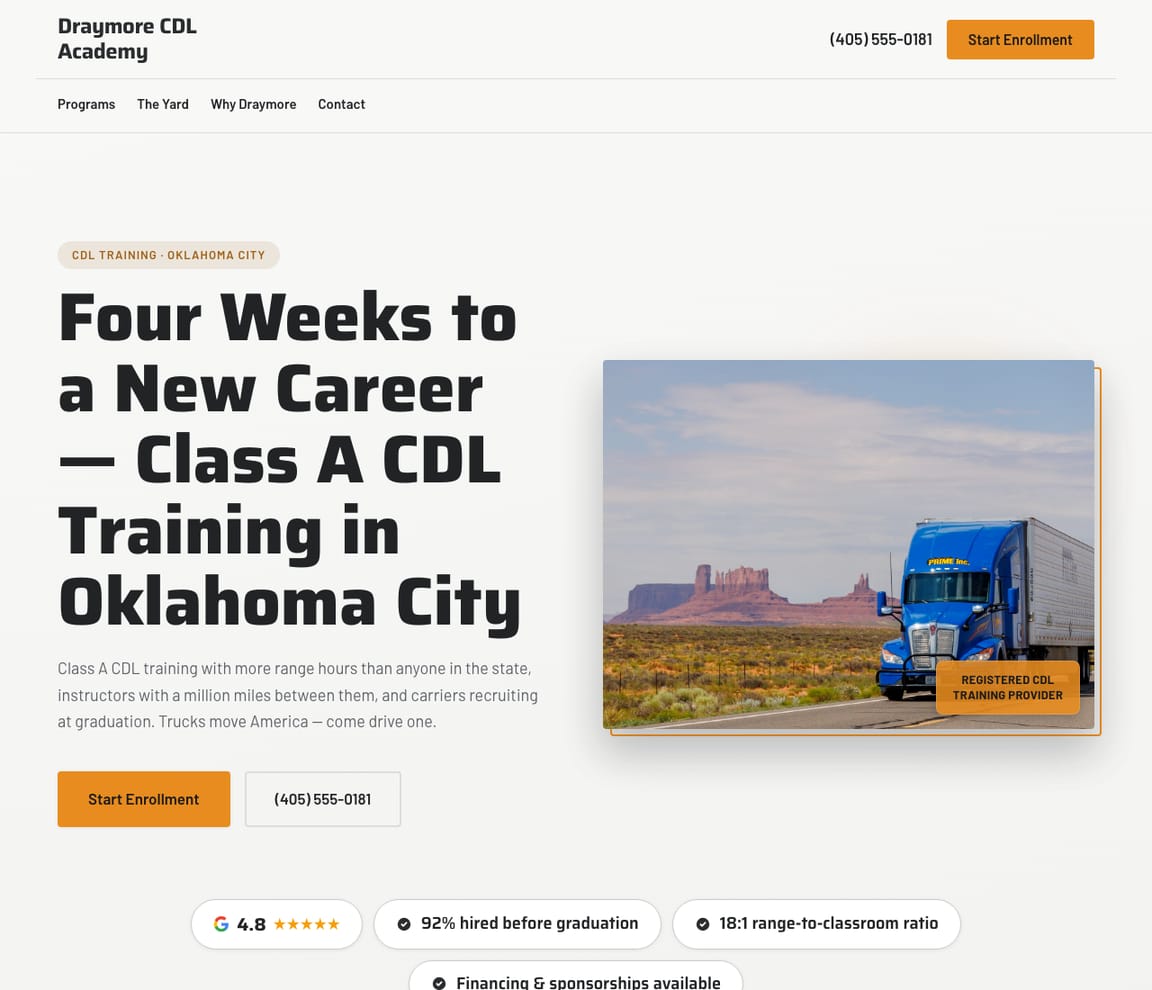
Driving school website designs you can start from
Every one is a real Zarla template you can make yours in about a minute — just add your school's name, packages, and service area.
GET FOUND
Get found by local learners and parents
A website plus a Google Business Profile is how nearby families find and choose a driving school. Zarla sets up both and wires them together.
"Driving school near me"
Show up in local Google searches the moment a parent or new driver looks for lessons in your area — the highest-intent leads there are.
Google Business Profile
Your hours, lesson packages, photos, and reviews right in Google Maps, so a family can call or book a lesson in one tap.
Reviews that win the booking
Parents choose the instructor other parents trust. Collect and show off 5-star reviews and pass-rate wins — the deciding factor between you and the next school.
Google Search
Ggreenlightdrivingschool.com
Greenlight Driving School — Trusted driving school in Your AreaLicensed driving school available for residential and commercial work. Same-day response.← Your Zarla siteCcitydrivingschoolservices.com
City driving school ServicesGoogle Maps
1
Greenlight Driving School
← You2
Metro driving school Co.
3
Quick driving school Services
AI assistants (ChatGPT / Perplexity)
For driving school services in your area: Greenlight Driving School — 4.9★ across 200+ Google reviews, same-day response, licensed and insured.
YOUR LAUNCH PLAN
Your driving school launch checklist
Everything above, boiled down to the concrete steps. Work through them in order and you'll be open for business — and findable on Google — faster than you'd think.
- Decide who you'll teach — teens, adults, or a specialty like nervous drivers or road-test prep.
- Check your state's DMV rules — instructor license, driving-school permit, and the exact requirements where you operate.
- Get your instructor certification — background check, clean driving record, and any required course.
- Fit dual-control brakes and get commercial insurance — the two things that make your car road-legal for paid lessons.
- Set your prices and packages — per lesson-hour, plus a teen bundle and road-test prep.
- Build your website and connect a Google Business Profile — free with Zarla.
- Ask for referrals from friends, family, and local parents — and leave cards at the high school.
- Run a great first lesson, then ask for a Google review after every student passes.
REAL CUSTOMERS
Owners who got online without a developer
Verified reviews from real Zarla customers.
“Great professional website in less than a minute, with the use of AI and a few descriptive prompts. This has saved me bundles of time and research on web developers.”
“Optimized for local service-based businesses. Easiest website build I've experienced. The AI-based build is the way to go instead of clunky theme-based websites. Get the site built and get out of the weeds with Zarla!”
“Quickly built my website from scratch. No hiccups. Would highly recommend Zarla for someone with no experience who wants to start a polished business website.”
“I had no idea how to set up a website for my business. Thanks to Zarla, they've helped me a lot.”
“Very reliable, professional, and fast results. I was able to get my business online in no time, and the ease of access made it so simple.”
Free to build
Ready to get your driving school online?
Describe your school and Zarla builds your website in about a minute — lesson packages, a booking form, room for parent reviews, and your logo, all connected to Google.
Free to build and preview — no code, no credit card.
Frequently asked questions
Do you need a license to start a driving school?
Almost always, yes. Most U.S. states require two things: an instructor license (you'll typically need to be 21 or older, hold a clean multi-year driving record, pass a background check, and complete a state-approved course) and a separate driving-school or business license for the school itself. Your car also needs dual-control brakes and commercial insurance. The rules are set state by state, so check your state DMV or licensing agency — for example California's DMV, Texas TDLR, or Florida's DHSMV — for the exact steps.
How much does it cost to start a driving school?
Plan on roughly $4,000–$10,000 to launch a one-instructor school: instructor license and course ($200–$600), a dual-control brake install ($400–$1,000), commercial auto insurance ($2,500–$5,000 in year one), signage, and a car. You can start closer to $3,000 by using a reliable car you already own and building your website free with Zarla.
Is a driving school a profitable business?
It can be. Margins are healthy because a single dual-control car and a full calendar cover most of your costs, and lesson packages give you repeat, predictable revenue. Commercial insurance is the main thing eating into profit, so instructors who keep the car booked, teach specialties like road-test prep and defensive driving, and earn strong reviews do best. Demand is steady — new teen drivers age in every year.
Do I need a permit to start a driving school?
Two different "permits" come up. You'll likely need a driving-school permit or business license to operate — that's part of your state's licensing process. Separately, your students must hold a learner's permit before you can legally take them out for behind-the-wheel lessons on public roads. Confirm both with your state DMV before your first lesson.
How much should I charge for driving lessons?
Most instructors charge $50–$90 per lesson-hour, with teens usually buying a package of 6–10 lessons plus a separate road-test-prep session (often with the use of your car for the test). Price by adding up your time, fuel, the car, and insurance, then check what local schools charge by calling a few as a "parent." Specialty lessons — nervous drivers, seniors, defensive driving — command a premium.
How do I start my own driving school?
Start with the regulated parts, in this order: pick your focus (teens, adults, or a specialty), check your state DMV's exact requirements, get your instructor license and driving-school permit, fit dual-control brakes and buy commercial insurance, then set your pricing. Once you're legal to teach, build a website and Google Business Profile so families can find and book you — that last step is where most new schools fall down.
How do I get my driving school found on Google?
Three things do the heavy lifting: a professional website that lists your lesson packages, service areas, and reviews with a "book a lesson" button; a Google Business Profile connected to that website so you appear on Google Maps for "driving school near me"; and a steady stream of 5-star reviews from parents and students. An AI builder like Zarla creates the website free in about a minute and connects it to your Google Business Profile, so you're findable from day one.