BUSINESS GUIDE
How to start a tutoring business in 2026
The real version, for a tutor going independent at the family's home, the library or online: what families pay and how to set your rate, what the law asks of you, the marketplaces and what they keep — and how to fill your afternoons with students.
Free to build · Pay when you publish · No credit card
$35–$60an hour: what most tutors charge on Wyzant (2024)
$100–$200an hour for SAT and ACT prep, a tutor's rate to a national brand's
$20.84an hour: median pay for employed tutors (O*NET, 2025)
No codeto get online
See it in action
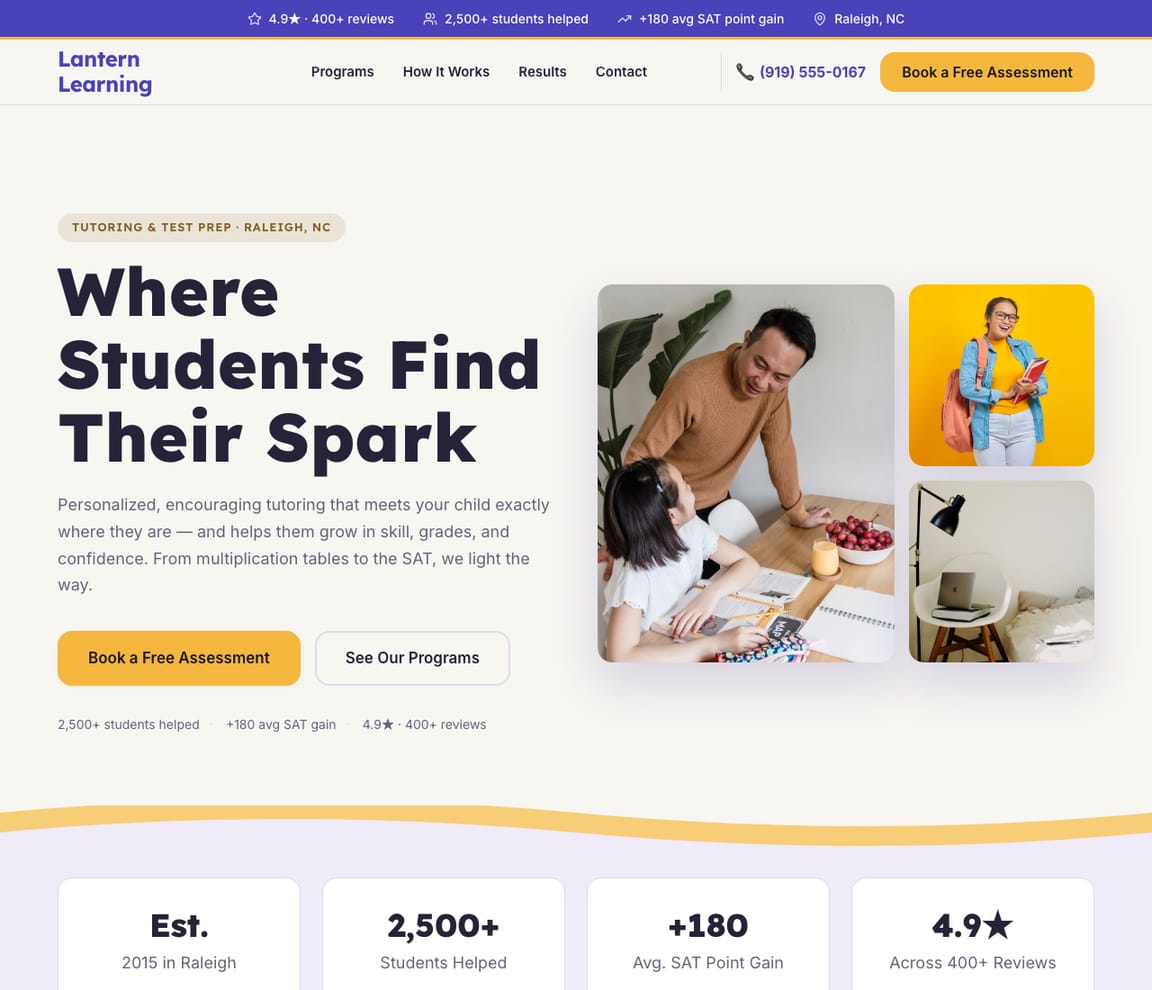
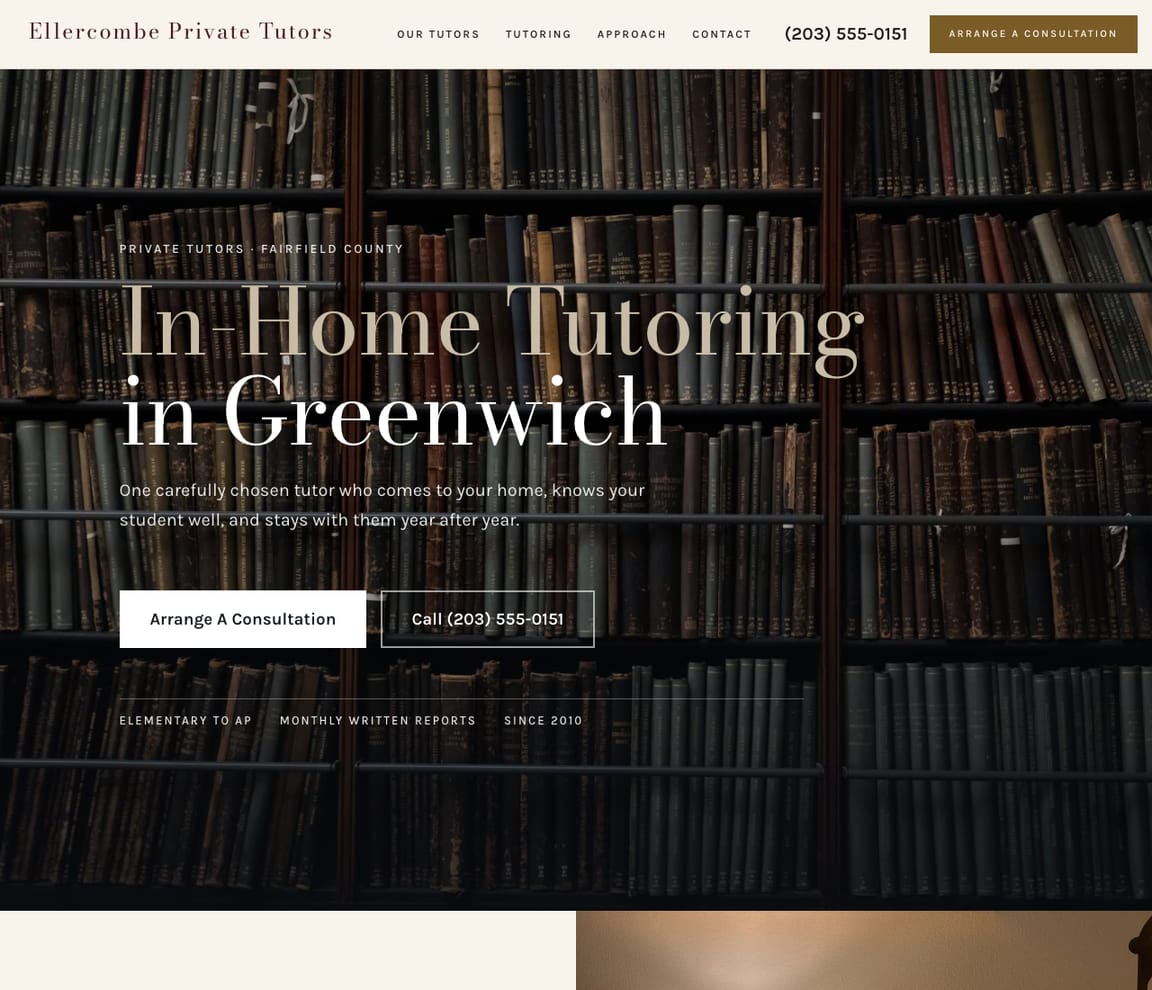
See what your tutoring website could look like
This is a real Zarla template for a tutoring and test prep business. Describe yours — the subjects and grades you teach, in person or online, the towns you cover — and you'll have a site like this, with an inquiry form for parents and room for your story, in about a minute.
- Professional design — not a generic template
- Looks great on desktop and mobile
- Content written for your industry
Build the website
Start your tutoring website now
Add your town and your business's name to the sentence, and Zarla builds the site: the subjects and grades you teach, in person or online, your story and an inquiry form. Add your rates and online booking for a free assessment when you're ready, then publish.
Already have a website? Bring it across →Zarla keeps your old page addresses where it can and redirects the ones that change, helping you keep the Google standing you've built.
Is a tutoring business worth starting — and how much do tutors charge?
The first question every parent asks is the price, and the answer runs wide. On Wyzant, a US tutoring marketplace, the average is $35 to $60 an hour, with plenty of tutors below and above (Wyzant, December 2024). Tutors on Care.com post lower starting rates — about $24 an hour for elementary, middle and high school, $60 for college subjects and $100 for test prep, as of September 2025 — and the founder of WorldWise Tutoring charges $75 an hour for in-person elementary tutoring around Chicago and Houston, and $10 less online (Care.com, September 2025). A Huntington Learning Center franchise in Brentwood, Tennessee, charges $75 an hour one on one and $60 an hour in a group of three or four (Education Next, October 2024).
Specialists and test prep sit higher. One reading-tutoring provider's own 2026 survey puts the national average for an hour with a Science of Reading or Orton-Gillingham tutor at $113.06 (The Reading Guru, 2026). A Los Angeles tutoring owner puts SAT and ACT prep at about $100 an hour and up (Care.com), and Princeton Review lists 10 hours of SAT tutoring at $2,000 and 18 hours at $3,150 — $175 to $200 an hour (Princeton Review). Families also buy by the month: Tutor.com lists one online hour a month at $39.99 (Tutor.com), and a Kumon center in Pooler, Georgia, charges $190 a month for math or reading and $375 for both (Kumon of Pooler, June 2025).
The trade is large and steady rather than booming. The Census counted 9,820 tutoring and exam-prep businesses with employees in 2023, employing 108,755 people (Census County Business Patterns, 2023) — solo tutors aren't in that count. O*NET puts employed tutors' median pay at $20.84 an hour in 2025, with “little or no change” projected in their numbers to 2035 (O*NET). That median is what a tutoring company pays a tutor; what you charge as the owner is the rest of this guide.
The hard parts are the hours and the calendar. Lessons fit after school, in the evenings and on weekends — one South Carolina center opened Tuesday to Thursday from 4 p.m. to 7 p.m. and on Saturday mornings, at $40 an hour (The Post and Courier, 2019) — so a full week is a few dozen teaching hours, and summer either empties the calendar or, for those who sell summer programs, fills it. That's what the rest of this guide sets up.
How to start a tutoring business, in plain English
Pick what you teach, and to whom. “K–8 math and reading”, “high-school chemistry”, “SAT prep”, “reading support for kids with dyslexia” — parents search for the problem, not for “a tutor”, and the subject sets the rate. Then decide where you'll teach: the family's home, a library study room or a video call. Most independent tutors start with all three.
Licenses: the paperwork is a business's, not a teacher's. In the US we found no state that licenses private tutoring itself, and you don't need a teaching certificate to tutor privately — New York's license, for example, is for teachers in private schools (NYC Business). Rules attach where schools pay for tutoring: Texas sets rules for the tutoring providers districts use for accelerated instruction (Texas Education Agency). For a solo tutor the paperwork is any business's: you're a sole proprietor automatically the day you start (SBA), an LLC costs $40 to form in Kentucky (Kentucky SOS) and $300 in Texas (Texas SOS), and an EIN is free from the IRS (IRS). Check your city's business license too.
Background checks: expected by parents, and the law can require one once you hire. Wyzant doesn't require its tutors to have one — a family can order a check on a tutor for $15.99 (Wyzant) — and a check on yourself from a screening company starts at $49.99 (Checkr). Once you employ tutors, some states make checks a duty. California requires “an administrator, employee, or regular volunteer of a youth service organization” to “undergo a background check” (Cal. Bus. & Prof. Code §18975) — whether a tutoring company counts as one is a question for a California lawyer — and Pennsylvania's child abuse clearance, for paid roles with direct contact with children through a program, activity or service, costs $13 (Pennsylvania DHS). Check your state before you hire, and keep sessions with minors in a public place or with a parent home.
Sales tax: usually not, but check. In the US most states don't tax tutoring: Texas's list of taxable services leaves it out (Texas Comptroller), and Washington's 2025 tax on more services excludes “one-on-one instructional activities such as tutoring” (Washington DOR). But Hawaii's general excise tax applies to all business activities, at 4% for most (Hawaii DOTAX); New Mexico's gross receipts tax covers performing services in the state (New Mexico TRD); South Dakota's exemption for educational services leaves out industry 8299 (SDCL 10-45-12.1), which lists tutoring (SIC manual); and West Virginia presumes every service taxable unless an exemption applies (WV Tax Division). Check with your state's revenue department before you set prices.
Insurance. General liability covers an accident in a family's home; professional liability covers a family's claim that your teaching cost them. Insureon's medians for professional-services businesses — it names tutors among the lower-risk ones — are $29 a month ($350 a year) for general liability, $43 a month for professional liability and $49 for workers' comp (Insureon, April 2025); its July 2026 medians for education consultants are $29 and $42 (Insureon). An insurer that sells abuse and molestation coverage notes that general and professional liability typically exclude those claims (Insurance Canopy) — ask about it once you hire.
Marketplaces find students, and keep a share. Wyzant keeps a 25% platform fee from each lesson (Wyzant); Preply keeps all of a new student's trial lesson, then 33% falling to 18% as your hours grow (Preply); Outschool collects a 30% fee on paid enrollments (Outschool). They're a quick way to find first students and an expensive way to keep them, so many tutors move their regulars onto their own scheduling and invoicing.
What it costs to start. Tutoring software for one tutor is $16.95 a month at TutorBird (TutorBird) or from $16.49 a month plus a small fee per lesson at Teachworks (Teachworks); an online classroom with a whiteboard runs $9 to $29 a month for one tutor (Lessonspace); a USB headset is $24.99 (Logitech); the digital SAT's full-length practice tests are free in the College Board's Bluebook app (College Board); and a Google Business Profile is free (Google). The National Tutoring Association's membership is $45 (NTA), with a $15 initial application for its professional tutor certification (NTA) — optional, and no state we found requires it. For a solo tutor working in homes, at the library and online, our free tutoring business plan adds it up to $1,966–$9,416: your pay while the week fills, a laptop and headset if you need them, books, a year of liability coverage, a background check, registration, marketing, a website and software.
When you hire. Whether a tutor is a contractor or an employee depends on how much you control the work, the money and the relationship (IRS); for tax years beginning after 2025, the 1099 reporting threshold rose to $2,000 (IRS). If you drive to students, the 2026 business mileage rate is 76 cents a mile from July (IRS). A contract tutor costs about what tutoring companies pay — the $20.84 median above.
A center is a different business. Office space in Dallas–Fort Worth averaged $34.17 a square foot a year in mid-2026 (Cushman & Wakefield, Q2 2026) — about $2,850 a month for 1,000 square feet. A franchise packages the center for you: Kumon puts the total investment at $101,630 to $233,780 with a $2,000 franchise fee (Kumon), Mathnasium at $127,316 to $165,846 (Mathnasium), and Huntington at $177,742 to $326,382 with a $42,000 fee (Huntington). Most independent tutors start in homes and online and add a room only when the waiting list pays for it. The tutoring website templates and tutoring website examples show what a good tutor's site looks like, and Zarla's tutoring website builder is how a parent searching for help finds yours.
What tutors who started their own business actually say
None of this is our opinion about the trade. It comes from tutoring-business owners talking to local news and the business press between 2024 and 2026 — read each as theirs at the time. Four things come up again and again.
The first students come from people who already know you. Rebecca Beard of Niceville Tutoring in Florida started by advertising in local Facebook groups: “My growth was fast,” she said. “Parents, high schoolers, and college students contacted me for help, particularly in math and for test prep.” And: “Before long,” she recalls, “my schedule was fully booked, and I had a waiting list.” (850 Business Magazine, March 2025). Julie Schwartz of Count On Me Tutoring in Oceanside, New York, on the local fairs where she makes appearances: “They definitely help our exposure,” she said. “We try to raise more community awareness.” (Patch, August 2025).
Start at a price you can defend, then raise it. Greg Freebury, owner of Think and Evolve Tutoring in Los Angeles: “When first starting out, I would recommend charging the bare minimum, maybe $20 or $30 per hour.” His reason: “you have no reputation, no ratings and no recommendations… Because you lack this kind of social proof, you will need to compete based on price.” (Care.com, updated October 2025). Steve Menking, who left a Wall Street job, set his rate on Wyzant “at just under $100 an hour” and, as referrals came in, was earning about $150 an hour by 2017; now running Menking Tutoring LLC, he says: “It's been better and more fulfilling than I ever could have imagined.” (CNBC, November 2024).
“I know the material, the state standards, and how to teach, but the business side was entirely new to me.” — Rebecca Beard, founder, Niceville Tutoring, 850 Business Magazine, March 2025
One on one is the product. Ashley Gilbert of Keep It Up Tutoring in Forest Lake, Minnesota: “The way I like to say it to parents is our school system does the best that they can, and they are wonderful and fabulous, but they are not equipped to work one on one with kids.” (Forest Lake Times, April 2026). Lauren Rainwater of Captivate Learning Center in Cullman, Alabama, on her small groups: “Learning pods are a student and family favorite because it’s only 2-3 students all working on the same skill.” (The Cullman Tribune, March 2025). And Brian Telford, who owns a Huntington franchise in Brentwood, Tennessee, on why families come: “There have always been students that struggled in school, right? Some of the students we see may have still needed help, even if Covid hadn’t happened.” (Education Next, October 2024).
Growth means hiring — carefully — and sometimes a room. Beard again, on the contract tutors she vets: “We’ve turned down candidates who didn’t meet our standards.” And on moving out of coffee shops and libraries: “As demand grew, it became obvious I needed a dedicated space.” (850 Business Magazine). Gilbert: “My five year goal was to leave teaching and do this full time, and I ended up doing that in three years.” (Forest Lake Times). Schwartz, weeks after launching: “We recently started the hiring process, and we're expanding very fast.” (Patch). Kim Yerick of Learning Lane Tutors in Woodbridge, Virginia, in her own words: “Tutoring gave me more control of my schedule, but of course starting off and building clients is a risk.” (VoyageVirginia, October 2026). Ourania Liandrakis, who founded Tip-Top Brain Tutoring in Queens: “I always wanted to open a learning center that was different, no cookie-cutter tutoring.” (QNS, November 2025).
An editor who tracks side hustles puts the range plainly: “Tutors can earn anywhere from $15 to more than $150 an hour, depending on the subject that they teach.” — Kathy Kristof, SideHusl.com (CNBC, December 2024).
The through-line: the tutors who last pick a subject they're good at, price it honestly and raise it as the reviews come in, fill their week through the people who already trust them, and hire slowly once the waiting list is real.
THE STARTER KIT
What you need to start a tutoring business
A subject and a grade band
What you teach and to whom — K–8 math, high-school chemistry, SAT prep, reading support — narrow enough that a parent searching the problem finds you.
A place to teach
The family's home, a library study room or a video call: a laptop, a headset, an online whiteboard, and the books and practice tests for your subjects.
A background check
Not required by law for a solo tutor in the states we checked, but parents expect one — and some states require checks once you employ tutors.
Your rate and your policies
An hourly rate for each subject, a monthly package, and a written cancellation and payment policy, so your income doesn't depend on who remembers to pay.
Registration and insurance
A business registration or a sole proprietorship, a free EIN when you need one, and general and professional liability coverage once you're working with families.
A way to be found
A Google Business Profile and a website with your subjects, your background and a way to ask a question — then teachers, counselors and parents who send families to you.
THE PAPERWORK
Licenses, checks and insurance for a tutoring business
| Typical cost | Time to get | Legally required? | |
|---|---|---|---|
| Business registration (LLC) and local business license | e.g. $40 (Kentucky), $300 (Texas) | Days | Depends on your structure and city |
| EIN from the IRS | Free | Minutes online | If you hire or have partners; optional when solo |
| A tutoring license or teaching certificate | None to buy | — | No state we found licenses private tutoring |
| Background check | $15.99–$49.99 a check | Days | Not for a solo tutor in the states we checked; for staff in some states |
| Sales tax registration | Set by your state | Days to weeks | Only where your state taxes tutoring, e.g. HI, NM |
| General and professional liability insurance | $29 + $43/month (medians) | Same day | Not by law; schools and centers ask |
| Workers' compensation | $49/month median | Days | In most states, once you hire employees |
| National Tutoring Association certification | $45 membership + $15 application | Weeks | No — optional |
THE STEPS
How to start a tutoring business (step by step)
Eight steps from “I could teach that” to a full week of students.
01
Pick your subjects and students
Choose the subjects, grade levels and tests you'll teach, and whether you'll meet at home, at the library or online. A narrow niche is easier to be found for.
02
Set your rate and policies
Price each subject against what tutors near you charge, add a monthly package, and write your cancellation, payment and make-up-lesson policy before the first family.
03
Register the business
Start as a sole proprietor or form an LLC, get a free EIN when you need one, and check your city's business license and your state's sales tax rules.
04
Get a background check and insurance
Run a background check on yourself, buy general and professional liability coverage, and keep sessions with minors in a public place or with a parent home.
Before your first student05
Set up where you teach
A headset and an online whiteboard for video lessons, the books and practice tests for your subjects, and scheduling and invoicing that won't need chasing.
06
Get found by parents searching
Put your Google Business Profile and website live with your subjects, your background, your rates and a way to ask a question.
07
Tell the people who refer
Introduce yourself to teachers, school counselors, librarians and the parents in your neighborhood groups — and ask every family for a review.
08
Grow past your own hours
Sell monthly packages and summer programs, then bring on contract tutors when the waiting list outgrows your afternoons.
THE COSTS
How much does it cost to start a tutoring business?
The total is our free tutoring business plan's itemized US ranges for a solo tutor working in homes, at the library and online: your pay while the week fills, a laptop and headset if you need them, books, a year of liability coverage, a background check, registration, marketing, a website and software. A center is extra. Insurance from Insureon, software from TutorBird and Teachworks, checked October 2026.
$1,966–$9,416to start solo — your pay while the week fills and a laptop are the biggest lines
$72/monthgeneral plus professional liability, the two Insureon medians added together
$16.95/monthfor tutoring software for one tutor, at list price
$101,630+for a tutoring franchise, at the low end of Kumon's range
WHAT WE'VE LEARNED
What actually makes a parent book a tutor
Thousands of local business websites in, the pattern for lessons is clear: the parent arrives worried about a grade and unsure about a stranger. Three things on a page decide who gets the message.
Subjects and grades they can find
The subjects you teach by grade — “algebra and geometry, grades 7–10”, “reading for K–3” — and the tests you prepare for, so the parent knows you fit their child.
Who the tutor is
Your teaching background, your degree or your specialty, a photo, and that you have a background check — the questions every parent asks before a first session.
A clear first step
Your rate or a starting price, how lessons work in person and online, reviews from parents, and one easy way to ask a question or book a first session.
THE UPSIDE
What a tutoring business can earn
Rates from Wyzant (December 2024), a Huntington franchise in Tennessee (Education Next, 2024) and one reading-tutoring provider's 2026 survey; pay from O*NET. Averages, not a promise — your subject, your results and how many hours you fill decide it.
$35–$60/hrwhat most tutors charge on Wyzant, with plenty above and below
$75/hrone on one at a Huntington Learning Center franchise in Tennessee
$113.06/hrthe average for a reading specialist, in one provider's 2026 survey
$20.84/hrthe 2025 US median for employed tutors — about what a contract tutor costs you
SEE IT WORK
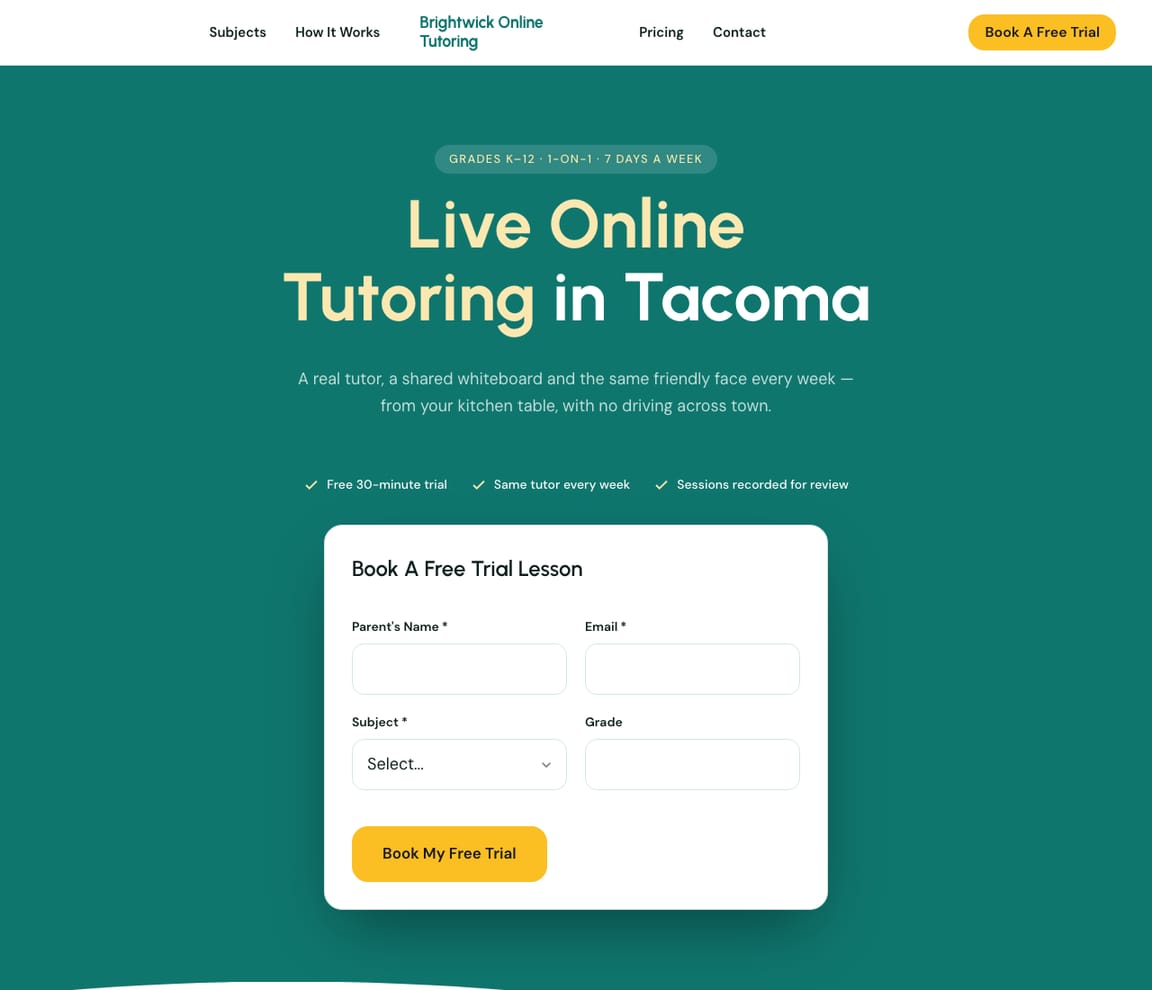
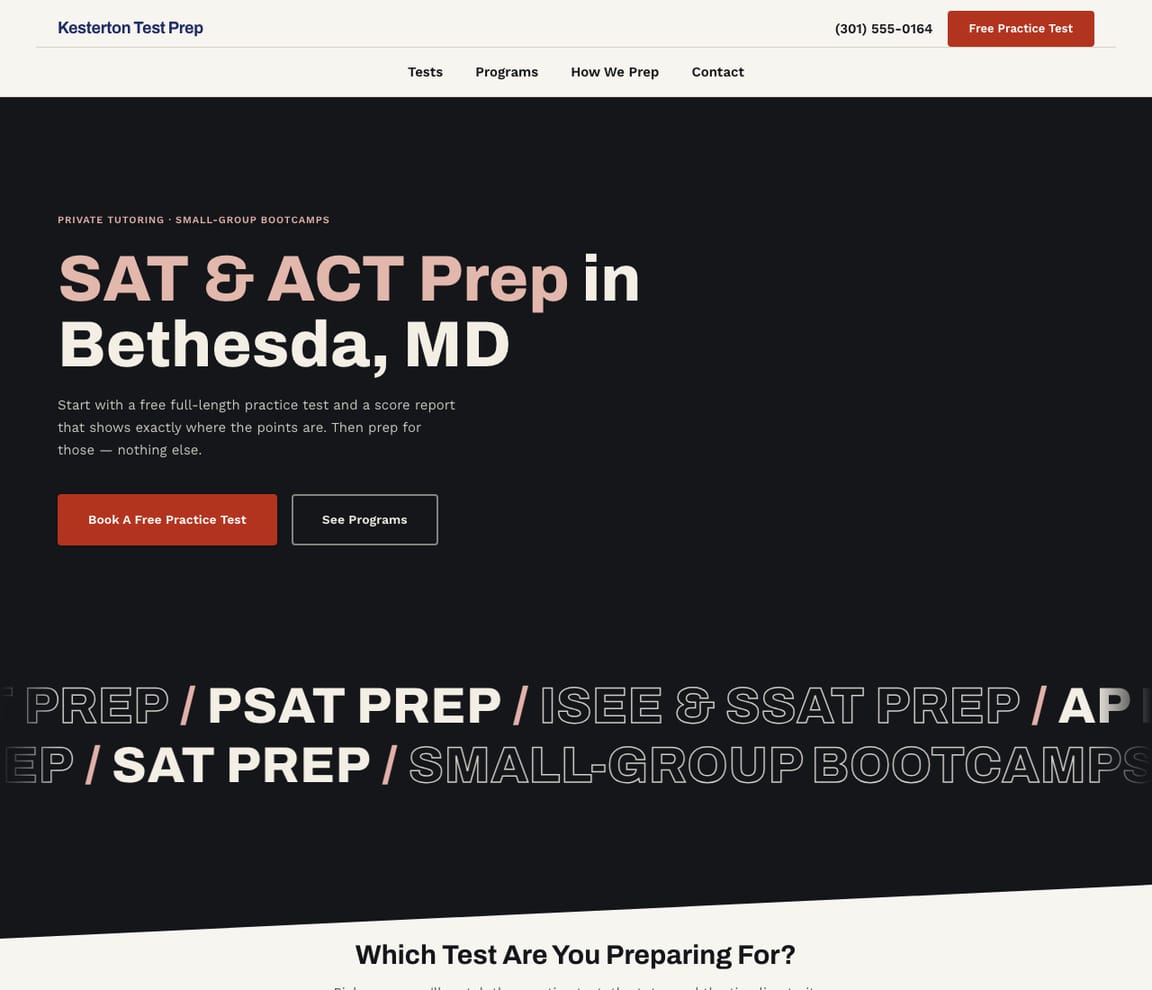
Tutoring website designs you can start from
All four are real Zarla templates. Open the one closest to how you'll teach — in the family's home, online, SAT and ACT prep, or reading and dyslexia support — swap in your subjects, your story and your town, and publish.
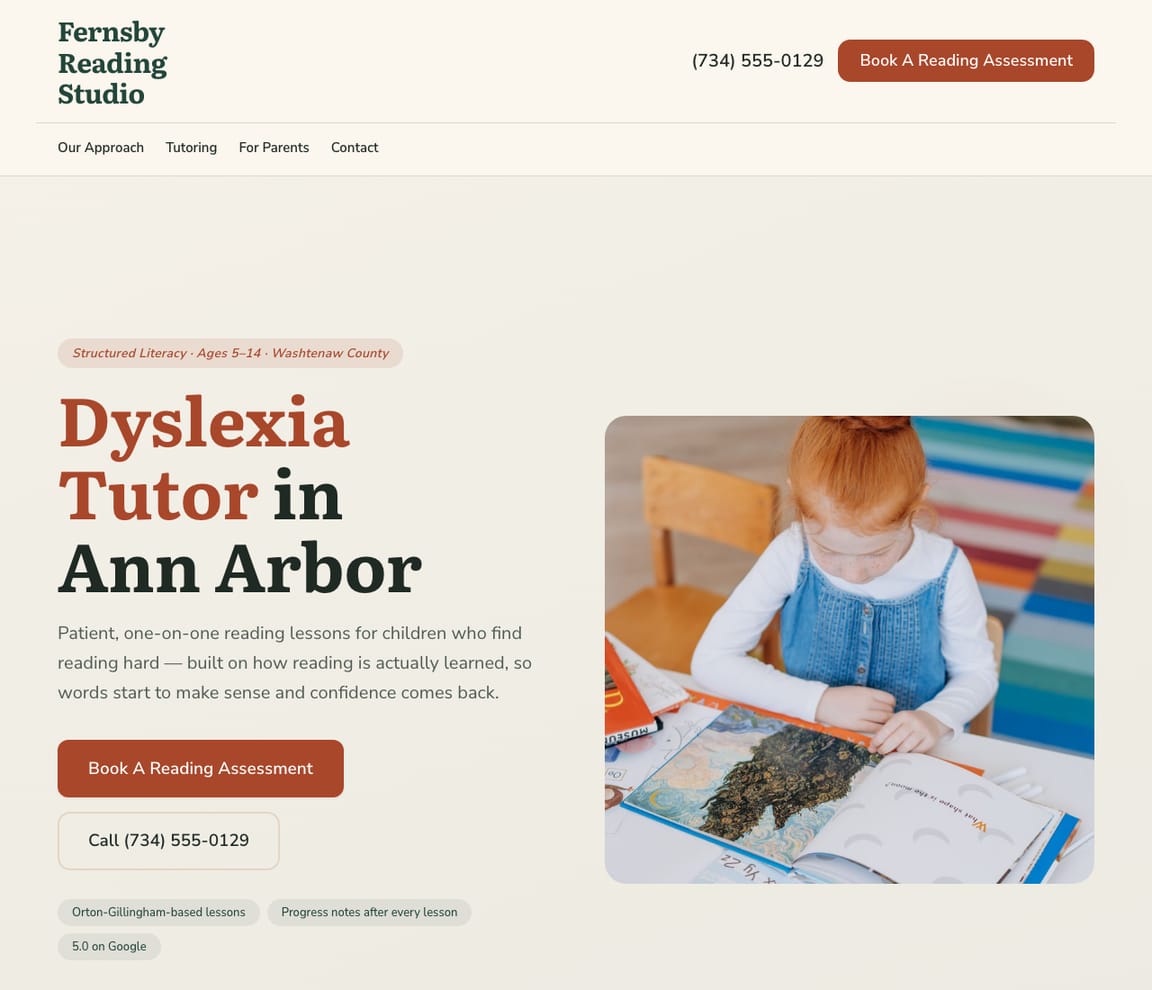
GET FOUND
Get found by the parent searching the problem
Parents search for the problem — “math tutor”, “reading tutor for dyslexia”, “SAT prep” — and then check who the tutor is and what it costs. Zarla builds the website with your subjects and an inquiry form. Add your rates and online booking for a free assessment in chat, and once you connect your Google Business Profile, your name, location and reviews stay in step on both.
“Math tutor near me”
Searched by a parent after a bad report card or a long night of homework. Your subjects, the grades you teach and a quick way to ask a question answer it before they try the next name.
Google Business Profile
Your subjects, the area you travel to or that you teach online, your hours and your reviews inside Google Search and Maps. Free, and an afternoon to set up.
Reviews from parents
Ask when the grade comes up or the test score comes back — and send the link that evening. Reviews that name the subject and the change sell the next family.
Google Search
Mmaplestreettutoring.com
Maple Street Tutoring — Trusted Tutoring in Your AreaOne-on-one math and reading tutoring for grades 3–12, at home, at the library or online. Background-checked tutor. Ask about a free first session.← Your Zarla siteCcitytutoringservices.com
City Tutoring ServicesGoogle Maps
1
Maple Street Tutoring
← You2
Metro Tutoring Co.
3
Quick Tutoring Services
AI assistants (ChatGPT / Perplexity)
For a local math tutor in your area: Maple Street Tutoring — a local math tutor who works with your child's grade, in person or online, with a background check, clear rates and reviews from parents nearby.
YOUR LAUNCH PLAN
Your tutoring business launch checklist
The whole guide as things to check off. Work through them in order and you'll be priced, legal, insured and findable before the first parent calls.
- Pick your subjects, grades and tests — and where you'll teach.
- Set your hourly rate and a monthly package — checked against tutors near you.
- Write your policies — cancellation, payment in advance, make-up lessons.
- Register the business — and check your city's license and your state's sales tax.
- Run a background check on yourself — and buy general and professional liability coverage.
- Set up for online lessons — a headset, an online whiteboard, scheduling and invoicing.
- Get found — website and Google Business Profile live with your subjects and background.
- Tell teachers, counselors and librarians — and ask every family for a review.
REAL CUSTOMERS
Small business owners who got online with Zarla
Verified reviews from real Zarla customers.
“Quickly built my website from scratch. No hiccups. Would highly recommend Zarla for someone with no experience who wants to start a polished business website.”
“Great professional website in less than a minute, with the use of AI and a few descriptive prompts. This has saved me bundles of time and research on web developers.”
“I had no idea how to set up a website for my business. Thanks to Zarla, they've helped me a lot.”
“Very reliable, professional, and fast results. I was able to get my business online in no time, and the ease of access made it so simple.”
Be the tutor parents find when they search
Add your town, your subjects and your business's name, and Zarla builds the website from that one line — the subjects and grades you teach, how lessons work and an inquiry form for parents. Free to build; you pay when you publish.
Already have a website? Bring it across →Zarla keeps your old page addresses where it can and redirects the ones that change, helping you keep the Google standing you've built.
Frequently asked questions
How much do tutors charge?
In the US, most tutors on Wyzant charge $35 to $60 an hour (December 2024), and tutors on Care.com post starting rates of about $24 an hour for school subjects, $60 for college subjects and $100 for test prep (September 2025). Established tutors and centers charge more — $75 an hour one on one at a Huntington franchise in Tennessee — and SAT tutoring at Princeton Review's list prices works out to $175 to $200 an hour. Reading specialists averaged $113.06 an hour in one provider's 2026 survey.
How much does it cost to start a tutoring business?
In the US, about $1,966 to $9,416 for a solo tutor working in homes, at the library and online, in our tutoring business plan's itemized ranges — your pay while the week fills, a laptop and headset if you need them, books, a year of liability coverage, a background check, registration, marketing, a website and software. You can start for less with the laptop you own. A center adds rent, and a franchise runs $101,630 to $326,382 across Kumon, Mathnasium and Huntington.
Do you need a license to start a tutoring business?
In the US, we found no state that licenses private tutoring itself, and a teaching certificate isn't required to tutor privately. You need what any business needs — a registration or a sole proprietorship, your city's business license where it has one, and sales tax registration in the few states that tax tutoring, such as Hawaii and New Mexico. Rules do apply when schools pay for tutoring, and some states require background checks once you employ tutors, so check your state before you hire.
Do I need an LLC to be a tutor?
No. In the US you're a sole proprietor automatically the day you start, and many tutors stay one until they hire. An LLC keeps business debts and claims away from your personal savings in most cases; it costs $40 to form in Kentucky and $300 in Texas, and an EIN is free from the IRS. Confirm the details for your state with an accountant.
What qualifications do I need to tutor?
No license or teaching certificate is required for private tutoring in the states we checked — knowledge of your subject, a way to show it and a background check are what parents look for. A degree, teaching experience or a specialty such as reading support or test prep lets you charge more. Certification is optional: the National Tutoring Association's membership is $45 with a $15 application for its tutor certification.
Is $30 an hour for tutoring good?
It's a normal starting rate. It sits above the $20.84 median that tutoring companies pay employed tutors (O*NET, 2025) and at the bottom of the $35 to $60 most Wyzant tutors charge — and a Los Angeles tutoring owner advises new tutors to start at “maybe $20 or $30 per hour” until they have reviews. For high-school science, reading support or test prep, $30 is low.
Is $50 an hour too much for tutoring?
No — it sits in the middle of the US market. Most Wyzant tutors charge $35 to $60 an hour, a Huntington franchise in Tennessee charges $75 one on one, and SAT and ACT prep starts at about $100 an hour for one Los Angeles tutor. Your subject, the grade, your experience and your results decide where you land.
How do I price myself as a tutor?
Start from what tutors near you charge for your subject and grade, then place yourself by experience: newer tutors start lower, specialists and test-prep tutors higher. Add a monthly package so families commit to a weekly slot, and write down your cancellation and payment policy. Raise your rate as reviews and referrals come in — one New York tutor set his rate just under $100 an hour and was earning about $150 an hour by 2017.
What do private tutors get paid?
It depends on who sets the rate. Tutors employed by a company earned a median $20.84 an hour in 2025 (O*NET). On a marketplace you keep what's left after its fee — Wyzant keeps 25%, so a $40 lesson pays you $30. An independent tutor keeps the whole rate, commonly $35 to $75 an hour, less their own costs and the hours spent finding students.
How can I start an online tutoring business?
Pick your subject, then choose how families find you: a marketplace such as Wyzant (a 25% fee), Preply (all of the trial lesson, then 33% falling to 18%) or Outschool (30% of enrollments), or your own website and Google profile. You'll need a headset, a video tool and an online whiteboard — classroom tools for one tutor run $9 to $29 a month — plus scheduling and invoicing. One Chicago and Houston tutoring founder charges $10 an hour less online than in person.
Is being a tutor a good side hustle?
Often, yes: you set your own rates and hours, and the work fits after school and on weekends. A side-hustle editor told CNBC in 2024 that tutors can earn from $15 to more than $150 an hour depending on the subject. The limits are the after-school hours, a quiet summer unless you sell summer programs, and a market that's steady rather than growing — O*NET projects little or no change in tutor numbers to 2035.
How do I get students for a tutoring business?
Start with people who already trust you: teachers, school counselors, librarians and parents in your neighborhood groups, and ask every family for a review when the grade comes up. Put your subjects, grades, background and rates on a website and a Google Business Profile so parents searching for a tutor find you. Zarla builds the website from one sentence, with your subjects and an inquiry form, and syncs your Google profile once you connect it.