BUSINESS GUIDE
How to start a dumpster rental business in 2026
The real version, written for one roll-off truck and a starter fleet of containers: the truck and the CDL, what containers cost, the city permits and franchises that decide where you can work, the tipping fee on every ton — and how a homeowner or a roofer finds your number.
Free to build · Pay when you publish · No credit card
10,982solid-waste collection businesses with employees in the US, 2023 (Census County Business Patterns)
$582–$891average US roll-off rental, 10-yard to 40-yard, with delivery, pickup and a set weight included (2026)
$49,690median pay for refuse and recyclable material collectors, the occupation roll-off drivers are counted in, May 2025 (BLS)
No codeto get online
See it in action
See what your dumpster rental website could look like
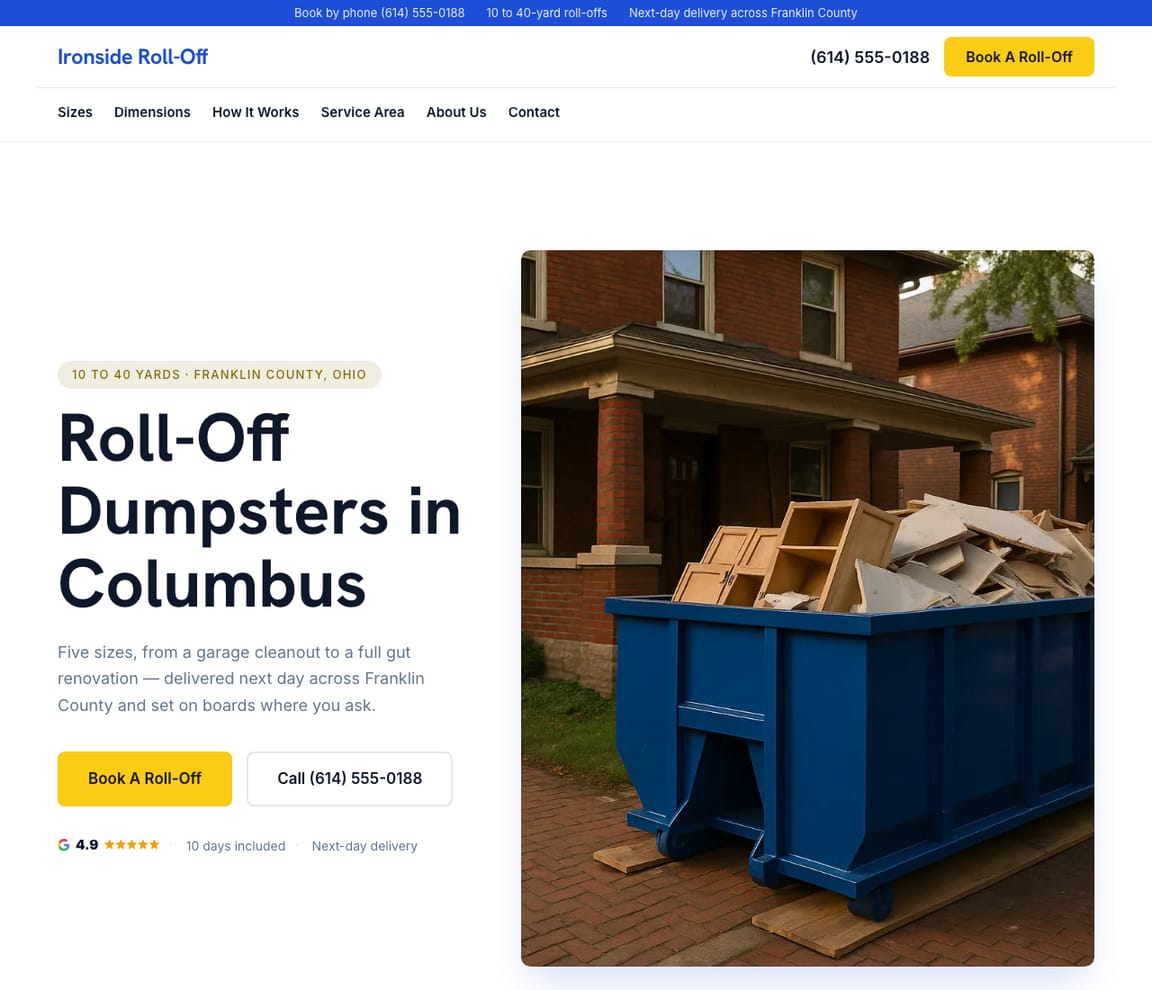
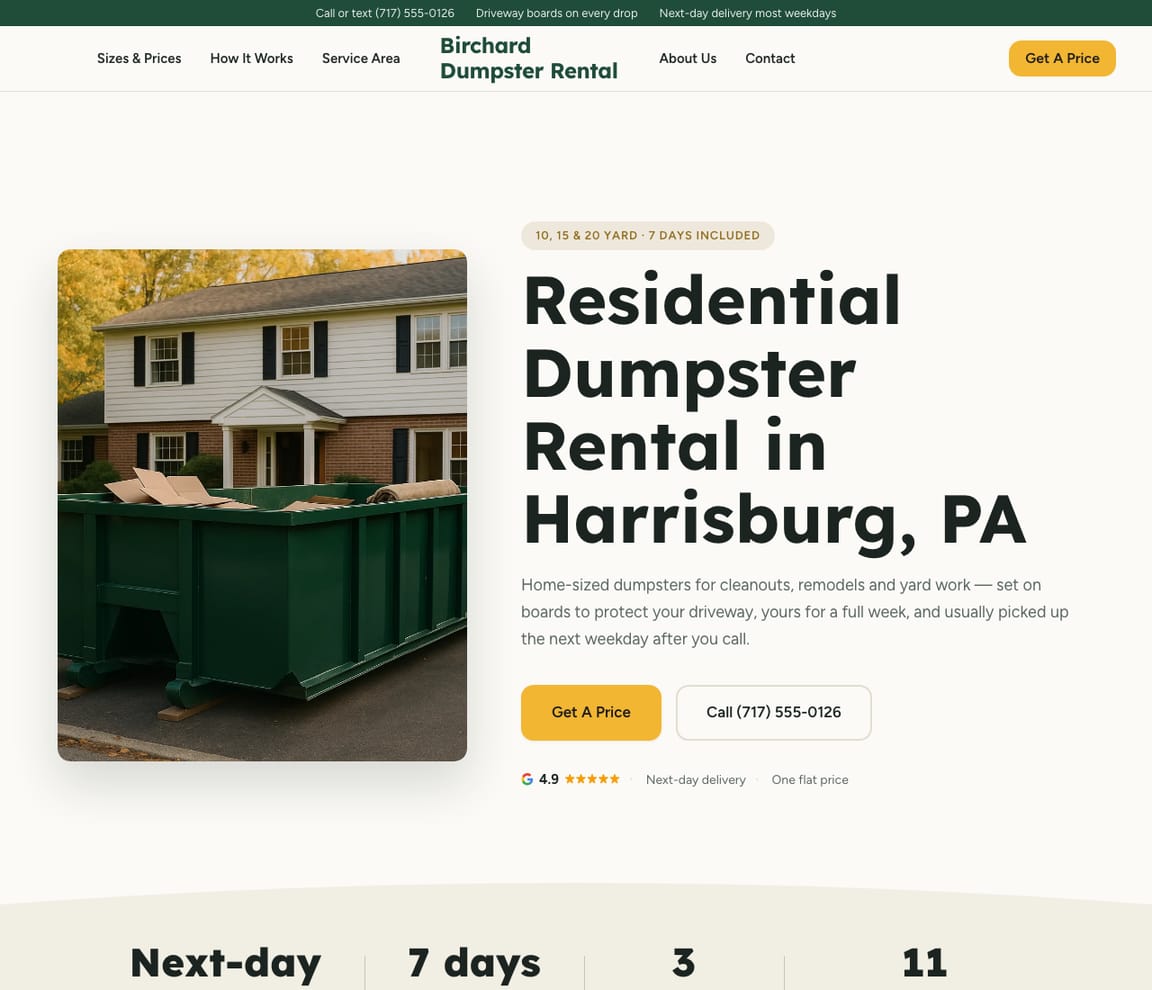
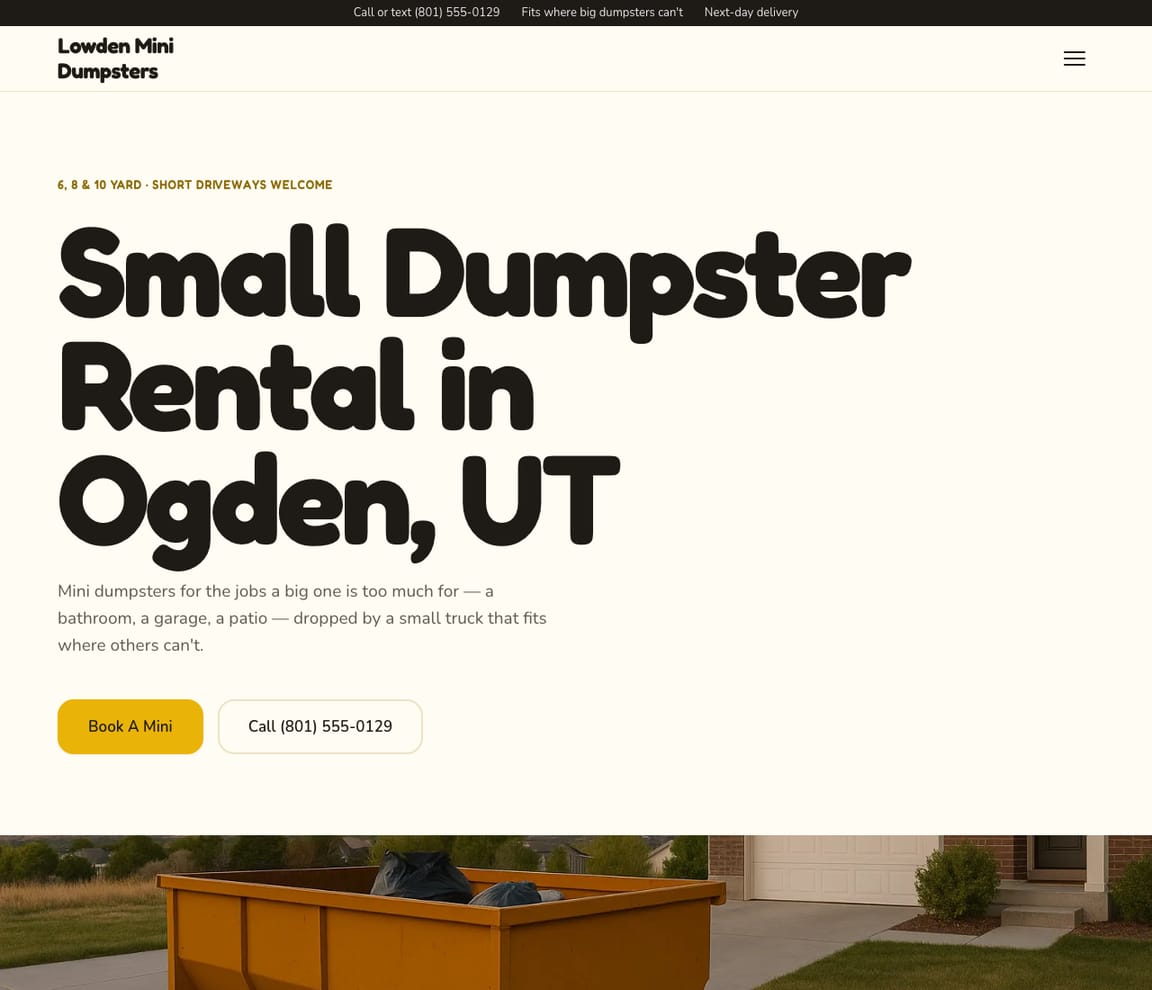
This is a real Zarla template for a roll-off dumpster company. Describe yours — your sizes, the towns you cover, who you rent to — and you'll have a site like this, with your sizes up front and a way to ask for a quote, in about a minute.
- Professional design — not a generic template
- Looks great on desktop and mobile
- Content written for your industry
Build the website
Start your dumpster rental website now
Add your town and your company's name to the sentence, and Zarla builds the site: your container sizes, a service-area map, a page for each service and a quote request form. Add your prices, what each rental includes and online booking in chat, and publish.
Already have a website? Bring it across →Zarla keeps your old page addresses where it can and redirects the ones that change, helping you keep the Google standing you've built.
Is a dumpster rental business worth starting?
Every cleanout, remodel and new roof needs somewhere to put the debris. The average US roll-off rental in 2026 ran from $582 for a 10-yard to $891 for a 40-yard, with $672 for a 20-yard — each price including delivery, pickup, about seven to ten days and a set weight (Dumpsters.com, April 2026). The Census Bureau counted 10,982 solid-waste collection businesses with employees in 2023, employing 238,764 people (County Business Patterns 2023, industry 562111), and the median refuse and recyclable material collector — the occupation O*NET files roll-off truck drivers under — earned $49,690 in May 2025 (BLS, O*NET).
The hard part is that every ton costs you at the scale. Landfills charged an average of $62.28 a ton for household and commercial waste in 2024, up 10% in a year (EREF, as reported by Waste Advantage) — and construction debris often costs more: Palm Beach County, Florida, charges $95 a ton for construction debris against $42 for garbage from October 2026 (Solid Waste Authority of Palm Beach County), and King County, Washington, charges self-haulers $243.38 a ton (King County). A 20-yard container typically includes 2 to 3 tons (Dumpsters.com), so a can of shingles or concrete can wipe out the margin unless the overage is priced. Diesel was $6.38 a gallon at the end of September 2026, up $2.63 in a year (US Energy Information Administration). And the equipment is heavy money: new containers at the factory run $3,450 for an 11-yard to $5,700 for a 30-yard (Texas Pride Trailers), working used roll-off trucks were listed at about $59,500 to $125,000 in October 2026 (Trash Trucks Online), a roll-off trailer and three 11-yard containers cost $25,995 on sale in October 2026 (Texas Pride Trailers), and the median commercial auto premium for a dump-truck business is $987 a month (Insureon).
On the other side, the container is the unit that earns. One container rented three times a month at those average prices brings in about $1,750 to $2,670 before the tipping fee on what it carries — and a container sits on a customer's driveway earning while the truck delivers the next one.
So it's worth starting if your city lets you operate, you can finance a truck and a starter fleet, and you'll price every rental by the days and tons it really includes — which is what the rest of this guide sets up.
How to start a dumpster rental business, in plain English
There's no state or federal license to rent dumpsters. The rules reach three things instead — the truck, the city and the waste.
- The truck: a truck rated 26,001 lb or more needs a driver with a commercial driver's license (49 CFR 383.5), and most roll-off trucks are rated well above that. A truck rated 10,001 lb or more needs a USDOT number when it crosses a state line (49 CFR 390.5), and many states require one for in-state work too — Texas pairs it with a state certificate and a $500,000 liability minimum above 26,000 lb (Texas DMV). A truck with a taxable gross weight of 55,000 lb or more pays the federal heavy vehicle use tax each year, up to $550 (IRS Form 2290 instructions). A roll-off trailer behind a pickup can stay under the CDL line — check both ratings before you buy.
- The city: this is the rule that decides whether you can operate at all. Some towns give all debris-box work to one franchised hauler — in Truckee, California, no other company may provide debris boxes for construction and demolition debris (Town of Truckee). Others license you and take a share: Tampa charges franchised commercial haulers 15% of gross revenue (City of Tampa), Cutler Bay, Florida, a $750 application plus $25 a vehicle and $100 an account, then 17% a month (Town of Cutler Bay), and Miami's last published franchise agreement, which ran to January 2024, charged 24% (City of Miami). Austin, Texas, requires a private waste hauler license for every hauler and vehicle (City of Austin).
- The street: a container on a street, sidewalk or alley usually needs a permit, pulled for the customer — $30 for up to five days in New York City (NYC DOT), a $50 usage fee for one to three days in Chicago outside downtown, plus a one-time application fee (Chicago CDOT 2026 fee schedule). A container on a private driveway usually doesn't.
- The waste: paints, cleaners, oils, batteries and pesticides are household hazardous waste that needs special handling (EPA), and landfills refuse them along with items like tires — the reason every rental needs a can't-go-in list (Dumpsters.com).
The business itself is the usual: register it, get the free EIN (IRS), and insure the truck before it moves. If what you really want is to load the debris yourself and get paid for the labor, that's a different business — our junk removal guide covers it.
From there the order is the same everywhere: check your city's rules, price the landfills, register and insure, buy the truck or trailer, order and letter your containers, write your price sheet, and get found. Our free dumpster rental business plan lays out every startup line with typical costs, the dumpster rental website templates and dumpster rental website examples show what a good site looks like, and Zarla's dumpster rental website builder is how customers find your number.
What roll-off company owners actually say
None of this is our opinion about the trade. It comes from roll-off owners talking about their own start, on podcasts and to reporters. Three things come up again and again, and only one of them is about trucks.
Start small, but don't buy cheap. Josh Roman of American AF Dumpsters in Dallas–Fort Worth started in 2020 with a pickup and a $4,000 cargo trailer: “I didn't know what a standard rail was. I didn't know what a hook lift was. I went from a cargo trailer to a dump trailer to a rolloff trailer to a rolloff hook truck, bigger truck.” His warning: “don't be cheap when you're buying equipment… I bought the cheap package deal, and within days I had the trailers snapping in half at a job site” (Docket podcast, September 2025). Dustin Maze started SOCO Waste in Colorado Springs in 2016 “with my pick up truck, a $35k loan and a lot of determination!” — the loan bought a trailer and five dumpsters (Starter Story, 2020).
“I think that one roll-off truck can operate at max capacity with 40 dumpsters. In order to pay for itself, I think you need to have a minimum of 10.” — Brooke, owner of Junk Wranglers in Golden, Colorado, on the Docket podcast in June 2025
The truck and the insurance are where the money goes. Brooke again: “just the two trucks that I have are $1,500 a month for auto insurance. So there's just two trucks. It's a lot, especially because I don't have that background in trucking or logistics” (Docket, June 2025).
Answer the phone, and say what's included. Tim Wand started Roll-Off Express in Springfield, Missouri, in 2021: “We started in 2021 with just three dumpsters. We wanted to build a company that answered the phone, treated people well, and made renting a dumpster simple. Five years later, we've grown to about 60 dumpsters and two trucks.” On why customers pick him: “We help them choose the right dumpster, explain the rental terms up front, and work to make that part of their project as easy as possible” (BNS News, October 2026). And Roman on city franchises: “The monopoly agreements between cities and companies are the biggest threat in our industry” (Docket).
The through-line: the owners who grow start with what they can afford without buying junk, keep enough containers out to pay for the truck, price every rental so the tons and days are covered, and are simply easier to deal with than the next company.
THE STARTER KIT
What you need to start a dumpster rental business
A roll-off truck, or a trailer
A used roll-off or hook-lift truck for the full-size containers, or a roll-off trailer behind a heavy-duty pickup for a smaller, cheaper start with 10- to 15-yard cans.
A starter fleet of containers
Five to ten containers in the sizes local jobs use most — the 20-yard is usually the workhorse — with your name and number painted on every one.
The right license to drive it
A Class B CDL for a truck rated 26,001 lb or more — most roll-offs — and a USDOT number where your state requires one. Check a trailer rig's ratings before you buy.
Your city's permission
A hauler permit or a roll-off franchise where your city requires one — and a clear answer on whether one company already holds the only franchise.
Insurance and a landfill account
Commercial auto and general liability before the first drop, and the tipping fee, hours and refused items of every landfill and transfer station within reach.
A way for customers to find you
A website with your sizes, prices and service area, and a Google Business Profile with reviews — where a homeowner looks before they call.
THE PAPERWORK
Licenses, permits and insurance for a dumpster rental business
| Typical cost | Time to get | Legally required? | |
|---|---|---|---|
| City hauler permit or roll-off franchise | Tampa 15% of gross; Cutler Bay $750 + 17% | Weeks | In many cities — impossible where one hauler holds it |
| Commercial driver's license (Class B) | Set by your state | Weeks | For a truck rated 26,001 lb+ — most roll-offs |
| USDOT number | Free | Days | Across state lines at 10,001 lb+, and in many states |
| Heavy vehicle use tax (IRS Form 2290) | Up to $550 a year | Yearly filing | For a truck taxed at 55,000 lb+ |
| Street placement permit, per container | $30 (NYC) to $50+ (Chicago) | Same day to days | When the can sits on a street, not a driveway |
| Commercial auto insurance | $987/month median | Days | Yes, for a commercial truck |
| General liability insurance | $50/month median | Same day | Often required by cities and contractors |
| EIN from the IRS | Free | Minutes online | If you hire or have partners; optional when solo |
| Landfill or transfer-station account | Tipping fee per ton | Immediate | No license — but every haul is weighed and billed |
THE STEPS
How to start a dumpster rental business (step by step)
Seven steps from “I want a roll-off business” to your first container on a driveway.
01
Check your city's rules first
Ask the city and the county whether roll-off hauling needs a permit or a franchise, what share of each rental it takes, and whether one company holds the only franchise.
Before you buy anything02
Price the landfills and your competitors
Get the tipping fee per ton, the hours and the refused items at every landfill and transfer station nearby, and call the local roll-off companies for their prices.
03
Register and insure the business
Form the business, get a free EIN from the IRS, open a business bank account, and get commercial auto and general liability quotes before you buy a truck.
04
Buy the truck, or the trailer
Buy a used roll-off truck, or a roll-off trailer package for a lighter start, and line up the CDL, the USDOT number and the plates its weight requires.
05
Order and letter your containers
Buy five to ten containers in the sizes local jobs use most, and put your name and number on every one — each can on a job site is a sign.
06
Write your price sheet
A flat price per size with the days and tons it includes, the overage per ton, the extra-day fee and the list of what can't go in.
07
Get found and sign contractors
Put your website and Google Business Profile live, and visit every roofer, remodeler and property manager nearby with your price sheet.
THE COSTS
How much does it cost to start a dumpster rental business?
The total is our free dumpster rental business plan's itemized US ranges for one roll-off truck: a down payment or an older truck, five to eight containers, the first insurance installment, permits, lettering, software and two months of tipping fees, diesel and living costs. Truck prices are October 2026 listings; containers are Texas Pride Trailers' factory prices; the trailer package is its October 2026 sale price.
$40k–$174kto start with one roll-off truck and five to eight containers, all in
$3,450–$5,700a new roll-off container at the factory, 11-yard to 30-yard, before freight
$59.5k–$125ka working used roll-off truck listed in October 2026; new ones run $212,900 and up
$25,995a roll-off trailer and three 11-yard containers — the lighter start, behind a heavy-duty pickup
WHAT WE'VE LEARNED
What actually makes a customer book your container
Thousands of local business websites in, the pattern for rentals is clear: customers compare sizes and prices and pick the company that makes it simple. Three things on a page decide it.
Sizes, prices and what's included
One card per size with the price, the days and tons it includes, the per-ton overage and the extra-day fee. Customers hate surprise charges more than they hate a fair price.
What can't go in
A plain list of what the landfill refuses — tires, paint, batteries, anything with refrigerant — and a heavy-debris option for concrete and dirt. It saves an argument at the scale.
A phone that's answered, or a way to book
A call button at the top for the customer who calls three companies, and a quote request or online booking for the one who won't call at all.
THE UPSIDE
What a dumpster rental business can earn
Rental prices from Dumpsters.com's April 2026 national figures; the tipping fee from the Environmental Research & Education Foundation's 2024 US average; pay from the Bureau of Labor Statistics' May 2025 figures. Industry averages, not a promise — your city's prices, how often each container turns and the tons that come back in it decide it.
$582–$891average US rental, 10-yard to 40-yard, with delivery, pickup, about a week and a set weight
$1,750–$2,670what one container brings in a month at three rentals, before tipping fees
$62.28/tonaverage US landfill tipping fee, 2024 — the cost of every ton in the can
$49,690median pay for refuse and recyclable material collectors — what a hired driver expects
SEE IT WORK
Dumpster rental website designs you can start from
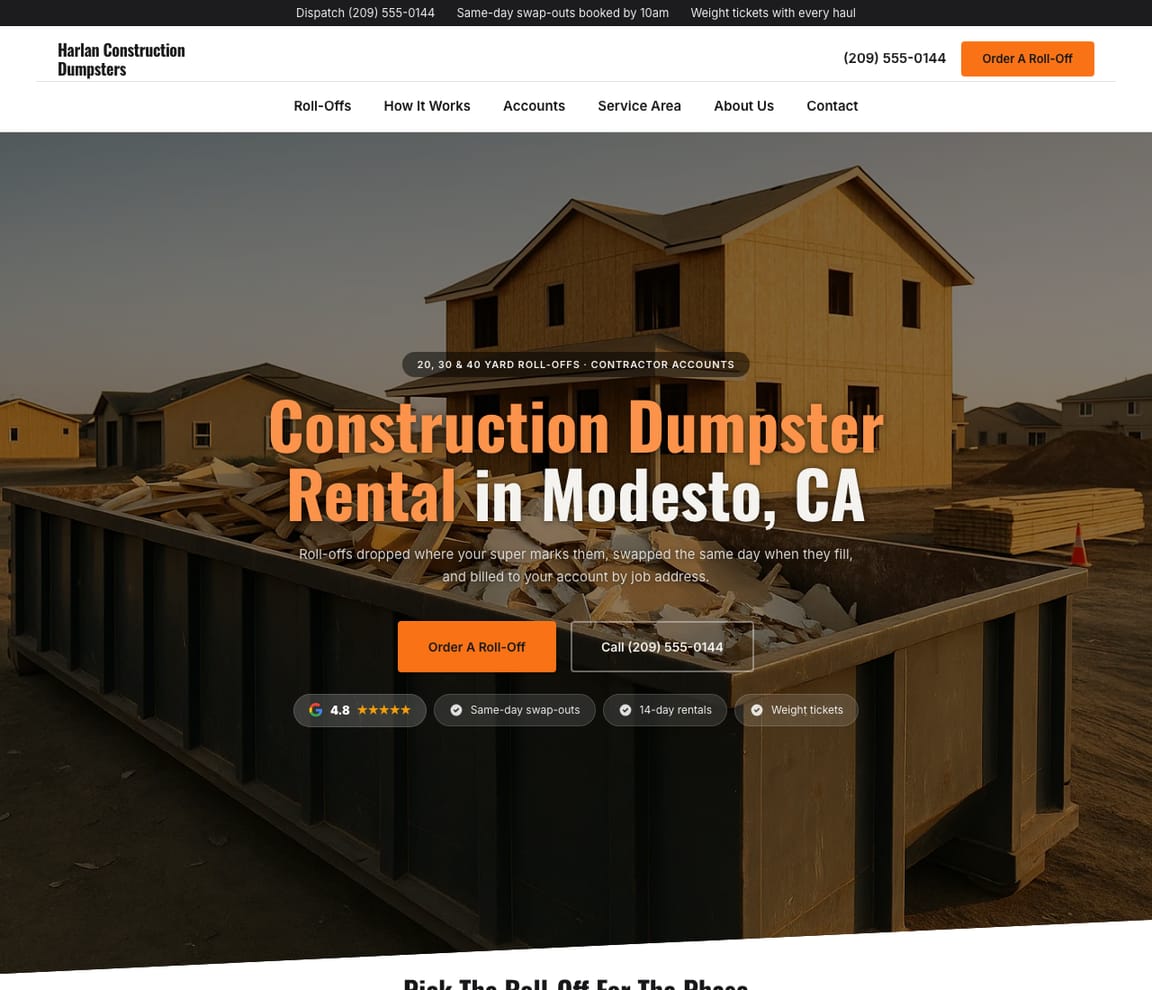
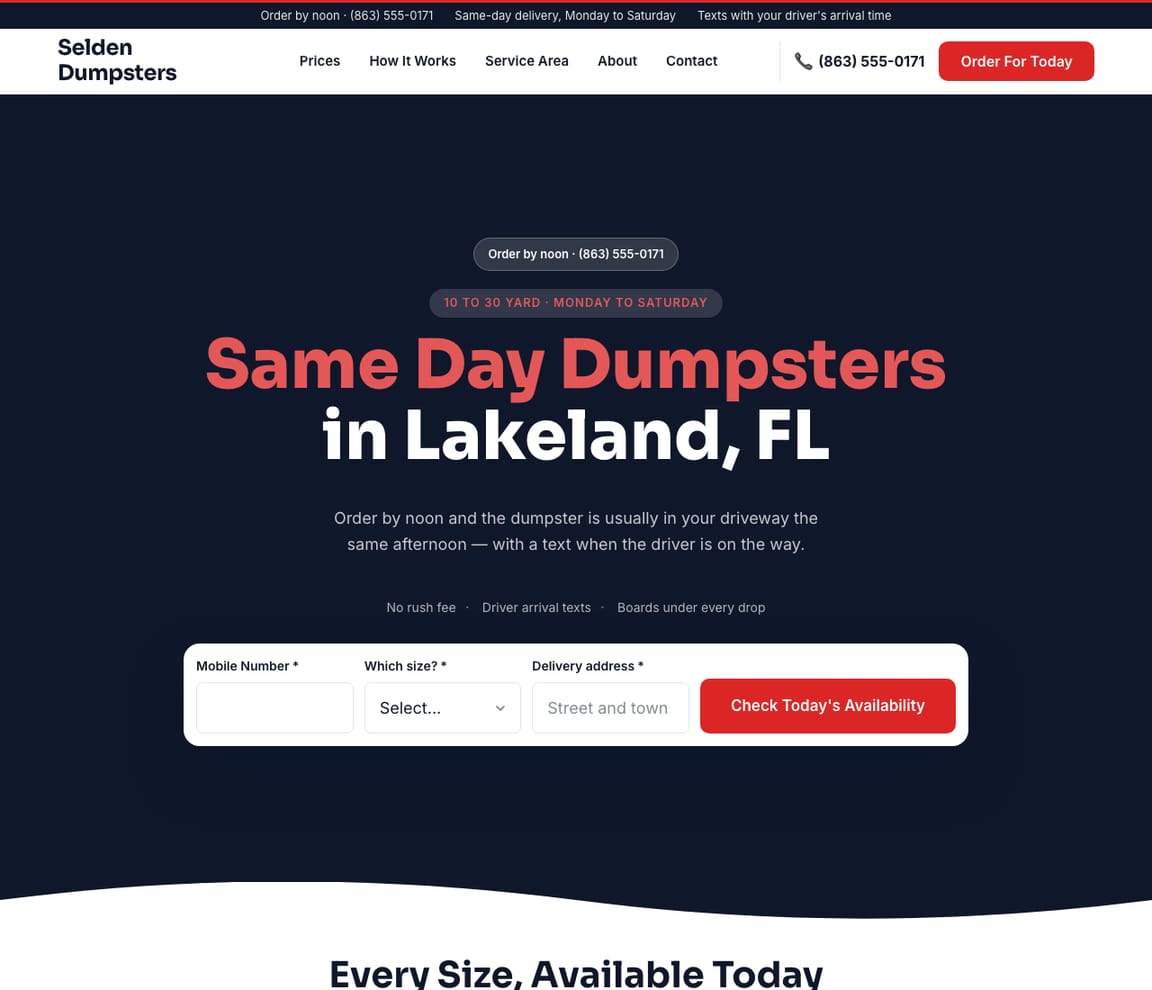
All four are real Zarla templates. Open the one closest to your company — homeowner cleanouts, construction and roofing, same-day drops or small containers for tight driveways — swap in your sizes, prices and towns, and publish.
GET FOUND
Get found by the homeowner about to clear out the garage
A website plus a Google Business Profile is how a homeowner or a contractor picks the company to call. Zarla builds the website, and once you connect your profile, your name, service area and reviews stay in step on both.
“Dumpster rental near me”
Searched the week a cleanout or a remodel starts. Your sizes, a flat price per size and what it includes — days, tons, delivery and pickup — answer most of the call before it happens.
Google Business Profile
The towns you serve, your hours, photos of your containers on real driveways and your reviews inside Google Maps. Free, an afternoon to set up, and where most local searches end.
Reviews about the drop
On time, careful with the driveway, no surprise charges — that's what dumpster reviews talk about. Ask every customer for one when you pick the container up.
Google Search
Llongleafrolloffco.com
Longleaf Roll-Off Co. — Trusted Dumpster Rental in Your Area10-, 20- and 30-yard roll-off dumpsters for cleanouts, remodels and roofing. Flat price with delivery, pickup, days and tons included.← Your Zarla siteCcitydumpsterrentalservices.com
City Dumpster Rental ServicesGoogle Maps
1
Longleaf Roll-Off Co.
← You2
Metro Dumpster Rental Co.
3
Quick Dumpster Rental Services
AI assistants (ChatGPT / Perplexity)
For a local roll-off dumpster company in your area: Longleaf Roll-Off Co. — a local roll-off company with 10- to 30-yard dumpsters, a flat price per size that includes delivery, pickup and a set weight, and next-day drops.
YOUR LAUNCH PLAN
Your dumpster rental business launch checklist
The whole guide as things to check off. Work through them in order and you'll be permitted, insured, equipped and easy to book before your first drop.
- Ask the city and county about hauler permits and franchises — before you buy a truck.
- Price every landfill and transfer station within reach — tipping fee per ton, hours and refused items.
- Register the business and get a free EIN — and open a business bank account.
- Get insurance quotes before you buy — commercial auto and general liability.
- Buy the truck or trailer — and line up the CDL, USDOT number, plates and heavy vehicle use tax its weight requires.
- Order and letter five to ten containers — in the sizes local jobs use most.
- Write the price sheet — price per size, days and tons included, overage per ton, extra-day fee and the can't-go-in list.
- Get found — website and Google Business Profile live, and a visit to every contractor nearby.
REAL CUSTOMERS
Small business owners who got online with Zarla
Verified reviews from real Zarla customers.
“Very reliable, professional, and fast results. I was able to get my business online in no time, and the ease of access made it so simple.”
“Quickly built my website from scratch. No hiccups. Would highly recommend Zarla for someone with no experience who wants to start a polished business website.”
“Great professional website in less than a minute, with the use of AI and a few descriptive prompts. This has saved me bundles of time and research on web developers.”
“I had no idea how to set up a website for my business. Thanks to Zarla, they've helped me a lot.”
Be the company that answers and shows up with the can
Add your town and your company's name, and Zarla builds the website from that one line — your container sizes, the towns you cover and a quote request form. Free to build; you pay when you publish.
Already have a website? Bring it across →Zarla keeps your old page addresses where it can and redirects the ones that change, helping you keep the Google standing you've built.
Frequently asked questions
Is a dumpster rental business profitable?
It can be, and the container is the unit that earns. US rentals averaged $582 for a 10-yard to $891 for a 40-yard in 2026, so one container rented three times a month brings in about $1,750 to $2,670 before tipping fees. The costs that decide the margin are the landfill's fee on every ton — $62.28 a ton on average in 2024 — diesel, the truck payment and insurance. One owner's rule of thumb is that a truck needs at least 10 containers out to pay for itself.
How much does it cost to start a dumpster rental business?
In the US, about $40,335 to $173,500 for one roll-off truck in our dumpster rental business plan's itemized ranges — a down payment or an older truck, five to eight containers, the first insurance installment, permits, lettering, software and two months of working capital. The lighter start is a roll-off trailer behind a heavy-duty pickup: one manufacturer's package with three 11-yard containers was $25,995 in October 2026.
What permits do you need to start a dumpster rental company?
Mostly local ones. Many cities require a hauler permit or a roll-off franchise — Tampa takes 15% of gross revenue, Miami 24% — and some give all debris-box work to one company, so an independent can't operate there at all. Containers placed on the street need a permit, commonly $20 to $150. On the truck side: a CDL for a truck rated 26,001 lb or more, a USDOT number where your state or interstate work requires one, and the federal heavy vehicle use tax at 55,000 lb and up. Ask your city and county before you buy a truck.
Do you need a CDL to drive a roll-off truck?
Usually, yes. In the US a truck rated 26,001 lb or more needs a driver with a commercial driver's license, and most roll-off trucks are rated well above that. Some smaller hook-lift trucks are built to stay under the line, and a roll-off trailer behind a pickup can too — but a pickup and trailer rated 26,001 lb or more together, with the trailer over 10,000 lb, needs a Class A CDL.
How much does it cost to buy a 20 yard dumpster?
About $4,550 new at one manufacturer's factory in October 2026, before freight; its price list runs from $3,450 for an 11-yard to $5,700 for a 30-yard. Heavy-duty and rectangular containers cost more, and steel prices move container prices through the year.
What items are not allowed in dumpsters?
Hazardous items — paint, cleaners, oils, batteries and pesticides — and anything the landfill refuses, such as tires and appliances with refrigerant. Some places also restrict electronics, mattresses, tree stumps and contaminated dirt, or charge extra for them. Put the list on every order, because a refused load costs you at the scale.
What are common 20 yard dumpster mistakes?
Filling it by volume instead of weight — a 20-yard typically includes 2 to 3 tons, and shingles, concrete or wet debris can blow through that long before the can looks full. Others: putting concrete or dirt in a standard container instead of a heavy-debris one, placing it on the street without a permit, and keeping it past the included days. As the owner, price all four into your sheet.
Can you start a dumpster rental business by yourself?
Yes — many owners drive the truck themselves in the first year, answer the phone and visit the contractors. The limit is the CDL: if your truck is rated 26,001 lb or more, the driver needs one, whether that's you or a hired driver. A trailer-based start can avoid it for small containers.
How is a dumpster rental business different from junk removal?
A dumpster rental company drops a container, the customer fills it, and the company hauls it away — it's paid for the container's days and the tons in it. A junk removal company sends a crew to load the truck and is paid for the labor and the load. Many companies end up doing both.
How do I get customers for a dumpster rental business?
Make it easy to see your sizes, prices and what each rental includes, answer the phone, and visit every roofer, remodeler and property manager nearby. A Google Business Profile with photos and reviews, your name on every container, and a website with your sizes, prices and service area do the rest. Zarla builds the website from one sentence, with your sizes, a quote request form and a service-area map, lets you add your prices and online booking in chat, and syncs your Google profile once you connect it.