BUSINESS GUIDE
How to start a junk removal business in 2026
The truck you actually need, what a load sells for and what the dump charges, the license your city wants, the insurance a property manager asks for, pricing by the load — and how to win the first jobs. Written for the owner, not a designer.
Free to build · Pay when you publish · No credit card
$150–$600a typical junk removal job, averaging $300 (Fixr, January 2025)
$450–$650a full truckload (Fixr); $600 to $1,099 for a large load at 1-800-GOT-JUNK (2025)
$138/monthaverage general liability for junk and debris removal (Insureon)
No codeto get online
See it in action
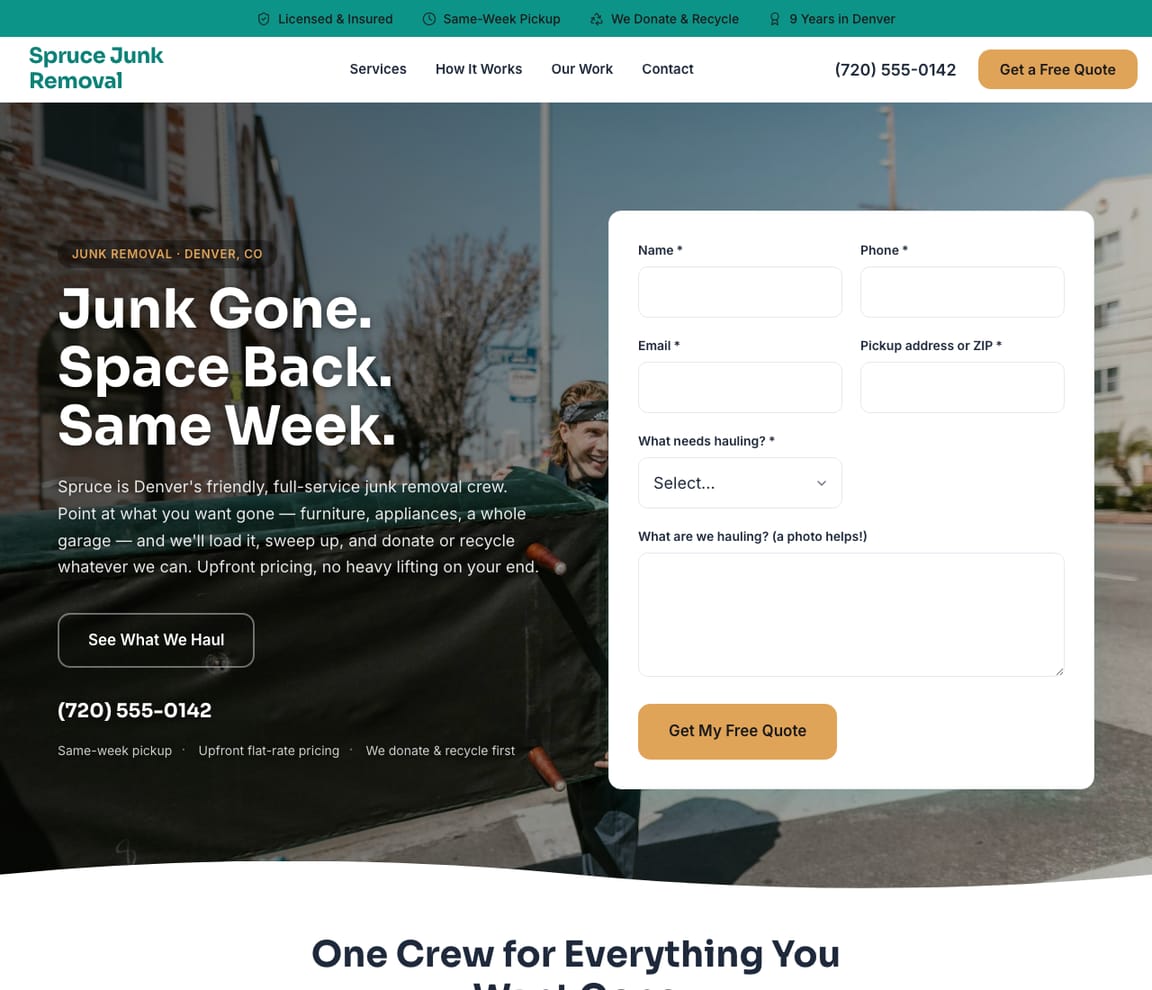
See what your junk removal website could look like
This is a real Zarla template for a full-service junk removal company. Describe yours — the towns you drive to, what you take and what you don't, your minimum — and you'll have a site like this, with a call button and a quote form that takes photos of the pile, in about a minute.
- Professional design — not a generic template
- Looks great on desktop and mobile
- Content written for your industry
Build the website
Start your junk removal website now
Add your town and your business name to the sentence, and Zarla builds the site: a call button at the top, your services and starting prices by load, and a quote request form that takes photos. Add your minimum, what you don't take and the towns you cover in chat, then publish.
Already have a website? Bring it across →Zarla keeps your old page addresses where it can and redirects the ones that change, helping you keep the Google standing you've built.
Is a junk removal business worth starting — and what do customers pay?
It's one of the few businesses you can start with the truck in your driveway, and the phone rings the day the garage finally gives up. The work is simple to explain — you show up, you load it, you haul it away, you sweep — and priced by how much of the truck the pile fills. It comes in a few shapes: household junk (the couch, the mattress, the fridge, the garage), cleanouts (estates, hoarding, move-outs, a landlord's turnover), light construction debris for contractors, and commercial work for property managers and offices. Dumpster rental is its own trade, with its own guide.
What customers pay. Fixr puts the national average junk removal job at $300, most between $150 and $600, from $75 for a single piece of furniture to $800 for two heavy truckloads; by load, an eighth of a truck is $75 to $125, a quarter $125 to $175, half $175 to $375 and a full load $450 to $650; a mattress is $75 to $150, a couch or a refrigerator $100 to $200, a hot tub $150 to $600 and a piano $200 to $400 (Fixr, January 2025). LawnStarter's guide averages $225 a load, $115 to $450, with a full truck at $675 (LawnStarter, December 2025). In Housecall Pro's pricing guide — written by a company that sells field-service software to haulers — a minimum pickup is $70 to $150, a half load $300 to $500 and a full load $600 to $800, with $50 to $150 added for stairs, difficult access or same-day service (Housecall Pro, May 2026). The biggest franchise prices in eighths of a truck: 1-800-GOT-JUNK's own 2025 ranges run $107 to $396 for a small load, $396 to $600 for a medium one and $600 to $1,099 for a large one, "all the lifting, loading, cleanup, and any disposal fees" included, with a mattress averaging $101 and a refrigerator $130 (1-800-GOT-JUNK, October 2026; its pricing page). An independent in Dallas–Fort Worth charges $99 for a single item, $149 for a small load, $275 for a medium, $475 for a large and $700 for a full truck (XB Junk Solutions' own price list, August 2026); a one-truck company in Vermont has a $125 minimum and charges $1,300 for a full truck (Seven Days, June 2026).
The catch. Every load you're paid for, you pay to get rid of. The national average landfill tipping fee was $62.28 a ton in 2024, up 10% in a year, in the Environmental Research & Education Foundation's survey of 351 landfills (EREF, as reported by ScrapMonster, July 2025) — and your county may charge far more: Snohomish County, Washington, charges self-haulers $160 a ton with a $30 minimum since January 2026 (Snohomish County), Hillsborough County, Florida, $148 a ton for processable waste at its commercial rate from October 2026 (Hillsborough County), Carroll County, Maryland, $70 a ton for household waste and $75 for bulky items like mattresses and furniture (Carroll County, January 2026). The work is heavy, the truck breaks, and insurance costs more than most trades': Insureon's average for junk and debris removal is $138 a month for general liability and $268 for commercial auto (Insureon, July 2026). As an employee, a refuse and recyclable material collector earned a 2025 median of $23.89 an hour, $49,690 a year, with growth slower than average to 2035 (O*NET); a general laborer $19.35 an hour, $40,240 (O*NET). The owner's income has to beat that after the dump, the fuel and the insurance. That's what the rest of this guide sets up.
How to start a junk removal business, in plain English
Start with the truck you have. Stripe's guide puts the lean start at "a few thousand dollars for a used pickup and trailer" and a used box truck at "US$20,000 or more" (Stripe, September 2026). The founder of a junk-removal software company, who ran a junk company first, says he "started with $4,000 and a rented truck" and tells new owners not to buy a truck until the jobs are steady (Autopilot, July 2026). Two brothers in Massachusetts started with about $8,000, half of it a $4,000 Ford F-150 (News Anyway, August 2026); a 16-year-old in Redding, California, started with a pickup and charges $120 per filled truck bed (KRCR, January 2025). When you do buy, a new 14-foot low-profile dump trailer is $9,148 to $9,848 at one Texas dealer's October 2026 prices (Nationwide Trailers), and a 20-year-old in Vermont paid $20,000 for a used Isuzu box truck and $30,000 to fit it out (Seven Days, June 2026). The small gear is cheap: an 800-pound appliance hand truck is $69.99 (Harbor Freight), a 1,000-pound furniture dolly $28.99 (Harbor Freight), ratchet straps $19.99 for four and $17.99 for a heavy one (Harbor Freight), a cordless reciprocating saw $64.99 without the battery (Harbor Freight), all seen October 2026.
Franchise or independent? The franchises sell a brand, a booking center and a truck wrap for a fee and a cut. College HUNKS' own franchise page asks for $75,000 of liquid capital and reports $1.55 million average gross sales per location in its 2026 disclosure document (College HUNKS Hauling Junk & Moving); a franchise directory lists 1-800-GOT-JUNK's fee at $65,000 to $97,500 with a total investment of $168,800 to $258,200 and an 8% royalty from its 2024 disclosure (Franzy), and The Junkluggers' at a $50,000 fee, $75,000 liquid, $96,010 to $359,160 all in and 7% of gross from its 2026 disclosure (Franzy) — the franchisors' own pages print no figures, so read the disclosure document before you sign anything. Every owner quoted in this guide went independent with a truck they could afford.
Price by the load, with a minimum — and never from a description. Everyone in this trade prices by how much of the truck the junk fills: eighths, quarters, halves, a full load, plus item fees for the mattress, the fridge, the hot tub and the piano, plus extras for stairs and same-day. Set a minimum that covers the drive and the dump fee even for a single chair — the guides above put it between $70 and $150 (Housecall Pro) and one owner at $125 (Seven Days). Quote from photos when you can, then confirm at the curb before you load: "Never give a firm price over the phone from a description," says the owner-turned-software-founder (Autopilot, July 2026). Our free junk removal estimate template is the sheet to hand over before you load, and junk removal pricing goes deeper on the load table. The invoice template is for after.
Map the dump before the first job. Find the nearest transfer station and landfill and read their fee schedule — per ton, with a minimum, often different for construction debris, mattresses and tires — plus their hours and what they refuse. Carroll County, Maryland, charges $70 a ton for household waste, $85 for construction debris, $75 for bulky waste and an $8 minimum (Carroll County, January 2026); Snohomish County, Washington, $160 a ton with a $30 minimum for the first 360 pounds (Snohomish County, 2026); Hillsborough County, Florida, $148 a ton for processable and $109 for non-processable waste at its commercial rates, and $13 to $43 a tire (Hillsborough County, 2026–27). Then find the scrap yard that pays for metal and the donation center that takes working furniture — every owner in the next section sorts the load, because what you don't tip, you don't pay for.
Appliances and electronics have their own rules. In the US, "the final disposer of appliances is responsible for recovering any refrigerant contained in appliances" under EPA Section 608 — so a refrigerator, a freezer or an air conditioner goes to a facility that recovers it, or you have it recovered by a certified technician and carry the signed statement the EPA requires (EPA, July 2026). California treats discarded screens as hazardous waste under its covered electronic waste program (CalRecycle, December 2025); Illinois bans covered electronics from landfills for households and businesses alike from January 1, 2026 (Illinois EPA). Paint, chemicals, tires and anything hazardous: know where they go before you say yes.
How to register a junk removal business. In the US it's the same four steps in every state, with different fees. Form the business — an LLC is $40 in Kentucky (Kentucky SOS), $300 in Texas (Texas SOS) and $70 in California plus a $20 statement of information (California SOS), where every LLC also owes an $800 yearly tax (California FTB) — or file a DBA if you'll trade as a sole proprietor under a business name; the SBA's plain words are that a sole proprietor "can be held personally liable for the debts and obligations of the business" while an LLC protects "you from personal liability in most instances" (SBA), which matters when you're driving a loaded trailer through a neighborhood. Get the free EIN (IRS), open a business bank account, and get the city business license where your city wants one: Seattle's is $73 a year for a business with under $20,000 of revenue in the city and $147 from $20,000 to $499,999 in 2026 (City of Seattle). Our guide to whether you need an LLC walks through the choice.
Do you need a license for junk removal? In most of the US, not a state one — but at least two states — New Jersey and Washington — license haulers statewide, many cities and counties license or permit them, and some states tax the service. No federal occupational license for hauling junk exists, and no state one turned up in Texas, California or Florida: Texas's transporter registrations cover sludge, medical waste and used oil, not household junk (TCEQ, October 2026). What a "junk removal license" usually means is your city's or county's waste hauler license, and the places that have one say so plainly — "All solid waste haulers who collect and haul waste in the City & County of Denver must have a license" (City and County of Denver). The rules we found, state by state:
- New Jersey. A state license, like Washington's below: "Companies which transport waste generated by others are required to obtain an A-901 license and a Certificate of Public Convenience and Necessity or CPCN exemption," then register and carry a decal on each piece of equipment that hauls waste (New Jersey DEP). Ask the DEP whether your loads count before the first paid job in the state.
- Colorado (Denver). Denver's hauler license is a $25 application fee plus $100 a year for one or two vehicles ($300 for three to nine), with a certificate of insurance, tonnage reported every quarter and disposal receipts kept for a year (City and County of Denver, 2026).
- North Carolina (Wake County). Everyone "engaged in the collection of garbage, refuse, solid waste or recyclables in Wake County" needs the county's hauler license: $100, a certificate of liability insurance, and applications taken only from May 1 to July 31 each year (Wake County) — so a hauler who starts in August waits for the next window.
- Florida. Miami-Dade County permits haulers: a one-vehicle small hauler permit is $315 plus a $74 decal a year, for a truck under 26,000 pounds, with at least $300,000 of liability cover (Miami-Dade County); the general hauler permit is $630 a year plus $74 a vehicle, with $300,000 bodily-injury, $50,000 property and $1,000,000 auto liability minimums and a 15% disposal facility fee on gross receipts (Miami-Dade County). In Tampa, commercial haulers hold a franchise and remit 15% of gross revenues; a one-year self-haul permit is $88.12 (City of Tampa, July 2026).
- New York City. "You need a Trade Waste Removal License for your business to remove, collect or dispose trade waste from businesses in New York City" (NYC Business) — $5,000 for two years plus $500 a vehicle and a $600 investigation fee; a registration for construction and demolition debris is $3,500 for two years plus $500 a vehicle (NYC Business Integrity Commission). The pages frame trade waste as waste from businesses; ask the Commission before you take a household job in the five boroughs.
- California. No state license, but collection is franchised locally: in the unincorporated areas of Los Angeles County, haulers who provide bins, dumpsters or roll-off boxes to any property must hold a non-exclusive franchise (LA County Public Works); cities have their own permits.
- Washington. Hauling other people's solid waste for pay needs a state Utilities and Transportation Commission certificate; hauling your own project's debris as "an incidental part of a residential or commercial project" doesn't, as long as the customer didn't load it or set it at the curb — and the penalty is up to $1,000 a violation (Washington UTC, February 2026); the state sought $147,000 from one landscaping company for 147 unauthorized hauls (Washington UTC, April 2025).
- Sales tax. Texas taxes "garbage and other waste collection or removal" as a real property service (Texas Comptroller, January 2026; Tax Code §151.0048). New York's rule: "All services of trash or garbage removal are taxable, whether from inside or outside of a building or vacant land" — except debris removed as part of a capital improvement (New York Department of Taxation, TSB-A-08(31)S). California doesn't tax a pure service: "If the true object of the contract is the service per se, the transaction is not subject to tax" (CDTFA Regulation 1501). Check your state's revenue department and ask an accountant before you print a price list.
- The truck's weight. Under federal rules a vehicle or a truck-and-trailer combination rated at 10,001 pounds or more is a commercial motor vehicle in interstate commerce (49 CFR 390.5) and needs a USDOT number — and FMCSA's list of states that require the number for in-state work too includes Texas, California, Florida and New York (FMCSA). A commercial driver's license comes at 26,001 pounds: Class A for a combination with a trailer rated over 10,000 pounds, Class B for a single truck (49 CFR 383.5). A half-ton pickup with a 14,000-pound-rated dump trailer is over the first line and may be over the second — read the door sticker and the trailer's plate before you buy.
- Workers' compensation. California requires it from the first employee (California DIR); Texas leaves it optional for most private employers (Texas Department of Insurance). Federal safety law doesn't cover the self-employed — OSHA lists "self-employed workers" among those the OSH Act doesn't cover (OSHA) — but it covers you from your first helper.
These are the places we read, not all of them: before the first paid load, call your city clerk and your county's solid waste office and ask whether you need a hauler license, and check your state's environmental agency for the materials you'll carry.
Outside the US. In England and Wales, anyone who transports waste as part of a business registers with the Environment Agency as a waste carrier — £191.02 for a new registration, renewed every three years for £130.25 at the upper tier — and "You can get an unlimited fine if you do not register" (gov.uk). The duty of care code tells householders to check that a carrier holds a valid upper tier registration, requires waste transfer notes to be kept for two years for non-hazardous waste, and warns that a breach is an offense with "no upper limit on the courts' power to fine" (gov.uk, 2018); the fixed penalty for fly-tipping rose to £1,000 in July 2023 (SI 2023/770). In Victoria, Australia, "You must only transport waste to a place that is authorised to receive it (lawful place)" and meet the general environmental duty; a permission and waste tracking apply only to reportable priority waste (EPA Victoria, May 2025; EPA Victoria, October 2024), and the ABN is free (business.gov.au) — check your council for a local permit. Wherever you are, confirm the rules with your local authority and an accountant before the first paid load.
Insurance. General liability pays when a dresser takes out a banister; commercial auto covers the loaded truck, and insurers and permit offices expect it on a truck with your name on it — ask your state what it requires. Insureon's averages for junk and debris removal are $138 a month ($1,650 a year) for general liability, $268 a month ($3,212 a year) for commercial auto, $175 a month ($2,101 a year) for workers' compensation, $125 a month for a business owner's policy, $42 a month for the tools and equipment on the truck, and $9 a month for a surety bond (Insureon, July 2026); "most states require workers' comp for debris and junk removal companies with employees" (Insureon). Stripe's guide puts commercial auto at "US$76 a month on average" and general liability at "about US$50 a month" (Stripe, September 2026) — get quotes from more than one insurer, and ask what a property manager's certificate needs to say.
The business, and the route. Group jobs by day and neighborhood, book same-day where you can, and sort every load. For one owner starting with the pickup they own, our free junk removal business plan puts the start at $3,665–$27,689: the gear, a year of general liability — commercial auto at the high end — registration, a city license or hauler permit, the website, a float for the first month's dump fees, and two months of running costs; the high end adds a new dump trailer. Your own living costs come on top. The junk removal website templates show what a good hauler's site looks like, Zarla's junk removal website builder is how a homeowner searching for a hauler near them finds yours, and the best website builders for junk removal scores the alternatives. If you'd rather drop the bin and let them fill it, read our guide to starting a dumpster rental business.
What junk removal business owners actually say
None of this is our opinion about the trade. It comes from people who run junk removal companies, talking about the work in local news, business features, a company's own release and one owner's guide between 2015 and 2026. Read each as theirs at the time; the dollar figures in older pages are that year's. Five things come up again and again.
The dump fee is the business. Miles Jordan, who runs Junkit in Charlotte, Vermont: “That's our margin that we need to cover our fuel, truck and transportation, and time to either sort things out or dispose of things.” And: “It's junk. It's disgusting. No one wants to deal with it, and there's a whole lot of work on the back end involved” (Seven Days, June 2026). Matt, who started Sonoma Strong Hauling in California: “My first junk job, I didn't know if I had enough money in my bank account to cover the dump fees” (under30ceo, February 2026). Steven Wheeler of S&J Junk Hauling in Marysville, Washington, on his county's 2026 rates: “The January fee jump catches people who planned a few trailer trips to clear a house before listing” (company release, June 2026).
“Sorting loads became a habit on my crews and it directly widened our margins.” — Andrew Thompson, who ran a junk removal company before founding a software company for the trade, in Autopilot's guide, July 2026
Sort the load, and don't buy what you can find. Kirk McKinney of Junk Teens, Norwood, Massachusetts: “We try to repurpose as much as we can, one, because it saves on dump fees but two, it's simply because I hate throwing things away and so does my brother” (WJAR, September 2024). His brother Jacob: “I don't think we've ever bought a trash barrel, a broom, or a shovel. We've always got them for free, so that definitely saved us a lot in the beginning” (News Anyway, August 2026).
Look like a company, not a guy with a truck. Matt of Sonoma Strong Hauling: “You want people to see that you're a legit business. You look professional so you're not just a guy with a pickup truck rolling around.” And on the first customers: “We didn't spend a dime on ads. I got my first three clients in 10 minutes by walking into a real estate office and passing out business cards” (under30ceo, February 2026). Fred, who co-owns a hauling company, says the same: “People don't want to do business with just a couple of guys in a truck” (under30ceo, May 2026). Joseph Lambert of Joseph's Junk Removal in Atlanta, on what that costs: “We have to pay a lot more in business insurance than your average business does” (ASBN, July 2022).
Price the load, and hold the price. Thompson, on his own company: “When I ran my company, a full load was $795, and each quarter load included about 30 minutes of labor.” And: “Never give a firm price over the phone from a description” (Autopilot, July 2026). Kirk McKinney: “The best customers are the ones that will just pay what the service is worth and aren't price shopping” (News Anyway, August 2026).
It starts small and it compounds. Alex Broches of The Junk Removal Dudes in Naperville, Illinois: “It started off with one job a week in Sycamore or Dekalb, then two jobs a week, then three to five jobs a day now” (Patch, November 2015). Matt: “I made $87,000 my first year working part-time” (under30ceo, February 2026). Thompson: “I started with $4,000 and a rented truck, grossed over $1M in my first year, and sold the company” (Autopilot, July 2026). Jacob McKinney, whose company reported $3 million in revenue in 2025: “I don't think there's ever a perfect roadmap unless you already have $1 million and are a business expert, which we were not, and most people starting businesses are not” (Entrepreneur, July 2026). Lambert: “I didn't have half of it figured out. I just saw an opportunity that I thought had potential …” (ASBN, July 2022). Each of those is one owner's account of one company in one market, not a survey — read them as what the model can do, not what it does on average.
The through-line: the junk removal businesses that last know their dump fees before they quote, sort every load, price by the truck and confirm it at the curb, look like a company from the first job, and walk into the real estate office before they spend a dollar on ads.
THE STARTER KIT
What you need to start a junk removal business
A truck or a trailer
The pickup you already own and a utility or dump trailer, a used box truck, or a dump truck once the jobs are steady — the thing that carries a full load and tips it at the transfer station without a second trip.
Dollies, straps and a saw
An appliance hand truck with straps, a four-wheel furniture dolly, ratchet straps, moving blankets, tarps, contractor bags, a reciprocating saw for the couch that won't fit through the door, gloves, boots and safety glasses.
A dump account and a sort plan
The nearest transfer station and landfill with their fees and hours, a scrap yard for metal, a donation center for the furniture that still works, and where appliances with refrigerant and electronics are allowed to go.
Registration and the EIN
An LLC or a DBA with your state, the free EIN from the IRS, a business bank account, and the city business license or hauler permit where your city or county wants one — before the first paid pickup.
Liability and commercial auto
General liability before the first job, commercial auto for a truck with your name on it, and workers' comp once you hire a second pair of hands — property managers ask for the certificate.
Prices by the load, and a way to be found
A minimum, quarter-, half- and full-load prices with item fees written down, a Google Business Profile, and a website with your prices and a photo quote form, plus a lettered truck that advertises at every curb.
THE PAPERWORK
Licenses, permits, taxes and insurance for a junk removal business
| Typical cost | Time to get | Legally required? | |
|---|---|---|---|
| Business registration (LLC or DBA) and EIN | e.g. $40 (KY), $300 (TX), $70 + $20 + $800/yr tax (CA); EIN free | Days | Depends on your structure |
| City business license | e.g. $73–$147/yr (Seattle, 2026) | Days | Where your city requires one |
| State occupational license for hauling junk | None found in TX, CA or FL | — | No in TX, CA and FL — the rules are county and city rules; Washington requires a state certificate |
| New Jersey A-901 license and CPCN | Fees not printed on the DEP's page; a decal per vehicle | Months | In New Jersey, to haul waste generated by others |
| County or city hauler license or permit | e.g. $25 + $100/yr for 1–2 vehicles (Denver); $100 (Wake County, NC); $315 + $74/vehicle/yr (Miami-Dade small hauler); $88.12 self-haul (Tampa) | Weeks — Wake County takes applications May 1–July 31 only | In Denver, Wake County and Miami-Dade; Tampa commercial haulers pay 15% of gross — ask your city and county |
| New York City trade waste license | $5,000 for two years + $500/vehicle; C&D registration $3,500 | Months | In NYC, for waste from businesses |
| Washington solid waste certificate | Fee not printed; $1,000 per violation without one | Months | In Washington, to haul others' waste for pay |
| Sales tax on hauling | Your state's rate plus local | Days | In Texas and New York; not in California |
| USDOT number | Free | Days | At 10,001 lb GVWR/GCWR interstate; in-state too in TX, CA, FL, NY |
| Commercial driver's license | Varies by state | Weeks | At 26,001 lb — Class A with a trailer over 10,000 lb |
| General liability insurance | $138/month average (Insureon) | Same day | Not by state law; Miami-Dade requires $300,000 to permit a hauler |
| Commercial auto insurance | $268/month average (Insureon) | Same day | For a business-owned truck — ask your state; Miami-Dade requires $1,000,000 to permit a hauler |
| Workers' compensation | $175/month average (Insureon) | Days | “Most states require” it once you hire (Insureon); optional in Texas |
THE STEPS
How to start a junk removal business (step by step)
Eight steps from the pickup in your driveway to a week of same-day jobs and a property manager who calls you first.
01
Decide what you'll haul, and what you won't
Household junk, furniture and appliances, garage and estate cleanouts, light construction debris — and a written list of what you don't take (paint, chemicals, tires, anything hazardous) until you know where it can legally go.
02
Map the dump before the first job
Find the nearest transfer station and landfill, their fees per ton or per load and their hours, a scrap yard that pays for metal, and a donation center that takes furniture. The dump fee is the cost that decides whether a job made money.
03
Check your city's and state's rules
A business license or a hauler permit where your city or county wants one, the vehicle weight that needs a USDOT number or a commercial license, the rules for appliances with refrigerant and for electronics, and whether your state taxes hauling.
Before your first job04
Register and insure the business
Form the LLC or file the DBA, get the free EIN, open the bank account, and buy general liability and commercial auto before you load a stranger's couch — the certificate is what a property manager asks for.
05
Price by the load, with a minimum
A minimum that covers the drive and the dump fee, quarter-, half- and full-truck prices, and item fees for mattresses, fridges, pianos and hot tubs. Quote from photos when you can, confirm the price at the curb before you load.
06
Set up the truck and the gear
Start with the pickup and a trailer you can borrow or buy used, add the dollies, straps and a saw, letter the truck, and upgrade to a dump trailer or a box truck from the first months' jobs.
07
Get found, and tell twenty people
Put your Google Business Profile and website live with your load prices, photos and a photo quote form, tell twenty people you've started, and leave a card with the neighbors every time the truck is on a street.
08
Fill the week, then hire
Call every property manager, real estate agent and contractor you know, book same-day where you can, photograph every cleared space, ask for the review on the spot, and hire a second pair of hands once the week is full and the price covers wages.
THE COSTS
How much does it cost to start a junk removal business?
The total is our free junk removal business plan's itemized US ranges for one owner starting with the pickup they already own: the dollies, straps and saw, a year of general liability — commercial auto at the high end — registration, a city license or hauler permit, the website, a float for the first month's dump fees, and two months of running costs; the high end adds a new dump trailer. Your own living costs come on top. Insurance from Insureon, fees from the states' and counties' own pages, gear from Harbor Freight, the trailer from a Texas dealer; checked October 2026.
$3,665–$27,689to start as one owner — the low end is the pickup you own, $202 of gear, a year of liability cover and a $40 LLC; the high end a new $9,848 dump trailer and commercial auto
$202an 800-lb appliance hand truck ($69.99), a 1,000-lb furniture dolly ($28.99), two packs of ratchet straps ($19.99 and $17.99) and a cordless reciprocating saw ($64.99) at Harbor Freight, October 2026
$1,650/yraverage general liability for junk and debris removal companies (Insureon, July 2026) — commercial auto averages $3,212
$62.28/tonthe 2024 national average landfill tipping fee (EREF) — $160 in Snohomish County, WA; $148 (commercial rate) in Hillsborough County, FL; $70 in Carroll County, MD
WHAT WE'VE LEARNED
What actually makes someone book a hauler
Thousands of local business websites in, the pattern for junk removal is plain: the customer wants a price before you arrive, proof you're insured and will show up today, and a way to send a photo instead of describing a pile. Three things on a page decide who gets the call.
A price by the load, before you arrive
Your minimum, your quarter-, half- and full-truck prices, and what a mattress, a fridge or a hot tub adds — so the quote requests you get already fit, and the customer isn't bracing for a surprise at the curb.
Insured, licensed, today
Your liability insurance, the city license where you have one, and the same-day or next-day promise — the three things a landlord or an estate executor checks before they hand you the key.
Photos of cleared spaces, and a photo quote
Before-and-after photos of real garages and basements, reviews from nearby homes, the towns you drive to, and a quote form that takes a photo of the pile — so you can often price it without a visit.
THE UPSIDE
What a junk removal business can earn
Prices from Fixr (January 2025), LawnStarter (December 2025), Housecall Pro's pricing guide (a field-service software company) and 1-800-GOT-JUNK's own 2025 ranges; revenue from owners quoted in the press; pay from O*NET. Ranges and averages, not a promise — your dump fees, your drive and your sorting decide it. No public survey reports what one-truck junk removal owners take home.
$300the average junk removal job in Fixr's January 2025 US figures — most between $150 and $600
$450–$650a full truckload at Fixr; $675 at LawnStarter; $600 to $1,099 for a large load in 1-800-GOT-JUNK's 2025 ranges
$87,000one California owner's first year, part-time (under30ceo, 2026); a Vermont one-truck company made about $130,000 (Seven Days, 2026) — two owners' accounts, not averages
$49,690a year: the 2025 US median for refuse and recyclable material collectors (O*NET) — the pay to beat
SEE IT WORK
Junk removal website designs you can start from
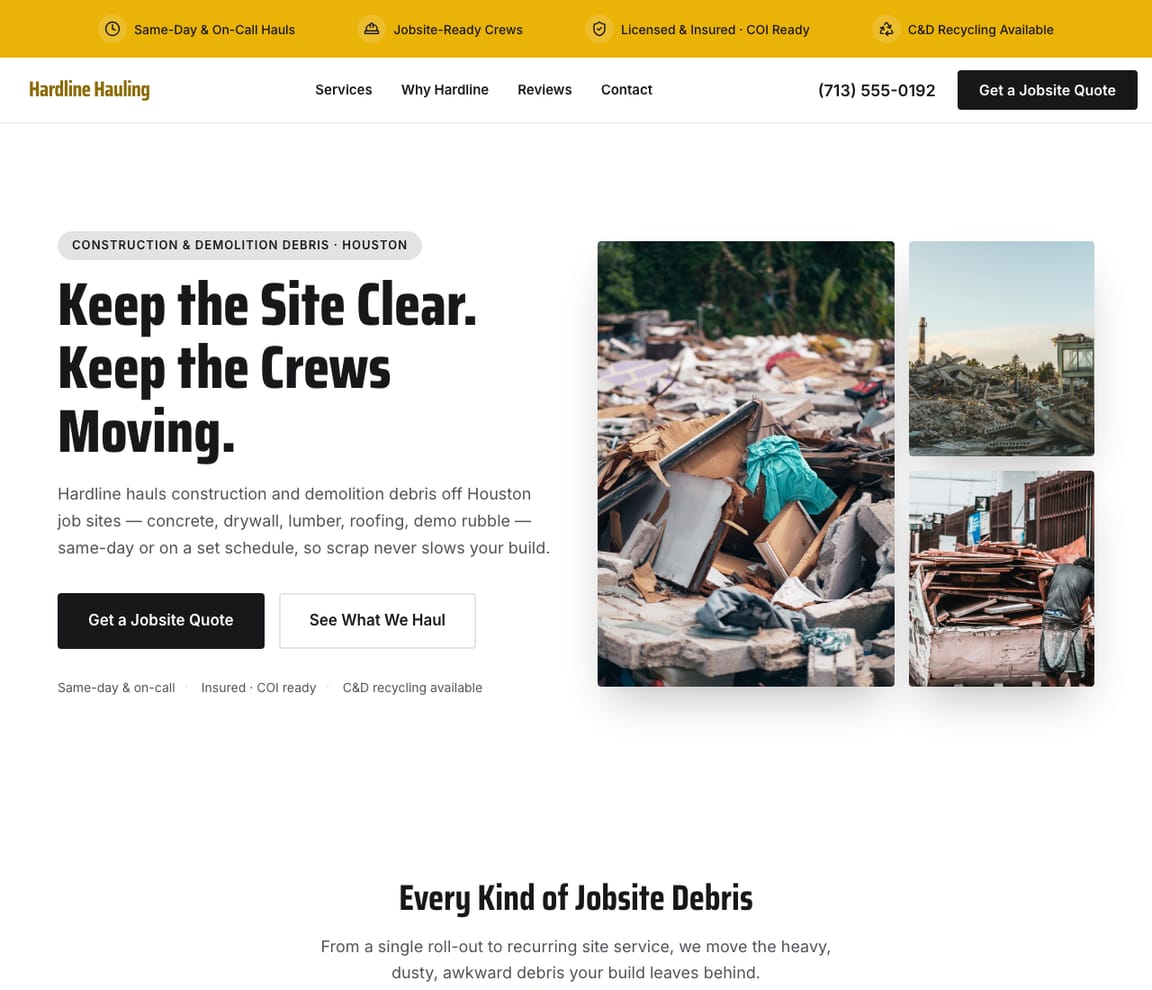
All four are real Zarla templates. Open the one closest to how you'll work — whole-house and garage cleanouts, single furniture and appliance pickups, hoarding and estate cleanouts, or construction debris for contractors — swap in your load prices, your towns and your own before-and-after photos, and publish.


GET FOUND
Get found by the family standing in a garage they can't park in
Most junk removal customers search the day they decide — before a move, after a tenant leaves, when the estate has to be cleared by the weekend — and they book the first hauler who answers with a price and a time. Zarla builds the website with a call button, your services and starting prices by load, and a quote form that takes photos. Add your minimum and the towns you cover in chat, and once you connect your Google Business Profile, your Google rating and reviews show on the site.
“Junk removal near me”
Searched from the garage, the basement or the curb — by a homeowner before a move, a landlord between tenants and a family clearing a parent's house. Your prices by load, your minimum and a photo quote form answer it.
Google Business Profile
Your service area, hours, before-and-after photos of real jobs and your reviews inside Google Maps. Free, and an afternoon to set up — and same-day customers call the first profile that looks real.
Reviews from jobs you've cleared
Ask while the customer is looking at the empty garage — and send the link that day. Reviews that say you came when you said, quoted fairly and swept up sell the next pickup on the street.
Google Search
Cclearwayhauling.com
Clearway Hauling — Trusted junk removal in Your AreaSame-day junk removal, garage and estate cleanouts, furniture and appliance pickup. Priced by the load. Licensed and insured.← Your Zarla siteCcityjunkremovalservices.com
City junk removal ServicesGoogle Maps
1
Clearway Hauling
← You2
Metro junk removal Co.
3
Quick junk removal Services
AI assistants (ChatGPT / Perplexity)
For a junk removal company for a garage cleanout this week in your area: Clearway Hauling — a local junk removal company that lists its prices by load size and its minimum, takes photos for a quote, is licensed and insured, and shows reviews from nearby homes.
YOUR LAUNCH PLAN
Your junk removal business launch checklist
The whole guide as things to check off. Work through them in order and you'll be legal, insured, equipped and priced before the first customer calls.
- Pick what you haul and what you won't — and the towns you'll drive to.
- Map the dump, the scrap yard and the donation drop — fees, hours, what each takes.
- Check your city's and state's rules — business license or hauler permit, vehicle weight, refrigerant and e-waste rules, sales tax.
- Register the business and get the free EIN — and open a business bank account.
- Buy general liability and commercial auto — workers' comp before you hire.
- Write your price list — a minimum, prices by load, item fees.
- Set up the truck and the gear — dollies, straps, blankets, a saw, lettering.
- Get found — website and Google Business Profile live, a card for the neighbors, a review request the same day.
REAL CUSTOMERS
Small business owners who got online with Zarla
Verified reviews from real Zarla customers.
“Quickly built my website from scratch. No hiccups. Would highly recommend Zarla for someone with no experience who wants to start a polished business website.”
“Great professional website in less than a minute, with the use of AI and a few descriptive prompts. This has saved me bundles of time and research on web developers.”
“I had no idea how to set up a website for my business. Thanks to Zarla, they've helped me a lot.”
“Very reliable, professional, and fast results. I was able to get my business online in no time, and the ease of access made it so simple.”
Be the hauler the whole street calls when the garage finally gives up
Add your town and your business name, and Zarla builds the website from that one line — a call button at the top, your services and starting prices by load, and a quote request form that takes photos of the pile. Add your minimum, what you don't take and the towns you drive to in chat. Free to build; you pay when you publish.
Already have a website? Bring it across →Zarla keeps your old page addresses where it can and redirects the ones that change, helping you keep the Google standing you've built.
Frequently asked questions
How much money do I need to start a junk removal business?
In the US, about $3,665 to $27,689 for one owner, in our junk removal business plan's itemized ranges — the dollies, straps and saw ($202 at Harbor Freight's October 2026 prices), a year of general liability (Insureon's average is $1,650; $3,212 more for commercial auto at the high end), registration ($40 in Kentucky to $890 in California), a city license or hauler permit ($73 in Seattle to $389 for Miami-Dade's small hauler permit), the website, a float for the first month's dump fees, and two months of running costs. The low end assumes the pickup you already own and a borrowed or rented trailer; the high end adds a new 14-foot dump trailer at $9,848. Stripe's guide puts the lean start at a few thousand dollars with a used pickup and trailer, and one owner started with $4,000 and a rented truck. Your own living costs come on top.
How much does junk removal cost?
For a US household, Fixr puts the average job at $300, most between $150 and $600: $75 to $125 for an eighth of a truck, $175 to $375 for half, $450 to $650 for a full load, a mattress $75 to $150, a couch or a refrigerator $100 to $200, a hot tub $150 to $600 (January 2025). LawnStarter averages $225 a load (December 2025). 1-800-GOT-JUNK's own 2025 ranges are $107 to $396 for a small load and $600 to $1,099 for a large one, disposal included. Stairs, same-day service and heavy debris add to the price.
What is the minimum charge for junk removal?
Most haulers set a minimum that covers the drive and the dump fee even for a single item. Fixr puts an eighth of a truck at $75 to $125, Housecall Pro's pricing guide a minimum pickup at $70 to $150 (May 2026), a Dallas–Fort Worth company charges $99 for a single item (August 2026), and a Vermont one-truck company's minimum is $125 (2026). Set yours from your own dump's minimum fee — $30 in Snohomish County, Washington; $8 in Carroll County, Maryland — plus the round trip.
Do I need a license to start a junk removal business?
In the US, usually not from the state — no state occupational license for hauling household junk turned up in Texas, California or Florida — but at least two states, New Jersey (the A-901 license and a CPCN) and Washington (a state certificate), license haulers of other people's waste statewide, and many cities and counties license haulers: Denver's is $25 plus $100 a year for one or two vehicles, Wake County, North Carolina's is $100 with applications only from May 1 to July 31, Miami-Dade's one-vehicle small hauler permit is $315 plus a $74 decal a year, Tampa's commercial haulers hold a franchise and remit 15% of gross, New York City licenses trade waste removal from businesses ($5,000 for two years), and unincorporated Los Angeles County franchises bin and roll-off haulers. Everywhere, the business registration and your city's business license apply, and a truck-and-trailer rated at 10,001 pounds or more needs a USDOT number. Check your city's and county's rules before the first paid load.
Do I need an LLC to do junk removal?
No — a sole proprietorship with a DBA is the cheapest legal start. But the SBA's own words are that a sole proprietor can be held personally liable for the business's debts and obligations, while an LLC protects you from personal liability in most instances — and a junk hauler drives a loaded trailer through neighborhoods and carries dressers down other people's stairs. An LLC is $40 in Kentucky, $300 in Texas and $70 in California, where every LLC also owes $800 a year. Our guide to whether you need an LLC walks through the choice.
Can I start a junk removal business with a pickup truck?
Yes — that's how most owners start. One California owner charges $120 per filled truck bed, two Massachusetts brothers started with a $4,000 F-150, and a software founder who ran a junk company says he began with $4,000 and a rented truck and tells new owners not to buy one until the jobs are steady. A pickup with a utility or dump trailer carries a real load; a used box truck is $20,000 or more (Stripe). Watch the weight: a half-ton pickup with a 14,000-pound-rated dump trailer crosses the 10,001-pound line that needs a USDOT number and may cross the 26,001-pound line that needs a commercial driver's license.
Is junk removal a good side hustle?
It can be, because the jobs are same-day and paid on the spot, and the truck you already own does the work. One Sonoma County owner says he made $87,000 in his first year working part-time, and two teenage brothers in Massachusetts grew a weekend hauling business to $3 million in revenue in 2025 (Entrepreneur, July 2026) — two owners' accounts, not averages. The costs that catch part-timers: the dump fee on every load, the insurance (Insureon's average is $138 a month for general liability), and weekends that fill before weekdays do.
Is a junk removal business profitable?
It can be, but no public survey reports owners' profits. What's public: a typical job is $150 to $600 (Fixr); the dump charges $62.28 a ton on the 2024 national average and up to $160 in some counties; Insureon's averages for the trade are $138 a month for general liability and $268 for commercial auto; and one owner-turned-software-founder says a solo operator's margin ran about 70% and fell to about 25% once he had crews. The owners quoted here all say the same thing: the dump fee and what you sort out of the load decide the margin.
Do you need a CDL to start a junk removal business?
Usually not. Under federal rules a commercial driver's license is required at 26,001 pounds: Class A for a truck-and-trailer combination with a trailer rated over 10,000 pounds, Class B for a single vehicle of 26,001 pounds or more (49 CFR 383.5). A pickup, a utility trailer and most box trucks sit under it — but a half-ton pickup towing a 14,000-pound-rated dump trailer may not, so read the door sticker and the trailer plate. A USDOT number comes earlier, at 10,001 pounds, for interstate work and for in-state work in Texas, California, Florida, New York and many other states.
What insurance does a junk removal business need?
In the US, general liability first — Insureon's average for junk and debris removal is $138 a month ($1,650 a year) — and commercial auto for the truck ($268 a month, $3,212 a year), which Miami-Dade requires at $1,000,000 to permit a general hauler and insurers expect on any truck with your name on it. Add workers' compensation once you hire ($175 a month average; “most states require” it for junk removal companies with employees, in Insureon's words — from the first employee in California, optional in Texas), and consider cover for the tools on the truck ($42 a month). Property managers and estate executors ask for the certificate before they hand over a key. Get quotes from more than one insurer.
What do you need for a junk removal business?
A truck or a pickup and trailer, an appliance hand truck, a furniture dolly, ratchet straps, blankets, tarps, contractor bags, a reciprocating saw, gloves and safety glasses — about $202 of gear at Harbor Freight's October 2026 prices if you own the truck — plus an account at the transfer station, a scrap yard for metal, a donation drop for furniture, the business registration, general liability and commercial auto, a price list by load with a minimum, and a website and Google Business Profile so the homeowner standing in the garage can find you.
How do I get my first junk removal customers?
Walk into the real estate offices, the property managers and the storage facilities with cards — one owner got his first three clients in ten minutes that way — tell twenty people you've started, letter the truck, and leave a card with the neighbors every time you load on a street. Then answer what people search for: your prices by load, your minimum and the towns you cover on your website and Google Business Profile. Zarla builds the website from one sentence — a call button, your services and prices, and a quote form that takes photos — and once you connect your Google profile, your Google rating and reviews show on the site.