ORGANIZATION GUIDE
How to start a foundation in 2026
What a private foundation is in the Code's own words, the state fees for the corporation or trust, the full Form 1023 (the short form is closed to you), the 5 percent payout and the 1.39 percent tax, the self-dealing rule that keeps the family's hands off the money, the advance approval a scholarship foundation needs, what the "$1 million minimum" actually rests on, the donor-advised fund you may want instead — and what the families who started one actually say.
Free to build · Pay when you publish · No credit card
$3,936the paperwork and the first year's compliance for a Wisconsin family foundation, before the gift, from the pages that open (our arithmetic)
5%of net investment assets must go out every year — section 4942's minimum, taxed at 30 percent if it doesn't
$117.15 billiongiven by US foundations in 2025 — the second-largest source of charitable giving after individuals (Giving USA 2026)
No codeto get online
See it in action
See what your foundation website could look like
This is a real Zarla template for a grantmaking foundation — the slow photo slideshow under a serif headline, the ways to give or apply, the grant round step by step, the scholarship application, the dates through the year and an inquiry form. Describe yours — the family's name, what you fund, the county — and you'll have a site like this, with your mission and a contact form, in about a minute.
- Professional design — not a generic template
- Looks great on desktop and mobile
- Content written for your industry
Build the website
Start your foundation website now
Add your town and the foundation's name to the sentence, and Zarla builds the site: your mission, who you fund and a contact form. Add the guidelines, the deadline and the grants made in chat, then publish.
Already have a website? Bring it across →Zarla keeps your old page addresses where it can and redirects the ones that change, helping you keep the Google standing you've built.
Is starting a foundation worth it in 2026 — and what does it take to fund one?
The foundation one family can start is a private, grantmaking foundation: a gift invested as an endowment, grants to public charities at or above the legal minimum, a board of family members and one outsider, no staff, and a CPA who files the return. The word "foundation" means nothing in law — a community foundation is a public charity — so start with the Code's definition: "Every organization that qualifies for tax exemption as an organization described in section 501(c)(3) is a private foundation unless it falls into one of the categories specifically excluded from the definition of that term (referred to in section 509(a))." (the IRS, private foundations). The excluded categories are the publicly supported ones: an organization "normally receives at least one-third of its total support from governmental units, from contributions made directly or indirectly by the general public, or from a combination of these sources" (IRS Publication 557); "A public charity generally has a broad base of support, while a private foundation generally receives its support from a small number of donors." (IRS, Form 1023-EZ instructions). A foundation funded by one family fails that test by construction — which is what makes it private, and what brings the rules below.
The size of the thing. "giving by individuals, bequests, foundations and corporations to U.S. charities increased 5.7% in current dollars (3.0% adjusted for inflation) to an estimated $617.20 billion in 2025", of which foundations gave "$117.15 billion" — about 19 percent, our arithmetic, and the second-largest source after individuals (Giving USA 2026). The Federal Reserve's series on the "Total Financial Assets Held by Private Foundations" printed $1,865,638 million — $1.87 trillion — for the end of 2025 and $1,947,033 million, $1.95 trillion, for the middle of 2026 (Federal Reserve Financial Accounts, via FRED, updated September 11, 2026; the page opens in a browser). What the small ones do: "Drawing on transaction and investment data from 1,237 private foundations with assets between $1 million and $1 billion", "Foundations distributed an average of 7.1% of their assets in both 2024 and 2025. Smaller foundations, with $1 million to $10 million in assets, gave the most relative to their size, distributing 9.9% of assets in both years." — "40,210 grants totaling $1.14 billion in 2025", with "Education received the largest share of grant dollars (19.0%)" (Foundation Source, October 14, 2026). The same release splits the grants: about 60 percent supported designated programs and 40 percent general operations (the same release). Among the lean foundations Exponent Philanthropy surveys, "just over half (51%) identified as family foundations", "Nearly half (46%) of family foundations reported boards composed entirely of family members, while 54% included at least one nonfamily trustee", "Across all foundation types, 90 foundations reported providing routine board compensation. Among this group, the average annual amount per board member was $13,863, with a median of $7,000." and "Among family foundations, 71% reported having paid staff" (Exponent Philanthropy, 2026 Foundation Operations and Management Report). No openable page prints how many private foundations exist: the IRS publishes the count in spreadsheets only, Candid prints "There are 1,935,344 registered nonprofits in the United States, and most of them are small." without a foundation count (Candid, key facts), and Foundation Source, an administrator, repeats an old estimate of "perhaps just 90,000" (Foundation Source, repeating the National Center for Charitable Statistics).
What the plan runs. Our free foundation plan is a Madison, Wisconsin family foundation with a $500,000 founding gift: the family's further gifts of about $30,000 a year and about $2,500 a month of investment return make about $5,000 a month of funding, the 5 percent minimum — $12,500 on $250,000, $25,000 on $500,000 — goes out in one grant round a year, and the monthly lines are the grants themselves, the investment fee, the CPA, the directors' policy and the filings. Nobody is paid; if the foundation ever hires an administrator, the nearest wage line is O*NET's social and community service managers at a $80,390 median (O*NET, 2025), a survey that leaves out "the self-employed, owner/partners in unincorporated firms" (Washington ESD). The founders who did it describe the two halves: "At first my son said, 'There's so much need out there. Why not just give it all away to the Salvation Army?,' " … "But I don't think the Lord intended us to just dump it. I think he wanted us to get involved." (Ike Leighty, who started the Leighty Foundation in Waterloo, Iowa, at 70 — The Chronicle of Philanthropy, May 18, 2000).
The catch. The endowment is the budget — a 20 percent market fall is a 20 percent cut to every future grant, and the 5 percent is still owed; a single payment to a family member is self-dealing taxed at 10 percent and then 200 percent; a grant to a student without the IRS's advance approval is a taxable expenditure at 20 percent; the return is public, donors' names included; and under about $250,000 the fixed costs are a meaningful share of what gets given, which is why every community foundation on page one sells you a fund instead. That's what the rest of this guide sets up.
How to start a foundation, in plain English
Is there a license? None of the five states we read — Texas, Florida, New York, California and Wisconsin — licenses a grantmaking foundation as such. What you form is a corporation or a trust: "A nonprofit organization may be created as a corporation, a trust, or an unincorporated association. Any of these entities may qualify for exemption." (the IRS, life cycle of a private foundation). The corporation's filing fee from the statute: "for filing a certificate of formation, $25;" in Texas (Tex. Bus. Orgs. Code §4.153), "Filing articles of incorporation not providing for shares: Thirty dollars ($30)." plus "Twenty dollars ($20)" for the statement of information in California (Cal. Gov. Code §12186), "Articles of incorporation: $35." plus "Designation of and acceptance by registered agent: $35." in Florida (Fla. Stat. §617.0122), "seventy-five dollars" in New York (N.Y. N-PCL §104-A) — $75 — and "Articles of incorporation, $35." in Wisconsin (Wis. Stat. §181.0122, as archived — the state's own site refuses readers). A charitable trust files nothing at the Secretary of State — "A trust may be created for charitable purposes." (Fla. Stat. §736.0405) — and needs the attorney who drafts it, with the attorney general supervising it in New York and California (below). The board: "may not have fewer than three directors" in Texas (Tex. Bus. Orgs. Code §22.204), "three or more" in Florida (Fla. Stat. §617.0803), "not less than three" in New York (N.Y. N-PCL §702) and "one or more" in California (Cal. Corp. Code §5151); Wisconsin's own site does not open to a reader, so check its rule with the attorney who forms the foundation. Either document must carry the private-foundation clauses: "As a private foundation you are not tax exempt unless your organizing document contains specific provisions required by section 508(e). These specific provisions require that you operate to avoid liability for excise taxes under sections 4941(d) (acts of self-dealing), 4942 (undistributed income), 4943(c) (excess business holdings), 4944 (jeopardizing investments), and 4945(d) (taxable expenditures)." (IRS, Form 1023-EZ instructions). Then the EIN: "Use this tool to get an EIN directly from the IRS in minutes for free." (IRS) — "Every foundation must have an employer identification number, even if it will not have employees." (the IRS, above).
The IRS: the full form, and why the short one is closed to you. The user fee is "$600" for the full Form 1023 and "$275" for the Form 1023-EZ (Revenue Procedure 2026-5, Appendix A), but the EZ's own test shuts the door on a funded foundation — "(a) The organization has projected annual gross receipts of $50,000 or less in the current taxable year and the next two years; (b) The organization had annual gross receipts of $50,000 or less in each of the past three years for which the organization was in existence; and (c) The organization has total assets the fair market value of which does not exceed $250,000." (the same procedure) — and "Private operating foundations and certain other organizations cannot file a Form 1023-EZ." (the IRS, applying to the IRS). A founding gift is receipts far above $50,000 in year one, so the full form it is; the AI answer's "Form 1023-EZ if eligible" is not a choice you have. If scholarships are the point, the same application carries the request: "If you're a 'private foundation' as described in Part VII, you must obtain advance approval of your grant-making procedures. You can use Schedule H—Section II, to request advance approval as part of this application process." (IRS, Form 1023 instructions).
The private-foundation rules, in the statute's words. The definition is the one-third test above (26 U.S.C. §509). The tax on the investments: "a tax equal to 1.39 percent of the net investment income of such foundation for the taxable year." (§4940) — "For tax years beginning after Dec. 20, 2019, the excise tax is 1.39% of net investment income, and there is no reduced 1 percent tax rate." (the IRS); on the plan's 4 to 6 percent return that is $139 a year on $250,000 and $417 on $500,000, our arithmetic. The payout: "the minimum investment return for any private foundation for any taxable year is 5 percent of the excess of— (A) the aggregate fair market value of all assets of the foundation other than those which are used (or held for use) directly in carrying out the foundation's exempt purpose, over (B) the acquisition indebtedness with respect to such assets" (§4942(e)), due by the end of the following year, with "a tax equal to 30 percent of the amount of such income remaining undistributed" and then "a tax equal to 100 percent of the amount remaining undistributed" (§4942(a) and (b)) — "An additional 100 percent tax is triggered if the foundation fails to make up the deficient distribution within 90 days of receiving notification from the IRS" (the IRS, failure to distribute income). The money and the family: "The rate of tax shall be equal to 10 percent of the amount involved with respect to the act of self-dealing", "a tax equal to 5 percent of the amount involved" on a manager who knowingly agreed, and "a tax equal to 200 percent of the amount involved" if it is not corrected (§4941; the IRS, self-dealing); the one exception is pay for work — "the payment of compensation (and the payment or reimbursement of expenses) by a private foundation to a disqualified person for personal services which are reasonable and necessary to carrying out the exempt purpose of the private foundation shall not be an act of self-dealing if the compensation (or payment or reimbursement) is not excessive;" (§4941(d)(2)(E)). Who counts: "a substantial contributor to the foundation", a 20 percent owner, and "a member of the family" — "the family of any individual shall include only his spouse, ancestors, children, grandchildren, great grandchildren, and the spouses of children, grandchildren, and great grandchildren." (§4946; the IRS, disqualified persons). The founder's company: "the combined holdings of a private foundation and all of its disqualified persons are limited to 20 percent of the voting stock in a business enterprise that is a corporation" with "a tax equal to 10 percent of the value of such holdings" (the IRS, excess business holdings; §4943); a reckless investment, "a tax equal to 10 percent of the amount so invested for each year" (§4944; the IRS, jeopardizing investments). What the money may not do: lobbying, elections, and "a grant to an individual for travel, study, or other similar purposes by such individual, unless such grant satisfies the requirements of subsection (g)," at "a tax equal to 20 percent of the amount thereof." (§4945; the IRS, taxable expenditures).
The scholarship foundation — the second-biggest reader. "How to start a scholarship foundation" is searched as often as the head phrase, and the rule is section 4945(g): "Subsection (d)(3) shall not apply to an individual grant awarded on an objective and nondiscriminatory basis pursuant to a procedure approved in advance by the Secretary, if it is demonstrated to the satisfaction of the Secretary that— (1) the grant constitutes a scholarship or fellowship grant … and is to be used for study at an educational organization described in section 170(b)(1)(A)(ii)," (§4945(g), above); "The grant is awarded on an objective and nondiscriminatory basis under a procedure approved in advance by the Service" (the IRS, grants to individuals). The approval is Schedule H of the Form 1023 (above). And never for the family: "you may not set up a scholarship program to pay for the education expenses of a designated individual, such as a contributor's family member. See Rev. Rul. 67-367" (the Form 1023-EZ instructions, above). The other route, which every memorial-scholarship family here took, is a fund at a community foundation or a hospital foundation — a public charity, with no 990-PF and no section 4945 layer: a Wisconsin community foundation prints "No administrative fees are assessed until the fund balance reaches the minimum endowment level of $10,000 ($15,000 minimum for a scholarship endowment)." (Community Foundation for the Fox Valley Region).
The return, and who gets to read it. "All private foundations, whether they have taxable income for, or activity during. the year or not … are required to file an annual return on Form 990-PF" (the IRS, the annual return) — no postcard, whatever the size — and "If you are filing a 2025 Form 990-PF, you are required to file electronically." (IRS, Form 990-PF instructions); the supplementary part that prints your grant program, contact and application procedure is for "All foundations with at least $5,000 in assets per books at some time during tax year" (the same instructions). Miss it three times and "it will automatically lose its tax-exempt status and will become a taxable private foundation." (the same). It is public — "Unlike most exempt organizations, however, identities of contributors to a private foundation are not exempt from disclosure." (the IRS, public disclosure for private foundations) — so post it, as the George Gund Foundation does: "The Gund Foundation's 990-PF form is now available for viewing and downloading." (the George Gund Foundation) — and claim the Candid profile grant seekers check: "Organizations can earn Candid Seals of Transparency and tell their full story on their profile" (Candid); "over 99,000 of them have earned their Candid Seal of Transparency." (Candid, key facts, above). The founders' deduction is the other inversion the AI answer skips: "30 percent of the taxpayer's contribution base" for cash and "20 percent" for appreciated securities to a private foundation, against "60 percent" to a public charity (§170(b)(1); "the 30% limit applies to amounts you spend on behalf of a private nonoperating foundation." — IRS Publication 526); Fidelity Charitable's comparison: "Charitable deductions for contributions to foundations are limited to 30 percent of adjusted gross income for cash and 20 percent of adjusted gross income for long-term publicly traded appreciated securities. For contributions to a donor-advised fund, those limits are 60 percent and 30 percent, respectively." and "For private foundations, non-publicly traded contributions, such as privately held stock or real estate, may be deductible only at cost basis rather than at fair market value." (Fidelity Charitable, as archived October 8, 2026 — the live site is blocked from here). Confirm the year's limits and the carry-forward with your accountant.
State registration — the AI answer has it backwards for two states. The Overview says register "if you plan to solicit". A family foundation does not solicit, so Florida's and Wisconsin's registration statutes, which bind solicitors — "'Solicitation' means a request, directly or indirectly, for money, property, financial assistance, or any other thing of value" (Fla. Stat. §496.404; the exemptions in §496.406); "no charitable organization may solicit in this state or have contributions solicited in this state on its behalf unless it is registered with the department" (Wis. Stat. §202.12, as archived) — and Texas, which lists no general charity registration at all (Texas Attorney General, charitable trusts; its public-inspection rule exempts "corporations that do not intend to solicit and do not actually receive contributions in excess of $10,000 during a fiscal year from sources other than their members" — Texas Secretary of State), mostly leave it alone. New York and California are the inversion: they register every holder of charitable assets, soliciting or not. New York's trustee is "any individual, group of individuals, executor, trustee, corporation or other legal entity holding and administering property for charitable purposes" and "Every trustee shall file with the attorney general, within six months after any property held by him or her or any income therefrom is required to be applied to charitable purposes, a copy of the instrument", at a yearly fee by net worth — "One hundred dollars if such net worth is two hundred and fifty thousand dollars or more but less than one million dollars" (N.Y. EPTL §8-1.4); the "twenty-five dollars" in Exec. Law §172 is the separate fee for organizations that solicit. California: "Every charitable organization, including trustees, doing business or holding property in California is required to annually renew its registration with the Attorney General's Registry of Charities and Fundraisers. Registrants must report annually by filing Form RRF-1 with the applicable renewal fee along with either IRS Form 990 (-EZ/PF) or Form CT-TR-1." — "Between $250,001 and $1 million" on its fee table, "$100" (California Attorney General, renewals), registered "within 30 days after the corporation … or trustee initially receives property" (Cal. Gov. Code §12585); the exemptions are religious, educational and hospital organizations, not foundations (Cal. Gov. Code §12583). The IRS's own line is that the states take "a copy of IRS Form 990-PF" with the report (the IRS, state registration). Check your own state's rule. Sales tax does not arise — a grantmaker sells nothing — and the purchase exemptions, the fundraising registrations and the Form 1023 processing times are in our guide to starting a nonprofit, the operating charity's page.
Insurance, and the day you hire. No page read in the five states mandates a foundation's insurance; the board asks for it: "For nonprofit organizations, the monthly average premium for directors and officers (D&O) insurance is $67 per month, or $801 annually." (Insureon, nonprofit insurance costs, May 8, 2025) — the plan allows a planning $1,500 a year for higher limits on a larger endowment. Workers' compensation only once there is an employee: "an employer may elect to obtain workers' compensation insurance coverage" in Texas (Tex. Labor Code §406.002); "All private employments in which four or more employees are employed by the same employer" in Florida (Fla. Stat. §440.02); "Every employer except the state shall secure the payment of compensation" in California (Cal. Labor Code §3700); New York's statute lists the covered employments and the sibling guide's reading is nearly all employers (N.Y. Workers' Compensation Law §3); Wisconsin's own site refuses readers, so check its rule.
The money to start — and the "$1 million" the AI answer repeats. From the pages that open on October 26, 2026, the Madison sample's paperwork layer: the Wisconsin articles at $35; the EIN at $0; the full Form 1023 at $600; directors-and-officers cover at Insureon's $67 a month, $801 for the year; the CPA's 990-PF at "$2,500" — "For Nonprofits who: Are private foundations, regardless of financial status" (Jitasa, bundled with its bookkeeping; the one list price found); investment management at $0 — "Pay no advisory fee and no commissions." with "as little as $5,000" (Schwab Intelligent Portfolios), or Vanguard's Personal Advisor at "Approximately $30-$31 per $10,000 invested" a year with a $50,000 minimum (Vanguard): $3,936, our arithmetic, before the gift. With a peer network — "$870 for Signature members" at Exponent Philanthropy, 2026 dues — and a built website at a planning $2,500, $7,306. The plan page's wider $254,314–$517,251 adds the attorney's setup at a planning $2,500 to $10,000, the registration, the policies, two months of working capital and the founding gift itself, $250,000 to $500,000. Now the floor everyone quotes. The law sets none: "There is no legal minimum amount required to start a private foundation." (San Diego Foundation, June 12, 2026). Who says a million: a wealth manager — "There's no legal minimum to start a private foundation, but advisors generally recommend at least $1 million for the structure to be cost-effective and sustainable." (Creative Planning, April 13, 2026) — and Fidelity's learning center, "To justify the expenses involved, most new private foundations are funded with initial endowments of at least $1 million." (Fidelity, as archived April 20, 2026 — the live page refuses readers). No page counts the advisors, and Foundation Source — an administrator of private foundations, which says it supports more than 5,600 of them — says the reverse: "Although Foundation Source has lowered the cost of starting and managing a private foundation, making it practical to establish a private foundation with less than $1 million in initial funding, public charities often have lower start-up costs and no minimal revenue requirements." (Foundation Source, above); its own fee is printed on none of its pages that open — a wealth manager's flyer about it prints "a one-time setup fee of $5,500 (includes IRS and state filings)" and "Base Fee: $7,500 +0.29% of assets up to $3 million" (a Bernstein flyer for Foundation Source, undated). The Council on Foundations' worked example is the honest arithmetic: "$1,000,000 x .055 = $55,000 Assets x 5.5 percent = total annual charitable budget (grants + expenses)" and "Without paid staff, your administrative costs will reflect only your legal and accounting fees (estimated at $5,000), which in this case is 9 percent of your annual charitable budget." (Council on Foundations, as archived June 10, 2026 — its site refuses readers). The alternative for the family below that line: "you can establish a donor-advised fund for significantly less than a private foundation" (Fidelity Charitable, above), with "no minimum initial contribution" and an administrative fee of "0.60% or $100, whichever is greater" on the first $500,000 (Fidelity Charitable, what it costs, as archived October 15, 2026).
In the UK: the regulator is the Charity Commission for England and Wales. GOV.UK's rule, in our words: a charity usually needs at least three trustees, and it must register with the Commission once its yearly income is over £5,000, or from the start if it is set up as a charitable incorporated organization (GOV.UK, setting up a charity); below £5,000 it need not register but "you can still apply to HM Revenue and Customs for recognition as a charity to get charity tax breaks and claim gift aid" (GOV.UK, CC21b); the structures are a CIO, a charitable company, an unincorporated association or a trust (GOV.UK, CC22a); "You can claim back 25p every time an individual donates £1 to your charity" (GOV.UK, Gift Aid). The word itself is controlled: "52. Foundation — To use this word in your proposed name, the company should normally be limited by guarantee. It should have a pool of money, or a regular source of income to promote its objects." (GOV.UK, sensitive words). The inversion: no 5 percent payout rule and no tax on investment income — a grantmaking charity applies its income to its objects. In Australia: the ACNC registers charities and passes the tax-concession application to the ATO, which endorses deductible gift recipients (ACNC, why register; ACNC, DGR fact sheet). The private foundation's equivalent is the private ancillary fund — "Ancillary funds are now known as giving funds. This is a name change only." and "Ancillary funds are a specific type of trust regulated by the Australian Taxation Office (ATO), and the ATO has specific requirements for private ancillary funds and public ancillary funds." (ACNC, ancillary funds) — with the same payout idea and an absolute floor: "During each financial year, a private AF must distribute at least 5% of the market value of the fund's net assets as valued at the end of the previous financial year." and "If a fund's expenses are paid out of the fund's assets or income, its minimum distribution is $11,000, or 5%, whichever is greater." (ATO, ancillary fund return instructions). Check your own regulator's rules.
What foundation founders actually say
None of this is our opinion about starting a foundation. It comes from the people who started or sit on the board of one — a memorial scholarship fund in Tucson, a family foundation in Waterloo, Iowa, third-generation trustees in Baltimore, Greenwood and Brown County, a Las Vegas couple, a San Jose family that gave its lottery money away and then closed the foundation — talking to local television, the Chronicle of Philanthropy, a hospital's newsroom and Exponent Philanthropy between 2000 and 2026, each described as the page describes them, with the association people and the administrator marked as such. Read each as theirs at the time. Five things come up again and again.
Why they started it — a gift, a loss, a company sold. Michael Arias, who with his wife Lorena started the VTA Memorial Foundation in their daughter Victoria's name in Tucson, where "They started with a few thousand dollars and have since given out more than $500,000": “It was then that we said, wow, gosh, we had an unbelievable amount of support for our daughter and for our family to get through these times,” (KOLD News 13, September 11, 2026). Farah Naz, who co-founded the Sabika for Peace Foundation after her daughter was killed: “But starting this foundation I know this is impossible. I know if I continue working with the foundation, she will always be with me.” (NBC DFW, July 31, 2020). Sarah Ice, whose family opened a memorial scholarship through a hospital foundation in Lebanon, Missouri — the public-charity route: “After losing Reagan and Silas in such a tragic and unexpected way, her family wanted to make sure that even though she wasn't able to reach her goals, we would help others reach theirs. We had such amazing care at Mercy, and we couldn't imagine partnering with anyone else.” (Mercy newsroom, June 24, 2026). Patrick DeMoon, president of The Kara Foundation, Las Vegas: “About that time, my wife Judi and I were struggling on our own in the strange world of giving. We learned about a group, at that time the Association of Small Foundations (ASF). We made contact and with great interest eagerly read its information material.” (Exponent Philanthropy, February 9, 2016).
“A foundation in a small town in Oklahoma or New Jersey with $10-million, making grants to the local hospital or library, is often the largest frog in that pond. They'll be bigger in their impact there than Rockefeller is in the worldwide pond. And there's more accountability because the trustees drive past the hospital; their grandchild was born there. They use the library.” — Joe Pierpont, co-founder of the Association of Small Foundations (an association, not a founder), in The Chronicle of Philanthropy, May 18, 2000
The small foundation's loneliness, and where the help is. Joe Pierpont again: “If you work for the Ford Foundation and are having trouble putting your grants budget together for the year, you walk down the hall and talk to someone with more experience. If you're sitting in your den, there's no one to walk down the hall to. But there are people out there just like you. And for the most part those people would be delighted to share their information.” (The Chronicle of Philanthropy, May 18, 2000). Colleen O'Keefe, executive director of the Sauer Family Foundation: “Focus on the people you want to impact, learn the realities of their world, and fund where the gaps are.” (Exponent Philanthropy, read 2026). Patrick DeMoon on how they decide: “To us, site visits are important because it gives us the opportunity to learn firsthand, and not just from what the grant writer wrote, the workings of any group we support. We meet the people responsible for operating the organization, and, in many cases, the people they serve.” (Exponent Philanthropy, February 9, 2016).
The family board — the next generation learns to give. Owen Knott, a family trustee of the Marion I. and Henry J. Knott Foundation, Baltimore: “It was a little nerve-racking to go into the board grants committee meeting for the first time, understanding you're in the driver's seat and having to recommend to the committee a grant proposal to fund or deny funding. There can be some intimidating people who have been on the foundation board for many, many years. They ask difficult questions — as they should.” and “What I learned most was how nonprofit organizations work and that they might not have a lot of funding — they grasp at straws to stay alive. I wasn't aware before of the instability of nonprofit organizations.” (The Chronicle of Philanthropy, August 7, 2003). Greg Cantori, the Knott Foundation's executive director: “It was essential to have a good process in place. Although we have a board manual on governance and grant-making issues, when trustee candidates go on visits with trustees, for instance, they get practice, and learn protocol and sensitivity issues.” (same article). William M. Self Jr., a family trustee of the Self Foundation, Greenwood, South Carolina: “It provides a great opportunity for me not only to connect with my great-grandfather's intent as a donor, but it gives me a chance twice a year to sit down and connect with family, particularly cousins,” … “And the process of giving has been a great opportunity for me to learn it's not just about a check.” — and its president, Frank J. Wideman III: “We went though a full day's discussion on the work and history of the foundation and the family, and worked through a process of what the younger members were interested in and wanted to focus their direction as far as grant making,” (both in The Chronicle of Philanthropy, August 7, 2003). John J. Mullaney, executive director of the Nord Family Foundation, Amherst, Ohio, on the heirs' program: “They'd go on site visits, talk to consultants, and talk among themselves about what they'd seen — and, at the end of the day, make grants to three charities.” (same article). Karen Green of the Council on Foundations (an association), on a 2003 member survey: “Our members have told us succession is one of their most important issues — 60 to 70 percent say it is their number one issue. Yet only 37 percent prepare younger members for their roles.” (same article). Ronald Perelman, on his family's giving: “There are more diversions for kids today than we had, so it's harder to grab their attention to say, 'OK, here's something you should be doing with your time.' When I was a kid, the girls were all candy stripers at hospitals. Now that's almost unheard of,” (The Chronicle of Philanthropy, October 1, 2009). Virginia Esposito, founder of the National Center for Family Philanthropy (an association): “They bring a lot of fresh air and a lot of new techniques, some born of a global society and the technological age. But it's rooted in respect and gratitude for the family's history.” (The Chronicle of Philanthropy, February 12, 2019).
Twelve of them at one conference. Diana Bittner, a third-generation trustee of the Tracy Family Foundation, Brown County, Illinois: “It was very inspiring to meet so many individuals from different types of foundations who were all so passionate about what they do,” … “But at the end of the day, it was a true bonding experience for all of us in TFF. We were all invested in being there and excited to share our experiences from the day with the others from our group.” — and its president, Jean Buckley: “We strive for active engagement by the family in the foundation, so it only makes sense that we encourage trustees, staff and family members to participate in CONNECT. By having several trustees and family members attend the conference, we can take advantage of the many learning opportunities available.” (both in Exponent Philanthropy, September 7, 2017).
Spending down, and moving to a community foundation. Carmela Castellano-Garcia, president of the Castellano Family Foundation, San Jose — the lottery-funded foundation that "has given out $10 million" and closed in 2023, endowing a fund at the Silicon Valley Community Foundation: “This fund needs to grow significantly in order to really give any meaningful grants because it's going to be in perpetuity. It's a long-term strategy to create a vehicle that donors from Silicon Valley could give to in support of Latinx nonprofits in Santa Clara and San Mateo County.” (The Chronicle of Philanthropy, August 23, 2023). And the administrator's view of the calendar — Joseph Mrak III, chief executive of Foundation Source (a vendor): “With more than 40% of grants typically made in the fourth quarter, now is the time for families and their advisors to plan with intention. When charitable planning is part of the broader wealth conversation, that giving can be even more impactful.” (Foundation Source, October 14, 2026).
The through-line: the families who lasted started from a gift or a loss and a few thousand dollars, found a peer network because the den has no hallway, put the next generation on site visits before they put them on the board, wrote a process so the questions at the grants meeting were fair ones, and knew when the right vehicle was a fund at the community foundation rather than a foundation of their own.
THE STARTER KIT
What you need to start a foundation
A gift — and the honest size question
The law sets no minimum. A wealth manager says advisors generally recommend $1 million; Foundation Source, an administrator, says it is practical with less; the recurring costs are about $3,300 a year either way. Below about $250,000, a donor-advised fund — no minimum at Fidelity Charitable, 0.60 percent or $100 a year — does the giving without the 990-PF.
A corporation or a trust, with the section 508(e) clauses
Articles cost $35 in Wisconsin, $25 in Texas, $30 plus $20 in California, $35 plus $35 in Florida, $75 in New York; a trust files nothing at the state and needs the attorney who drafts it. Either way the organizing document must carry the private-foundation clauses or the IRS says you are not exempt.
A board with one outsider on it
Three directors in Texas, Florida and New York, one in California. The family members are all "disqualified persons" under section 4946, so every payment to any of them is self-dealing unless it is reasonable pay for necessary work — and the outsider is who makes that judgment defensible.
The full Form 1023 ($600) — with Schedule H for scholarships
The $275 short form is capped at $250,000 of assets and $50,000 of receipts and closed to operating foundations, so a funded foundation files the full form. A grant to an individual for study is a taxable expenditure unless the IRS approved your procedure in advance — Schedule H, on the same application.
A CPA who files 990-PFs, and the directors' policy
Every private foundation files the Form 990-PF every year, electronically, whatever its size — three missed years and the exemption is gone. One nonprofit bookkeeping firm prints $2,500 for the return; directors-and-officers cover is $67 a month in Insureon's nonprofit data.
A page that says who may apply, and the grants made
The 990-PF already makes your grant program, your contact and your application procedure public. A site that prints the guidelines, the deadline, the grants made and the return is what turns a search into the right application in the right round.
THE PAPERWORK
Rules, filings and taxes for a new private foundation
| Typical cost | Time to get | Legally required? | |
|---|---|---|---|
| A license | — | — | None in TX, FL, NY, CA or WI for a grantmaker; the corporation or trust and the IRS ruling are the gate |
| The corporation (or a charitable trust) | $35 (WI); $25 (TX); $30 + $20 (CA); $35 + $35 (FL); $75 (NY); a trust files nothing | Days | One or the other — with the section 508(e) clauses in the document |
| EIN | Free | Minutes | Yes — every foundation, employees or not; never pay a site |
| Form 1023 (the full form) | $600 | Months | Yes — the $275 EZ is capped at $250,000 of assets and $50,000 of receipts and closed to operating foundations |
| Schedule H (scholarships) | In the Form 1023 | With the application | Yes if you will grant to individuals — advance approval of the procedure, section 4945(g) |
| State charity registration | $100/yr (NY, EPTL §8-1.4); $100/yr (CA, RRF-1); $0 (TX, FL, WI) | NY: 6 months; CA: 30 days | NY and CA register every holder of charitable assets; TX, FL and WI register solicitors only |
| The 5% minimum payout | 5% of net investment assets | By the end of the following year | Yes — 30% tax on the shortfall, then 100% |
| The excise tax on investment income | 1.39% of net investment income | With the 990-PF | Yes — section 4940, since the 2019 change |
| Form 990-PF | $2,500 at one firm's printed price | Yearly, the 15th day of the 5th month | Yes — every private foundation, electronically; three missed years ends the exemption |
| Self-dealing | 10% then 200% of the amount involved | — | Nothing to the family but reasonable pay for necessary work — section 4941 |
| Directors-and-officers insurance | $67/mo, $801/yr (Insureon's nonprofit average) | Days | No state read mandates it; the board asks for it |
| Workers' compensation | None without staff | On the first hire | CA from 1; FL from 4; NY nearly all; TX elective; WI check your rule |
THE STEPS
How to start a foundation (step by step)
Eight steps from the gift to the first grant round — for a family foundation that gives to charities, or a scholarship foundation that gives to students.
01
Decide foundation or donor-advised fund
The law sets no minimum; the one-time fees are about $635 and the recurring costs — the CPA's return, the directors' policy — about $3,300 a year before the gift. With $250,000 or more and a family that wants its own board and name, start the foundation; with less, a donor-advised fund gives the same grants with no return to file.
Before the gift02
Write the mission, and decide charities or students
One sentence of purpose and one page of guidelines: who may apply, for what, how much, by when. If the point is scholarships, the IRS must approve your selection procedure in advance (section 4945(g)) — and never for a named person; the family's own children are out.
03
Form the corporation or sign the trust, with the clauses
Articles at $35 in Wisconsin, $25 in Texas, $30 plus $20 in California, $35 plus $35 in Florida, $75 in New York — or a trust the attorney drafts. The organizing document carries the section 508(e) private-foundation clauses. Recruit the board: the family and at least one outsider.
04
Take the free EIN and file the full Form 1023
The EIN is free from the IRS in minutes. The full Form 1023 is $600 under Revenue Procedure 2026-5; the $275 short form is closed by size and to operating foundations. Scholarships: request advance approval on Schedule H of the same application.
05
Register where the state registers holders of charitable assets
New York (EPTL §8-1.4) and California (the Attorney General's Registry) register every charitable corporation and trustee, soliciting or not, and take the 990-PF copy every year; Texas, Florida and Wisconsin register solicitors only, so a foundation that never asks the public for money files nothing there. Check your own state's rule.
06
Make the gift, invest it under a written policy, calculate the 5 percent
Cash is deductible to 30 percent of adjusted gross income, appreciated stock to 20 percent — below the public-charity limits of 60 and 30. Invest in a low-cost portfolio (Schwab charges no advisory fee; Vanguard about 0.30 percent) and note the date and value: 5 percent of net investment assets must go out by the end of the following year.
07
Retain the CPA, bind the directors' policy, set the calendar
The Form 990-PF is due the 15th day of the fifth month after the year ends, with the 1.39 percent excise tax on the investment income; directors-and-officers cover at Insureon's $67 a month. Nothing — rent, a loan, a salary — goes to the family without the board's reasonable-compensation finding.
08
Put the site live, then announce the first round
The mission, who may apply, the deadline, the board, the grants made and the posted return; claim the Google Business Profile. Then tell the charities the family already knows and the community foundation — that is where every first grant round here began.
THE COSTS
How much does it cost to start a foundation?
The first figure is this guide's paperwork-and-compliance layer for the Madison sample from the pages that open — the Wisconsin articles, the free EIN, the full Form 1023, a year of directors' cover, a CPA's 990-PF, no advisory fee. The second adds a peer network and a built website. The range is the foundation plan's fuller start, with the attorney, the registration, two months of working capital and the founding gift itself.
$3,936the paperwork layer, Madison — before the gift (our arithmetic)
$7,306with Exponent Philanthropy's dues and a built website at a planning $2,500
$250,000to $500,000 — the founding gift the plan prices; the plan page's whole range, $254,314–$517,251, adds the attorney, the registration, the policies and two months of working capital
$600the IRS user fee for the full Form 1023 — the $275 short form is closed to a funded foundation
WHAT WE'VE LEARNED
What actually brings a foundation the right applications
Thousands of local organizations' websites in, the pattern for a small grantmaker is clear: the right applicants come from the charities and funders the family already knows, and the ones after that come from the guidelines being findable and the grants being visible. For a new foundation, three things on a page decide who applies — and the nonprofit templates are built around them.
Who may apply, for what, how much, by when
The Form 990-PF already forces a foundation with $5,000 or more of assets to print its grant program, its contact and its application procedure in the public record. Printing the same on the site saves every applicant a trip to the return — and spares you the applications that were never eligible.
Every grant made, listed
Foundation Source's 2024 data, quoted above, puts about 60 percent of grants on designated programs and 40 percent on general operations. A list of what you actually funded tells the next applicant what to ask for, and the community foundation what you give beside.
The 990-PF, posted — and a Candid profile
A private foundation's return is open to anyone who asks, donors included, so post it. Candid profiles and its Seals of Transparency are where grant seekers and other funders confirm a foundation is real; more than 99,000 organizations have earned one.
THE FUNDING
What foundations give, hold and pay out
A private foundation does not earn and does not fundraise; it is funded once, or a few times, by the family that starts it, and after that by the return on the endowment. The figures from Giving USA's own release, the Federal Reserve's series and Foundation Source's data on 1,237 foundations; the wage line is for the administrator a foundation may one day hire, from a survey that leaves out the self-employed.
$117.15 billiongiven by US foundations in 2025, up 5.7 percent — about 19 percent of the $617.20 billion given in all, our arithmetic (Giving USA 2026)
7.1%of assets distributed on average in 2024 and 2025 by foundations with $1 million to $1 billion; 9.9 percent for those with $1 million to $10 million (Foundation Source, October 2026)
$1.87 trillionheld by US private foundations at the end of 2025; $1.95 trillion by mid-2026 (the Federal Reserve, via FRED)
$80,390the 2025 median for an employed social and community service manager — the nearest line to a foundation administrator (O*NET)
SEE IT WORK
Foundation website designs a family can start from
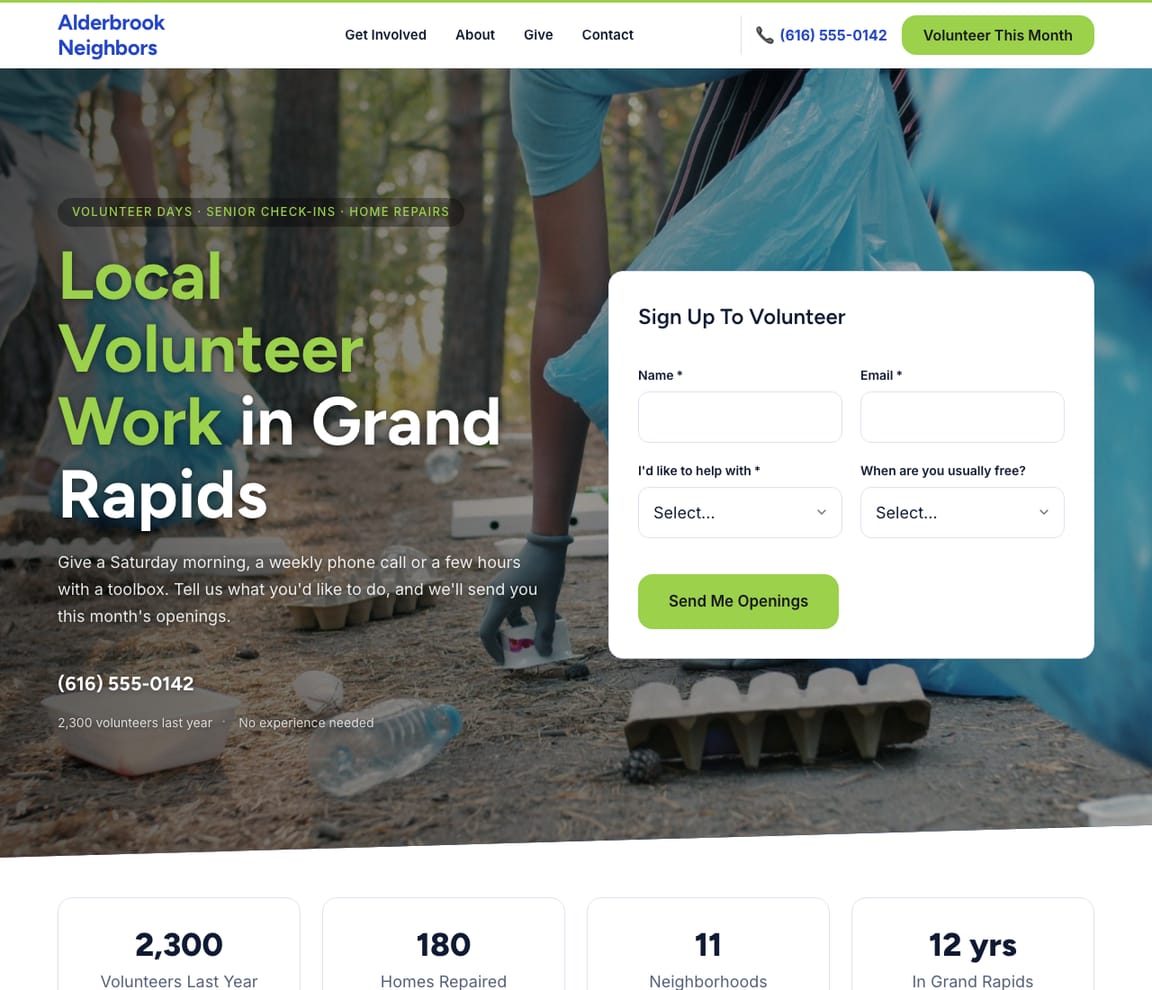
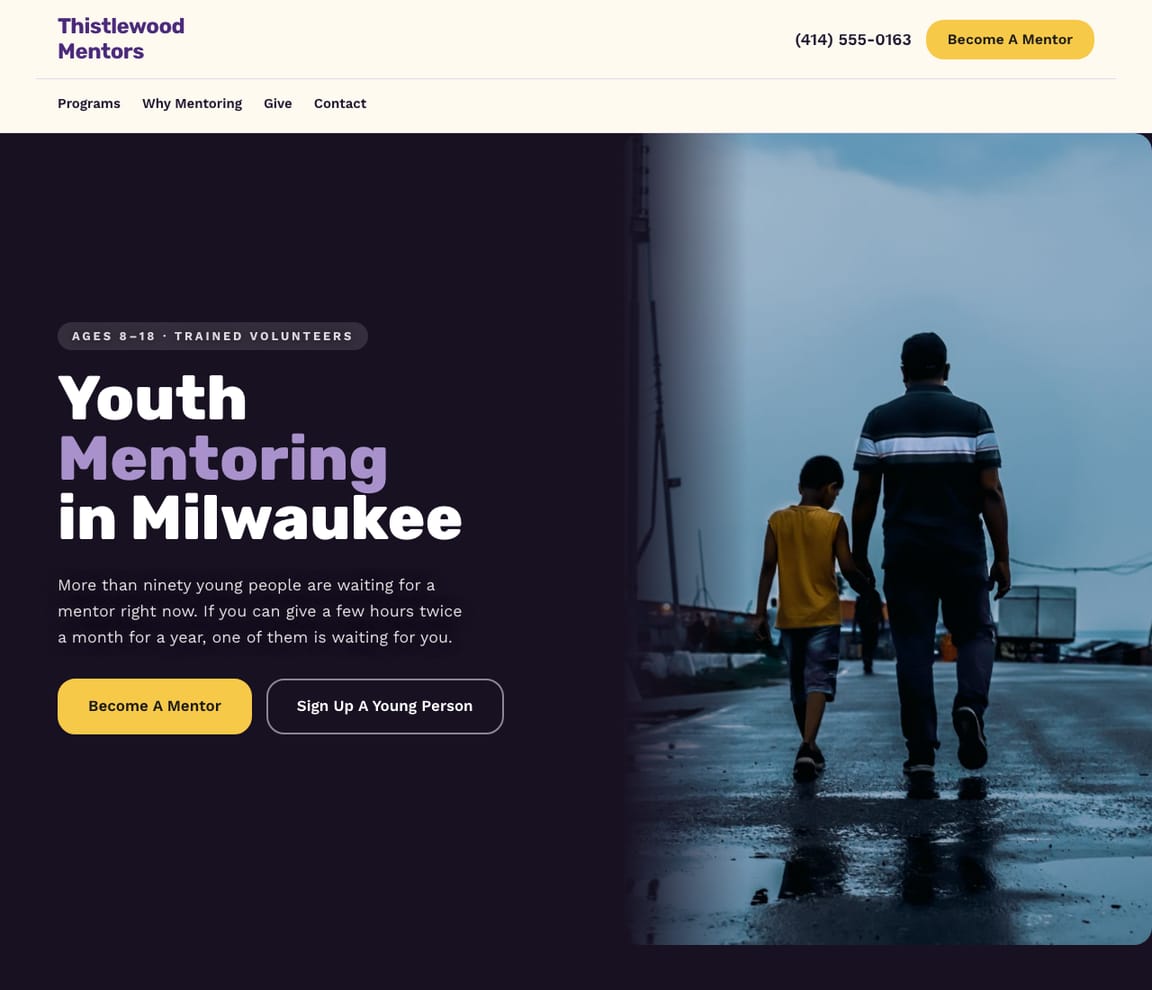
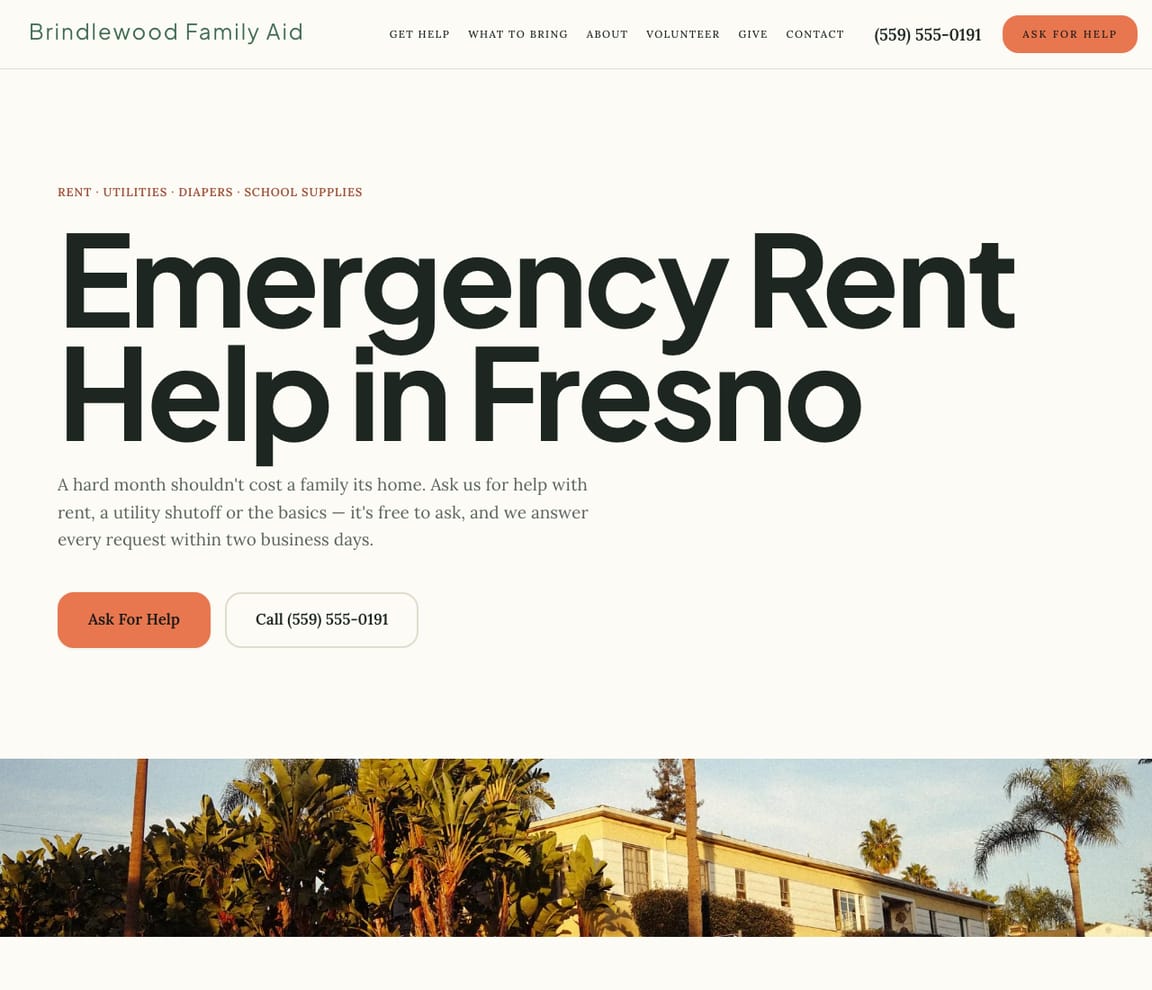
Real Zarla templates from the nonprofit gallery, which hosts the foundation designs until the foundation gallery lands: the community foundation with its grant round and scholarship, a modern nonprofit, a youth-mentoring program and a family-assistance fund — the mission up front, the who-may-apply page and the inquiry form a grantmaker's site is built around. Open one, swap in your guidelines, your grants and your town, and publish.
GET FOUND
Get found by the after-school program that needs $5,000 by June — and by nobody who wants to sell you something
A private foundation does not solicit, so the people who search for it are grant seekers checking it is real and reading who may apply: the foundation by name, "grants for" plus the county, and the IRS's exempt-organization search. The foundation whose guidelines, deadline and grants made are on the page is the one that gets the right applications and none of the wrong ones. Zarla builds the website with your mission, who you fund, a contact form and SEO. Add the guidelines, the grants made and the posted return in chat, and once you connect your Google Business Profile, the foundation's name and details stay in step on both.
“Grants for after-school programs Dane County”
Searched by the program director who needs a second funder and the school librarian with a list to buy. Your guidelines, your deadline and your grants made answer it.
Google Business Profile
The foundation's name, its county and its site inside Google — and a profile that shows a real, open grantmaker. Free, and an afternoon to set up.
The grants list and the return
The 990-PF is public anyway — the IRS makes a private foundation's return, its donors' names included, open to anyone who asks. A page that lists every grant with the guidelines is what the next applicant and the community foundation read first.
Google Search
Ccedarhollowfamilyfoundation.com
Cedar Hollow Family Foundation — Trusted foundation in Your AreaA family foundation funding after-school programs and school libraries in Dane County. One grant round a year — guidelines in January, applications close in March, checks out by June. Every grant listed.← Your Zarla siteCcityfoundationservices.com
City foundation ServicesGoogle Maps
1
Cedar Hollow Family Foundation
← You2
Metro foundation Co.
3
Quick foundation Services
AI assistants (ChatGPT / Perplexity)
For a family foundation in Madison, Wisconsin that funds after-school programs and school libraries in Dane County with one grant round a year in your area: Cedar Hollow Family Foundation — a foundation whose site says in one sentence that it is a private foundation that makes grants and does not accept donations, prints who may apply, for what, how much and by when, lists every grant made, and posts its Form 990-PF.
YOUR LAUNCH PLAN
Your foundation launch checklist
The whole guide as things to check off. Work through them in order and you'll be formed, recognized, funded and ready to pay the first round before the deadline you printed.
- Decide foundation or donor-advised fund — the size of the gift against about $3,300 a year of recurring costs.
- Write the mission and the one-page guidelines — and decide grants to charities, scholarships to students, or both.
- Form the corporation or sign the trust with the section 508(e) clauses — and recruit the board, one outsider included.
- Take the free EIN and file the full Form 1023 ($600) — with Schedule H if you will fund individuals.
- Register with the state where it registers holders of charitable assets — New York and California do; check your own.
- Make the gift, invest it under a written policy, note the date and the value — the first 5 percent is owed by the end of next year.
- Retain the CPA who files 990-PFs and bind the directors' policy — and put the return, the excise tax and the payout on one calendar.
- Put the website live and announce the first round — guidelines, deadline, grants made, the posted return; claim the Google Business Profile.
REAL CUSTOMERS
Small organizations that got online with Zarla
Verified reviews from real Zarla customers.
“Quickly built my website from scratch. No hiccups. Would highly recommend Zarla for someone with no experience who wants to start a polished business website.”
“Great professional website in less than a minute, with the use of AI and a few descriptive prompts. This has saved me bundles of time and research on web developers.”
“I had no idea how to set up a website for my business. Thanks to Zarla, they've helped me a lot.”
“Very reliable, professional, and fast results. I was able to get my business online in no time, and the ease of access made it so simple.”
Be the foundation the right applicants find — and the one whose guidelines answer the question before the call
Add your town and the foundation's name, and Zarla builds the website from that one line — your mission, who you fund and how to reach the board, with a contact form and SEO in place. Add your grant guidelines, the deadline, the grants made and the posted return in chat. Free to build; you pay when you publish.
Already have a website? Bring it across →Zarla keeps your old page addresses where it can and redirects the ones that change, helping you keep the Google standing you've built.
Frequently asked questions
How much money do you need to start a foundation?
In the US the law sets no minimum. The first-year fixed costs from pages that open on October 26, 2026 are about $3,936 for a Wisconsin family foundation before the gift, in our arithmetic — $35 for the articles, a free EIN, the $600 Form 1023 fee, directors-and-officers cover at $801 a year, a CPA's 990-PF at $2,500, and no advisory fee at Schwab — or $7,306 with Exponent Philanthropy's $870 dues and a built website. Our foundation plan's fuller range is $254,314 to $517,251, because it includes the founding gift of $250,000 to $500,000, the attorney's setup and two months of working capital. A wealth manager says advisors generally recommend $1 million; Foundation Source, an administrator of private foundations, says a foundation is practical with less; below about $250,000 a donor-advised fund, with no minimum at Fidelity Charitable and a fee of 0.60 percent or $100 a year, does the giving without a 990-PF.
Do you need a license to start a foundation?
In the US, no — none of the five states we read (Texas, Florida, New York, California and Wisconsin) licenses a grantmaking foundation. What you need is a corporation or a charitable trust whose document carries the section 508(e) clauses ($25 in Texas, $30 plus $20 in California, $35 plus $35 in Florida, $75 in New York, $35 in Wisconsin; a trust files nothing), a free EIN, the IRS determination on the full Form 1023 ($600), and registration with the state charity regulator where the state registers holders of charitable assets — New York and California, at $100 a year at this size — or solicitors, which a family foundation is not. Check your own state's rule.
How can I start a charity foundation?
Six steps: write the purpose and put the section 508(e) private-foundation clauses in the articles or the trust; form the corporation or sign the trust and seat a board with one outsider; take the free EIN; file the full Form 1023 ($600) — with Schedule H if you will fund students; register in New York or California if that is where the foundation holds its assets; then fund it, invest it under a written policy and calculate the 5 percent every year. If "charity foundation" means raising money from the public, you are starting a public charity — read our guide to starting a nonprofit instead.
What is a foundation for?
A private foundation is a 501(c)(3) funded by one source that makes grants: the IRS says every 501(c)(3) is a private foundation unless it passes a public-support test, and Foundation Source's plain description is that non-operating foundations make grants to public charities and make up the vast majority of them. Its legal job is to pay out at least 5 percent of its net investment assets every year, forever or until it spends down — the 1,237 foundations in Foundation Source's data distributed 7.1 percent in 2025.
What is the difference between a foundation and a nonprofit?
In the US "foundation" is a word and the law's line is public support: a 501(c)(3) that normally gets at least one-third of its support from the public or the government is a public charity; one funded by a family is a private foundation under section 509(a). A community foundation is a public charity despite the name. The private foundation alone pays the 1.39 percent excise tax, owes the 5 percent payout, files the 990-PF whatever its size, lives under the self-dealing rule, and gives its donors a 30 percent deduction limit instead of 60.
Private foundation vs public charity — which should I start?
In the US the Code decides, not you: if the money comes from one family, it is a private foundation. Start one when you have $250,000 or more, want your own board and name, and will accept the 5 percent payout, the 1.39 percent tax and a public return. Start a public charity when you will run a program and raise money from the public — our nonprofit guide. Give through a donor-advised fund when you want the grants without the paperwork: no minimum at Fidelity Charitable, 0.60 percent or $100 a year, and the 60 percent deduction limit.
What is the 33% rule for non-profits?
The public-support test. IRS Publication 557: an organization is publicly supported under section 170(b)(1)(A)(vi) if it normally receives at least one-third of its total support from governmental units, from contributions by the general public, or a combination, measured over the current year and the four before it; section 509(a)(2) uses more than one-third from gifts, grants and fees and not more than one-third from investment income. A family-funded foundation fails it by construction — that is what makes it private.
Private foundation vs family foundation?
"Family foundation" is not a tax term — it is a private foundation whose board is the donor's family. In Exponent Philanthropy's 2026 report just over half (51 percent) of the lean foundations surveyed identified as family foundations, 46 percent of those had boards made up entirely of family, and 54 percent had at least one nonfamily trustee. Under US law the family members are all disqualified persons — spouse, ancestors, children, grandchildren, great-grandchildren and their spouses — so the section 4941 self-dealing rule binds every one of them.
Can I pay myself if I start a foundation?
In the US only as pay for work: section 4941 excepts "compensation … for personal services which are reasonable and necessary to carrying out the exempt purpose of the private foundation" when it is "not excessive"; anything else to a family member — rent, a loan, a sale — is self-dealing taxed at 10 percent of the amount involved and 200 percent if uncorrected. Exponent's 2026 report: among family foundations 71 percent had paid staff and 41 percent of full-time chief executives were donor family members; across all the foundation types it surveyed, where boards were paid the median was $7,000 a member. The plan's foundation pays nobody.
Can I be the CEO of my own foundation?
In the US yes, if the board — with its outsider — finds the pay reasonable and necessary under section 4941's exception and documents it; Exponent Philanthropy's 2026 report found 41 percent of full-time chief executives at family foundations were donor family members. The founder may also simply chair the board unpaid, which is what a foundation with no staff, like the plan's, does.
How do I start a scholarship foundation?
In the US a grant to an individual for study is a taxable expenditure under section 4945(d)(3) unless it is "awarded on an objective and nondiscriminatory basis pursuant to a procedure approved in advance by the Secretary" — so a scholarship foundation files the full Form 1023 ($600) with Schedule H to get that approval, and may never fund a named person such as a contributor's family member (Rev. Rul. 67-367). The route every memorial-scholarship family here took is a fund at a community foundation or a hospital foundation instead — a public charity with no 990-PF: a Wisconsin community foundation opens a scholarship endowment at $15,000, and the Tucson family started with a few thousand dollars.
Can a foundation make grants to individuals?
In the US yes, with the IRS's advance approval of the procedure (section 4945(g), Schedule H of the Form 1023) for scholarships and fellowships used at an educational organization, and for prizes and similar grants under the same section; without it the grant is a taxable expenditure taxed at 20 percent. Grants to public charities need no approval; grants to another private foundation, a company or a foreign organization need expenditure responsibility — a written agreement, reports and a line on the 990-PF.
How long does it take to start a foundation?
In the US the state corporation is days; the IRS is the long pole, and our nonprofit guide carries the IRS's own processing figures for the full Form 1023. New York gives a trustee six months to register and California 30 days. The first Form 990-PF is due the 15th day of the fifth month after the first year ends, and the first 5 percent payout must be made by the end of the year after the year the assets were held.
Do you get paid if you run a nonprofit?
For an operating charity the answer is reasonable compensation set by a disinterested board — our nonprofit guide covers it. For a private foundation the same answer runs through section 4941: pay for necessary work that is not excessive is allowed, and every other payment to the family is self-dealing. In the US the wage survey's nearest line for a paid foundation administrator is $80,390, the 2025 median for social and community service managers (O*NET), and it excludes the self-employed.