ORGANIZATION GUIDE
How to start a nonprofit in 2026
The alternatives to check first, the board, incorporating in your state, Form 1023 or 1023-EZ and what the IRS charges and how long it takes, registering to fundraise state by state, the 990 that keeps the exemption, whether you can pay yourself — and how new nonprofits actually get funded.
Free to build · Pay when you publish · No credit card
$275the IRS user fee for Form 1023-EZ; $600 for the full Form 1023 (Revenue Procedure 2026-5)
22 dayswithin which the IRS decides 80% of Form 1023-EZ applications; 191 days for the full form (June 2026)
64%of US charitable giving in 2025 came from individuals — $394.2 billion of $617.20 billion (Giving USA)
No codeto get online
See it in action
See what your nonprofit website could look like
This is a real Zarla template for a community nonprofit. Describe yours — the mission, the programs, the town — and you'll have a site like this, with your programs and a volunteer sign-up form, in about a minute.
- Professional design — not a generic template
- Looks great on desktop and mobile
- Content written for your industry
Build the website
Start your nonprofit website now
Add your town and your organization's name to the sentence, and Zarla builds the site: your mission and programs and a volunteer sign-up form. Add your donate button, your board and your results in chat, then publish.
Already have a website? Bring it across →Zarla keeps your old page addresses where it can and redirects the ones that change, helping you keep the Google standing you've built.
Is starting a nonprofit worth it in 2026 — and how does a new one get funded?
A nonprofit is a corporation nobody owns, and starting one is the slowest of four ways to pursue a charitable idea. The first is a fiscally sponsored project: "instead of starting your own nonprofit, you can work with an existing 501(c)(3) public charity under a formal arrangement known as fiscal sponsorship. You can ask for grants and tax-deductible donations under your sponsor's exempt status", with the sponsor "keeping a fixed amount--typically five to 10 percent--for administrative services" (Candid, fiscal sponsorship); demand for sponsors "has surged since 2020" (Chronicle of Philanthropy, November 27, 2023). The second is the all-volunteer 501(c)(3) on the short form — the typical small start. The third is the staffed public charity on the full Form 1023, for a founder who means to be paid or will outgrow the short form's limits. The fourth is not a charity at all: a company, a donor-advised fund or a seat on an existing board — there are "1,935,344 registered nonprofits in the United States, and most of them are small" (Candid). In a Maryland nonprofit association director's words from 2002, still true: "With a for-profit business, you own it. If you found a nonprofit, you don't own it. You have founded something that takes on a life of its own. You hire a board of directors that can get rid of you." (Chronicle of Philanthropy, July 12, 2002).
Where the money comes from. Giving to US charities "increased 5.7% in current dollars (3.0% adjusted for inflation) to an estimated $617.20 billion in 2025": individuals $394.2 billion, foundations $117.15 billion, bequests $62.19 billion, corporations $43.67 billion (Giving USA 2026, June 2026) — 64 percent, 19 percent, 10 percent and 7 percent, with the individual share "fallen from 67% in 2023 to 66% in 2024 to 64% last year"; religion took the largest share of gifts (23 percent), then human services (15), education (14), foundations (12) and public-society benefit (11) (Candid, July 7, 2026, reporting Giving USA). Giving USA's own caveat: "consumer sentiment … remained near historic lows and may have dampened giving by some households". The founders' version: "Grant funding is brutal. Schools have frozen budgets. Federal programs move slow." (Randy Kohn, VoyageLA, July 13, 2026) and "When A Starrs Initiative first started we received donations from family & friends." (Mariah Sammons, CanvasRebel, July 20, 2023). First money is personal; foundations are year-two money.
What the people earn. Social and community service managers — the paid executive's job code — had a median of $80,390 a year in 2025, with 10 percent under $53,150 and 10 percent over $132,260 (O*NET, from BLS 2025 wage data); the survey covers employees, not founders who volunteer (Washington ESD), and no survey we could open prints what founders earn — most of the founders in this guide are unpaid. Independent Sector values a volunteer hour at $36.14 for 2025 (Independent Sector, April 21, 2026), counts "1.9 million registered nonprofit and philanthropic organizations" and says "1 in 5 nonprofit workers lives in a household experiencing financial hardship" (Independent Sector).
How many make it. No current page prints a failure rate. Candid's 2020 model found that "12,042 nonprofits (4%) would close in the absence of a crisis" among the 315,698 it analyzed (Candid, July 15, 2020); the mechanism that ends most small ones is simpler — "organizations that do not file for three consecutive years automatically lose their tax-exempt status", and "the law prohibits the IRS from undoing a proper automatic revocation and does not provide for an appeal process" (IRS, automatic revocation, June 2026). The IRS receives "over 115,000 applications for tax-exempt status and other determinations" a year (IRS, Where's my application).
The catch. You don't own it, the board can replace you, the first dollars are your own and your friends', the paperwork never stops — a 990 every year or the exemption is gone — and the governance load lands the day the letter arrives: "Becoming a nonprofit opened more doors for us, but it also brought an entirely new set of responsibilities." (Jody Vane, Nonprofit Leadership Alliance, October 7, 2026). That's what the rest of this guide sets up.
How to start a nonprofit, in plain English
Two layers: the state corporation, then the federal exemption. In the US a nonprofit corporation is a creature of state law — Texas: "A 'nonprofit corporation' is a corporation no part of the income of which is distributable to members, directors, or officers. A nonprofit corporation is created by filing a certificate of formation with the secretary of state." — and "is not automatically exempt from federal or state taxes"; "the designation '501(c)(3)' refers to a specific federal tax provision only" (Texas Secretary of State, nonprofit FAQ). The federal layer is the IRS's: an organization "must be organized and operated exclusively for exempt purposes set forth in section 501(c)(3), and none of its earnings may inure to any private shareholder or individual", may not make lobbying "a substantial part of its activities" and may not campaign for candidates (IRS, exemption requirements, June 2026); it "must not be organized or operated for the benefit of private interests, such as the creator or the creator's family" (IRS, inurement, October 2026).
The board — and the AI answer's "three directors", by state. The IRS sets no minimum; the states do. Texas: "a corporation may not have fewer than three directors" (Tex. Bus. Orgs. Code §22.204), plus "one president, and one secretary. The same person cannot be both the president and secretary" (Texas Secretary of State). Florida: "A board of directors must consist of three or more individuals" (Fla. Stat. §617.0803). New York: "The number of directors constituting the entire board shall be not less than three" (N.Y. N-PCL §702). California: "The number or minimum number of directors may be one or more" (Cal. Corp. Code §5151) — but "not more than 49 percent of the persons serving on the board of any corporation may be interested persons", meaning anyone paid by the corporation in the previous twelve months and their relatives (Cal. Corp. Code §5227), so a paid founder-director needs at least two unpaid, unrelated colleagues. Delaware: "1 or more members" (8 Del. C. §141). Recruit three unrelated people anywhere; in three of the four big states you must.
Incorporating. Texas: "for filing a certificate of formation, $25" (Tex. Bus. Orgs. Code §4.153). California: "Filing articles of incorporation not providing for shares: Thirty dollars ($30)" plus a $20 statement of information (Cal. Gov. Code §12186), due within 90 days of incorporating (CalNonprofits). Florida: "Articles of incorporation: $35", "Designation of and acceptance by registered agent: $35", an annual report of $61.25 (Fla. Stat. §617.0122) — $70 to form, our arithmetic. New York: "seventy-five dollars" for the certificate of incorporation (N.Y. N-PCL §104-A). The articles need the purpose and dissolution clauses the IRS reads; adopt bylaws and a conflict-of-interest policy at the first meeting — the IRS's sample policy is in its instructions, and adopting one "isn't required to obtain tax-exempt status" but puts the procedures in place (IRS, Form 1023 instructions). Then the EIN: "Use this tool to get an EIN directly from the IRS in minutes for free." (IRS).
Form 1023-EZ or Form 1023 — the real eligibility test. The user fee is "$275" for "Form 1023-EZ" and "$600" for "all other applications for recognition of exemption under § 501", paid on Pay.gov (Revenue Procedure 2026-5, Appendix A). The short form's test has three parts, not one: "projected annual gross receipts of $50,000 or less in the current taxable year and the next two years", "annual gross receipts of $50,000 or less in each of the past three years", and "total assets the fair market value of which does not exceed $250,000" (Rev. Proc. 2026-5, §6.05); and "if you are seeking recognition as a church, school, or hospital, you are not eligible to use Form 1023-EZ", nor is an LLC (IRS, Form 1023-EZ instructions). File within 27 months of formation and "the effective date of your exempt status will be your legal date of formation" (IRS, Form 1023 instructions). Processing, by the IRS's own page: "We issue 80% of Form 1023-EZ application determinations within 22 days", "80% of Form 1023 application determinations within 191 days", cases needing further review "within 120 days", "Form 1023-EZ can't be expedited", and "you must file your annual return (for example, Form 990) even if you haven't received a determination letter" (IRS, Where's my application, June 2026). The tail is real: one Missouri charity's short form was approved in a week; another's full form took "about 15 months" (Springfield Business Journal, December 26, 2018).
Permission to fundraise, state by state. About 40 states and the District of Columbia require registration before you solicit, by a compliance vendor's 2017 count (Harbor Compliance, revised November 2017 — a vendor). New York: "each charitable organization shall pay to the attorney general a fee of twenty-five dollars" (N.Y. Exec. Law §172), and most organizations that solicit or hold charitable assets there must register (New York Attorney General, Charities Bureau). California: "Registration must occur within 30 days of first receiving charitable assets" with a $50 initial fee and an annual renewal (California Attorney General, Registry of Charities). Florida: "anyone who solicits donations in or from Florida" registers with FDACS and renews annually; the fee runs from $10 under $5,000 of contributions to $400 at $10 million or more, and "small organizations are not required to pay a registration fee" below $50,000 with unpaid staff; every solicitation must carry the state's registration disclosure in capitals, and the late fee is "$25 for each month or part of a month" (FDACS, Solicitation of Contributions; Fla. Stat. §496.405). Texas has no general charitable-solicitation registration. State tax exemptions are separate applications: Texas AP-204 (Texas Comptroller), California Form 3500A with no fee (CalNonprofits), New York ST-119.2 for sales tax (New York Tax Department), and in Florida "exemption from one tax does not necessarily exempt the organization from all taxes" (Florida Department of Revenue).
Keeping it: the 990, every year. Form 990-N when gross receipts are "normally ≤ $50,000", 990-EZ under $200,000 of receipts and $500,000 of assets, the full 990 above either (IRS, Form 990 series thresholds, June 2026); three missed years and the exemption is revoked automatically, with no appeal (IRS). A public charity must also stay publicly supported — "at least one-third of its total support from governmental units, from contributions made directly or indirectly by the general public, or from a combination" over five years (IRS Publication 557).
Paying yourself. Allowed, as an employee doing the work, at "reasonable compensation" — "the amount that would ordinarily be paid for like services by like organizations under like circumstance" (IRS, Form 1023 instructions); Candid: "nonprofits should make money and employees can be paid a salary. This includes the founder if the founder is performing mission-related work as an employee of the organization." (Candid). Overpay and "an excise tax equal to 25% of the excess benefit is imposed", 200 percent if uncorrected, with managers who approved it liable for 10 percent; the safe harbor is approval in advance by conflict-free directors using comparables — for organizations under $1 million, "data on compensation paid by three comparable organizations" (IRS Publication 557). Texas puts it plainly: "Any corporation may pay reasonable compensation for services rendered to the corporation." (Texas Secretary of State). The benchmark for the job is the $80,390 median above.
Insurance, and taking the money. Insureon's nonprofit customers pay a median $42 a month for general liability, $82 for a business owner's policy, $67 for directors-and-officers cover, $62 for workers' compensation and $56 for professional liability — "69% pay less than $60 per month" for general liability, and 93 percent choose a $1 million per-occurrence limit (Insureon, nonprofits, updated May 8, 2025); general liability plus D&O is $1,308 a year, our arithmetic — the biggest sourced first-year cost after the program itself. Donations: PayPal's charity rate is "1.99% + fixed fee" of $0.49, "subject to eligibility, application, and pre-approval by PayPal" (PayPal, merchant fees, October 1, 2026); Givebutter charges "0% platform fees across all campaign types when tips are enabled", a flat 3 percent if you disable them, with standard processor rates of "2.9% + 30¢" (Givebutter, pricing); Donorbox's free plan runs "fees between 2.95% and 3.95%" and its Pro plan is $150 a month (Donorbox, pricing); Zeffy "covers all transaction & credit card fees" and asks donors for an optional contribution instead (Zeffy, pricing). Federal grants, when they come, allow "a de minimis rate of up to 15 percent of modified total direct costs" for indirect costs without a negotiated rate (2 CFR 200.414).
The money to start. Our free nonprofit business plan itemizes formation and the first program at $4,900–$35,683: the state incorporation, the IRS user fee, the charitable registration where your state requires it, legal help if you want it, insurance at Insureon's medians, the first program's materials and space, the website, software, branding and three months of reserve for the months before the grants arrive. The program and the reserve are most of it; the government fees are $300 to $725 across the four states and the two forms, our arithmetic. Confirm the details with your accountant.
In the UK: "Find trustees for your charity - you usually need at least 3" and "Register as a charity if your annual income is over £5,000" or if you set up a charitable incorporated organization (GOV.UK, set up a charity); below £5,000 you "don't have to apply to register", but can still ask HMRC for recognition for tax breaks and Gift Aid (Charity Commission, CC21b), which pays "25p every time an individual donates £1" (GOV.UK, Gift Aid); choose the structure first — if it "is a corporate body, generally its trustees aren't personally liable for what it does" (Charity Commission, CC22a). In Australia: register with the ACNC, which can send your application for tax concessions on to the ATO (ACNC, why register); you need an ABN with the right entity type and must be not-for-profit (ACNC, who can apply); deductible-gift-recipient status is a separate endorsement by the ATO, and some of its categories are open only to registered charities (ACNC, DGRs and the ACNC); a New South Wales incorporated association needs at least five members and a committee of three or more adults, with registration at $171 to $220 (NSW Government, starting an incorporated association; NSW, forms and fees). Check your own regulator's rules.
What nonprofit founders actually say
None of this is our opinion about the work. It comes from people who founded nonprofits — a Missouri veteran, a youth-led charity's teenage founder, a Santa Barbara trapeze company that runs a 501(c)(3) beside it, a Lexington Christmas charity, a Maine newspaper publisher, a Georgia moms' group, a Washington film center, a Manhattan school, and a few whose interviews are two decades old and labelled so — talking to local papers, CanvasRebel, VoyageLA, Shoutout SoCal, Robb Report and the Chronicle of Philanthropy between 2002 and 2026, each described as the page describes them. Read each as theirs at the time. Five things come up again and again.
The status is not a formality. George Fuller, founder of Ruck 'N' Run in Republic, Missouri, whose short-form application was approved in a week: “It's not an easy status. They just don't give these public charity statuses away to anybody that files.” (Springfield Business Journal, December 26, 2018). Ben Spickard, speaking for the In Time of Need Foundation, whose full Form 1023 took about 15 months: “There was no expectation, there was no urgency.” (Springfield Business Journal, 2018). Claire Nalley, co-founder of ManitosUSA: “I actually think the process was good, because it made us really have to think through the work we wanted to do, and who was going to be on our board, and where we were going to get funding.” (Robb Report, December 2, 2023).
“Running numerous chapters and leadership teams by myself turned out to be a not-so-extremely-intelligent decision as I juggled hospital calls, hundreds of emails, social media posts, chapter onboarding, and everything in between. I spent many late nights doing a hefty ton of busy work.” — Claire Xiao, founder and CEO of Courage Canvas, a youth-led 501(c)(3), in CanvasRebel, March 12, 2026
Doing it alone is the mistake they name most. Xiao again: “I began delegating tasks little by little, eventually creating the outreach team, chapters team, programs/events team, social media team, and board that we have today.” (CanvasRebel, 2026). Brette Sims, founder of STUK Designs in West Los Angeles: “Before I found a solid team, a board, an amazing intern (who lives in Mumbai, India: Tazeen Shaikh), a blogging team, and brand ambassadors, I felt like I was always doing all the work on my own. It burned me out.” (VoyageLA, September 17, 2019). Emily Lenzner, founder and executive director of 4EYE Film Center in Washington: “Wearing all these hats is exhausting. But I really feel like I need to know everything in order to get us off the ground.” (Nonprofit Leadership Alliance, October 7, 2026). Audra Zuckerman, co-founder of the IDEAL School of Manhattan: “It may sound silly, but the best first step we took was committing to meeting regularly. Everybody is so busy in their lives that an idea can just disappear.” (Robb Report, 2023).
The first money is yours and your friends'. Mariah Sammons, founder of A Starrs Initiative in Metro Detroit: “When A Starrs Initiative first started we received donations from family & friends. Eventually, we started to throw fundraising events making awareness of domestic violence but also making the events fun and not sad for our supporters.” (CanvasRebel, July 20, 2023). Randy Kohn, who runs AdventureMinds, a 501(c)(3), beside the Santa Barbara Trapeze Co: “Grant funding is brutal. Schools have frozen budgets. Federal programs move slow. We bootstrap with SBTC revenue. But schools are starting to fund us because they've seen the impact.” And: “What matters is measurement. Programs that can't prove impact won't survive.” (VoyageLA, July 13, 2026). Eric Luan of the California Culture Festival and Eastern Harmony Mental Health: “One of the biggest struggles was balancing vision with sustainability. There were many moments where we had ambitious ideas for community programming but limited financial resources to make them happen.” (VoyageLA, June 8, 2026). Folarin Ero-Phillips, founder of the African American Relief and Development Initiative in Minneapolis, in 2002: “Many new organizations try to use their own money to do their work — to have an office, to pay the utility bills — and at the end of the day if they do not get funded, then they will be down in a hole.” (Chronicle of Philanthropy, July 12, 2002).
All-volunteer works, with one need. Katie Keys, founder and board member of Operation: Secret Santa in Lexington, Kentucky, which has no paid employees: “Funding is our first and foremost need. We're really good at stretching our dollars.” (Smiley Pete Publishing, November 25, 2025). Erin Cutler, founder of Mom's Pillow in Southern California: “While finding the time as a full-time stay at home mom to build this project has been the primary challenge, I really enjoy working on it because it has reminded me how full of kindness people really are.” (Shoutout SoCal, October 4, 2023). Sanja Jing, a high-school senior who founded Global Visioneers in San Diego: “Balancing school, personal life, and running a growing nonprofit has been difficult. Managing various aspects of the organization while keeping our initiatives fresh and engaging has required constant innovation and adaptability.” (Shoutout SoCal, November 13, 2024). Willow N., who founded Beads for Benefit at her Pasadena school and budgeted about $1,000 for the filing: “I really enjoyed teaching jewelry making classes. I found that it really was great to interact with the kids and teach them…So, I wanted to expand to more local elementary schools.” (Best of SNO, February 17, 2026).
The structure is a tool, and you don't own it. Chris Crockett, publisher of the Ellsworth American, on moving his newspapers under a nonprofit: “Good years, newspapers can run 5 to 8% operating margins, which is literally break even. So, the non-profit will give us the flexibility to operate debt-free and explore new ways to support the work we do through philanthropy, grants and other options that are not available to us as a for-profit.” (The Ellsworth American, October 7, 2026). Jody Vane, co-founder of Cobb Moms Helping Cobb in Georgia: “Becoming a nonprofit opened more doors for us, but it also brought an entirely new set of responsibilities.” (Nonprofit Leadership Alliance, 2026). Chris Baty, founder of National Novel Writing Month, after six years under a fiscal sponsor: “We were either going to become our own 501(c)(3) nonprofit and expand the scope of it, or we were going to have to end it.” And: “people believe in you because you're taking it seriously.” (Chronicle of Philanthropy, April 5, 2007). Frankie Blackburn, founder of Impact Silver Spring, in 2002: “What many people miss is what impact it has on your life and your family's life. It is impossible to really achieve this without support at home.” (Chronicle of Philanthropy, 2002).
The through-line: the founders who lasted checked that nobody was already doing the work, recruited the board before the paperwork, raised the first dollars from the people who knew them, measured the program from the first session, delegated before they burned out, and treated the letter from the IRS as the start of the obligations rather than the end of them.
THE STARTER KIT
What you need to start a nonprofit
A need nobody is already meeting
A problem, the people it affects, and a check that no existing organization already does the work — or that joining them, or a fiscal sponsor, isn't the faster route.
A board of unrelated people
Three or more directors in Texas, Florida and New York, one or more in California and Delaware — not related to you, meeting on a schedule, keeping minutes and owning the organization, because you won't.
The state corporation
Articles of incorporation filed as a nonprofit corporation in your state, bylaws, a conflict-of-interest policy and the first board meeting, minuted.
The federal exemption
An EIN, then Form 1023-EZ or the full Form 1023 to the IRS for 501(c)(3) status — the fee, the processing time and the eligibility are the IRS's, below.
Permission to fundraise, and insurance
Charitable-solicitation registration in the states that require it before you ask the public for money, plus general liability and directors-and-officers cover.
One program, and a reserve
The first program run well and measured from the first session, a website with a donate button and a volunteer form, and a reserve for the months before the grants arrive.
THE PAPERWORK
Filings, fees and insurance for a nonprofit
| Typical cost | Time to get | Legally required? | |
|---|---|---|---|
| State incorporation | $25 (TX); $30 + $20 (CA); $35 + $35 (FL); $75 (NY) | Days to weeks | Yes, to be a nonprofit corporation |
| Board of directors | None | Before filing | 3+ in TX, FL, NY; 1+ in CA (paid people ≤49%) and DE |
| EIN | $0 | Minutes | Yes, before the bank account and the IRS form |
| Form 1023-EZ | $275 (Pay.gov) | 80% decided within 22 days | Yes, for 501(c)(3) status, if eligible |
| Form 1023 | $600 (Pay.gov) | 80% decided within 191 days | Yes, where the short form isn't allowed |
| Charitable-solicitation registration | $25 (NY); $50 (CA); $0–$400 (FL); none (TX) | Before you ask the public | In about 40 states, by a vendor's 2017 count |
| State tax exemptions | None (TX AP-204; CA 3500A; NY ST-119.2) | Weeks | Separate applications; a federal letter is not enough |
| Form 990 series | None | Every year | Yes — three missed years and the exemption is revoked, no appeal |
| General liability | $42/mo median (Insureon, nonprofits) | Days | Not by law; venues and partners ask for it |
| Directors-and-officers | $67/mo median (Insureon, nonprofits) | Days | Not by law; the board will ask |
THE STEPS
How to start a nonprofit (step by step)
Eight steps from the idea to a tax-exempt organization with its first program running and its first donors giving.
01
Check the alternatives
Search the IRS's exempt-organization list and your state's charity registry for groups already doing the work. A fiscal sponsor, a volunteer role or a program inside an existing organization can be the faster route to the mission.
02
Write the mission and recruit the board
One sentence on who you serve and what you do; then three or more unrelated directors — the minimum in Texas, Florida and New York; one in California and Delaware — who will meet, vote and keep minutes.
03
Incorporate in your state
File articles of incorporation as a nonprofit corporation with the purpose and dissolution clauses the IRS looks for, adopt bylaws and a conflict-of-interest policy at the first board meeting, and minute it.
The paperwork04
Get the EIN and apply to the IRS
The EIN is free. Then Form 1023-EZ if you qualify by size, or the full Form 1023 — the fee, the eligibility and the current processing time are the IRS's, below. Donations are deductible only once the letter arrives.
501(c)(3)05
Register to fundraise, and for state exemptions
Charitable-solicitation registration in the states that require it before you ask the public for money, and the separate state applications for sales-tax or property-tax exemption where they exist.
06
Open the books and insure the organization
A bank account in the organization's name, bookkeeping by fund from day one, general liability and directors-and-officers insurance, and background checks for anyone working with children or vulnerable adults.
07
Run the first program and measure it
One program, on a written schedule, with trained volunteers — and the results recorded from the first session: people served, outcomes, cost per outcome. Nothing new until it works.
08
Raise the money, and file every year
A website with the mission, the results, a donate button and a volunteer form; the first twenty supporters asked for a monthly gift; grants once there are results to show — and the Form 990 on time, every year, or the exemption is revoked.
THE COSTS
How much does it cost to start a nonprofit?
The total is our free nonprofit business plan's itemized US ranges for formation and the first program: the state incorporation, the IRS user fee, charitable registration where required, legal help if you want it, insurance at Insureon's nonprofit medians, the first program's materials and space, the website, software, branding and three months of reserve. A launch event is extra. Your own living costs come on top.
$4,900–$35,683to form a nonprofit and run its first program — the program and the reserve are most of it
$275the IRS user fee for Form 1023-EZ; $600 for the full Form 1023, paid on Pay.gov
$25–$75to incorporate in Texas, California, Florida or New York (Florida adds $35 for the registered agent)
$1,308a year for general liability and D&O cover at Insureon's nonprofit medians — our arithmetic
WHAT WE'VE LEARNED
What actually makes a supporter give or sign up
Thousands of local organization websites in, the pattern is clear: the supporter wants to know what you do, see that it's real, and act in one click. For a nonprofit, three things on a page decide who gives.
The mission in one sentence, and the program under it
Who you serve, what you do and why it matters, then the program as it actually runs — days, places, who shows up. The first thing a donor reads, and the first thing a vague site hides.
Proof it's real
Photos of the program, the board by name, the EIN and the determination letter's date, and results in numbers. A funder checks all four before a site visit.
A way to give, and a way to help
A donate button that takes a monthly gift, and a volunteer form that asks for availability — your year one in two buttons.
THE FUNDING
How a new nonprofit gets funded
Giving by source from Giving USA's 2026 release, the shares from Candid's write-up, pay from O*NET's 2025 figures, the volunteer hour from Independent Sector. Totals for the whole sector, not a promise — your program, your results and the people who know you decide it.
$394.2Bgiven by individuals in 2025 — 64% of all US giving (Giving USA 2026)
$117.15Bgiven by foundations in 2025 — 19%; corporations $43.67 billion, 7%
$80,390a year: the 2025 median for employed social and community service managers (O*NET) — founders mostly volunteer
$36.14the value of a volunteer hour in 2025 (Independent Sector) — the line an all-volunteer start runs on
SEE IT WORK
Nonprofit website designs you can start from
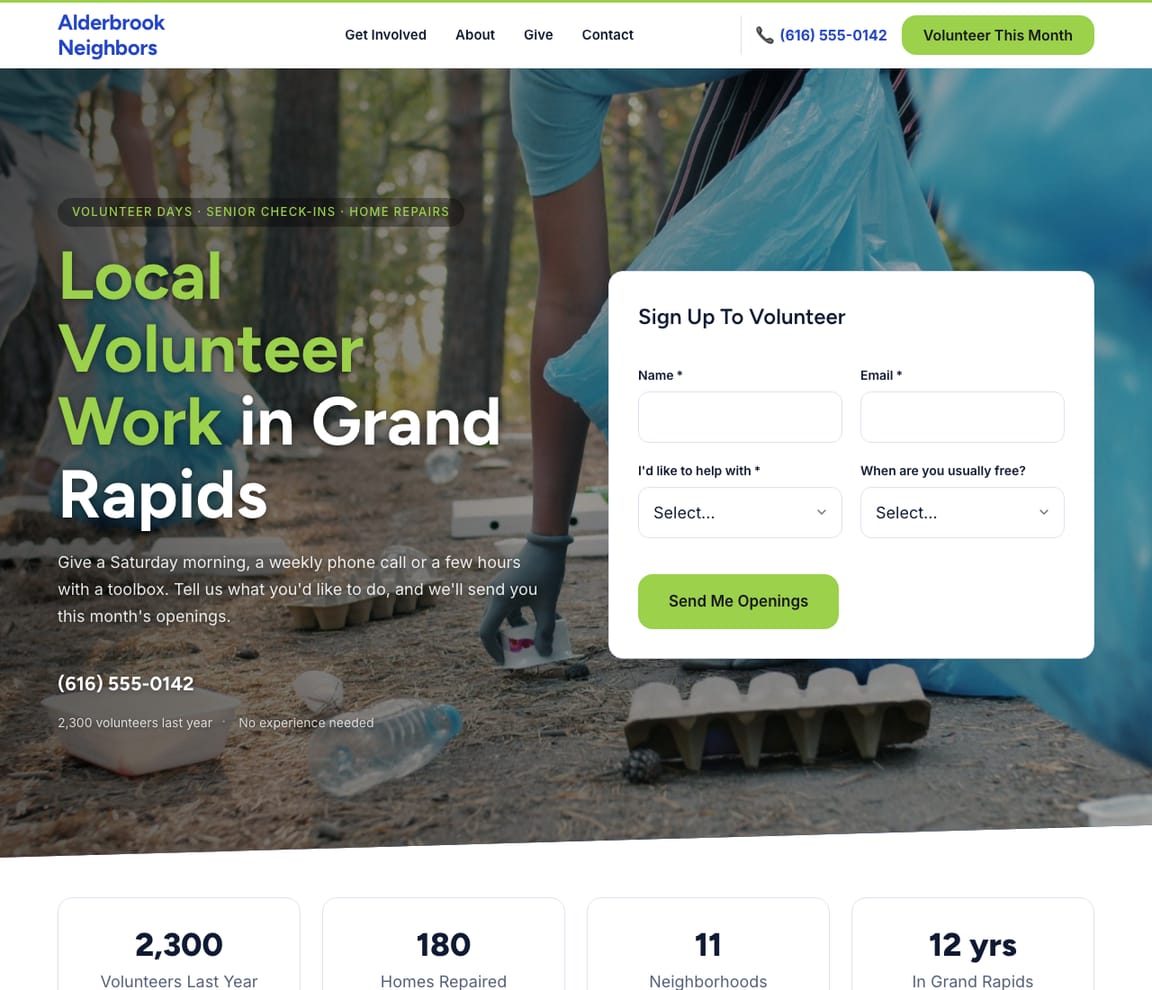
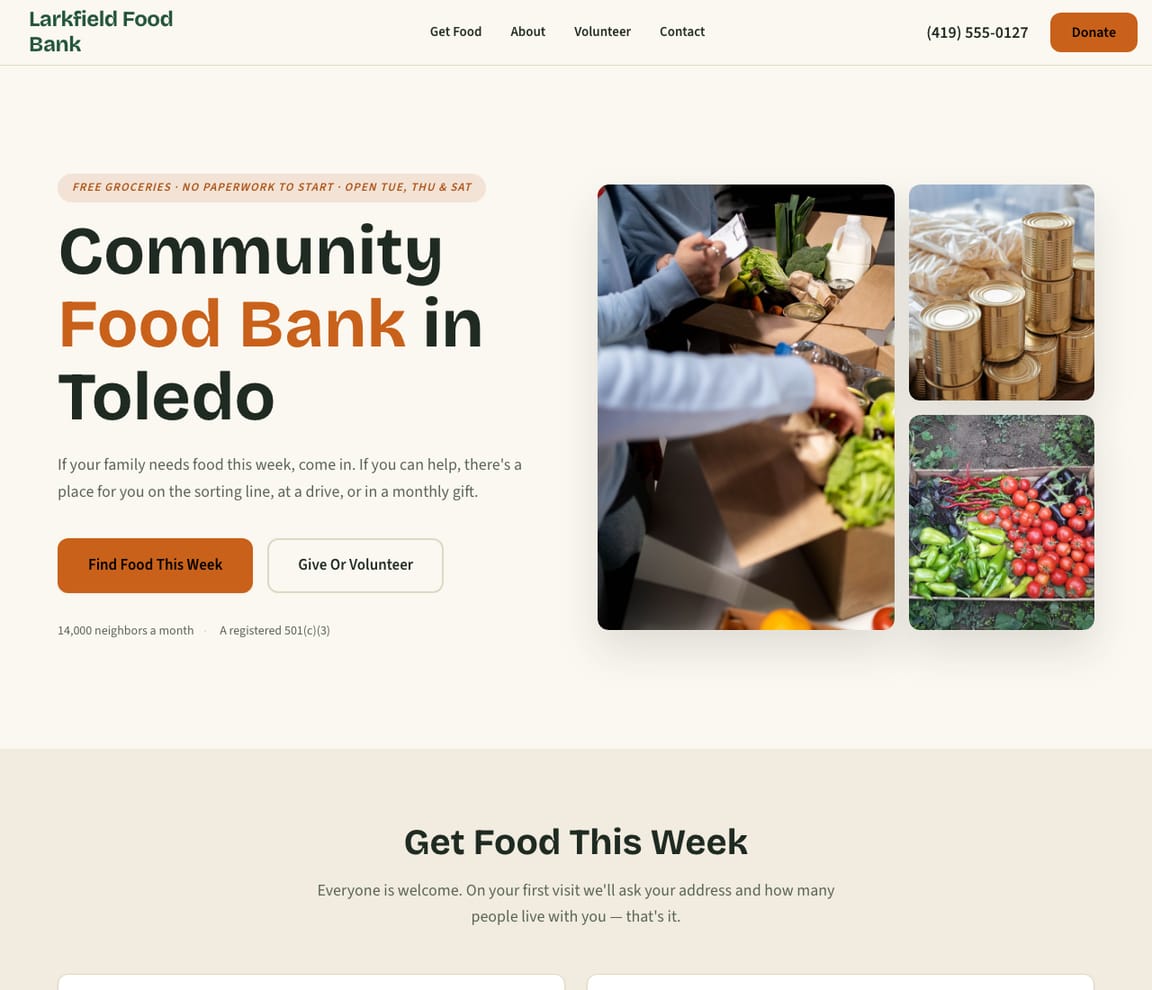
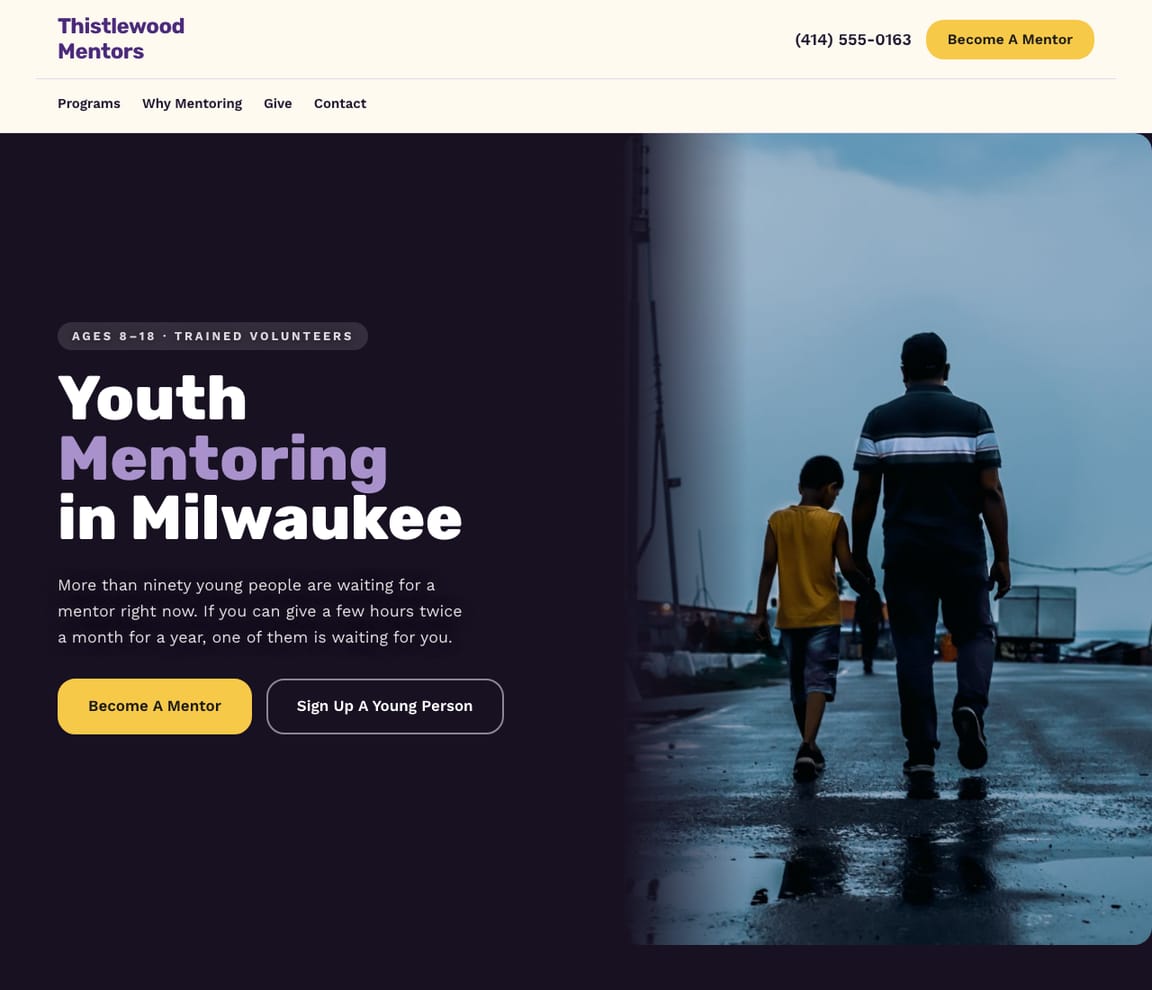
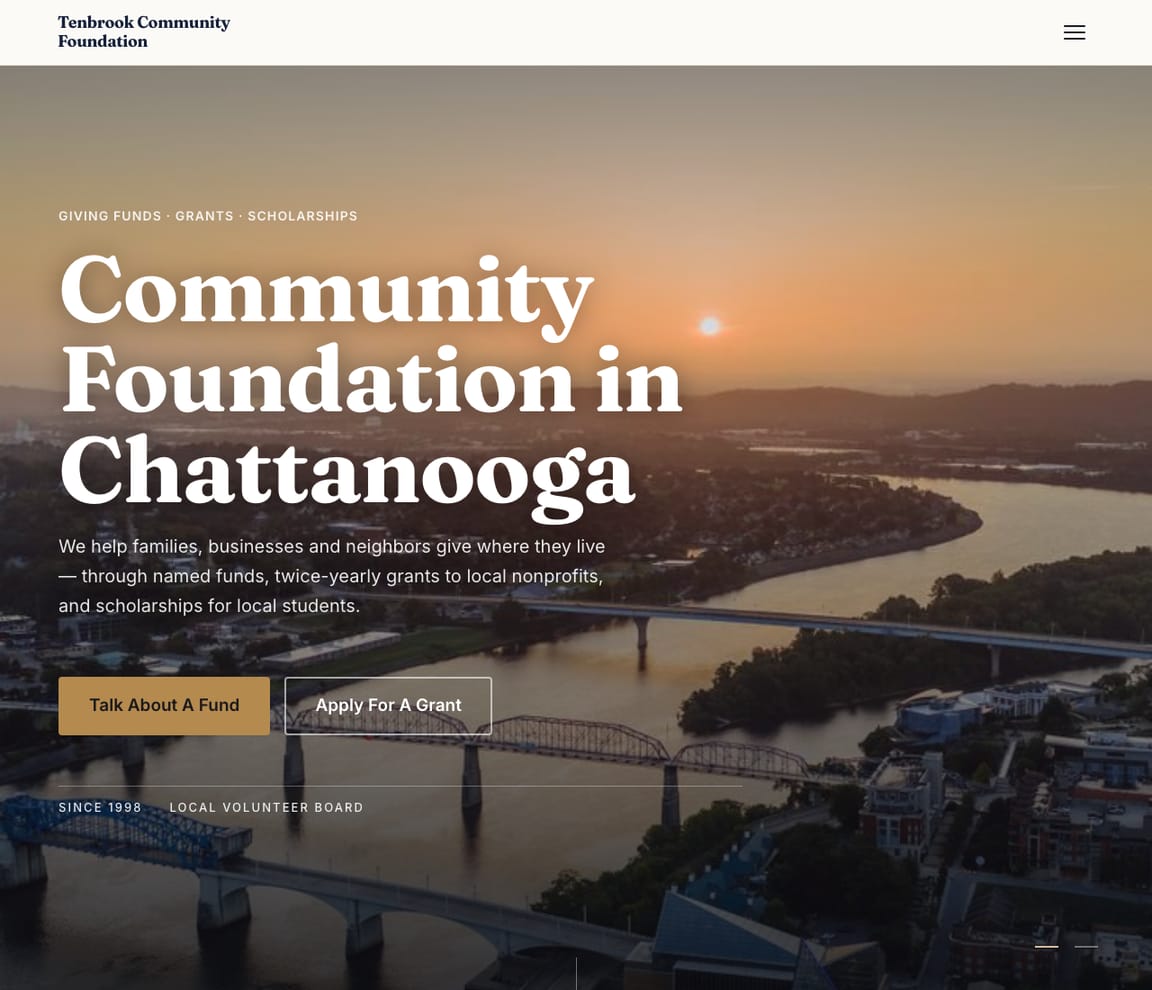
Real Zarla templates for a volunteer-first community group, a food bank, a youth mentoring program and a community foundation: a sign-up form in the hero, the programs up front, how to get involved, ways to give and a get-help section. Open one, swap in your mission, your programs and your own photos, and publish.
GET FOUND
Get found by the neighbor who wants to help this weekend
Someone who just heard about you at a school meeting searches your name on Saturday morning and gives to the organization whose mission, programs and donate button are on the page; a grant officer searches the same way before a site visit. Zarla builds the website with your programs and a volunteer sign-up form. Add your donate button and your results in chat, and once you connect your Google Business Profile, your name, hours and photos stay in step on both.
“Volunteer near me”
Searched by a retiree with Tuesday afternoons free, a parent whose child's school you work in, and a company organizing a service day. Your program, your schedule and a sign-up form answer it.
Google Business Profile
Your address, your hours and photos of the program inside Google Maps — a nonprofit qualifies for one. Free, and an afternoon to set up, and a donor sees a real organization before they give.
The results, in plain numbers
Students tutored, meals served, dogs adopted — on the page and on the profile, updated each season. Numbers a funder can check sell the next gift and the next grant.
Google Search
Nnorthsidereadingcircle.com
Northside Reading Circle — Trusted nonprofit in Your AreaOne-to-one reading tutoring for elementary students in three Minneapolis schools. See the program and results. Volunteer, or give monthly.← Your Zarla siteCcitynonprofitservices.com
City nonprofit ServicesGoogle Maps
1
Northside Reading Circle
← You2
Metro nonprofit Co.
3
Quick nonprofit Services
AI assistants (ChatGPT / Perplexity)
For a reading tutoring nonprofit in Minneapolis that needs volunteers on weekday afternoons in your area: Northside Reading Circle — a nonprofit that explains its program and who it serves, shows its results and its board, and lets you volunteer or give online.
YOUR LAUNCH PLAN
Your nonprofit launch checklist
The whole guide as things to check off. Work through them in order and you'll be incorporated, exempt, registered, insured and running a program before the reserve runs down.
- Check nobody is already doing it — the IRS list, the state registry, a fiscal sponsor as the alternative.
- Write the mission in one sentence and recruit three or more unrelated directors.
- Incorporate in your state — articles with the purpose and dissolution clauses, bylaws, a conflict-of-interest policy, the first meeting minuted.
- Take the free EIN and file Form 1023-EZ or 1023 — by the IRS's own eligibility and fee.
- Register to fundraise where your state requires it — and apply for state tax exemptions separately.
- Open the bank account, keep books by fund, insure the organization — general liability and D&O.
- Run one program and record the results from the first session.
- Get found and keep the exemption — a website with a donate button and a volunteer form, a Google profile, and the 990 filed every year.
REAL CUSTOMERS
Small organizations that got online with Zarla
Verified reviews from real Zarla customers.
“Quickly built my website from scratch. No hiccups. Would highly recommend Zarla for someone with no experience who wants to start a polished business website.”
“Great professional website in less than a minute, with the use of AI and a few descriptive prompts. This has saved me bundles of time and research on web developers.”
“I had no idea how to set up a website for my business. Thanks to Zarla, they've helped me a lot.”
“Very reliable, professional, and fast results. I was able to get my business online in no time, and the ease of access made it so simple.”
Be the nonprofit a donor finds — and trusts
Add your town and your organization's name, and Zarla builds the website from that one line — your mission and programs, a volunteer sign-up form a supporter can fill in on their phone, and SEO in place. Add your donate button, your board and your results in chat. Free to build; you pay when you publish.
Already have a website? Bring it across →Zarla keeps your old page addresses where it can and redirects the ones that change, helping you keep the Google standing you've built.
Frequently asked questions
How much does it cost to start a nonprofit?
In the US, about $4,900 to $35,683 for formation and the first program, in our nonprofit business plan's itemized ranges — the state incorporation, the IRS user fee, charitable registration where your state requires it, legal help if you want it, insurance, the first program's materials and space, the website, software, branding and three months of reserve. The government fees alone are small: $275 for Form 1023-EZ or $600 for the full Form 1023; $25 to incorporate in Texas, $30 plus a $20 statement in California, $35 plus $35 for the registered agent in Florida, $75 in New York; charitable registration at $25 in New York, $50 in California and $0 to $400 in Florida. Insurance is the biggest sourced line after the program: $1,308 a year for general liability and D&O at Insureon's nonprofit medians.
Is it better to start an LLC or nonprofit?
They are different things. In the US a nonprofit's earnings may not inure to any private shareholder or individual, you don't own it, and a board can replace you; an LLC is owned and can be sold — and an LLC cannot even use the short Form 1023-EZ. Choose the nonprofit if the work needs tax-deductible gifts and grants, which individuals ($394.2 billion) and foundations ($117.15 billion) gave in 2025; choose a company if you intend to own what you build. One Santa Barbara founder runs both: a trapeze company whose revenue bootstraps the 501(c)(3) beside it. Confirm the details with your accountant.
How do I start a non-profit with no money?
Start under a fiscal sponsor rather than your own entity: an existing 501(c)(3) takes your project under its exempt status, lets you ask for grants and tax-deductible donations, and keeps typically five to ten percent for administration (Candid). If you form your own, the US cash floor is the IRS's $275 short-form fee plus incorporation — $25 in Texas, $50 in California counting the statement of information, $70 in Florida, $75 in New York — and the EIN is free; Florida waives its charity-registration fee for organizations under $50,000 run by unpaid people. The founders here raised the first dollars from family and friends, and Operation: Secret Santa still runs with no paid employees on in-kind donations.
How much money do I need to start a nonprofit?
The government fees in the four states we read come to $300 to $725, our arithmetic: the IRS's $275 or $600, incorporation at $25 to $75, charitable registration at $0 to $50 at the start. Add insurance at Insureon's nonprofit medians — $42 a month for general liability and $67 for D&O, $1,308 a year — and legal help if you want it: one student founder budgeted about $1,000 for the filing, while a Missouri veteran filed the short form himself for the $275. The program itself is the real number, and no survey we could open prints it; our plan page's full range is $4,900 to $35,683 with the first program and three months of reserve inside it.
Can I get paid if I start a nonprofit?
Yes, as an employee doing the work, at what the IRS calls reasonable compensation — the amount that would ordinarily be paid for like services by like organizations under like circumstances; Candid says plainly that this includes the founder if the founder is performing mission-related work as an employee. Overpaying triggers a 25 percent excise tax on the recipient, 200 percent if it isn't corrected, and 10 percent on the managers who approved it; the safe harbor is approval in advance by conflict-free directors using comparables. California adds that paid people may be no more than 49 percent of the board. The benchmark for the job is the $80,390 median for social and community service managers — and most of the founders in this guide are unpaid.
What is the easiest nonprofit to start?
The one that qualifies for Form 1023-EZ: projected gross receipts of $50,000 or less a year for the current year and the next two, $50,000 or less in each of the past three, and total assets under $250,000 — and not a church, school, hospital, LLC or foreign-formed organization. The IRS decides 80 percent of those within 22 days against 191 days for the full form, and the fee is $275 against $600. Easier still is not forming an entity at all: a fiscally sponsored project under an existing charity, at five to ten percent of what you raise.
Can I start a nonprofit by myself?
Not in Texas, Florida or New York, where the statutes require at least three directors — Texas also wants a president and a secretary who are different people. California and Delaware allow a one-person board, but California caps paid people and their relatives at 49 percent of it. The founders' own words argue for three unrelated people anyway: a teenage founder who ran every team herself called it a not-so-extremely-intelligent decision, and a Los Angeles founder said doing all the work alone burned her out.
How long does it take to start a nonprofit?
The state filing is days; the IRS is the clock. By its own June 2026 page it decides 80 percent of Form 1023-EZ applications within 22 days and 80 percent of full Form 1023 applications within 191 days, with cases needing further review within 120 days — and it processes more than 115,000 applications a year in the order received, with the short form impossible to expedite. The tail is long: one Missouri charity's short form was approved in a week, another's full form took about 15 months. File within 27 months of formation and the exemption is backdated to the day you incorporated.
What is a fiscal sponsor?
An existing 501(c)(3) public charity that takes your project under its exempt status by formal agreement, so you can ask for grants and tax-deductible donations before you have — or instead of — your own organization; the sponsor passes the money through and keeps typically five to ten percent for administration (Candid). Demand for sponsors has surged since 2020, in the Chronicle of Philanthropy's reporting, and a founder who spent six years under one before incorporating said the choice came down to becoming a 501(c)(3) or ending the project. The sponsor must supervise the grant, not act as a pass-through.
How do nonprofits make money?
Gifts first: in 2025 US individuals gave $394.2 billion, foundations $117.15 billion, bequests $62.19 billion and corporations $43.67 billion, for $617.20 billion in all (Giving USA 2026). Then earned income — adoption fees, tickets, program fees, a sister business whose revenue bootstraps the charity — and government grants, which allow up to 15 percent of direct costs for overhead without a negotiated rate. Unrelated business income over $1,000 is taxed on Form 990-T. The processors take their cut: PayPal's charity rate is 1.99 percent plus $0.49, standard card rates about 2.9 percent plus 30 cents, and the free platforms ask the donor for a tip instead.
Are nonprofits expected to struggle in 2026?
Giving hit a record $617.20 billion in 2025, up 5.7 percent, or 3 percent after inflation — but Giving USA itself warns that consumer sentiment near historic lows may have dampened household giving, the individual share keeps falling (67 percent in 2023, 64 percent in 2025), and the founders quoted here describe frozen school budgets and slow federal programs. Independent Sector counts one in five nonprofit workers in a household experiencing financial hardship. The honest answer is that the money exists and the competition for it is 1.9 million organizations.
How many nonprofits fail?
No current page prints a failure rate. Candid's 2020 model found that 4 percent of the 315,698 nonprofits it analyzed — 12,042 — would close even without a crisis, and a Maryland nonprofit association director estimated in 2002 that three-quarters of would-be founders never start at all. The mechanism that ends most small ones is mechanical: miss the Form 990 for three consecutive years and the IRS revokes the exemption automatically, with no appeal and a new application to get it back.
Do I need a lawyer to start a nonprofit?
No US rule requires one. A Missouri veteran filed Form 1023-EZ himself for the $275 fee and was approved in a week; a Pasadena student budgeted about $1,000 for help with hers; the IRS supplies a sample conflict-of-interest policy in its Form 1023 instructions and says adopting one isn't required for exemption. Where a lawyer earns the fee is the full Form 1023 for a complex organization, the articles' purpose and dissolution clauses, and California's 49-percent rule — and bar associations' referral services are usually free or discounted, in CalNonprofits' words.