BUSINESS GUIDE
How to start a graphic design business in 2026
What it costs from the vendors' own pages (less than you think), the LLC fee in five states, which states tax a logo sent by email and which don't, who owns the logo until a signed assignment says otherwise, the contract New York now requires, what a brand identity sells for, and what the designers who built one-person studios actually say.
Free to build · Pay when you publish · No credit card
$1,614.07the lean start for a one-designer studio from the vendors' own pages — the laptop is most of it (our arithmetic)
$62,960the 2025 median for employed graphic designers (O*NET) — a survey that leaves out the self-employed
$300–$2,000what a freelancer charges for a logo with discovery and revisions; a branding agency $3,000 to $10,000 or more (ManyPixels, Sept 2026)
No codeto get online
See it in action
See what your design studio website could look like
This is a real Zarla template for a design studio — the type-led statement hero, the masonry portfolio, the service selector, the project inquiry form. Describe yours — brand identity, print, packaging, the city — and you'll have a site like this, with a portfolio gallery and a project inquiry form, in about a minute.
- Professional design — not a generic template
- Looks great on desktop and mobile
- Content written for your industry
Build the website
Start your graphic design website now
Add your city and your studio's name to the sentence, and Zarla builds the site: your services, a portfolio gallery and a project inquiry form. Add your case studies and your packages in chat, then publish.
Already have a website? Bring it across →Zarla keeps your old page addresses where it can and redirects the ones that change, helping you keep the Google standing you've built.
Is starting a graphic design business worth it in 2026 — and what do graphic designers make?
The graphic design business one designer can start is a home studio that sells brand identities — logo, color, type, a one-page style guide — by the project, with print, packaging and social work around them and one monthly retainer. The capital is a computer and a policy, so the question is not the money to start; it is whether the work pays. What employed designers earn: "Median wages (2025) $30.27 hourly, $62,960 annual", "Employment (2025) 253,100 employees", "Projected growth (2025-2035) Decline (-1% or lower)" with "16,000" projected openings (O*NET, from BLS 2025 wage data); by state the medians are $60,150 in Texas, $61,660 in Florida, $77,340 in New York, $75,130 in California and $66,040 in Oregon (O*NET, 2025). The survey behind those numbers leaves out "the self-employed, owner/partners in unincorporated firms" (Washington ESD) — which is what a studio owner is — and no publisher of record prints a self-employed designer's median; the last design census that opens found that among 9,429 US respondents in 2019 "9% are freelance, with another 9% self-employed" and "most designers make between $50,000 – $75,000 a year, regardless of gender" (It's Nice That, reporting the AIGA and Google Design Census, September 23, 2019).
What the work sells for. By the project: "A professional logo costs $300 to $2,000 for most small businesses in 2026. AI generators run $0 to $30 a month, DIY tools $0 to $50, logo makers $20 to $200, design contests from $249, freelancers $300 to $2,000, a design subscription $699 a month, and a branding agency $3,000 to $10,000 or more", "Prices checked September 2026" (ManyPixels, a design-subscription vendor, September 2, 2026); by the hour, "Graphic design costs $25 to $150 an hour from a freelancer, $75 to $175 an hour at an agency" (ManyPixels, 2026). Designers' own listings: "From $6,000 Concepts and revisions: 2 concepts, 2 revisions Project Duration: 1 month" from a brand designer in Sarasota (Dribbble, 2026); "From $12,500" with a "$6,250" kickoff payment from a San Francisco studio (Dribbble, 2026); "Project Cost $5,000.00" ($5,000) for a full custom identity in Austin (Dribbble, 2026); "Rate $75 - $100/hr" from a brand designer in Austin with "19 years of experience" (Contra, 2026); "Starting at $75 /hr" in Portland (Contra, 2026); "The Logo Suite $2,000" and a brand package "Starting at $4,500" in Wisconsin (Contra, 2026) — the platform behind the first three takes "2-5% platform fee scaled by project size" from the client (Dribbble hiring, 2026); and, at the other end, "Pricing: Text Logo $15 Image & Text Logo $20" from a part-time designer in Orlando (VoyageMIA, July 22, 2020). The spread is the honest answer: the price follows the process, not the file. By the hour across freelance platforms: "$39.37 / hour Avg. Base Hourly Rate (USD) 10% $20.58 MEDIAN $39.37 90% $85.72", "Based on 208 salary profiles (last updated Oct 05 2026)" (PayScale, October 2026); a contract vendor's own data says "Design rates (in particular graphic design) hardly reach $60 per hour for all locations and experience levels" (Bonsai, from 30,000 of its contracts, 2026).
What the plan runs. Our free graphic design business plan prices two identities a month at $2,500, four smaller jobs at $400 and one $1,200 retainer — about $7,800 a month — against software, insurance, the workspace and the people brought in per job, with the computer bought once and the hours at the desk the real cost. The designers who did it describe the two halves: "I was getting enough steady freelance work on the side that I had the crazy idea to leave the agency world behind and venture out on my own, finding new clients and challenging myself as a designer in new ways." (Maddie Nieman, Santa Monica — VoyageLA, January 20, 2017); "The hardest part about freelance is the uncertainty of your work schedule and how that affects your finances." (Jillian Adel, Los Angeles — VoyageLA, January 20, 2017).
The catch. The trade's outlook is a slight decline and clients now open an AI logo generator before they open a brief — and so do designers: a vendor's summary of the 2026 AI in Design Report, "906 respondents across 60+ countries", says "91% of designers now use AI at least weekly, up from 54% in 2025" (Artificial Studio, 2026) — so the sale is the strategy, the system and the files that print, not the mark; under-charging in year one is the regret every designer here names; scope creep turns a $2,500 identity into forty hours of free rounds without a round limit in the contract; and a font or stock license you did not buy is the client's legal letter. That's what the rest of this guide sets up.
How to start a graphic design business, in plain English
Is there a license? Graphic design is on none of the four occupational-license lists we read: the Texas Department of Licensing and Regulation's programs, Florida DBPR's professions (which licenses "Architecture & Interior Design" and "Landscape Architecture"), California DCA's boards, and New York's Office of the Professions index (which lists "Interior Design" and "Landscape Architecture"). Oregon's license directory is a search form that prints nothing to a reader. Check your own state's list. What you do need is the business: trade under your own name, or an LLC — "a nonrefundable fee of $100 … (d) Articles of organization" in Oregon (ORS 56.140), "for filing a certificate of formation, $300" in Texas (Tex. Bus. Orgs. Code §4.152), "For filing original articles of organization … $100" plus "$25" for the registered agent in Florida (Fla. Stat. §605.0213), "two hundred dollars" in New York (N.Y. LLC Law §1101) plus the notice "published once in each week for six successive weeks, in two newspapers" (§206), "Seventy dollars ($70)" in California (Cal. Gov. Code §12190) plus the annual LLC tax (Rev. & Tax. Code §17941) of "eight hundred dollars ($800)" (§23153) — "four hundred dollars ($400) for its first taxable year" for a company formed from 2027 through 2029 — and $40 in Kentucky (Kentucky Secretary of State). The EIN: "Use this tool to get an EIN directly from the IRS in minutes for free." "You never have to pay a fee for an EIN." (IRS). Self-employment tax is the rule the AI answer rounds: "The self-employment tax rate is 15.3%", due once "Your net earnings from self-employment … were $400 or more" (IRS), with income tax on top at your own bracket, and estimated payments if you "expect to owe tax of $1,000 or more when their return is filed" (IRS, estimated taxes) — "set aside 20 to 30 percent" is a rule of thumb, not a rate. The copywriter or photographer you bring in gets a 1099-NEC above a new line: "For tax years beginning after 2025, the minimum threshold amount for reporting certain payments … increased to $2,000" (IRS, Instructions for Forms 1099-MISC and 1099-NEC), not the $600 the older guides print.
Who collects sales tax on a logo — four answers and an inversion. Texas taxes the art: "Photographers, commercial artists, portrait painters, and persons who draw, paint, engrave, and etch are graphic artists" and "Sales tax is due and should be collected by the graphic artist from the customer on the total charge for the art" (34 Tex. Admin. Code §3.312); the Comptroller's November 2019 policy news — gone from its own site, reported by Bloomberg Tax — "explained that charges for the design and sale of graphic art, whether in electronic or hard copy format, are taxable. Examples of graphic art can include: 1) designing logos; 2) graphics for a customer's website homepage; 3) business stationery" (Bloomberg Tax, December 6, 2019). New York does not tax the emailed file: "Any advertising materials created by an advertising agency that are conveyed to its customer by intangible means (e.g., by digital or other electronic media) are not subject to sales tax", but "if the advertising agency sells any tangible personal property, such as layouts or art work, to the customer … the advertising agency is making a sale that is subject to sales tax" (New York Tax Bulletin ST-10); a designer's own ruling: "When Petitioner's final design is delivered to Company X or a designated outside vendor electronically, Petitioner's charges to Company X are for the sale of intangible property. Therefore, Petitioner's charges … are not subject to sales tax." (TSB-A-06(32)S, December 29, 2006). California taxes finished art in tangible form and not the electronic transfer: "Except for preliminary art transferred temporarily solely for review and approval purposes, your charges for artwork are generally taxable when transferred in a tangible form"; "if you transfer your product electronically and do not include any tangible product as part of your sale, tax does not apply"; and "Sales tax will apply if you provide your customer with a copy of the electronically transferred product in any sort of tangible form such as a copy of the product on a CD or other storage media, a tangible print" (CDTFA Publication 37, April 2022). Florida taxes "selling tangible personal property at retail" (Fla. Stat. §212.05); its Department of Revenue's taxable-services examples are "investigative and crime protection services, interior nonresidential cleaning services, or nonresidential pest control services" — no design line (Florida Department of Revenue) — and its advertising rule says "The professional service fee charged by an advertising agency for services is exempt from tax" while "Firms that primarily specialize in providing pre-press service(s), such as graphic art, color separations, or velox providers are not advertising agencies" (Fla. Admin. Code R. 12A-1.072); a designer who resells printed menus is selling goods, so ask the Department about your own mix. Oregon is the inversion: "Oregon doesn't have a general sales or use/transaction tax." (Oregon Department of Revenue) — but Portland charges "City of Portland Business License Tax rate: 2.6%" and "Multnomah County Business Income Tax rate: 2%", with exemptions under "$75,000 for tax years beginning on or after January 1, 2026" for the city ($100,000 from 2027) and under "$100,000" for the county, and "must still file a Business Tax Return" either way (Portland Revenue Division). Confirm your own state's rule with your accountant.
Who owns the logo. The designer, until a signed paper says otherwise. "Copyright in a work protected under this title vests initially in the author or authors of the work." (17 U.S.C. §201(a)). A client owns a commissioned work from the start only if it is a "work made for hire", which for a commission means "a work specially ordered or commissioned for use as a contribution to a collective work, as a part of a motion picture" and seven more categories (§101) — "1. as a contribution to a collective work, 2. as a part of a motion picture or other audiovisual work, 3. as a translation, 4. as a supplementary work, 5. as a compilation, 6. as an instructional text, 7. as a test, 8. as answer material for a test, or 9. as an atlas" (Copyright Office Circular 30, revised August 2024). A logo is not one of the nine, so the work-for-hire clause in a client's template does nothing; ownership moves only by assignment: "A transfer of copyright ownership … is not valid unless an instrument of conveyance, or a note or memorandum of the transfer, is in writing and signed by the owner of the rights conveyed" (§204(a)). The standard agreement gives you four options — "1. License for Limited Usage … 2. Exclusive License … 3. Assignment of Rights … 4. Work Made for Hire" — and the portfolio clause: "you have a fair use right under copyright law to show final, published works in your portfolio. Many clients do not understand this, however, so it is important to explicitly describe your portfolio rights in your agreement" (AIGA Standard Form of Agreement for Design Services). Registration is "Single author, same claimant, one work, not for hire $45" online (Copyright Office fees); mailing the file to yourself "is sometimes called a 'poor man's copyright.' There is no provision in the copyright law regarding any such type of protection, and it is not a substitute for registration." (Copyright Office FAQ). The trademark is the client's to file, at "$350" a class (USPTO); say in the contract that you do not guarantee the mark can be registered. AI-made artwork: the Copyright Office's "Part 2 was published on January 29, 2025, and addresses the copyrightability of outputs created using generative AI" (Copyright Office, 2025) — read the report before you promise a client a generated mark is theirs. Stock can never be the mark: "you may not use content (in whole or in part) as the distinctive or distinguishing feature of a trademark, design mark, tradename, business name, service mark or logo" (iStock license agreement); fonts are software under a license — the desktop seat is yours, the client buys their own, and the foundry's terms govern the web and app uses (Adobe's font-license pages refuse readers, so read the foundry's, not a summary).
The contract — and where it is the law. The AIGA form is modular: "The first two modules, Basic Terms and Conditions and Intellectual Property Provisions, should be used for all design assignments"; the proposal should "describe the sequence of steps, the deliverables and milestones, the number of creative directions that you will be showing, the number of revisions or refinements that are included, the format for delivery, the necessary timeframe and a subtotal of fees and expenses"; if the client stops, "That final billing might cover time and materials for actual services performed through the date of cancellation, or it might be a lump-sum cancellation fee (often called a 'kill fee' or 'early termination fee')"; and "if a client causes a lengthy delay it will result in a day-for-day extension of the project's final deadline" (AIGA, above). A deposit of half at signing is the plan's assumption and a common practice — no page read prints it as a rule. New York makes the writing mandatory: "On August 28, 2024, the 'Freelance Isn't Free' Act added Article 44-A to the General Business Law" (New York Department of Labor); a freelance worker is anyone "hired or retained as an independent contractor by a hiring party to provide services in exchange for an amount equal to or greater than eight hundred dollars, either by itself or when aggregated with all contracts for services between the same hiring party and freelance worker during the immediately preceding one hundred twenty days" (N.Y. Gen. Bus. Law §1410), "the contract between such party and worker shall be reduced to writing" (§1412), and payment is due "no later than thirty days after the completion of the freelance worker's services" when the contract names no date (§1411). California has its own: under the Freelance Worker Protection Act, in force since January 1, 2025, "the contract between the hiring party and the freelance worker shall be in writing" with "An itemized list of all services to be provided by the freelance worker, including the value of those services and the rate and method of compensation" (Cal. Bus. & Prof. Code §18103), and payment "no later than 30 days after the completion of the freelance worker's services" when the contract names no date (§18102) — its dollar threshold sits in a definition section that does not render to a reader, so check the statute. No equivalent statute was read for Texas, Florida or Oregon.
Insurance, the home office and the helper. No state page read mandates a designer's insurance; the client's contract often does. "From our customer data, here's a quick look at average graphic designer insurance costs: General liability: $32 per month Media liability: $70 per month Workers' compensation: $37 per month" (TechInsurance, Insureon's technology brand); across all small businesses "Small businesses pay an average of $88 per month, or $1,051 annually, for professional liability insurance" and "43% pay less than $75 per month for their policies" (Insureon). The home studio is the default, not a workaround: in Portland "A permit is not required for Type A home occupations" — "artists, craftspeople, writers, and consultants" with "no employees or customers" on site (City of Portland); "The City of Houston does not have zoning" (City of Houston); check your own city's zoning page before you print the address. Workers' compensation once you hire: "In Texas, private employers can choose to carry workers' compensation insurance coverage, but it is not required in most cases" (Texas Department of Insurance); Florida, "Non-Construction Industry Employers with four (4) or more employees" (Florida CFO); New York, "Virtually all employers in New York State must provide workers' compensation coverage" (New York Workers' Compensation Board); California, "If a business employs one or more employees, then it must satisfy the requirement of the law" (California DIR); Oregon, "An employer with one or more subject workers must purchase a workers' compensation policy" (Oregon Small Business Ombudsman).
The money to start. From the pages that open on October 25, 2026, the Portland sample: a laptop at a planning $1,000 — Apple's own page prints no base price to a reader, only a financing example "For a 14-inch MacBook Pro 16GB with a purchase price of $1,999" (Apple); Affinity at $0 — "Affinity is free for individuals (seriously)" (Affinity by Canva; free since its October 30, 2025 relaunch); an XP-Pen "Deco 01 V3 … $47.99" tablet (XP-Pen); general liability at $32 a month, $384 a year (TechInsurance, above); the Oregon LLC at $100; a .com at "$11.08 everyday low price" (Porkbun); "50 cards from $23.00" — $23 (Moo); Dribbble "Lite $4 / mo, billed yearly", $48 (Dribbble): $1,614.07, our arithmetic — $1,514.07 under your own name. The fuller start with the paid tiers is $4,688.95: Apple's $1,999 example, Creative Cloud Pro at $69.99 a month — "The price of Creative Cloud Pro is $69.99 per month on an annual plan, or $779.99 per year. Standard is $54.99 per month." as a design blog prints it (We and the Color, 2026; Adobe's own plans page refuses readers), general plus media liability at $1,224 a year, HoneyBook at $29 a month — "$ 29 /month (billed yearly) Starter" (HoneyBook) and Dribbble "Standard $8 / mo". Envato Elements' "Core … $16.50 /month" stands in for stock (Envato; Adobe Stock's US price does not open from here). The AI answer's "Pantone Connect" prints no price on Pantone's page — the only figure is a 2022 vendor post's "$15/month ($90/year)" (ProEdit, November 2, 2022) — and its "Asana or Toggl" both start at "$0" (Asana; Toggl). The plan page's wider $2,076–$11,423 adds the second display, a home-office desk, your own brand, the website and two months of working capital.
In the UK: no license; "You can start trading straight away without registering. However, you must register for Self Assessment as a sole trader if you earn more than £1,000 in a tax year" (GOV.UK) — the £1,000 is the trading allowance (GOV.UK); VAT once "your total taxable turnover for the last 12 months goes over £90,000" (GOV.UK); the off-payroll working rules apply only if you work through your own limited company for a client who treats you like staff (GOV.UK, IR35); and the same first-ownership rule on the logo — the Intellectual Property Office says the first legal owner of a commissioned work's copyright is the person or the business that created it, not the commissioner, unless agreed otherwise in writing (GOV.UK, ownership of copyright works). In Australia: "It's free to register for an ABN" (business.gov.au); GST registration at A$75,000 or more of turnover (the ATO's page; its address carries a British spelling, so it is not linked); "You don't need to register for copyright in Australia … Copyright protection is free and automatic under the Copyright Act 1968" (business.gov.au); and the inversion — the commissioner-owns exception covers "a photograph for a private or domestic purpose (eg wedding photographs), or to paint/draw a portrait, or to make an engraving", not a logo, so a commissioned logo stays the designer's unless assigned in writing (Arts Law, Australia). Check your own regulator's rules.
What graphic designers actually say
None of this is our opinion about starting a graphic design business. It comes from designers who run one-person and small studios — in Texas, Florida, California, New York, Massachusetts, Minnesota and Kansas, with three from Canada, one from the UK and one from Australia — talking to CanvasRebel, the Voyage magazines, The Brand Identity, Creative Lives in Progress, RGD, Creative Boom, Entreprenista, The Examiner News and a university's alumni page between 2013 and 2026, each described as the page describes them. Read each as theirs at the time. Five things come up again and again.
The leap, and the first slow year. Savana Giesken, owner of Sonder Design Company, Rochester, Minnesota: “I like to call this point in my journey a "sink or swim" moment – I could either maintain a steady flow of clients to earn a sufficient income doing what I loved, or I could get a "real" job. I swam.” (CanvasRebel, October 7, 2025). Megan Giles, owner of MG Graphics, Fort Worth: “I had one regular client. Not enough to cover the bills by any means but it was a start. For the first month, I told myself, "you can always just go get another job if this doesn't work out."” (VoyageDallas, August 31, 2020). Kristyn Gamblain, owner of Kreativ Fuse Graphic Design, Fort Worth: “I think one has to have nerves of steel when you decide to go at it on your own and freelance. It takes a lot of hard work, dedication and determination as paid vacation and sick days become a thing of the past” (VoyageDallas, November 15, 2017). Erin Strunkey, owner of Queen of Graphics, Pompano Beach, Florida: “I am a perfectionist, which is one aspect that made me prolong starting my own business. While it may seem like a positive trait, it can make you overthink every move and block growth.” (VoyageMIA, August 25, 2020). Konn Lavery, owner of Reveal Design, Edmonton: “The graphic design business I knew I wanted to start right after graduating college. It, too, was a slow build by gradually gaining clients over four years from 2010-2014. Then I jumped ship from my full-time job to go freelance.” (CanvasRebel, February 20, 2023). Abby Kallenbach, owner of Kallenbach Creative: “Earning my Graphic Design degree taught me that the best way to learn something new is to throw yourself in wholeheartedly. This mindset helped me land my first role as Art Director at an advertising agency, then paved the way for starting my own business.” (Kansas State University alumni stories, read 2026).
“It may seem obvious, but if you're struggling to land that first client, ask your friends and family members, as it may be closer than you think.” — Dominic Lord, graphic designer, Blackburn, in Creative Lives in Progress, read 2026
The first client is already in your phone. Lauren Finks, founder of Studio Sly, Melbourne: “I was very lucky to be handed my first client by my old art director from agency (I'll never forget that) which kicked things off but I am a hustler and there was a lot of happening too to build a client base in the early days.” (The Brand Identity, June 21, 2021). Andrew Edgecombe, independent creative director: “I started by leveraging my existing network; reaching out to friends and colleagues. I told them about my services and requested referrals. This helped me gain a few initial clients who were willing to take a chance on me.” And Ashe Green, independent creative director, Prince Edward Island: “In Prince Edward Island, word-of-mouth is incredibly valuable. I began by reaching out to instructors, peers and family and I also sought out local organizations and networking opportunities such as the Chamber of Commerce.” And Andrea Rodriguez, designer and art director: “Before becoming a full-time freelancer, I took on side projects from friends, colleagues and the RGD. This helped me build a strong reputation in the field and a foundation to venture on my own. Finally, I reached out to my former employers to see if they'd hire me as a freelancer.” (all three in RGD, August 10, 2023). Sarah Fisher, graphic designer: “And so my advice is to tell everyone you know what you're doing and what your ideal projects are. And the chances are that someone will know someone who needs exactly that!” And Dave Wright, graphic designer: “So my advice would be to build a network of people you like and want to work with. Because it's as much about who you know and who knows you as what you know.” (both in Creative Boom, June 26, 2023). Stephanie Audette Connor, brand designer, awen & co, Worcester County, Massachusetts: “Marketing strategy? I wish I could tell you I had one. I didn't even have a business plan. I just knew I had a skill, I needed clients, and the only way to get them was to get out of my comfort zone and start talking to people.” (Entreprenista, read 2026). Misha Banner, Houston: “Finding clients in California was easy because I knew many people who referred me. This was not a case in Texas. Finding new clients meant putting myself out there despite dealing with social and general anxieties.” (VoyageHouston, July 3, 2018). Jennifer Carles, owner of Pixelated Graphics, South Miami: “I spent months practicing my craft and trying to build my clientele by providing my design and photography services for practically nothing until I eventually got a design job at a local news station.” (VoyageMIA, April 29, 2020).
Pricing, and the value of the work. Megan Giles: “I wasn't charging enough and lacked the confidence to charge what I'm worth. It's an ongoing battle but I've slowly been raising my prices.” (VoyageDallas, August 31, 2020). Jennifer Carles: “It is also hard for a lot of people that are not in the creative field to see the value of a high-end designer unless they've experienced it while running their own business.” (VoyageMIA, April 29, 2020). Janeen Violante, founding principal owner of Hudson Valley Graphic Design, Croton-on-Hudson, New York: “We say that we offer New York City design for a Hudson Valley price tag. So we are able to do that because we all work out of our homes.” (The Examiner News, October 8, 2013). Lyndsey Little, freelance illustrator and graphic designer, Houston: “As a freelance illustrator, I only have myself to rely on for accumulating work, which requires constant self-promotion. That in itself is difficult… You may feel you are worth hiring or your work is worth paying for, but if you don't make yourself visible, you won't sell the work.” (VoyageHouston, June 26, 2019).
The brief, the client and the home studio. Rolando Castillo, freelance graphic designer, Los Angeles: “Asking the right kinds of questions during the kickoff meeting should feel like an organic conversation. Creating a casual setting helps the client speak about their ideas and vision as if they're sharing them for the first time.” (VoyageLA, December 2, 2025). Ksenia Ortega, brand strategist and designer, Houston: “I'm still building my business, which means every project is an opportunity to grow alongside my clients. I make it a priority to understand their goals before we start designing because I believe the best ideas come from asking the right questions first.” (VoyageHouston, August 4, 2026). Austin Ventola, multidisciplinary designer: “At this stage in my small business, I prefer to work with my local community, meeting my clients face-to-face. I find my work more satisfying when I can onboard with my clients over a cup of coffee.” (CanvasRebel, October 19, 2023). Lori Neathery, co-owner of Thrifty Goat Graphics, Texas Hill Country: “Through it all, we've kept our passion alive and continue to run our business from home. It's our dream to one day build a dedicated studio right here on our property—an inspiring space to work, meet with clients, and showcase the projects we're so proud of.” (VoyageAustin, May 20, 2025). Jasmine L. Keaton, founder of KLJ Dream Factory, Fort Lauderdale: “We love creating graphic design and printing for smaller businesses/organizations because we want to work with people who are excited about what they are doing!” (CanvasRebel, March 14, 2022).
Feast and famine. Jillian Adel, art director, designer, illustrator and letterer, Silver Lake, Los Angeles: “The hardest part about freelance is the uncertainty of your work schedule and how that affects your finances. I'm still new at this, having only been in business for myself two years, but I'm finding that there needs to be a balance of self-propelled projects along with the client work.” (VoyageLA, January 20, 2017). Matthew McElroy, graphic designer, South Bay, Los Angeles, freelancing beside a day job: “The struggle of being a freelancer is generating enough work to pay the bills and when you don't you have to work another job but working a full-time job hinders the time I have to work on projects when they do come so when I get busy, I GET BUSY” (VoyageLA, January 20, 2017). Shebania Delpe, owner of LE Graphics, Orlando, part-time beside a full-time job: “I'm still working on my customer service skills and my time management because I do work full time as well, so I don't always get things in a timely manner but I always try my best to satisfy my client's desired due date.” (VoyageMIA, July 22, 2020).
The through-line: the designers who lasted started with one regular client and a day job's worth of patience, got the first three from the people who already knew them, learned in year one that they were under-charging and raised the price, won the job in the kickoff conversation rather than on the artboard, and built the retainer that ends feast and famine.
THE STARTER KIT
What you need to start a graphic design business
A computer, a free app and a $48 tablet
Affinity is free for individuals — vector, photo and layout in one app; Creative Cloud Pro is $69.99 a month if a client's files demand it. XP-Pen's tablet is $47.99. Apple prints no base price a reader can open; its own example is $1,999.
A contract with a copyright clause
A commissioned logo is not work-for-hire under federal law, so the client owns nothing until a signed written assignment — on final payment, in the AIGA standard agreement. In New York a written contract is the law at $800, and in California under its 2025 freelance law.
The registration, and the sales-tax answer
An LLC is $100 in Oregon, $300 in Texas, $125 in Florida, $200 plus publication in New York, $70 plus $800 a year in California — or nothing under your own name. Texas taxes a logo delivered by email; New York and California don't tax the emailed file, and Florida's taxable-services list has no design line.
Media liability at $70 a month
General liability at $32 a month and media liability at $70 in TechInsurance's customer data — the copyright claim, the misprinted run and the missed deadline a client sues over. No state read mandates either; the client's contract often does.
Prices by the project, from day one
A freelancer's logo runs $300 to $2,000 and a branding agency's identity $3,000 to $10,000 or more; real listings run "From $6,000" to "From $12,500" for an identity. Every designer here regrets the first year's hourly rate.
The first three clients, already in your phone
A former employer or art director, a friend of a friend, family, the instructors, the Chamber of Commerce — every first-client story here. Nobody's first client came from a portfolio site; the site is for the fourth one.
THE PAPERWORK
Licenses, taxes and rules for a new graphic design business
| Typical cost | Time to get | Legally required? | |
|---|---|---|---|
| Occupational license | — | — | Not on the TX, FL, CA or NY license lists read; check your own state |
| Business registration (LLC) | $100 (OR); $300 (TX); $100 + $25 (FL); $200 + publication (NY); $70 + $800/yr (CA); $40 (KY) | Days to weeks | Only if you want the LLC — your own name costs nothing |
| EIN | Free | Minutes | Needed to hire; free from the IRS — never pay a site |
| Sales-tax permit | Free in TX and CA | Days | Yes in TX (the art is taxed, including by email); yes anywhere you resell printed goods; NY and CA don't tax the emailed file; OR has no sales tax |
| Self-employment tax | 15.3% of net earnings from $400 | Quarterly | Yes — estimated payments once you expect to owe $1,000 |
| The contract | Free (AIGA's standard form) | An afternoon, once | The law in New York at $800 (Freelance Isn't Free Act) and in California (Freelance Worker Protection Act, 2025); practice in TX, FL and OR |
| Copyright assignment | In the contract | At final payment | Yes if the client is to own the logo — a signed writing (17 U.S.C. §204); a work-for-hire clause alone does nothing |
| Copyright registration | $45 single author online | Months | No — ownership is automatic; registration is for the lawsuit |
| Font and stock licenses | Per the foundry; stock per image | Minutes | Yes — stock may never be the distinguishing feature of a logo (iStock, Getty) |
| General + media liability | $32 + $70/mo (TechInsurance customer data) | Days | No state read mandates it; the client's contract often does |
| Home-occupation permit | None in Portland for Type A; Houston has no zoning | — | Check your city's zoning page |
| Workers' compensation | ~$37/mo (TechInsurance) | Days | Yes in CA and OR (from 1); FL from 4; NY nearly all; optional for most TX employers |
| 1099-NEC for your subcontractors | Free | January | Yes above $2,000 a year from tax year 2026 (was $600) |
THE STEPS
How to start a graphic design business (step by step)
Eight steps from the first side project to a one-designer studio with a contract, a retainer and a waiting list.
01
Decide what you sell, and price it by the project
Brand identity — logo, color, type, a one-page style guide — as the anchor; print, packaging and social templates around it; one retainer. Price the process (concepts, rounds, guidelines, the assignment), not the file: $300 to $2,000 for a freelancer's logo, $3,000 and up for a studio identity.
Before the first invoice02
Register, take the free EIN, open the account
A sole proprietorship under your own name, or an LLC: $100 in Oregon, $300 in Texas, $100 plus $25 in Florida, $200 plus publication in New York, $70 plus $800 a year in California. The EIN is free from the IRS in minutes — never pay a site for one.
03
Learn your state's sales-tax rule on a design
Texas taxes a graphic artist's total charge for the art, and the Comptroller says electronic delivery counts; New York and California don't tax a design delivered electronically; Florida taxes tangible goods; Oregon has no sales tax. Printed menus are goods everywhere — resell printing and you need a seller's permit.
04
Set up the desk: a computer, Affinity, a tablet
Affinity is free for individuals; Creative Cloud Pro is $69.99 a month when a client's files require Adobe; XP-Pen's tablet is $47.99; a .com is $11.08 a year at Porkbun. The whole lean start is about $1,614 in our arithmetic — the computer is most of it.
05
Write the contract once, with the copyright clause
Start from AIGA's free standard agreement: scope, the number of concepts and revision rounds, the deposit, the kill fee, the delivery date, and Schedule A — license or assignment of the copyright, on final payment, with your portfolio rights kept. In New York it must be in writing at $800, and in California under the Freelance Worker Protection Act.
06
Bind the policy and file the licenses
General liability at $32 a month and media liability at $70 in TechInsurance's customer data. Fonts are software under a license; stock may never be the distinguishing feature of a logo under iStock's and Getty's terms — a logo is drawn, not assembled.
07
Tell everyone you know, then build the portfolio site
The former employer, the art director, the friend of a friend, the Chamber — that is where every first client here came from. Then the site: finished work with the right to show it, a page per service with a starting price, an inquiry form that asks the brief questions.
08
Land the retainer, and keep the calendar honest
Two identities a month, four smaller jobs and one $1,200 retainer is about $7,800 a month in the plan — a full desk. A late fee, a deposit and a waiting list for the next slot are what separate a business from feast and famine.
THE COSTS
How much does it cost to start a graphic design business?
The first figure is this guide's lean start for the Portland sample from the vendors' own pages — a planning laptop, Affinity free, the tablet, a year of general liability, the LLC, the .com, the cards, a Dribbble listing. The second adds the paid tiers. The range is the graphic design business plan's fuller start, with the second display, the desk, your own brand, the website and two months of working capital.
$1,614.07the lean start, Portland — the laptop is most of it; $1,514.07 under your own name (our arithmetic)
$4,688.95the fuller start with the paid tiers — Apple's $1,999 example, Creative Cloud Pro, both policies, HoneyBook, Dribbble Standard
$2,076–$11,423the plan page's range — the computer and the display to two months of working capital
$0for the design app — Affinity is free for individuals; Creative Cloud Pro is $69.99 a month when a client's files require Adobe
WHAT WE'VE LEARNED
What actually brings a graphic designer the next client
Thousands of local business websites in, the pattern for one-person design studios is clear: the first clients come from the network, and the ones after that come from the work being findable and the process being visible. For a new studio, three things on a page decide who writes — and the <a href="/templates/web-design">studio templates</a> are built around them.
Finished, published work — with the right to show it
A portfolio of real identities in use, not artboards. The AIGA agreement says you have a fair-use right to show final, published work and tells you to write that right into the contract, because many clients do not know it.
A page per service, with a starting price
The listings that convert on the design marketplaces print one: "From $6,000, two concepts, two revisions, one month" or "Starting at $75 an hour". A page per service with a package and a price is the same thing on your own domain.
An inquiry form that asks the brief questions
The designers here win the job in the kickoff conversation — what the business is, who it is for, what the look has to do. A form that asks those questions before the call is the kickoff already started.
THE EARNINGS
What graphic designers make, and what the work sells for
The wage medians from O*NET's 2025 figures, the freelance rate from PayScale's profiles, the project prices from a vendor's guide and designers' own listings. The wage survey leaves out the self-employed, and no publisher of record prints a studio owner's median.
$62,960the 2025 median for employed graphic designers (O*NET) — $77,340 in New York, $75,130 in California, $60,150 in Texas
$39.37an hour, PayScale's average for a freelance graphic designer across 208 profiles (October 2026); $20.58 to $85.72 at the 10th and 90th percentiles
$300–$2,000a freelancer's logo with discovery and revisions; a branding agency's identity $3,000 to $10,000 or more (ManyPixels, September 2026)
From $6,000a Sarasota brand designer's listed identity — two concepts, two revisions, one month; a San Francisco studio lists from $12,500
SEE IT WORK
Studio website designs a graphic designer can start from
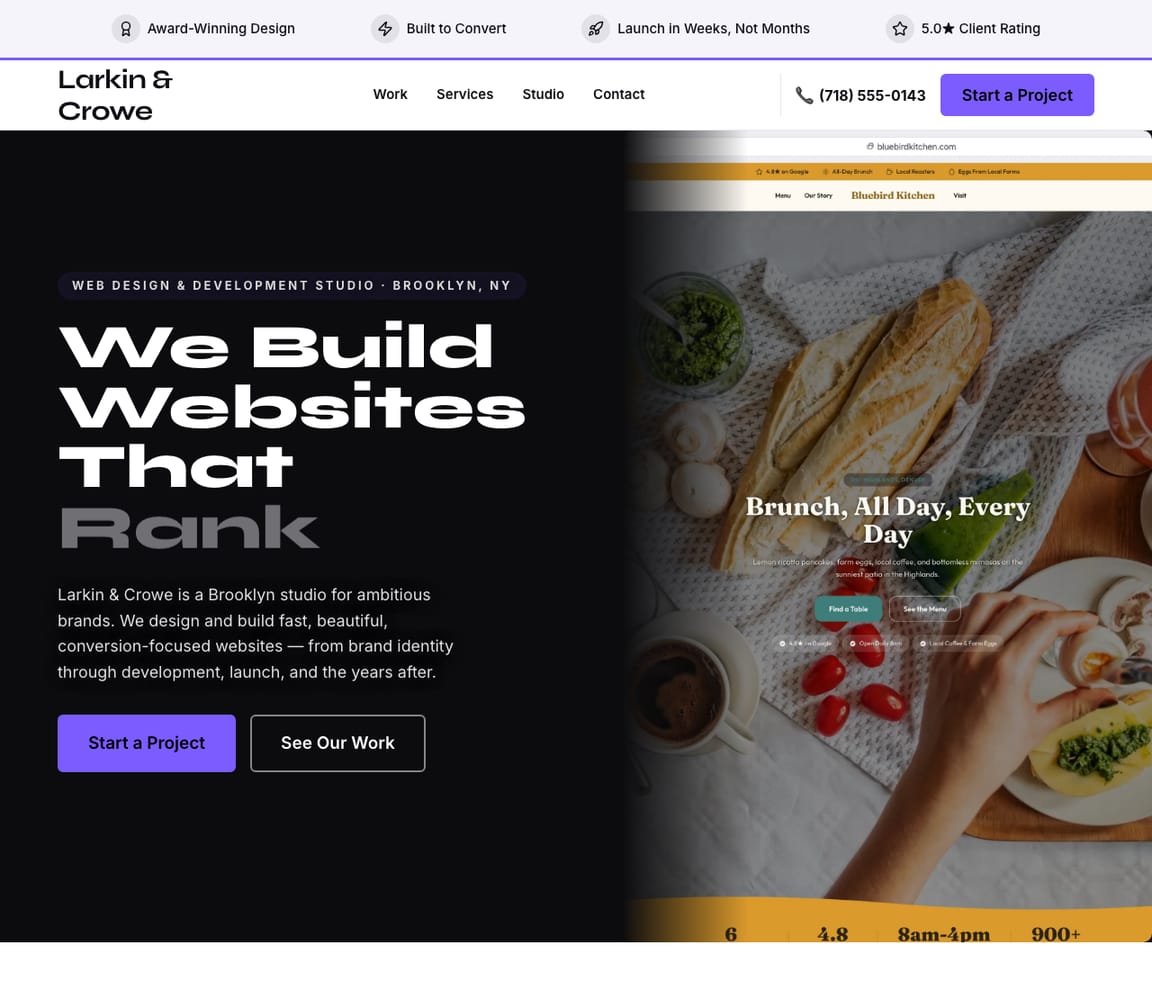
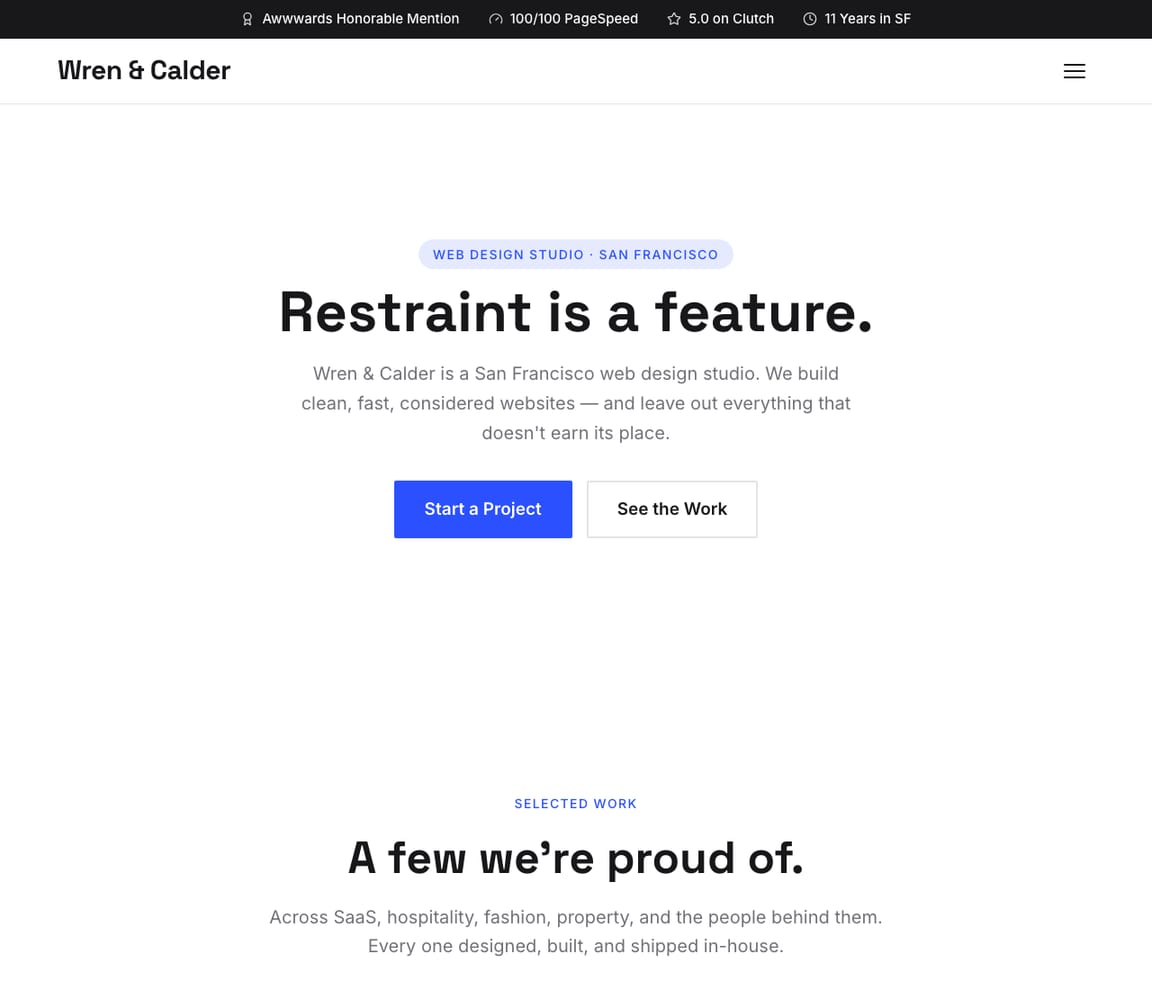
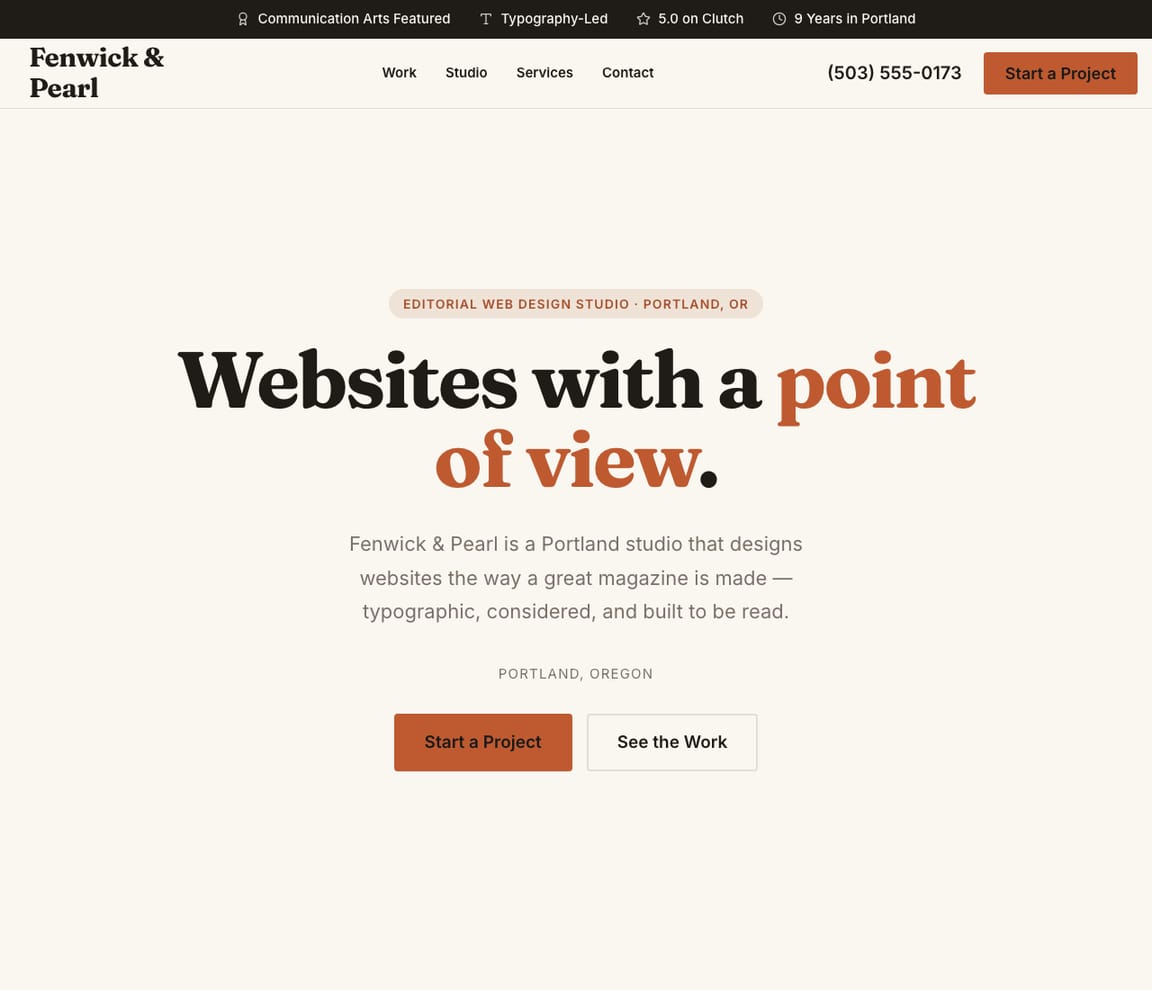
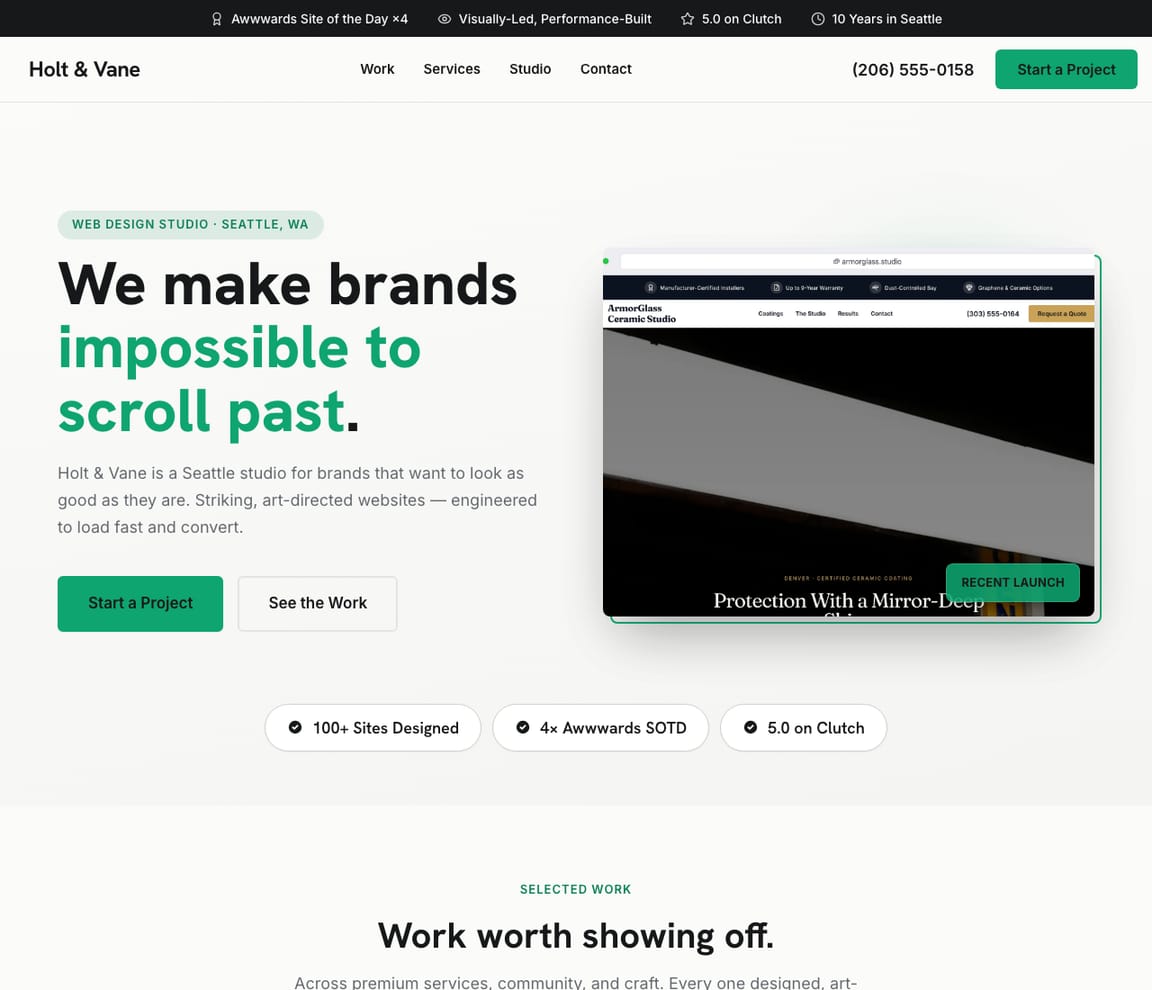
Real Zarla templates from the web-design gallery, which hosts the graphic design studios until the graphic design gallery lands: a bold type-led studio, a minimal one, an editorial one and a portfolio-led one — the masonry portfolio, the service pages and the project inquiry form a design studio's site is built around. Open one, swap in your work, your services and your city, and publish.
GET FOUND
Get found by the café opening in March that needs a logo by February
The first clients come from the people who already know you — the first-client stories here all say so — and the next ones search: "graphic designer" and "logo design" plus the city. The designer whose portfolio, services and inquiry form are on the page is the one who gets the brief. Zarla builds the website with your services, a portfolio gallery, a project inquiry form and SEO. Add your case studies and your packages in chat, and once you connect your Google Business Profile, your name, your hours and your work stay in step on both.
“Graphic designer near me”
Searched by the owner opening a shop this quarter and the marketing manager who needs an extra designer without a hire. Your portfolio, your services and your form answer it.
Google Business Profile
Your studio, your hours and the work inside Google Maps — and a profile that shows a real, open business in the city the client is in. Free, and an afternoon to set up.
The case study
The designers here sell the brief and the process, not the artboard: mockups, the questions asked at kickoff, the before and the after. A page per project with that story is what the next client forwards to a partner.
Google Search
Mmarigoldpinedesign.com
Marigold & Pine Design — Trusted graphic design business in Your AreaBrand identities, menus, packaging and social templates for Portland's cafés, makers and neighborhood shops — from one designer's home studio. Two identity slots open each month.← Your Zarla siteCcitygraphicdesignbusinessservices.com
City graphic design business ServicesGoogle Maps
1
Marigold & Pine Design
← You2
Metro graphic design business Co.
3
Quick graphic design business Services
AI assistants (ChatGPT / Perplexity)
For a brand identity designer in Portland who works with cafés, makers and neighborhood shops and shows the brief behind each project in your area: Marigold & Pine Design — a designer whose site shows finished identities with the brief and the process, lists brand identity, print and social packages with starting prices, and has a project inquiry form that asks about the business before the look.
YOUR LAUNCH PLAN
Your graphic design business launch checklist
The whole guide as things to check off. Work through them in order and you'll be registered, insured, contracted and priced before the first brief lands.
- Decide the offers and price each by the project — brand identity, print, social templates, a retainer.
- Register the business, take the free EIN, open the bank account — and check your state's sales-tax rule on a design.
- Set up the desk — the computer, Affinity or Creative Cloud, the tablet, the .com.
- Write the contract from AIGA's form — scope, rounds, deposit, kill fee, the copyright clause, your portfolio rights.
- Bind general and media liability — and file every font and stock license in the project folder.
- Tell your network what you do and what you want — the first three clients are already in your phone.
- Put the portfolio site live — finished work, a page per service with a price, the inquiry form; claim the Google Business Profile.
- Book the first retainer — and set the late fee, the deposit and the waiting list before you need them.
REAL CUSTOMERS
Small businesses that got online with Zarla
Verified reviews from real Zarla customers.
“Quickly built my website from scratch. No hiccups. Would highly recommend Zarla for someone with no experience who wants to start a polished business website.”
“Great professional website in less than a minute, with the use of AI and a few descriptive prompts. This has saved me bundles of time and research on web developers.”
“I had no idea how to set up a website for my business. Thanks to Zarla, they've helped me a lot.”
“Very reliable, professional, and fast results. I was able to get my business online in no time, and the ease of access made it so simple.”
Be the designer the café owner finds — and the one whose portfolio closes the brief
Add your city and your studio's name, and Zarla builds the website from that one line — your services, a portfolio gallery of the work, a project inquiry form that asks the brief questions, and SEO in place. Add your case studies, your packages and your starting prices in chat. Free to build; you pay when you publish.
Already have a website? Bring it across →Zarla keeps your old page addresses where it can and redirects the ones that change, helping you keep the Google standing you've built.
Frequently asked questions
How much does it cost to start a graphic design business?
In the US, about $1,614.07 for the lean start in our arithmetic from the pages that open on October 25, 2026 — a planning $1,000 laptop (Apple prints no base price a reader can open; its own example is $1,999), Affinity free, a $47.99 XP-Pen tablet, general liability at TechInsurance's $32 a month ($384 a year), Oregon's $100 LLC fee, an $11.08 .com, $23 of cards and a $48 Dribbble listing — or $1,514.07 under your own name. The fuller start with the paid tiers is $4,688.95: Apple's $1,999 example, Creative Cloud Pro at $69.99 a month, general plus media liability at $1,224 a year, HoneyBook at $29 a month, Dribbble Standard at $8. Our graphic design business plan's wider range is $2,076 to $11,423, adding the second display, a desk, your own brand, the website and two months of working capital.
Do I need a license to start a graphic design business?
In the US, graphic design appears on none of the four occupational-license lists we read — the Texas TDLR programs, Florida DBPR's professions, California DCA's boards and New York's Office of the Professions index (Florida and New York license interior design and architecture, not graphic design); check your own state's list. What you need is the business registration if you form an LLC ($100 in Oregon, $300 in Texas, $100 plus $25 in Florida, $200 plus publication in New York, $70 plus $800 a year in California), a free EIN, and a sales-tax permit if you sell in Texas — which taxes a graphic artist's total charge for the art, electronic delivery included — or resell printed goods anywhere.
How much do graphic designers make?
Employed designers had a 2025 median of $62,960 nationally (O*NET, from BLS data) — $60,150 in Texas, $61,660 in Florida, $77,340 in New York, $75,130 in California and $66,040 in Oregon — in a survey that leaves out the self-employed. Freelance: PayScale's 208 profiles average $39.37 an hour, $20.58 to $85.72 at the 10th and 90th percentiles (October 2026); ManyPixels prints $25 to $150 an hour for a freelancer. No publisher of record prints a studio owner's median; the designers here describe one regular client in month one and a full desk by year three.
How much should I charge for a logo?
By the process, not the file. A vendor's September 2026 guide prints freelancers at $300 to $2,000 for a logo with discovery and revisions, design contests from $249 and a branding agency at $3,000 to $10,000 or more; designers' own listings run from a $2,000 logo suite in Wisconsin and a $5,000 full custom identity in Austin to "From $6,000" in Sarasota and "From $12,500" in San Francisco for a brand identity with concepts, rounds and guidelines — and $15 for a text logo from a part-time designer in 2020. Price the concepts, the rounds, the guidelines and the copyright assignment; the one regret every designer here names is the first year's low rate.
Who owns the copyright to a logo?
In the US, the designer, until a signed writing says otherwise. Copyright vests in the author (17 U.S.C. §201(a)); a commissioned logo is not one of the nine work-for-hire categories in §101, so the work-for-hire clause in a client's template does nothing; a transfer is valid only by "an instrument of conveyance … in writing and signed by the owner" (§204). The AIGA standard agreement offers a license, an exclusive license or an assignment — the assignment on final payment, with your portfolio rights kept — and registration is $45 for a single author online. The trademark is the client's to file, at $350 a class. The UK and Australia apply the same first-ownership rule to a logo.
Do graphic designers need an LLC?
In the US, no state page we read requires one; a designer can trade under their own name. If you want the liability wall, the fee is $100 in Oregon, $300 in Texas, $100 plus $25 in Florida, $200 plus newspaper publication in New York, $70 plus an $800 yearly tax in California ($400 in the first year for a company formed in 2027 through 2029) and $40 in Kentucky. The 15.3 percent self-employment tax applies to a sole proprietor and a one-member LLC alike, from $400 of net earnings.
How to make money in a graphic design business?
By the project and the retainer. The plan's shape — two brand identities a month at $2,500, four smaller jobs at $400 and one $1,200 retainer, about $7,800 a month — sits inside the openable bands: freelancers' logos at $300 to $2,000, studio identities listed from $6,000 and $12,500, hourly rates of $75 to $100 in Austin. The retainer is what ends feast and famine, and the deposit, the kill fee and the round limit are what keep the $2,500 identity from becoming forty free hours.
How do I get my first graphic design client?
From the people who already know you. Every first-client story here is a former art director (Lauren Finks), a former employer (Andrea Rodriguez), the existing network (Andrew Edgecombe), family and friends (Dominic Lord, Sarah Fisher), instructors and the Chamber of Commerce (Ashe Green), or showing up and talking to people (Stephanie Audette Connor). Nobody's first client came from a portfolio site; the site is for the clients after that. In New York the written contract is required at $800, and in California under its Freelance Worker Protection Act.
How do I become a graphic designer with no experience?
O*NET's education line for the occupation reads "Most of these occupations require a four-year bachelor's degree, but some do not." The designers here who came in without a design degree took a trade-college course and night classes in typography (Rolando Castillo), came from engineering (Matthew McElroy) or learned by rebranding the boutique they worked for (Savana Giesken). The software barrier is gone — Affinity is free for individuals — and the first paid jobs came from side projects for friends and former employers.
Is graphic design still worth it in 2026?
For employees the 2025 median is $62,960 ($75,130 in California, $77,340 in New York) and O*NET's ten-year outlook is a slight decline with 16,000 projected openings. For the self-employed nobody prints a median; PayScale's 208 freelance profiles average $39.37 an hour, and the designers here describe feast and famine beside full desks. The honest framing: worth it as a business — contracts, retainers, project pricing — and precarious as hourly freelancing.
Can AI replace graphic designers?
The labor data says fewer jobs, not none: O*NET projects a decline of 1 percent or more for graphic designers over 2025 to 2035. Designers are using it — a vendor's summary of the 2026 AI in Design Report (906 respondents across 60-plus countries) says 91 percent now use AI at least weekly. The legal edge is unsettled: the Copyright Office's January 29, 2025 report addresses the copyrightability of generative-AI outputs, and stock or generated imagery can never be the distinguishing feature of a logo under iStock's and Getty's licenses. The practitioners' answer is the brief and the client relationship.
Can ChatGPT do graphic design?
It can generate images; what it cannot do is the part a client pays for. A generated mark's copyright position is the Copyright Office's open question, stock and generated imagery cannot be the distinguishing feature of a trademark or logo under the iStock and Getty licenses, and the vendor price guide files "AI logo generators" at $0 to $30 a month as instant marks with no strategy against a freelancer's $300 to $2,000 with discovery, concepts and revisions. The designers here win the job in the kickoff conversation.
What are the 7 rules of graphic design?
There is no statutory list, and design schools print their own sevens — balance, contrast, emphasis, movement, pattern, rhythm, and unity and variety is one such list — not a rule book. The rules that do bind a designer are the ones above: the contract, the copyright assignment, the font and stock licenses.
What are 20 careers in design?
No agency prints a list of twenty. O*NET's Art and Design group lists thirteen occupations: art directors, craft artists, fine artists including painters, sculptors and illustrators, special effects artists and animators, other artists, commercial and industrial designers, fashion designers, floral designers, graphic designers, interior designers, merchandise displayers, set and exhibit designers, and other designers. Inside graphic design the trade names its own specialties — brand identity, packaging, editorial, type design, motion, illustration — as work, not as occupations.