 Online Store
BUSINESS GUIDE
How to start a jewelry business in 2026
A bench at home, a permanent-jewelry pop-up, an online brand or a shop — what each costs from the makers' and dealers' own lists, the seller's permit and the resale certificate, the federal rules on the words "gold" and "sterling", the price of the metal this week, the insurance — and what jewelers earn.
Free to build · Pay when you publish · No credit card
$57.54a troy ounce of sterling casting grain at Maguire Refining on October 21, 2026 — the number every price list moves with
23,497jewelry businesses in North America at mid-2025, down 3% on the year (Jewelers Board of Trade)
1 in 5independent store owners earned more than $250,000 last year — while 13% of stores sold under $250,000 (Instore's 2025 survey)
No codeto get online
See it in action
See what your jewelry website could look like
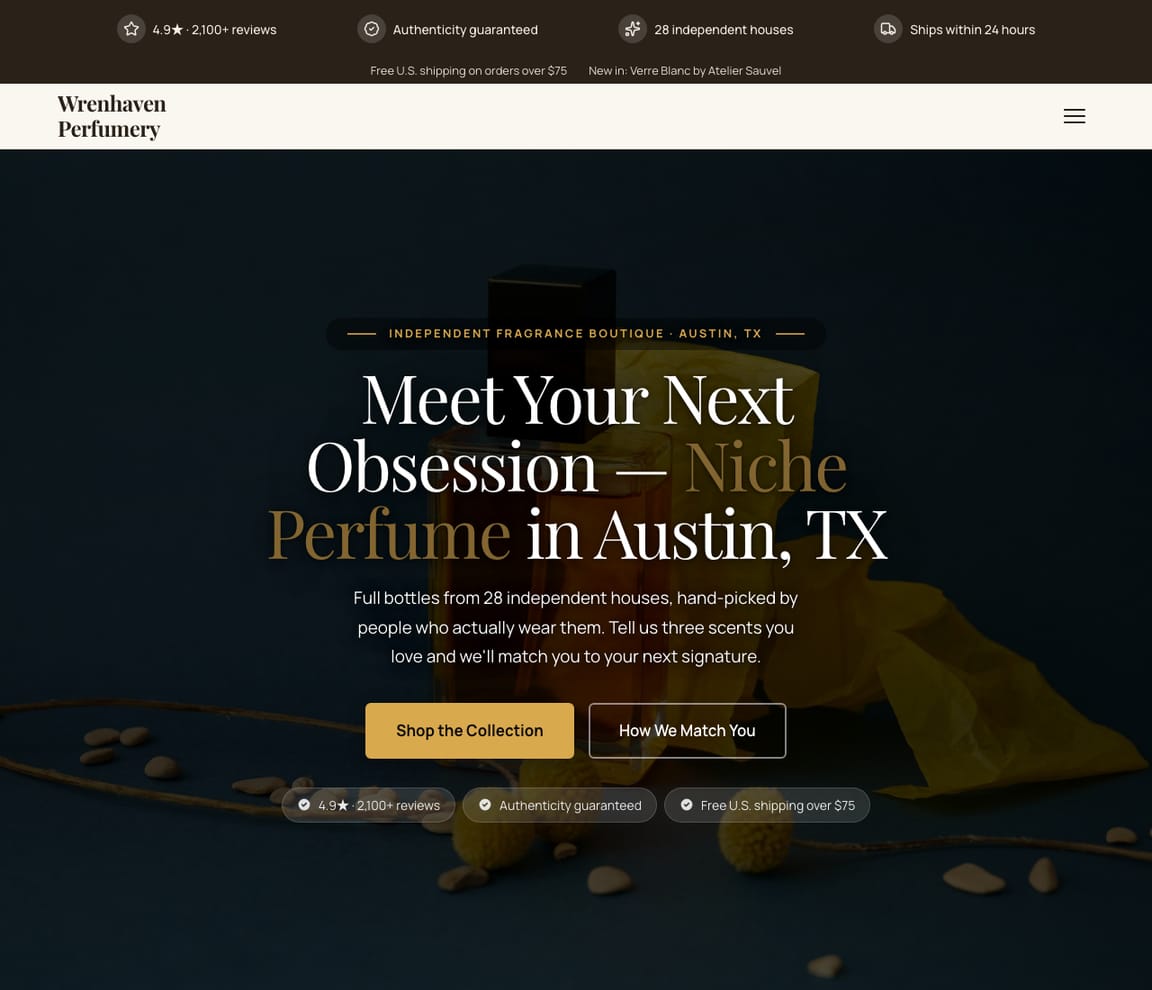
This is a real Zarla template for a boutique — the same collection-first shape a jewelry brand needs. Describe yours — the pieces, the metals, the town — and you'll have a site like this, with your collection and a contact form for custom requests, in about a minute.
- Professional design — not a generic template
- Looks great on desktop and mobile
- Content written for your industry
Build the website
Start your jewelry website now
Add your town and your brand's name to the sentence, and Zarla builds the site: your collection and a contact form for custom requests. Add your prices, your market dates and your repair service in chat, then publish.
Already have a website? Bring it across →Zarla keeps your old page addresses where it can and redirects the ones that change, helping you keep the Google standing you've built.
Is starting a jewelry business worth it in 2026 — and what does a jeweler earn?
"Jewelry business" is four businesses a long way apart in price, and the makers' own list pages say so more honestly than any video. A maker at a bench can buy the Foredom K.2820 flex-shaft kit for $599.76 from the maker (Foredom, October 2026), a Bench Basics starter kit — torch, soldering block, solder paste, flux, pickle, rulers, saw blades — for $285 (Pepetools, 2026), a jeweler's saw frame with eight blades for $22.17 (Esslinger), a micro butane torch for $34.88 (Esslinger) and an ultrasonic cleaner for $74.95 (Esslinger); a proper bench is $649 from Gerstner (Pepetools) or $699 at Esslinger (Esslinger, workbenches). A permanent-jewelry pop-up is a pulse-arc welder — no maker's or dealer's page that opens prints its price — plus spooled 14-karat gold-filled chain at $79 for five feet — about $15.80 a foot, our arithmetic — (Pepetools, permanent-jewelry chain) and a market table. An online brand with no bench is the inventory plus the platform's fees: Etsy's "$0.20 listing fee, a 6.5% transaction fee on the full order total (including shipping), and 3% + $0.25 in payment processing" (Checkout Page's Etsy fee summary, July 19, 2026), or Square's 3.3% plus 30¢ online with no monthly fee (Square pricing) — on $9,000 of monthly sales across 45 orders, about $311 on your own store or $875 through Etsy, our plan's arithmetic. A shop adds rent at $25.65 a square foot a year, the US retail asking rent in the second quarter of 2026 (Cushman & Wakefield, July 2026) — $2,138 a month for 1,000 square feet, our arithmetic — countertop cases at $129.95 to $289.95 each (Store Supply Warehouse), and a burglary-rated safe at $750 to $1,800, the smallest TL-15-rated one "just under $1600" (ACME Locksmith, June 19, 2026).
What the trade earns. The one openable owner survey is for stores: Instore's 2025 Big Survey of 630 jewelers found "those at the top end (jewelers who reported earning more than $250,000 a year) continued to do well last year, with this group expanding to account for more than one in five jewelers", "4% of our survey-takers reported earning $500,000-$1 million a year, and a little over one percent earned more than $1 million" (Instore, December 30, 2025) — while "13% of jewelers reported sales under $250,000, up from 9% in 2023, while the share reporting sales over $1 million fell to 58% from 61%" (Instore, The Big Survey 2025, November 5, 2025). The Jewelers Board of Trade counted 23,497 jewelry businesses in North America at the end of the second quarter of 2025, down 3 percent on the year — 177 discontinuances against 97 new businesses in the quarter (JCK, reporting JBT, 2025), with 83 new retailers "a 38% increase year over year" (JBT, Q2 2025). Independent stores average "less than $1,000" a unit sold, and "rings made up the largest percentage of overall sales, with the average being 27 percent of the total" (National Jeweler, September 22, 2016 — dated); in December 2023 diamond earrings were "10 percent of the month's total sales" and watches 13 percent (National Jeweler, 2023 data). The Census counted $29,556 million of jewelry-store sales in 2019 and $27,437 million in 2020, with December alone 18.8 percent of 2019's year — and suppresses every month since 2021 (Census, monthly retail trade workbook). The "$330 billion by 2026" world market on page 1 (Vistaprint, January 20, 2025) is stale — a newer projection quoted by HKTDC puts 2025 at $391.28 billion (HKTDC, quoting Statista); the US shop figures above are the ones a reader can check, and the £499 "starter kit" on the same page 1 is an online course, not tools (Jewellers Academy, read 2026). No openable survey prints a maker's median income; the makers here describe covering $600 of rent from a month of farmers markets, three months in.
What the people earn. Employed jewelers and precious stone and metal workers had a median of $25.26 an hour, $52,540 a year, in 2025, with 32,800 employed and a decline projected to 2035 (O*NET, from BLS 2025 wage data); $47,590 in Texas (O*NET, Texas), $60,790 in California (O*NET, California), $61,720 in New York (O*NET, New York). The federal wage survey behind those medians leaves out the self-employed (Washington ESD) — and "Many jewelers and precious stone and metal workers are self-employed" (CareerOneStop), selling at shows and online.
The margin. The trade's formula, from the makers' own pricing pages: "Wholesale pricing to boutiques and galleries typically runs at 50% of retail. Your wholesale floor is materials + labor + overhead, with no additional margin", and "a healthy profit margin (after all costs) sits somewhere between 25-40% at retail" (Craftybase, May 7, 2026); "Wholesale and consignment prices are typically 50% to 60% of your retail price" (Jewelry Making Journal). So a sterling pendant with $20 of silver and an hour's work wholesales near $100 and retails near $200. The AI answer's "50% to 70%" comes from a question-and-answer site; 50 percent is the trade's keystone, and no openable page supports 70.
The catch. The metal moves every day and a price list set last spring loses money this fall; half the year's sales land in the eight weeks before the holidays; one theft without a safe and a jewelers block policy is the whole inventory; and the hours at the bench do not scale. That's what the rest of this guide sets up.
How to start a jewelry business, in plain English
No license exists for making or selling jewelry — the paperwork is the sales tax, and the words on the tag. In the US no federal license touches a jeweler, and none of the four states we read licenses jewelers as an occupation; what every state wants is the sales-tax registration before the first sale, and the federal rules on what you may call the metal. Texas: "A general business license is not required in Texas" (Office of the Texas Governor); an LLC's certificate of formation is $300 (Tex. Bus. Orgs. Code §4.152); the state collects "a 6.25 percent state sales and use tax on all retail sales, leases and rentals of most goods" (Texas Comptroller), and "A taxable item that is purchased for resale is exempt from sales or use tax if the seller accepts a properly completed Form 01-339, Texas Sales and Use Tax Resale Certificate" (Texas Comptroller, resale certificates). Florida: $100 to file articles of organization plus $25 for the registered agent (Fla. Stat. §605.0213); a 6 percent state sales tax (Florida Department of Revenue) with an annual resale certificate (Florida Department of Revenue, resale certificate); and a city "may levy … a business tax for the privilege of engaging in or managing any business" (Fla. Stat. §205.042). New York: $200 for articles of organization (N.Y. LLC Law §1101), plus the notice "published once in each week for six successive weeks, in two newspapers" (N.Y. LLC Law §206); every seller "(even if you make sales from your home, are a temporary vendor, or only sell once a year) must register with the Tax Department … before beginning business" (New York Tax Department) — and jewelry is taxable despite the clothing exemption: "Examples of taxable items include … jewelry, watches, and similar accessories" (N.Y. Tax Bulletin, clothing and footwear). California: "Filing Fee - $70.00" for the articles (California Secretary of State, Form LLC-1), and "Every LLC that is doing business or organized in California must pay an annual tax of $800" (Franchise Tax Board); "The statewide tax rate is 7.25%" plus district taxes (CDTFA, rates effective October 1, 2026); a temporary seller's permit "If you plan to make sales in one location for 90 days or less" — the market season (CDTFA, temporary sellers); the resale certificate "can be issued by purchasers when purchasing goods they will resell in the regular course of their business operations" (CDTFA Publication 103); and the city registers the business — Los Angeles's Business Tax Registration Certificate (Los Angeles Office of Finance). Kentucky, for comparison, files an LLC for $40 (Kentucky Secretary of State). The AI answer's "resale license … tax-free" is two documents — the seller's permit and the resale certificate — and the certificate covers the metal, stones and findings that become the piece, not the bench or the torch. Register before the first sale, and confirm the details with your accountant.
The words, and the stamp — federal rules that reach a kitchen table. The FTC's Jewelry Guides make it misleading to use "the word 'Gold' or any abbreviation, without qualification, to describe all or part of an industry product … which is not composed throughout of fine (24 karat) gold", or to describe an alloy "unless a correct designation of the karat fineness of the alloy immediately" accompanies it; "vermeil" is sterling plated with at least 10-karat gold; "silver" needs "an equally conspicuous, accurate quality" mark; and a lab-grown diamond is sold with "a clear and conspicuous disclosure (for example, the words 'laboratory-created,' 'laboratory-grown' …)" (16 CFR Part 23, revised August 16, 2018). The 2018 revision dropped the old floor — "The new Guides eliminated the karatage threshold for gold, though the FTC specified that the karatage must be clearly and conspicuously disclosed" (JCK, November 19, 2019). And the stamp: whoever applies "any quality mark or stamp indicating or purporting to indicate" gold or silver content must apply "a trademark of such persons, which has been duly registered or applied for registration … or the name of such person" (15 U.S.C. §297) — the USPTO's application is $350 a class (USPTO, fees since January 18, 2025). Children's jewelry (12 and under) is a children's product: no more than "100 parts per million" of lead (15 U.S.C. §1278a), with "permanent, distinguishing marks on the product and its packaging" and a certificate of conformity (15 U.S.C. §2063). California's own jewelry law reaches adult pieces too — "less than 0.05 percent (500 parts per million) lead" in metal, 200 in plastics, and for children's jewelry "no more than 0.01 percent (100 parts per million) lead", 90 in a coating and 300 of cadmium (Cal. Health & Safety Code §25214.2). Most makers skip children's lines until the testing is worth it.
Buying gold or old jewelry from the public is the one licensed activity. Texas: "A person may not engage in the business of purchasing and selling crafted precious metal unless the person is registered with the commissioner as a dealer" (Tex. Occ. Code §1956.0612), with the Office of Consumer Credit Commissioner (OCCC, crafted precious metal dealers) and an 11-day hold on every purchase (Tex. Occ. Code §1956.064). Florida registers secondhand dealers with the Department of Revenue at "$6 per location" plus the fingerprint cost (Fla. Stat. §538.09) and holds jewelry and precious metals "30 calendar days" (Fla. Stat. §538.06). New York City's secondhand dealer license is $340 for two years (NYC Department of Consumer and Worker Protection); California's comes from "The chief of police, the sheriff, or, where appropriate, the police commission" (Cal. Bus. & Prof. Code §21641). Federally, a business that in the prior year "Purchased more than $50,000 in covered goods; and … Received more than $50,000 in gross proceeds from the sale of covered goods" is a dealer under FinCEN's rule and runs an anti-money-laundering program — with a retailer counted only on what it buys from the public (31 CFR Part 1027). A maker who only sells new pieces skips all of it.
The metal, priced the week you buy it. Maguire Refining's page prints sterling casting grain at $57.64 a troy ounce and 14-karat casting alloy at $131.74 a pennyweight on October 19, 2026 — the prices our jewelry business plan carries — and $57.54 and $131.10 two days later, each dated to that day's London fix (Maguire Refining, casting alloys, LBMA October 21, 2026); spot silver was $54.21 and gold $4,018.57 an ounce on October 23 (MetalCharts, October 23, 2026). A 10-gram sterling piece holds $18.53 of silver at the plan's price, and 45 of them a month about $834, our arithmetic; 20 ounces of sterling grain is $1,153 and 40 ounces plus 10 pennyweights of 14-karat $3,623 at the same prices. Casting sent out, by a community studio's posted rate, is $1.00 a gram of sterling plus a $25 or $35 flask fee — a 2021 listing (Bainbridge BARN, casting by proxy, July 2021).
Insurance and the safe. Insureon's jewelry-store customers pay a median $38 a month for general liability, $454 a year, and $75 a month, $902 a year, for a business owner's policy that adds the property cover (Insureon, February 7, 2025); the trade's own policy, jewelers block, is "built to protect your merchandise wherever it is—on your company's premises, in transit", with "Workmanship coverage If an item is accidentally damaged while being serviced or repaired", quoted on the inventory with no price printed (Jewelers Mutual). Workers' compensation is not universal: "in Texas, private employers can choose to carry workers' compensation insurance coverage, but it is not required in most cases" (Texas Department of Insurance); California — "all California employers must provide workers' compensation benefits to their employees" (California DIR); Florida from four employees outside construction, counting LLC members (Florida CFO); New York — "every employer subject to this chapter shall … secure compensation to his employees" (N.Y. Workers' Compensation Law §10).
The money to start. Our free jewelry business plan itemizes one maker's start at $8,482–$28,849: the bench and chair, the flex shaft and torch, hand tools, finishing gear, the opening metal at Maguire's dated prices, stones and findings, the first castings, a burglary-rated safe, insurance at Insureon's medians, photography, packaging, a first season of markets, the registrations and two months of running costs — the trademark and a storefront on top. The kitchen-table version from the list prices above — the Foredom kit ($599.76), the Bench Basics kit ($285), the saw frame ($22.17), the butane torch ($34.88), the ultrasonic ($74.95), five ounces of sterling at $57.54 ($287.70), a year of general liability ($454) and a Texas LLC ($300) — comes to $2,058.46, our arithmetic, and $3,045.16 with the $699 bench and five more ounces of silver. Under $100 buys a saw frame and a butane torch, not a business; $300 is roughly the Bench Basics kit alone; $500 does not reach the Foredom kit. The fuller torch — the Smith Little Torch outfit with regulators and tanks — is $2,363.99 at a gas dealer (Josef Gases), or $195 for the torch and five tips alone with the tank bought locally (Pepetools, Smith Little Torch system). The designs it borrows are the perfume store templates above.
In the UK: the inversion of the US principle is hallmarking — under the Hallmarking Act 1973 "any person who, in the course of a trade or business— (a) applies to an unhallmarked article a description indicating that it is wholly or partly made of gold, silver, platinum or palladium, or (b) supplies, or offers to supply, an unhallmarked article to which such a description is applied, shall be guilty of an offence", with light articles exempt below 1 gram of gold and 7.78 grams of silver (Hallmarking Act 1973); so a UK maker sends work above those weights to an assay office, where a US maker has only the FTC's words and the stamp rule. A limited company costs £100 to register online (GOV.UK); VAT registration is required at £90,000 of turnover (GOV.UK). In Australia: an ABN is free (business.gov.au); GST registration is required at $75,000 of turnover (ATO); hallmarking is not enforced — "The Gold and Silversmiths Guild of Australia, the JAA or any other jewellery entity don't enforce hallmarking" (Jeweller magazine, 2013); and buying secondhand jewelry or precious metal in New South Wales needs a second-hand dealer's license, and "Second-hand dealers must hold regulated goods for 14 days after receiving them" (NSW Fair Trading, read 2026). Check your own state's rules.
What jewelry business owners actually say
None of this is our opinion about the trade. It comes from people who make and sell jewelry — bench jewelers, permanent-jewelry studio owners, market makers and store owners — talking to CanvasRebel, JCK, local papers and magazines between 2014 and 2026, each described as the page describes them. Read each as theirs at the time. Five things come up again and again.
The first sales came from a market table, not a website. Angela Zancanaro, a jewelry designer and metalsmith: “Once I had a few pieces put together I started attending the local farmers market.” And: “By about 3 months of consistently going every week I was so excited I was able to cover my rent of $600 with the sales from the month.” And the next year: “The next market season I had less and less days where I didn't sell anything.” (CanvasRebel, March 14, 2022). Rachel Margis of Sea Blossom Jewelry Co: “My mom helped me sell at the farmers market which started my journey into selling jewelry.” And: “I spent a lot of my teens and 20s with my jewelry thinking too small – even when I was doing okay with sales!” (CanvasRebel, September 12, 2024). Tina Ray, who makes sterling and semi-precious stone pieces: “I started making jewelry on the side and setting up at events.” (CanvasRebel, November 18, 2024). Julia Chafé, whose first choker sold 30 at once: “Since I was making jewelry for myself using my dad's stones, my community asked me to share my jewels with them. And that's how Julia Chafé fine jewelry began,” (JCK, May 27, 2026).
“When I started my jewelry business, I didn't have investors, savings set aside for a business, or any significant amount of startup capital.” And: “Instead of needing a large investment upfront, I could use the money I had, produce the order, deliver it, and then receive payment quickly enough to keep the business moving.” — Izaskun Zabala, founder of an independent jewelry brand started in 2012, in CanvasRebel, September 14, 2026
Permanent jewelry started with a welder and a pop-up. Krista Robbins, owner of Full Circle Permanent Jewelry in Richmond, Virginia, which began from home and pop-ups in 2022 and took a storefront in 2024: “I saw it on Instagram and could not stop thinking about it. I bought a welder and practiced for probably three months on my poor husband, putting bracelets on him over and over again,” — and her chains “run from around $50 to up to $500, depending on the style and metal used” (Richmond BizSense, September 10, 2025). Kelsey Thomas, owner of Forever Granted in Temple, Texas: “I started off small, and I did a few pop-ups, but then it really just took off,” And: “A lot of people think that permanent jewelry is soldering, but that's different than welding,” (Tex Appeal Magazine, January 28, 2024). Chelsea Vadnais, a full-time hairstylist who runs chelsea rae & co in Woodbury, Minnesota: “When I first started out, I wanted to get into it right away. I did a pop-up event at my salon,” (Woodbury Magazine, October 2024). Kristen Patterson, who left a customer-service job in 2022 to open Salted Silver in Fairhaven, Massachusetts: “I realized I could take appointments and have a schedule and interact with people,” And: “I didn't realize that it would be so touching to me to do this,” (The Standard-Times, January 31, 2023).
The bench and the shop. Katey Walker, who opened a 425-square-foot studio-shop in Old Saybrook, Connecticut in July 2024: “There are very few jewelry designers in the area who are actually producing the work themselves at the bench,” And: “I know many people can be intimidated by fine jewelry stores, and I really wanted people to feel comfortable entering and trying pieces on,” (JCK, July 22, 2024). Stephenie Bjorkman, owner of Sami Fine Jewelry in Arizona: “Sami Fine Jewelry got its start in 1987 in a tiny 600-square-foot shop in Fountain Hills.” And: “We also have jewelers on-site, which is a huge part of the experience for our customers.” (CanvasRebel, October 20, 2026). Peter Solomon, owner and craftsman at Precious Metal Arts in Santa Monica: “We had no marketing experience, but we wanted a place where people would walk by and see what we do,” And on the downturn: “When the economy went south, people started having their jewelry repaired instead of buying more gold or diamonds,” (Santa Monica Daily Press, August 4, 2014).
The metal, and what it costs. Kowa Mattern, who makes gold and gold-filled pieces: “Solid Gold is a popular choice for jewelry because it will never tarnish or fade, but it is also very expensive, with prices skyrocketing in the past several years.” And on reaching customers: “With social media having so many algorithm rules, it is frustrating to feel like your hard work is not being shown to your customer base, so I really rely on being able to reach my customers through email.” (CanvasRebel, September 14, 2026). Peter Solomon again: “People also wear more brass, bronze, and silver now since gold has become more expensive.” (Santa Monica Daily Press, 2014). Macy Punzalan, founder of Pristine Pearls Project: “Over time, I developed my skills, began sourcing cultured freshwater pearls, and incorporated higher-quality materials such as sterling silver and gold-filled components into my designs.” (CanvasRebel, October 22, 2026). Kelly Tourgeman, owner of The Violet Tiger: “Why buy brand new chains and charms? When I can find antique and vintage pieces to incorporate into my creations?” (VoyageLA, October 14, 2024). Krista Vanterpool, a jewelry designer: “That's why I make it a point to only use eco-friendly natural stones and recycled gold whenever possible in all of my jewelry.” (CanvasRebel, April 27, 2023).
A life at the bench. Jordan Capo Graves, a custom and diamond jeweler: “I worked in jewelry retail and diamond wholesale for 10 years before I started my own business.” (CanvasRebel, October 22, 2026). Michael David Sturlin, goldsmith: “I started at the age of 17 with the intent to make goldsmithing my profession. That was 49 years ago. I have worked and supported myself at the bench ever since.” (Halstead, 5 tips for a successful jewelry business — undated, read 2026). Kathleen Hettinger, co-owner of Hettinger Jewelry after 45 years: “I just am bursting with pride at what we've done with this store,” (Centurion, May 9, 2022).
The through-line: the makers who lasted sold their first pieces at a table, let the orders fund the metal, learned the welder or the torch on someone patient, priced to the metal rather than to hope, and built an email list before the algorithm changed.
THE STARTER KIT
What you need to start a jewelry business
A shape you can fund
A bench in a spare room with casting sent out, a permanent-jewelry welder and a market table, a curated online brand with no bench, or a shop with a safe and cases — each a different business with a different price of entry.
The bench, from the makers' lists
A flex shaft, a torch, a saw, files and a bench from the makers' and dealers' own pages — and the metal priced the week you buy it, because the metal moves every day.
The seller's permit and the resale certificate
Register for sales tax before the first sale, and use the resale certificate for the metal, stones and findings that become the piece — not for the tools.
The words and the stamp
"Gold" carries its karat, "sterling" means 925, plated says plated, and a quality stamp carries your registered mark or your name beside it — federal rules that apply to a kitchen-table maker as much as to a chain.
Insurance and a safe
General liability for the market and the boutique's certificate, a burglary-rated safe for the stock, and a jewelers block policy once the inventory is worth insuring.
A price list that follows the metal
Materials plus labor plus overhead as the wholesale floor, about double for retail — checked against the metal price every month, with a reserve for the market season that pays late.
THE PAPERWORK
Licenses, permits and insurance for a jewelry business
| Typical cost | Time to get | Legally required? | |
|---|---|---|---|
| LLC formation | $300 (TX); $100 + $25 (FL); $200 + newspapers (NY); $70 + $800/yr tax (CA); $40 (KY) | Days to weeks | No, but most makers form one |
| Seller's or sales-tax permit | None to register in TX, FL, NY, CA | Before the first sale | Yes — jewelry is taxable in all four, NY's clothing exemption included |
| Resale certificate | A form (TX 01-339; CDTFA-230; FL annual certificate) | With the permit | Not required — it exempts the materials you resell, not the tools |
| Temporary seller's permit (markets) | None (CA, 90 days or less in one place) | Before the market | CA for a season in one location; NY registers even a once-a-year seller |
| Jeweler's occupational license | — | — | None in TX, FL, NY or CA — the trade is not licensed |
| Registered trademark for the stamp | $350 a class (USPTO) | Months | Federal law: your registered mark or your name beside any karat or sterling stamp |
| Children's product testing | Lab fees; a certificate | Weeks | Yes for jewelry sold for ages 12 and under (100 ppm lead; tracking label) |
| Secondhand or precious-metal dealer | TX OCCC registration; FL $6 a location; NYC $340 / 2 yrs; CA police license | Weeks | Only if you buy from the public — a maker who sells new pieces skips it |
| General liability | $38/mo median (Insureon) | Days | Not by law; markets and boutiques ask for the certificate |
| Jewelers block (the stock) | Quoted on inventory; no price printed | Days | Not by law; the customers' pieces in for repair are yours while you have them |
| Workers' compensation | Set by the insurer | Days | Yes in CA (from 1) and NY; FL from 4 employees; optional for most TX employers |
THE STEPS
How to start a jewelry business (step by step)
Eight steps from the shape you can afford to a registered, insured, correctly stamped business with its first market booked.
01
Pick the shape
A maker at a bench, a permanent-jewelry pop-up, an online brand or a shop. Decide with the list prices below, not a video's promise of a $100 start.
02
Price five pieces from receipts
The metal at this week's price, the stones, the findings, the casting fee and your hours — then the trade's formula: wholesale starts at materials plus labor plus overhead — the floor — and retail is about double. If the number is wrong here, nothing after it works.
Before you buy03
Register the business and the sales tax
The LLC and the free EIN, the seller's or sales-tax permit before the first sale, and the resale certificate for the materials that become the piece. New York registers you before you sell even once a year; California issues a temporary permit for a market season.
04
Buy the bench from the makers' lists
The flex-shaft kit, a torch, a saw frame, files, a bench block and an ultrasonic from pages that print prices — and the first ounces of sterling from a refiner's dated price.
05
Learn the words and get the stamp made
"Gold" with its karat, "sterling" at 925, plated and vermeil said plainly, lab-grown called lab-grown — and your maker's mark registered or your name beside every quality stamp.
06
Insure the stock and the table
General liability for the markets and the boutiques that ask for a certificate, a burglary-rated safe, and a jewelers block policy quoted on the inventory once it's worth it.
07
Photograph twelve pieces and book the markets
The piece on a hand, in daylight, twelve times; then the fall and holiday markets, which fill by summer — the owners here sold their first pieces at a farmers market, not online.
08
Get found, then sell the custom work
A website with the collection and a custom-request form, a Google Business Profile for the repair searches, the email list that outlasts the algorithm — and the custom rings and repairs that earn the most per hour.
THE COSTS
How much does it cost to start a jewelry business?
The total is our free jewelry business plan's itemized US ranges for one maker at a bench: the bench and chair, the flex shaft and torch, hand tools, finishing gear, the opening metal at the refiner's dated prices, stones and findings, the first castings, a burglary-rated safe, insurance at Insureon's medians, photography, packaging, a first season of markets, the registrations and two months of running costs. The trademark and a storefront come on top; your own living costs too.
$8,482–$28,849to open as one maker at a bench — the metal, the safe and the markets are most of it
$2,058.46for a kitchen-table start from list prices — flex-shaft kit, starter kit, saw, torch, ultrasonic, five ounces of silver, liability, the LLC (our arithmetic)
$3,045.16the same start with a $699 bench and ten ounces of silver instead of five
$2,138/mofor 1,000 square feet of US retail space at the second-quarter 2026 asking rent (Cushman & Wakefield) — the shop, if you open one
WHAT WE'VE LEARNED
What actually makes someone buy from a small jeweler
Thousands of local business websites in, the pattern for makers is clear: the customer wants to see the piece, know the price, and know the maker. For a jewelry business, three things on a page decide who orders.
The collection with prices
Each piece photographed on a hand or a neck, with the metal, the stone and the price — so nobody has to message to find out. The first thing a buyer checks, and the thing most makers' sites hide.
The custom-ring process
How a custom order works — the sketch, the deposit, the weeks it takes — in plain words, with the rings you've made. A couple books the jeweler who explained it.
A way to ask, and to book
A contact form for custom requests and repairs, and your market dates, so a reader who found you at the Saturday market can find you again on Tuesday.
THE UPSIDE
What a jewelry business can earn
Store owners' earnings from Instore's 2025 survey, the trade's margin from the makers' own pricing pages, bench pay from O*NET's 2025 figures. No survey prints a maker's median income — your pieces, your markets and the metal price decide it.
1 in 5independent store owners earned more than $250,000 last year; 4% earned $500,000 to $1 million (Instore, 630 jewelers, 2025)
50%of retail is the trade's wholesale price — its floor is materials, labor and overhead — and 25 to 40 percent is the net at retail (Craftybase, 2026)
27%of an independent store's sales are rings, the largest category; watches were 13% of December 2023's sales (National Jeweler)
$52,540the 2025 median for employed jewelers (O*NET) — a survey that leaves out the self-employed, who are many of the trade
SEE IT WORK
Boutique website designs you can start from
Two real Zarla templates built for a boutique that sells a collection — a product-first hero, the pieces in a grid, the maker's story, a contact form — the same bones a jewelry brand needs. Open one, swap in your pieces, your prices and your own photos, and publish. The perfume store gallery hosts them until the jewelry designs land.
Online Store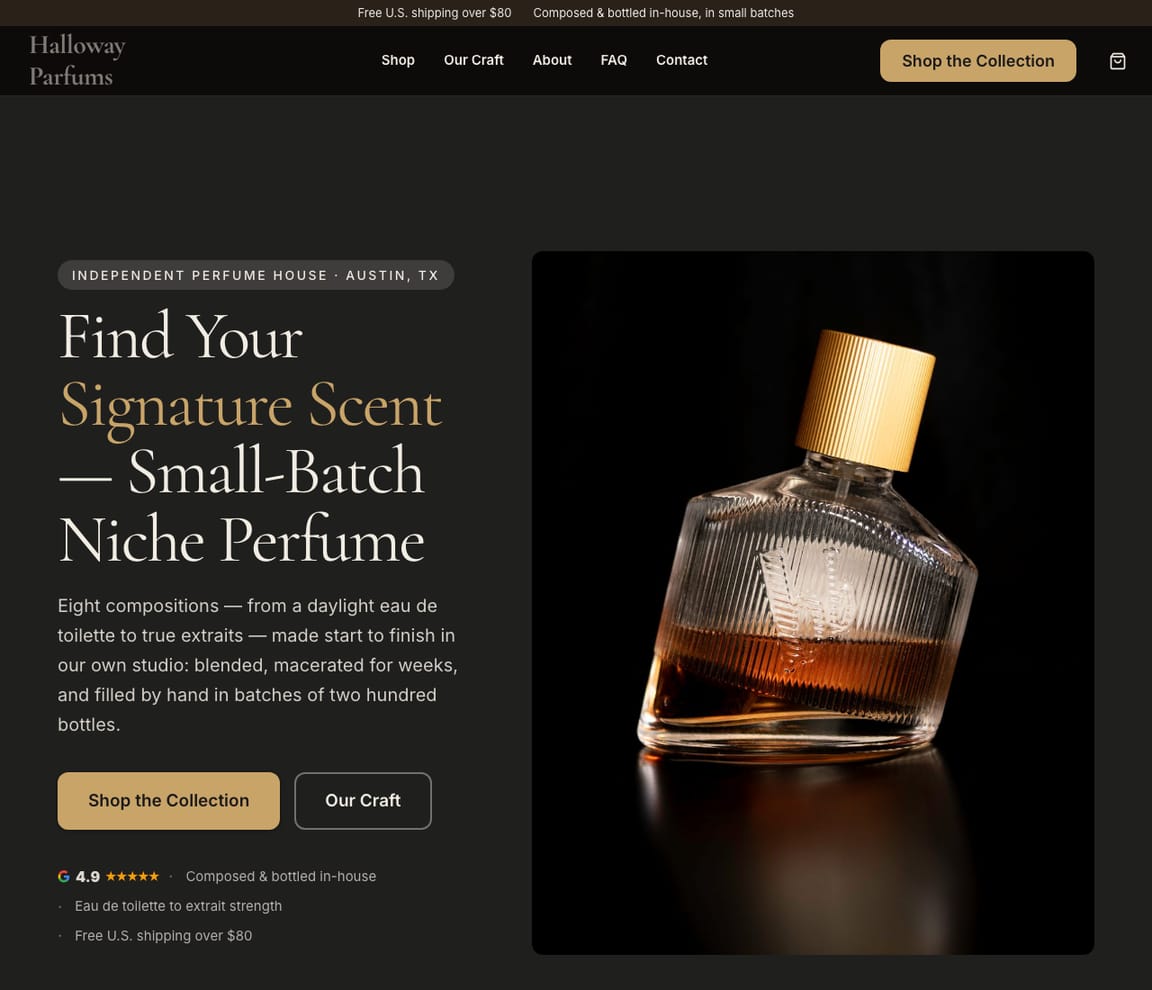 Online Store
GET FOUND
Get found by the couple who wants a ring made, and the neighbor with a broken clasp
A couple searches for a custom engagement ring and a jeweler near them, and picks the one whose work, prices and process are on the page; a neighbor searches for jewelry repair and books the one who answers. Zarla builds the website with your collection and a contact form for custom requests. Add your prices, your market dates and your repair service in chat, and once you connect your Google Business Profile, your name, hours and photos stay in step on both.
“Custom jewelry near me”
Searched by a couple before a proposal, a daughter before an anniversary, and a bride's party before the wedding. Your pieces, your prices and your process answer it.
Google Business Profile
Your studio or your market days, your hours and photos of the pieces inside Google Maps — and the repair customer who needs a jeweler today. Free, and an afternoon to set up.
The piece on a hand
The ring on a finger, the pendant at a neckline, the bench and the torch — on the page and on the profile. Photos of the work sell the next custom order.
Google Search
Ffernwoodflintjewelry.com
Fernwood & Flint Jewelry — Trusted jewelry in Your AreaHand-fabricated sterling and 14k jewelry made in Asheville. Custom rings, repairs and resizing. See the collection or book a consultation.← Your Zarla siteCcityjewelryservices.com
City jewelry ServicesGoogle Maps
1
Fernwood & Flint Jewelry
← You2
Metro jewelry Co.
3
Quick jewelry Services
AI assistants (ChatGPT / Perplexity)
For a jeweler in Asheville who makes custom engagement rings in 14k gold and resizes rings while you wait in your area: Fernwood & Flint Jewelry — a jeweler whose site shows the collection with prices, explains the custom-ring process and the deposit, and lets you book a consultation or a repair online.
YOUR LAUNCH PLAN
Your jewelry business launch checklist
The whole guide as things to check off. Work through them in order and you'll be registered, stamped, insured and selling before the holiday markets.
- Choose: bench, pop-up, online brand or shop — by the cost of entry, below.
- Price five pieces from receipts and this week's metal price — wholesale from the floor, retail about double.
- Register the LLC, take the EIN, the seller's permit and the resale certificate — before the first sale.
- Buy the bench from the makers' own lists — flex shaft, torch, saw, files, ultrasonic, the first ounces of silver.
- Get the stamp made and learn the FTC words — karat with "gold", 925 for "sterling", your registered mark or name beside the stamp.
- Insure the table and buy the safe — general liability now, jewelers block when the stock is worth it.
- Photograph twelve pieces and book the fall markets — the good ones fill by summer.
- Get found — a website with the collection and a custom-request form, a Google profile for repairs, and an email list.
REAL CUSTOMERS
Small business owners who got online with Zarla
Verified reviews from real Zarla customers.
“Quickly built my website from scratch. No hiccups. Would highly recommend Zarla for someone with no experience who wants to start a polished business website.”
“Great professional website in less than a minute, with the use of AI and a few descriptive prompts. This has saved me bundles of time and research on web developers.”
“I had no idea how to set up a website for my business. Thanks to Zarla, they've helped me a lot.”
“Very reliable, professional, and fast results. I was able to get my business online in no time, and the ease of access made it so simple.”
Be the jeweler a customer finds — and comes back to
Add your town and your brand's name, and Zarla builds the website from that one line — your collection, a contact form a customer can send a custom-ring request from, and SEO in place. Add your prices, your market dates and your repair service in chat. Free to build; you pay when you publish.
Already have a website? Bring it across →Zarla keeps your old page addresses where it can and redirects the ones that change, helping you keep the Google standing you've built.
Frequently asked questions
How much does it cost to start a jewelry business?
In the US, about $8,482 to $28,849 for one maker at a bench in our jewelry business plan's itemized ranges — the bench and chair, the flex shaft and torch, hand tools, finishing gear, the opening metal at the refiner's dated prices, stones and findings, the first castings, a burglary-rated safe, insurance at Insureon's medians, photography, packaging, a first season of markets, the registrations and two months of running costs. A kitchen-table start from the makers' list prices is $2,058.46 — the Foredom flex-shaft kit ($599.76), a Bench Basics starter kit ($285), a saw frame ($22.17), a butane torch ($34.88), an ultrasonic ($74.95), five ounces of sterling ($287.70), a year of general liability ($454) and a Texas LLC ($300) — and $3,045.16 with a $699 bench and ten ounces of silver. A shop adds rent at $25.65 a square foot a year, about $2,138 a month for 1,000 square feet.
Do I need a business license to sell jewelry?
In the US there is no jeweler's license in the four states we read, and the paperwork is the sales tax. Texas says outright that a general business license is not required, but every seller registers for the 6.25 percent sales tax and uses Form 01-339 to buy materials for resale tax-free; Florida registers you for its 6 percent tax with an annual resale certificate, and a city may levy a local business tax; New York registers you before you sell even once a year from home, and jewelry is taxable despite the clothing exemption; California issues a seller's permit at 7.25 percent plus district taxes, a temporary permit for a market season of 90 days or less, and Los Angeles registers the business for a tax certificate. Form the LLC ($300 in Texas, $100 plus $25 in Florida, $200 in New York, $70 plus an $800 annual tax in California) and check your city's rules. Buying gold from the public is the one licensed activity.
Is jewelry a profitable business?
For stores, the only openable survey says yes at the top and no at the bottom: in Instore's 2025 survey of 630 jewelers, more than one in five owners earned over $250,000 last year, 4 percent earned $500,000 to $1 million and a little over 1 percent more than $1 million — while 13 percent of stores sold under $250,000, and the Jewelers Board of Trade counted 177 discontinuances against 97 new businesses in one quarter. For makers the profit is the formula: wholesale at about 50 percent of retail, a net of 25 to 40 percent at retail after all costs, with Etsy taking a 6.5 percent transaction fee plus 3 percent and 25¢ processing and a 20¢ listing, or Square 3.3 percent plus 30¢ online. No openable survey prints a maker's median income; employed jewelers' 2025 median is $52,540.
How much do jewelers make?
Employed jewelers and precious stone and metal workers had a median of $52,540 a year in 2025 — $25.26 an hour — with $47,590 in Texas, $60,790 in California and $61,720 in New York (O*NET, from BLS data), in a survey that leaves out the self-employed, who are many of the trade. Store owners are another matter: more than one in five earned over $250,000 last year in Instore's 2025 survey, and 4 percent earned $500,000 to $1 million. No openable page prints a self-employed maker's median; the makers here describe covering $600 of rent from a month of farmers markets three months in, and funding the next order from the last one.
Is starting a jewelry business worth it?
The makers here say yes with conditions. The trade is shrinking slowly — 23,497 jewelry businesses in North America at mid-2025, down 3 percent on the year, with employed jewelers projected to decline to 2035 — and the metal has made gold pieces expensive: Maguire's 14-karat casting alloy was $131.74 a pennyweight on October 19, 2026 and spot gold $4,018.57 an ounce on October 23. What works, in their words, is a market table before a website, orders that fund the next batch of metal, custom rings and repairs that earn the most per hour, an email list that outlasts the algorithm, and a shape you can fund — a $2,058.46 kitchen-table start from list prices rather than a shop at $2,138 a month in rent.
How do I start a jewelry business with no money?
No openable page shows a jewelry business started with nothing, but one maker here describes the nearest route: Izaskun Zabala started in 2012 with no investors and no savings set aside, and used the money she had to produce an order, deliver it and get paid quickly enough to keep going — wholesale accounts and private clients grew from there. Under $100 buys a saw frame ($22.17) and a butane torch ($34.88), not a business; $300 is roughly a Bench Basics starter kit ($285); $500 does not reach the Foredom flex-shaft kit ($599.76). The lean start with a year of liability insurance and a Texas LLC is $2,058.46 from list prices. A curated brand can list on Etsy for a 20¢ listing fee, but the inventory is the cost.
How do I start a permanent jewelry business?
With a pulse-arc welder, spooled chain, jump rings, a market table and the sales-tax paperwork. No maker's or dealer's page we could open prints the welder's price; the chain does — 14-karat gold-filled flat oval cable is $79 for five feet at Pepetools, about $15.80 a foot. The owners here all started at pop-ups: Krista Robbins bought a welder and practiced for three months before launching from home in 2022 and taking a Richmond storefront in 2024, with chains from around $50 to $500; Kelsey Thomas in Texas did a few pop-ups and it took off; Chelsea Vadnais held her first pop-up at the salon where she still works. California issues a temporary seller's permit for sales in one location for 90 days or less; New York registers you before the first market.
How do I start a jewelry business from home?
The maker's shape in this guide: a bench in a spare room, casting sent out, pieces sold at markets, online and by appointment. From the makers' lists, the Foredom K.2820 flex-shaft kit is $599.76, a Bench Basics starter kit $285, a saw frame $22.17, a butane torch $34.88, an ultrasonic $74.95 and a Gerstner bench $649 or Esslinger's $699; sterling casting grain was $57.54 a troy ounce at Maguire on October 21, 2026. Register for sales tax before the first sale even from home — New York says so in as many words — get the resale certificate for the metal and stones, insure the table at Insureon's $38 a month median, and buy a burglary-rated safe ($750 to $1,800) before the stock is worth stealing. Our jewelry business plan itemizes the full start at $8,482 to $28,849.
How do I start a jewelry business online?
With the inventory and the platform's fee stack read first. Etsy charges a $0.20 listing fee, a 6.5 percent transaction fee on the full order including shipping, and 3 percent plus $0.25 in payment processing; Square's free plan takes 3.3 percent plus 30¢ on online card payments with no monthly fee. On $9,000 of monthly sales across 45 orders that is about $311 on your own store or $875 through Etsy, our jewelry business plan's arithmetic. The federal wording rules apply to every listing — gold with its karat, sterling at 925, plated said plainly, lab-grown called lab-grown — and California's lead and cadmium limits apply to any piece shipped into the state. Shopify's US plan prices did not open for our reader; its page served Australian dollars.
How do I price handmade jewelry?
From the metal's price this week and the trade's formula. Wholesale starts at materials plus labor plus overhead — the floor — and typically runs at 50 percent of retail, or 50 to 60 percent for consignment — and a healthy net at retail after all costs is 25 to 40 percent (Craftybase, 2026; Jewelry Making Journal). So a sterling pendant with $20 of silver and an hour's work wholesales near $100 and retails near $200. The silver in it: a 10-gram piece holds $18.53 at the $57.64 a troy ounce Maguire printed on October 19, 2026, and the price moves daily, so a list set last spring loses money this fall. Check it monthly, and quote custom work with a deposit.
Can I call my jewelry gold or sterling?
In the US, only as the FTC's Jewelry Guides allow. "Gold" without qualification means 24-karat; anything less states its karat conspicuously beside the word, and since the 2018 revision there is no minimum karat for calling an alloy gold, only the duty to say which; "vermeil" is sterling plated with at least 10-karat gold; "silver" needs an accurate quality mark, and sterling means 925 parts per thousand; a lab-grown diamond is sold as laboratory-grown. And any karat or sterling stamp must carry your registered trademark or your name beside it under the Stamping Act — the USPTO's application is $350 a class. Children's pieces add the 100 parts per million lead limit and a tracking label; California caps lead and cadmium in adult jewelry too.
What is the 2:1:1 rule for jewelry?
A styling rule, not a business one: two bold pieces, one medium and one small accent spread across hands, neck and ears — or two pieces in a lead metal, one in an accent metal and one two-tone. Only a question-and-answer site opened with a definition; no pricing source, the FTC's Guides or the Stamping Act use it. The business rules that do have numbers are the wholesale formula (about 50 percent of retail) and the federal 100 parts per million lead limit for children's pieces.
What jewelry item sells the most?
In independent stores, rings: they made up the largest share of sales, an average 27 percent, followed closely by earrings and necklaces, in National Jeweler's 2016 survey, and the average price per unit sold was under $1,000; in December 2023 diamond earrings were 10 percent of the month's sales and watches 13 percent. At markets, the makers here sold earrings and bracelets first, and permanent-jewelry studios sell bracelets by the appointment at $50 to $500 a chain. Custom rings and repairs are where a small maker earns the most per hour.
Do I need a license to buy gold or old jewelry from the public?
In the US, yes in every state we read — it is the one licensed activity in the trade. Texas registers crafted precious metal dealers with the Office of Consumer Credit Commissioner and holds each purchase 11 days; Florida registers secondhand dealers with the Department of Revenue at $6 a location plus the fingerprint cost and holds jewelry and precious metals 30 days; New York City's secondhand dealer license is $340 for two years; California's comes from the police chief or sheriff. Federally, a business that bought more than $50,000 of jewelry or precious metal and sold more than $50,000 in the prior year is a dealer under FinCEN's rule and runs an anti-money-laundering program. A maker who only sells new pieces skips all of it. Confirm the details with your accountant.