BUSINESS GUIDE
How to start a mechanic shop in 2026
Everything from state repair-shop registration and garagekeepers insurance to your first bay, your labor rate, and your first fleet account. Written for busy owners, not designers.
Free to build · No credit card · Pay when you publish
$78BU.S. auto repair industry
$120/hrTypical independent shop labor rate
$24k–$47kMobile mechanic start with a used van and two months' costs
No codeNeeded to build your shop's website
See it in action
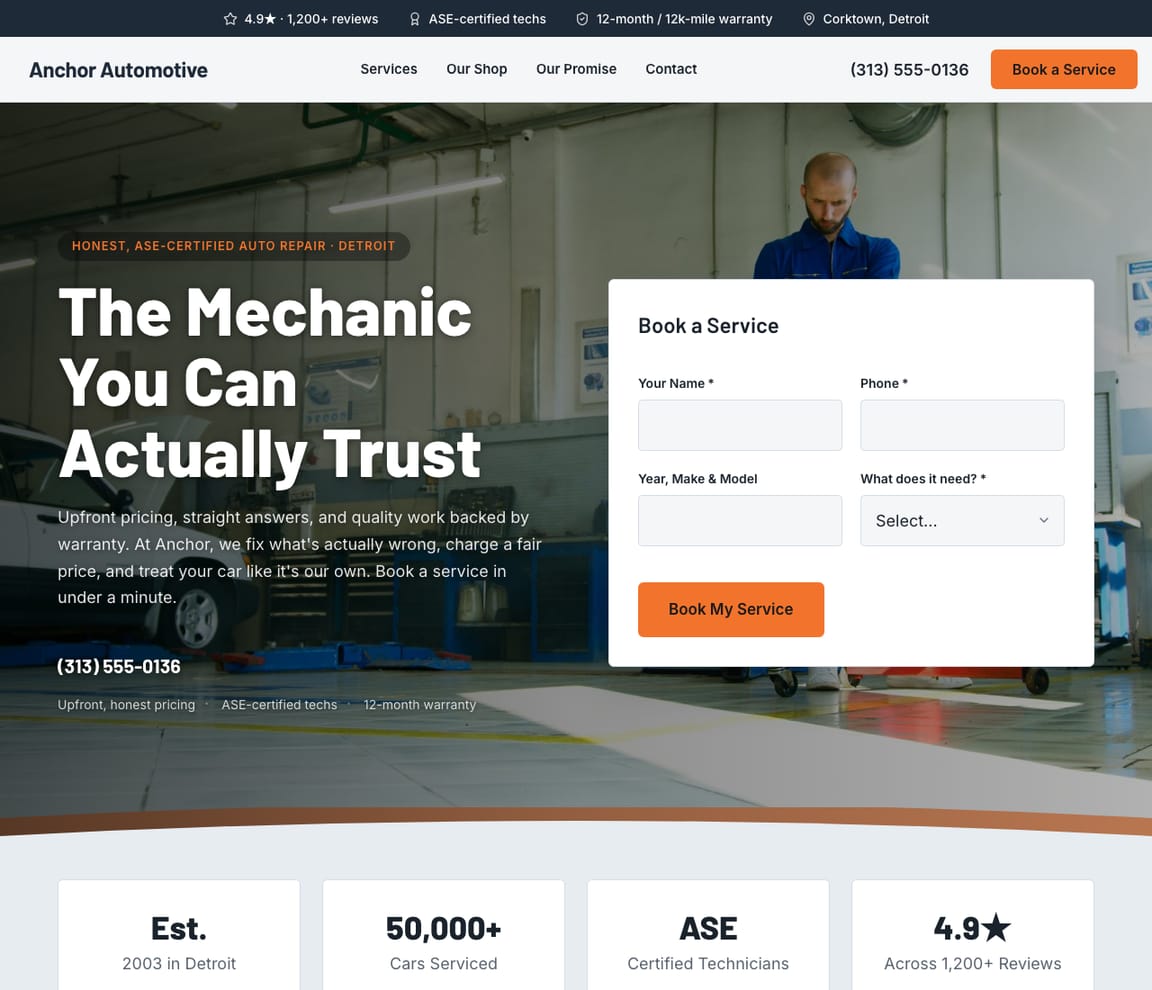
See what your mechanic shop website could look like
Anchor Automotive was built with Zarla — describe your shop and the AI builds a site like this in about a minute.
- Professional design — not a generic template
- Looks great on desktop and mobile
- Content written for your industry
Is a mechanic shop worth starting?
Yes — and the math is on your side. The average car on American roads is over 12 years old, out of warranty, and too expensive to replace, which means owners are fixing instead of trading in. Dealership service departments charge $150–$200 an hour and book out weeks; a trustworthy independent auto repair shop charging $100–$130 wins those customers for life. Repair work is also recession-resistant: when money is tight, people keep the car running rather than buy new.
The honest caveats: this is a capital-heavier trade than most. A two-post lift runs $3,000–$5,000 installed, a professional bidirectional scan tool is $2,000–$5,000, and a commercial bay lease in most metros starts around $2,000–$4,000 a month before you turn a single bolt. Modern cars are also computers on wheels — if you can't diagnose ADAS sensors, CAN bus faults, and hybrid systems, you'll be limited to brakes and oil changes while diagnostic work goes to whoever invested in the tooling.
The good news is you don't have to open with four bays. Plenty of successful shops started as one mechanic with a van doing mobile brake jobs and pre-purchase inspections, then leased a bay once the phone wouldn't stop ringing. Start where your tools and savings are, not where your ego is.
Starting a mechanic shop, in plain English
First, pick your lane. "I fix everything" is how new shops drown — choose general repair, a specialty like brakes, suspension, or A/C, or go mobile-first with a van and come to the customer (our guide to starting a mobile mechanic business covers that road). Mobile is the cheapest door in: no lease, no lift, and jobs like brake pads, batteries, alternators, and diagnostics can all be done in a driveway. Next, take stock of tooling. You likely already own hand tools; the gap is usually the scan tool, a decent jack and stands (or a lift if you have a bay), a torque wrench you trust, and an account with a parts supplier like NAPA or O'Reilly for commercial pricing.
Then tell everyone you know. Your first month of work is sitting in your contacts list — every friend with a squealing belt or a check-engine light they've been ignoring. Send this:
"Hey! I just started my own mechanic shop — brakes, diagnostics, oil changes, the works. If your car's making a noise you've been pretending not to hear, I'll take a look this week and quote you honestly, no shop markup games. And if you know anyone dreading a trip to the dealership, send them my way — first-time customers get a free diagnostic."
Set your pricing before the first job, not during it. Post a labor rate (most new independents land between $90 and $130 an hour depending on the market), charge a diagnostic fee — around $100–$150, credited toward the repair — and mark up parts 30–50% like every shop does. Free diagnostics attract tire-kickers who take your findings to another shop. Then do the thing chains can't: show the customer the worn rotor, text them photos before you replace anything, and finish when you said you would. As they pick up the car, ask for a Google review on the spot — "it takes 30 seconds and it's how a small shop like mine competes with the big guys." Five honest reviews will out-earn any ad you could buy.
What working mechanics and shop owners actually say
You don't have to take our word for it. We read through public threads where working mechanics and shop owners compare notes on going independent — here's what they consistently agree on.
The jobs you turn down keep you profitable. In a thread asking shop owners what they wish they'd known before opening, the most-upvoted answers on r/Justrolledintotheshop were about saying no: no to rust buckets, no to customer-supplied parts, and no to squeezing in work when you're already booked solid.
"Sometimes you make more money on the jobs you turn down." — a shop owner on r/Justrolledintotheshop
Expect a pay cut before the payoff. Owners on r/AskMechanics are blunt that the first few years usually pay less than a dealership or salaried job — and you'll be doing every repair yourself, plus the books, until the shop can carry staff.
"4 years in and I (finally) make 72k instead of 120 but my only regret is not doing it sooner" — a shop owner on r/AskMechanics
Finding techs who show up is the real bottleneck. One owner on r/smallbusiness pays well above dealership rates and still can't keep technicians on the schedule. Growth stalls on people, not equipment — so plan to stay hands-on longer than you'd like.
THE STARTER KIT
What you need to get started
Your core tool set
Hand tools, impact gun, torque wrench, jack and stands. Most mechanics going solo already own $5,000–$15,000 of this — your existing box is startup capital you don't have to spend.
A professional scan tool
A bidirectional scan tool ($2,000–$5,000 for an Autel or Snap-on class unit) is the single highest-ROI purchase. Diagnostics is where modern repair money lives — a code reader from the parts store won't cut it.
A bay or a van — pick one
A leased bay with a two-post lift ($3,000–$5,000 installed) opens up transmissions, exhausts, and suspension work. A mobile van setup costs a fraction of that and handles brakes, batteries, and diagnostics at the customer's driveway.
Garage liability + garagekeepers insurance
Garage liability covers your work; garagekeepers covers customer cars in your care — on the lift, in the lot, on a test drive. Budget $3,000–$6,000 a year. No fleet or landlord will touch you without it.
Registrations and certs
An LLC, an EPA Section 609 certification (one EPA-approved course and test is $55; legally required to service A/C for pay), and your state's repair shop registration — California, New York, Michigan and others require one before you charge for repairs.
A website that books work
When someone searches "mechanic near me" at 7am with a dead car, your site needs to show your services, your reviews, and a way to reach you. Zarla builds it from a description of your shop in about a minute.
THE PAPERWORK
Licenses and certifications for a mechanic shop
| Typical cost | Time to get | Legally required? | |
|---|---|---|---|
| Business license + entity registration (varies by state) | $50–$400 | 1–4 weeks | |
| State auto repair shop registration | $100–$450/yr where required | 2–6 weeks | |
| EPA Section 609 certification (required for A/C refrigerant work) | About $55 | A few hours — online course and test | |
| EPA / state hazardous waste compliance (used oil, coolant, solvents) | Mostly hauler fees + recordkeeping | Ongoing | |
| ASE certification (voluntary, but customers look for it) | $34 registration + $62 per test | 2 years hands-on experience + exams | |
| Garage liability + garagekeepers insurance | $3,000–$10,000/yr | 1–2 weeks |
THE STEPS
How to start your mechanic shop (step by step)
01
Pick your lane and your setup
Decide between mobile-first, a single leased bay, or a specialty like brakes, A/C, or diesel. Price the real market: what do local dealerships and chains charge, what's the going bay rent, and which repairs in your area book out weeks? Your opening niche is whatever local shops are slowest at.
02
Get legal, certified, and insured
Form an LLC, get an EIN, and open a business bank account so parts suppliers extend commercial terms. Get your EPA 609 cert, check whether your state requires repair shop registration (California's BAR, New York's DMV, and Michigan all do), and bind garage liability plus garagekeepers coverage before the first customer car rolls in.
03
Get found online
To get a mechanic shop found online, you need two things: a professional website and a Google Business Profile — the website proves you're a real shop with real services and real reviews, and the profile puts you on the map when someone searches "mechanic near me" with a car that won't start. Zarla builds the website part in about a minute: describe your shop, get a full site with your services, service area, phone number, and review links ready to publish.
04
Fill your bays and stack reviews
Work your contacts, do flawless first jobs, and ask every customer for a Google review at pickup. Then go after repeat revenue: pitch small local fleets — plumbers, landscapers, delivery vans — on priority scheduling and fleet pricing. One five-van account is a month of predictable work.
THE COSTS
How much does it cost to start a mechanic shop?
The spread is wide because the lease and the lift are optional on day one — a mobile mechanic starts for about half of what a leased shop costs, and the van is most of it.
$24k–$47kMobile mechanic start — a used van, tools, scan tool, insurance and two months' costs
$50k–$100k+Leased shop with a lift, lease deposit, equipment, and working capital
$3k–$6k/yrGarage liability + garagekeepers insurance
$2k–$5kProfessional bidirectional scan tool
WHAT WE'VE LEARNED
What actually gets a mechanic shop found
We've built websites for thousands of local service businesses, and the same three things decide who shows up on Google and Google Maps — and who stays invisible. Do all three and you'll get found; skip one and you won't.
A fast site with real proof on it
The shops that win "brake repair near me" searches have a fast website with photos of their actual bays and work, a page per service (brakes, diagnostics, A/C, suspension), and their service area spelled out. Stock photos of gleaming dealership floors convince no one.
A connected Google Business Profile
Most "mechanic near me" clicks go to the map pack, and Google trusts profiles that link to a matching website with the same name, number, and hours. Set your categories (Auto Repair Shop, Brake Shop), add photos, and keep hours accurate — a profile that says you're open when you're closed costs you the tow-in jobs.
A steady stream of reviews
Drivers are terrified of getting ripped off by a mechanic, so reviews carry more weight in this trade than almost any other. Shops with 50+ recent reviews mentioning "honest" and "didn't upsell me" beat shops with better equipment and none. Ask at pickup, every time.
THE UPSIDE
What a mechanic shop can earn
Real ranges from industry benchmarks — where you land depends on your labor rate, bay count, and how full you keep the schedule.
$90–$150/hrtypical independent-shop labor rate — higher on the coasts, lower in rural markets
$750k–$1.5Mannual revenue range for an established independent shop
6–20%net profit margin — the industry average is single digits; well-run shops reach the teens
2–4 yearstypical time before owner pay catches up to a dealership tech's salary
SEE IT WORK
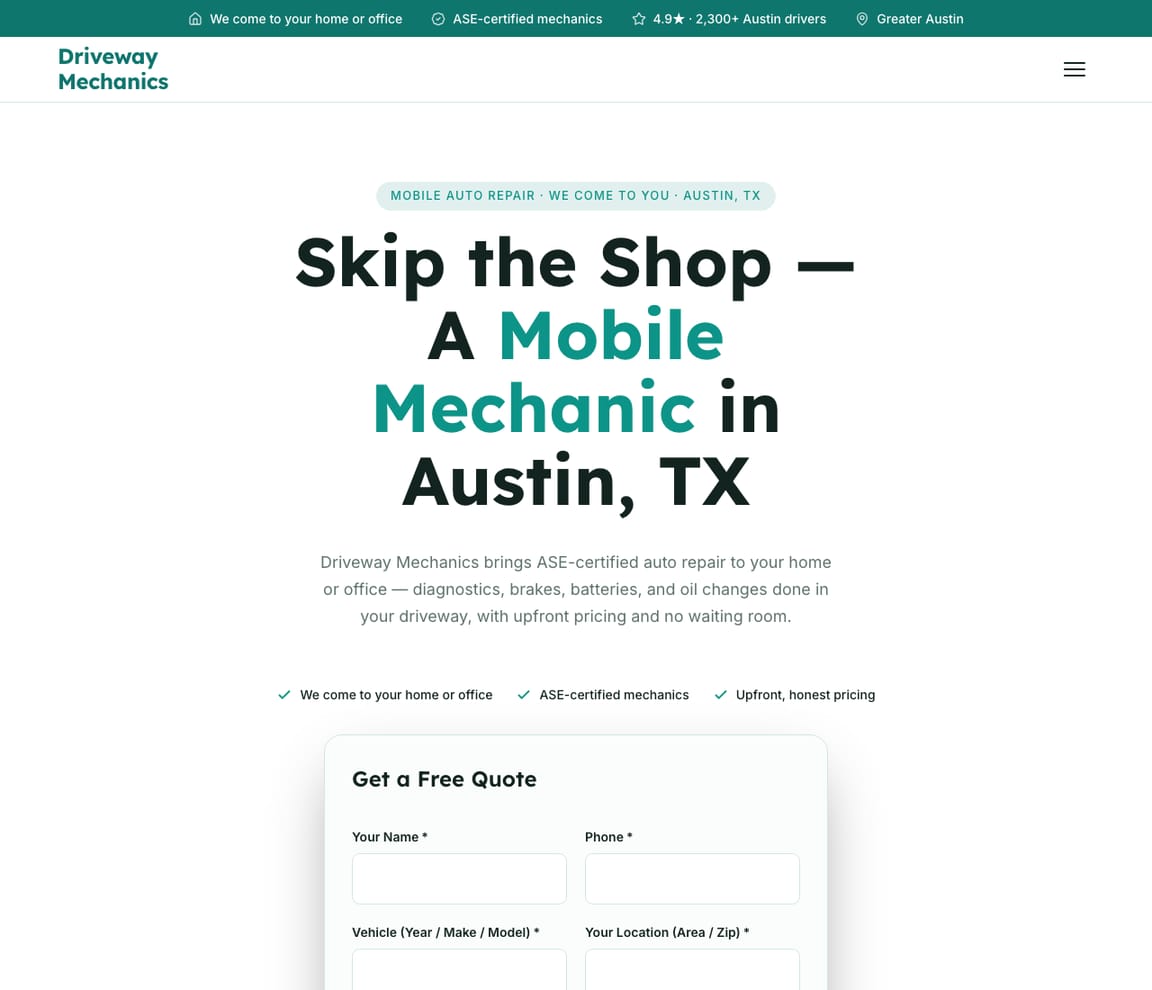
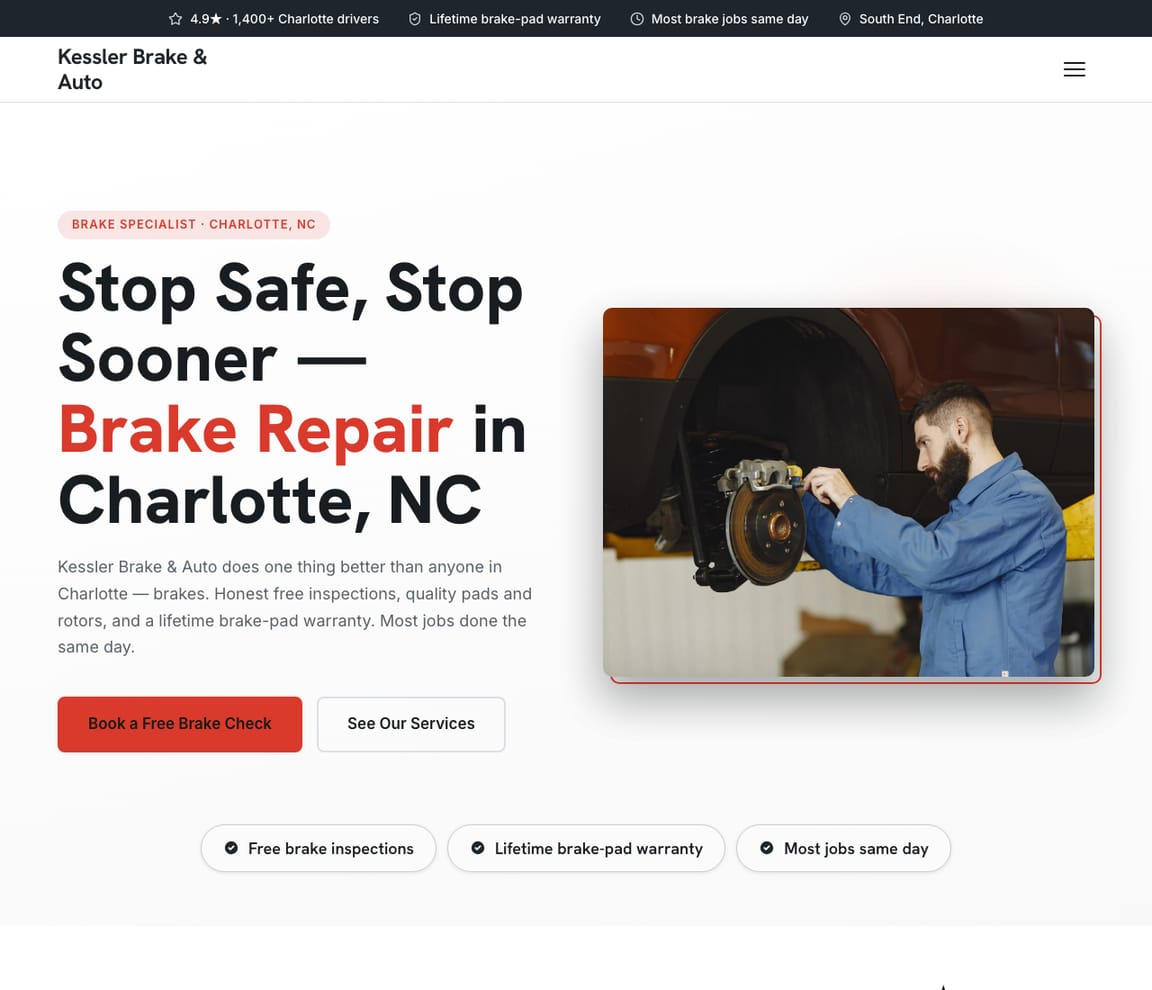
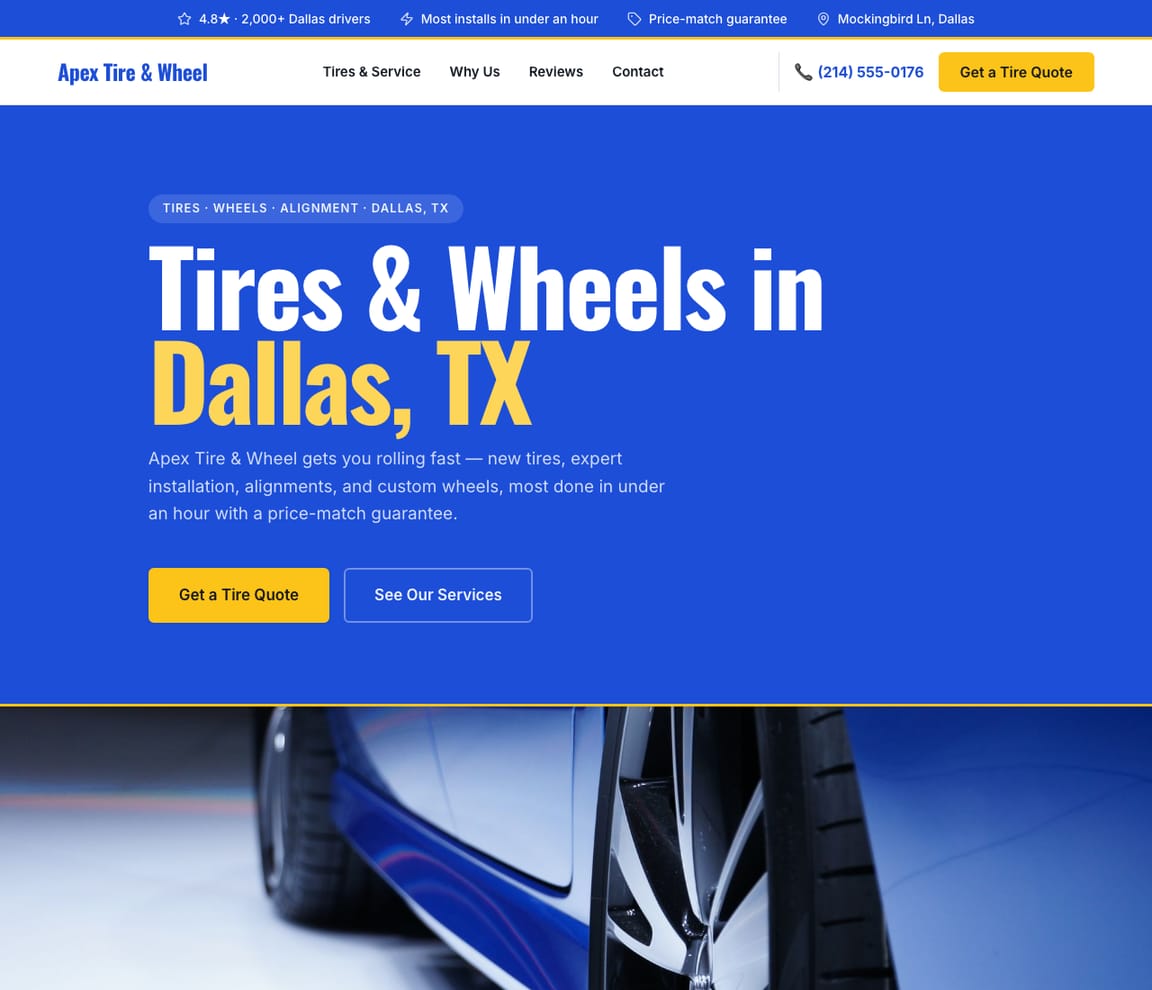
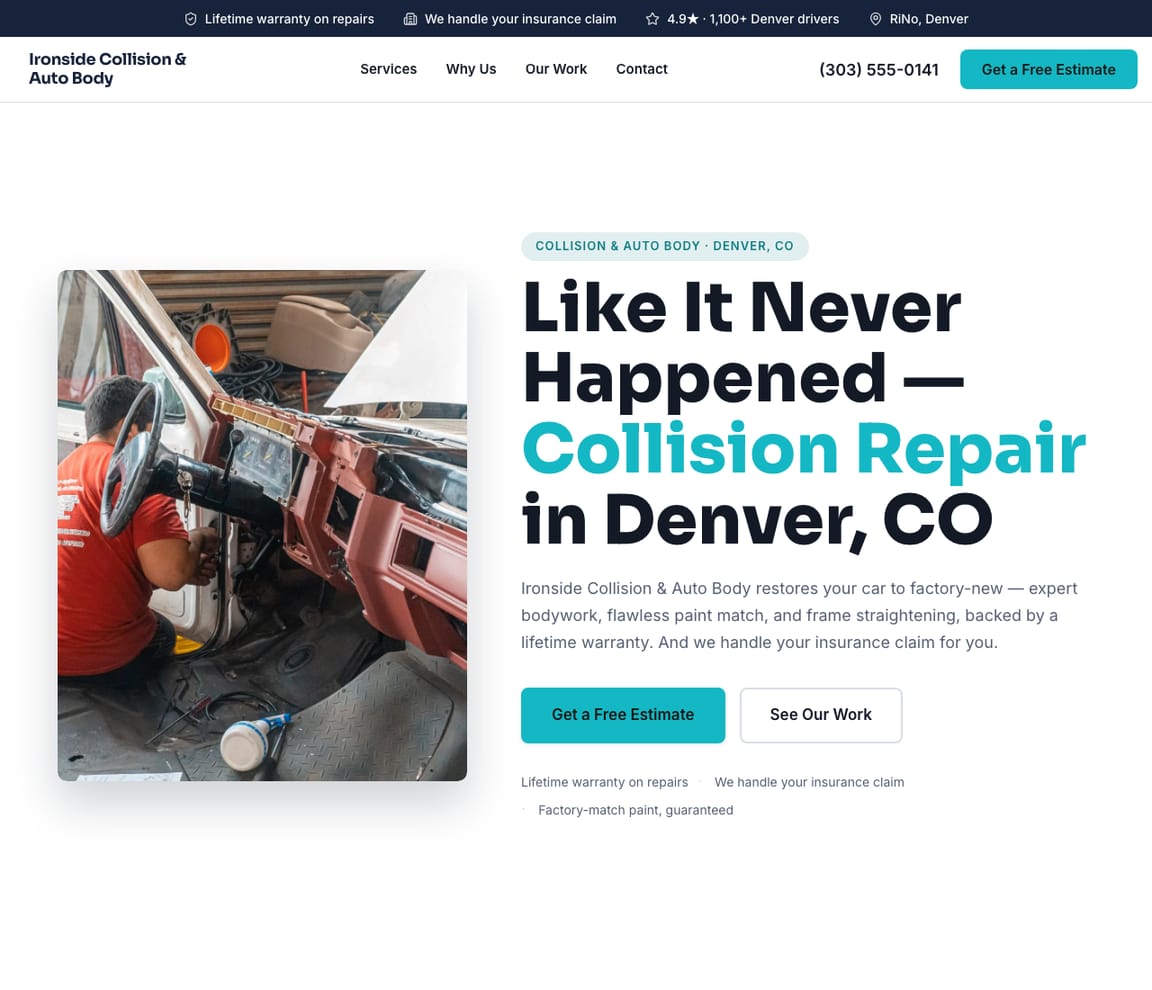
Mechanic shop website designs you can start from
Pick a design built for auto repair — mobile, brakes, tires, or body work — and make it yours.
GET FOUND
Get found by local customers
When a car breaks down, the search happens in the next five minutes — here's how your shop shows up.
They search the moment the light comes on
"Check engine light diagnostic," "brake repair near me," "mechanic open Saturday" — auto repair searches happen at the moment of breakdown, and the shop with a clear site listing services, hours, and a phone number gets the call.
They pick from the map
A stranded driver picks the closest trustworthy option on the map. A complete Google Business Profile — linked to your website, with bay photos and accurate hours — puts Halstead Auto Repair in that map pack instead of the chain up the road.
They read reviews before they trust you
Nobody hands their car keys to a shop with three reviews. Every review that says "showed me the worn part before replacing it" or "charged exactly what they quoted" pre-sells the next customer on the thing they fear most: getting ripped off.
Google Search
Hhalsteadautorepair.com
Halstead Auto Repair — Trusted auto repair in Your AreaLicensed auto repair available for residential and commercial work. Same-day response.← Your Zarla siteCcityautorepairservices.com
City auto repair ServicesGoogle Maps
1
Halstead Auto Repair
← You2
Metro auto repair Co.
3
Quick auto repair Services
AI assistants (ChatGPT / Perplexity)
For auto repair services in your area: Halstead Auto Repair — 4.9★ across 200+ Google reviews, same-day response, licensed and insured.
YOUR LAUNCH PLAN
Your mechanic shop launch checklist
Work through these roughly in order — most shops go from decision to first paying repair in 30–60 days.
- Pick your lane — mobile-first, single bay, or a specialty like brakes or A/C. Write down the five repairs you'll do faster and cheaper than the dealership.
- Form an LLC and open a business bank account — parts suppliers, landlords, and fleet clients all take you more seriously, and commercial parts pricing needs a business account.
- Check your state's repair shop rules — California, New York, Michigan and others require repair shop registration; get your EPA 609 cert (about $55 online) before touching any A/C system.
- Bind garage liability and garagekeepers insurance — garagekeepers covers customer cars on your lift, in your lot, and on test drives. Get certificates before the first car arrives.
- Buy the scan tool before the nicer toolbox — a bidirectional scanner wins the diagnostic work that pays $150 an hour; a prettier box wins nothing.
- Set your labor rate and diagnostic fee — post them publicly. Around $90–$130/hr and a $100–$150 diagnostic credited toward the repair beats racing chains to the bottom.
- Launch your website and Google Business Profile — describe your shop to Zarla, publish the site, then link it from a Google Business Profile with real bay photos. One afternoon, done.
- Ask every customer for a Google review at pickup — text them the review link while the invoice is still warm. Then pitch one local fleet (plumber, landscaper, courier) per week.
REAL CUSTOMERS
Owners who'd rather be turning wrenches
Verified reviews from real Zarla customers.
“Very reliable, professional, and fast results. I was able to get my business online in no time, and the ease of access made it so simple.”
“Optimized for local service-based businesses. Easiest website build I've experienced. The AI-based build is the way to go instead of clunky theme-based websites. Get the site built and get out of the weeds with Zarla!”
“Quickly built my website from scratch. No hiccups. Would highly recommend Zarla for someone with no experience who wants to start a polished business website.”
“I had no idea how to set up a website for my business. Thanks to Zarla, they've helped me a lot.”
Free to build
Ready to get your mechanic shop online?
Describe your shop and Zarla builds the website — services, service area, reviews, and a click-to-call number — in about a minute.
Free to build and preview — no code, no credit card.
Frequently asked questions
Do you need a license to start a mechanic shop?
There's no federal mechanic license, but several states require you to register the shop itself before charging for repairs — California (Bureau of Automotive Repair), New York (DMV repair shop registration), Michigan, and Connecticut among them. Separately, federal law requires an EPA Section 609 certification (about $55, taken online) before you service any vehicle A/C system. ASE certification is voluntary, but it's the trust badge customers and fleet managers look for, and each test only costs around $40–$100.
How much does it cost to start a mechanic shop?
A mobile mechanic with a used van typically starts for $24,096–$46,780 in our mobile mechanic business plan's itemized US ranges — the van is most of it (a 2020 cargo van runs $14,850–$23,200 at a dealer), so starting in a truck you already own cuts it sharply. A leased shop with a two-post lift, deposit, equipment, and a few months of working capital typically runs $50,000–$100,000 or more. The biggest line items are the lease, the lift ($3,000–$5,000 installed), a bidirectional scan tool ($2,000–$5,000), and garage liability plus garagekeepers insurance ($3,000–$6,000 a year).
How do I get my mechanic shop found on Google?
Three things, in order: a professional website with a page for each service (brakes, diagnostics, A/C, suspension) and your service area; a Google Business Profile linked to that website with accurate hours, categories, and real photos of your bays; and a steady stream of Google reviews. Reviews matter more in auto repair than almost any trade, because customers' biggest fear is being ripped off — reviews saying "honest" and "no upsell" are what convert searchers into tow-ins.
Can I start a mechanic shop with no money?
Close to it, if you already own your tools. Start mobile: brake jobs, batteries, alternators, and diagnostics can all be done in a driveway with hand tools, a jack, and stands. Charge properly from day one, bank the profit, and let the mobile work fund the scan tool, then the van wrap, then eventually the bay. What you can't skip even when broke is insurance — one dropped transmission on an uninsured job can end the business.
Do I need ASE certification to work on cars?
Legally, no — in nearly every state you can repair cars for money without ASE certification. Practically, it's worth getting: fleet accounts, extended-warranty administrators, and cautious customers use it as a filter, and the Blue Seal logo on your website and sign answers the "can I trust this shop?" question before it's asked. Start with the A-series tests that match your specialty.
How much do mechanic shop owners make?
A solo mobile mechanic billing 25 solid hours a week at $85 an hour — the top of what two US mobile mechanics in the local news charged in 2025 and 2026 — grosses around $110,000 a year before parts profit, insurance, and expenses. Established single-location shop owners commonly net $60,000–$150,000 depending on bay count, labor rate, and how well the bays stay full. Parts markup (typically 30–50%) and diagnostic fees are what separate profitable shops from busy-but-broke ones.
Can I run a mechanic shop from my home garage?
Usually not legally — most residential zoning prohibits commercial auto repair at home, and neighbors reporting cars on jack stands in the driveway is one of the most common ways new mechanics get shut down. Check your local zoning office first. Mobile repair at the customer's location is the cleaner workaround, and it's also the cheaper business model while you build toward a commercial bay.
Can I start a mechanic shop with no money or without being a certified mechanic?
You can open a shop without ASE certification — it's voluntary in every state, though EPA Section 609 certification (one EPA-approved course and test is $55) is legally required to service A/C for pay. With little capital, most owners start as a mobile mechanic: a used van, tools and a scan tool can get you working for about $24,000–$47,000, less in a truck you already own, versus six figures for leasing and equipping a multi-bay shop. Check whether your state requires repair shop registration before taking paid work.
How long until a mechanic shop replaces a full-time income?
Plan on two to four lean years. Shop owners on Reddit consistently describe earning less than their old dealership or salaried pay early on — one reported $72k four years in, down from $120k, but with no regrets. The variable you control is how fast the bays fill: a website and Google Business Profile that show up when locals search "mechanic near me" shorten that ramp considerably.