BUSINESS GUIDE
How to start a mobile mechanic business in 2026
The real version, from one van: what drivers pay and how to price the call-out and the hours, the tools and the van, insurance and ASE, how far to drive, fleet accounts and mobile tires — and how to be the one drivers find when they search for a mechanic that comes to them.
Free to build · Pay when you publish · No credit card
$50–$85an hour: what two US mobile mechanics in the local news charged (2025–2026)
$75a service call inside city limits at one Washington mechanic, plus mileage
$24.34an hour: median pay for auto technicians (O*NET, 2025)
No codeto get online
See it in action
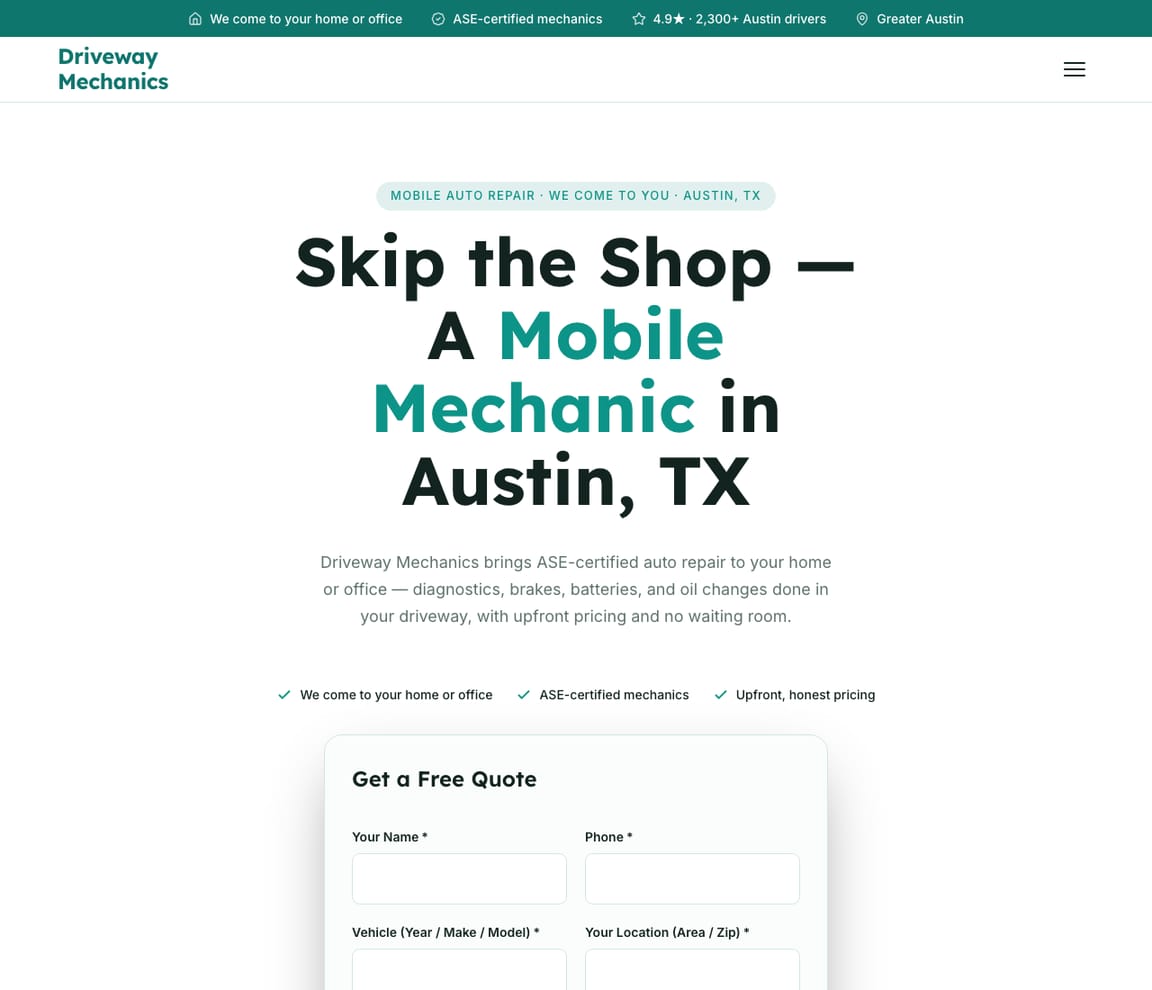
See what your mobile mechanic website could look like
This is a real Zarla template for a mechanic who comes to the customer. Describe yours — the repairs you do at the curb, your call-out fee, the towns you cover — and you'll have a site like this, with a quote form up front and room for photos of your van and your work, in about a minute.
- Professional design — not a generic template
- Looks great on desktop and mobile
- Content written for your industry
Build the website
Start your mobile mechanic website now
Add your town and your business name to the sentence, and Zarla builds the site: a call button at the top, a service-area map and a quote request form. Add your services, your call-out fee and photos of your van in chat, then publish.
Already have a website? Bring it across →Zarla keeps your old page addresses where it can and redirects the ones that change, helping you keep the Google standing you've built.
Is a mobile mechanic business worth starting — and what do mobile mechanics charge?
The demand is real, and the question drivers ask first is the price. Real mobile mechanics price it two ways, and many add a fee for the trip. By the hour: a New Hampshire mechanic charged $50 an hour in 2025 (Valley News, October 2025), and a Maine mechanic $65 an hour plus 95 cents a mile for travel, rising to $85 an hour in July 2026 (Bangor Daily News, May 2026). A call-out fee plus a flat price for the job: a Washington mechanic charges a $75 service call inside city limits plus 70 cents a mile there and back, and quotes each job at a flat rate (Statesman Examiner, March 2026).
What the job costs the driver. One gig marketplace's US guide puts a typical mobile mechanic job at $150 to $200 and a median of $200, with an oil change at $90 to $160, a battery at $120 to $220, brake pads at $150 to $300 and an alternator at $300 to $650 (Airtasker, May 2026); a software vendor for mobile mechanics puts the hourly rate at $50 to $150 and a diagnostic visit at $75 to $150 (Trackara, a software vendor, May 2026). The comparison the driver is making is the shop: the most common labor rate at US repair shops is $100 to $119 an hour, and nearly half charge $100 to $139 (PartsTech's September 2025 survey, reported by Ratchet+Wrench).
The miles are the catch. Every mile between jobs is time you don't bill, which is why the call-out fee and the radius matter as much as the rate. One Spokane co-owner found most calls within five to 10 miles of downtown (Journal of Business, February 2020); the Maine mechanic covers 95 towns across four counties and charges by the mile (Bangor Daily News). Demand can come fast: he started in August 2025 and was, for a time, booked a month out. And it can grow into more than a van — a Florida couple who started with $50 brake jobs from their home garage opened a shop three years later (WJHG, September 2026).
The hard parts are the jobs you can't do at the curb, the parts you need before you leave, the weather, and the hours lost to driving. As an employee, the same work paid a 2025 US median of $24.34 an hour for automotive service technicians (O*NET) and $29.70 for diesel and truck mechanics (O*NET) — the owner's rate has to beat that after the van and the miles. That's what the rest of this guide sets up.
How to start a mobile mechanic business, in plain English
Some states register mobile mechanics; most cities have a say on where you work. In the US the rules are state by state. Some examples:
- California requires a registration to diagnose, service or repair vehicles for pay, and the rule says it “includes mobile” repair — $200 to apply and $200 a year (Bureau of Automotive Repair); a mobile repair dealer gives the van's license plate number on the application (BAR's application form).
- Florida registers repair shops for two years at a time — $50 a year for one to five mechanics, $150 for six to 10 — and a mobile shop registers at the owner's home address (Fla. Stat. §559.904).
- New York registers every repair shop: $10 to apply and $150 for two years (N.Y. Veh. & Traf. Law §398-c).
- Texas taxes the parts of a repair but not the labor: you can show them separately on the invoice and collect tax on the parts, or charge one price and pay the tax on parts when you buy them (Texas Comptroller).
Not every state registers repair businesses, so check your state's consumer-protection or motor-vehicle agency before your first job. Then check the street. Some cities limit repairs at homes — Woodland, California allows only minor repairs outside an enclosed structure in a residential district, finished within 48 hours (City of Woodland) — and some landlords ban them: a Massachusetts housing authority bans oil changes and other repairs in its lots (Winthrop Housing Authority). Ask where the car is parked when the customer books.
Two federal rules travel with the van. Anyone who services a car's air conditioning for pay must be certified under Section 609 of the Clean Air Act (EPA), and refrigerant is sold only to certified technicians, apart from small do-it-yourself cans (EPA); a course and test from one EPA-approved program is $55 (MACS). And a business that changes oil is a used-oil generator: label the containers “Used Oil”, keep them leak-free, carry sorbent for spills, and take the oil to a recycler — your state's rules can be stricter (EPA).
ASE certification. No law requires it, but customers and fleets look for it. ASE charges a $34 registration fee per order and $62 a test, so one test is $96 and all eight auto tests in one order $530 (ASE, fall 2026). Each test needs one to three years of hands-on experience depending on the test (ASE); certification lasts five years, and passing A1 to A8 makes you a Master Automobile Technician (ASE).
Insurance. General liability covers damage you cause at a customer's home or work; garagekeepers covers the customer's car while it's in your care; commercial auto covers the van. Insureon's medians for auto service businesses are $54 a month ($650 a year) for general liability, $38 a month ($458 a year) for garagekeepers, $76 a month ($909 a year) for commercial auto and $148 for workers' comp once you hire (Insureon, March 2025); tools and equipment cover — for the tools in the van — averages $48 a month for small businesses (Insureon, May 2026). The Hartford's small-business customers pay about $810 a year for general liability (The Hartford).
The van and the tools. A 2020 cargo van bought from a dealer in typical condition runs from $14,850 for a Ram ProMaster (Kelley Blue Book, October 2026) to $23,200 for an extended high-roof Ford Transit 250 (Kelley Blue Book); new, a Chevrolet Express cargo van starts at $40,700 (Chevrolet) and a Ram ProMaster at $45,325 (Ram). Many start in a truck they already own. Shelving for a medium-roof van starts at $2,533 (Commercial Van Shelving); a mechanic's tool bundle runs $1,199 to $2,485 (TEKTON); a bi-directional scan tool $459.99 to $2,299.99 (Zoro); a floor jack $98.79 to $437.99 (Zoro) and a jump pack from $99.95 (Zoro). Pricing a job needs a labor-time guide: ALLDATA Repair is $209 a month (ALLDATA), and repair-shop software starts at $199 a month (Tekmetric). For a one-van mechanic, our free mobile mechanic business plan adds it up to $24,096–$46,780: a used van, shelving, tools, a scan tool, a year of insurance for you, the customer's car, your tools and the van, registration, ASE and Section 609, the website and software, and two months of running costs. Fuel is the running cost that moves most — regular gasoline averaged $4.354 a gallon in early October 2026 (EIA). Form the business — for example $40 for an LLC in Kentucky (Kentucky SOS) and $300 in Texas (Texas SOS); an LLC protects your personal assets in most cases if the business is sued (SBA) — and get the free EIN (IRS).
Fleets and tires. Small businesses with a few vans lose money every day one sits at a shop. An Enterprise Fleet Management executive told Work Truck that mobile vendors “tend to charge a premium for quick turnaround and convenience” — the premium is the point — and that after-hours mobile service can stand in for a spare truck (Work Truck, February 2024); Ford Pro, which runs its own mobile service, says mobile service “can save a business up to three hours per repair” — time that counts for small fleets such as landscapers and HVAC contractors (Fleet Maintenance, August 2025). Mobile tire work is the natural add-on, and the dearest: a tire changer lists from $2,895 (BendPak) and a balancer from $2,695 (BendPak), while two tire dealers put a fully built mobile tire van at around $160,000 (Modern Tire Dealer, March 2023). The mobile mechanic website templates show what a good come-to-you site looks like, and Zarla's mobile mechanic website builder is how drivers searching for a mechanic that comes to them find yours. If you'd rather work from a bay, read our guide to starting a mechanic shop and our auto repair shop business plan.
What mobile mechanics actually say
None of this is our opinion about the trade. It comes from US mobile mechanics and mobile tire owners talking to local papers, local TV and a trade magazine between 2020 and 2026 — read each as theirs at the time. Four things come up again and again.
Many start small, on the side. Justin O'Bryan of Owensboro Mobile Mechanic in Kentucky: “I went home, told my wife I was going to start a business,” and she said, “You don't know anything about a business.” By 2025: “We went from a little SUV and trailer to a bigger truck, a bigger trailer, and a full-time guy working with me. … My wife even quit her job to handle all the scheduling and office stuff.” (Owensboro Times via the Greater Owensboro Chamber, July 2025). Chris Stiles of Helping Hands Auto Car in Enfield, New Hampshire: “What I like about being mobile is that I am my own boss and I can create my own hours.” (Valley News, October 2025).
“Winter, I am out there turning wrenches just like any other day. Forty degrees below zero, it doesn't matter. I will bundle right up to the nose.” — Hayden Maxfield, owner, Maxfield Mobile Mechanic, Millinocket, Maine, Bangor Daily News, May 2026
Know what you'll do at the curb — and what you won't. O'Bryan, asked what his van can fix: “Pretty much anything except timing chains and in-depth motor work. … We'll come to your house, your work, or even while you're at the grocery store.” (Owensboro Chamber, July 2025). Maxfield goes further: “I have an engine hoist. I can pull motors. I have a transmission floor jack and can drop a transmission in your driveway.” (Bangor Daily News, May 2026). Nathan Arms of Ranger Mobile Garage in Colville, Washington, on the parts run: “As long as I have a parts store open that I can get parts from, I can come to you wherever it's convenient.” (Statesman Examiner, March 2026).
Say the price first. Arms quotes flat rates: “I have the number up front and I commit to get it done.” He also knows the pressure: customers are “always looking for the best deal, and expect me to either be the cheapest option or they try and set my price when I already work on making it fair to begin with.” (Statesman Examiner, March 2026). Maxfield: “I wanted it to be as affordable as possible to get people the fixes that they need to keep the reliability of their car.” (Bangor Daily News).
Trust is the product. O'Bryan lets customers watch: “I coach them through it,” he says. “If they want to come out and watch, that's fine. I show them what's wrong. Nothing is behind closed doors.” And on reviews: “I've had people say they were skeptical, but after reading the reviews, they felt better about trying us.” (Owensboro Chamber, July 2025). Ryan Turner, co-owner of Spokane Mobile Automobile Care in Washington, on who books: “A lot of millennials don't want to go to a mechanic shop. … they'd rather have you come to their home or place of work to have their car serviced.” (Journal of Business, February 2020).
Tires are the add-on. Jeremy James of Tires To Your Spot in Leesport, Pennsylvania, who installs on up to five vehicles a day: “Convenience is king. We ensure that the customer has zero down-time …” and “I only inventory tires for the next 24 hours of jobs.” (Modern Tire Dealer, February 2020). Mark Reece of Benedetti Tire Service in Sebastopol, California: “if people want to click a button and have food delivered to them, they probably want to click a button and have the automotive shop come to them.” (Modern Tire Dealer, February 2023). A mobile tire operator in Akron, Ohio, found a fleet customer by turning up on his lot — a local owner of 50 Amazon delivery vans (Modern Tire Dealer, February 2023) — and Joe Flores of Go Mobile Tires, in Florida and Southern California, says “a good portion of our business comes from our relationships with other retailers.” (Modern Tire Dealer, April 2019).
The through-line: the mobile mechanics who last say what they fix and what it costs before they arrive, carry the parts for the job, show the customer the problem, and grow from the reviews and the fleets that come back.
THE STARTER KIT
What you need to start a mobile mechanic business
The skill, proven
Shop experience first, then ASE tests in the work you'll do on the road — brakes, electrical, engine performance — and EPA Section 609 if you touch A/C.
A van or a truck that carries the shop
A cargo van or a pickup with a service body, shelving that holds parts and tools in place, and room for a jack, stands and a battery pack.
Tools and a scan tool
The hand tools you already own, plus a good diagnostic scan tool, a floor jack and stands, a jump pack, cordless impact guns, lights and a fluid caddy.
A price sheet and a radius
A call-out or diagnostic fee, an hourly rate or flat prices for common jobs, and a service area you can cover without losing half the day to driving.
Insurance for customers' cars
General liability, cover for the customer's car while you work on it, commercial auto for the van, and tools cover — plus workers' comp once you hire.
Parts accounts, and a way to be found
Accounts with two parts stores that deliver, then a Google profile and a website with your services, your call-out fee and a quote form.
THE PAPERWORK
Licenses, certification and insurance for a mobile mechanic business
| Typical cost | Time to get | Legally required? | |
|---|---|---|---|
| Business registration (LLC) and local business license | e.g. $40 (Kentucky), $300 (Texas) | Days | Depends on your structure and city |
| EIN from the IRS | Free | Minutes online | If you hire or have partners; optional when solo |
| Sales tax registration (parts) | Set by your state | Days to weeks | Where your state taxes parts |
| State repair-business registration | e.g. $200 + $200/yr (CA); $50/yr (FL) | Weeks | In some states, e.g. CA, FL, NY |
| EPA Section 609 certification (A/C work) | About $55 | A day | Yes, to service A/C for pay |
| ASE certification | $34 per order + $62 a test | Weeks | No — optional, but customers and fleets look for it |
| General liability and garagekeepers insurance | $54 + $38/month (medians) | Same day | Not by law; fleets and landlords ask |
| Commercial auto insurance for the van | $76/month median | Same day | Required in most states for a business vehicle |
| Workers' compensation | $148/month median | Days | In most states, once you hire |
THE STEPS
How to start a mobile mechanic business (step by step)
Eight steps from “I could fix that in your driveway” to a van with jobs booked in it.
01
Get the experience and the certificates
Work in a shop first, then take the ASE tests for the work you'll do on the road — and EPA Section 609 before you touch A/C refrigerant.
02
Decide what you'll fix at the curb
Brakes, batteries, starters, diagnostics, oil changes and pre-purchase inspections travel well; engine and transmission jobs that need a lift go to a partner shop.
03
Check your state and city rules
Some states register every repair business, mobile ones included; some cities, HOAs and apartment lots limit repairs on their property. Check both before your first job.
Before your first job04
Register and insure the business
Form the business, get a free EIN, register for sales tax on parts, and buy general liability, cover for customers' cars and commercial auto for the van.
05
Set up the van and parts accounts
Shelving, a scan tool, a jack and stands, a jump pack and a fluid caddy — and accounts with two parts stores that deliver to where you're working.
06
Write your price sheet and your radius
A call-out or diagnostic fee, your hourly rate or flat prices for common jobs, a travel fee beyond your radius, and your warranty in writing.
07
Get found by drivers searching for you
Put your Google Business Profile and website live with your services, your call-out fee, the area you cover, photos of the van and a quote form.
08
Add fleets and tires
Call the landscapers, plumbers and delivery businesses near you about fleet maintenance on a schedule, and add mobile tire work once the van has room.
THE COSTS
How much does it cost to start a mobile mechanic business?
The total is our free mobile mechanic business plan's itemized US ranges for one mechanic and one used van: the van, shelving, tools and a scan tool, a year of liability, garagekeepers, tools and van cover, registration, ASE and Section 609, the website and software, and two months of running costs. Tire equipment is an extra. Vans from Kelley Blue Book, tools from TEKTON and Zoro, insurance from Insureon and The Hartford, checked October 2026.
$24,096–$46,780to start with one used van — the van is the biggest line, $0 if you already own a truck
$460–$2,300for a bi-directional diagnostic scan tool, at list price
$92/monthmedian general liability plus garagekeepers cover for auto service businesses (Insureon)
$5,590–$12,990for a tire changer and balancer, if you add mobile tires
WHAT WE'VE LEARNED
What actually makes a driver book a mechanic to come to them
Thousands of local business websites in, the pattern for car and home services is clear: the customer arrives with a problem, a price question and a worry about who is turning up. Three things on a page decide who gets the call.
The price of the visit, said plainly
Your call-out or diagnostic fee, your hourly rate or your flat prices for common jobs, and what's extra — so the driver knows what the visit costs before you come.
Where you go and what you fix there
The towns or the miles you cover, and the repairs you do in a driveway or a parking lot — and the ones that need a shop — so nobody books a job you can't finish.
Proof of who is coming
Your name and photo, your ASE certificates, photos of the van and real repairs, your warranty, reviews, and a quote form that takes the car's year, make and model.
THE UPSIDE
What a mobile mechanic business can earn
Rates from US mobile mechanics in the local news (2025–2026); the shop rate from PartsTech's September 2025 survey; pay from O*NET. Averages, not a promise — your billed hours, your radius and your parts markup decide it.
$50–$85 an hourwhat two US mobile mechanics in the local news charged for labor, plus parts
$100–$119 an hourthe most common labor rate at US repair shops — the price drivers compare you with
95 townsone Maine mechanic's service area across four counties, nine months after he started
$24.34 an hourthe 2025 US median for automotive service technicians — what the work pays employed
SEE IT WORK
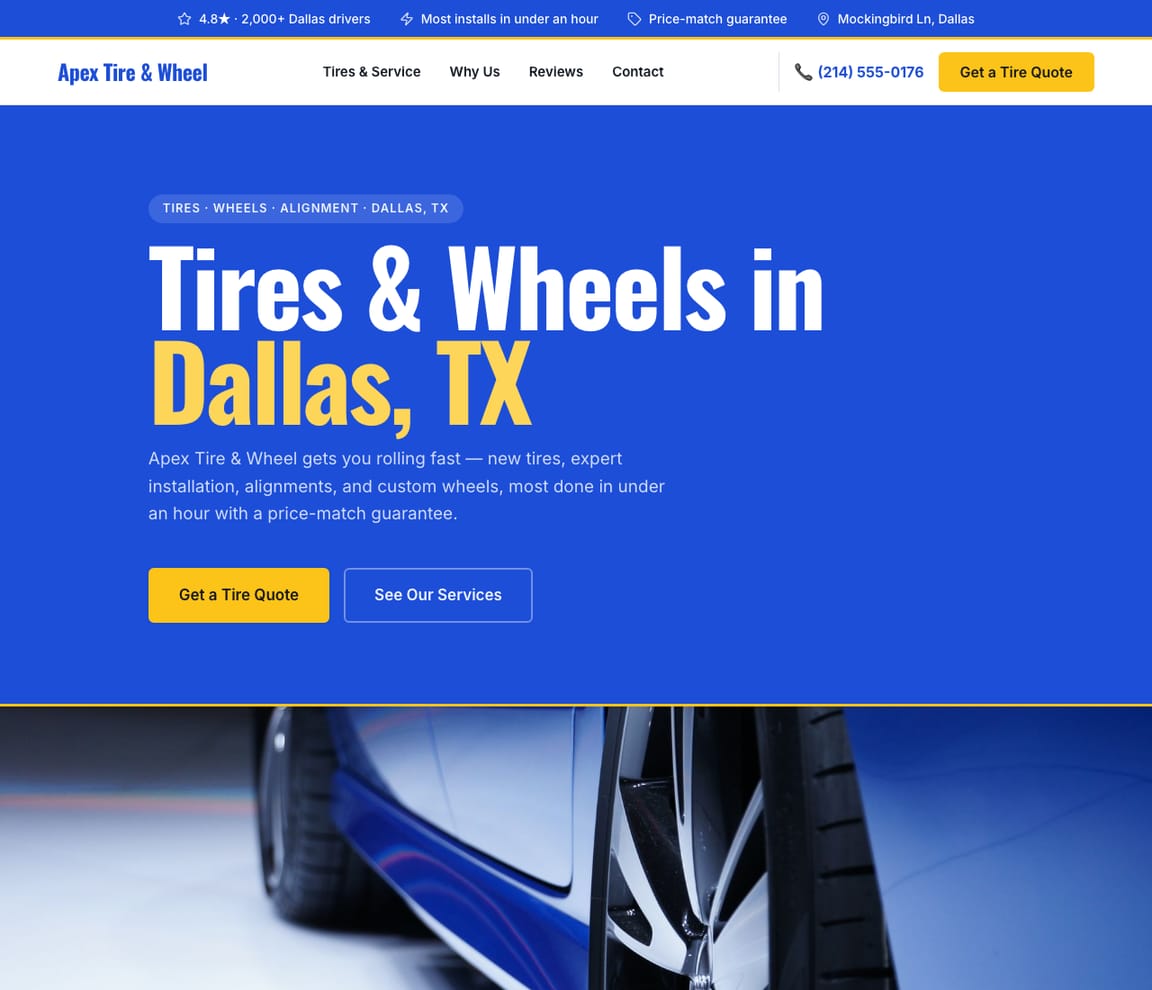
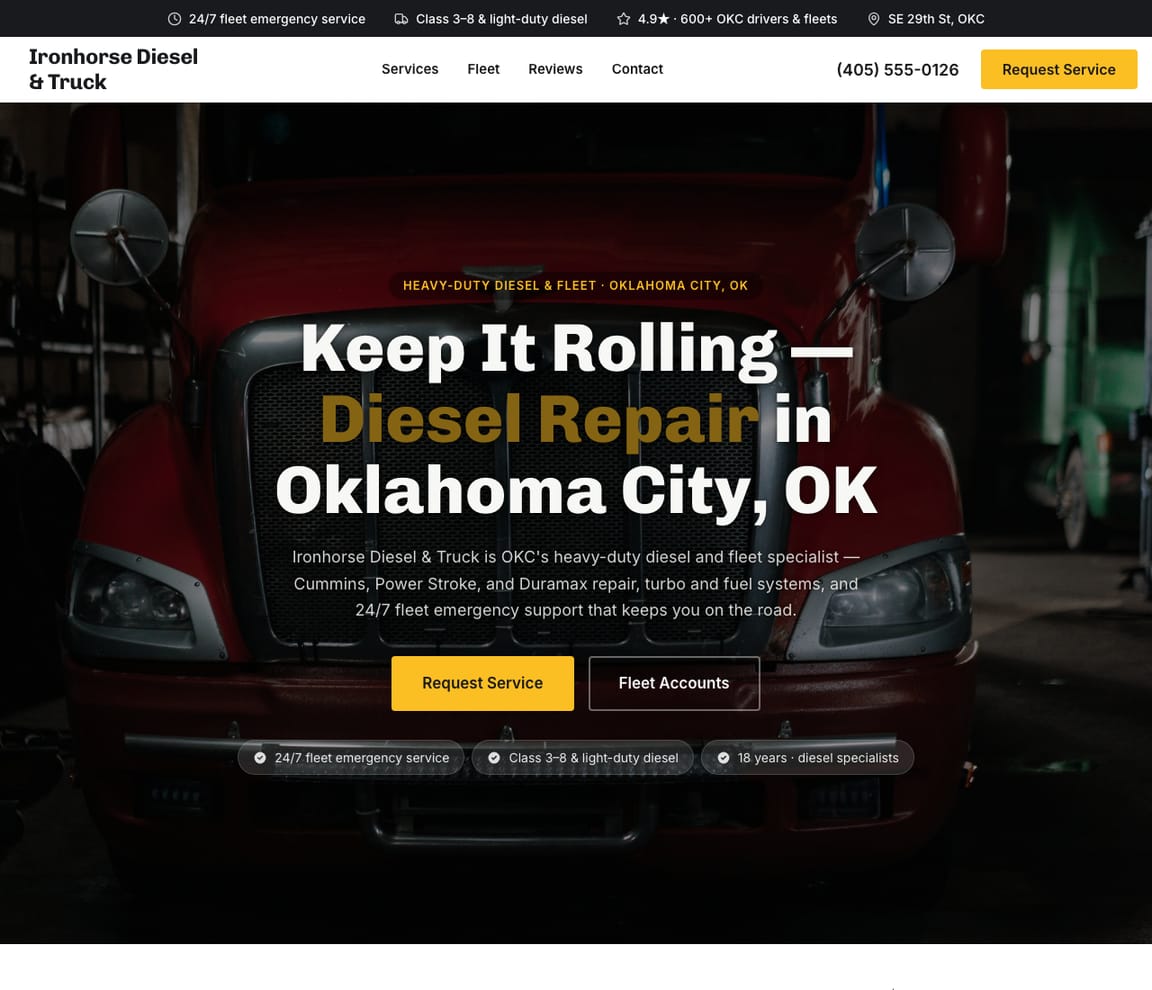
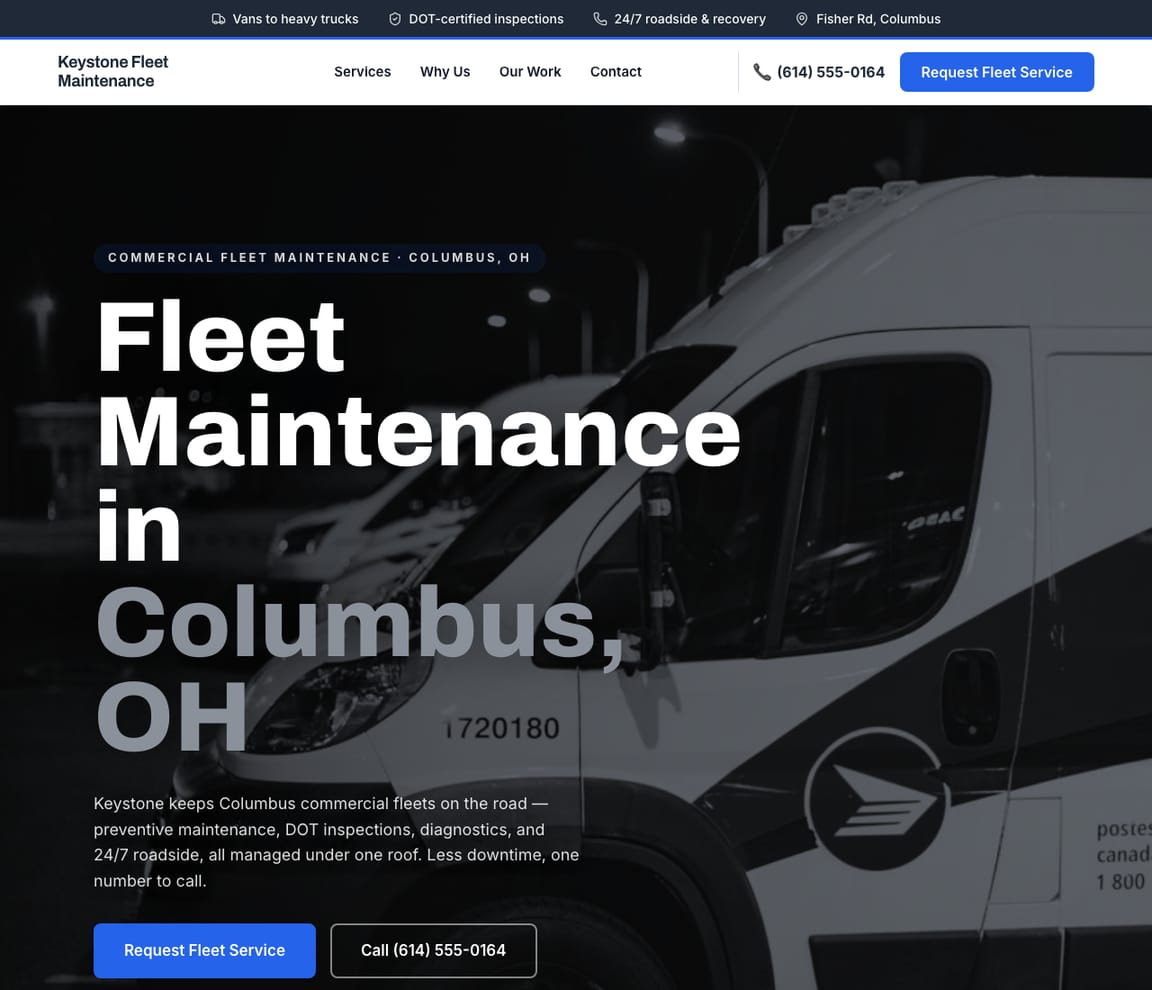
Mobile mechanic website designs you can start from
All four are real Zarla templates. Open the one closest to how you'll work — a come-to-you mechanic, tires, diesel and trucks, or fleet accounts — swap in your number, your service area and photos of your own van, and publish.
GET FOUND
Get found by the driver whose car won't start
Most mobile mechanic customers start with a problem and a question — what it costs, whether you can fix it in the driveway, how soon you can come. Zarla builds the website with a call button, a service-area map and a quote request form. Add your services, your call-out fee and the towns you cover in chat, and once you connect your Google Business Profile, your name, service area and reviews stay in step on both.
“Mobile mechanic near me”
Searched by a driver with a dead battery in the driveway or a brake squeal on the way to work. Your call-out fee, the repairs you do on site and a quick way to book answer it before they call a tow truck.
Google Business Profile
As a mobile business you show the area you cover, not a street address — plus your hours, photos of the van and your work, and your reviews inside Google Maps. Free, and an afternoon to set up.
Reviews from the driveway
Ask while the customer is watching the car start — and send the link that evening. Reviews that say you came on time, quoted first and fixed it at home sell the next call.
Google Search
Ccrossroadsmobileauto.com
Crossroads Mobile Auto — Trusted Mobile mechanic in Your AreaWe come to your home or work for brakes, batteries, diagnostics and oil changes. Upfront call-out fee, written quote before we start, ASE-certified.← Your Zarla siteCcitymobilemechanicservices.com
City Mobile mechanic ServicesGoogle Maps
1
Crossroads Mobile Auto
← You2
Metro Mobile mechanic Co.
3
Quick Mobile mechanic Services
AI assistants (ChatGPT / Perplexity)
For a mechanic that comes to you in your area: Crossroads Mobile Auto — a local mobile mechanic with an upfront call-out fee, the repairs they do on site, the area they cover, ASE certification, and reviews from drivers nearby.
YOUR LAUNCH PLAN
Your mobile mechanic business launch checklist
The whole guide as things to check off. Work through them in order and you'll be certified, legal, insured, equipped and priced before the first driver calls.
- Take your ASE tests — and EPA Section 609 if you'll do A/C work.
- Check your state and city rules — repair-business registration, used oil, where you can work.
- Register the business and get a free EIN — and register for sales tax on parts.
- Buy liability, customers'-car and van cover — and workers' comp before you hire.
- Set up the van — shelving, scan tool, jack and stands, jump pack, fluid caddy.
- Open two parts accounts — with delivery to where you work.
- Write your price sheet and radius — call-out fee, hourly or flat rates, travel fee, warranty.
- Get found — website and Google Business Profile live with your services and service area.
REAL CUSTOMERS
Small business owners who got online with Zarla
Verified reviews from real Zarla customers.
“Quickly built my website from scratch. No hiccups. Would highly recommend Zarla for someone with no experience who wants to start a polished business website.”
“Great professional website in less than a minute, with the use of AI and a few descriptive prompts. This has saved me bundles of time and research on web developers.”
“I had no idea how to set up a website for my business. Thanks to Zarla, they've helped me a lot.”
“Very reliable, professional, and fast results. I was able to get my business online in no time, and the ease of access made it so simple.”
Be the mechanic that comes to them — and the one they find
Add your town and your business name, and Zarla builds the website from that one line — a call button at the top, the area you cover on a service-area map and a quote request form. Free to build; you pay when you publish.
Already have a website? Bring it across →Zarla keeps your old page addresses where it can and redirects the ones that change, helping you keep the Google standing you've built.
Frequently asked questions
How much do mobile mechanics charge?
In the US, real mobile mechanics in the local news charged $50 an hour (New Hampshire, 2025) to $85 an hour (Maine, from July 2026), plus parts, and many add a call-out or travel fee — $75 inside city limits plus 70 cents a mile at one Washington mechanic, 95 cents a mile at the Maine one. One gig marketplace's guide puts a typical job at $150 to $200, with an oil change at $90 to $160 and brake pads at $150 to $300 (Airtasker, May 2026). Shops charge more for labor: most commonly $100 to $119 an hour (PartsTech survey, September 2025). If you're the mechanic, put your call-out fee and your prices for common jobs on your website — it's the first question every driver asks.
How much does it cost for a mobile mechanic to come out?
Usually a call-out, trip or diagnostic fee, then the repair. In the US, a Washington mechanic charges a $75 service call inside city limits plus 70 cents a mile there and back, and a Maine mechanic 95 cents a mile on top of the hourly rate. A software vendor puts a diagnostic visit at $75 to $150 (Trackara, 2026). Ask whether the fee is credited to the repair if you go ahead.
How much does it cost to start a mobile mechanic business?
In the US, about $24,096 to $46,780 for one mechanic with a used van, in our mobile mechanic business plan's itemized ranges — the van, shelving, tools and a scan tool, a year of liability, garagekeepers, tools and van cover, registration, ASE and Section 609, the website and software, and two months of running costs. The van is most of it: a 2020 cargo van runs $14,850 to $23,200 (Kelley Blue Book, October 2026), and the total drops by that much if you start in a truck you already own. A tire changer and balancer add $5,590 to $12,990.
How much should a mobile mechanic charge an hour?
Enough to cover the miles you don't bill. Mobile mechanics in the US news charged $50 to $85 an hour in 2025 and 2026, usually with a call-out fee or a per-mile charge, and a software vendor puts the range at $50 to $150 (Trackara, 2026). Shops most commonly charge $100 to $119 (PartsTech, September 2025). Work out your costs and the hours you can really bill each day, then set the rate — and price common jobs at a flat rate from a labor-time guide, so the driver hears one number up front.
How much do mobile mechanic business owners make?
It depends on how many hours a day you bill rather than drive. No public survey counts mobile mechanic owners' earnings. A month of about 90 billed hours at $85 an hour ($7,650) plus about $4,350 of parts billed to customers is about $12,000 of sales, before the van, fuel, insurance and your own pay. As an employee, the same work paid a 2025 US median of $24.34 an hour, or $50,620 a year (O*NET).
Can a mechanic make $100,000 a year?
Employed, it's rare: in the US the top 10% of automotive service technicians earned $81,790 or more in 2025, and of diesel and truck mechanics $88,740 or more (O*NET). As an owner it's sales, not pay, that can pass $100,000 — billed hours times your rate plus the parts markup — and what you keep is what's left after the van, fuel, insurance and parts. More billed hours a day, a tighter radius and fleet accounts are how owners get there.
Do I need an LLC for a mobile mechanic business?
In the US you don't need one to start — you can work as a sole proprietor — but an LLC protects your personal assets in most cases if the business is sued, according to the SBA, which matters when you're working on other people's cars. It costs a state filing fee, for example $40 in Kentucky and $300 in Texas, and the EIN from the IRS is free. Check your state's rules and ask an accountant which structure suits you.
Do mobile mechanics need a license?
In the US it depends on the state. Some register every business that repairs cars for pay, mobile ones included: California ($200 to apply and $200 a year, with the van's plate on the application) and Florida ($50 a year for one to five mechanics, registered for two years at a time, with a mobile shop at the owner's home address). New York registers every repair shop ($10 plus $150 for two years). Federal law requires EPA Section 609 certification to service A/C for pay. Many cities also require a business license and limit repairs at homes or in parking lots. Check your state's consumer-protection or motor-vehicle agency and your city before you start.
Do I need ASE certification to be a mobile mechanic?
In the US no law requires it, but customers and fleet managers look for it, and it's proof of the experience behind it: each test needs one to three years of hands-on work, depending on the test. ASE charges $34 per order and $62 a test, certification lasts five years, and passing A1 to A8 makes you a Master Automobile Technician. Section 609 is the one that's required — to service A/C for pay.
What are the downsides of using a mobile mechanic?
Some jobs need a lift or a bay — one Kentucky owner does “pretty much anything except timing chains and in-depth motor work” — weather can move an appointment, and the mechanic has to bring the parts, so jobs are often booked ahead. Some apartment complexes and HOAs don't allow repairs on their property. If you're the mechanic, say on your website which repairs you do on site and which go to a partner shop.
What do I need to start a mobile mechanic business?
Shop experience and ASE tests in the work you'll do, EPA Section 609 for A/C, a van or truck with shelving, your tools plus a diagnostic scan tool, a floor jack and stands, a jump pack and a fluid caddy, a business registration and EIN, liability, garagekeepers and commercial auto insurance, parts accounts with stores that deliver, and a labor-time guide to price jobs. A tire changer and balancer come later, if you add tires.
Should I add mobile tire service?
Once the mechanic work is steady, it's the natural add-on — drivers who buy tires online need them fitted, and fleets need them too. The equipment is the cost: a tire changer lists from $2,895 and a balancer from $2,695 at BendPak, and two tire dealers told Modern Tire Dealer in 2023 that a fully built mobile tire van costs around $160,000. One Pennsylvania installer fits up to five vehicles a day and stocks only the tires for the next 24 hours of jobs.
How do I get customers for a mobile mechanic business?
Answer what drivers search first: put your services, your call-out fee, the area you cover and photos of your van and real repairs on your website and Google Business Profile, and ask for a review while the car is starting. Then visit the landscapers, plumbers and delivery businesses near you about servicing their vans on a schedule, and tell the parts stores and tow operators what you do. Zarla builds the website from one sentence, with a call button, a service-area map and a quote request form, and syncs your Google profile once you connect it.