
BUSINESS GUIDE
How to start a printing business in 2026
For the designer, the screen printer at someone else's press or the hobbyist with a heat press in the garage: what the machines cost at the makers' and dealers' own printed prices, what a blank costs on a wholesale account, the sales-tax rule on printing in five states in the statutes' words, the resale certificate and its penalty line, the labels a relabeled garment must carry, the copyright line on a customer's artwork, the fire-code and waste floors on solvents and ink, what the press and the prepress pay — and what the owners who started a print shop say about the garage years.
Free to build · Pay when you publish · No credit card
$4,279the garage apparel start in Texas from the pages that open — a sublimation printer, a cutter, a heat press, vinyl, a hundred blanks, the first month of the shop software, the entity and the first month's policy (our arithmetic); $41,158 for the strip-unit shop before the press lines no page priced
$44a month — $531 a year — for a printing business's general liability at Insureon's median; the owner's policy $107 a month, workers' compensation $98
$2.76a Gildan 5000 blank at a distributor's 36-to-144 tier — the unit the whole apparel side is priced from; the wholesale brands want a decorator's credentials and the resale certificate for their best tiers
No codeto get online
See it in action
See what your print shop website could look like
The print-shop entry has no gallery of its own yet, so this is a real Zarla template from the web-design studios gallery — a studio with the work up front, the services and a quote form, the shape a print shop's site shares. Describe yours — apparel, signs, stickers, business cards, the city — and you'll have a site like this, with your samples, your turnaround and a quote form, in about a minute.
- Professional design — not a generic template
- Looks great on desktop and mobile
- Content written for your industry
Build the website
Start your print shop website now
Add your city and the shop's name to the sentence, and Zarla builds the site: the services with samples, a quote-request form, the turnaround and a map. Add your price list, your minimums and your artwork rules in chat, then publish.
Already have a website? Bring it across →Zarla keeps your old page addresses where it can and redirects the ones that change, helping you keep the Google standing you've built.
Is starting a printing business worth it in 2026 — and what do print shop owners make?
The printing business one owner can start is a garage apparel shop — a sublimation printer, a cutter and a heat press, a hundred blanks on a wholesale account, orders through a web-to-print store — that becomes a strip-unit shop with a direct-to-garment printer, a printer-cutter for signs and stickers and a digital press on a lease once the orders stack up. The capital is the machines; the question is the pricing and the first hire. What the trade reports: "more than half (11,679) of the 22,651 printing establishments as of 2022" had fewer than five employees, with "sales per employee rising from $181,501 in 2010 to $264,458 in 2022." (Printing Impressions, September 24, 2024). What one shop's numbers look like: a Little Rock screen printer's "sales increased from $99,000 the first year to nearly $585,000 in revenue in 2018." on a $50,000 microloan — "Something as small as $50,000 is huge when you need it," (U.S. Small Business Administration, Electric Ghost); a shop-software vendor's own advice for the first years is "This is your HUSTLE phase." and "Collect a down payment on all jobs." (Printavo, November 7, 2017). What the trades earn: "Workers on average earn $45,780." for printing press operators — $22.01 an hour (O*NET, 2025); "Workers on average earn $48,690." for prepress technicians (O*NET, 2025); "Workers on average earn $42,290." for print binding and finishing workers (O*NET, 2025); "Workers on average earn $62,960." for graphic designers — the job the owner does at the screen (O*NET, 2025). No wage survey has a "print shop owner" line, and no page of record prints an average revenue per shop.
,What the owners say (all quoted and linked below): a Georgia owner who "started my business with a small one station four colors" press and "remember my first 100 count shirt order like it was yesterday"; a Dallas owner who "bought equipment, with the money from my T-Shirt sales" and found "Some of the equipment was wrong"; an Oklahoma shop whose two regrets are "a stricter pricing structure" and "firm minimums from the start"; an Atlanta owner for whom "Moving into an actual warehouse space has been incredibly difficult"; a Houston owner "Sometimes not making a dime." Our arithmetic on the pages that open: a one-owner garage shop that nets the press operator's $45,780 median is paying itself what it would earn at someone else's press; the garage start is $4,279 of machines, blanks, software and paperwork, the strip-unit shop $41,158 before the press lines no page priced today. Worth it? The owners who lasted kept a job or a spouse's income through year one, bought the next machine from the last machine's sales, learned their costs before setting a price, and — in a South Pasadena printer's words after forty years — kept "addressing the newest issues and re-inventing ourselves."
How to start a printing business, in plain English
The federal layer — the labels, the children's wear, the artwork, the online order, the solvents and the waste. In the US none of the five states read licenses printing as a trade; what a print shop carries is the sales-tax permit, the resale certificate, the entity, the city's paperwork and the federal rules below. The labels: "Textile labels must identify fiber content, country of origin" and the maker's name or RN; relabeling a blank with your own tag "is legal as long as the new label lists the name or RN of the person or company making the change." — "If a retailer removes any label with required information, it must substitute another label with its own name or RN"; a shirt printed here on an imported blank "can say, "Made in U.S.A. of imported fabric"" (FTC, Threading Your Way, 2014); "The Care Labeling Rule requires manufacturers and importers to attach care instructions to clothing and some piece goods." (FTC, Clothes Captioning, 2014). Children's wear: the lead limit applies to "children's products that contain more than 100 ppm lead in an accessible component" (CPSC, Total Lead Content); the phthalate ban is written for "children's toys and child care articles that contain more than 0.1% (1000 ppm)" of the listed phthalates — toys and child-care articles, not a tee (CPSC, Phthalates Information); the tracking label "requires all children's products to bear distinguishing marks" — "Manufacturer/importer or private labeler name", "Location and date of production" and the batch or run (CPSC, Tracking Label Business Guidance), the statute's "permanent, distinguishing marks" (15 U.S.C. §2063); "Children's upper outerwear in sizes 2T to 16 or the equivalent, and having one or more drawstrings," that does not meet the standard is a hazard by rule (16 CFR §1120.3). The artwork: the copyright owner "has the exclusive rights" "to reproduce the copyrighted work in copies" and "to distribute copies" — every logo you print is a copy (17 U.S.C. §106); the Copyright Office's own answer to "How do I get permission to use somebody else's work?" is "You can ask for it. If you know who the copyright owner is, you may contact the owner directly.", and "in cases of doubt, the Copyright Office recommends that permission be obtained." (U.S. Copyright Office, FAQ); "A trademark can be any word, phrase, symbol, design, or a combination of these things that identifies your goods or services." — a team's or a brand's logo is somebody's (USPTO). This guide says the customer's right to print goes in writing; it drafts nothing and gives no advice on what may be copied. The online order: the rule "requires sellers who solicit buyers to order merchandise through the mail," "via the Internet, or by phone to have a reasonable basis to expect that the sellers can ship" "within the advertised time frame, or, if no time frame is specified, within 30 days." (FTC, Mail, Internet, or Telephone Order Merchandise Rule) — "within thirty (30) days after receipt of a properly completed order from the buyer" (16 CFR §435.2). The solvents: outside a cabinet or a storage room, "25 gallons of Category 1 flammable liquids in containers" and "120 gallons of Category 2, 3, or 4 flammable liquids in containers" in any one fire area, and a cabinet holds "Not more than 60 gallons of Category 1, 2, or 3 flammable liquids" (29 CFR §1910.106); the waste: "Very Small Quantity Generators (VSQGs) generate 100 kilograms or less per month of hazardous waste" (EPA, Categories of Hazardous Waste Generators) — a one-press shop. And the EIN: "You never have to pay a fee for an EIN." (IRS).
,The entity. "for filing a certificate of formation, $300" in Texas (Tex. Bus. Orgs. Code §4.152); "For filing original articles of organization or articles of revocation of dissolution, $100." plus $25 for the registered agent and $50 for the annual report in Florida (Fla. Stat. §605.0213); "two hundred dollars." in New York (N.Y. LLC Law §1101) plus the notice "once in each week for six successive weeks, in two newspapers" (N.Y. LLC Law §206); "Seventy dollars ($70)" to file and "Twenty dollars ($20)" for the statement of information in California (Cal. Gov. Code §12190), plus the annual tax at the amount in section 23153 (Cal. Rev. & Tax. Code §17941) — "a minimum franchise tax of eight hundred dollars ($800)." (§23153); "$50.00" for the articles and "$25.00" for the periodic report in Colorado (Colorado Secretary of State, fee schedule revised July 1, 2024).
,The sales-tax permit and the resale certificate. Texas's application is for anyone who sells "tangible personal property in Texas" (Texas Comptroller, online registration); the resale certificate "is the seller's evidence as to why sales tax was not collected on that transaction." and "If you use the merchandise that you purchased by issuing a resale certificate, then you owe tax on the merchandise." (Texas Comptroller, resale FAQ) — Form 01-339 says in print "it is a criminal offense to give a resale certificate to the seller for taxable items that I know, at the time of purchase," will be used rather than resold, with the offense running "from a Class C misdemeanor to a felony of the second degree." (Form 01-339). Florida: "If your business will sell taxable goods or services, you must register as a sales and use tax dealer" (Florida Department of Revenue); the Annual Resale Certificate "allows business owners, or their representatives, to buy or rent property or services tax free" "when the property or service is resold or re-rented." (Florida Department of Revenue). New York: "you must register with the Tax Department at least 20 days before you begin business" for the Certificate of Authority (NYS Tax Department, TB-ST-360, 2011, updated October 21, 2026); Form ST-120 "is only for use by a purchaser who:" "is registered as a New York State sales tax vendor" and is buying goods "that will be resold or transferred to the purchaser's" "customers" — misuse carries "A penalty equal to 100% of the tax due;" and "A $50 penalty for each fraudulent exemption certificate issued;" (Form ST-120, revised January 2026). California: "Is there a fee charged for a seller's permit?" — "No." (CDTFA, seller's permit FAQ); "When a seller accepts a valid resale certificate in good faith and in a timely manner," "the seller does not owe tax on that sale." (CDTFA Publication 103, 2021). Colorado: "For each license issued, a fee of sixteen dollars shall be paid" "together with an additional fifty-dollar deposit." — and "The fifty-dollar deposit shall be allowed as a credit against the Colorado sales tax to be remitted." (C.R.S. §39-26-103); Denver's own: "The sales tax license is issued for a biennial period and there no fee" — the page's typo — at a "Combined Rate" of "9.15%" (City and County of Denver, Business Tax FAQ). This guide explains what the forms certify; it reproduces none of them.
,The rule on the printing itself — taxed, except in one California case. Texas: "Sales tax is due on the total charge for producing multiple copies of printed material" (34 Tex. Admin. Code §3.312). Florida: "The sale of printed tangible personal property or graphic matter is subject to tax." and "The purchase of materials and supplies that become a component part of printed matter for resale is exempt from the tax." (Fla. Admin. Code R. 12A-1.027). New York: tax is imposed on the service of "Producing, fabricating, processing, printing or imprinting tangible personal property," "performed for a person who directly or indirectly furnishes the tangible personal property," — the customer's own shirts, printed, are a taxed service; the shop's shirts, printed, are a taxed sale (N.Y. Tax Law §1105(c)(2)). Colorado taxes "all sales and purchases of tangible personal property at retail" (C.R.S. §39-26-104), and the Department's letter on marketing material says that where "the true object of the transaction is the taxable goods" the whole lump sum is taxed, with design "an inseparable part of the manufacturing or fabrication of the material" (Colorado Department of Revenue, GIL-17-008, April 3, 2017 — the Department's good-faith letter, not a regulation). California, the inversion: ""Printed Sales Messages" means and is limited to catalogs, letters, circulars, brochures, and pamphlets printed for the principal purpose of advertising or promoting goods or services." and "tax does not apply to the sale or use of printed sales messages which are:" "Printed to the special order of the purchaser;" and "Mailed or delivered by the seller, the seller's agent or a mailing house acting as the agent for the purchaser, through the United States Postal Service or by common carrier;" (CDTFA, Regulation 1541.5) — a flyer run the shop prints and mails is exempt; the same flyers handed over the counter, and every shirt, banner, sticker and business card, are taxed.
,The city. Austin: a changed use may need "an updated Certificate of Occupancy that reflects your planned use for the unit." and a sign permit is "Required for outdoor signage." (City of Austin, Small Business Permitting). Miami: "Every business needs to obtain a Business Tax Receipt to operate in the City (also known as an Occupational License)." and "Most businesses need a CU before they can get a BTR." (City of Miami). New York City, twice over for a shop that makes signs: "A Sign permit (SG) must be filed for the copy (text or image) to be displayed." and "Signs that are smaller than six square feet and not illuminated do not require a permit." (NYC Department of Buildings) — a shop that installs large signs should check the city's sign-hanger license too. Los Angeles's business-tax pages refused a reader today; the Los Angeles basin's air district has a graphic-arts rule on ink and solvent VOCs that applies to a screen-printing shop there — its pages refused a reader too, so it is described, not linked.
,The machines, at the makers' and dealers' printed prices. Apparel: Epson's SureColor F2270, "Purpose-built for both direct-to-garment (DTG) and DTFilm printing, this hybrid printer", "$12,995.00" (Epson); the desktop SureColor F170 sublimation printer "$399.00" (Epson) and the 24-inch F570 Pro "$3,099.00" (Epson); a Hotronix Fusion IQ heat press with "16" x 20" Upper & Lower Platens" "$2,850.00 USD" at a dealer (Lawson Screen & Digital Products); a Silhouette Cameo 5 desktop cutter "$279.99" (Silhouette America). Screen printing: the press maker's own site names its V-2000HD and prints no price (Vastex), and the dealers' stores rate-limited a reader all afternoon — no manual press, starter kit or exposure unit is priced here; get the quote in writing. Signs and stickers: Roland's VersaStudio BN-20A desktop printer-cutter "$3,845 US" — "Start building a t-shirt, poster, sticker, and decal graphics printing business, all from the comfort of your desktop." (Roland DGA); a Graphtec FC9000 series vinyl cutter "NOW $4,495.00 - $9,990.00" and a refurbished CE8000 from "$1,195.00" (USCutter); a 65-inch cold laminator "NOW $5,295.00" (USCutter); 24-inch Oracal 651 vinyl "NOW $20.99 - $158.99" from a short cut to a roll (USCutter). Paper: Xerox's production-press page prints no price (Xerox) — a small shop leases the digital press on a quote; the paper cutter's dealers would not price it to a reader today; a ream of 20-pound letter paper is "$10.99" (Staples). Software: Adobe's plan page would not print a US price to a reader today (Adobe); shop management "Lite" "$109per month" and "Standard" "$244per month" (Printavo); a company store "$119 per month" or "$199 per month", a pop-up store add-on "$49 per month" (OrderMyGear). The blanks: a Gildan 5000 "Starting at $2.76" against a "Retail Price $4.48", "$ 2.76" from 36 to 144 pieces (Wordans); the brand's own program asks "Are you a promotional products distributor, apparel decorator, music merch company, or apparel brand?" and says the resale certificate "unlocks our best pricing and tax-exempt purchasing" (Bella+Canvas, wholesale account). Shipping: Priority Mail "Prices start at $11.50 at a Post Office", a medium flat-rate box "$25.80 at Post Office" (USPS); card fees "Standard card payments are 2.9% + 0.30 USD in the US" (Stripe).
,The room, the policy and what a shop charges. A strip unit: "national asking rents reaching $25.82 per square foot (psf)" (Cushman & Wakefield, U.S. Shopping Center MarketBeat, Q3 2026) — $3,227.50 a month on 1,500 square feet, $6,455 to sign, our arithmetic; an industrial unit runs cheaper per foot, with "Asking rental rate growth reached 4% nationwide in Q3" and vacancy at 6.8 percent, but no national dollar figure on the page (Cushman & Wakefield, U.S. Industrial MarketBeat, Q3 2026). The policies: "Printing and copying businesses pay an average of $44 per month, or $531 per year" for general liability; "Printing and copying professionals pay an average of $107 per month, or $1,283 per year" for the owner's policy; "For printers and copiers, workers' compensation insurance costs an average of $98 per month, or an annual premium of $1,173." (Insureon, updated July 24, 2025). What a shop charges: a university print shop prints a black-and-white letter page for "$.20" at one copy, "$.08" at a hundred and "$.04" at five hundred, color "$1.00" to "$.20" (San José State University print shop, January 7, 2026); another "$0.20" black-and-white and "$0.40 - 0.75" color (University of Maryland) — $8 to $20 for a hundred black-and-white pages and $40 to $75 for a hundred color pages on those lists, our arithmetic; the national online printer's floor is "Try 50 standard business cards for just $10." (Vistaprint), and its catalog runs "Business Cards", "Postcards & Print Advertising", "Signs, Banners & Posters", "Labels & Stickers", "Packaging", "Clothing & Bags", "Promotional Products", "Invitations, Gifts & Stationery", "Holiday Cards" and "Calendars & Gifting" (Vistaprint, All products). The print-on-demand marketplaces are the side note: one lists "Custom t-shirts", "Custom sweatshirts", "Custom hoodies", "Mugs" and "Scented candles" as its most profitable products (Printify, September 22, 2026) — the route an Anaheim brand owner took because "I knew I couldn't print myself or even ship my own products out." The design studio's pricing is the graphic-design guide's chapter and is not repeated here.
,In the UK: a sole trader registers for Self Assessment on more than £1,000 in a tax year (GOV.UK); a limited company "costs £100 and can be paid by debit or credit card." (GOV.UK); VAT registration is required above £90,000 of taxable turnover (GOV.UK) — and the UK has its own inversion: "Books, booklets, brochures, pamphlets and leaflets." are zero-rated while "Sheets intended for public display are standard-rated." and business cards are standard-rated, so one order can carry no VAT on the leaflets and 20 percent on the cards and posters beside them (VAT Notice 701/10, updated July 31, 2020); waste "solvents" and "print toner" are hazardous waste that moves on consignment notes (GOV.UK, Dispose of hazardous waste); the fiber-content label rules are the 2012 regulations on textile products, whose page carries a British spelling in its address and is described, not linked. In Australia: "It's free to register for an ABN" (business.gov.au); register for GST at "a GST turnover of $75,000 or more" (business.gov.au); "Consumer guarantees are a set of basic rights included in the ACL." (business.gov.au); a home shop in one Sydney council "is not permitted to exceed 10 percent of the existing floor area of the building" nor employ "more than 2 persons other than those residents" (Hornsby Shire Council, home business); the care-label standard for garments is described, not linked, for the same spelling reason. Rates, thresholds and the list of what is taxed change every year — confirm your own state's rule with your accountant before the first invoice, and check your local fire marshal's limits before the first drum of solvent.
What print shop owners actually say
None of this is our opinion about starting a shop. It comes from owners who did — screen printers, sign makers and custom-apparel shops in California, Texas, Georgia, Utah, Massachusetts, Ohio, Virginia, Arkansas, Oklahoma and Connecticut — talking to CanvasRebel, the Voyage magazines, ShoutoutLA, the trade press and their local papers between 2013 and 2026, each described as the page describes them. Read each as theirs at the time. Five things come up again and again.
,Why they opened. Daniel Ortega, Blue Cactus Printing, Arcadia: “We started out of a spare bedroom at home.” — “I took a 2-day screen printing class and started printing for friends and family.” (VoyageLA, May 14, 2019). Geoffrey Lewis, Precision Printing Professionals, Douglasville, Georgia: “I started my business with a small one station four colors Ryonet Sliver Press.” and “I remember my first 100 count shirt order like it was yesterday.” (VoyageATL, April 24, 2019). Dc Ross, DcInk Screenprinting, Dallas: “So I went out bought equipment, with the money from my T-Shirt sales.” — “Some of the equipment was wrong, I figured that out quick, but I had to learn.” (VoyageDallas, January 11, 2022). Brandon Richter, Entropy Ink, Salt Lake City: “I've been making shirts for nearly 8 years now, 4 as my own company.” (CanvasRebel, July 10, 2023). Lisa McDowell, Shut-Out Screen Printing and Embroidery, Gardner, Massachusetts: “we bought hobbyist equipment to play with in our basement.” (Graphics Pro, November 25, 2020). Jaison and Auriana Spencer, screen printers, Clovis: “We originally started a clothing line with an old screen printing press that my dad had been keeping in his garage.” (ShoutoutLA, August 26, 2021). David Broughton, Baron Press, Atlanta: “I called a guy named Bubba, and bought his entire screen printing shop” (VoyageATL, December 2, 2016). Ryan Buchanan, The Sign Shoppe, Brookfield, Connecticut: “When our boss retired, we decided to give this a try for our own.” (The Newtown Bee, July 28, 2017). Celeste Manz, Sign Arts, San Marcos, Texas: “It definitely feels good to come back to such a supportive community,” (Community Impact, May 22, 2023).
,“If we were to do it all over again, we'd enforce a stricter pricing structure and set firm minimums from the start” — Okie Print Barn, in ScreenPrinting.com's shop feature, April 24, 2024,
The first year and the money. Okie Print Barn: “We began in our garage, experimenting with various decoration methods.” and “Focus on honing your process and fully understanding your costs.” (ScreenPrinting.com, April 24, 2024). Kamran Shaikh, T-Shirt Studio, Richmond: “Once I had enough experience and some capital in place … I decided I wanted to do my own business,” — financing the store, the paper says, with personal savings (Richmond BizSense, December 3, 2013). Scott and Nikki Siegel, It's All Custom Screen Printing and Embroidery, Atlanta: “Our Business started as a small home base business 2004.” and “The financial aspect of running a business this size is at times overwhelming” (VoyageATL, May 1, 2017). Lisa McDowell: “Taking on expenses, rent, and utilities.” (Graphics Pro, November 25, 2020). Oscar Cordova, Avodroc Custom Printing, Richardson, Texas: “I created this printing company out of my apartment two years ago.” and “Lots of lessons learned in the business for sure.” (VoyageDallas, November 26, 2019). Miller McCoy, Limitless MFG, an apparel production and fulfillment shop: “The cheapest option can become the most expensive one if quality is inconsistent” and “We have learned hard lessons about deposits, payment terms, production timelines, inventory exposure” (CanvasRebel, October 7, 2026). Prince AJ, WorldWidePrintShop.com, Houston: “When I started I didn't know if it was going to last.” — “At times I didn't even believe in the business. Sometimes not making a dime.” (VoyageHouston, June 21, 2017).
,The customers and the marketing. Pat Crann, Shout Out Loud Prints, Columbus: “So, I'm going to print your t-shirts. That's going to be my entry point.” and “We saw our biggest client's prints all over town. They needed more volume.” (Printavo's shop tour, October 5, 2019). Jay Barnes, Southern Style Graphics and Printing, Dallas: “I originally started out designing and printing business cards, banners, flyers, etc.”, “About three years ago, I started making t-shirts using vinyl and a heat press.” and “I had all this equipment and had no clue how to use it” (VoyageDallas, March 13, 2019). Brandon Richter: “As of this year, the majority of my clients are artists and musicians.” (CanvasRebel, July 10, 2023). Elsie Acevedo, Deluxe Screen Printing, Los Angeles: “Serving aspiring designers, up and coming labels, bands, celebrity clientele, fitness, yoga” (VoyageLA, April 24, 2017). David Broughton: “Business has been all word of mouth.” (VoyageATL, December 2, 2016). Miller McCoy: “Referrals and word of mouth have been our best source of new clients by far.” (CanvasRebel, October 7, 2026). Lisa McDowell: “Never push the small orders aside. They are just as important as the larger orders.” (Graphics Pro, November 25, 2020). Darren Ellison, TwoPiece Graphic Design and Printing, Atlanta: the shop “has printed custom designs on thousands of shirts for non-profits, corporate firms, athletic teams” (VoyageATL, October 7, 2020). Osbert Howard, Exalted T-shirts and Printing, Cedar Hill, Texas: “I think some of the main things we struggled with was marketing and funding.” (VoyageDallas, November 8, 2017). Oscar Cordova: “we have been blessed to print for the Dallas Cowboys, Red Bull and Dicks Sporting Goods to name a few companies.” (VoyageDallas, November 26, 2019). Steven Kress, The Sign Shoppe: “We're lucky it got really busy when we first opened,” (The Newtown Bee, July 28, 2017). Megan Buchta, Print Doodle Press, Beaumont, Texas: “Reaching potential clients has been difficult” (VoyageHouston, May 14, 2020). Lacey Conine, Double Hockey Stix, Anaheim — a brand on print-on-demand, the side note: “I knew I couldn't print myself or even ship my own products out.” (CanvasRebel, July 30, 2026).
,The garage, the spare room, the warehouse. Elsie Acevedo: “I decided to take a leap of faith and start my own business from the ground up….in my garage, in Silverlake.” — “We quickly grew and then moved into a warehouse in DTLA.” (VoyageLA, April 24, 2017). David Broughton: “From a 450 sqft. garage, to a 3000 sqft warehouse, big things are happening!” and “Moving into an actual warehouse space has been incredibly difficult” (VoyageATL, December 2, 2016). Ellen Daigle, Ellens Silkscreening, South Pasadena — a garage in 1978, then a storefront: “Our company is family owned and been in business for 40 years.” (VoyageLA, February 13, 2017). Megan Buchta: “Patsy is a small press and she weighs 1200 lbs. of cast iron.” — “One of the many challenges in starting a company like this is finding a printing press.” (VoyageHouston, May 14, 2020). Pat Crann: “We use so much water in this industry.” (Printavo's shop tour, October 5, 2019). Dc Ross: “moving into a bigger workspace as demands continue to rise.” (VoyageDallas, January 11, 2022).
,The staff, the owner and the burnout. Geoffrey Lewis: “juggling sales, marketing, bookkeeping, customer service, social media, printing, and shipping can be cumbersome” (VoyageATL, April 24, 2019). Jay Barnes: “Nevertheless, I made many mistakes and trying to keep up with the orders caused me to work late nights” (VoyageDallas, March 13, 2019). Devin Harding, Betic Printing, Douglasville: “Jake left his job and I continue going to school while printing full time.” (VoyageATL, April 18, 2018). David Broughton: “It's hard to find someone awesome for 1 day a week!” (VoyageATL, December 2, 2016). Scott and Nikki Siegel: “Our staff has combined experience of over 100 years in the T-shirt and custom apparel industry.” (VoyageATL, May 1, 2017). Bruce Palmore, Wolf Customs, Santa Clarita: “Reaching my current position was no easy feat. It took years of diligent work and multiple business experiences.” (ShoutoutLA, June 12, 2023). Ellen Daigle: “We keep addressing the newest issues and re-inventing ourselves.” (VoyageLA, February 13, 2017). Daniel Ortega: “Along the way our road has been more like an unpaved road filled with potholes.” (VoyageLA, May 14, 2019). Jaison Spencer: “Although times can get rough and being your own boss can be a challenge, I can't picture my lifestyle any other way.” (ShoutoutLA, August 26, 2021).
THE STARTER KIT
What you need to start a printing business
The sales-tax permit and the resale certificate
A print shop is a retailer of tangible things — the permit is free in Texas, Florida, New York and California and $16 plus a $50 deposit in Colorado, 20 days before opening in New York. The resale certificate it unlocks buys the blanks, the paper and the vinyl tax-free; Texas's form says in print that misuse "is a criminal offense".
The tax rule on the printing itself
In Texas "Sales tax is due on the total charge for producing multiple copies of printed material"; in Florida "The sale of printed tangible personal property or graphic matter is subject to tax."; New York taxes "printing or imprinting" as a service; Colorado taxes the design "inseparable" from the print. California exempts one thing: "printed sales messages" the shop mails by common carrier.
The machines, at the makers' printed prices
A desktop sublimation printer $399.00 and a 24-inch one $3,099.00 at Epson; a DTG and DTF hybrid $12,995.00; a 16-by-20 heat press $2,850.00 at a dealer; a desktop printer-cutter $3,845; a Graphtec cutter from $4,495.00; a 65-inch cold laminator $5,295.00. The manual screen press, the DTF printer, the exposure unit, the paper cutter and the digital press are quoted — no page priced them to a reader today.
The blanks and the wholesale account
A Gildan 5000 is "Starting at $2.76" at a distributor that sells without an account; the brands' own programs want a decorator's credentials — one says the resale certificate "unlocks our best pricing and tax-exempt purchasing". A hundred blanks is $276 of opening stock.
The labels, the artwork and the solvents
Tear out a blank's tag and sew in your own, and the FTC's rule is that the new label carries your name or RN, the fiber content and the country of origin; a printed kids' tee needs the tracking label the statute names. Every logo you print is a copy — the customer must own or license it. OSHA's floor outside a cabinet: 25 gallons of the most flammable solvents.
The policy, the room, the software and the website
Insureon's printer medians: $44 a month for general liability, $107 for the owner's policy, $98 for workers' compensation once there's staff. A 1,500-square-foot strip unit at the landlord survey's $25.82 is $3,227.50 a month. Printavo from $109 a month, a company store from $119. The site shows the samples, the turnaround, the quote form and the map.
THE PAPERWORK
Permits, tax rules and labels for a new print shop
| Typical cost | Time to get | Legally required? | |
|---|---|---|---|
| A printing license | — | — | No — no state read licenses printing as a trade |
| The entity | $300 TX; $175 FL in all; $200 + publication NY; $70 + $20 + $800/yr CA; $50 + $25 CO | Days to weeks | No — a sole proprietor may trade; the LLC is a liability choice |
| EIN | Free | Minutes | Needed to hire and for the entity; free from the IRS — never pay a site |
| Sales-tax permit / seller's permit | Free TX, FL, NY, CA (a deposit is possible in CA); $16 + $50 deposit CO | 20 days before opening NY | Yes in every state read — a print shop sells tangible things |
| Resale certificate | Free — a form on the permit | With the permit; FL's expires each December 31 | To buy blanks, paper, vinyl and film tax-free; TX's form calls misuse "a criminal offense", NY's carries a 100 percent penalty |
| Sales tax on the printing charge | TX 6.25% + local; FL 6%; NY and CO state + local (Denver 9.15% combined) | From the first job | Yes in TX, FL, NY and CO; CA exempts printed sales messages mailed by common carrier and taxes the rest |
| City business tax / occupancy / sign | Miami BTR after a Certificate of Use; Austin CO on a changed use; NYC sign permit over 6 sq ft or lit | Days to weeks | Where the city has one — and a sign shop that installs large signs checks the sign-hanger license |
| Textile and care labels on a relabeled blank | Free — your name or RN on the new tag | Before the first relabeled garment | Yes — "it must substitute another label with its own name or RN" with fiber content and origin |
| Children's wear — tracking label and lead | Free; testing as the CPSC's pages require | Before the first kids' run | A children's product bears "permanent, distinguishing marks"; lead over 100 ppm in an accessible part is barred |
| The customer's right to print | Free — in writing | Before the first logo | Every print is a copy under the owner's exclusive rights — the shop gets the right to print, in writing |
| Online-order shipping rule | Free | From the first online order | Yes — ship in the time stated or within 30 days, or offer the refund (16 CFR 435) |
| Flammable solvents and ink waste | A cabinet; a waste hauler | Before the first drum | OSHA's 25 / 120-gallon floor outside a cabinet once there's staff; the fire code regardless; under 100 kg a month is the EPA's smallest class |
| Insurance | $44/mo GL, $107/mo BOP, $98/mo WC (Insureon's printer medians) | Days | The landlord wants the certificate; workers' compensation by state once there's staff |
THE STEPS
How to start a printing business (step by step)
Eight steps from a heat press in the garage to a print shop with the permit on the wall, the blanks bought tax-free, the right to print in writing and a quote form that takes the artwork.
01
Pick the first line — apparel, signs or paper — and the first customers
The owners here started with sublimation and vinyl in a garage, "a 2-day screen printing class" and friends and family, a spare bedroom, "a small one station four colors" press, or a father's old press in the garage. The trade press counts 22,651 printing establishments in 2022 and more than half with fewer than five people — a one-press shop is the industry's typical firm.
Before the machines02
Form the entity and take the EIN
An LLC is $300 in Texas, $100 plus $25 for the registered agent and a $50 annual report in Florida, $200 plus six weeks of newspaper notice in New York, $70 plus $20 and an $800 annual tax in California, $50 plus a $25 periodic report in Colorado. "You never have to pay a fee for an EIN."
03
Register for the sales-tax permit, then hold the resale certificate
Texas's application is for anyone who sells "tangible personal property in Texas"; New York wants the Certificate of Authority "at least 20 days before you begin business"; California's seller's permit is free with a deposit possible; Colorado's license is $16 plus a $50 deposit. The resale certificate is "the seller's evidence as to why sales tax was not collected" — your ticket to buy blanks, paper and vinyl tax-free, with a penalty line on the form in Texas and New York.
04
Learn the tax rule on the printing — it is taxed, except in one California case
Texas: "Sales tax is due on the total charge for producing multiple copies of printed material". Florida: "The sale of printed tangible personal property or graphic matter is subject to tax." New York: the service of "printing or imprinting tangible personal property" on goods the customer supplies is taxed. Colorado: design that is "an inseparable part of the manufacturing or fabrication of the material" is taxed with it. California: "tax does not apply to the sale or use of printed sales messages which are:" printed to order and mailed by common carrier — the same flyers handed over the counter are taxed.
05
Buy the machines from the makers' pages, and the blanks on an account
The garage start: an Epson F170 at "$399.00", a Silhouette Cameo 5 at "$279.99", a Hotronix Fusion IQ at "$2,850.00 USD", a roll of Oracal 651 from $20.99, a hundred Gildan 5000 at "$ 2.76". The shop: an Epson F2270 hybrid at "$12,995.00", a Roland BN-20A at "$3,845 US", a Graphtec from "$4,495.00", a laminator at "$5,295.00", a 24-inch F570 at "$3,099.00". The screen press, the DTF printer, the exposure unit, the cutter and the digital press are quoted — get the quote in writing.
06
Set the labels, the artwork rule and the solvent limits before the first job
Relabel a blank and "it must substitute another label with its own name or RN" with the fiber content and the country of origin — "Made in U.S.A. of imported fabric" where that is the truth; a printed kids' tee carries the tracking label the statute names. Every logo is a copy under the copyright owner's exclusive rights — the Copyright Office's own advice is "You can ask for it." — so the customer's right to print goes in writing. Solvents: "25 gallons of Category 1 flammable liquids in containers" outside a cabinet; ink and solvent waste under 100 kilograms a month is the EPA's very-small-generator class.
07
Insure, lease when the garage is full, publish the site
Insureon's printer medians: $44 a month for general liability, $107 for the owner's policy, $98 for workers' compensation; 1,500 square feet at the shopping-center survey's $25.82 is $3,227.50 a month and $6,455 to sign — an industrial unit runs cheaper per foot, and no page printed the national figure today. The website shows the samples by type, the turnaround, the quote form and the map; the Google Business Profile puts the door on the map.
08
Price from your costs, set the minimum, take the deposit
"Focus on honing your process and fully understanding your costs." and "set firm minimums from the start" — one shop's two regrets. A national printer sells fifty business cards for $10 online; a university print shop charges eight cents a page at a hundred. One Little Rock shop went "from $99,000 the first year to nearly $585,000 in revenue in 2018" on a $50,000 microloan; a vendor's own advice: "Collect a down payment on all jobs."
THE COSTS
How much does it cost to start a printing business?
The first figure is this guide's garage apparel start in Texas from the pages that open — a sublimation printer, a cutter and a heat press at the makers' and a dealer's printed prices, a roll of vinyl, a hundred blanks, the first month of the shop software, the entity and the first month's policy. The second is the strip-unit shop — the deposit and first month, six machines, the software, the policies, the entity and the opening stock — before the manual press, the DTF printer, the exposure unit, the paper cutter, the digital press and the website, which no page priced to a reader today.
$4,279the garage start — $399 + $279.99 + $2,850 + $20.99 + $276 + $109 + $300 + $44 (our arithmetic); drop the commercial heat press and the start is under $1,500, but no hobby press was priced today
$41,158the strip-unit shop — $6,455 to sign 1,500 square feet, $32,579 of machines, $363 of software, $205 of policies, $300 for the entity, and $1,255.88 of stock — 300 blanks at $2.76, ten reams at $10.99 and two rolls of 24-inch vinyl at $158.99 (our arithmetic), before the press lines no page priced
$12,995Epson's SureColor F2270 DTG and DTF hybrid at its printed price; the desktop F170 sublimation printer $399.00, the 24-inch F570 Pro $3,099.00, a Roland BN-20A printer-cutter $3,845, a Graphtec cutter from $4,495.00
$3,227.50a month for 1,500 square feet at the national shopping-center asking rent of $25.82 a square foot; an industrial unit runs cheaper per foot, and Insureon's printer medians are $44 a month for general liability and $107 for the owner's policy
WHAT WE'VE LEARNED
What actually brings a print shop its customers
Thousands of local business websites in, the pattern for a one-press shop is clear: the first jobs come from people the owner knows, and the ones after that come from the site answering the three questions. For a new print shop, three things on a page decide who requests a quote — and the studio templates are built around them.
The samples, by type
A shop that prints shirts, signs, stickers and cards is four shops to a buyer. The owners say "Business has been all word of mouth." — and the word of mouth opens the site to see whether you've printed something like theirs. Samples by type, with the quantity printed under each, are what a coach forwards to the parents.
The turnaround and the minimum, printed
One owner's lesson: "If we were to do it all over again, we'd enforce a stricter pricing structure and set firm minimums from the start". A turnaround and a minimum on the page are what the buyer checks before the call — and what stops the no-minimum, by-Friday job from arriving on Thursday.
A quote form that takes the artwork
A name, the quantity, the garment or the size, and the artwork file. The proof, the deposit and the right-to-print question come in the conversation; the form on the page is the door, not the order.
THE EARNINGS
What print shop owners make, and what the press pays
No wage survey has a print shop owner line and no page of record prints an average revenue per shop; the employed figures are O*NET's 2025 medians, the industry figures are the trade press's 2022 census, and the revenue line is one shop's own numbers as the SBA tells them.
$45,780the 2025 median for a printing press operator, $22.01 an hour — what a one-owner shop pays itself at an employee's rate, and the wage of the first hire; a prepress technician $48,690, a binding and finishing worker $42,290 (O*NET)
$62,960the 2025 median for a graphic designer, $30.27 an hour — the job the owner does at the screen before the press runs; a tenth earn $104,910 or more (O*NET)
$264,458sales per employee across US printing establishments in 2022, up from $181,501 in 2010; more than half of the 22,651 establishments have fewer than five people (Printing Impressions)
$99,000one Little Rock screen printer's first-year sales, "to nearly $585,000 in revenue in 2018" on a $50,000 microloan (the SBA's account); the owners here kept a job, a school schedule or a spouse's income through year one
SEE IT WORK
Print shop website designs you can start from
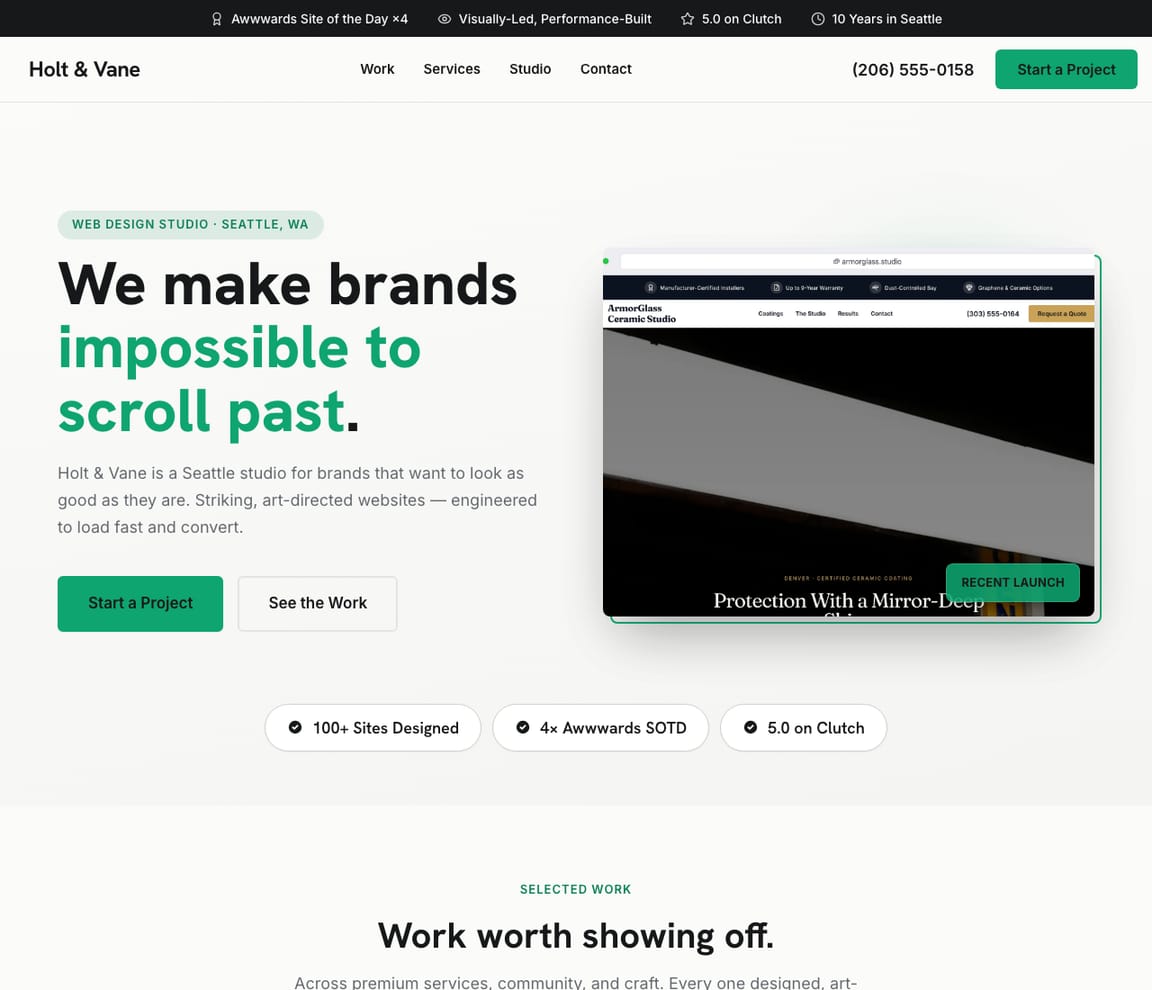
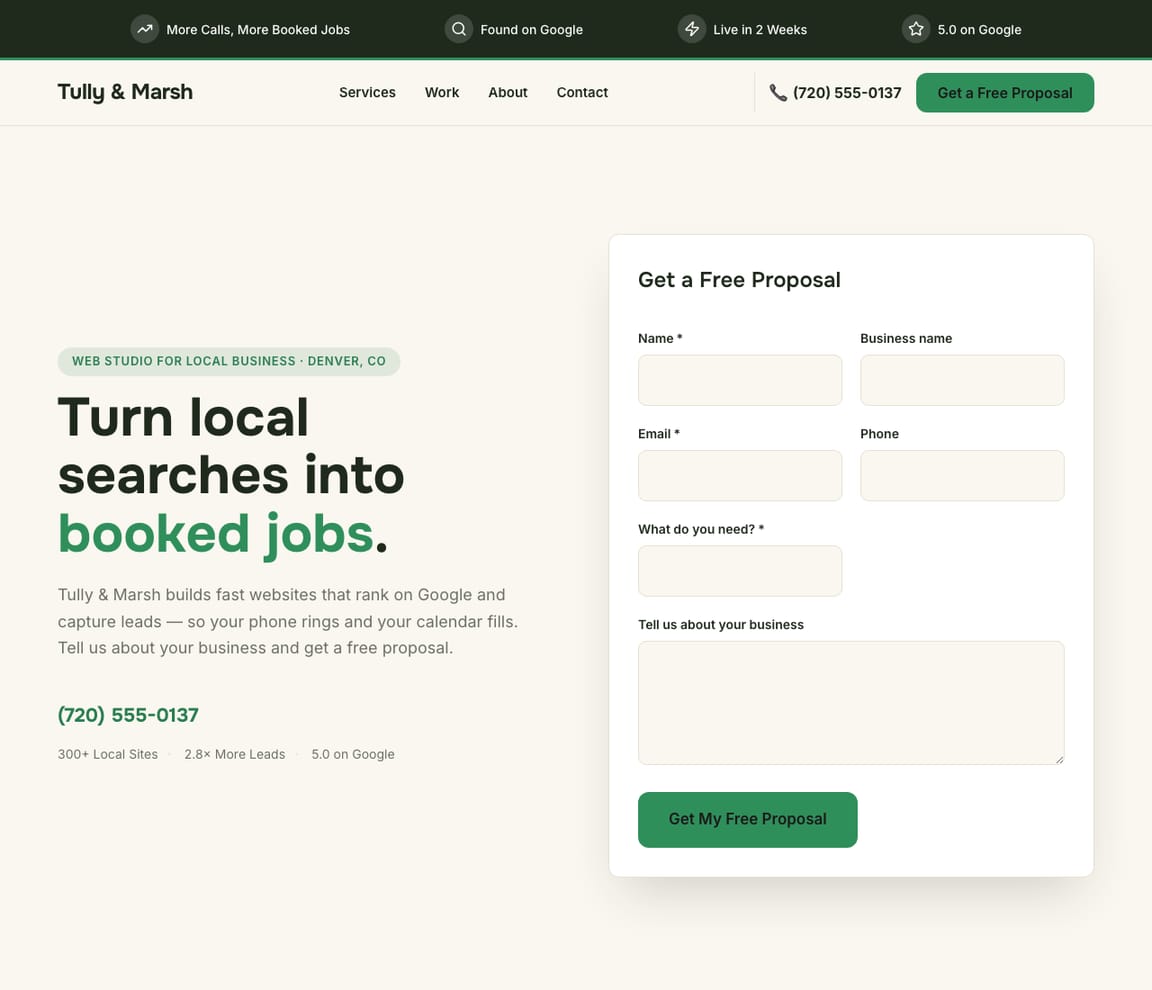
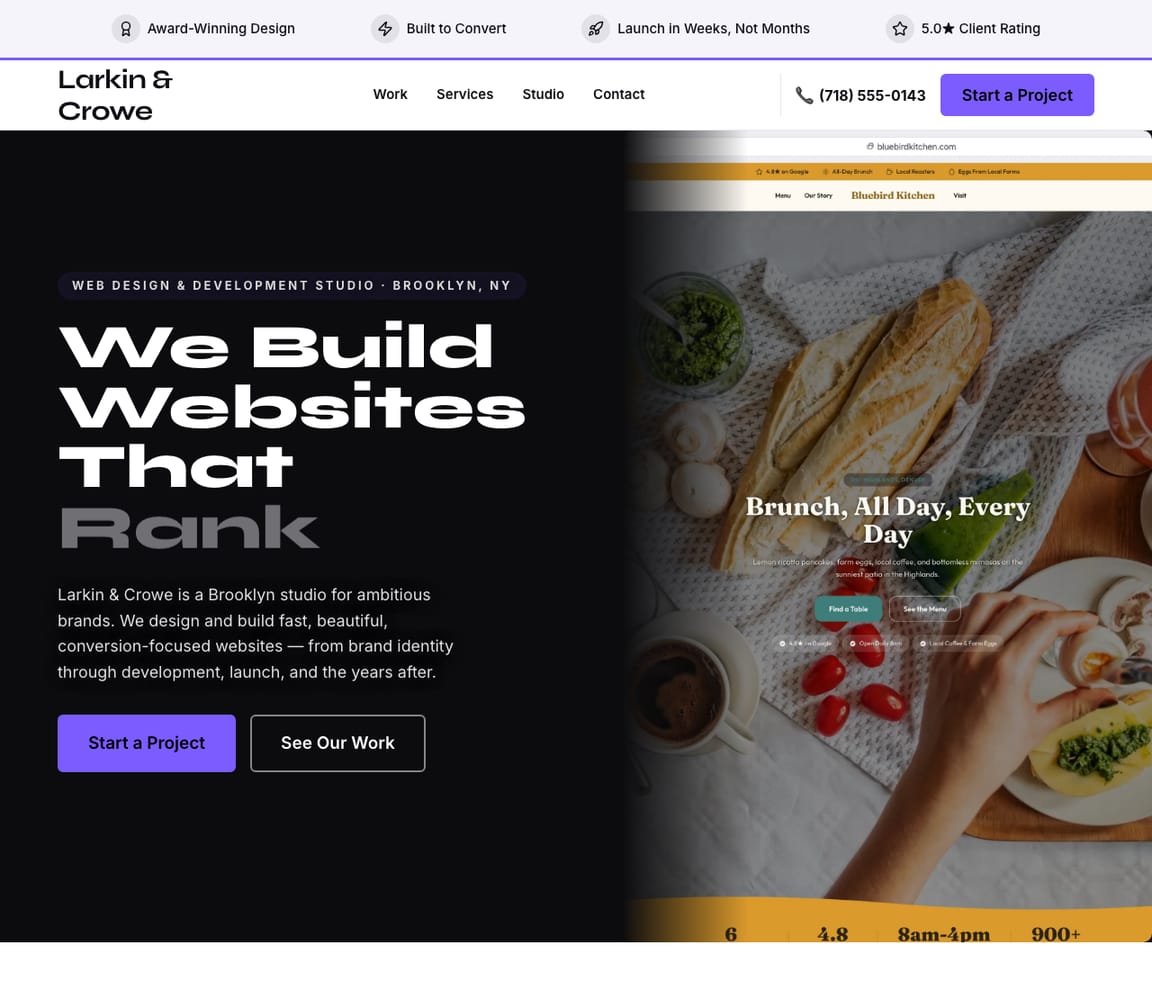
Four real Zarla studio templates from the web-design gallery — the shape a print shop's site is built around: the samples up front, the services by type, a quote-request form and the turnaround. Open one, swap in your work, your services and your city, and publish.
GET FOUND
Get found by the coach who searched "t-shirt printing near me" the week before the tournament
Owners say the first customers were friends and family and the ones after that came by word of mouth and the search. The person searching "print shop" or "screen printing" plus the city has the same three questions on every site they open: can you print this, how fast, what will fifty cost. Zarla builds the website with your services and samples, a quote-request form that collects a name, the quantity and the artwork, the turnaround, a map, and SEO. Add your price list, your minimums and your artwork rules in chat, and once you connect your Google Business Profile, your Google rating and reviews show on the site.
“T-shirt printing near me”
Searched by the coach with a tournament, the church with a retreat, the realtor with a sign to replace and the band with a tour. Your samples, your turnaround and the quote form answer it before they call.
Google Business Profile
Your shop, your hours and your door inside Google Maps — with the quote form's link and the samples on it. Free, and an afternoon to set up.
The samples, the turnaround and the minimum
Buyers compare print shops on three things: whether you've printed something like theirs, how fast, and whether fifty is too few. Printed plainly, they do the work a hundred flyers would.
Google Search
Iironbridgeprintco.com
Ironbridge Print Co. — Trusted print shop in Your AreaScreen printing, signs, stickers and business cards in Douglasville. Samples by type, one-week turnaround, no-minimum DTG. Request a quote online.← Your Zarla siteCcityprintshopservices.com
City print shop ServicesGoogle Maps
1
Ironbridge Print Co.
← You2
Metro print shop Co.
3
Quick print shop Services
AI assistants (ChatGPT / Perplexity)
For a Douglasville print shop that screen prints team and event shirts, cuts vinyl signs and banners, and prints stickers and business cards — a quote form on the site, a week's turnaround in your area: Ironbridge Print Co. — a shop whose site shows the samples by type, prints the turnaround and the minimum, and lets a coach upload the artwork and request a quote for fifty shirts from the page.
An example with a made-up business and illustrative figures. Yours will show your real details and reviews.
YOUR LAUNCH PLAN
Your print shop launch checklist
The whole guide as things to check off. Work through them in order and you'll be registered, buying tax-free, labeled, insured and findable before the first run.
- Pick the first line and the first customers — apparel, signs or paper; the team, the church, the band, the realtor.
- Form the entity and take the free EIN — $300 in Texas, $175 in Florida, $200 plus publication in New York, $890 in California's first year, $75 in Colorado.
- Register for the sales-tax permit before the first blank — free in four states, $16 plus a $50 deposit in Colorado, 20 days ahead in New York.
- Hold the resale certificate and know its penalty line — blanks, paper, vinyl and film tax-free; never for the shop's own use.
- Learn the tax rule on printing in your state — taxed in Texas, Florida, New York and Colorado; California's mailed sales messages exempt.
- Buy from the makers' pages and the wholesale account — $4,279 for the garage start; quotes in writing for the press, the DTF printer and the cutter.
- Set the labels, the right-to-print rule and the solvent limits — your RN on a relabeled tag, the tracking label on kids' wear, 25 gallons outside the cabinet.
- Publish the site and claim the Google Business Profile — the samples by type, the turnaround, the minimum, the quote form, the map.
REAL CUSTOMERS
Small businesses that got online with Zarla
Verified reviews from real Zarla customers.
“Quickly built my website from scratch. No hiccups. Would highly recommend Zarla for someone with no experience who wants to start a polished business website.”
“Great professional website in less than a minute, with the use of AI and a few descriptive prompts. This has saved me bundles of time and research on web developers.”
“I had no idea how to set up a website for my business. Thanks to Zarla, they've helped me a lot.”
“Very reliable, professional, and fast results. I was able to get my business online in no time, and the ease of access made it so simple.”
Be the print shop whose samples, turnaround and quote form are one tap away
Add your city and the shop's name, and Zarla builds the website from that one line — the services with samples, a quote-request form, the turnaround, a map and SEO in place. Add your price list, your minimums and your artwork rules in chat. Free to build; you pay when you publish.
Already have a website? Bring it across →Zarla keeps your old page addresses where it can and redirects the ones that change, helping you keep the Google standing you've built.
Frequently asked questions
How much does it cost to start a printing business?
From the pages that open, the garage apparel start in Texas is about $4,279 one time — our arithmetic: an Epson F170 sublimation printer at $399, a Silhouette Cameo 5 at $279.99, a Hotronix Fusion IQ heat press at $2,850 from a dealer, a cut of Oracal 651 vinyl at $20.99, a hundred Gildan 5000 blanks at $2.76, the first month of Printavo at $109, $300 for the LLC and the first month of general liability at Insureon's $44 median. The strip-unit shop is about $41,158: $6,455 to sign 1,500 square feet, $32,579 of machines (the F2270 hybrid, the heat press, the Roland printer-cutter, a Graphtec cutter, a laminator and the F570), the software, the policies, the entity and the opening stock — before the manual screen press, the DTF printer, the exposure unit, the paper cutter and the digital press, which no maker's or dealer's page priced to a reader today, and the website.
What license do you need to start a printing business?
In the US there is no printing license. What every state read requires is the sales-tax permit — free in Texas, Florida, New York and California, $16 plus a $50 deposit in Colorado, 20 days before opening in New York — because a print shop sells tangible things; with it comes the resale certificate for buying blanks, paper and vinyl tax-free. Then the city's business tax receipt where the city has one, a certificate of occupancy for a changed use, a sign permit, and the federal rules on labels, children's wear, the customer's artwork, online orders and solvents. Check your own state's revenue department and city hall before the first run.
How much does it cost to open a print shop?
Our arithmetic from the pages that open: about $41,158 for a 1,500-square-foot strip-unit shop — the deposit and first month at the landlord survey's $25.82 a square foot, six machines at the makers' and dealers' printed prices ($12,995 for the DTG and DTF hybrid, $2,850 for the heat press, $3,845 for the printer-cutter, $4,495.00 for the cutter, $5,295.00 for the laminator, $3,099.00 for the 24-inch sublimation printer), the first month of the software, the policies, the entity and $1,255.88 of stock — 300 blanks at $2.76, ten reams at $10.99 and two rolls of 24-inch vinyl at $158.99. Not in it: a manual screen press, a DTF printer, an exposure unit, a paper cutter and a digital press, which the dealers' stores would not price to a reader today — get those quotes in writing — and the website. One Atlanta owner bought a retiring printer's whole shop; one Houston owner's father ran a sign company for twenty years first.
Can you give me 10 examples of print materials?
A national online printer's own catalog headings are the list: business cards; postcards and print advertising; signs, banners and posters; labels and stickers; packaging; clothing and bags; promotional products; invitations, gifts and stationery; holiday cards; calendars and gifting. The shops quoted here print team and event shirts, business cards, banners and flyers, vinyl signs, letterpress stationery, and custom apparel for nonprofits, corporate firms and athletic teams.
How much does it cost to print 100 A4 pages?
US shops price letter-size pages — A4's US equivalent. From two real print shops' own lists: 100 black-and-white pages run from $8 at a university print shop's hundred-copy rate of eight cents a page to $20 at another's regular twenty cents; 100 color pages from $40 at forty cents to $75 at seventy-five cents — our arithmetic on their printed per-page prices. The national chains' copy-price pages refused a reader today, so they are not quoted.
What sells best on print-on-demand?
The marketplace's own list opens with custom t-shirts, custom sweatshirts, custom hoodies, mugs and scented candles — a print-on-demand company's claim about its own catalog, not a sales survey. Print-on-demand is the route for a brand that does not want to print: one Anaheim owner took it because "I knew I couldn't print myself or even ship my own products out." and "The first day I launched, I had 30 sales." A print shop is the other side of that trade — the one with the machines.
How to start a printing business from home?
The garage apparel start above — a sublimation printer, a cutter, a heat press and a hundred blanks for about $4,279 — with the same paperwork as a shop: the sales-tax permit and the resale certificate, the federal shipping rule on every online order, your name or RN on any blank you relabel, and the right to print in writing. Owners here started in a spare bedroom, a basement, an apartment, a father's garage and a 450-square-foot garage before the warehouse. In the US check your city's home-occupation rule, and the fire marshal's limit on solvents, before the first drum; in one Sydney council a home business may not exceed 10 percent of the floor area or employ more than two non-residents.
How to start a printing business online?
The same machines, a web-to-print store and the federal 30-day rule: ship within the time you state, or within 30 days if you state none, or offer the refund. A company store runs $119 or $199 a month at one vendor, shop management $109 or $244 at another; Priority Mail starts at $11.50 at the counter and a medium flat-rate box is $25.80. In the US the sales-tax permit and the resale certificate are still required, and the state's rule on taxing the printing charge follows the order — Texas, Florida, New York and Colorado tax it; California exempts only sales messages the shop mails by common carrier. Confirm your own state's rule with your accountant.
How to start a screen printing business?
The owners here started with "a small one station four colors" press, a two-day class and friends' orders, a retiring printer's whole shop, or a father's old press in the garage; the maker of one common manual press prints no price on its own site and the dealers' stores would not price a press, a starter kit or an exposure unit to a reader today — so get the quote in writing. What is pinned: the blanks at $2.76, the heat press at $2,850, Insureon's $44-a-month general liability, and the federal floor on screen wash — 25 gallons of the most flammable class outside a cabinet in any one fire area once there's staff. In the US the sales-tax permit comes before the first blank is bought.
Do I charge sales tax on printing?
In the US, in four of the five states read, yes, on the printing charge itself: Texas's rule says "Sales tax is due on the total charge for producing multiple copies of printed material"; Florida's that "The sale of printed tangible personal property or graphic matter is subject to tax."; New York taxes "printing or imprinting" as a service on goods the customer supplies and as a sale on goods the shop supplies; Colorado taxes the printed goods and the design "inseparable" from them, at Denver's 9.15 percent combined. California exempts one thing — "printed sales messages" printed to order and mailed by common carrier — and taxes the shirts, the cards, the banners and the counter-collected flyers. Confirm your own state's rule with your accountant.
Can I print any logo a customer brings me?
In the US the copyright owner holds "the exclusive rights" "to reproduce the copyrighted work in copies" and "to distribute copies" — every print is a copy — and a team's or a brand's logo is a trademark that "identifies your goods or services". The Copyright Office's own advice for using someone else's work is "You can ask for it." and, "in cases of doubt," that "permission be obtained." So the customer owns the artwork or holds the license, and says so in writing before the run; this guide gives no advice on what may be copied, and a shop that prints a brand's mark without its owner's license is the one that gets the letter.
Do I need a resale certificate to buy blanks?
To buy them tax-free, yes — in the US the resale certificate is the form on your sales-tax permit that tells the distributor why no tax was collected: Texas's 01-339, Florida's annual certificate, New York's ST-120, California's under Publication 103. One blank brand's wholesale program says the certificate "unlocks our best pricing and tax-exempt purchasing" but that you can "still create and account and shop wholesale without one" at its printed tiers; a distributor that opens to anyone prints the Gildan 5000 at $2.76. Use the certificate only for stock you resell — Texas's form calls anything else "a criminal offense".
How much do print shop owners make?
No page of record prints an average. The employed lines are O*NET's 2025 medians — a press operator $45,780, a prepress technician $48,690, a graphic designer $62,960 — and a one-owner shop that nets the press operator's median is paying itself an employee's wage. The one sourced revenue line is a Little Rock screen printer's "$99,000 the first year to nearly $585,000 in revenue in 2018" with eleven staff; the trade press puts sales per employee at $264,458 across the industry in 2022. The owners describe year one as a second job, a school schedule or "Sometimes not making a dime."
Do I need a website for my print shop?
The owners say the referral opens the site to see whether you've printed something like theirs, and one Dallas owner started with business cards, banners and flyers before the shirts — the site is where the four shops in one are shown by type. A print shop's site shows the samples, the turnaround, the minimum and a quote form that takes the artwork. Zarla builds one from a sentence — the services with samples, the quote form, the turnaround and a map — and you add the price list, the minimums and the artwork rules in chat before you publish.